Select Page

Get a grip on paint scratch repair: ScratchPro

Get a grip on paint scratch repair: ScratchPro

I’m a great believer in the Rule of 5. A car-enthusiast friend says he won’t attempt a big repair job – car or home – unless he’ll be doing at least five similar repairs. Because, he says, the first job he’ll screw up, the second will be better and by the fifth, he will have become a passable expert.

That’s how I feel about trying to make repairs to paint – and most other automotive and household chores.

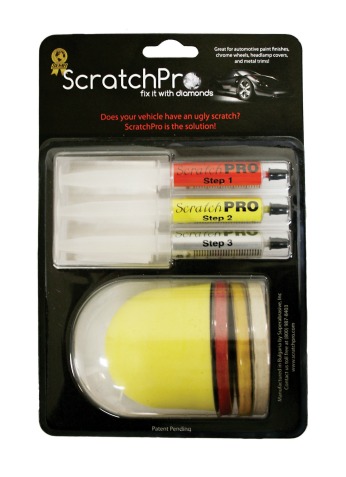
I recalled the rule when a pitch from ScratchPro paint repair landed in my inbox. The kit costs about $30 at the company website and other sites, such as  http://www.amazon.com/s/ref=nb_sb_noss?url=search-alias%3Daps&field-keywords=scratchpro

But, as a test, I gave this manual, three-step buffing-compound treatment an arm-wringing workout. There are ds. A solid rubber, dome-like applicator holds the pad securely and allows even, balanced pressure. It is a much better applicator than a cloth or paper towel, which when wet don’t provide even pressure and wad up quickly, adding to the frustration of the user.

A concern with any of these aftermarket scratch removers is the likelihood of causing more harm than good to the paint finish. The uninformed do not realize that a deep scratch, one that can be felt with a fingernail, is too deep for a home remedy. Most of the light scratches that can be repaired by ScratchPro are overlooked except by those who are fanatical about their vehicle’s finish and appearance.

For those who plunge forward for a paint repair, know that it takes patience and strict adherence to the application guide. Do a little homework and watch the how-to video at the website, www.ScratchPro.com.

The single-step process for cleaning plastic headlight lenses works well on moderate haze. And I liked that the paint areas do not have to be masked off to prevent abrasion. Buffing the paint area around the lens brightened the whole project.

I also tried ScratchPro on an aluminum wheel, but the applicator is not a help there and too large to get into nooks and corners.  I would have had to put too much time and effort into improving one wheel, let alone finding the strength for three others.

For the cost of one ScratchPro, a DIYer could take his or her vehicle to a specialist such as Bumper Doc, pay a little more and get the whole car worked on, including headlights.

Paint detail work is a craft best left to a specialist when you really love your car. If you’re doing a quickie fluff and buff for sale, ScratchPro is a good alternative.
New car test: Chrysler 300 SRT8 – the tire-smoking BIG Hemi

New car test: Chrysler 300 SRT8 – the tire-smoking BIG Hemi
Road test: 2012 Chrysler 300 SRT8

The 2012 300 SRT8 is a show of force and finesse with its 470-hp, 6.4-liter Hemi V-8 and 5-speed Auto Stick transmission.

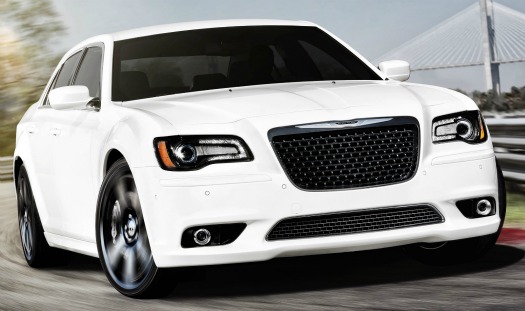
New car test: Chrysler 300 SRT8 with the big, tire-smoking Hemi gives a big-guns salute that will make American sedan drivers sit a little taller in the seat.

This 470-horsepower, “big” Hemi, 6.4 liter V-8 is a likeable, over-the-top show of force – with luxury finesse. It will smoke the rear tires like a drag car, launch to 60 mph in less than 5 seconds and get 23 mpg on the highway on the daily commute.

Redesigned last year, the 300 sedan is an example of company survival. Engineers, designers and CEO agreed on a goal and went to work. The new styling is a revolution when it could so easily have defaulted to evolutionary change.

 For a closer look: http://veh.cl/31c

Nitpicky issues

The previous sedan, which went on sale in 2005, was a good car with nitpicky issues – weak interior quality and cheap-looking plastics not worthy of a flagship sedan. All that has been resolved and the 2012 model rolls as quietly as the best luxury European sedans.

There are 10 models of 300 with choices of rear- and all-wheel drive, the new Pentastar V-6 and two Hemi V-8s. Big news for the V-6 models is the addition of an eight-speed automatic. The extra gearing pushes V-6 highway fuel economy to 31 mpg for rear-drive cars and 23 mpg combined city and highway. AWD sedans will get a combined 21 mpg city/highway.

Pricing ranges from about $28,000 to $50,000-plus for the top-line SRT8, today’s test car.

Serious displacement

The 300 SRT8 has a big, booming drive quality. For a sedan that weighs 4,365 pounds, the beefed up hydraulic steering has a direct feel and crisp response. There is no grab from the mighty Brembo disc brakes. And power roll on is smooth and linear – but when those big guns go off, you know you’ve been hit with some serious displacement.

A new “active” exhaust system also allows straight-through  passage to mid and rear mufflers for that heavy sound ’o power.

The five-speed Auto Stick is the last of the old that needs updating, but Chrysler isn’t saying when that will be for the V-8s. Automatic shifting is aimed for fuel consumption, with the engine switching to four cylinders when possible.

Sport mode – selected on the billboard size digital screen on the center stack – amps up the excitement, but manual shifts are inelegantly performed and with no engine-rev-matching downshifts. Sport mode also stiffens the suspension nicely for enhanced grip but it, elegantly, does not hammer the occupants.

The 8.4-inch color touchscreen has a performance page that includes timers for 0-60 mph, eighth and quarter mile. There also is 60-0 mph braking distance and lateral and longitudinal g-forces. But it’s still awkward that Sport mode can only be selected on-screen and not by a handy-to-reach button.

Performance numbers

Chrysler says the 300 SRT8 will do 0-60 mph in the high 4-second range; the quarter mile in the high 12-second range; and 0-100-0 mph in less than 16 seconds. It has a top speed of 175 mph and takes 120 feet to stop from 60 mph. Also standard with any SRT8 model is a performance-driving course (www.DriveSRT.com)

And the driving is an enjoyable hands-on experience. There’s room at the steering wheel for a robust, 6-foot-4 male and even good back seat legroom for those behind. The panorama moonroof, $1,295, opens the cabin experience and can be enjoyed open at highway speeds, while most of these whip up painful buffeting.

The interior has snap and sparkle, especially with the no-cost option of red leather. Two large gauges are bright with Sapphire Blue lighting and chrome in an appealing Rolex-like treatment. The leather-wrapped and heated SRT steering wheel has a flat bottom to help thigh room.

Heated and ventilated front seats are standard (back seats are heated) and also standard are heated and cooled front cup holders. The generous 16.3 cubic-foot trunk is expandable by a 60/40 folding seatback.

The soft-touch “cast-skin” plastic used on the dash top and door panels is almost too skin-like with a rubbery-rich feel. Some of the old plastic is still visible down low in the car where it really doesn’t matter.

The 300 SRT8 sticks its big and bold Audi-like nose in the center of credible competitors from the East and West, but when the tire smoke clears, this is American performance at its best.