

European models of the VW ID Buzz go on sale this year, followed by a long-wheelbase passenger model for North America in 2024

Two-tone VW ID Buzz models will have the roof, upper areas and hood finished in Candy White. Areas below the character line are in a choice of four shades, such as this hue of Energetic Orange. (Photos courtesy of Volkswagen)
Table of Contents
Powertrain
Dimensions
Paint Colors
Interior Design
Cabin Electronics
Interactive ‘ID Light’
Driver Assist Systems
Sustainability
Official photos and many details were released today, March 9, for the much-anticipated debut of the electric-powered VW ID Buzz and ID Buzz Cargo. Both body styles, passenger and cargo variants, will go on sale in European markets in the third quarter of this year. For the U.S., a long-wheelbase passenger model will debut in 2023 and go on sale in 2024.
The zero-tailpipe emission vehicles transfer the design of the iconic 1950 Type 2 Microbus to the era of electric mobility. However, the ID Buzz is not the first microbus with an electric drivetrain. Fifty years ago at the Hannover Trade Fair Volkswagen showed a T2 bus powered by a rear-mounted electric motor with a maximum range of 52.8 miles.
ID Buzz Powertrain
European versions of the VW ID Buzz and ID Buzz Cargo will come to market with a high-voltage lithium-ion battery providing gross energy content of 82 kWh (77 kWh usable). With its 12 modules, the battery system supplies a 201 horsepower electric motor, driving the rear axle, with maximum torque of 229 foot-pounds. The top speed is limited to 90 mph.
The electric driving range of either model of VW ID Buzz has not been released. But industry sources report that the U.S. version will have a larger battery and electric driving range of around 260 miles. A dual-motor, all-wheel-drive configuration is expected to be added later. Details for the U.S. version will be available closer to launch.
The battery is mounted in the floor of the vehicle. An 11 kW (AC) charger is included for home and Level 2 systems. The ID Buzz also will have a CCS plug connector for use at DC fast-charging stations, at which the charging power increases to as much as 170 kW.
With DC-fast charging, the battery charge level rises from 5 to 80 percent in just 30 minutes, Volkswagen says. In the future, a Plug & Charge function will be offered.
For Europe, bi-directional charging will enable the VW ID Buzz and ID Buzz Cargo to feed power that they don’t need into the domestic grid (vehicle-to-home). VW says this can also make the power available for stabilizing the power grid. The power transfer and communication take place via an optional DC bi-directional wall box.

Sustainability measures include replacing leather with non-animal material.
ID Buzz Dimensions
On a wheelbase of 117.6 inches, both ID Buzz models are 185.5 inches long, 76.3 inches tall, and 78.1 inches wide, not including the side mirrors.
The ID Buzz has full LED lighting. At the front, are charismatically styled headlights, daytime running lights, and a slim lateral bar between the headlights.
In an homage to the original microbus, the VW logo is much larger than all other current Volkswagens. At the back, the ID Buzz has horizontally arranged LED taillights, which are connected by a full-width light strip.
ID Buzz Paint Colors
European versions of the passenger and cargo models will be available in base colors or two-tone styles. The spectrum consists of 11 single-color choices of Candy White (nonmetallic), Mono Silver, Lime Yellow, Starlight Blue, Energetic Orange, Bay Leaf Green, and Deep Black.
There will be four two-tone options. On two-tone ID Buzz models, the upper section, including roof and V-shaped hood, is finished in Candy White, while the areas below the character line are in a choice of four shades: Lime Yellow, Starlight Blue, Energetic Orange or Bay Leaf Green. Side mirrors and door handles are finished in body color.
Both European ID Buzz versions will come with 18-inch steel wheels as standard. On passenger vehicle models, aluminum-alloy wheels are available in sizes ranging from 18 to 21 inches.
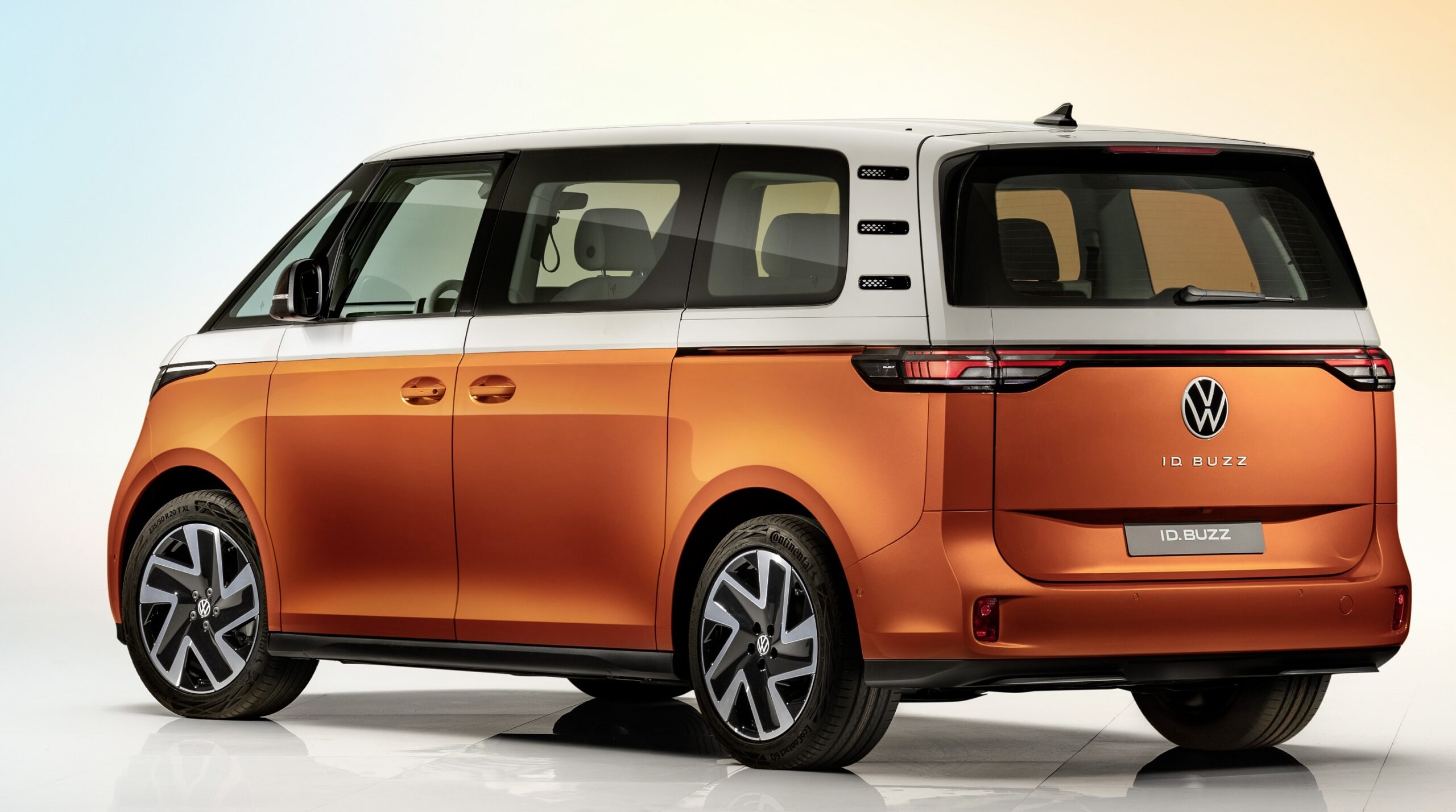
At the back, horizontal LED taillights are connected by a full-width light strip.
Interior Design
For passenger models of the ID Buzz, drivers will face a standard 10-inch Digital Cockpit display, which is paired with a 10-inch infotainment system centrally positioned in the dashboard. A 12-inch display with navigation is optional.
Both the Digital Cockpit and infotainment system are connected with the instrument panel only at the bottom, looking like free-floating tablets.
Beneath the infotainment system is a control bar with digital buttons and touch sliders to regulate temperature and audio volume. The digital buttons provide direct access to menus for the dual-zone Climatronic settings, driver assist systems, driving profiles, and parking functions.
The ID Buzz Cargo will launch with three seats in the cab as standard. The extended wheelbase version for North America will have a seven-seat configuration in three rows of 2/3/2 arrangement. The three-person bench in the second row can be folded flat or split 60/40, and it can be moved lengthways 5.9 inches.
Cargo capacity of 39.6 cubic feet will be expandable by an optional height-adjustable cargo floor to create a level load surface. Two side sliding doors are fitted as standard.
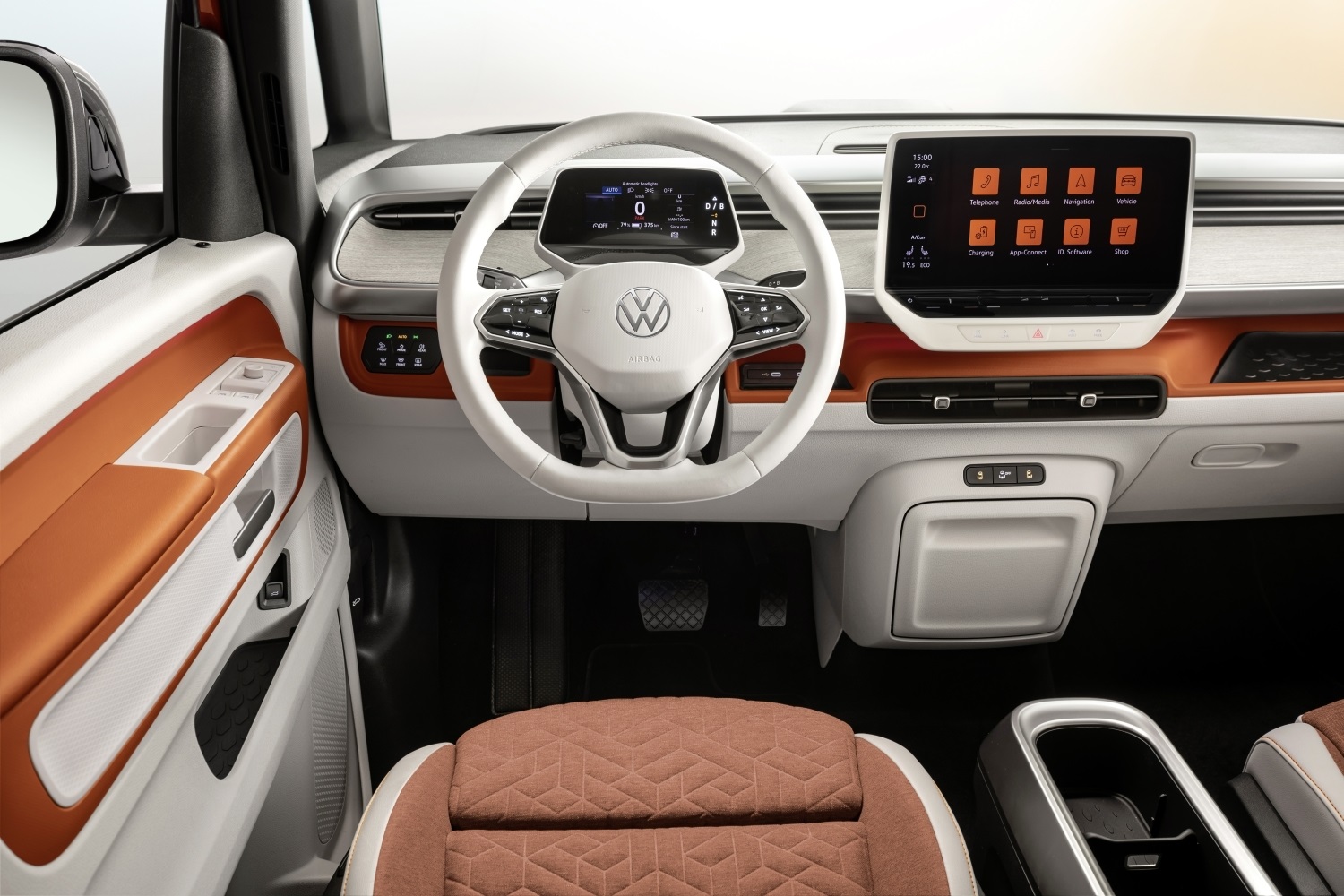
The Digital Cockpit and infotainment screens appear as free-floating tablets.
Cabin Electronics
To the left of the multifunction steering wheel, there is an island of digital controls for activating the light functions, heating, and defrost for the windshield and rear window. To the right of the steering wheel are two USB-C plugs and a tray for wireless charging (wireless App-Connect is also standard).
In the center console, there are, depending on specification, two more USB-C plugs; there is a fifth in the front passenger door, another in each of the two sliding doors, and one by the rearview mirror for a dashcam.
Two cupholders fold out from the lower dashboard area. In the ID Buzz Cargo, there are two more cupholders near the A-pillars.
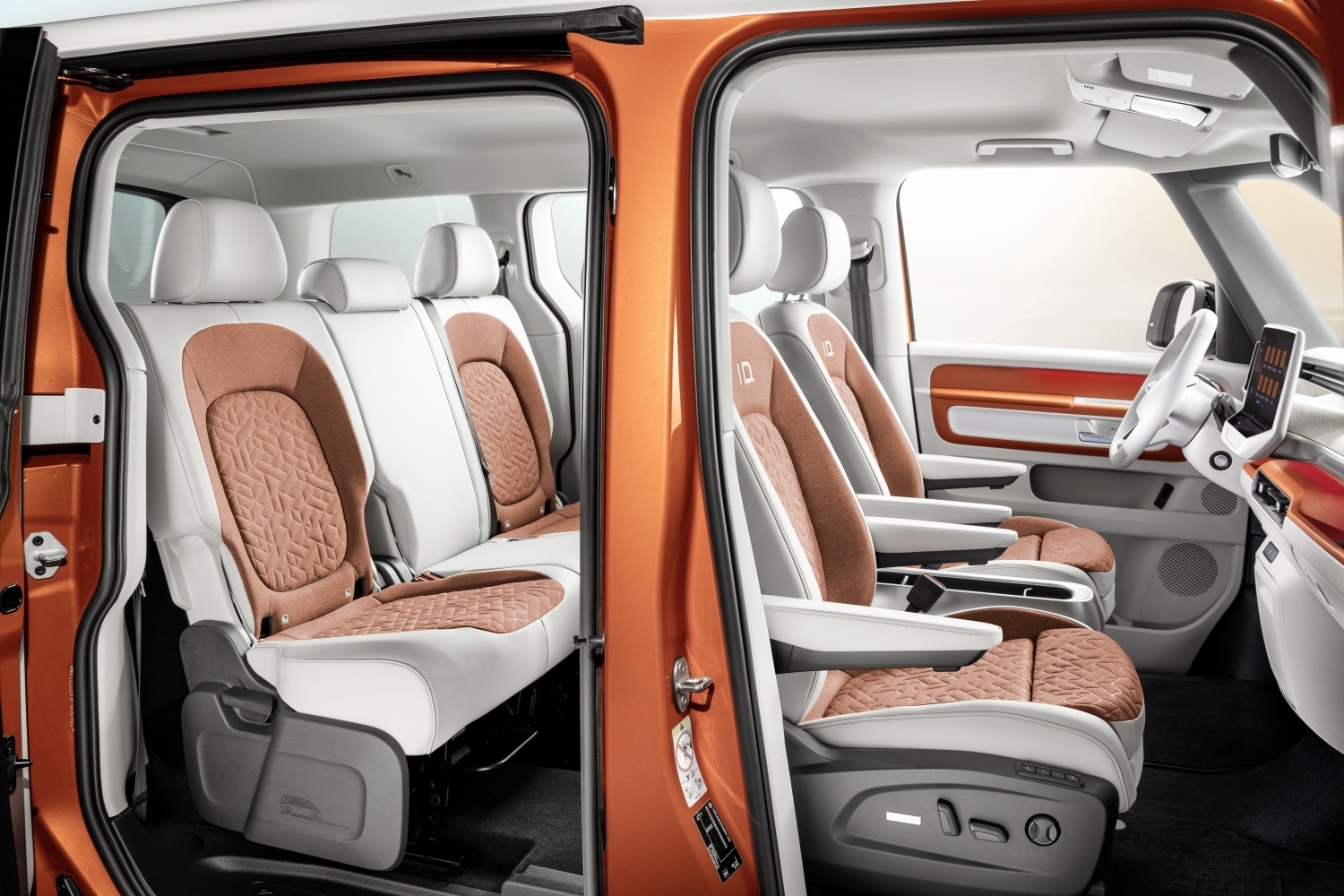
U.S. models of the ID.Buzz will have three rows and seven seats.
Interactive ‘ID Light’
As with other models of Volkswagen’s all-electric vehicle family, the new ID Buzz comes with the interactive ID Light. It stretches across in front of the windshield in the driver’s field of vision above the instrument panel. The head-up style of display gives the driver information based on the color and position of the light signal. For example, a signal in the right-hand area of the strip advises of obstructions in this area or corresponds with a navigation instruction to change lanes. When the ID Light goes red, it is signaling danger and the need to brake.
Driver Assist Systems
European five-seater ID Buzz models are equipped with standard Front Assist, Lane Assist, and Dynamic Road Sign Display. Optional systems include Adaptive Cruise Control, Side Assist, Travel Assist, Emergency Assist, Park Assist, Light Assist, and Area View.

An optional height-adjustable cargo floor will create a level load surface.
Sustainability
Both versions of ID Buzz are designed with sustainable measures, such as not using leather in the vehicle. The steering wheel cover is made of polyurethane but has a high-quality appearance and feels like leather.
Seat-cover materials, floor coverings, and the headliner of the ID Buzz incorporate recycled material. There will be a fabric made of what is known as Seaqual yarn. Its fibers consist of 10 percent collected ocean plastic and 90 percent recycled plastic bottles.
The two ID Buzz models will also use organically based vehicle paint and forgo cobalt in the high-voltage battery. The company’s sustainability measures include a plant that recycles the high-voltage batteries at the end of their automotive life cycle to prepare them for a second use.
The VW ID Buzz and ID Buzz Cargo models are being produced by Volkswagen Commercial Vehicles at its main plant in Hannover, Germany.
