

Innovations elevate the Canoo EV pickup truck to disruptor status

The purpose-built Canoo EV pickup truck amplifies “cab-forward” design and was engineered for maximum cargo capacity on the smallest footprint possible. (Photos courtesy of Canoo)
If a 1950s cab-over-engine White truck mated with a 1960s drop-side VW transporter, the offspring might look something like the Canoo EV pickup.
The purpose-built Canoo pickup truck amplifies the design statement of “cab forward” and was engineered for maximum cargo capacity on the smallest footprint possible, the company says. Some of the Canoo features include workbenches with power plugs, tool storage areas, front and rear trunks, and a modular expandable bed.

The Canoo EV will be sold in regular- and extended-cab models, with a bench seat or buckets.
The modular electric platform will be the architecture for a passenger van, a cargo van and the pickup, which will be first to market. The production version of the pickup will open for preorders in the second quarter of 2021, with deliveries beginning as early as 2023.
It will be sold in regular- and extended-cab models, with a bench seat or buckets. The powertrain can be configured for rear- or all-wheel drive with rear or dual motors. Horsepower is 300 with an estimated 332 foot-pounds of torque, the company says.

The signature headlights and taillights will serve as core brand identifiers without the need for a logo.
Canoo EV pricing has not yet been released. But ownership will be through a month-to-month subscription with no set end date. The subscription may include services such as registration, maintenance, insurance management, and charging — all from the app, the company says.
While there will be several new EV pickups to make their debuts in about the same timeframe (including Bollinger, Ford F-150, GMC Hummer EV SUT, Lordstown Endurance, Rivian, Tesla), some of the designs are familiar and appear to be based on existing SUV or pickup platforms.
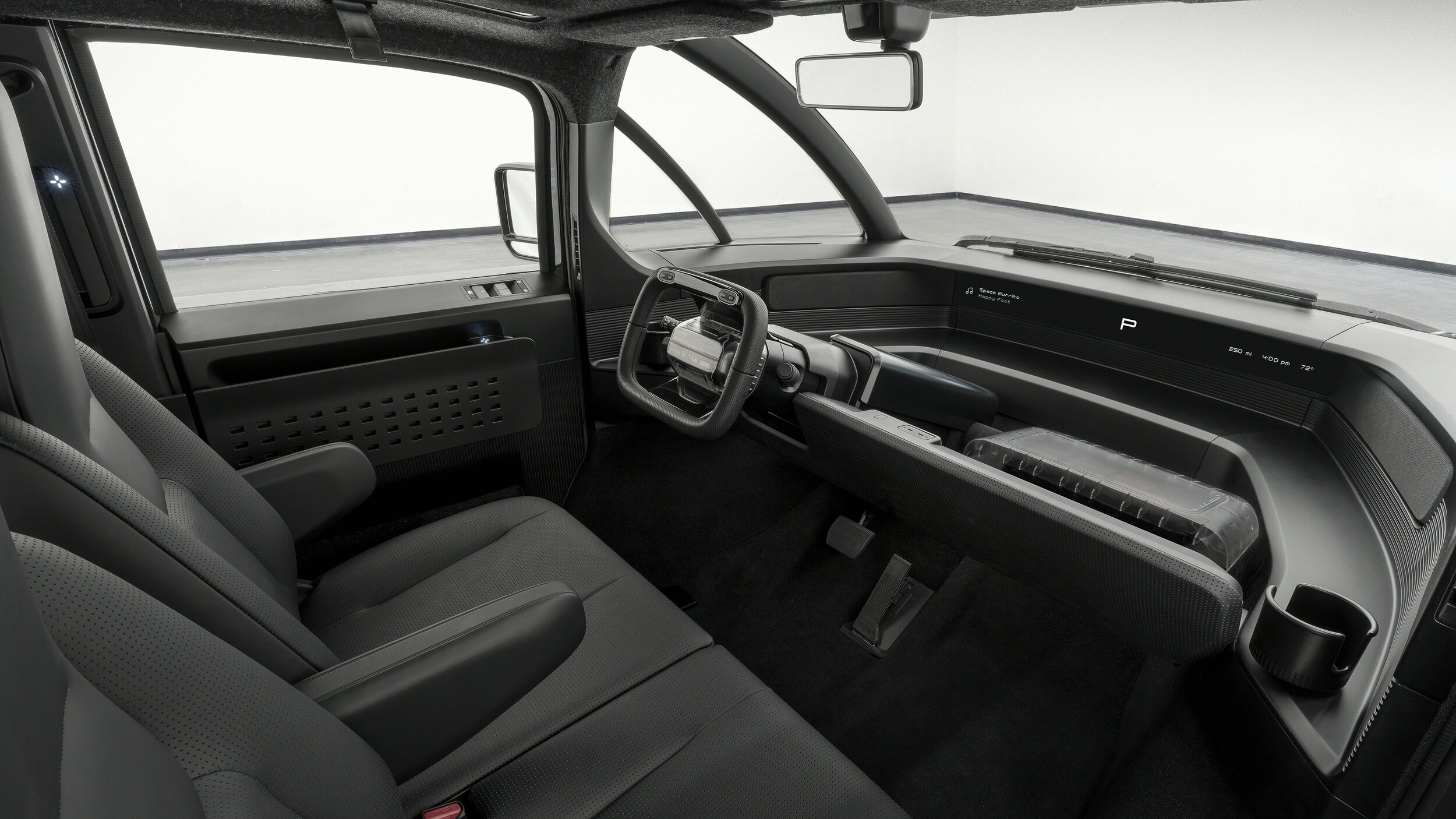
The cabin is lined with durable trim and materials.
Canoo EV Pickup Innovations
There is nothing routine or repurposed about the Canoo pickup. Using a “skateboard” powertrain arrangement, the chassis is a self-contained unit that can be driven on its own with any cabin placed on top. The company refers to the various cabins as “top hats.”
The Canoo EV pickup has 35 percent fewer parts than a non-EV truck, the company says, but it has the payload (1,800 pounds) of a full-size.
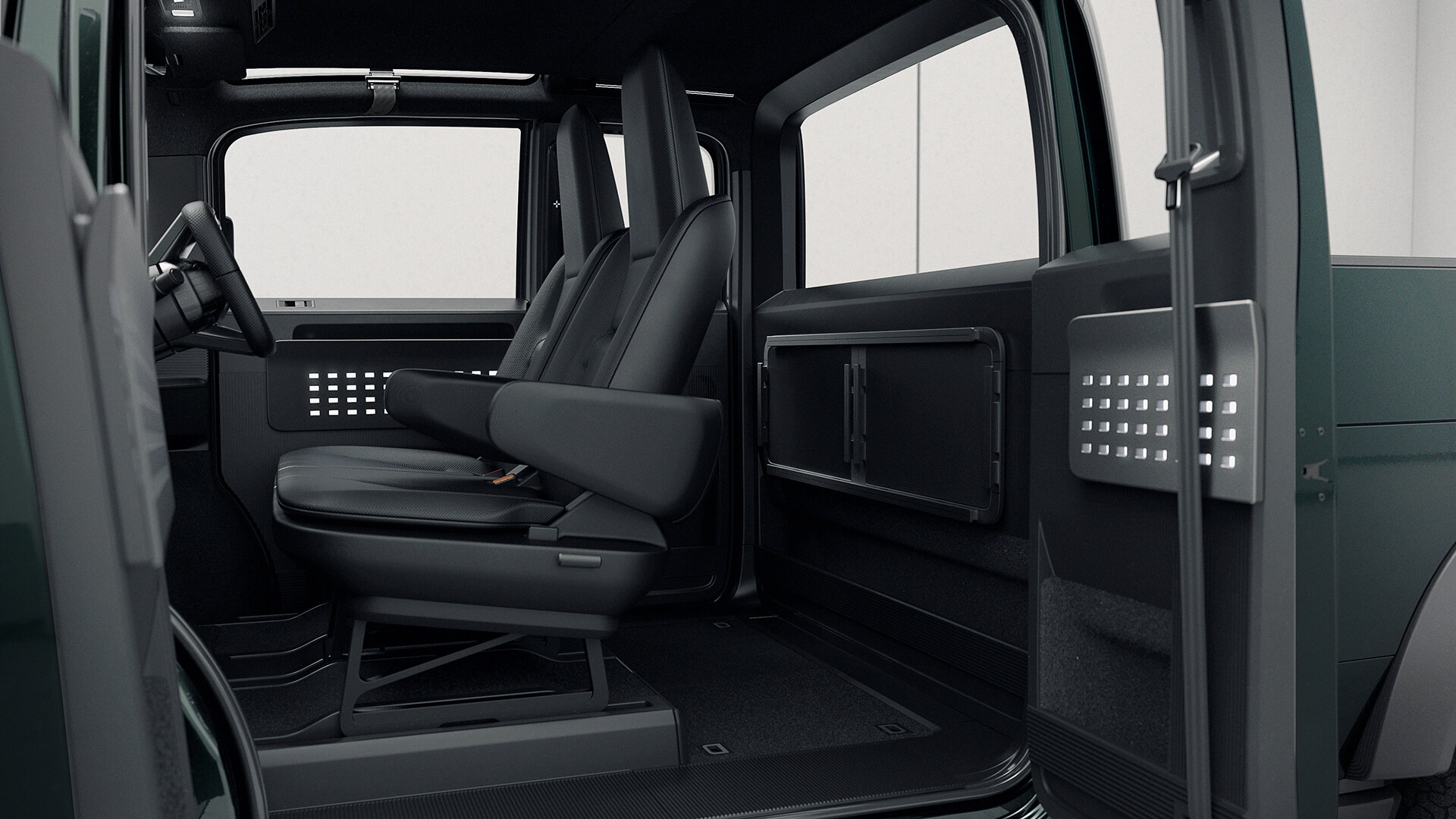
The pickup will be offered in regular- and extended-cab models.
The steel chassis for the “skateboard” architecture has a thermoplastic polymer outer skin. With a base curb weight of 4,453 pounds, the company estimates a driving range of 200-250 miles. The base battery is 80kWh, and an upgradable battery pack will be offered.
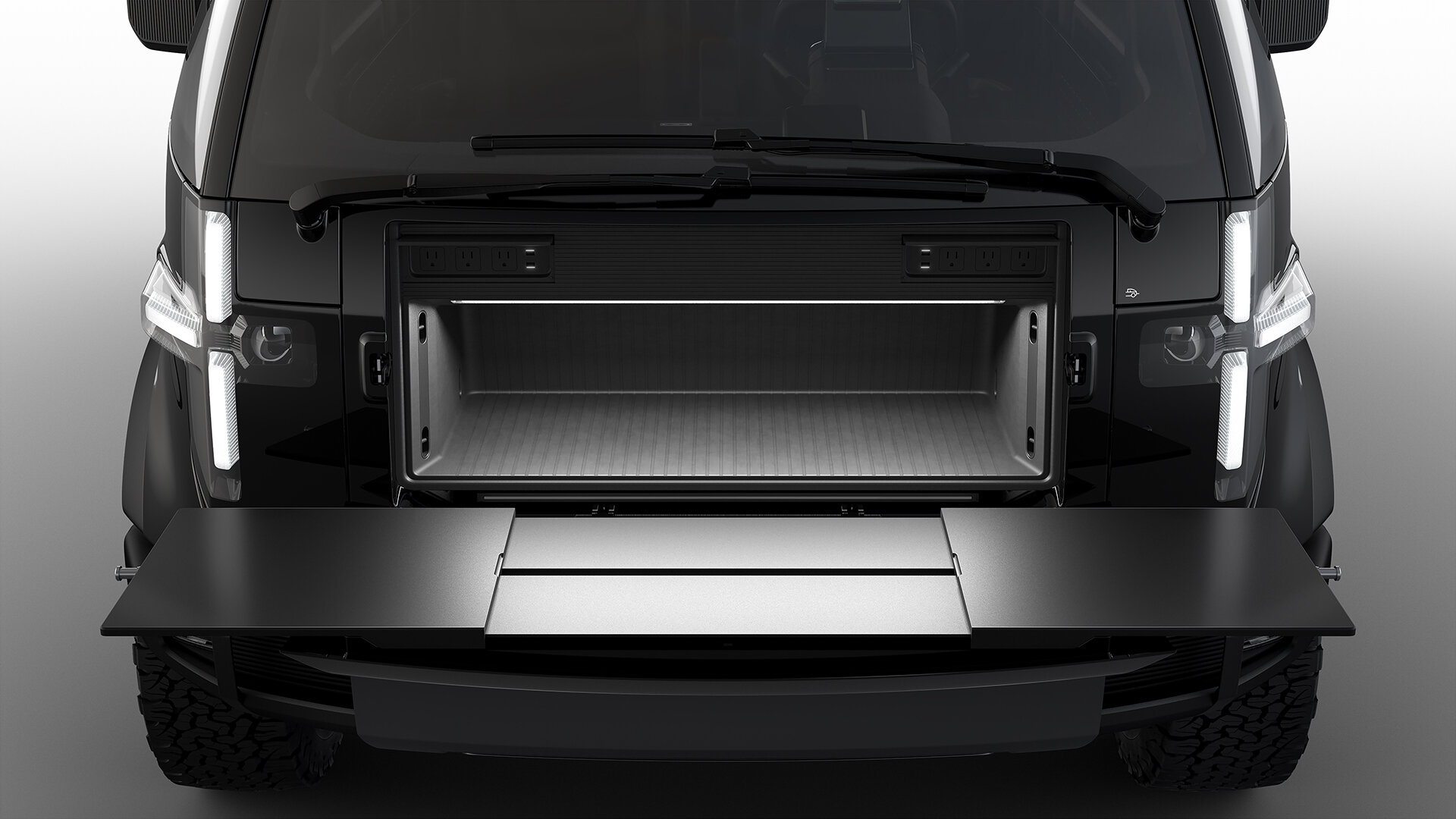
Workbenches at the front and rear tailgates have with power plug-ins.
The pickup presents several innovative utility features. Among them:
- A drop side worktable;
- Workbenches at the front and rear tailgates, with power plug-ins;
- Seating for two to four, with a bench or bucket seats and a rear-hinged back door.
- Integrated exterior toolboxes that double as side steps
- Compartmentable 6-foot bed, with slideout for 8 feet. The bed length is extended by manually pulling out a section of floor at the rear tailgate that integrates for a flat floor.
- Overhead and perimeter lighting, to view bed contents.
- Camper shells in various sizes.

Drop-side work tables.
Public Viewing
Future subscribers will have the chance to learn more about the Canoo vehicles and the brand’s philosophy this fall at two public events on a Southern California tour:
Sept. 19: The Abbot Kinney Festival in Venice, Calif.
Oct. 20: The Car Classic at the ArtCenter College of Design in Pasadena, Calif.
Skateboard Powertrain
The Canoo platform integrates all critical components of an electric powertrain to be as flat and efficient as possible. The “skateboard” is a self-contained unit that can be driven on its own with any cabin placed on top.
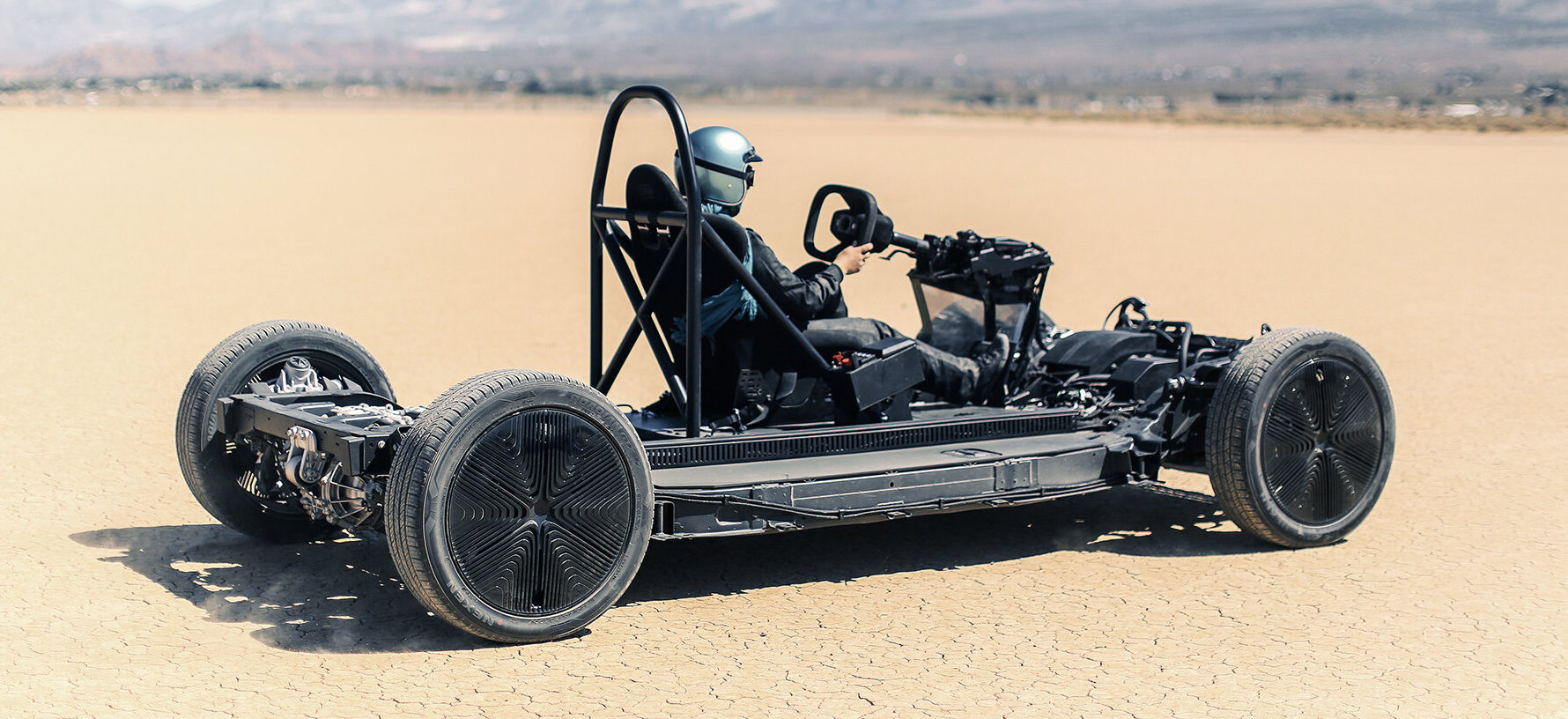
The SkateKart illustrates how the Canoo platform can be driven without a ‘top hat’ cabin.
Traditional EV platforms have power units, shock-absorber towers, and mechanical steering columns that protrude into the vehicle and take up space. By incorporating steer-by-wire and other space-saving technologies, and no engine compartment, the company says, the Canoo EV pickup has a flatbed size comparable to America’s best-selling pickup truck, but on a smaller footprint. This makes the vehicle easier to maneuver and more convenient to drive and park in any terrain.

Among the Canoo EV body styles will be a seven-passenger minivan and a multi-purpose delivery vehicle (below).
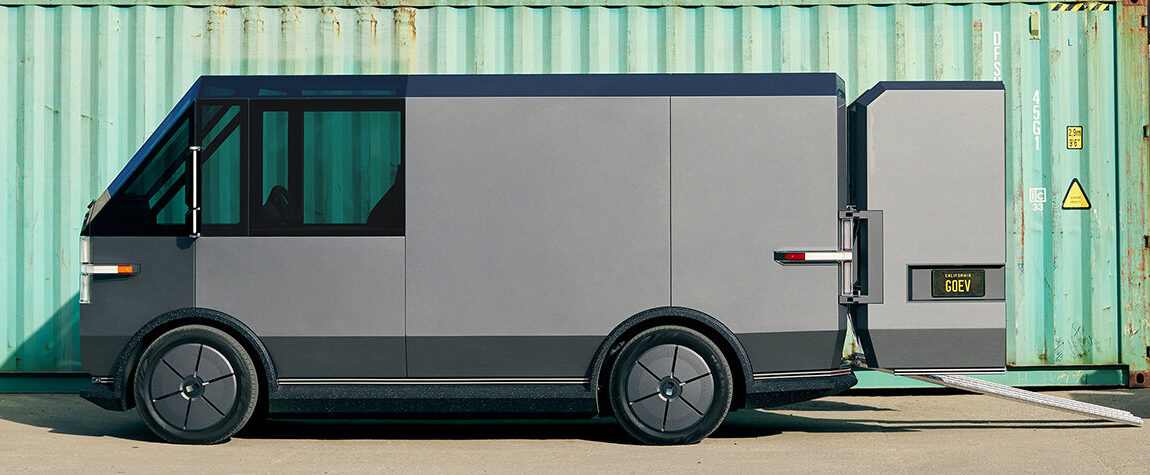
Canoo EV Cabin Design
All Canoo EV vehicles will share the same underpinning and different cabins or “top hats” that can be married to create unique vehicles.
“We have complete freedom to locate the steering wheel to suit any cabin design and driver position. It also leads to a more responsive and smoother driving experience. Because steer-by-wire eliminates the need for a mechanical connection, there is more freedom to arrange the interior space of the vehicle to provide customers with exciting new vehicle options,” the company said in a release.

Perimeter lighting.
The wide-view passenger compartment maximizes driver visibility, with advanced lighting technologies for adaptive safety. The company’s signature headlights and taillights are core brand identifiers without the need for a logo.
Beyond just storage, the front surface of the vehicle has been extended to better protect the headlights and windscreen.
The bumpers feature integrated tow hooks, with front fog lamps. There are metal skid plates at the front and rear. The cabin is lined with durable trim and materials.
The extended cab model has two seats in the front with a customizable rear compartment that can accommodate two additional seats or support additional purpose-built use-case configurability.
Driver-Assist Systems
Canoo claims to one of the first companies to integrate two commonly used technologies — advanced driver-assistance systems (ADAS) and Driver Monitoring, the company says.
The system uses seven cameras, five radars, and 12 ultrasonic sensors.
The cameras provide surround-view images to the perception system while the
radars provide 360 degrees of sensor data to measure the speed and distance of other vehicles or objects. The ultrasonic sensors provide short-range distance measurements for parking maneuvers.
The suite of sensors is class-competitive to other Level 2+ systems, the company says, and can be upgraded as technologies evolve.
Full specifications for the Canoo EV will be revealed closer to production.
For more information: www.canoo.com
