If you are of the mindset ‘A-B-T’ — Anything But Tesla — or Anything But Elon, the GV60 and Genesis brand have that upstart passion without the politics
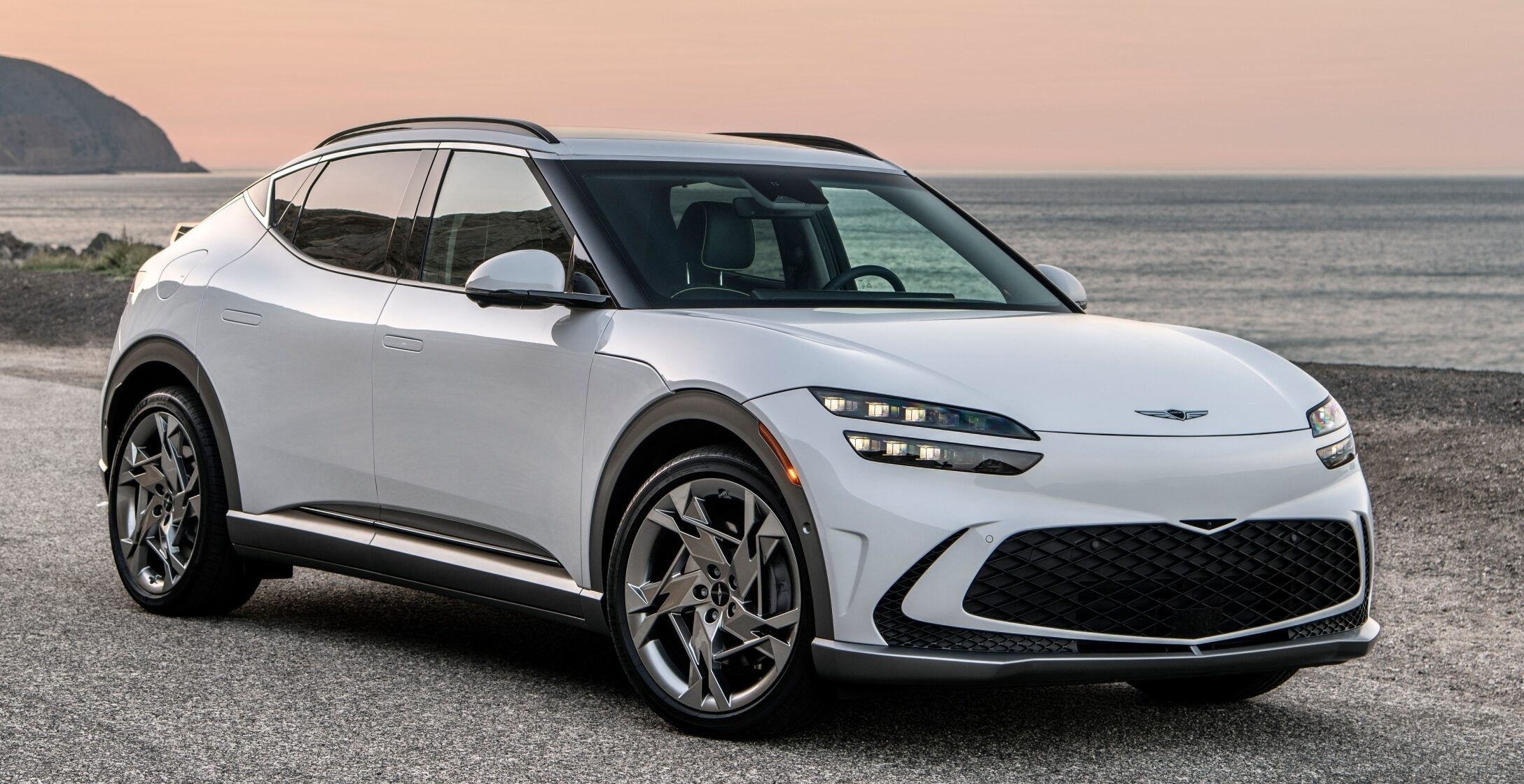
The compact Genesis GV60 electric SUV is sold in two AWD trim levels with battery-electric driving ranges of 248 or 235 miles. Starting prices are about $60,000 and $70,000. (Photos courtesy of Genesis USA or as credited)
Table of Contents
9 Cool Things
Genesis Brand Overview
GV60 Pricing
Genesis Warranties
State of the Art and Aesthetics
Face Connect
GV60 Powertrains
GV60 Charging Times
Ride and Handling
Why Buy the Genesis GV60?
Specifications
The Genesis GV60 brings a fistful of finesse to the staid state of electric vehicle design. This small battery-electric “SUV” has a custom appearance, the best-looking rear-end in autodom today, and not one EV badge anywhere.
It’s that dang skateboard powertrain that has complicated EV styling. Once that foundation is laid, designers must wrap a superstructure above and around it. The result is taller body sides, raised ride height, and lower rooflines to craft a sporty presence. Of course, there are roof rails for accessory carriers. So, the vehicle then becomes an “SUV.” Ford calls its Mustang Mach-E an SUV, but is it really an SUV?
Most new EV exterior designs are awkward. Stylists apply some creative spackle to aid aerodynamics and to make their vehicle look different — maybe even cool. But all makers seem to agree that their EV must not look like the traditional combustion-engine vehicle.
Hyundai broke away from that styling bondage with Ioniq 5 and the just-released 2023 Ioniq 6 sedan. Both models creatively disguise their skateboard architectures without defaulting to SUV.
Genesis continues that inspiration with the GV60 — and likely for its other vehicles moving forward.
Will such design innovations be the future “normalization” for electric vehicles?

The interior is rich in non-pretentious luxury and ergonomic placement of controls.
9 Cool Things About GV60
-

The crystal sphere is to create an atmosphere of futuristic mobility.
Biometric fingerprint access and Face Connect. Enter and drive the GV60 without the key;
- Electric-Active Sound Design;
- Rotating and illuminated crystal shift ball;
- Glove box drawer. A rethinking of a glove box, which slides out and is lighted;
- Boost mode. Shaves about 0.3 of a second from a performance run to 60 mph;
- Mobile Power Source: Vehicle-to-Load charging ability is emergency ready to power and recharge devices;
- i-Pedal driving. Speed up, slow down, or stop using the accelerator pedal as the system captures kinetic energy to replenish the battery (in small amounts).
- Multi 400/800Volt rapid charging system. The standard cable helps shorten charging time at public stations.
The Small EV Competition
There are almost too many choices for the uninitiated shopping for a new small SUV EV, and many more EVs will be available soon.
Among the competing vehicles are the Audi Q4 etron, BMW i4, Cadillac Lyriq, Chevrolet Bolt, Mercedes-Benz EQB, Nissan Ariya, Polestar (models 1, 2, or 3), Toyota BZ4X (and Subaru Solterra and upcoming Lexus RZ 450e), VW iD4, and Volvo XC40 Recharge.

The GV60 has layers of refined materials, with more of the round design theme. (Mark Maynard)
Genesis Brand Overview
Genesis is the luxury division of South Korea-based Hyundai Motor and also the parent company to Kia Motors. The Genesis GV60 is the first Genesis model developed on the Hyundai Electric Global Modular Platform (E-GMP). It is a dedicated EV platform used for the Hyundai Ioniq 5, Ioniq 6, and the Kia EV6.
It was in late 2016 when the brand launched in the U.S. It debuted with a sedan lineup of the G80 and G90 large sedans. Unfortunately, American motorists were fixated on SUVs, and the well-regarded Genesis sedans were overlooked or viewed with suspicion. Then, in 2018, the Genesis G70 sport sedan debuted, but it also faced resistance from many other established sport sedans from the more well-known luxury brands. It did not help that the dealer group was disorganized, and the supply of cars needed to be better.
It wasn’t until 2020 that the brand introduced its first SUV, the large-midsize GV80. “V” in the nameplate stands for versatility. The GV80 was followed by the Electrified (battery-electric) G80 sedan in 2021. The midsize GV70 SUV followed in 2021, and the Electrified GV70 will go on sale later this year. Genesis says it will have a fully electric lineup by 2030.
The compact-class GV60, today’s tester, went on sale in 2022 as a 2023 model.

How would an owner use this slim front-trunk space of .07 cubic feet? (Mark Maynard)
Genesis GV60 Pricing
The 2023 Genesis GV60 is sold in two all-wheel-drive trim levels of Advanced and Performance. Pricing starts at $60,415 for Advanced, which has a 314-horsepower, dual-motor powertrain (for AWD), and a battery-electric driving range of 248 miles.
The Performance model, today’s tester, starts at $69,415. With one option for Matterhorn white paint ($1,500), the tester was $70,915.
Retail pricing includes the $1,125 freight charge from Ulsan, Korea.
The electrified GV60 is now available in 22 states: Arizona, California, Colorado, Connecticut, Georgia, Illinois, Indiana, Louisiana, Maryland, Massachusetts, Minnesota, North Carolina, New Jersey, Nevada, New York, Pennsylvania, Utah, South Carolina, Texas, Virginia, Wisconsin, and Washington.
Genesis is also in a collaboration with Electrify America to offer three years of 30-minute free charging sessions from the date of vehicle purchase.
The availability of tax credits for electric vehicle leases, such as for the GV60, still needs to be determined. For current pricing and offers, go to Genesis.com
Genesis Warranties
Owning a Genesis brings some special warranty perks:
- Concierge Services;
- 10 years or 100,000-miles powertrain;
- 10 years or 100,000-miles electric vehicle system (or in California, 10 years or 150,000 miles);
- 5 years or 60,000 miles bumper to bumper;
- 3 years or 36,000 miles of free scheduled maintenance;
- 3 years or 36,000 miles free service valet;
- 3 years of free map updates;
Service valet is money to an owner. Genesis will handle vehicle pickup, deliver a replacement Genesis, and return your vehicle when service is required. The pickup and return can be anywhere the owner chooses, within reason. Learn more about the Service Valet here.
The free three-year subscription also provides online or app scheduling of service appointments. The GV60 also will give a screen alert to owners when it is time for service and then connect to schedule an appointment with the preferred dealership.
Concierge Services
Many new vehicle owners develop relationships with the dealer’s service manager, but Genesis encourages owner involvement through its concierge services. For example, if the nearest Genesis dealer is out of your way, the concierge can arrange an at-home test drive or multiple test drives. And if you loved the Genesis you tested, the concierge will help make arrangements at the nearest dealership to finalize the sale. To get started, go here.
State of the Art and Aesthetics
Inside and out, the Genesis GV60 has some unique design elements, some of which are just fun.
Most EVs use special colors and badging, usually green or blue, to proclaim the owner is driving an electric vehicle. The GV60 has none of those.

Full LED lighting.
And there is very little brand identification. There is one GV60 badge on the rear deck, one Genesis winged logo on the hood, and the name spelled out on the deck.
The exterior styling is complete and substantial. Most makers would have designated the GV60 an “SUV coupe,” defined by a sloping rear roofline and the smallish back seat area. The so-called SUV coupe does not focus on cargo capacity but on style and speed.
For the GV60, the arching roofline trails smoothly to the rear. There are no contrived bulges on the hood or along the sides to make the GV60 look fast. The 20- or 21-inch tires and wheels fill their spaces for a solid stance.
A chrome strip outlines the windows and flows rearward to an uncommon “V” cut into the rear pillar that appears to be part of the rear glass. At the base of the back glass is an integrated spoiler. It’s probably just a design gimmick, but it adds to the solid appearance. The spoiler does, however, create a split rear-window issue. At first glance in the rearview mirror, it looked problematic, but it became a non-issue for me. And the around-view camera system enables complete visibility.

The Genesis GV60 has the best looking rear-end in autodom today.
GV60 Interior Design
The interior is of non-pretentious luxury with much microsuede, such as in the headliner, and appealing Nappa leather (in the GV60 Performance). There is a circle theme in the door handles, speakers, and the rotating crystal ball — a “sphere” in Genesis terms — on the shift console.
Genesis says the crystal sphere is to create an indoor atmosphere of futuristic mobility. When the GV60 is ready to drive, the sphere rotates 180 degrees to present the Shift By Wire dial. Upon shutoff, the sphere rotates again to become a mood light.
Circular dial buttons on the lower arc of the steering wheel are for performance settings. The left button sets the performance modes of Eco, Comfort, and Sport. The bold yellow button on the right is labeled “Boost.” When activated, Boost performs a nitrous-like 10-second overboost of acceleration. For a blast to 0-60 mph, “boost” mode trims about 0.3 of a second from the time standard time of about 4.2 seconds to 3.9.
To me, the “Boost” is a novelty. The new owner will do it a few times to impress friends. But the acceleration in Sport mode is already quick, depending on how hard the driver pushes the accelerator. Eco, to me, is frustratingly resistant, and Comfort is true to the word.
Face Connect and Fingerprint ID
The GV60 introduces a pair of technologies that might initially seem alien to the experienced motorist: Face Connect and Fingerprint Authentication Systems.
I would never knowingly leave home without the key fob in my pocket. However, the key fob for the GV60 is large and bulky. And in this morning’s newsfeed, a surfer lamented that his car had been stolen from a parking lot. He said he had hidden his car key and hurried down to the surf. When he returned, his car was gone.
This is validation for Face Connect and Fingerprint Authentication. For sports enthusiasts who don’t want to risk losing a key during an activity, bring your face and index finger.
Face Connect uses a Near Infra-Red camera to recognize the driver’s face to lock or unlock its doors without a key. A driver only needs to touch the door handle and show their face to the camera on the B-pillar. The system can register two faces, and the setup is similar to how facial ID is used for a smartphone. Genesis says the NIR system also functions accurately in the dark or when the weather is cloudy.
But to start the GV60 without a key requires Fingerprint Authentication. As for a smartphone fingerprint ID, users must record a fingerprint on the shift console’s small (round) fingerprint pad. Touch the recorded fingertip to the button, and the car is ready to start with the ignition button.
The GV60 also has the second generation of Digital Key, which now works without holding the smartphone near the door. Users just have to touch the door handle. The digital key can be shared with up to three people.

21-inch Michelin Primacy Tour tires (255/40) are wide and meaty on the GV60 Performance.
Genesis GV60 Powertrains
The standard AWD model has a 74kW front motor and a 160 kW rear motor. The power adds up to 234 kW or 314 horsepower. Torque of 446 foot-pounds is key to instant acceleration. The standard model has a driving range of 248 miles.
The Performance model has two 160kW motors, one each for the front and rear wheels. The second motor raises total output to 320kW or 429-hp and torque of 516 lb.-ft. The Performance model has an EPA-estimated driving range of 235 miles. However, I achieved a range readout of 244 to 247 miles when charging at home on my Level 2 charger.
Both models have the same size lithium-ion polymer battery of 697 volts and 77.4 kWh capacity. And the transmission for both models is a single-speed reduction gear.
There also is a Drift mode. And breaking loose those fat Michelins will require that 516 lb.-ft. of torque.
Intelligent Pedal
The Intelligent Pedal function (i-Pedal) works through the accelerator pedal to decelerate, stop, and pipe energy back to the battery (regeneration). Regen can be increased or decreased by using the shift paddles at the steering wheel. Not all manufacturers believe in the so-called e-pedal and prefer the driver to be more active in driving. I find i-Pedal provides precise function and maximizing regen when I’m not paying attention to it.
Battery Conditioning
Genesis says the GV60 is the first model to feature battery conditioning. It preheats the pack for better performance in cold weather. And it also shortens the amount of charging time by adjusting the battery temperature.
The GV60 has a multi-400/800Volt rapid charging system that boosts the 400V supplied by the charger to 800V. The heavy-gauge onboard charging cable works with various public charging systems.
For example, when charging at 350kW with the ultra-speed charging function, the battery can be charged from 10 percent to 80 percent in just 18 minutes. Also, the charging time for slow charging is quicker by increasing the charging capacity from 7.2kW to 11kW.
GV60 Charging Times
- AC Level 2, 240-volt: about 7 hours from 10 to 100 percent;
- 50 kW rapid charging: 73 minutes from 10 to 80 percent;
- 250 kW (800 volts): 18 minutes from 10 to 80 percent;
- AC home120V / 12A: about 68 hours
GV60 as Mobile Power Source
The GV60 can also be used as a mobile power source to tap the battery to charge other electronic devices. The so-called V2L (Vehicle to Load) function supports a 3.6kW charge, which is higher than the power supply in the average home. The system can be a savior in a power-out emergency, tailgating, or camping.

Back seat space feels compact with a butts-down, knees-up position. (Mark Maynard)
GV60 Performance Ride and Handling
The GV60 Performance is a sport sedan EV. Its release of power is eager and controllable. And this is despite a curb weight of 4,890 pounds, of which 1,055 to 1,060 pounds is for the battery. Most small electric SUVs are in this weight range, but AWD takes horsepower to move the mass.
While the GV60 has plenty of power, it’s not a sparkling performer in its cornering ability. It is quite responsive, but its arching roofline and electronic suspension are not assets in performance driving.
Both GV60 models have an independent suspension with front struts and a rear multilink. The GV60 Performance adds an electronically controlled suspension with road preview. The preview function pulls information from the front camera and navigation system to recognize rough roads or speed bumps. In such conditions, the damping force adjusts to the road conditions.
I’m sure suspension electronics can read the road in milliseconds, but sometimes a millisecond is too long. A well-engineered steel spring suspension can sometimes provide a quicker and more controlled response.
In my experience driving the Performance model, the ride quality in Comfort mode was luxuriously compliant (soft). It absorbed the harshness of rough pavement, but a pothole could produce an unnerving jolt. In Sport mode, the suspension tightened but was not harsh.
Long Wheelbase
Because of the powertrain skateboard layout, the GV60 has a long wheelbase of 114.2 inches; that’s several inches longer than a comparably sized combustion SUV. Consequently, the GV60 has a relatively wide turning circle of 39.2 feet, or maybe wider with the 21-inch tires. Its maneuverability is not unwieldy, but it does not feel nimble in underground parking.
Stopping force is absolute from four-wheel ventilated discs front and rear, with 14.1-inch rotors. There are four-piston calipers at the front and a single-piston rear caliper.
The GV60 Performance gets 21-inch Michelin Primacy Tour tires (255/40), which are wide and meaty for an SUV of this size. The standard GV60 gets 20-inch Michelin Primacy but has a narrower tread face of 255/45.
electric-Active Sound Design
Genesis says the GV60 is also its first model to use electric-Active Sound Design (e-ASD). The system provides various virtual driving sounds through the speakers based on the driving mode, the vehicle’s speed, and accelerator pedal data.
Drivers have a choice of three sounds:
Futuristic, symbolizes the direction of future mobility;
G-Engine, based on soft and sporty engine sounds;
E-Motor, reimagines motor sounds.
I don’t even know which sound was active when I was driving. It sounded like any electric vehicle, which was just fine for me. Will owners really personalize the sound of their GV60?

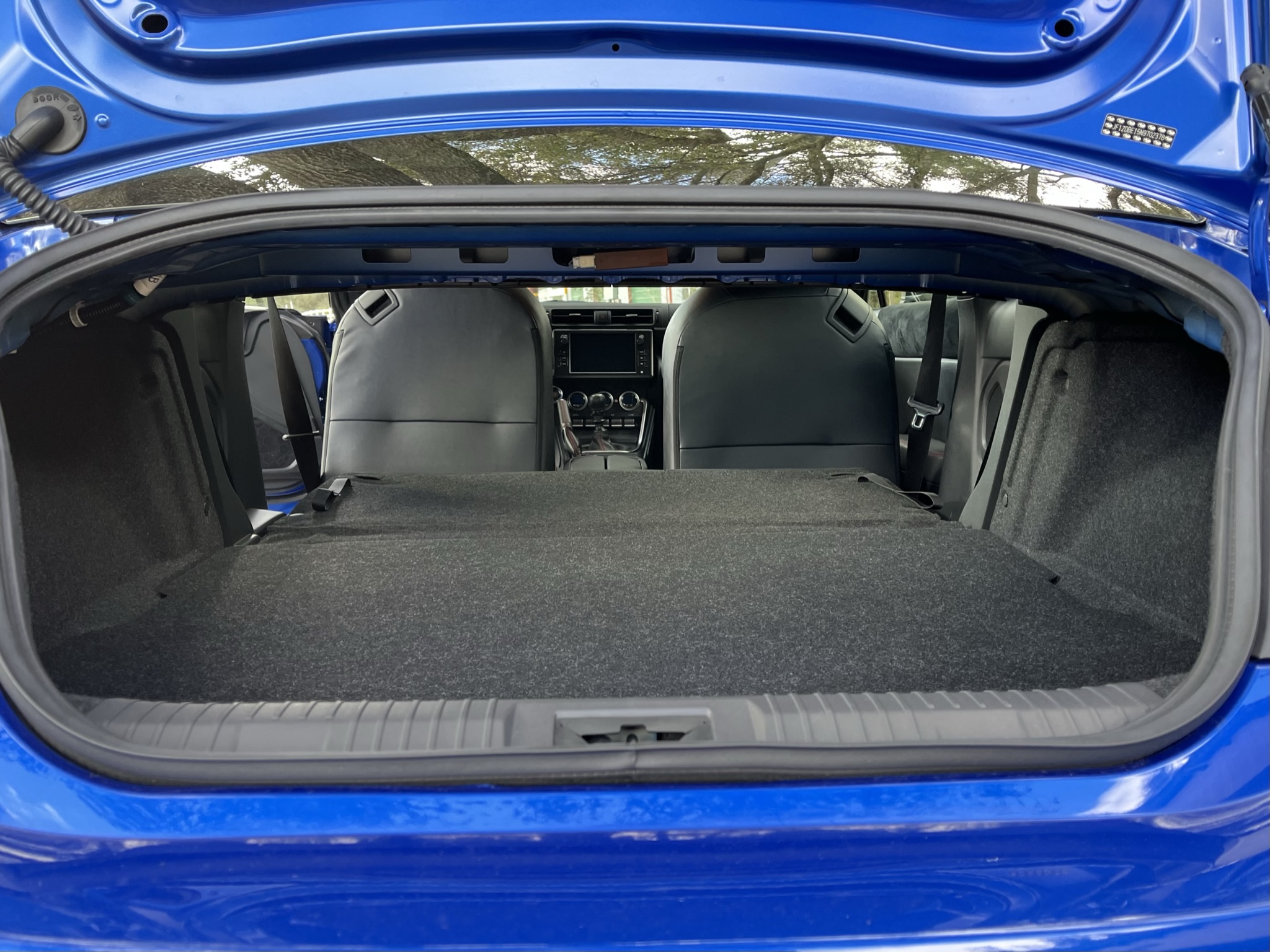
Fold the back seats for up to 6 feet in length. (Mark Maynard)
Highway Drive Assist
Keep your hands on the wheel for Highway Driving Assist. It’s the same system found in Hyundai and Kia models. (Full safety features are listed in the specs box below.)
The sophisticated array of advanced technologies allows Level 2 assisted driving. The system works with reasonable accuracy, though in my experience the system would allow the GV60 to drift beyond the lane markings. And then give a warning tone, as if I was at fault.
These driver-assist systems take time for the uninitiated to find their comfort level. The support is an all-seeing set of eyes that is of particular value in the crammed daily commuting traffic, especially in narrow construction areas. I now activate steering assist in HDA as a distraction-avoidance safeguard.

Tidy storage space under the cargo floor for the charging cables and manuals.
Why Buy the Genesis GV60?
If you are of the mindset “A-B-T” — Anything But Tesla — or Anything But Elon, the GV60 and Genesis brand have that upstart passion without the politics.
While many GV60 reviews are critical of the driving range that is less than 300 miles on a full charge. For most owners, 300 miles is a benefit for vacation travel. For the daily drive, however, most owners will have (or should get) a home charger. There is good range for a Saturday drive to the country without range anxiety. And if a quick charge is needed, it won’t take that long with the GV60’s speed charging system.
The buyer for the Genesis GV60 will value its aesthetics and artful presentation. The engineering and electronics have already been well-tested in the various Hyundai and Kia models. And the Genesis warranties provide security for a brand still developing a reputation.
Lease the GV60 today, and in three years, trade it in for the updated version with a fresh battery and another three years of Service Valet and Concierge support.
Genesis GV60 Performance Specifications
Body style: compact 5-door, 5-seat AWD SUV
Motor: Permanent magnet synchronous reluctance motor; 429-hp, 320 kw total; front: 160 kW, rear 160; 10-second Boost Mode allows for 483-hp or 360 kW; 516 lb.-ft. torque
Transmission: single speed reduction gear
Estimated driving range: 235 to 246 miles
Battery: 697-volt lithium-ion polymer; 77.4 kWh capacity; 618 cells; weight 1,060.3 pounds
Charging times: AC Level 2, 240-volt: about 7 hours from 10 to 100 percent;
50 kW rapid charging 73 minutes from 10 to 80 percent; 250 kW (800 volts) 18 minutes from 10 to 80 percent
Onboard charger: Ultra-fast up to 800 volts or 350 kW
0-60 mph acceleration, estimated: 4.2 seconds, 3.9 seconds in Boost Mode
Towing capacity: 2,000 pounds, with a braked trailer
BY THE NUMBERS
Front head/leg room: 39/42.3 inches
Rear head/leg room: 38.1/37.6 inches
Length/wheelbase: 177.8/114.2 inches
Width/height: 74.4/62.4 inches
Curb weight: 4,890 pounds
Turning circle: 39.2 feet
Cargo space: 24-54.7 cubic feet; front trunk, .07 cu.ft.
FEATURES
Standard equipment includes: Nappa leather-trimmed upholstery, surround-view camera system, smart cruise control with stop-and-go, 17-speaker Bang & Olufsen audio system (1,400 watts), remote smart parking assist, electric parking brake with auto-hold, 14-way power driver seat with 4-way power lumbar and cushion extension, a 12-way power front passenger seat with 4-way power lumbar, heated and ventilated front seats, carpeted floor mats;
Safety features include: 8 air bags, electronic stability and traction controls, brake assist, hill-start control, park distance warning front and rear, driver-attention warning, high-beam assist, rear occupant alert;
Driver-assist technologies include: forward collision avoidance assist; lane-keeping assist and lane-following assist; blind-spot collision avoidance-assist; blind-spot view monitor; rear cross-traffic collision-avoidance assist; highway driving assist; intelligent speed-limit assist; parking collision-avoidance assist.
PRICING
Base price: $69,415, including $1,125 freight charge; price as tested $70,915
Options on test vehicle: Matterhorn white paint $1,500
Where assembled: Ulsan, Korea
Warranties: 5-years/60,000-miles bumper to bumper; 3-years/36,000-miles free scheduled maintenance; 3-years/36,000-miles free service valet; 10-years/100,000-miles powertrain; 10-years/100,000-miles electric vehicle system; 3-years free map updates.




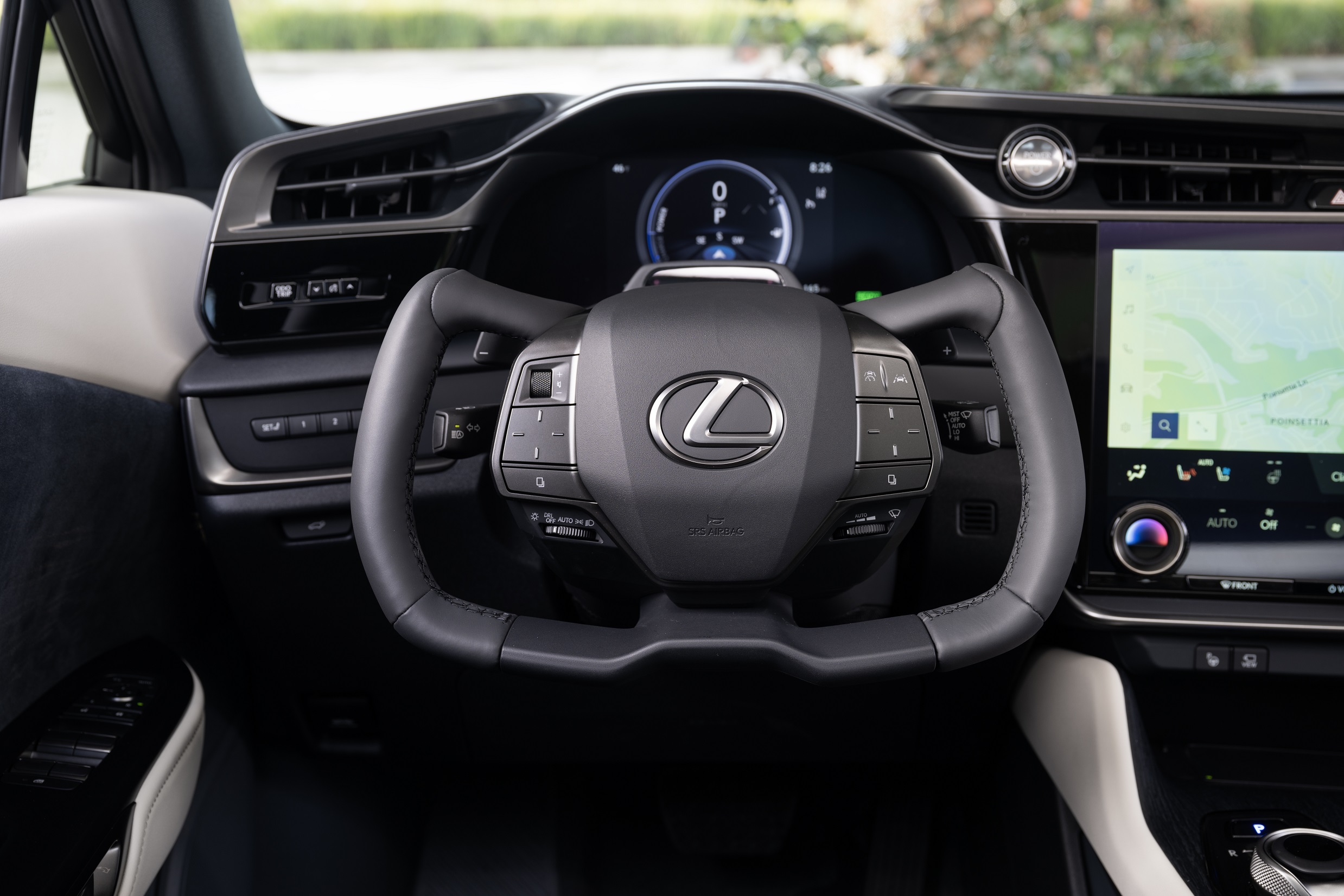


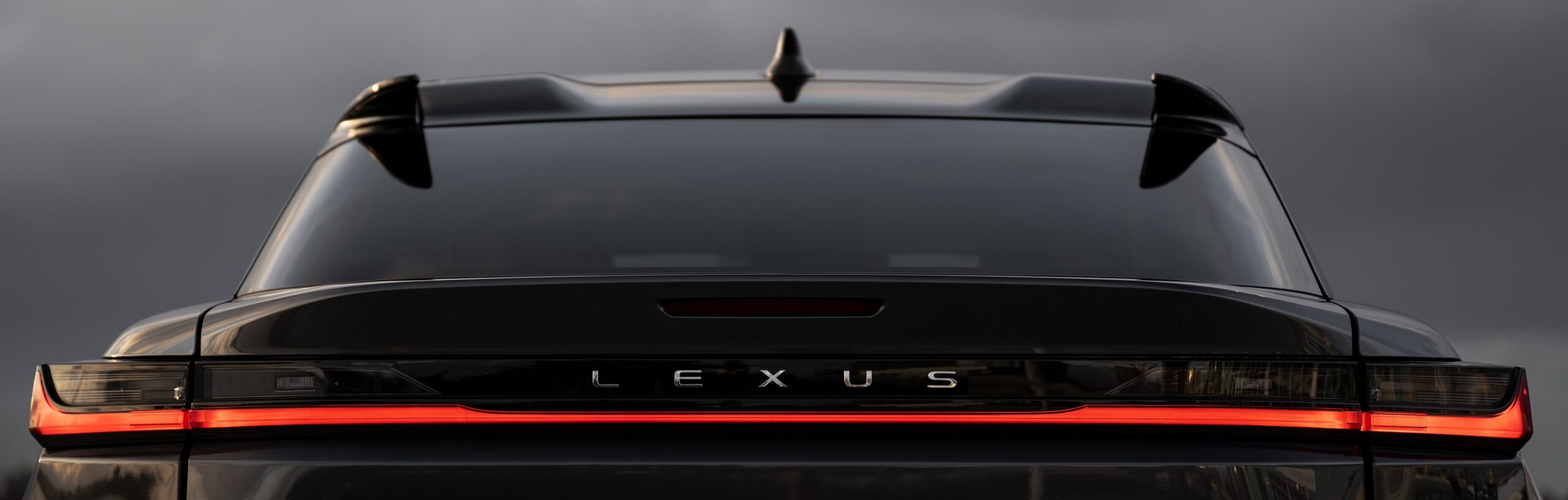
 The RZ will be recognizable at night by the optional lighted front Lexus logo, $200. The logo also illuminates when charging.