This original photo of the Curtiss Condor B-2 bomber was taken at the Curtiss Aerospace development plant in Garden City, N.Y. The image is dated Aug. 14, 1929. (Photo from the Paul S. Maynard archive)
The Curtiss Condor B-2 bomber became known as a ‘Flying Battleship’
Long before the current-generation B2 Spirit “Stealth Bomber” by Northrop Grumman there was the Curtiss Condor B-2 bomber built for the U.S. Army.
It was an enormous fabric-covered biplane aircraft with a wingspan of 90 feet and a length of 47 feet 4 inches. With its armaments, it became known as a “Flying Battleship,” but its use was short-lived.
According to its page in Wikipedia, the B-2 Condor’s two engines sat in nacelles between the wings, flanking the fuselage. It had a twin set of rudders on a twin tail, a configuration that was becoming obsolete by that time. At the rear of each nacelle was a gunner position. And there was another gunner in the nose.
As a twin-engine heavy bomber, the B-2 Condor was powered by two 650-horsepower Curtiss GV-1570-7 Conqueror V-12 water-cooled piston engines.
In a report by Joe Baugher (Encyclopedia of American Aircraft), the engines were housed inside nacelles mounted on top of the lower wing. “The engines were cooled by rather angular radiators that jutted up vertically from each nacelle.
“One of the more unusual innovations introduced by the [second prototype] XB-2 was the addition of a defensive gunner position in the rear of each nacelle. It was hoped that this arrangement would offer a clearer field of fire for the gunners than the more conventional fuselage-situated positions. An additional gunner position was provided in the nose. Each position was provided with a pair of Lewis .30-06 machine guns.”
According to the Baugher report, the Condor’s bombload was typically 2,508 pounds but could be increased to 4,000 pounds on short flights.
Curtiss Condor Competitors
The Curtiss Condor B-2 competed against the Keystone XB-1B, the Keystone XLB-6, the Sikorsky S-37B, and the Atlantic-Fokker XLB-2, according to the Baugher report.
“When an Army board of review met in February of 1928 to decide which design was to be awarded a contract, they immediately ruled out the XB-1B, the XLB-2, and the S-37. However, the board was unable to decide between the XB-2 and the XLB-6. The XB-2 had the better performance, but the XLB-6 was only $24,750 per unit.
“The per-unit cost of the B-2 was $76,373, more than three times the cost of a Keystone bomber. In a split decision, the Board opted for the Keystone design, but on June 23, 1928, Curtiss was given a contract for two B-2s (Serial nos. 28-398/399). A further 10 were ordered in 1929 (29-28/37).
“The twelve production B-2s were delivered from May 1929 to January 1930. Notable differences from the XB-2 included the use of three-bladed propellers and somewhat shorter and wider radiators mounted on top of the engine nacelles.
At sea level, the Curtiss Condor had a maximum speed of 132 mph — though many reports say it struggled to reach that max V — and 128 mph at 5,000 feet. The plane had a cruising speed of 105.5 mph and a cruising range of 805 miles.
End of the Condor Line
During the early 1930s, the advances in bomber design were so rapid that canvas-covered biplanes such as the B-2 rapidly became obsolete, Baugher wrote.
“Consequently, the B-2 served only briefly with the Army, being taken out of service in 1934. The last B-2 was surveyed in July of 1936. So far as I am aware, none survives today.”
After production of the B-2, Curtiss Aircraft left the bomber business, concentrating on the Hawk series of pursuit aircraft in the 1930s.
The civilian version of the Curtiss Condor, circa 1944, was the first airliner in the world to provide sleeping berths. (Photo from the Paul S. Maynard archive)
The Civilian Curtiss Condor
The Model 53 was an airliner version of the Model 52 Condor B-2 bomber. The Condor was the first airliner in the world to provide sleeping berths.
The Army permitted this development in 1928, and the first of the new aircraft made its maiden flight in June 1929. The civilian B-2 was an 18-seat passenger aircraft called the Condor 18 (also known as the Condor T32), according to HistoryOfWar.org.
At the time, there was a need for sleeper-transports, and the simplicity of design allowed for quick production and delivery to serve this market, according to HistoryOfWar. The Curtiss Condor could carry 12 passengers as a sleeper-transport or 15 passengers for day transport.
Luxury Cabin Accommodations
The Condor was the first multi-engine airliner with an electrically operated retractable landing gear. To help absorb vibration, the Condor was the first to have its engines mounted on rubber bushings.
The passenger cabin was appointed in fabric and leather, and each seat had individual hot and cold air vents.
The lavatory featured a basin with hot and cold running water, a mirror, and a vanity. However, the Condor remained in airline service for only three years, making it the last biplane purchased for civil transport.
Only a short time afterward, the all-metal airliners, the Boeing 247 and Douglas DC-1, made their debut in 1933. The only competing factor that the Condor had with the modern airplanes was that it had retractable landing gear.
Two 710 hp Wright SCR-1820-F3 Cyclone, 9-cylinder radial engines powered the passenger Condor.
Condor Flight History
The first civilian Condor converted from a military Model 52, flew for the first time on July 21, 1929. Including the prototype, six were built. Of these, the first three were converted from bomber model 52s. They operated with TAT and Eastern Air Line, though only for about a year. The Conqueror’s development was never quite completed, and in 1932 the US Army, after spending large sums on it, withdrew support and turned to air-cooled engines.
CURTISS B-2 CONDOR SPECIFICATIONS
Twin-engine heavy bomber biplane. Initial production version; 12 built.
Crew: 5; two wing gunners, the nose gunner, pilot, and co-pilot.
Length: 47 feet 4 inches
Wingspan: 90 feet
Empty weight: 9,300 pounds
Gross weight: 16,951 pounds
Powerplant: 2 × Curtiss GV-1570-7 Conqueror V-12 water-cooled piston engine, 600 hp each
PERFORMANCE
Maximum speed: 132 mph
Cruising speed: 105.5 mph
Range: 805 miles
Service ceiling: 17,100 feet
Rate of climb: 850 feet/minute
ARMAMENT
Guns: 6 .30-06 caliber Lewis machine-guns
Bombload: 2,508 pounds
Note: This is another image from my dad, Paul Smith Maynard, who worked four decades in aviation as an engineer. Dad began his career in about 1943 after graduating from West Virginia University. He started with Curtiss-Wright Corp., a pioneer in making flying machines. He went on to work at North American Aviation and Rockwell International.
MMustang fever began 61 years ago on Friday, April 17, 1964. On that day, it was reported that an estimated “millions” of looky-loos from around the world packed into Flushing Meadows Park in Queens for the debut of the Ford Mustang at the New York World’s Fair. The date was just 16 days after the debut of the Plymouth Barracuda. But the 1965 model-year Mustang would prove to be Ford’s most successful launch since the Model A.
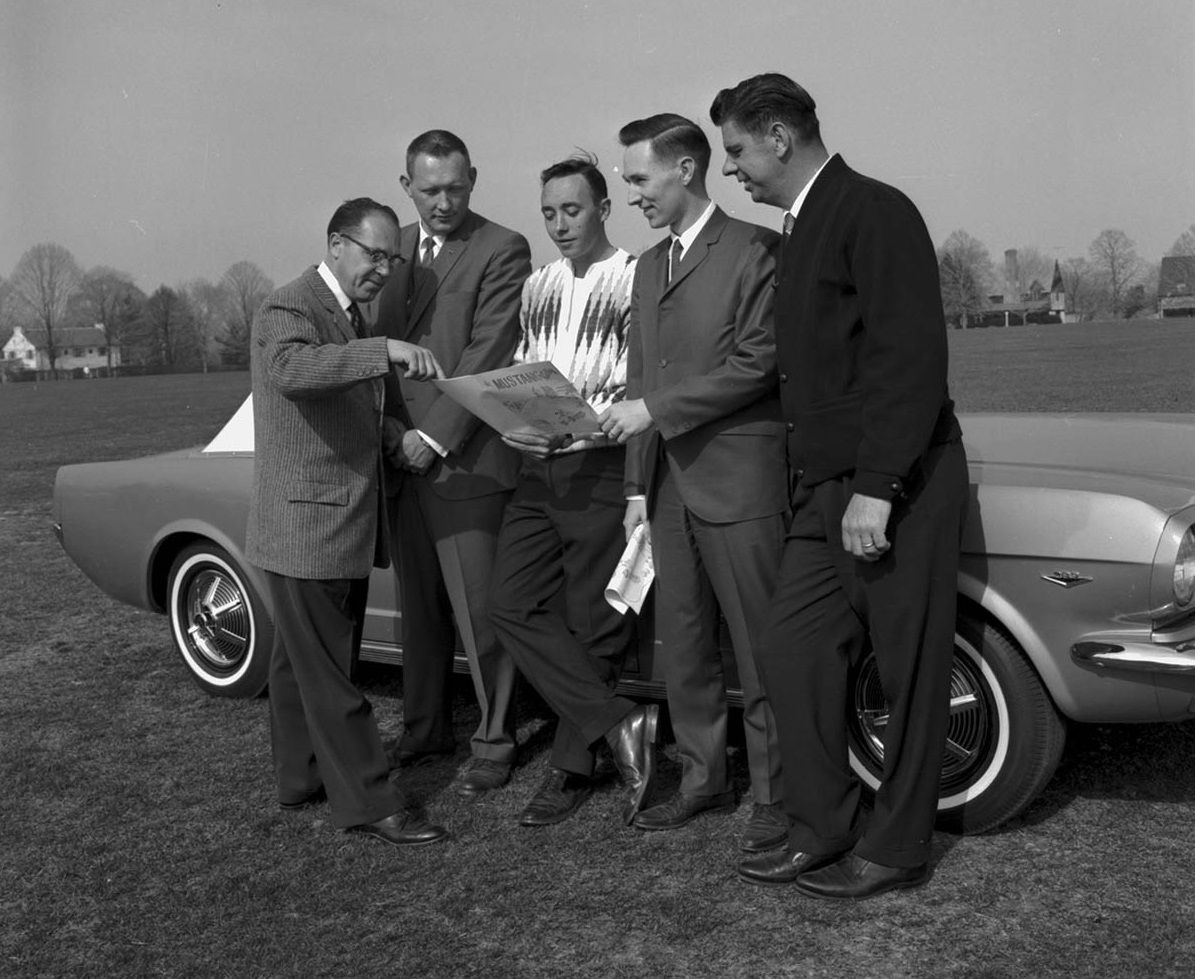
It was a media-rich event, including a test drive for journalists. The so-called Mustang Road Rally traveled from the World’s Fair to Dearborn, via Niagara Falls.
Journalists prepare to head out for the first Ford Mustang Road Rally. The route went from Westchester Country Club in New York to Dearborn, Mich.
Journalists make a fuel stop along the way to Dearborn.
A stop at Niagara Falls on the way to Dearborn.
The ‘1964½’ Mustang
Enthusiasts dubbed the first-year car as the “1964½” Mustang. But all Mustangs were advertised, VIN coded and titled by Ford as 1965 models. Production began in Dearborn, Mich., on March 9, 1964.
Original sales forecasts projected fewer than 100,000 units for the first year, however, the mark was surpassed in three months from rollout. Another 318,000 cars would be sold during the model year (a record). And in its first 18 months on sale, more than 1 million Mustangs were built.
Henry Ford II poses with the all-new Mustang at the Ford Pavilion during the World’s Fair debut. The sporty four-seater is named after the legendary P-51 Mustang fighter plane from World War II. The price at launch: $2,368.
In August 2018, Ford produced the 10 millionth Mustang. It was a 2019 Wimbledon White convertible with a V-8 engine, which matched the first 1965 Mustang.
First Generation Mustang: 1965–1973
An early 1965 Mustang hardtop.
To meet its advertised list price of $2,368, the Mustang was based heavily on components that were already in production for other Ford models. This was the same business plan that Ford used for the first-gen 1955-1957 Thunderbirds. Many if not most of the interior, chassis, suspension and drivetrain components came from the Falcon and Fairlane.
1965 Ford Mustang T5 prototype.
The Big Block Mustang
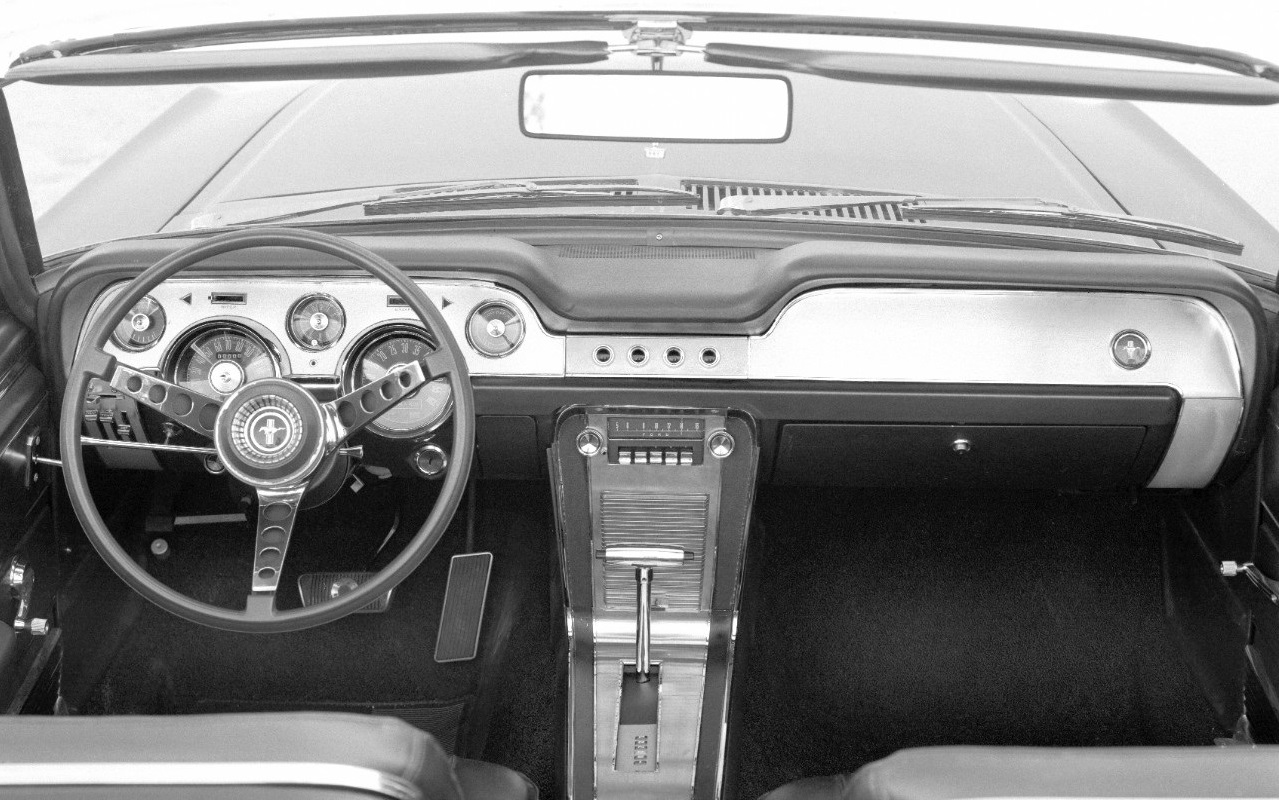
From 1967 until 1973, the Mustang got bigger, allowing a big block engine to be offered for the first time. Front and rear end styling was more pronounced, and the “twin cove” instrument panel offered a thicker crash pad and larger gauges.
The 1964 Dearborn, Mich., assembly plant.
Hardtop, fastback, and convertible body styles continued as before.
Around this time, the Mustang was paired with a Mercury variant, called the Cougar, which used its own styling cues, such as a “prowling cat” logo and hidden quad headlamps.
New safety regulations by the U.S. National Highway Traffic Safety Administration had to be applied for 1967. The added feature included an energy-absorbing steering column, four-way emergency flashers, a dual-circuit hydraulic braking system, and softer interior knobs.
Mustang sales passed the 1 million mark in March 1966.
1965 Ford Mustang Fastback.
1968 Pony Car Refresh
The 1968 models received revised side scoops, steering wheel, and gasoline caps. Side marker lights were also added that year, and cars built after Jan. 1, 1968, included shoulder belts for both front seats on coupes. The 1968 models also introduced a new 302-cubic-inch (4.9-liter) V-8 engine that would meet new federal emissions regulations.
The 1965 Mustang interior.
A 1966 Mustang GT fastback.
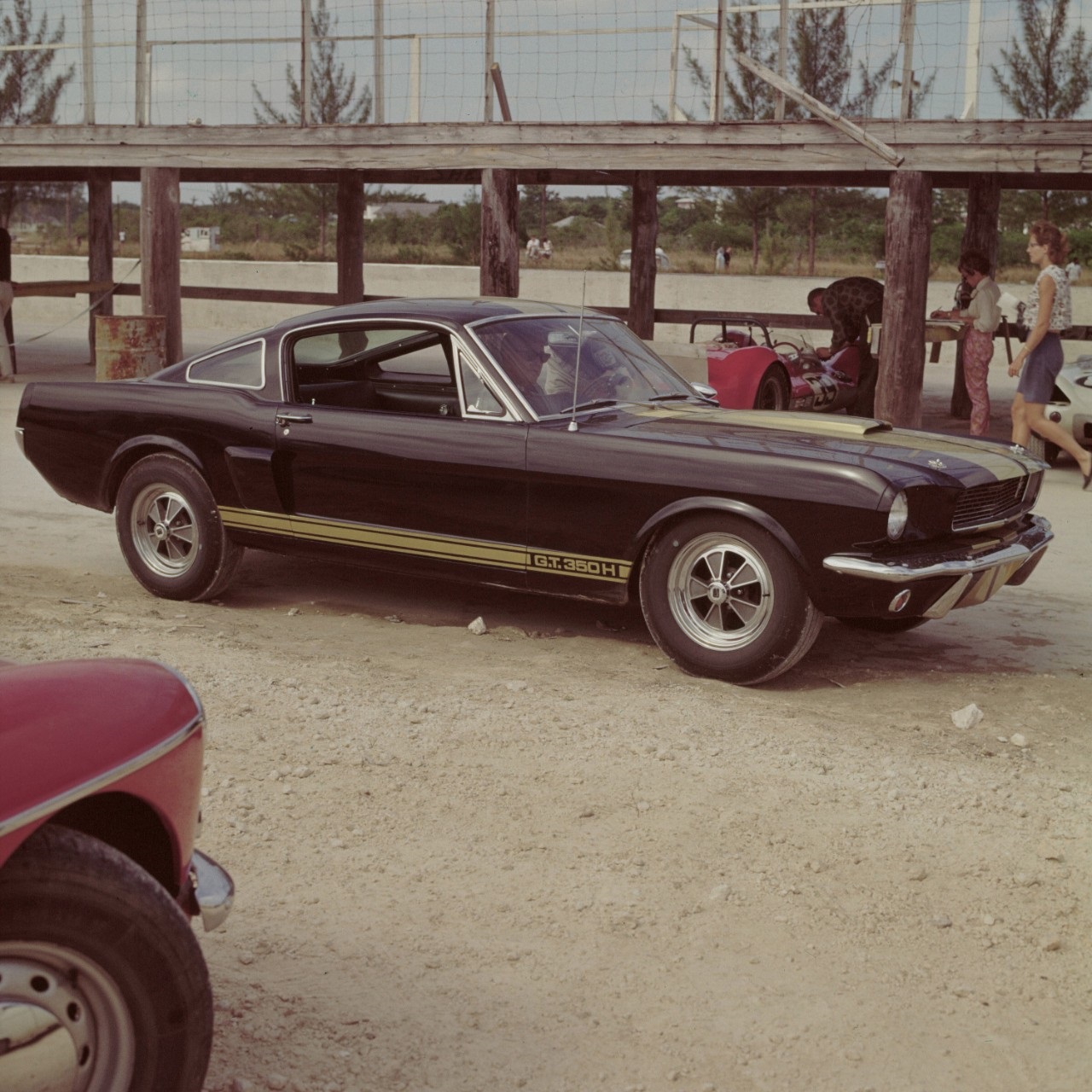
The 1966 Shelby Mustang GT-350H, the so-called rent-a-racer.
The 1967 instrument panel.
1969 Mustang Grows In Size
The restyling for 1969 added more heft to the body as width and length again increased. The curb weight went up markedly, too. V-8 power returns to Mustang with the 302 cubic-inch small-block.
Due to the larger body and revised front-end styling, the 1969 models (but less so in 1970) had a notable aggressive stance.
The 1968.
The 1969 Boss 302.
The 1969 models featured “quad headlamps” which disappeared to make way for a wider grille and a return to standard headlamps in the 1970 models.
Ford designer Larry Shinoda in the design studio courtyard with the 1969 Mustang Boss.
This switch back to standard headlamps was an attempt to tame the aggressive styling of the 1969 model, which some felt was too extreme and hurt sales, but 1969 production exceeded the 1970 total.
Prototype testing of the Boss 302.
The 1970 Fastback.
The 1971 Mustang Mach 1.
The 1971 model was the biggest Mustang to date. It was nearly a foot longer and some 600 pounds heavier than the originals.
The Boss 351, with its “Cleveland” block and Cobra Jet heads, debuts. The Mach 1 comes with a variety of powertrains, topped by the 429 Super Cobra Jet (SCJ).
A 1972 hardtop.
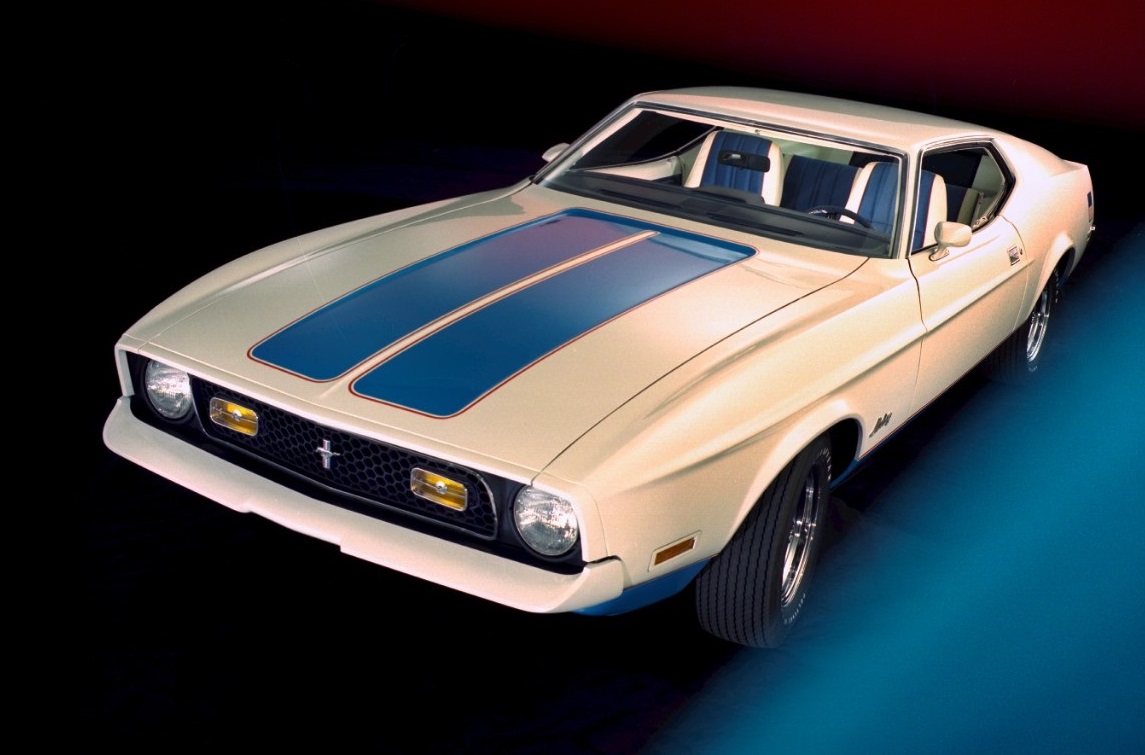
For 1972, styling is unchanged from 1971, and the only new model offering is the Sprint – a special red, white, and blue exterior paint-and-tape package.
2nd Generation: 1974–1978
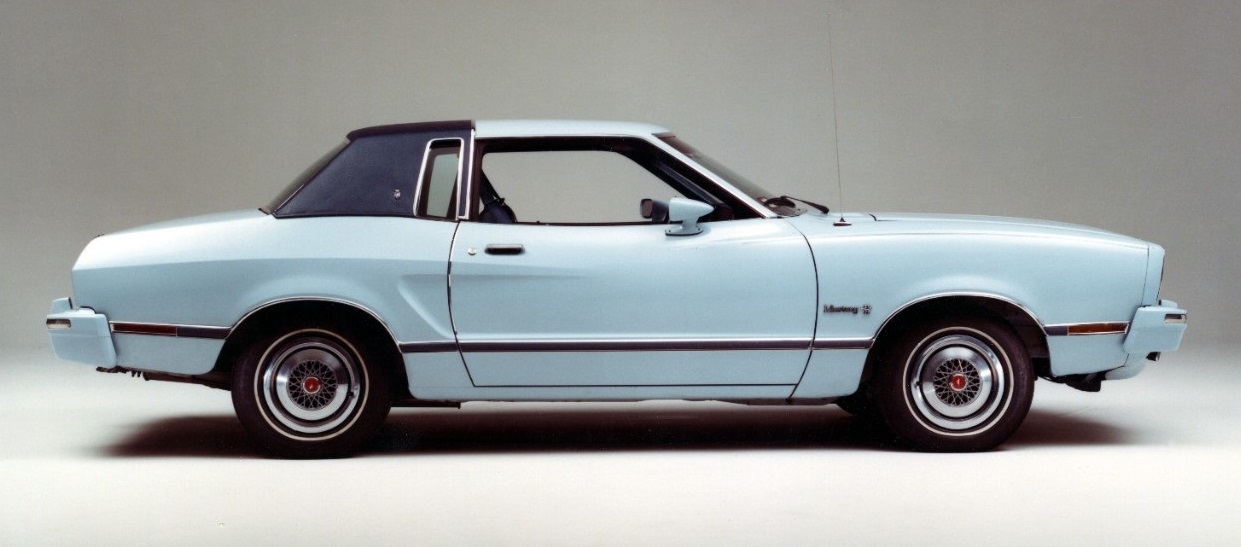
The 1974 Mustang II hatchback, the first application of a liftback body style.
The Pinto years
Lee Iacocca, who had been one of the forces behind the original Mustang, became president of Ford Motor Co in 1970 and ordered a smaller, more fuel-efficient Mustang for 1974. Initially, it was to be based on the Ford Maverick but ultimately was based on the Ford Pinto subcompact.
The 1975 Mustang II Ghia.
Workers perform quality control checks at the Dearborn Assembly in 1975.
The new model called the “Mustang II,” was introduced on Sept. 21, 1973, two months before the first 1973 oil crisis. Its reduced size allowed it to compete against successful imported sports coupés such as the Datsun 240Z, Toyota Celica, and the European Ford Capri. (The Capri was Ford-built in Germany and Britain, but sold in the U.S. by Mercury).
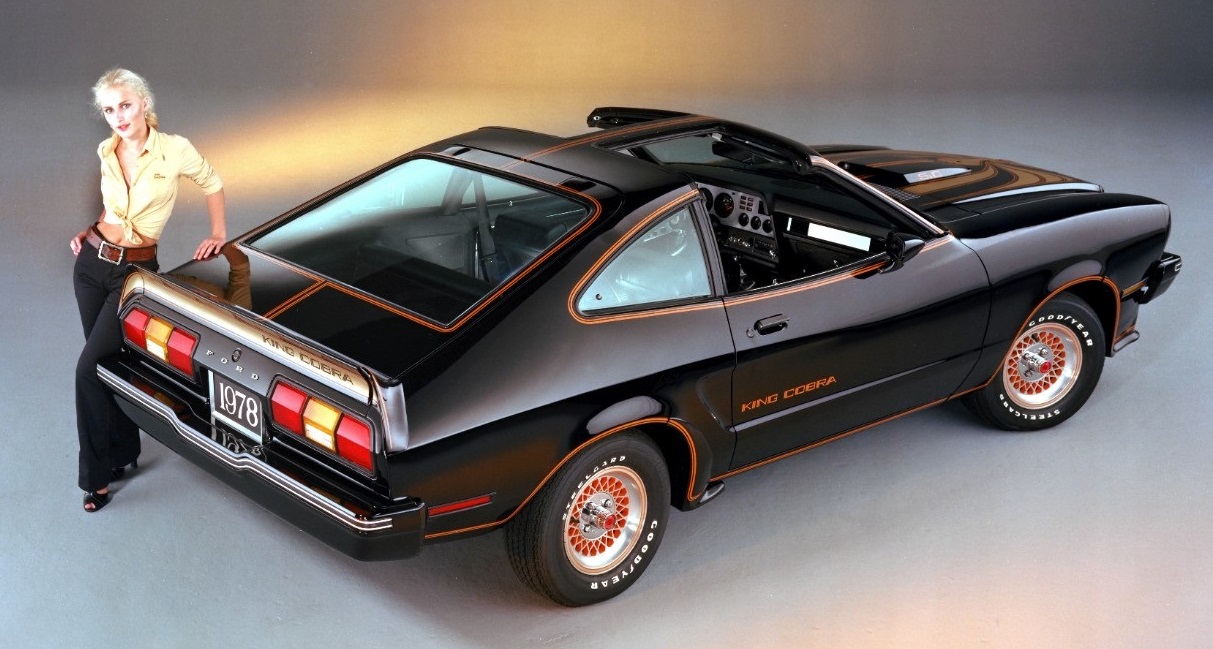
The 1978 Mustang II King Cobra.
First-year sales were 385,993 cars, compared with the original Mustang’s 12-month sales record of 418,812. Ultimately, the Mustang II would be an early example of downsizing that would take place among Detroit’s Big Three later in the decade.
3rd Generation: 1979–1993
The redesigned 1979 Mustang was moved to the larger Fox platform, initially developed for the 1978 Ford Fairmont and Mercury Zephyr.
With the introduction of the Fox Body Mustang in 1979, more European design language was adopted inside and out. The two-spoke wheel from Mustang II was replaced with a four-spoke wheel, which was later shared with other Ford products.
The updated four-spoke wheel.
A larger body
The 1979 Mustang was based on the larger Fox platform (initially developed for the 1978 Ford Fairmont and Mercury Zephyr). The larger body with an increased wheelbase yielded more interior space for four passengers, especially in the back seat, as well as a larger capacity trunk and a bigger engine bay.
For 1980, the 302-cubic-inch V-8 engine is dropped and replaced by an economical 119-hp, 255-cubic-inch derivative of the “Windsor” small-block V-8.
From 1981.
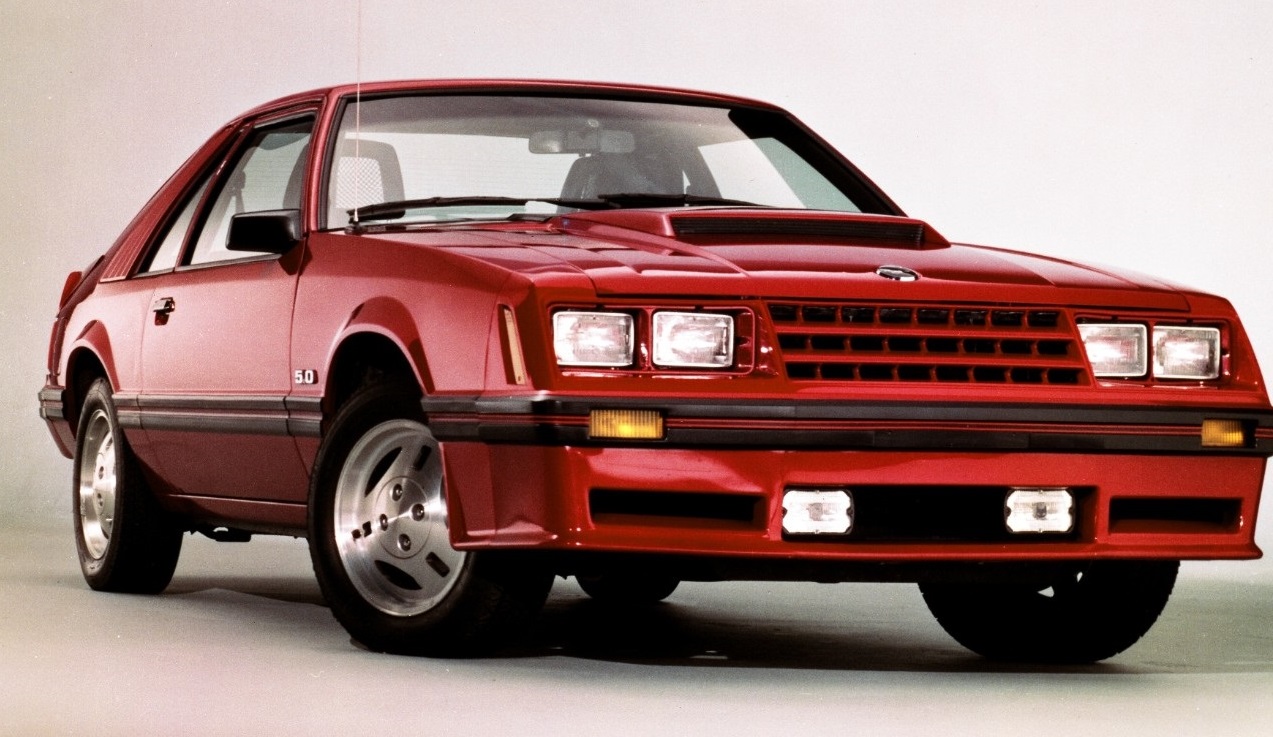
The 1982 Mustang GT.
Body styles included a coupé (or notchback), hatchback and convertible.
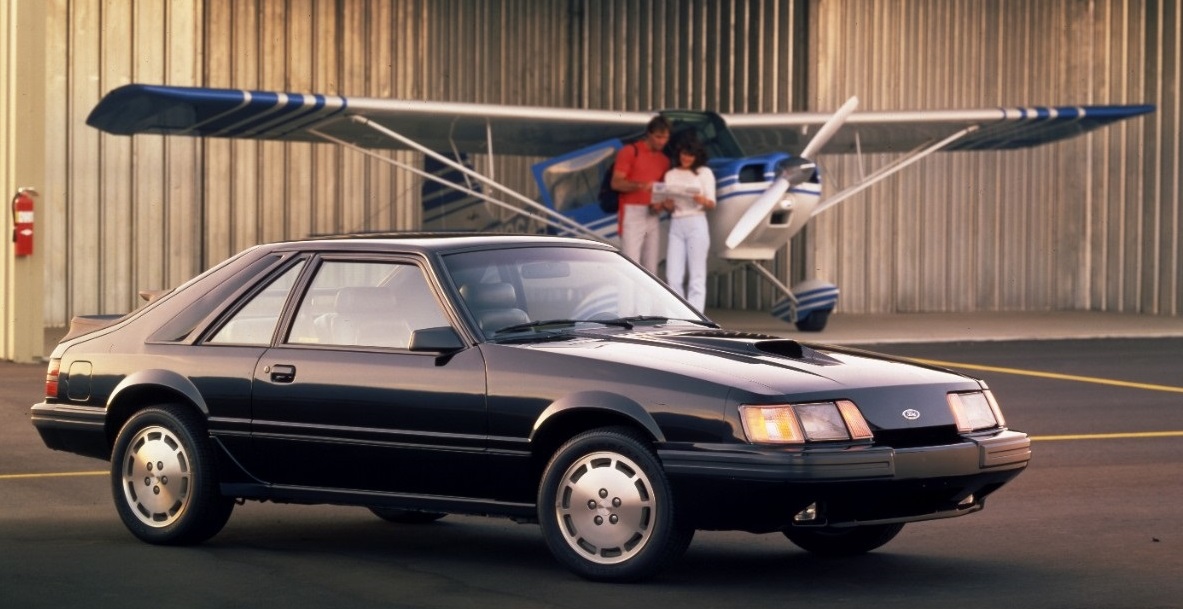
The GT-350 20th Anniversary Edition was added in 1984, and the high-performance SVO model ran from 1984–1986 followed by the Cobra R in 1993.
After 10 years, Mustang again has a convertible model for 1983. It featured a power top and a tempered glass back window.
The third-generation Mustang had two different front-end styles. From 1979 to 1986, the front end was angled back using four rectangular headlights, known by enthusiasts as “Four Eyes.” The front end was restyled for the 1987 to 1993 model years to reflect the contemporary, rounded-off “aero” style of the Ford Taurus using flush-composite headlamps and a smooth grille-less nose.
The 1986 Mustang SVO.
The Mustang was selected as the 1979 Official Indianapolis 500 Pace Car with replicas sold to the public. Its special body-appearance parts were adapted by the Cobra package for 1980-81.
The Mustang received a major restyling for 1987, including the interior, which carried it through the end of the 1993 model year.
The 1987 GT convertible.
Under the newly-established Ford SVT division, the 1993 Ford Mustang SVT Cobra and Cobra R were added. These special, high-performance models closed out the third generation of the Mustang.
4th Generation: 1994–2004
The launch of the fourth-generation Mustang included a nod to the original 1964 pony car. The new model had a twin cockpit layout and sculpted modern styling for the steering wheel and air bag.
The interior redesign made the various buttons easier to use, while allowing for the driver to keep eyes on the road and hands on the wheel. Horn buttons were replaced with a hinged air-bag cover, acting as horn control at the wheel’s center.
The Notchback Coupe
In November 1993, the Mustang debuted its first major redesign in 15 years. Code-named “SN-95” by the automaker, it was based on an updated version of the rear-wheel-drive Fox platform called “Fox-4.” The new styling by Patrick Schiavone incorporated several styling cues from earlier Mustangs. For the first time since its introduction 1964, a notchback coupe model was unavailable.
The 1995 Cobra coupe.
For 1999, the Mustang was reskinned with Ford’s New Edge styling theme with sharper contours, larger wheel arches, and creases in its bodywork, but its basic proportions, interior design, and chassis remained the same as the previous model.
“New Edge” styling.
There were also three alternate models offered in this generation: the 2001 Bullitt, the 2003 and 2004 Mach 1 and the 320-hp 1999 and 2001, and 390-hp 2003 and 2004 Cobra.
Convertibles from 1999, 1994, and 1965.
The 2000 SVT Mustang Cobra.
The 2001 Mustang Bullitt GT, in the likeness of the 1968 from the movie.
The 2003 Mach 1.
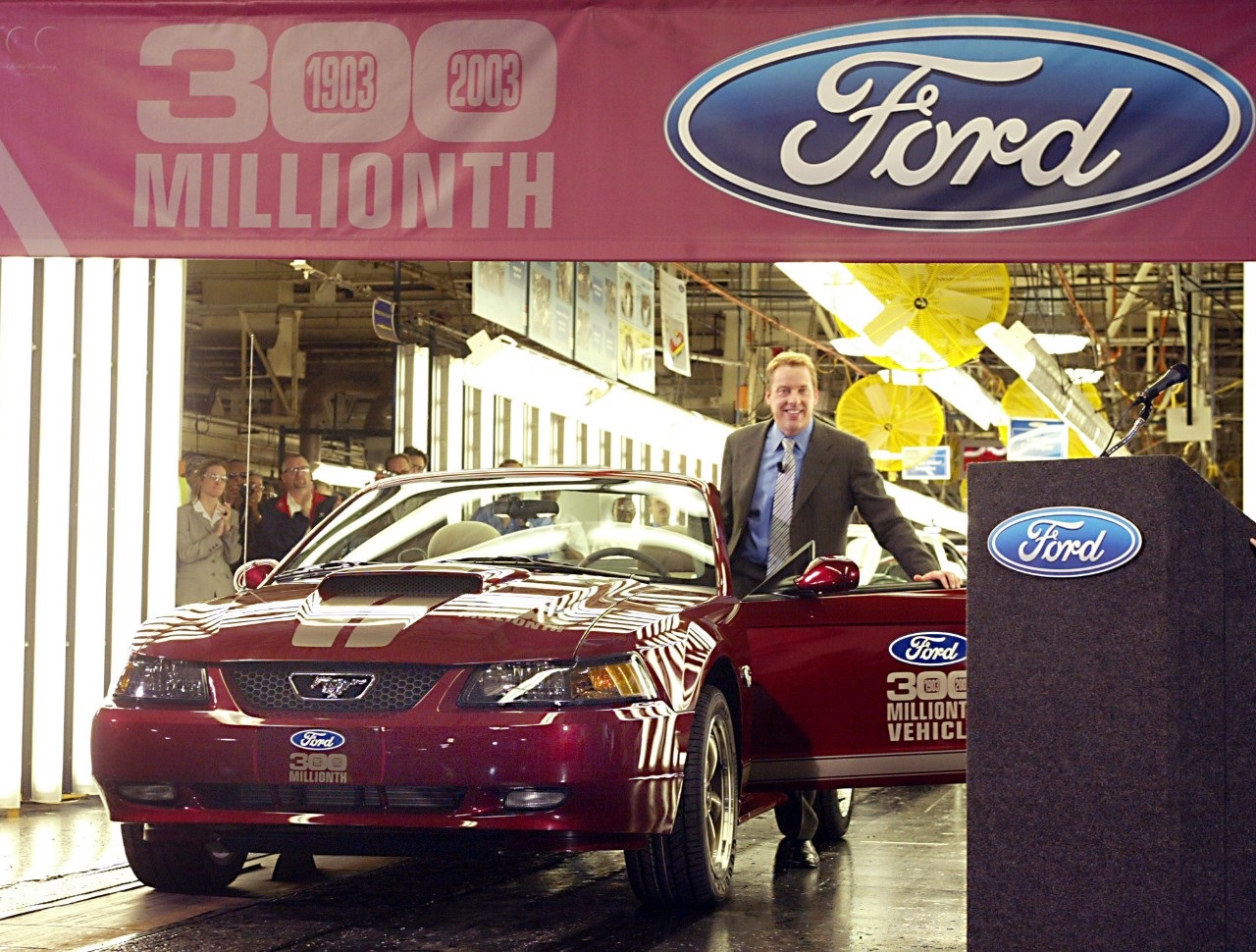
Bill Ford presents the 300 millionth Ford vehicle, a 2004 Mustang GT convertible 40th-anniversary edition. The 2004 Mustangs are the last cars built at Ford’s Dearborn Assembly Plant, which had produced every model Mustang year since the car’s inception.
5th Generation: 2005–2014
The redesigned model for 2005.
Retro Futurism
The redesigned 2005 Mustang recalls the fastback Mustangs of the late-1960s. Ford’s senior vice president of design, J Mays, called it “retro-futurism.” The fifth-generation Mustang was manufactured at the Flat Rock Assembly Plant in Flat Rock, Mich.
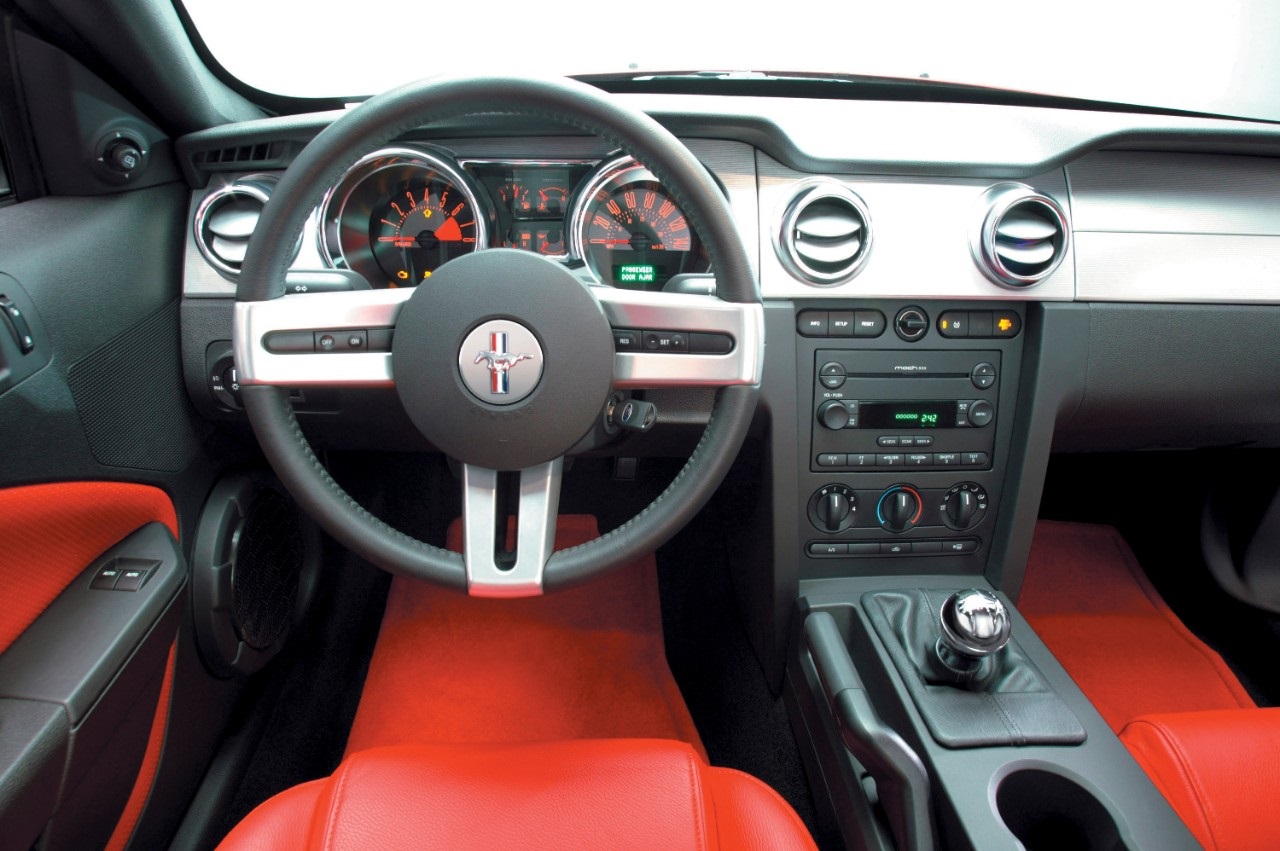
A 2005 GT convertible instrument panel.
The refreshed 2010 Mustang was released in the spring of 2009 with a redesigned exterior — which included sequential LED taillights.
2007 Mustang Shelby introduces a 500-hp supercharged 5.4-liter V-8.
For 2012, a new Mustang Boss 302 version was introduced. And in the second quarter of 2012, Ford launched an update to the Mustang line as an early 2013 model.
The 2012 Mustang Boss 302 Laguna Seca.
The 2013 U.S. Air Force Thunderbirds Edition Mustang.
6th Generation: 2015 to present
The sixth-generation redesign added a wider and lower body and, for the first time, a fully independent rear suspension. A 2015 Mustang GT is shown.
The sixth-generation Mustang was unveiled on Dec. 5, 2013, in Dearborn, Mich., New York City, Los Angeles, Barcelona (Spain), Shanghai (China), and Sydney, Australia. The internal project code name is S-550.
The 2017 Mustang adds a 2.3-liter turbocharged four-cylinder engine.
Changes include a body widened by 1.5 inches and lowered 1.4 inches, a trapezoidal grille, and a 2.75-inch lower decklid. A new independent rear suspension (IRS) system was developed specifically for the new model.
The 10 millionth Mustang sold was a 2019 Wimbledon White GT convertible with a 460-hp, V-8 and six-speed manual.
The 2018 model year Mustang featured a minor exterior redesign and the debut of a 310-hp, 2.4-liter turbocharged (Ecoboost) four-cylinder. The 3.0-liter V-6 was dropped.
The 5.0-liter V-8 got a power boost to 460 hp and 420 lb-ft torque. The automatic transmission for all models was upgraded to a 10-speed.
The 2020 Mustang GT500, the most powerful street-legal Ford to date. Its supercharged 5.2-liter V-8 producing more than 700 hp.
2022 Mustang Shelby GT500 Heritage Edition
The limited run of 2022 Mustang Shelby GT500 Heritage Edition fastbacks will be finished in Brittany Blue, inspired by the original hue.
The 760-horsepower Shelby GT500 Heritage Edition will also have a choice of two stripe options:
Painted over-the-top racing stripes with GT500 logo (available in Wimbledon White or Absolute Black);
Vinyl over-the-top racing stripes with unique vinyl side stripe featuring GT500 logo (in Wimbledon White).
Carroll Shelby took his legendary Mustang GT350 model further in 1967 to craft the first-generation Shelby GT500. It was modified with a 428-cubic-inch V-8 inspired by his team’s 1-2-3 finish at Le Mans.
Shelby called the original Shelby GT500 “the first real car I’m really proud of.”
The 2022 Mustang Shelby GT500 has a starting U.S. Manufacturer’s Suggested Retail Price of $73,465 — not including the $1,195 freight charge and $2,600 Gas Guzzler Tax.
The Shelby GT500 Heritage Edition package would add $2,140. And the GT500 Heritage Edition package with hand-painted stripes adds $12,140 to the Shelby GT500’s U.S. MSRP.
7th Generation: 2024 Mustang Redesigned
Ford says the new exterior design is heritage-inspired to appeal to the ‘broadest Mustang customer mindset yet.’
The completely redesigned 2024 Ford Mustang marks the seventh generation of the coupe sold ’round the world.
“Investing in another generation of Mustang is a big statement at a time when many of our competitors are exiting the business of internal combustion vehicles,” Jim Farley, CEO of Ford Motor Co., said in a statement. “Ford, however, is turbocharging its ICE growth plan, adding connected technology, opinionated derivatives, and hybrid options to our most profitable and popular cars — all in the Ford Blue family — on top of investing $50 billion in electric vehicles through 2026.”
Interior Treatment
The redesigned fighter jet-inspired cockpit is centered by two flowing and curved displays
The redesigned fighter jet-inspired cockpit is centered by two flowing and curved displays that can be quickly customized to show information the driver wants or needs to see.
The car’s 12.4-inch digital instrument cluster can display different animated designs and new drive-mode visuals. The customized capability is based on the same “Unreal Engine 3D” creation tool used in modern video games. When selecting personalized drive mode settings, the car’s current setup is displayed on the center stack as real-time graphical renderings. Settings can be adjusted by swiping the graphic to rotate the car virtually in a true gamified style.
“We’re taking advantage of every pixel,” said Ford Mustang interaction design manager Craig Sandvig. “We can be creative in showing necessary driving information and give the driver control of selecting colors, classic Mustang gauges, or even a ‘calm’ screen where only minimal details are displayed.”
Exterior Design
Ford says the new exterior design is heritage-inspired to appeal to the “broadest Mustang customer mindset yet.”
A low, horizontal brow across the front emphasizes overall frontal width, while the upper grille design shape is influenced by the original 1960s design. The Tri-Bar LED headlamps continue the Mustang’s classic lighting signature. The sleek roofline is meant to inspire a broad sprinting stance. And shortened rear overhang has the authentic proportions of the first generation — but with widened haunches.
Of interest to racers, the roofline allows drivers to enter and exit without removing their helmets. On the rear deck, new signature tri-bar lighting and a redesigned diffuser improved aerodynamic balance.
Also new for this generation is unique front-end styling for each model. The GT, for example, is differentiated from EcoBoost models by larger, more aggressive grille openings for increased airflow. The GT also has new hood vents and a redesigned front splitter.
The Mustang is assembled at Flat Rock Assembly Plant in Flat Rock, Mich.
Several Thrush J-6 airplanes were flown by female pilots during the early 1930s to make record-breaking endurance flights, including one in which the aircraft stayed aloft for almost 10 days.
The 1929 Curtiss Thrush bridged the gap between small personal aircraft and larger commercial airliners. (Photo from the Paul S. Maynard archive)
The Curtiss Thrush exemplified the transitional phase of aviation in the late 1920s. The 1929 Thrush bridged the gap between small personal aircraft and larger commercial airliners. Its design innovations and contributions to endurance flying underscore its significance in aviation history.
Introduced in 1929, the Curtiss Thrush is a six-passenger, high-wing monoplane developed by the Curtiss Aeroplane and Motor Co. Based on an enlarged version of the Curtiss Robin, the Thrush aimed to serve as a light transport and utility aircraft. Its development featured both Curtiss and Wright engines, reflecting the era’s rapid advancements in aviation technology.
Aviation historian Joseph P. Juptner, in his work “U.S. Civil Aircraft: Vol. 3,” noted that “the fuselage of the Thrush formed the basis for the twin-engine Curtiss Kingbird.” The plane’s design would highlight its influence on subsequent aircraft developments.
Design and Development
The initial prototypes of the Curtiss Thrush were equipped with 170 horsepower Curtiss Challenger engines. However, these engines were found to be underpowered for the aircraft’s design. Consequently, the production models designated Thrush J were outfitted with more robust 225-hp Wright J-6-7 Whirlwind radial engines. This upgrade significantly enhanced the aircraft’s performance.
The fuselage construction utilized a Pratt truss frame made primarily from duralumin tubing, a high-strength, lightweight aluminum alloy. Chrome-molybdenum steel reinforced high-stress areas, all covered in fabric. The wings featured solid spruce spars and stamped Alclad ribs, with a semi-cantilever design supported by steel tube struts.
The Curtiss Thrush J-6 “Outdoor Girl” flown by pilots Helen Richey and Frances Marsalis. (Photo courtesy of San Diego Air and Space Museum Archive)
Operational History
The Curtiss Thrush played a notable role in early aviation endurance records. In August 1932, pilots Louise Thaden and Frances Marsalis flew a Thrush J, named “I.J. Fox,” for 196 hours and 5 minutes. Their effort set an endurance record near Valley Stream, N.Y. This achievement contributed to Thaden receiving the Harmon Trophy in 1936. (“I. J. Fox” refers to their sponsor, a nationally known fur store operator founded by Isidore Joseph Fox.
Later, in December 1933, pilots Helen Richey and Frances Marsalis set another endurance record. The pair of women pilots flew another Thrush J, “Outdoor Girl,” for 237 hours and 42 minutes over Miami, Fla. (The plane was named for a brand of women’s cosmetics, a new sponsor.) Their Thrush J-6 was refueled from the air by a Curtiss Robin. The endurance flight further demonstrated the aircraft’s capabilities.
Internationally, the Thrush saw limited use. The China National Aviation Corp. ordered 12 units, but only 10 were produced, with just one making it to China in 1930.
Additionally, one Thrush was operated in Cuba by the Compañía Nacional Cubana de Aviación Curtiss. A subsidiary of North American Aviation Inc., the airline was the precursor to Cubana de Aviación, the national airline of Cuba.
This is another image from my dad, Paul Smith Maynard, who worked as an engineer in aviation for four decades. Dad began his career in about 1943 after graduating from West Virginia University. He started with Curtiss-Wright Corp., a pioneer in making flying machines. He went on to work at North American Aviation and Rockwell International. See more of his vintage plane pics here.
The Curtiss SC Seahawk, capable of being fitted with a float or wheeled landing gear, was America’s best World War II floatplane scout
More than 500 Curtiss Seahawk scout planes were built at the plant in Columbus, Ohio. The first flight of a prototype XSC-1 took place Feb. 16, 1944. (Photo from the Paul S. Maynard archive)
The Curtiss SC Seahawk was a scout seaplane launched from a Navy cruiser for observation. According to the plane’s page in Wikipedia, the single-seat seaplane landed in water and was retrieved by hoist. Though capable in concept, the Curtiss SC Seahawk did not see significant action during World War II. By the end of the war, helicopters were replacing seaplanes.
The Curtiss Aeroplane and Motor Co. designed the Seahawk for the U.S. Navy during World War II. In the late stages of the war and into peacetime, the Seahawk gradually replaced the existing Curtiss SO3C Seamew and Vought OS2U Kingfisher floatplanes.
A Curtiss Seahawk spotting plane hoisted aboard USS IOWA (BB-61), off San Francisco, July 1947. A second SC-1 is on the catapult at right. (Ted Huggins photo from the archive of Naval History and Heritage Command, Washington, DC)
Curtiss Production Order
Work began in June 1942 following a U.S. Navy Bureau of Aeronautics request for observation seaplane proposals. Curtiss submitted the Seahawk design on Aug. 1, 1942, and a contract for two prototypes and five service test aircraft was awarded on Aug. 25. Before the prototypes’ first flight, a production order for 500 SC-1s followed in June 1943.
While only intended to seat the pilot, a bunk was added in the aft fuselage for rescue or personnel transfer. Two .50 caliber M2 Browning machine guns were fitted in the wings, and two underwing hardpoints allowed the carriage of 250-pound bombs or surface-scan radar on the right wing. The wings were foldable. The main float, designed to incorporate a bomb bay, is claimed to have been prone to leaks. Curtiss modified the design to carry an auxiliary fuel tank.
Piloted by Ensign F.H. Gilkie, a Curtiss SC-2 Seahawk is catapulted from the USS Missouri (BB-63). The photo is dated Feb. 27, 1948. (Official U.S. Navy Photograph, from the archive of Naval History and Heritage Command, Washington, DC)
The first flight of a prototype XSC-1 took place on Feb. 16, 1944, at the Columbus, Ohio, Curtiss plant. Flight testing continued through April 28, when the last of the seven pre-production aircraft took to the air. Nine more prototypes were built under the designation SC-2 with a second seat and modified cockpit. Series production was not undertaken.
For retrieval, a Curtiss SC-1 Seahawk taxis up to a sea-sled towed by USS IOWA (BB-61) off San Francisco in July 1947. (Ted Huggins photo from the archive of the Naval History and Heritage Command, Washington, DC)
Seahawk History
The first serial-production Seahawks were delivered to the USS Guam on Oct. 22, 1944. All 577 aircraft eventually produced for the Navy were delivered on conventional landing gear. The planes were then flown to the appropriate naval air station, where floats were installed for service as needed.
Capable of being fitted with a float or wheeled landing gear, the Seahawk was America’s best World War II floatplane scout. However, its protracted development time meant it entered service too late to see significant action in the war. It was not until June 1945, during the pre-invasion bombardment of Borneo, that the Seahawk was involved in military action. By the war’s end, seaplanes were becoming less desirable, with helicopters replacing the Seahawk soon afterward.
The Seahawk’s tri-color camouflage and markings were required by U.S. Navy regulations from 1944 to 1945 and later postwar regulations.
There are no known surviving examples of the Seahawk today.
A Seahawk scout warms up its engine at a Pacific Base circa 1944-45. Note beaching gear and ladder, with an APS-4 radar pod under the wing. While only intended to seat the pilot, a bunk was provided in the aft fuselage for rescue or personnel transfer. (Naval History and Heritage Command, Washington, DC)
Curtiss SC Seahawk Specifications
Crew: 1, with space for a single stretcher patient
Note: This is another image from my dad, Paul Smith Maynard, who worked four decades in aviation as an engineer. Dad began his career in about 1943 after graduating from West Virginia University. He started with Curtiss-Wright Corp., a pioneer in making flying machines. He went on to work at North American Aviation and Rockwell International.
During the ‘Golden Age of Flight,’ the Curtiss Robin made history for several endurance stunts, including a ‘wrong way’ record
The 1928 Curtiss Robin debuted innovative features and was known as a reliable workhorse aircraft, setting several endurance records and stunts. (Photo from the Paul S. Maynard archive)
The Curtiss Robin looks spartan, but this high-wing monoplane gained popularity for its innovative features and remarkable performance.
This workhorse Robin, in production from 1928 to 1930, was one of the first commercially successful light aircraft, debuting several aviation firsts. Among the Robin’s innovations was a retractable landing gear, one of the first aircraft to be so equipped in the Golden Age of Flight. The Robin was also one of the first to be powered by a radial engine.
Along the way, the Curtiss Robin set more than one aviation record, including a “wrong way” record.
According to a report at the National Air and Space Museum, the Curtiss Robin was a departure by the Curtiss Aeroplane and Motor Co. into the emerging civilian market of the late 1920s.
“This three-seat monoplane flew in the spring of 1928 with a 90-hp Curtiss OX-5, the engine that had powered Curtiss JN-4 Jenny trainers in World War I. Robins offered flight characteristics as straightforward as their appealing lines and modest performance. A distinctive feature was side cockpit windows that ran almost to the floor.”
Constructed of a wooden wing and steel tubing fuselage, the Curtiss Robin had an enclosed cabin that set it apart from other aircraft of its era. The cabin accommodated two passengers seated side-by-side behind the pilot. The cabin’s enclosed structure provided protection against the elements.
The Robin was produced in St. Louis, Mo., in association with the Robertson Aircraft Corp. The fixed-base operation ran the contract air mail route between St. Louis and Chicago.
Famous Robin Stunts
According to the Museum Of Flight, the Robin was a practical airplane, but best remembered for unusual endurance flights.
In 1930, Dale ‘Red’ Jackson performed more than 400 consecutive slow rolls in his Robin.
In 1929, Dale Jackson and Forrest O’Brine spent nearly 17 days circling over St. Louis. But that record was surpassed in 1935 by the brothers Fred and Al Key, who flew their Robin for more than 27 continuous days. Fuel was delivered from another Robin via hose; mail, food, oil, and spare parts came via container on a rope.
One of aviation’s most endearing records was set in a Curtiss Robin by Douglas “Wrong Way” Corrigan. He allegedly set off from New York for California in July 1938 and touched down in Ireland 28 hours later, claiming that he had accidentally read his compass backward. The plucky pilot — who had been denied official permission to fly the Atlantic — thus earned his nickname.
The ‘Newsboy’ Robin
From September 1929 to May 1930, a Robin C-2 was used to deliver the McCook, Neb., Daily Gazette to rural Nebraska and Kansas communities. Dubbed “The Newsboy,” the airplane flew a nonstop route of 380 miles daily, dropping bundles of newspapers out of a hole in the bottom of the fuselage from 500 feet to local carriers. The Robin C-2 was powered by a Curtiss R-600 Challenger, a six-cylinder, double-row, air-cooled, radial engine.
Range: 785 miles cruising; 580 miles at full throttle
Source: Wikipedia; “Curtiss Robin 1932 – Specifications,” Aviation Heritage Foundation
This is another image from my dad, Paul Smith Maynard, who worked as an engineer in aviation for four decades. Dad began his career in about 1943 after graduating from West Virginia University. He started with Curtiss-Wright Corp., a pioneer in making flying machines. He went on to work at North American Aviation and Rockwell International.
The 1941 Curtiss O-52 Owl two-seat observation aircraft played a crucial role in U.S. Air Force intelligence gathering, but technological advancements made it obsolete at its debut
The 1941 Curtiss O-52 Owl was a large, advanced two-person observation aircraft ordered by the U.S. Air Force. The monoplane was ordered into production in 1939, but it was obsolete at its launch in 1940 and mainly saw use as a trainer. (Photo from the Paul S. Maynard archive)
TThe Curtiss O-52 “Owl,” introduced in 1941, is a testament to the United States’ commitment to advancing its military aviation capabilities during World War II. A reconnaissance aircraft, the O-52 played a crucial role in intelligence gathering and surveillance operations, showcasing technological advancements of its time.
The O-52 Owl evolved from the earlier Stinson O-49 Vigilant and was designed by the renowned American aircraft manufacturer Curtiss-Wright Corp. The Owl’s robust construction and impressive performance made it an integral part of the U.S. Army Air Corps’ reconnaissance fleet. The plane’s distinctive features included a high-wing monoplane design, fixed landing gear, and an enclosed cockpit for the crew of two. A total of 203 O-52s were built.
In 1941, however, the aircraft became unsatisfactory to modern combat situations in overseas areas, according to a report in AeroCorner.com. Consequently, the aircraft was consigned to perform courier roles inside the United States and for anti-submarine warfare (A/S) on the Gulf of Mexico, Atlantic, and Pacific oceans. In November 1942, the Soviet Union ordered 30 aircraft in the Lend-Lease policy.
Performance
The Curtiss O-52 boasted a maximum speed of 220 mph and was powered by a 600-horsepower Pratt & Whitney R-1340-51 Wasp nine-cylinder radial engine. Its endurance and range were vital for long-duration reconnaissance missions, providing critical information for military strategists during global conflict.
The importance of the Curtiss O-52 in wartime operations cannot be overstated. As aviation historian John M. Andrade notes in his book “U.S. Military Aircraft Designations and Serials: 1909 to 1979.” “The O-52 was a significant improvement over its predecessor, the O-49 Vigilant.” The book highlights how the O-52 offered enhanced capabilities, demonstrating Curtiss-Wright’s commitment to innovation in military aviation.
According to a report in HistoryOfWar.org, the O-52 two-person cockpit was extensively glazed, and the wing was mounted on top of the cockpit glazing. The Owl had a retractable undercarriage, with the wheels pulling back into wells in the side of the fuselage. There were dual controls and doors on the cockpit floor to use a camera.
“To give the plane good low-speed handling, it had full-length automatic leading-edge slots linked to wide-span trailing-edge flaps that operated whenever the slots were extended.
“It was armed with one fixed forward-firing machine gun and one flexibly mounted machine gun in the observer’s position. It had a retractable turtle back, first developed for the [Curtiss] SOC Seagull scout observation seaplane, which improved the observer’s field of fire.
In the ever-evolving landscape of military aviation during World War II, the Curtiss O-52 Owl was pivotal in shaping the success of reconnaissance and intelligence operations. Its design, performance, and adaptability underscored the United States’ commitment to staying at the forefront of aviation technology during global conflict, leaving an enduring legacy in the annals of military history.
1941 CURTISS O-52 OWL SPECIFICATIONS
Mission: Reconnaissance aircraft used by the United States Army Air Corps during World War II
One .30 caliber M1919 Browning machine gun in the forward fuselage;
One .30 caliber M1919 Browning machine gun in the rear cockpit;
Bombs or photo-reconnaissance equipment could be carried under the wings.
Sources: Wikipedia and HistoryOfWar.org
Note: These specifications reflect the Curtiss O-52 Owl’s design and performance characteristics, highlighting its role as a reconnaissance aircraft during a critical period in aviation history. Specific details might vary slightly depending on the variant and modifications made to individual aircraft during their operational lifespan.
This is another image from my dad, Paul Smith Maynard, who worked as an engineer in aviation for four decades. Dad began his career in about 1943 after graduating from West Virginia University. He started with Curtiss-Wright Corp., a pioneer in making flying machines. He went on to work at North American Aviation and Rockwell International.