The rise and fall and rise again of auto racing and its impact on the urban landscape of Southern California

Racers on the Point Loma Road racecourse in San Diego hustle along Chatsworth Boulevard and downhill on Canon. Book author Harold Osmer claims that ‘more automobile racing has taken place in Southern California than any other area of the world.’ (HOPubs)
While working on a graduate thesis on the non-stimulating topic of “Geography, Land Use Planning,” author Harold Osmer dug into a far more exciting topic: land used for auto racing in Southern California.
In the third revision of his book “Where They Raced Turn 3,” Osmer lays down the groundwork for his claim that “more automobile racing has taken place in Southern California than any other area of the world.”

“Where They Raced Turn 3: Auto racing venues in Southern California, 1900-2020;” by Harold Osmer; 144-page softcover landscape format; 340 images; $34.95 U.S., with express shipping. Order the book at HOPublishing.com
In his thesis research, the academic question was, he said in the book, “Where and when were race tracks located and what effect did they have on future land use?”
The results of his initial thesis became “Where They Raced,” published in 1996. The updated version, “Where They Raced LAP2,” came out in 2000.
Finding new details
While history has not changed, Osmer has learned much and tapped the Internet for details not easily unearthed since “LAP2.” And those additions are chronicled in “Turn 3.”
His three books have always been about the geography of SoCal auto racing instead of the personalities and technological aspects of motorsports.
By his definition, Southern California reaches north to include Bakersfield and Ventura, south to San Diego, and east to the state line.
Racing venues were established in Santa Monica and Beverly Hills. San Diego County had several tracks, including on the grounds of what is now Sea World. And there was racing on the grounds of Television City in Los Angeles. And L.A. had four very different tracks by the name of Ascot.
“Chances are good that there was an auto-racing venue within a few miles of wherever you are in Southern California,” Osmer wrote. And that is true of my experience in San Diego.

The Silvergate Speedway in San Diego ran from 1933 to 1936. (HOPubs)
Point Loma Road Race
I live just off what was the route for the Point Loma Road Race of 1915. It was one of the opening events for the 1915 Panama California Exposition. The 5.9-mile-long race circuit had dramatic elevation changes, a few tight curves, and a 2-mile flat straightaway on dirt roads, Osmer wrote.
“Racers went along Rosecrans Street to Chatsworth Boulevard then down along Canon Street back to Rosecrans on what reporters dubbed a ‘legless horse’ pattern. Drivers circled the course 51 times for a total distance of 305 miles on January 9, 1915.”
Today as I drive along Chatsworth or Canon, I try to relive the scene. The big Stutzes, Mercers, Peugeots, or Duesenbergs being arm-wrestled into a powerslide through the rutted dirt turns and the occasional decreasing radius. The engines poured out exhaust smoke and the dirt track churned up billows of dust.
That was the final actual road race held in San Diego, Osmer wrote. And it would be another 15 years before professional automobile racing would return.
Race venues in Southern California
“Where They Raced Turn 3” chronicles road-race courses, dirt-track speedways, small and oval racing venues, and drag racing.
Osmer tells a good story with much input from knowledgeable sources. The black-and-white images, 340 of them, are compelling to see and truly define the blood sport that is motor racing.
The book is a vibrant recount and revitalization of historical motor racing locations.
Southern California impact
“This book is less about who and what raced in favor of the when and where they raced,” Osmer wrote. “Chances are good that there was an auto-racing venue within a few miles of wherever you are in Southern California.
“Look around, and listen for the echoes of the motors and the cheers from the fans.”


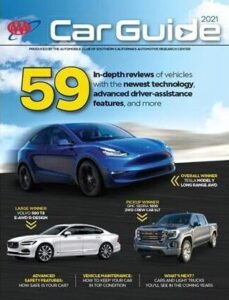 According to AAA, driver interest in advanced safety technology is high. When asked which of these systems they want in their next vehicle, two-thirds (67 percent) of drivers said automatic emergency braking, followed by reverse automatic emergency braking (63 percent) and lane-keeping assistance (61percent). A majority of new vehicle models come equipped with at least one of these systems.


 The ISO Bizzarrini AC/3 featured in Retromotive magazine. (Saam Gabbay)


 Most of his finds are beyond the financial resources of caring adopters to resuscitate these battered beauties and return them to a glorious rebirth. But it’s sure fun to read their stories. Among them, the complete but ratty 1966 Lotus Europa Type 46, bought from the original owner and stashed in a garage for 30 years. Cotter called it “a real time capsule,” still shod with 13-inch American Racing Libra aftermarket wheels. There is a lot of American iron on the pages of Motor City, most of which had been salted away in storage before the road salt ate the entire car. But there is shadowy intrigue in the occasional marque from Europe or from a race shop or an old chop job. Cotter tells a good tale and Ross has an explorer’s perspective in capturing the visual storytelling. Info: “Motor City Barn Finds: Detroit’s Lost Collector Cars,” published by Motorbooks; $35 hardcover; 208 pages.
  With the takeover by communists in 1959 and the subsequent trade embargos, whatever cars were on the island stayed on the island without access to parts. But that didn’t stop the locals from driving those beaters and keeping them on the road with creative alternatives to factory replacement parts. Tom Cotter, known largely for his barn-find car books, went back in time with Bill Warner (founder of the Amelia Island Concours) to learn the island’s automotive history. The initial assignment was a focus on early auto racing, which had a start in 1903 and continued in the mid-1950s for the three Cuban Grand Prix. Sir Stirling Moss, who won two of the three race, wrote the foreword. “The kidnapping of “El Maestro” Juan Manual Fangio, in 1958 somewhat defined the direction the country was to go,” he wrote. Cotter and Warner visited Cuba just as the country was again opened to the U.S. But Cotter urges that it will be too late to experience the old ways once they start building McDonald’s restaurants and Home Depots. The photos in “Cuba’s Car Culture” are familiar from others that I’ve seen online and in other books, but it is the storytelling of Cotter and Warner that weld fresh metal into the story. Info: “Cuba’s Car Culture: Celebrating the Island’s Automotive Love Affair,” published by Motorbooks; $35 hardcover; 192 pages.