Select Page

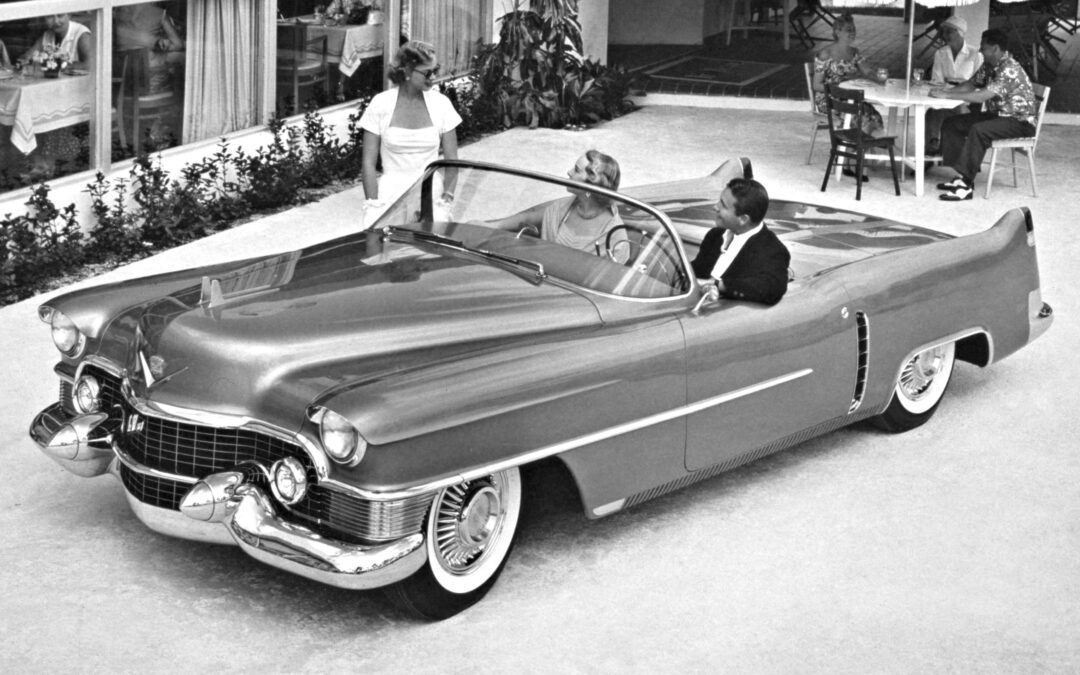
1953 Cadillac Le Mans Concept

1953 Cadillac Le Mans Concept

Harley Earl’s revolutionary Cadillac Le Mans concept was a look into the future of automotive design

The 1953 Cadillac Le Mans concept convertible

The 1953 Cadillac Le Mans concept, named for the 24 Hours of Le Mans endurance race in France, never went into production, but the design was an exercise using fiberglass and two-seater design. (GM Archives)

BY MARK MAYNARD

The 1953 Cadillac Le Mans was a star dream car at the 1953 General Motors Motorama. The big Caddy’s futuristic design and powerful performance impressed the public and the automotive press, and it helped to set the stage for the next generation of Cadillac cars.

Designed by GM’s legendary design chief, Harley Earl, the Le Mans concept was named for the 24 Hours of Le Mans race in France, in which Cadillac competed in 1950.

Earl uses the concept car to showcase Cadillac’s vision for the future of automotive design. The Le Mans concept was a two-seat, fiberglass-bodied roadster with a low profile and a long, sleek body. Innovative design elements included a wraparound windshield, hidden headlights, and a tailfin design that would become a signature feature of Cadillac cars in the 1950s.

The Le Mans concept’s sporty styling closely resembled the 1954 Eldorado limited production convertible, according to a report at SuperCars.net  Compared to a standard Cadillac convertible, the Le Mans was nearly eight inches lower and its fiberglass body and 115-inch wheelbase made it 400 pounds lighter.

While the 1953 Le Mans concept was never put into production, four versions of the Le Mans concept were built, of which three are accounted for today. One is in the GM Heritage Center in Detroit. But there is some mystery as to the whereabouts of the fourth car, explained in a 2013 AutoWeek story by Wallace Wyss.

1953 Cadillac Le Mans Specifications

Body style: 2-seat roadster; fiberglass body on steel ladder frame

Engine: 6.4-liter, 331-cubic-inch 250-horsepower Cadillac V-8

Transmission: 4-speed Hydramatic

Wheelbase/Length: 116/196 inches

Width/height: 74/51 inches

Curb weight: 4,405 pounds


Other story sources:

Ford Wins 1966 24 Hours of Le Mans

Ford Wins 1966 24 Hours of Le Mans

The 2021 89th edition of the 24 Hours of Le Mans will take place Aug. 21-22

A Ford GT 40 racecar passes beneath the big Dunlop tire race bridge at the 1966 24 Hours of Le Mans.

A Ford GT40 Mk II at the 1966 24 Hours of Le Mans. (Ford PR archive)

BY MARK MAYNARD

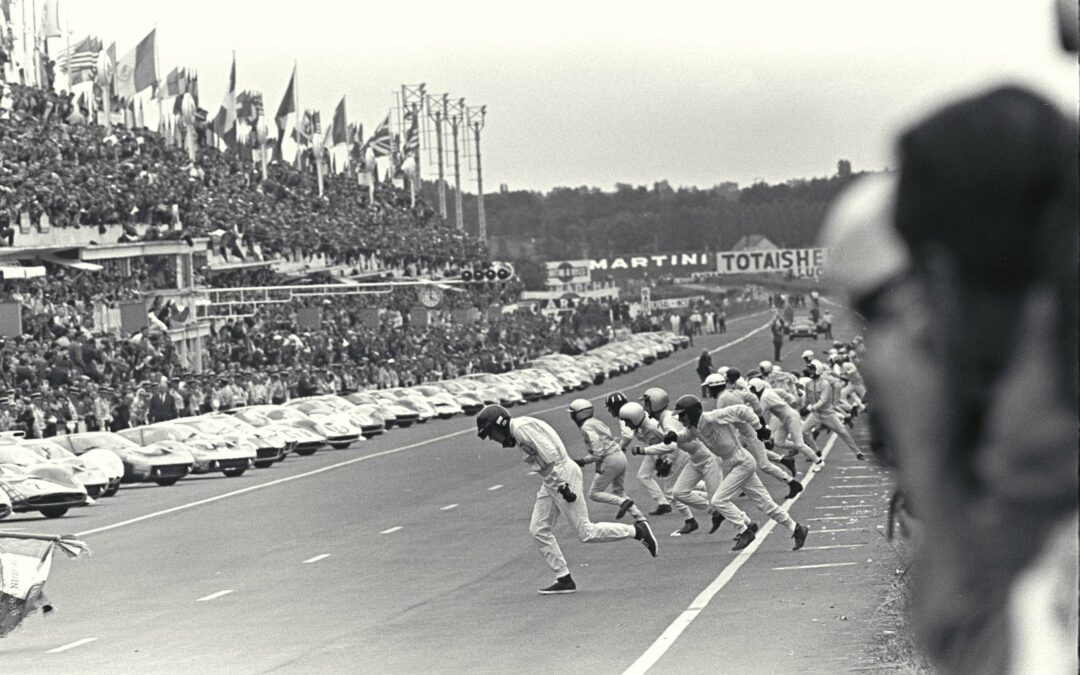
Perhaps overlooked in the Juneteenth celebrations this year was the historic win for Ford Motor at the 24 Hours of Le Mans. It was June 19, 1966, when Ford won the endurance race, placing first, second and third, according to a post at AutomotiveHistory.org.

“When the 1966 24 Hours of Le Mans came to an end on this day in 1966 it was a Ford GT40 in first, second and third place, marking the first time an American automobile won the race. With the three Mk. II Fords so far out in front.”

89th edition of the 24 Hours of Le Mans

After last year’s closed-door event, the 2021 24 Hours of Le Mans will take place Aug. 21-22 with trackside spectators. Tickets went on sale today, June 21. Learn more at the track’s website. 

2021 ticket prices

  • Race Week General Enclosure Pass: $106.05 (€89)
  • Weekend General Enclosure Pass: $94.13 (€79)
  • Practice/Qualifying Pass (valid for Wednesday and Thursday: $58.38 (€49)
  • Wednesday General Enclosure Pass: $43 (€36)
  • Thursday General Enclosure Pass: $51.23 (€43)
  • Weekend Grandstand Pass (general enclosure admission + grandstand seat): from $165.62 (€139)
  • Race Week Grandstand Pass (general enclosure admission + grandstand seat): from $177.54 (€149)

Free access

General Enclosure is free to those younger than 16, born on or after Aug. 22, 2005.

The grandstand is free to children younger than 8, born on or after Aug. 22, 2013.

Pandemic restrictions

Some COVID-19 restrictions are still in place for the race. Attendance is limited to 50,000 or 20 percent of the usual attendance.

The latest French government health pass (June 9, 2021) requires proof of one of the following:

Full vaccination (completed at least two weeks prior);

A negative PCR or antigen test result within the last 48 hours;

A person has recovered from COVID-19, attested by a positive PCR or antigen test result, at least 2 weeks and no more than 6 months old.

See more vintage car photography here

1939 Buick Roadmaster Indianapolis 500 Pace Car

1939 Buick Roadmaster Indianapolis 500 Pace Car

Buick’s motorsports history includes two NASCAR titles and six Indianapolis 500 pace cars

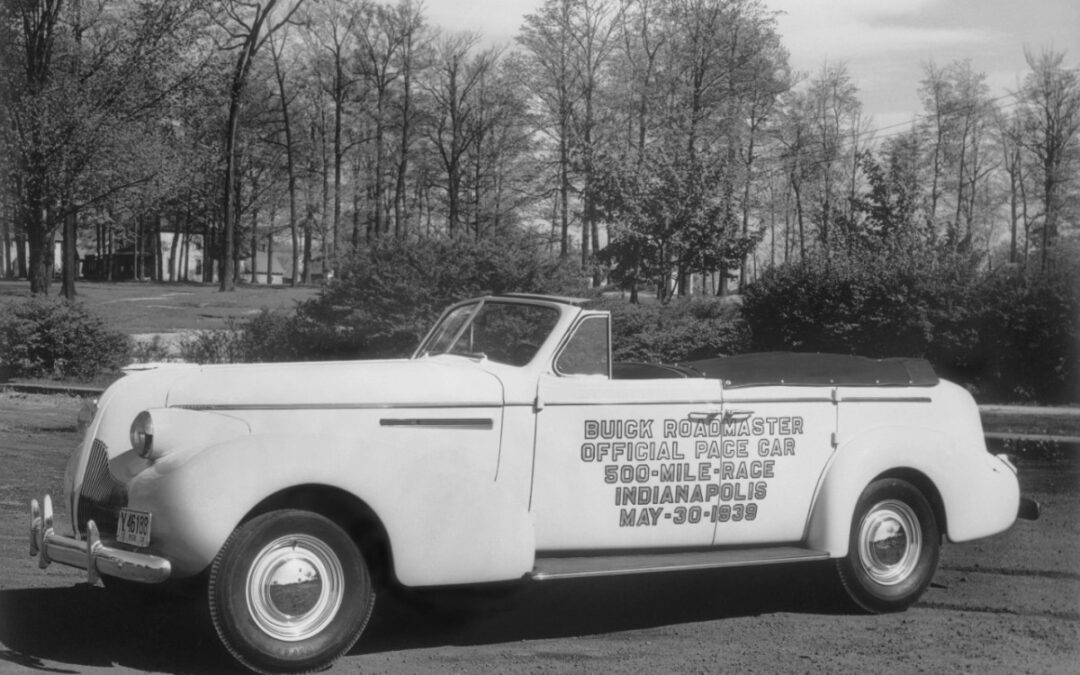
The 1939 Buick Roadmaster Indy Pace Car painted in creamy yelllow with black Indianapolis 500 lettering outlined in black

The 1939 Roadmaster Indianapolis 500 pace car was painted in creamy yellow with gold lettering outlined in black.  (GM media archives)

BY MARK MAYNARD

Just three 1939 Roadmaster Indianapolis 500 pace cars were built. The cars were based on the rare Roadmaster convertible “80C,”  according to an auction report by R.M. Sothebys.  Each car was presented in the “Indy 500 Livery” of the period-popular colors of creamy yellow with gold lettering outlined in black.

The red interior featured an elaborate, painted wood-grain dash in red and red leather upholstery. The Indy 500 treatment also included a black parade tonneau and a cloth top with boot.

Among the features in the Indy 500 package were dual side-mount spare tires and an accessory spotlight at the base of the driver-side windshield, though neither feature is shown in this marketing photo.

Buick History

Buick was on a roll in 1939 with innovative advertising and promotion.  Sales were soaring and there had been a host of product improvements, according to the 2011 auction report.

Buick boss Harlow Curtice was determined to set a new sales record. To stimulate sales, the 1939 Buick Roadmaster Indianapolis 500 pace car was created. It was based on the rare Roadmaster Convertible Sedan.

A new sales target of 200,000 cars was set and at the dealer’s kickoff meeting an airplane was displayed on stage with the number “200,000” painted on its wings. The campaign was successful as Buick sold more than 208,000 cars. The result solidified Buick’s position as No. 4 in the industry, behind only the Big Three.

R.M. Sothebys auctioned a 1939 Roadmaster Indianapolis 500 pace car at its 2011 Hershey, Pa., event. The car sold for $62,500.

Look here for more vintage car photos.

1954 Dodge Indianapolis 500 Pace Car

1954 Dodge Indianapolis 500 Pace Car

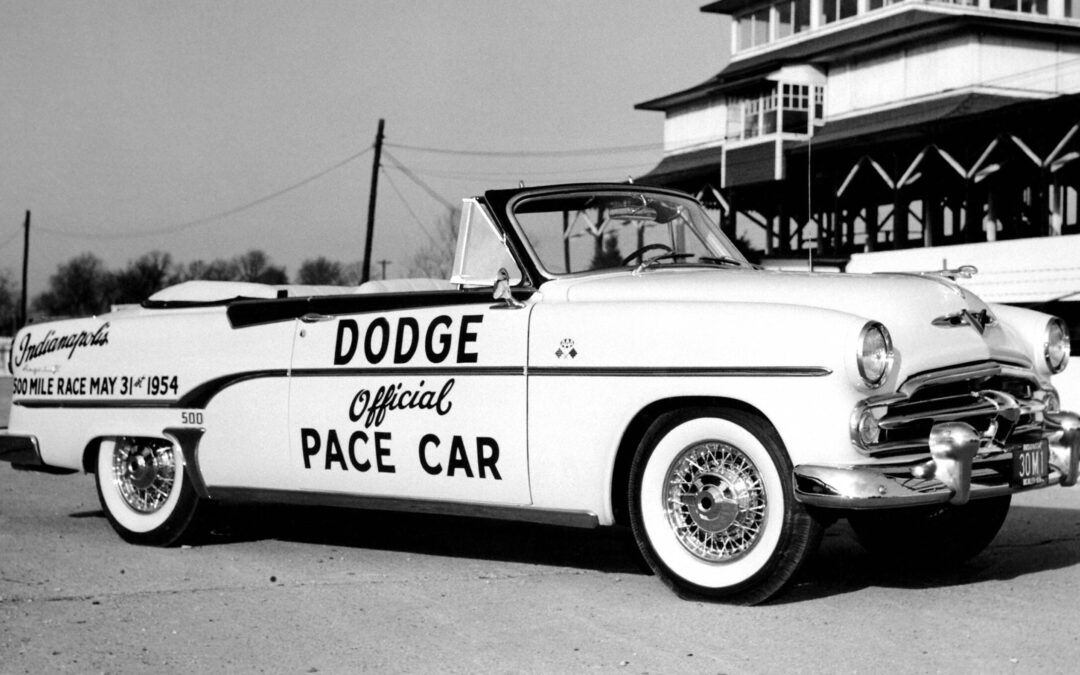
The 1954 Dodge Royal Indianapolis 500 pace car was a good example of race marketing

1954 Dodge Royal Indianapolis 500 pace car

There were 701 Indianapolis 500 pace-car replicas built and all were painted two-tone Pace Car Yellow and Jewel Black. (Stellantis media archives)

BY MARK MAYNARD

Chevrolet has a long history of offering replica Indianapolis 500 pace cars, but other makers, such as Dodge, took advantage of the marketing opportunity, too.

The Dodge Royal was introduced in 1954 as the top trim level. Many enthusiasts consider the Royal as the Dodge division’s first muscle car.

To direct attention to the new model, Dodge created the 1954 Dodge 500 Indy Pace Car. It was offered only with a 150-horsepower, 241-cubic-inc, Red Ram Hemi V-8 engine.

There were 701 pace-car replicas built and all were painted in the two-tone Pace Car Yellow and Jewel Black, according to a report at BringATrailer.com.

1954 Dodge Indianapolis Pace Car

The Royal slotted above the mid-level Dodge Coronet and the base level Meadowbrook, according to the car’s page in Wikipedia. The Royal lineup consisted of a four-door sedan, a convertible, club coupe and a two-door sport coupe hardtop.

The pace car was designated the Royal 500 and cost $2,808. Its MSRP was $201 more than the regular model, according to SignificantCars.com. “The buyer got the same equipment as the actual pace car, including a Continental-style rear spare-tire mount, Kelsey Hayes wire wheels and special trim and lettering.”

The Red Ram V-8 engine used a Stromberg two-barrel carburetor with 7.5:1 compression and solid valve lifters. It was rated at 150-hp at 4,400 rpm.  But the actual pace car was fitted with a custom Offenhauser intake manifold and Rochester four-barrel for a reported 170 bhp at 4,400 rpm,” according to SignificantCars.com.

“The Offy manifold that went on the actual pace car might have had a Rochester because Offenhauser preferred Rochester carbs in those days, the author wrote. “I believe Dodge made their own cast iron manifold for the replicas and put a 450 cfm Carter WCFB on those. This manifold and carb setup was available on pace car replicas via special order.”

1956 Volvo 122 ‘Amason’ aka Amazon

1956 Volvo 122 ‘Amason’ aka Amazon

A vintage corporate PR image showing three Volvo Amazon cars being weighed together and lifted by a crane.This corporate PR image for the Volvo Amazon has the caption: “Three models are lifted to check their total weights.” (Photos courtesy of Volvo)


BY MARK MAYNARD

The Volvo Amazon was a midsized car manufactured and marketed by Volvo Cars from 1956 to 1970, according to its page in Wikipedia. It was introduced to the United States in 1959 as the 122S during the New York International Auto Show.

When introduced, the car was named the Amason (with an ‘s’) in tribute to the fierce female warriors of Greek mythology, the Amazons. German motorcycle manufacturer Kreidler had already registered the name. After negotiations, the two companies agreed that Volvo could only use the name Amazon within Sweden. Subsequently, Volvo began its tri-digit nomenclature and the line became known as the 120 Series.

Volvo invented the three-point seat belt in 1959

In 1959, Volvo claimed to be the world’s first manufacturer to provide front seat belts as standard equipment.

Ponton Styling 

The Volvo Amazon was sold in body styles of two-door sedan, four-door sedan, and five-door wagon — all noted for their ponton styling.

“The Amazon’s “ponton” (pontoon-like) three-box styling was inspired by U.S. cars of the early 1950s, according to Wikipedia. The ponton styling strongly resembled the Chrysler New Yorker sedan and the Chrysler 300C hardtop coupe. Amazon designer Jan Wilsgaard said he was inspired by an American Kaiser he saw at the Gothenburg, Sweden, port.

At introduction, the Amazon had a choice of two four-cylinder engines. The base in-line OHV 1.6-liter had 60-horsepower and there was an uplevel 85-hp variant. Power upgrades came in 1961 with a 70- or 90-hp 1.8-liter four-cylinder, with a bump to 95-hp in 1965.

A colorful marketing image of a two-tone red and white Amazon surrounded by admiring caballeros

This group of caballeros (ranch hands) might be pondering an Amazon pickup.

The Volvo Amazon had floor-mounted manual transmissions had either three- or four-speeds, with or without overdrive. However, some cars were delivered with a steering-column shifter.

Always a safety innovator, Volvo invented the three-point seat belt. It then began to provide the front seat belts as standard equipment. The belts were added to all Amazon models, including those for export.

1954 Dodge Indy Pace Car

1954 Dodge Indy Pace Car

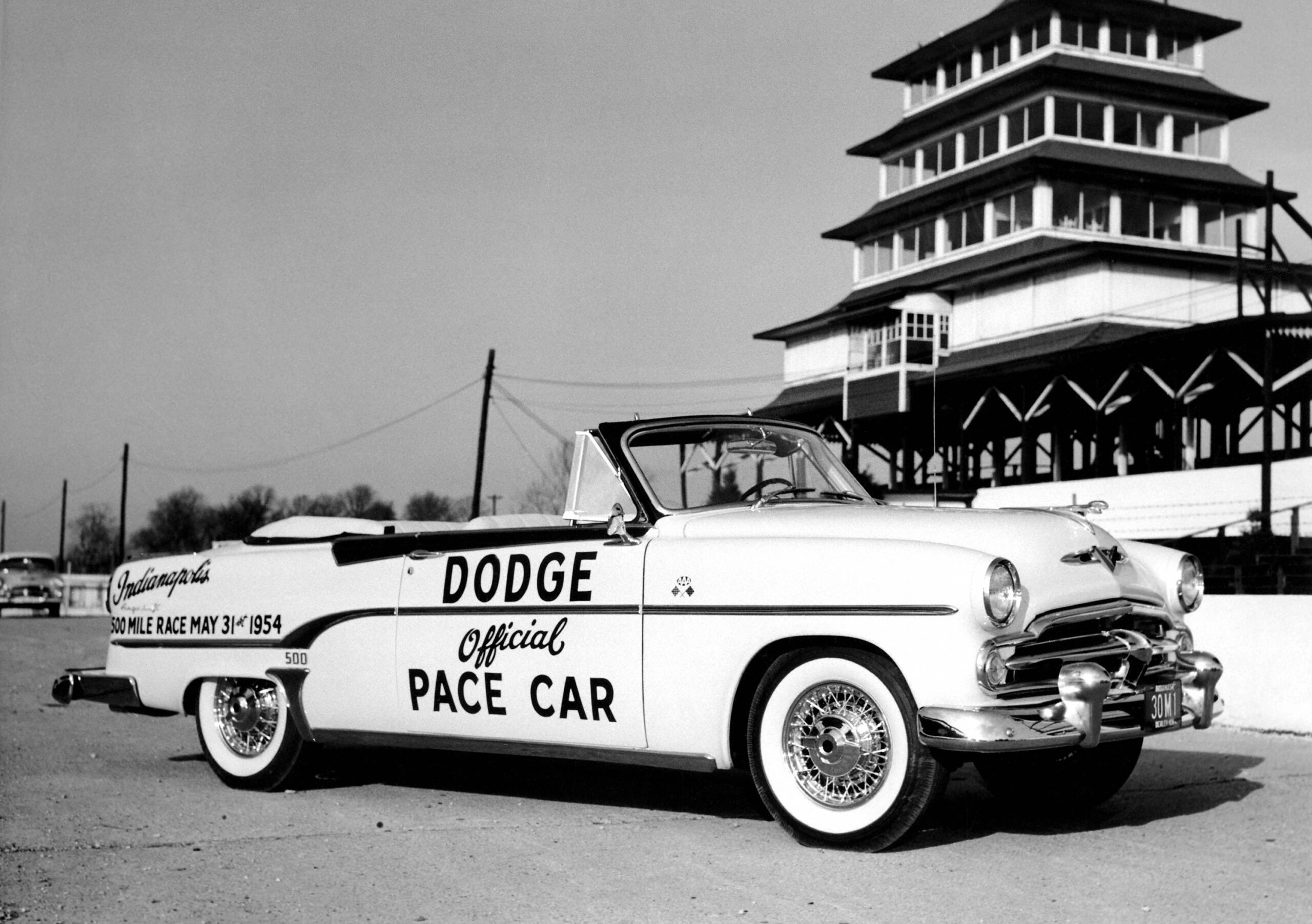
1954 Dodge Indianapolis 500 Pace Car.There were 701 Dodge Indy Pace Car 500 pace-car replicas built, all in Pace Car Yellow and Jewel Black. (Stellantis NV)
BY MARK MAYNARD

The 1954 Dodge Indy Pace Car was introduced for the debut of the new Royal top trim level. It was offered only with a 241-cubic-inch, 150-hp, Red Ram Hemi V-8 engine.

The Royal slotted above the mid-level Dodge Coronet and the base level Meadowbrook. The Royal lineup consisted of a four-door sedan, convertible, club coupe, and sport coupe two-door hardtop.

To direct attention to the new model, Dodge created the 1954 Dodge Indy Pace Car.

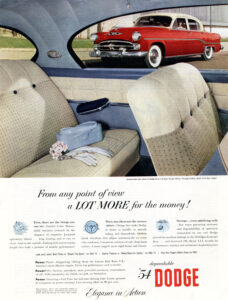
1954 Dodge print advertisement.

(Stellantis NV)

According to a report in BringATrailer.com , many enthusiasts consider the Royal the division’s first muscle car. There were 701 pace-car replicas built, “all which were painted Pace Car Yellow and Jewel Black two-tone.”

The cars were designated the Royal 500 and cost $2,808 — $201 more than the regular model, according to SignificantCars.com. “For that, the buyer got the same equipment as the actual pace car, including a Continental-style rear spare-tire mount, Kelsey Hayes wire wheels, and special trim and lettering.

A 1954 Dodge Royal two-door hardtop

The lineup consisted of a four-door sedan, convertible, club coupe and sport coupe, the latter being a two-door hardtop. (Stellantis NV)

Red Ram V-8

“Royal 500s came with the Red Ram V-8, which used a Stromberg two-barrel carburetor, had 7.5:1 compression and solid valve lifters and was rated at 150 hp at 4,400 rpm.

“The actual pace car was fitted with a custom Offenhauser intake manifold and Rochester four-barrel for a reported 170 bhp at 4,400 rpm. (‘The Offy manifold that went on the actual pace car may have had a Rochester because Offenhauser preferred Rochester carbs in those days. I believe Dodge made their own cast iron manifold for the replicas and put a 450 cfm Carter WCFB on those.’). This manifold and carb setup was available on pace car replicas via special order.”