Select Page

Toyota Crown Review

Toyota Crown Review

The 2024 Toyota Crown Hybrid restores the American pastime of driving for pleasure with up to 41 mpg highway and a cruising range of 600 miles

A red Crown parked along am outcrop of granite

The 2024 Toyota Crown hybrid has standard all-wheel drive and two choices of gasoline-electric powertrains, with fuel-economy estimates of up to 41 mpg on the highway. Pricing starts at $41,445. (Photography by Mark Maynard)

Jump To Table of Contents

The Reimagined Sedan
Toyota Crown History
2024 Toyota Crown Pricing
Which Crown Fits You?
Ride and Handling
Powertrains and Performance
Interior Function
Safety Features
Why Buy the 2024 Toyota Crown?
Specifications

BY MARK MAYNARD

The 2024 Toyota Crown is one of the most pleasurable hybrid sedans I have driven — and I did not expect to like it. The Crown exterior looked awkward in photos, as if it was built for an EV skateboard platform (think Mustang Mach-E). The design treatment has some SUV influences in the fender overriders and black center swipe along the lower body.

The body styling is fast, like a sport sedan. It has a slightly elevated ride height, standard on-demand all-wheel drive, and expansive trunk-cargo capacity. But do these fundamentals define the Crown as a sport-utility car? A crossover? A hybrid of both? After a couple of hundred miles on a bonding drive, what it is did not matter.

The Crown feels luxurious in a sturdy and durable experience. The premium quality and varied textures of interior materials are not the Toyota of old. Nor are the Crown’s thorough soundproofing and road-smoothing suspension.

Top off the 14.2-gallon tank with 87 octane, queue the Proclaimers’ “I’m Gonna Be (500 Miles),” then engage the advanced cruise control and settle in for nearly 600 miles. With care, a driver can expect up to 41 mpg on the highway.

In the Toyota car lineup, Crown takes the slot where the Avalon flagship sedan held court from 1995 until it was discontinued in 2022.

However, Toyota already has at least nine hybrid models in its lineup, including the midsize Camry Hybrid sedan. Two of those gasoline-electric hybrids are plug-ins, and there is one battery electric, the bZ4X. But not one of those electrified Toyotas is anything like the 2024 Crown.

An upward rear view of the panoramic roof with trees showing through the glass

The Crown’s panoramic greenhouse.

The Reimagined Large Sedan

Built on Toyota’s rigid GA-K platform, Crown makes a bold entry with its hammerhead front end, the Kitana-like slice of LED headlights, and an elevated stance 19-inch or 21-inch wheels; Toyota says those 21s are the largest ever on one of its sedans.

It seems risky to re-enter the now-gone mainstream segment of large-midsize sedans, like Toyota’s Avalon and the Acura RDX, Chevrolet Impala, Chrysler 300, Kia 900, or Nissan Maxima. But there is a reason for this graveyard of greats.

With ever-increasing fuel economy and emissions regulations levied on sedans, manufacturers tried to beat the system with harder tires, lower ride heights, and lower rooflines for aerodynamics. The interior width was carved out slightly, but the cabin space felt cramped for the taller American motorist. The low ride height was uncomfortable for entry and exit, and sporty exterior styling often compromised sightlines. The final blow was pricing, sometimes $5,000 to $10,000 more than the midsize sedan in the lineup.

Now, enter the Crown sedan. It has all the elements stripped away from sedans to meet mileage standards. Crown has open sightlines, a higher hip entry point requiring no duck-and-drop, and tall headroom even with the panoramic roof. Switches, window lifts, and climate-control tabs are clearly marked and in easy reach. Better yet, there is no annoying touchscreen display to tap, tap, tap in search of a category. Everything the driver needs is designed for head-up driving.

I grew to like the exterior styling — and several passersby were compelled to praise the Crown’s strong stance and the 21-inch tire and wheel package.

Toyota Crown History

The 2024 Toyota Crown nameplate lacks prestige — or sexiness — in North America, but the model is rich in Toyota history.

According to the Crown page on Wikipedia, the nameplate was introduced in 1955 as the Toyopet Crown. “It holds the distinction of being the longest-running passenger-car nameplate affixed to any Toyota model.”

The Crown is also the seventh longest-running model nameplate in the world after the Mercedes-Benz S-Class (1954), Chevrolet Corvette (1953), Toyota Land Cruiser (1951), Volkswagen Transporter (1950), Ford F-Series (1947), and Chevrolet Suburban (1935).

Here’s another bit of trivia, also from Wikipedia. The Crown nameplate continues a Toyota tradition of naming their sedans “crown” in various languages. There are Crown, Corona, Camry, and Corolla, and there are names for types of crowns, such as Tiara, or other things associated with royalty, like Scepter.

Looking forward at the Crown driver area

Driver controls are placed for head-up driving.

A New Crown Family

a horizontal view of a dark blue 2025 Toyota Crown Signia crossover SUV

The 2025 Toyota Crown Signia.

There will be a family of Crowns, per Wikipedia, though Toyota PR would not confirm nor deny: “In 2022, Toyota [Japan] unveiled four different Crown models to replace the 15th-generation model. The first model that is available is the Crossover-type Crown, which is also marketed in North America as the sole Crown model.

The remaining three models, Sedan, Sport, and Estate, will be released in 2023 and 2024, respectively, and will be available in hybrid, plug-in hybrid, and fuel cell powertrains depending on the model.”

The Estate will be the upcoming Crown Signia SUV crossover. It is expected to go on sale this summer, 2024.

The dark gray leather wrapped and stitched

The leather-wrapped and stitched steering wheel gives a secure handshake to the driver.

Midsize Hybrid Sedan Choices*

  • 2024 Honda Accord Hybrid $34,000-$40,000; lithium-ion battery pack; fuel economy 48/47/47 mpg city/highway/combined using recommended 87 octane; total system power 212 hp combined.
  • 2024 Toyota Camry Hybrid $30,000-$35,390; lithium-ion battery pack; total system power 208 hp; fuel economy 51/53/52 mpg city/highway/combined, using 87 octane fuel.
  • 2024 Hyundai Sonata Hybrid $29,565-$37,715; lithium-ion battery pack; total system power 192 hp; fuel economy 44/51/47 mpg city/highway/combined, using 87 octane fuel.

Search for all hybrid cars at FuelEconomy.gov.

*Retail pricing includes the freight charge.

Looking at the back up image in the 12 inch multimedia screen

The 12.3-inch multimedia screen with multiview camera system.

2024 Toyota Crown Pricing

There are three trim levels to the 2024 Toyota Crown, all with standard all-wheel drive. There are two hybrid powertrains, including the 340-hp Hybrid MAX exclusive to the Platinum model.

Crown retail pricing includes the $1,095 freight charge from Aichi, Japan.

XLE $41,445 — no option packages available;

Limited $47,045 — 1 factory option package available;

Platinum $54,465 — no factory option packages available.

There are five paint colors, with three that are optional. Black and Magnetic Gray Metallic are no-cost. Available for $425 are Oxygen White, Heavy Metal (dark gray), and Supersonic Red.

And there are three no-cost interior colors of Black leather, Macadamia leather, and Black with Dark Chestnut Leather.

Find current Crown pricing here.

Check for Toyota Crown special offers here.

Today’s Crown Limited tester was $50,740 with two options: Bi-tone Supersonic Red with black $425, and the Advanced Technology package, $3,570, which adds:

  • 21-inch 10-spoke dark metallic alloy wheels
  • Panoramic view monitor with perimeter scan
  • Digital key compatibility (remote connect trial or subscription required)
  • Traffic Jam Assist (Drive connect trial or subscription required)
  • Front Cross-Traffic Alert
  • Lane Change Assist
The driver seat reclined all the way looks extremely relaxed

Waaay back recline for a road trip rest stop.

Which Crown Fits You?

XLE: Well-equipped with standard features and safety technologies, the XLE has the lightest curb weight and likely will have the highest fuel economy. However, the XLE has no access to factory option packages and has a black interior with fabric upholstery.

Limited: The Crown Limited would be my choice. The hybrid performance is strong throughout the entire power band. The work commuter would also benefit from the Advanced Tech package for its panoramic view monitor and added eyes for front-cross traffic alert and Traffic Jam assistance. The 21-inch wheels also look right and contribute to a strong stance without sacrificing ride quality or noise.

Platinum: Platinum is the loaded crown jewel with its turbocharged powertrain, Adaptive Variable Suspension, and Advanced Park (for automated assist when backing into or parallel parking). I haven’t driven this model — but it should provide thoroughbred performance with 400 foot-pounds of instantly available torque. The Platinum’s only fault could be its lower mileage ratings; it is the heaviest of the trim levels at 4,343 pounds. The standard suspension is so well calibrated for balance and weight control that the real-time damping of the adaptive suspension might be unnecessary.

the open door entry to the Crown front passenger seat, showing the gray and black interior.

The Crown Limited has leather-trimmed upholstery and heated and ventilated front seats.

Crown Limited Ride and Handling

It was a good day to head to the backcountry hills of San Diego County for a long drive in the 2024 Toyota Crown Hybrid. Toyota’s Level 2 semi-autonomous drive system is accurate for lane centering without nervous alerts. It is an ideal system for rubbernecking as you tool along.

Toyota injects some secret sauce into the Crown’s steel suspension, with front MacPherson struts, a stabilizer bar, and a multilink rear with a stabilizer bar. This setup performed with luxurious compliance, the great equalizer to bad street surfaces. The Crown can step across speed bumps without a lot of head woggle and dives across intersection dips without a chin scrape. When there was a full-compression bump, the suspension never gave a bottoming-out jolt. Occasionally, I could feel side-to-side heave on unsettled turns. But the overall impression is of remarkable damping control when powering through exit ramps or evasive maneuvers.

Enabling the cornering grip are the 21-inch Michelin Primacy Tour all-season tires. These grand touring tires have a hefty footprint of 8.9 inches and did not spin up cabin noise despite an above-average treadwear (hardness) rating of 540.

Four-wheel disc brakes are appropriately sized for controlled and absolute stopping power. (Towing is not recommended for any Crown model.) Front ventilated rotors are 12.9 inches, and solid rear rotors are 12.5 inches.

Electric power steering tracks steady and is responsive to small inputs but (like most electrified steering systems) lacks road communication with the driver. A 38.8-foot turning circle is manageable in urban parking but is a couple of tenths wider than the Avalon TRD.

The 21 inch Michelin tire and turbine spoke alloy wheel

21-inch Michelin Primacy Tour all-season tires are quiet rolling with secure traction.

Powertrains and Performance

XLE and Limited trim levels have the standard gasoline-electric Toyota Hybrid System. Front and rear electric motors are integrated with a 2.5-liter Dynamic Force four-cylinder engine; it has 236 horsepower and 163 foot-pounds of torque. The transmission is an electronic continuously variable automatic. EPA-estimated mileage ratings are 42 mpg city, 41 highway, and 41 mpg combined.

Platinum gets the more powerful 340-hp, 2.4-liter turbocharged Hybrid MAX engine with a combined net torque of 400.4 lb.-ft. Its direct-shift transmission is a variant of the eCVT; it adds a launch gear for stronger off-the-line acceleration and then simulates six gear shifts. The Platinum has mileage ratings of 29/32/30 mpg.

Both electrified engines use Toyota’s D-4S direct and port fuel injection. The combination gives a more complete and clean fuel burn to prevent carbon buildup on the intake valves. Here’s a D-4S explainer.

Both Crown powertrains use a nickel-metal hydride battery pack, with power ratings of 230.4 volts and 5.0-amp hours. The Crown hybrid system includes a battery-only EV Mode, which allows driving about a half mile and up to speeds of about 20 mph, depending on the battery pack’s state of charge. With the engine’s stop-start at idle, that means the Crown creeps emissions-free in extended stop-start traffic.

The nickel-metal battery pack has one big advantage over a more densely powered (and expensive) lithium-ion battery: a nickel-metal battery will be less costly to replace should an owner keep their Crown beyond the hybrid battery warranty of 10 years or 150,000 miles. And the Crown should be a keeper.

An open hood view of the Crown engine

The standard Toyota Hybrid System with a 2.5-liter Dynamic Force four-cylinder engine.

2 AWD Systems

To boost mileage, the standard hybrid system drives the Crown XLE and Limited in front-wheel drive until slippage occurs. A separate rear-mounted electric motor powers the rear wheels when the electronic on-demand AWD senses traction loss.

The Platinum model has full-time electronic AWD, and its fuel economy shows the drop in range. This new AWD system uses a front-mounted motor and rear eAxle electric motor. Depending on the driving, the system adjusts the power split between 70/30 and 20/80 front to rear. Toyota says this system has the feel of rear-wheel drive.

the open driver side door showing the bottle holder and switch controls.

A functional design to door panel access.

Crown Hybrid Performance

While both Crown engines run on 87 octane or higher, 91-octane fuel boosts performance. On premium fuel, Toyota says its Crown, with the standard hybrid system, will accelerate to 60 mph in 7.6 seconds. The Hybrid Max is capable of 0-60 mph in 5.7 seconds.

The Limited’s electronic continuously variable transmission performs with fluid effort. There is some engine noise on hard acceleration, but it has a deep voice, and the rubber-banding of the eCVT is minimal, and the pickup is quick.

The eCVT has performance modes of Normal, Sport, and Eco. In my test week, I used Eco when on the highway with cruise control and Sport when in traffic to guard the gap to the vehicle ahead. Normal mode was responsive around town and would feel quite potent when pressed hard.

On paper, Crown’s fuel economy ratings are comparable to or a notch above competing small hybrid SUVs — and better than Toyota’s RAV4 Hybrid and its Venza hybrid. But Crown’s curb weight is stout at nearly 4,000 pounds, and with all-wheel drive, I could not finesse the total combined mpg to more than 36.2, according to the display in the 12.3-inch driver info array. Oddly, there was no algorithm to check instant or accumulated mileage besides a graph chart in the multimedia display.

Crown Interior Function

The Crown makes a good first impression. Its stocky steering wheel with stitched leather gives a reassuring handshake. The dual-cockpit front seat space has an appealing design.

The shift console is a fresh presentation with a vertical slot for wireless phone charging. And there is a second vertical phone slot with a pair of charging USBs.

Of course, the console integrates a pair of cup holders, and the well-padded center armrest has deep storage. Door panels have large-bottle capacity.

Toyota says Crown engineers spent countless hours studying and engineering reductions in noise, vibration, and harshness. The materials and placement were optimized to minimize noise in the frequencies that typically interfere with conversation.

Creating such a traffic-calmed cabin included acoustic glass on the front side windows, a dashboard silencer pad, and an engine cover made of acoustic absorbing materials. Noise-minimizing insulation and body sealing material are layered between the engine bay and cabin, under the carpeting, and above the headliner.

Because the cabin is so soundproofed, I noticed the noisy fan AC fan speeds and seat ventilation fans.

Looking through the open back door at the back seats with the center armrest down.

The hybrid battery is located beneath the back seat, but seat comfort is not compromised.

Back Seat and Cargo Space

Crown back seat space is more of a 2+2 layout than three across because of the tall and wide exhaust tunnel. Legroom of 38.9 inches is almost an inch and a half shorter than in the Avalon. Rear foot space is tight, too. Consequently, the seating feels more compact than midsize, and passengers will let you know. The center seat is narrow and perched with footroom splayed by the intrusive hump in the floor.

Trunk space of 15.2 cubic feet is slightly smaller than the Avalon’s 16 cu.ft. trunk. But the Crown trunk is wide (41 inches) with a low liftover. Fold the 60/40 back seat for up to 6 ½ feet in length.

Instead of a rinky-dink “tire-inflation system,” the Crown has trunk space for a full-size, 21-inch spare tire.

Crown Safety Features

A safety hood pop explosive device raises the hood a few inches in the event of a front hit of a pedestrian

The Crown’s pyrotechnic charge.

The 2024 Crown is a Top Safety Pick-Plus by the Insurance Institute for Highway Safety. The institute gives top marks of “Good” for the Crown’s crashworthiness in small overlap front, moderate overlap front, and side collisions.

According to the IIHS, the standard front crash prevention system earns superior ratings in daytime and nighttime pedestrian tests. The LED projector headlights on the Limited and Platinum trims earn a good rating, while those that come with the XLE trim are rated acceptable.

Crown has not yet been tested by the National Traffic Safety Administration.

Standard Crown safety features include six air bags, blind spot alerts, lane departure accident-avoidance system, and lane keep assist. Advanced technologies in the standard Toyota Safety Sense 3.0 include a pre-collision system with pedestrian detection and a blind-spot monitor with rear cross-traffic alert.

Perusing the Toyota Crown owner’s manual, I found this nifty pyrotechnic feature: the “Pop Up Hood.” In the event of a collision with a pedestrian, the Crown packs a pair of pop-up explosive devices to raise the hood a few inches. The system satisfies a European safety regulation to improve pedestrian “survivability” in a low-speed frontal hit.

The pyrotechnic hood system is necessary because of the Crown’s sloping hood. I first saw the pop-up system in the Lexus LC convertible. The system allows a sharp angle to the hood when so many new car designs today have blunt front ends. Two explosive charges are positioned at the hood hinges.

Open trunk space looking through the folded back seat

Trunk space of 15.2 cubic feet is expandable for up to 6 ½ feet in length.

looking at the 21 inch full size temporary space under the trunk floor of the Crown

A full-size temporary spare fits under the cargo floor.

What A Crown Owner Says

My tax preparer, Mike Hoffman, is the target buyer for the Crown.

“I had a 2020 Avalon TRD I purchased used with 2,500 miles on it through a Dodge dealership in Escondido. Picked it up for a steal at $34,000 because they could not get it sold. I sold it 2 years later for $40,000 because of the high price of used cars [during the Covid pandemic]. [The Avalon] was too low for me.”

He says he loves his Crown Limited, “but to get the good mileage, the sweet spot is between 65 to 70 mph. Also, the map and [connected multimedia] systems require a subscription fee after the first year. I was not told about this until I bought the vehicle. My Avalon’s cabin was very similar in size to the Crown, but the trunk is a little smaller.”

A rear three quarter view of the 2024 Crown with a background of blue sky and San Diego backcountry

This large-midsize Crown is luxuriously quiet, a road-smoother, and drivers can rubberneck at will when using its semi-autonomous driver-assistance systems

Why Buy the 2024 Toyota Crown?

Electric vehicles are the future of transportation. However, EVs have their own set of problems that owners must process. And for road-trip driving, the poor condition of public charging stations and lengthy charging times blunt the freedom of adventure.

As a gasoline-electric hybrid, the Crown is a super ultra-low emissions vehicle or SULEV. Its energy impact score ranks it 7 out of the top 10 for smog and greenhouse gas emissions.

If the multitude of electronic sensors hold up over time, the Toyota Crown would make a good long-term purchase, with what could be lower maintenance costs.

Toyota jeweled its Crown for a good fit with features, eager horsepower, and quality materials. $51,000, as tested, seemed like all the money for a hybrid sedan until I drove it. And then I said, $51K has value, and I wouldn’t change a thing.

Indeed, there could be renewed interest from drivers who value electronic simplicity, comfort, and fuel-efficiency freedom.

2024 Toyota Crown Limited Specifications

Body style: Midsize 5-seat, 4-door sedan with electronic on-demand all-wheel drive

Engine: 2.5-liter direct-injected, Atkinson cycle Dynamic Force 4-cylinder; 163 lb.-ft. from 3,600-5,200 rpm

Transmission: E-CVT, continuously variable automatic

Fuel economy: 42/41/41 mpg city/hwy/combined; 87 octane or higher

0-60 mph acceleration: 7.6 seconds, using premium fuel

HYBRID DRIVE

Motor: Permanent magnet synchronous; Front 88 kW with 149 lb.-ft. torque; Rear 40 kW with 89 lb.- ft. torque

Power, AWD: 184 hp at 6,000 rpm

Combined system power: 236 hp

Battery: Nickel-metal hydride; 230.4 volts, 5.0 Ah capacity

BY THE NUMBERS

Fuel tank: 14.5 gallons

Trunk space: 15.2 cubic feet

Front head/leg room: 38.2/42.1 inches

Rear head/leg room: 37.5/38.9 inches

Shoulder room: 57.1 inches front, 55.1 in. rear

Length/wheelbase: 196.1/112.2 inches

Curb weight: 3,980 pounds

Turning circle: 38.8 feet

FEATURES

Standard equipment includes: Smart key locking with push-button ignition; full-speed range dynamic radar cruise control; back-up camera with guidance lines; front and rear parking assist tones; 4-door smart key locking; leather-trimmed front seats with seatback pockets; 8-way power adjustable driver’s seat with lumbar support; 8-way power-adjustable front seat; heated and ventilated front seats; heated rear seats; heated leather-trimmed tilt/telescopic steering wheel with audio and driver assist controls; 60/40 split fold-down rear seats; leather shift knob; dual-zone automatic climate control system with dust and pollen filter; 12.3-inch multi-information display screen; dual extendable sun visors and illuminated vanity mirrors; Qi-compatible wireless smartphone charging with full-charge indicator light; 4 USB-C charge ports (2 front/two rear); 1 USB-A charge port (front console); 1 12-volt power outlet in front console; LED front and rear reading lights and cargo area light; covered center console, armrest, and storage; auto-dimming rearview mirror with HomeLink universal transceiver;

Safety features include: Toyota Safety Sense 3.0 with pre-collision system and pedestrian detection, blind-spot monitor with rear cross-traffic alert

CHASSIS COMPONENTS

Brakes: power-assisted 4-wheel discs; front ventilated rotors, 12.9 inches; Rear, solid 12.5-inch rotors; electric parking brake

Steering: Electric parallel-type electric power system; 38.8-foot turning circle

Tires and wheels: 21-inch alloy wheels (optional) and 225/45 Michelin Primacy Tour all-season grand touring tire with a 21-inch temporary spare.

Suspension: Front MacPherson struts with stabilizer bar; Rear
multilink with stabilizer bar

PRICING

Base price: $47,045, including $1,095 freight charge; price as tested $51,040

Options on test vehicle: Supersonic Red with black bi-tone paint $425

Advanced Technology package (available on Limited only) $3,570. Package includes:

  • 21-inch 10-spoke dark metallic alloy wheels
  • Panoramic view monitor with perimeter scan
  • Digital key compatibility (remote connect trial or subscription required)
  • Traffic Jam Assist (Drive connect trial or subscription required)
  • Front Cross-Traffic Alert
  • Lane Change Assist

Where assembled: Aichi, Japan

Warranties:

  • 3-years/36,000-miles comprehensive;
  • 5-years/60,000-miles powertrain;
  • 10-years/150,000-miles hybrid battery;
  • The complimentary ToyotaCare maintenance plan for 2 years or 25,000 miles covers all normal factory scheduled service and 24/7 roadside assistance.

Toyota RAV4 Prime Review

Toyota RAV4 Prime Review

The 2023 Toyota RAV4 Prime is a filling serving of meat and potatoes, just not prime rib

A side view of a Blueprint Blue 2023 RAV4 Prime

The 2023 Toyota RAV4 Prime has an electric driving range of 42 to 44 miles and a total driving range up to 600 miles. Today’s tester came to $52,227. (Photos courtesy of Toyota USA)

Table of Contents

Small Plug-In SUV Competitors
RAV4 Pricing
Performance and Powertrain
RAV4 PHEV or Gas-Electric Hybrid?
Ride and Handling
Interior Function
Safety Features and Technologies
Why Buy the 2023 Toyota RAV4 Prime?
Specifications

BY MARK MAYNARD

What the Toyota RAV4 Prime lacks in refinement, it makes up for it with horsepower and its 42 to 44 miles of battery electric driving range. But such plug-in efficiency comes at a price.

I considered a new plug-in hybrid to replace my 2008 Ford Escape Hybrid with 135,000 miles. I liked the idea of a plug-in because most of the driving for me and the girlfriend-wife is around town. I have a 240-volt Level 2 EV home charger, and there is an appeal to having a full “tank” every morning.

The 2023 Toyota RAV4 Prime was a strong contender, and after a test drive, its 302 horsepower was a selling point. But after some research and cost analysis, I decided that I could sacrifice a few battery miles for a more refined interior and more comfortable ride.

Front seats

Sightlines are open at the side mirrors.

Small SUV Plug-In Competitors

Including the Toyota RAV4 Prime, there are currently six mainstream small SUVs that have plug-in hybrid (PHEV) options:

2024 Dodge Hornet R/T, 32 miles of electric range, starting at $42,530;

2023 Ford Escape PHEV, 37 miles of electric range, $42,640 (including a $645 acquisition fee);

2023 Hyundai Tucson PHEV, 33 miles of electric range; $39,000 to $46,000;

2023 Kia Sportage PHEV, 34 miles of electric range; $40,000 to $45,000;

2023 Mitsubishi Outlander PHEV, 38 miles electric range; $40,000 to $50,000;

My preference of the lot is the 2023 Hyundai Tucson PHEV. I liked its rational and unexaggerated styling and its interior presence of premium materials and construction.

2023 Toyota RAV4 Pricing

The 2023 Toyota RAV4 Prime has starting prices of $44,425 to $48,310, including AWD. But the top-line XSE AWD tester model topped out at $52,227, including the $1,350 freight charge from Obu, Aichi, Japan.

The 2023 Hyundai Tucson PHEV Limited “as built” came to $46,820, including some cargo area extras and carpeted floor mats, and the $1,335 freight charge from Ulsan, South Korea (Tucson gas versions, however, are built in Alabama.

My thumbnail notes came down to this:

  • $52,000 RAV4 buys 44 miles of battery driving or $1,159.09 per mile of range;
  • $47,000 Tucson buys 33 miles of battery driving or $1,468.75 per mile of range
A vertical design to the LED running lights.

A vertical design to the LED running lights.

For the $5,000 price difference between the two PHEVs, the 2023 Toyota RAV4 Prime has the cost-per-mile advantage of $309.66 for the 11-mile range difference. But the $5,000 difference in starting prices buys a lot of gasoline, and the Hyundai Tucson has a more rewarding presence for the money.

(The Toyota RAV4 Prime does not qualify for the federal tax credit in 2023 because its final assembly is not in North America. Some state incentives for PHEVs range from $1,000 to $6,500, but with many qualifiers. Check here for details.)

Find current Toyota RAV4 pricing and offers here.

RAV4 Prime engine bay

The 302-hp gasoline-electric powertrain in the RAV4 Prime.

RAV4 Prime Powertrain

The gasoline-electric powertrain combines a 2.5-liter Dynamic Force four-cylinder engine, electric motors front and rear (for all-wheel drive), and a lithium-ion battery pack.

Only the new-for-2023 RAV4 Hybrid Woodland Edition still has a nickel-metal hydride battery pack, 244.8 volts. The 2023 RAV4 Hybrid Limited and Hybrid XSE have 259-volt lithium-ion cells.

The 18.1-kWh battery pack in the RAV4 Prime has an official battery-electric driving range of 42 to 44 miles. However, expect the battery-driving range to be less with more highway driving and closer to the 42-44 miles around town. A 6.6 kWh onboard charger is standard with Prime.

After a full charge at home, the onboard computer indicated 47 miles of potential EV range and 413 miles of combined gas and electric range. A full charge the second night brought 44 miles of EV range.

Toyota says it will take 2.5 hours to fully recharge on a 240-volt outlet. Charging times on a 120-volt household outlet would take about 12 hours (overnight).

The continuously variable transmission has performance modes of Sport, Eco, Normal, EV, HV, Auto EV/HV, Charge, and Trail. (The RAV4 Prime can be partially charged when the engine is running.)

The 2023 RAV4 Prime earns an EPA combined rating of 94 MPGe, or 38 mpg gasoline only, combined city/highway.

A view of the steering wheel and center stack of cabin controls

Driver controls are mostly just a finger’s reach away, with knobs for audio and climate control.

PHEV or Gas-Electric Hybrid?

The Toyota RAV4 Prime is an efficient tool for family duty, but it becomes less efficient for vacation trips when taking the time to charge is inconvenient. A standard gasoline-electric hybrid makes a better all-around choice. For example, the 2023 Toyota RAV4 Hybrid has peak mileage ratings of 41 mpg city, 38 highway, and 40 mpg combined; it has a full range of 580 miles on the recommended unleaded fuel. That mileage compares to 27/35/30 mpg for the gasoline RAV4.

Warranty coverage for the RAV4 Prime’s hybrid battery  is for 10 years or 150,000 miles, and EV drive components are covered for 8 years or 100,000 miles.

Ride and Handling

Black wheel and all-season, 19 inch tires

The RAV4 Prime XSE has 19-inch all-season tires and alloy wheels.

The ride quality of the RAV4 Prime feels somewhat coarse, tall, and almost tippy, not in cornering but in how the suspension must manage the curb weight of 4,300 pounds. Though heavy, the RAV4 Prime does not communicate the impression of being solidly built.

Acceleration uptake is smooth and measured. And brake pedal feel is smooth and reassuring. The steering force, too, is smooth but without any feedback. And there is noticeable wind noise at speed on the highway.

RAV4 Interior Function

Sightlines are open at the side mirrors. And driver controls are mostly just a finger’s reach away, with knobs for audio volume, tuning, and adjusting climate control. The access switch for the heated steering wheel is out of the way, below and left of the steering wheel.

There is reasonably tall front headroom of 37.7 inches with the sunroof. An asset for shorter drivers is the long reach of seat adjustment to the steering wheel. I have never been able to move a driver’s seat as far forward as in this RAV4.

Toyota loads up the RAV4 Prime XSE with a gratuitous list of standard features. The complete list is in the specs box below, but among the notable examples are:

  • Smart key locking with push-button ignition;
  • Rearview camera system with overhead 360 view;
  • 10-inch color head-up (windshield) display;
  • Heated and ventilated front seats;
  • Power adjustable driver seat;
  • Wireless charging pad;
  • 4 charging USBs;
  • Locking glovebox big enough to hold all the owner’s manuals;
  • Softex upholstery (which I prefer to Toyota leather) with red accents.

Back-seat passengers might comment about the odd hump in the second-row floor at the base of the front console. If the doors could open just a few degrees wider, it would benefit elbow room when loading toddlers into child seats, but there is adult head and leg room of 39.5 and 37.8 inches.

Cargo space is multifunctional with a 60/40 split reclining fold-flat rear seat and 33.5 cubic feet behind the second row, stacked to the headliner. The cargo opening is wide at 44 inches and tall at 33 inches; fold the second-row seatback for 6 feet in length.

The cargo area also has a height-adjustable deck board, side net, and tonneau cover.

An LED headlight

The Prime XSE has LED projector low- and high-beam headlights.

RAV4 Safety Technologies

The RAV4 might be compact, but it has a full complement of safety features and driver-assist technologies. Its basic safety features include eight air bags, a blind-spot monitor with rear cross-traffic alert, hill-start and downhill-assist controls, and active cornering assist.

Toyota’s Star Safety System adds enhanced stability and traction controls, brake-force distribution, brake assist, and Smart Stop technology;

Tying together those features is Toyota Safety Sense 2.5. This suite of systems integrates a precollision system with pedestrian detection, full-speed range dynamic radar cruise control, lane departure alert with steering assist, lane tracing assist, automatic high beams, and road sign assist.

The open cargo area

Cargo space is multifunctional with a fold-flat rear seat.

Why Buy the 2023 Toyota RAV4 Prime?

The Toyota RAV4 is an enduring model, debuting in North America in 1995 for the 1996 model year. The compact ute was born as a utility vehicle and continues with a utility foundation. After 28 years, The RAV4 is now in its fifth generation. Toyota is working to upgrade its dutiful RAV with more refined interior elements, just not all at once.

To date, the only plug-in hybrid vehicles with technology to charge the hybrid battery while driving are the 2024 Mazda CX-90 and two models of Volvo Recharge SUVs.

Until more manufacturers enhance the plug-ins with on-road charging ability, a plug-in is at its most efficient around town.

The Toyota RAV4 isn’t expected to have its next complete redesign until 2027, so the current generation is still full of life. If maximum range on battery power is your goal, then the Toyota RAV4 Prime is the obvious choice.

A rear view of the RAV

The Toyota RAV4 has a full complement of safety features and driver-assist technologies. Standard safety features include eight air bags, Toyota’s Star Safety System, and Toyota Safety Sense 2.5.

2023 Toyota RAV4 Prime Specifications

Body style: compact, 5-seat, 5-door SUV with electronic on-demand all-wheel drive

Engine: 2.5-Liter Dynamic Force 4-cylinder with dual direct- and port-injection

Power: 302 combined net horsepower; 177 hp at 6,000 rpm; 165 lb.-ft. 3,600 rpm

Electric motor: power output (front/rear) 179/53 hp front, 134/40 kW rear; torque 199/89 lb.-ft. (front/rear)

Transmission: Continuously variable-speed automatic with sequential shift mode simulating 8 speeds; performance modes of Sport, Eco, Normal, EV, HV, Auto EV/HV, Charge, and Trail

Emission rating: Super Ultra Low Emission Vehicle

Battery: 355.2-volt lithium-ion

Charging: 2.5 hours with 6.6kw onboard charger on a 240-volt Level 2 charger

EPA-estimated driving range: 42-44 miles

Fuel economy: 38 mpg combined

Fuel economy equivalent: 94 mpg-e; 38 mpg combined, gas engine only

0-60 mph acceleration: 5.7 seconds (per Toyota)

BY THE NUMBERS

Max towing capacity: 2,500 pounds, with standard trailer-sway control

Fuel tank: 14.5 gallons

Cargo space: 33.5 cubic feet

Front head/leg room: 37.7/41 inches

Rear head/leg room: 39.5/37.8 inches

Length/wheelbase: 180.9/105.9 inches

Curb weight: 4,300 pounds

Turning circle: 37.4 feet

FEATURES

Standard Prime equipment includes: power tilt-slide moonroof with one-touch open-close, electric parking brake with brake hold, lockable glove compartment, center armrest console with covered storage compartment, two front cup holders, sun visors with sliding extensions and illuminated vanity mirrors, 5 USB ports (one for media, two front and rear USB charging ports; 60/40 split reclining fold-flat rear seat with center armrest and cup holders, height-adjustable power liftgate with jam protection, height-adjustable rear cargo area deck board, cargo area side net, side and rear privacy glass, cargo area tonneau cover;

Exterior highlights: vertical LED front accent lights, dual chrome-tipped exhaust, low-profile black roof rails, black-painted (folded) heated power outside mirrors with turn signal and blind-spot warning indicators, LED projector low- and beams and auto on/off, color-keyed outside door handles with touch-sensor lock-unlock feature on front doors; one 12-volt 120-watt auxiliary power outlet in front instrument panel storage tray and one 12-volt, 120-watt auxiliary power outlet in cargo area;

Prime XSE Interior Features

Smart key locking and push-button start; backup camera with gridlines; leather-trimmed tilt-telescopic 3-spoke steering wheel with silver accents and redundant controls for audio, hands-free phone, voice-command, Qi-compatible wireless smartphone charging; Dynamic Radar Cruise Control, Lane Departure Alert, and Lane Trace Assist; power liftgate and remote illuminated entry; 6-speaker 10.5-inch infotainment system with wireless Apple CarPlay and Android Auto compatible, satellite radio with 3-month trial subscription; sunglass console with map lights, and Safety Connect button; dual zone automatic climate control system with dust and pollen filter and rear-seat vents; black fabric-trimmed headliner; red-accented interior, including stitching on dash, doors and seat, and black anti-slip in-dash storage trays with blue ambient lighting; SofTex-trimmed seats with red stitching and fabric seat inserts; heated front seats; 8-way power-adjustable front driver’s seat with lumbar support; 4-way adjustable front passenger seat with seatback pocket; heated front seats; soft-touch dash, door and armrests with stitched dash, door and center console accents, and anti-slip interior door grip; LED front-seat reading lights, dome light and cargo area light; rear liftgate window defogger, auto-dimming rearview mirror with HomeLink universal transceiver;

Hybrid-Specific Features: black diamond-patterned bar front grille; active grille shutters; silver-painted front lower spoiler; aerodynamic underbody panels with vortex generators; front and rear wheel spats; integrated rear spoiler; red-painted shock absorbers; blue ambient lighting for in-dash shelves, center console cup holders and in front footwells; acoustic noise-reducing front side windows;

RAV4 Safety Features

Standard 8 air bags; blind spot monitor with rear cross-traffic alert; hill start assist and downhill assist control; active cornering assist;

Star Safety System includes: Enhanced stability and traction controls, brake-force distribution, brake assist, and Smart Stop Technology;

Toyota Safety Sense 2.5, includes: precollision system with pedestrian detection, full-speed range dynamic radar cruise control, lane departure alert with steering assist, lane tracing assist, automatic high beams, road sign assist.

CHASSIS COMPONENTS

Brakes: Power-assisted ventilated 4-wheel disc brakes; 12.9-inch front rotors; 12.4-inch rear rotors;

Steering: Electric power-assisted rack-and-pinion; 37.4-foot turning circle;

Suspension: Independent MacPherson front struts with stabilizer bar; multi-link rear with stabilizer bar;

Tires-Wheels (XSE): All-season 235/55 19-inch; 5-spoke alloy wheels

2023 RAV4 PRIME XSE PRICING

Base price: $48,310, including $1,350 freight charge; price as tested $52,227

Options on test vehicle: Premium audio package $1,620; Weather package $375; Premium package $2,960; Roof rack cross bars $315; carpet floor mags and cargo mat $269; Door sill protector $199; Rear bumper applique $69; Mudguards $69; Wheel locks $65

Where assembled: Obu, Aichi, Japan

Warranties: 3-years/36,000-miles; roadside assistance 2-years/unlimited mileage; free scheduled maintenance 2-years/25,000-miles; Hybrid battery 10-years/150,000-miles; EV drive components 8-years/100,000-miles

2023 Toyota GR Corolla Core Review

2023 Toyota GR Corolla Core Review

The 300-hp, 3-cylinder all-wheel-drive 2023 Toyota GR Corolla is a $40K teacup supercar that speaks loudly and rolls on wide Michelin Pilot Sport 4 tires

An exterior three quarter view of a supersonic red 300-horsepower, three-cylinder 2023 Toyota GR Corolla

The 300-horsepower, three-cylinder 2023 Toyota GR Corolla is a skunkworks project with Toyota GAZOO Racing team. (Photos courtesy of Toyota)

Table of Contents

Toyota Racing
Engineering by GAZOO
My Favorite Sport Compacts
Pricing for the 3 GR Corolla Editions
Safety Features and Technologies
Corolla GR Core Ride and Handling
Why Buy the 2023 Toyota GR Corolla?
Specifications

BY MARK MAYNARD

I heard the growl of the GR Corolla before the Toyota driver rounded the corner to my house to deliver the week’s test car. The gutty exhaust tone was not the usual pitter-patter of little Corolla feet. The 300-horsepower, all-wheel-drive 2023 Toyota GR Corolla speaks loudly and rolls on wide Michelin Pilot Sport tires.

What is remarkable about this 300-hp is that it comes from a three-cylinder engine. The teacup powerplant is Toyota’s G16E-GTS engine with direct and port injection. The 1.6-liter turbocharged engine is tuned “for snappy acceleration out of the corners,” Toyota says. Peak torque runs steadily from 3,000 to 5,500 rpm. The max 300 horsepower comes on at 6,500 rpm. The only transmission offered is a six-speed manual. And the all-wheel-drive system has driver-manipulated torque split front to rear.

Triple exhaust tips reduce back pressure for maximum power and are a subtle show of weaponry.

If it even matters, the fuel economy is 21 mpg city, 28 highway, and 24 mpg combined using the required premium fuel. The 13.2-gallon fuel tank is the same size as in all Toyota Corollas.

GR Corolla interior features include metal-trimmed pedals, 6-way adjustable driver’s seat, and an 8-inch multimedia display with 6-speaker audio system.

GR Corolla interior features include metal-trimmed pedals, a 6-way adjustable driver’s seat, and an 8-inch multimedia display with 6-speaker audio system.

Toyota Racing Background

The GR Corolla is a wicked little dart of marketing. It promotes another side of this juggernaut automaker, the second-largest automaker in the world (just behind VW Group).

Toyota has been racing professionally for more than 41 years in American events. It has teams in the Baja 1000, NASCAR, NHRA, Formula Drift, World Rally, and even Midget racing. But the transfer of racing technology hasn’t bled so visibly onto Toyota’s retail vehicle development.

The GR Corolla is a special project granted corporate approval from Toyota Motor Corp. President Akio “Morizo” Toyoda, now 67. He is the founder’s grandson, but he has become better known as Toyota’s chief test driver. He is a skilled racetrack veteran and an advocate for corporate-backed racing.

Because Toyoda was so hands-on in race-testing Toyotas, he took the pseudonym of “Morizo” to disguise his activities from the corporate naysayers. It’s a fun story, found here.

The open hood shows the 300 hp turbocharged three cylinder engine

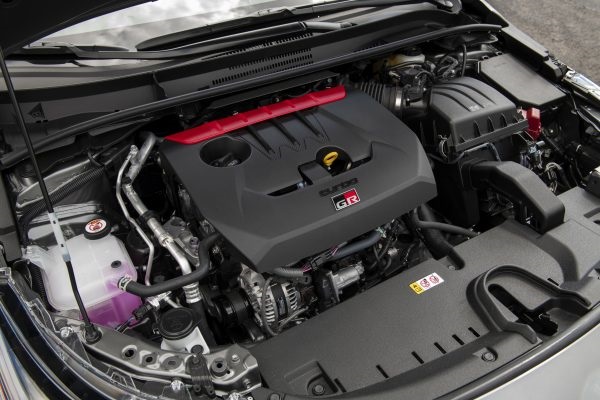
The GR Corolla’s 300-hp, G16E-GTS 3-cylinder turbocharged engine, tuned “for snappy acceleration out of the corners.”

Engineering by GAZOO Racing

Toyoda worked with its Toyota GAZOO Racing team to get this project right. It is this skunkworks group that develops technologies for Toyota’s GR sub-brand.

The mild-mannered Corolla is built on Toyota’s GA-C platform, accommodating front- and all-wheel-drive powertrains. But before the power goes in, the Corolla gets a workover at the GR factory at Toyota’s Motomachi plant. The accommodating five-door hatch is transformed with frame reinforcements, functional air vents for the engine and brakes, and other aerodynamic tweaks for stability at speed.

The GR Corolla is Toyota GAZOO Racing’s first wholly developed and manufactured model for the North American market. Their work is also available in the Toyota GR86 ($29,000) and the GR Supra ($45,000). Enthusiasts in Japan, Europe, and other countries also have access to the subcompact Toyota GR Yaris. It scoops up 261 hp from the same GR Corolla engine, but the GR Yaris is 430 pounds lighter.

The six-speed shifter with rev-matching downshifts.

The six-speed shifter with rev-matching downshifts.

The team’s detail-obsessed engineering created a race-pedigreed and street-legal track car sold at Toyota dealerships with the standard new-vehicle warranty of 3 years or 36,000 miles bumper to bumper and 5 years or 60,000 miles for the powertrain.

Coverage includes “responsible driving on track days,” Toyota says, but it also stresses induvial responsibility. To help protect the car, Toyota offers GR Corolla buyers a one-year membership to the National Auto Sport Association, with a free, coached track day session.

Comparable cars include the 315-hp Honda Civic Type R, 276-hp Hyundai Elantra N, 271-hp Subaru WRX, and 315-hp VW Golf R.

The 12.3-inch driver information screen has digital gauges for power settings and turbo pressure, a center tach, and gear position indicator lights.

The 12.3-inch driver information screen has digital gauges for power settings and turbo pressure, a center tach, and gear position indicator lights.

My Favorite Sport Compact Cars

The GR Corolla reminded me of the most fun sport-compact cars I have tested. It’s not just about power; it’s the delivery, and the connectedness of the car to the driver.:

1997 Acura Integra Type R;

1998 Ford Contour SVT;

2017-2019 Ford Fiesta ST;

2009 Fiat 500 Abarth;

2018 Hyundai Elantra GT;

2019 Hyundai Veloster N;

2003-2005 Dodge Neon SRT-4;

2004 Mazdaspeed Miata;

2010 Mazdaspeed3 5-door;

2004 Subaru Impreza WRX sedan;

VW GTI or Golf R any year;

And now the 2023 Toyota GR Corolla.

GR Corolla Editions Pricing

There are three performance levels for the 2023 GR Corolla. And buyers of each receive a 1-year membership to the National Auto Sport Association. Included is a free High Performance Driving Experience .

I tested the entry GR Corolla Core. Core pricing starts at $36,995, including the $1,095 freight charge from Japan. There is a choice of three paint colors: black, white, and Supersonic red, a $425 option.

My Core tester had two of the three available factory options:

Performance package, $1,180, includes front and rear Torsen limited-slip differentials, 4-piston aluminum fixed-caliper disc brakes with red-painted calipers and GR logo (front), 2-piston aluminum fixed-caliper disc brakes with red-painted calipers and GR logo (rear)

Technology package, $770, includes 8-speaker JBL audio system with dynamic navigation (with 3-year trial), including 8-inch touchscreen, Android Auto and Apple CarPlay compatible, one USB media port, wireless smartphone charging pad.

Supersonic Red paint added $425.

Also available is a Cold Weather package, $500, which adds heated front seats and steering wheel.

The GR Corolla Circuit Edition has Brin-Naub synthetic leather-trimmed sport seats with red stitching.

The GR Corolla Circuit Edition has Brin-Naub synthetic leather-trimmed seats with red stitching.

GR Corolla Circuit Edition, $43,995

There is no shame in owning the entry GR Corolla Core. It is a showcase of performance engineering, but it might not compare well to a friend who stepped up to the Circuit Edition. This rascal gets serious about higher performance.

Circuit Edition standard features include a forged carbon fiber roof and an aluminum hood with a bulge and gloss-black air vents. Its disc brakes are the same size as the Core but with red-painted calipers and GR logo.

Rather than the Core’s open differential, the Circuit Edition has Torsen limited slip differentials front are rear.

And there are more gloss black body trim elements, rather than the Core’s matte black.

Circuit Edition interior features include Brin-Naub and synthetic leather-trimmed sport seats with red stitching, red mesh inserts, and GR-badged headrests. It also includes the cold weather package of heated front seats and heated leather steering wheel.

The optional carbon fiber roof saves a few ounces of weight

A carbon-fiber roof is standard on the Circuit and Morizo Editions.

GR Corolla Morizo Edition, $50,995

Finding a track-ready GR Corolla Morizo Edition won’t be easy: only 200 were built for 2023.

The two-seat Morizo Edition is the lightest and most powerful of the three trim levels. Its engine gets a 22 lb.-ft. torque boost to 295 foot-pounds from 3,250-4,600 rpm.

Lightweighting comes from several areas. GR engineers removed nearly 100 pounds of weight versus the Circuit Edition, now estimated to be 3,186 pounds. Most weight savings came from removing the back seat, rear speakers, and window lifts. Even the rear wiper and motor were pulled.

The hood and front door panels are aluminum, which saves weight and slightly lowers the center of gravity.

To further stiffen the hatchback body, the engineers added two more floor braces and one more rear strut brace. The frame has an additional 349 spot welds, with more than 19 ½ feet (6 meters) of structural adhesive applied.

Other Morizo modifications range from a close-ratio transmission and shorter differential gears to front brake ducts and mono-tube shock absorbers. Unique forged wheels have wider Michelin Pilot Sport Cup 2 tires.

Check here for current pricing and offers

To lighten the GR Corolla Morizo Edition, engineers pulled over 100 pounds of content for a curb estimated to be 3,186 pounds.

To lighten the GR Corolla Morizo Edition, engineers pulled over 100 pounds of content for a curb estimated to be 3,186 pounds.

GR Corolla Safety Technologies

The GR Corolla is a legitimate, five-door sport-compact car with an expansive tech safety package that gives it Level 2 semi-autonomous driving capability. Toyota’s semi-autonomous driving is among the most accurate I’ve tested. Lane guidance is precise and did not let the car drift wide through highway cornering or cross the white lines.

Among the safety features are 10 air bags, a blind spot monitor with rear cross-traffic alert, and Toyota’s Star Safety System, which includes enhanced stability and traction controls.

Advanced safety technologies include Toyota Safety Sense 3.0, which includes:

  • Pre-collision system with pedestrian detection;
  • Lane departure alert with steering assist;
  • Lane tracing assist;
  • Automatic high beams;
  • Dynamic radar cruise control;
  • Road Sign Assist.
All GR Corollas have 14-inch ventilated front discs with four-piston calipers and rear 11.7-inch rear ventilated discs with two-piston calipers.

All GR Corollas have 14-inch ventilated front discs with four-piston calipers and rear 11.7-inch rear ventilated discs with two-piston calipers.

GR Corolla Core Ride and Handling

Choose the Core for its pure fun of rev, shift, and terrorize friends and the school carpool. As with any elite performance model today, the GR Corolla Core has a split personality. Toss the key to anybody who can work a stick shift, and they will have an easy time getting started. Make them aware that there is plenty of sporty fun within legal speed limits. It is on the upper end of engine revs that requires more focus from the driver.

Driving is friendly and unintimidating, but be ready when you engage Sport mode and roll on the power. The engine has bullish torque and acceleration to 60 mph scoots by un 4.99 seconds (same for the Circuit Edition). The lightened and more heavily braced Morizo Edition shaves a couple of tenths at 4.92 seconds.

The clutch has a medium-weight engagement, though never tiring. The shifter has refined gear engagement with a steely machined response. The gearbox is so NOT Corolla.

For all trim levels of GR Corolla, the GR-FOUR AWD has three driver-selectable torque-split settings, front-to-rear: Street 60/40, Touring 30:70), Track 50/50

The suspension is protective of occupants in daily driving but hit a surprise pothole and feel the painful jolt. I’d check the gauges for the flat tire icon on some hits, but I never had a blowout. And those remarkably responsive Michelins will cost around $250 each to replace. The tire has a sticky treadwear rating (UTQG) of 300, which pencils out to a warranty of 30,000 miles. The owner, however, will have waaay too much fun for the rubber to last that long.

The open cargo door shows plenty of space for groceries and track gear

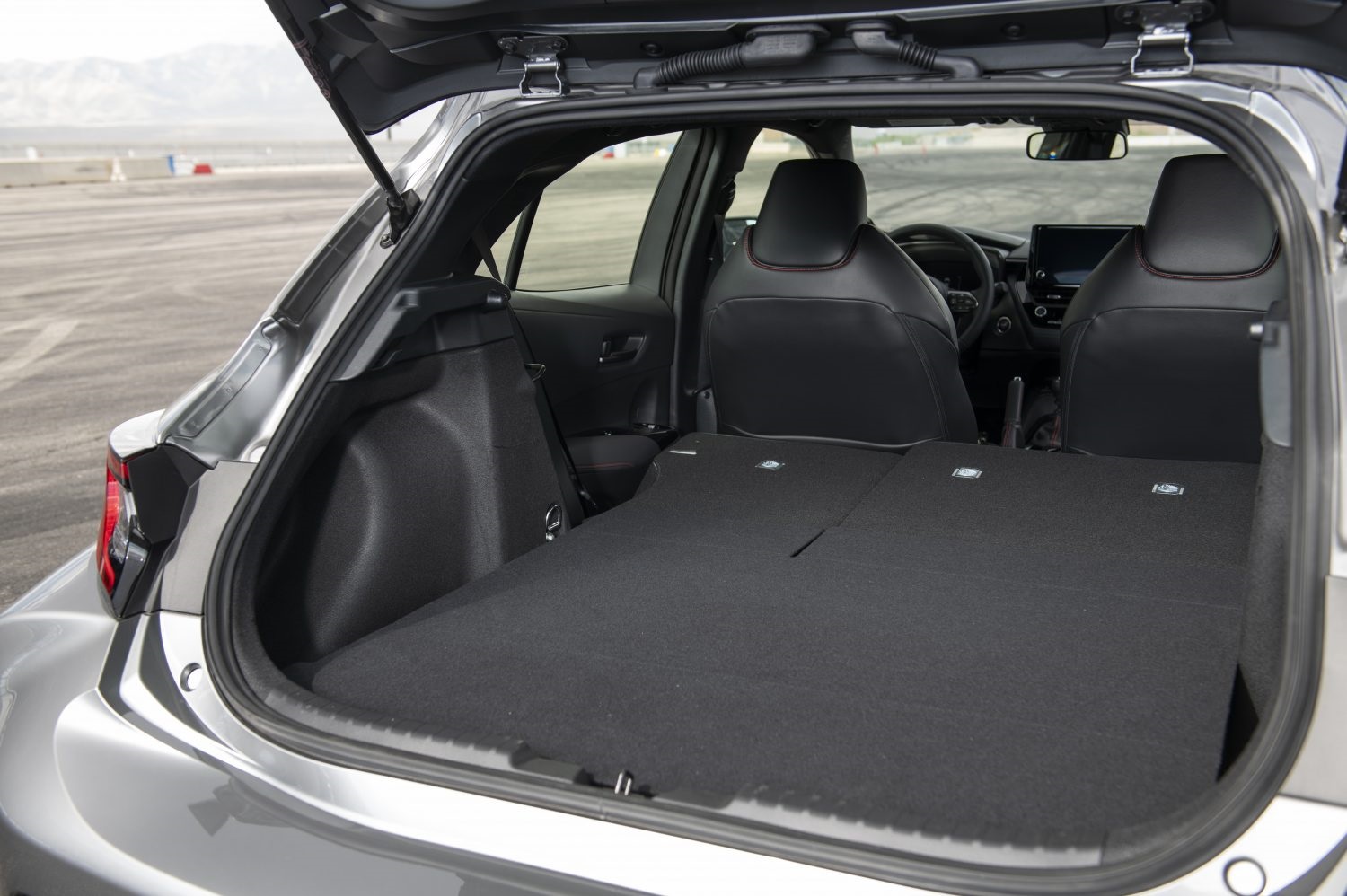
Plenty of space for groceries or track gear.

Why Buy the 2023 Toyota GR Corolla?

The GR Corolla is a pocket-class supercar. It would not be my choice as a road-trip car, but it makes for a helluva fun everything else. It is a performance bargain at less than $40,000. But with a first-year build of around 6,600 cars, pricing competition is rampant.

Many dealership markups are ridiculous. Reports by GR Corolla shoppers have quoted “Limited Market Value” markups of $10,000 to $20,000 for a Core model. And the greed rises exponentially for the Circuit Edition and Morizo editions.

However, according to threads on the GR Corolla forum, there are dealers doing MSRP. “You just have to do the research and find them.”

Toyota does what it can to police those exorbitant dealer addendums, a spokesman said.

“We do our best to have a conversation with the dealer and try to get them to look long-term,” he said. “The GR Corolla will always be somewhat limited in volume, but over time enough supply will help alleviate the current dealer markup situation. “

Toyota has not announced its 2024 lineup yet, but it has said the GR Corolla Circuit Edition will continue for model year 2024. And my source said there would be future GR Corollas.

You’ll just have to do the research to find them.

A rear three quarter view of a SuperSonic red GR Corolla hatchback

The GR Corolla is a wicked little dart of marketing that promotes a more daring side of juggernaut automaker Toyota, known more for its mass-produced dependability.

2023 Toyota GR Corolla Core Specifications

Body style: compact, 5-door, 5-seat AWD hatchback

Engine: 300-hp, turbocharged direct and port injection, 1.6-liter 3-cylinder with rev-matching downshifts; 273 lb.-ft. from 3,000-5,500 rpm

Compression ratio: 10.5:1

Max boost pressure: 25.2 PSI (Core Grade and Circuit Edition); 26.3 PSI (Morizo Edition)

Transmission: 6-speed manual with rev-matching downshifts

GR-FOUR AWD: 3 driver-selectable torque-split settings, front-to-rear: Street 60/40, Touring 30:70), Track 50/50

Differential type: Open (Core Grade); front and rear Torsen limited-slip differentials Circuit Edition and Morizo

0-60 mph acceleration, manufacturer estimated: 4.99 seconds (Core and Circuit Edition); 4.92-sec. (Morizo Edition)

Top speed: 142.9 mph

Fuel economy: 21/28/24 mpg city/hwy/combined; premium fuel required

CHASSIS HARDWARE

Suspension: MacPherson-type struts front, rear double wishbone-type multilink with stabilizer bars front and rear, 26.5mm front, 24mm rear.

Brakes, all models: 14-inch ventilated front discs with 4-piston calipers; 11.7-inch rear ventilated discs with 2-piston calipers.

Wheels: 18-inch cast alloy gloss black 15 spoke, Core Grade and
Circuit Edition; 18-inch, 10-spoke forged alloy wheels in a matte black finish, Morizo Edition.

Tires: 18-inch 235/40R Michelin Pilot Sport 4, Core Grade and Circuit Edition; 245/40R Michelin Pilot Sport Cup 2, Morizo Edition.

Track width, front/rear: 62.6 inches, Core and Circuit Edition; 62.6/63.7 inches, Morizo Edition.

Curb weights: 3,252 pounds Core; 3,262 lbs. with dual limited-slip diffs

Coefficient of drag: 0.35

BY THE NUMBERS

Fuel tank: 13.2 gallons

Cargo space: 17.8 cubic feet

Front head/leg room: 38.4/42 inches

Rear head/leg room: 37.6/29.9 inches

Length/wheelbase: 173.6/103.9 inches

Turning circle: 36.1 feet

FEATURES

GR upgrades include:

  • Wide body front and rear fender flares
  • Fabric sport seats with GR logo
  • Matte black front grille with GR badge
  • Rear bumper with air vents and gloss black front fender vents
  • Stainless steel triple exhaust tips
  • GR leather-trimmed steering wheel.

Standard GR Corolla features include: smart-key locking with GR push-button ignition, a rearview camera with parking aid lines, a 12.3-inch driver info display, an 8-inch multimedia display with six-speaker audio system, wireless Apple CarPlay and Android Auto compatibility, 60/40 split folding back seat, gloss black 15-spoke 18-inch wheels with 235/40 Michelin Pilot Sport4 tires; 14-inch 4-piston vented front disc brakes and 11.7-inch 2-piston vented rear discs.

Safety features include: 10 air bags, blind spot monitor with rear cross-traffic alert, Star Safety System of enhanced vehicle stability control, traction
control, 4-wheel ABS, electronic brake-force distribution, brake assist, and Smart Stop Technology;

Advanced safety technologies: Toyota Safety Sense 3.0 includes:

  • Pre-collision system with pedestrian detection;
  • Lane departure alert with steering assist;
  • Lane tracing assist;
  • Automatic high beams;
  • Dynamic radar cruise control;
  • Road Sign Assist.

PRICING

GR Corolla Core base price: $35,900, including $1,095 freight charge; price as tested $39,659

Options on test vehicle: SuperSonic paint $425; carpet cargo mat $110; carpet floor mats $179;

Performance package, $1,180, adds front and rear limited-slip differentials with red-painted brake calipers and GR logo

Technology package, $770, adds premium 8-speaker JBL audio with a wireless phone charging pad

Where assembled: Aichi, Japan

Warranties: 3-years/36,000-miles bumper to bumper with roadside assistance; 2-years/25,000-miles free scheduled maintenance; 5-years/60,000-miles powertrain

Toyota Corolla Cross Hybrid First Drive

Toyota Corolla Cross Hybrid First Drive

The subcompact 2023 Corolla Cross Hybrid racks up 45 mpg in town, 38 on the highway, and 42 mpg combined — with standard all-wheel drive

A gold-colored Toyota Corolla Cross Hybrid horizonal view

The new 2023 Toyota Corolla Cross Hybrid has fuel economy estimates of 45 mpg city, 38 highway, and 42 mpg combined. Pricing starts at $30,000, including automatic all-wheel drive. (Photos courtesy of ToyotaUSA)

Table of Contents

Notes from the Test Drive
Interior Function
The Hybrid Powertrain
Pricing
Standard Features By Trim
Warranty Coverage
Safety Technologies
Suspension, Steering, Brakes
Specifications

BY MARK MAYNARD

Toyota’s Corolla Cross is a likable small SUV — and it’s even more likable now that it is available in a gasoline-electric hybrid model. The hybrid model joins the front-wheel-drive, gas-engine Corolla Cross, which went on sale last year.

If there ever was a no-brainer choice for a first-time small ute buyer, the Corolla Cross is it. Its functional body style reminds of a mini-me RAV4, which has grown significantly in size and price. And it is a serious fuel miser with EPA estimated ratings of 45/38/42 mpg city, highway, and combined.

Toyota was in the Carlsbad, Calif., area of San Diego County for the first U.S. journalist drives of the 2023 Corolla Cross Hybrid. Journalists had drive time in the three trim levels of the Corolla Cross Hybrid.

Experiencing the range of trim levels with standard all-wheel drive gave me a good first-drive overview. Based on my first taste of the Corolla Cross Hybrid, I’d like to explore it more on an at-home evaluation for a proper review.

The driver area of the Corolla Cross

Entry-level models have an 8-inch touchscreen and smart key access.

Notes From the Test Drive

Toyota calls the Corolla Cross Hybrid’s exterior styling “approachable” with a higher line-of-sight. The sturdy stance disguises the upright interior, with open sightlines across the hood and over the shoulder.

Unique front and rear styling and optional two-tone paint choices visually separate the gas and hybrid models.

Standard all-wheel drive seems unusual, but after the wicked weather this winter and spring, the automatic AWD system could be a lifesaver and high on a buyer’s wish list of features.

Of the three trim levels, the base Corolla Cross Hybrid S is ideal for buyers who can live without a moonroof, power liftgate, two-tone paint, adaptive (turning) headlights, or a potent JBL audio system. The only factory choice is for special paint, a $425 cost.

Among the standard features are two USB-C charge ports and a multimedia audio system. It has all the connectivity features, including wireless Apple CarPlay and Android Auto. The multimedia system also allows over-the-air updates.

The driver seat has six-way manual adjustment and four-way for the front passenger.

I was more comfortable in the fabric-trimmed seats of the S rather than the sportier fabric seats in the SE. But the Softex-trimmed (synthetic leather) upholstery in the XSE adds heated front seats and a power driver’s seat.

The view from the open front passenger door showing the upholstery and dashboard

Cabin materials show Toyota’s newfound attention to using more refined materials and textures.

The Corolla Cross Hybrid Powertrain

Both models of Corolla Cross have a 2.0-liter Dynamic Force four-cylinder engine and an electronic continuously controlled automatic transmission.

Powertrain similarities end there, however.

The gas Corolla Cross has 169 horsepower with front-drive fuel-economy ratings of 31/33/32 mpg city/highway/combined and 29/32/30 AWD.

Performance from the Corolla Cross Hybrid jumps to 169 hp, which Toyota says makes it capable of launching to 60 mph in 8 seconds. If only its 10.6-gallon tank were larger to stretch the time between fill-ups, but placing the hybrid battery under the back seat took up the space. Still, the range is good at around 450 miles.

The open hood showing the engine

169-hp from the combined power of the engine and hybrid system.

Interior Function

The interior is not flamboyantly designed but has all the right toughness where it is needed. The materials show Toyota’s newfound attention to using more refined materials and textures.

Smart packaging of the Corolla Cross provides tall front headroom and back-seat space for a young family. Back-seat legroom, however, is grade-schooler-tight at 32 inches. Cargo space has square dimensions for friends-helping-friends move into the new condo.

The CVT shifter in the Corolla Cross

The e-CVT with Sport mode and hill-start assist.

Toyota Corolla Cross Hybrid Pricing

Expect the 2023 Toyota Corolla Cross Hybrid in dealerships this June. It is offered in S, XSE, and XSE trim levels. Starting prices by trim level:

S $29,065;

SE $29,290;

XSE $32,160.

Manufacturer Suggested Retail Pricing includes the $1,095 freight charge from the new Mazda Toyota Manufacturing plant in Huntsville, Ala.

Check here for current pricing and special offers.

An LED headlight of the Corolla Cross

LED headlights are standard on the Corolla Cross Hybrid S and SE models. Adaptive (turning) headlights are a $615 option for the XSE.

Standard Features By Trim Level

The S and SE trim levels have 17-inch alloy wheels, an 8-inch touchscreen, sport-tuned suspension, LED headlamps, and smart key access. The only factory option for the S is optional paint colors, which cost $425.

Moving up to the SE Corolla Cross Hybrid adds privacy glass, roof rails, and paddle shifters. A blind-spot monitor and rear cross-traffic alert add to the standard roster of safety features (highlighted below).

The top-line XSE is the sportiest offering, with such extras as:

  • 18-inch alloy wheels;
  • LED headlamps, taillamps, and fog lamps;
  • Softex-trimmed (synthetic leather) upholstery with heated front seats and a power driver’s seat.
An 18 inch alloy on the topline XSE model.

The XSE has 18-inch alloy wheels with a black-painted machined finish and 225/55 all-season tires.

Warranty Coverage

Toyota’s basic new-vehicle warranty coverage covers 3 years or 36,000 miles bumper to bumper and 5 years or 60,000 miles for the powertrain.

Hybrid-related components that require repairs to correct defects in materials or workmanship are covered for 8 years or 100,000 miles, whichever comes first from the original date of first use when sold as new.

The hybrid battery is covered for 10 years or 150,000 miles, whichever comes first, and is transferable across ownership.

The warranty package includes ToyotaCare, covering factory-scheduled maintenance for two years or 25,000 miles with 2 years of roadside assistance.

Paint Color Choices

The SE and XSE levels of the Corolla Cross Hybrid have special two-tone combinations, $500 each:

  • Sonic Silver with a black roof;
  • Barcelona Red with a black roof;
  • Blue Crush Metallic and black roof, and;
  • Acidic Blast (gold) and black roof. Acidic Blast is a new color.

Standard monochromatic paint colors include:

  • Jet Black Mica;
  • Cypress (forest green);
  • Celestite (sky blue);
  • Wind Chill Pearl (off-white; $425 extra)
a view of the back seat through an open side door

Back-seat legroom is grade-schooler tight at 32 inches.

 Corolla Cross Safety Technologies

Including nine air bags, the Corolla Cross Hybrid has substantial standard safety features, anchored by Toyota Safety Sense 3.0. Among the advanced technologies are:

PCS w/PD — Pre-Collision System with Pedestrian Detection;

DRCC — Dynamic Radar Cruise Control;

LDA w/SA — Lane Departure Alert with Steering Assist;

LTA — Lane Tracing Assist;

LCA — Lane Change Assist;

FCT — Front Cross Traffic Alert;

RSA — Road Sign Assist.

Star Safety System includes:

VSC — Enhanced Vehicle Stability Control;

TRAC — Traction Control;

ABS — Anti-lock Brake System;

EBD — Electronic Brake-force Distribution;

BA — Brake Assist;

SST — Smart Stop Technology;

AHB — Automatic High Beams;

PDA — Proactive Driving Assist.

A rear view of a gold colored Corolla Cross Hybrid

The Corolla Cross Hybrid model has unique front and rear styling, and optional two-tone paint choices, $500 each. AcidicBlast paint color is shown.

Suspension, Steering, Brakes

Suspension: Four-wheel independent with front sport-tuned MacPherson struts with stabilizer bar, coil springs, and hydraulic shock absorbers; Rear, sport-tuned double-wishbone multi-link rear with coil springs, trailing arms, stabilizer bar and hydraulic shock absorbers;

Steering: Electric power-assisted rack-and-pinion;

Brakes: Front ventilated 12-inch diameter rotors; rear solid 11.1-inch rotors.

Wheels and Tires

S and SE: 17-inch silver-colored alloy wheels with 215/65 all-season tire;

XSE: 18-inch alloy wheels with black-painted machined finish with 225/55R all-season tires;

There is a tire-inflation system, no spare tire.

Curb weights

S — 3,395 pounds;

SE — 3,385 pounds;

XSE — 3,430 pounds.

A view of the open cargo area with the tailgate raised

Cargo space of 40.3 cu.ft. behind the back seat. All-weather floor liners (three) are a $179 accessory.

The open cargo space with the back seat folded

Fold the back seat and load it up for friends-helping-friends move into the new condo.

2023 Toyota Corolla Cross Hybrid Specifications

Body style: All-wheel-drive 5-seat, 5-door small SUV

Engine: 150-hp 2.0-liter with direct- and multiport injection; 139 lb.-ft. torque at 4,400 rpm

Transmission: E-CVT with electronic on-demand AWD

Fuel economy: 45/38/42 mpg; 87 octane or higher recommended

Max towing capacity: 1,500 pounds

0-60 mph acceleration: 8 seconds, per Toyota

COROLLA CROSS HYBRID SYSTEM

Electric motor: permanent magnet synchronous; 152 lb.-ft. torque

Battery: 222-volt lithium-ion; 4.08 Ahr

System voltage: DC600V

Combined system power: 196 hp

BY THE NUMBERS

Fuel tank: 10.6 gallons

Cargo space: 40.3 to 61.8 cubic feet

Front head/leg room: 39.5 inches*/42.9 inches

Rear head/leg room: 39.1/32 inches

Length/wheelbase: 176.8/103.9 inches

Turning circle: 35.4 feet

PRICING

Base prices, including the $1,095 freight charge:

S $29,065;

SE $29,290;

XSE $32,160

Where assembled: Huntsville, Ala.

Warranties: 3-years/36,000-miles bumper to bumper; 5-years/60,000-miles powertrain; hybrid components are covered for 8 years or 100,000 miles, and the hybrid battery is covered for 10 years or 150,000 miles.

Included in the warranty package is ToyotaCare, covering factory-scheduled maintenance for two years or 25,000 miles, with 2 years of roadside assistance.

2023 Toyota Prius Prime First Drive

2023 Toyota Prius Prime First Drive

Re-engineered and stylishly redesigned, the 2023 Toyota Prius Prime plug-in hybrid has more power and up to 44 miles of battery-only driving. But it is also much more expensive.

A Supersonic Red Prius Prime

The redesigned 2023 Toyota Prius Prime is more powerful, with up to 44 miles of battery-electric driving. (Photos courtesy of ToyotaUSA)

Table of Contents

3 Cool Features
‘Sexy’ New Body Style
The Refined Interior
Plug-in Hybrid Powertrain
Charging at Home
Can You Name These Safety Abbreviations
2023 Prius Prime Pricing
Standard Features By Trim Level
Specifications

BY MARK MAYNARD

Owners of the previous-generation Toyota Prius Prime will not be happy if, just for the heck of it, they test drive a 2023 Prime model, a plug-in hybrid. Comparing the old model with the completely redesigned and re-engineered 2023 Prius Prime is like comparing a canoe with a streamliner.

Improvements in power, ride quality, and interior accommodations are near-luxury in a more rewarding presentation. And now, with a larger electric-drive motor and a larger four-cylinder engine, the battery driving range was improved to 39 to 44 miles, from 25 miles in the previous model.

Built on the second-generation TNGA-C platform, the 2023 Prius Prime has a lower center of gravity, reduced weight, and increased body rigidity compared to the previous generation. Toyota says the position of the hybrid traction battery was also moved to under the rear seat, yielding a lower center of gravity and a little more trunk space.

Toyota was recently in the Carlsbad, Calif., area of San Diego County for the first U.S. journalist drives of the 2023 Prius Prime PHEV and Corolla Cross Hybrid. Journalists had drive time along short routes in various trim levels of both vehicles. Soon, I will have more time for a proper review, but my time in the vehicles gave a good first-drive overview.

A leather-trimmed heated steering wheel in the entry SE model.

A leather-trimmed heated steering wheel in the entry SE model.

3 Cool Features

Traffic Jam Assist: For those on the daily commute of heavy traffic, Traffic Jam Assist can help take some of the stress from low-speed, stop-and-go driving. Here’s how it works: While driving on a highway with Dynamic Radar Cruise Control and Lane-Trace Assist activated, system sensors will detect when traffic is slowing. If operating conditions are OK, the assist system will provide acceleration, braking, and hands-free steering control under the active supervision of the driver. This system will only operate at speeds lower than 25 mph. The driver monitoring camera also must confirm the driver has their eyes on the road to allow for hands-free operation. The driver will get a prompt to resume control when traffic clears, or the speed drops below 25 mph.

Solar Roof: The 185-watt solar roof option ($640) can charge the drive battery incrementally while parked. Solar charging also supplies power to auxiliary functions while driving. Information about power generation is shown in the vehicle’s multi-information display.

Predictive Efficient Drive with Predictive Deceleration Support: This all-seeing system optimizes range by observing the driver’s stopping patterns on frequently driven routes. The system will then suggest when to let off the accelerator. Predictive Efficient Drive is a standard feature on all trim levels, but it requires a subscription for cloud navigation. The XSE Premium gets one free year of service, but the lower trim levels require an additional Drive Connect subscription.

XSE Premium 12.3-inch Touchscreen and JBL Premium Audio.

XSE Premium 12.3-inch Touchscreen and JBL Premium Audio.

‘Sexy’ New Body Style

The new Prius Prime builds upon the foundation of the standard five-seat and front-wheel-drive gasoline-electric hybrid Prius sedan. The body is 2 inches lower, an inch wider, and an inch longer than the previous generation. The smooth, aerodynamic shape has a “hammerhead nose,” lower roofline, and widened rear.

Wheel sizes are also vital to efficient performance. The entry SE model has 17-inch wheels, which Toyota says yields 44 miles of battery-electric driving. Moving up to the Prius Prime XSE trim levels adds 19-inch wheels but drops the battery driving range to 39 miles.

Curb weights are up by about 100 to 200 pounds vs. the 2022 model, which affected fuel-economy ratings, too. The 2022 Prius Prime has mileage ratings of 55/53/54 mpg city, highway, and combined. Those estimates compare to the 2023 Prius Prime at 53/51/52 mpg city/highway/combined for the base model to 50/47/48 mpg for the mid and top-line models.

The previous Prius Prime also has a farther total driving range of 640 miles compared to 550 to 600 miles for the new model.

Despite the Prime’s sleek shape (Toyota calls it “sexy”), its drag coefficient is a couple of hundredths less efficient: 0.27 vs. 0.25 for the outgoing model.

SofTex-trimmed heated and ventilated front seats in the XSE Premium.

SofTex-trimmed heated and ventilated front seats in the XSE Premium.

The Refined Prime Interior

Subtle elements of red and red ambient lighting enhance higher-quality materials in the cabin. The wider cabin benefits shoulder room by just over 1 inch and legroom stay the same at 43.2 inches. But the lower roofline trims the front headroom by 1.4 inches, which is notable in the cabin.

The driver position still has the same gauge-viewing complexity as the Prius hybrid. The more extended steering column and smallish gauge array with many details seem far away for easy viewing. However, there is a functional workaround with attention to seatback angle and steering-wheel height.

Back-seat space took a more significant trim of headroom, losing nearly three-quarters of an inch (now at 38 inches). Rear legroom grew by a noticeable 1.4 inches. With the lower headroom, however, the back seat is no place for large adults.

Trunk space increased, but by less than a cubic foot. But the wide and flat cargo capacity is very usable and expandable by the folding back seat for up to 26.7 cu. ft.

The back seat space is tight in the Prius Prime

Back seat headroom and legroom are snug at 36.4 and 34.8 inches, respectively.

Plug-in Hybrid Powertrain

Toyota’s fifth-generation hybrid powertrain pairs the M20A-FXS 2.0-liter four-cylinder Atkinson-cycle gas engine with two motor generators (MG1 and MG2). The transmission is a planetary-type E-CVT, continuously variable automatic.

The engine works with the electric motor MG2 to drive the front wheels and to boost performance as needed. Both motors work to charge the lithium-ion battery.

Combined power from the gas engine (150 horsepower) and electric motors is 220 hp. When driving in Hybrid Mode, Toyota cites an estimated 0-60 acceleration in 6.6 seconds — compared to 10.2 seconds for the outgoing model.

More powertrain details are in the specifications chart below.

An open hood view of the prime engine and electrification elements

Toyota’s fifth-generation hybrid powertrain pairs the 2.0-liter four-cylinder gas engine with two motor generators (MG1 and MG2) through a continuously variable transmission.

Finessing the Power

The Prius Prime has three drive modes that allow drivers to finesse battery reserves or power: EV Mode, HV/EV Auto Mode, and Hybrid Mode.

EV Auto Mode — relies on the battery for driving around town.

HV/EV Auto Mode — the engine will engage where it is more efficient, such as up steep hills or at higher speeds.

Hybrid Mode —automatically switches between the gasoline engine and the electric motor.

There also are selectable performance modes of Eco, Normal, and Sport.

the open charge door of the Prime

It will take about 11 hours to recharge the Prius Prime using a household outlet or four hours with a 240-volt Level 2 charger.

Charging at Home

There is no special equipment needed for home charging. The Prius Prime comes with a charging cable, but an optional 240-volt charging system will be quicker to recharge.

The battery will recharge on a standard 120-volt home outlet in about 11 hours. (Toyota recommends using a dedicated GFI 15-amp outlet). Charging with a 240-volt, Level 2 charger will take about 4 hours.

Can You Name The Safety Abbreviations?

Prius Prime’s standard safety features and technologies include eight air bags and:

TJA — Traffic Jam Assist;

SEA — Safe Exit Assist.

Toyota Safety Sense 3.0 includes:

PCS w/PD — Pre-Collision System with Pedestrian Detection;

DRCC — Dynamic Radar Cruise Control;

LDA w/SA — Lane Departure Alert with Steering Assist;

LTA — Lane Tracing Assist;

LCA — Lane Change Assist;

FCT — Front Cross Traffic Alert;

RSA — Road Sign Assist.

Star Safety System includes:

VSC — Enhanced Vehicle Stability Control;

TRAC — Traction Control;

ABS — Anti-lock Brake System;

EBD — Electronic Brake-force Distribution;

BA — Brake Assist;

SST — Smart Stop Technology;

AHB — Automatic High Beams;

PDA — Proactive Driving Assist.

19-inch Michelin Primacy all-season tires on the XSE model.

19-inch Michelin Primacy all-season tires on the XSE model.

Ride and Handling

Improvements to the suspension, steering, and braking will make an immediate impression — and not just for owners of the prior-gen Prime.

There is complete smoothness to pedal response in regenerative braking, rather than a stop-start, on-off action. And the damping effect of the suspension has an almost-sporty feel. The steel-spring suspension eliminates the jounce and heavy feel of hefting a 3,500-pound small car. The hybrid battery weighs 284 pounds — just 19 pounds heavier — or 287 pounds with the solar roof.

Electric-assist steering has some actual road feel, and the sturdy, three-spoke wheel glides through the hands. Turning circles, however, are wider by a foot, now at 34.4 for the SE and 35.4 feet for the XSE.

More hardware stats are in the specs box below.

Seats folded in the Prime cargo hold

Trunk space is wide, flat, and expandable by the folding back seat for up to 26.7 cu. ft.

A view of the rear cargo compartment

2023 Toyota Prius Prime Pricing

The redesigned 2023 Toyota Prius Prime is expected in dealerships next month, May 2023.

As before, there are three trim levels, renamed SE, XSE, and XSE Premium. And MSRPs are significantly higher than the outgoing model — by $3,580 for the SE, $5,050 for the XSE, and $4,620 for the XSE Premium.

2023 Prius Prime Manufacturer’s Suggested Retail Prices:

SE $33,445;
XSE $36,695;
XSE Premium $40,265.

Retail prices include the $1,095 freight charge from the Tsutsumi Plant, in Aichi, Japan.

Check here for updated Prius Prime pricing and special offers.

For comparison, the Toyota 2023 Prius hybrid has starting prices across six trim levels in front- or all-wheel drive that range from $28,545 to $36,960.

2023 Prius Prime paint colors:

  • Cutting Edge (light gray)
  • Guardian Gray
  • Midnight Black Metallic
  • Reservoir Blue
  • Wind Chill Pearl (white; $425 premium)
  • Supersonic Red ($425 premium)
The clever side slot for phone charging on the center console.

The clever side slot for phone charging on the center console.

Standard Features By Trim Level

SE equipment includes:

Dark gray 17-inch alloy wheels with wheel covers;

8-inch Toyota Audio Multimedia touchscreen;

6-way adjustable fabric front seats in black with red trim;

6 USB-c ports;

Electric parking brake;

Leather-trimmed heated steering wheel;

8 air bags and blind spot monitor with rear cross-traffic alert

Optional features include front and rear parking assist with automatic braking.

XSE equipment builds on SE features and includes:

Machine-finished 19-inch alloy wheels;

8-way adjustable heated power driver’s SofTex-trimmed seat. Black upholstery has red trim;

Smart key entry and push-button ignition;

Wireless phone charger;

Front and rear parking assist with automatic braking;

Available options include a 12.3-inch high-resolution touchscreen display, fixed glass roof, and Digital Key.

The XSE Premium layers onto the SE and XSE features, adding:

8-speaker, JBL Premium audio system;

12.3-inch touchscreen display;

The new Prius Prime has an optional solar roof for $640. This image shows a corner of the solar roof title

The 185-watt solar roof option ($640) for the XSE Premium can charge the drive battery while parked. The solar charger also supplies power to auxiliary functions while driving.

Fixed glass roof;

SofTex-trimmed heated and ventilated front seats;

Power rear liftback;

Digital Key.

Available options include a Panoramic View Monitor, Digital Rearview Mirror, heated rear seats, and Advanced Park. The parking system helps the driver steer into a parking space, whether parallel or backing into a perpendicular space. A combination of cameras and sensors recognizes the vehicle’s surroundings.

A rear view of a Supersonic Red Prius Prime

The more polished and stylish 2023 Prius Prime has improvements in power, ride quality, and interior accommodations

2023 Toyota Prius Prime Specifications

Body style: compact, 5-seat, 5-door, front-wheel-drive plug-in hybrid sedan

Engine: 150-hp, Atkinson-cycle, 16-valve VVT-I 2.0-liter 4-cylinder; 139 lb.-ft. torque

Motor Generator 2: Drives front wheels, regeneration during braking: Permanent Magnet AC Synchronous, 160-hp, 120 kW

Combined system power: 220 hp

Transmission: E-CVT

Plug-in hybrid battery pack: 13.6 kWh (51 Ahr) lithium-ion

Battery weight: 284 pounds (287 with solar roof)

Onboard charger capacity: 3.5 kW

Charge times: Approximately 4 hours on 240 volts; 11 hours on 120 volt

Emission certification: SULEV30 with Transitional Zero Emission Vehicle (TZEV)

MILEAGE AND DRIVING RANGE

EPA estimated fuel economy ratings; 87 octane recommended:

SE — 53/51/52 mpg city/hwy/combined;

XSE, XSE Premium — 50/47/48;

EPA estimated MPGe (combined): 127 SE; 114 XSE, XSE Premium

Estimated total driving range: 600 miles SE; 550 miles XSE, XSE Premium

EV Driving Range (up to 84 mph): up to 44 miles SE; up to 39 miles XSE, XSE Premium

0-60 mph acceleration: 6.6 seconds, in Hybrid Mode

HARDWARE EQUIPMENT

Suspension: 4-wheel independent; front MacPherson struts with stabilizer bar; rear multi-link stabilizer bar;

Braking: four-wheel disc brakes with ABS; 12-inch ventilated front discs; solid 11-inch rear discs with integrated regenerative braking and Star Safety System;

Steering: electric power-assisted rack-and-pinion.

BY THE NUMBERS

Drag coefficient: 0.27 with 17-inch wheels

Fuel tank: 10.6 gallons

Cargo space: 20.3-26.7 cubic feet

Front head/leg room: 38/43.2 inches

Rear head/leg room: 36.4/34.8 inches

Length/wheelbase: 181.1/108.3 inches

Curb weights: SE 3,461 pounds; XSE 3,516 lbs.; XSE Premium 3,571

Turning circles: 34.4 feet SE; 35.4 feet XSE, XSE Premium

Where assembled: Tsutsumi Plant, Aichi, Japan

Warranties: 3-years/36,000-miles bumper to bumper; 5-years/60,000-miles powertrain; and 10-years/150,000-miles for the hybrid battery

Toyota Tundra Capstone Hybrid Pickup Review

Toyota Tundra Capstone Hybrid Pickup Review

Tripping the white fantastic in the 2023 Toyota Tundra Capstone with its white-and-black leather cabin

The 2023 Toyota Tundra Capstone has an exclusive white-and-black leather interior. Capstone pricing starts at $77,040. (Photos courtesy of Toyota)

The 2023 Toyota Tundra Capstone has an exclusive white-and-black leather interior. Pricing starts at $77,040. (Photos courtesy of Toyota)

Table of Contents

Tundra Redesign Challenge
Tailgate Tricks
2023 Toyota Tundra Pricing
Hybrid-Related Warranties
iForce Powertrains and Fuel Economy
Interior Function
Ride and Handling
Intimidation Factor
Why Buy the Toyota Tundra Capstone?
Specifications

BY MARK MAYNARD

The Toyota Tundra pickup has long been dogging the tailgates of the Ford F-150, Chevrolet Silverado, GMC Sierra, and Ram 1500. Though the Tundra has always been capable, its presentation seemed dumbed down to fit an outdated perception of the American pickup. Even its exterior styling was a mashup of “Fordamrolet.”

With a thorough redesign for 2022, Toyota has elevated the Tundra with style and technologies — for better and worse.

A few years ago, at a big four-wheelers desert run, I watched a Tundra throwing rooster tails of synchronized sand art as it swept up a steep dune. It was a dealership truck (by the license plate) and optioned with the TRD package. The truck’s ability was remarkable because this stock Tundra always made it to the top of the big dune, while caged buggies and fat-tired crawlers failed. It seemed insulting to the modified rigs. And a prime selling opportunity.

Toyota learns and evolves quickly. The 2023 Toyota Tundra lineup has seven trim levels, from basic work trucks to high luxury. But more than the basic trucks, luxury models have been added steadily.

Now in its third generation, the new Tundra was introduced for 2022. It was designed in the U.S. and built in Texas at Toyota Motor Manufacturing (TMMTX) in San Antonio.

At long last, the restyled Tundra breaks loose from most comparisons to the Big 3 pickups and plows through the air with a mug that won’t be confused as a Fordamrolet.

But just as it is challenging to master a foreign language, there is something uniquely American about a pickup. And not all foreign makers can master the lingo. Toyota is catching up.

Front headroom is almost 10-gallon tall at 39.3 inches with Capstone’s standard panoramic moonroof.

Front headroom is almost 10-gallon tall with Capstone’s standard panoramic moonroof.

Tundra Redesign Challenge

“Technical muscle” was the Tundra design mantra for the 2022 makeover.

Inside the Tundra Capstone, the design group applied premium materials in high-contact areas, including wrapped armrests and pads across the dash and doors.

Toyota says that high-strength steel throughout the chassis increased rigidity considerably over the previous generation Tundra. Aluminum is used in critical areas to reduce weight. Frame cross members are more than doubled in size for reinforcement and additional rigidity. For the Limited model and above, the cab mounts to the frame with hydraulic mounts for a quieter ride.

Tundra’s bed of sheet-molded compound (SMC) is lightweight and extremely strong, backed by aluminum reinforcing cross members, Toyota says. An SMC bed is resistant to denting, impact dings, and rust corrosion.

Tundra Tailgate Tricks

There has been a small revolution in pickup tailgates. Some now offer a step-and-grab bar that folds away. Others have drop panels that form steps or accommodate a fifth-wheel trailer hitch. Some have a wider section for a work-site bench or even a connection for a Bluetooth audio system. Some have a tailgate measurement strip and indents for a cup or can.

Toyota’s innovation is the power tailgate release in the left-rear taillight. Just give it an elbow bump when walking up with an armload of gear, or release the tailgate from the key fob. And there is a power bed step at the driver-side left corner; the step lowers with the tailgate.

Toyota says that the Tundra tailgate benefits from light-weighting construction and is 20 percent lighter than the previous generation.

7 Tundra Trim Levels

As before, the new-gen Tundra is sold in two four-door body styles: Double Cab and CrewMax.

Double Cab models have bed-length choices of 6.5 feet or 8.1 feet. CrewMax models can have a 5.5-foot bed or the new 6.5-foot bed.

The 2023 Tundra lineup has seven choices: SR, SR5, Limited, Platinum, 1794 grades, TRD Pro, and Capstone. Rear-wheel drive is standard, with optional four-wheel drive.

At its introduction years ago, the Toyota Tundra Limited might have been the most luxurious choice. But as $70,000 has become the new $50,000 pickup, Toyota added a Platinum model and then the slightly more expensive 1794 with some Old West influences. The Tundra TRD, $9,000 more than the 1794, is the off-road package, but it’s pricey, starting at $70,000. And now the Tundra Capstone wears the luxury boots, and it is priced as such.

The Capstone is the halo choice with standard four-wheel drive, a CrewMax cab, 5.5-foot bed, and exclusive white-and-black leather cabin. Pricing starts at $77,000 or $79,000 with the one big factory option package. A wide range of accessories — including ball-hitch mounts, bed extenders, a dash camera, console safe, tie downs, racks, spray-on bedliner, or a hard tonneau cover — can nudge the price beyond $80,000.

High-luxury pickups don’t make practical sense, but they are impressive at the marina launch and equestrian events. Most Tundra sales are for midrange models, of course, but Toyota has to keep up with the Fordamrolets. And these country coaches are rich with options, including pearlescent paint, hand-tooled semi-aniline leather, and the most advanced technologies. If a passenger car can be so equipped, so can a pickup.

The 14-inch screen provides big-screen camera views.

The 14-inch screen provides big-screen camera views.

2023 Toyota Tundra Pricing

Tundra starting prices range from $38,760 for the entry rear-wheel-drive SR to $77,040 for the top-line Capstone iFORCE MAX with standard 4WD. Pricing includes the $1,795 freight charge from San Antonio.

The SR model is the basic work truck. Moving up to the SR5, $44,265, creates a more functional tow vehicle with a Class IV towing hitch and seven-pin wiring harness. Also included are tow-haul and tow-plus driving modes, 18-inch alloy wheels, and a power vertical or horizontal rear window.

The TRD Pro, $70,315, is factory primed for off-road capability. Its features include:

  •  Multi-terrain select with crawl control;
  •  A 1.1-inch lift with Fox shock absorbers;
  • Electronically controlled locking differential.

Special TRD Pro features include a heritage-like “Toyota” grille with LED light bar and marker lights, 18-inch matte-black forged-aluminum BBS wheels, and a 12-speaker JBL audio system.

The Capstone iFORCE MAX tester was $79,174 with these options:

  • Adaptive variable suspension with load-leveling rear height control air suspension $1,045;
  • Wind Chill Pearl paint $425;
  • Ball mount $65;
  • Non-skid spray-on bedliner $579.

Find current Tundra pricing and offers here.

Tundra Hybrid-Related Warranties

Toyota’s basic 36-month/36,000-mile new-vehicle warranty applies to all components other than normal wear and maintenance. Additional 60-month warranties cover the powertrain for 60,000 miles and corrosion with no mileage limitation.

Hybrid-related components, including the battery control module, hybrid control module, and inverter with converter, are covered for 8 years or 100,000 miles, whichever comes first.

The hybrid battery has coverage of 10 years or 150,000 miles, whichever comes first.

ToyotaCare covers regular factory-scheduled maintenance and 24-hour roadside assistance for two years or 25,000 miles, whichever comes first.

iForce Powertrains and Fuel Economy

Tundra has two 3.5-liter, twin-turbo iFORCE V-6 powertrains, both with a 10-speed automatic transmission. The transmission has a sequential shift mode, uphill-downhill shift logic, and tow/haul driving modes.

The sophisticated engine design uses Toyota’s D-4ST direct injection and port injection.

The entry V-6 for the SR trim has 348 horsepower and 405 foot-pounds of torque at 2,000 p.m. The uplevel engine for the rest of the models has 389 hp and 479 lb.-ft. torque at 2,400 rpm.

The i-FORCE MAX hybrid twin-turbo V-6 is available only in the TRD Pro and Capstone trim levels. The hybrid powertrain has 437 horsepower at 5,200 rpm, and 583 lb.-ft. of torque at 2,400 rpm.

Hybridization combines the V-6 and motor generator with a clutch in the bell housing between the engine and transmission. A 288-volt sealed nickel-metal hydride battery is under the rear passenger seats.

The motor generator adds power through the transmission. But parallel hybrid components function during engine start-up, EV driving, electric assist, and energy regeneration.

The electric motor does most of the work at speeds below 18 mph. Then the gasoline engine engages for power in the mid- and high-speed range. When using tow/haul mode, the engine is in full internal-combustion control.

a view of the i-FORCE MAX hybrid twin-turbo V-6 437 horsepower and 583 lb.-ft. of torque at 2,400 rpm.

The i-FORCE MAX hybrid twin-turbo V-6 437 horsepower and 583 lb.-ft. of torque at 2,400 rpm. (Mark Maynard photo)

i-FORCE MAX Performance

The torque is particularly well-suited for transporting livestock, boats, and travel trailers. The roll-on of acceleration is not abrupt and does not launch the truck with tire-spinning force. Instead, the power progressively moves out, preserving whatever is in or on the trailer and, perhaps, a bit of fuel.

Fuel-Economy Ratings

Though more powerful, the hybrid iFORCE MAX engine has the best EPA-mileage ratings of the Tundra line: 20 mpg city, 24 highway, and 22 MPG combined.

That mileage compares to the standard iFORCE V-6, with mileage ratings of 18/24/20 mpg for the SR trim and 18/23/20 mpg for the upper trims.

In my week of driving the hybrid iFORCE MAX, I worked up to a combined city-highway mileage rating of 15.6 mpg, with much highway cruising. With careful acceleration, the 32.2-gallon tank could stretch range to almost 500 miles.

A photo of the Captone's 22 inch alloy wheels and tires

The Capstone gets the largest Tundra wheel size of 22 inches.

Interior Function

Americans like big pickups because there is plenty of room in the cabin. The lowly passenger sedan has been mercilessly downsized to meet fuel economy and emissions standards.

With Capstone’s standard panoramic moonroof, Tundra’s front headroom is almost 10-gallon tall at 39.3 inches. There is room for large adults to spread out and plenty of storage and stash places.

Standard Capstone equipment is in the specs box at the end of this story. Among its luxury features are 10-way power seats, heated and ventilated. Power running boards are a welcome feature for a leg up to the front or rear seats.

A huge help in parking is the panoramic view monitor, which includes an overhead side-panel view panel of the truck. The color graphics are excellent on the 14-inch audio multimedia screen.

Back seat headroom is also tall (36.9 inches), and legroom is adult comfortable at 41.6 inches, even if there is a tall driver ahead.

The Tundra back seat

Back-seat legroom of 41.6 inches is adult comfortable, even if there is a tall driver ahead.

Ride and Handling

Tundra had been a hold-out for rear leaf springs, but a new multi-link suspension has replaced the old. The change to a more carlike suspension provides a smoother ride, especially when the bed has no weight.

The multilink suspension has not hurt towing or payload. The maximum towing capacity for Tundra increases 17.6 percent over the previous generation, to 12,000 pounds. Toyota says the maximum payload increases to 1,940 pounds, an improvement of more than 11 percent.

For the first time, a rear air suspension system is available with automatic and manual leveling functions. Another first for Tundra is the available Adaptive Variable Suspension system. Toyota says that AVS improves ride quality and handling by continually adjusting damping force based on road conditions.

You might mistake the semi-aniline leather for Lexus upholstery, but the ride quality is still pickup truck. The multilink suspension, and particularly the adaptive suspension, eliminates the empty-bed chatter on the highway, but without cargo, in the bed, you’ll know this truck has working-class roots.
Braking

To put the binders on a six-ton towing capacity (6,095 pounds at the curb) requires hefty brakes. The Tundra has power-assisted and ventilated four-wheel discs. The large, 13.9-inch front discs have opposed dual-piston calipers. The rear 13.6-inch discs use single-piston calipers.

While lesser trim levels have a max towing rating of 12,000 pounds, the Capstone is rated for 10,340 pounds.

A side view of the Capstone

The Tundra Capstone has a tow rating of 10,340 pounds and a max payload of 1,485 pounds.

The Intimidation Factor

The full-size pickup today is designed to be intimidating. These are the broad-shoulder linemen in the scrimmage for recognition. The bigger, the better, which works well in the open plains, mountain terrain, and desert regions. Not so much in the city.

With the intimidation factor, however, comes too much mass in the design solely to impress the competition. Depending on the cab size, whether extended or full and the bed length, a typical full-size pickup turning circle ranges from about 40 to 52 feet and more.

The wheelbase of the Tundra Capstone CrewMax is 145.7 inches (a tick over 12 feet), and this rig is 80.2 inches wide, not including the large side mirrors. Its width is comparable to the competition, and so is its length of 233.6 inches or 19.5 feet with its 5.5-foot bed. The Capstone’s turning circle isn’t terrible at 48.6 feet. But these packers are not nimble when navigating city streets. Parking is a consideration when heading out on errands.

The Capstone was like steering a stormtrooper in its Wind Chill Pearl (white) paint ($425) and two-tone white and black interior. The height of the hood opening is 4 feet from the ground and another half foot taller with the (unnecessary) hood bulge.

Sightlines across the wide hood and blunt front end are challenged. It takes time to become comfortable navigating city streets. The iForce Max hood scoops are like epaulets on a commander’s uniform — ornamental, but they show who has the big swinging sword. The pair of scoops flanking the hood are nonfunctional except to complicate sightlines at the fenders.

A close up of the nonfunctional hood scoops for the iMax hybrid engine.

The iForce Max hood scoops are ornamental.

Light Duty vs. Heavy Duty

The Big 3 competing pickups, however, also offer heavy-duty versions. These have higher tow ratings, spring rates, and payload capacity. The H-D models are typically a half-inch to an inch wider, a few inches taller, and about 10 to 18 inches longer. Toyota appears to split the difference by offering a one size Tundra with dimensions landing between half-ton and three-quarter-ton ratings, or light vs. heavy duty.

And that’s why the Tundra feels bigger than it needs to be. Driving the Capstone in town was like steering a stormtrooper in its Wind Chill Pearl (white) paint ($425) and two-tone white and black interior. The height of the hood opening is 4 feet from the ground and another half foot taller with the (unnecessary) hood bulge.

The iForce Max adds to the sightline complexity with a pair of non-functional “scoops” flanking the rear of the hood. They are ornamental — like epaulets on a commander’s uniform — but they show the troops who has the big swinging sword.

Sightlines across the wide hood, side mirrors and blunt front end are challenged, made more complex with the faux iForce Max scoops. It takes time to become comfortable navigating city streets.

Why Buy the Toyota Tundra Capstone?

All new full-size pickups on sale today offer pretty much the same thing. It just depends upon the church in which you believe. The brands copy each other and then make a modification to offer something unique. And then boast that their way is the truth and the light.

The Tundra will appeal to those disciples of Toyota. And in my experience, Toyota puts a little more effort into more precise engineering to do it right the first time.

The Tundra Capstone, with its white leather interior, isn’t a work truck or for the construction, boss pulling into muddy work sites. It’s not for the off-road adventurer. It’s not especially suited for the homeowner loading up at the building supply center. It can fill all those roles, but the Tundra Capstone will be most at home when hitched to a horse trailer for prestigious shows or riding events. You’ll also find the Capstone at the marina, steering a big boat down the ramp. In those venues, the Tundra Capstone will make a stunning statement — and vigorous use won’t cause undue harm to the pristine interior.

A studio shot of a rear three quarter view of the white Tundra

Hydraulic frame mounts provide a quieter ride on Tundra Limited and higher trims.

Toyota Tundra Capstone Specifications

Body style: full-size, 5-seat pickup with 5.5-foot bed

Engine: 437-hp, 3.5-liter, twin-turbocharged iForce Max V-6 Hybrid with water intercoolers and electric motor-generator; 583 lb.-ft. torque at 2,400 rpm

Hybrid components: Parallel hybrid system with permanent magnet electric motor-generator located between engine and transmission;

Electric motor output: 48 hp and 184 lb.-ft. torque

Hybrid battery: 288-volt nickel-metal hydride with 240 cells; 1.87 kWh capacity

Transmission: 10-speed sequential shift mode automatic, with uphill-downhill shift logic and tow-haul driving modes; 4WDemand part-time 4WD with electronically controlled two-speed transfer case (high/low range)

Fuel economy: 19/22/20 mpg city/hwy/combined; 87 octane or higher

Towing capacity: 10,340 pounds

Max payload: 1,485 pounds

Max tongue weight: 1,117 pounds

BY THE NUMBERS

Fuel tank: 32.2 gallons

Front head/leg room: 39.3*/41.2 inches *w/moonroof

Rear head/leg room: 36.9/41.6 inches

Shoulder room, front and rear: 65/ 62.4 inches

Length/wheelbase: 233.6/145.7 inches

Width/height: 80.2/78 inches

Curb weight: 6,095 pounds

Turning circle: 48.6 feet

FEATURES

Standard Capstone equipment includes: power tilt-slide sunroof, semi-aniline upholstery, 12-inch digital gauge display; 10-inch head-up windshield display, 10-way power adjustable (heated and ventilated) front seats with 4-way lumbar, heated and ventilated rear seats, 14-inch audio multimedia screen with 12-speaker JBL audio system with subwoofer, Apple CarPlay and Android Auto apps, 22-inch dark chrome alloy wheels, aluminum reinforced composite bed with 120-volt AC power outlet and LED lighting, auto-leveling LED headlights, power running boards and bed step;

Safety features and technologies include: 8 air bags, precollision system with pedestrian detection, full-speed range dynamic cruise control, lane-departure with steering assist, lane-tracing assist, road sign assist, blind-spot monitor, trailer backup guide with straight path.

PRICING

Base 2023 Capstone price: $77,040, including $1,795 freight charge; price as tested $79,174

Options on test vehicle: Adaptive variable suspension with load-leveling rear height control air suspension $1,045; Wind Chill Pearl paint $425; ball mount $65; non-skid spray-on bedliner $579

Where assembled: San Antonio, Texas