Select Page

April 26, 1948: Ford begins 1949 model-year production

April 26, 1948: Ford begins 1949 model-year production

Nicknamed “Shoebox Ford,” the 1949 Ford debuted the first post-WWII major redesign

A black and white photo of a new 1949 Ford club coupe

Redesigned from the ground up in many ways, the new Ford retained the drivetrain of previous Ford models. A 226 cubic inch six-cylinder came standard, while an optional 239 cubic inch flathead V-8. (Photos courtesy of Ford PR archives)

BY MARK MAYNARD

The 1949 Ford was the first all-new automobile design introduced by the Big Three after World War II, according to its page in Wikipedia 
Civilian production had been suspended during the war, and the 1946 through 1948 models from Ford, GM, and Chrysler were updates of their pre-war models.

The 1949 Ford would come to market in June, beating Chevrolet by about six months and Plymouth by about nine, according to AutomotiveHistory.org.

A 1951 Ford Country Squire woodie wagon at a construction site with a steam shovel in the background

The 1949 Ford ‘ponton’ styling would continue through the 1951 model year, with an updated design offered in 1952.

New Fords bore model names such as the Custom or Standard Tudor or Fordor, referencing the number of doors on the car. The new models came in coupe, sedan, and convertible body styles, with steel and woody wagon variations.

Redesigned from the ground up in many ways, the new Ford did retain the drivetrain of previous Ford models. A 226 cubic inch six-cylinder came standard, while an optional 239 cubic inch flathead V-8 made the car more fun.

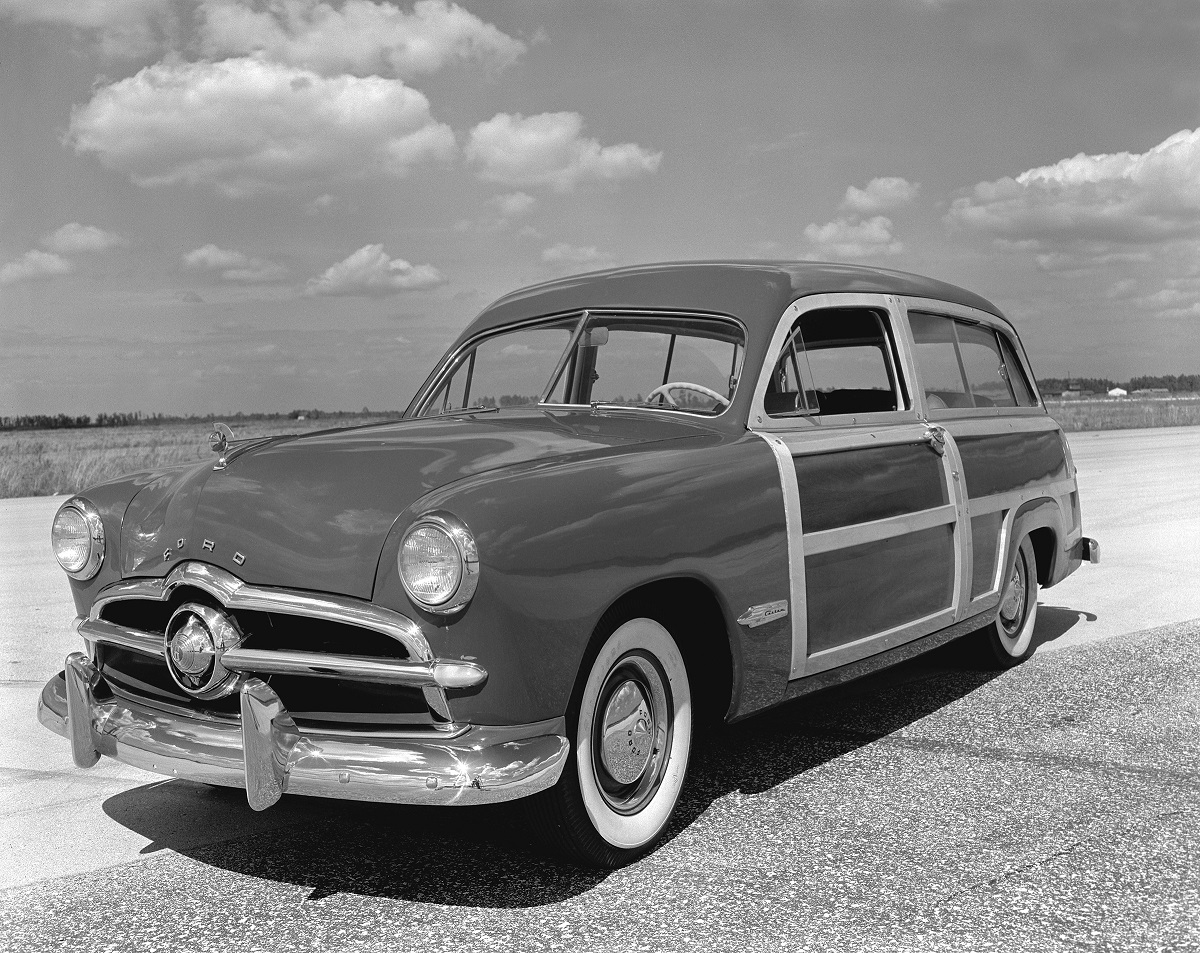
A 1949 Ford woodie wagon

New-for-1949 models came in coupe, sedan, and convertible body styles, with steel and woody wagon variations.


The “Shoebox” Design

According to Wikipedia, the ’49 Ford body style became known as “Shoebox Ford” for its slab-sided “ponton” design. But the 1949 Ford is credited with saving Ford and ushering in modern, streamlined car design with changes such as integrated fenders.

This design would continue through the 1951 model year, with an updated design offered in 1952. Frank L. Engle designed the crest.

A color photo of a 1949 Mercury convertible

The redesigned Mercury Eight for 1949 also debuted the “ponton” styling of the new Fords. The fresh styling was a sales success for both brands.

The redesigned Mercury Eight for 1949 also debuted the “ponton” styling of the new Fords. The fresh design ended the monotony of warmed-over pre-war style, which helped differentiate Mercury from its comparable Ford cousin, a trick that spelled sales success. Sales figures for both Ford and Mercury broke records in 1949.

See more photos and stories about classic cars here

2023 Nissan Pathfinder Platinum Review

2023 Nissan Pathfinder Platinum Review

The fifth-generation 2023 Nissan Pathfinder feels built for the long haul. Nothing about it seemed budget constrained or cheap. Many of its design features are helping hands for parents.

A side view of a red Nissan Pathfinder

The fifth-generation Nissan Pathfinder follows in the tracks of the nameplate’s first U.S. hardbody model from 1986. (Photos courtesy of NissanUSA or as credited)

Table of Contents

Pathfinder Through the Years
7 Cool Features
Oddities and Observations
What’s New for 2023?
2023 Nissan Pathfinder Pricing
How Is It To Drive?
Brakes, Steering, Suspension
Back Seats and Cargo Space
Why Buy the 2023 Nissan Pathfinder?
Specifications

BY MARK MAYNARD

The Nissan Pathfinder has traveled many paths since it debuted as a “hardbody” in 1986.

The first-generation Pathfinder was introduced for model year 1987 as a two-door body-on-frame SUV. Built on a ladder-type frame, Pathfinder shared styling and most components with the Nissan Hardbody pickup.

Pathfinder’s optional 4WD system was considered unique at the time because it could be engaged electronically — “shift on the fly” — while the vehicle was moving. All versions of Pathfinder were available in two-wheel drive or manually engaged 4WD configurations. Base models had modest power from a 106-horsepower, 2.4-liter four-cylinder engine or an optional 143-hp 3.0-liter V-6.

Nissan’s new SUV was in response to the growing competition: Chevrolet Blazer, Ford Bronco II, Jeep Cherokee, and import SUVs such as the Toyota 4Runner, Honda Passport, and the 1989 to 2004 Isuzu MU.

Today, there are more three-row SUV competitors than ever. Among the choices for 2023 are the Chevrolet Traverse, Honda Pilot, Hyundai Palisade, Jeep Grand Cherokee L, Kia Telluride, Mitsubishi Outlander, Toyota Highlander, and VW Atlas.

The front seat area of the 2023 nissanp pathfinder

A roomy driver area with headroom of 41.1 inches with the panoramic moonroof.

Pathfinder Through the Years

Nissan tended dutifully over the years to keep Pathfinder current and competitive. It was ahead of its time for some features, but not all variants endured the tests of owners.

It was October 1989 when Nissan debuted the four-door Pathfinder. Then, in late 1995, the second-generation Pathfinder was introduced with revised styling. There was another mild redesign in 2002.

A completely redesigned, third-generation Pathfinder debuted in late 2004 for the 2005 model year.

Model year 2013 brought a critical shift for the fourth-generation Pathfinder. The body-on-frame, truck-based SUV was replaced with a unibody design and sleek new (aerodynamic) exterior styling. It used the same platform as the Infiniti QX60, Altima, Maxima, Murano, and Quest minivan.

Nissan launched a short-lived gasoline-electric hybrid Pathfinder in 2014. Its powertrain was a supercharged 2.5-liter four-cylinder gasoline engine and an electric motor paired with a compact lithium-ion battery. The hybrid model, however, was a one-year-only offering. Owners complained they could not get gas mileage close to the advertised 25 to 28 mpg.

The fifth-generation Pathfinder was unveiled in early February 2021 as a 2022 model, skipping the 2021 model year.

Nissan brought back more emphasis on the current Pathfinder as a family adventure vehicle. The more squared-off styling — and what might be the best-looking rear end of any new SUV — ever-so-slightly goes back to the roots of Pathfinder.

There is an active forum for Pathfinder owners at PathfinderTalk.com. Owners — some of whom are lifelong Nissan faithful — post their problems, remedies, and praise.

the view from the third row of the pathfinder panoramic moonroof

The panoramic moonroof is standard on the Platinum.

7 Features Owners Will Value

Nissan engineers and designers sweat the small details and provide many enhancements and innovations. Some of these emerge only after time on the road.

Auto on-off LED headlights linked to windshield wiper use. In California and other states, it is the law to use headlights with wipers in the rain. With Nissan’s auto function, drivers will know they are always compliant.

Capacitive touch lock-unlock rear side doors. Such a simple convenience, but many others save some budget and omit that access to the rear side doors. Walking up to the back doors with an armful of kid or groceries, the driver gains quick access with a touch of the door handle. Too often, back-door entry requires first touching a front-door handle.

“Bridge” storage. Nissan makes the most of the front center console with a deep bin and “bridge” under-storage space. The pass-through bridge is also convenient for the passenger. Most other shift consoles are solid, which wastes the extra storage potential.

The pathfinder's 'bridge' storage in the lower center console

‘Bridge’ storage below and above the shift console, with a phone-audio e-bin.

Storage shelf above the glove compartment. The slim shelf will fit any generation iPhone, Nissan says. It is also mostly out of sight and sunshine.

2nd-row pushbutton seat release. Loading kids into the third row is so simple any kid can do it. The pushbutton release at the door-side seat base of the captain’s chair boosts the chair up and forward for third-row access.

the second row captain's chairs

The Captain’s Chairs package with removable center console.

54.1-liter luggage box. The undercargo floor storage compartment (1.9 cubic feet) has a hinged lid and dividers to separate the good-sized compartments. It’s part of the Cargo package, $345, and worth it.

10-way power passenger seat for Pathfinder SL and Platinum. Some imports don’t even provide height adjustment for the passenger — and nobody likes being low in the front seat.

6,000-pound towing capacity. Base models can pull a trailer up to 3,500 pounds, but the Rock Creek and Platinum models are uprated to a 3-ton capacity.

the understorage of the pathfinder

The underfloor storage box is made more functional with the section dividers from the optional Cargo package. (Mark Maynard photo)

 Oddities and Observations

Transmission unexpectedly went into Park while sitting at a stoplight. I don’t believe I bumped the electronic shifter’s Park button atop the shifter grip, yet the Pathfinder transmission went into Park at a stoplight near my home. I didn’t discover the issue until the light turned green. The problem never occurred again in my test week.

Tilt-down mirror confused. When engaging reverse, the passenger side mirror is supposed to tilt down to show the curb and then go back into position when Drive or Park are engaged. The tilt-down can work on either left or right-side mirrors. The driver must select the left or right mirror control on the door panel. I tried both sides, and each time, the side mirror tilted up, not down.

Slow response to infotainment screen. Making a selection on the infotainment screen would take a second or two to activate. Of course, I’d tap the selection again, thinking I’d missed the icon. Nope, it’s just slow.

No wireless Android Auto. While Apple CarPlay has wireless connectivity, Android users must use the access cable.

ProPILOT Assist vagueness. This Level 2 driver-assist system was once at the vanguard of semi-autonomous driving. But the advanced technologies that go into Level 2 have been honed by others to be more accurate, especially in lane centering. In my experience, the system allowed the Pathfinder to drift wide in cornering, crossing the white lines, and then giving me an alert. It also seemed the Pathfinder was closer to the lane marking on the right than the left. Still, ProPILOT is welcome backup in heavy commuting, but  keep both hands on the wheel.

The pathfinder has an around view camera system

The Intelligent Around View Monitor with Moving Object Detection.

What’s New for 2023 Pathfinder?

Nissan brought back the off-roading ready Pathfinder Rock Creek for 2023. Among its adventuring credentials are standard Intelligent 4WD, an off-road-tuned suspension, and a 5/8-inch suspension lift.

Using premium fuel gives the 3.5-liter V-6 engine a power boost of 11 horsepower and 11 foot pounds of torque. A Nissan spokesman explained that the bump in power for Pathfinder Rock Creek is by engine software programming to take advantage of the extra octane in premium fuel. “The engine computer senses the extra octane and adjusts accordingly. The other Pathfinder models don’t get this programming, so they won’t get a horsepower boost like the Rock Creek.”

I suggested that Nissan consider adding that engine-software programming as an option. How much would you pay for 11 more hp?

Other Rock Creek upgrades include:

  • 18-inch beadlock-style wheels with all-terrain tires;
  • Tubular roof rack with a 220-pound capacity;
  • Tow hitch receiver and harness with 6,000-pound maximum towing capability;
  • LED fog lights;
  • Intelligent Around View Monitor with Off-Road Mode. A front-view camera shows the terrain ahead, with a side view, all of which help driver’s place the tires where there is solid ground;
  • Orange interior stitching and second-row captain’s chairs.
  • Rock Creek pricing starts at $44,355.

The 12-inch digital 'dashboard' gauge array

The 12-inch digital dashboard.

Other 2023 Pathfinder Upgrades

  1. The upper-range SL trim levels now have a standard wireless phone charging pad;
  2. Pathfinder Platinum has a new captain’s chairs package, which adds a removable console between the second-row chairs. And it can be easily removed if needed for step-through access to the third row.
  3. 10-way power passenger seat for Pathfinder SL and Platinum. Hooray. Not all Japanese makes provide such adjustability for the front passenger.

The pathfinder third row

Third-row seating is kid class, but access is easy with pushbutton release of the second row.

2023 Nissan Pathfinder Pricing

There are five trim levels for the 2023 Nissan Pathfinder in front- or four-wheel drive. All trims have a 284-hp, 3.5-liter V-6 and a nine-speed automatic transmission. Starting prices below include the $1,335 freight charge from Smyrna, Tenn.

Pathfinder S: $36,535 2WD, $38,435 4WD (add $1,900 for 4WD)

Key S trim features include:

  • Nissan Safety Shield 360, driver-assist system;
  • Tri-zone automatic temperature control;
  • Apple CarPlay connectivity;
  • EZ FLEX seating system featuring Latch And Glide and 3rd-row 60/40-split fold-flat reclining bench seat.

Pathfinder SV: $39,355 2WD, $41,255 4WD

Key SV features include:

  • Heated front seats;
  • ProPILOT driver-assist system;
  • Intelligent Lane Intervention;
  • Intelligent Blind Spot Intervention;
  • 10-way power driver’s seat with 2-way power lumbar;
  • Remote Engine Start System with Intelligent Climate Control.

Pathfinder SL: $44,855

Key SL features include:

  • Four-wheel drive;
  • Leather-trimmed seats in first and second rows;
  • NissanConnect 9-inch color infotainment touch-screen display;
  • Intelligent Around View Monitor;
  • Wireless Apple CarPlay integration;
  • Wireless charger;
  • ProPILOT Assist with Navi-link.

Pathfinder Platinum: $49,505 2WD, $51,405 4WD

Key Platinum features include:

  • 20-inch aluminum-alloy wheels;
  • Heated and ventilated front seats;
  • Panoramic moonroof;
  • Head-up windshield display;
  • Bose premium audio system with 13 speakers, including dual woofers;
  • Tow-hitch receiver with 4-pin wiring harness.

Check here for current pricing and special offers.

The Pathfinder Platinum tester was $55,035 with seven options, including special paint for $790 and $550 for the Captain’s Chairs package, with the removable center console. But the most impressive (usable) option to me is the Cargo package, $345. Among its assets are heavy-duty rubber cargo floor and seatback protectors.

All of the tester’s options and pricing are in the specifications chart below.

Safety Features and Technologies

Every Pathfinder has the Nissan Safety Shield 360. This collection of technologies includes Automatic Emergency Braking with Pedestrian Detection, Blind Spot Warning, Rear Cross Traffic Alert, Lane Departure Warning, High Beam Assist, and Rear Automatic Braking.

And all versions of Pathfinder have 10 air bags, but there is an added driver-seat front-center bag on the Platinum.

Other safety features are in the specs chart below.

Dial-up performance modes from Sand to Sport.

Dial-up performance modes from Sand to Sport.

How Is It To Drive?

The 2023 Nissan Pathfinder feels big and wide, though it has about the same size footprint as its competition. Nissan gave Pathfinder all the power and suspension elements to be driver-engaging, but the result is more fundamental than fun-demental. Most users wouldn’t pile in the family and head out to tear up some back roads.

The turning circle with 20-inch tires is a manageable 38.7 feet, with driver assists from the around-view camera when parking.

The sole powertrain is a 284-hp, direct-injected 3.5-liter V-6 with a nine-speed automatic. Hallelujah, Nissan ditched the continuously variable automatic for this nine-speed, and few will be looking back. Shift points are well-timed but sluggish to downshift when going up hills. Overall acceleration, however, was quick enough that I didn’t feel the need to engage Sport mode. (However, I do use Sport when plugging along in the heavy commute. The quicker Sport kick is helpful to ward off those cretins who try to dive into the too-small space between you and the car ahead.)

With 259 foot-pounds of torque at 4,800 rpm, there is adequate force to handle the Pathfinder Platinum’s 4,625 pounds, not including occupants.

Fuel economy estimates of 20 mpg city and 25 mpg highway might be hopeful; 87 octane is recommended for all models but Rock Creek. Around town in my week of driving, my average fuel economy hovered between 11 to 16 mpg. I worked up to 22 mpg on more extended highway driving, meeting the EPA estimate.

The pathfinder's v6 engine

The 284-hp 3.5-liter V-6 for all Pathfinder trim levels.

Braking, Steering, Suspension

Pathfinder’s foundation feels robust and substantial, essential for towing and adventuring off the highway. The ride quality is comfortable but gives an unexpected sport-tuned jolt over rough road. Inputs to steering and braking are refined and steady.

But there is noticeable ambient cabin noise at highway speeds, which I attributed to the prominent roof rail cross bars.

The 6,000-pound towing capacity for Platinum and Rock Creek requires the Class III receiver hitch, the seven-pin connector for trailer braking, and the factory-installed transmission oil cooler. The upgrade is part of the Premium Package on the SV and SL models. The SV Premium Package is $2,170, and the SL Premium Package is $2,990.

Braking: Four-wheel disc brakes have vented rotors front and rear with 13.8-inch rotors front and 13-inch rotors rear.

Steering: electric power assist with vehicle-speed assist,

Suspension: four-wheel independent with front struts and rear multi-link setup; solid stabilizer bar front, hollow rear. Twin tube, dual-flow path shock absorbers;

Tires-Wheels: 255/50 20-inch all-season tires on machined aluminum-alloy wheels with a dark metallic gray finish. A temporary spare stows underbody at the cargo area;

The Pathfinder Platinum is well dressed in 20-inch all-season tires on machined aluminum-alloy wheels with a dark metallic gray finish.

The Pathfinder Platinum is well dressed in 20-inch all-season tires on aluminum-alloy wheels.

Back Seats and Cargo Space

Raised back seat height in the Pathfinder is very kid friendly for open views and helpful to ward off motion

electronic back seat ac and vent controls

Electronic climate controls for the second row.

queasiness. Also beneficial are ceiling vents just above each side window, with reading lights. There also is a lot of seatback recline, another parenting asset for sleeping youngsters.

A flat floor in the second and third rows is the great enabler for comfortable foot space, uncompromised by a transmission tunnel. Adult legroom in the second row is functional at 35.5 inches, which can be stretched a bit with a few inches of fore-aft slide.

And there is plenty of big-bottle space in the door panels.

a pair of chilld seats in the second row

Captain kids’ chairs.

Parents will appreciate the pushbutton spring release to slide forward the second-row seat for third-row access. And there’s a one-arm push to lock down the seat. As with most midsize, three-row SUVs, the way back is best for small children.

Cargo capacity ranges from grocery bag and gym bag space behind the third row (16.6 cubic feet) to family vacation capacity of 45 cu.ft. with the third row folded.

The liftgate opening is 49 inches wide, or 4 feet, 1 inch. With both rows folded, there is about 6 ½ feet in length for a wide bay of 80.5 cu.ft. Other cargo area features include two grocery bag hooks, four tie downs, lighting, and a 12-volt plug.

Cargo space behind the third row is 16.6 cubic feet

Check out the heavy-duty rubber cargo mat and seatback protector, both are part of the $345 Cargo package, and worth it. (Mark Maynard photos)

Both rows of seats are folded for big and open cargo space

Fold both back seats for 6 ½ feet-plus in length.

Why Buy the 2023 Nissan Pathfinder?

The fifth-generation Nissan Pathfinder feels built for the long haul. Nothing about it seemed budget constrained or cheap. Many of its design features were helping hands for parents, at least for those who resist the “M” word for minivan. And the details of Nissan’s design and engineering will bring years of “Gee, I like that little extra.”

Pathfinder’s next midcycle freshening is planned for 2025, so there are long legs for the current model. But shop wisely for the most value.

The Platinum model has an appreciable load of standard features. However, you can step down a grade to the Pathfinder SL and add options that mimic the Platinum for a sticker of $48,190. I prefer a monotone paint scheme, saving $790. And to save another $395, stay away from optional paint colors, such as Scarlet Ember Tintcoat (a gorgeous red) or Pearl White TriCoat, for $395 each. Then save another $390 if you won’t use the (wind-noise generating) roof rail cross bars.

Add it up, and the Pathfinder SL 4WD, with leather-trimmed upholstery, saves nearly $7,000 over the Platinum. And that savings will buy a lot of gas for a driving vacation.

The good look rear end of the new pathfinder

Starting prices for the 2023 Nissan Pathfinder range from $36,535 to $50,000.

2023 Nissan Pathfinder Platinum Specifications

Body style: large-midsize, 3-row, 7-seat SUV with 4WD

Engine: 284-hp, naturally aspirated and direct-injection 3.5-liter V-6; 259 lb.-ft. torque at 4,800 rpm

Transmission: 9-speed automatic with manual shift mode paddle shifters, and electronic shift-by-wire drive selector; Intelligent 4WD with 7-position Drive and Terrain Mode

Fuel economy: 20/25/22 mpg city/hwy/combined; 87 octane

Tow capacity: up to 6,000 pounds; class III tow hitch with harness and 4-pin prewiring; trailer-sway control

BY THE NUMBERS

Fuel tank: 18.5 gallons

Cargo space: 16.6 cubic feet behind 3rd row; 45 cu.ft. 3rd row folded; 80.5 with both rows folded

Front head/leg room: 41.1*/44.3 inches *42.3 inches w/o moonroof

2nd-row head/leg room: 39.6/35.5 inches

3rd-row head/leg room: 37.8/28 inches

Length/wheelbase: 197.7/114.2 inches

Curb weight: 4,625 pounds

Turning circle: 38.7 feet

FEATURES

Standard equipment includes: Nissan Intelligent Key with push-button ignition, Intelligent cruise control, panoramic moonroof (with one-touch power tilt-sliding glass with shade), tri-zone climate control, wireless phone charging pad, 12.3-inch gauge display, head-up driver windshield display, 9-inch color navigation-infotainment touch display, 13-speaker Bose premium audio system with subwoofer, 10-way power adjusted front seats, heated and ventilated front seats, sun visors with extenders and vanity mirrors, heated 2nd-row window seats, quilted semi-aniline leather-trimmed upholstery in first and second rows, power tilt-telescopic steering column, two-driver memory presets, automatic LED headlights (high and low beams), LED running lights and fog lights, body-color power-folding and heated side mirrors with reverse tilt-down, privacy glass (rear-side windows and liftgate window), silver-finish roof rails, motion-activated power liftgate, 2 12-volt DC power outlets (1 front console, 1 in cargo area);

Safety features include: 11 air bags (including for Platinum, a driver seat-mounted front-center bag), dynamic traction control, hill-start assist with hill-hold control and hill-descent control, brake-force distribution, brake assist, 4-wheel ABS; LED side mirror-mounted turn signals;

Driver-assist technologies include: ProPILOT Assist semi-autonomous driver assist with Navi-link, blind-spot warning and blind-spot intervention, rear cross-traffic alert, automatic emergency braking with pedestrian detection, automatic rear braking, Intelligent forward-collision warning, Intelligent lane intervention.

PRICING

Base Platinum MSRP: $51,405, including $1,335 freight charge; price as tested $55,035

Options on test vehicle: Two-tone paint $790; captain chair’s package $550; roof-rail crossbars $390; LED fog lights $345; lighting package (without running boards $945; carpeted floor mats with captain’s chairs (4-piece set) $265; cargo package $345

Where assembled: Smyrna, Tenn.

Warranties: 3-years/36,000-miles bumper to bumper with 24/7 roadside assistance; 5-years/60,000-miles powertrain

Toyota Corolla Cross Hybrid First Drive

Toyota Corolla Cross Hybrid First Drive

The subcompact 2023 Corolla Cross Hybrid racks up 45 mpg in town, 38 on the highway, and 42 mpg combined — with standard all-wheel drive

A gold-colored Toyota Corolla Cross Hybrid horizonal view

The new 2023 Toyota Corolla Cross Hybrid has fuel economy estimates of 45 mpg city, 38 highway, and 42 mpg combined. Pricing starts at $30,000, including automatic all-wheel drive. (Photos courtesy of ToyotaUSA)

Table of Contents

Notes from the Test Drive
Interior Function
The Hybrid Powertrain
Pricing
Standard Features By Trim
Warranty Coverage
Safety Technologies
Suspension, Steering, Brakes
Specifications

BY MARK MAYNARD

Toyota’s Corolla Cross is a likable small SUV — and it’s even more likable now that it is available in a gasoline-electric hybrid model. The hybrid model joins the front-wheel-drive, gas-engine Corolla Cross, which went on sale last year.

If there ever was a no-brainer choice for a first-time small ute buyer, the Corolla Cross is it. Its functional body style reminds of a mini-me RAV4, which has grown significantly in size and price. And it is a serious fuel miser with EPA estimated ratings of 45/38/42 mpg city, highway, and combined.

Toyota was in the Carlsbad, Calif., area of San Diego County for the first U.S. journalist drives of the 2023 Corolla Cross Hybrid. Journalists had drive time in the three trim levels of the Corolla Cross Hybrid.

Experiencing the range of trim levels with standard all-wheel drive gave me a good first-drive overview. Based on my first taste of the Corolla Cross Hybrid, I’d like to explore it more on an at-home evaluation for a proper review.

The driver area of the Corolla Cross

Entry-level models have an 8-inch touchscreen and smart key access.

Notes From the Test Drive

Toyota calls the Corolla Cross Hybrid’s exterior styling “approachable” with a higher line-of-sight. The sturdy stance disguises the upright interior, with open sightlines across the hood and over the shoulder.

Unique front and rear styling and optional two-tone paint choices visually separate the gas and hybrid models.

Standard all-wheel drive seems unusual, but after the wicked weather this winter and spring, the automatic AWD system could be a lifesaver and high on a buyer’s wish list of features.

Of the three trim levels, the base Corolla Cross Hybrid S is ideal for buyers who can live without a moonroof, power liftgate, two-tone paint, adaptive (turning) headlights, or a potent JBL audio system. The only factory choice is for special paint, a $425 cost.

Among the standard features are two USB-C charge ports and a multimedia audio system. It has all the connectivity features, including wireless Apple CarPlay and Android Auto. The multimedia system also allows over-the-air updates.

The driver seat has six-way manual adjustment and four-way for the front passenger.

I was more comfortable in the fabric-trimmed seats of the S rather than the sportier fabric seats in the SE. But the Softex-trimmed (synthetic leather) upholstery in the XSE adds heated front seats and a power driver’s seat.

The view from the open front passenger door showing the upholstery and dashboard

Cabin materials show Toyota’s newfound attention to using more refined materials and textures.

The Corolla Cross Hybrid Powertrain

Both models of Corolla Cross have a 2.0-liter Dynamic Force four-cylinder engine and an electronic continuously controlled automatic transmission.

Powertrain similarities end there, however.

The gas Corolla Cross has 169 horsepower with front-drive fuel-economy ratings of 31/33/32 mpg city/highway/combined and 29/32/30 AWD.

Performance from the Corolla Cross Hybrid jumps to 169 hp, which Toyota says makes it capable of launching to 60 mph in 8 seconds. If only its 10.6-gallon tank were larger to stretch the time between fill-ups, but placing the hybrid battery under the back seat took up the space. Still, the range is good at around 450 miles.

The open hood showing the engine

169-hp from the combined power of the engine and hybrid system.

Interior Function

The interior is not flamboyantly designed but has all the right toughness where it is needed. The materials show Toyota’s newfound attention to using more refined materials and textures.

Smart packaging of the Corolla Cross provides tall front headroom and back-seat space for a young family. Back-seat legroom, however, is grade-schooler-tight at 32 inches. Cargo space has square dimensions for friends-helping-friends move into the new condo.

The CVT shifter in the Corolla Cross

The e-CVT with Sport mode and hill-start assist.

Toyota Corolla Cross Hybrid Pricing

Expect the 2023 Toyota Corolla Cross Hybrid in dealerships this June. It is offered in S, XSE, and XSE trim levels. Starting prices by trim level:

S $29,065;

SE $29,290;

XSE $32,160.

Manufacturer Suggested Retail Pricing includes the $1,095 freight charge from the new Mazda Toyota Manufacturing plant in Huntsville, Ala.

Check here for current pricing and special offers.

An LED headlight of the Corolla Cross

LED headlights are standard on the Corolla Cross Hybrid S and SE models. Adaptive (turning) headlights are a $615 option for the XSE.

Standard Features By Trim Level

The S and SE trim levels have 17-inch alloy wheels, an 8-inch touchscreen, sport-tuned suspension, LED headlamps, and smart key access. The only factory option for the S is optional paint colors, which cost $425.

Moving up to the SE Corolla Cross Hybrid adds privacy glass, roof rails, and paddle shifters. A blind-spot monitor and rear cross-traffic alert add to the standard roster of safety features (highlighted below).

The top-line XSE is the sportiest offering, with such extras as:

  • 18-inch alloy wheels;
  • LED headlamps, taillamps, and fog lamps;
  • Softex-trimmed (synthetic leather) upholstery with heated front seats and a power driver’s seat.

An 18 inch alloy on the topline XSE model.

The XSE has 18-inch alloy wheels with a black-painted machined finish and 225/55 all-season tires.

Warranty Coverage

Toyota’s basic new-vehicle warranty coverage covers 3 years or 36,000 miles bumper to bumper and 5 years or 60,000 miles for the powertrain.

Hybrid-related components that require repairs to correct defects in materials or workmanship are covered for 8 years or 100,000 miles, whichever comes first from the original date of first use when sold as new.

The hybrid battery is covered for 10 years or 150,000 miles, whichever comes first, and is transferable across ownership.

The warranty package includes ToyotaCare, covering factory-scheduled maintenance for two years or 25,000 miles with 2 years of roadside assistance.

Paint Color Choices

The SE and XSE levels of the Corolla Cross Hybrid have special two-tone combinations, $500 each:

  • Sonic Silver with a black roof;
  • Barcelona Red with a black roof;
  • Blue Crush Metallic and black roof, and;
  • Acidic Blast (gold) and black roof. Acidic Blast is a new color.

Standard monochromatic paint colors include:

  • Jet Black Mica;
  • Cypress (forest green);
  • Celestite (sky blue);
  • Wind Chill Pearl (off-white; $425 extra)

a view of the back seat through an open side door

Back-seat legroom is grade-schooler tight at 32 inches.

 Corolla Cross Safety Technologies

Including nine air bags, the Corolla Cross Hybrid has substantial standard safety features, anchored by Toyota Safety Sense 3.0. Among the advanced technologies are:

PCS w/PD — Pre-Collision System with Pedestrian Detection;

DRCC — Dynamic Radar Cruise Control;

LDA w/SA — Lane Departure Alert with Steering Assist;

LTA — Lane Tracing Assist;

LCA — Lane Change Assist;

FCT — Front Cross Traffic Alert;

RSA — Road Sign Assist.

Star Safety System includes:

VSC — Enhanced Vehicle Stability Control;

TRAC — Traction Control;

ABS — Anti-lock Brake System;

EBD — Electronic Brake-force Distribution;

BA — Brake Assist;

SST — Smart Stop Technology;

AHB — Automatic High Beams;

PDA — Proactive Driving Assist.

A rear view of a gold colored Corolla Cross Hybrid

The Corolla Cross Hybrid model has unique front and rear styling, and optional two-tone paint choices, $500 each. AcidicBlast paint color is shown.

Suspension, Steering, Brakes

Suspension: Four-wheel independent with front sport-tuned MacPherson struts with stabilizer bar, coil springs, and hydraulic shock absorbers; Rear, sport-tuned double-wishbone multi-link rear with coil springs, trailing arms, stabilizer bar and hydraulic shock absorbers;

Steering: Electric power-assisted rack-and-pinion;

Brakes: Front ventilated 12-inch diameter rotors; rear solid 11.1-inch rotors.

Wheels and Tires

S and SE: 17-inch silver-colored alloy wheels with 215/65 all-season tire;

XSE: 18-inch alloy wheels with black-painted machined finish with 225/55R all-season tires;

There is a tire-inflation system, no spare tire.

Curb weights

S — 3,395 pounds;

SE — 3,385 pounds;

XSE — 3,430 pounds.

A view of the open cargo area with the tailgate raised

Cargo space of 40.3 cu.ft. behind the back seat. All-weather floor liners (three) are a $179 accessory.

The open cargo space with the back seat folded

Fold the back seat and load it up for friends-helping-friends move into the new condo.

2023 Toyota Corolla Cross Hybrid Specifications

Body style: All-wheel-drive 5-seat, 5-door small SUV

Engine: 150-hp 2.0-liter with direct- and multiport injection; 139 lb.-ft. torque at 4,400 rpm

Transmission: E-CVT with electronic on-demand AWD

Fuel economy: 45/38/42 mpg; 87 octane or higher recommended

Max towing capacity: 1,500 pounds

0-60 mph acceleration: 8 seconds, per Toyota

COROLLA CROSS HYBRID SYSTEM

Electric motor: permanent magnet synchronous; 152 lb.-ft. torque

Battery: 222-volt lithium-ion; 4.08 Ahr

System voltage: DC600V

Combined system power: 196 hp

BY THE NUMBERS

Fuel tank: 10.6 gallons

Cargo space: 40.3 to 61.8 cubic feet

Front head/leg room: 39.5 inches*/42.9 inches

Rear head/leg room: 39.1/32 inches

Length/wheelbase: 176.8/103.9 inches

Turning circle: 35.4 feet

PRICING

Base prices, including the $1,095 freight charge:

S $29,065;

SE $29,290;

XSE $32,160

Where assembled: Huntsville, Ala.

Warranties: 3-years/36,000-miles bumper to bumper; 5-years/60,000-miles powertrain; hybrid components are covered for 8 years or 100,000 miles, and the hybrid battery is covered for 10 years or 150,000 miles.

Included in the warranty package is ToyotaCare, covering factory-scheduled maintenance for two years or 25,000 miles, with 2 years of roadside assistance.

2023 Toyota Prius Prime First Drive

2023 Toyota Prius Prime First Drive

Re-engineered and stylishly redesigned, the 2023 Toyota Prius Prime plug-in hybrid has more power and up to 44 miles of battery-only driving. But it is also much more expensive.

A Supersonic Red Prius Prime

The redesigned 2023 Toyota Prius Prime is more powerful, with up to 44 miles of battery-electric driving. (Photos courtesy of ToyotaUSA)

Table of Contents

3 Cool Features
‘Sexy’ New Body Style
The Refined Interior
Plug-in Hybrid Powertrain
Charging at Home
Can You Name These Safety Abbreviations
2023 Prius Prime Pricing
Standard Features By Trim Level
Specifications

BY MARK MAYNARD

Owners of the previous-generation Toyota Prius Prime will not be happy if, just for the heck of it, they test drive a 2023 Prime model, a plug-in hybrid. Comparing the old model with the completely redesigned and re-engineered 2023 Prius Prime is like comparing a canoe with a streamliner.

Improvements in power, ride quality, and interior accommodations are near-luxury in a more rewarding presentation. And now, with a larger electric-drive motor and a larger four-cylinder engine, the battery driving range was improved to 39 to 44 miles, from 25 miles in the previous model.

Built on the second-generation TNGA-C platform, the 2023 Prius Prime has a lower center of gravity, reduced weight, and increased body rigidity compared to the previous generation. Toyota says the position of the hybrid traction battery was also moved to under the rear seat, yielding a lower center of gravity and a little more trunk space.

Toyota was recently in the Carlsbad, Calif., area of San Diego County for the first U.S. journalist drives of the 2023 Prius Prime PHEV and Corolla Cross Hybrid. Journalists had drive time along short routes in various trim levels of both vehicles. Soon, I will have more time for a proper review, but my time in the vehicles gave a good first-drive overview.

A leather-trimmed heated steering wheel in the entry SE model.

A leather-trimmed heated steering wheel in the entry SE model.

3 Cool Features

Traffic Jam Assist: For those on the daily commute of heavy traffic, Traffic Jam Assist can help take some of the stress from low-speed, stop-and-go driving. Here’s how it works: While driving on a highway with Dynamic Radar Cruise Control and Lane-Trace Assist activated, system sensors will detect when traffic is slowing. If operating conditions are OK, the assist system will provide acceleration, braking, and hands-free steering control under the active supervision of the driver. This system will only operate at speeds lower than 25 mph. The driver monitoring camera also must confirm the driver has their eyes on the road to allow for hands-free operation. The driver will get a prompt to resume control when traffic clears, or the speed drops below 25 mph.

Solar Roof: The 185-watt solar roof option ($640) can charge the drive battery incrementally while parked. Solar charging also supplies power to auxiliary functions while driving. Information about power generation is shown in the vehicle’s multi-information display.

Predictive Efficient Drive with Predictive Deceleration Support: This all-seeing system optimizes range by observing the driver’s stopping patterns on frequently driven routes. The system will then suggest when to let off the accelerator. Predictive Efficient Drive is a standard feature on all trim levels, but it requires a subscription for cloud navigation. The XSE Premium gets one free year of service, but the lower trim levels require an additional Drive Connect subscription.

XSE Premium 12.3-inch Touchscreen and JBL Premium Audio.

XSE Premium 12.3-inch Touchscreen and JBL Premium Audio.

‘Sexy’ New Body Style

The new Prius Prime builds upon the foundation of the standard five-seat and front-wheel-drive gasoline-electric hybrid Prius sedan. The body is 2 inches lower, an inch wider, and an inch longer than the previous generation. The smooth, aerodynamic shape has a “hammerhead nose,” lower roofline, and widened rear.

Wheel sizes are also vital to efficient performance. The entry SE model has 17-inch wheels, which Toyota says yields 44 miles of battery-electric driving. Moving up to the Prius Prime XSE trim levels adds 19-inch wheels but drops the battery driving range to 39 miles.

Curb weights are up by about 100 to 200 pounds vs. the 2022 model, which affected fuel-economy ratings, too. The 2022 Prius Prime has mileage ratings of 55/53/54 mpg city, highway, and combined. Those estimates compare to the 2023 Prius Prime at 53/51/52 mpg city/highway/combined for the base model to 50/47/48 mpg for the mid and top-line models.

The previous Prius Prime also has a farther total driving range of 640 miles compared to 550 to 600 miles for the new model.

Despite the Prime’s sleek shape (Toyota calls it “sexy”), its drag coefficient is a couple of hundredths less efficient: 0.27 vs. 0.25 for the outgoing model.

SofTex-trimmed heated and ventilated front seats in the XSE Premium.

SofTex-trimmed heated and ventilated front seats in the XSE Premium.

The Refined Prime Interior

Subtle elements of red and red ambient lighting enhance higher-quality materials in the cabin. The wider cabin benefits shoulder room by just over 1 inch and legroom stay the same at 43.2 inches. But the lower roofline trims the front headroom by 1.4 inches, which is notable in the cabin.

The driver position still has the same gauge-viewing complexity as the Prius hybrid. The more extended steering column and smallish gauge array with many details seem far away for easy viewing. However, there is a functional workaround with attention to seatback angle and steering-wheel height.

Back-seat space took a more significant trim of headroom, losing nearly three-quarters of an inch (now at 38 inches). Rear legroom grew by a noticeable 1.4 inches. With the lower headroom, however, the back seat is no place for large adults.

Trunk space increased, but by less than a cubic foot. But the wide and flat cargo capacity is very usable and expandable by the folding back seat for up to 26.7 cu. ft.

The back seat space is tight in the Prius Prime

Back seat headroom and legroom are snug at 36.4 and 34.8 inches, respectively.

Plug-in Hybrid Powertrain

Toyota’s fifth-generation hybrid powertrain pairs the M20A-FXS 2.0-liter four-cylinder Atkinson-cycle gas engine with two motor generators (MG1 and MG2). The transmission is a planetary-type E-CVT, continuously variable automatic.

The engine works with the electric motor MG2 to drive the front wheels and to boost performance as needed. Both motors work to charge the lithium-ion battery.

Combined power from the gas engine (150 horsepower) and electric motors is 220 hp. When driving in Hybrid Mode, Toyota cites an estimated 0-60 acceleration in 6.6 seconds — compared to 10.2 seconds for the outgoing model.

More powertrain details are in the specifications chart below.

An open hood view of the prime engine and electrification elements

Toyota’s fifth-generation hybrid powertrain pairs the 2.0-liter four-cylinder gas engine with two motor generators (MG1 and MG2) through a continuously variable transmission.

Finessing the Power

The Prius Prime has three drive modes that allow drivers to finesse battery reserves or power: EV Mode, HV/EV Auto Mode, and Hybrid Mode.

EV Auto Mode — relies on the battery for driving around town.

HV/EV Auto Mode — the engine will engage where it is more efficient, such as up steep hills or at higher speeds.

Hybrid Mode —automatically switches between the gasoline engine and the electric motor.

There also are selectable performance modes of Eco, Normal, and Sport.

the open charge door of the Prime

It will take about 11 hours to recharge the Prius Prime using a household outlet or four hours with a 240-volt Level 2 charger.

Charging at Home

There is no special equipment needed for home charging. The Prius Prime comes with a charging cable, but an optional 240-volt charging system will be quicker to recharge.

The battery will recharge on a standard 120-volt home outlet in about 11 hours. (Toyota recommends using a dedicated GFI 15-amp outlet). Charging with a 240-volt, Level 2 charger will take about 4 hours.

Can You Name The Safety Abbreviations?

Prius Prime’s standard safety features and technologies include eight air bags and:

TJA — Traffic Jam Assist;

SEA — Safe Exit Assist.

Toyota Safety Sense 3.0 includes:

PCS w/PD — Pre-Collision System with Pedestrian Detection;

DRCC — Dynamic Radar Cruise Control;

LDA w/SA — Lane Departure Alert with Steering Assist;

LTA — Lane Tracing Assist;

LCA — Lane Change Assist;

FCT — Front Cross Traffic Alert;

RSA — Road Sign Assist.

Star Safety System includes:

VSC — Enhanced Vehicle Stability Control;

TRAC — Traction Control;

ABS — Anti-lock Brake System;

EBD — Electronic Brake-force Distribution;

BA — Brake Assist;

SST — Smart Stop Technology;

AHB — Automatic High Beams;

PDA — Proactive Driving Assist.

19-inch Michelin Primacy all-season tires on the XSE model.

19-inch Michelin Primacy all-season tires on the XSE model.

Ride and Handling

Improvements to the suspension, steering, and braking will make an immediate impression — and not just for owners of the prior-gen Prime.

There is complete smoothness to pedal response in regenerative braking, rather than a stop-start, on-off action. And the damping effect of the suspension has an almost-sporty feel. The steel-spring suspension eliminates the jounce and heavy feel of hefting a 3,500-pound small car. The hybrid battery weighs 284 pounds — just 19 pounds heavier — or 287 pounds with the solar roof.

Electric-assist steering has some actual road feel, and the sturdy, three-spoke wheel glides through the hands. Turning circles, however, are wider by a foot, now at 34.4 for the SE and 35.4 feet for the XSE.

More hardware stats are in the specs box below.

Seats folded in the Prime cargo hold

Trunk space is wide, flat, and expandable by the folding back seat for up to 26.7 cu. ft.

A view of the rear cargo compartment

2023 Toyota Prius Prime Pricing

The redesigned 2023 Toyota Prius Prime is expected in dealerships next month, May 2023.

As before, there are three trim levels, renamed SE, XSE, and XSE Premium. And MSRPs are significantly higher than the outgoing model — by $3,580 for the SE, $5,050 for the XSE, and $4,620 for the XSE Premium.

2023 Prius Prime Manufacturer’s Suggested Retail Prices:

SE $33,445;
XSE $36,695;
XSE Premium $40,265.

Retail prices include the $1,095 freight charge from the Tsutsumi Plant, in Aichi, Japan.

Check here for updated Prius Prime pricing and special offers.

For comparison, the Toyota 2023 Prius hybrid has starting prices across six trim levels in front- or all-wheel drive that range from $28,545 to $36,960.

2023 Prius Prime paint colors:

  • Cutting Edge (light gray)
  • Guardian Gray
  • Midnight Black Metallic
  • Reservoir Blue
  • Wind Chill Pearl (white; $425 premium)
  • Supersonic Red ($425 premium)

The clever side slot for phone charging on the center console.

The clever side slot for phone charging on the center console.

Standard Features By Trim Level

SE equipment includes:

Dark gray 17-inch alloy wheels with wheel covers;

8-inch Toyota Audio Multimedia touchscreen;

6-way adjustable fabric front seats in black with red trim;

6 USB-c ports;

Electric parking brake;

Leather-trimmed heated steering wheel;

8 air bags and blind spot monitor with rear cross-traffic alert

Optional features include front and rear parking assist with automatic braking.

XSE equipment builds on SE features and includes:

Machine-finished 19-inch alloy wheels;

8-way adjustable heated power driver’s SofTex-trimmed seat. Black upholstery has red trim;

Smart key entry and push-button ignition;

Wireless phone charger;

Front and rear parking assist with automatic braking;

Available options include a 12.3-inch high-resolution touchscreen display, fixed glass roof, and Digital Key.

The XSE Premium layers onto the SE and XSE features, adding:

8-speaker, JBL Premium audio system;

12.3-inch touchscreen display;

The new Prius Prime has an optional solar roof for $640. This image shows a corner of the solar roof title

The 185-watt solar roof option ($640) for the XSE Premium can charge the drive battery while parked. The solar charger also supplies power to auxiliary functions while driving.

Fixed glass roof;

SofTex-trimmed heated and ventilated front seats;

Power rear liftback;

Digital Key.

Available options include a Panoramic View Monitor, Digital Rearview Mirror, heated rear seats, and Advanced Park. The parking system helps the driver steer into a parking space, whether parallel or backing into a perpendicular space. A combination of cameras and sensors recognizes the vehicle’s surroundings.

A rear view of a Supersonic Red Prius Prime

The more polished and stylish 2023 Prius Prime has improvements in power, ride quality, and interior accommodations

2023 Toyota Prius Prime Specifications

Body style: compact, 5-seat, 5-door, front-wheel-drive plug-in hybrid sedan

Engine: 150-hp, Atkinson-cycle, 16-valve VVT-I 2.0-liter 4-cylinder; 139 lb.-ft. torque

Motor Generator 2: Drives front wheels, regeneration during braking: Permanent Magnet AC Synchronous, 160-hp, 120 kW

Combined system power: 220 hp

Transmission: E-CVT

Plug-in hybrid battery pack: 13.6 kWh (51 Ahr) lithium-ion

Battery weight: 284 pounds (287 with solar roof)

Onboard charger capacity: 3.5 kW

Charge times: Approximately 4 hours on 240 volts; 11 hours on 120 volt

Emission certification: SULEV30 with Transitional Zero Emission Vehicle (TZEV)

MILEAGE AND DRIVING RANGE

EPA estimated fuel economy ratings; 87 octane recommended:

SE — 53/51/52 mpg city/hwy/combined;

XSE, XSE Premium — 50/47/48;

EPA estimated MPGe (combined): 127 SE; 114 XSE, XSE Premium

Estimated total driving range: 600 miles SE; 550 miles XSE, XSE Premium

EV Driving Range (up to 84 mph): up to 44 miles SE; up to 39 miles XSE, XSE Premium

0-60 mph acceleration: 6.6 seconds, in Hybrid Mode

HARDWARE EQUIPMENT

Suspension: 4-wheel independent; front MacPherson struts with stabilizer bar; rear multi-link stabilizer bar;

Braking: four-wheel disc brakes with ABS; 12-inch ventilated front discs; solid 11-inch rear discs with integrated regenerative braking and Star Safety System;

Steering: electric power-assisted rack-and-pinion.

BY THE NUMBERS

Drag coefficient: 0.27 with 17-inch wheels

Fuel tank: 10.6 gallons

Cargo space: 20.3-26.7 cubic feet

Front head/leg room: 38/43.2 inches

Rear head/leg room: 36.4/34.8 inches

Length/wheelbase: 181.1/108.3 inches

Curb weights: SE 3,461 pounds; XSE 3,516 lbs.; XSE Premium 3,571

Turning circles: 34.4 feet SE; 35.4 feet XSE, XSE Premium

Where assembled: Tsutsumi Plant, Aichi, Japan

Warranties: 3-years/36,000-miles bumper to bumper; 5-years/60,000-miles powertrain; and 10-years/150,000-miles for the hybrid battery

57th Annual Easter Jeep Safari April 1-9

57th Annual Easter Jeep Safari April 1-9

 The long-running Moab Easter Jeep Safari will draw 20,000 participants and debut 7 wild Jeep concept vehicles, four of which are electrified

The group of 7 Jeep concept vehicles

Seven one-of-a-kind Jeep concept vehicles take four-wheeling to the next level of Jeep 4×4 capability for the 2023 Easter Jeep Safari. (Photos courtesy of Stellantis)

Table of Contents

Wrangler Magneto 3.0 Concept
Scrambler 392 Concept
1978 Jeep Cherokee 4xe Concept
Wrangler Rubicon 4xe Concept
Grand Wagoneer Overland Concept
Wrangler Rubicon 4xe Departure Concept
Gladiator Rubicon Sideburn Concept
Jeep Performance Parts

 BY MARK MAYNARD

Jeep has just off-loaded seven wild mission-capable concept vehicles for the 57th annual Easter Jeep Safari, April 1-9, 2023, in Moab, Utah

The annual gathering since 1967, began as a simple one-day trail ride by the Moab Chamber of Commerce. Over the years, as participation grew, the Easter Safari expanded until it finally reached the current nine-day event. “Big Saturday” remains the culmination of the event on the Saturday of Easter weekend.

Today, Moab’s Red Rock 4-Wheelers four-wheel-drive club hosts the Easter Jeep Safari. The club will lead trail rides and some daylong trips.

“Every year, more than 20,000 Jeep enthusiasts descend on Moab, Utah, for Easter Jeep Safari to wheel in the most extreme off-road conditions,” said Jim Morrison, senior vice president and head of Jeep brand North America. 

Moab, Utah — the Jeep brand’s home away from home — has the ideal conditions to connect with Jeep enthusiasts. Morrison said in a release that Jeep listens to its followers for their feedback on where they want to take the Jeep brand into the future.

A trail ride of Jeeps in Moab

Moab’s Red Rock 4-Wheelers four-wheel-drive club hosts the Easter Jeep Safari and leads trail rides and some daylong trips.

Sermon On the Mount 

Electrified power and commanding performance will be front and center during this year’s Safari, Morrison said. Jeep engineers and designers from Jeep Performance Parts (JPP) by Mopar have created one-off rock-crawling and terrain-traversing vehicles to take four-wheeling to the next level.

The Wrangler Magneto, Jeep’s first battery-electric vehicle concept, returns for a third season. The third iteration of the Jeep Wrangler SUV concept, Magneto 3.0, and three other Jeep 4xe concept vehicles are a testament to the Jeep brand’s commitment to Zero Emission Freedom and 4×4 leadership.

Each concept features the latest production and prototype Jeep Performance Parts, all battle-tested for durability.

“Unlike any other aftermarket offerings, our growing portfolio of factory-tested and factory-backed parts and accessories are designed and engineered to face the toughest trails in the world,” said Mark Bosanac, North America senior vice president, Mopar service, parts, and customer care.  

The 2023 Easter Jeep Safari concept vehicles include:

Jeep Wrangler Magneto 3.0 

The Jeep Magneto concept

The Jeep Wrangler Magneto 3.0 Concept is back with modifications for its third safari.

When the Jeep design team began building the Jeep Wrangler Magneto concept, the intention was to use the platform to discover and push the boundaries of 4×4 electrification.

The Jeep Magneto 1.0 concept made its Safari debut in 2021 as a fully capable battery-electric off-roader. Based on a two-door 2020 Jeep Wrangler Rubicon, the Magneto features a custom-built axial flux electric motor that operates up to 6,000 rpm. Its 285-horsepower e-motor connects to a six-speed manual transmission. The compact e-motor was initially tuned to deliver up to 273 foot-pounds of torque.

The 2022 debut of Jeep Magneto 2.0 raised the e-motor power to 625 hp with 850 lb.-ft. of peak torque.

Updates to the 2023 Jeep Magneto include a more efficient motor and updated programming. Together, the powertrain has a 20 percent increase in useable energy and range, Jeep says.

Also new to the 2023 Jeep Magneto 3.0 concept are three driver-selectable functions. Output select allows the driver to choose between two power settings:

Standard: 285 horsepower and 273 lb.-ft. of torque; 

Maximum: 650 horsepower and 900 lb.-ft. of torque;

  • Two-stage power regeneration mode allows normal driving while off, or with enhanced brake regeneration using the electric motor when engaged ;
  • Aggressive hill-descent mode selectable in low range for “one-pedal” off-road driving;

Trail-riding assets of Magneto 3.0 include:

  • Dynatrac 60 front axles (5.38:1 ratio) and Dynatrac 80 rear axles (5.38:1 ratio).
  • 20-inch off-road beadlock wheels.
  • 40-inch mud terrain tires.
  • A 3-inch lift.   

A clear hood insert on the Magneto concept

The tinted hood insert on the Magneto 3.0 Concept.

Bodywork changes include:

  • Door openings swept back by 6 inches for ease of access, ; 
  • A new B-pillar was moved rearward 2.36 inches (60mm) from stock to make way for a custom anti-roll bar;
  • Front fenders stretched back on the trailing edge by two inches; 
  • Windshield raked 12 degrees to give the side view a “chopped” roof feel without shortening the front glass.  

An updated paint scheme showcases all three evolutions of the Jeep Magneto 3.0. The Bright White and Surf Blue theme remains, but it was amped up with more vibrant exterior details and red accents. Magneto’s front seats are re-trimmed in blue leather with red accent stitching. The rear seats have been removed, and the floor is Rhino-lined in Surf Blue.

Jeep Scrambler 392 

The lime-green Jeep Scrambler conceptIntroduced in 1981, the Jeep Scrambler CJ-8 was Jeep’s first convertible, compact truck. This small pickup was similar to the CJ-7, but featured a longer 103-inch wheelbase and an extended rear overhang for increased cargo space.

Fast forward four decades, and the 2023 Jeep Scrambler 392 concept follows in the tracks of the CJ-8. Though a V-8 engine was never available for the CJ-8, the 392 Scrambler concept has a 470-hp 6.4-liter HEMI V-8 with 470 lb.-ft. of torque.  

The Jeep Scrambler 392 concept started as a four-door Wrangler Rubicon. Custom carbon-fiber bodywork reduced body weight. The windshield is laid back 12 degrees and matches a lower roof. The modified silhouette reminds of chopped-top hotrods.

A clear plastic hood panel to show the engine

A tinted, clear insert in the hood sets off the 392-cubic-inch V-8. in the Scrambler 392.

One of the most functional features of the Jeep Scrambler 392 concept is the newly released AccuAir air suspension kit developed for the Jeep Wrangler and Jeep Gladiator. This adjustable-height system ranges from 1.5 to 5.5 inches. The ride height can be adjusted on the fly with an in-cab controller or through long-range Bluetooth on a wireless device.

Updated bodywork includes a new front fender flare and carbon-fiber hood. A tinted, clear insert in the hood sets off the 392-cubic-inch V-8. Lightweight front and rear bumpers with new fender flares allow more clearance for a larger tire and wheel combo.

The Jeep Scrambler 392 concept sits on 40-inch tires on custom 20-inch rims. The rims and tow hooks are finished in Brass Monkey paint, the same as today’s Jeep Wrangler Rubicon 392. The concept’s Sublime green paint contrasts with the interior treatment of blue plaid inserts with green stitching.

1978 Jeep Cherokee 4xe Concept

The Jeep Cherokee 4xe electrified concept

This year’s resto-mod concept recalls the 1974 Jeep Cherokee SJ, a two-door version of the Wagoneer. The Cherokee SJ was aimed at younger, more adventurous drivers, Jeep says. 

The Cherokee 4xe concept began with a 1978 Jeep Cherokee, which was married with a 2022 Jeep Wrangler Rubicon 4xe

The original body was heavily modified, and the exterior melds original proportions with an unmistakably 1970s multicolor paint scheme.

At a glance, the ’78 Jeep Cherokee 4xe concept looks similar to a vintage Jeep Cherokee SJ. But it has been transformed into a modern, electrified, off-road performer.

The bright yellow interior of the Jeep Cherokee 4xe

The concept’s custom interior features low-back bucket seats trimmed in leather.

Under the hood, the ’78 Cherokee 4xe concept uses the Jeep Wrangler 4xe powertrain. Power comes from two electric motors, a high-voltage battery pack, and a 2.0-liter turbocharged four-cylinder engine. An eight-speed automatic transmission connects with a 4:1 transfer case. The gearing delivers enough power to turn the 37-inch tires wrapped around custom 17-inch “slotted mag” style wheels.  

The concept’s custom interior features low-back bucket seats trimmed in leather. The rear bench seat was replaced with a four-point safety cage, and the rear cargo space houses a full-size spare tire.  

Jeep Wrangler Rubicon 4xe 

A rearview of the Rubicon conceptThis Jeep Wrangler Rubicon 4xe concept won’t be overlooked on the trail. It has an unapologetic color palette in its pink-purple-hued paint with gloss black accents. 

An AccuAir air suspension kit raises off-road capability. The adjustable suspension allows clearance for the concept’s 37-inch tires and 17-inch high-gloss black American Expedition Vehicles Borah wheels. Additional AEV pieces include front and rear bumpers, differential covers, and a Warn Zeon winch.

The Wrangler Rubicon concept in bright pink-purple paint

Grand Wagoneer Overland

 The Grand Wagoneer Overland concept with a rooftop sleeping tent for twoOver the hills and through the canyonlands with the cross-trekking 2023 Grand Wagoneer Overland Concept. The exterior of the Grand Wagoneer Overland concept is painted Industrial Green with Gunmetal accents.

The Grand Wagoneer Overland concept leverages the new 510-hp 3.0-liter V-6 Hurricane Twin Turbo 510 engine with 500 lb.-ft. of torque.

A stand-out feature of the overlanding-inspired concept is its rooftop RedTail Overland Skyloft. The carbon-fiber-constructed Skyloft unfolds in around 10 seconds from the inside by pushing up with one arm.

Inside, the Skyloft’s second- and third-row seats have been removed, and the rear-most sunroof was repositioned to create a weatherproof, step-up entrance from the third-row seating area to the Skyloft level. Entry and exit are by a sliding door and a small step, which doubles as a table. 

The 2 person skyloft

The Skyloft unfolds from the inside by pushing up with one arm.

The two-person Skyloft is a climate-controlled oasis. Its cozy interior has two oversized beanbags, a plush throw rug, pillows, and interior lighting. The interior also provides storage for bikes, gear, or anything else worth its weight and size to pack along.

A heavy-duty Warn winch was at the front grille features two sets of custom laser lights for superior night-time visibility. A durable, black Rhino-lined roof has a pop of orange to call out the outdoor gear used by many overlanding enthusiasts.

Bodywork includes larger wheel openings and custom wheel flares. A custom front chin and rear valance improve approach and departure angles. The concept’s 35-inch tires and 18-inch wheels give a 1.5-inch lift to the vehicle, boosting break over and ground clearance.

Jeep Wrangler Rubicon 4xe Departure 

The Wrangler Rubicon 4xe Departure concept in Harbor Blue paintThe Jeep Wrangler 4xe Departure is a plug-in hybrid with a catalog of special equipment. It can manage tall steps with 37-inch BF Goodrich tires on 17-by-8.5-inch Vintage Bronze KMC Impact OL wheels. It gets a 2-inch JPP lift kit with Bilstein performance shock absorbers. 

A wide-mouth tubular guard, measuring 4 feet by 1 foot, protects the seven-slot grille. The custom grille guard also folds to create a bumper bench, an ideal perch for two to take a break along the trail. Below the grille guard is a modified Rubicon bumper with a Warn winch.   

New, flat fender flares have integral removable daytime-running-light covers, which are 50-state legal. 

The Rubicon Departure leather interior

Dark Harbor blue exterior paint is carried onto the instrument panel, which features various Vintage Bronze accents.

Unique to the Wrangler 4xe Departure concept are innovative options to mount the spare wheel and tire. At the rear is a custom tube gate that allows front- or rear-facing positions for the spare wheel and tire. When the spare is flipped outward, the system acts as a bed extender for more cargo space. When the gate is turned toward the cabin, the rear overhang is improved for off-roading, with the spare wheel and tire safely secured. The convertible gate maintains a factory backup camera and CHMSL in either position.  

Dark Harbor blue exterior paint is carried onto the instrument panel, which features various Vintage Bronze accents. The bold interior treatment has Nappa leather colors of Light Acorn Squash with darker Carnegie Hall brown, accented with off-white stitching. The Dark Harbor blue continues onto the 

The Wrangler 4xe Departure concept also features an accessory instrument panel rail to mount phones or accessories for recording trail rides.

Jeep Gladiator Rubicon Sideburn 

A rearview of the Jeep Sideburn concept in lime green.

The Jeep Gladiator Sideburn concept, in Solar Flash Yellow paint, gets a JPP 2-inch lift kit with Bilstein performance shock absorbers. Hefty-footprint BF Goodrich tires, 37-by-13-inches, are on black HRE six-spoke wheels, 17-by-9-inches

In response to Jeeper feedback, the Gladiator Sideburn concept has a pair of removable 11-inch TYRI rectangular LED lights at each roof panel. The lighting bracket features a quick disconnect.

A front tire of the Sideburn concept

A hefty-footprint BF Goodrich tires, 37-by-13-inches, are on black HRE six-spoke wheels.

The bed on the Gladiator Sideburn has Molle storage panels mounted above and behind the wheel flares. Integrated RotoPaX containers are specially designed for fuel and liquid storage. In the bed, a modified Mopar spare tire carrier secures a 37-inch wheel and tire.

JPP half doors, side steps, and grab handles add to the open-air attitude.

Custom instrument panel bezels carry a 3D topographical map of Moab scenery. The map is in a matte-black base with gloss dark-silver trails. Accents throughout the cabin are in Atomic Silver matte paint. 

Jeep Performance Parts

A see-through image to show jeep performance parts

JPP’s factory-backed and quality-tested parts include axles, lift kits, bumpers, winches, skid plates, and suspension components.

Created in 2012 and offered by Mopar for the Jeep brand, JPP develops high-end, hard-core quality aftermarket accessories and performance parts. 

The factory-backed and quality-tested parts include axles, lift kits, bumpers, winches, skid plates, and suspension components. 

To see the full line of Jeep Performance Parts, visit Mopar.com.

Audi A6 Allroad Quattro Review

Audi A6 Allroad Quattro Review

The 2023 Audi A6 allroad is not inexpensive, but owners will not tire of driving or owning this savvy wagon

A side view of the Audi A6 allroad along a sandy beach

The 2023 Audi A6 allroad quattro is sold in trim levels of Premium Plus and Prestige, with starting prices of $70,000 and $75,000. (Mark Maynard photos)

Table of Contents

What Makes an allroad?
2023 allroad Pricing
Safety Awards
Driving the A6 allroad
4-Wheel Air Suspension
Interior Function
Back Seats and Cargo
Why Buy the 2023 Audi A6 quattro allroad?
Specifications

BY MARK MAYNARD

The Audi A6 allroad is an elegant continental cruiser with adventurous intent. But this all-wheel-drive wagon has largely been avoided by American motorists with lingering disdain for the “W” word.

Such anti-wagon sentiment is unfortunate because the A6 allroad is about as much a traditional wagon as an SUV is about Sport and Utility.

A new A6 allroad is not inexpensive, starting at around $70,000 and upwards of $80,000 with options. But those buyers get a vehicle they will never tire of driving or owning.

Unfortunately — or fortunately for some savvy buyers — Audi is transitioning to electric powertrains for all new models by 2026. However, a spokesman said Audi expects to continue selling combustion-engine cars until 2033.

“There are no plans to eliminate the allroad at this time,” he wrote in an email. Indeed, there is also the smaller Audi A4 allroad ($46,000), and it is scheduled for a redesign next year.

Details for a redesigned gasoline-powered A6 sedan are scarce. But there are industry reports of a battery-electric Audi A6 e-tron expected sometime in 2024. And there are online computer-generated images of a stunning A6 Avant e-tron concept wagon — which, with a subtle raised suspension, could be a new A6 allroad e-tron.

Looking at Audi’s ‘virtual cockpit’ — the gauge array — is a 12.3-inch color display.

Audi’s ‘virtual cockpit’ — the gauge array — is a 12.3-inch color display.

What Makes an A6 allroad?

Audi uses “avant” to define its wagons. The “allroad” exploits the wagon with a reinforced off-road-capable appearance. Off-roading is relative to how the allroad is used. Its allroad-ing badge is about all-around toughness for the urban landscape or powering through the extremes of weather, with correct winter tires.

Among the allroad’s physical features are larger diameter tires than the A6 sedan. Bumpers and fender flares have a tough-wearing, matte finish. The roof, too, is coated in the matte finish, with four longitudinal ribs for increased strength. The bumpers also have integrated aluminum skid plates. Redesigned headlights, larger side mirrors, and a lack of door “rub strips” are unique to the allroad.

The A6 allroad has just two wagon-style competitors in the Mercedes-Benz E-class All-Terrain and the Volvo V90 Cross Country.

Allroad welcome lighting projected on the ground at the driver's door

Welcome lighting.

2020 A6 Redesign

In truth, not much has been enhanced on the Audi A6 allroad since its complete redesign in 2019 for 2020.

Among the changes: A specially tuned adaptive air suspension with controlled damping was added to boost ride height. At the suspension’s maximum height, the allroad sits 1.8 inches higher than the A6 sedan. The air suspension can also lower the ride eight to just 6 inches above road level. In the lowest position, the suspension also has stiffer spring and damping rates for performance handling.

Also unique to the allroad is a specific grille with chrome vertical slats and optional 20-inch wheels.

Additions to the A6 allroad Prestige for 2023 include an optional ($3,000) black Dinamica headliner (suedelike microfiber) for the Prestige model. And the Prestige package also adds Remote Park-Assist Plus, which uses an array of sensors to seek out an appropriate parking spot.

The top view camera system with Virtual 360 view.

The top view camera system with Virtual 360 view.

2023 Audi A6 allroad Pricing

The 2023 Audi A6 allroad quattro is sold in two trim levels of Premium Plus and Prestige, today’s tester.

The Premium Plus starts at $68,995, including the $1,095 freight charge from Neckarsulm, Germany. Premium Plus standard equipment includes adaptive air suspension, Matrix-design LED headlights, parking system-plus (front and rear acoustic sensors), Bang & Olufsen 3D sound system, and a top view camera system with Virtual 360 view.

Of the nine paint colors, eight are metallic and are a $595 option. Only Brilliant Black is a no-cost choice.

For buyers who don’t care for the SUV look of the contrasting fender overriders, have them painted body color. The full paint finish option (for select colors) is $1,000.

The Prestige model starts at $74,495 (including the freight charge) and builds on the Premium Plus equipment. The Prestige tester was $83,940, with these options:

Prestige package, $5,500, adds: Adaptive cruise assist with lane guidance, animation for headlights and taillights, HD matrix-design LED headlights, ambient LED interior multicolor package, dual-pane acoustic side glass, four-zone climate control, heated rear seats, manual side window sunshades, power lumbar front passenger seat, power soft-closing doors, and ventilated front seats.

Safety tech upgrades include Audi side assist with pre-sense rear, intersection assist, and traffic sign recognition.

Luxury package, $2,850, adds more leather (on the dash, armrests, and center console), massaging front seats, passenger seat memory, and Valcona and Milano leather upholstery.

Bang & Olufsen 3D Advanced Sound System, $4,900.

Dew Silver metallic paint, $595.

Black Optic package, $1,100, adds 20-inch five-arm-turbine wheels with a platinum-gray finish; all-season tires, black roof rails, and Manhattan Gray contrast paint.

Check here for current pricing and offers.

Looking at the front seatbacks upholstered in Valcona and Milano leather

Valcona and Milano leather upholstery.

Audi A6 allroad Safety Awards

The 2022 Audi A6, A6 allroad, A7, Audi Q5, Q5 Sportback, e-tron, and e-tron Sportback have been named the Insurance Institute for Highway Safety 2022 “TOP SAFETY PICK+” in the large luxury cars, midsize luxury SUVs and large SUVs categories.

The National Highway Traffic Safety Administration gave the A6 allroad a top five-star rating overall. The A6 allroad got five stars each for rollover and side-impact protection (for front and rear occupants).

In a frontal crash, NHTSA gave five stars for driver protection and four stars for the front passenger.

The grille with a pair of driver-assistance sensors

Driver assistance sensors, including adaptive cruise control, and intersection turning assist.

A6 allroad Driver-Assist Systems

The A6 allroad Prestige has a complete set of driver-assist systems to allow hands-on-the-wheel semi-autonomous driving. Among its technologies are:

Adaptive Cruise Assist. The “hands-on” system helps the driver with acceleration and braking. Cruise assist maintains speed and following distance, with lane tracking, over a speed range of 0-95 mph and during traffic jam situations;

Audi pre-sense front. The system detects vehicles, pedestrians, and cyclists in the vehicle’s path at speeds of 20 to 52 mph. The system can initiate braking when a potential collision is detected;

Intersection assist. Monitors cross traffic when pulling through an intersection or crossing lanes. The slow-speed system can apply the brakes at speeds of up to 6.2 mph or with visual and audio warnings at speeds of up to 18.6 mph;

Turn assist. Helps prevent a collision with an oncoming vehicle when turning left by applying the brakes and steering the vehicle within its lane;

Traffic sign recognition (part of the Driver assistance package), displays speed limits in the Audi virtual cockpit;

Audi side assist. Blind-spot monitoring via LED indicators on the exterior side mirror housings at speeds above 9 mph;

Audi pre-sense rear. Monitors the following traffic and can close the windows and sunroof and tension the seat belts in the case of a rear-end collision;

Rear cross traffic assist (as part of Audi side assist). When reversing out of a perpendicular parking space, the system will alert the driver with a brake jolt in certain situations.

The 20-inch turbine wheels in the Black Optics package, $1,100.

The 20-inch turbine wheels in the Black Optics package, $1,100.

Driving the A6 allroad

American motorists have done so much with so little for so long that it is rewarding to enjoy the power of a V-6. The only engine offered for the A6 allroad is the 335-horsepower, turbocharged and direct-injected 3.0-liter V-6. The reward pays off with the engine’s 369 foot-pounds of torque that powers up at a low 1,370 rpm. Audi cites 0-60 mph acceleration in 5.1 seconds.

Technically, the 3.0-liter V-6 is a “mild hybrid” with brake-energy recuperation and engine stop-start at idle.

The seven-speed S tronic dual-clutch hooks up without hesitation. While Audi’s quattro all-wheel drive system predictively modifies power as the driver or driving conditions require — on-road or off and in snow or dirt.

Fuel economy ratings with the recommended premium are 21/28/23 mpg city, highway, and combined. In a week of driving, I worked up to 32 mpg in extended highway driving and averaged 15 to 19 mpg around town. And with a 19.3-gallon tank, the A6 allroad is road-trip ready.

The 335-hp turbocharged and direct-injected 3.0-liter V-6.

The 335-hp turbocharged and direct-injected 3.0-liter V-6.

4-Wheel Air Suspension

Some air suspensions I have tested can be busy trying to steady the ride, particularly on heavier vehicles. Not so the A6 allroad’s system. This air ride has such refined calibrations that there is no noticeable catch-up as the system sensors react to rough patches. And there is no chin scraping at driveways and dips in the road.

The ride is rail-steady at 75 mph. The solid allroad chassis and thorough soundproofing, with dual-pane side glass, create a traffic-calmed cabin.

Four-wheel-disc braking is absolute in response and without grab. At the front are six-piston calipers for 14.7-inch rotors with a rear 13-inch rotor and single-piston caliper.

Tires and wheels in the Black Optic package are 20-inch Continental ProContact TX 245/45 tires with attractive five-arm-turbine design wheels in dark silver.

A front inside door panel shows the precise fit and assembly

The design treatment is contemporary but subdued with precise assembly and panel fit.

A6 allroad Interior Function

Nothing says luxury like power door closers (in the Prestige package). And then the delicious aroma of Audi leathers goes to my head. The upholstery is a combination of Valcona and Milano cowhides. The leathers and the stitching have the appearance of being made to last, like that of a classic overstuffed club chair.

The midsize cabin provides generous space, without design trendiness. The interior treatment is contemporary but subdued, with honed precision to assembly and panel fit.

There is no big, sightline-blocking billboard infotainment screen. The upper 10.1-inch display controls the infotainment, and its placement in the face of the instrument panel catches no sun glare. The lower 8.6-inch display controls climate, comfort, and convenience functions; its large text is easy to read at a glance while driving.

Audi’s “virtual cockpit” — the gauge array — is a 12.3-inch color display. It has modes of Classic or Infotainment and can display the navigation map and route.

Front headroom with the panoramic sunroof is 38.3 inches, with clearance for 6-foot-plus adults.

Driver sightlines are unobstructed across the hood and over the shoulder. The instrument panel has trim lines with an open display of features.

But the cabin design is showing its age. There are limited areas for small-item storage. And there is no dedicated space to rest a phone, except a cup holder or in the armrest console with the wireless charging pad. Nor is there a physical switch to activate the steering-wheel heat. Drivers must activate the heating function by voice command or access it through the vehicle settings on the infotainment screen.

A view of the allroad back seats

The tall transmission tunnel creates more a 2+2 cabin.

 Back Seat and Cargo Space

Back seat space is reasonably comfortable, with 37.4 inches of legroom. However, the tall transmission tunnel takes up center-seat foot room, creating a functionally 2+2 space. The seats are well stuffed but with a butts-down, knees-up position for legroom. The seat cushion cheats on length for legroom, and there is no seatback recline.

Cargo capacity rivals two-row SUVs. Entry is 42 inches wide by 29 inches tall, with about 6 ½ feet in length when the 40/20/40 back seat is folded. Unique among SUVs or wagons is the track system with cleats.

An electronic display of controls for back seat heat AC and seat heaters

Fully functioning back seat controls.

Audi A6 allroad Reliability and Recalls

Now in its fifth generation, the A6 allroad is enjoying its best four years for solid reliability, according to CarComplaints.com.  The website editors made this notation about the A6 allroad: “For now, there are no complaints on file for the Audi A6 allroad for any [fifth-generation] model year. “It’s either not very popular … or it’s very, very good.”

At NHTSA.gov/recalls, the 2020-2022 Audi A6 allroad had nine recalls:

1. Control Module Shutdown Can Reduce Engine Power. Liquid spilled in the rear seat may penetrate and cause the gateway control module to shut down. (The problem included all variants of the A6 and A7.) The remedy is for dealers to install a protective cover, free of charge.
2. Rear Axle May Be Misaligned. The rear axle alignment may not have been inspected after the repairs for Recall 21V-295 (42L1) to add lock nuts. To address, dealers will inspect the rear axle, adjust the alignment as necessary, and replace any prematurely or unevenly worn tires free of charge.
3. Passenger Air Bag May Deploy Incorrectly. The score line on the passenger air bag may not have been manufactured correctly. Audi will notify owners, and dealers will inspect the passenger air bag score line and repair it as necessary, free of charge.

Other 2020-2023 A6 allroad complaints include an Inoperative Rearview Camera Display; Fuel Gauge May Display An Inaccurate Fuel Reading; and Seat Belt Locking Retractor Malfunction.

Learn more about vehicle recalls at NHTSA.

The open cargo space with the back seat folded

Unique cargo tracks, and about 6 1/2 feet in length the back seat folded.

The shallow under-cargo storage space

Shallow storage under the cargo floor. Below is a full-size temporary spare tire.

Why Buy the 2023 Audi A6 quattro allroad?

I like the 2023 Audi A6 allroad quattro, a lot. But I like it even more when saving $20,000.

I’ve never recommended buying a certified used vehicle when the new model is an “all-new” design and engineering. My preference is to get the latest “architecture,” from electronics to body rigidity. But the current-generation A6 allroad is different.

As the lifespan of the A6 allroad winds down, there is a strong incentive to consider a Certified Pre-Owned model. After all, few enhancements have been done since the allroad’s 2020 redesign, and I expect no more major improvements that will exceed what is now on dealership lots.

A quick scan online brought up a local Audi dealer’s 2020 A6 allroad Prestige (same trim as my tester) with just 4,235 miles for $64,300.

The same local Audi dealer also listed a 2021 A6 allroad 55 Prestige for $67,330, and among its options was the Executive package, $3,250.

And Cars.com listed a one-owner, no-accidents 2020 Audi A6 allroad 3.0T Premium Plus with 34,903 miles for $56,981.

Audi Certified Pre Owned

A CPO Audi is often a lease-return vehicle with no accidents and low mileage. It is then put through a 125+ point dealer inspection and sold with a limited warranty of 2 years or 50,000 miles.

If you can live without a few interior conveniences, there is long-term ownership appeal to a certified-used A6 allroad. Its maintenance does not have the liability of a big expensive hybrid battery that will need to be replaced sometime. It is, however, packed with electronics and sensors that can go haywire. Replacing the 48-volt engine-cranking battery will cost upwards of $1,700 at the dealership, but it also requires new calibrations to function with the other electronics. Ask if the battery is near replacement, and then, check that the recalls have been performed.

When the A6 allroad is maintained according to the owner’s manual, the owner will enjoy a fully functioning dream car. And there might be time and miles remaining on the factory warranty of 4 years or 50,000 miles. The bumper-to-bumper coverage includes the powertrain, with roadside assistance.

A rear three quarter view of the A6 allroad

Quattro all-wheel drive predictively modifies power as the driver or driving conditions require.

2023 Audi A6 quattro allroad Specifications

Body style: midsize 5-seat, 5-door all-wheel-drive wagon

Engine: 335-hp, 24-valve, turbocharged and direct-injected 3.0-liter V-6 with Audi valvelift and variable timing; 369 lb.-ft. torque at 1,370 rpm

Transmission: 7-speed S tronic dual-clutch and quattro AWD

0-60 mph: 5.1 seconds

Fuel economy: 21/28/23 mpg city/hwy/combined; premium fuel recommended.

BY THE NUMBERS

Fuel tank: 19.3 gallons

Cargo space: 30 cubic feet

Front head/leg room: 38.3/41.3 inches

Rear head/leg room: 39.5/37.4 inches

Length/wheelbase: 194.9 /115.2 inches

Curb weight: 4,486 pounds

Turning circle: 40 feet

Aerodynamic drag co-efficient: 0.31 cd

FEATURES

Standard allroad equipment includes: Smartkey entry and push-button ignition, Audi Virtual Cockpit-plus, adaptive air suspension, heated steering wheel, wood inlay trim, Matrix-design LED headlights, parking system plus (front and rear acoustic sensors), Bang & Olufsen 3D sound system, and top view camera system with Virtual 360 view, dual-pane acoustic side glass, electric parking brake, heated front seats, 40/20/40 folding back seat;

Prestige-specific equipment: remote park assist-plus (not available in New York or Vermont), HD Matrix-design LED headlights, power soft-closing doors, head-up display, front passenger-seat lumbar, manual rear sunshades, ventilated front seats;

Prestige safety technologies include:  adaptive cruise assist with lane guidance, side assist with presence rear; intersection assist, and traffic-sign recognition,

Safety features include: 10 air bags, front and rear parking sensors with surround-view camera, lane-departure warning, forward collision warning and avoidance assistance.

PRICING

Base allroad Prestige price: $74,495, including $1,095 freight charge; price as tested $83,940

Options on test vehicle: Prestige package, $5,500; Luxury package, $2,850; Bang & Olufsen 3D Advanced Sound System, $4,900; Dew Silver metallic paint, $595; Black Optic package, $1,100

Where assembled: Neckarsulm, Germany

Warranty: 4-years/50,000-miles bumper to bumper, including powertrain, with roadside assistance