Select Page

1967 Lamborghini Marzal Concept

1967 Lamborghini Marzal Concept

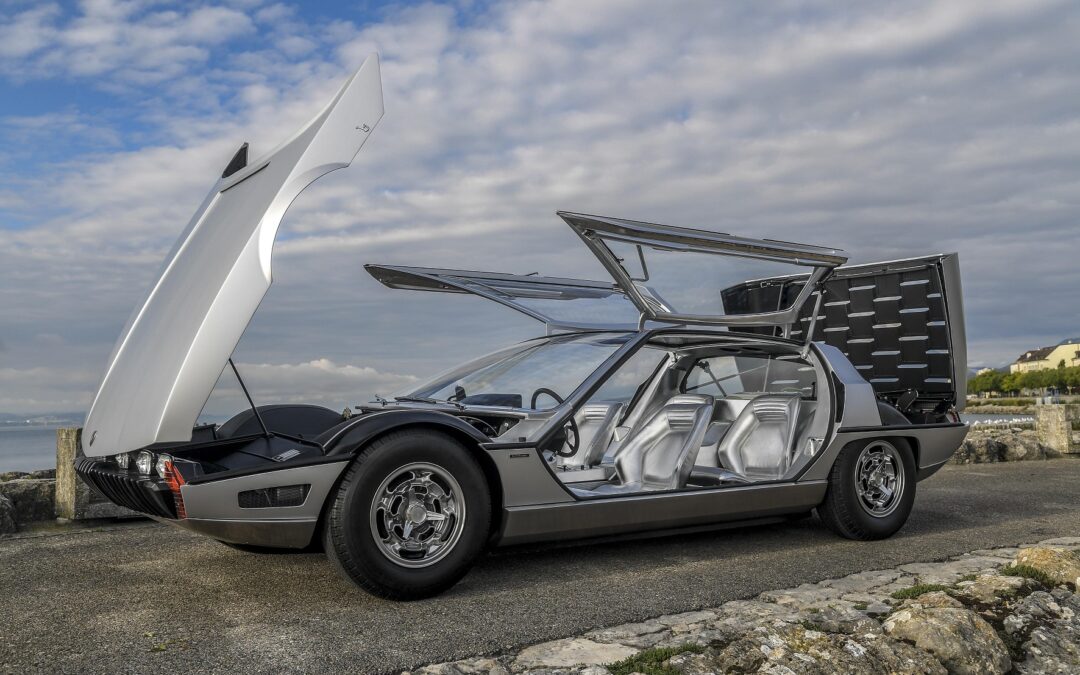
The 1967 Lamborghini Marzal concept car is distinctive for its expansive glass roof, spanning 48.4 square feet

The 1967 Marzal with doors open

The four-seat Lamborghini Marzal was created as a concept for a true four-seat grand-tourer. (Photos courtesy of Lamborghini)


BY MARK MAYNARD

The 1967 Lamborghini Marzal was a one-off show car that became a worldwide icon of style and design. The ultramodern four-seat Marzal was designed by Marcello Gandini for Carrozzeria Bertone https://en.wikipedia.org/wiki/Gruppo_Bertone
Among its many special design elements were:

  • An interior upholstered in silver-colored leather;
  • A hexagonal central design theme. The geometric shape was repeated in the dashboard, the rear window, and in the console cut-out;
  • 6 narrow S.E.V. Marchal headlamps in the thin, wedge-shaped nose;
  • The extensive glass surface covers 4.5 square meters, reaching from the gullwing doors to the roof.

Lamborghini calls the Marzal “a fully operational show car with the largest glass surface in history.”

The hexagonal design theme.

The central design theme for the Marzal centered around the hexagon.

4 Seat Grand Tourer

Lamborghini president Ferruccio Lamborghini had the Marzal created as a concept for a true four-seat grand touring car. In his lineup already were the 400GT 2+2 and the Miura.

The Marzal remained a one-off, though the general shape and many of the ideas would later be used in the Lamborghini Espada.
According to the Marzal page in Wikipedia, Ferruccio Lamborghini initially viewed the creation of the Marzal as advertising rather than a production model.

“The Marzal was not developed as a production car. If you present a car like the Marzal at automobile shows such as Geneva, Turin, and Frankfurt, all the magazines report on the first page about it. You would rather spend 100 million lire for building such an automobile which is still less expensive than paying for all the advertising. That would cost almost a billion lire. So it compensates in any case to build such a throwaway car.”

The silver leather interior

The Marzal interior is entirely upholstered in silver-colored leather.

Lamborghini Marzal Specifications

The rear-engine and rear-wheel-drive Marzal was a relative lightweight at 2,960 pounds on a 103.1-inch wheelbase. It was 14.6 feet long (175.2 inches) and stood 43.3 inches tall by 66.9 inches wide. The concept car shared a chassis, suspension, steering, and brakes with the Miura.

The Marzal is powered by half of the Lamborghini 4.0-liter V-12 engine. The 175-horsepower, 2.0-liter inline-six-cylinder engine produced peak torque of 132 foot-pounds at 4,600 rpm. Top speed was estimated at 118 miles per hour (190 kmh).

The Marzal from behind

Lamborghini President Ferruccio Lamborghini had the Marzal created as a concept for a true four-seat grand touring car.

Lamborghini Marzal History

The Lamborghini Marzal made its public debut at the 1967 Monaco Grand Prix. Prince Rainier III, accompanied by his wife, Princess Grace, drove the car on his traditional parade lap before the start of the race.

The car made a second public appearance at the 1996 Concorso Italiano in Monterey, Calif.,  in honor of Carrozzeria Bertone. The Bertone-designed Lamborghini Athon concept was also exhibited at the ’96 Concorso Italiano.

Later the Athon was driven by Prince Albert II during the opening ceremony of the 2018 Historic Grand Prix of Monaco.

The Marzal had been maintained in the Bertone Design Study Museum until it closed in 2014.  The Marzal was then sold at RM Sotheby’s Villa d’Este auction on May 21, 2011, for $1,750,449.96 (1,512,000 Euros) including buyer’s premium.

The Marzal on the track in 1967

The Lamborghini Marzal at the 1967 Monaco Grand Prix.

Lamborghini Marzal Lap of Honor

On May 7, 1967, shortly before the Monte Carlo Formula 1 Grand Prix, His Serene Highness Rainier III, Prince of Monaco, completed the lap of honor on the track in a legendary car: the Lamborghini Marzal. Its glazed gullwing doors provided an almost unimpeded view of the interior and the silver leather upholstery.

Princess Grace sat in the passenger seat, next to Prince Rainier. Photos of the couple in the Marzal traveled all around the world, turning this unique car into a legend.

Fifty-one years since its first track appearance, the Lamborghini Marzal was displayed at the Grand Prix de Monaco Historique. Lamborghini Polo Storico, celebrating its history with several laps on the same roads as in 1967.

On display at the 2018 Monaco Grand Prix historics.

The Lamborghini Marzal and Espada as displayed at the 2018 Grand Prix of Monaco.

Alfa Romeo 900 Print Advertisement

Alfa Romeo 900 Print Advertisement
The 1947 Alfa Romeo 900 commercial truck

The new Alfa Romeo 900 had a 9,500cc, 128-hp six-cylinder diesel engine and four-speed transmission. (Stellantis)

BY MARK MAYNARD

The Alfa Romeo 900 commercial truck was produced from 1947 to 1954. As a line, the model was virtually identical to its successor, the Alfa Romeo 800, according to its page in Wikipedia.

The new truck had a 9,500cc, 128-hp six-cylinder diesel engine and four-speed transmission. In addition, the loading capacity was increased to 9 tons, and a three-axle version was also available.

By the mid-1950s, the Model 900 was updated and became known as the Model 950. The main difference between the two models is the small windows behind the front doors of the cab.

The 950 was in production until 1958. The 950 was replaced that year by the new Mille model.

Alfa Romeo 800

The Alfa Romeo 800 heavy truck was in production between 1940 and 1947. According to its Wikipedia military page, the Model 800 was first produced as a military version 800RE and after the war as a civilian version.

The military Model 800 was initially used only in the Italian Army (“Regio Esercito”). It was used mainly in North Africa, Russia and occupied France.

The 800 was equipped with a fuel-injected 8.7-liter diesel engine and could reach a top speed of 31 mph (50 kmh).  There also were gas generator and gasoline models produced.

A half-track prototype version called the CSEM 800RE was made for the Italian army. The Centro Studi ed Esperienze della Motorizzazione was the Italian Army’s vehicle research and development organization.

Some of the 800RE models were also converted to the German Army as half-track Maultier trucks.

The 800 was replaced by the model 900.

#TBT: 8 of the Coolest Volkswagen Concept Cars

#TBT: 8 of the Coolest Volkswagen Concept Cars

Volkswagen’s concept cars have opened windows into the future of car design, technology, and performance

The Italdesign Machimoto VW concept

The 1986 Italdesign Machimoto was a mash-up of a motorcycle, convertible, and family car. (Photos courtesy of Volkswagen)

BY MARK MAYNARD

Concept cars have long been an appetizer to the public for what can or could be in their next mode of transportation. Over the years, Volkswagen has debuted a wide range of concept cars that have opened windows into the future of car design, technology and performance. These imaginative machines are intended to test an idea, a vision, or to showcase features that may one day end up on the road.

However, the majority of concepts are seen once in an auto-show display and then never packed away, never to be seen again.

For Volkswagen, the goal is to push the boundaries of what’s possible and get its customers and stakeholders to think about what could come next. A prime example is the new ID.4 EV that was born from the ID. CROZZ concept.

Here’s a look at eight interesting and influential VW concepts.

Italdesign Machimoto

Resembling more of an amusement test car than a road vehicle, the 1986 Italdesign Machimoto was a motorcycle, convertible, and family car mash-up.

Based on the Golf GTi 16V platform, the open-top roadster has flexible seating. The Machimoto’s tandem motorcycle-style saddle seats allow seating for six or nine passengers. The car’s steering was by a unique wheel that could transform from a handlebar style into a traditional steering wheel.

It is powered by a Golf GTI four-cylinder engine with around 139 horsepower.

Passengers were advised to wear a helmet while cruising in the prototype.

The Machimoto concept was featured in several Italian movies but never put into production.

Scooter

The 1986 VW Scooter was a concept for city driving. It was a nimble, three-wheeled, front-wheel drive two-door coupé.

Its drivetrain was a front-mounted 40-hp, 1-liter four-cylinder engine, and four-speed manual transmission.

A lightweight at just under 1,400 pounds, the Scooter has the bold styling of the 1980s and featured gull-wing doors.

Volkswagen would continue to explore the concept of zero-emissions and city “micromobility.” After Scooter, VW showed a pair of two-wheeled scooters at the 2019 Geneva auto show.

The thrifty VW Scooter concept

The VW Scooter concept was a study of zero-emissions and city “micromobility.”

Futura Concept

The Volkswagen Futura was unveiled in 1989 as an Integrated Research Volkswagen — IRVW. The futuristic minivan with gull-wing doors featured electronic technologies far ahead of its time.

Its futuristic features included distance sensors, parking- and braking-assistance functions, a navigation system, an onboard computer, and an electric parking brake.

The Futura concept got instant attention for its futuristic doors that opened upward, not out. The door design was to provide easy access to the front and rear seats.

It was powered by an 82-hp engine with a mechanical supercharger and an evaporation cooling system.

The Futura never made it to market, but its original design elements were applied to the production ID.3 at the 2019 Frankfurt Motor Show.

The futuristic VW Futura concept minivan

The Futura was a futuristic minivan with gull-wing doors.

W12 Nardo

The W12 Nardo is a supercar unique to Volkswagen. It was a design to test the W-configuration engine. And it ended up breaking records.

First introduced as the W12 in 1997, the Nardo was re-introduced in 2001 and named after the famous Nardo Ring test track in Italy.

An Italian design team was tasked to design a vehicle to accommodate VW’s Syncro 4WD system and a 12-cylinder engine in a W-configuration. Such an engineering integration had never been done before.

Weighing 2,646 pounds, the 600-hp W12 Nardo could accelerate from 0 to 60 mph in just 3.5 seconds.

In February 2002, the W12 Nardo concept set out to break records. The test pilots drove for 24 hours straight, covering 4,909.8 miles. It was an accomplishment that went farther than any other car had managed to travel in the same amount of time.

The W12 Nardo did not go into production (but it is familiar as the Audi R8). The engineering helped establish a new type of engine that would be used in the midsize VW Passat sedan, multiple European VW models, and most notably, the Bugatti Veyron.

The VW W12 Nardo race prototype

The W12 Nardo exudes speed when standing still.

Magellan

Named in the spirit of the great explorer, the Magellan concept was part car, part SUV and part truck.

Volkswagen’s Design Center in Spain created the concept in 2002. It was revealed around the same time as the first Touareg SUV went on sale.

The all-wheel-drive Magellan concept had 19-inch wheels and an air suspension. Its interior could seat six among three rows in a 2+2+2 layout.

Other notable features included a removable navigation system, dubbed “G.P.S. to Go.” The nav module could be used outside of the vehicle for biking and hiking.

The 2002 Magellan concept for outdoor enthusiasts

The 2002 Magellan was designed for outdoor enthusiasts.

EcoRacer

The lightweight EcoRacer diesel sports-car concept was part coupe, convertible and speedster. Revealed at the 2005 Tokyo Motor Show, the EcoRacer was a design quest to be the most economical sports car of all time.

Its carbon fiber body helped hold the curb weight to just 1,874 pounds. Powered by a midmounted 136-hp,1.5-liter diesel engine, the EcoRacer could accelerate to 62 mph in 6.3 seconds. It had a top speed of 142 mph.

It is the roof that is the EcoRacer’s most unique feature. The driver could transform the EcoRacer from a coupe into a convertible by removing the hardtop. The windscreen and frame could then be removed to create a speedster.

The EcoRacer was a research vehicle to unite economy and performance under a styled “roof.”

The 2005 VW EcoRacer concept

The 2005 EcoRacer can transform from coupe to convertible to a roadster.

XL Sport Concept

The hyperefficient 2014 XL Sport was built for speed. Propelled by a two-cylinder engine, the two-seat coupe could accelerate from 0 to 62 mph in about 5.7 seconds.

Its wing doors are hinged at two points that allow for an upward and forward swivel. And its dashboard was designed for motorsports and includes an individual lap timer and oil pressure display.

The 2014 XL Sport supercar prototype

The XL Sport was a supercar for enthusiasts of the eco-minded XL1.

Atlas Tanoak

The Atlas Tanoak debuted at the New York International Auto Show in March 2018. A V-6 gas engine powers the midsize, dual-cab pickup concept. At the time, it was the world’s first pickup to be based on Volkswagen’s modular transverse toolkit (MQB).

Tanoak is named after a species of evergreens native to the California coastline.

The Tanoak was based on an extended-wheelbase Atlas SUV, but the concept is longer and could seat up to five passengers. The concept’s V-6 drivetrain mirrors the 2021 Atlas with 276-hp V-6 and eight-speed automatic transmission with 4MOTION all-wheel-drive.

The Atlas Tanoak concept

The Tanoak name is from a variety of evergreen native to the California coastline.

1961 Buick Special Deluxe

1961 Buick Special Deluxe
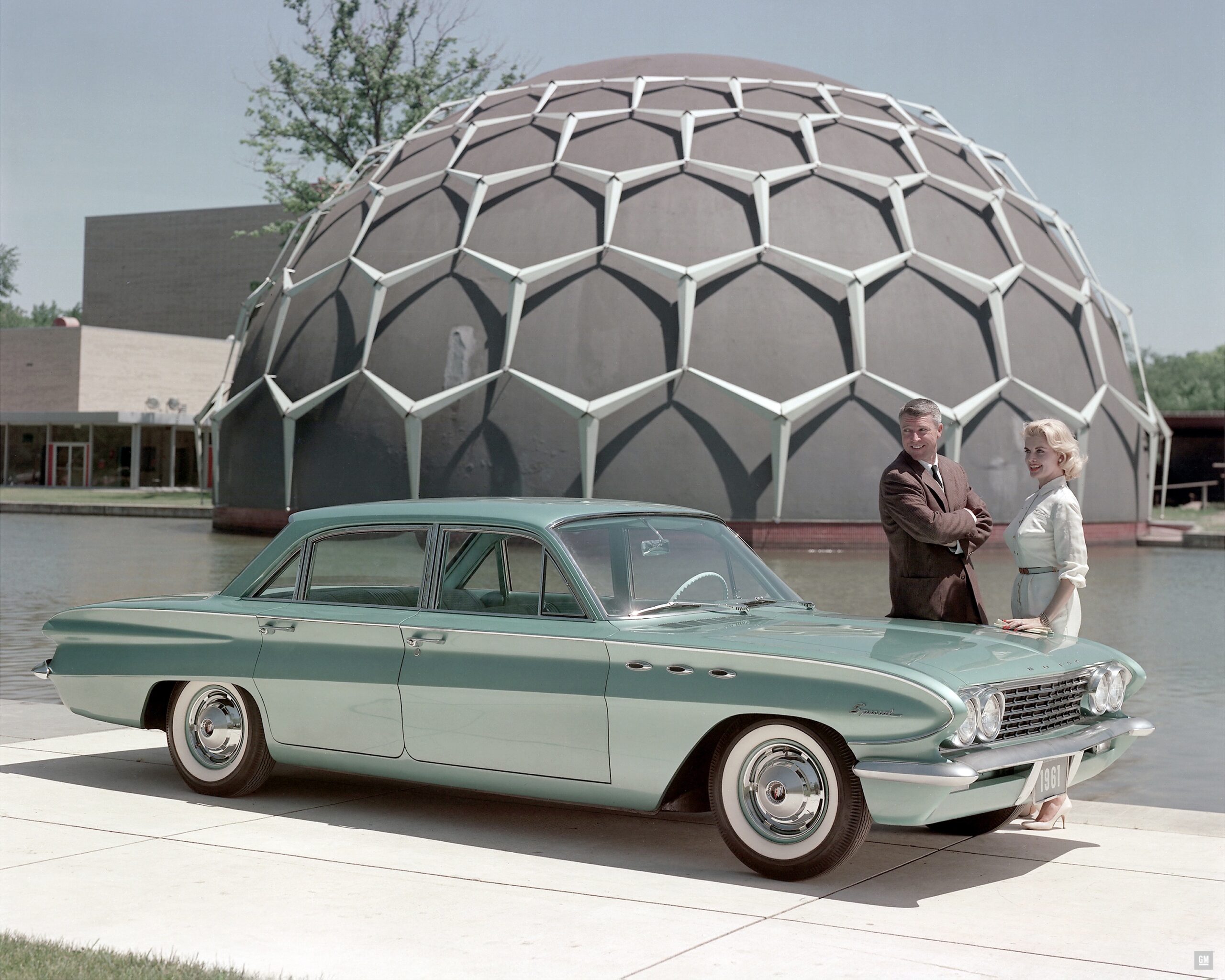
The 1961 Buick Special was an entry level model.

The entry-level Buick Special can trace its heritage to the Buick Model 10, a companion to Buick’s first car, the Model B. (GM photo archives)

BY MARK MAYNARD

The Buick Special was typically the brand’s lowest-priced model. According to its page in Wikipedia, the nameplate started as a full-size car in 1936. After a two-year hiatus, the model returned in 1938 as a midsize.

The Special was built for several decades and was offered as a coupe, sedan, and later as a station wagon.

General Motors modernized its entry-level products in the 1960s, and the Special introduced the modern Buick V-6. The engine would become the core engine for GM for several decades and lives on in current upgraded V6 products.

“By 1970, Special was no longer offered as a standalone model, but the name would later be used for the entry trim on 1975 to 1979 and 1991 to 1996 Century models.

The entry-level Buick can trace its heritage to the Buick Model 10, a companion to Buick’s first car, the Model B. The Model 10 started as one of the independent brands merged into Buick, called the Janney, a Brass-Era carmaker.

In 1961, the model returned after an absence of two years, but this time it was on the new unibody compact GM Y platform.

Buick Special Powertrains

The Special’s engine was the 155-horsepower, aluminum-block 215-cubic-inch V-8. It was paired with the two-speed Dual Path Turbine Drive automatic transmission. The Dual Path was a Buick design and shared no common parts with the better known Chevrolet Power-Glide transmission.

Buick introduced the performance-oriented Skylark trim level midyear. It featured unique trim elements, optional bucket seats, and a 185 hp, four-barrel version of the 215 V-8.

In 1962, the Special was the first American car to use a V-6 engine in volume production; it earned Motor Trend’s Car of the Year for 1962.

The 198-cubic-inch “Fireball” was engineered from the 215 V-8.

The design used many of the same V-8 parameters, but it was cast in iron. Peak horsepower was 135 hp at 4,600 rpm with 205 foot-pounds of torque at 2,400 rpm.

In Road & Track testing that year, the editors were impressed with Buick’s “practical” new V6, saying it “sounds and performs exactly like the aluminum V8 in most respects.”

1963 Special Refresh

In 1963, the Special’s exterior was restyled. Mechanically, however, the car was identical to the 1962 model. According to the Wikipedia report, there were also some minor interior updates to the dash and instrument cluster.

The 1963 Special was available as a two-door pillared hardtop coupe, four-door sedan, a convertible, and a station wagon.

The 1963 body was only produced for one year and had sales of 148,750, including 42,321 Skylarks. The car was redesigned for 1964.

1966 Dodge Charger — “Leader of the Dodge Rebellion”

1966 Dodge Charger — “Leader of the Dodge Rebellion”

The Dodge Charger debuted in 1966 as a midsize sporty car that would compete with the Rambler Marlin, Ford Mustang, and Plymouth Barracuda

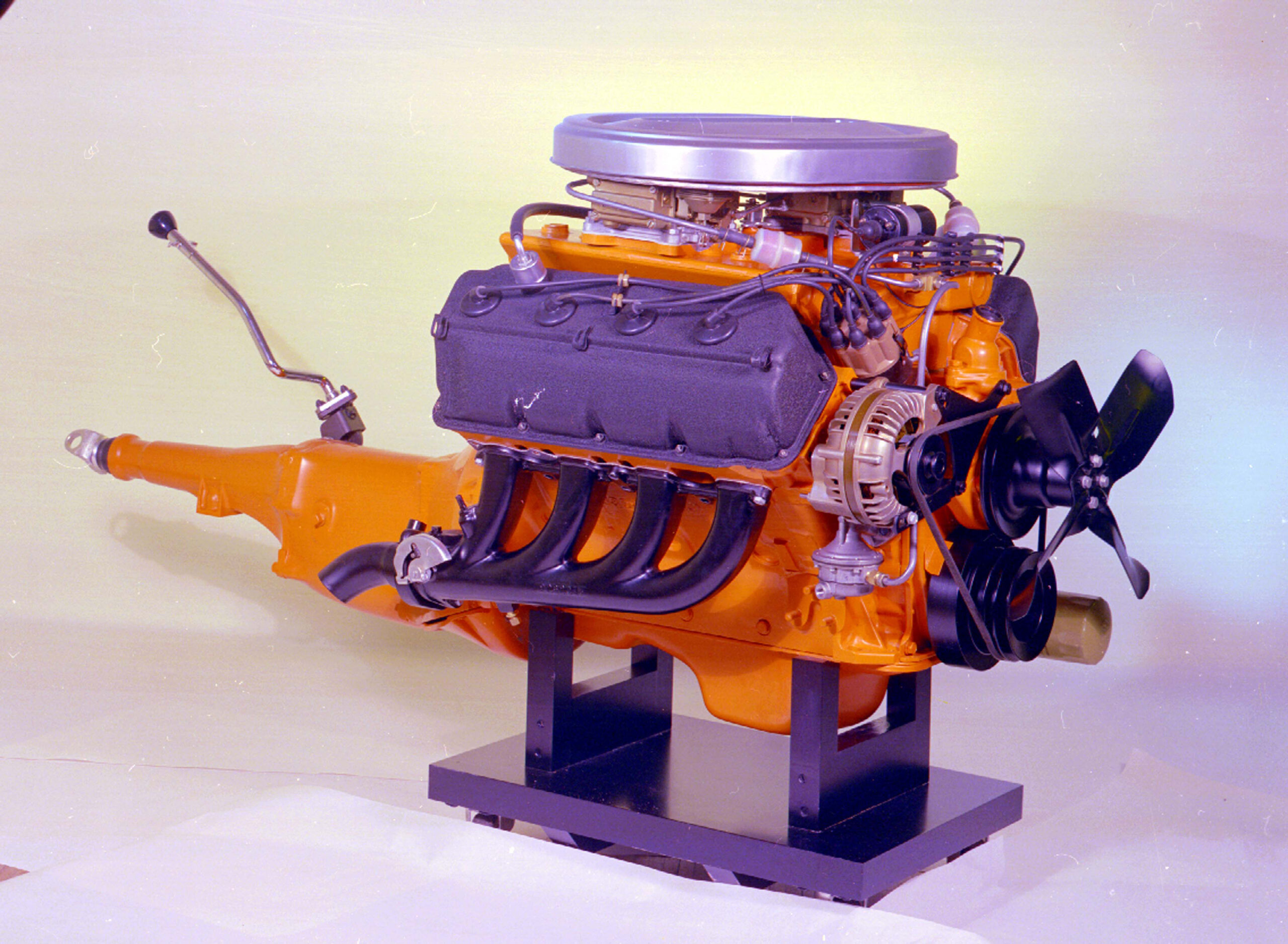
A Hemi V8 and transmission on a display stand 1966 Dodge Charger

The first generation 1966 Dodge Charger introduced a fastback roofline and pot-metal “electric shaver” grille. (Photography courtesy of Stellantis)


BY MARK MAYNARD

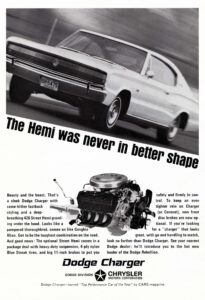
During the early-1950s, automakers were exploring new ideas in the personal luxury and specialty cars.A 1966 print ad for the Dodge Charger

The Hemi engine package included heavy-duty suspension, four-ply nylon Blue Streak tires, and “big” 11-inch brakes. According to Wikipedia, Chrysler had been slow to enter the specialty car market, but tapped its Dodge Division to enter the marketplace. Its first offering would be a midsize B-bodied Dodge Charger. It would fit between the “pony car” Ford Mustang and “personal luxury Ford Thunderbird.

The design focus was to create a fastback look while sharing as much existing company hardware as possible. The result was the Coronet-based Charger. The exterior styling was, in general, a departure from Dodge’s mainstream cars. Introduced in mid-1966, the Charger would compete with the Rambler Marlin, Ford Mustang, and Plymouth Barracuda.

The 1965 Charger concept

The 1965 Dodge Charger II Concept created the desired fastback look shared much existing company hardware.

The interior design of the Charger was different from all other cars, according to the Wiki page. It debuted a full-length center console and “all bucket seating” front and rear. Also an innovation, the rear pseudo-buckets could be folded to create more cargo space through the enormous rear hatch.

The Hemi Halo

The Charger wasn’t intended to compete head-to-head in performance with pony cars but was available with Chrysler’s famed 426 Hemi V8.
On Jan. 1, 1966, The 1966 Charger had its big public debut at the Rose Bowl as the new “Leader of the Dodge Rebellion.” The Charger’s debut was also followed midyear by a new street version of the 426 cubic-inch, 7.0-liter Chrysler Hemi engine.

The Charger wasn’t intended to compete head-to-head in performance with pony cars but was available with Chrysler’s famed 426 Hemi V8.

With the Charger, Dodge had a new model to build a performance image with this engine.

The Charger was designed by Carl “CAM” Cameron and introduced a fastback roofline and pot-metal “electric shaver” grille. Its fully rotating headlights were a feature not seen on a Chrysler product since the 1942 DeSoto. The fastback design ended over a full-width six-lamp taillight in the rear with chromed and wide-spaced “C H A R G E R” lettering.

Dodge Charger Powertrains

According to the Wiki report, Charger powertrains for 1966 consisted of V-8s with three choices of transmission.

Four engines were offered:

  • 318 cubic-inch 5.2-liter with a two-barrel carburetor for the base-model Charger;
  • 361-cubic-inch, 5.9-liter two-barrel;
  • 383 cubic-inch, 6.3-liter with a four-barrel carburetor;
  • And the new 426 Street Hemi. Only 468 Chargers were built with the 426.

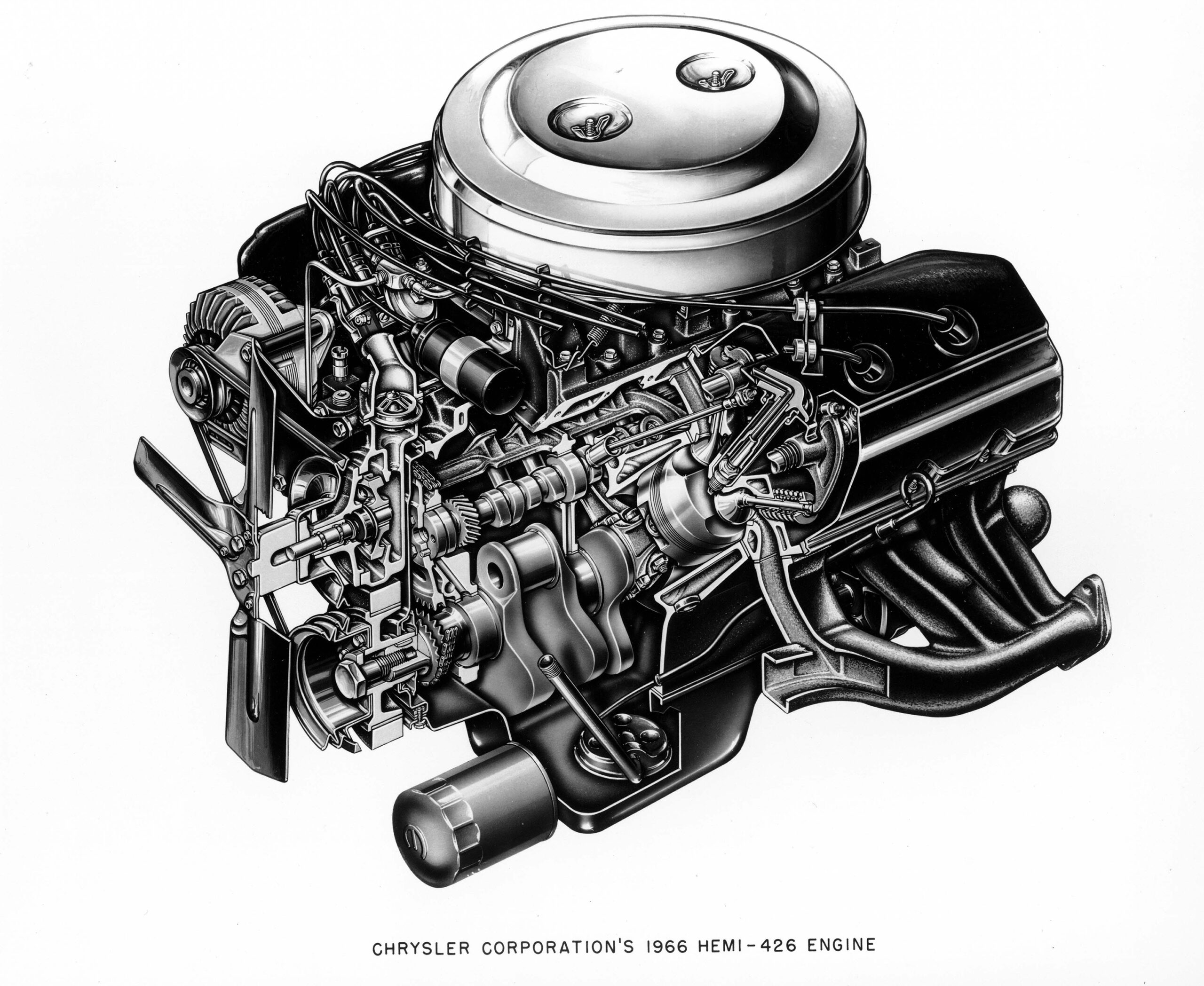
A cutaway illustration of the Hemi V8

The transmissions for the 1966 Charger:

  • Three-speed steering-column mounted manual with the base engine,
  • Console-mounted four-speed manual;
  • Three-speed automatic.

Total 196 Dodge Charger production came to 37,344 units for the mid-model year introduction.

1959 Ford Country Squire with Push Button’ Station Wagon Living’ equipment

1959 Ford Country Squire with Push Button’ Station Wagon Living’ equipment

The Country Squire wagon concept packaged the car-camping essentials, including the boat and kitchen sink

The Country Squire concept packaged such camping essentials as a car-top tent with a double bed, an electric refrigerator, and a shower. (Ford)

BY MARK MAYNARD

Ford Motor cast a line for 1959 to test the waters of consumer interest for a car-camping concept based on a 1959 Ford Country Squire. The rig would provide push-button station wagon living with all the gear, including the kitchen sink.

According to Wikipedia, the U.S. and the world were emerging from the “Recession of 1958.”  And Ford marketers might have felt that consumers were ready to get out and enjoy the freedom of car camping.

That might have been so, but not so much for this outrageously sophisticated concept. I came across these two photos at the Ford media site, but there were no other details.

In this era before the modern SUV, the big Ford Squire wagon was a good starting place. Built on a bigger platform for 1959, the Country Squire body was 5 inches longer and the new 118-inch wheelbase was 2 inches longer than the 1958 model. In addition, the second and third rows were re-engineered to fold flat.

The 1959 Ford Country Squire wagon concept with Push Button ‘Station Wagon Living’ equipment and rooftop boat

The rooftop boat neatly contained the concept’s camping essentials. (Ford)

Country Squire Concept

An online search for information on this concept car brought up Shorpy.com, an American historical photo archive.

Shorpy has a news item from the Washington Post of July 3, 1958, highlighting the details.

“Travelers and sportsmen who would like to park their cars after a day’s drive and set up camp by pushing a few magic buttons may be able one day to do just that.

“With the ‘pushbutton camper,’ a specially equipped experimental Ford station wagon, a traveling couple could pull into a parking area, lower a boat from the roof top, pitch their tent and set up a kitchen unit protected by an overhead awning — almost without getting out of the car.

“One push button lifts the boat and swings it over the side so it can be easily removed for launching. A car-top tent, containing a full-sized double bed, already made up and equipped with a reading lamp, is erected by another button.

“After the tailgate is opened, a third button slides out the compact kitchen unit complete with an electric refrigerator and two-burner stove, a work table and meat cutting block, and a sink with hot and cold running water.

“The roof compartment also houses a shower head, complete with curtain. Ford has no definite plans for mass producing such a vehicle.

“If consumer demand warranted it, a company official said, the automatic equipment could be produced by independent suppliers and installed by a Ford dealer.”

‘Louie Mattar’s Fabulous Car’

The Country Squire wagon concept was a feat of engineering finesse, but it was not the first such example.

I give that credit to Louie Mattar who upfitted a 1947 Cadillac with all the comforts of home. Then, in 1952, he and two other men established a cross-country endurance record. They drove the Cadillac from San Diego to New York and back without stopping. Their trip totaled 6,320 miles and required refueling from a moving gas truck three times.

“Louie Mattar’s Fabulous Car” is on view at the San Diego Automotive Museum.