Select Page

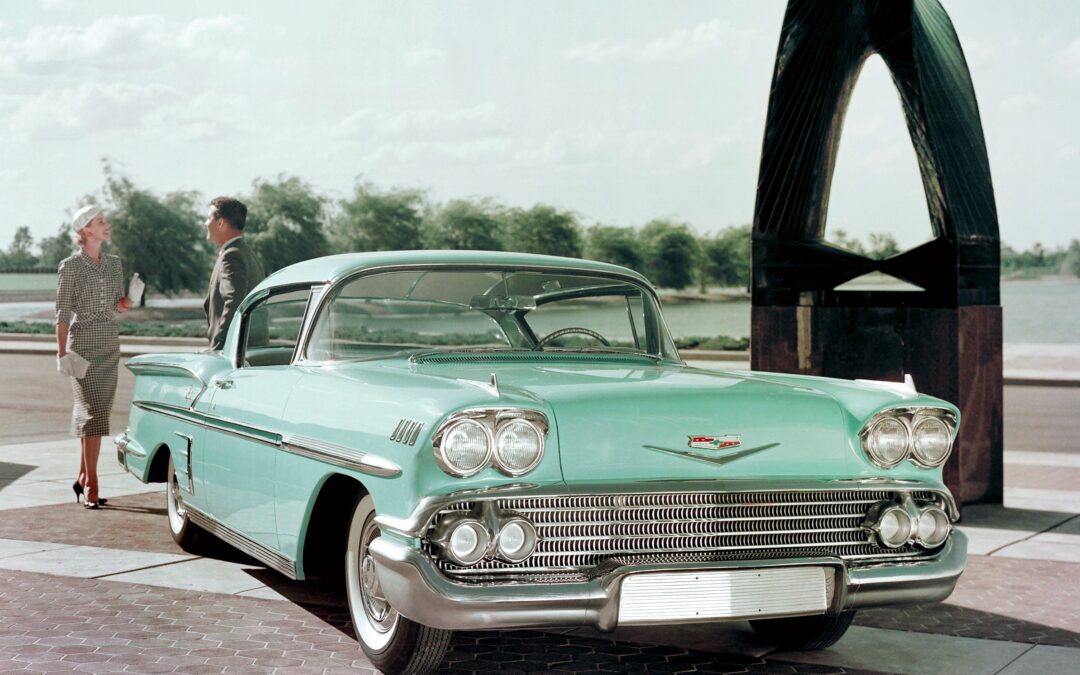
1958 Chevrolet Bel Air Impala Sport Coupe

1958 Chevrolet Bel Air Impala Sport Coupe
1958 Chevrolet Bel Air Impala Sport Coupe.

The 1958 Impala was the top model for the Chevrolet Bel Air line of hardtops and convertibles. (Photos from GM Media Archive)

BY MARK MAYNARD

In the recession year of 1958, GM promoted its 50th year of production. In tribute, the company introduced anniversary models for each brand: Cadillac, Buick, Oldsmobile, Pontiac, and Chevrolet.

According to the Impala’s Wikipedia page, the 1958 models shared a common appearance on the top models for each brand: the Cadillac Eldorado Seville, Buick Limited Riviera, Oldsmobile Starfire 98, Pontiac Bonneville Catalina, and the Chevrolet Bel Air Impala.

“The 1958 Impala was the top model for the Bel Air line of hardtops and convertibles.

“From the windshield pillars rearward, the 1958 Bel Air Impala differed structurally from the lower-priced Chevrolet models. Hardtops had a slightly shorter greenhouse and a longer rear deck.

“The wheelbase of the Impala was longer than the lower-priced models, although the overall length was identical. Interiors held a two-spoke steering wheel and color-keyed door panels with brushed aluminum trim. No other series included a convertible.

The 1958 Chevrolet Bel Air Impala

The 1958 Chevrolet Bel Air Impala helped Chevrolet regain the No. 1 production spot in this recession year.

“The 1958 Chevrolet models were longer, lower, and wider than their predecessors. And this was the first model year for dual headlamps.

“Deeply sculptured rear fenders replaced the tailfins of the 1957. In addition, impalas had three taillights on each side, while lesser models had two and wagons just one.

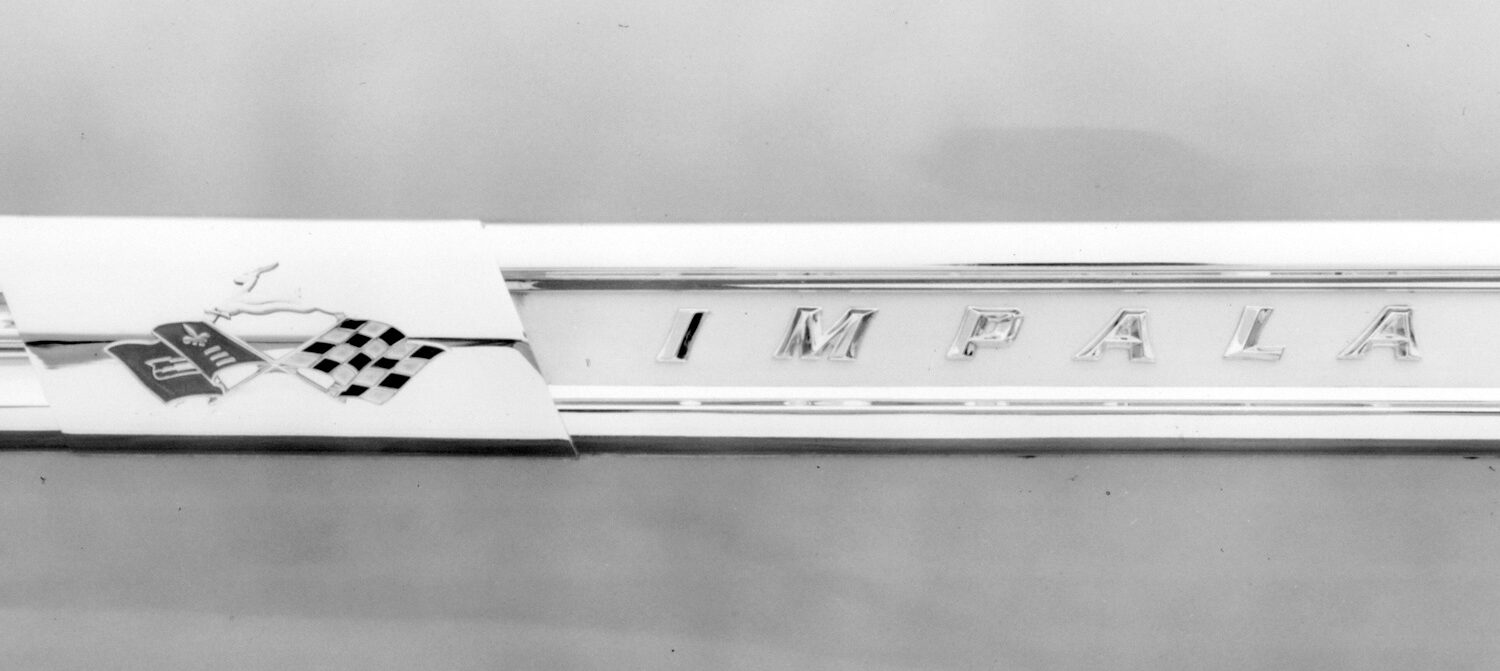
Impalas included crossed-flag insignias above the side moldings, bright rocker moldings, and dummy rear-fender scoops.

The 1959 Chevrolet Impala logo and nameplate

The Chevrolet Impala was identified by the image of a leaping African antelope in some form or another since its debut in 1958.

Chevrolet Impala Powertrains

A 283 cubic-inch V-8 was standard. Its power ratings ranged from 185 to 230 horsepower. When upgraded with Rochester Ramjet fuel injection, power output increased to 250 hp.

Two versions of Chevrolet’s first big-block 348-cubic-inch (5.7-liter) V-8 were optional:

  • A single four-barrel carburetor, producing 250;
  • Three two-barrel carburetors, 280 hp.

55,989 Impala convertibles and 125,480 coupes were built, representing 15 percent of Chevrolet production. In addition, the 1958 Chevrolet Bel Air Impala helped Chevrolet regain the number-one production spot in this recession year.

1960 Chrysler Windsor

1960 Chrysler Windsor

In 1959, Chrysler advertised the Windsor’s new wedge-head “B” engines as ‘Golden Lions’ and the cars as ‘Lion Hearted’

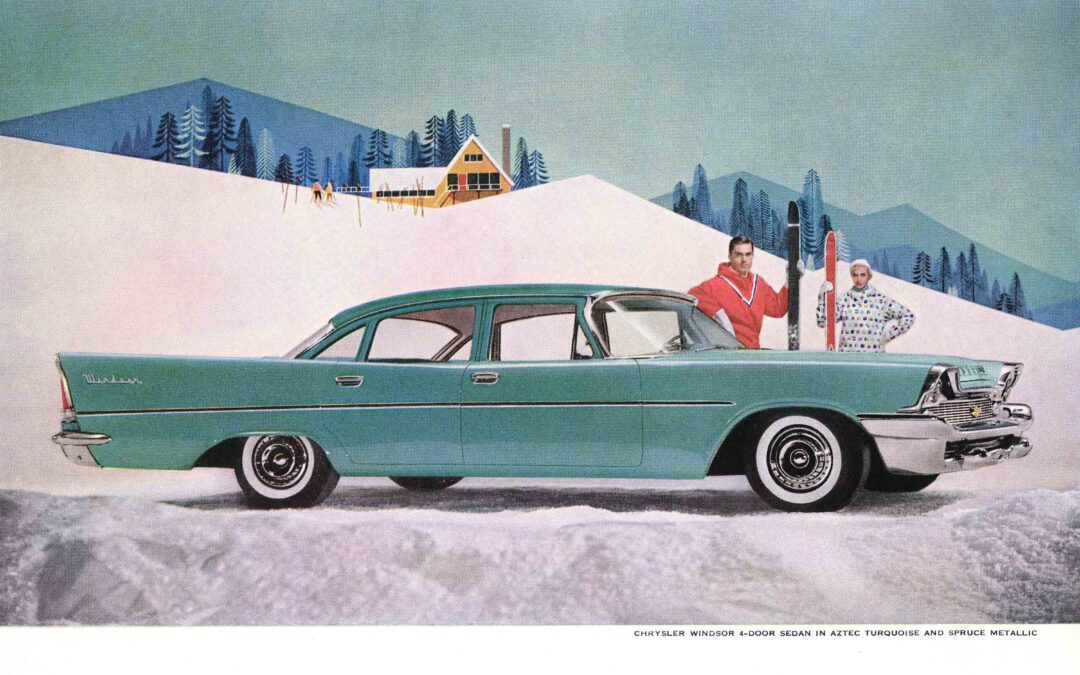
A print ad for the 1960 Chrysler sedan in a wintry landscape


BY MARK MAYNARD

The full-size Chrysler Windsor sedan was in production from 1939 through to 1961 in the U.S. and in Canada until 1966.

In 1959, Chrysler started to advertise the Windsor’s new wedge-head “B” engines as “Golden Lions” and the cars as “Lion Hearted,” according to Wikipedia.

“The RB 383-cubic-inch V8 produced 305 hp with a twin-barrel carburetor. Lions were used in the advertising, and the cars had lion emblems on the front doors and on the cylinder heads.

“In 1960, all Chrysler cars got a unibody frame. A new parking brake was also used, and the brakes on the Windsor were 11-inch drums. Air conditioning was a $510 option.

At nearly 18 feet long and 79.4 inches wide, the Windsor rode on a long wheelbase of 122 inches.

Windsor By the Numbers

In a report by ConceptCarz.com,  the “Golden Lions” was part of Chrysler’s advertising campaign for the new wedge-head “B” engines. Introduced the previous year, the cars were known as “Lion Hearted.”

“The RB 383 cubic-inch V8 had five main bearings, hydraulic valve lifters, a Carter two-barrel carburetor, a cast-iron block, and delivered just over 300 horsepower.

“The Canadian-built Windsors were powered by the ‘Low Block’ 361 cubic-inch engines from the U.S.-built DeSotos and Dodges. Instead of the ‘Golden Lion’ medallion, they received three golden crests on the front doors.

Dual headlamps were standard, and the Flitesweep deck lid, stone shields, and sill moldings were optional equipment.

1960 Windsor Pricing

“Windsor body styles included a hardtop coupe priced at $3,280, a hardtop sedan at $3,345, a sedan at $3,195, and a convertible at $3,625. A six-passenger station wagon was $3,735, and the nine-passenger version listed for $3,815.

“The most popular body style was the sedan with 25,152 examples built, followed by 6,496 of the hardtop coupe, and 5,897 of the hardtop sedan.

“The convertibles and station wagons were exclusive, with 1,467 of the convertible, 1,120 of the six-passenger wagon, and 1,026 of the nine-passenger wagon constructed.”

Alfa Romeo Tipo 158 ‘Alfetta.’

Alfa Romeo Tipo 158 ‘Alfetta.’

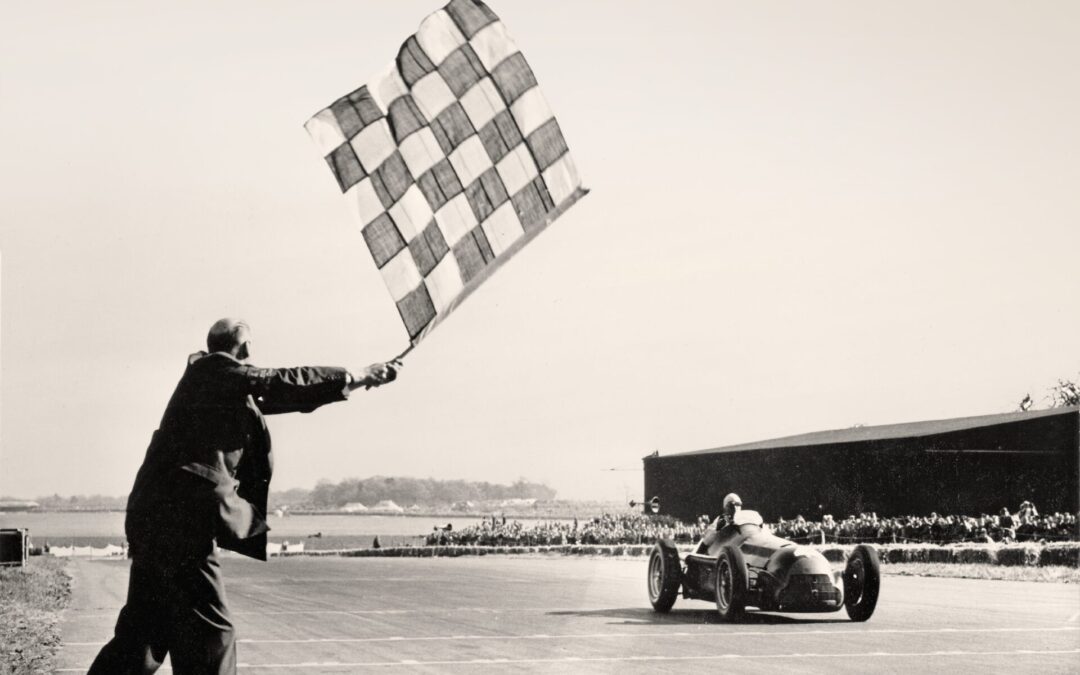
Nino Farina takes the checkered flag in an Alfa Romeo 158 at the 1950 Silverstone Grand Prix. The first ‘hat trick’ of Formula 1.”

Nino Farina takes the checkered flag in an Alfa Romeo 158 at the 1950 Silverstone Grand Prix. The first ‘hat trick’ of Formula 1.”

Nino Farina in Alfa Romeo 158 at the 1950 Silverstone Grand Prix.

BY MARK MAYNARD

The energy is compelling in this vintage PR image from the Alfa Romeo media site.

The modern era’s first World Championship Formula 1 race was staged May 13, 1950, at the Silverstone Circuit in Silverstone, England.
Giuseppe “Nino” Farina won the Grand Prix of Europe with his Alfa Romeo Tipo 158 ‘Alfetta.’

It was such an impressive feat that King George VI personally congratulated all the drivers of the Alfa Romeo Team for the exceptional result: pole position (Farina), victory (Farina), fastest lap (Farina), and top place in the league throughout the Grand Prix.

The “Little Alfa”

The Alfa Romeo 158/159, also known as the Alfetta (Little Alfa in Italian), is one of the Italian manufacturer’s most successful Grand Prix racing cars.

According to its page in Wikipedia, the Alfa Romeo 158 and its derivative, the 159, took 47 wins from 54 Grands Prix entered. The race car was developed initially for the pre-World War II voiturette formula (1937) and had a 1.5-liter straight-8 supercharged engine. The car’s 158 ID refers to its 1.5-liter engine and eight cylinders.

Following World War II, the car was eligible for the new Formula One introduced in 1947.

The “3F” Team

In the hands of drivers such as Nino Farina, Juan Manuel Fangio, and Luigi Fagioli, it dominated the first two seasons of the Drivers’ World Championship.

In a 2015 report by Sports Car Digest, Alfa Romeo fielded a team of four “Alfetta” to the Silverstone track for the debut World Championship Formula 1 race in 1950.

The Alfa Romeo 158 race cars were entrusted to Giuseppe “Nino” Farina, who became the world champion at the end of the season, and to Luigi Fagioli, Juan Manuel Fangio. Fangio was the rising Argentine star who won the world title in ’51 again with the Alfetta, and Reg Parnell, a British driver chosen in honor of the country hosting the first Championship.

Farina won the race, and two other places on the podium were also Alfa Romeo entries. The cars of the Milan-based company dominated the race, a script that was repeated throughout the Championship.

During the season, the trio of Farina, Fagioli, and Fangio was dubbed by the public as “the 3F.” Together with their Alfa Romeo, they held the name of Italy high in international motor racing, a historic moment for the country and Alfa Romeo.

After the race, King George VI personally congratulated all the drivers of the Alfa Romeo Team for the exceptional result: pole position (Farina), victory (Farina) and other two places on the podium, fastest lap (Farina), and the top of the league throughout the Grand Prix.
“‘Nino’ Farina thus also took home the first ‘hat trick’ of Formula 1.”

1959 Chevrolet El Camino

1959 Chevrolet El Camino

The 1959 Chevrolet El Camino  combined dramatically finned styling with half-ton pickup utility

A pastoral photo of a 1959 Chevrolet El Camino on a stone bridge in the countryside

Unlike a standard pickup truck, the El Camino was adapted from the two-door Chevrolet Brookwood two-door wagon. (Photos courtesy of GM archives)

BY MARK MAYNARD

The original Chevrolet El Camino introduced for 1959 combined the dramatically finned styling of that period’s Chevrolet cars with half-ton pickup utility.

The El Camino as a passenger-car pickup was intended to answer the success of the Ford Ranchero coupé utility. The Chevrolet variant was based on the B-body Biscayne wagon but lasted only two years.

Production resumed for the 1964-1977 model years based on the Chevelle platform. Then, it continued for the 1978-1987 model years based on the GM G-body platform for midsized, long-wheelbase rear-wheel-drive cars. Examples of G-body cars are the 1969-1972 Pontiac Grand Prix and 1970-1972 Chevrolet Monte Carlo.

The Personal-Car Pickup

Unlike a standard pickup truck, the El Camino was adapted from the two-door Chevrolet station wagon platform and integrated the cab and cargo bed into the body, according to its page in Wikipedia.

The excitement of the El Camino’s debut was short-lived. After 1960, the passenger-car pickup went on a three-year hiatus.

Chevrolet revived the “personal pickup” concept for 1964, with a new version based on that year’s new midsize Chevrolet Chevelle.

During the ‘muscle car’ era that followed, El Camino buyers could order their truck with a Chevrolet high-performance big-block V-8 powertrain, creating a sport pickup that could “haul” in more ways than one. By 1968, a complete Super Sport package was available.

The Chevelle El Camino was produced through two more styling generations (1968-1972 and 1973-1977).

For 1978, the El Camino was moved to that year’s new, smaller Malibu platform. The final El Caminos were 1987 models.

The GMC truck division also had its badge-engineered El Camino variant, called the Sprint. It was introduced for the 1971 model year. Renamed Caballero in 1978, it was also produced through the 1987 model year.

A vintage image from Chevrolet PR photo archives of a red 1959 El Camino

The 1959 El Camino was aimed at the success of the Ford Ranchero, introduced in 1957.

Origin of the El Camino

The concept of a two-door pickup-like vehicle based on a passenger car began in the United States in the 1920s. The body style was known as a roadster utility, roadster pickup, or a light delivery model.

Ford Australia was the first company to produce a coupé utility. The idea for such a vehicle came from a 1932 letter from a farmer’s wife in Victoria, Australia. She asked for “a vehicle to go to church in on a Sunday and which can carry our pigs to market on Mondays.”

Ford designer Lew Bandt developed a suitable solution, and the first coupé utility model was released in 1934.

General Motors’ Australian subsidiary Holden also produced a Chevrolet coupé utility in 1935. And Studebaker produced the Coupé Express from 1937 to 1939.

The body style did not reappear in the U.S. until the release of the 1957 Ford Ranchero.

1967 Lamborghini Marzal Concept

1967 Lamborghini Marzal Concept

The 1967 Lamborghini Marzal concept car is distinctive for its expansive glass roof, spanning 48.4 square feet

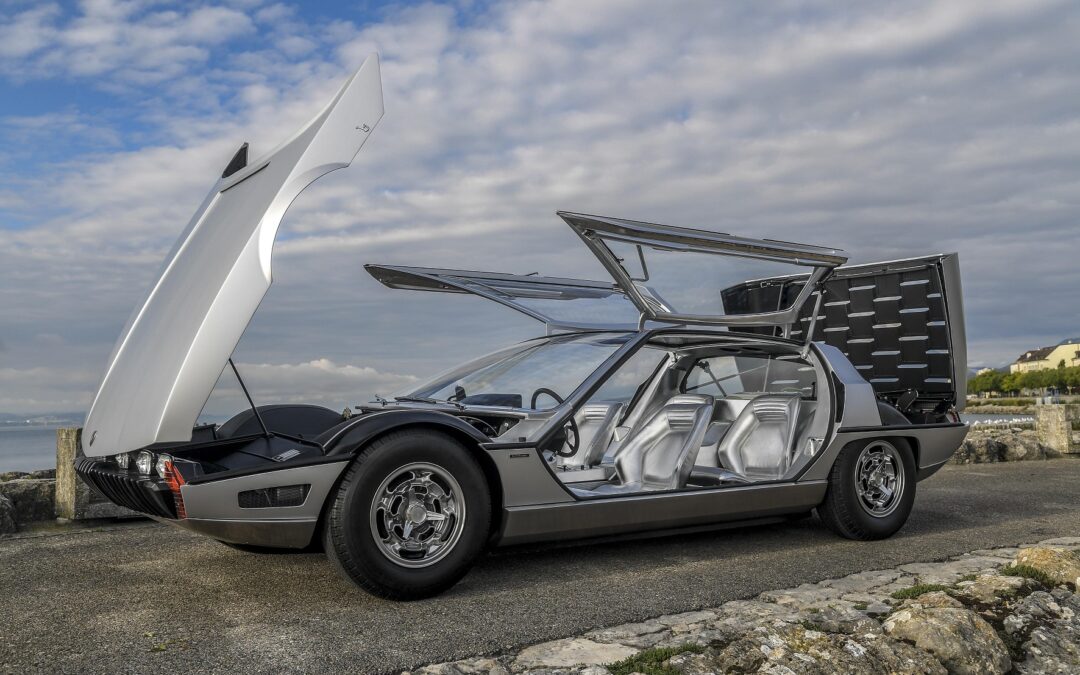
The 1967 Marzal with doors open

The four-seat Lamborghini Marzal was created as a concept for a true four-seat grand-tourer. (Photos courtesy of Lamborghini)


BY MARK MAYNARD

The 1967 Lamborghini Marzal was a one-off show car that became a worldwide icon of style and design. The ultramodern four-seat Marzal was designed by Marcello Gandini for Carrozzeria Bertone https://en.wikipedia.org/wiki/Gruppo_Bertone
Among its many special design elements were:

  • An interior upholstered in silver-colored leather;
  • A hexagonal central design theme. The geometric shape was repeated in the dashboard, the rear window, and in the console cut-out;
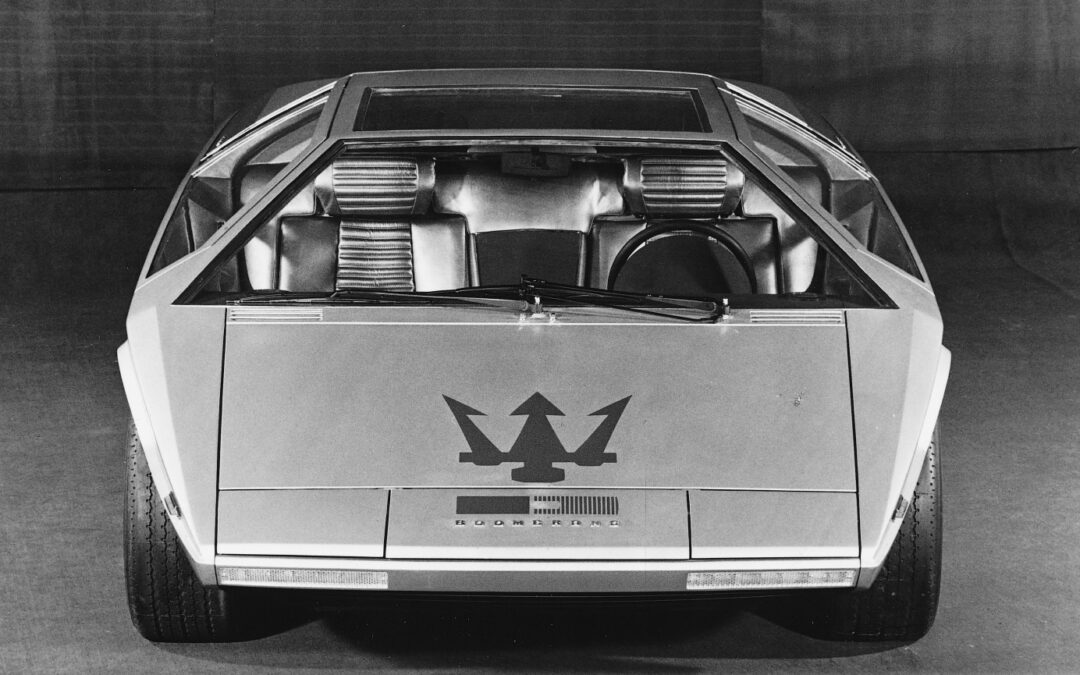
  • 6 narrow S.E.V. Marchal headlamps in the thin, wedge-shaped nose;
  • The extensive glass surface covers 4.5 square meters, reaching from the gullwing doors to the roof.

Lamborghini calls the Marzal “a fully operational show car with the largest glass surface in history.”

The hexagonal design theme.

The central design theme for the Marzal centered around the hexagon.

4 Seat Grand Tourer

Lamborghini president Ferruccio Lamborghini had the Marzal created as a concept for a true four-seat grand touring car. In his lineup already were the 400GT 2+2 and the Miura.

The Marzal remained a one-off, though the general shape and many of the ideas would later be used in the Lamborghini Espada.
According to the Marzal page in Wikipedia, Ferruccio Lamborghini initially viewed the creation of the Marzal as advertising rather than a production model.

“The Marzal was not developed as a production car. If you present a car like the Marzal at automobile shows such as Geneva, Turin, and Frankfurt, all the magazines report on the first page about it. You would rather spend 100 million lire for building such an automobile which is still less expensive than paying for all the advertising. That would cost almost a billion lire. So it compensates in any case to build such a throwaway car.”

The silver leather interior

The Marzal interior is entirely upholstered in silver-colored leather.

Lamborghini Marzal Specifications

The rear-engine and rear-wheel-drive Marzal was a relative lightweight at 2,960 pounds on a 103.1-inch wheelbase. It was 14.6 feet long (175.2 inches) and stood 43.3 inches tall by 66.9 inches wide. The concept car shared a chassis, suspension, steering, and brakes with the Miura.

The Marzal is powered by half of the Lamborghini 4.0-liter V-12 engine. The 175-horsepower, 2.0-liter inline-six-cylinder engine produced peak torque of 132 foot-pounds at 4,600 rpm. Top speed was estimated at 118 miles per hour (190 kmh).

The Marzal from behind

Lamborghini President Ferruccio Lamborghini had the Marzal created as a concept for a true four-seat grand touring car.

Lamborghini Marzal History

The Lamborghini Marzal made its public debut at the 1967 Monaco Grand Prix. Prince Rainier III, accompanied by his wife, Princess Grace, drove the car on his traditional parade lap before the start of the race.

The car made a second public appearance at the 1996 Concorso Italiano in Monterey, Calif.,  in honor of Carrozzeria Bertone. The Bertone-designed Lamborghini Athon concept was also exhibited at the ’96 Concorso Italiano.

Later the Athon was driven by Prince Albert II during the opening ceremony of the 2018 Historic Grand Prix of Monaco.

The Marzal had been maintained in the Bertone Design Study Museum until it closed in 2014.  The Marzal was then sold at RM Sotheby’s Villa d’Este auction on May 21, 2011, for $1,750,449.96 (1,512,000 Euros) including buyer’s premium.

The Marzal on the track in 1967

The Lamborghini Marzal at the 1967 Monaco Grand Prix.

Lamborghini Marzal Lap of Honor

On May 7, 1967, shortly before the Monte Carlo Formula 1 Grand Prix, His Serene Highness Rainier III, Prince of Monaco, completed the lap of honor on the track in a legendary car: the Lamborghini Marzal. Its glazed gullwing doors provided an almost unimpeded view of the interior and the silver leather upholstery.

Princess Grace sat in the passenger seat, next to Prince Rainier. Photos of the couple in the Marzal traveled all around the world, turning this unique car into a legend.

Fifty-one years since its first track appearance, the Lamborghini Marzal was displayed at the Grand Prix de Monaco Historique. Lamborghini Polo Storico, celebrating its history with several laps on the same roads as in 1967.

On display at the 2018 Monaco Grand Prix historics.

The Lamborghini Marzal and Espada as displayed at the 2018 Grand Prix of Monaco.

Alfa Romeo 900 Print Advertisement

Alfa Romeo 900 Print Advertisement
The 1947 Alfa Romeo 900 commercial truck

The new Alfa Romeo 900 had a 9,500cc, 128-hp six-cylinder diesel engine and four-speed transmission. (Stellantis)

BY MARK MAYNARD

The Alfa Romeo 900 commercial truck was produced from 1947 to 1954. As a line, the model was virtually identical to its successor, the Alfa Romeo 800, according to its page in Wikipedia.

The new truck had a 9,500cc, 128-hp six-cylinder diesel engine and four-speed transmission. In addition, the loading capacity was increased to 9 tons, and a three-axle version was also available.

By the mid-1950s, the Model 900 was updated and became known as the Model 950. The main difference between the two models is the small windows behind the front doors of the cab.

The 950 was in production until 1958. The 950 was replaced that year by the new Mille model.

Alfa Romeo 800

The Alfa Romeo 800 heavy truck was in production between 1940 and 1947. According to its Wikipedia military page, the Model 800 was first produced as a military version 800RE and after the war as a civilian version.

The military Model 800 was initially used only in the Italian Army (“Regio Esercito”). It was used mainly in North Africa, Russia and occupied France.

The 800 was equipped with a fuel-injected 8.7-liter diesel engine and could reach a top speed of 31 mph (50 kmh).  There also were gas generator and gasoline models produced.

A half-track prototype version called the CSEM 800RE was made for the Italian army. The Centro Studi ed Esperienze della Motorizzazione was the Italian Army’s vehicle research and development organization.

Some of the 800RE models were also converted to the German Army as half-track Maultier trucks.

The 800 was replaced by the model 900.