Select Page

CoverSeal: Before the Winter Winds Blow

CoverSeal: Before the Winter Winds Blow
CoverSeal’s weighted vehicle covers reach from the ground up.

CoverSeal’s weighted covers reach from the ground up. (Photos courtesy of CoverSeal)

BY MARK MAYNARD

A CoverSeal is not the same old car cover. Outdoor protective vehicle covers have had the same format since harried drivers no longer had room in their garages. Apartment and condominium car owners are at more of a disadvantage if there is no off-street parking.

I have bought and evaluated many car covers, and most outdoor car covers fall loosely to the ground, flapping in the breeze. CoverSeal rethought the concept and created weighted covers that reach from the ground up. The unique covers have a weighted tubing at the base that encircles the vehicle.

CoverSeal claims that the weighted bottom can help deter rodents from making a home and eating wiring in the vehicle. Rodents are sneaky about finding ways into a vehicle, but these covers weigh 45-50 pounds with the weighted lower portion.

The weighted bottoms are comprised of black water-resistant polyester fabric with what CoverSeal calls a sealing tube. The corrugated sealing tube looks like a flexible landscape drainage hose. The 2-inch tube is packed with powdered sand and secured in the baseline tubing with heavy-duty PVC-coated polyester. An enhanced heat seal closure prevents sand leakage, CoverSeal says.

I am particularly interested in how the covers will block sunlight from baking tires and causing premature stress cracks. The rubber in tires absorbs UV radiation from the sun, which causes the rubber to dry out and harden. This process is called photodegradation.

For drivers in northern climates, the heavy-duty covers shed water and prevent snow buildup.

CoverSeal’s weighted covers reach from the ground up. (Photos courtesy of CoverSeal)

The covers’ weighted bottoms are a black, water-resistant polyester fabric with what CoverSeal calls a sealing tube.

Heavy duty “Denier”

The best and most long-lasting car covers I have bought were made of Sunbrella fabric. CoverSeal does not use Sunbella fabric for a couple of good reasons.

“We provide a 1-year warranty for materials and workmanship,” a spokesperson wrote in an email. “Sunbrella fabrics are made from acrylic. They tend to be more coarse and more waterproof. Sunbrella covers usually have a softer laminated layer to overcome the coarse fiber. If the cover traps moisture, it can oxidize the paint. Rayon and nylon do not hold up to UV and sunlight. We use polyester at 420D (Denier). It is a nice middle ground between durability, softness and water resistance. We do not need a soft laminate layer as we can treat the fabric with various coatings.”

According to online sources, “Denier” is defined as the weight of 9,000 meters of nylon fiber in grams. Coated in polyurethane, polyester 420D is also water-repellent and mildew-resistant. The fabric was originally developed for military parachute backpacks.

CoverSeal covers cannot be secured with a lock and cable. Adding grommets was considered but voted down for two reasons: First, it gives rodents an ingress path. Second, if someone wants your cover and clips the cable or, worse, really pulls it, you might still have your cover, but it will be severely damaged.

CoverSeal vehicle covers are not custom-fitted by make and model. However, there are sizes of large, full-size, midsize, sports cars, small SUVs, and pickups.

CoverSeal vehicle covers are not custom-fitted by make and model. However, there are sizes of large, full-size, midsize, sports cars, small SUVs, and pickups.

CoverSeal Vehicle Fitment and Pricing

CoverSeal vehicle covers are not designed specifically by make and model. However, there are sizes of large, full-size, midsize, sports cars, pickups, and small SUVs.

Of special interest will be CoverSeal pricing when compared to a Sunbrella cover. A typical Sunbrella outdoor car cover can cost $300 to $600. Pricing for CoverSeal vehicle covers ranges from $330 to $390.

CoverSeal has heavy-duty covers for short- or long-bed pickups, $410 or $620.

Light-duty indoor vehicle covers are all-weather and breathable for long-term indoor storage. The cover design is loose-fitting to protect the paintwork while making the model unrecognizable and secure. There are two sizes, midsize and full size, for $160.

CoverSeal also has a range of patio furniture covers. There are choices for large or small tables and furniture groupings. These range in price according to size, about $150 to $180.

There also are covers for propane-powered barbecues, which range in price from $110 to $130.

CoverSeal also makes heavy-duty outdoor tractor covers, $375.

Sizing Guide

Tips for selecting a CoverSeal: As the dimensions listed are of maximum fit, it is necessary to confirm the vehicle’s size before purchasing a car cover. Check vehicle dimensions online for year, make, and model. Also, consider upgraded tire sizes, if the vehicle is lifted or has a roof rack and crossbars.

CoverSeal car covers are made in Tijuana, Mexico. The covers are also marketed in China.

Order and learn more at GetCoverSeal. Use COVER24 to get 15 percent off your order.

Audi RS 5 Competition Coupe Review

Audi RS 5 Competition Coupe Review

 A package-price reduction with added standard equipment makes the 2024 Audi RS 5 Competition a near-value statement 

The Ascari Blue color of the RS 5

The 444-hp 2024 Audi RS 5 Competition Coupe starts at $80,790, which is $6,525 less than in 2023.  (Photography by Audi or as credited)

Table of Contents

New for the 2024 RS 5
RS 5 Competition Package
Pricing
RS 5 Performance
Competition Ride and Handling
Interior Function
Why Buy the 2024 Audi RS 5 Competition?
Specifications

BY MARK MAYNARD

There is good news for the 2024 Audi RS 5 Competition Coupe and Sportback models. First, the bad news: the base price for the 2024 model is up a trifling $700, now starting at $80,790. The good news is an overall price reduction for the Competition Package saved $6,525.

An Audi RS 5 Competition coupe that cost $100,585 in 2023 is now $94,040, with the same five options and packages. In 2023, the RS 5 Competition package cost $16,100. For 2024, the package is $10,300. The main deletion from the package is the front ceramic brakes. The 15.7-inch front ceramic brakes save weight and improve brake disc cooling for on-track performance. The default choice for 2024 are 14.8-inch steel rotors. Both rotors are ventilated with six-piston fixed calipers. Steel rear disc brakes are unchanged with 13-inch ventilated rotors.

There were availability issues with the carbon fiber brakes, Audi says, and made this decision: “Rather than allow a customer to order the carbon brakes and us not be able to build the car immediately, keeping a customer waiting, we decided to proactively remove the option for this model year. As supplier availability issues get resolved, we may re-evaluate this,” a spokesman wrote in an email.

Trimming the cost of the Competition package and adding a lot of new standard equipment makes the RS 5 Competition more of a value tease, and some of its new standard elements are optional in the competition.

The Competition

Audi RS5 Coupe prime competitors include:

505-hp Alfa Romeo Giulia Quadrifoglio, base price $83,365, includes $500 paint option.

503-hp BMW M4 Competition xDrive Coupe, base price $91,245 with 3 driving-assist technologies.

503 hp Mercedes-AMG C63 S (2023), $94,975 with six options comparable to RS 5 tester.

472-hp Cadillac CT4-V Blackwing, $73,770.

565-hp Nissan GT-R, $123,000

*Suggested retail pricing includes the freight charge.

The front seat area with alcantara upholstery and carbon fiber trim accents

The Competition package adds Pearl Nappa and Dinamica upholstery. Front sport seats have power bolster and seat-bottom adjustment.

New for 2024?

There are no exterior or powertrain changes for the 2024 RS 5 lineup, just the following features now as standard equipment:

  • Adaptive cruise control (ACC);
  • Audi active lane assist;
  • Parking system-plus;
  • Heated steering wheel with Hands on Detection (HoD);
  • Remote engine start via myAudi app.
  • The Navigation package now adds traffic sign recognition, activating Predictive adaptive cruise control (pACC).
  • All RS 5 models have a Navigation package ($1,450) that now includes a six-month trial subscription to Audi Connect PLUS with the Audi app store.
  • Progressive Red metallic paint replaces Tango Red metallic.
A cool "runway" Sport mode to the gauge array.

A “Runway” mode is exclusive to the RS Virtual Cockpit layout. (Mark Maynard)

What’s in the $10,300 Competition Package?

The 2024 Audi RS 5 Competition package, $10,300, includes:

  • 20-inch 5-Y-spoke design milled-cut wheels in bi-color phantom black finish;
  • Pirelli P Zero Corsa tires;
  • 180 mph top track speed;
  • Sport direct steering;
  • Coil-over suspension system with front and rear sport sway bars;
  • RS Sport exhaust system with matte black tailpipes;
  • Red brake calipers;
  • RS carbon matte inlays;
  • Matte carbon front splitter, rear diffuser, and exterior mirror housings;
  • High-gloss black exterior trim, black Audi rings and badges;
  • Pearl Nappa and Dinamica seat upholstery with piano black front seat side trim
  • Alcantara covered steering wheel, shift lever, and center console;
  • Seatbelts with red edging and RS logo floor mats with red edging.

2024 Audi RS 5 Pricing

The U.S. was first introduced to the midsize RS 5 for the 2013 model year. The second-gen RS 5 came out for 2018, followed in 2021 with a significant refresh. The RS 5 Competition package was added for 2023.

Sold in two-door Coupe and five-door Sportback models, both RS 5 variants have the same powertrain. RS 5 Competition Coupe pricing starts at $80,790 vs. $79,995 for the Sportback; pricing includes the $1,095 freight charge from Ingolstadt, Germany.

Of the eight paint colors, only Nardo Gray is a no-cost choice. Six hues are a $595 upgrade, including the tester’s Ascari Blue metallic. Named for Spain’s Circuito Ascari track, the deep sky blue hue has sublet flecks of purple. Sebring Black Crystal, $1,095, is exclusive to the Competition package.

Find current Audi RS 5 pricing here. And look for special offers here.

The engine with carbon fiber dress up kit

With 444 twin-turbocharged and intercooled horsepower, the 2.9-liter is Audi’s most potent V-6 in the A5 lineup. (Mark Maynard)

Competition Performance

With 444 twin-turbocharged and intercooled horsepower, the 2.9-liter is Audi’s most potent V-6 in the A5 lineup. With peak torque holding steady from 2,000-5,000 rpm, there is no delay in the spooling of power, though the standard drive mode is turned for fuel economy. Audi cites 0-60 acceleration in 3.7 seconds for the Coupe and 3.8 seconds for the Sportback. With all-wheel drive, that’s a righteous launch for a curb weight of 3,990 pounds, or around 4,300 pounds with driver and a friend.

The RS 5 engine has a determined engine note that gets better with a heavier foot. Reduced insulation between the engine compartment and interior gives a grand exhaust recital. Press the steering wheel button for RS mode and let the howling begin. The eight-speed feeds shifts with rapid-fire precision, with a lovely crackle and snort on downshifts.

Competition models boost maximum top track speed to 180 mph, up 25 mph from the non-Comp RS 5. Trimming the soundproofing also saved nearly 18 pounds, Audi says.

Fuel economy ratings of 18 mpg city, 26 highway, and 21 mpg combined on the recommended premium fuel are reasonable, especially with the 15.3-gallon tank. During my week of testing, my around-town average ranged between 14 and 18 mpg; on highway runs, it clicked along at 22.4 mpg.

Denting my mileage was liberal use of Sport mode. It’s just the way to go with this powertrain. And I so enjoy how Audi provides easy Sport-mode access with just a slap of the shifter down for Sport and another pull for standard Drive mode.

Driver Assistance

On the daily commute, the Comfort mode suspension is forgiving, though still taut. Crowded urban driving is helped by the RS driver assistance package, which is $3,000. The active lane assist gives good centering, but the reaction is skitzy in cornering, likely due to controlling the very wide Pirelli P Zero motorsport tires. And I’d also add the Side Assist package, $500, which includes matte aluminum side mirror caps.

RS 5 Competition Ride and Handling

With its slightly lower roofline, the Audi RS 5 Coupe might be more track competitive than the slightly taller and heavier Sportback on a longer wheelbase (111.3 vs. 108.9). However, the Sportback has larger cargo-trunk capacity (21.3 vs. 10.9 cu.ft.) and easier access to the back seats, with 2.4 inches more legroom.

Acceleration to 60 mph for both trim levels is a bellowing 3.8 seconds in the Sportback and 3.7 in the coupe.

Street or track, the RS 5 steers with planted precision; the steering weight is light but responsive with minimal input. The Sport Direct Steering in the Competition package has a quicker ratio of 13.1:1 vs. for the standard 15.9:1 box.

For added handling control, Audi includes a set of tools to manually lower the front and rear spring height by 10mm; that’s an overall ride height 20mm lower than the regular RS 5.

The stock Pirelli P Zero Corsa motorsport tires have “racing type compounds,” earning them a sticky treadwear rating (UTQG) of 80 with the highest AA traction rating. The compounding is rubber cement for traction, but many runs on a hot track day event would likely scrub tread to the wear bars; replacements will run around $425 each, or $469. At the Audi dealer, installing four tires would cost around $1,726, not including sales tax.

The driver area of the audi RS 5

Alcantara upholstery with Crescendo Red stitching dresses up the three-spoke heated steering wheel, shift lever, and center console.

RS 5 Interior Function

Audi interiors are handsome and refined. The Competition package amps visual energy with Pearl Nappa and Dinamica front-seat upholstery; Piano Black side-seat trim replaces the standard Fine Nappa leather seats. Matte carbon inlays reinforce a performance focus. Alcantara faux suede with crescendo red stitching dresses up the three-spoke heated steering wheel, shift lever, and center console. Safety belts and floor mats also are edged in red.

The midsize cabin proportions of the RS 5 are a comfort fit. The ride height accommodates without a drop-and-twist sequence into the seat. Even the seat bolsters’ side and bottom are unrestrictive, but they can be snugged for control in cornering switchbacks.

Cabin width allows front shoulder room of 55.3 inches vs. 55.7 in the Sportback. The broad front seat area allows enough instrument panel width to include the necessities: a wireless charging pad, cup holders, and easy access to cabin controls. However, engagement of the driver-assist function is awkwardly positioned on the end of the hard-to-see cruise-control stalk.

Headroom of 37.4 inches with the moonroof will fit tall drivers without looking through the windshield header. However, that head space might be tight when wearing a helmet.

Rear legroom is snug at 32.7 inches, but kids won’t notice, and adults will gladly pull up their knees.

A rear three quarter view

The RS 5 Competition package adds 20-inch milled-cut wheels in a bi-color phantom black finish, Pirelli P Zero Corsa tires, and a carbon trunk-lid spoiler.

Why Buy the 2024 Audi RS 5 Competition?

Some motorists will spend $85,000 for a loaded pickup — before adding accessories, special paint, or tooled leather. And then their truck might be used to haul soil from the home improvement center, the kid’s gear to college, or a Christmas tree. It doesn’t matter, it is a personal choice.

The Audi RS 5 might be a little more subtle than its competitors in its display of supersport engineering. But when paying $100,000 for the RS 5, that driver will feel and hear the engineering that makes their car special. He or she will have no regrets . . . until the redesigned 2025 Audi RS 5 coupe debuts.

2024 Audi RS 5 Competition Specifications

Body style: Midsize 2-door 4-seat 2+2 all-wheel-drive Coupe or Sportback

Engine: 444-hp, twin turbocharged and intercooled 2.9-liter V-6; 442 lb.-ft. torque from 2,000-5,000 rpm

Maximum turbo boost: 21 psi

Transmission: 8-speed Tiptronic automatic

Fuel economy: 18/26/21 mpg city/hwy/combined; premium fuel

0-60 mph acceleration: 3.7 seconds

Top track speed: 155 mph

Drag coefficient: 0.32

BY THE NUMBERS

Fuel tank: 15.3 gallons

Trunk space: 10.9 cubic feet

Front head/leg room: 37.4/41.3 inches

Rear head/leg room: 36.1/32.7 inches

Length/wheelbase: 185.9/108.9 inches

Curb weight: 3,990 pounds

Turning circle: 38.4 feet

FEATURES

Standard equipment includes: Advanced key for lock-unlock and push-button ignition, Audi virtual cockpit (with appearance modes of Sport and S Performance), electric parking brake, rearview camera, Fine Nappa leather upholstery, honeycomb stitched S sport seats with RS embossing, RS carbon inlays, power side bolsters, and massage function, power sunroof, Bang & Olufsen audio system with 3D sound, Matrix-design LED headlights with Audi laser light, LED interior lighting;

Safety features include: 8 air bags, stability control with sport mode, front and rear parking sensors, lane-departure warning;

Driver assistance features include: Audi Pre-sense basic (preventative occupant protection; Audi Pre-sence City with forward collision warning and avoidance assistance;

SUSPENSION COMPONENTS

Steering: Electromechanical progressive system

Suspension: RS sport front and rear

Brakes: 4-wheel steel discs, 14.8-inch rotors front, 13-inch rear;

Tires-Wheels: 20-inch 5-Y spoke design forged wheels in bi-color finish; Pirelli P zero Corsa motorsport tires

PRICING

Base RS 5 Competition Coupe price: $80,790, including $1,095 freight charge; price as tested $94,040

Options on test vehicle:

  • Ascari Blue metallic paint $595;
  • RS driver assistance package, $1,500, adds head-up display, Park assist (parking entry functionality), top view camera system, traffic sign recognition;
  • Navigation package with side assist $1,500;
  • Competition package with standard brakes, $10,300.

Where assembled: Ingolstadt, Germany

Warranty: 4-years/50,000-miles bumper to bumper with roadside assistance

Hyundai Ioniq 6 Review

Hyundai Ioniq 6 Review

There is nothing “traditional” about the midsize Ioniq 6, but its features and technologies are familiar, with welcome engagement for driver and occupants.

A side view of the Hyundai Ioniq 6 electric sedan

The 2024 Hyundai Ioniq 6 is sold in four trim levels in rear or all-wheel drive with standard and long-range battery options. Starting prices range from $42,715 to $57,215. (Photos courtesy of Hyundai USA or as credited)

Table of Contents

Who Will Buy the Ioniq 6?
Choices of Power and Driving Ranges
Charging the Ioniq 6
2024 Ioniq 6 Pricing
Touchy Feely Design
The Human Experience
Enter the Living Space
Clever Function
Ride and Handling
Driver Assist Technologies
Back Seats and Cargo
Why Buy the Hyundai Ioniq 6?
2024 Hyundai Ioniq 6 Specifications

BY MARK MAYNARD

The Hyundai Ioniq 6 is not just a benchmark electric car; it is a well-done passenger car without gimmicks or compromise to comfort or drivability.

For those considering an electric vehicle, the Ioniq 6 treats you right, from its gracious ride quality to its ease of entry and exit and many appreciated details. Its potential as an emergency power source is not the least among its assets.

The midsize “coupe sedan” has been a breakout star for Hyundai. The Ioniq 6 debuted last year and is a “carryover” model with no changes for 2024.

Exterior styling of the Ioniq 6 has stirred controversy. The rear end is very busy with two spoilers, vertical metallic accent bars, and “parametric pixel” cubes liberally applied in the lighting.

Front views are sleek and refined, with a smooth slope to the hood, centered between the curvaceous fenders. The dramatic slope is key to aerodynamics, but at a compromise to space in the front trunk. The frunk’s 0.5 cu.ft. shows good use of space, but the space is long and shallow but lighted. How an owner would use this leftover space? For gloves? A microfiber towel? Christmas gift hiding place?

Trimming the height of the frunk was likely to allow the steep slant of the nose, contributing to low aerodynamic drag. Intended or not, the slope of the hood also allows open sightlines. The slant design treatment has been compared to the 1980s Porsche 911 Turbo S “slantnose.” The Porsche “Flachbau,” or flat front design, had a low front aerodynamic flow for its race cars.

Driver information comes from two side-by-side, 12.3-inch digital screens with white backgrounds.

Driver information comes from two side-by-side, 12.3-inch digital screens.

Who Will Buy the Ioniq 6?

Hyundai’s marketing research has decided that the focus buyer for the Ioniq 6 will be:

  • Millennial professionals who are confident in their choices and looking to transition to electric;
  • Accomplished singles or couples who are typically urban. They are comfortable standing apart and differing from the status quo. They seek to make an informed choice for their next vehicle;
  • They are looking to reward themselves with an EV that makes a statement of confidence and doesn’t compromise on a premium interior, advanced technology (safety and connectivity), or limit (through charging and range) their active lifestyle.
The front seatbacks gently cradle with modest cushion bolstering that does not give a goodbye wedgie when exiting.

The front seatbacks gently cradle with modest cushion bolstering.

Choices of Power and Driving Ranges

The 2024 Hyundai Ioniq 6 is sold in four trim levels in rear or all-wheel drive with standard and long-range battery options:

Standard range RWD with a 53-kWh battery pack of 264 cells; 149-hp (111kW); up to 240-mile range; 0-62 mph 9 seconds.

Long range RWD with a 77.4 kWh battery pack of 384 cells; 225 hp (168kW); up to 361-mile range; 0-62 mph 7.4 seconds.

Dual-Motor HTRAC AWD long range, with 77.4 kWh battery; 320 hp (239 kW), up to 316-mile range; 0-62 mph 5.1 seconds.

The single-speed transmission has four driving modes of Eco, Normal, Sport, Snow, and Custom, with a dedicated eAWD torque split for each drive mode.

The power closing charge door on the right rear flank.

The power closing charge door on the right rear flank. (Mark Maynard photo)

Charging the Ioniq 6

According to Hyundai, the Ioniq 6 battery pack will charge from 10 percent to 80 percent in 18 minutes at an ultra-fast 800V charging facility. Connecting to the more common 350-kW Level 3 fast charger can add as much as 65 miles of range in 5 minutes.

Hyundai includes a 10.9-kW onboard charger as standard equipment so owners can plug it into a household outlet or a 240V Level 2 home charger. Charging a depleted battery at home on a Level 2 charger would take around seven hours. I plugged in at home with 150 miles remaining on the charge, and it took about 4 hours to reach 100 percent.

Here are the official charging times, up to 80 percent:

Level II standard 120-volt: 6 hours 55 minutes

50kW: 73 minutes;

Rapid Charging, 350kW: 18 minutes.

Hyundai’s Multi-Charging System

Hyundai has patented its multi-charging system, calling it world-first technology. The system enables the motor and inverter to boost 400V to 800V for stable charging compatibility.

The technology includes “reverse compatibility,” also known as bidirectional. This added level of engineering — Vehicle to Load (V2L) — allows the Ioniq 6 battery to be used as an alternate power source. V2L is handy in the event of a significant power outage. It has enough power to operate small appliances, recharge electronic devices, or boost another EV.

The shift-by-wire gear selector.

The no-confusion shift-by-wire gear selector.

Recharging an EV on vacation travel is still a time-management effort, no matter if the EV has a range of 600 miles. The recharge still requires a break for a meal or shopping.

Hyundai has partnered with Electrify America to provide free fast-charge sessions. The plan is provided to any new all-electric Hyundai model. For the Kona small SUV, owners will receive up to 250kWh or about 1,000 miles of driving. Buyers of the Ioniq 5 and Ioniq 6 get two years of 30-minute DC fast-charging sessions.

2024 Hyundai Ioniq 6 Pricing

Starting prices include the $1,115 freight charge from Asan, Korea; add $3,500 for AWD:

SE RWD standard range: $42,715;

SE RWD long range: $46,615;

SEL: $48,815 (RWD 305-mile range, AWD 270-mile range);

Limited RWD: $53,715, up to 305-mile range;

Limited AWD, $57,215, up to 270-mile range.

The Limited AWD Long Range tester cost $58,425 with Gravity Gold matte paint ($1,000) and carpeted floor mats ($210).

Find current Hyundai pricing here.

Hyundai’s new-vehicle warranties include 10 years or 60,000 miles bumper to bumper and 10 years or 100,000 miles for the powertrain and electric vehicle systems.

The front door panel grip rail with ambient lighting.

The front door panel grip rail with ambient lighting.

Hyundai Ioniq 6 Incentives and Rebates

Leasing a 2023 and 2024 Hyundai Ioniq 6 qualifies for up to $7,500 in an IRS credit. The incentive is only available on a lease, and other qualifiers can apply. Learn more here.

There is a California Clean Fuel Reward of $2,000, but participants are eligible based on gross annual income, as stated on their federal tax return. Details are here.

Find federal and state laws or incentives here.

And the Ioniq 6 qualifies for High-Occupancy-Vehicle freeway access, with the green DMV decal

A front trunk of 0.5 cu.ft. shows good use of space, but how would an owner use it? For gloves? A microfiber towel? Christmas gift hiding place?

How would an owner use this shallow but lighted front trunk? (Mark Maynard photo)

Touchy Feely Design

Hyundai went far left coast in planning the Ioniq 6 interior. In the big wall map of features to be considered, Hyundai designers came up with many categories including “Mindful Cocoon,” “Ethical Design,” and “Emotional Efficiency.”

The cabin is referred to as “Living Space” and is defined by a cab-forward exterior design, a stretched cabin, and a low hood for a streamlined silhouette. The cabin as “Living Space” would have “Transparent Accents,” “Light Reflection,” “Parametric Pixel,” and “Eco Materials,” for “Sustainability.”

That’s a touchy-feely marketing focus that doesn’t mean a whole lot to an owner, but Hyundai neatly ties it all together. Perhaps most apparent is the “Parametric Pixel.” In, out, and around the Ioniq 6 are series of cube pixel-like accents, such as in the taillights, the trunk-lid spoiler, and on the steering wheel. There is no badge for Hyundai or Ioniq on the wheel, just a row of four, square pixels that light up when charging; they show the state of charge, whether one, two, or four squares.

The dashboard ‘winglet’ design.

The dashboard’s‘winglet’ design.

The Human Experience

Popular magazine reviews of the Hyundai Ioniq 6 go deep into its powertrain kilowattage, 0-60 acceleration, and charging times. The Ioniq 6 aces those categories, which an owner will quickly accept and appreciate. However, there is a bigger presence of thoughtfulness toward the human experience. That aspect will be a pleasant discovery period for the many surprise-and-delight features throughout the living space.

Achieving max aerodynamic flow can mean lowering the car’s ride height. That’s good for the manufacturer’s fuel-efficiency standards but damning to the driver and occupants who must drop into a seat while peering into the taillights of the vehicle ahead. Ride height is one reason SUVs have become so popular. Hyundai, however, managed to give the Ioniq 6 a comfortable step-in height with a commanding forward view. Most modern sedans are now notorious for chin-scraping on driveways and dips in the road, but the Ioniq 6 has none of those tendencies.

Those attributes alone make the Ioniq 6 a “buy.”

An artsy view from the back seat forward showing the wide sunroof

Enter the Living Space

Modern low-riding sedans lost buyers because of trimmed headroom. Hyundai went upward with Ioniq 6 headroom, providing (tall for a car) 40.2 inches of hair space without the wide sunroof or 38.3 inches with it.

Seat design is another strong selling point, whether in the front or back. Hyundai’s H-Tex leatherette upholstery feels rich to the touch and is more compliant than leather hides. The front seatbacks gently cradle with modest cushion bolstering that does not give a goodbye wedgie when exiting. Thigh support is full-bodied and suitable for those tall enough to need all 45.4 inches of the car’s very long legroom.

The tester’s interior was basic black but refined by meticulously neat stitching, patterns, textures, and translucent plastics in the lower areas of the cabin. I liked the robust driver’s footrest, and the metal-trimmed pedals fit well with the interior design and black microsuede headliner.

And the greenhouse of the living space is a lighthouse of unobstructed views at the side mirrors, over the shoulder, and the somewhat cropped back glass.

A winglet-design dashboard is unique with 90-degree angles at each end by the windows. The dashboard looks like a plug-and-play unit, but it all works — though it will look odd for the first few drives.

Driver information comes from two side-by-side, 12.3-inch digital screens with white backgrounds. The driver’s instrument cluster with EV display is visible in all lighting conditions with text and graphics that are an easy read.

The HD touch-screen navigation screen includes a split screen for the around-view camera system. The screen anchors at least a dozen categories with icons for connecting a phone, media, climate, and charging.

The “bridge” center console with storage shelf below.

The “bridge” console with storage shelf below.

Clever Function

A “bridge” console extends from the base of the instrument panel and divides the front seats, with unique storage. The upper level has cup holders, a wireless charging pad, window lift switches, and door locks. An armrest box has useful storage and conceals two Type C USB ports, and there is an old-style USB-A next to the wireless charging pad.

Below the bridge is a long, open storage space with low sides for a purse or take-out food bags.

Without a space-robbing gearshift lever, the designers rethought what could be. Placing window and lock controls on the console is different, but I adapted quickly. Moving the switches from the traditional door panel allowed the designer to create a long, padded armrest with an integrated grab rail for closing the door. On opening, the grab rail — with a bead of ambient lighting — provides the ideal leverage point to control the door from punching the car next to it.

Hyundai gives owners a 3-month trial for the Wi-Fi hotspot, followed by a $20 per month Verizon data plan. Or the owner can add the Ioniq 6 to their phone plan.

Mercifully, the digital infotainment touchscreen has various buttons and switches for such oft-used features as volume, tuning, fan speed, and temp control.

All controls were intuitive for me to quickly figure out and use — a degree in IT is not required. Also smartly designed is the steering-column mounted, shift-by-wire gear selector. The sturdy stalk is clearly marked D-N-R, with a Park button at the end. Turning the tab-end of the stalk was never confusing to select D or R.

an image of the Ioniq's 20-inch Pirelli tire and alloy wheel

The Ioniq 6 Limited has 20-inch Pirelli P Zero Elect all-season tires. (Mark Maynard photo)

Ioniq 6 AWD Ride and Handling

Underpinned by a seemingly unsophisticated steel suspension, there is outstanding control from the front MacPherson struts and rear multi-link. The setup provides capable finesse in enthusiastic driving, but the main asset is how the suspension absorbs the jarring roughness of crappy road surfaces and potholes. The ride is luxurious without a complex air ride system or electronic control.

On the Interstate with cruise set and Hyundai Drive Assist engaged, the Ioniq 6 settles in and tracks like a streamliner. The ride quality is consistently unruffled over California’s cantankerous concrete highways, but the ride is carpet smooth on blacktop.

The Hyundai Ioniq 6 is among the aerodynamic slipperiest cars on sale today. Models with 18-inch wheels have a drag coefficient of 0.20, while 20-inch models rise to 0.27 (matching the 2023 Toyota Prius). Other aerodynamically sleek cars include the Mercedes-Benz EQS and Mercedes-Benz EQE (0.20), Lucid Air (0.21cd), and Porsche Taycan (0.22 cd).

Ioniq 6 back seat

The Ioniq 6 has a comfortable stretch of back legroom.

Driver Assist Technologies

The Ioniq 6 has all the expected safety features, including six air bags and a full spectrum of advanced technologies, including Hyundai’s Highway Driving Assist 2.

This evolved system is reliably accurate for Level 2 semi-autonomous driving. When engaged, the lane-centering function is spot-on and keeps the car from drifting wide across the white lines or Botts dots. However, some stretches of light-colored Interstate highway can play tricks on the cameras, causing brief slowdowns.

The evolved technologies now allow Lane Change Assistance. It can be activated when the turn signal is held for a left or right move and the driver has hands on the steering wheel. In my experience, the response was too slow, and I intervened to make the lane change. This function is just one more layer of technology toward fully autonomous driving.

More relevant in the evolved HDA is how it now can respond to low-speed cut-ins of other vehicles or motorcyclists. The system also will adjust the car’s position in the lane if another vehicle in the adjacent lane moves too close.

Also evolved is the Smart Cruise Control with Machine Learning. This electronic “intelligence” mimics the driver’s acceleration style and spacing with the vehicle ahead. I’m too much of an actual driver to give up this type of control.

Other advanced driving-assist technologies include:

  • Blind-spot collision-avoidance assist and Blind-Spot View Monitor;
  • Rear Cross-Traffic Collision-Avoidance Assist;
  • Parking Distance Warning, reverse and forward;
  • Parking Collision-Avoidance Assist (reverse, forward, side);
  • Remote Smart Parking Assist 2;
  • Forward Collision-Avoidance Assist with Car/Ped/Cyclist Detection and Junction Turning;
  • Lane Keeping and Lane Following Assist;
  • Intelligent Speed Limit Assist.
Fold the 60/40 rear seatback for 6 feet in length. (Mark Maynard photo)

Fold the 60/40 rear seatback for 6 feet in length. (Mark Maynard photo)

Back Seat and Cargo Space

The Ioniq 6 is too nice to use as a ride-share sedan, but what a lovely back seat it has.

A comfortable stretch of back legroom seems longer than its specification of 34.7 inches. Headroom is adult accommodating for all but the very tall, somewhat cropped by the trailing arc of the roofline.

A completely flat floor provides exceptional three-across footroom. The bench seat has good thigh support and a relaxed seatback angle. The door panel has a bottle slot and a uniquely integrated niche as a small catchall for gum wrappers and other bits. The door also has the armrest rail for easy closing.

Other occupant amenities include a fold-down center armrest with dual can holders, two USB-C ports, center air vents with left and right flow, and grab handles above each door with a jacket hook on the driver side.

Trunk space is wide and low, looking more spacious than its 11.2 cubic feet. But fold the 60/40 seatback for up to six feet in ladder or ski length. A power trunk closer is a bonus for the Ioniq 6 Limited.

Charging cable storage under the trunk floor.

Charging cable storage under the trunk floor. (Mark Maynard photo)

Why Buy the Hyundai Ioniq 6?

For those who have said good riddance to a modern midsize sedan, the Hyundai Ioniq 6 could be a mind-changer, not just a game-changer.

The average price of a new midsize sedan is around $32,000, which compares to $48,000 for a midsize SUV, according to MoneyGeek.

Spending a little more upfront for the Ioniq 6 — charging at home is a lot cheaper than buying gasoline — buys a no-compromises family car, with the added incentive of it being a power source for emergency support or pleasurable activities.

A rear view of the Ioniq 6

The Limited AWD Long Range tester cost $58,425 with Gravity Gold matte paint ($1,000) and carpeted floor mats ($210).

2024 Hyundai Ioniq 6 Limited Specifications

Body style: midsize 5-seat, 4-door coupe-sedan in rear- or all-wheel drive

Motor: Permanent magnet synchronous

Power, AWD: 320 hp, 74 kW + 165 kW; 446 lb.-ft. torque

Battery: 77.4 kWh lithium-ion, 697 volts; output 277 kW

Transmission: Single-speed reduction gear

EPA-estimated driving range: 316 miles

Fuel economy equivalent, MPGe: AWD 111/94/103 city/hwy/combined); RWD
129/105/117

Charging, up to 80%:

Level II standard 120-volt: 6 hours 55 minutes

50kW: 73 minutes;

Rapid Charging, 350kW: 18 minutes;

BY THE NUMBERS

Coefficient of drag: 0.22 cd

Trunk space, rear: 11.2 cubic feet; 0.5 cu.ft. front trunk

Front head/leg room: 38.3*/45.4 inches *w/sunroof

Rear head/leg room: 36.9/34.7 inches

Length/wheelbase: 191.1/116.1 inches

Width/height: 74/58.9 inches

Curb weight: 4,616 pounds

Turning circle: 38.8 feet

FEATURES

Standard Limited equipment includes: smart key locking and push-button ignition, 12.3-inch HD touchscreen navigation system, 12.3-inch digital instrument cluster with EV display, Hyundai digital key (smartphone access), surround-view monitor, wireless device charging, Bose audio system with satellite radio, Android Auto or Apple CarPlay infotainment, Bluetooth phone and audio, H-Tex upholstery, 8-way power front seats with lumbar, heated and ventilated front seats, heated steering wheel, 60/40-split folding rear seats with armrest and cup holders;

Exterior features: wide sunroof, solar glass on front doors and windshield, acoustic windshield;

Safety features include: 6 air bags, electronic stability and traction controls, Brake Assist;

Advanced safety technologies, include:

  • Smart Cruise Control (SCC) with Stop & Go + Machine Learning;
  • Remote Smart Parking Assist 2;
  • Blind-spot collision-avoidance assist;
  • Blind-Spot View Monitor;
  • Rear Cross-Traffic Collision-Avoidance Assist;
  • Parking Distance Warning, reverse and forward;
  • Parking Collision-Avoidance Assist (reverse, forward, side);
  • Forward Collision-Avoidance Assist with Car/Ped/Cyclist Detection and Junction Turning;
  • Lane Keeping Assist;
  • Lane Following Assist;
  • Intelligent Speed Limit Assist;
  • Highway Driving Assist II;

CHASSIS COMPONENTS

Tires and wheels: 20-inch 245/40 Pirelli P Zero elect all season tires;

Braking: 4-wheel regenerative with brake-level control paddles;

Steering: Motor-driven power-assisted, 38.9-foot turning circle;

Chassis: Monocoque high-strength steel unibody;

Suspension: Front MacPherson struts with coil springs and gas shock absorbers; rear multi-link

PRICING

Base Limited price: $53,715, including $1,115 freight charge; price as tested $58,425

Options on test vehicle: Gravity Gold matte paint $1,000; carpeted floor mats $210

Where assembled: Asan, Korea

Warranties: 10-years/60,000-miles bumper to bumper; 10-years/100,000-miles powertrain and electric vehicle systems; 3-years/36,000-miles free scheduled maintenance; 5-years/unlimited mileage roadside assistance

1963 Mercedes-Benz 230 SL ‘Pagoda’ Debut

1963 Mercedes-Benz 230 SL ‘Pagoda’ Debut
A 1963 SL in front of a bavarian hotel.

Production of the Mercedes-Benz SL “Pagoda” (W 113) ran from 1963 to 1967. (Photos courtesy of Mercedes-Benz Classic archive).

BY MARK MAYNARD

The Mercedes-Benz 230 SL, also known as the W113, debuted at the Geneva auto show on March 14, 1963.

With its aerodynamic design and a removable hardtop roof, the two-seat Mercedes -Benz 230 SL two-seater replaced the 190 SL and the 300 SL models. Of the 48,912 W113 SLs produced between 1963 and 1967, 19,440 were sold in the U.S, according to the W113 page in Wikipedia.

All 230 SL models were rear-wheel drive and equipped with an inline-six cylinder engine and a standard four-speed manual transmission or automatic four-speed, mainly for the U.S. market. The hood, trunk lid, door skins, and tonneau cover were made of aluminum to reduce weight.

A black and white pr photo Mercedes Benz display at the Geneva Motor Show, March 14-24, 1963. Standing beside the car are safety developer Béla Barényi (right) and designer Paul Bracq.

The 230 SL at its premiere at the Geneva Motor Show, March 14-24, 1963. Standing beside the car are safety developer Béla Barényi (right) and designer Paul Bracq.

The front styling of the SL showcases the upright Bosch “fishbowl” headlights. The large three-pointed star centered the simple chrome grille, which paid homage to the 300 SL roadster.

W113 SLs were typically configured as a coupe-roadster with a soft top and an optional removable hardtop. A 2+2 was introduced with the 250 SL “California Coupe,” which had a fold-down rear bench seat instead of a soft top.

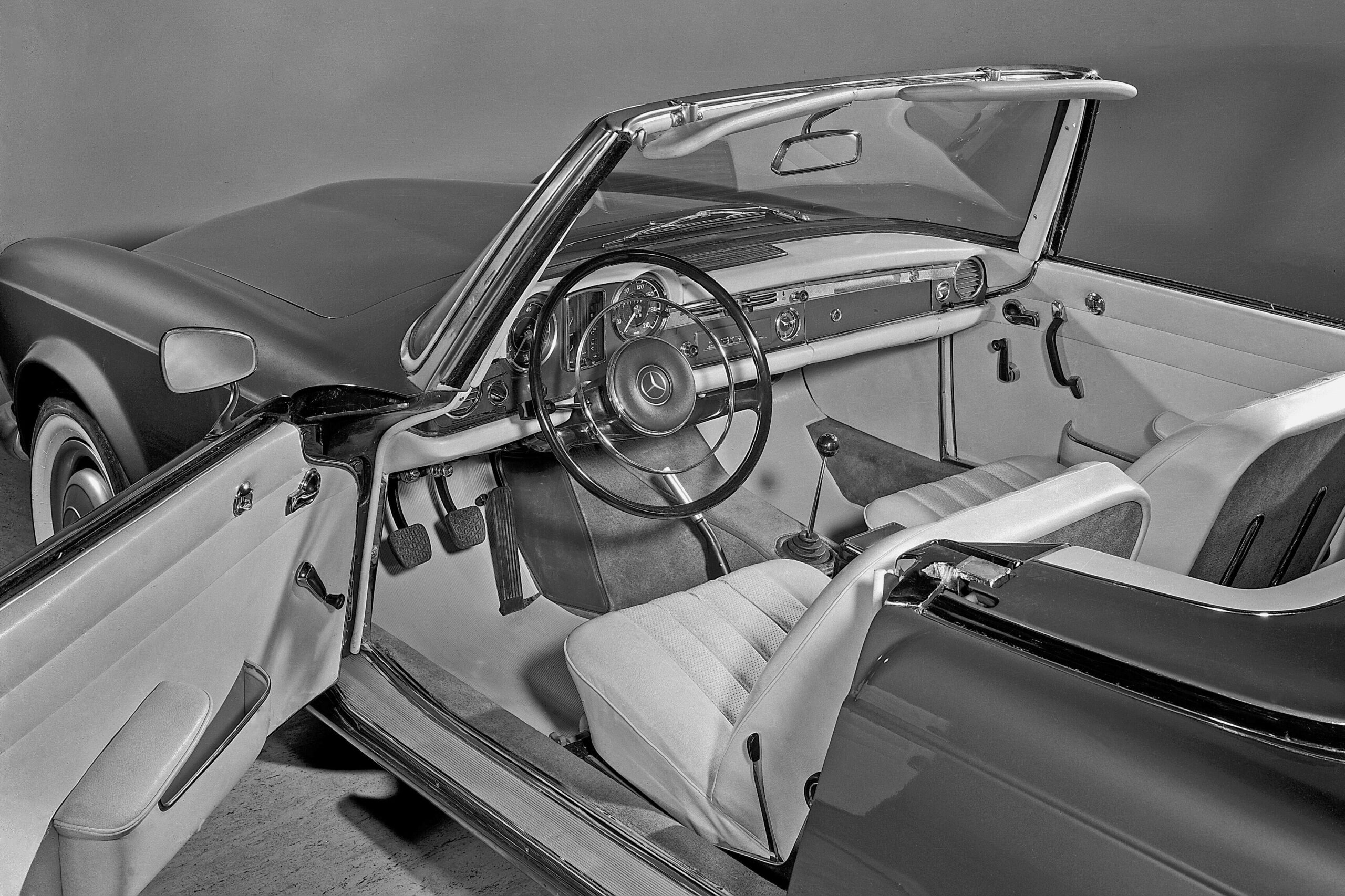
A studio image of the 230 SL interior.

A studio image of the 230 SL interior.

SL Heritage From 1955

The redesigned 230 SL traces its heritage to the first 190 SL model in 1955.

“By 1955, Mercedes-Benz Technical Director Prof. Fritz Nallinger and his team held no illusions regarding the 190 SL’s lack of performance,” according to the Wikipedia report.

The high price of the legendary 300 SL supercar kept it elusive for all but the most affluent buyers. To reach more buyers, Mercedes-Benz started evolving the 190 SL on a new platform, model code W127. It would have a fuel-injected 2.2 liter M127 inline-six engine, internally denoted as 220 SL. Encouraged by positive test results, Nallinger proposed that the 220 SL go into production in July 1957.

The 148-hp 2.3-liter straight six in the 1963 230 SL.

The 148-hp 2.3-liter straight six in the Mercedes-Benz 230 SL.

230 SL Production Delayed

Technical difficulties kept postponing the production start of the W127. The emerging new S-Class W 112 platform introduced novel body manufacturing technology. So in 1960, Nallinger proposed to develop an entirely new 220 SL design based on the “fintail” W 111 sedan platform, its wheelbase shortened by nearly a foot (11.8 inches).

The revised W 113 platform debuted an improved and fuel-injected 2.3 liter M127 inline-six engine, rated 148 horsepower with 149 foot-pounds of torque. The newly designated 230 SL also debuted the distinctive “pagoda” hardtop roof.

“It was our aim to create a very safe and fast sports car with high performance, which despite its sports characteristics, provides a very high degree of traveling comfort,” Nallinger said at the Geneva debut.

A black and white auto show display of 230 SLs.

The1963 Frankfurt International Motor Show display for the Mercedes-Benz 230 SL.

230 SL Performance

Mercedes-Benz Chief Engineer Rudolf Uhlenhaut demonstrated the capabilities of the 230 SL on the tight three-quarter mile Annemasse Vétraz-Monthoux race track in 1963. (The track was active from active 1962-1972).

Uhlenhaut clocked a best lap time of 47.5 seconds versus 47.3 seconds by Grand Prix driver Mike Parkes in his 3-liter V12 Ferrari 250 GT.

SL, or Sehr Leicht, translates as “very light.”

The original list price for a 1963 230 SL was $7,506. Today, a 1963-1967 Mercedes-Benz SL 230 in “Good” condition has a selling price of around $50,000, according to Hagerty.com.

Production of the 230 SL commenced in June 1963 and ended on Jan. 5, 1967.

The rally team in 1964.

The “Pagoda” SL was a successful rally car. This photo of the rally team is from the 34th Spa-Sofia-Liège Rally Aug. 25-29, 1964. From left to right: Martin Braungart, Dieter Glemser, Alfred Kling, Ewy Rosqvist, Manfred Schiek, Eugen Böhringer, Rolf Kreder and Klaus Kaiser.

Subaru BRZ Review

Subaru BRZ Review

Like a good red wine, the 2023 Subaru BRZ has gotten better with age. It has earned its tire wear as a sports car — not a “sporty” car with apologies

An exterior view of the a blue BRZ

The 2023 Subaru BRZ is offered in two trim levels of Premium and Limited. Pricing starts at $29,615 for the Premium and $32,115 for the Limited. (Photos courtesy of Subaru or as credited).

Table of Contents

2022 Subaru BRZ redesign
2023 BRZ Pricing
Powertrain
Ride and Handling
Suspension, Braking, Steering
Interior Function
Why Buy the 2023 Subaru BRZ?
Specifications

BY MARK MAYNARD

The Subaru BRZ is a dagger of inspiration when it’s time to cut to the chase. This rear-wheel drive, subcompact 2-plus-2 coupe has a snick-shift attitude with steely resolve. And by 2023 standards, it’s almost cheap to buy. Pricing starts at $29,615.

2022 Subaru BRZ Redesign

When the first BRZ launched in 2012 as a 2013 model, it was basically a badge-engineered model of the Scion FR-S. And when the Scion brand died in 2016, Toyota adopted it as the 86, or “eight-six” to purists. (In 2008, Toyota bought 16.5 percent of Fuji Heavy Industries, which includes the Subaru automotive brand.)

With its 200-hp, 2.0-liter engine (205-hp for automatic-equipped models), the first BRZ was a tepid performer that looked faster than it was.

That all changed with the redesigned and re-engineered second-generation 2022 BRZ. It introduced the 2.4-liter engine, the gear-changer that transformed the BRZ from a “sporty” car to a sports car.

Moving the BRZ to the Subaru Global Platform brought a 50-percent boost in twisting stiffness. The stiffer body allows a more responsive turn-in and throttle steering control.

The new body has been lightened with an aluminum roof, front fenders, and hood. With the reduced body weight, the center of gravity is now lower than the first-gen model, Subaru says — putting the BRZ on par with exotic hyper-cars.

The double-bubble roof design is just part of the aerodynamically enhanced body design. Other design elements include:

•An engine undercover insulator;

•Front fender air outlet;

•Body color rocker spoiler;

•An integrated trunk spoiler.

The 3 spoke steering wheel in the BRZ

A heated three-spoke wheel, and three pedals.

2023 Subaru BRZ Pricing

BRZ is available in two trim levels of Premium and Limited (today’s tester). Premium pricing starts at $29,615. It has the same performance elements as the Limited but with fewer interior upgrades. Among the standard BRZ fare is smart-key locking with push-button ignition, 17-inch wheels, fabric upholstery, a six-speaker audio system, and the leather-wrapped three-spoke steering wheel with red stitching.

The Limited starts at $32,115. It has such upgrades as leather-and-Ultrasuede-trimmed performance front seats, BRIN NAUB nubuck-like trim on the instrument panel visor and door trim, an eight-speaker audio system, and blind spot detection with rear cross-traffic alert. Get the list of standard equipment in the specs box at the end of this story.

Retail prices include the $1,020 freight charge from Gunma, Japan.

Check here for current pricing and offers.

The integrated trunk-lid spoiler.

The integrated trunk-lid spoiler.

Sporty BRZ Accessories Include

Rear Bumper Diffuser, $699.95: Lower rear body panel helps to direct airflow and adds a sculpted finished appearance.

STI Flexible V-Bar, $429.95: The performance-tuned STI Flexible V-Bar tightens steering response, stability, and cornering grip.

STI Shift Knob (for manual shifter), $216: A statement piece of aluminum and leather materials.

*Accessory prices do not include dealer installation.

A snick-shift six-speed manual.

A snick-shift six-speed manual.

BRZ Powertrain

In 2013, the co-developed engine began as a naturally aspirated flat-four 2.0-liter. At 200 horsepower, it was underpowered. But it was a debut for Toyota’s D-4S — Dynamic Force ‘Superior’ with direct and port fuel injection. The pairing improves fuel atomization while the port side is a self-cleaning feature to help rinse injector carbon build-up.

Fast forward to the 2022 redesign, and the new FA24 2.4-liter is still a “boxer” with horizontally opposed cylinders. The engine has 228 horsepower and a peak torque rating of 184 foot-pounds at 3,700 rpm. The sophisticated mighty-mite has a high-compression ratio of 12.5:1, requiring the energy of premium fuel.

Power delivery is by choice of six-speed transmissions, either a stick with a Torsen limited-slip differential or automatic. The automatic — $1,500 in the Premium, $1,700 in Limited — includes adaptive control, manual shift mode, downshift engine blipping, and steering wheel paddle shifters. Opting for the automatic also adds Subaru’s EyeSight Driver Assist Technology.

Both gearboxes have a Track mode and Traction Control Off switch. And for those who actually run their BRZ through a performance course, the tire pressure monitoring system has individual tire pressure displays and registrations for two sets of wheels, such as for your race rubber.

Testers at Edmunds.com managed a 0-60 mph acceleration run in 6.1 seconds in a manual BRZ Limited. “That’s almost a second quicker than the previous version and similar to the acceleration of the latest Golf GTI (5.9 seconds) and Mazda Miata (6 seconds),” wrote senior vehicle test editor Kurt Niebuhr.

Fuel economy ratings for the manual are 20/27/22 mpg. I worked up to 29.3 mpg on a longer highway run. The automatic offers an incremental mileage improvement of 21/30/25 mpg city/highway/combined.

The 24-liter 'boxer' four cylinder engine in the BRZ

The FA24 ‘boxer’ 2.4-liter has 228 hp and peak torque of 184 foot-pounds at 3,700 rpm.

BRZ Ride and Handling

The more powerful 2.4-flat four-cylinder has the guts to pull steady from liftoff to interstate cruising. It is an eager scrapper that does not blow past the pleasure of feeling the suspension give and take. A reassuring push is felt in the driver’s seat from rear-wheel control.

There is no need to rush shifts. The engine’s 184 foot-pounds of peak torque are easily finessed with the six-speed stick. The clutch is light and the gears engage with steely engagement, and I never missed a one in my week of testing. (A seven-speed gearbox might help fuel economy, but I liked the control of the six-speed.)

Hill-start assist eliminates clutching anxiety — there’s about a 3-second hold before the backward roll.

Despite a low-slung stance and driving position, the BRZ is not prone to chin-scraping at every low dip in the road or driveway. However, while idling in traffic, I was looking into the ass-end of a Prius, and just about any other car.

At speed on the highway, the BRZ is a maelstrom of sounds. There is a rush of road noise and wind noise. But this is a sports car, and the rage of sounds can be forgiven. Tach it up, and revs in the higher rpms start speaking in enthusiast’s tongues.

The customizable 7-inch digital instrument panel.

The customizable 7-inch digital instrument panel.

Suspension, Braking, Steering

Underpinning the BRZ is a four-wheel independent suspension. The front has MacPherson-type struts with lower L-arms, coil springs, a stabilizer bar, and a strut tower brace. At the rear is a double wishbone with coil springs, stab bar, and anti-lift engineering.

Four-wheel ventilated disc brakes have 11.6-inch front rotors with dual-piston calipers. At the rear, 11.4-inch rotors with a single pot caliper.

Quick-ratio rack-and-pinion has well-calibrated electric assist. The turning circle is a tidy 35.4 feet.

Tires on the Premium model are 17-inch summer performance, 215/45. The Limited’s 18-inch tires are Michelin Pilot Sport 4 summer performance, 215/40. Both models have a tire repair kit, not a spare.

The Limited’s 18-inch tires are Michelin Pilot Sport 4 summer performance

The Limited’s 18-inch tires are Michelin Pilot Sport 4 summer performance, 215/40. (Mark Maynard)

BRZ Curb Weights

The Limited manual weighs 2,864 pounds or just 49 pounds more than the Premium. (Compared to the first-gen model, the 2023 BRZ manual is just 88 pounds heavier.) Opting for the automatic shifter adds just 17 pounds for the Limited or 20 lbs. for the Premium.

Ultrasuede-trimmed performance buckets in the BRZ

Ultrasuede-trimmed performance buckets.

Interior Function

Settle into the cockpit, and you’ll notice some functional roominess. Headroom of 37 inches will be limiting to some, but a 6-foot-6 friend had no problem getting comfortable behind the wheel.

Sightlines are surprisingly open for such a low and swoopy body style.

There is much carryover content and materials between the BRZ and its alt-ego Toyota GR86. But there are subtle differences. For one, the BRZ has an electric parking brake, and the Toyota GR86 has a hand brake, which is beneficial for scooting the rear end at the apex of the slalom. Otherwise, Subaru’s interior treatment has premium appeal.

The Limited adds a leather-wrapped three-spoke steering wheel and shifter, Ultrasuede-trimmed performance front seats, heated front seats, carpeted floor mats with red stitching and BRZ logo, and a six-way manual driver’s seat.

Interior space is compact with a modular Subaru Starlink 8-inch multimedia audio system with Apple CarPlay and Android Auto connectivity. The screen doubles as a decent-sized rearview camera. Navigation is via the Starlink app.

The eight-speaker audio system works hard but is challenged by the noisy ride.

My daily complaint was how the seat belt cut across my neck. There is a guide loop, but it unsnapped almost immediately after securing the belt.

The very small back seats in the BRZ

The back seats make a better platform with the seatback folded. (Mark Maynard)

Back Seat and Cargo Space

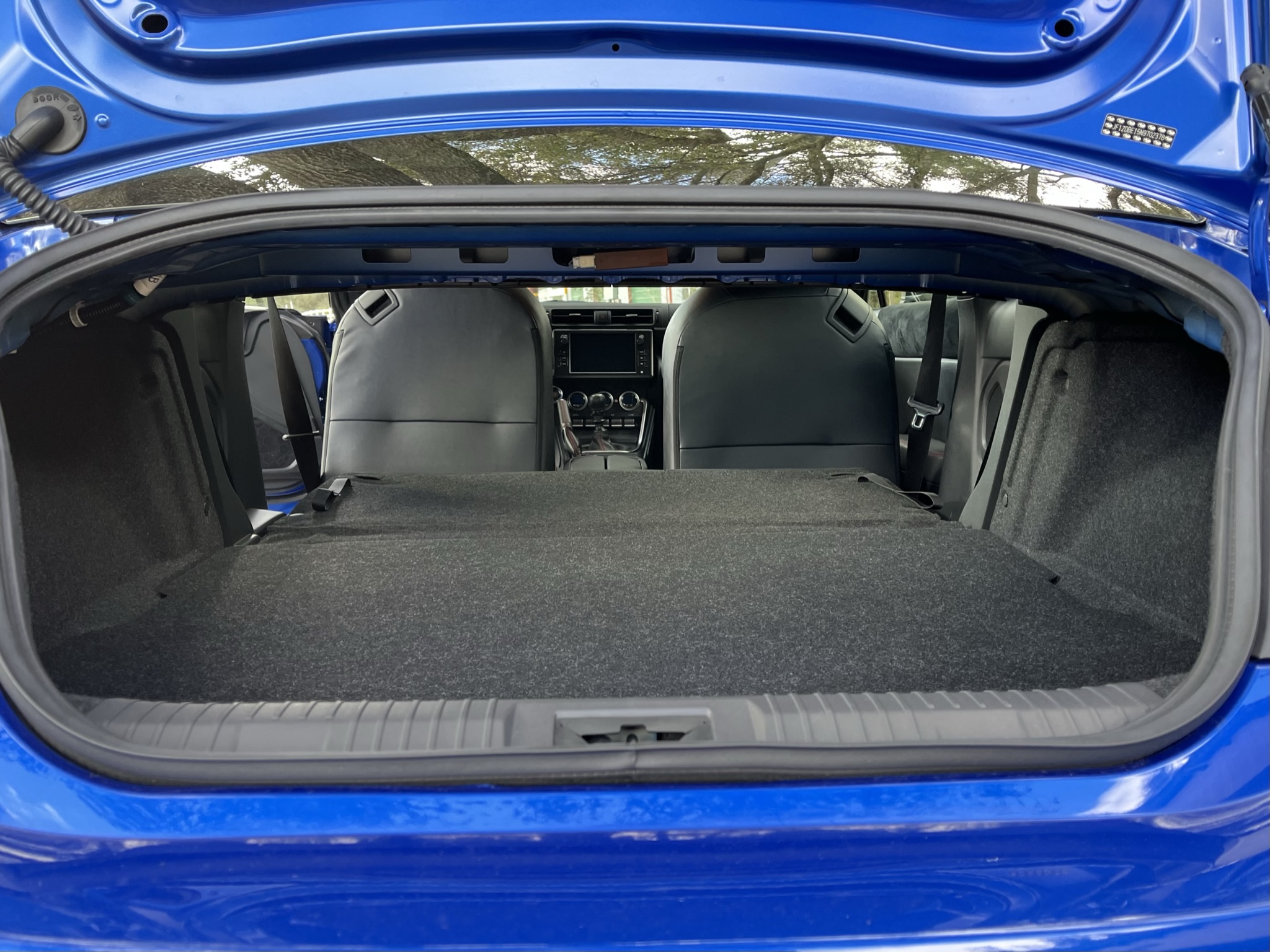
Back seat space is a mere suggestion. Technically, there are 29.9 inches of legroom, but that becomes zero-inches with any occupant in the front seats. But fold the seatback, and there is about 5 feet in length for sports gear.

The BRZ cargo space with the back seat folded

Fold the seatback for about 5 feet in length. (Mark Maynard)

Why Buy the 2023 Subaru BRZ?

Like a good red wine, the Subaru BRZ has improved with age. It has earned its tire wear as a sports car, not a mere “sporty” car.

There is simple and honest integrity to the 2023 Subaru BRZ. Unlike some high-strung performance coupes, the BRZ is an everyday driver that does not extract a pound of muscle pain upon entry or exit.

It is built for fun, and the BRZ lets it rip with precision. It seems as if it should cost more, but just grab it and run with it like you stole it.

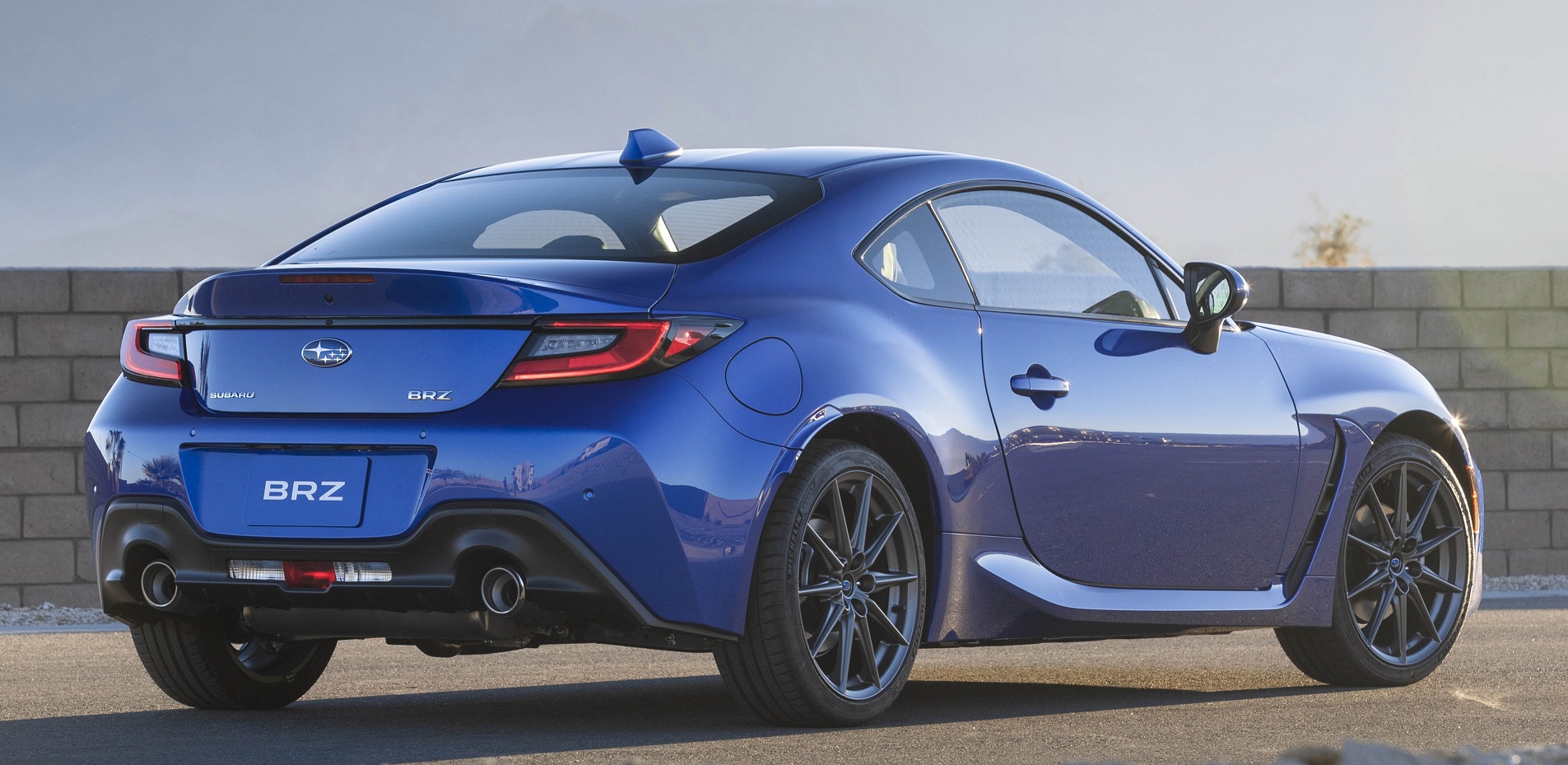
A rear view of a bold, blue BRZ

The second-gen BRZ has a lower center of gravity than the first-gen model.

2023 Subaru BRZ Limited Specifications

Body style: subcompact, 2+2 rear-wheel-drive coupe with aluminum hood, front fenders and roof

Engine: FA24 228-hp 2.4-liter, horizontally opposed (‘boxer’) 4-cylinder with direct and port fuel injection with multi-spray injectors), aluminum alloy cylinder block and cylinder heads; 184 lb.-ft. torque at 3,700 rpm

Transmission: 6-speed manual with Torsen limited-slip differential

Fuel economy: 20/27/22 mpg on the recommended premium fuel

0-60 mph acceleration: 6.1 seconds *per Edmunds.com

BY THE NUMBERS

Fuel tank: 13.2 gallons

Trunk space: 6.3 cubic feet

Front head/leg room: 37/41.5 inches

Rear head/leg room: 33.5/29.9 inches

Length/wheelbase: 167.9/101.4 inches

Width/height: 69.9/51.6 inches

Curb weight: 2,864 pounds

Turning circle: 35.4 feet

FEATURES

Limited model standard equipment includes: smart-key entry and push-button ignition, rearview camera, steering responsive LED high and low beam headlights, LED running lights, Subaru Starlink 8-inch multimedia audio system with Apple CarPlay and Android Auto connectivity, 8-speaker audio system with satellite radio, carpeted floor mats with red stitching and BRZ logo, heated front seats, leather-wrapped 3-spoke steering wheel and shifter, Ultrasuede trimmed performance-design front seats, 6-way manual driver’s seat, fold-down rear seatback, 18-inch alloy wheels with Michelin Pilot Sport 4 summer performance tires (215/40)

Safety features include: 7 air bags, stability and traction controls, blind-spot detection with cross-traffic alert, brake-force distribution, brake assist

PRICING

Limited base price: $32,115, including $1,020 freight charge; price as tested $32,115

Options on test vehicle: None

Where assembled: Gunma, Japan

Warranties: 3-years/36,000-miles bumper to bumper with roadside assistance; 5-years/60,000-miles powertrain