Select Page

Kia Telluride: What’s New for 2023

Kia Telluride: What’s New for 2023

1,000-mile round-trip road trip in a 2023 Kia Telluride in near-luxury and complete comfort

An exterior view of a 2023 Kia Telluride sport utility vehicle in wolf gray

The 2023 Kia Telluride SX-Prestige X-Line tester was $53,825 with options for Wolf Gray paint ($495) and carpeted floor mats ($210). Pricing includes the $1,335 freight charge from West Point, Ga. (Photos by Mark Maynard)

Table of Contents

Road-Trip Ready Telluride
2023 Telluride Pricing
Interior Function
Back Seats and Cargo Space
V-6 Performance
Ride and Handling
Safety Technologies
What’s New for 2023?
Why Buy the Kia Telluride?
Specifications

BY MARK MAYNARD

I had just unpacked from a 1,000-mile round-trip road trip in a 2023 Kia Telluride and wasn’t ready for the drive to end. It was a holiday getaway with the girlfriend-wife and her sister and brother-in-law to spend Christmas with the sisters’ brother and wife in Santa Cruz. It was the quintessential getaway of four retirement-age friends rolling along in near luxury and complete comfort.

With its 291-horsepower V-6, there was plenty of power for secure acceleration — with all of us, our gear, and the Telluride’s all-wheel-drive curb weight of 4,482 pounds. Hefting such poundage still returned a combined fuel economy of 21.2 mpg to a max of 25.6 — on the recommended 87 octane.

To call the Telluride an SUV is almost disrespectful. The clumsy term with negative impact has endured from the early truck-based “sport utility” vehicles. And most of these were seldom sporty or provided much utility.

A view through the windshield from the driver's seat on a rainy day.

Sightlines are unobstructed over the fenders and over the shoulder.

Road-Trip Ready Telluride

The test vehicle was an upper trim level Telluride SX-Prestige V-6 with all-wheel drive and the new-for-2023 X-Line treatment. The new X-Line and X-Pro trim levels have some off-roading traits. X-Line and X-Pro trims have a slightly raised ride height (about a third of an inch), 20-inch black wheels, a unique black grille, trailering tow mode, and upgraded traction control for better control on gravel and sand.

Somebody could forgive such a blunt front end for some interior wind noise, but the Telluride is better soundproofed than some luxury SUVs I’ve tested. Conversations do not wash out in a wall of white noise or road harshness, thank you very much in part to the Michelin tires.

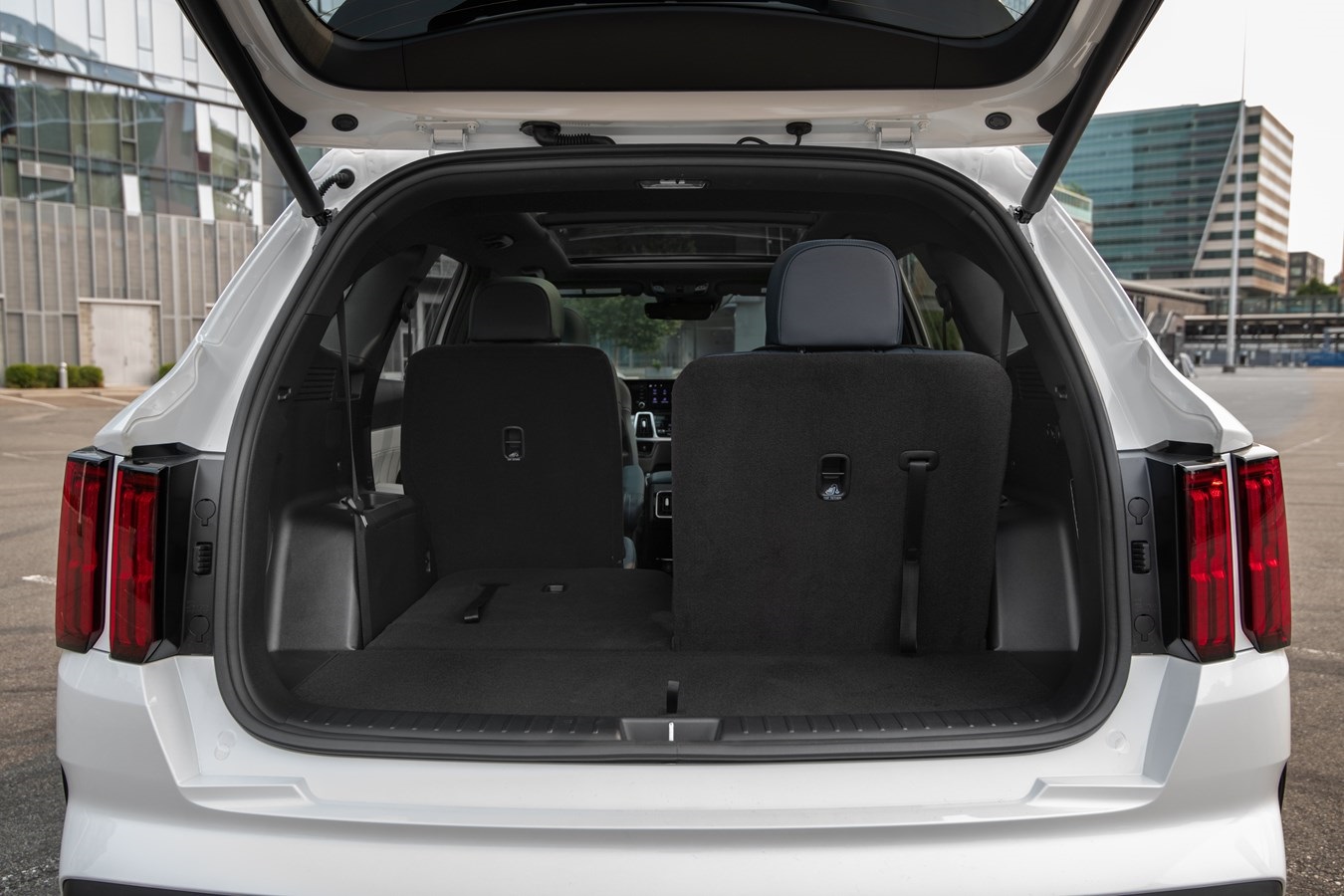
With three rows, the Telluride has seats for seven with the second-row captains’ chairs or eight seats with a second-row bench. The three-position third row is kid class in legroom, but it folds flat into the floor, making it ideal for lots of luggage. We could stow all the suitcases, the cooler of homemade foods and goodies for holiday meals, and the presents. It all fit below the rear window line, but if cargo must be stacked to the headliner, the Telluride has a digital rearview camera that gives a wide-open rearward view. (It is a welcome feature when pulling a trailer.)

There is no need for running boards to climb aboard (even with the X-Line lift). And all four of us had captain’s chairs, heated and ventilated, with rear side sunshades. The front seats are power-adjustable, including lumbar, with seat-bottom thigh extension for the driver.

Dual pane sunroofs in the Telluride SX create a light and pleasurable space for passengers.

Dual pane sunroofs in the Telluride SX Prestige.

2023 Kia Telluride Pricing

Telluride is sold in 10 trim levels: LX, S, EX, EX-X-Line, SX, SX-X-Line, SX-X-Pro, SX Prestige, SX Prestige X-Line, SX Prestige X-Pro. Entry-level LX, S, EX trims are front-wheel drive; AWD is optional ($2,000) and includes Michelin tires. Trims of SX and above have standard, active on-demand AWD.

The powertrain for all trims is a 291-horsepower, Atkinson cycle 3.8-liter, direct-injected V-6, and eight-speed automatic transmission. The tow rating is 5,000 pounds or 5,500 for the SX X-Pro.

Starting prices range from $37,025 for the LX to $54,120 for the top-line SX Prestige X-Pro. Today’s SX-Prestige X-Line tester starts at $53,120, and with options for Wolf Gray paint ($495) and carpeted floor mats ($210), the sticker price was $53,825. All manufacturers’ retail pricing includes the $1,335 freight charge from West Point, Ga.

Kia’s new vehicle warranty coverage is 5 years or 60,000 miles bumper to bumper with roadside assistance. The powertrain has coverage of 10 years or 100,000 miles.

Find current pricing and incentives here.

Second row legroom in the Telluride is very long at 42.4 inches.

Second-row legroom is grand at 42.4 inches.

Telluride Interior Function

Because the cabin has door-to-door shoulder room of 61.6 inches, interior roominess is maximized.

The contemporary cabin design is open with contemporary with design elements of brushed metal trim and light gray wood in the tester. The plastics have an appealing texture, with attentive assembly to all panels. The headliner, roof pillars, and visors are wrapped in soft microsuede. Large sliding sun visors have large, covered mirrors.

There are 39.5 inches of front headroom and long legroom of 44.1 inches. Sightlines are open and further empowered by the around-view camera. (The Telluride is a big vehicle, but the camera system with an overhead side view is empowering when parking and backing out of the space.)

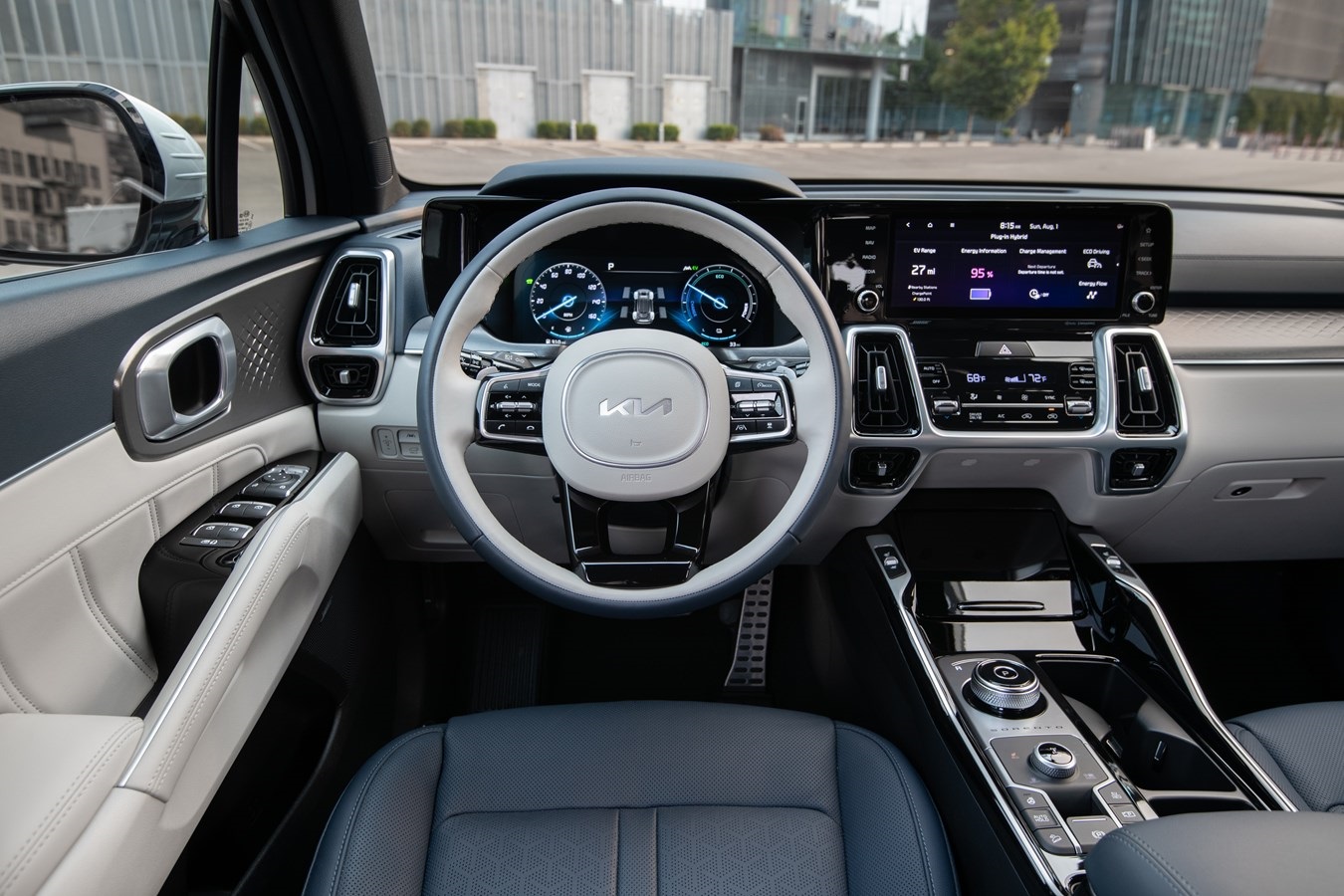
The shift console is efficiently designed with a large charging bin with a wireless pad, 12-volt plug and two USBs. The drive-mode controller (comfort, sport, smart, eco, etc.) takes up just a small square of space, with the nearby electric parking brake switch.
A heated steering wheel.

A heated steering wheel.

Sturdy grab rails flank each side of the console, and there is yet another USB in the dual-level armrest box.

There is no confusion when reaching for climate controls or to access the navigation system, radio or other media choices. But the navi system was a struggle to use, so we used the Waze smartphone app.

Telluride has almost as many USB ports as cup holders (12). There are up to six USB chargers, five of which are the more modern C-Type. But there is one “old-style” A-Type USB in the e-bin.

Back Seats and Cargo Space

The second-row captain’s chairs are road-trip ready. They recline and, in the SX, are heated and ventilated. Legroom is grand at 42.4 inches maximum. With no step rail, placing a child in a car seat is much easier.

The back side of the front armrest console has a pair of cup holders; down low is a 12-volt plug and a 115-volt, 150-watt household outlet. Plus, there is a charging USB notched into the front seatback sides, with a bag hook in each seatback.

An electronic AC controller in the headliner allows control of fan speed, vent flow, and temperature; the controller panel also packages a pair of large reading lights. The moonroof is a welcome skylight, but it would be nice to have a separate sunshade control switch, not just the main controller up front.

Entry to the third row is via a one-touch button to tilt and slide the captain’s seats, with a nearby grab handle for leverage. The three-seat bench, with legroom of 31.4 inches, is snug for adults but fun for youngsters. The seats recline, and the area is stocked with reading lights, cup or box holders, and two more charging USBs.

The cargo area is 4 feet wide and square with up to 7 feet in length with both rows folded, but the captain’s chairs prevent a contiguous floor, such as for sleeping. Behind the third row is 21 cubic feet of grocery capacity. And below the floor is some usable basement space, with storage for the roller shade.

The second-row seats tip and slide for third-row access.

The second-row seats tip and slide for third-row access.

Telluride’s V-6 Performance

I’ve long believed in electric and electrified vehicles, so a V-6 combustion engine might seem indulgent. But it is an asset for a vehicle of this size. The Telluride’s combustion V-6 uses the Atkinson cycle design for fuel efficiency. Together with auto stop-start at idle, the direct-injected engine can be considered a mild hybrid. With 262 foot-pounds of torque at 5,200 rpm, the power response is unhesitating in Sport mode and guarded in Eco mode.

In this round-trip road trip of almost 1,000 miles, my average fuel economy ranged from 21.2 mpg to a high of 25.6. The sweet spot for interstate cruising with cruise control was a consistent 22.8 mpg. With that mileage, the 18.8-gallon tank could provide a cruising range of around 425 miles.

I couldn’t complain about the fuel economy with a cabin of four adults, tooling along between 70 and 80 mph. The Telluride SX curb weight is 4,524 pounds, plus another 700 pounds or so with people and luggage.

I drove the entire trip in Eco mode, thinking that would stretch the mileage. But I also was surprised to find that Eco mode was capable of stiff acceleration when needed, but it wasn’t all that quick to respond to an urgent demand for get-going power.

The transmission also has modes for Smart, Sport, and Comfort. Each mode applies different calibrations for the engine, transmission, and steering effort.

When I’m creeping along in commuter traffic, I dial up Sport mode. There is enough added kick to guard my line against impatient drivers who have to try to cut in front.

The V-6 Telluride engine.

291 hp and thrifty fuel economy of 18 mpg city, 24 highway and 21 mpg combined.

Telluride AWD Ride and Handling

In Eco mode, the steering weight is comfortable and appreciated when hands are on the wheel for 8 hours. The wheel has an easy roll in tight parking situations but was never vague at speed. And the suspension and Michelin tires help the Telluride track steady at high speeds without wandering. Driving the Telluride SX X-Line — with self-leveling rear suspension — never felt heavy, nor was there body lean in cornering. For my passengers, there was no mention of queasiness — and that’s high praise for a road-trip vehicle or for parents with children prone to motion sickness.

Four-wheel disc brakes are reassuring with 13.4-inch vented rotors front and solid 12-inch rotors rear.

The wide navigation and camera screen in the dashboard

Dual 12.3-inch-wide display screens for driver info and navigation and camera system.

Telluride Safety Technologies

The multi-tasking shift console with e-bin and wireless charging pad.

The multi-tasking shift console with e-bin and charging pad.

Kia’s advanced driver assist systems contribute to a much more relaxed driving experience.

Highway Driving Assist 2 (standard on upper trim levels) is a semi-autonomous system that requires both hands on the wheel. But the vast network of safety technologies functions as an array of eyes to keep the Telluride on course. The system gives accurate lane centering, and not once did the Telluride drift wide in cornering or cross the highway lines or Botts dots.

Among the safety features are seven air bags, navigation-based smart cruise control, and Intelligent Speed Limit Assist. The list of driver-assist technologies is highlighted below in ADAS Technologies.

Active On-Demand AWD

Kia’s active on-demand all-wheel-drive system distributes torque between the front and rear wheels. Depending on road conditions and driver action, the system continually redistributes the amount of power transferred fore and aft.

In everyday driving, Eco and Comfort modes can direct 20 to 35 percent of the power to the rear wheels. Sport, Smart, and Snow modes can deliver up to 50 percent of the power to the rear wheels. AWD Lock”sends power evenly to all four wheels.

A gloss-black front wheel and Michelin tire on the Telluride with X-Line treatment

The Telluride X-Line gets 20-inch Michelin Primacy 245/50 tires and gloss-black wheels.

What’s New for 2023?

The Kia Telluride was a smash success when it debuted in the spring of 2019 as a 2020 model. It had the right look and the right stance — substantial and engaging. And 2023 brings a range of updates for Telluride.

The 2023 Kia Telluride has some freshened exterior styling, mainly for a more rugged yet refined look, Kia says. Among the tweaks are the following:

  • Revised vertical headlamp design with optional LED headlights and fog lights;
  • New front fascia and grille;
  • Revised taillights and new rear fascia and trim;
  • New wheel designs for every trim;
  • Three new exterior colors: Midnight Lake Blue, Dawning Red, Jungle Green;
  • X-Line trim replaces the former Telluride Nightfall Edition;
  • Downhill Brake Control, which helps keep a controlled descent on steep roads.
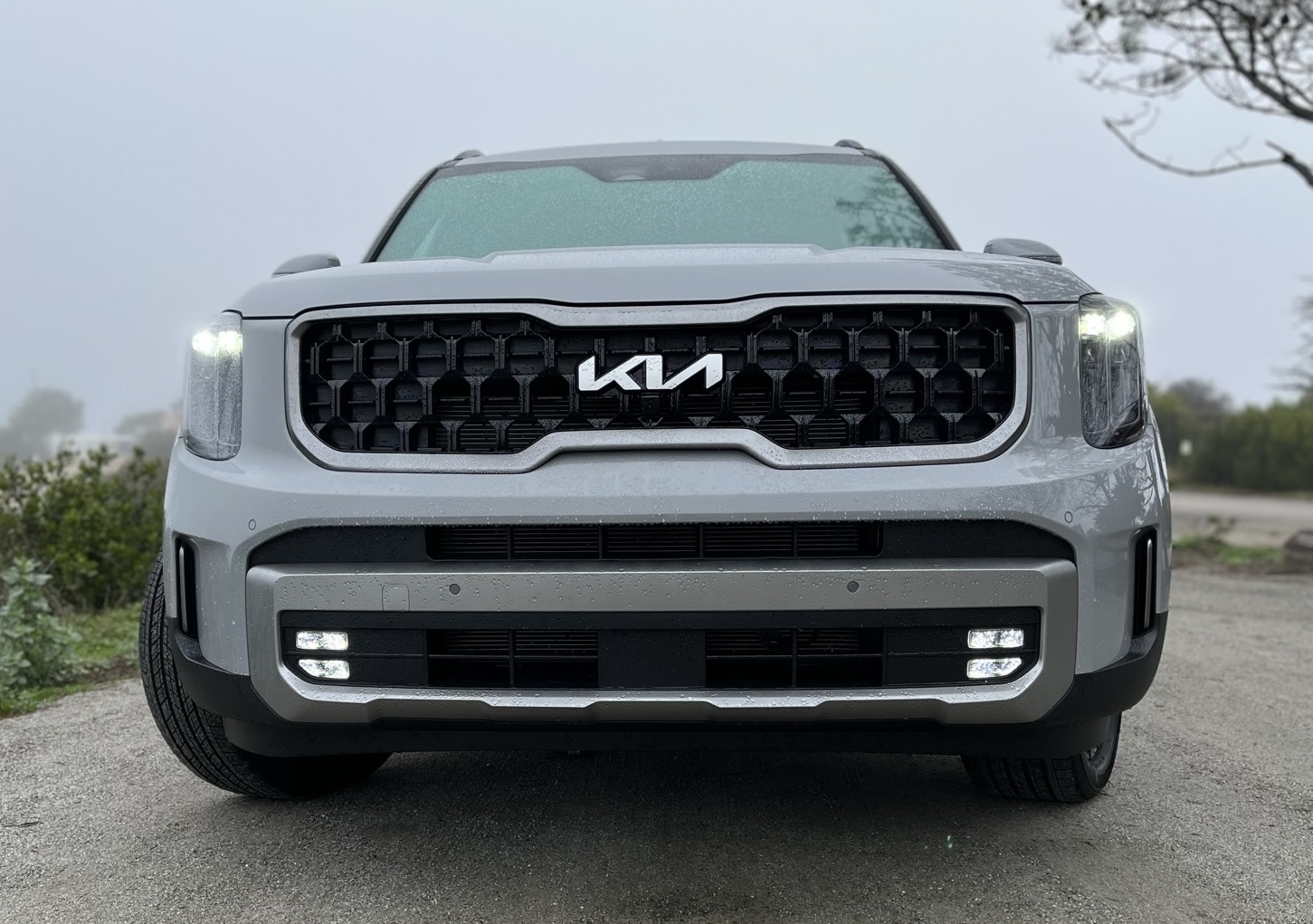
The Telluride X-Line has a unique, black grille treatment.

The Telluride X-Line has a unique grille treatment.

New 2023 Convenience Technologies

  • Standard upgraded 12.3-inch navigation screen (increased from 10.3 inches);
  • Optional full display mirror with HomeLink;
  • Optional Smart Power Liftgate with “Auto Close” function;
  • Kia Connect services for embedded connectivity:
  • Available Digital Key: Allows compatible iPhone, Apple Watch, and Samsung Galaxy smart devices to be used as a virtual vehicle key to lock, unlock and drive. Digital keys can be shared with friends and family over text messages on available devices;
  • In-vehicle Wi-Fi Hotspot connects up to five devices to 4G LTE-based internet;
  • Automatic over-the-air updates for maps and infotainment;
  • Kia Access App for Apple Watch and Samsung Galaxy smartwatch to access such features as remote climate control and door lock/unlock;
  • Stolen vehicle tracking and immobilization capability;
  • Connected Routing: The server-based system will calculate the optimal route using real-time and predicted traffic information. The cloud system uses past driving information to learn the driver’s preferred route;
  • Smart Speaker Integration: Amazon Alexa or Google Assistant can remotely control some functions, such as remote start.
There is rewarding quality to the stitching and precise alignment of interior panes.

There is rewarding quality to the stitching and precise alignment of interior panes.

Expanded ADAS Technologies

The 2023 Advanced Driver Assist Systems add several new technologies:

Intelligent Speed Limit Assist — ISLA: Can detect a road’s maximum speed limit in some cases, provide alerts to the driver and even limit the speed of the car depending on the settings (standard);

Navigation-based Smart Cruise Control – Curve — NSCC-C: In certain circumstances, the smart cruise control can lower the vehicle’s speed proactively before upcoming curves in the road (available);

Highway Driving Assist 2 — HDA 2: A driving convenience system that helps to maintain a predetermined distance from the vehicle detected in front, keep the vehicle within detected lane markers on certain highways, and assist in lane changes under certain conditions (optional; HDA 1.5 is standard);

Forward Collision Avoidance – Junction Turning — FCA-JT: Detects oncoming vehicles while turning left at an intersection (junction). If the system detects that a collision might be likely, the system may apply the brakes to help slow or stop the car (standard);

Forward Collision Avoidance – Junction Crossing — FCA-JC: Is designed to detect crossing vehicles while passing through an intersection. If the system detects that a collision might be likely, the system may apply the brakes to help slow or stop the car (available);

Forward Collision Avoidance – Lane Change Oncoming — FCA-LO: Designed to give steering input to help prevent collisions if the system detects oncoming vehicles while passing other vehicles (available);

Forward Collision Avoidance – Lane Change Side — FCA-LS: Provides steering input to help prevent collisions if the system detects cycles or vehicles in front of the car while changing lanes (available);

Forward Collision Avoidance – Evasive Steering Assist — FCA-ESA: Gives steering input to help prevent collisions if the system detects obstacles, pedestrians, or vehicles in front of the car while driving straight (available).

Looking through the open driver-side door at the front seats.

Front headroom is tall at 39.5 inches, and the driver seat is 8-way power adjustable.

Why Buy the Kia Telluride?

The Telluride is big but efficient, even nimble for a vehicle that is 16.4 feet long. After 12 hours in the saddle, the seats began to feel like leather saddles. But only seat massagers would have prevented that. Still, I stepped out at fuel stops without stiffness or back pain. And I was always eager to climb aboard and continue the adventure.

After our trip, it was a sad wave goodbye to the Telluride. If it had fit easily in my garage, it would have been a keeper.

A rear three quarter view of the wolf gray Telluride with gloss black alloy wheels.

The Kia Telluride X-Line package adds such features as raised, bridge-type roof rails, body-color door handles, and exclusive 20-inch wheels.

2023 Kia Telluride SX-Prestige X-Line V6 AWD Specifications

Body style: large 7-seat, 5-door SUV

Engine: 291-hp, direct-injected 3.8-liter V-6; 262 lb.-ft. torque at 5,200 rpm

Transmission: 8-speed automatic with active on-demand AWD

Fuel economy: 18/24/21 mpg city/hwy/combined; 87 octane recommended

BY THE NUMBERS

Towing capacity: 5,000 pounds

Fuel tank: 18.8 gallons

Cargo space: 21 to 46 cubic feet

Front head/leg room: 39.5/41.4 inches

2nd-row head/leg room: 38.8/42.4 inches

3rd-row head/leg room: 37.8/31.4 inches

Length/wheelbase: 196.9/114.2 inches

Width/height: 78.3/ 70.5 (with roof rails) inches

Curb weight: 4,524 pounds

Turning circle: 38.8 feet

FEATURES

Telluride SX-Prestige Standard equipment includes: smart key entry with push-button ignition and remote start, digital key (for smartphone app use), digital rearview mirror, Nappa-leather trimmed seat upholstery, 10-way power front seats with driver-seat memory, heated steering wheel, heated and ventilated front and rear seats, dual panoramic 12.3-inch panoramic displays with navigation, wireless phone charging pad, surround view monitor and blind-spot view monitor, head-up display, Kia Connect with free 1-year trial, Harman-Kardon audio system;

SX-Prestige exterior features include: 20-inch alloy wheel, dual sunroofs (2nd row fixed), LED headlights, smart power liftgate, power-folding side mirrors with turn signals, roof rails, and rear privacy glass.

Standard safety features and technologies include: 7 air bags, Forward Collision Warning, Forward Collision Avoidance Assist with Pedestrian & Cyclist Detection, high beam assist, lane departure warning, lane keeping assist, blind spot collision warning, driver attention warning, rear cross-traffic collision-avoidance assist, parking distance warning – reverse, lane following assist, safe exit assist;

Kia Drive Wise Driver-Assist Technologies: Forward collision avoidance (cyclist and junction turning), blind spot collision warning, rear cross-traffic collision-avoidance assist, safe exit assist, highway driving assist 2, parking distance warning forward and reverse, smart cruise control with stop-and-go, parking collision avoidance assist, reverse.

PRICING

Telluride SX-Prestige X-Line base price: $53,120, including $1,335 freight charge; price as tested $53,825

Options on test vehicle: Wolf Gray paint $495; carpeted floor mats $210

Where assembled: West Point, Ga.

Warranties: 5-years/60,000-miles bumper to bumper with roadside assistance; 10-years/100,000-miles powertrain

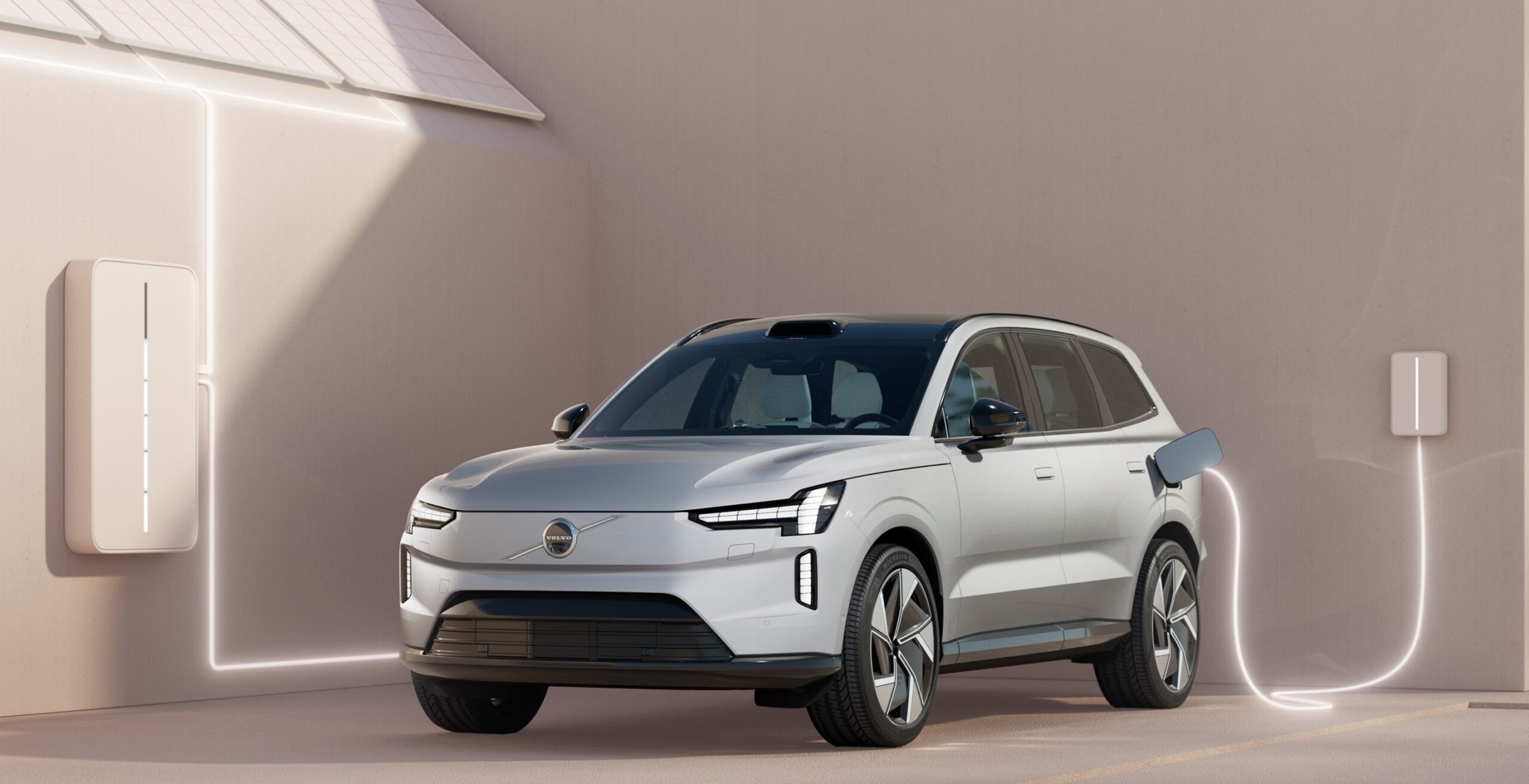
Volvo EX90 Electric SUV Reveal

Volvo EX90 Electric SUV Reveal

The 2024 Volvo EX90 is the company’s vision of a large family SUV in the electric age. Pricing will start at around $80,000.

The 2024 Volvo EX90 is the company’s vision of a large family SUV in the electric age. A home energy management system features a bi-directional wall box to power a home.

The 2024 Volvo EX90 is the company’s vision of a large family SUV in the electric age. A home energy management system features a bi-directional wall box to power a home. (Photos courtesy of Volvo Cars USA)

BY MARK MAYNARD

Volvo revealed its battery-electric EX90 SUV Nov. 9, 2022, in downtown Stockholm. The much-anticipated seven-seat SUV represents the start of a new era for Volvo as a carmaker of battery-electric vehicles.

Volvo has only one other battery-electric vehicle, the XC40 Recharge. However, the company plans to offer only battery-electric vehicles by 2030 and expects to be carbon-neutral by 2040. The Sweden-based carmaker is now owned by Geely Automobile, a major automotive brand based in China

Though the EX90 debuted in Sweden, U.S. models will be built in Charleston (Ridgeville), S.C., beginning next year.

Volvo CEO Jim Rowan said, “The Volvo EX90 is a statement for where we are, and where we are going. It’s fully electric with a range of up to 300 miles on a single charge, designed to further raise our safety standards, the first Volvo car to be truly defined by its software and part of a wider ecosystem, connecting to your home and your other devices. The Volvo EX90 is the start of something new for Volvo Cars in many ways.”

Rowan also said that EX90 would be sold online or by going to a retailer. “You decide how you access it,” he said, “whether that is through outright ownership, by subscribing to it, or by leasing it. Whatever works for you.”

Front seats with the large vertical infotainment screen

Interior materials are made of recycled plastics and bio-materials that Volvo calls Nordico. The 14.5-inch vertical center screen has Google built-in for apps and services.

Battery-Electric Powertrain

The powertrain at launch will be a twin-motor all-wheel drive version. It is powered by a 111kWh lithium-ion battery and two permanent magnet electric motors. Total power is up 496 horsepower and 671 foot-pounds of torque, though a lower horsepower version will be available.

The frunk, or front trunk

Charging cable storage in the “frunk.”

Volvo says that the battery pack can be charged from 10 percent to 80 percent in about 30 minutes. However, the release did not mention which level of pubic charger could supply that charge rate, whether 150kW, 250kW, or 350kW, or if that charge rate requires a Level 3 DC fast charger, which is hard to find.

Also advantageous is bi-directional charging. The battery pack in the Volvo EX90 can be tapped as an extra energy supply, such as to power a home, other electric devices, or another electric Volvo. The company says that bi-directional charging will be available in the future and in select markets.

A side view of the ex90 connected to a battery charger.

The 111kWh lithium-ion battery pack can be charged from 10 percent to 80 percent in about 30 minutes.

EX90 Safety Technologies

The Volvo EX90 is the smartest and safest vehicle the company has ever made. And it can get smarter and safer over time as it learns from new data and receives over-the-air updates.

The company says that the latest network of Volvo’s sensing technologies creates an invisible shield of safety. Cameras, radars, and lidar function through high-performance core

Thor's Hammer headlight design.

“Thor’s Hammer” lighting.

computers. NVIDIA DRIVE runs Volvo Cars’ in-house software to create a real-time, 360-degree view of the world.

The lidar system, by Luminar, can sense the road ahead, whether day or night, and at highway speeds, Volvo says. The system can see small objects hundreds of yards ahead, which gives more time to inform, act and avoid. Volvo’s Pilot Assist driving function has been improved with a new steering assist while changing lanes.

Unsupervised Driving

Volvo says the EX90 is hardware-ready for unsupervised driving in the future.

Inside, special sensors and cameras track eye-gaze concentration. The technology can determine when the driver is distracted, drowsy, or inattentive. And if that fails and there is a collision, the Volvo EX90 is designed to safely stop and call for help.

San Diego-based Qualcomm Technologies’ Snapdragon Cockpit Platforms runs most of the core interior functions, from safety and infotainment to battery management.

A 14.5-inch vertical center screen has Google built-in for apps and services, including hands-free help from Google Assistant and Google Maps. And the Volvo EX90 will also be compatible with wireless Apple CarPlay.

Digital phone key technology will function as the car key through a smartphone app.

The second row back seat area

New interior radar developed by Volvo is sensitive enough to detect the tiniest movements at the sub-millimeter scale — such as those of a sleeping toddler. The radar feature covers the entire interior of the car, including the trunk.

Volvo EX90 Preordering Now

Pricing for the 2024 Volvo EX90 will start at around $80,000. Vehicles can be preordered in the U.S. with a $500 deposit. Get the details at VolvoCars.com/us. Customers placing preorders will be asked to configure their cars in the fall of 2023 and will receive prioritization when deliveries begin in early 2024.

Other information and full specifications will be available closer to the on-sale date.

The EX90 cargo space with the tailgate raised

Flexible cargo capacity.

Kia Sorento PHEV SX-Prestige AWD Review

Kia Sorento PHEV SX-Prestige AWD Review

A road trip in a 2023 Kia Sorento plug-in yields 35.2 mpg over 1,225 miles after using 34 miles of battery driving

A forward view of the Kia Sorento PHEV along a marina with sailboats

For 2023, the Kia Sorento PHEV is sold in just one all-wheel-drive trim level with a starting price of $50,185. (Photos courtesy of Kia America)

Table of Contents

Overview
Competing PHEV SUVs
Pricing
Performance
Hybrid Battery Charging
Driver-Assistance Systems
Ride and Handling
Interior Function
Back Seats and Cargo Space
Why Buy the Kia Sorento PHEV?
Specifications

BY MARK MAYNARD

Ijust completed a 1,225-mile road trip in the Kia Sorento PHEV and logged an average of 35.2 miles per gallon. Much of the round-trip from San Diego to Sonoma, Calif., was driven at 70 mph with cruise control. I was pleased with the mileage and expect most owners of this all-wheel-drive, midsize SUV with three rows of seating would be, too.

A plug-in hybrid isn’t necessarily the optimum choice for a road trip, but the Sorento is ideal for its comfort and a sense of reinforced safety. With 31- to 34- miles of battery-electric driving, many owners could drive the workweek with minimal emissions, engine firing, and using pricey fuel.

The six-seat Sorento PHEV is rich in premium interior materials and contemporary design. The midsize cabin provides ample space for shoulder width, tall headroom, and a third row that folds flat to the floor. There is plenty of room for luggage and treasures picked up along the way.

The front seats in the Sorento PHEV

The midsize cabin provides ample space for shoulder width and tall headroom.

For daylong driving, the suite of advanced driver-assist systems took away much of the stress in guarding my line. I grew to trust the system, which kept the Sorento well-centered in the lane, including the curves. Steering assist was reassuring and not invasive. And I drove the entire round trip with no dashboard warnings or loud safety alerts: the Sorento and its network of electronics performed flawlessly.

Besides its suite of advanced safety technologies, the Sorento PHEV has solid NHTSA safety ratings:
• 4 out of 5 stars overall
• 4 stars for frontal and rollover crashes
• 5 stars for side-impact protection
• 4.5 stars for rollover protection

Kia Sorento Overview

Redesigned last year, the fourth-generation Kia Sorento is nearly 1.4 inches longer than the previous model, adding to interior space. The body structure was made stronger, which Kia says improved ride, handling, noise, vibration, and harshness.

The body structure is designed with a multi-load path to distribute the impact forces of kinetic energy through the body. Seven air bags are standard with an array of standard and optional safety technologies and advanced driver-assist systems.

As a midsize SUV crossover, the Sorento is part of Kia’s “Plan S” electrification strategy. The lineup of Sorento trim levels is a triple play of four-cylinder powertrains: gasoline, gasoline-electric hybrid, and the plug-in-hybrid.

The base gas-powered Sorento ($31,000) has a choice of a 191-hp, non-turbocharged 2.5 liter or a 281-hp turbocharged version ($37,000); both with an eight-speed automatic transmission.

The Sorento Hybrid ($38,000) has a turbocharged 227-hp, 1.6-liter engine, and six-speed automatic. And the top-line Sorento PHEV has a 261-hp version of the 1.6-liter engine and six-speed automatic.

A driving gauge shows available miles of electric driving

The plug-in Sorento has an electric driving range of 31 to 34 miles.

Competing Midsize SUV Plug-in Hybrids

  • Hyundai Santa Fe, 31-mile EV range; $41,000-$47,000;
  • Jeep Grand Cherokee 4xe, 25-mile battery range; $61,000-$69,000;
  • Volvo XC60 Recharge, 19-mile EV range; $59,000-$69,000;
  • Volvo XC90 Recharge, 18-mile EV range; $73,000-$80,000;
  • Lincoln Aviator Grand Touring, 21-mile EV range; $71,000;
  • BMW X5 xDrive45e, 31-mile range; $66,000;
  • Porsche Cayenne E-Hybrid, 17-mile range; $88,000; and Porsche Cayenne Turbo S E-Hybrid, 15-mile range; $173,000.

*Above MSRPs include AWD and the freight charge.

2023 Kia Sorento Pricing

For 2023, there is just one well-stocked trim level of Sorento PHEV, the SX-Prestige with all-wheel drive. And it has a one size fits all starting price of $50,185, including the $1,295 freight charge from Korea. With two options for Snow White Pearl paint ($445) and carpeted floor mats ($210), the as-tested price was a reasonable $50,840 (though there likely will be pricing surcharges at the dealership and a possible “protection” package that could add more to the sticker price).

A cargo cover, $190, would be a smart addition, as would a cargo-area mat, $115, which might help with soundproofing in an open cargo area.

Kia Sorento warranties include 10-years/100,000-miles of coverage for the powertrain and hybrid battery. Bumper-to-bumper coverage is for 5-years/60,000-miles with roadside assistance.

Find current pricing and available lease or purchase offers here.

The Sorento's panoramic roof

The panoramic roof as skylight.

Sorento SX-P Upgrades

Kia loaded the 2023 Sorento PHEV SX-P with desirable standard features. Among them:

  • 3-row seating with second-row captain’s chairs;
  • Perforated leather seat upholstery;
  • All-wheel-drive with torque vectoring;
  • 19-inch alloy wheels;
  • 12.3-inch digital gauge cluster (a first for any Kia SUV);
  • Surround View Monitor, using four cameras to create a 360-degree perspective around the vehicle;
  • Blind View Monitor projects live video view of adjacent lanes in the instrument cluster, activated via the turn signal;
  • Electrochromic rearview mirror.

Other standard Sorento PHEV features include:
•Smart key with push-button start and remote start (from key fob).
•Eight USB charging ports.
•10.25-inch high-resolution color touchscreen display with navigation and Kia’s UVO telematics link.
•Satellite radio.
•Wireless smartphone charging pad.
•12-speaker Bose Centerpoint sound system.

The Sorento shift console is a multifunction desktop of organization.

A multifunction desktop of organization.

Sorento PHEV Performance

According to the EPA, the Sorento PHEV’s combined gasoline-electric driving range can be as high as 460 miles. But in my experience, the most driving range I achieved, according to the onboard computer, was 390 miles. That factored the 31 miles of a fully charged battery and 359 miles from the gas engine.

After switching from battery power to engine, the EPA mileage ratings, using 87 octane fuel, are 35 mpg city, 33 highway, and 34 mpg combined, or a combined 79 MPGe rating.

Filling the fuel tank of 12.4 gallons with 87 octane wasn’t overly painful. Gas prices ranged from $5.99 per gallon at the start of my trip to $6.59 and almost $7 by week’s end. The price of unleaded 87 octane had jumped by $1 since I’d filled up for the trip.

Finessing the Fuel

Kia’s plug-in hybrid system switches from battery power to engine intervention for more aggressive driving. And even with a depleted battery, the hybrid system functions as any other hybrid system, giving some short-range and low-speed acceleration, regenerative braking, and auto stop-start at idle.

Because Kia uses a traditional, stepped six-speed automatic transmission, there is no delay in forward motion.

Driving with battery power lifts the performance noticeably. Acceleration is more absolute off the line and continues quickly up to highway speeds. After the transition to gasoline, the turbocharged four-cylinder is quite capable at hefting the Sorento PHEV’s curb weight of 4,537 pounds, which includes 309 pounds for the hybrid battery.

Torque-vectoring all-wheel drive (cornering control) includes a locking center differential. If the system detects wheel slippage, it reroutes power between the front and rear axles and applies subtle braking pressure to the left and right wheels to help maintain traction.

A view of the open engine and hybrid features in the Sorento engine bay

The Sorento PHEV has a 66.9 kW electric motor and a 1.6-liter turbocharged engine that combine for 261 horsepower.

Charging the Hybrid Battery

The 14 kWh lithium-ion polymer battery can be recharged in two to three hours or more, Kia says. And all of my charging sessions for a depleted battery took four hours. That is too long for a stop during a road trip, so most of my driving was on gasoline with some input from the hybrid system. I tried to charge in Sonoma, but the public charging station I visited had four charge stations, three of which were “unavailable.” Two other EV drivers had pulled in, and we shared gripes about the poor maintenance of public charging in general. The one functioning charger was occupied by a fully charged car, but no owner was in sight.

For those over-the-river trips to friends and family, Kia includes a heavy-duty charging cable that can be plugged into a household outlet. Plan on nine hours for a full charge.

Driver-Assistance Systems

I am a hands-on driver when using driver-assist systems. It takes time to develop trust in these electronics. Still, Kia’s assistance calibrations were accurate and prevented the Sorento from drifting across lane lines, and it even tracked well when the lane lines were disrupted or decayed.

The Sorento PHEV has an expansive network of Kia Drive Wise Advanced Driver-Assistance Systems, including:

Blind Spot Collision Avoidance Assist — Rear with parallel exit: Under certain conditions, the system can detect vehicles traveling in the next lane. When a vehicle is “seen” in the blind spot, it brakes the outer wheel to help return the vehicle to its lane.

Forward Collision Warning: Designed to detect a vehicle ahead and to calculate distance and closing speed. The system will fire off an alert if it senses a potential frontal collision.

Forward Collision-Avoidance Assist — Junction Turning: As the driver brakes to prevent a collision, the system can lessen the effects when turning left and an oncoming vehicle is approaching.

Highway Driving Assist: Uses federal highway speed limit information from the navigation system and, under certain conditions, will automatically adjust speed to be within the posted speed limit.

Intelligent Speed Limit Assist: Automatically changes the set speed of Smart Cruise Control by using the speed limit information detected through the front camera or GPS navigation information.

Lane Following Assist: Follows lane markings with steering inputs to help maintain lane-centering.

Navigation-Based Smart Cruise Control — Curve: The system can reduce vehicle speed proactively before upcoming curves.

Rear Cross-Traffic Collision-Avoidance Assist: When approaching cross traffic is detected, the system alerts the driver and can apply the brakes.

A shot of the 19-inch tire and wheel package for the Sorento plug in hybrid

Alloy wheels and 19-inch all-season Continental CrossContact LX Sport tires are standard.

Sorento PHEV Ride and Handling

Sorento’s steel-spring suspension (front MacPherson struts with a multilink rear) capably handles the hefty curb weight. Straight-line ride quality is quite smooth, and I could sense the engineering for low friction and extended glide. However, there is noticeable head toss when turning into driveways or navigating speed bumps.

The 19-inch Continental CrossContact LX Sport 235/55 tires are very compliant with a comfortable treadwear rating of 480, which translates to a 50,000-mile warranty.

Four-wheel ventilated disc brakes have 12.8-inch rotors front and rear. Pedal response is refined and regeneration is well modulated without unexpected grabbiness.

Kia Sorento Interior Function

There appears to have been a generous budget to make the Sorento PHEV more luxurious than some entry-luxury vehicles. The cabin is rich in premium materials, neatly stitched leather, and soft surfaces for elbows. The black woven headliner is calming without making the cabin feel closed in.

Driver sightlines are open at the side mirrors by the small corner glass. Over-the-shoulder glances are compromised by the second-row headrests of the captain’s chairs. But the restricted view was of no consequence with the around-view camera system and Kia’s nifty turn-signal camera views, left or right.

Front headroom is tall at 40.3 inches with long legroom of 41.4 inches.

Fourteen-way power front seats are comfortably bolstered and well-stuffed to handle a tankful of road-trip driving. The seats include a newly added thigh extender, so tall drivers should be able to find an optimum position.

The center shift console is a multi-use desktop. The shift module anchors the rotary shift dial and performance-control selections (Eco, Sport, Smart). The wireless charging pad, two charging USBs, and a data-media USB are just ahead on the console.

Driver information is easily viewed on the 12-inch-wide screen, which can be configured to show a range of functions. But there is a lot of information to fit in the smallish gauge dials.

Infotainment selections are separated from the 10.25-inch touchscreen with AC and vent controls below.

Especially appreciated are the second-tier air vents, four of them across the dashboard. A female friend once told me that she bought her SUV because it had crotch-cooling vents, and the Sorento’s venting should have the same effect.

A door panel in the Sorento PHEV shows contemporary design and materials.

Sorento PHEV is rich in premium interior materials and contemporary design.

Kia Sorento Back Seats and Cargo Space

Legroom in the second row is impressively long at 40.3 inches with headroom of 39.1 inches. And the expansive pano roof creates an enjoyable space. But the seat bottoms of the captain’s chairs might feel downsized to upsized adults.

A flat second-row floor adds to a sense of openness. And the seats have several inches of fore-aft slide with seatback recline.

Second row legroom is long at 40.3 inches but seat bottoms are short.

Legroom is long at 40.3 inches but seat bottoms are short.

Third-row space is kid-class, but with easy access.

Third-row space is kid-class, but with easy access.

Access to the pair of third-row seats is by an easy-to-operate tilt and slide second row. Legroom is kid-class at 29.6 inches (or less if the second-row seats are not moved forward). However, the space is accommodating with a USB charge port on each side, and a cup-mug holder and a burger-snack slot.

Large corner glass is a humane child-tending addition for ambient light.

The cargo area has wide access of 44 inches with 30 ½ inches of entry height. Fold the third-row seats for 41 inches of square and flat cargo space. Handy straps on the back of the seats make them easy to pull back into position.

Or fold both rows of seats for almost 7 feet in length (if the front passenger seat is moved forward).

There is some subfloor storage, but it’s not large enough to stow the charging cable.

The Sorento’s third row that folds flat to the floor.

The Sorento’s third row that folds flat to the floor.

Why Buy the Kia Sorento PHEV?

A plug-in hybrid is a half-step to total battery-electric driving. For many drivers, a plug-in will be a smart choice until battery technology advances to provide more than 300 miles of cost-effective range.

The Kia Sorento Hybrid is also a good family choice. It is less expensive with fuel economy ratings of 39/35/37 mpg in front drive or 36/33/36 mpg AWD. But it does not have the value-added asset of fuel-price protection.

A range of 31 to 34 miles is almost like getting a free gallon of gas every day from the Kia Sorento PHEV. And for those owners with a home charger, there is the reassurance of always having a full “tank.”

the rear quarter panel for the charging port.

The Sorento PHEV plug port is at the rear quarter panel.

2023 Kia Sorento PHEV SX-AWD Specifications

Body style: midsize 6-seat, 5-door SUV with active on-demand 4WD

Engine: 177.2-hp turbocharged 1.6-liter 4-cylinder; 195.4 lb.-ft. torque from 1,500-4,500 rpm

Hybrid System: 89.8 hp permanent magnet motor with 360-volt, 14 kWh lithium-ion polymer battery

Total system power: 261 hp and 258 lb.-ft. torque

Transmission: 6-speed automatic

Battery-electric driving range: 31-34 miles

Total driving range: 460 miles, maximum (390 miles observed)

MPGe fuel economy equivalent: 54/48/52 mpge city/hwy/combined; regular unleaded fuel

Engine-only fuel economy: 35/33/34 mpg; 87 octane recommended

Top speed: 74.6mph in EV mode; 120 mph for ICE

0-62 mph acceleration: 8.7 seconds

Towing capacity: 1,654 pounds with an unbraked trailer

BY THE NUMBERS

Fuel tank: 12.4 gallons

Cargo space: 12.6 to 38.5 cubic feet

Front head/leg room: 40.3/41.4 inches

2nd-row head/leg room: 39.1/40.3 inches

3rd-row head/leg room: 36.8/29.6 inches

Length/wheelbase: 189.4/110.8 inches

Curb weight: 4,537 pounds (including 309 lbs. for the hybrid battery)

Turning circle: 37.9 feet

FEATURES

Standard Sorento equipment includes: smart-key entry with push-button ignition and remote start, power and heated front seats, 2nd-row captain’s chairs, one-touch slide and fold 2nd-row seats10.25-inch touchscreen with navigation and MapCare, Android Auto and Apple CarPlay apps; UVO link with a free trial; satellite radio 3-month free trial; 4.2-inch supervision cluster, USB charging in all 3 rows

Standard Sorento exterior equipment: 19-inch wheels; hands-free liftgate; roof rails; LED projector headlights, fog, and taillights; heated side mirrors with turn-signal indicators .

Sorento SX-P AWD features include: surround-view monitor, blind-spot view monitor, Bose premium audio, 12.3-inch digital instrument cluster, perforated leather upholstery, ventilated front seats, heated 2nd-row seats, auto-dimming rearview mirror, power-folding side mirrors, parking collision-avoidance assist-reverse, multi power adjustable driver’s seat with memory.

Safety features include: 7 air bags (including driver’s knee bag), rear occupant alert with ultrasonic sensors, stability and traction controls

Driver-assist technologies: forward collision avoidance (cyclist and junction turning), blind-spot collision avoidance assist-rear; rear cross-traffic collision avoidance assist, intelligent cruise control with stop and go; lane-keeping assist and lane-following assist, parking distance warning, forward and reverse

PRICING

Base Kia Sorento PHEV price: $50,185, including $1,295 freight charge; price as tested $50,840.

Options on test vehicle: Snow White Pearl paint $445; carpeted floor mats $210.

Where assembled: Hwasung, Korea

Warranties: 10-years/100,000-miles powertrain; 5-years/60,000-miles bumper-to-bumper coverage with roadside assistance.

Chevrolet Bolt EUV Review

Chevrolet Bolt EUV Review

There is much to like about the simple usability of the 2023 Chevrolet Bolt EUV, especially its high-value pricing

A horizontal side view of the Bolt EUV somewhere on a beach

The 2023 Chevrolet Bolt EUV is sold in four front-wheel-drive trim levels. Starting prices range from about $28,000 to $33,190, including the $995 freight charge from Lake Orion, Mich. (Photos courtesy of Chevrolet or as noted)

Table of Contents

Overview
Range and Charging
Bolt Recalls
Pricing
Information About Bolt Tax Credits
Interior Function
Performance and One-Pedal Driving
Ride and Handling
Super Cruise Technology, Confusion
Why Buy the Chevrolet Bolt EUV?
Specifications

BY MARK MAYNARD

Six inches can be pretty satisfying when trying to make the best impression — especially when it’s in the back seat of a Chevrolet Bolt EUV.

The extended-length Bolt “Electric Utility Vehicle” was added for the 2022 model year, following the original Bolt’s debut in 2017. Both models share a battery-electric front-motor and front-wheel drive layout. The small SUV crossover has five seats, four doors, and a rear liftgate. The design of both models features a high-strength-steel frame and aluminum front fenders, hood, door, and liftgate.

Both versions of Chevrolet Bolt use the same powertrain:

• A 65-kWh nickel-lithium-ion high-voltage battery

• Variable-speed automatic transmission

• A permanent magnet 150-kWh drive motor

The shorter Bolt EV has an EPA-estimated driving range of 259 miles. The Bolt EUV, heavier by 90 pounds, has a range estimate of 247 miles.

Among the Bolt competitors for size, electric driving range, and pricing are the Kia Niro EV and Hyundai Kona EV.

The Bolt has roomy front seat area has tall headroom of 40 inches.

The roomy front seat area has tall headroom of 40 inches.

Chevrolet Bolt EUV Overview

Designing the Bolt EUV freshened the front-end styling which was also applied to the standard Bolt. But no exterior sheet metal parts are shared between the two vehicles.

The new body style is about 6 inches longer than the standard model on a wheelbase stretched by 2.9 inches. And back seat legroom grew by 3.1 inches, now at 39.2.

The new interior includes a flat-bottom steering wheel that incorporates the Regen on Demand paddle.

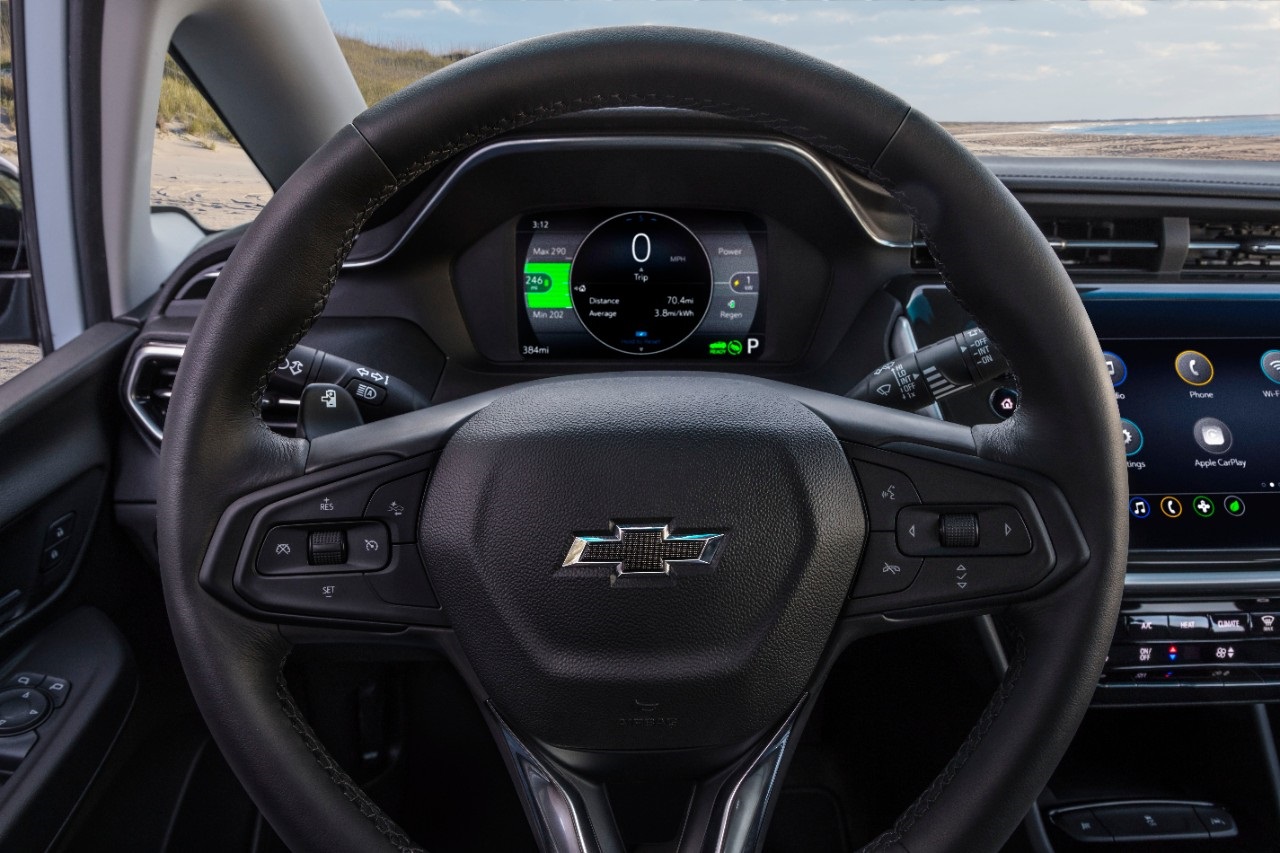
A view of the 8-inch color driver information center.

A view of the 8-inch color driver information center.

 Bolt Range and Charging

With every new Bolt EUV, Chevrolet includes a dual-level charge cord. It has a changeable plug that can be used with a household 120-volt three-prong outlet for Level 1 charging. Or change ends to plug into a 240-volt NEMA 14-50 amp outlet for 7.7kW Level 2 charging (the charge rate of many home EV chargers). For many Bolt owners, however, the dual cable function could eliminate the need to buy and install a home charger.

For maximum Level 2 charging speed, both Bolt models are capable of 11kW Level 2 charging, but only with a higher-capacity charger.

  • Level 1 120-volt charging will add about 4 miles of range per hour of charge.
  • Level 2 240-volt charging (with the dual-level charge cord) will add about 25 miles of range per hour of charge, with a full charge in about 10 hours.

Chevrolet will cover standard installation through Qmerit for Level 2 home charging. The offer is good whether leasing or purchasing a Bolt model.

And Chevrolet EV owners also have access to more than 80,000 chargers in North America through the Energy feature in the myChevrolet app. There are several other access points to the app, including:

  • Route planning and locations of available charging stations along the way.
  • Real-time alerts about range.
  • Click-to-charge payment for public charging.

Chevrolet Bolt Recalls

There is much to like about the simple usability of the Chevrolet Bolt or Bolt EUV, including their high-value pricing. Unfortunately, it was smacked down last year with a significant recall by the National Highway Traffic Safety Administration. GM had to recall all 143,000 Bolt and Bolt EUV models because of a battery manufacturing defect that increased fire risk. Korea-based LG Energy Solutions makes the lithium-ion batteries.

GM quickly found two manufacturing defects in the battery cells: a torn anode tab and folded separator. GM said that in some rare circumstances, the defects could lead to a battery fire.

The remedy is to replace entire battery packs or selected battery modules. Progress has been slow, and other occasional electrical glitches have been noted, according to comments on the many Bolt-owner websites. Among my sources were ChevyBolt.org and the Chevy Bolt Owners Facebook page.

Says General Motors: “We continue to prioritize battery module replacements for customers and are making progress every day. Customers who have completed the most recent software update can charge their [Bolt] battery to 100 percent capacity.”

Federal law requires automakers to provide hybrid battery warranty coverage of 8 years or 100,000 miles. But California requires a warranty length of 10 years or 150,000 miles.

Check here for Chevrolet information on the Bolt recall.

Owners may also contact the National Highway Traffic Safety Administration Vehicle Safety Hotline at 1-888-327-4236 or go to NHTSA.gov.

Chevrolet Bolt Pricing

For 2023, the 2023 Bolt EV is available in two trim levels: 1LT and 2LT, with starting prices of $26,595 and $29,795.

The 2023 Bolt EUV is available in four trim levels: LT, LT Redline, Premier, and Premier Redline. New for 2023, the Redline treatment includes black wheels with red accents, black leather-trimmed upholstery with red stitching, and a horizontal red line on exterior mirror caps. The Redline is available with no-cost paint colors of Mosaic Black Metallic, Silver Flare Metallic, or Summit White.

2023 Bolt EUV starting prices are $28,195 for the LT; $28,690 for the LT Redline; $32,695 for Premier, and $33,190 for Premier Redline. All Bolt MSRPs include the $995 freight charge from Lake Orion, Mich.

 Chevrolet Bolt Tax Incentives

Congress recently passed new legislation in the Inflation Reduction Act of 2022. The law changes credit amounts and requirements for clean energy vehicles, according to FuelEconomy.gov. Among the new requirements to qualify for a federal EV tax incentive, the vehicle’s final assembly has to be completed in North America.

In regard to the federal EV tax credit for the Chevrolet Bolt, General Motors is waiting on full Treasury guidance to determine vehicle eligibility. However, the IRA requirements make an important modification to the EV tax credit: It lifts the 200,000-vehicle-volume cap, which GM had already hit as an early mover on EVs.

According to GM’s latest statement on the federal EV tax credit provisions in the Inflation Reduction Act: “We think the legislation aligns very well with GM’s long-term plans, and over the life of the credit, we intend to offer a number of vehicles that should be eligible.

“While some of the provisions are challenging and cannot be achieved overnight, we are confident we can rise to the challenge because of the domestic manufacturing investments we are making to secure a supply chain for batteries and critical minerals,” GM said in the statement. “We will have more updates after the implementing guidance is finalized.”

For updates, check with your Chevrolet dealership or FuelEconomy.gov

Chevy Bolt Standard Equipment

There is no shortage of standard equipment on the base LT model. Among its safety features are 10 air bags, an electric parking brake, and Lane Keep Assist with Lane Departure Warning.

LT convenience features include keyless entry and starting with remote start, six-way manually adjusted front seats, wireless phone charging, USB type A and C charge ports, six-speaker audio system, HD rearview camera with guidance lines, and wireless capability for Apple CarPlay or Android Auto.

The 8-inch color driver-information center (gauges) has a choice of visual themes for Modern or Enhanced. And there is a screen that includes displays of vehicle efficiency with programmable charge times.

The Premier tester was $37,390 with the two major factory option packages of Sun and Sound ($2,495) and Super Cruise, $2,200. Details are below in the specifications chart.

Bolt EUV Premier adds such extras as perforated leather-trimmed upholstery, an eight-way power driver seat with two-way power lumbar, heated and ventilated front seats, heated steering wheel, and heated rear seats. Safety technologies include rear park assist, rear cross-traffic alert, rear camera mirror (digital), HD surround-view camera system, and lane change alert with side blind zone alert.

Find current pricing and special offers for the 2022 and 2023 Bolt EUV here.

A view of the Bolt shift console and upper infotainment system screen

Bolt electronics are not intimidating but facilitating.

Bolt EUV Interior Function

The Bolt EUV has big-and-tall head and leg room for a subcompact-class SUV.

Front headroom is large-vehicle tall at 40 inches as a hardtop or 39.1 inches with the dual-panel panoramic power sunroof, part of the $2,495 Sun and Sand package.

Legroom in the front seats is a lengthy 44.3 inches. There is comfortable seating for a 6-foot-6 passenger who has uncropped visibility out the windshield or having to steeply recline the seatback.

Back seat roominess benefits from a completely flat floor. While the rear legroom is long, the bench seat bottom is short for adult thigh support. But it works well for the school carpool or ride-hailing.

Cargo space is just a few tenths smaller than the standard Bolt. The space measures 16.3 cubic feet behind the back seat or 56.9 cu. ft. with the 60/40 back folded. The cargo entry opening is wide at 41 inches with multi-level capacity. Subfloor storage beneath the second level neatly stores the charging cables. Fold the back seat for 5 feet in length. And the roof rack is low enough to load bikes or other awkward-shaped gear that won’t fit inside.

Interior Design

Chevrolet interiors have a premium mix of plastics and other textured materials, all of which are in the Bolt.

The driver area is simply designed and straightforward to use. The technologies, such as the Chevrolet Infotainment 3 Plus touchscreen, are not intimidating but facilitating. Its 10.2-inch-wide screen is easily viewed, and there should be no frustration for tech beginners to page through the choices.

Especially welcome are physical switches for many cabin functions, such as fan speed, temp control, and seat heating and ventilation.

Driver sightlines are unencumbered at the side mirrors or over the shoulder. And in between, the Premier’s surround-view camera system gives overhead and front or rear views. It is salvation when inching out of tight parking to see when it is time to crank the steering wheel.

The Bolt EUV back seat

Short bench but long legroom of 39.2 inches in the Bolt EUV.

Performance and One-Pedal Driving

There is enjoyable kick to the Bolt EUV performance with its 200 horsepower and 266 foot-pounds of torque. For most of my test week, I nursed the battery reserve by driving in Normal mode. And then I found Sport mode, which changed my perspective. Sport mode adds a line-drive response to acceleration. It is not blunt-force fun, but Chevy cites an estimated acceleration to 60 mph in 7 seconds and 6.9 for the slightly shorter Bolt EV.

With a Level 2 charger at home and the freedom to charge at will, I felt empowered to enjoy the quickness of Sport mode. And, in my experience, it was not a significant drain on the battery. The quick zip is enjoyable around town and essential to guard your line in commuter traffic.

The 200-hp Bolt powertrain

The 200-hp Bolt powertrain. (Mark Maynard)

One-Pedal Driving

I especially enjoy the feature of one-pedal driving, the so-called e-Pedal. The driver can slow or stop the Bolt using only the accelerator pedal under most conditions. And at the same time, the system recaptures energy for the battery.

In time, drivers can anticipate their stopping distance and lift off the accelerator to stop precisely at the intersection. The function does not eliminate the need to use the brake pedal altogether, especially in emergencies. But using one-pedal driving reduces the switching back and forth between pedals, which can take away from the electric driving range.

The one-pedal function can be switched off at the shift-console button. Sometimes when inching along in heavy traffic or when parking, the e-Pedal operation can be jerky.

When one-pedal is not engaged, the driver can get manually applied regeneration by using the Regen on Demand paddle at the back of the steering wheel. Pulling the regen paddle activates the regeneration process, piping kinetic energy to the battery.

Bolt EUV Ride and Handling

For a tall and small SUV, the Bolt EUV rolls with uncommon smoothness and no choppiness on the interstate. The suspension is simple but well-engineered of front MacPherson struts with a solid stabilizer bar and a rear torsion beam with coil springs.

The driver might notice the heft of the curb weight, 3,715 pounds, with the 947-pound battery. But I experienced no bottoming-out in dips are sensitivity to chin scrapes at driveways.

The suspension has a comfort-ride composure, but the Bolt EUV is steady in evasive maneuvers or hard braking. Its turning circle of 38.3 feet is nimble enough in cramped parking or making a U-turn on a side street.

Regenerative four-wheel-disc braking has vented 11-inch front rotors and 10-inch solid rotors rear. There is good steering response and little noise or road harshness transmitted by the 17-inch Michelin Energy Saver Selfseal (215/50).

And the Bolts are dolly towable behind a motorhome.

Super Cruise Technology

The 2022 Bolt EUV is the first Chevrolet offered with Super Cruise, a so-called hands-free driver assistance technology for enabled roads. The assist system can be used on more than 200,000 miles of enabled roads in the U.S. and Canada.

Super Cruise employs many advanced technology features, including a Driver Attention System and precision LiDAR map data. The Driver Attention System uses a small camera on the top of the steering column. It works with infrared lights to determine where the driver is looking whenever Super Cruise is in operation.

If the Driver Attention System detects the driver’s gaze has turned away from the road ahead for too long, the steering wheel light bar will prompt the driver to return their attention to the road. If the system determines continued inattentiveness, it will use visible and audible alerts to notify the driver to take back control of the wheel.

I don’t like surprises while driving, and semi-autonomous or fully autonomous systems always inject a little surprise into the driving experience. In my experiences with Super Cruise, I consider it a good hands-on driver-assist system — and I always drive with my hands poised near the steering wheel.

Super Cruise Confusion

Like many driver-assist systems, Super Cruise is not precise in lane centering. At times, the system would issue alerts when the Bolt EUV crossed into the white lines of lane delineation — but it did not cross over completely.

It was a prior testing experience that really put me on guard. While testing a GMC Sierra with the hands-free system, Super Cruise misread the road ahead.

Along a section of Interstate 5 north of downtown San Diego near the state Route 52 exit toward La Jolla, the interstate runs beneath SR52 as it merges with the interstate. The divided highway of SR52 cast two bold shadows across I-5. Approaching the underpass at 65 mph, Super Cruise must have thought the dark shadows were solid objects. The system applied full braking force at the first shadow crossing the interstate. It could not have stopped the truck, as the Sierra crossed the first shadow, it resumed heavy acceleration. Then, just a few yards beyond it came upon the second shadow, and Super Cruise again slammed on the brakes.

Fortunately, in both incidents the highway behind was clear for several car lengths.

I took over steering as my pounding heart rate settled down. The Super Cruise system also shut down and gave a message that the dealership should examine the vehicle.

While testing Super Cruise in the Bolt EUV, I covered the same interstate route to see what would happen. It was a cloudy day, but the system still applied braking but less firmly at the lighter shadows.

If I were buying a Bolt EUV, I’d pass on the $2,200 Super Cruise option and enjoy the standard adaptive cruise control with stop-and-go.

Fold the Bolt's 60/40 folding back seat for about 5 feet in length.

Fold the 60/40 folding back seat for about 5 feet in length. (Mark Maynard)

Why Buy the Chevrolet Bolt EUV?

The Chevrolet Bolt EUV is not a lifestyle statement. It is a life choice — and a smart one. It has the familiar operation of a traditional car but elevated by electric power.

There are many compact SUV EVs that are theaters of dazzling electronic tech. And most of those can cost $50,000 and a lot more.

The Bolts are an uncompromising first step into the future of battery-electric vehicles.

The second level of Bolt subfloor storage.

The Bolt EUV’s second level of subfloor storage. (Mark Maynard)

The third level of Bolt subfloor storage for storing the charge cable

Charging cables and Super Cruise brain in the lowest cargo subfloor. (Mark Maynard)

Chevrolet Bolt EUV Specifications

Body style: subcompact, 5-door, 5-seat, front-wheel drive battery-electric SUV crossover

Transmission: 1-speed automatic with one-pedal drive and Sport mode

BATTERY SYSTEM

Battery: 65 kWh lithium-ion of 288 cells

Weight: 947 pounds

ELECTRIC DRIVE

Type: Single motor and gearset

Motor: 200-hp permanent magnetic drive motor; 266 lb.-ft. torque

Driving range: EPA-estimated 247 miles on a full charge

0-60 mph acceleration: 7 seconds, using Sport mode

CHARGING TIMES

120 volt: 4 miles of range per hour

240 volt, 32 amps (dual charge cord): 25 miles of range per hour; full charge in about 10 hours

240 volt, 48 amps: 37 miles of range per hour; full charge in about 7 hours

DC fast charge: up to 95 miles in 30 minutes

EPA fuel economy equivalent: 125/104 city/hwy MPGe

BY THE NUMBERS

Cargo space: 16.3-56.9 cubic feet

Front head/leg room: 39.1*/44.3 inches *40 inches w/o sunroof

Rear head/leg room: 37.8/39.2 inches

Length/wheelbase: 169.7/105.3 inches

Curb weight: 3,715 pounds

Turning circle: 38.3 feet

FEATURES

Standard equipment includes: smart key locking and push-button ignition, remote start, Chevrolet Infotainment 3 Plus with 10.2-inch wide HD color touch screen with voice recognition, electric parking brake, Bluetooth phone and audio, wireless Apple CarPlay and Android Auto capable, in-vehicle apps, wireless charging, efficiency display screens with programable charge times, perforated leather-trimmed upholstery, leather-wrapped steering wheel, 8-inch driver-information display, sliding visors with lighted vanity mirrors, 8-way power driver seat with 2-way lumbar, 6-way manual front passenger seat, heated and ventilated front seats, heated rear seats, adaptive cruise control, HD surround-view camera system, solar-absorbing glass, LED headlights-taillights-daytime running lights, 17-inch alloy wheels with carbon flash painted pockets, heated and power adjusted side mirrors with turn-signal indicators, rear wiper-washer.

Safety features include: 8 air bags; stability and traction controls; lane change alert with side blind zone alert, rear cross-traffic alert, and rear park assist (standard on Premier and available on LT).

Chevy Safety Assist includes automatic emergency braking, front pedestrian braking, lane keep assist with lane departure warning, following-distance indicator, forward collision alert, and IntelliBeam auto high beams.

PRICING

Bolt EUV Premier base price: $32,695 including $995 freight charge; price as tested $43,690

Options on test vehicle: Sun and Sound package, $2,495, includes 7-speaker Bose audio system, power dual-panel sunroof with power sunshade, Chevrolet Infotainment 3 Plus with navigation;

Super Cruise, $2,200, includes 3-years of Super Cruise connectivity and enhanced automatic emergency braking.

Where assembled: Lake Orion, Mich.

Warranties: 3-years/36,000-miles basic bumper to bumper; free first scheduled maintenance service; 8-years/100,000-miles electric propulsion components (but 10-years/150,000-miles in California); 5 years/60,000 miles roadside assistance and courtesy vehicle when serviced

Jeep Grand Wagoneer Review

Jeep Grand Wagoneer Review

 The 2022 Wagoneer will become a portfolio of vehicles that redefines ‘American premium,’ Jeep says

The Grand Wagoneer in Midnight Blue paint.

The Jeep Grand Wagoneer is sold in four trim levels with all-wheel drive. Starting prices range from $89,995 to $109,995, including the $2,000 freight charge from the Warren (Michigan) Truck Assembly Plant. (Photos courtesy of Stellantis)

Table of Contents

Wagoneer History
The Modern Wagoneer
2023 Hurricane Engine and L models
Pricing
Putting the Grand in Wagoneer
10 Cool Features
Performance and Ride and Handling
Wagoneer Client Services
10 Customer Promises
Why Buy the Grand Wagoneer?
Specifications

BY MARK MAYNARD

Jeep ballsied its way into the fray of large, body-on-frame SUVs with its 2022 Wagoneer and Grand Wagoneer. This segment of full-size, seven- to eight-passenger truck-based utes are friendly titans, and throwbacks to what were once just big family wagons.

For years the segment was a three-way competition, dominated by the Chevrolet Suburban (and Tahoe), Ford Expedition, and Nissan Armada. And their luxury variants.

According to GoodCarBadCar.net Second quarter U.S. sales of big SUVs, including the Suburban-based GMC Yukon, totaled 63,061.

And there is big money in big SUVs. So far in 2022, transaction prices on average have ranged from the mid-$60,000s to around $105,000, including the Lincoln Navigator and Cadillac Escalade ESV.

Dinosaur or Dynamic?

The full-size SUV market has remained strong despite headwinds in the form of rising prices, scarce supply, and high fuel prices, said Ed Kim, president and chief analyst at AutoPacific, Inc. The automotive marketing research and product-consulting firm has offices in Long Beach, Calif., Michigan, Wisconsin, and North Carolina.

“Outside of families who need the space and towing capacity of a full-size body-on-frame SUV, full-size SUVs are increasingly popular among livery customers,” Kim said. “As full-size premium sedans like the Lincoln Town Car and Cadillac XTS have disappeared from their respective brands’ portfolios, livery customers have had to look elsewhere.

Kim said that the Wagoneer and Grand Wagoneer are very well executed full-size SUVs that are extremely competitive and, in some ways, better than the incumbents. “With their classy and very well-finished interiors, they will certainly impress any livery customers fortunate enough to ride in one.

“The Jeep brand has been pushing itself further upscale, so there certainly would be no brand deficit to using a Wagoneer or Grand Wagoneer as a livery vehicle,” Kim said in email correspondence. “Livery firms now have another very appealing choice in the Wagoneer and Grand Wagoneer, so there’s no doubt they will find an audience in the livery market.”

The standard and long wheel base models of Wagoneer back to back

2022 Grand Wagoneer (left) and 2023 Grand Wagoneer L (right)

Wagoneer History

The brought-back Wagoneer nameplate continues in the original model’s uplevel presentation. The first-generation Jeep Wagoneer debuted in 1962 for the 1963 model year. Jeep says it the Wagoneer was the first four-wheel-drive vehicle mated to an automatic transmission.

Compared with the more utilitarian Jeep Cherokee, the first-generation Wagoneer was engineered for better ride quality, a more stylish appearance, and a luxurious interior. An independent front suspension was optional. Quadra-Trac, the first automatic full-time four-wheel-drive system, was introduced in 1973.

The Grand Wagoneer debuted in 1984 and marked the beginning of the luxury SUV. Jeep called it “the gold standard of the SUV market.” It was made special by leather upholstery, air conditioning, AM-FM-CB stereo radios, additional sound insulation, and wood-grain exterior trim. Jeep said the Grand Wagoneer’s 175-horsepower 360-cubic-inch V-8 engine had the segment’s highest towing rating.
A 1975 Jeep Wagoneer with simulated wood-panel sides.

A 1975 Jeep Wagoneer.

The Modern Wagoneer

The Jeep division of parent-company Stellantis took its sweet time to re-enter the fray, but it plays by its own rules. Jeep has elevated the format with comprehensive advanced technologies and premium materials.

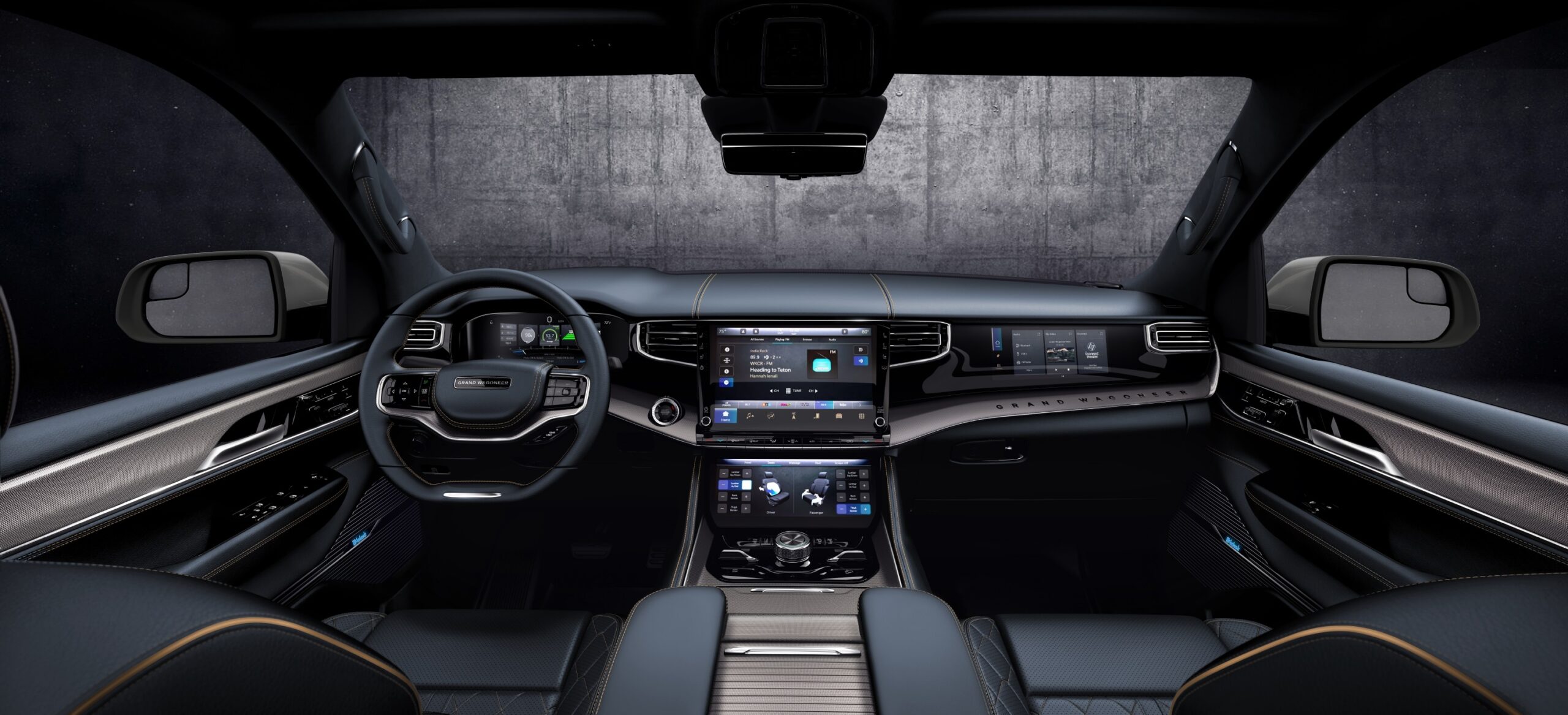
The posh interior treatment of the Grand Wagoneer reminds of midcentury modern Chrysler. Everything about the interior and styling is over-the-top. The design and engineering have the weighty feel of quality. And its engineering teems with advanced technologies that are not fearsome to learn or use.

Stellantis Design Chief Ralph Gilles says the Grand Wagoneer was done the American way. “The first impression is that everything is so beautifully done,” he said in a video overview.

Jeep says the Wagoneer will become a portfolio of vehicles that redefines “American premium” while delivering a unique customer experience. The customer experience will include 10 promises and Wagoneer Client Services.
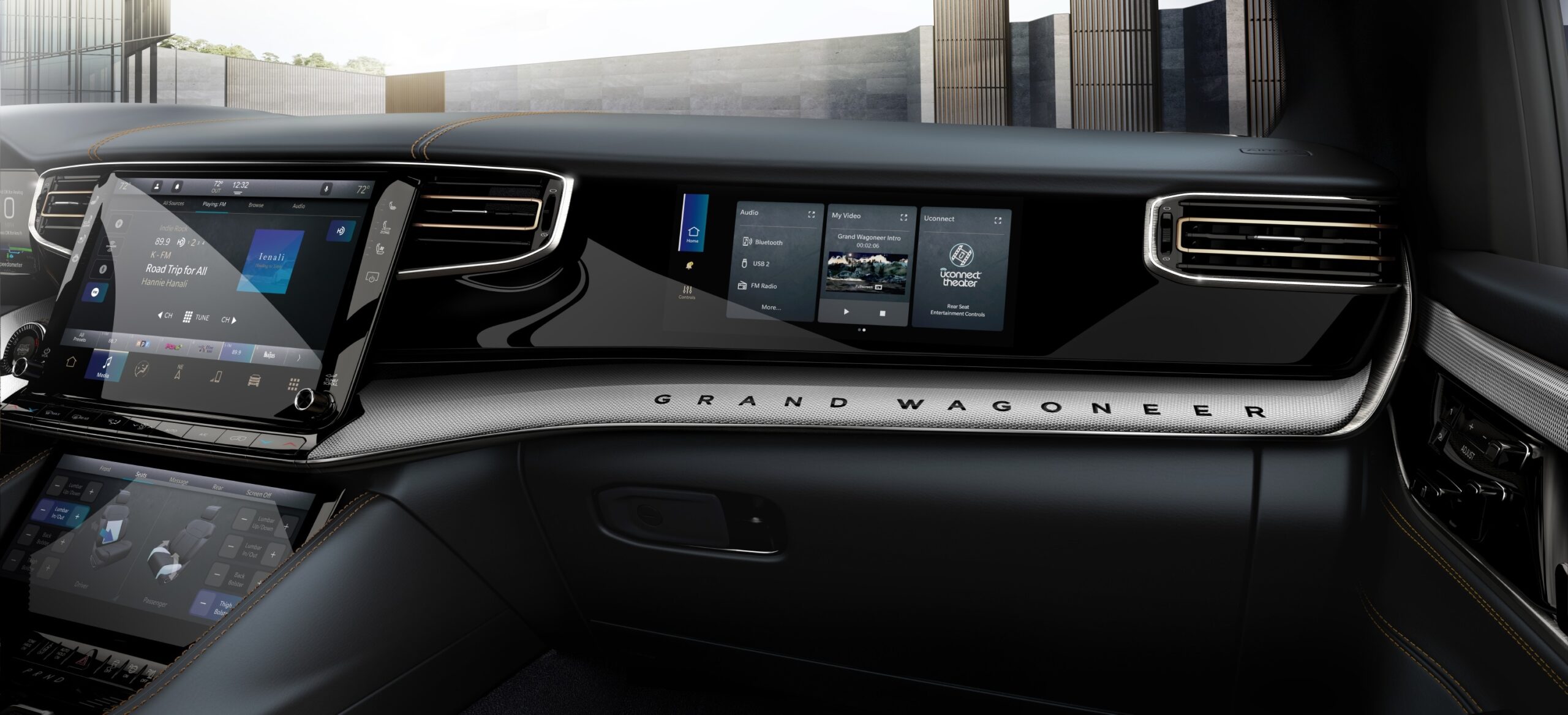
A front right 22 inch Goodyear Eagle tire on the Grand Wagoneer

Significant tire patch from the 22-inch Goodyear Eagle grand touring tires (285/45).

Wagoneer Foundation

The Wagoneer foundation is sourced from the Ram 1500 pickup, but any comparisons stop there. There are no shared body panels or other common parts that can be seen and touched. The Wagoneer format is a separator from the competition, which starts with a finished pickup truck engineered for hard work first and luxury second.

The current sales plan features two models, Wagoneer and Grand Wagoneer that fill mainstream and luxury categories. Both models have a third row and seating for up to eight. For 2022, both models are V8-powered, but that changes for 2023:

2022 Wagoneer uses a 392 horsepower, 5.7-liter V-8 engine. It has the next generation of eTorque 48-volt hybrid with fuel-saving technologies of cylinder deactivation and variable cam timing. Rear-wheel drive is standard rear-wheel drive or there are three options of 4WD systems. The rear-drive Wagoneer has fuel-economy ratings of 16/22/18 mpg city/highway/combined; and 15/20/17 mpg for 4WD. Midgrade fuel is recommended.

2022 Grand Wagoneer features a 471-hp, 6.4-liter V-8 also with cylinder deactivation and variable cam timing. Four-wheel-drive fuel-economy ratings are 13/18/15 mpg using the recommended premium fuel.

Each engine mates to a TorqueFlite eight-speed automatic transmission.

The Agave blue interior of the Grand Wagoneer

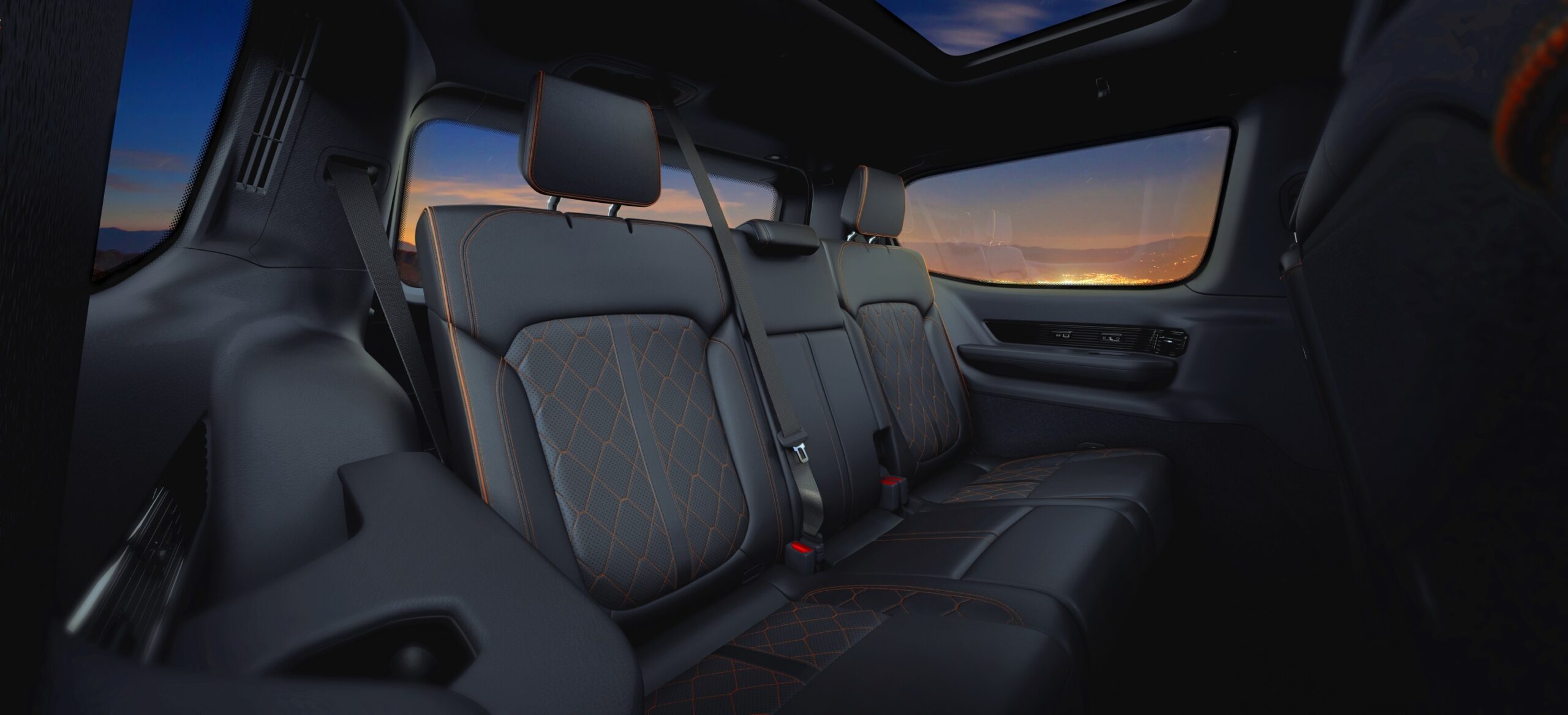
The Blue Agave interior with quilted Palermo leather.

2023 Hurricane Engine and L Models

Long-wheelbase models for both series of Wagoneer will be introduced for the 2023 model year. The additional 12 inches in overall length went to more rear-seat legroom and cargo capacity. With both rows of seats folded, there is room to slide in a few sheets of 4-by-8-foot plywood, Jeep says.

A new family of Hurricane inline six-cylinder engines will trim fuel use and maintain horsepower. The 3.0-liter twin-turbocharged inline-six-cylinder engines have two power levels:

The 420-hp Hurricane in the Wagoneer L has 468 foot-pounds of torque. The heavier Grand Wagoneer gets the high-output Hurricane twin-turbo 510, with 510-hp and 500 lb.-ft. of torque.

Jeep says a run of the Hurricane twin-turbo 510 engine will be available on the 2022 Grand Wagoneer. Ordering is now open for the $2,000 engine option. Rear-drive models have mileage ratings of 15/21/17 mpg on the recommended premium fuel.

Also new for 2023 is the Wagoneer L Carbide with a black theme. Special features include gloss black wheels, black grille, gloss black mirror, and headlamp trim. The interior has a technical hydrographic instrument panel trim and door panels with gloss black seats.

A Wagonner Carbide emphasizing black elements

A 2023 Wagoneer L Carbide. Turn-key for limo service.

2022 Wagoneer Pricing

The 2022 Wagoneer is sold in six trim levels of Series I, Series II, Series III and three series of the Carbide model. Starting prices for the standard rear-drive Wagoneer range from about $61,000 to $76,000. Carbide models range in price from $66,490 to $80,190; add $3,000 for 4WD.

The 2022 Grand Wagoneer is sold in four trim levels, all with four-wheel drive: Series I, Series II, Obsidian, and Series III.

Series I starts at $89,995, Series II at $99,995, Obsidian at $105,490, and Series III at $109,995. All MSRPs include the $2,000 freight charge from the Warren (Michigan) Truck Assembly Plant.

The Grand Wagoneer Series III tester was $116,720. It was nearly fully loaded with factory options and included: Midnight Sky metallic paint $645; Customer preferred package 23W $995; rear-seat entertainment group $2,195; 22-inch machined aluminum wheels with black noise pockets $1,595; and embossed metal interior accents $1,295.

There was a $1,500 bonus cash allowance for both Wagoneer models. See current Grand Wagoneer pricing here.

The passenger side 10.25 inch wide touch screen of controls

The passenger-side 10.25-inch touchscreen.

Safety Features

Standard safety features include eight air bags, automatic emergency braking with pedestrian and cyclist detection, active lane management, blind-spot monitoring, rear cross-path detection, and intersection collision assist.

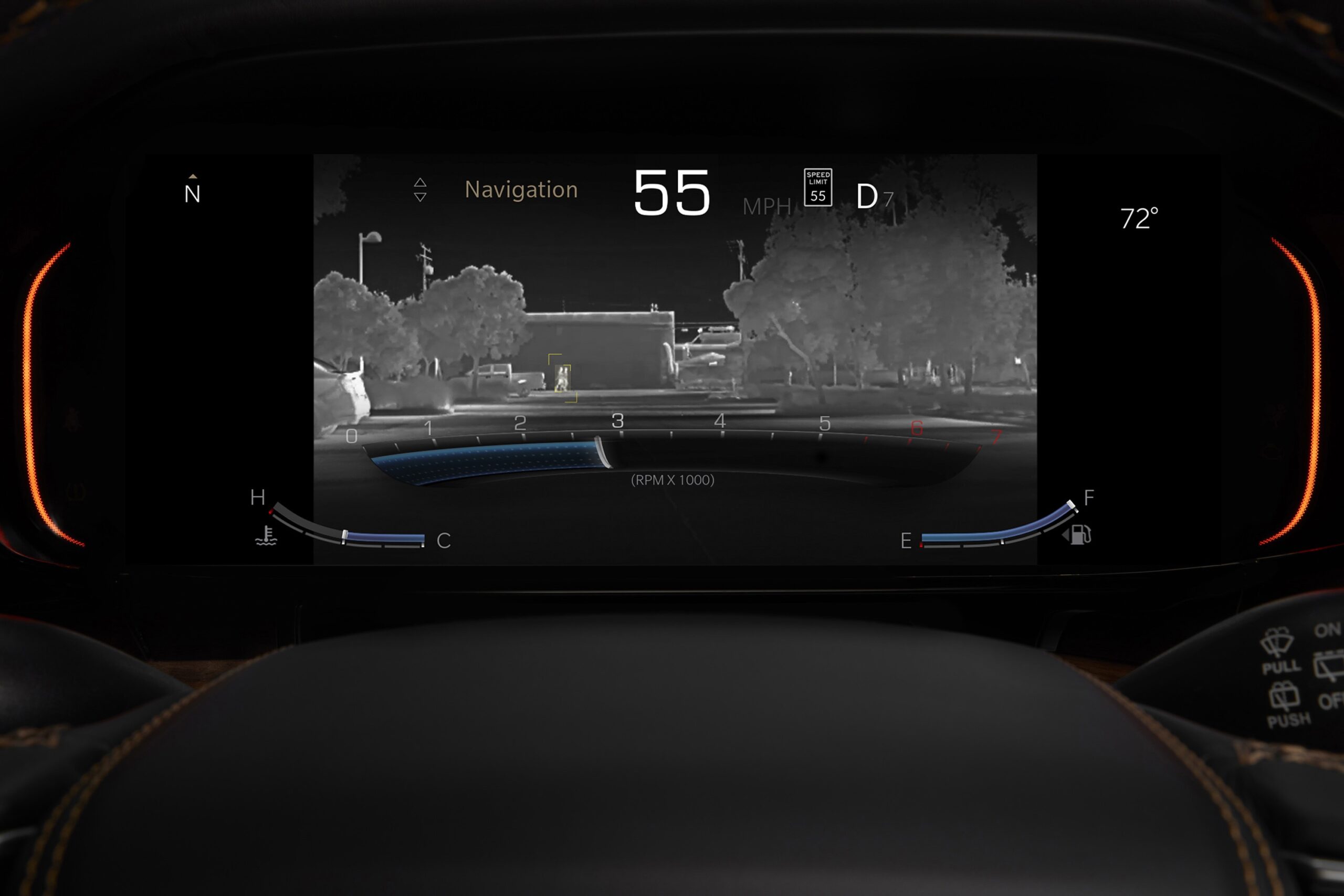
A black and white image of the night vision camera

The Night Vision Camera is especially useful where there are no street lights.

Putting the Grand in Wagoneer

The Grand Wagoneer will stand tall — and long — among the luxury-class competitors. The standard wheelbase models of Wagoneer are about 4 inches longer than their closest competitors. Among the competing luxury SUVs are the BMW X7, Cadillac Escalade, Infiniti QX80, Land Rover Range Rover, Lincoln Navigator, and Mercedes-Benz GLS.

The Grand Wagoneer cabin is rich in comfort, with grandstand views. Jeep tried to ensure a quiet cabin with an acoustic laminated windshield, front door glass, laminated rear glass, and active noise canceling through the audio system. It is an engineering marvel for this towering beast to power along the highway in such traffic-calmed style.

From the suede headliner to the full-weave carpeting, The Grand Wagoneer’s list of standard equipment might be the longest I’ve had to itemize for any vehicle I’ve tested. Power door-closers and heated armrests might be the only missing luxe perks.

The entire list is in the specifications at the end of this review, but here are a few of the standout luxury basics:

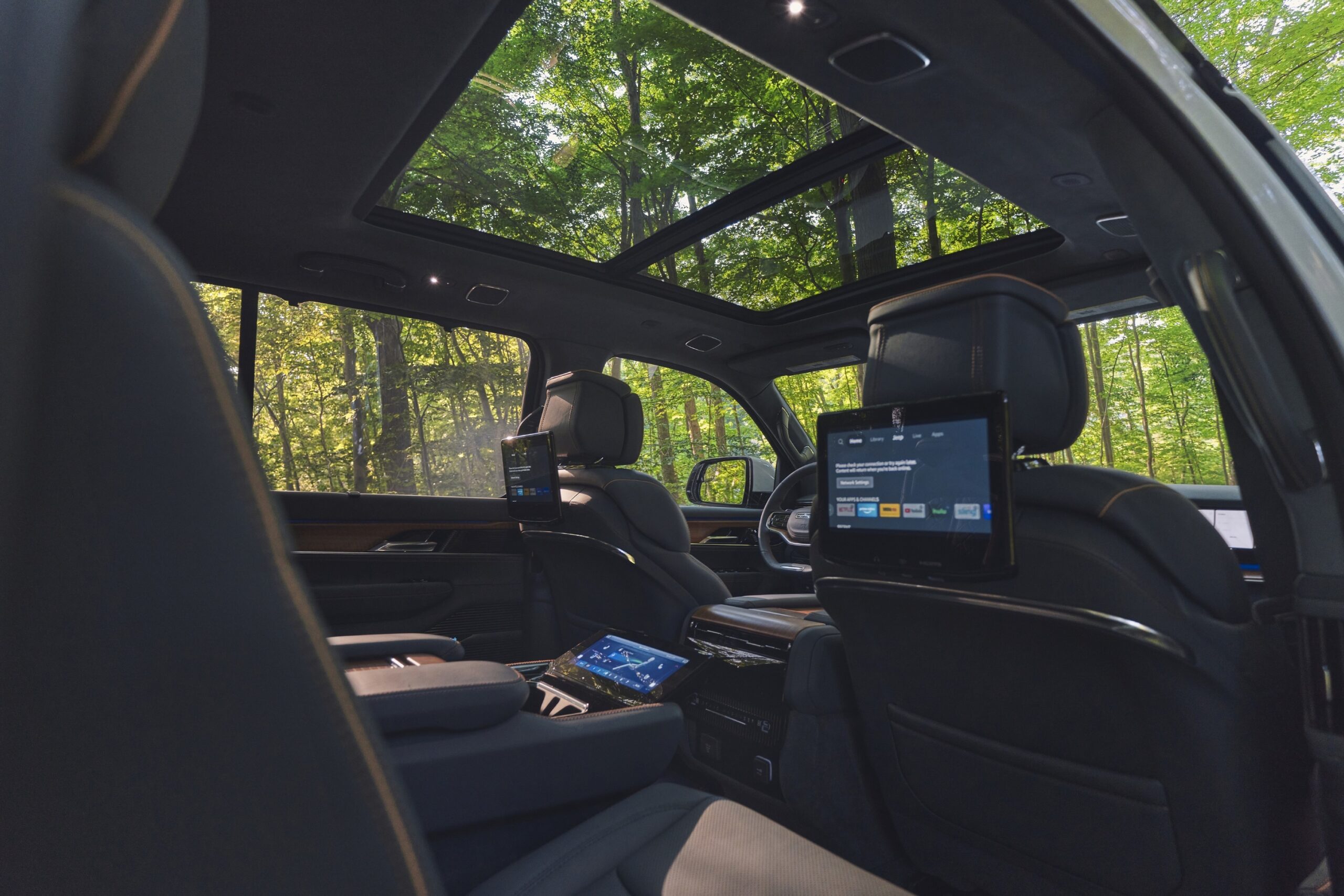
Quilted Palermo leather-trimmed massaging seats, 20-way power adjustable front seats, suede headliner, natural walnut interior trim, second-row captain’s chairs with power tilt and slide, heated and ventilated front and second-row seats, luxury front and rear floor mats, reversible cargo mat, foldable cargo shade. There also is a new Uconnect 5 Navigation and infotainment system with voice command, a 360-degree surround-view camera system, and a 23-speaker McIntosh entertainment system.

A digital rearview camera mirror is standard, but I can’t use it with my eyeglasses. When I look at the digital mirror, it takes a second or two for my eyes to focus. But the mirror can be switched to the low-tech original.

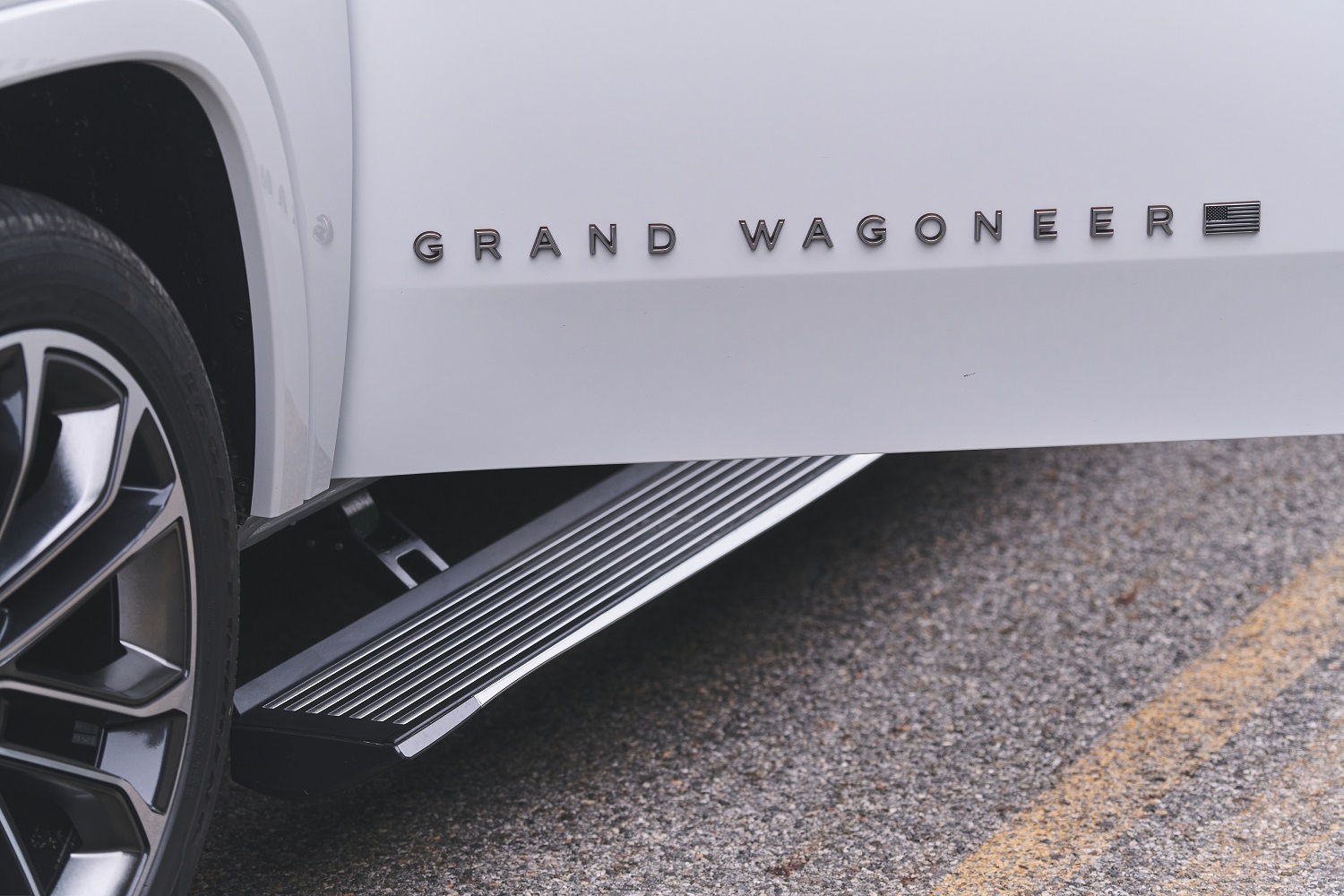
Power running boards lower to a convenient step-aboard height.

Power running boards lower to a convenient step-aboard height.

10 Cool Grand Wagoneer Features

Some of my favorite Grand Wagoneer features:

Power running boards. These lower to a convenient step-aboard height, particularly with the air suspension’s lowered ride height when parked. Too often, running boards create too much of a step and are awkward to use. The design of the boards forms the rocker panel, so legs do not rub on dirty metal.

Power-adjustable pedals (with memory sets). Adjustable pedals are a safety feature to help dial in a secure seating position for drivers of all sizes. The pedals are assets with the power tilt-and-telescoping steering wheel.

Rear seat monitoring camera. The overhead split-screen view of the second row is mainly to keep an eye on a child’s seat, or two — or a pet.

Power folding and reclining second- and third-row seats. How convenient to have this function for loading kids or cargo. And with power switches in the cargo area to fold the second row or fold and raise the third row.

Tri-pane panoramic sunroof and sunshade. The span of glass is dramatic, particularly for those in the second and third rows.

Roof rack with crossbars. Roof-rack crossbars are typically an added cost, but these are standard and store neatly below the cargo floor. Storing the crossbars when not needed helps trim wind noise.

11 USB ports. Let’s hope the USB port does not soon become obsolete. The Wagoneer and Grand Wagoner have eight USB ports, of the dual C-type and standard style. The count goes to 11 with the rear entertainment system.

Night Vision camera with pedestrian and animal detection. This type of system is an asset in areas without street lights. But it is a little odd visually to see the smallish X-ray-like presentation in the driver-info display.

Back seat passengers can view streaming TV and movies on the optional Rear Seat Entertainment system

The Rear Seat Entertainment system, $1,295, features two 10.1-inch touchscreens for streaming movies, apps, and Fire TV for Auto.

Wagoneer Screen Envy

There are nearly 45 inches of display screens along the front instrument panel. Among the inch count are the 12.3-inch-wide instrument cluster, and a 12-inch horizontal touchscreen to access audio, navigation, apps, and views from the 360-degree camera. Just below is a 10.25-inch horizontal display for cabin controls. Then push a button, and the screen rotates to reveal the media hub with two dual USB ports, aux-in, and the wireless charging pad.

To empower the front passenger, the Grand Wagoneer includes a 10.25-inch-wide passenger screen. The access has four primary functions:

  • Co-Pilot (navigation and device management);
  •  Entertainment (via HDMI or rear seat entertainment control);
  •  The ability to view the exterior vehicle cameras;
  •  Fire TV for Auto.  It is possible to start a movie at home and finish it in the Grand Wagoneer.

And there is a 10.25-inch rear screen in the second row to adjust temp, fan, airflow, and seat heating and ventilating controls.

The Rear Seat Entertainment system, $2,195, features Amazon Fire TV built-in. Second-row passengers can stream TV, movies, and apps on two 10.1-inch touch screens on the seatbacks.

In total, there are 75 inches of display screens.

Performance and Ride and Handling

The big 6.4-liter V-8 hits its power stride with a peak of 455 lb.-ft. of torque at 4,400 rpm. The eight-speed automatic rolls smoothly through gear changes while showing respect to stretching fuel economy. Sport mode steps up off-the-line force but not aggressively.

Fuel economy is challenged. The best I could get was 13.3 mpg on a long highway run. Owners will not enjoy filling the 26.5-gallon tank, but they will enjoy every mile it provides.

A hood-up view of the 6.4-lter V-8 engine.

Grand Wagoneer’s 471-hp, 6.4-liter V-8. (Mark Maynard photo)

Ride and Handling

Road tripping in a Grand Wagoneer Series III is a first-class cruiseliner experience. There is headroom and legroom for 6-foot-6 tall adults in the first and second rows. And the second-row captain’s recline and are heated and ventilated.

The ride quality is supple, and some might consider it too soft in road undulations. But there is very little wind or tire noise at highway speeds. And the tire patch is significant from 22-inch Goodyear Eagle grand touring tires (285/45).

Four-wheel-disc stopping power is absolute and necessary when controlling three-plus tons. The front brakes have 14.88-inch vented rotors, and the solid rear rotors are 14.76 inches.

At 6,420 pounds, the Grand Wagoneer is at least 300 to 800 pounds heavier than its mainstream competition. But its turning circle of 38 feet is up to 3 feet tighter.

The Grand Wagoneer’s max tow capacity is a benchmark at 9,850 pounds. A Class IV receiver hitch and 7- and 4-pin wiring harness are included.

Grand Wagoneer’s Air Ride

The GW’s Quadra-lift air suspension gives the feel of a carpeted ride. Head toss is well controlled over speed bumps or when pulling into driveways. The sophisticated system includes electronic semi-active damping to match changing road conditions and stabilizer bars.

Quadra-Lift adds up to 3.6 inches of lift, supported by four-corner air springs. The air-cushioned ride operates automatically, or it can be manually controlled at the shift console. It has five height settings:

Normal Ride Height (NRH): 8 inches of clearance offers improved fuel economy, as well as improved aerodynamics during on-road driving;

Off-road 1: Lifts the vehicle an additional inch from NRH for added height in clearing obstacles (9 inches);

Off-road 2: Adds 2 more inches of ride height, for 10 inches of ground clearance;

Park Mode: Lowers the vehicle 1.6 inches from NRH. NRH and Park Mode are driver-selectable, allowing the driver full control over vehicle ride height;

Aero Mode: Lowers the vehicle 0.6 inches from normal ride height. Aero Mode is controlled by vehicle speed and adjusts for optimal performance and fuel economy. The vehicle will also lower to Aero Mode when in Sport Mode

The spacious second row captains chairs

There is headroom and legroom for 6-foot-6 passengers in the second row.

Wagoneer 4WD Systems

The Grand Wagoneer gets the top two-speed on-demand four-wheel-drive system. Its Selec-Terrain traction control has five modes: Automatic (functional for on- or off-road driving), Sport, Snow, Sand/Mud.

Rock mode works with the Quadra-Lift for a maximum height of 10 inches.

Selec-Speed Control integrates hill-ascent and hill-descent controls. The Electronic Range Select system, engaged at the steering wheel, allows drivers to control vehicle speed up and down trail grades without using the accelerator or brake pedals.

Wagoneer Client Services

Wagoneer will become a portfolio of vehicles that defines “American premium” and delivers a unique customer experience, the company says.

Customers interested in purchasing a Wagoneer or Grand Wagoneer can go to Wagoneer.com, select a dealer and place a $500 deposit. A Wagoneer concierge will make contact to initiate the order process, provide vehicle updates, and assist with any dealer interactions.

After a customer receives their vehicle, support will continue through a VIP helpline via Wagoneer Client Services. Those services include:

  • Five years of free dealership maintenance, including oil changes and tire rotations;
  • 24/7 concierge support and roadside assistance via phone or online chat;
  • No-charge equivalent service loaner;
  • Trip interruption coverage;
  • VIP access to exclusive events;
  • Interior and exterior vehicle cleaning and a full tank of fuel when serviced;
  • Vehicle pickup/delivery for service;
  • Free Wi-Fi and phone charging at the dealership.
The third row seats

With more than 3 feet of legroom, the third row can recline or fold flat.

10 Customer Promises

1. Only dealers that earn a “Customer First” award for excellence by J.D. Power will be allowed to sell the Wagoneer.

2. The sales process will be efficient. Sales reps will use tablets and full integration to digital communication.

3. Certified Wagoneer Ambassadors. To become certified, a sales or service associate must complete more than 90 hours of training and pass exams to ensure that he or she truly understands the brand, the cars, how they can be used, and how they can be equipped.

4. Every Wagoneer and Grand Wagoneer will be sold with a full gas tank.

5. The vehicle will be thoroughly cleaned at delivery and after servicing and will be returned with radio, seating, climate, and other settings left as the customer had them.

6. Tech access to remote showrooms and to schedule test drives and delivery services.

7. An appropriate loan vehicle will be provided when a Wagoneer must be left at the dealership.

8. Remote services and diagnostics to schedule services and updates, including over-the-air updates and remote diagnostics.

9. Free Wi-Fi and phone charging in the showroom or service lounge, with “high-quality beverages and snacks.”

10. Wagoneer Client Services will provide 24/7 customer support and five years of maintenance. Concierge support and roadside assistance will always be available.

Both back rows of seats folded to show the open cargo area

All-new 2022 Grand Wagoneer rear interior cargo space (94.2 cu. ft. with second and third rows folded flat).

Why Buy the Grand Wagoneer?

It’s not a Jeep, it’s a Wagoneer — the only Jeep ID on the vehicle is in the headlight lenses. The Grand Wagoneer is grand luxury, not a Rubicon Trail-tested SUV. The elite dealership support and promises should be reassuring to new customers and conquests to the brand.

Despite the considerable sticker prices for these big vehicles, customers generally have incomes that make high fuel prices more of an inconvenience than a reason to reject such vehicles, auto-analyst Kim said. “The segment should remain strong in the coming years as lots of product action in that space will keep consumers interested and engaged.”

A rear view of the Grand Wagoneer

The Wagoneer customer experience includes 10 promises and dedicated client services.

2022 Grand Wagoneer Series III Specifications

Body style: large, 5-door, 7-seat body-on-frame SUV with two-speed electronically controlled 4WD

Engine: 471-hp 6.4-liter V-8 with fuel-saver mode and active grille shutters; 455 lb.-ft. torque at 4,400 rpm

Transmission: 8-speed Torqueflite 8HP75 automatic

4WD system: 2-speed electronically shifted transfer case; variable (50/50 or 100 front/rear) with traction modes of Automatic, Tow, Snow, Mud, Sand, Rock, and Sport

Fuel economy: 13/18/15 mpg city/hwy/combined; premium fuel recommended

Towing capacity: 9,850 pounds, with included Class IV receiver hitch and 7- and 4-pin wiring harness

BY THE NUMBERS

Fuel tank: 26.5 gallons

Cargo space: 27.4/70.9/116.7 cubic feet, behind 3rd row/2nd row/front seats

Front head/leg room: 41.3/40.9 inches

2nd-row head/leg room: 40/42.7 inches

3rd-row head/leg room: 39/36.6 inches

Length/wheelbase: 214.7/123 inches

Width/height: 94*/76.6 inches *at the mirrors

Curb weight: 6,420 pounds

Turning circle: 38 feet

FEATURES

Standard equipment includes: Keyless entry and push-button ignition, quilted Palermo leather-trimmed massaging seats, power running boards, 20-way power adjustable front seats, 2nd-row captain’s chairs with power tilt and slide, power folding and heated side mirrors, 60/40 power folding and reclining 3rd-row seats,  hands-free power liftgate, heated and ventilated front and 2nd-row seats, 12.3-inch cluster display, suede headliner, natural walnut interior trim, Uconnect 5 Nav with 12-inch touch screen display, integrated voice command with Bluetooth, 23-speaker McIntosh entertainment system, satellite radio with 6-month subscription, media hub with 2 USB ports and aux-in,tri-pane panoramic sunroof,  locking and lighted glove box, 4-zone automatic climate control, luxury front and rear floor mats, reversible floor mat, foldable cargo shade, roof rack with adjustable roof-rail crossbars, rear back-up-camera washer.

Driving features and technologies: head-up display, automatic headlights and high-beam control, map-in-cluster display, off-road info pages, adaptive cruise control with stop and go, ParkSense automated parking system, ParkSense front and rear park- assist with stop, night vision with pedestrian and animal detection, remote-start system, side distance warning, traffic sign recognition, 4G LTE Wi-Fi hot spot (trial included), automatic crash-notification service, connected travel and traffic services, Apple CarPlay and Google Android Auto, power-adjustable pedals (with memory sets), wireless charging pad, electric parking brake, digital rearview camera mirror, observation mirror, rear seat monitoring camera, acoustic-laminated windshield and front side glass, active noise-control system, LED exterior lighting with 3-optic fog lamps with cornering, 360-degree surround-view camera system.

Safety features include: 8 air bags, automatic emergency braking with pedestrian and cyclist detection, active lane management, blind-spot monitoring, rear cross path detection, intersection collision assist, rear park assist sensors with stop, all-speed traction control, electronic stability control, brake assist, hill-start assist.

PRICING

Series III base price: $109,995, including $2,000 freight charge; price as tested $116,720

Options on test vehicle:

  • Midnight Sky paint $645;
  • Heavy-duty trailer-tow package, $995, adds a trailer-brake control, chrome tow hooks, trailer-hitch lineup assist, trailer-hitch zoom, removable rear tow hook, heavy-duty engine cooling;
  • Rear-seat entertainment group, $2,195, includes Amazon Fire TV built-in;
  • 22-inch machined aluminum wheels with black noise pockets $1,595;
  • Embossed-metal interior accents $1,295

Where assembled: Warren (Michigan) Truck Assembly Plant

Warranties: 3-years/36,000-miles bumper to bumper; 5-years/60,000-miles powertrain; roadside assistance 5-years/60,000-miles