Select Page

Hyundai Sonata N Line Review

Hyundai Sonata N Line Review

The 2024 Hyundai Sonata N Line sport sedan is a subtle display of elevated, if not wicked, performance for a well-equipped $36,310

A front three quarter view of a silver N Line sedan

Hyundai has made significant updates to the midsize 2024 Sonata, with sharpened performance to the Sonata N Line. (Photography courtesy of Hyundai or as credited)

Jump To Special Features

What’s New for the 2024 Sonata?
2024 Hyundai Sonata Pricing
Extensive Safety Features
N Line Performance
Under the Hood
Ride and Handling
Why Buy the 2024 Hyundai Sonata N Line?
Specifications

BY MARK MAYNARD

Quick, before Hyundai finance managers realize that the powertrain engineering team ignored all cost restrictions for its Sonata N Line.

This popular midsize sedan has gone through a major midcycle freshening for 2024. The updates are more than the usual nips and tucks inside and out. For the first time, there is an all-wheel-drive option for one trim level. And the new Sonata N Line is a subtle display of elevated performance. For a well-equipped $36,310, I did not expect the pleasure of such punch in my week’s test drive.

The Sonata N Line is an outlier sport sedan in the midsize segment. It has no real competition except its company cousin, the Kia K5 GT, which uses the same N Line powertrain. Why is it so isolated? It might be the price point or a perception that the mainstream midsize segment is a grownups’ family car.

Sport compact sedans, however, are numerous, including Hyundai’s Elantra N Line. Among competing four-door sportsters are the Honda Civic Si, Subaru WRX, Toyota GR Corolla, and VW Jetta GLI. And there are higher performance versions for each compact, at a cost. Pricing on average for these mere sporty sedans starts in the low to mid $30,000s. Opting for one of their more notorious trim levels can add $10,000-$15,000 to the MSRP.

The incredibly well-equipped 2024 Hyundai Sonata N Line is a larger car with impressive engineering, priced at $36,310.

By EPA interior space standards, the Sonata is a “large” car.

The cabin has tech-contemporary style, centered by a new curved display screen.

The N Line cabin has tech-contemporary style, centered by a new curved display screen.

What’s New for the 2024 Sonata?

The 2024 exterior redesign leans into Hyundai’s styling language of “sensuous sportiness.” Among the influences are Sonata’s horizontal layout, signature “Seamless Horizon Lamp,” and wide-set hidden headlights. A full-width LED light strip at the hood shutline runs just above the main headlights, hidden above the air intakes.

Hyundai says a new grille and larger air intakes create a more dynamic and aggressive appearance. At the rear, stylized H-lights emphasize the wide stance. LED lighting adds a contemporary tech style. A black spoiler-shaped trunk lid and a rear lower fascia molded around dual exhaust tips set a performance tone.

The N Line’s 19-inch tire and wheel package gives a strong stance, with capability from Pirelli P Zero all-season tires. Standard Sonata wheels are 16, 17, or 18 inches.
Thanks go to the N Line model for new body reinforcements. There were also more general improvements in noise, vibration, and harshness.

Special N Line cabin details include red trim across the dashboard and air vents, with red stitching throughout. The steering wheel material was changed, and the upper seatbacks of the front seats have an embroidered N logo.

On the N Line and upper trims, there is a new curved display screen. The digital presentation links two separate 12.3-inch displays under a single pane of glass.

Other updates include:

  • Wireless Apple CarPlay and Android Auto have been expanded to all 2024 Sonata models;
  • Continuous over-the-air software updates;
  • Improved sound quality from the 12-speaker Bose Premium Sound System with new CenterPoint 360 technology.
Front sport seats with microfiber suede inserts have higher grip leatherette side bolsters.

N-Line sport seats with microfiber suede inserts and higher grip leatherette side bolsters.

2024 Hyundai Sonata Lineup

The refreshed 2004 Hyundai Sonata is available in gasoline or gas-electric hybrid models, in front- or all-wheel drive.

  • Gas-powered Sonatas have a 191-hp 2.5-liter direct-injection four-cylinder engine. On 87-octane fuel, it has fuel economy ratings of 25/36/29 mpg city/highway/combined. The transmission is an eight-speed Smartstream automatic with an overdrive lock-up torque converter.
  • Hybrid-powered Sonatas have a 192-hp 2.0-liter four-cylinder engine, 39 kW (51 hp) motor, and 270-volt lithium battery pack. The transmission is a six-speed automatic.
  •  Sonata N Line has a specially developed 290-hp turbocharged 2.5-liter engine and an eight-speed wet dual-clutch automatic with steering wheel paddle shifters.

All-Wheel Drive

Hyundai TRACtion (H-TRAC) all-wheel-drive system is now available on the entry SEL model with 2.5-liter engine. The electronically “intelligent” system reroutes power between the front and rear axles. The system will also apply subtle brake pressure to the left and right wheels to help maintain cornering control.

2024 Hyundai Sonata Pricing*

  • SEL $28,860 with carpeted floor mats ($210); add $1,500 for all-wheel drive. Standard SEL features include keyless entry with push-button ignition, fabric upholstery, heated front seats, an eight-way power driver seat, a six-way manual front passenger seat, a 12.3-inch infotainment touch screen, and a wireless phone charging pad.
  • SEL Hybrid (FWD) $31,950. The gasoline-electric powertrain achieves fuel economy ratings of 44/51/47 mpg city/highway/combined.
  • SEL Limited Hybrid $38,350. Special features include leather-trimmed upholstery, heated and ventilated front seats, and 17-inch alloy wheels with an eco-spoke design.
  • N-Line $36,310, including carpeted floor mats.

*Retail starting prices include the $1,150 freight charge from Asan, Korea.

Check current Hyundai pricing and special offers here.

Paint Colors

Hyundai says the Sonata’s exterior colors have a state-of-the-art aircraft look. The Sonata N Line’s Aero Matte Silver ($1,000) changes color from warm to cool depending on the light.

Additional exterior colors include Onyx Black Pearl, Serenity White Pearl ($470), Atlas White, Portofino Gray (matte-metallic), Transmission Blue Pearl, Carbon Blue Pearl, Ultimate Red Metallic, Cream Beige, and Aero Silver Metallic.

Interiors are trimmed in black, dark gray, and greige two-tone, or dark gray and camel two-tone. Dark gray with red stitching and N Line red paint is exclusive to the Sonata N Line model.

The open trunk of 15.6 cubic feet

This sedan has useful utility in its 15.6 cu.ft. trunk, and fold the 60/40 back seat for up to 6 feet in length.

Warranty Coverages

Hyundai has become known for its vaunted warranty coverages: 5 years or 60,000 miles bumper to bumper with roadside assistance. And new vehicles also have free maintenance for 3 years or 36,000 miles.

Hyundai repaired its early powertrain reliability with major engineering improvements and by offering a 10-year, 100,000-mile powertrain warranty. However, getting satisfaction in the event of an engine problem can be elusive, according to Consumer Reports. In a recent report ranking dealership satisfaction scores of 22 makes, Hyundai ranked third from the bottom. Kia was last, and just above is Jeep. Ouch.

The new steering wheel mounted shift lever looks odd, works well.

The new steering wheel-mounted shift lever looks odd but works well.

Interior Function

Size matters when putting controls and switches in logical order. The wide digital screen is not prone to glare or odd reflections. And there is no confusion to knobs, dials, or switches to control cabin comfort or audio.

There is enough stretch to the body that sightlines are open over the shoulder, across the hood, and at the side mirrors.

Headroom of 37.8 inches with the panoramic sunroof should fit most drivers. Taller drivers might prefer to skip the panoramic roof to get 40 inches of headroom. The front legroom is incredibly long, at 46.1 inches. With door-to-door shoulder room of 57.9 inches, the front seat area does not feel cramped.

The Sonata N Line sport seats have good comfort and thigh support due to their breathable and grippy microfiber suede centers. Higher grip leatherette side bolsters were not intrusive to entry and exit. But I would like a more pronounced D-shaped steering wheel, which helps with thigh room.

The redesign also introduces a new gearshift stalk at the steering wheel. It might look weird initially, but it functions easily with a twist up or down to engage gears. The shifter is a smart way to move a lever from the center seat console for more useful space. A switch on the console changes drive modes from Normal to Smart, Sport, and My Mode.

An e-bin at the forward console has C-Type charging USBs, a 12-volt and 180-watt power plug, and a wide charging pad.

Back Seat and Cargo Space

With just 34.8 inches of max legroom, the window seats still have a comfortable stretch with good footroom. The center seat has the typical perched position, making it more useful for its broad fold-down armrest. Conveniences include two C-type USBs, grab handles with coat hooks above each door, and slim door-panel storage.

There is good utility to this sedan with is 15.6 cubic feet of trunk space, and golf-bag capable. Or fold the 60/40 back seat for up to 6 feet in length, easily negotiated through the wide trunk opening. Trunk assets include dual seatback-release pulls and an interior light. There is no N Line spare, just a “mobility kit” of tire sealer and inflator pump.

The Sonata back seat with adequate 35.8 inches of legroom

With just 34.8 inches of max legroom, the window seats still have a comfortable stretch with good footroom.

Sonata’s Extensive Safety Features

The Hyundai Sonata has comprehensive safety technologies and features, including 5 mph bumpers. The industry bumper standard is 2.5 mph for passenger cars (not trucks, SUVs, or minivans). The federal law is intended to prevent damage to the car body and safety-related equipment at barrier impact speeds of 2.5 mph across the full width and 1.5 mph on the corners. But 2.5 seems to have little benefit.

An umbrella of circuitry also protects the Sonata and its occupants. The various systems are comprised of three radar systems, five cameras, and 13 ultrasonic sensors. All linked, the systems allow for semi-autonomous driver-assist features of standard adaptive cruise control, forward-collision braking, and lane-following assist.

The individual technologies are:

FCA 1.5: Forward Collision-Avoidance Assist 1.5;

RCCA: Rear Cross-traffic Collision-avoidance Assist;

BCA: Blind-spot Collision Assist;

SEW: Safe Exit Warning;

SEA: Safe Exit Assist;

LKA: Lane Keeping Assist;

LFA: Lane Following Assist;

SCC with S&G: Smart Cruise Control with Stop & Go;

RSPA: Remote Smart Parking Assist (enables the user to park the vehicle and exit parking spots by remotely reversing and forwarding with the smart key from outside the car;

NSCC: Navigation-based Smart Cruise Control (optional);

HDA: Highway Driving Assist to help relieve driver stress (optional).

N Line Performance

The Sonata N Line is a sleeper sport sedan — and a lot more than paint and tape. Its 290-horsepower, 2.5-liter turbocharged engine was developed specially for the N Line, and its eight-speed dual-clutch (automated manual transmission) thrives in high-rev performance.

While turbocharged 290 hp is great, the N-Line’s torque stands out. The 311 foot-pounds run steady from 1,650-4,000 rpm. In its testing, Motor Trend clocked zero to 60 mph in 5.6 seconds.

When the red mist whispers, there is Sport-Plus, just a couple of pages away in the vehicle settings. Sport-Plus mode is in the “My Mode” category. Use the slider buttons to maximize the performance of shift points and steering weight. Neither setting makes for a harsh or uncomfortable ride, but mercy, the performance is amplified to the predator level. Flicking off steering wheel paddle shifts gives instantaneous upshifts and rev-matching downshifts.

N Line Sport-Plus mode also includes launch control and rev-matching downshifts. Active Sound Design makes the engine sound more virile inside the cabin, but it still sounds ratchety.

Yet, there are those times of enthusiast driving when the N-Line could use a locking differential when the front tires lose grip and torque steer takes over.

N-Line has a console switch to toggle between comfort, Sport, and My Mode. Sport modes sharpen acceleration response and steering weight.

The eight-speed wet dual-clutch automatic gave hesitant shifts while driving around town. That action was the gears engaging in the automated manual transmission. It annoyed me, but I discovered that Sport mode eliminated the clutching action. That is how I enjoyed the rest of my drive week, regardless of fuel economy.

A view of the N Line’s 290-hp 2.5 liter four-cylinder engine.

The N Line’s 290-hp 2.5 liter four-cylinder engine.

Under the Hood

Pop the N Line hood, and Hyundai’s detailed engineering for serviceability and DIY maintenance becomes apparent. First, there are two robust hydraulic hood struts, not a spindly prop rod. Never mind that those struts (and tailgate struts) will wear out and need to be replaced. It is the budget for hydraulic struts that matters.

Sonata's easy to change air filter

Air filter can be changed in less than a minute!

Next, check out the huge air pipe feeding the turbocharger. It is securely routed to avoid chafing on the also-large air intake tube next to it. Then, follow the air intake feed to the air filter box. The strong black plastic box has a user-considerate design with small flipper tabs. Opening, removing, and slipping in a new filter should take less than a minute.

Thermal-sandwiched metallic pads are behind and above the hood for turbocharger heat protection.

The 12-volt battery has dual lifting handles. Both battery terminals have a cover to protect positive and negative posts, and the positive terminal has its own high-current fuse.

Look closer for the corrosion-protected engine-transmission grounding strap. The robust strap is fully covered.

The user friendly fuse panel under the hood of the Sonata.

The simple fuse-box schematic. (Peter Badore photos)

Now, eyes right to the vehicle fuse box near the right-side shock tower, clearly identified. Remove the lid, and the underside has a detailed schematic chart showing each fuse amperage and what it protects. There are also six spare fuses and a useable plastic tweezer-like tool to pull a blown fuse.

Finally, for the owner and service tech, many of the screw heads are rounded to protect knuckles.

All these added design features add cost and weight. Many carmakers in the Sonata’s price segment cut such extras from their budgets.

Fuel Economy Numbers

At 3,534 pounds, the Hyundai Sonata N Line is the second heaviest Sonata in the lineup. It slots behind the Limited at 3,687 pounds or the SEL AWD model at 3,466.

Sonata N Line has fuel economy ratings of 23 mpg city, 32 highway, and 27 mpg combined on the recommended 87 octane fuel. In my 200-mile week of driving, I saw mileage averages of 29.4 around town to 35 mpg on the highway.

However, those mileage ratings are several mpgs off those of the four-cylinder 2024 Honda Accord turbo (29/37/32 mpg) and 2024 Toyota Camry (28/39/32 mpg).

Sonata N Line Ride and Handling

The suspension stands out for its agile finesse in transferring weight. The refined engineering of suspension components is felt in the low-friction glide quality.

Modern family sedans have been made lower and wider in the hope of improving fuel economy and meeting federal mileage standards. Consequently, some new sedans ride so low that comfortable entry and exit are compromised.

Not so the Hyundai Sonata. Its ride height allows excellent forward sightlines and comfortable entry and exit. Drivers can confidently transition driveways without a chin scrape. There is no tiptoeing across lumpy intersections in concern of bottoming out. It is hard to avoid that awful “graunch” in most other sedans and some small SUVs today.

Hyundai has applied various aerodynamic designs, winglets, and air-breaking widgets to lower the drag coefficient to 0.28. The Toyota Prius, by comparison, has a Cd of 0.27. Despite more soundproofing, there is much ambient noise in the cabin at highway speeds. It did not seem to come from tire harshness or suspension points.

Complementing ride and steering control are the 19-inch 245/40 Pirelli P Zero all-season tires, on the test car. Their rubber chemistry is compliant with an upper-midrange 500 treadwear rating (UTQG). Replacements will run around $300 each (not installed), per TireRack.com.

The N Line’s 19-inch tire and wheel package with Pirelli P Zero all-season tires.

The N Line’s 19-inch tire and wheel package with Pirelli P Zero all-season tires.

Why Buy the 2024 Hyundai Sonata N Line?

Hyundai believes there is renewed interest in sedans. The Sonata offers accommodating utility and a generous budget for many useful features.

There is more to the Sonata N Line than what is typically perceived as a family sedan. Enjoying this stealthy sport sedan requires no physical sacrifice.

Now, switch off the drive assistance, take the wheel, and just enjoy driving.

A slightly overhead view of a silver Sonata N Line

The Sonata N Line is an outlier sport sedan with no real competition, except its company cousin the Kia K5 GT.

2024 Hyundai Sonata N Line Specifications

Body style: midsize, 5-seat, 4-door front-wheel-drive sedan; unibody high-strength steel

Engine: 290 hp, Smartstream 2.5-liter turbocharged and direct-injected DOHC 16-valve inline 4-cylinder; 311 lb.-ft. torque from 1,650-4,000 rpm

Transmission: 8-speed N automatic wet dual-clutch

Fuel economy: 23/32/27 mpg city/hwy/combined;

Coefficient of drag: 0.27 Cd

BY THE NUMBERS

Fuel tank: 15.9 gallons

Trunk space: 15.6 cubic feet

Front head/leg room: 37.8*/46.1 inches *40 inches w/o sunroof

Rear head/leg room: 37.4*/34.8 inches *38.4 w/o sunroof

Shoulder room, front/rear: 57.9/56.1 inches

Hip room, front/rear: 54/.6/54.4 inches

Length/wheelbase: 193.3/111.8 inches

Height/width: 56.9/73.2 (not including mirrors) inches

Curb weight: 3,534 pounds

Turning circle: 35.9 feet

FEATURES

Sonata N Line standard equipment includes: Proximity key with push-button ignition, 12.3-inch color gauge array, 12.3-inch touchscreen for navigation-audio, panoramic sunroof, surround view monitor, dual automatic temperature control, wireless Apple CarPlay and Android Auto, 12-speaker Bose audio system with satellite radio, 8-way power driver’ seat, 6-way front passenger seat, heated front seats, electric parking brake, 60/40 folding back seat, hands-free trunk, lighted vanity mirrors and visor extensions, locking and lighted glove box.

N-Line features: larger front bumper grille area, exclusive 19-inch wheels, rear spoiler, dual twin-tip exhaust, front sport seats with microfiber suede inserts and higher-grip side bolsters, leather-wrapped steering wheel, metal and rubber brake and accelerator pedals, LED map lights, red-accented stitching and cross-metal patterned trim, Active Sound Design, Launch Control, N Powershift, and rev-matching downshifts.

Sonata N-Line standard safety features include: 9 air bags, 5 mph bumpers, stability and traction controls, safe exit warning;

Safety technologies include: blind-spot collision warning with rear cross-traffic collision avoidance assist; blind-spot view monitor; forward collision-avoidance assist with pedestrian, cyclist detection and junction turning; parking collision-avoidance assist rear; high-beam assist; lane keeping assist, lane follow assist, and driver attention warning.

CHASSIS COMPONENTS

Brakes: 4-wheel disc brakes; 13.6-inch ventilated front rotors, 12.8-inch rear solid discs; 4-wheel ABS with electronic brake-force distribution with brake assist; electric parking brake

Steering: column-mounted rack and pinion; motor-driven power assist with engine rpm-sensing; turning circle 35.9 feet

Tires-wheels (on test car): 19-inch 245/40 Pirelli P Zero all-season on 5 dual-spoke wheels; tire mobility kit (no temporary spare)

Suspension: front MacPherson struts with a stabilizer bar; rear multilink with a stabilizer bar; gas shock absorbers front and rear

PRICING

Base price: $36,100, including $1,150 freight charge; price as tested $36,310

Options on test vehicle: Carpeted floor mats $210

Where assembled: Asan, Korea

Warranties: 5-years/60,000-miles bumper to bumper with roadside assistance; 3-years/36,000-miles complimentary maintenance; 10-years/100,000-miles powertrain

Lexus TX 500h F Sport Review

Lexus TX 500h F Sport Review

I loved testing the 2024 Lexus TX 500h F Sport, until it stopped loving me.

The 2024 Lexus TX is a roomy family-class, three-row SUV crossover with sophisticated styling and three powertrains, two of which are hybrid.

The Lexus TX is a roomy family-class, three-row SUV crossover with sophisticated styling and three powertrains, two of which are hybrid. (Photography courtesy of Lexus or as credited)

Jump To Special Features

An Electrical Gremlin?
The Amateur Diagnosis
Lexus Responds
About the 2024 Lexus TX
2024 Lexus TX Pricing
Safety Features
Interior Function
Why Buy the 2024 Lexus TX 500h?
Specifications

BY MARK MAYNARD

The 2024 Lexus TX 500h is a big, roomy, family-class, three-row SUV crossover with sophisticated styling and innovative features. The 366-hp turbocharged, four-cylinder gasoline-electric powertrain exceeds performance expectations for its 5,000-pound curb weight with all-wheel drive. Standard rear-wheel steering is an urban dweller’s godsend, chopping a foot or more from the turning circle. At 38 feet curb to curb, the TX empowers drivers to go where large vehicles usually fear to tread.

Inside, the cabin has tall headroom of 40 inches amid luxury class materials and leather-trimmed upholstery. Lexus loaded the TX 500h F Sport model with a full complement of powered and pampering conveniences. The pair of second-row captain’s chairs have impressive legroom of 39.5 inches. Even the power-folding third-row seats are not a penalty pad with decent legroom (33.5 inches). And those in the waaay back have full-service treatment with air vents, reclining seatback, ports for phone charging, cup holders, and lighting.

I gladly went out to run errands in this nearly 17-foot-long F Sport people mover, which has a Trail Mode. Lexus doubled down on soundproofing and body reinforcements. The exterior styling is handsome with only the broad and louvered F Sport grille as the lone gimmick. Its bold statement will be marred with a license plate.

The weeklong evaluation was thoroughly enjoyable, until it wasn’t. My pleasurable job of testing this TX 500h F Sport hit a short circuit that nearly left me stranded.

Looking from the second row seats at the TX front seat area

The Lexus TX has front headroom of 40 inches with a panorama glass roof.

An Electrical Gremlin?

I had been out on a long note-taking drive on a Friday morning and then parked the TX at home. I did not drive the TX on Saturday but demonstrated its charms to a Lexus-owning neighbor couple. I showed them the power tailgate, the power-folding third-row, and the power push-pull electric door releases. On Sunday, I made a Home Depot run for garden soil, a distance no farther than six miles round-trip.

Upon my return home, I backed the TX into our driveway and unloaded the bags of soil. With the tailgate raised, I took the opportunity to measure the cargo space for liftover, width, depth, and height. When I went around to the rear side door to lower the seatback, the door would not open. Hmm, what am I doing wrong?

This TX model has door-release sensors on all side doors. I touched the lock sensor again, and again, but nothing. I pulled out the key fob and hit the unlock button. Nothing.

I then moved to the front doors, which were also locked.

Earlier in the week, I noticed that the driver’s door handle end cap to access the key port was loose. It was held in place by a thin strip of Velcro. Odd, I thought, and surely not factory. I wondered if a previous driver had a similar experience to mine, needing entry by the valet key.

It was then that the girlfriend-wife came out to the TX, and I explained the situation. She volunteered to climb through the open tailgate, across and around the second-row seats, to reach the driver door release lever. Success. The driver’s door opened, but no other doors would unlock.

Versatile seating and a dramatic panorama glass roof with an opening forward section.

Versatile seating and a dramatic panorama glass roof with an opening forward section.

The Amateur Diagnosis

And there was no response when I hit the start button.

Was the problem a dead or dying battery in the remote key fob? If the 12-volt battery were dead, why could I open and close the tailgate, several times?

I consider myself a semiprofessional auto journalist with 33 years of experience. But it was time to use my lifeline and call a friend. My neighbor Peter Badore is a retired Chrysler International Operations vice president and former military engineer. He is always up for an automotive problem. (Peter is also a Porsche collector who buys and repairs German cars. He also owns two hybrid cars and an electric Ford Mach-E.)

He answered my call, and we reviewed the processes I had just completed. He came over with his digital voltmeter and a hefty jumper box.

The underhood decal graphic showing battery placement

The under-hood battery decal.

We raised the TX hood in search of a positive battery post but found none. Peter happened to notice a 2-by-1-inch decal under the hood. It is a tiny graphic showing the locations of the hybrid battery (under the second-row seats) and an image of a 12-volt battery identified as Pb. Some of us might remember from high school chemistry that Pb is the metallic element of lead. (Peter did, I did not.)

The decal showed the 12-volt battery in the right quarter panel of the cargo area. There was no identifier on the side panel to indicate a battery, but we popped it off, and there it was. Peter used the voltmeter to check the battery health, which was indeed low, down to 9 volts. It should have been closer to 11 or 12 volts for cranking power.

Start-Up Stumbles

It was time now to charge the battery for an hour or two. But the battery is tucked so low into the side compartment that getting the positive charger clamp to stay on the post was a struggle. Peter persevered and wrestled the clamp into position.

A red jump cable connected to the positive battery post on the battery in the cargo side corner.

A tight location to jump-start the 12-volt battery.

With power flowing from the jumper box, I tried to start the TX. But instead of engine cranking, a dialog box appeared in the center gauge display. I was instructed to touch the remote fob on the stater button so the system could recognize the key. It made an immediate connection, and I could start the TX.

At last, it appeared we were exiting the electrical resistance — but would the charge hold? Or was there a parasitic drain? Indeed, the charge held for the next two days before the TX went back to its L.A. press fleet.

If this happened to an owner and family who had just spent a fun day at Disneyland, the TX would need to be towed to a dealership. Trust would be lost in the vehicle, if only temporarily.

Toyota can and should do better under the hood and in the cargo area to clarify and illustrate jump-starting procedures.

Lexus Responds

My contact in Lexus PR responded to my email query: “Thanks so much for bringing this to my attention and I’m so sorry to hear that! This was a prototype vehicle, rather than production and we have not experienced this issue on our other prototypes. I am keeping track of all prototype issues, and again, I appreciate you sharing this.”

Lexus got back to me in a week with this reply: “We have identified that it was a one-off battery issue and we have addressed this with our quality team.”

F Sport leather-trimmed heated and ventilated front seats.

F Sport leather-trimmed heated and ventilated front seats.

About the 2024 Lexus TX

There are seven SUVs in the Lexus lineup, but only two models — the midsize GX and large LX — have seats for six to seven. Neither, however, is ideal for a growing family. However, Lexus has filled its people-mover gap with the TX three-row SUV crossover.

Lexus benefits from several upcycled vehicles from its parent company, Toyota. Its latest addition, the 2024 Lexus TX, is based on the Toyota Grand Highlander, introduced last year.

The TX is now the brand’s most efficient vehicle for a growing family. It could become the choice for drivers who cringe at the M-word — minivan. The second and third rows are easily entered with tip-and-slide seats, and the cargo space is broad, square, and functional.

Three-row competitors include the Acura MDX, Audi Q7, Infiniti QX60, and Volvo XC90.

The 2024 Lexus TX is available in five trim levels with three powertrains of gasoline, gasoline-electric hybrid, or gasoline-electric plug-in hybrid. The hybrids use two battery chemistries: nickel-metal hydride for the TX 500h F Sport and lithium-ion for the TX 500h+ F Sport plug-in hybrid. Both hybrid models include F Sport Performance features, rear-wheel steering, and all-wheel drive.

Five paint colors have no additional cost on F Sport models, but Cloud Burst Gray is a $500 hue on the TX 350.

Tire and wheel sizes are 20 inches on non-F Sport models and 22 inches for F Sport.

The 12.3-inch-wide digital gauge array.

The 12.3-inch-wide digital gauge array.

Lexus TX Pricing

Today’s review is of the 2024 TX 500h F Sport Performance Luxury, which has an as-tested price of $77,235.

Here is the price walk of the three trims:

275-hp TX 350: 2.4-liter turbocharged inline four-cylinder with eight-speed Direct Shift automatic transmission. Front-wheel-drive fuel economy ratings are 21/27/23 mpg city/highway/combined and 20/26/23 mpg AWD. Lexus recommends premium fuel for all TX powertrains. Toyota, however, recommends 87 octane or higher for its Grand Highlander Hybrids. The TX 350 is available in three trim levels with starting prices of $55,050 (front-wheel drive) to $62,550 AWD.

366-hp TX 500h F Sport Performance Premium AWD, $69,350: 2.4-liter turbocharged gas-electric hybrid with DIRECT4 AWD and six-speed automatic transmission. The parallel hybrid system integrates a front 64-kW motor and a rear 76-kW eAxle. Lexus says this system provides near-instantaneous power to the rear wheels. The TX 500h combines DIRECT4 and Dynamic Rear Steering. The 288-volt nickel-metal hydride battery of 240 cells has a 5 amp-hour charge and 1.4 kW of total power.

A open hood view of the 273 hp TX 500h F Sport’s gasoline-electric engine.

The TX 500h F Sport’s gasoline-electric engine generates 273 hp.

TX 500h F Sport Performance Luxury AWD, $72,650. This trim uses the same gas-electric hybrid powertrain as the TX 500h F Sport Performance.

404-hp TX 550h+ Luxury AWD, $78,050:  3.5-liter V-6 plug-in hybrid and e-CVT transmission. The plug-in system provides fuel economy of 28/29/28 mpg city/highway/combined, with 33 miles of battery driving. TX550h+ Luxury has a fuel tank of 14.5 gallons, which is 3.3 gallons smaller than the standard TX 500h. The lithium-ion battery adds 408 pounds above the 500h for a curb weight of 5,357 pounds. However, the TX PHEV cannot recharge the battery while driving. Mazda provided this game-changing technology for its CX-90 PHEV, which costs around $60,000 fully loaded.

Price Check

For a pricing comparison, a top-trim level Toyota Grand Highlander Hybrid will cost $60,000.

Check current Lexus and TX pricing here.

Find special offers here.

A front tire showing the 22 inch TX F Sport tires

The 500h F Sport rolls on 22-inch Continental tires on smoked gray and black alloy wheels.

Lexus TX Enhancements

Transitioning from a Toyota model, Lexus engineers reinforced the TX body rigidity, including robot-applied automotive glue (adhesive) in optimal locations. Other stiffening enhancements include: Spot welding; rear multilink suspension design; widened front and rear tracks.

To help control weight gain, Lexus says the outer panel thickness has been “fine-tuned” on the side members, front door assembly, and rear door assembly. The hood and front fenders are aluminum, and the back door is steel, optimized for front-to-rear weight distribution.

The 550h F Sport has auto-leveling Bi-LED headlights and LED fog lights.

The 550h F Sport has auto-leveling Bi-LED headlights and LED fog lights.

TX Suspensions

Entry-level TX models have a MacPherson strut-type front suspension and a rear five-arm multilink. F Sport models have standard rear-wheel steering and an adaptive variable suspension. AVS uses solenoid-type actuators to modify the shock absorbers’ damping force on all four wheels. Near-instant damping adjustments are based on driving and road conditions. When driving on a rough road surface, the damping force keeps a lower rating for a comfortable ride. When entering a turn, the damping force sharpens responsiveness and control.

All TX models have four-wheel ventilated disc brakes. The front-drive TX 350 has front disc rotors of 13.3 inches. TX 500h hybrid models have 15.7-inch rotors, and all models have 13.3-inch rear rotors. And all TX trim levels can tow up to 5,000 pounds.

*More chassis components are in the specifications at the end of this story.

The shift console for the 8 speed automatic transmission in the TX also has modular cupholders and an e-charging bin

Modular, multifunction cup holders, an e-bin charging area, and electronic eight-speed shifter.

TX Safety Features and Technologies

There are eight air bags in the Lexus TX, including a driver knee bag and front passenger-seat-cushion air bag. Under the skin of the TX, there is NASA launch capability for the sensors and computer calculations.

Among the safety technologies is the Lexus safety system 3.0. It protects occupants and the TX with level II semi-autonomous driver assist. It is a reliable lane-centering system without drifting across the white lines or Botts dots, as do some systems. If you manage to activate the rear cross-traffic alert, know the braking response is set to “Slam stop.” It is rewarding, and frightening.

Elements of Safety System 3.0 include:

  • Lane-tracing assist;
  • Road sign assist;
  • Pre-collision system with pedestrian detection;
  • Dynamic radar cruise control with curve speed management;
  • Lane departure alert with steering assist;
  • Intelligent high beam headlights (dimming).

Worth noting is the infrared driver eyesight monitoring camera on top of the steering column. The camera detects driver distraction and will give a chime for too much rubbernecking. I got a message saying to “Sit Up” on the center gauge display. My remedy was to lower the power steering wheel a bit.

The wide louvers in the F Sport grille

Among the F Sport features is a stylized grille.

Interior Function

With 60 inches of door-to-door room, there is plenty of space for ergonomic and intuitive control and switch placement. Sightlines are unobstructed across the fenders, at the side mirrors, and over the shoulder.

The F Sport seats, however, have “sporty” wedgie-inducting seat-bottom bolsters. And I felt some seat-bottom sag after an hour on the road. The second-row captain’s chairs are short on thigh support, likely to benefit legroom.

A 14-inch color touchscreen display centers the instrument panel for navigation, cameras, and CarPlay apps. Below are temperature dials and a volume button. The display works well even when making adjustments while driving.

Below the center stack is the charging e-bin with a wireless pad and three USB ports. The short electronic shifter provides solid and unconfusing gear engagement. The center armrest console has a split-style padded top, which allows the passenger to flip a lid to dig into the storage space. Cup holders are modular and removable and can accommodate a favorite mug.

Because the big infotainment screen takes up so much space, the air vents are placed below and at both ends of the dashboard. The placement could be better; they tend to blow air on elbows or hands.

Somewhat unique in the TX specifications chart are measurements for “Couple Distances.” I’d not seen that before for any make or model. The Lexus TX has second-row couple-space of 39.3 inches shoulder to shoulder.  But I’m not sure how that is relevant with the captain’s chairs.

Second-row captain’s chairs with recline and tip-and-slide for third-row entry.

Second-row captain’s chairs with recline and tip-and-slide for third-row entry.

Cargo Space

There is as much emphasis on utility as creature comforts in the TX. There is 20.2 cubic feet of grocery and gear space behind the third row. Bags of groceries won’t roll around, and there should be enough depth for a big golf bag.

Fold the third row for 57.4 cubic feet, stacked to the headliner. Power folding the third row, however, is painfully slow. I would rather have a manual release. But with both seat rows folded, there is 7 feet in length. Load-in entry is wide at 49 inches. And there are 33 inches of entry height to load tricycles, bikes, and boards.

An open cargo area of the Lexus crossover

Cargo space is generous and configurable. Fold both rows of seats for 7 feet in length.

Ride and Handling

The Lexus TX F Sport is not particularly sporty to drive, though it is quite capable of rapid cornering. Braking is absolute and balanced with tender engagement and no nose dive.

However, the adaptable suspension allowed a bouncy, jostling, but comfortable ride. The F Sport’s 22-inch tires and nearly 5,000-pound curb weight might be part of the sway.

Sharpening the suspension in Custom mode didn’t help, but it did make the ride feel harder. And in any suspension setting, the front end could take a hard jolt on the chin.

After bounding along some interstate undulations, the girlfriend-wife started to feel queasy. That tendency would be worse in the back rows.

Despite just slim roof rails (with optional cross bars), there was noticeable wind noise at highway speeds. Insulated side glass (despite a weight gain) might help reduce ambient interior noise.

The F Sport Luxury AWD tester was fitted with 22-inch Continental CrossContact LX 20 EcoPlus tires, 255/45. These are tough all-season tires with a fairly hard treadwear rating of 680 for a 70,000-mile limited warranty, per Continental. Continental says its EcoPlus Technology helps the tires stop shorter on wet roads and extends tread life. The tires’ flanged lower sidewall helps reduce the possibility of curb damage to wheels. Replacement tires will run around $350 each (before installation), per TireRack.com.

The pair of power-folding third-row seats have legroom of 33.5 inches.

The pair of power-folding third-row seats have legroom of 33.5 inches.

Why Buy the 2024 Lexus TX 500h?

I was unaware I was evaluating a prototype rather than a production vehicle until I communicated with Lexus. (The tester had the quality construction of a production vehicle.) Had I known, my story would have been more of an overview of the TX, with a Lexus follow-up on the battery drain.

Journalists are usually advised in advance when manufacturers hold media drives that include prototype or preproduction vehicles. If a problem arises, the response is: “If you like it, it’s production. If not, it’s preproduction (prototype).”

The electrical issue I experienced could be dismissed as a growing pain and easily resolved. But it was worth the discussion and awareness.

Electric glitches are the bane of the modern automobile. Considering the thousands of neural synapses all talking simultaneously, it is surprising that I haven’t encountered such gremlins in testing other vehicles. Could a 48-volt battery be necessary to monitor all these systems in the TX F Sport models?

There is much I like about the F Sport styling and content, but not the front seats or adaptive suspension. My preference would be a Lexus TX 500h without F Sport glam, but an absolute yes for rear-wheel steering. For now, however, Lexus won’t say if such a choice is in the future.

A rear three quarter view of a TX painted Incognito gray

Among the five TX paint colors is the tester’s Incognito gray.

2024 Lexus TX 500h F Sport Specifications

Body style: 6-7 seat, 3-row gasoline-electric hybrid SUV Crossover with Direct4 all-wheel drive

Engine: 271-hp 2.4-liter 4-cylinder with D4-S direct and port injection; 339 lb.ft. torque from 2,000-3,000-rpm

Motor generators: permanent magnet synchronous, front and rear

Total system power: 273 hp (64 hp front motor, 75.9 hp rear motor)

Total max torque: front motor, 215 lb.-ft. from 2,000-3,000 rpm; rear motor 124 lb.-ft. from 2,000-3,000 rpm

Battery: Nickel-metal hydride; 288 volts; 240 cells; 5 amp hour capacity

Transmission: 6-speed automatic

0-60 mph acceleration: 6.1 seconds

Fuel economy: 27/28/27 mpg city/hwy/combined; premium fuel recommended

Drag coefficient: 0.34 Cd

Towing capacity: 5,000 pounds

BY THE NUMBERS

Fuel tank: 17.7 gallons

Cargo space: 20.2 to 57.4 cubic feet

Front head/leg room: 40/41.6 inches

2nd-row head/leg room: 38.5/39.5 inches

3rd-row head/leg room: 37.2/33.5 inches

Shoulder room front/rear: 60/60 inches

Hip room, front/rear: 56.5/56.8 inches

Length/wheelbase: 203.1/116.4 inches

Curb weight: 4,949 pounds

Turning circle: 36.5 feet, estimated with rear-wheel steering

FEATURES

Standard equipment includes: Lexus interface with 14-inch touchscreen display; panorama glass roof; Mark Levinson audio system; wireless phone charger; thematic ambient lighting; heated and ventilated second-row captain’s chairs; power-folding third row;

F Sport content: suspension tuning; dynamic rear steering; performance dampers; exterior front fascia and rear valance black roof rails; dark chrome window trim surrounds; power-folding black side mirrors; 22-inch wheels; leather-trimmed and heated steering wheel; aluminum pedals and scuff plates; leather-trimmed heated and ventilated power front seats with driver-seat memory presets;

Connected Technologies: Drive Connect with cloud navigation; Intelligent Assistant, Destination Assist (3-year trial, 4G dependent); Safety Connect and Service Connect with up to 10-year trials, remote connect 3-year trial (4G dependent); Wi-fi connect (AT&T hotspot) up to 30-day 3GM trial (4G dependent); satellite radio (3-month trial); wireless Apple CarPlay and Android Auto capability.

Safety features include: Blind spot monitor with rear cross-traffic alert; intuitive parking assist with auto braking, digital latch with safe-exit alert;

Safety technologies include: Lexus safety system 3.0: lane-tracing assist; road sign assist; pre-collision system with pedestrian detection; dynamic radar cruise control with curve speed management; lane departure alert with steering assist; intelligent high beam headlights (dimming).

CHASSIS COMPONENTS

Brakes: 4-wheel ventilated discs; 6-piston opposed aluminum monoblock front; rear floating-type single piston; 15.7 inches front, 13.3 inches rear

Steering: electric rack and pinion; 38-foot turning circle; electric parking brake; F Sport dynamic rear steering

Tires-wheels: 22-inch Continental CrossContact LX 20 EcoPlus, 255/45; UTQG 680

Suspension: F sport electrically adaptive with performance tuning

PRICING

Base TX 500h F Sport price: $72,650, including $1,350 freight charge; price as tested $77,235

Options on test vehicle: 120-volt/1,500-watt power outlet $560; logo side puddle lamps $175; wheel locks $85; USB fast phone charging cables $85; carpet cargo mat $150; door-edge guards $155;

Convenience package $895, includes front cross-traffic alert, traffic-jam assist (with Drive Connect subscription; 3-year trial included), digital key (with remote connect subscription)

Technology package $2,380, includes: Advanced Park with remote park, digital rearview mirror, and head-up display

Cold area package $100, adds windshield wiper de-icer

Where assembled: Princeton, Ind.

Warranties: 4-years/50,000-miles bumper to bumper with roadside assistance;
Free first and second maintenance services at 6-months/5,000 miles and 1-year/10,000-miles;

Wheel alignment and balancing: 1-year/12,000-miles;

Powertrain: 6-years/70,000-miles;

Hybrid system: 8-years/100,000-miles (covers hybrid control module, hybrid battery, and inverter with converter).


Lexus RZ 450e First Drive

Lexus RZ 450e First Drive

The 2023 Lexus RZ 450e is a lightning rod of change for the brand

The battery electric 2023 Lexus RZ 450e has standard all-wheel-drive, and driving ranges of 196 or 220 miles, depending on tie size. Pricing starts at about $61,000.

The battery electric 2023 Lexus RZ 450e has standard all-wheel-drive and driving ranges of 196 or 220 miles, depending on tie size. Pricing starts at about $61,000. (Photos courtesy of Lexus)

Table of Contents

6 Intriguing Features
Pricing and Warranties
Incentives and Rebates
RZ Buyer Demographics
Driving the RZ
Safety Technologies
Powertrain
Charging
Reinventing the Wheel
Why Buy the Lexus RZ 450e?
Specifications

BY MARK MAYNARD

Lexus flipped the switch for its electric-vehicle future with the 2023 RZ 450e midsize SUV. The RZ is the brand’s first purpose-built battery-electric vehicle that will be available throughout the U.S. and globally.

Built on the e-TNGA platform shared with the Toyota bZ4X and Subaru Solterra, the RZ will go on sale this spring. Sizewise, the RZ is technically a small SUV, but it splits the segment between a super-compact and midsize.

Sold in two all-wheel-drive trim levels with two wheel sizes, RZ 450e starting prices range from about $61,000 to $66,000. Because the RZ and BZ-Solterra are built in Japan at the Motomachi Plant (in Toyota City), none qualifies for the federal tax incentive of $7,500. State and local incentives, however, might be available (details below).

Both models have a 71.4 kWh lithium-ion battery pack for total system horsepower of 308. RZ’s DIRECT4 all-wheel-drive system has two eAxle motors, a 150 kW front motor and an 80 kW rear.

Entry models with 18-inch wheels have an EPA-estimated electric driving range of up to 220 miles and an MPGe rating of 115/98/107 city/highway/combined. Models with 20-inch wheels have an EPA-estimated range of up to 196 miles or an MPGe of 102/87/95.

“RZ” stands for “Radiant Zero,” such as for “shining” and Zero Emissions. Similarly, Toyota uses BZ for Beyond Zero to brand its battery-electric vehicles.

In a full year of RZ 450e sales, Lexus says it hopes to sell 4,900 units. In the U.S., there are around 240 Lexus dealerships.

The RZ interior has a minimalist design theme with new materials and special lighting to create a luxurious impression.

The RZ interior has a minimalist design theme with new materials and special lighting.

6 Intriguing RZ Features

Steering By Wire

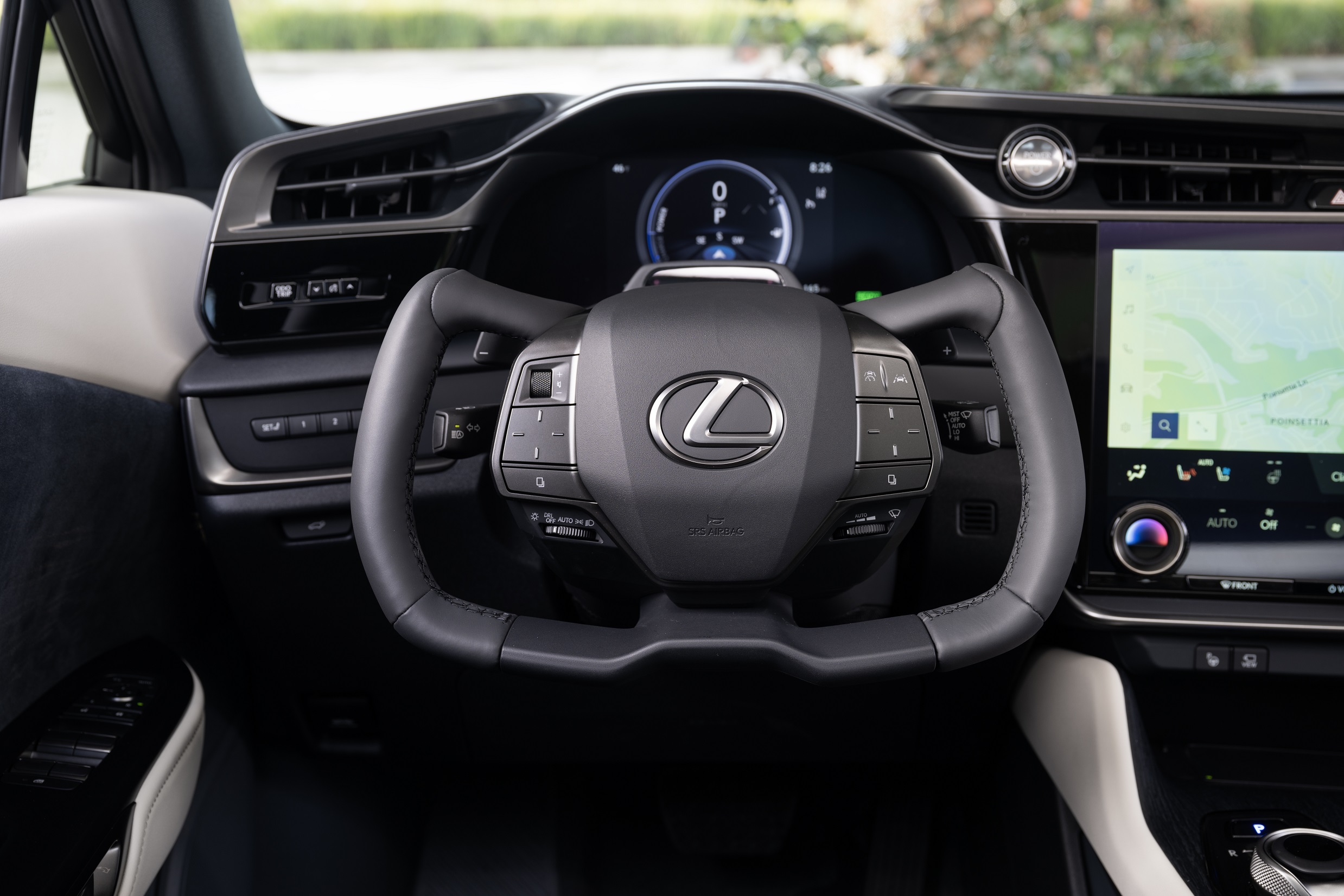
The steer by wire system uses a yoke rather than a wheel. The optional system is still be tested and refined by Lexus engineers.

Steering by wire uses a yoke rather than a wheel.

The optional steer-by-wire system eliminates the mechanical steering column to the front axle and, with it, the transfer of vibration. Instead, electrical signals communicate steering inputs for much quicker steering response. And instead of a steering “wheel,” Lexus uses a steering yoke. A yoke will help train drivers to use smaller steering inputs rather than hand-over-hand movements to rotate a wheel. The system’s steering ratio constantly adjusts to the speed of the vehicle. Steering by wire provides more “agility in slow-speed situations and impressive stability at higher speeds,” Lexus says.

The steer-by-wire system also has a different gauge cluster that sits higher (1.5 inches) and farther away (1.4 inches) from the driver. The change in positioning is to minimize the driver’s line-of-sight movement.

Dealerships will provide initial testing to familiarize owners before sending them down the road. And it will take time for new users to adapt, but not just to the quicker steering response.

It was an odd initial experience in my testing of the yoke system. That was primarily due to my muscle memory of rotating a wheel. The yoke requires the driver’s hands to be in a 9-and-3 position. There will be fewer positions to rest hands on longer trips.

The system, however, is still being refined and is expected to be available in the U.S. at a future date. Pricing has not been set.

Electrochromic Dynamic Sky panoramic roof

The electrochromic Dynamic Sky panoramic roof changes from opaque to clear at the touch of a button.

The electrochromic Dynamic Sky panoramic roof changes from opaque to clear.

All models of RZ have a panoramic glass roof, but the Luxury model has the option ($550) of an electrochromic function. The so-called smart glass transitions from opaque to clear at the touch of a button at the top of the windshield header. The goal is to eliminate the need for a sunshade.

Radiant Heating

The optional radiant heaters are positioned at the base of the dashboard to heat front passengers’ legs and feet.

The optional radiant heaters are positioned at the base of the dashboard.

It takes less energy to heat occupants than to heat the entire cabin, so Lexus added radiant heating for the front seat, standard in the Luxury model. The heaters at the base of the dashboard warm legs and feet and are in addition to seat heaters (and ventilation).

Radiant heat might have more value to buyers in colder regions. The radiant heater on the passenger side replaces the glove box, removing any interior locking storage.

With the loss of the glove box, materials that typically are kept in the glove box, such as owner’s manuals, can be stored in the under area of the shift console peninsula. But even this space required an adjustment. To help keep items from slipping off the shelf and into the driver’s foot space, the console has about a 2-inch taller lip on the driver’s side versus an inch lip on the passenger side.

Shadow Illumination

Embedded lighting in the door panels is used in the RZ 450e to create a sense of luxury.

Embedded lighting is used in the RZ 450e to create a sense of luxury.

Part of Lexus’ plan to redefine luxury is using shadow illumination. The upper front door panels are embedded with a span of light that creates a decorative pattern. Trouble is, the pattern is only visible at night. During the day, the door panels are rather bland looking. In the Luxury model, users have a choice of 50 ambient interior colors and 14 themes.

Vortex Generators

Vortex Generators at the end of the roof are intended to channel air flow down the glass to sweep away rain.

Vortex Generators are intended to channel air flow down the glass to sweep away rain.

At the roof’s end at the back glass, the so-called vortex generators channel airflow down the glass, eliminating the need for a rear wiper arm. In theory, the downward flow of air could be effective at highway speeds. But in town, those vortex generators will do nothing to clear away rain, heavy morning dew, or frost.

Illuminated Logo

An illuminated front logo, $200, also lights up when the RZ is charging.The RZ will be recognizable at night by the optional lighted front Lexus logo, $200. The logo also illuminates when charging.

Lexus RZ Pricing and Warranties

Starting prices listed below include the $1,150 freight charge from Motomachi Plant in Toyota City, Japan.

Premium with 18-inch wheels: $60,800;

Premium with 20-inch wheels: $62,040;

Luxury: $66,300.

Check here for current pricing and incentives.

Competing EVs to the RZ 450e include the Audi etron, Genesis GV60, Jaguar iPace, Polestar 2, Tesla Model Y, and Volvo XC40 Recharge.

A two tone paint option for Ether and Black paint is $1,200.

Two-tone Ether and Black paint, $1,200.

Color Choices

The RZ has a selection of five paint colors, including the new Ether blue. Four of the hues are $500 each, and only Caviar (black) is a no-cost choice. There also are two two-tone choices of Ether and Black Onyx or Cloudburst Gray and Black Onyx, $1,200 each.

And there are three interior color options: Thunderstorm and Macadamia, Palomino, and Dapple Gray.

Lexus RZ Warranties

  • 10-years/150,000-miles high-voltage battery;
  • 4-years/50,000-miles bumper to bumper;
  • 6-years/70,000-miles powertrain;
  • 2 free scheduled maintenance service appointments at 6-months/5,000-miles (whichever is earlier) and 12-months/10,000-miles;
  • Roadside assistance: 4-years/unlimited mileage

RZ Incentives and Rebates

The 2023 Lexus RZ 450e does not qualify for the Federal Electric Vehicle Tax Credit because it is built in Japan, not the United States. And because Lexus and Toyota have exceeded the government’s 200,000-unit limit. However, the RZ does qualify for some state and regional perks. The California Clean Fuel Reward amount has been temporarily reduced to $0 from $750.

As of this posting, information for the California Clean Vehicle Rebate for the Lexus RZ 450e was unavailable. When active, the rebate was $2,000. Participants are eligible based on gross annual income, as stated on their federal tax return.

Toyota created this incentive finder for federal, state, and municipality incentives.

The RZ 450e also qualifies for California (and other states) High-Occupancy-Vehicle freeway access, with the green DMV decal

Lexus Reserve

This new Lexus Reserve program aims to reduce “range anxiety” for drivers who don’t want to plan a driving trip around stops at charging stations. RZ 450e owners and lessees can rent another Lexus vehicle from their dealer for free. The program provides 30 days of a rental that can be used for three years from the date of purchase or lease. RZ 450e owners also will have access to a concierge guest experience to answer BEV questions.

Lexus RZ Buyer Demographics

Lexus expects the target customer for the RZ 450e will be:

  • Highly educated professionals and city and suburban residents;
  • Higher than average household income of $175,000-plus;
  • Older millennials and couples or families, with an even split of male and female buyers.
  • Lexus loyalists moving up from the comparably sized RX SUV or compact NX, and Toyota-brand move-ups.
  • First-time EV buyers who waited to make an intentional, refined choice.

Redefining Lexus Luxury

Lightweight materials are essential when building an EV. The lighter the curb weight, the farther the battery range. But the traditional materials that define a luxury car are heavy — leather upholstery, wood or metallic trim, and extensive power-operated features.

Instead, Lexus presents new interior design and materials, with special lighting effects to create a luxurious impression.

NuLuxe synthetic leather (half the weight of leather) is the standard upholstery in Premium models. And manufactured Ultrasuede fabric is standard for the Luxury. Luxury models also have access to an optional Tsuyasumi film, which has a shiny charcoal effect on the center console.

The minimalist interior treatment, however, might not appeal to the traditional buyer accustomed to Lexus’ pampering features.

More standard features are highlighted in the specs box at the end of this story.

Interior Function

There are five USB charging ports in the RZ cabin. Three USB Type-C ports with a wireless charger are on the lower instrument panel. Back-seat passengers have two Type-C USB ports at the base of the center console.

A standard 14-inch touchscreen has high-definition clarity for infotainment, navigation display, and the panoramic view monitor. The Luxury adds a 10-inch-wide head-up windshield display.

Tall headroom of 39.8 inches with the pano roof is spacious enough for 6-foot-6 occupants. Legroom is a comfortable stretch at 42.1 inches.

Driver controls are traditional with intuitive function and reach. And sightlines are open at the side windows and across the hood. Rearward views are slim out the back glass, but the panoramic view camera system is a great enabler in tight parking situations.

There is a standard 10-speaker sound system or an optional 13-speaker Mark Levinson Surround Sound system.

Back seat space is reasonably accommodating, but legroom of 38 inches is not limo-like, depending on who is sitting ahead.

The fast slope of the roof crops some cargo space, but Lexus says there is width for a golf bag at the tailgate entry. Or fold the second row for up flat space of 48 cubic feet.

Back seat legroom of 38 inches can be tight when tall occupants are seated ahead. Shown is the Palomino NuLuxe upholstery.

Back seat legroom of 38 inches can be tight when tall occupants are seated ahead.

Driving the RZ

At the recent media launch in San Diego, journalists could drive both trim levels of RZ in 18- and 20-inch wheels. The RZs were preproduction models but appeared production ready. Still, it is the procedure for preproduction media vehicles to be well-prepped for the perception of full function. The production version, however, might have differences. The following observations came after driving various short routes in the area.

The first thing prospective buyers will notice about the RZ 450e is its styling. Lexus embraced its “spindle” grille treatment but as a complete spindle body design. The RZ exterior is a movement of angles, arcs, and aerodynamic twists and turns.

Noise Calmed Cabin

Once buckled in place, the second aspect of the RZ will be the cabin’s quietness. Lexus is proud of its ability to filter out unpleasant noise and harshness. In my experience, this cabin might be the quietest of any in the high-luxury segment. The quiet is so penetrating that it is relaxing.

While the Premium model is luxuriously calmed, the Luxury model adds acoustic front and rear side window glass for the vault feel.

Another quieting aid is the tires. For the stable ride quality Lexus wanted, the RZ has staggered-width tires, wider at the rear. The Luxury model preserves its hushed cabin with ultra-high performance Dunlop SP Sport Maxx 060 20-inch tires 235/50. These are soft and grippy tires. But know that the treadwear rating (UTQG) for these ultra-performance Dunlops is a low 280. That number translates to a tread lifespan of around 25,000 miles or so. And plan on purchasing snow tires for driving in winter weather.

The Premium model is fitted with 18-inch Bridgestone Turanza EL450 (235/60) all-season touring tires. The Turanza EL450 has a more durable treadwear rating of 400. For a UTQG (Uniform Tire Quality Grading) comparison, a midsize all-season touring tire for a crossover SUV will have ratings as high as 700 to 800.

Parking is uncomplicated with a turning circle of 36.8 feet or a little more with 20-inch tires. And there is the Advanced Park system as part of the $1,475 Technology package. Use Advanced Park to find and automatically park horizontally or nose-in. The package includes the Digital Key app and the 10-inch head-up display.

The Luxury model rolls quietly on 20-inch ultra-high-performance Dunlop tires.

The Luxury model rolls quietly on 20-inch ultra-high-performance Dunlop tires.

RZ Safety Technologies

Under its skin, the RZ 450e has an advanced neural network of safety and driver-assist technologies. Lexus’ driver-assist systems are among the most steady and predictable for lane-centering and vehicle control, without frightening alerts to potential intrusions from other vehicles.

Leading the lineup of tech is the Lexus Safety System+ 3.0. Among its assist features are:

PCS — Pre-Collision System with Pedestrian Detection.

DRCC — All-speed Dynamic Radar Cruise Control: In highway driving, the adaptive cruise system uses radar and camera technology to help keep the vehicle at a preset speed and distance from vehicles ahead, even in stop-and-go traffic.

CSM — Curve Speed Management, within DRCC. A new feature to help manage speed in curves when cruise control is engaged.

LTA — Lane Tracing Assist. Lines on the road or a preceding vehicles give active assistance to keep the vehicle centered in its lane;

LDA w/SA — Lane Departure Alert with Steering Assist;

PDA — Proactive Driving Assist: Initiates gradual braking into curves or braking and steering to maintain distance control between the vehicle and a preceding vehicle, pedestrian, or bicyclist;

Risk Avoidance Emergency Steer Assist: Objects in the lane can be avoided by gentle braking and steering under certain daytime conditions;

Left Turn Oncoming Vehicle Detection/Braking.

The open RZ hood shows th e The electric powertrain modules and control hardware.

The electric powertrain modules and control hardware under the hood.

Lexus RZ Powertrain

The Lexus RZ 450e has a total system power of 308 hp, generated by two dual permanent-magnet synchronous motors. The dual-motor setup has a 150 kW motor at the front and an 80 kW rear. Transferring power is a single-speed e-Axle.

Either model, Lexus says, can launch to 60 mph in 5 seconds.

A “skateboard” style battery pack is positioned under the floor, extending from about the engine-bay firewall to just ahead of the back seat. The 96 cells of lithium-ion batteries generate 355 volts for total battery power of 71.4 kWh; the battery capacity is 201 Ah (ampere-hours).

Lexus uses water-cooling and water-heating systems to protect the battery pack from temperature swings.

RZ acceleration can be brisk and forceful, depending on how hard the accelerator is used. RZ performance can be manipulated by four drive modes of Normal, Sport, Eco, and Range. Range mode switches off the air-conditioning system and applies a more rear-wheel-drive bias.

I’m always conservative when driving an EV, but Sport is a go-to in heavy traffic to help guard my line.

There is no “e-pedal” driving, in which the vehicle can be slowed to a stop by lifting off the accelerator pedal. Instead, paddle shifters at the steering wheel can be used to vary the amount of regenerative braking force.

Lexus RZ Charging Times

Under ideal conditions, the RZ can fully recharge in about 9.5 hours with a Level 2 charger, and from 0-80 percent in approximately 30 minutes with a DC fast charger.

The RZ comes with a Level 1 vehicle-charging cable for 120-volt outlets. And all models are equipped with a Combined Charging System (CCS) socket for at-home and public charging.

For at-home charging, most Lexus dealers offer an option to purchase a ChargePoint Home Flex Level 2 charger ($749, not including installation) at the dealership or directly from ChargePoint. ChargePoint Home Flex is Energy Star certified and Wi-Fi connected. The charger can be installed indoors or outdoors and comes with a 23-foot charging cable. The home charger can add up to 25 miles of range per hour and fully recharge the battery when plugged in overnight.

For help in charger selection and installation, Lexus recommends Qmerit.

The installation service can help locate a certified electrician to install the EV charger and provide an initial free quote. Customers will be provided information on Qmerit during their purchase checkout process at participating dealers.

The open charge door on the left front fender of the RZ

150kW rapid charging can add 10-80 percent in around 30 minutes.

Curb Weights

Heavy electric cars are not always dynamic to drive. While the RZ is not exactly sporty in its handling, sportiness was important in suspension engineering.

Lightweighting features and technologies in developing the RZ have made it among the lighter EVs in its size segment. The RZ weighs 200 to 300 pounds less than competitors such as the Volvo, Mustang Mach-e, or the VW ID.4. The RZ weighs a whopping 1,296 pounds less than the Cadillac Lyriq.

The RZ Premium model weighs 4,586 pounds with 20-inch wheels, and 4,619 pounds for the Luxury model. Hefting that weight smoothly is a challenge, especially with SUV height. But the suspension engineering creates a truly svelte ride quality. There is no objectionable bottoming-out jounce and rebound as the dampers adjust to catch and control the heave of weight.

RZ Suspension, Steering, Braking

The RZ suspension is not overly sophisticated. It is comprised of front MacPherson-type struts and a rear trailing arm multi-link configuration. Both assemblies are tuned and located for handling balance, roll posture, and ride comfort.

At the rear, Frequency Reactive Dampers alter the dampening force on the extension stroke in response to road surface frequency input. The FRD works to provide a high level of handling stability, Lexus says.

Also neatly dialed in with the suspension are the steering response and braking engagement. The drive-by-wire steering is constant in turns, but I could not discern any road feedback.

Four-wheel ventilated disc brakes have 12.9-inch front rotors and 12.5 inches rear. The regenerative braking has no on-off effect as the brake pedal is applied and pushes through to the engagement point. Drivers will value the smooth engagement when nosing their RZ into a parking space with a vehicle or wall ahead.

Folded seatback of the open cargo area

The fast slope of the roof crops some cargo space, but Lexus says there is width for a golf bag.

Reinventing the Wheel

The automotive industry is in the middle of a once-in-a-century transition from internal-combustion propulsion to electric. And Lexus, too, is in a pivotal moment of major transformation, said Greg Kitzens, Lexus marketing GM.

Lexus aims to sell fully electric vehicles worldwide by 2035, with the hope of selling 1 million EVs globally in 2030, Kitzens said at a recent media test drive. (According to industry reports, Toyota targets global sales of 3.5 million EVs in that time frame.)

Electrified vehicles are not new to Lexus. The brand launched its first gasoline-electric hybrid RX SUV in 2004 and today has seven hybrid or plug-in electric vehicles in its lineup.

Electrification of existing Lexus and Toyota vehicles was the faster route to reducing greenhouse gas emissions to help slow climate change. The world’s largest automaker is now being criticized for not launching more battery-electric models.

It was a simple business plan, with some consideration of the planet, Kitzens said on the sidelines of the RZ media drive.

“The battery resources to build one battery-electric vehicle could instead be used to build six plug-in electric Lexus vehicles or 90 gasoline-electric hybrids,” Kitzens said. He was citing research by Gil Pratt, Toyota Motors’ chief scientist and executive fellow for research.

Today, Toyota Motor is at work on a wholly re-engineered, next-generation platform dedicated to battery electric vehicles arriving in 2026. It is a “BEV-first mindset,” but with a balanced approach that will include plug-ins and hybrids.

With lithium as scarce as it is, automakers can reduce carbon emissions more quickly through a multipronged approach to electrification that includes hybrids rather than focusing exclusively on fully electric vehicles, said Pratt in an Automotive News report.

A rear view of a blue RZ 450e

The RZ styling is a movement of angles, arcs, and aerodynamic twists and turns.

Why Buy the Lexus RZ 450e?

The RZ 450e doesn’t set any charging speeds, driving range, or powertrain efficiency benchmarks. But Toyota and Lexus focus on the real-world range for reliability and battery life.

Don’t get hung up on competitors’ claims of 300 or more miles of battery driving. With a home charger, it really doesn’t matter if your EV has a range of 200 or 350 miles. You’ll both meet at the public charging station on a long driving trip.

Either RZ model is favorably priced as a luxury electric SUV.

A nicely equipped Premium model will cost around $63,415. A nicely optioned Luxury model with such extras as two-tone paint ($1,200), the cold-weather package ($200) and another $200 for the illuminated Lexus grille logo, and the Dynamic Sky roof ($550) will run $67,300.

For the $3,885 pricing difference, I prefer the Luxury model for the complete Lexus luxury treatment.

2023 Lexus RZ 450e Specifications

Body style: midsize, 5-door, 5-seat electric SUV with standard AWD

Motors: dual permanent magnet synchronous, 150 kW front, 80 kW rear

Total system power: 308 hp

Transmission: e-Axle single speed

Battery: 355-volt lithium-ion with 71.4 kWh total battery power from 96 cells

EPA-estimated driving range: 220 miles with 18-inch tires; 196 miles with 20-inch tires

Fuel economy equivalents: 115/98/107 mpg-e city/hwy/combined with 18-inch tires; 102/87/95 mpg-e with 20-inch tires

Top speed: 99 mph

0-60 mph acceleration: 5 seconds

AC Charging Times

Level 1, 110-120 volts, from 0-100 percent, around 50 hours;

Level 2: 240-volt, 32 amp (7 kW), around 9.5 hours

DC Fast Charging Times

400-amp, 150 kW: 0 to 80 percent, around 30 minutes

Charger output: 6.6 kWh

BY THE NUMBERS

Cargo space: 24 to 48 cubic feet

Front head/leg room: 39.8/42.1 inches

Rear head/leg room: 39.7/38 inches

Length/wheelbase: 189.2/112.2 inches

Curb weights

Premium 18-inch wheels: 4,564 pounds

Premium 20-inch wheels: 4,586 pounds

Luxury: 4,619 pounds

Turning circle: 36.8 feet

FEATURES

Standard Luxury model equipment includes: Panorama glass roof, NuLuxe-trimmed seats and interior door trim, 14-inch touchscreen infotainment-navigation display, panoramic view monitor, 10-inch head-up windshield display, wireless Apple CarPlay or Android Auto, wireless phone charging pad and 5 USB charging ports, single-color ambient lighting with Shadow Illumination, electric parking brake, heated and ventilated front seats, paddle shifters with regenerative braking force indicator, memory presets for driver’s seat-steering wheel-side mirrors, digital rearview mirror, power liftgate with kick sensor, 10 air bags;

TIRES

  • Premium model: 18-inch Bridgestone Turanza EL450 all-season touring, 235/60 front, 255/55 rear
  • Luxury model: 20-inch Dunlop SP Sport Maxx ultra-high performance, 235/50 front, 255/45 rear

Safety features and technologies include: 10 air bags, Advanced Park and Intuitive Parking Assist with auto braking, blind-spot monitor with rear cross-traffic alert, Lexus Safety System+ 3.0

Where assembled: Motomachi Plant, Toyota City, Japan

Warranties

  • 4-years/50,000-miles bumper to bumper;
  • 6-years/70,000-miles powertrain;
  • 2 free scheduled maintenance service visits at 6-months/5,000-miles and 12-months/10,000-miles;
  • High-voltage battery warranty: 10-years/150,000-miles;
  • Roadside assistance: 4-years/unlimited mileage

New tires provide a rewarding new-car feel on a budget

The new tire centers at JBA Speed Shop are a Tire Rack top five-star installer. (Photos by Mark Maynard) 


JBA Speed Shop now provides full tire services and front-end alignment, including for high-performance vehicles


By MARK MAYNARD

New tires are one of the simplest and least expensive ways to give your old ride that new-car feel. Even if the tread does not appear to be unevenly worn or down to the wear-bar indicators, the National Highway Traffic Safety Administration and new-vehicle manufacturers suggest a tire is only 100 percent safe to use until it turns 5 to 6 years old. Of course, a tire can be operable up to 10 years if you check it for issues annually after the fifth year.

In 2013, I had re-tired my 2008 Ford Escape Hybrid (bought in 2012) with four new Goodyear Assurance Fuel Max all-season touring tires. They were promoted as an affordable choice with low-rolling resistance to stretch fuel mileage. They have a tread-life warranty of 6-years or 65,000-miles, which put my set of Goodyears at the end of their life cycle, even though they had substantial tread remaining.

The 7-year-old Goodyear Assurance tires appeared to have good tread remaining, but the cracks of old age were apparent on closer examination.

They did not appear worn out, but upon closer examination, there were visible surface cracks from age — and the tires now rode like hard, black checkers. On the highway I could average 30 mpg and 17-24 around town.

During a suspension check-up for shock absorbers and other suspension elements, the technician advised that the tires were old and should be replaced. They also were out of balance and a front-end alignment was needed.

All of those necessary service points had crept up over the last few years and I had accepted that the tires were just hard and noisy. And I had also accepted that the choppy ride at highway speeds was just how the compact, front-drive SUV handled. I never pushed it for cornering maneuvers, so how it handled was just fine as a daily driver.

But after replacing the front struts and rear shock absorbers, the handling and ride quality improved dramatically. And then I knew that new tires would really improve the ride.

But not just any new tires.

The MeltdownTires center specializes in high-performance applications.

There are many brands of tires for a compact SUV, but it is difficult to choose a winner when the user reviews contradict each other. I was shopping a premium all-season tire and had written a short story on Pirelli’s Scorpion Verde All Season Plus II tires.

Checking various tire sites, the Scorpion Verde had many positive reviews. So I started shopping prices at Tirebuyer.com, which often has the lowest pricing, especially when shipped directly to an installer.

JBA owner J. Bittle bought the best equipment money can buy, he says, including the state-of-the-art Hunter machines.

A set of Scorpion Verdes, size 235/70R16, would cost $590 or $147.50, with free shipping to a tire shop of my choice. And at the time there was a $40 discount if I ordered by a deadline.

For a comparison, I called the JBA Speed Shop in the Kearny Mesa area of San Diego. Owner J. Bittle had recently opened a tire facility in an annex building at his compound. Among the speed shop’s specialties are dynamometer testing for chassis and engine, machine-shop services for custom engine builds and the blueprinting of an engine and a “plumbing” center for braided steel lines, military-spec fuel lines, oil lines and brake lines.

His tire center includes an online tire-shopping link that populates all the major brands and their common pricing. The link listed the same pricing as at Tirebuyer.com. And JBA is a Tire Rack top five-star installer; tires can be purchased online and shipped to JBA for installation.

JBA stocks top brand names in wheels and tires.

I liked the idea of supporting the home-grown business and had JBA order the tires, which were shipped to the shop in about five days.

Bittle has added two levels of tire service. His JBA Tire Center offers basic tires and wheels, “for the best service for the best price,” he says. And the MeltdownTires Performance Center specializes in high-performance tires, including race rubber and custom wheels, whether for a new car or a full custom hot rod.

“A standard alignment center does not understand what occurs when you lower vehicles, so we brought it in-house because we couldn’t outsource anymore,” he said. “It’s becoming more and more difficult to find trusted vendors,” he said, “especially for balancing Plus-1 or Plus-2 tire fitments [adding larger and wider wheels by 1, 2 or 3 inches].

“There are only a couple of facilities in town that have the facilities that we do,” he said. “Our Hunter machines are state of the art and we bought the best equipment money can buy.”

I made an appointment to have the tires installed and an alignment. The tires, mounting and balancing ($20 each) and other fees (tire disposal and recycling) came to a no-regrets $738.34 plus $98 for the alignment.

Premium tire upgrade

Unless you are putting tires on a junker to sell, upgrading to more premium tire brings rewards you will appreciate and value every time you drive. And I also noted a significant boost in fuel economy.

The Goodyear Assurance Fuel Max tires I replaced were good for about 30 mpg on the highway and 17 to 24 mpg around town. While making a recent 80-mile highway run last week on the new Pirellis, I was quite surprised to see that the Escape’s mileage counter had hit 33.3 mpg and it might have gone higher with more highway driving. Around town, the tires are helping to deliver an average of 24-27 mpg. When new, my Escape had factory mileage ratings of 34/30/32 mpg city/hwy combined.

What Pirelli says

I found the Scorpion Verde tires to be quiet rolling and supple, and very responsive in cornering.

The Scorpion Verde tires are quiet rolling and supple. A side benefit has been improved fuel economy.

Pirelli says its Scorpion Verde All Season Plus II tires are an extremely well-balanced choice for SUVs and crossovers. The eco-friendly tire (verde meaning “green” in Italian) delivers high performance, low noise and excellent handling, the company says.

The all-season touring tire was updated in mid-2019 with a new tread compound and a larger footprint for improved wet and dry handling and wet braking. The second-gen formula maintains the mileage, comfort, noise and winter performance of the previous generation, Pirelli says.

Sold in 40 sizes, from 16 to 22 inches, the Scorpion Verde All Season Plus II is covered by a 65,000-mile limited tread wear warranty. Depending on the size, pricing can range from $140 to $255 each. And Pirelli offers a 30-day trial offer, called Confidence Plus Plan. If a buyer is not satisfied with a set of four new tires, they can be exchanged for a new set of four Pirelli tires at the original place of purchase, within 30 days from the original date of purchase.

Older vehicles run great, until they don’t — and then it can be a major expense to get them back to what we had before, which might not feel like the cost was worth it. New tires, however, are like a halo of good feelings and give reassurance of safety in foul weather.

With good tires, you will know exactly where your money went — and you’ll remind yourself to do it sooner next time.

MarkMaynard@cox.net