Select Page

Nissan Family Cookbook

Nissan Family Cookbook

The first Nissan Family Cookbook has 140 recipes, ranging from appetizers and soups to main dishes and desserts

The cover of the Nissan Family Cookbook

BY MARK MAYNARD

Holiday celebrations are different this year, but that doesn’t stop our cravings for our favorite and festive seasonal recipes. Sweet or savory, Nissan’s U.S. manufacturing team has introduced the “Nissan Family Cookbook,” the first such collaborative to assemble good things in the kitchen — and it’s free to download.

There are 140 recipes in the cookbook, ranging from appetizers and soups to main dishes and desserts. The team’s hope was to help people feel connected to one another and to break up the pandemic-induced monotony and make new memories, said Steve Marsh, senior vice president, manufacturing, Nissan North America, Inc.

“The kitchen is typically the center of holiday activity. It’s where everybody wants to be, and there’s no reason why this can’t continue, even during these unprecedented times,” Marsh said in a statement.

Family traditions

Several recipes included in the cookbook carry special meaning:

Christy Boisseau, Nissan Smyrna [Tenn.] Vehicle Assembly Plant. She chose her dad’s “Boss Hogg’s Tennessee Swamp Cabbage” (in the soups and salads section).

“My dad, Tim ‘Boss Hogg’ Boisseau, retired from the Smyrna plant a few years ago. His recipe is well-known and I’m happy to keep the family tradition going by sharing it with our Nissan family and neighbors,” said Boisseau.

Bill Thompson, Nissan Canton (Miss.) Vehicle Assembly Plant. He shared a favorite of his son: “Bacon Wrapped Chicken Breast” (Entrees section).

“I have a son with special needs who loves to help me cook. He loves bacon and chicken so much that we had to put it together,” said Thompson.

Arthur Snyder, Nissan Decherd [Tenn.] Powertrain Plant. Snyder dedicated his favorite “Apple Crisp” from childhood (Desserts section).

“Born and raised in Rochester, N.Y., I grew up surrounded by apple orchards, so I ate a lot of apples. This is my favorite way to enjoy them,” said Snyder.

Many of the recipes reflect a Southern spiciness, but all connect with a long family tradition — though not as remembered by Hank Williams Jr.

Among some of the dishes I found interesting:

  • Balsamic Garlic Pork Tenderloin
  • Tuscan Butter Shrimp
  • Fresh Turnip, Mustard or Collard Greens
  • Pocketknife Coleslaw
  • $250 Chocolate Chip Cookies
  • Southside Blueberry Peach Cobbler
  • Thai Curry Wings
  • Pepperoni Stew

The Nissan Family Cookbook is free to download here.

Hyundai Sonata N Line Review

Hyundai Sonata N Line Review

The 2024 Hyundai Sonata N Line sport sedan is a subtle display of elevated, if not wicked, performance for a well-equipped $36,310

A front three quarter view of a silver N Line sedan

Hyundai has made significant updates to the midsize 2024 Sonata, with sharpened performance to the Sonata N Line. (Photography courtesy of Hyundai or as credited)

Jump To Special Features

What’s New for the 2024 Sonata?
2024 Hyundai Sonata Pricing
Extensive Safety Features
N Line Performance
Under the Hood
Ride and Handling
Why Buy the 2024 Hyundai Sonata N Line?
Specifications

BY MARK MAYNARD

Quick, before Hyundai finance managers realize that the powertrain engineering team ignored all cost restrictions for its Sonata N Line.

This popular midsize sedan has gone through a major midcycle freshening for 2024. The updates are more than the usual nips and tucks inside and out. For the first time, there is an all-wheel-drive option for one trim level. And the new Sonata N Line is a subtle display of elevated performance. For a well-equipped $36,310, I did not expect the pleasure of such punch in my week’s test drive.

The Sonata N Line is an outlier sport sedan in the midsize segment. It has no real competition except its company cousin, the Kia K5 GT, which uses the same N Line powertrain. Why is it so isolated? It might be the price point or a perception that the mainstream midsize segment is a grownups’ family car.

Sport compact sedans, however, are numerous, including Hyundai’s Elantra N Line. Among competing four-door sportsters are the Honda Civic Si, Subaru WRX, Toyota GR Corolla, and VW Jetta GLI. And there are higher performance versions for each compact, at a cost. Pricing on average for these mere sporty sedans starts in the low to mid $30,000s. Opting for one of their more notorious trim levels can add $10,000-$15,000 to the MSRP.

The incredibly well-equipped 2024 Hyundai Sonata N Line is a larger car with impressive engineering, priced at $36,310.

By EPA interior space standards, the Sonata is a “large” car.

The cabin has tech-contemporary style, centered by a new curved display screen.

The N Line cabin has tech-contemporary style, centered by a new curved display screen.

What’s New for the 2024 Sonata?

The 2024 exterior redesign leans into Hyundai’s styling language of “sensuous sportiness.” Among the influences are Sonata’s horizontal layout, signature “Seamless Horizon Lamp,” and wide-set hidden headlights. A full-width LED light strip at the hood shutline runs just above the main headlights, hidden above the air intakes.

Hyundai says a new grille and larger air intakes create a more dynamic and aggressive appearance. At the rear, stylized H-lights emphasize the wide stance. LED lighting adds a contemporary tech style. A black spoiler-shaped trunk lid and a rear lower fascia molded around dual exhaust tips set a performance tone.

The N Line’s 19-inch tire and wheel package gives a strong stance, with capability from Pirelli P Zero all-season tires. Standard Sonata wheels are 16, 17, or 18 inches.
Thanks go to the N Line model for new body reinforcements. There were also more general improvements in noise, vibration, and harshness.

Special N Line cabin details include red trim across the dashboard and air vents, with red stitching throughout. The steering wheel material was changed, and the upper seatbacks of the front seats have an embroidered N logo.

On the N Line and upper trims, there is a new curved display screen. The digital presentation links two separate 12.3-inch displays under a single pane of glass.

Other updates include:

  • Wireless Apple CarPlay and Android Auto have been expanded to all 2024 Sonata models;
  • Continuous over-the-air software updates;
  • Improved sound quality from the 12-speaker Bose Premium Sound System with new CenterPoint 360 technology.
Front sport seats with microfiber suede inserts have higher grip leatherette side bolsters.

N-Line sport seats with microfiber suede inserts and higher grip leatherette side bolsters.

2024 Hyundai Sonata Lineup

The refreshed 2004 Hyundai Sonata is available in gasoline or gas-electric hybrid models, in front- or all-wheel drive.

  • Gas-powered Sonatas have a 191-hp 2.5-liter direct-injection four-cylinder engine. On 87-octane fuel, it has fuel economy ratings of 25/36/29 mpg city/highway/combined. The transmission is an eight-speed Smartstream automatic with an overdrive lock-up torque converter.
  • Hybrid-powered Sonatas have a 192-hp 2.0-liter four-cylinder engine, 39 kW (51 hp) motor, and 270-volt lithium battery pack. The transmission is a six-speed automatic.
  •  Sonata N Line has a specially developed 290-hp turbocharged 2.5-liter engine and an eight-speed wet dual-clutch automatic with steering wheel paddle shifters.

All-Wheel Drive

Hyundai TRACtion (H-TRAC) all-wheel-drive system is now available on the entry SEL model with 2.5-liter engine. The electronically “intelligent” system reroutes power between the front and rear axles. The system will also apply subtle brake pressure to the left and right wheels to help maintain cornering control.

2024 Hyundai Sonata Pricing*

  • SEL $28,860 with carpeted floor mats ($210); add $1,500 for all-wheel drive. Standard SEL features include keyless entry with push-button ignition, fabric upholstery, heated front seats, an eight-way power driver seat, a six-way manual front passenger seat, a 12.3-inch infotainment touch screen, and a wireless phone charging pad.
  • SEL Hybrid (FWD) $31,950. The gasoline-electric powertrain achieves fuel economy ratings of 44/51/47 mpg city/highway/combined.
  • SEL Limited Hybrid $38,350. Special features include leather-trimmed upholstery, heated and ventilated front seats, and 17-inch alloy wheels with an eco-spoke design.
  • N-Line $36,310, including carpeted floor mats.

*Retail starting prices include the $1,150 freight charge from Asan, Korea.

Check current Hyundai pricing and special offers here.

Paint Colors

Hyundai says the Sonata’s exterior colors have a state-of-the-art aircraft look. The Sonata N Line’s Aero Matte Silver ($1,000) changes color from warm to cool depending on the light.

Additional exterior colors include Onyx Black Pearl, Serenity White Pearl ($470), Atlas White, Portofino Gray (matte-metallic), Transmission Blue Pearl, Carbon Blue Pearl, Ultimate Red Metallic, Cream Beige, and Aero Silver Metallic.

Interiors are trimmed in black, dark gray, and greige two-tone, or dark gray and camel two-tone. Dark gray with red stitching and N Line red paint is exclusive to the Sonata N Line model.

The open trunk of 15.6 cubic feet

This sedan has useful utility in its 15.6 cu.ft. trunk, and fold the 60/40 back seat for up to 6 feet in length.

Warranty Coverages

Hyundai has become known for its vaunted warranty coverages: 5 years or 60,000 miles bumper to bumper with roadside assistance. And new vehicles also have free maintenance for 3 years or 36,000 miles.

Hyundai repaired its early powertrain reliability with major engineering improvements and by offering a 10-year, 100,000-mile powertrain warranty. However, getting satisfaction in the event of an engine problem can be elusive, according to Consumer Reports. In a recent report ranking dealership satisfaction scores of 22 makes, Hyundai ranked third from the bottom. Kia was last, and just above is Jeep. Ouch.

The new steering wheel mounted shift lever looks odd, works well.

The new steering wheel-mounted shift lever looks odd but works well.

Interior Function

Size matters when putting controls and switches in logical order. The wide digital screen is not prone to glare or odd reflections. And there is no confusion to knobs, dials, or switches to control cabin comfort or audio.

There is enough stretch to the body that sightlines are open over the shoulder, across the hood, and at the side mirrors.

Headroom of 37.8 inches with the panoramic sunroof should fit most drivers. Taller drivers might prefer to skip the panoramic roof to get 40 inches of headroom. The front legroom is incredibly long, at 46.1 inches. With door-to-door shoulder room of 57.9 inches, the front seat area does not feel cramped.

The Sonata N Line sport seats have good comfort and thigh support due to their breathable and grippy microfiber suede centers. Higher grip leatherette side bolsters were not intrusive to entry and exit. But I would like a more pronounced D-shaped steering wheel, which helps with thigh room.

The redesign also introduces a new gearshift stalk at the steering wheel. It might look weird initially, but it functions easily with a twist up or down to engage gears. The shifter is a smart way to move a lever from the center seat console for more useful space. A switch on the console changes drive modes from Normal to Smart, Sport, and My Mode.

An e-bin at the forward console has C-Type charging USBs, a 12-volt and 180-watt power plug, and a wide charging pad.

Back Seat and Cargo Space

With just 34.8 inches of max legroom, the window seats still have a comfortable stretch with good footroom. The center seat has the typical perched position, making it more useful for its broad fold-down armrest. Conveniences include two C-type USBs, grab handles with coat hooks above each door, and slim door-panel storage.

There is good utility to this sedan with is 15.6 cubic feet of trunk space, and golf-bag capable. Or fold the 60/40 back seat for up to 6 feet in length, easily negotiated through the wide trunk opening. Trunk assets include dual seatback-release pulls and an interior light. There is no N Line spare, just a “mobility kit” of tire sealer and inflator pump.

The Sonata back seat with adequate 35.8 inches of legroom

With just 34.8 inches of max legroom, the window seats still have a comfortable stretch with good footroom.

Sonata’s Extensive Safety Features

The Hyundai Sonata has comprehensive safety technologies and features, including 5 mph bumpers. The industry bumper standard is 2.5 mph for passenger cars (not trucks, SUVs, or minivans). The federal law is intended to prevent damage to the car body and safety-related equipment at barrier impact speeds of 2.5 mph across the full width and 1.5 mph on the corners. But 2.5 seems to have little benefit.

An umbrella of circuitry also protects the Sonata and its occupants. The various systems are comprised of three radar systems, five cameras, and 13 ultrasonic sensors. All linked, the systems allow for semi-autonomous driver-assist features of standard adaptive cruise control, forward-collision braking, and lane-following assist.

The individual technologies are:

FCA 1.5: Forward Collision-Avoidance Assist 1.5;

RCCA: Rear Cross-traffic Collision-avoidance Assist;

BCA: Blind-spot Collision Assist;

SEW: Safe Exit Warning;

SEA: Safe Exit Assist;

LKA: Lane Keeping Assist;

LFA: Lane Following Assist;

SCC with S&G: Smart Cruise Control with Stop & Go;

RSPA: Remote Smart Parking Assist (enables the user to park the vehicle and exit parking spots by remotely reversing and forwarding with the smart key from outside the car;

NSCC: Navigation-based Smart Cruise Control (optional);

HDA: Highway Driving Assist to help relieve driver stress (optional).

N Line Performance

The Sonata N Line is a sleeper sport sedan — and a lot more than paint and tape. Its 290-horsepower, 2.5-liter turbocharged engine was developed specially for the N Line, and its eight-speed dual-clutch (automated manual transmission) thrives in high-rev performance.

While turbocharged 290 hp is great, the N-Line’s torque stands out. The 311 foot-pounds run steady from 1,650-4,000 rpm. In its testing, Motor Trend clocked zero to 60 mph in 5.6 seconds.

When the red mist whispers, there is Sport-Plus, just a couple of pages away in the vehicle settings. Sport-Plus mode is in the “My Mode” category. Use the slider buttons to maximize the performance of shift points and steering weight. Neither setting makes for a harsh or uncomfortable ride, but mercy, the performance is amplified to the predator level. Flicking off steering wheel paddle shifts gives instantaneous upshifts and rev-matching downshifts.

N Line Sport-Plus mode also includes launch control and rev-matching downshifts. Active Sound Design makes the engine sound more virile inside the cabin, but it still sounds ratchety.

Yet, there are those times of enthusiast driving when the N-Line could use a locking differential when the front tires lose grip and torque steer takes over.

N-Line has a console switch to toggle between comfort, Sport, and My Mode. Sport modes sharpen acceleration response and steering weight.

The eight-speed wet dual-clutch automatic gave hesitant shifts while driving around town. That action was the gears engaging in the automated manual transmission. It annoyed me, but I discovered that Sport mode eliminated the clutching action. That is how I enjoyed the rest of my drive week, regardless of fuel economy.

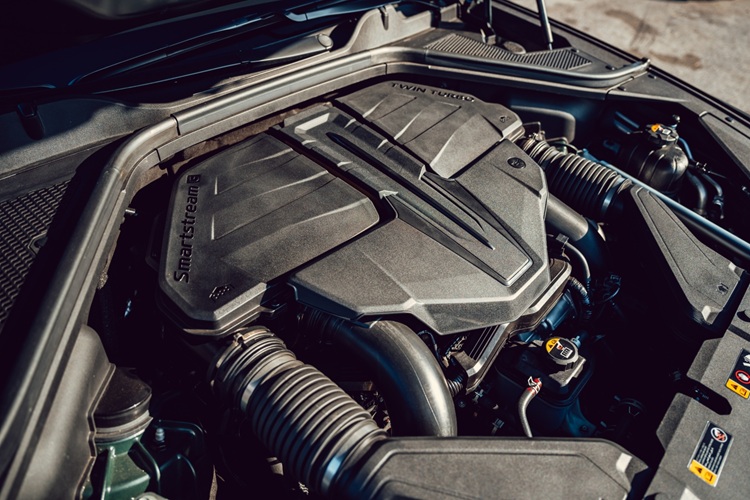
A view of the N Line’s 290-hp 2.5 liter four-cylinder engine.

The N Line’s 290-hp 2.5 liter four-cylinder engine.

Under the Hood

Pop the N Line hood, and Hyundai’s detailed engineering for serviceability and DIY maintenance becomes apparent. First, there are two robust hydraulic hood struts, not a spindly prop rod. Never mind that those struts (and tailgate struts) will wear out and need to be replaced. It is the budget for hydraulic struts that matters.

Sonata's easy to change air filter

Air filter can be changed in less than a minute!

Next, check out the huge air pipe feeding the turbocharger. It is securely routed to avoid chafing on the also-large air intake tube next to it. Then, follow the air intake feed to the air filter box. The strong black plastic box has a user-considerate design with small flipper tabs. Opening, removing, and slipping in a new filter should take less than a minute.

Thermal-sandwiched metallic pads are behind and above the hood for turbocharger heat protection.

The 12-volt battery has dual lifting handles. Both battery terminals have a cover to protect positive and negative posts, and the positive terminal has its own high-current fuse.

Look closer for the corrosion-protected engine-transmission grounding strap. The robust strap is fully covered.

The user friendly fuse panel under the hood of the Sonata.

The simple fuse-box schematic. (Peter Badore photos)

Now, eyes right to the vehicle fuse box near the right-side shock tower, clearly identified. Remove the lid, and the underside has a detailed schematic chart showing each fuse amperage and what it protects. There are also six spare fuses and a useable plastic tweezer-like tool to pull a blown fuse.

Finally, for the owner and service tech, many of the screw heads are rounded to protect knuckles.

All these added design features add cost and weight. Many carmakers in the Sonata’s price segment cut such extras from their budgets.

Fuel Economy Numbers

At 3,534 pounds, the Hyundai Sonata N Line is the second heaviest Sonata in the lineup. It slots behind the Limited at 3,687 pounds or the SEL AWD model at 3,466.

Sonata N Line has fuel economy ratings of 23 mpg city, 32 highway, and 27 mpg combined on the recommended 87 octane fuel. In my 200-mile week of driving, I saw mileage averages of 29.4 around town to 35 mpg on the highway.

However, those mileage ratings are several mpgs off those of the four-cylinder 2024 Honda Accord turbo (29/37/32 mpg) and 2024 Toyota Camry (28/39/32 mpg).

Sonata N Line Ride and Handling

The suspension stands out for its agile finesse in transferring weight. The refined engineering of suspension components is felt in the low-friction glide quality.

Modern family sedans have been made lower and wider in the hope of improving fuel economy and meeting federal mileage standards. Consequently, some new sedans ride so low that comfortable entry and exit are compromised.

Not so the Hyundai Sonata. Its ride height allows excellent forward sightlines and comfortable entry and exit. Drivers can confidently transition driveways without a chin scrape. There is no tiptoeing across lumpy intersections in concern of bottoming out. It is hard to avoid that awful “graunch” in most other sedans and some small SUVs today.

Hyundai has applied various aerodynamic designs, winglets, and air-breaking widgets to lower the drag coefficient to 0.28. The Toyota Prius, by comparison, has a Cd of 0.27. Despite more soundproofing, there is much ambient noise in the cabin at highway speeds. It did not seem to come from tire harshness or suspension points.

Complementing ride and steering control are the 19-inch 245/40 Pirelli P Zero all-season tires, on the test car. Their rubber chemistry is compliant with an upper-midrange 500 treadwear rating (UTQG). Replacements will run around $300 each (not installed), per TireRack.com.

The N Line’s 19-inch tire and wheel package with Pirelli P Zero all-season tires.

The N Line’s 19-inch tire and wheel package with Pirelli P Zero all-season tires.

Why Buy the 2024 Hyundai Sonata N Line?

Hyundai believes there is renewed interest in sedans. The Sonata offers accommodating utility and a generous budget for many useful features.

There is more to the Sonata N Line than what is typically perceived as a family sedan. Enjoying this stealthy sport sedan requires no physical sacrifice.

Now, switch off the drive assistance, take the wheel, and just enjoy driving.

A slightly overhead view of a silver Sonata N Line

The Sonata N Line is an outlier sport sedan with no real competition, except its company cousin the Kia K5 GT.

2024 Hyundai Sonata N Line Specifications

Body style: midsize, 5-seat, 4-door front-wheel-drive sedan; unibody high-strength steel

Engine: 290 hp, Smartstream 2.5-liter turbocharged and direct-injected DOHC 16-valve inline 4-cylinder; 311 lb.-ft. torque from 1,650-4,000 rpm

Transmission: 8-speed N automatic wet dual-clutch

Fuel economy: 23/32/27 mpg city/hwy/combined;

Coefficient of drag: 0.27 Cd

BY THE NUMBERS

Fuel tank: 15.9 gallons

Trunk space: 15.6 cubic feet

Front head/leg room: 37.8*/46.1 inches *40 inches w/o sunroof

Rear head/leg room: 37.4*/34.8 inches *38.4 w/o sunroof

Shoulder room, front/rear: 57.9/56.1 inches

Hip room, front/rear: 54/.6/54.4 inches

Length/wheelbase: 193.3/111.8 inches

Height/width: 56.9/73.2 (not including mirrors) inches

Curb weight: 3,534 pounds

Turning circle: 35.9 feet

FEATURES

Sonata N Line standard equipment includes: Proximity key with push-button ignition, 12.3-inch color gauge array, 12.3-inch touchscreen for navigation-audio, panoramic sunroof, surround view monitor, dual automatic temperature control, wireless Apple CarPlay and Android Auto, 12-speaker Bose audio system with satellite radio, 8-way power driver’ seat, 6-way front passenger seat, heated front seats, electric parking brake, 60/40 folding back seat, hands-free trunk, lighted vanity mirrors and visor extensions, locking and lighted glove box.

N-Line features: larger front bumper grille area, exclusive 19-inch wheels, rear spoiler, dual twin-tip exhaust, front sport seats with microfiber suede inserts and higher-grip side bolsters, leather-wrapped steering wheel, metal and rubber brake and accelerator pedals, LED map lights, red-accented stitching and cross-metal patterned trim, Active Sound Design, Launch Control, N Powershift, and rev-matching downshifts.

Sonata N-Line standard safety features include: 9 air bags, 5 mph bumpers, stability and traction controls, safe exit warning;

Safety technologies include: blind-spot collision warning with rear cross-traffic collision avoidance assist; blind-spot view monitor; forward collision-avoidance assist with pedestrian, cyclist detection and junction turning; parking collision-avoidance assist rear; high-beam assist; lane keeping assist, lane follow assist, and driver attention warning.

CHASSIS COMPONENTS

Brakes: 4-wheel disc brakes; 13.6-inch ventilated front rotors, 12.8-inch rear solid discs; 4-wheel ABS with electronic brake-force distribution with brake assist; electric parking brake

Steering: column-mounted rack and pinion; motor-driven power assist with engine rpm-sensing; turning circle 35.9 feet

Tires-wheels (on test car): 19-inch 245/40 Pirelli P Zero all-season on 5 dual-spoke wheels; tire mobility kit (no temporary spare)

Suspension: front MacPherson struts with a stabilizer bar; rear multilink with a stabilizer bar; gas shock absorbers front and rear

PRICING

Base price: $36,100, including $1,150 freight charge; price as tested $36,310

Options on test vehicle: Carpeted floor mats $210

Where assembled: Asan, Korea

Warranties: 5-years/60,000-miles bumper to bumper with roadside assistance; 3-years/36,000-miles complimentary maintenance; 10-years/100,000-miles powertrain

Lexus NX 450h+ Review

Lexus NX 450h+ Review

On-road recharging of the 2025 Lexus NX 450h+ plug-in hybrid is the missing link between a hybrid and full EV

A front three quarter view of the bold blue 2025 Lexus NX small SUV crossover

The 2025 Lexus NX is available in four powertrains, including two hybrid electric models, in front- or all-wheel drive. Starting prices range from around $42,000 to $64,000 (Photography courtesy of Lexus or as credited)

Jump To Special Features

Lexus NX Overview
What’s New for 2025?
Lexus NX Model Line Pricing
What is California Clean Assist?
NX Safety Features and Technologies
Powertrain and Performance
F Sport Ride and Handling
Interior Function
Why Buy the 2025 Lexus NX 450h PHEV?
Specifications

BY MARK MAYNARD

The on-road recharging function of the 2025 Lexus NX 450h+ plug-in hybrid is the missing link between a hybrid and full EV. Being able to recharge the small hybrid battery while driving elevates this PHEV as a one-vehicle choice for the tentative EV buyer.

The battery-electric driving range is 26 to 37 miles, which provides emissions-free driving. And because this small SUV can charge on the go, it continues to extend the driving range and fuel savings.

It is a functional system that can be used to bank battery power while running on gasoline. When the charge runs out, hit the console switch for Charge Mode. Switch to EV power to save gas when the battery is full again.

Even when driving in EV mode, the gas engine will kick in for strong acceleration or on steep hills.

Charge mode quickly adds miles while driving at interstate speeds and slower while in town. The recharging was so efficient that I did not need to plug in on my home 240-volt charger. However, on-road charging will only boost the battery to an 80 percent charge, so owners might want to plug in overnight for the full 37-mile range.

This recharging mode elevates the common plug-in hybrid to a strong daily commuter, an enviable vacation traveler, a fuel saver, and an emissions conservator. It is that spoonful of sugar that sweetens the $60,000 price tag.

Recharging on the go should be the future tech for all plug-in hybrids. So far, I have tested only a few PHEVs with this capability, including the Mazda CX-90 and McLaren Artura.

Looking over the driver seat at the red sport interior

It is easy to get comfortable in the NX driver space. A red interior is a no-cost choice.

2025 Lexus NX Overview

The Lexus NX is a compact-class, five-seat, five-door SUV crossover. It was fully redesigned from the inside out in 2022.

In the Lexus SUV lineup, the compact NX — “Nimble Crossover” — fits between the subcompact UX and the mid-size RX. You might not know by looking at it, but the Lexus NX shares a platform with the Toyota RAV4. The rakishly stylish NX has the same powertrain options and uses the same 105.9-inch wheelbase. The NX is about 2 ½ inches longer and less than a half-inch wider (due to body styling). And the NX roofline is about an inch lower than the RAV4. Still, the NX feels like a smaller compact than the RAV4.

Though nimble to drive, the NX is hampered by wide turning circles of 38 to 40 feet. And the span might be wider on the taller 20-inch tires of the F Sport models.

Comparable small SUVs to the Lexus NX include the Audi Q3, BMW X1, Mercedes-Benz GLA, and Volvo XC40.

The optional wireless charging pad is on a sliding shelf with small storage below.

The wireless charging pad is on a sliding shelf with small storage below.

What’s New for 2025?

For the 2025 model year, the NX line has just minor changes. Two new color options are available: Copper Crest (exterior) and Macadamia (interior, Luxury grade only). Inside, two USB Type-C ports are now included in the front console, and a wireless charger is available on all trim levels. Intuitive Parking Assist with Automatic Braking, Auto Rain Sensing Wipers, and a power liftgate are now standard.

Over-the-air updates offer real-time updates for mapping and media.

Looking rearward through the panoramic glass roof, a $1,600 option in the NX

The optional panoramic glass roof, $1,600, outclasses the small $1,100 power tilt-and-slide moonroof.

2025 Lexus NX Model Line Pricing

The 2025 Lexus NX is available in four powertrains, including two hybrid electric models. The starting prices listed below include the $1,175 freight charge from Miyawaka, Japan. All models are front- or all-wheel drive.

NX 250 FWD/AWD $42,140/$43,740

The 203-hp NX 250 has a naturally aspirated 2.5-liter four-cylinder engine with an eight-speed automatic transmission.

0-60 mph acceleration: 8.2 seconds (FWD), 8.6 seconds (AWD);

EPA-estimated fuel economy: FWD, 26/33/28 mpg city/hwy/combined; AWD 25/32/28. Regular unleaded fuel is recommended.

NX 350 AWD $45,900; NX 350 Premium AWD $47,825

The NX 350 gets a power boost from a turbocharged 2.4-liter four-cylinder with 275 hp and eight-speed transmission.

0-60 mph acceleration: 6.6 seconds;

EPA-estimated fuel economy: 21/28/24 mpg city/hwy/combined/ Premium fuel is recommended.

NX 350h AWD $46,600

The gasoline-electric hybrid NX 350h has a 240-hp 2.5-liter four-cylinder gasoline engine and electronic continuously variable automatic transmission. The hybrid system comprises two high-torque electric drive motor generators and a lithium-ion battery pack.

Motor generator 1 starts the engine and charges the hybrid battery.

Motor generator 2 (134-hp) drives the front wheels and provides regeneration during braking.

Rear motor generator (40 hp) drives the rear wheels when tire slippage is detected.

0-60 mph acceleration: 7.2 seconds

EPA-estimated fuel economy: 431/37/39 mpg/city/hwy; premium fuel is recommended.

NX 450h+ AWD PHEV $62,415

The NX 450h+ plug-in hybrid has an EPA-estimated 37-mile range on electric power only. The combined electric and gas-engine driving range is up to 550 miles. The hybrid system with a high-capacity lithium-ion battery is engineered for faster charging times. The system also reduces power loss when converting from AC to DC power. A full charge on a Level 2 240-volt home or public system takes around three hours. A three-prong 7 kW onboard charging cable is standard for use in a household plug.

Electronic AWD optimizes front and rear torque distribution according to the driving conditions.

0-60 mph acceleration: 6 seconds;

EPA-estimated fuel economy: 36 mpg combined, 84 mpg-e; premium fuel is recommended.

NX 450h+ F Sport Handling AWD $63,505

F Sport performance attributes include Active Variable Suspension (AVS), and front and rear performance dampers. There is no power boost, but performance can be manipulated by driving modes of Normal, Eco, EV, Sport, and Sport S+.

Exclusive F Sport features include:

  • Dark Graphite Aluminum ornamentation;
  • A unique performance gauge array;
  • Bolstered sport seats, sport steering wheel, aluminum pedals, and F Sport scuff plates.
  • Perforated interior upholstery is available in no-cost colors of black or Circuit Red NuLuxe. Sport-inspired elements and stitching enhance the appearance of seats, steering wheel, and center console.

The exterior is set off by 20-inch black alloy wheels framed by color-key over-fenders. The vehicle is also topped with black roof rails and window surrounds.

Find current Lexus NX pricing here.

Check here for current Lexus NX offers

Today’s featured NX is the top-line 450h+ F Sport Handling AWD. As tested, it cost $66,419. Among the tester’s extras are:

  • Ultrasonic Blue Mica paint $595.
  • Panoramic view color monitor, $1,070, but the package includes lane-change assist and front cross-traffic alert.
  • Wireless phone charging pad and digital key (with a 3-year trial remote connect subscription) $450. (But why is a wireless charging pad an upsell on a $60K vehicle?)
Looking at the driver side electric door release lever in the armrest

The electric door-release push lever. There also is manual lever below in case the battery dies.

Lexus New Vehicle Warranties

The Lexus NX (and all Lexus models) have warranty coverage of 4 years or 50,000 miles bumper to bumper. No-cost first and second scheduled maintenance services include a free loaner vehicle and a carwash.

Hybrid-related components that require repairs to correct defects in materials or assembly are covered for 8 years or 100,000 miles.

The hybrid battery is covered for 10 years or 150,000 miles and is transferable across ownership.

The charge door on the right rear quarter panel with the cable connected

A full charge on a Level 2 240-volt home or public system takes around three hours.

What is California Clean Assist?

Lexus and Toyota offer a special Clean Assist program for California plug-in hybrid owners. Eligible Toyota Group vehicles include the Lexus NX 450h+ and Lexus RZ BEV, Toyota Prius Plug-in, Prius Prime, or RAV4 Prime.

The program allows owners of plug-in hybrid models to offset their vehicle charging with 100 percent renewable energy. The automaker matches the electricity used to charge your plug-in or battery-electric vehicle through Renewable Energy Certificates.

Lexus will match the electricity used to charge your plug-in NX with renewable electricity to make your vehicle’s charging free of CO2 emissions.

If applicable, Lexus reports the total amount of your clean energy to state and local regulatory boards. The credits for Low Carbon Fuel Standard help promote and educate EV adoption.

Owners with a registered Lexus account can enroll in the program using the Lexus app. Tap the Clean Assist card to “Enroll Now.”

Learn more about Clean Assist here.

Looking at the 302-hp gas-electric hybrid powertrain in the Lexus NX

The 302-hp gas-electric hybrid powertrain. (Mark Maynard)

Powertrain and Performance

The gas-electric hybridization is a parallel system with a gas engine, high-voltage lithium-ion battery, and three permanent magnet electric motors. The 2.5-liter four-cylinder engine brings 181 horsepower, which jumps to 302 hp from the motors and battery.

That’s responsive power for a small SUV weighing 4,475 pounds. On average, my fuel economy was around 33 mpg, but the reward is extending battery driving.

The F Sport has drive modes of Eco, Normal, EV, Sport, and Sport S+. I drove in Eco for most of the week before I switched up. Eco is fine for in-town driving to max fuel economy. Sport is much more engaging, though.

Regenerative braking captures heat from braking and pipes it back to the battery pack. The large, ventilated four-wheel disc brakes have rewarding force without grab or dive. Lexus was not timid in providing braking force. The four-wheel ventilated brakes have 12.9-inch rotors at the front and 12.5 inches rear.

Triple beam LED headlights with washers and cornering lamps.

Triple beam LED headlights with washers and cornering lamps.

NX Safety Technologies

In addition to eight air bags and large four-wheel disc brakes, the NX has received multiple safety ratings. So far, the accolades include:

  • Five stars from the Euro NCAP;
  • Top Safety Pick+ from the Insurance Institute for Highway Safety;
  • NHTSA awarded four out of five stars in its frontal crash test and five stars in the side crash test.

I especially enjoyed and took advantage of the standard Lexus Safety System+ 3.0 driver-assistance features. (Full details are in the specs box at the end of the review.)

Typically, I only use the All-Speed Dynamic Radar Cruise Control on the highway. In this test week, I engaged DRCC in town at 25 mph, and the system almost worked as one-pedal driving. Radar and cameras watch the road ahead to maintain the preset speed and distance from vehicles ahead. The system will automatically slow or stop if the NX gets closer than the preset distance. When the road ahead clears, the vehicle returns to its preset speed.

There is a lot to explore among the sophisticated technologies of the Lexus NX.

Lexus NX F Sport features include aluminum pedals.

Lexus NX F Sport features include robust aluminum pedals.

F Sport Ride and Handling

The F Sport model has the hotted-up appearance of the urban street fighter. Except for the adaptive suspension, it’s mostly cosmetic, but the treatment spans from good to horrible. Built on Toyota’s TNGA-K platform, the NX chassis is solid and ideal for a performance suspension.

The adaptive setup is an eager partner for sporty driving, if that is your intent. But it can be tiring on every drive.

On chunky road surfaces, the suspension instantly stiffens with jarring jolts. Along twisting country roads with undulations and crumbly portions, the suspension continually adjusts and can feel unsettled.

It is a noisy ride, too. No matter how high I crank the 17-speaker Mark Levinson surround sound system, it is not enough to silence the wind and road noise. There must not be much soundproofing between the firewall and cabin, which is why I always tried to run on battery power.

The noisy ride might be from the Bridgestone Alenza run-flat tires. The tires have soft compounding (a 300 treadwear rating), which is good for performance adhesion. However, according to user reviews at TireRack.com , these tires were worn to the treadwear bars between 7,800 to 8,500 miles. Replacements will run around $385 each, not including installation, etc.

The Lexus Spindle Grille is a brand-defining style feature.

The Lexus Spindle Grille is a brand-defining style feature.

Interior Function

It is easy to get comfortable in the NX driver space, but headroom might be an issue for the big and tall. The NX is, after all, a compact. Front headroom of 38.3 inches is acceptable for most, with long legroom of 41 inches.

Drivers of shorter stature will appreciate how far forward the power seats can move.

The optional wireless charging pad is a smart design. It sits on a sliding shelf that will fit large phones and is adjacent to the USB charging ports. The clever part is that the shelf can slide forward to reveal small storage below.

There also is usable stash space in the door panels and a locking glove box.

I liked the multiview camera system, showing front, rear, and an overhead view to show how badly I parked. And all doors have a locking sensor, which is a big plus for me. It saves a second or two from having to unlock the front doors to get into the back. Seconds matter when loading children.

The NX back seat is reasonably comfortable with a couple notches of recline.

The NX back seat is reasonably comfortable with a couple notches of recline. (Mark Maynard)

Back Seat and Cargo Space

The 60/40 split bench is reasonably comfortable with a couple of notches of recline. Headroom is good at 37.1 inches. Legroom sounds good at 36.1 inches unless Uncle Long John is seated ahead.

Foot space getting in and out is tight for adults.

Back seat amenities include the fold-down armrest with can holders. There are grab handles with jack hooks above each door, two charging USBs, and a 12-volt plug.

The open cargo area with the 60/40 back seat folded

Fold the back seat for about 6 feet in length.

Cargo Space

Cargo space is functional at 22.7 cubic feet, stacking gear to the ceiling. The tailgate entry is a broad 39 inches with about 29 inches from floor to headliner. Fold the back seat for 6 feet in length, with the front seat powered forward.

Under-cargo storage has divided portions to carry the charging cable, next to the 12-volt battery. Access to the battery is convenient for the occasional jump start.

There is cargo underfloor storage for the charging cable and the folded cargo cover when not in use

Tidy underfloor storage for the charging cable, and easy access to the 12-volt battery. (Mark Maynard)

Why Buy the 2025 Lexus NX 450h PHEV?

The 2025 Lexus NX plug-in hybrid is appealing as an all-around SUV crossover. Its small size makes for an ideal navigator in congested urban centers. AWD is a plus. With the NX vault of safety features, parents can feel secure in rewarding their graduates with any level of NX.

Amping up the performance for the F Sport might be overkill. The NX is better as an electrified choice than a performance vehicle.

I am a proponent of a plug-in that can be recharged while driving. But at what cost? There is a $15,815 starting price separation between the NX 450h+ PHEV and the hybrid NX 350h AWD. Is there enough green value to the NX plug-in pricing, or will buyers bank the price difference for gasoline?

Let me know which model you would buy and why. Email me at MarkMaynard@cox.net.

A rear three quarter view of the Lexus NX

You might not know by looking at it, but the Lexus NX shares a platform with the Toyota RAV4.

2025 Lexus NX 450h Specifications

Body style: compact 5-seat, 5-door SUV crossover with full-time all-weather drive (AWD)

Engine: 181 hp A25A-FXS 2.5 liter in-line 4-cylinder with D4S port and direct fuel injection;

Hybrid power system: Series parallel system with gas engine, high-voltage battery, and electric motors; Permanent magnet motors

Total system power: 302 hp

Motor generator 1: Generator, engine starter, charges hybrid battery

Motor generator 2: Drives front wheels, regeneration during braking

Rear motor generator: Drives rear wheels, regeneration during braking

Battery: 355.2-volt lithium-ion

Transmission: E-CVT with electronic all- or front-wheel-drive control

Plug-in Hybrid fuel economy: 36 mpg combined city/hwy; 84 mpg-e fuel-economy equivalent; premium fuel required

Battery driving range: up to 37 miles

Total driving range: 550 miles electric and gas

Coefficient of drag: 0.37 Cd with 20-inch wheels

60 mph acceleration: 6 seconds; top track speed 124 mph

Charging: 12 hours to charge using a 120-volt outlet or about 2.5 hours using a 240-volt outlet.

BY THE NUMBERS

Towing capacity: 2,000 pounds

Fuel tank: 14.5 gallons

Cargo space: 22.7/46.9 cubic feet

Front head/leg room: 38.3*/41 inches *w/sunroof

Rear head/leg room: 37.1/36.1 inches

Length/wheelbase: 183.5/105.9 inches

Width/height: 73.4/65.8 inches

Track width, f/r: 63.2/64.0 inches

Curb weight: 4,475 pounds

Turning circle: 40 feet

SAFETY TECHNOLOGIES

The standard Lexus Safety System+ 3.0 includes:

Pre-Collision System with Pedestrian Detection. Using a camera and millimeter-wave radar, the pre-collision system can help detect and alert to a vehicle, pedestrian, or cyclist. If the driver does not react, the system can use automatic emergency braking between 7 and 110 mph.

Left Turn Oncoming Vehicle Detection/Braking. If turning left in front of an oncoming vehicle, the system will issue a warning alert followed by automatic braking, which is functional during daylight hours.

Risk Avoidance Emergency Steer Assist. Emergency maneuvers get an additional steering boost to prevent lane departure. The assistance functions between 25-50 mph, and the relative speed to the detected object is between 25-50 mph.

Emergency Driving Stop System. If the system detects no driver input for a time, audible warnings will alert the driver. If the driver does not respond, the system will slow the vehicle to a stop, keeping it safely in the lane. EDSS only operates when driving on expressways with DRCC and LTA activated.

Lane Departure Alert with Steering Assist. Functional above 32 mph, LDA w/SA will issue audible and visual alerts if an inadvertent lane departure is detected. If the driver does not take corrective action, the system will initiate gentle corrective steering for lane-keeping assistance.

Proactive Driving Assist. Using a camera and radar, PDA monitors distance control between a preceding vehicle, pedestrian, or bicyclist. The system will engage gentle braking and steering into curves as needed.

Road Sign Assist. A camera detects speed limit signs, stop signs, Do Not Enter signs, yield signs, and certain warning signs. A signage icon is displayed in the driver gauge array and head-up display.

All-Speed Dynamic Radar Cruise Control. Radar and cameras work to maintain the preset speed and distance from vehicles ahead. If the car gets closer than the preset distance, the system will automatically slow or stop it. When the road ahead clears, the vehicle returns to its preset speed.

Lane Tracing Assist. When Dynamic Radar Cruise Control is enabled, LTA uses the lines on the road and preceding vehicles for active driving assistance. The system will help keep the vehicle centered in its lane.

CHASSIS COMPONENTS

Brakes: 4-wheel ventilated discs; front, 12.9-inch rotors; rear rotors, 12.48 inches; 4-channel, 4-sensor ABS

Steering: Electric power-assisted; 40-foot turning circle

Tires-wheels: run-flat Bridgestone Alenza 235/50R20 standard; UTQG 300

Suspension: front, MacPherson strut type; rear, trailing arm type double-wishbone

PRICING

Base price: $63,505, including $1,175 freight charge; price as tested $66,419

Options on test vehicle: premium Ultrasonic Blue Mica paint, $595; panoramic view monitor with lane-change assist and front traffic alert, $1,070; wireless phone charging and digital key, $450; activity mount (trailer hitch), $390; illuminated cargo sills, $300; rear and side door puddle lamps, $325; illuminated door sills, $460; cargo mat, net, and key glove, $240; wheel locks $95;

Where assembled: Miyawaka, Fukuoka, Japan

Warranties:

  • Bumper to bumper, 4-years/50,000-miles for all components other than normal wear and maintenance items; wheel alignment and balancing are covered for 12 months or 12,000 miles;
  • Hybrid system: 8-years/100,000-miles for Hybrid control module, Hybrid battery control module, Hybrid battery, and inverter with converter;
  • Powertrain, 6 years/70,000 miles, covering engine, transmission and transaxle, front-wheel-drive system, and rear-wheel drive.


Genesis USA Debuts 3 2026 Prestige Black Models

Genesis USA Debuts 3 2026 Prestige Black Models

Monochrome meets modern luxury in the Genesis GV80 SUV, GV80 Coupe, and flagship G90 large sedan

A sunset group shot of the Genesis GV80 SUVs and G90 sedans in white or black paint.

The 2026 Genesis GV80 and G90 Prestige Black models are now the top trim levels, and luxury laden. (Photography courtesy of Genesis USA)

Jump To Special Features

Prestige Black Pricing and Features
375-hp GV80 Engine
409-hp G90 E-SC Engine
Genesis Warranty Coverages
Genesis Service Valet
2026 Genesis GV80 Prestige Black AWD Specifications

BY MARK MAYNARD

If you want someone’s attention, you whisper. But to command attention without making a sound, you go black for your luxury ride. Genesis has elevated its 2026 GV80 SUV and GV90 flagship sedan by cloaking them in the monochromatic Prestige Black trim. This isn’t just paint; it’s a “striking blend of sophistication and style,” designed to capture attention with a velvet hush.

The intensely monochromatic design package was previously exclusive to Korea. Genesis says the treatment creates a “striking blend of sophistication and style.”

The five-passenger Prestige Black models are now the top trim levels and are luxury-laden. Standard features include V-6 engines, eight-speed automatic transmissions, and sumptuous interiors. The whole package is wrapped in comprehensive Genesis warranties, including concierge support.

Both body styles are available in paint colors of Vik Black or Uyuni white, $650 each. Both interiors are in Obsidian Black. Genesis says Iceland’s volcanic beaches inspire its Vik Black; Uyuni White is reminiscent of Bolivia’s salt flats, also known as the Salar de Uyuni.

“North American customers are increasingly looking for vehicles that express their personal style while offering exceptional craftsmanship,” Tedros Mengiste, chief operating officer of Genesis Motor North America, said in a statement. “Prestige Black delivers exactly that.”

Prestige Black Pricing and Features

The GV80 Prestige Black (long roof) starts at $84,745, including the paint premium and a $1,495 freight charge.

Also available on the Prestige Black trim is the GV80 coupe. Its fastback roof gives a more sporting stance with some compromise in cargo height. The coupe is also a little pricier than the long-roof GV80 Prestige Black. It has a starting price of $91,545, including Vik Black or white paint.

Pricing for the 2026 Genesis G90 Prestige Black starts at $107,895, including paint and freight.

The G90 and GV80 are built in Ulsan, Korea.

Find manufacturer pricing for all 2025-2026 Genesis models here.

The hood and Genesis logo are darkened.

Exterior Prestige Black features include a darkened grille, emblems, and headlamp bezels.

Genesis GV80 Prestige Black

Whether in black or white metallic paint, the 2026 Genesis GV80 Prestige Black has a commanding presence inside and out. Its exterior features black accents and 22-inch gloss-black alloy wheels. Both colors are paired with a signature darkened grille, emblems, and headlamp bezels. All-wheel drive with Terrain Mode Select is standard.

Inside, the GV80 has an Obsidian Black Monotone interior. Select features include Black Ash open-pore wood trim and black-finished controls throughout the cabin. Five-passenger seating includes power reclining rear seats with an OLED welcome and goodbye animation.

GV80 Prestige Black features include:

Exterior Accents: Gloss black grille, door handles, fascia, roof rails, daylight opening moldings

Brakes: Black monobloc four-piston fixed front calipers, black rear calipers

Wheels: 22-inch black alloy wheels with all-season tires

Headlights: Black inner bezels

Emblems: Dark Genesis Guilloché emblem (front), dark lettering (rear)

Interior: Black monotone Nappa leather with exclusive quilting

Trim: ‘Black Ash’ open-pore wood

Black-finished controls throughout the cabin.

Black-finished controls throughout the cabin.

Controls: Black switches, air vents, buttons, shifter

Audio: Anodized black speaker grilles

Technology: OLED welcome/goodbye animation, infotainment theme, and sound

Key Fob: Prestige Black, exclusive

Inside, the GV80 has an Obsidian Black Monotone interior.

Inside, the GV80 has an Obsidian Black Monotone interior.

375-hp GV80 Engine

Powering the GV80 AWD is a 375-horsepower, direct-injected, twin-turbocharged 3.5-liter V-6 paired with an eight-speed automatic transmission. Sophisticated engineering includes hydraulic (“hydro”) motor mounts to damp noise, vibration, and harshness. The hydro mounts stabilize the engine while absorbing engine vibrations before they reach the chassis and the cabin.

Looking at the 375 hp V6 engine in the 2026 Genesis GV80 SUV

The GV80 375-hp, twin-turbocharged V-6.

The 5,250-pound GV80 Black has mileage ratings of 16 mpg city, 22 highway, and 19 mpg combined. A 21.1-gallon fuel tank provides a considerable cruising range, using the recommended premium fuel.
Genesis G90 Prestige Black

G90 Prestige Black Flagship

A static, horizontal image of The G90 Prestige Black in Uyuni white.

The G90 Prestige Black in Uyuni white.

Genesis’s flagship G90 Prestige Black sets a standard for executive luxury, the Korean carmaker says. The large sedan’s exterior is set off by 21-inch black alloy wheels, a gloss black grille, and dark Genesis emblems. The cabin is wrapped in semi-aniline Nappa leather with exclusive quilting. Black Ash wood trim complements brass-colored G-Matrix inlays.

The G90 interior is a showcase of refinement, with black accents on switches, air vents, and anodized black speaker grilles. The LCD welcome and goodbye feature has clever technological animation.

Read my review of the 2025 Genesis G90 3.5T E-Supercharged:

https://tinyurl.com/44v3ms6e

Looking at a G90 back seat with quilted leather pattern

The G90 Prestige Black cabin is tailored in semi-aniline Nappa leather with exclusive quilting.

 409-hp G90 E-SC Engine

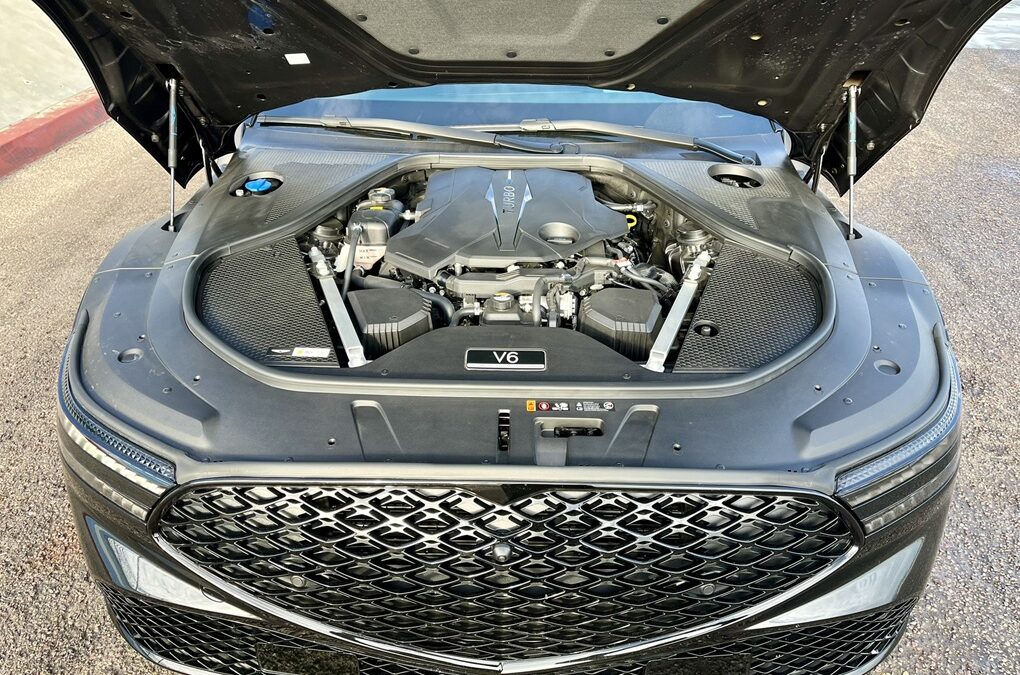
The Genesis G90 V-6 builds on the 3.5-liter powertrain with a 48-volt e-Supercharger for mild hybrid technology. Turbocharging and supercharging give the G90 E-SC performance lift. Its power ratings are 409 horsepower and 405 foot-pounds of torque, with torque available from a low 1,300 rpm up to 4,500 rpm. The 48-volt e-supercharger tightens launch force, closing the gap between turbo-spooling and forceful acceleration.

Fuel economy ratings are 17/22/20 mpg using the recommended premium fuel. Expect a cruising range of nearly 400 miles from its 19.3-gallon tank.

The Genesis G90 Black has a curb weight of 5,194 pounds.

Looking at the 409 hp supercharged V6 in the 2026 Genesis G90 sedan

The G90’s 409-hp twin-turbocharged and supercharged 3.5-liter V-6. (Mark Maynard photo)

G90 Prestige Black features include:

Exterior accents: Gloss black grille, door handles, fascia, daylight opening moldings

Wheels: 21-inch black alloy wheels with floating center caps

Interior: Black monotone semi-aniline Nappa leather with quilting

Trim: ‘Black Ash’ open-pore wood with brass-colored G-Matrix inlay

Controls: Black switches, air vents, buttons, shifter

Audio: Anodized black speaker grilles

Technology: LCD welcome and goodbye animation, infotainment theme, and sound

Key Fob: Prestige Black, exclusive

Brakes: Black monobloc four-piston fixed front calipers, black rear calipers

Headlights: Black inner bezels

Emblems: Dark Genesis Guilloché emblem (front), dark lettering (rear)

21 inch black wheels on the G90

The G90 Prestige Black is fitted with 21-inch black wheels.

Genesis Warranty Coverages

Genesis warranty coverage is gold class. Bumper-to-bumper new vehicle coverage is for 5 years or 60,000 miles, and powertrain coverage is for 10 years or 100,000 miles.

And there is greater gold in owner care:

  • 3-years/36,000-miles complimentary maintenance and service valet;
  • 3 years of free map updates;

And 3 years of free Genesis Connected Services, which include:

Connected Care: Safety and maintenance services, including automatic collision notification, enhanced roadside assistance, and monthly vehicle health reports.

Remote: Convenience features include Remote Start with Climate Control, Remote Door Lock/Unlock, and Stolen Vehicle Recovery.

Guidance: Navigation-related services such as Destination Search and Send-to-Car.

The connected services are accessed through the vehicle’s infotainment screen, the Genesis website, smartphone app, or Smartwatch.

For those buying a used 2023 or newer Genesis vehicle, there is still free access to safety and maintenance features. However, a subscription is required to use the convenience and remote technology features included in the Remote and Guidance packages. The cost for each of these packages is $9.90 per month or $99 per year.

For more information, visit the Genesis Owners website or contact Genesis customer support here.

A close detail image of the refined trim treatment on the inside door panel

The cabin has Black Ash open-pore wood trim and black-finished controls throughout.

 Genesis Service Valet

An outstanding buyer incentive is the Genesis Service Valet, a free program for the first three years of ownership.

Key features include:

  • Vehicle pickup and return: Schedule maintenance or repairs online or via the Genesis mobile app. A dealership representative will pick up your vehicle from your chosen location.
  • Free loaner vehicle: Genesis provides a loaner vehicle while servicing your vehicle.
  • Flexible scheduling: Choose times and locations for pickup and return of your vehicle.

For more details or to schedule a Service Valet appointment, visit the Genesis Owners website here.

2026 Genesis GV80 Prestige Black AWD Specifications

Body style: 5-passenger, 5-door midsize luxury SUV; composed primarily of advanced high-strength steel

Engine: 375-hp 3.5-liter direct-injected and twin-turbocharged V-6, 391 lb.-ft. torque from 1,300-4,500 rpm; with idle stop-start

Transmission: 8-speed shiftable automatic with terrain-mode select all-wheel drive for snow, mud, sand

Fuel economy: 16/22/19 mpg city/hwy/combined; premium fuel recommended but not required

BY THE NUMBERS

Coefficient of drag: 0.33 Cd

Fuel tank: 21.1 gallons

Cargo space: 38.7 cubic feet (behind 2nd row); 71.1 cu. ft. max

Front head/leg room: 40.2 / 41.6 inches

Rear head/leg room: 38.4 / 38.7 inches

Length/wheelbase: 194.5 / 116.3 inches

Curb weight: 5,250 pounds

Turning circle: 39.3 feet, with 22-inch tires

Towing capacity: 6,000 pounds

Safety features include:

  • 10 air bags
  • Forward collision-avoidance assist
  • Blind-spot view monitor
  • Lane keeping and lane following assist
  • Smart cruise control with stop & go
  • Surround view monitor
  • Rear cross-traffic collision-avoidance assist

CHASSIS COMPONENTS

Brakes: Monobloc front brakes with black calipers; ventilated 14.9-inch front rotors, 14.2-inch rear rotors

Steering: Electric power-assisted rack-and-pinion

Tires-wheels: 22-inch black alloy wheels with all-season tires; 265/40R22; temporary spare

Suspension: Electronically controlled four-wheel independent with front/rear stabilizer bars; with Road Preview; electronic limited-slip differential

PRICING

GV80 Prestige Black Base price: $83,250, including $1,495 freight charge; price as tested: $85,395, with metallic paint

Where assembled: Ulsan, South Korea

Warranty: 3-years/36,000-miles complimentary maintenance and service valet; 3-year map updates; free

Genesis Connected Services; 5-years/60,000-miles bumper to bumper; 10-years/100,000-miles powertrain

Curtiss Condor Bomber and Civilian Condor

Curtiss Condor Bomber and Civilian Condor
A 1929 black and white photo of a Curtis Condor bomber

This original photo of the Curtiss Condor B-2 bomber was taken at the Curtiss Aerospace development plant in Garden City, N.Y. The image is dated Aug. 14, 1929. (Photo from the Paul S. Maynard archive)

The Curtiss Condor B-2 bomber became known as a ‘Flying Battleship’

BY MARK MAYNARD

Long before the current-generation B2 Spirit “Stealth Bomber” by Northrop Grumman there was the Curtiss Condor B-2 bomber built for the U.S. Army.

It was an enormous fabric-covered biplane aircraft with a wingspan of 90 feet and a length of 47 feet 4 inches. With its armaments, it became known as a “Flying Battleship,” but its use was short-lived.

According to its page in Wikipedia, the B-2 Condor’s two engines sat in nacelles between the wings, flanking the fuselage. It had a twin set of rudders on a twin tail, a configuration that was becoming obsolete by that time. At the rear of each nacelle was a gunner position. And there was another gunner in the nose.

As a twin-engine heavy bomber, the B-2 Condor was powered by two 650-horsepower Curtiss GV-1570-7 Conqueror V-12 water-cooled piston engines.

In a report by Joe Baugher (Encyclopedia of American Aircraft), the engines were housed inside nacelles mounted on top of the lower wing. “The engines were cooled by rather angular radiators that jutted up vertically from each nacelle.

“One of the more unusual innovations introduced by the [second prototype] XB-2 was the addition of a defensive gunner position in the rear of each nacelle. It was hoped that this arrangement would offer a clearer field of fire for the gunners than the more conventional fuselage-situated positions. An additional gunner position was provided in the nose. Each position was provided with a pair of Lewis .30-06 machine guns.”

According to the Baugher report, the Condor’s bombload was typically 2,508 pounds but could be increased to 4,000 pounds on short flights.

Curtiss Condor Competitors

The Curtiss Condor B-2 competed against the Keystone XB-1B, the Keystone XLB-6, the Sikorsky S-37B, and the Atlantic-Fokker XLB-2, according to the Baugher report.

“When an Army board of review met in February of 1928 to decide which design was to be awarded a contract, they immediately ruled out the XB-1B, the XLB-2, and the S-37. However, the board was unable to decide between the XB-2 and the XLB-6. The XB-2 had the better performance, but the XLB-6 was only $24,750 per unit.

“The per-unit cost of the B-2 was $76,373, more than three times the cost of a Keystone bomber. In a split decision, the Board opted for the Keystone design, but on June 23, 1928, Curtiss was given a contract for two B-2s (Serial nos. 28-398/399). A further 10 were ordered in 1929 (29-28/37).

“The twelve production B-2s were delivered from May 1929 to January 1930. Notable differences from the XB-2 included the use of three-bladed propellers and somewhat shorter and wider radiators mounted on top of the engine nacelles.

At sea level, the Curtiss Condor had a maximum speed of 132 mph — though many reports say it struggled to reach that max V — and 128 mph at 5,000 feet. The plane had a cruising speed of 105.5 mph and a cruising range of 805 miles.

End of the Condor Line

During the early 1930s, the advances in bomber design were so rapid that canvas-covered biplanes such as the B-2 rapidly became obsolete, Baugher wrote.

“Consequently, the B-2 served only briefly with the Army, being taken out of service in 1934. The last B-2 was surveyed in July of 1936. So far as I am aware, none survives today.”

After production of the B-2, Curtiss Aircraft left the bomber business, concentrating on the Hawk series of pursuit aircraft in the 1930s.

A 1929 black and white photo of a civilian version of the Curtis Condor bomber

The civilian version of the Curtiss Condor, circa 1944,  was the first airliner in the world to provide sleeping berths. (Photo from the Paul S. Maynard archive)

The Civilian Curtiss Condor

The Model 53 was an airliner version of the Model 52 Condor B-2 bomber. The Condor was the first airliner in the world to provide sleeping berths.

The Army permitted this development in 1928, and the first of the new aircraft made its maiden flight in June 1929. The civilian B-2 was an 18-seat passenger aircraft called the Condor 18 (also known as the Condor T32), according to HistoryOfWar.org.

At the time, there was a need for sleeper-transports, and the simplicity of design allowed for quick production and delivery to serve this market, according to HistoryOfWar. The Curtiss Condor could carry 12 passengers as a sleeper-transport or 15 passengers for day transport.

Luxury Cabin Accommodations

The Condor was the first multi-engine airliner with an electrically operated retractable landing gear. To help absorb vibration, the Condor was the first to have its engines mounted on rubber bushings.

The passenger cabin was appointed in fabric and leather, and each seat had individual hot and cold air vents.

The lavatory featured a basin with hot and cold running water, a mirror, and a vanity. However, the Condor remained in airline service for only three years, making it the last biplane purchased for civil transport.

Only a short time afterward, the all-metal airliners, the Boeing 247 and Douglas DC-1, made their debut in 1933. The only competing factor that the Condor had with the modern airplanes was that it had retractable landing gear.

Two 710 hp Wright SCR-1820-F3 Cyclone, 9-cylinder radial engines powered the passenger Condor.

Condor Flight History

The first civilian Condor converted from a military Model 52, flew for the first time on July 21, 1929. Including the prototype, six were built. Of these, the first three were converted from bomber model 52s. They operated with TAT and Eastern Air Line, though only for about a year. The Conqueror’s development was never quite completed, and in 1932 the US Army, after spending large sums on it, withdrew support and turned to air-cooled engines.

CURTISS B-2 CONDOR SPECIFICATIONS

Twin-engine heavy bomber biplane. Initial production version; 12 built.

Crew: 5; two wing gunners, the nose gunner, pilot, and co-pilot.

Length: 47 feet 4 inches

Wingspan: 90 feet

Empty weight: 9,300 pounds

Gross weight: 16,951 pounds

Powerplant: 2 × Curtiss GV-1570-7 Conqueror V-12 water-cooled piston engine, 600 hp each

PERFORMANCE

Maximum speed: 132 mph

Cruising speed: 105.5 mph

Range: 805 miles

Service ceiling: 17,100 feet

Rate of climb: 850 feet/minute

ARMAMENT

Guns: 6 .30-06 caliber Lewis machine-guns

Bombload: 2,508 pounds

Note: This is another image from my dad, Paul Smith Maynard, who worked four decades in aviation as an engineer. Dad began his career in about 1943 after graduating from West Virginia University. He started with Curtiss-Wright Corp., a pioneer in making flying machines. He went on to work at North American Aviation and Rockwell International.

See more of his vintage plane pics here.