Select Page

Kia Carnival MPV Review

Kia Carnival MPV Review

The 2023 Kia Carnival is an ark of accommodation. Its lean styling is a refreshing reset to the typical minivan’s big hips and broad beam

An exterior view of the blue Kia Carnival in front of a train station

The 2023 Kia Carnival MPV SX Prestige tester was $49,285 with three options. (Mark Maynard photos or as credited)

Jump to Features

The Last Honest Vehicle
Pricing
New for 2023
Interior Function
Back Seats and Cargo
Powertrain and Performance
Ride and Handling
Why Buy the Kia Carnival?
Specifications

BY MARK MAYNARD

I see the look in fathers’ eyes as they follow my slow cruise in the Kia Carnival MPV through the beach parking lot. It is a look of envy — with resignation that their lot in life could be so much easier with that damn M-word — minivan. But, no, their hands and their partner’s hands are struggling to untangle a stroller from a crowded trunk while they schlep armloads of a trike, scooter, and a stuffed duffel of clothes and snacks for when everybody is wet, tired, and cranky.

There is much irrational venom directed at this most-efficient mode of moving people. It is as if the minivan represents swallowed pride to make the best of a sad situation.

I count my blessings that this stage has passed in my life. But I always enjoyed testing minivans. Not for their lively drivability but for an hour or so of free time. I’d park the latest test minivan in the driveway, and the kids would want to do homework or watch a movie. It was a secure space that would give me 45 minutes of peace and quiet … for laundry or cooking.

There is comfort and security in the family minivan. It is the modern ark of accommodation. Sure, bring a friend or three. And parents can pull the seats for room to haul furniture … to usher that college kid to the college dorm.

Minivans are built for comfort and accommodation. They are part lounge and part romper room. And any minivan with a combustion engine will get better fuel economy and cost less to maintain (tires and suspension elements) than a comparably sized SUV.

Driver controls are smartly placed and ergonomically designed.

Driver controls are smartly placed and ergonomically designed.

The Last Honest Vehicle

Unlike the SUV, the minivan is the last honest vehicle made today. Minivans don’t have to be something other than what they were intended. A minivan does not need sport bucket seats with their annoying in-your-crack bottom bolsters. A minivan doesn’t need paddle shifters. They surely don’t need a tachometer, which might be the most worthless space-cluttering element in the driver’s gauge display for an automatic-transmission vehicle. And they don’t need a Sport mode to turn the gauge display red.

Manufacturers have tried to sportify the minivan to little avail. Sporty features, such as aerodynamic fairings and hot wheels, just added to the cost. Today, the minivan segment is small: the Chrysler Pacifica, Honda Odyssey, Toyota Sienna, and today’s tester, the Kia Carnival MPV.

Kia has sold a minivan in the U.S. since 2002 called Sedona. It was unremarkable at the time when compared to the competition from Honda, Chrysler, and Toyota. But it did get high marks for safety from NHTSA and IIHS.

Undeterred, Kia moved forward with a second generation in 2005 as a 2006. A third generation came along in 2014 as a 2015. And now, the fourth generation debuted in North America in Feb. 2021 as a 2022 model. The 2022 redesign included adding Kia’s global nameplate Carnival MPV, or multi-purpose vehicle.

There isn’t a beauty competition for a minivan — it just can’t be ugly. Except for the Kia Carnival, there is dowdy minivan DNA in the exterior styling of the competitors, mainly in the big hips and a broad beam. The Kia Carnival, however, looks more like a business attaché. It has lean lines without contrived curves or bulges to hint at “sport.” The Carnival’s styling is legitimate and contemporary.

The 12.3-inch-wide navigation screen

A 12.3-inch navigation screen. (Kia)

2023 Kia Carnival Pricing

All models of Carnival are front-wheel drive with no option for all-wheel drive. For that traction capability, minivan shoppers must consider the Chrysler Pacifica or Toyota Sienna.

The 2023 Kia Carnival MPV is sold in four trim levels of LX, EX, SX, and SX Prestige. Pricing starts at $34,465 for the LX, and there is an LX Seat Package model for $36,465; it adds eight-passenger seating with SynTex upholstery and second-row slide-flex seat adjustment.

The midrange EX and SX start at $39,965 and $43,165.

The SX Prestige tester starts at $47,565 and was $49,285 with three options:

  • Astra Blue paint ($495);
  • Rear seat entertainment package ($1,000);
  • Carpeted floor mats ($200, for three rows).

All MSRPs include the $1,395 freight charge from Gwangmyeong, Korea.

For current Carnival pricing and incentives, go to Kia.com

VIP lounge seating with power controls.

VIP lounge seating with power controls.

What’s New On the 2023 Kia Carnival?

With the Carnival’s debut just a year ago, updates for 2023 are a minor shuffling of features for the SX and SX Prestige models. And there were price increases of $800 for the LX and EX models and $500 for the SX; the freight charge went up by $70.

SX

  • Integrated panoramic 12.3-inch digital cluster and 12.3-inch center display are now standard;
  • Blind-Spot View Monitor is now standard;
  • Dual screen rear seat entertainment and streaming media package was added as a $1,000 option.

SX Prestige

  • 8-passenger Slide-Flex Seating with second-row center multi-function seat is now standard;
  • Dual screen rear seat entertainment system and streaming media capability is a new $1,000 option;
  • 2nd row VIP Lounge Seats is a no-cost option, replacing 2nd-row Slide-Flex Seats. The seat package is for seven-passenger seating and adds a pair of power-operated VIP lounge seats that recline with leg support and an adjustable headrest. The seats also are heated and ventilated.
The video Passenger View display.

The video Passenger View display.

Carnival Interior Function

Space is the luxurious frontier of a minivan. And while the Kia Carnival is not a luxury vehicle, its refinement of interior materials, switchgear, and touchpoints are of rewarding quality.

The Carnival cabin has big-and-tall front headroom of 40.9 inches and shoulder room (door to door) of 64.2 inches, which is 2.6 inches wider than the Kia Telluride SUV.

Sightlines for the driver are unobstructed at the side mirrors and across the hood. Of special value is the around-view camera with overhead and forward views. The camera can be switched on when inching forward in a parking slot or the garage.

There is no stress to step in and buckle up, and definitely no need for running boards, but there is still an elevated ride height for a clear view down the road.

The interior design is fresh with no old-fogey faux wood trim, just clean metallic trim elements. All controls are smartly placed and ergonomically designed.

The shift console is a functional work zone with cup holders divided by a phone slot. A charging e-bin includes a wireless pad and USB charging ports. Small storage areas are handily placed throughout, including a large armrest box.

Rather than a flip-down conversation mirror to keep an eye on children, Kia has a video passenger view and talk function. It is accessed through the main 12.3-inch wide screen and can be set up as a one-touch button on the steering wheel.

The third row seats in the Kia Carnival

Third-row legroom of 35.6 inches is up to 3 inches less than in some competitors.

Back Seats and Cargo Space

Sliding side doors are a parent’s friend — power-operated and foot activated. The openness of the doors allows a parent to get close to the child seat for buckling without hoisting a child up into an SUV seating position.

The driver has controls to open and close either side door, which is helpful for the school taxi when admitting your charges, especially when there is rain or snow.

I would prefer the standard three-position second row; it has more family function than the VIP Lounge seats that are exclusive to the SX Prestige. With the eight-seat configuration, the second-row seats can be removed, or just the center seat removed for an aisle pass-through to the third row.

Kia adds a nifty feature of slide-flex seat adjustment. Both window seats can be moved manually inward by a couple of inches. The side movement is beneficial with the VIP Lounge seats, which cannot be removed and do not have a fold-and-tumble design for third-row access. The side flex isn’t much, but it doesn’t take much for a kid to slip by and into the third row.

Lounge seats (heated and ventilated) seem like a cool idea, cruising in a La-Z-Boy style with legs supported. But the full recline position made me feel propped up and vulnerable. It might seem more special when parked and watching a movie. I felt uncomfortable (safe) with the sizeable iPad-like video screens so close on the front seatbacks.

There is adult legroom in the second row — a max of 40.5 inches if a tall person is not sitting ahead. But a tall adult might not feel comfortable in full recline of the lounge seats.

The power panel for second-row climate controls.

Electronic second-row climate controls.

Carnival’s Third Row

There is no shortage of details for those in the third row. There are charging ports, an inset for cups or juice boxes, and a phone slot.

Headroom of 38.6 inches is adequate for adults of average size. However, the max legroom of 35.6 inches is up to 3 inches less than some competitors.
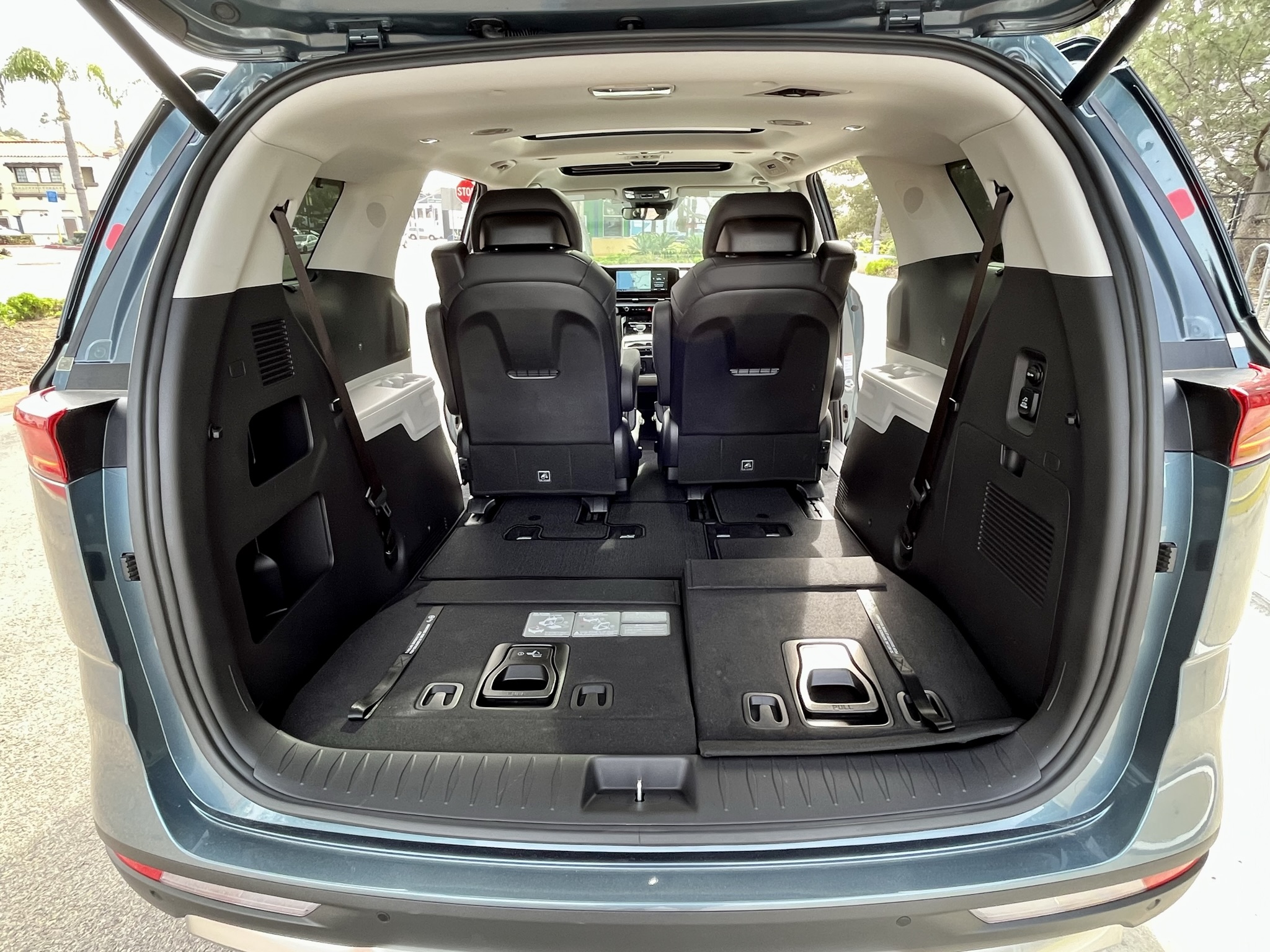
The Carnival cargo area with the third row folded

Fold the third row for 5 feet in length of flat storage.

Carnival Cargo Space

Carnival earns its cargo salt with the obligatory 4-foot width, as if owners will load sheets of plywood. As with most minivans, the waaay back has multi-function.

With the third-row seats in place, there is a deep well of steamer-trunk capacity that neatly corrals a multitude of grocery bags or whatever. Fold the 60/40 seatbacks to drop flat into the cargo well and a parent could roll in bikes and trikes or strap down a large dog kennel. The interior height of 40 inches is about 31 inches or less for a midsize SUV. With the third row folded there is flat space that is 5 feet in length.

The storage well in the cargo area when the third row seats are upright

Steamer-trunk cargo capacity behind the third row.

Carnival Powertrain and Performance

No overworked turbocharged four-cylinder for this Carnival. All models have the same V-6 and eight-speed automatic powertrain. The 290-horsepower direct-injected 3.5-liter V-6 has 262 foot-pounds of peak torque at 5,000 rpm.

Fuel economy ratings are 19 mpg city, 26 highway, and 22 mpg combined using the recommended 87 octane fuel. In my week of testing, the mileage around town was 19-21 mpg, and on the highway, I tooled along at 28.9 mpg, which might have gone higher had I not needed to exit.

With the generous 19-gallon fuel tank, thrifty drivers could expect a vacation-driving range of 500 miles or more.

Acceleration force is easy to modulate to maximize mileage or to put the hammer down for evasive action. There is no delay in acceleration response.
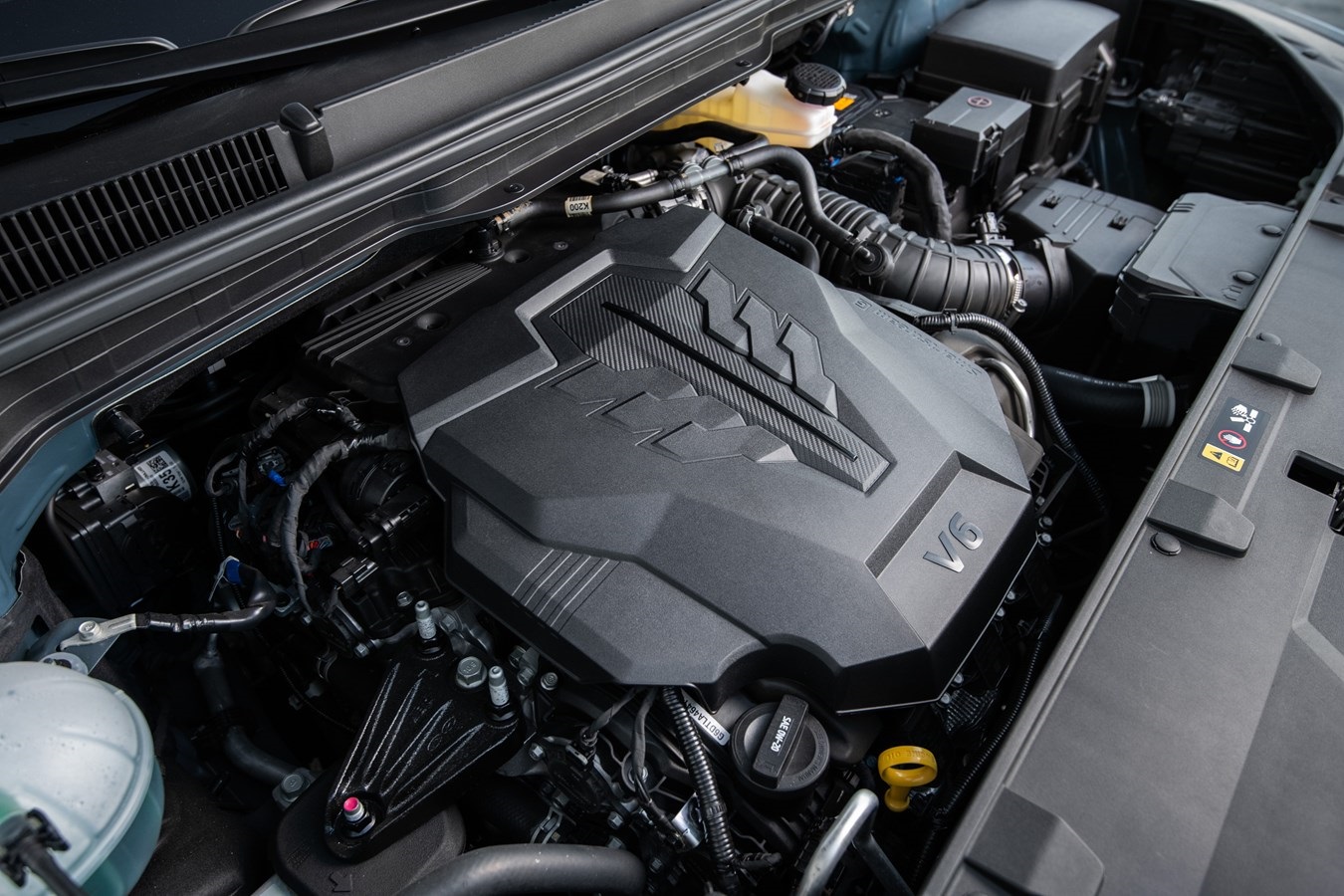
An open hood view of the 290-hp 3.5-liter V-6

The 290-hp 3.5-liter V-6. (Kia)

Carnival SX Prestige Ride and Handling

One of the most endearing aspects of minivan ownership is, generally, a forgiving ride quality. The Kia Carnival is especially adept at not tossing heads when pulling into driveways or when transitioning speed bumps.

The suspension is a well-engineered four-wheel independent setup with steel springs and gas-charged shock absorbers. The front has MacPherson struts and a multi-link at the rear.

Ride quality with the 19-inch Goodyear Assurance Finesse tires (235/55) was poised and carpet smooth — traits I did not expect from my past experiences with Goodyear Assurance tires. These tires are affordable and will cost between $220 and $250 each when replaced.

Advantageous is the light weight to the steering and very compact turning circle of 38 feet. It is possible to make a U-turn on most residential streets. Steering control, though light, is entirely on track while cruising at speed.

Four-wheel-disc braking engages with uncommon smoothness and direct engagement. Front and rear rotors are 12.8 inches, with ventilated discs at the front and solid discs rear. These discs are comparable to the competition’s and seem fit to handle a 3,500-pound trailer with brakes.

19-inch Goodyear Assurance Finesse tires and black alloy wheels.

The SX Prestige tester in 19-inch Goodyear Assurance Finesse tires and black alloy wheels.

Why Buy the Kia Carnival?

Minivan marketers have told me that once the children are out of the house, many parents hold onto their weary, old minivan. It’s just too convenient for its size.

If so, the Kia Carnival SX Prestige will be their upgrade minivan. The VIP seats will be a special perk for those travel getaways with friends.

And best of all, the Kia Carnival doesn’t look like a minivan.

The Carnival EX and SX trim levels are the meat and potatoes of family fare. And the package for rear seat entertainment is worth the $1,500 option. It’s the price for 45 minutes of rest time for parents.

A rear view of the Astra Blue Carnival

The Kia Carnival has a very compact turning circle of 38 feet. (Kia)

Kia Carnival SX Prestige Specifications

Body style: large 7- to 8-passenger front-wheel-drive minivan

Engine: 290-hp, direct-injected 3.5-liter V-6; 262 lb.-ft. torque at 5,000 rpm

Transmission: 8-speed automatic

Fuel economy: 19/26/22 mpg; 87 octane

Towing capacity: 3,500 pounds

BY THE NUMBERS

Fuel tank: 19 gallons

Cargo space: 40.2 to 86.9 cubic feet

Front head/leg room: 40.9/41.1 inches

2nd-row head/leg room: 39.5/40.5 inches

3rd-row head/leg room: 38.6/35.6 inches

Length/wheelbase: 203/121.7 inches

Curb weight: 4,727 pounds

Turning circle: 38 feet

FEATURES

SX Prestige standard features, include: smart-key entry and push-button ignition, electric parking brake, surround-view monitor, 12.3-inch dual panoramic displays for driver gauges and navigation, blind-spot view monitors (side mirror image display in driver gauges); smart cruise control with stop-and-go; dual power tilt and slide sunroof; LED projection headlights and LED rear combination lights; LED interior lighting; leather-trimmed upholstery; heated and ventilated front and rear seats; Bose premium audio; heated steering wheel; auto-dimming rearview mirror with Homelink controls, passenger view (camera) and passenger talk.

Safety features include: 7 air bags (including driver’s knee bag), rear occupant alert with ultrasonic sensors, parking distance warning forward and reverse

Driver-assist technologies, include: forward collision-avoidance assist with cyclist and junction turning; blind-spot collision-avoidance assist; rear cross-traffic collision-avoidance assist; driver attention warning and high-beam assist; lane-keeping assist and lane-following assist; parking collision-avoidance assist reverse; safe exist assist; highway driving assist.

PRICING

Base price: $47,565, including $1,395 freight charge; price as tested $49,285

Options on test vehicle: Astra Blue paint $495; rear seat entertainment package $1,000; carpeted floor mats $200, for three rows.

Where assembled: Gwangmyeong, Korea

Warranties: 10-years/100,000-miles powertrain; 5-years/60,000-miles bumper to bumper with roadside assistance

Corvette E-Ray Overview

Corvette E-Ray Overview

The 2024 E-Ray is the quickest production Corvette in history, clocking a 2.5-second 0-60 mph time before passing the quarter mile in 10.5 seconds

An exterior view of the E Ray

The 2024 Corvette E-Ray goes on sale later this year with an MSRP of $104,295 for the 1LZ coupe and $111,295 for the 1LZ convertible model. (Photos courtesy of Chevrolet)

BY MARK MAYNARD

The Corvette had a second day of infamy yesterday when Chevrolet released photos and many details for its 2024 Corvette E-Ray. It will be the first electrified Corvette with all-wheel drive and a gasoline-electric hybrid powertrain using the 6.2-liter V-8.

For Corvette enthusiasts, the E-Ray reveal on Jan. 17 is exactly 70 years after the 1953 Corvette debuted at Motorama in New York City.

“In 1953, the enthusiastic reaction to the Chevrolet Corvette concept kicked off seven decades of passion, performance and American ingenuity,” Mark Reuss, General Motors president, said in a statement. “E-Ray, as the first electrified, all-wheel-drive Corvette, takes it a step further and expands the promise of what Corvette can deliver.”

The 2024 E-Ray — available as a removable roof coupe or hardtop convertible — pairs two separate propulsion systems. The gasoline-electric hybrid system provides naturally aspirated V-8 power with a permanent magnet electric drive motor and a 1.9 kWh lithium-ion battery pack between the seats.

“The electrification technology enhances the feeling of control in all conditions, adding an unexpected degree of composure,” said Tadge Juechter, chief executive engineer, Corvette.

E Ray driver area with bright blue leather interior.

E-Ray’s interior choices include 2 carbon fiber trim packages, 3 seat choices, and 7 interior colors.

E-Ray Performance

The E-Ray is the quickest production Corvette in history, Chevrolet says. The E-Ray will accelerate to 60 mph in 2.5 seconds (a tenth of a second faster than the track-ready Corvette Z06) and complete the quarter-mile in 10.5 seconds.

Achieving such quickness and top speed is notable for the Corvette. According to Chevrolet, the E-Ray has a base dry weight of 3,774 pounds for the coupe and 3,856 pounds for the convertible. That is around 400 pounds heavier than the Stingray and about 300 pounds more than the Z06 equipped with carbon fiber wheels and the Z06 Performance package. The curb weight, with fuel, etc., will be higher.

Chevrolet is developing a fully battery-powered Corvette, but officials have not said when that model might arrive.

Driver side 3/4 view of 2024 Chevrolet Corvette E-Ray 3LZ convertible with Natural Tan Interior.

A 2024 E-Ray 3LZ convertible with Natural Tan Interior.

2024 Corvette E-Ray Pricing

The 2024 Corvette E-Ray goes on sale later this year with an MSRP of $104,295 for the 1LZ coupe and $111,295 for the 1LZ convertible model.

A base 2023 Corvette Stingray coupe starts at about $66,000 or $74,000 for the Stingray convertible. The Corvette Z06 starts at $110,00 for the coupe and about $117,000 for the convertible.

Z06 pricing includes $2,600 for the gas-guzzler tax. Will the E-Ray avoid the GGT?

E-Ray production will be at GM’s Corvette assembly plant in Bowling Green, Ky.

More information and specifications will be released closer to the on-sale date. Follow E-Ray developments at Chevrolet.com.

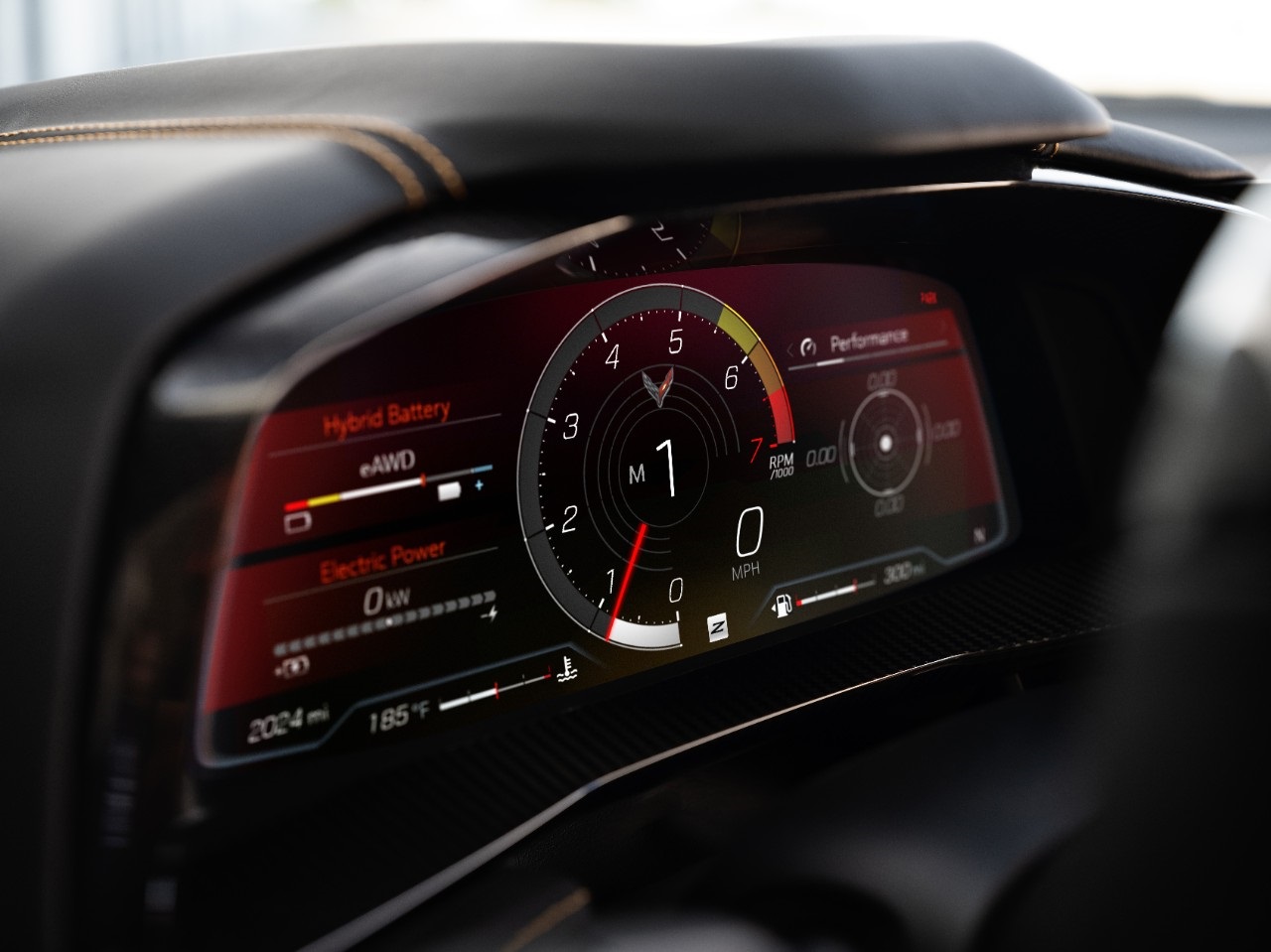
Close up view of gauges layout on E-Ray Performance App

The E-Ray Performance App on the infotainment screen.

E-Ray Hybrid Powertrain

The 6.2-liter LT2 small-block V-8 is paired with an eight-speed dual-clutch automated-manual transmission. The gas engine puts 470 foot pounds of torque at 5,150 rpm to the rear axle. The permanent magnet electric drive motor puts another 160-hp and 125 lb.-ft. of torque through the front wheels.

In total, E-Ray produces a combined 655 horsepower from the electric motor and V-8.

The engine’s Active Fuel Management system uses the electric motor to run on four cylinders, such as when coasting at highway speeds.

The amount of electric assist varies for the Corvette E-Ray’s six driver-selectable modes: Tour, Sport, Track, Weather, My Mode, and Z-Mode. Drivers can also select the Charge+ feature to maximize the battery’s state of charge.

Chevrolet says it has created a “visceral sound experience” for the combined powertrain. And to keep peace with neighbors, a Stealth Mode allows all-electric driving at start-up. The quiet mode will hold until the engine fires at 45 mph for everyday driving.

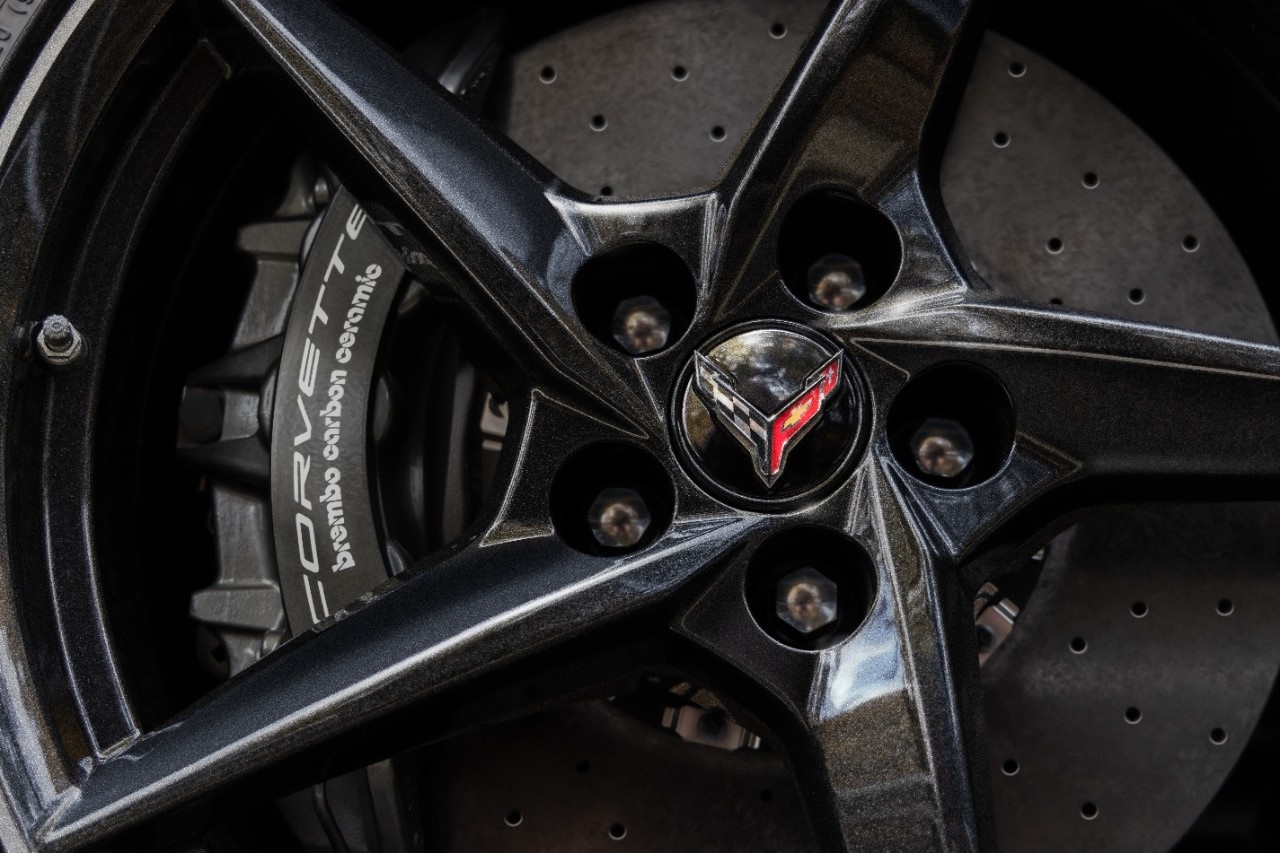
E Ray gloss black wheel finish

The E-Ray has 15.7-inch brake discs at the front and 15.4-inch discs rear.

Intelligent eAWD

E-Ray’s eAWD system continually learns the road surface, Chevrolet says. The so-called intelligent system seamlessly adapts to traction conditions and driver input. During enthusiastic driving and in low traction road conditions, E-Ray’s eAWD system enhances vehicle stability by directing additional power to the front wheels.

E-Ray Features and Technologies

  • New lightweight lithium-ion 12-volt battery for stop/start functionality
    of the gas engine;
  • Standard Brembo Carbon Ceramic brake system;
  • Standard Magnetic Ride Control 4.0 with three suspension settings;
  • Staggered 20- and 21-inch wheels with Michelin Pilot Sport all-season tires. (Michelin Pilot Sport 4S summer tires are available with an optional performance
    package.)

The E-Ray Performance App on the infotainment system provides the driver with technical insights into how the propulsion system is operating. There are three primary display layouts:

  • Gauges (displays dynamic power output from electric motor and V-8 engine);
  • Dyno (provides a graph of power/torque across selectable time intervals) ;
  • Data (showcases electrical system performance and efficiency).
Overhead view of the Silver Flare with Electric Blue stripe package.

The Silver Flare with Electric Blue stripe package.

E-Ray Exterior Design

The E-Ray is built from the wide-body Corvette Z06. The wider body accommodates wide staggered-width wheels to help manage the increased torque. The lightweight alloy wheels have a twisted five-spoke star design exclusive to E-Ray.

The Corvette E-Ray’s compact electric motor over the front axle preserves space in the front trunk.

Rear 7/8 view of an E-Ray coupe in Seawolf Gray parked in a parking garage.

The E-Ray’s low, wide stance is 3.6 inches wider overall than the standard Stingray model.

Corvette E-Ray Design Highlights

  • 4 aluminum wheel finishes;
  • 14 exterior color choices — including new for 2024 Riptide Blue, Seawolf Gray, and Cacti;
  • E-Ray-exclusive body-length stripe package in Electric Blue;
  • Standard carbon flash badging;
  • Available black exhaust tips and bright badging;
  • Available carbon fiber ground effects;
  • Optional carbon fiber wheels in carbon flash, visible carbon fiber finish or visible carbon fiber with a red stripe;
  • New  Artemis Dipped interior, available on 2024 Corvettes. The treatment features deep green tones throughout the cabin. Other options for interior design include two carbon fiber trim packages, three seat choices, seven interior colors, and more.

Cadillac Debuts Hydra-Matic Drive for 1940

Cadillac Debuts Hydra-Matic Drive for 1940

Advertising in 1940 proclaimed GM’s Hydra-Matic Drive Transmission as “the greatest advancement since the self-starter”

A black-and-white PR photo of a Cadillac Sixty-One coupe.

The1941 Cadillac Sixty-One five-passenger coupe was touted as ‘the mightiest, thriftiest, lowest-priced Cadillac V-8 ever built.’ (GM Media Archive)

BY MARK MAYNARD

In 1939, General Motors’ Cadillac and Oldsmobile divisions introduced breakthrough technology in the fully automatic Hydra-Matic Drive transmission. The transmission debuted for the 1940 model year.

“The Hydramatic was the first mass-produced fully-automatic transmission developed for passenger automobile use,” according to its page in Wikipedia.

Shiftless transmissions had been a focus during the 1930s. Then, as now, shifting a manual gearbox required more effort than most drivers cared to exert.

According to the Wiki story, automakers were in the fast lane to develop a transmission that reduces or eliminates the need to shift gears.

“At the time, synchronized gear shifting was still a novelty (typically only for higher gears). The exception was Cadillac’s breakthrough synchromesh fully synchronized manual transmission.”

The synchromesh transmission was designed by Cadillac engineer Earl A. Thompson and introduced in the fall of 1928.

Developing a Shiftless Transmission

By the early 1930s, Thompson had begun work on a “shiftless” transmission. His pioneering work led to creating a new department within Cadillac Engineering. Headed by Thompson, the transmission group included engineers Ernest Seaholm, Ed Cole, Owen Nacker, and Oliver Kelley.

“During 1934, the Cadillac transmission group had developed a step-ratio gearbox that would shift automatically under full torque,” according to Wikipedia. “This group of engineers was then moved into the General Motors Research Laboratory, building pilot transmission units during 1935-36. The transmission then went to Oldsmobile for testing.

a 1940 color print ad for General Motors' new Hydra Matic fully automatic transmission

All Cadillac models for 1941 could be optioned with the Hydra-Matic. (GM Media Archive)

The group effort led to the so-called Automatic Safety Transmission. The AST was a semi-automatic transmission using planetary gears and a conventional friction clutch. Drivers were still required to use the clutch to shift into or out of gear, but not between the two forward gears.

Oldsmobile offered the AST from 1937-1939, while Buick offered it only in 1938.

The next step was the Hydra-Matic. It combined the hydraulic operation of a planetary gearbox (for the automation of shifting) with a fluid coupling instead of a friction clutch, eliminating the need for de-clutching. The transmission would have four forward speeds plus reverse.

The transmission was named “Hydra-Matic Drive” and went into production in May 1939 for the 1940 model year.

Start of Hydra-Matic Production

The first Oldsmobiles so equipped were shipped in October 1939 in the Oldsmobile Series 60 and the Oldsmobile Series 70.

Oldsmobile was chosen to introduce the Hydra-Matic for two reasons:

  • Economies of scale — Oldsmobile produced more cars than Cadillac and Buick at the time, thus providing a better test base;
  • And to protect the reputation of Cadillac and Buick in case of a market failure of the new transmission. Advertising proclaimed it “the greatest advancement since the self-starter.”

In 1940, the Hydra-Matic was a $57 option (around $1,102 today). The price almost doubled for 1941, to $100 (or about $1,842 today). For the 1941 Cadillacs, the Hydra-Matic cost $125.

The transmission was a popular upgrade. Almost 200,000 cars had been optioned with the transmission by the time passenger car production was halted for wartime production in February 1942.

Curtiss-Bleecker SX-5-1 Helicopter

Curtiss-Bleecker SX-5-1 Helicopter
Curtiss-Bleecker Helicopter on the runway at Curtiss Wright in Garden City, N.Y.

The Curtiss-Bleecker Helicopter, shown in 1930 at the Curtiss-Wright R&D facility in Garden Grove, Long Island, N.Y. Designer Maitland Bleecker stands with his aircraft. (Photo from the Paul S. Maynard archive)

The 1926 Curtiss-Bleecker Helicopter was an American prototype rotary wing aircraft that just didn’t fly, at least long enough for production

BY MARK MAYNARD

Looking like an escapee from a “Mad Max” movie, the Curtiss-Bleecker Helicopter was an American prototype rotary wing aircraft that was introduced in 1926, according to its page in Wikipedia.

Maitland B. Bleecker, a junior engineer from the National Advisory Committee for Aeronautics, designed the Curtiss-Bleecker Helicopter. Curtiss Wright constructed the two-seat aircraft for $250,000 over four years at it development facility in Garden City, Long Island, N.Y.

The aircraft featured a rotary wing design with a single engine. Each rotor, painted silver and yellow, had an individual propeller for thrust. Thrust was distributed from the centrally mounted engine through shafts to propellers mounted on each rotor blade.

A trailing control surface called a “stabovator” changes the pitch of the rotor. The aircraft was controlled by a stick that operated like a modern helicopter collective control. Yaw was controlled with a “Spin Vane” that used downwash from the rotor to pivot the aircraft with foot pedals.

The aircraft’s first flight was in 1926. However, testing on the Bleecker Helicopter was stopped after the failure of a drive shaft on a test flight in 1929. By 1933 the project was abandoned following vibrational issues in further tests.

The Garden City Curtiss-Wright plant closed in 1932 during the depression. Some machines were moved to Buffalo, N.Y. Others remained at Garden City and were sold off from time to time, up to 1935 or 1936, according to a legal case filed by Garden City.

Maitland Bleecker was 99 when he died on Oct. 19, 2002.

CURTISS-BLEECKER HELICOPTER SPECIFICATIONS

Seats: 2

Wing area of rotor blades: 370 sq. ft.

Empty weight: 2,800 pounds

Gross weight: 3,400 pounds

Fuel capacity: 30 U.S. gallons

Powerplant: 1 420-hp Pratt & Whitney Wasp radial piston

PERFORMANCE

Maximum speed: 70 mph

Rate of climb: 1,000 ft/min

Toyota Tundra Capstone Hybrid Pickup Review

Toyota Tundra Capstone Hybrid Pickup Review

Tripping the white fantastic in the 2023 Toyota Tundra Capstone with its white-and-black leather cabin

The 2023 Toyota Tundra Capstone has an exclusive white-and-black leather interior. Capstone pricing starts at $77,040. (Photos courtesy of Toyota)

The 2023 Toyota Tundra Capstone has an exclusive white-and-black leather interior. Pricing starts at $77,040. (Photos courtesy of Toyota)

Table of Contents

Tundra Redesign Challenge
Tailgate Tricks
2023 Toyota Tundra Pricing
Hybrid-Related Warranties
iForce Powertrains and Fuel Economy
Interior Function
Ride and Handling
Intimidation Factor
Why Buy the Toyota Tundra Capstone?
Specifications

BY MARK MAYNARD

The Toyota Tundra pickup has long been dogging the tailgates of the Ford F-150, Chevrolet Silverado, GMC Sierra, and Ram 1500. Though the Tundra has always been capable, its presentation seemed dumbed down to fit an outdated perception of the American pickup. Even its exterior styling was a mashup of “Fordamrolet.”

With a thorough redesign for 2022, Toyota has elevated the Tundra with style and technologies — for better and worse.

A few years ago, at a big four-wheelers desert run, I watched a Tundra throwing rooster tails of synchronized sand art as it swept up a steep dune. It was a dealership truck (by the license plate) and optioned with the TRD package. The truck’s ability was remarkable because this stock Tundra always made it to the top of the big dune, while caged buggies and fat-tired crawlers failed. It seemed insulting to the modified rigs. And a prime selling opportunity.

Toyota learns and evolves quickly. The 2023 Toyota Tundra lineup has seven trim levels, from basic work trucks to high luxury. But more than the basic trucks, luxury models have been added steadily.

Now in its third generation, the new Tundra was introduced for 2022. It was designed in the U.S. and built in Texas at Toyota Motor Manufacturing (TMMTX) in San Antonio.

At long last, the restyled Tundra breaks loose from most comparisons to the Big 3 pickups and plows through the air with a mug that won’t be confused as a Fordamrolet.

But just as it is challenging to master a foreign language, there is something uniquely American about a pickup. And not all foreign makers can master the lingo. Toyota is catching up.

Front headroom is almost 10-gallon tall at 39.3 inches with Capstone’s standard panoramic moonroof.

Front headroom is almost 10-gallon tall with Capstone’s standard panoramic moonroof.

Tundra Redesign Challenge

“Technical muscle” was the Tundra design mantra for the 2022 makeover.

Inside the Tundra Capstone, the design group applied premium materials in high-contact areas, including wrapped armrests and pads across the dash and doors.

Toyota says that high-strength steel throughout the chassis increased rigidity considerably over the previous generation Tundra. Aluminum is used in critical areas to reduce weight. Frame cross members are more than doubled in size for reinforcement and additional rigidity. For the Limited model and above, the cab mounts to the frame with hydraulic mounts for a quieter ride.

Tundra’s bed of sheet-molded compound (SMC) is lightweight and extremely strong, backed by aluminum reinforcing cross members, Toyota says. An SMC bed is resistant to denting, impact dings, and rust corrosion.

Tundra Tailgate Tricks

There has been a small revolution in pickup tailgates. Some now offer a step-and-grab bar that folds away. Others have drop panels that form steps or accommodate a fifth-wheel trailer hitch. Some have a wider section for a work-site bench or even a connection for a Bluetooth audio system. Some have a tailgate measurement strip and indents for a cup or can.

Toyota’s innovation is the power tailgate release in the left-rear taillight. Just give it an elbow bump when walking up with an armload of gear, or release the tailgate from the key fob. And there is a power bed step at the driver-side left corner; the step lowers with the tailgate.

Toyota says that the Tundra tailgate benefits from light-weighting construction and is 20 percent lighter than the previous generation.

7 Tundra Trim Levels

As before, the new-gen Tundra is sold in two four-door body styles: Double Cab and CrewMax.

Double Cab models have bed-length choices of 6.5 feet or 8.1 feet. CrewMax models can have a 5.5-foot bed or the new 6.5-foot bed.

The 2023 Tundra lineup has seven choices: SR, SR5, Limited, Platinum, 1794 grades, TRD Pro, and Capstone. Rear-wheel drive is standard, with optional four-wheel drive.

At its introduction years ago, the Toyota Tundra Limited might have been the most luxurious choice. But as $70,000 has become the new $50,000 pickup, Toyota added a Platinum model and then the slightly more expensive 1794 with some Old West influences. The Tundra TRD, $9,000 more than the 1794, is the off-road package, but it’s pricey, starting at $70,000. And now the Tundra Capstone wears the luxury boots, and it is priced as such.

The Capstone is the halo choice with standard four-wheel drive, a CrewMax cab, 5.5-foot bed, and exclusive white-and-black leather cabin. Pricing starts at $77,000 or $79,000 with the one big factory option package. A wide range of accessories — including ball-hitch mounts, bed extenders, a dash camera, console safe, tie downs, racks, spray-on bedliner, or a hard tonneau cover — can nudge the price beyond $80,000.

High-luxury pickups don’t make practical sense, but they are impressive at the marina launch and equestrian events. Most Tundra sales are for midrange models, of course, but Toyota has to keep up with the Fordamrolets. And these country coaches are rich with options, including pearlescent paint, hand-tooled semi-aniline leather, and the most advanced technologies. If a passenger car can be so equipped, so can a pickup.

The 14-inch screen provides big-screen camera views.

The 14-inch screen provides big-screen camera views.

2023 Toyota Tundra Pricing

Tundra starting prices range from $38,760 for the entry rear-wheel-drive SR to $77,040 for the top-line Capstone iFORCE MAX with standard 4WD. Pricing includes the $1,795 freight charge from San Antonio.

The SR model is the basic work truck. Moving up to the SR5, $44,265, creates a more functional tow vehicle with a Class IV towing hitch and seven-pin wiring harness. Also included are tow-haul and tow-plus driving modes, 18-inch alloy wheels, and a power vertical or horizontal rear window.

The TRD Pro, $70,315, is factory primed for off-road capability. Its features include:

  •  Multi-terrain select with crawl control;
  •  A 1.1-inch lift with Fox shock absorbers;
  • Electronically controlled locking differential.

Special TRD Pro features include a heritage-like “Toyota” grille with LED light bar and marker lights, 18-inch matte-black forged-aluminum BBS wheels, and a 12-speaker JBL audio system.

The Capstone iFORCE MAX tester was $79,174 with these options:

  • Adaptive variable suspension with load-leveling rear height control air suspension $1,045;
  • Wind Chill Pearl paint $425;
  • Ball mount $65;
  • Non-skid spray-on bedliner $579.

Find current Tundra pricing and offers here.

Tundra Hybrid-Related Warranties

Toyota’s basic 36-month/36,000-mile new-vehicle warranty applies to all components other than normal wear and maintenance. Additional 60-month warranties cover the powertrain for 60,000 miles and corrosion with no mileage limitation.

Hybrid-related components, including the battery control module, hybrid control module, and inverter with converter, are covered for 8 years or 100,000 miles, whichever comes first.

The hybrid battery has coverage of 10 years or 150,000 miles, whichever comes first.

ToyotaCare covers regular factory-scheduled maintenance and 24-hour roadside assistance for two years or 25,000 miles, whichever comes first.

iForce Powertrains and Fuel Economy

Tundra has two 3.5-liter, twin-turbo iFORCE V-6 powertrains, both with a 10-speed automatic transmission. The transmission has a sequential shift mode, uphill-downhill shift logic, and tow/haul driving modes.

The sophisticated engine design uses Toyota’s D-4ST direct injection and port injection.

The entry V-6 for the SR trim has 348 horsepower and 405 foot-pounds of torque at 2,000 p.m. The uplevel engine for the rest of the models has 389 hp and 479 lb.-ft. torque at 2,400 rpm.

The i-FORCE MAX hybrid twin-turbo V-6 is available only in the TRD Pro and Capstone trim levels. The hybrid powertrain has 437 horsepower at 5,200 rpm, and 583 lb.-ft. of torque at 2,400 rpm.

Hybridization combines the V-6 and motor generator with a clutch in the bell housing between the engine and transmission. A 288-volt sealed nickel-metal hydride battery is under the rear passenger seats.

The motor generator adds power through the transmission. But parallel hybrid components function during engine start-up, EV driving, electric assist, and energy regeneration.

The electric motor does most of the work at speeds below 18 mph. Then the gasoline engine engages for power in the mid- and high-speed range. When using tow/haul mode, the engine is in full internal-combustion control.

a view of the i-FORCE MAX hybrid twin-turbo V-6 437 horsepower and 583 lb.-ft. of torque at 2,400 rpm.

The i-FORCE MAX hybrid twin-turbo V-6 437 horsepower and 583 lb.-ft. of torque at 2,400 rpm. (Mark Maynard photo)

i-FORCE MAX Performance

The torque is particularly well-suited for transporting livestock, boats, and travel trailers. The roll-on of acceleration is not abrupt and does not launch the truck with tire-spinning force. Instead, the power progressively moves out, preserving whatever is in or on the trailer and, perhaps, a bit of fuel.

Fuel-Economy Ratings

Though more powerful, the hybrid iFORCE MAX engine has the best EPA-mileage ratings of the Tundra line: 20 mpg city, 24 highway, and 22 MPG combined.

That mileage compares to the standard iFORCE V-6, with mileage ratings of 18/24/20 mpg for the SR trim and 18/23/20 mpg for the upper trims.

In my week of driving the hybrid iFORCE MAX, I worked up to a combined city-highway mileage rating of 15.6 mpg, with much highway cruising. With careful acceleration, the 32.2-gallon tank could stretch range to almost 500 miles.

A photo of the Captone's 22 inch alloy wheels and tires

The Capstone gets the largest Tundra wheel size of 22 inches.

Interior Function

Americans like big pickups because there is plenty of room in the cabin. The lowly passenger sedan has been mercilessly downsized to meet fuel economy and emissions standards.

With Capstone’s standard panoramic moonroof, Tundra’s front headroom is almost 10-gallon tall at 39.3 inches. There is room for large adults to spread out and plenty of storage and stash places.

Standard Capstone equipment is in the specs box at the end of this story. Among its luxury features are 10-way power seats, heated and ventilated. Power running boards are a welcome feature for a leg up to the front or rear seats.

A huge help in parking is the panoramic view monitor, which includes an overhead side-panel view panel of the truck. The color graphics are excellent on the 14-inch audio multimedia screen.

Back seat headroom is also tall (36.9 inches), and legroom is adult comfortable at 41.6 inches, even if there is a tall driver ahead.

The Tundra back seat

Back-seat legroom of 41.6 inches is adult comfortable, even if there is a tall driver ahead.

Ride and Handling

Tundra had been a hold-out for rear leaf springs, but a new multi-link suspension has replaced the old. The change to a more carlike suspension provides a smoother ride, especially when the bed has no weight.

The multilink suspension has not hurt towing or payload. The maximum towing capacity for Tundra increases 17.6 percent over the previous generation, to 12,000 pounds. Toyota says the maximum payload increases to 1,940 pounds, an improvement of more than 11 percent.

For the first time, a rear air suspension system is available with automatic and manual leveling functions. Another first for Tundra is the available Adaptive Variable Suspension system. Toyota says that AVS improves ride quality and handling by continually adjusting damping force based on road conditions.

You might mistake the semi-aniline leather for Lexus upholstery, but the ride quality is still pickup truck. The multilink suspension, and particularly the adaptive suspension, eliminates the empty-bed chatter on the highway, but without cargo, in the bed, you’ll know this truck has working-class roots.
Braking

To put the binders on a six-ton towing capacity (6,095 pounds at the curb) requires hefty brakes. The Tundra has power-assisted and ventilated four-wheel discs. The large, 13.9-inch front discs have opposed dual-piston calipers. The rear 13.6-inch discs use single-piston calipers.

While lesser trim levels have a max towing rating of 12,000 pounds, the Capstone is rated for 10,340 pounds.

A side view of the Capstone

The Tundra Capstone has a tow rating of 10,340 pounds and a max payload of 1,485 pounds.

The Intimidation Factor

The full-size pickup today is designed to be intimidating. These are the broad-shoulder linemen in the scrimmage for recognition. The bigger, the better, which works well in the open plains, mountain terrain, and desert regions. Not so much in the city.

With the intimidation factor, however, comes too much mass in the design solely to impress the competition. Depending on the cab size, whether extended or full and the bed length, a typical full-size pickup turning circle ranges from about 40 to 52 feet and more.

The wheelbase of the Tundra Capstone CrewMax is 145.7 inches (a tick over 12 feet), and this rig is 80.2 inches wide, not including the large side mirrors. Its width is comparable to the competition, and so is its length of 233.6 inches or 19.5 feet with its 5.5-foot bed. The Capstone’s turning circle isn’t terrible at 48.6 feet. But these packers are not nimble when navigating city streets. Parking is a consideration when heading out on errands.

The Capstone was like steering a stormtrooper in its Wind Chill Pearl (white) paint ($425) and two-tone white and black interior. The height of the hood opening is 4 feet from the ground and another half foot taller with the (unnecessary) hood bulge.

Sightlines across the wide hood and blunt front end are challenged. It takes time to become comfortable navigating city streets. The iForce Max hood scoops are like epaulets on a commander’s uniform — ornamental, but they show who has the big swinging sword. The pair of scoops flanking the hood are nonfunctional except to complicate sightlines at the fenders.

A close up of the nonfunctional hood scoops for the iMax hybrid engine.

The iForce Max hood scoops are ornamental.

Light Duty vs. Heavy Duty

The Big 3 competing pickups, however, also offer heavy-duty versions. These have higher tow ratings, spring rates, and payload capacity. The H-D models are typically a half-inch to an inch wider, a few inches taller, and about 10 to 18 inches longer. Toyota appears to split the difference by offering a one size Tundra with dimensions landing between half-ton and three-quarter-ton ratings, or light vs. heavy duty.

And that’s why the Tundra feels bigger than it needs to be. Driving the Capstone in town was like steering a stormtrooper in its Wind Chill Pearl (white) paint ($425) and two-tone white and black interior. The height of the hood opening is 4 feet from the ground and another half foot taller with the (unnecessary) hood bulge.

The iForce Max adds to the sightline complexity with a pair of non-functional “scoops” flanking the rear of the hood. They are ornamental — like epaulets on a commander’s uniform — but they show the troops who has the big swinging sword.

Sightlines across the wide hood, side mirrors and blunt front end are challenged, made more complex with the faux iForce Max scoops. It takes time to become comfortable navigating city streets.

Why Buy the Toyota Tundra Capstone?

All new full-size pickups on sale today offer pretty much the same thing. It just depends upon the church in which you believe. The brands copy each other and then make a modification to offer something unique. And then boast that their way is the truth and the light.

The Tundra will appeal to those disciples of Toyota. And in my experience, Toyota puts a little more effort into more precise engineering to do it right the first time.

The Tundra Capstone, with its white leather interior, isn’t a work truck or for the construction, boss pulling into muddy work sites. It’s not for the off-road adventurer. It’s not especially suited for the homeowner loading up at the building supply center. It can fill all those roles, but the Tundra Capstone will be most at home when hitched to a horse trailer for prestigious shows or riding events. You’ll also find the Capstone at the marina, steering a big boat down the ramp. In those venues, the Tundra Capstone will make a stunning statement — and vigorous use won’t cause undue harm to the pristine interior.

A studio shot of a rear three quarter view of the white Tundra

Hydraulic frame mounts provide a quieter ride on Tundra Limited and higher trims.

Toyota Tundra Capstone Specifications

Body style: full-size, 5-seat pickup with 5.5-foot bed

Engine: 437-hp, 3.5-liter, twin-turbocharged iForce Max V-6 Hybrid with water intercoolers and electric motor-generator; 583 lb.-ft. torque at 2,400 rpm

Hybrid components: Parallel hybrid system with permanent magnet electric motor-generator located between engine and transmission;

Electric motor output: 48 hp and 184 lb.-ft. torque

Hybrid battery: 288-volt nickel-metal hydride with 240 cells; 1.87 kWh capacity

Transmission: 10-speed sequential shift mode automatic, with uphill-downhill shift logic and tow-haul driving modes; 4WDemand part-time 4WD with electronically controlled two-speed transfer case (high/low range)

Fuel economy: 19/22/20 mpg city/hwy/combined; 87 octane or higher

Towing capacity: 10,340 pounds

Max payload: 1,485 pounds

Max tongue weight: 1,117 pounds

BY THE NUMBERS

Fuel tank: 32.2 gallons

Front head/leg room: 39.3*/41.2 inches *w/moonroof

Rear head/leg room: 36.9/41.6 inches

Shoulder room, front and rear: 65/ 62.4 inches

Length/wheelbase: 233.6/145.7 inches

Width/height: 80.2/78 inches

Curb weight: 6,095 pounds

Turning circle: 48.6 feet

FEATURES

Standard Capstone equipment includes: power tilt-slide sunroof, semi-aniline upholstery, 12-inch digital gauge display; 10-inch head-up windshield display, 10-way power adjustable (heated and ventilated) front seats with 4-way lumbar, heated and ventilated rear seats, 14-inch audio multimedia screen with 12-speaker JBL audio system with subwoofer, Apple CarPlay and Android Auto apps, 22-inch dark chrome alloy wheels, aluminum reinforced composite bed with 120-volt AC power outlet and LED lighting, auto-leveling LED headlights, power running boards and bed step;

Safety features and technologies include: 8 air bags, precollision system with pedestrian detection, full-speed range dynamic cruise control, lane-departure with steering assist, lane-tracing assist, road sign assist, blind-spot monitor, trailer backup guide with straight path.

PRICING

Base 2023 Capstone price: $77,040, including $1,795 freight charge; price as tested $79,174

Options on test vehicle: Adaptive variable suspension with load-leveling rear height control air suspension $1,045; Wind Chill Pearl paint $425; ball mount $65; non-skid spray-on bedliner $579

Where assembled: San Antonio, Texas