Select Page

2022 Honda Rose Parade float aims to inspire dreamers

2022 Honda Rose Parade float aims to inspire dreamers

• Honda float will lead the Jan. 1, 2022, 133rd Rose Parade and introduce a theme of “Dream. Believe. Achieve.”
• Snapchat filter will enable viewers to build a virtual jet pack to fly over the parade route.
• 2022 Acura NSX Type S and 2022 Honda Passport TrailSport will serve as official vehicles.

A color drawing of the 2022 Honda Rose Parade float

Honda’s “Believe and Achieve!” float celebrates science, technology, engineering, arts, and math (STEAM) education.

BY MARK MAYNARD

Honda will showcase two new road and track assets witth its “Believe and Achieve!” parade float for the 2022 133rd Rose Parade on Jan. 1.

As presenting sponsor of the Rose Parade for the 12th consecutive year, Honda hopes to inspire young people to follow their dreams. The float depicts a young girl whose dreams have taken flight with a rocket pack she designed and built through her own ingenuity and passion.

Four Honda women associates will be aboard in tribute to education supporting science, technology, engineering, arts, and math (STEAM). The female engineers on the Honda float are Sue Bai, Nicole Harvel, Melanie Morimoto, and Yolanda Pate. All of whom work at Honda locations in Michigan, South Carolina, California, and Alabama. Their focus is on advanced vehicle safety research, manufacturing, and product quality.

With its North American regional headquarters in Torrance, Honda is the largest automaker in Southern California, including three R&D facilities in the Greater Los Angeles area.

The float is powered by a specially configured 3.5-liter V-6 engine from Honda.

Virtual Rose Parade Flyover 

On New Year’s Day, Honda will offer parade attendees and at-home viewers the opportunity to virtually fly over the parade route using a custom Snapchat filter. The filter will enable users to embrace their inner engineer as they don a virtual helmet and goggles, assemble a jet pack, and fly over a portion of the parade route. Honda also will host parade-related content on its TikTok, Instagram, and Twitter channels.

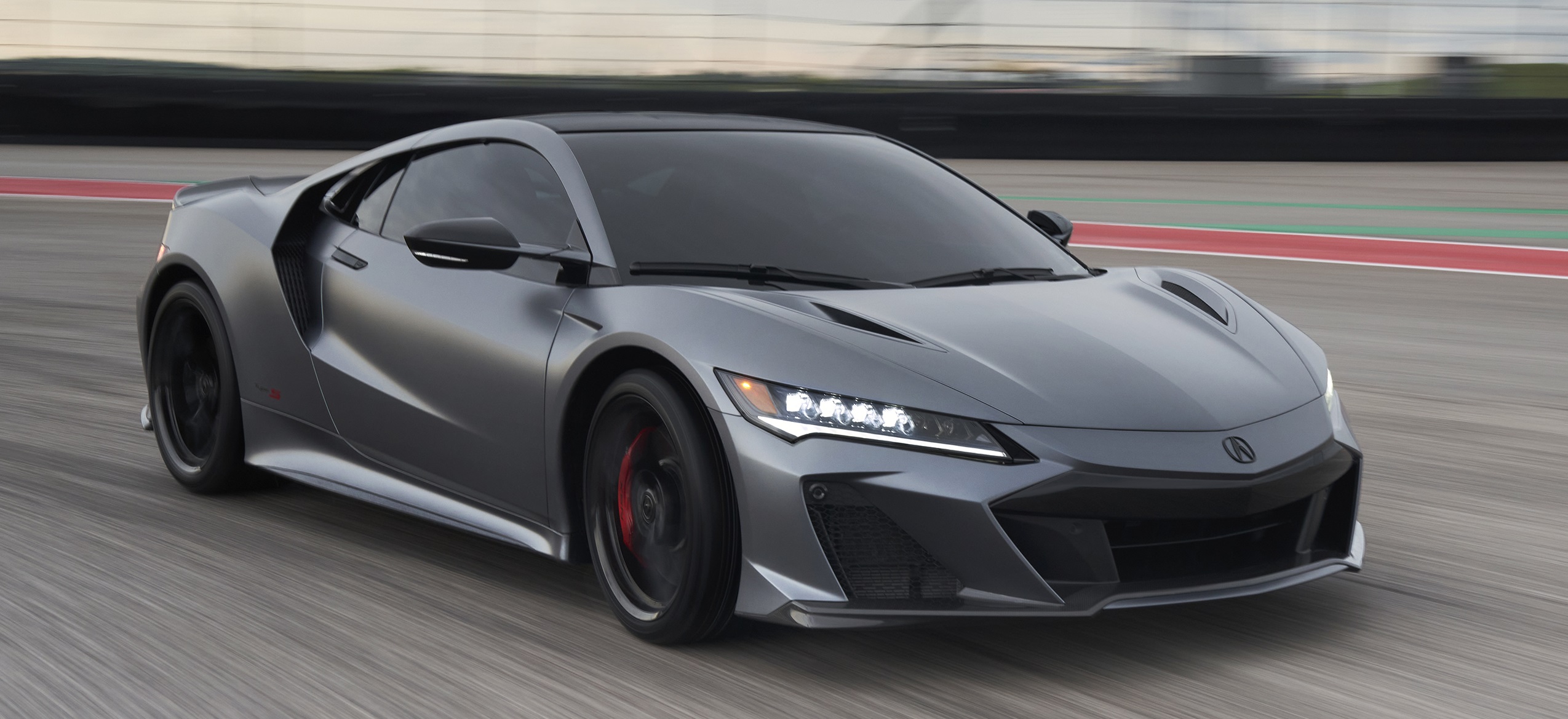
A track image of the 600 horsepower Acura NSX Type S

The limited-edition 600-hp Acura NSX Type S. (Acura)

Official Parade Pace and Sound Vehicles

Pacing the 2022 Rose Parade will be the new Acura NSX Type S supercar. With the final design completed at the Acura Design Studio in Torrance, the all-wheel-drive NSX was designed and developed by Honda engineers in Raymond, Ohio, and is hand-built exclusively at the company’s Performance Manufacturing Center in Marysville, Ohio.

Only 350 of the Type S model will be produced, with 300 units destined for U.S. customers. In addition, the new paint color, Gotham Gray matte metallic, will be applied to just 70 of the 350 cars to be built.

NSX Type S MSRP pricing starts at $169,500 or $182,500 with the lightweight package, which includes carbon-ceramic brakes in one of four colors, carbon engine cover, and carbon interior trim. The light-weighting trims the total curb weight by approximately 57.8 pounds.

The new for 2022 Honda Passport TrailSport

The 2022 Honda Passport was restyled front and rear. (Honda)

The new 2022 Honda Passport TrailSport will be the sound vehicle for the parade. The new Passport was designed at the Honda Design Studio in Torrance and developed by Honda engineers in Raymond, Ohio. The Passport is built at Honda’s Alabama Auto Plant in Lincoln, Ala.

The 2022 Honda Passport has updated front and rear styling. The appearance is new from the windshield pillars forward and includes a sculpted hood with a power bulge, squared-off nose, upright grille, and revised front fenders. At the back, a more aggressively styled rear bumper features cutouts for larger twin exhaust outlets, a tow hitch cover, and a metallic skid panel.

The unibody Passport has an independent front and rear suspension, standard 280-hp 3.5-liter V-6 engine, and nine-speed automatic transmission. The i-VTM4 torque-vectoring all-wheel-drive system is optional.

The Passport TrailSport, with standard i-VTM4 all-wheel drive, has a starting MSRP of $43,695, including the $1,225 freight charge from Lincoln, Ala.

2022 Volvo XC60 B6 AWD R-Design Review

2022 Volvo XC60 B6 AWD R-Design Review

The Volvo XC60 SUV has polite manners and efficient engine technology, but its purity of Volvoness separates this SUV from the competition

An exterior view of a white Volvo XC60 SUV crossover.

The Volvo XC60 SUV has had a few exterior updates for 2022 and some significant advanced technology additions, such as CleanZone air filtration. (Photos courtesy of Volvo unless otherwise credited.)

Table of Contents

Volvo XC60 Overview
New for 2022
2 New Engines
Pricing
Volvo Vehicle Warranty
Performance and Fuel Economy
Pilot Assist
Ride and Handling
Safety Features
CleanZone Air Filtration
Interior Function
Back Seats and Cargo
Why buy the Volvo XC60 B6?
Specifications

BY MARK MAYNARD

The Crystal White metallic paint of the 2022 Volvo XC60 tester is a popular conversation starter. The handsomely styled XC60 prompted comments of praise by several female passers-by as it sat parked in my driveway. It is an approachable and tastefully styled midsize SUV crossover.

Volvo says the XC60 was not designed to look down on others but to drive. In some ways, it is the missing link that merges a car with an SUV for uncompromising Scandinavian design. This five-seat SUV crossover has polite manners, efficient engine technology, and family function. But its allure is more than function and style; it is its purity of Volvoness that resonates.

The front seats of the XC60

The 10-way power seats are gently contoured and supportive for the long haul.

Volvo XC60 Overview

The first-generation XC60 for North America debuted in 2010, and it has continued as Volvo’s top-selling model — around the world. The second-gen debuted for 2018 and was made 1.8 inches longer and about the same width, but with a roofline that is 2.1 inches lower. In addition, the wheelbase lengthened by 3.6 inches, now at 112.8 inches.

The freshened 2022 model builds on that midsize footprint and adds a few significant updates. While the exterior changes for 2022 are subtle, Volvo’s attention to detail and some unique extras reinforce ownership.

The gas-engine XC60 models now have “mild hybrid” engines helping Volvo reach its goal of total electrification by 2030. By then, the company intends to sell only fully electric cars and phase out any vehicle in its global portfolio with an internal combustion engine, including hybrids.

And a unique addition is Volvo’s CleanZone air filtration system. The system can stop up to 95 percent of pollutants from entering the passenger compartment.

An overhead view from the multiview camera

The 360-degree surround view camera system includes overhead.

New for 2022

Highlights of the 2022 changes include:

  • Updated grille with updated and heated logo (for a clear Pilot Assist camera in all weather conditions);
  • Restyled front fascia with stronger horizontal lines in the lower fascia and a restyled rear fascia with hidden tailpipes;
  • New wheel designs and some new paint colors, including Silver Dawn Metallic;
  • Next-generation Android infotainment system integrated with Google. Included are Google Assistant with natural voice recognition, Google Maps with real-time traffic information, Google Play Store for media apps, and Bluetooth audio and phone connectivity.
  • Over-the-air software updates using the Volvo Cars app for such areas as propulsion systems, new features, bug fixes, and infotainment enhancements. In addition, Volvo says drivers of the pure electric XC40 Recharge should see an improved driving range. Its Range App will help maximize battery usage and give cold weather warnings for optimal battery performance.

Other XC60 infotainment features include 4G LTE connectivity with Wi-Fi hotspot, USB input, Google keyboard, and full Apple iPhone compatibility

The engine bay of the XC60

The 295-hp 2.0-liter 4-cylinder B6 engine is turbocharged and supercharged.

2 New Gas Engines

The Volvo XC60 is sold in gas-powered or gasoline-electric plug-in hybrid models.

Two new 2.0-liter four-cylinder gasoline engines debut mild hybrid electrification through a new 48-volt system. The system combines a 13-hp ISG or Integrated Starter Generator.

The ISG is notable for a couple of reasons. First, it provides a silent, fast and refined start/stop function, Volvo says. And it facilitates the engines’ idle stop-start operation and gives a torque boost at low speed.

What were engine designations of T5 and T6 are now B5 and B6. As before, the B5 engine is turbocharged, and the B6 is turbocharged and supercharged. The B5 has 247 horsepower and 258 foot-pounds of torque from 1,800 to 4,800 rpm.

The 295-hp B6 engine gets a new electric supercharger, or e-Charger, which replaces a mechanical supercharger. The e-Charger is quieter and provides enhanced engine response, Volvo says.

In addition, the B5 and the B6 now have electronic shifting and braking “by wire.” The latter allows brake energy to be banked and used to boost overall efficiency and fuel economy.

Volvo’s thoughtful engineering includes one of the most orderly engine bays I’ve seen. The engine shows off with a large, black plastic shroud and the secondary hood release is easy to find. Dual struts easily raise the hood to a near-vertical position.

The midsize Volvo SUV's back seats.

Back seat space has adult-class legroom of 38 inches.

Volvo XC60 Pricing

The gas XC60 is sold three trim levels of Momentum, Inscription, and R-Design. All models have a choice of B5 or B6 2.0-liter four-cylinder engines and Volvo’s eight-speed Geartronic automatic transmission.

Front-wheel drive is the standard drive layout with the optional advanced AWD system. (The AWD system has “instant on,” with little chance for the wheels to begin slipping on startup.)

Starting MSRPs range from $43,745 to $51,245 to $49,895. Today’s tester is the XC60 B6 AWD R-Design that was $65,890. Pricing includes the $1,095 freight charge from Gothenburg, Sweden.

The price difference between the B5 engine and the B6 is about $6,500. AWD adds $2,300.

The plug-in hybrid XC60 Recharge is sold in three 400-horsepower trim levels with starting prices ranging from $55,345 for the Inscription to $61,495 for the R-Design and up to $70,595 for the 415 hp XC60 Polestar T8 eAWD. The hybrid system allows about 19 miles of electric driving before switching to the 2.0-liter gas engine.

Check here for current pricing and incentives.

Volvo New Vehicle Warranty

The Volvo warranty package is for four years or 50,000 miles with roadside assistance and free scheduled maintenance for 3-years/36,000-miles. Also unique is that Volvo pays for four years of Google Assistant and Google Maps with its ever-helpful road sign information.
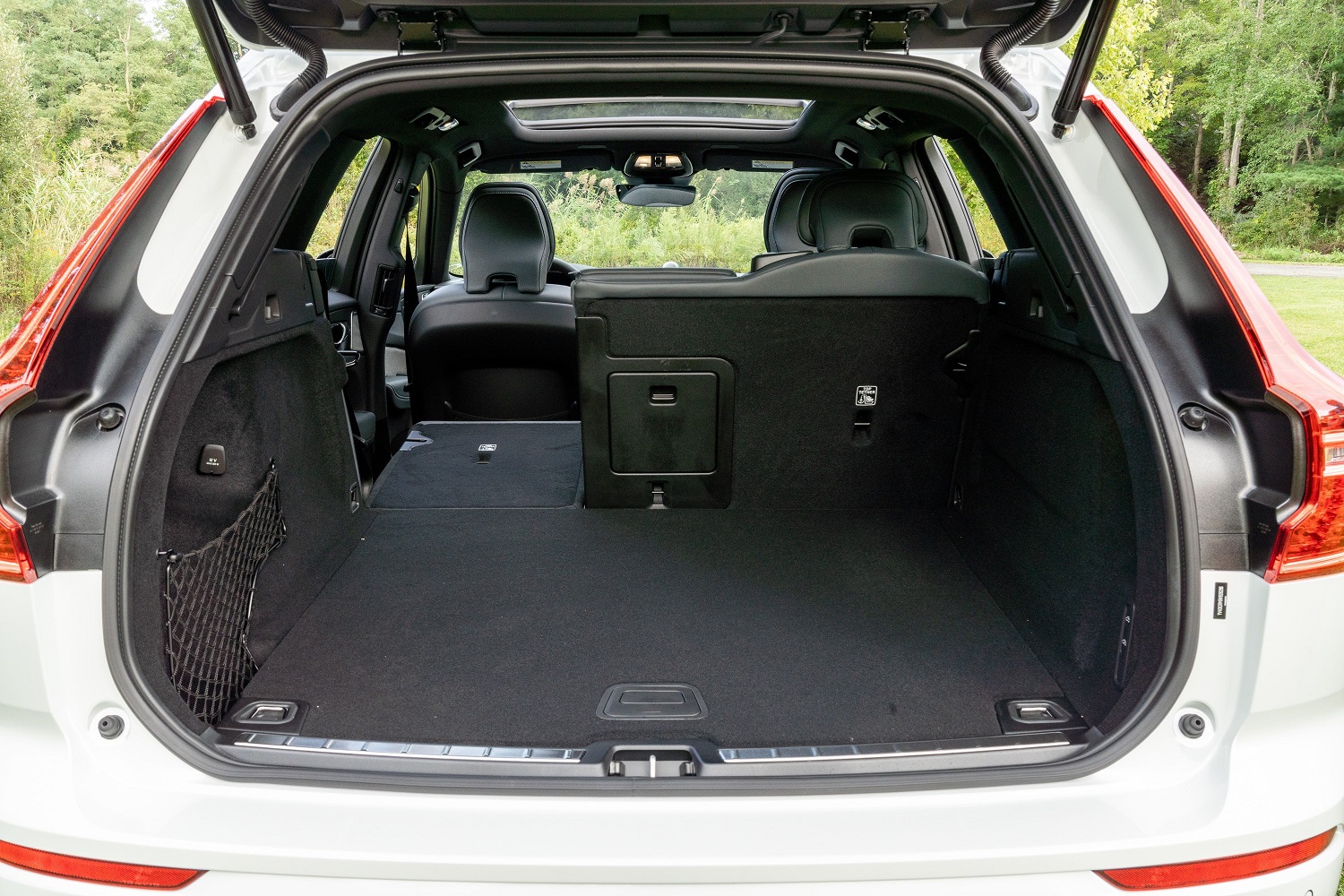
A seats folded view of the cargo area

Cargo space is wide and square.

Underfloor storage of the cargo area.

The 48-volt lithium-ion battery is in the upper left corner below the cargo floor. (Mark Maynard photo)

XC60 B6 Performance and Fuel Economy

Dual “charging” of the B6 engine gets the most out of its 2.0-liter engine. But moving away from a stop can seem sluggish — the tester weighs 4,238 pounds — until the e-supercharger kicks in. Then, the turbocharger carries the power into the higher rpms.

Once moving, the acceleration is responsive at all speeds. The eight-speed automatic gives easy downshifts, though timed to maximize fuel economy.

Dial up Sport mode and the performance attitude sharpens, but it is not hell-bent. I used the Sport mode in traffic to keep the power on point and then dialed back to Comfort on the open road for more fuel economy.

Fuel economy estimates for the B6 AWD are 21 mpg city, 27 highway and 24 mpg combined, on the recommended premium. I was averaging 23.4 to 24 mpg. Front-drive models have mileage ratings of 23/30/26 mpg. And the 18.8-gallon tank gives a substantial cruising range.

The electric steering has smooth rotation with adequate road feedback. In addition, the level of steering-wheel resistance can be made lighter or heavier by accessing the drive mode categories through the touchscreen. The turning circle is tight at 37.4 feet — an engineering accomplishment with all-wheel drive, the long wheelbase and 21-inch Pirelli Scorpion tires (an R-Design upgrade).

XC60 Pilot Assist

The Pilot Assist (part of the $2,050 Advanced package) is a suite of driver-assist systems for hands-on-the-wheel semi-autonomous driving. The assist system works on highways and at speeds up to 80 mph, and does not require a car in front to follow. The system will steer, accelerate and brake as needed.

The guidance calibrations work well enough, but the vehicle still crossed over the white line a few times and then gave me loud tones as a warning (as if I did something wrong). That’s why the driver must always stay vigilant and keep hands on the steering wheel. Pilot Assist is best used on major highways in stop-and-go commuter traffic.

These systems can also be prone to shutoff in low-light or shadowy conditions (such as under a highway overpass) and low sunlight into the camera, such as sunset. I’ve also experienced assist cancellations when traveling alongside a white semi-trailer. And California’s light gray concrete can confuse when the white lines are faded or disrupted.

XC60 R-Design Ride and Handling

Among the significant options on the tester was the four-corner air suspension, a stand-alone extra at $1,800. Volvo’s active chassis maintains ride height automatically and adapts each shock absorber to current road and driving conditions.

The suspension gently yields when stepping over speed bumps or along sections of broken road. Power hard into a corner and the nose follows the trajectory with a flat attitude and no unwieldy suspension rebound. But under light load on lumpy or crumbling road surfaces, the air suspension gets busy trying to balance the heaves and unevenness.

At higher speeds, the air suspension lowers the vehicle automatically to reduce drag and enhance stability. In addition, an Off-Road mode increases ground clearance. And loading or unloading cargo or tailgating, the cargo height can be lowered by 3 inches by pushing a button inside the load area.

The cabin is well soundproofed and the big Pirellis are a delicious upgrade for quiet rolling and supple grip. Braking is absolute and without grab or dive from 12.7-inch front discs, 11.9-inch rear.

XC60 Safety Features

Volvo is a safety champion, but I’m still not a supporter of the iPadlike touchscreen. The vertical screen in the center of the instrument panel is used to access just about everything, although there is a knob for audio volume. But making adjustments to temperature, fan speed, or seat heaters is a two-touch process, which usually takes eyes from the road.

However, the XC60 has an arsenal of other safety features, including City Safety. The collision avoidance system recognizes pedestrians, cyclists, and large animals. It also adds lane-keep assist and oncoming lane mitigation, which will take over steering if needed to avoid a head-on or front-corner impact.

Other standard safety features include six air bags, blind-spot warning, and cross-traffic alert, lane-keeping steering assist, oncoming lane mitigation (with steering assist), and hill-descent control.
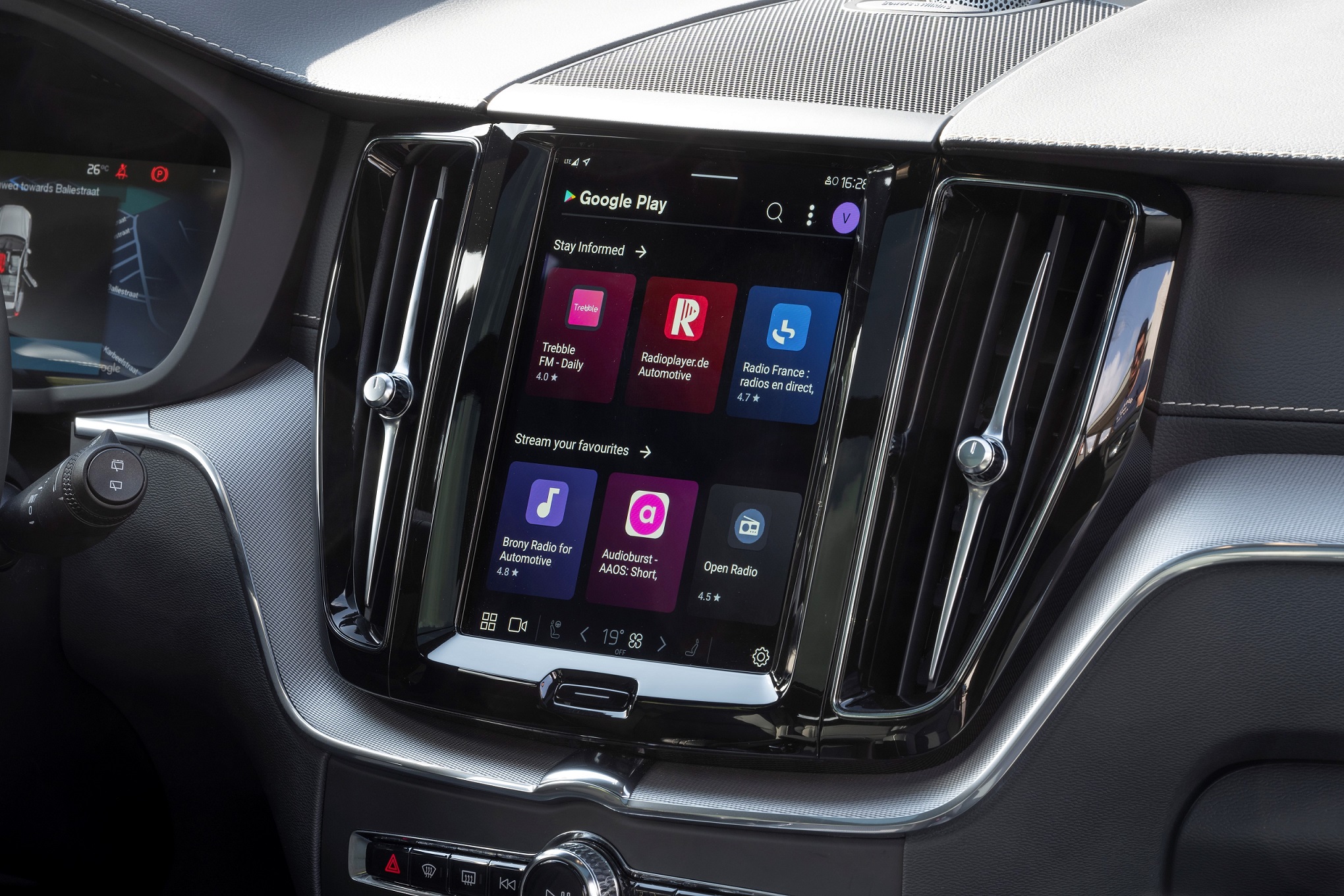
The 9-inch touchscreen in the Volvo instrument panel

Hey Google!

CleanZone Air Filtration

For people prone to breathing ailments, Volvo’s CleanZone air filtration system can mean the difference between going out and staying.

The advanced filter system (a world first, the company says) will trap airborne particles as small as 2.5 microns (PM 2.5). There are about 25,000 microns in an inch. The widths of the larger particles in the PM 2.5 size range would be about 30 times smaller than a human hair. The smaller particles are so small that several thousand could fit on the period at the end of this sentence.

The system’s multifilter also helps reduce dust, pollen, particles, and chemical odors.

The cabin can be pre-cleaned before entering the car using the Volvo Cars app. And on a warm day, the automatic CleanZone helps ventilate the passenger compartment when the vehicle is unlocked.

XC60 Interior Function

The interior design is artful but functional — mostly. The cabin is roomy with considerable headroom of 38 inches, even with the panoramic roof. Sightlines are unobstructed across the hood or over the shoulder. And the 360-degree surround-view camera system is a worthwhile addition to the Advanced package, $2,050, which includes Pilot Assist with adaptive cruise control.

The 10-way power seats, including seat-bottom tilt, are gently contoured and supportive for the long haul.

The switch controls for the front map lights and sunroof are touch-sensitive and require just a light touch to activate.

There is open access to the wireless charging pad on the shift console. Storage areas are somewhat limited, but there is a huge, nonlocking glove box and door panels with separate spaces for a large bottle and catchall space. The center armrest has a small storage box, which houses two USBs, including one C-type.

The 12.3-inch driver gauge array.

12.3-inch configurable driver gauge array.

Back Seat and Cargo Space

Back seat space has adult-class legroom of 38 inches, but with a slight butts-down, knees-up position with no seatback recline. There are numerous conveniences, including the coat hooks on the B-pillars. The broad, fold-down armrest is padded with pop-forward cup holders and covered but slim storage.

Back-seat B pillars have a vertical vent that provides airflow that is so helpful for passengers prone to motion discomfort. And there also is a pair of vents in the center floor console, along with fan and temperature controls, seat-heater switches, and a USB. Overhead grab handles include a hook for dry cleaning.

Cargo space is wide and square, with 17.1 cubic feet of space behind the second row or up to 29.4 cu.ft. with the back seat folded. The 60/40 split rear seat has release tabs in the cargo that drop easily. A handy hook and strap are provided to hold up the cargo floor when looking for the jack and flat-tire inflator. There also are dual side lights and a 12-volt plug. A side storage space has about a cubic foot of stash space, separated by a net.

Road Sign Information

How often do we drive and see no or very few speed-limit signs? Enter the eye-in-the-sky Road Sign Information. It might be one of those extras that the uninitiated might see as unnecessary. And Volvo pays for the subscription for the length of the warranty. The system alerts to speed limits, “no passing,” “do not enter,” and various types of supplementary signs.

The road sign is displayed on the speedometer or in the head-up display. It can also inform you about speed cameras. And if you drive in the wrong direction on a one-way street, you’ll be alerted with a no-entry sign icon.

Panoramic Moonroof

The dark-tinted laminated glass roof has a front section that opens or tilts and a power-operated fabric sunshade. When the vehicle is parked outside in hot weather, the sunshade closes automatically when the outside temperature reaches 77 degrees. And the roof can be closed from outside the vehicle with the remote key.

The panoramic roof in the XC60

The dark-tinted laminated glass roof has a front section that opens or tilts and a power-operated fabric sunshade.

What’s not to like?

  • For the as-tested price of nearly $67,000, savvy luxury-segment drivers might expect ventilated seats to go with the optional heated front seats.
  • A cargo area roller cover is a $295 option.
  • Modest fuel economy.
  • The sun visors are inadequate on driver’s left. The lower left edge is contoured to fit neatly into the headliner, which leaves a wide margin of the windshield where the sun invariably shines through.
  • Volvo’s distinctive head restraints, somewhat forward-leaning, can bother some taller occupants.

Why Buy the Volvo XC60 B6 R-Design?

A statement of style is important to this owner, and there is a genuine resonance to the gentleness of Volvo design and engineering.

While the Inscription trim level is luxurious, I prefer the sportier tone of the R-Design. I’d fret less about children scuffing the interior and I’d feel less guilt using it as a utility vehicle, as the Norse god Thor intended.

At nearly $67,000, the tester was fully priced, but it also has unique pleasures to relieve the price-point pain.

A rearview of the XC60

The 2022 Volvo XC60 has a restyled rear fascia with hidden tailpipes.

Volvo XC60 B6 AWD R-Design Specifications

Body style: midsize, 5-seat AWD

Engine: 295-hp, direct Injected and turbocharged and supercharged 2.0-liter 4-cylinder with idle stop-start; 310 lb.-ft. torque from 2,100-4,800 rpm

Transmission: 8-speed Geartronic

Fuel economy: 21/27/24 mpg city/hwy/combined; premium required

0-60 mph acceleration: 5.9 seconds

Coefficient of drag: 0.32

BY THE NUMBERS

Fuel tank: 18.8 gallons

Cargo space: 17.1-29.4 cubic feet

Front head/leg room: 38/41.5 in.

Rear head/leg room: 38*/38 in. *w/panoramic roof

Length/wheelbase: 185.4/112.8 inches

Curb weight: 4,238 lbs.

Turning circle: 37.4 ft.

Tow capacity: 3,500 lbs. braked trailer; 1,600 lbs. unbraked

FEATURES

Standard equipment includes: keyless locking with push-button ignition, 12.3-inch configurable driver gauge array, surround-view camera with front parking assist, adaptive cruise control, wireless smartphone charging, heated steering wheel, illuminated door handles, laminated panoramic moonroof with power sunshade, heated grille emblem (to help optimize front camera visibility in all conditions), head-up display, headlight washers, front cornering fog lights, park assist (front, rear, and sides), spray-arm wipers

R-Design Features: Front park assist, power-folding rear head restraints, HomeLink garage door transmitter, tailored dashboard, high-level interior illumination, 4-zone climate control with CleanZone, charcoal headliner, 10-way power (heated) front seats with lumbar and memory presets, 19-inch R-Design wheels, Nappa leather front sport seats, and leatherette rear seats, leather gear shift grip and metal-trimmed pedals, sport tailored steering wheel, high gloss black window trim, and mirror caps, high gloss black grille

Safety features include: 6 air bags, blind-spot warning and cross-traffic alert, Pilot assist (to help keep the vehicle centered in its lane and at a set speed), lane-keeping steering assist, oncoming lane mitigation (with steering assist), hill-descent control

PRICING

B6 AWD R-Design base price: $57,290, including $1,095 freight charge; price as tested $65,890

Options on test vehicle: Climate package, $750, includes headlight washers, heated rear seats and heated steering wheel; Advanced package, $2,050, includes head-up display, Pilot Assist driver-assistance system with adaptive cruise control, 360-degree surround-view camera, a 12-volt outlet in the cargo area, air quality with advanced air cleaner; metallic Crystal White paint $695; 4-corner air suspension $1,800; power tailgate $200; 21-inch double-spoke black diamond-cut alloy wheels $1,000; 15-speaker Bowers & Wilkins premium audio $3,200

Where assembled: Gothenburg, Sweden

1960 Chrysler Windsor

1960 Chrysler Windsor

In 1959, Chrysler advertised the Windsor’s new wedge-head “B” engines as ‘Golden Lions’ and the cars as ‘Lion Hearted’

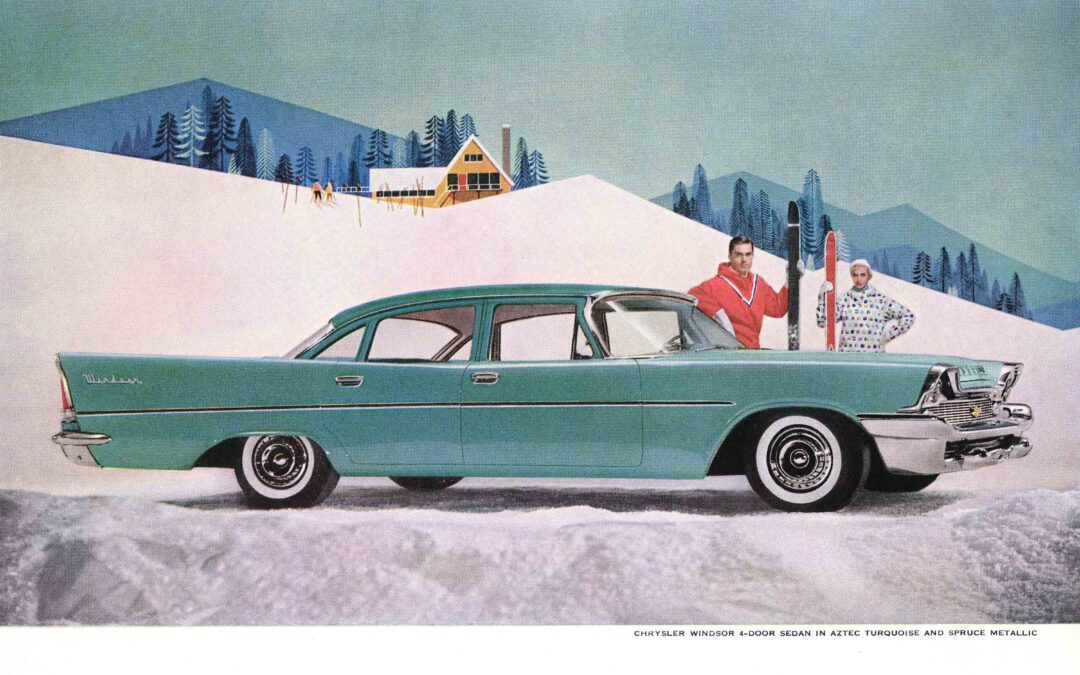
A print ad for the 1960 Chrysler sedan in a wintry landscape


BY MARK MAYNARD

The full-size Chrysler Windsor sedan was in production from 1939 through to 1961 in the U.S. and in Canada until 1966.

In 1959, Chrysler started to advertise the Windsor’s new wedge-head “B” engines as “Golden Lions” and the cars as “Lion Hearted,” according to Wikipedia.

“The RB 383-cubic-inch V8 produced 305 hp with a twin-barrel carburetor. Lions were used in the advertising, and the cars had lion emblems on the front doors and on the cylinder heads.

“In 1960, all Chrysler cars got a unibody frame. A new parking brake was also used, and the brakes on the Windsor were 11-inch drums. Air conditioning was a $510 option.

At nearly 18 feet long and 79.4 inches wide, the Windsor rode on a long wheelbase of 122 inches.

Windsor By the Numbers

In a report by ConceptCarz.com,  the “Golden Lions” was part of Chrysler’s advertising campaign for the new wedge-head “B” engines. Introduced the previous year, the cars were known as “Lion Hearted.”

“The RB 383 cubic-inch V8 had five main bearings, hydraulic valve lifters, a Carter two-barrel carburetor, a cast-iron block, and delivered just over 300 horsepower.

“The Canadian-built Windsors were powered by the ‘Low Block’ 361 cubic-inch engines from the U.S.-built DeSotos and Dodges. Instead of the ‘Golden Lion’ medallion, they received three golden crests on the front doors.

Dual headlamps were standard, and the Flitesweep deck lid, stone shields, and sill moldings were optional equipment.

1960 Windsor Pricing

“Windsor body styles included a hardtop coupe priced at $3,280, a hardtop sedan at $3,345, a sedan at $3,195, and a convertible at $3,625. A six-passenger station wagon was $3,735, and the nine-passenger version listed for $3,815.

“The most popular body style was the sedan with 25,152 examples built, followed by 6,496 of the hardtop coupe, and 5,897 of the hardtop sedan.

“The convertibles and station wagons were exclusive, with 1,467 of the convertible, 1,120 of the six-passenger wagon, and 1,026 of the nine-passenger wagon constructed.”

2023 Toyota bZ4X EV Overview

2023 Toyota bZ4X EV Overview

Midsize, battery-electric bZ4X SUV to have expected range of 250 miles and will go on sale in mid-2022

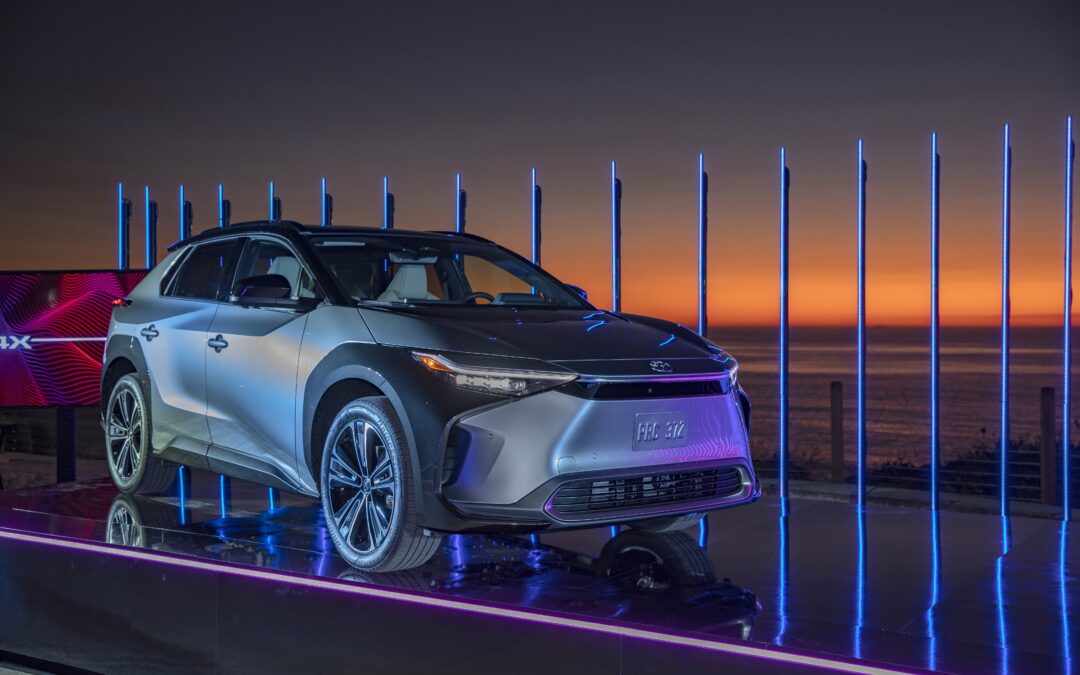
An exterior view of the Toyota bZ4X

The 2023 Toyota bZ4X is scheduled to go on sale in mid-2022 in front- or all-wheel-drive trim levels. Front-drive models have a driving range of 250 miles. (Photos courtesy of Toyota)

Table of Contents

bZ4X Architecture
bZ4X Features
Safety Systems
Intuitive Technologies
bXZ4X Pricing
The Future of EVs
EV Intention Study
bZ4X Specifications

BY MARK MAYNARD

Is the recent spike in gasoline prices an incentive or a barrier for motorists to shift to an electric vehicle? It’s complicated, says one industry expert, and the time it takes to charge has become a major issue.

Toyota was in San Diego County the week before Thanksgiving for an expansive “e-volution” electrified event for automotive media. It was a deep dive to layout Toyota’s plan for electric and electrified vehicles, fuel cells and to introduce its next EV, the bZ4X, a partnership with Subaru.

Toyota plans to introduce 15 battery-electric vehicles for North America, including seven new Toyota bZ EV models by 2025. Launched under the global “Toyota bZ” brand umbrella, the bZ4X will be the first model in the bZ series. “BZ” stands for “beyond Zero.” Globally, Toyota says it will debut around 70 electrified models by 2025. The corporate plan is to achieve carbon neutrality by 2050.

Toyota and Subaru jointly developed the midsize bZ4X. The partnership leverages Toyota’s strength in vehicle electrification while Subaru contributes its expertise in all-wheel-drive technologies.

The Toyota bZ4X is expected to go on sale in late spring 2022 as a 2023 model. The five-seat, five-door SUV will be sold initially in at least two front-wheel-drive trim levels with optional all-wheel drive.

Subaru has also just revealed its version of the bZ4X called the Subaru Solterra, Latin words for “sun” and “earth.” The Solterra has minor exterior changes and is also expected to go on sale in mid-2022.

Toyota’s electrified lineup of vehicles, in total, accounts for more than 40 percent of all alternative powertrain vehicles sold in the U.S. Toyota sells almost a dozen electrified models, including the hydrogen fuel-cell Mirai sedan, hybrids (including the 2022 Tundra full-size pickup), plug-in hybrids and now the bZ4X. In addition, Lexus, the luxury division of Toyota, currently markets six hybrid models.

A side view of the driver area.

Headroom might be limiting to tall drivers, but legroom is substantial.

bZ4X Architecture

The bZ4X is built on Toyota’s e-TNGA BEV-dedicated platform. The new vehicle is close in size and styling to the Toyota Venza hybrid but on a longer wheelbase. The 112.2-inch wheelbase provides length for the skateboard-style battery and electrical components.

The liquid-cooled lithium-ion battery pack is stored flat under the floor, which gives the vehicle a low center of gravity. Cross-bracing of the battery-pack housing is designed to withstand a collision from any angle.

With an AC synchronous electric generator mounted at the front axle, the front-drive powerplant has 201 horsepower. Front-drive models have a maximum output of 150 kW, or 160 kW with AWD.

The drive battery has 355 total voltage and total power of 71.4 kWh, increasing to 72.8 kWh for AWD.

Toyota cites a driving range of up to 250 miles for front-drive models; AWD range will be announced later. And Toyota has targeted battery-capacity retention of 90 percent after 10 years of ownership.

There were few details on charging times or any onboard charging equipment. But Toyota did say that using a public high-output charger would restore an 80 percent charge in less than an hour.

For comparison, the 2021 VW ID.4 (rear-wheel-drive only) is slightly smaller with a 201-hp motor and lithium-ion battery. The ID.4 has a driving range of 250-260 miles, but it is heavier by 327 pounds. In addition, Volkswagen says the 11 kW onboard charger allows the ID.4 to charge to full in about 7.5 hours at a home or public Level 2 charger.

bZ4X yoke-style steering wheel

The unique instrument panel design and infotainment screen expand the cabin’s feeling of space, Toyota says.

bZ4X Features

Toyota calls the bZ4X design theme “hi-tech and emotional.” The exterior is sleek and maximized for aerodynamics. The interior takes advantage of an open concept without a gas-powered vehicle’s protruding transmission base between the front seats. Instead, there is a spacious open area under the center shift console.

The steep rake of the windshield might limit entry headroom for some big-and-tall drivers, but legroom appears quite lengthy. The wide cabin, 59.6 inches, provides an open feel and generous shoulder room, Toyota says. And soundproofing glass and wind-noise reduction features create a quiet refuge.

Drivers will immediately notice the uniquely shaped, yoke-style steering wheel. The steering-by-wire system eliminates the need for a circular wheel for hand-over-hand turning, Toyota says. Instead, the “wheel” only turns 150 degrees from side to side, so the driver does not need to take a hand from the wheel. (Some reviewers have said that Toyota will offer a traditional wheel for those who aren’t ready for the change.)

Steering-by-wire has no mechanical connection to the wheels, which eliminates road vibrations.

Dimensions for back-seat space were not disclosed, but Toyota says there is “abundant legroom for front and rear seats as well as copious side-to-side space in the rear.”

Also new:

  • An optional solar recharging system for cabin functions;
  • Heat pump system for heating and air-conditioning;
  • Front-seat radiant foot-and-leg heater (a first for Toyota).
BZ4X navigation screen

The bZ4X navigation system uses map information from the cloud to obtain traffic information and parking space availability in real-time.

X-Mode All-Wheel drive

Subaru’s most notable contribution to the bZ4X is the all-wheel-drive system with X-Mode. The system is suited for everything from daily driving to light off-roading, Toyota says. A standout feature of the AWD system is Grip-Control.

The five-stage software program works in addition to the all-wheel-drive system.

Among its capabilities is to use lower gear ratios to generate extra power at the wheels that have grip. In addition, the X-Mode system makes the traction control system extra sensitive so that it intervenes earlier during wheel slippage. And the system works with Hill Descent Control for added braking on steep slopes.

The front view of the EV, showing the curved front bumper

The inward curve of the front bumper is distinctive to the bZ4X.

bZ4X Safety Systems

bZ4X will be the first to feature the latest Toyota Safety Sense safety package (TSS 3.0). This system has an expanded detection range of the millimeter-wave radar and monocular camera.

The pre-collision system now provides low-light cyclist detection, daytime motorcyclist detection, and guardrail detection. Also, lane recognition was improved while in lane-tracing-assist mode.

The rear of the bZ4X

The rear trapezoidal design theme emphasizes a powerful stance.

 bXZ4X Intuitive Technologies

With a Drive Connect trial or subscription, the bZ4X offers navigation that uses map information from the cloud to obtain traffic information and parking space availability in real-time.

A digital key function allows owners to lock, unlock, and start the vehicle with a smartphone. Digital keys can also be handed over between smartphones for family and friends to borrow and lend vehicles remotely.

Other features of the trial subscription include over-the-air (wireless) software updates. Without scheduling a dealership appointment, the updates might be for performance, the Safety Sense system, or the multimedia system, Toyota says.

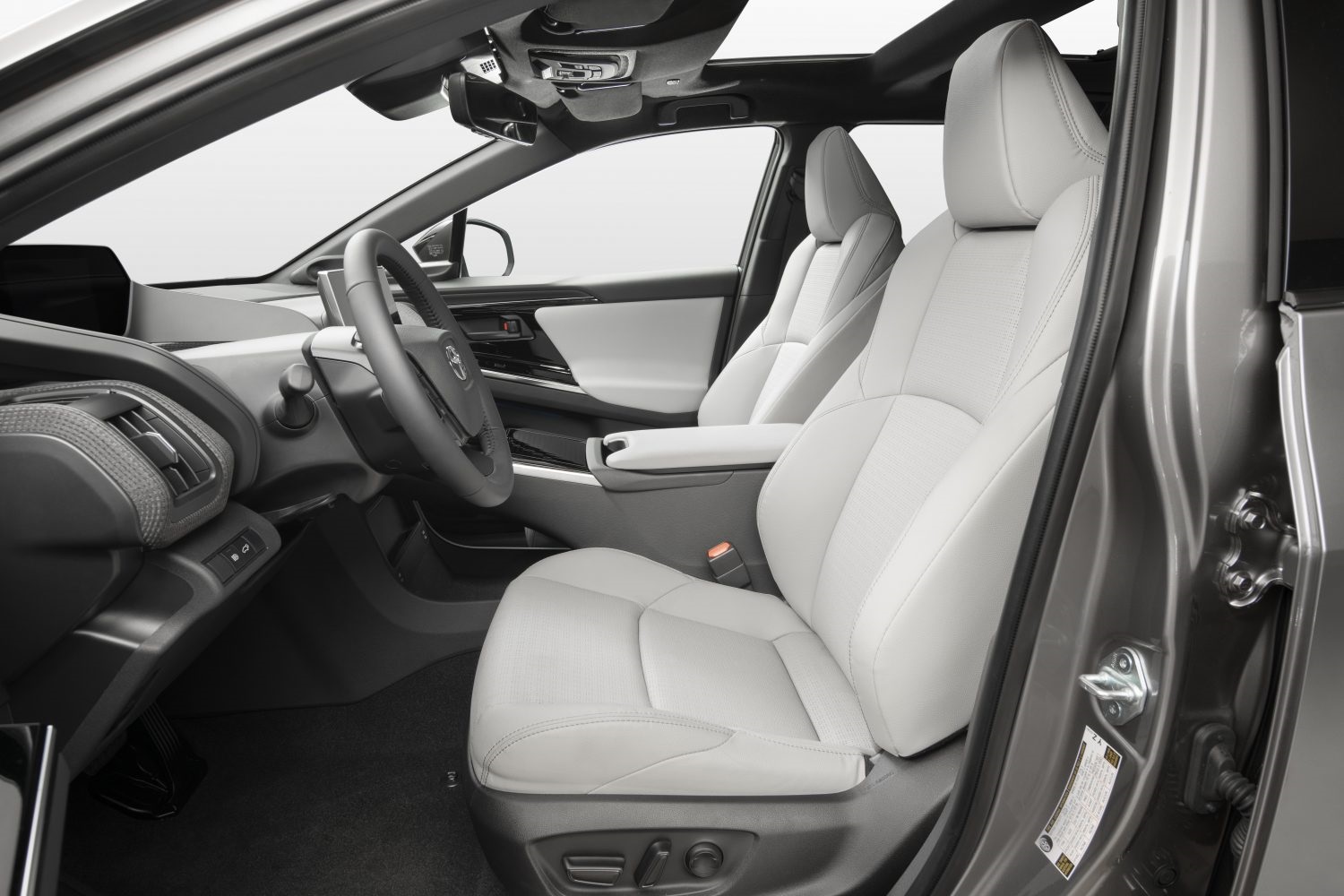
A view of the front passenger area

The extended center console has storage space below.

bXZ4X Pricing

Toyota plans to produce the Toyota bZ4X in Japan and China. The bZ4X is scheduled to go on sale in the U.S. in late spring 2022. Pricing will be announced closer to the on-sale date but expect the starting MSRPs to range from around $37,000 to $45,000.

To stay up to date on bZ4X, visit the bZ4X upcoming vehicle page. www.toyota.com/upcoming-vehicles/bZ4X.

The EV's back seat area

Back-seat-space dimensions were not disclosed, but Toyota says there is “copious side-to-side space.”

The Future of EVs

The federal government is aiming for EVs to represent half of U.S. new-vehicle sales by 2030, according to a recent report in Automotive News. That compares with 1.9 percent last year, according to Edmunds.

And automakers have laid out their own goals. For example, Volvo plans to fully electrify its lineup by 2030. General Motors is working toward a zero-emission light-vehicle lineup by 2035. And Volkswagen has said nearly all of its vehicles will be emission-free by 2040.

Among the mainstream family-size EV choices will be the upcoming Hyundai Ioniq 5 and Kia EV9 (in addition to the current Kia EV6), Mustang Mach-e, Tesla Model Y, and VW ID.4.

The bZ4X cargo area

Wide and square cargo space is expandable with the 60/40 folding back seat.

$5 Gasoline

Automakers can provide a functional electric vehicle, but will consumers pay the price?

On my I-5 interstate drive north to the Toyota media event in Encinitas, Calif., I passed a Chevron station at the La Costa Avenue exit. It advertised premium fuel (“supreme”) for $5.15 a gallon, regular unleaded was $4.85, and midgrade fuel was $4.99.

Granted, this Chevron is just off Interstate 5, so prices, of course, are higher than what a motorist can find in a neighborhood station. And there were news reports $6 and higher per-gallon prices in Los Angeles and Orange County, just up the coast.

Noting the heavy flow of midday, midweek traffic on the I-5, it does not appear that drivers are throttling back on speed or the amount of driving to conserve fuel and money.

bZ4X charging door

When using a public high-output charger, the battery can be restored to an 80 percent charge in less than an hour.

EV Intention Study

During past fuel-price spikes, industry pundits speculated that it would take $5-a-gallon gas for motorists to consider buying an electric vehicle. But the cost of everything has increased substantially since the 2012 spike, which set the all-time average high of $4.72 per gallon in the San Diego area.

Fuel prices now are probably not the highest motivator to move motorists to EVs, said George Peterson, president of AutoPacific, an automotive research firm in Tustin, Calif.

AutoPacific has just completed a comprehensive EV study that looks at EV owners and their satisfaction with their EVs. The study also focused on EV considerers and what they want in their future EV.

“We have been studying EV intention since 2005. From 2005 through 2019, consideration fluctuated between 2 percent and 5 percent,” Peterson said in an email. “In 2020, intention bumped up to 6 percent, and 2021 intention has risen again, now to 9 percent. This bodes well for the future of EVs, but not to the extent that the market will support the 130-plus new EV entries we will see through 2026.

“Remember, the median price of a new vehicle in the U.S. is around $37,000 now, so the EV premium is something that may be a minor issue with buyers. However, we still see time to charge as a major issue,” Peterson said.

“When we started looking at EVs, it appeared that a minimum range of 225 miles was required,” Peterson said. “Now, most new EVs are exceeding 225 miles, and many are overachieving by a substantial amount. So, time to charge might be the biggest hurdle.

“Very few American drivers have actually driven an EV yet,” Peterson said. “They don’t know the thrill of instant torque or how fun an EV can be to drive. The enthusiasts who pine for a throaty exhaust note will get over it in time.”

The rear view of the bZ4X

A lightweight body structure is partially made of high-tensile steel and reinforced frame components around the battery pack.

 Toyota bZ4X Specifications

Body style: 5-seat, 5-door midsize SUV, with front- or all-wheel drive

Motor type: AC synchronous electric generator

Battery type: Lithium-ion

Total power: 201 hp, 71.4 kWh VWD; 72.8 kWh AWD

Driving range: Up to 250 miles with FWD; AWD TBD

Maximum output (front motor): 150 kW 80 kW

0-62 mph acceleration: 8.4 seconds, FWD; 7.7 seconds, AWD

BY THE NUMBERS

Length/wheelbase: 184.6/112.2 in.

Height/width: 64.9 in. (inc. antenna)/ 73.2 in.

Curb weights: 4,232 FWD, 4,420 AWD lbs.

Turning circle: 37.6 ft.

Where assembled: Japan

Toyota RAV4 25th Anniversary Overview

Toyota RAV4 25th Anniversary Overview

Toyota Celebrates 25 Years of the RAV4 in North America; introduces New SE Hybrid model for 2022

Table of Contents

RAV4 History
RAV4 By Generations
The Current Generation RAV4
What’s New for 2022?
Specifications

A 2022 Toyota RAV4 SE Hybrid

For 2022, Toyota has freshened the RAV4 lineup with some exterior and interior updates and a new, less-expensive SE Hybrid model. (Photos courtesy of Toyota)

BY MARK MAYNARD

The 25th anniversary of the Toyota RAV4 is a coming-of-age story in North America. The small SUV crossover debuted in 1996 when midsize and large SUVs were the dominant herd on American highways.

Small vehicles were suspect, particularly in the U.S., for their safety structure as drivers navigated among the greater truck-based vehicles. The market segment for small SUVs had barely formed in 1996. And most of these were quirky import transplants with few changes for the preferences of North American drivers.

Among the early small SUV choices were the 1988 Daihatsu Rocky, the 1989 Geo Tracker (aka Suzuki Sidekick and Chevrolet Tracker), and the 1990 Isuzu Amigo. The offerings grew in 1996 with the diminutive two-door, two-seat 1996 Suzuki X-90 and the Kia Sportage (which brought the industry’s first knee air bag).

Today, there are around 20 small SUVs in the small SUV segment, and most manufacturers now offer one or two choices.

The driver area of a new RAV4

The RAV4 has reasonably tall front headroom of 37.7 inches, with a moonroof.

Toyota RAV4 History

The first Toyota RAV4 was available as five-door and three-door models. However, the four-door version dominated sales in the U.S. It was the only body style to return with the second-generation RAV4 in 2000.

Toyota refers to the RAV4 as the original small SUV. Now in its fifth generation, the RAV4 has become the best-selling Toyota model in the country. And in its 25-year history, it is on track for 5 million sales this fall.

RAV4 By Generations

  • The First RAV4, 1996-2000
  • Second Generation: 2000-2005
  • Third Generation: 2006-2012
  • Fourth Generation: 2013-2018
  • Fifth and Current Generation: 2019-
A view of the RAV4 front seats from the passenger side

Standard features include fabric-trimmed seats and a 7-inch touchscreen with a six-speaker audio system.

The Current Generation RAV4

The fifth-generation RAV4, introduced for 2019, offers the model’s widest selection to date. Model choices include:

  • The first RAV4 TRD Off-Road.
  • Gasoline-electric RAV4 Hybrid.
  • Flagship RAV4 Prime plug-in hybrid (PHEV). The RAV4 Prime has an EPA-estimated rating of 42 miles on battery power alone.
A gauge display of the RAV4 Hybrid

The 2021 RAV4 Hybrid has mileage ratings of 41/38/40 mpg city/hwy/combined on the recommended 87 octane.

RAV4 Powertrains

In gas-engine models, the 203-horsepower Dynamic Force 2.5-liter four-cylinder is paired with an eight-speed Direct-Shift, continuously variable automatic transmission. This powertrain has an EPA-estimated 28 mpg city, 35 highway, and 30 mpg combined for the front-wheel-drive LE model — the best ever for a gas RAV4, Toyota says.

RAV4 Hybrid models have a 40-mpg combined EPA-estimated rating, which is nearly a 30-percent improvement over the previous hybrid. Likewise, the hybrid’s e-AWD improves over the previous system. Its new independent rear motor operates proactively to maintain traction even before front-tire slippage is detected.

At the top of the model line, the RAV4 Prime PHEV (plug-in hybrid) is both the performance and efficiency leader. Available in SE and XSE trim levels with standard e-AWD, the RAV4 Prime has an EPA-estimated 94 MPGe rating. And it has an all-electric driving range of 42 miles on a single charge. When driven in hybrid mode, the RAV4 Prime powertrain can generate a combined 302 hp and is capable of 0-60 mph in 5.7 seconds. That acceleration makes it the second quickest Toyota in the lineup behind Supra.

The 18-inch tire and wheel of a RAV4

The RAV4 received a few new wheel colors and designs. All RAV4 models have standard aluminum wheels and 17- or 18-inch tires.

What’s New for 2022?

For 2022, the RAV4 will be available in a new SE Hybrid grade, and all RAV4 trim levels have been given some exterior and interior updates.

The 2022 RAV4 SE Hybrid model pares back some of the features built into the topline SLE model. For example, the SE Hybrid will be offered in a monotone paint scheme, fabric-trimmed seats, a six-speaker audio system, and a 7-inch touch screen.

Available options for the SE Hybrid include the weather package, which adds a heated and leather-wrapped steering wheel, heated front seats, and rain-sensing windshield wipers with a de-icer function.

The convenience package includes a moonroof, height-adjustable power liftgate, and Audio Plus with a 9-inch touchscreen.

Super sleek headlights on the topline RAV4

RAV4 headlights were updated for style and capability. And the XSE Hybrid gets the super sleek vertical lights that debuted on the XSE Prime in 2021.

Exterior Updates

Calvary Blue with a black roof (shown in the exterior photos) is a new paint-scheme choice for select RAV4 models, including the new SE Hybrid and TRD Off-Road.

There are a few new wheel colors and designs, and the headlights were updated for style and capability. New LED fog lamps are optional for XLE Premium, Limited, Adventure, and TRD Off-Road.

The XSE Hybrid also gets sleek vertical lights that debuted on the XSE Prime in 2021.

Interior updates are also found across the model line:

• All models now have a locking glove box and LED interior lights;

• XLE and above get illuminated interior switches;

• Limited grade gets an eight-way power passenger seat.

The RAV4 back seat

Back-seat legroom is midsize for a compact SUV at 37.8 inches.

RAV4 Pricing

The 2022 RAV4 Hybrid goes on this December. Toyota will release pricing and more details on the 2022 RAV4 in mid-December.

For comparison, the 2021 RAV4 Hybrid is sold with standard all-wheel drive in trim levels of LE, XLE, XLE Premium, XSE Premium, and Limited. Starting MSRPs range from $28,800 to $37,330, not including the $995 freight charge from Georgetown, Ky.

Pricing for the RAV4 Prime PHEV, sold in trims of SE and XSE, has starting prices of $38,250 and $41,575.

The price-step between 2021 RAV4 Hybrid models is about $2,000. If carried through for the 2022 RAV4 SE Hybrid, its starting price could be close to $26,800.

Check current Toyota-model pricing and incentives here.

A rear view of the 2022 RAV4

Calvary Blue with a black roof is a new paint-scheme choice for select RAV4 models, including the new SE Hybrid and TRD Off-Road.

2021 Toyota RAV4 Hybrid Specifications

Body style: compact, 5-seat, 5-door small SUV with e-AWD

Engine: 176-hp, 2.5-liter direct-injected Dynamic Force 4-cylinder with 16-valves, dual overhead camshafts, intelligent variable valve timing by an electric motor on the intake and exhaust camshafts

Electric motor: Permanent magnet synchronous

Combined power: 219-hp

Battery pack: Lithium-ion with 244.8-volts and a maximum of 650V

Transmission: electronically controlled CVT with sequential shift mode and electronic on-demand AWD

Fuel economy: 41/38/40 mpg city/hwy/combined on the recommended 87 octane;

Braking: Power-assisted, 12-inch front ventilated discs; solid 11.1-inch rear discs; electronic parking brake

Max towing capacity: 1,750 lbs.

BY THE NUMBERS

Fuel tank: 14.5 gallons

Cargo space: 37.6 to 69.8 cu. ft.

Front head/leg room: 37.7*/41 in. *with moonroof

Rear head/leg room: 39.5/37.8 in.

Length/wheelbase: 180.9/105.9 in.

Curb weights: 3,690 to 3,780 lbs.

Turning circle: 36.1 ft.

Where assembled: Georgetown, Ky.