Select Page

2023 Chevrolet Corvette Z06 Reveal

2023 Chevrolet Corvette Z06 Reveal

Race-bred 2023 Corvette Z06 will be the most capable ever, powered by a new 670-hp LT6 V-8

An exterior-rear view of the 2023 Z06

Chevrolet says it is putting the world on notice with its 2023 Corvette Z06, a global supercar made in America. (Photography courtesy of Chevrolet)

BY MARK MAYNARD

Chevrolet has just shown the 2023 Corvette Z06 with its new 5.5-liter LT6 naturally-aspirated V-8. The 670-horsepower engine is “the highest horsepower, naturally-aspirated V-8 to hit the market in any production car, ever,” Chevrolet said in a statement.

The engineers spent two years crafting a distinctive, rich exhaust tone unlike anything ever heard from a Corvette.

The Z06 chassis has underpinned Corvette Racing’s C8.R since it began competing in 2020. Using a shared chassis, similar engine architecture, and exterior proportions, the C8.R has been referred to internally as the Z06 hiding in plain sight, Chevrolet said in a statement.

Learn more at the Chevrolet website. And watch the release video narrated by Justin Bell.

A static engine display of the Z06 V-8.

The 2023 Corvette Z06 is powered by the 5.5-liter LT6 V-8. The engine makes 670 hp at 8,400 rpm with 460 foot-pounds of torque at 6,300 rpm.

Corvette Z06 Development

The Corvette Z06 was born in 1963 as an optional Special Equipment Package intended for racers. It included a stiffer suspension, heavy-duty brakes, a thicker front stabilizer bar, and a large, 36-gallon fuel tank that reduced the number of necessary pit stops in longer races. A fuel-injected 5.4-liter engine (327 cubic inches) and a close-ratio four-speed manual transmission were required with the package.

“Racing was the reason the Z06 was developed in 1963, and it continues to support the development of the road models that make them better on the street and the track,” said Tadge Juechter, chief executive engineer, Corvette. “It also means we’ve tested the Z06 on the best tracks around the world, from Circuit of the Americas here in the United States, to the Nürburgring in Germany.”

According to Chevrolet testing, the LT6 has 670 hp at 8,400 rpm and 460 foot-pounds of torque at 6,300 rpm. And the tachometer is set at a lofty 8,600 rpm. Chevrolet cites

The quad outlet of center exhaust tips on the Z06

The rear fascia houses centered floating exhaust bezels.

The LT6 is hand-assembled at the Performance Build Center in Kentucky’s Bowling Green Assembly Plant. Each engine features a plaque on the intake manifold with the technician’s signature, who crafted it from start to finish.

The new Z06 will be available in hardtop and convertible body styles in left- and right-hand drive. Production is set to begin in summer 2022.

The cockpit of the 2023 Z06 with a lot of carbon-fiber trim

The cockpit has been “elevated,” Chevrolet says, with rich materials and textures, including more carbon fiber trim.

Highlights of the 2023 Corvette Z06

  • A stance 3.6 inches wider than the Stingray, which gives room for its massive 345-series rear tires and more airflow through side air vents;
  • Unique front and rear fascias, a first for Z06. The front fascia is designed to optimize engine cooling. Special features include channeling air to a center heat exchanger, which is one of five for maximum cooling performance;
  • The reconfigurable rear spoiler, unique to Z06, has height-adjustable “wickerbill” elements. Subtle adjustments can improve high-speed stability and cornering capability on a racetrack;
    The rear spoiler on the Z06

    The reconfigurable rear spoiler, unique to Z06, has height-adjustable “wickerbill” elements.


  • Standard 20-inch front and 21-inch rear forged aluminum “spider” wheels — the largest wheels ever available on a production Corvette. There also are optional carbon fiber wheels (shown in the photo) that provide a 41-pound reduction in unsprung mass;
  • Specific suspension tuning includes Magnetic Ride Control 4.0. And the six-piston front disc brakes are larger than on the Stingray.
  • Brembo brake rotors are 14.6 inches in diameter at the front with six-piston calipers (compared to four-piston on the Stingray). Rear discs are 15 inches.
    The optional carbon fiber wheels on the Z06

    Michelin Pilot Sport 4S ZP tires are standard, with Sport Cup 2 R ZP tires included with the available Z07 package.


  • Eight-speed dual-clutch transmission has a “shorter” 5.56 final drive ratio compared to the Corvette Stingray, which boosts acceleration performance’
  • The driver area has been “elevated” with “rich materials and textures, including more carbon fiber trim and new options”;
  • Unique rear fascia houses centered floating exhaust bezels.
A closeup of the Z06 gauge array showing an 8,600 rpm redline.

The tachometer redlines at 8,600 rpm, 2,000 rpm more than the Stingray.

Z07 Performance Package

The optional Z07 performance package provides 734 pounds of downforce at 186 mph, more than any Corvette ever. The package includes a carbon fiber high rear wing and ground effects, specific chassis tuning, specific Magnetic Ride Control calibration, and unique Michelin Cup 2 R ZP tires, along with Brembo carbon-ceramic brakes and optional carbon fiber wheels.

2023 Z06 convertible and hardtop

The Corvette Z06 is set to begin production next summer 2022. As for all Corvettes, the Z06 will be built at the Bowling Green Assembly in left- and right-hand drive.

“Virtually every component that distinguishes the Z06 was developed to support or enhance its capability,” said Juechter. “By leveraging the mid-engine architecture’s inherent advantages, we are able to achieve 6 percent more downforce than a seventh-gen ZR1 at 8 percent lower drag.”

Toyota GR Supra 2.0 Review

Toyota GR Supra 2.0 Review

The turbocharged, four-cylinder 2021 Toyota GR Supra 2.0 is a genuine sports car with a German pedigree, high-quality engineering, and robust construction
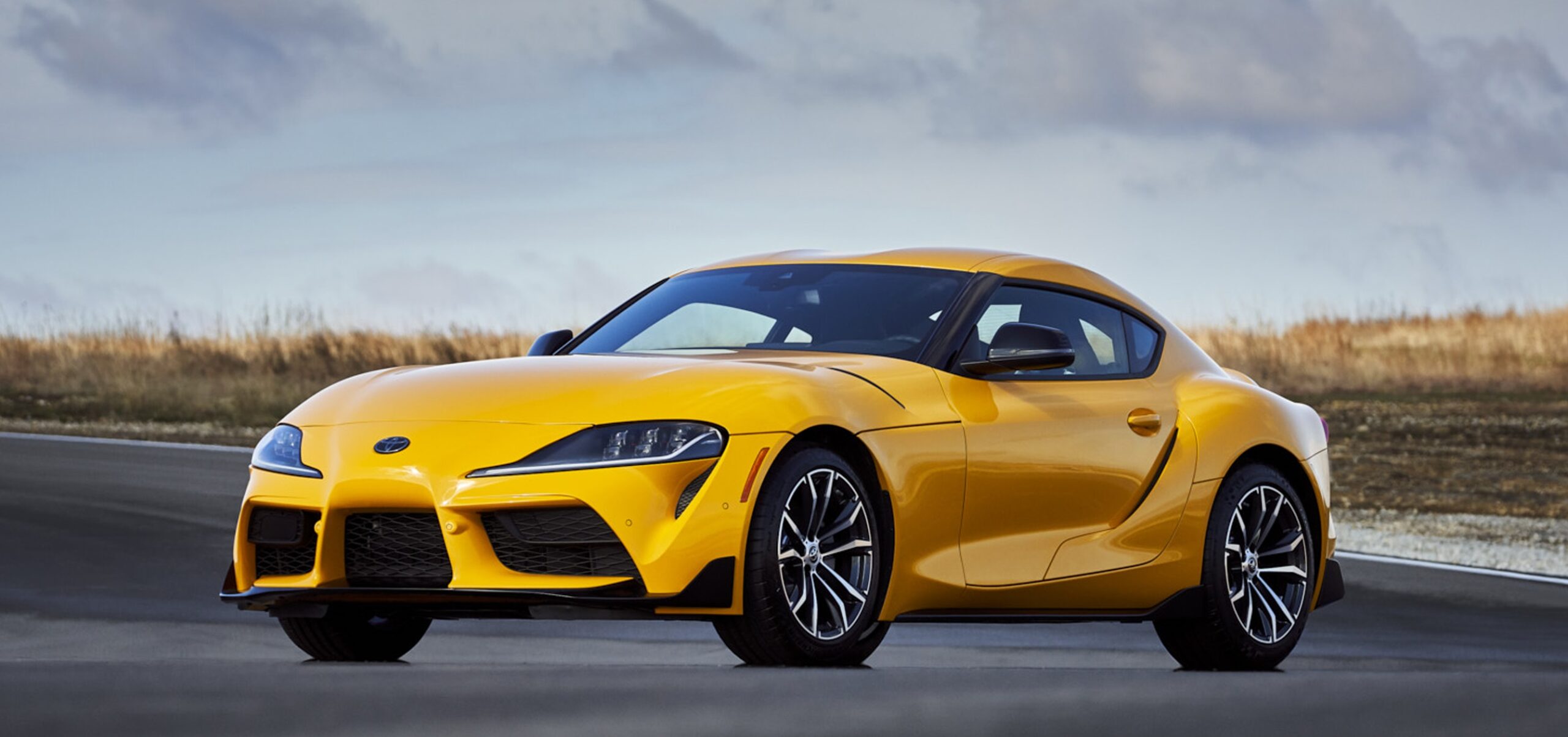
The exterior view of a Nitro Yellow GR Supra

The turbocharged, four-cylinder Toyota GR Supra 2.0 is new for 2021. Pricing starts at $44,215. (Photography courtesy of Toyota)

Table of Contents

Supra History
GR Supra Sport Top
What’s New for 2021-22?
Pricing
GR Supra A91-CF Edition
GR Supra GT4 Race Car
GR Supra 2.0 Performance
Ride and Handling
Interior Function
Why Buy the Toyota GR Supra 2.0?
Specifications

BY MARK MAYNARD

The return of the fifth-generation 2020 Toyota Supra was an act of blasphemy some enthusiasts shouted. The objection was the joint venture between BMW and Toyota. It was an arranged marriage for the diverse qualities of future development and shared costs.

BMW would benefit from Toyota’s long-term work on alternative-fuel propulsion systems, including a fuel cell. Toyota would reap the rewards of the German carmaker’s expertise in lightweight technologies. And the face of the deal would be represented by the joint development of a sports “vehicle,” which became the 2020 GR Supra.

The howls of discontent were heard before most enthusiasts even sat in the reborn Japanese two-seater.

Joint ventures are becoming common in the auto industry. For example, Toyota also partners with Subaru for its BRZ and Toyota GR86. And there also is the Mazda MX-5 Miata and Fiat 124 Spider.

It is a matter of cost-sharing, but is the BMW-Toyota arrangement a collaboration or a compromise?

The front-seat view from inside the GR Supra

Eight-way manually adjusted seats save weight in the GR Supra 2.0.

Toyota Supra History

The fifth generation of the brought-back Supra nameplate dates to the lineup from 1978 to 2002. But Toyota also credits the 1967 2000GT with its double-bubble roof and inline six-cylinder engine, two hallmarks applied to the 2020 Supra.

While the first four generations of Supra shared a foundation with Toyota’s sporty Celica,


the current model shares a foundation with the BMW Z4. For now, BMW keeps the Z4 convertible and Toyota builds a hardtop version with performance engineering from its Gazoo Racing team (GR).

The Z4 is an excellent beginning for a two-seat, rear-wheel-drive sports car. Toyota’s follow-through for the hardtop design provides an ideal 50:50 weight balance. Engineering calibrations for the engine, suspension, and exhaust provide excellent road adhesion. Ride quality has steely determination without battering the occupants.

Automotive News reports that the Toyota GR Supra is due for a “freshening” in 2023.
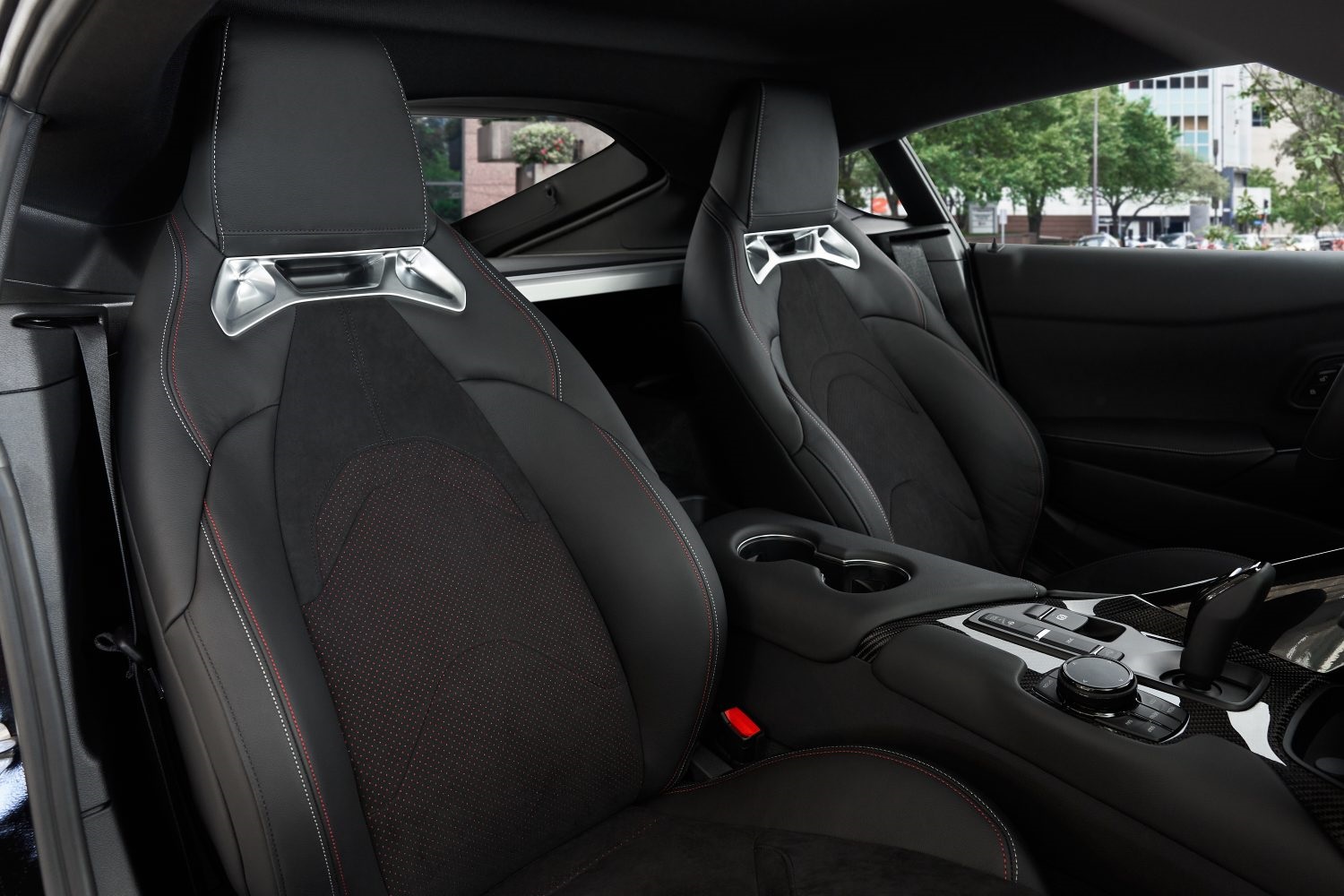
black Alcantara and leather-trimmed upholstery

Black Alcantara and leather-trimmed upholstery

GR Supra Sport Top

Perhaps the 2023 “freshening” could bring a convertible GR Supra?

Toyota showed the GR Supra Sport Top at this year’s Specialty Equipment Manufacturers Association (SEMA). The roof design has two composite panels that were 3D printed. And the roof panels are contoured to the body lines and the design retains the windshield header.

To maintain structural integrity, the roof’s outer body structures were reinforced. And there is added reinforcement under the engine bay and rearward.

The SEMA  show will run from Nov. 2-5 in the Las Vegas Convention Center.

The GR Supra Sport Top concept for a convertible model

The GR Supra Sport Top concept.

What’s New for 2021-22?

A year after its world debut, Toyota has grown the GR Supra family at both ends: an entry-level turbocharged four-cylinder model and a high-performance halo model.

For the first time in the U.S., Toyota has been able to add the 255-hp, 2.0-liter four-cylinder engine, formerly only available in the BMW Z4.

At the top end is the shut-up sauce for GR Supra complainers: the GR Supra A91-CF (Carbon Fiber) Edition, $64,305. This 2022 model includes a carbon fiber aerodynamics kit, 382-hp 3.0-liter inline six-cylinder engine, and a one-year membership to the National Auto Sport Association with high-performance driving instruction.

Limited to just 600 vehicles, the GR Supra A91-CF is well equipped with just one factory option for the Driver Assist Package, $1,195.

And in between the price range are two six-cylinder models. This year the GR Supra 3.0 and 3.0 Premium were granted horsepower to match the 382-hp in the Z4 M40i. Previously, the six-cylinder models were throttled back to 335 horsepower from 5,000-6,500 rpm with peak torque of 365 foot-pounds at 1,600 rpm. Now, peak horsepower ranges from 5,800-6,500 rpm and peak torque is 368 lb.-ft. from 1,800-5,000 rpm.

A rear angle view of the 2021 Supra

The “S” in the Supra logo was inspired by the Nürburgring “S” curve.

GR Supra Pricing

The fifth-generation 2021 GR (Gazoo Racing) Supra is offered in two turbocharged powertrains: a 255-hp 2.0-liter four-cylinder or 382-hp, 3.0-liter inline six-cylinder. Both versions have an eight-speed ZF-8 automatic transmission with paddle shifters.

Current GR Supra pricing ranges from $44,215 for the entry 2.0-liter to $64,305 for the A91-CF Edition. Pricing includes the $1,025 freight charge from Graz, Austria. The Supra is built at the Magna Steyr plant, which also builds the BMW Z4 among other specialty vehicles.

Today’s GR Supra 2.0 tester was $47,845, including a carpeted cargo mat for $80, wheel locks for $65, and the Safety & Technology Package for $3,485. (Package details are in the specifications chart at the end of this review.)

BMW sells just two versions of the Z4 roadster. The Z4 sDrive30i with the 2.0 turbo four-cylinder starts at $50,895. And the Z4 M40i, with 382-hp 3.0-liter inline six-cylinder starts at $64,695. (But Toyota includes more standard equipment for the GR Supra.)

Check current Toyota GR Supra pricing and incentives here.

The double-bubble roof

The double-bubble roof design bumps headroom to 38.3 inches.

Toyota GR Supra A91-CF Edition

Limited to just 600 cars, the GR Supra A91-CF Edition is the most exclusive Mark V Supra to date, Toyota says, and it’s only for North America.

The 2022 GR Supra A91-CF features a carbon fiber front splitter and larger canards (winglet-like add-ons). In addition, carbon fiber side rockers define the lower edge along the sides. And around the back, there is more carbon fiber in the duckbill spoiler and lower canards.

This aero kit isn’t just for looks, Toyota says. The design improves downforce and stability, whether scooting through the daily commute or hot-lapping the autocross.

Other special features include matte-black textured 19-inch wheels — chosen to set off the optional new paint color of matte-gray Phantom. Absolute Zero White and Nitro Yellow are the other color choices for the GR Supra A91-CF.

GR Supra A91 A91-CF Edition has a red-and-black interior theme throughout its Alcantara-and-leather-trimmed cabin. Details include red stitching on the 14-way power-adjustable and heated sport seats, carbon-fiber interior trim, a leather-wrapped three-spoke steering wheel, and sport pedals.

A range of standard intelligent safety features includes a pre-collision system with pedestrian detection and lane departure warning with steering assist.

And every new owner is given a one-year membership to the National Auto Sport Association with high-performance driving instruction.

The Limited to just 600 cars, the GR Supra A91-CF Edition is the most exclusive Mark V Supra to date and only for North America.

Limited to just 600 cars, the GR Supra A91-CF Edition is the most exclusive Mark V Supra to date and only for North America.

The 430-hp GR Supra GT4

There also is a race-prepped GR Supra GT4 for customer teams. It is based on the six-cylinder GR Supra and is developed and produced by Toyota Motorsport GmbH.

The GR Supra GT4 is powered by a 430-hp variant of the 3.0-liter inline six-cylinder engine with a single twin-scroll turbocharger. A seven-speed sports automatic transmission has paddle shifters and a mechanical limited-slip differential. An Akrapovič exhaust system is standard, and Ravenol provides first-fill lubricants.

The front splitter and rear wing are made of natural fiber composite, contributing to an overall weight of 2,976 pounds, which is 424 pounds less than a stock GR Supra 3.0. As is used for the GR Supra road car, the front suspension has MacPherson struts, and the rear multilink suspension uses KW dampers at the front and rear.

An enhanced braking system uses six-piston front calipers and four-piston rear, with tires by Pirelli.

Safety features include a high-strength roll cage on the lightweight steel body and an FIA-standard racing seat with a six-point harness.

The interior has a carbon-fiber instrument panel with a display and a steering wheel designed for GT4 competition.

Pricing starts at around $200,000. Contact TRD at trdusa.gt4@toyota.com  to get more information on the GR Supra GT4.

The GR Supra GT4 race car.

The GR Supra GT4 is powered by a 430-hp, 3.0-liter inline 6-cylinder engine.

GR Supra 2.0 Performance

At 3,181 pounds, the Supra 2.0 is more than 200 pounds lighter than the six-cylinder Supra 3.0. And that weight difference significantly changes the driving attitude of the car, in a positive way. The six-cylinder models are ate-up with power, which sometimes blows past the pleasure of feeling a German-engineered suspension make its graceful transitions.

With less weight over the front end, the Supra 2.0 feels nimble and quick. Throttle uptake is immediate without time lost to turbo spooling. And the engine tone and exhaust note are genuine for a performance car. There is not the high-speed drone of artificially generated engine “sound” that switches on and off.

In standard performance mode, the eight-speed automatic rolls through gears giving eager support to the driver. In Sport mode, the transmission has mind-reading precision, holding shifts for maximum enjoyment and giving heady downshifts.

Various sources cite 0-60 mph acceleration in 4.7 seconds for the GR Supra 2.0. And that compares to 4.4 seconds to reach 60 mph in the Supra 3.0 models. If valid, that 0.3 advantage for the 3.0 models comes at a cost difference of $8,350.

Fuel economy ratings are 25 mpg city, 32 highway and 28 mpg combined on the recommended premium fuel. (Those ratings compare to the six-cylinder model at 22/30/25 mpg.) My driving with liberal use of Sport mode worked up to 27.5 mpg, but I was focused more on fun than fuel economy.

Supra taillights

Rear combination lamps feature the turn, tail, and stop functions integrated into a ring shape.


Ride and Handling

The GR Supra is surprisingly uncomplicated to enjoy. It is an excuse to take the long way to work or to head out for weekend exploring. But it would not be my choice for a long road trip. It has a tight cockpit and the outside noise can be wearisome. However, the sport seats would remain comfortable for the range of the 13.7-gallon fuel tank.

After a few miles behind the wheel, the driver will warm up to the balance of the GR Supra 2.0. It is a rewarding engineering asset. The articulation of the suspension is a delicious experience as it stealthily makes weight transitions. Both powertrains have the same four-wheel-independent suspension with front MacPherson struts and a five-link rear setup. Stabilizer bars are the same gauge all around: 23.5 mm front and 18 mm rear.

Brush the brake pedal when barreling into a corner and the transmission flashes a downshift. Press harder on the pedal and downshifts fire off sequentially.

It is an active and engaging experience for the driver who will quickly forgive and forget that no manual gearbox is offered.

The electric power steering is keenly calibrated for an organic feel and smooth roll of the steering wheel. It takes just a twitch of the wheel to make a lane change, which brings yet another smile.

Despite the low front end, careful steering can avoid the occasional grind (and wince) of chin scraping.

Tires and Brakes

All Supra models get Michelin Pilot Super Sport staggered-size, ultra-high-performance tires. The Supra 2.0 has 18-inch alloy wheels with 255/40 front and 275/40 rear tires. And the Supra 3.0 has 19-inch forged aluminum wheels and slightly wider tires of 255/35 front and 275/35 rear.

Braking is by a matched set of 13-inch vented discs front and rear with a single-piston aluminum floating caliper. Six-cylinder models get 13.7-inch ventilated front discs with a four-piston fixed Brembo caliper; rear ventilated discs are 13.6 or 13 inches, depending on which model.

A tire and wheel on the Supra 3.0

Braking is by 13-inch vented discs front and rear. Six-cylinder models get 13.7-inch vented front discs and a four-piston Brembo caliper.

Interior Function

For such a high-performing car, it is accommodating as a daily driver. The shrink-wrapped body with a double-bubble roof allows headroom of 38.3 inches. With 42.2 inches of legroom and the eight-way manually adjusted seats, there should be room for those 6-feet-plus, but maybe not while wearing a helmet.

The seat-belt anchors are low and can be a struggle to click into position, competing for space with the bolstered seatback. Those of large girth will grumble about the extra effort to secure the belt, but the low anchor position actually improves the safety response.

Standard safety features include eight air bags, a precollision system with pedestrian alert and lane-departure warning with steering assist. Other safety elements are in the specs chart at the end of the story.
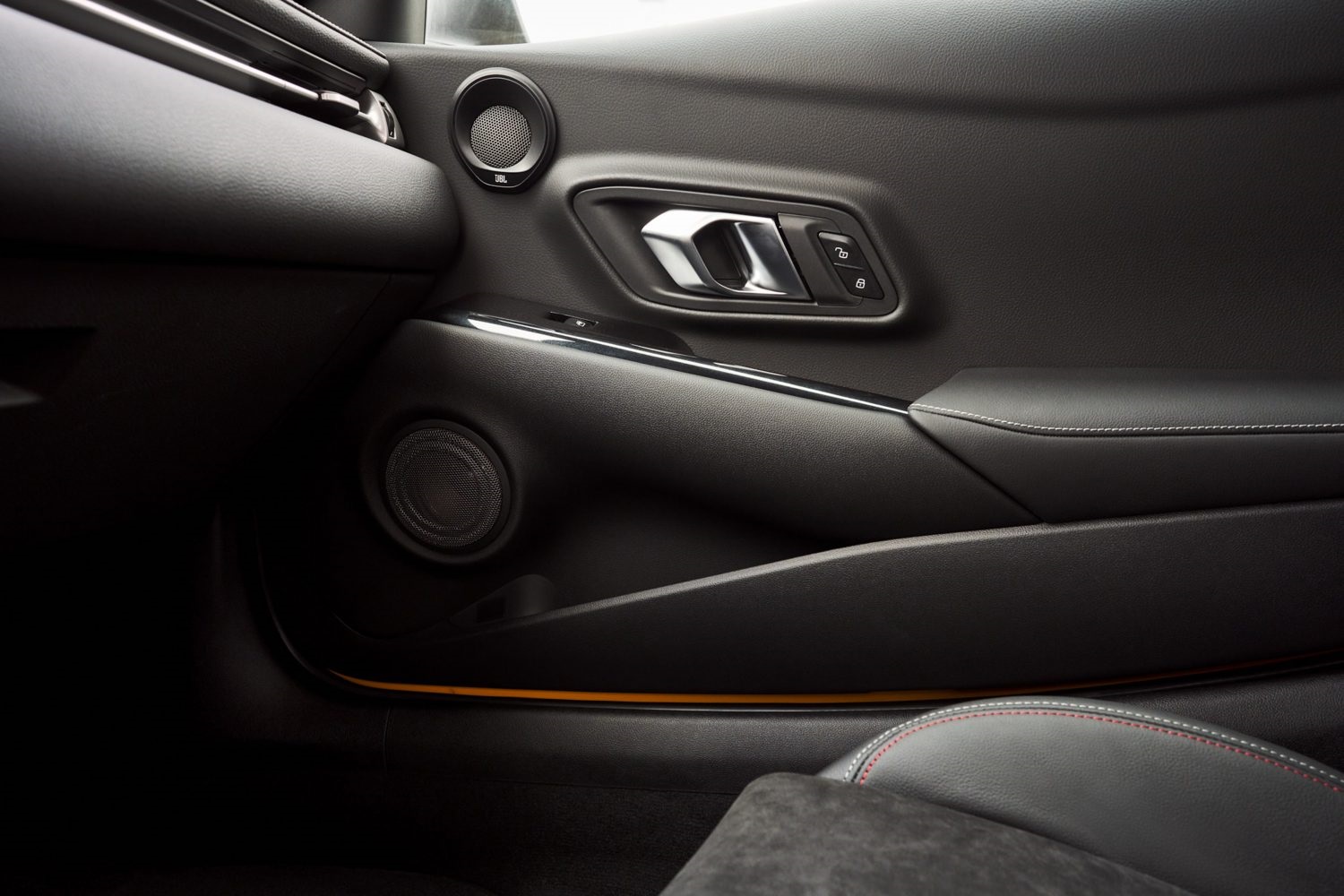
A door panel in the Supra

Interior assembly and materials are worthy of a $50,000 sports car.

Entry and Exit

The car is low with a wide sill that creates a duck-and-drop entry exercise. And those coupe doors are about 54 inches long, which is not an asset for access in tight parking situations. Finally, because the point of the spear is about 9 feet from the driver’s seat, I wished for a front camera (as in the Corvette) — in addition to the front and rear parking tones (with braking).

Sightlines out the front are good but compact out the small rear glass. Over-the-shoulder glances are blocked and damning at night. The rearview camera is small but helpful.

Cabin design is smartly organized with several areas for small-item storage, including a lockable glove box. The shift console is somewhat unique for its knee-bolstering brace on the driver’s right, and the left side is an open sweep that creates a sense of involvement for the passenger.

A bold and uncluttered gauge array has a dominant dial for RPMs and a digital speedo.

The 10.2 cubic feet of trunk space is adequate for weekend-getaway luggage.

Why Buy the Toyota GR Supra?

When you give an enthusiast a choice of more power or less, most will choose “more.” But the GR Supra 2.0 is not a cheapened model for a more appealing advertising price point.

The GR Supra 2.0 is a genuine sports car with a German pedigree, high-quality engineering, and robust construction.

Working with BMW is a blue-chip opportunity. The Z4 is a Thoroughbred in critical areas where some brands cheap out.

Toyota took the opportunity and built a family of GR Supras. The compromise might be for BMW, which has just the two Z4 roadster models.

Sales on average for the BMW Z4 convertible run about 280 a month, or 833 for the third quarter ending in September.

Supra sales in September were 436 (but down from 489 in Sept. 2020). But year to date Supra sales were 5,825 vs. 3,798 for 2020.

Maybe BMW will see Toyota’s positive business plan and be granted a hardtop Z4.
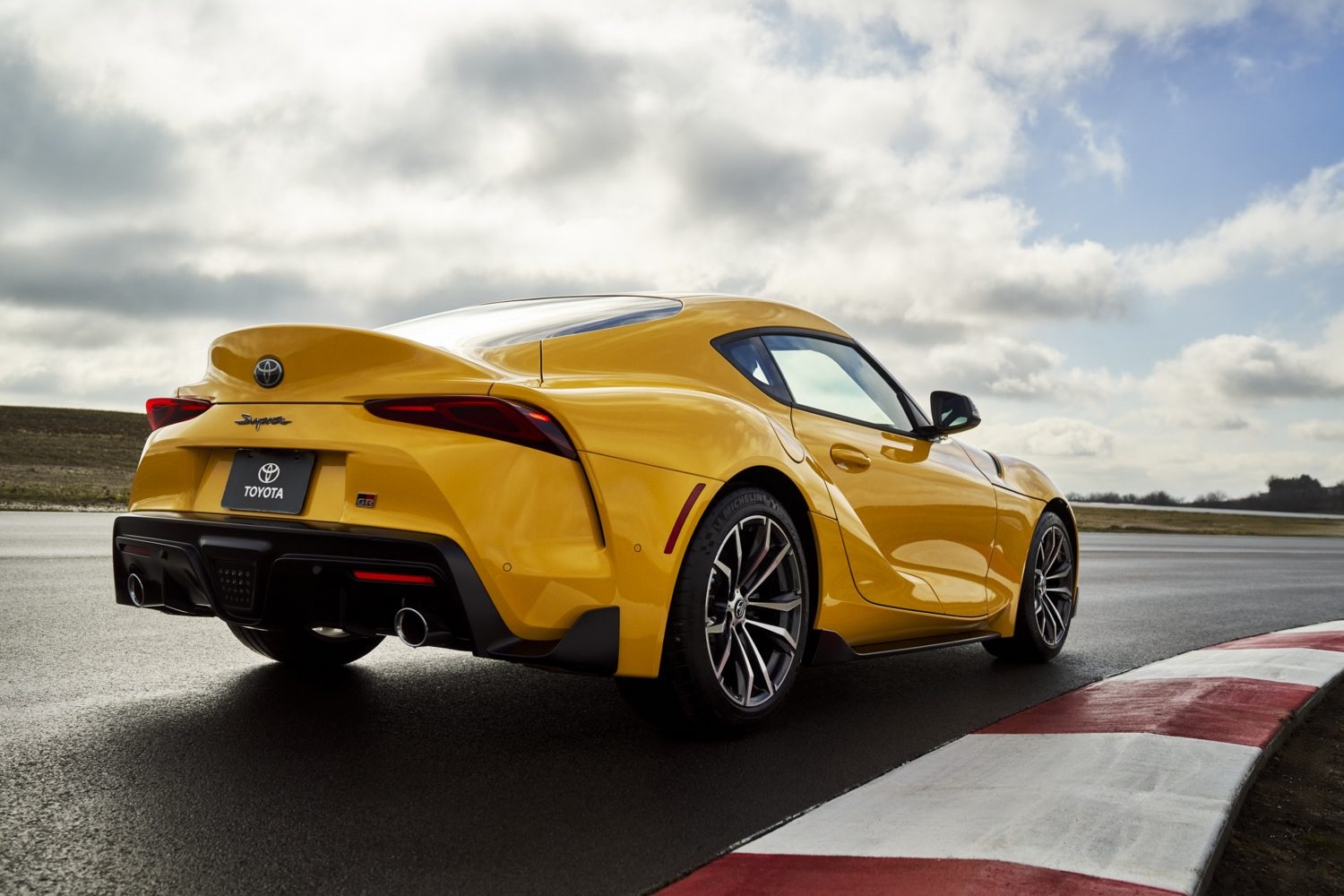
A yellow supra cornering on a racetrack

Automotive News reports that the Toyota GR Supra is due for a “freshening” in 2023.

Toyota Supra GR 2.0 Specifications

Body style: subcompact, rear-wheel-drive, 2-seat sports car

Engine: 255-hp, twin-scroll turbocharged direct-injected 2.0-liter, inline 4-cylinder; 295 lb.-ft. from 1,550-4,400 rpm

Transmission: 8-speed automatic with paddle shifters and launch control; active rear differential

0-60 mph: 4.7 seconds, Car and Driver magazine

Fuel economy: 25/32/28 mpg city/hwy/combined; premium fuel recommended

BY THE NUMBERS

Fuel tank: 13.7 gallons

Trunk space: 10.2 cubic feet

Head/leg room: 38.3/42.2 in.

Length/wheelbase: 172.5/97.2 in.

Curb weight: 3,181 lbs.

Turning circle: 34.1 ft.

FEATURES

Standard equipment includes: Smart key entry with push-button ignition, electric parking brake, rearview camera with guidance lines, 8.8-inch full digital gauge cluster, 8-way manual seats with 4-way lumbar, black Alcantara with leather sport seats, carbon-fiber interior trim, leather-wrapped 3-spoke steering wheel with paddle shifters, lined and locking glove box, 12-volt charging socket and 1.5-amp USB port, 4 speaker audio system with an 8.8-inch display screen with Supra Command and USB/Bluetooth connectivity

Exterior: 18-inch alloy wheels with Michelin Pilot Super Sport staggered size ultra-high-performance tires (255/40 front and 275/40 rear), gloss-black auto-folding heated side mirrors, LED front turn signal indicator and daytime running lights, 6-lens auto-leveling LED headlights (3 low beam, 3 high beam), LED tail lights and brake lights, aerodynamic underbody panel, dual rear exhaust outlets with polished stainless-steel tips

Safety features include: 8 air bags, precollision system with pedestrian alert, lane-departure warning with steering assist, auto high-beam headlight dimming, hill-start assist, brake assist, stability and traction controls

PRICING

Base price: $44,215, including $1,025 freight charge; price as tested $47,845

Options on test vehicle: Carpeted cargo mat $80 and wheel locks $65;

Safety & Technology Package, $3,485, include: Dynamic Radar Cruise Control (full speed), blind-spot monitor, rear cross-traffic alert, parking sensors with emergency braking function;

Technologies included in the package: 8.8-inch touchscreen navigation, 12 Speaker 500-watt JBL audio system with amplifier, touchpad rotary controller, wireless Apple CarPlay compatible (iOS only), speed limit information;

Supra Connected Services with up to 4-year trial: Included are remote services, remote maintenance, automatic emergency call, real-time traffic information, concierge, stolen vehicle recovery, map updates

Where assembled: Graz, Austria

Warranties: 3 years/36,000 miles bumper to bumper; 5 years/60,000 miles powertrain; ToyotaCare complimentary maintenance for 2 years/25,000-miles, includes all standard factory scheduled service and 24/7 roadside assistance

Alfa Romeo Tipo 158 ‘Alfetta.’

Alfa Romeo Tipo 158 ‘Alfetta.’

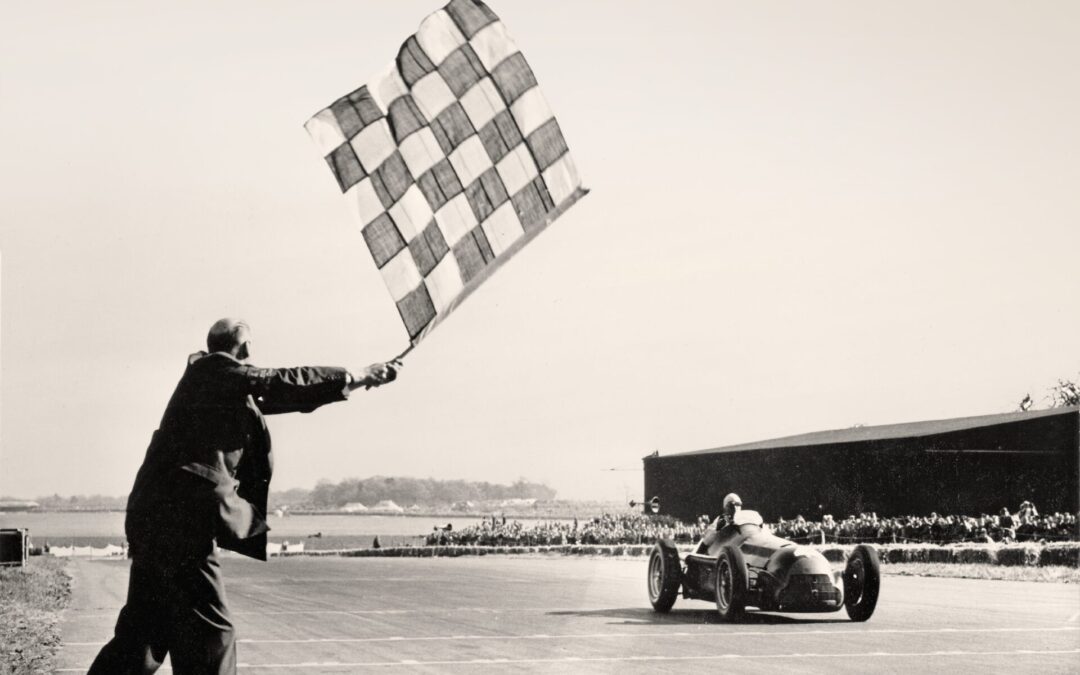
Nino Farina takes the checkered flag in an Alfa Romeo 158 at the 1950 Silverstone Grand Prix. The first ‘hat trick’ of Formula 1.”

Nino Farina takes the checkered flag in an Alfa Romeo 158 at the 1950 Silverstone Grand Prix. The first ‘hat trick’ of Formula 1.”

Nino Farina in Alfa Romeo 158 at the 1950 Silverstone Grand Prix.

BY MARK MAYNARD

The energy is compelling in this vintage PR image from the Alfa Romeo media site.

The modern era’s first World Championship Formula 1 race was staged May 13, 1950, at the Silverstone Circuit in Silverstone, England.
Giuseppe “Nino” Farina won the Grand Prix of Europe with his Alfa Romeo Tipo 158 ‘Alfetta.’

It was such an impressive feat that King George VI personally congratulated all the drivers of the Alfa Romeo Team for the exceptional result: pole position (Farina), victory (Farina), fastest lap (Farina), and top place in the league throughout the Grand Prix.

The “Little Alfa”

The Alfa Romeo 158/159, also known as the Alfetta (Little Alfa in Italian), is one of the Italian manufacturer’s most successful Grand Prix racing cars.

According to its page in Wikipedia, the Alfa Romeo 158 and its derivative, the 159, took 47 wins from 54 Grands Prix entered. The race car was developed initially for the pre-World War II voiturette formula (1937) and had a 1.5-liter straight-8 supercharged engine. The car’s 158 ID refers to its 1.5-liter engine and eight cylinders.

Following World War II, the car was eligible for the new Formula One introduced in 1947.

The “3F” Team

In the hands of drivers such as Nino Farina, Juan Manuel Fangio, and Luigi Fagioli, it dominated the first two seasons of the Drivers’ World Championship.

In a 2015 report by Sports Car Digest, Alfa Romeo fielded a team of four “Alfetta” to the Silverstone track for the debut World Championship Formula 1 race in 1950.

The Alfa Romeo 158 race cars were entrusted to Giuseppe “Nino” Farina, who became the world champion at the end of the season, and to Luigi Fagioli, Juan Manuel Fangio. Fangio was the rising Argentine star who won the world title in ’51 again with the Alfetta, and Reg Parnell, a British driver chosen in honor of the country hosting the first Championship.

Farina won the race, and two other places on the podium were also Alfa Romeo entries. The cars of the Milan-based company dominated the race, a script that was repeated throughout the Championship.

During the season, the trio of Farina, Fagioli, and Fangio was dubbed by the public as “the 3F.” Together with their Alfa Romeo, they held the name of Italy high in international motor racing, a historic moment for the country and Alfa Romeo.

After the race, King George VI personally congratulated all the drivers of the Alfa Romeo Team for the exceptional result: pole position (Farina), victory (Farina) and other two places on the podium, fastest lap (Farina), and the top of the league throughout the Grand Prix.
“‘Nino’ Farina thus also took home the first ‘hat trick’ of Formula 1.”

1959 Chevrolet El Camino

1959 Chevrolet El Camino

The 1959 Chevrolet El Camino  combined dramatically finned styling with half-ton pickup utility

A pastoral photo of a 1959 Chevrolet El Camino on a stone bridge in the countryside

Unlike a standard pickup truck, the El Camino was adapted from the two-door Chevrolet Brookwood two-door wagon. (Photos courtesy of GM archives)

BY MARK MAYNARD

The original Chevrolet El Camino introduced for 1959 combined the dramatically finned styling of that period’s Chevrolet cars with half-ton pickup utility.

The El Camino as a passenger-car pickup was intended to answer the success of the Ford Ranchero coupé utility. The Chevrolet variant was based on the B-body Biscayne wagon but lasted only two years.

Production resumed for the 1964-1977 model years based on the Chevelle platform. Then, it continued for the 1978-1987 model years based on the GM G-body platform for midsized, long-wheelbase rear-wheel-drive cars. Examples of G-body cars are the 1969-1972 Pontiac Grand Prix and 1970-1972 Chevrolet Monte Carlo.

The Personal-Car Pickup

Unlike a standard pickup truck, the El Camino was adapted from the two-door Chevrolet station wagon platform and integrated the cab and cargo bed into the body, according to its page in Wikipedia.

The excitement of the El Camino’s debut was short-lived. After 1960, the passenger-car pickup went on a three-year hiatus.

Chevrolet revived the “personal pickup” concept for 1964, with a new version based on that year’s new midsize Chevrolet Chevelle.

During the ‘muscle car’ era that followed, El Camino buyers could order their truck with a Chevrolet high-performance big-block V-8 powertrain, creating a sport pickup that could “haul” in more ways than one. By 1968, a complete Super Sport package was available.

The Chevelle El Camino was produced through two more styling generations (1968-1972 and 1973-1977).

For 1978, the El Camino was moved to that year’s new, smaller Malibu platform. The final El Caminos were 1987 models.

The GMC truck division also had its badge-engineered El Camino variant, called the Sprint. It was introduced for the 1971 model year. Renamed Caballero in 1978, it was also produced through the 1987 model year.

A vintage image from Chevrolet PR photo archives of a red 1959 El Camino

The 1959 El Camino was aimed at the success of the Ford Ranchero, introduced in 1957.

Origin of the El Camino

The concept of a two-door pickup-like vehicle based on a passenger car began in the United States in the 1920s. The body style was known as a roadster utility, roadster pickup, or a light delivery model.

Ford Australia was the first company to produce a coupé utility. The idea for such a vehicle came from a 1932 letter from a farmer’s wife in Victoria, Australia. She asked for “a vehicle to go to church in on a Sunday and which can carry our pigs to market on Mondays.”

Ford designer Lew Bandt developed a suitable solution, and the first coupé utility model was released in 1934.

General Motors’ Australian subsidiary Holden also produced a Chevrolet coupé utility in 1935. And Studebaker produced the Coupé Express from 1937 to 1939.

The body style did not reappear in the U.S. until the release of the 1957 Ford Ranchero.

2022 VW Tiguan Review

2022 VW Tiguan Review

Redesign of the 2022 Volkswagen Tiguan sharpens exterior styling and adds standard heated seats, safety technologies, and seats for 7

The redesigned Tiguan for 2022

The 2022 VW Tiguan’s front-end styling was sharpened to make it look more like the larger VW Atlas SUV. (Photography by Mark Maynard)

Table of Contents

Tiguan Overview
What’s New For 2022
Better Than Base Standard Features
Pricing
Performance and Fuel Economy
Ride and Handling
Safety Features
Interior Function
Back Seats and Cargo
Why Buy the VW Tiguan?
Specifications

BY MARK MAYNARD

I don’t often get to test an entry-level new car or truck. But a week in a base 2022 VW Tiguan was proof of the good bones that underpin this small SUV.

From the first drive-away, the Tiguan telegraphs the German engineering of a car to be enjoyed for its drivability. It is felt in the smooth roll of the steering and the quiet function of the compliant suspension. The cabin is well sound-isolated from road harshness or wind noise at speed, yet there was no significant effort for weighty soundproofing materials or laminated glass.

Tiguan driver's area

The driver’s position is secure with unhindered sightlines.

Manufacturers typically provide a well-equipped vehicle for media evaluations to showcase technologies and refining features. Generally, a base model has a reasonable amount of features, but limitations of technologies, option packages, and paint colors will cramp personal style. And the interior can be a plastic hell to meet a low price point for advertising.

Volkswagen, too, keeps the formula simple for the entry Tiguan S with limited options and paint colors. But so much is built into the Tiguan that the term “base” does not translate as cheap.

A wide angle view of the front seat area

There is a quality appearance to interior plastics and other materials.

VW Tiguan Overview

The VW Tiguan is part of a long line of VW Group vehicles, including the Audi Q5 and Porsche Macan. And like those luxury-class SUVs, the Tiguan embodies that shared German ethos for keen drivability.

The Tiguan nameplate is a mashup of German words for Tiger and Leguan (iguana). Volkswagen says Tiguan is its best-selling model in the U.S. and worldwide.

The second-generation Tiguan debuted in 2018, which makes the 2022 model a midcycle update. Sold globally, the U.S. model is the long-wheelbase version, which provides seating for seven. For the U.S., the Tiguan is built in Puebla, Mexico.

The Tiguan slots in the VW lineup as a compact-class SUV. But because of its long wheelbase, the cabin is more of a super-compact, even midsize by some measurements. The Tiguan is also somewhat unique among its competitors for a pair of standard third-row seats on front-wheel-drive models. All-wheel-drive models only have seats for five.

There are four trim levels of Tiguan, all powered by a 184-horsepower, 2.0-liter turbocharged and direct-injected four-cylinder engine. Front-wheel drive is standard and 4Motion all-wheel drive is available on the first three trims, while the top-of-range model includes AWD. All Tiguan models have an eight-speed automatic transmission.

Competing small SUVs include the Ford Escape, Honda CR-V, Hyundai Tucson, Jeep Cherokee, Mazda CX-5, Subaru Forester, and Toyota RAV4.

What’s New On the 2022 Tiguan?

For 2022, the Tiguan’s front-end styling was sharpened a bit to make it look more like the larger VW Atlas SUV. LED daytime running lights are new and complement LED lighting front and rear. In addition, there are four new wheel designs for the standard 17-inch aluminum alloys to 18-, 19-, and 20-inch wheels.

There are two new paint colors of Kings Red Metallic and Oryx White, both $395 each but not available on the base model. And for upper-trim models, there are two new interior colors of Cinnamon leatherette and Noisette (hazelnut color) leather.

Options include an illuminated line of lighting that flanks the VW logo. And there are updated R-Line design elements.

Volkswagen’s Digital Cockpit instrument cluster is now standard with an 8-inch display (or an optional 10-inch Digital Cockpit Pro).

Also standard is the Volkswagen Car-Net infotainment system (for apps). There is Wi-Fi but only with a data-plan subscription. From the second trim level, MIB3 infotainment is standard, along with wireless charging and wireless App-Connect for compatible devices.

Heated front seats are now standard, with a heated steering wheel and ventilated front seats as options.

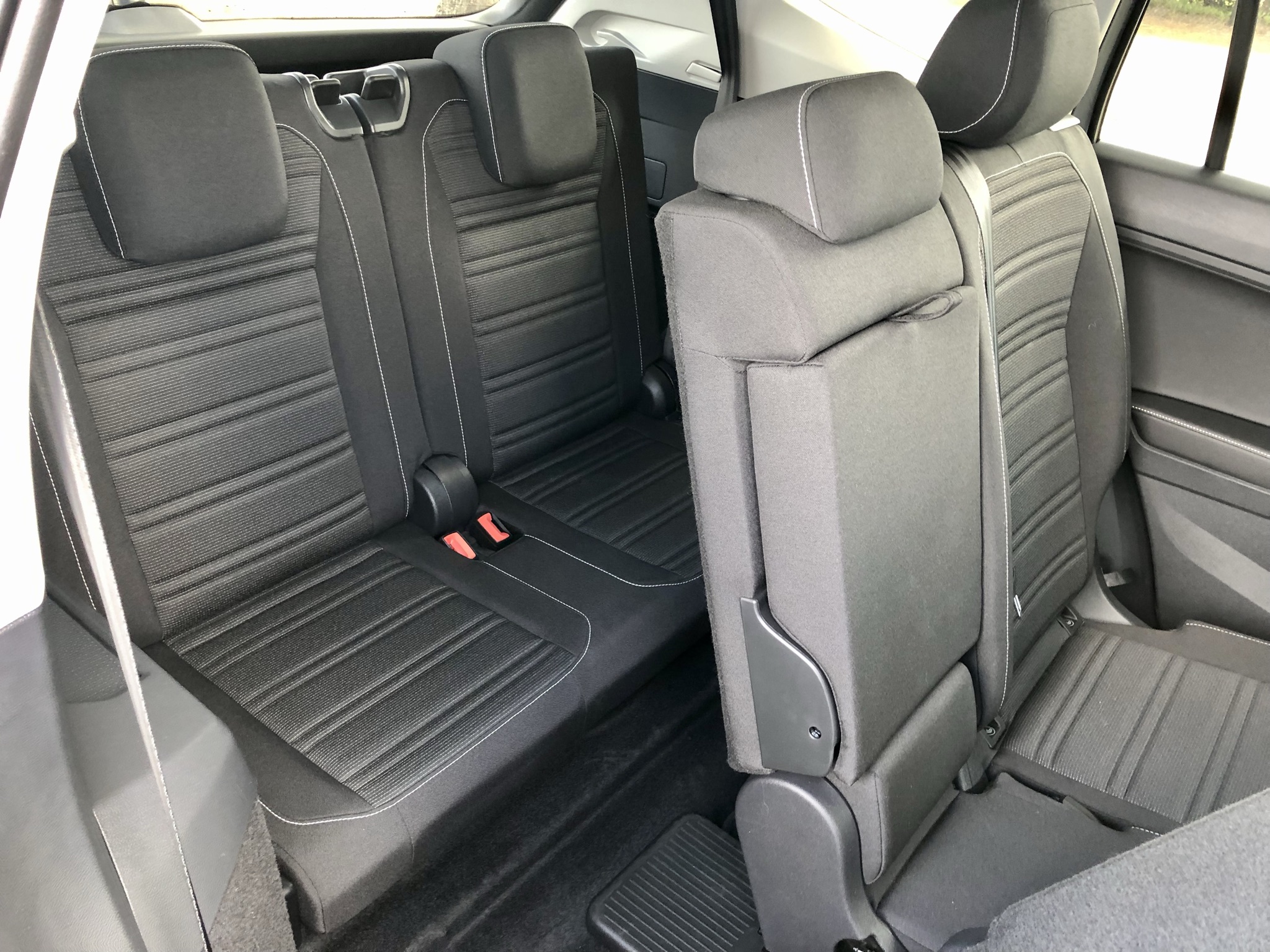
The third row of seats in the Tiguan

The third row is for kids only, but it will be handy for the school carpool.

Optional Tiguan Upgrades

Models from the second trim level up include a power tailgate and a next-generation Climatronic Touch interface for climate control.

R-Line models get a leather-wrapped steering wheel with touch “islands” and sliders.

Additional options include leatherette or leather seating surfaces, power driver and passenger seats, panoramic sunroof, Fender Premium Audio, and 15-color ambient lighting.

New interior colors include Cinnamon leatherette and Noisette leather.

Volkswagen’s Digital Cockpit instrument cluster is now standard and has an 8-inch display (or optional 10-inch Digital Cockpit Pro).

From the second trim in the revised lineup, MIB3 infotainment is standard, along with wireless charging and wireless App-Connect for compatible devices.

Heated front seats are now standard, with options for a heated steering wheel and ventilated front seats.

Additional options include leatherette or leather seating surfaces, power driver and passenger seats, panoramic sunroof, Fender Premium Audio, and 15-color ambient lighting.

Better Than Base Features

The number of standard details is almost untouchable by competing entry-level offerings.

  • New standard tech includes the Digital Cockpit configurable gauge array and keyless entry with push-button ignition.
  • Automatic up and down lifts for all windows, not just the driver’s. Some brands seem to dole out the auto-for-all function as if it were gold.
  • Grab handles above all doors. Some makers save a few dollars and leave out the driver’s handle.
  • VW interiors are almost spartan for their disdain of flash-bang gimmicks. The interior design is reserved, but the Tiguan plastics have a premium appearance and graining. A few brushed-aluminum accents add contemporary style along the face of the instrument panel, door panels, and switchgear.
  • Door panel storage is flocked for sound-dampening.
  • I also like the dual overhead reading lights in the second row. And the separate jacket hooks at the B-pillars are often a budget-killing feature on other SUVs.
  • The second row reclines or folds flat.
A view of the fabric front seats.

Fabric seats in the Tiguan S are durable, supportive, and heated.

VW Tiguan Pricing

The front-wheel-drive Tiguan is sold in four trim levels, all with the same powertrain. 4Motion all-wheel drive is available on the first three trims and standard on the top model.

Tiguan starting prices range from $27,190 to $37,790 for the top-line SEL R-Line with AWD. Otherwise, add $1,500 for all-wheel drive. A sunroof would add $1,200.

The Tiguan S tester was $28,085 with one option for the combined IQ.DRIVE Package and S Convenience Package, $895. The IQ.DRIVE package adds adaptive cruise control for hands-on semi-autonomous driving, with Travel Assist, Lane Assist, and Emergency Assist. Among the convenience elements are a leatherette-wrapped and stitched multi-function steering wheel. Also included are an auto-dimming interior rearview mirror and rain-sensing windshield wipers.

See the complete Tiguan S standard equipment list in the specifications list at the end of this review.

Find current pricing and incentives here.

 VW Tiguan S Performance

While the engine is the same as before, VW tinkered with the peak horsepower and torque power ratings. And because of its long wheelbase and third row, the Tiguan is heavier than most competitors by about 200 to 400 pounds. As a result, the curb weight of 3,765 pounds is reflected in the Tiguan’s performance and fuel economy.

Horsepower now peaks at 6,000 rpm, up from 4,360 rpm last year. And peak torque of 221 lb.-ft. at 1,900 rpm is now substantially higher than the previous peak at 1,600 rpm.

The re-calibrations might have been aimed at fuel economy, which is 1 mpg improved in the highway and combined ratings. But the 2022 ratings of 23 mpg city, 30 highway, and 26 mpg combined were unachievable in the front-drive tester. My driving averaged 14-15 mpg around town, and I was able to work up to just 24 mpg combined on highway driving. Longer daily commutes likely would stretch the mileage.

There’s not much compromise to fuel economy from front- to all-wheel drive. The 4Motion is rated 22/29/25 mpg, and mileage for the Tiguan R-Line drops to 21/28/24 mpg.

The engine runs on 87 octane for all models, and there’s a 15.3-gallon tank for front-drive models and a 15.9-gallon tank for AWD models.

In daily driving, there is a slight delay in acceleration until the turbo is fully charged. At times, pulling away from the light can bring a squeal of the front tires. And sometimes, the acceleration requires a heavier foot. On the highway at 70-75 mph there is strong pull for passing or emergency maneuvers.

Sport mode sharpens the response, but it can feel unsteady and with some abrupt gear changes.

The Tiguan's turbocharged four-cylinder engine

The 184-horsepower, 2.0-liter turbocharged four-cylinder engine.

Tiguan S Ride and Handling

The simplicity of the Tiguan suspension has secret-sauce engineering that is true to the Volkswagen DNA for driving. There are no hydraulics or electronics, just front struts with lower control arms, steel coil springs, telescopic dampers, and an anti-roll bar. The rear multilink also has coil springs, telescopic dampers, and an anti-roll bar.

The ride is uncommonly supple for an SUV of any size. The ride quality is firm but never harsh, and the cabin is remarkably quiet at highway speeds. Tiguan can handle enthusiastic cornering without falling all over itself.

Braking has a reassuring and flat grip from power-assisted, 13.4-inch vented front discs and 11.8-inch solid rear discs.

17-inch alloy wheels on the entry level Tiguann

17-inch alloy wheels are standard on the Tiguan S.

VW Tiguan Safety Features

All Tiguan models have such safety features as six air bags, automatic post-collision braking, forward collision warning, autonomous emergency braking, blind-spot monitor, and rear traffic alert.

New this year is standard Automatic Post-Collision Braking. The system will apply the brakes in certain crash types when the air-bag sensors detect a primary collision. Automatic braking is intended to reduce the chance of additional damage.

Tiguan also includes the Intelligent Crash Response System. The feature shuts off the fuel pump, unlocks the doors, and switches on the hazard lights if the car is involved in a severe collision.

 VW Tiguan Interior Function

The Tiguan S tester had a basic black interior with durable and attractive fabric upholstery. Cabin décor is contemporary with reserved use of satin aluminum accents. There is much black plastic, but it has a premium appearance and all panels were well aligned. However, the loud ping-pong tone of the turn signal could be toned down.

The doors open wide for easy entry and exit, which shows more engineering attention to finesse another degree or two on opening. The driver’s position is secure, with clear sightlines over the front fenders and over the shoulder. Headroom is tall at 39.6 inches with shoulder room. And there is a robust driver’s footrest.

The digital gauge array.

The digital gauge array. (VW)

I like the configurable gauge array to highlight a “classic” view or to add such categories as “gear and speed,” fuel economy, and range.

The front seats have manual height adjustment and are firmly stuffed for support on long drives. However, I would have liked some seat-cushion tilt and adjustable lower-back support (lumbar), which is not available on the Tiguan S. Door-side armrests and the steering wheel are neatly stitched as part of the IQ Drive package.

The standard 6.5-inch color display touch screen seems small, particularly when viewing the rearview camera. Upper trim models have an 8-inch display.

There are large and convenient storage areas, including a small box on driver’s left on the lower instrument panel. Bottle holders in the door panels have large capacity. Even the hood release lever is of stout design.

There is a charging area on the shift console with two USB-C ports and space to lay a large phone.

A front inside door panel with a large bottle holder

The door panel has large bottle storage and a neatly stitched armrest.

Tiguan Back Seats and Cargo Space

The second row is road-trip relaxed with 36.5 inches of maximum legroom with good footroom, even with Big Daddy in the front seat.

The bench seat has a 40-20-40 split with reclining seatbacks. The seats have fore-aft travel and tip-and-slide for access to the third row, but the manual function is stiff to use and could be refined for easier operation.

Second-row bench in the Tiguan

The second row has long legroom of 36.5 inches.

Amenities include airplane-style lights in the headliner, a fold-down center armrest, grab handles and four coat hooks.

Third-row space is best for a pair of youngsters. Headroom is 5.3 inches lower than in the second row (33.8 inches) and legroom is short at 27.9 inches. But the pair of seats are handy just in case, and the seats lie flat when folded.

Cargo space in the Tiguan

The Tiguan cargo space is flexible, with 12 cubic feet behind the third row.

Cargo space behind the third row is great for corralling grocery bags in the 12-cubic-foot space.

With the third row folded, there is 33 cubic feet of capacity, stacked to the headliner. Fold both rows or one section of the second row, and there is about 6 feet of length. The entry is wide at 45 inches.

There is underfloor storage for the roller-cover when the seats are in use. Other extras include a 12-volt plug and second-row seatback release levers.

Underfloor storage in the Tiguan cargo floor

The cargo roller cover can be stored in underfloor storage.

Why Buy the 2022 VW Tiguan?

So much is built into the 2022 VW Tiguan that the term “base” does not translate as cheap.

Seldom is a base model from any maker an acceptable purchase without a couple of option packages, at least. The entry Tiguan S is an exception. But even the test car had one package for $895, which added safety in its semi-autonomous driving elements and a couple of welcome convenience features.

At $28,085, the tester is fully priced, but it made for a value-plus purchase as a very enjoyable vehicle.

I am enthusiastic about the qualities of the Tiguan S, but it has limits for personalization. The S model has just four choices of paint colors: Platinum Gray Metallic, Pyrite Silver Metallic, Deep Black Pearl, and Pure White.

Moving up to the SE, $30,690, adds color choices of red (a $395 cost) or blue metallic, and pearlescent black or white.

And the SE also adds an eight-way power driver’s seat with manual lumbar, V-Tex leatherette upholstery, adaptive cruise control, Travel Assist, Lane Assist, Emergency Assist, wireless phone charging, Bluetooth phone connection, and audio streaming, and 18-inch wheels.

Depending on the purchaser, spending another $2,605 for the SE might build a better family SUV.

The rear angle of the Tiguan

VW Tiguan S pricing starts at $27,190. AWD adds $1,500

 2022 VW Tiguan S Specifications

Body style: compact, 7-seat, 5-door compact-class SUV in front- or optional all-wheel drive

Engine: 184-hp, turbocharged and intercooled direct-injected 2.0-liter 4-cylinder with auto stop-start at idle; 221 lb.-ft. peak torque at 1,900 rpm

Transmission: 8-speed automatic with sport and manual modes

Fuel economy: 23/30/26 mpg city/hwy/combined; 87 octane recommended

Towing capacity: 1,500 lbs., braked

BY THE NUMBERS

Fuel tank: 15.3 gallons

Cargo space: 12 to 33 cu. ft.

Front head/leg room: 39.6/40.2 in.

2nd-row head/leg room: 39.1/36.6 in.

3rd-row head/leg room: 33.8/27.9 in.

Length/wheelbase: 186.4/109.9 in.

Curb weight: 3,765 lbs.

Turning circle: 37.7 ft.

FEATURES

  • Standard Tiguan S equipment includes: Keyless entry and locking with push-button ignition, rearview camera, electric parking brake, digital cockpit gauge array with 8-inch display, cloth seating, heated front seats, multi-function steering wheel, 6-speaker audio system with Bluetooth connectivity, two USB-C ports, LED headlights and taillights (with LED Daytime Running Lights), black roof rails, body-colored heated side mirrors with turn signal indicators, Car-Net infotainment and apps with 6.5-inch touch screen and six-speaker sound system, Wi-Fi capability with subscription, sliding and folding 40-20-40 second-row seat, third-row 50/50 seating, and 17-inch aluminum-alloy wheels
  • Safety features include: 6 air bags, automatic post-collision braking, forward collision warning, autonomous emergency braking, blind-spot monitor, rear traffic alert

PRICING

Tiguan S Base price: $27,190, including $1,195 freight charge; price as tested $28,085

Options on test vehicle: IQ.DRIVE Package & S Convenience Package, $895, includes adaptive cruise control, auto-dimming interior rearview mirror, leatherette-wrapped, multi-function leatherette steering wheel, rain-sensing windshield wipers, travel assist, lane assist, emergency assist

Where assembled: Puebla, Mexico

Warranty: 4-years/50,000-miles bumper to bumper, transferred to a subsequent owner throughout the remainder of coverage; 3-years/36,000-miles roadside assistance; free scheduled maintenance for 2 years or 20,000 miles