Select Page

#TBT: 8 of the Coolest Volkswagen Concept Cars

#TBT: 8 of the Coolest Volkswagen Concept Cars

Volkswagen’s concept cars have opened windows into the future of car design, technology, and performance

The Italdesign Machimoto VW concept

The 1986 Italdesign Machimoto was a mash-up of a motorcycle, convertible, and family car. (Photos courtesy of Volkswagen)

BY MARK MAYNARD

Concept cars have long been an appetizer to the public for what can or could be in their next mode of transportation. Over the years, Volkswagen has debuted a wide range of concept cars that have opened windows into the future of car design, technology and performance. These imaginative machines are intended to test an idea, a vision, or to showcase features that may one day end up on the road.

However, the majority of concepts are seen once in an auto-show display and then never packed away, never to be seen again.

For Volkswagen, the goal is to push the boundaries of what’s possible and get its customers and stakeholders to think about what could come next. A prime example is the new ID.4 EV that was born from the ID. CROZZ concept.

Here’s a look at eight interesting and influential VW concepts.

Italdesign Machimoto

Resembling more of an amusement test car than a road vehicle, the 1986 Italdesign Machimoto was a motorcycle, convertible, and family car mash-up.

Based on the Golf GTi 16V platform, the open-top roadster has flexible seating. The Machimoto’s tandem motorcycle-style saddle seats allow seating for six or nine passengers. The car’s steering was by a unique wheel that could transform from a handlebar style into a traditional steering wheel.

It is powered by a Golf GTI four-cylinder engine with around 139 horsepower.

Passengers were advised to wear a helmet while cruising in the prototype.

The Machimoto concept was featured in several Italian movies but never put into production.

Scooter

The 1986 VW Scooter was a concept for city driving. It was a nimble, three-wheeled, front-wheel drive two-door coupé.

Its drivetrain was a front-mounted 40-hp, 1-liter four-cylinder engine, and four-speed manual transmission.

A lightweight at just under 1,400 pounds, the Scooter has the bold styling of the 1980s and featured gull-wing doors.

Volkswagen would continue to explore the concept of zero-emissions and city “micromobility.” After Scooter, VW showed a pair of two-wheeled scooters at the 2019 Geneva auto show.

The thrifty VW Scooter concept

The VW Scooter concept was a study of zero-emissions and city “micromobility.”

Futura Concept

The Volkswagen Futura was unveiled in 1989 as an Integrated Research Volkswagen — IRVW. The futuristic minivan with gull-wing doors featured electronic technologies far ahead of its time.

Its futuristic features included distance sensors, parking- and braking-assistance functions, a navigation system, an onboard computer, and an electric parking brake.

The Futura concept got instant attention for its futuristic doors that opened upward, not out. The door design was to provide easy access to the front and rear seats.

It was powered by an 82-hp engine with a mechanical supercharger and an evaporation cooling system.

The Futura never made it to market, but its original design elements were applied to the production ID.3 at the 2019 Frankfurt Motor Show.

The futuristic VW Futura concept minivan

The Futura was a futuristic minivan with gull-wing doors.

W12 Nardo

The W12 Nardo is a supercar unique to Volkswagen. It was a design to test the W-configuration engine. And it ended up breaking records.

First introduced as the W12 in 1997, the Nardo was re-introduced in 2001 and named after the famous Nardo Ring test track in Italy.

An Italian design team was tasked to design a vehicle to accommodate VW’s Syncro 4WD system and a 12-cylinder engine in a W-configuration. Such an engineering integration had never been done before.

Weighing 2,646 pounds, the 600-hp W12 Nardo could accelerate from 0 to 60 mph in just 3.5 seconds.

In February 2002, the W12 Nardo concept set out to break records. The test pilots drove for 24 hours straight, covering 4,909.8 miles. It was an accomplishment that went farther than any other car had managed to travel in the same amount of time.

The W12 Nardo did not go into production (but it is familiar as the Audi R8). The engineering helped establish a new type of engine that would be used in the midsize VW Passat sedan, multiple European VW models, and most notably, the Bugatti Veyron.

The VW W12 Nardo race prototype

The W12 Nardo exudes speed when standing still.

Magellan

Named in the spirit of the great explorer, the Magellan concept was part car, part SUV and part truck.

Volkswagen’s Design Center in Spain created the concept in 2002. It was revealed around the same time as the first Touareg SUV went on sale.

The all-wheel-drive Magellan concept had 19-inch wheels and an air suspension. Its interior could seat six among three rows in a 2+2+2 layout.

Other notable features included a removable navigation system, dubbed “G.P.S. to Go.” The nav module could be used outside of the vehicle for biking and hiking.

The 2002 Magellan concept for outdoor enthusiasts

The 2002 Magellan was designed for outdoor enthusiasts.

EcoRacer

The lightweight EcoRacer diesel sports-car concept was part coupe, convertible and speedster. Revealed at the 2005 Tokyo Motor Show, the EcoRacer was a design quest to be the most economical sports car of all time.

Its carbon fiber body helped hold the curb weight to just 1,874 pounds. Powered by a midmounted 136-hp,1.5-liter diesel engine, the EcoRacer could accelerate to 62 mph in 6.3 seconds. It had a top speed of 142 mph.

It is the roof that is the EcoRacer’s most unique feature. The driver could transform the EcoRacer from a coupe into a convertible by removing the hardtop. The windscreen and frame could then be removed to create a speedster.

The EcoRacer was a research vehicle to unite economy and performance under a styled “roof.”

The 2005 VW EcoRacer concept

The 2005 EcoRacer can transform from coupe to convertible to a roadster.

XL Sport Concept

The hyperefficient 2014 XL Sport was built for speed. Propelled by a two-cylinder engine, the two-seat coupe could accelerate from 0 to 62 mph in about 5.7 seconds.

Its wing doors are hinged at two points that allow for an upward and forward swivel. And its dashboard was designed for motorsports and includes an individual lap timer and oil pressure display.

The 2014 XL Sport supercar prototype

The XL Sport was a supercar for enthusiasts of the eco-minded XL1.

Atlas Tanoak

The Atlas Tanoak debuted at the New York International Auto Show in March 2018. A V-6 gas engine powers the midsize, dual-cab pickup concept. At the time, it was the world’s first pickup to be based on Volkswagen’s modular transverse toolkit (MQB).

Tanoak is named after a species of evergreens native to the California coastline.

The Tanoak was based on an extended-wheelbase Atlas SUV, but the concept is longer and could seat up to five passengers. The concept’s V-6 drivetrain mirrors the 2021 Atlas with 276-hp V-6 and eight-speed automatic transmission with 4MOTION all-wheel-drive.

The Atlas Tanoak concept

The Tanoak name is from a variety of evergreen native to the California coastline.

2022 Infiniti QX80 Overview

2022 Infiniti QX80 Overview

The “significantly refined” 2022 Infiniti QX80 SUV emphasizes a more luxurious interior and more technologies

An exterior view of the 2022 Infiniti QX80 SUV

The three-row, body-on-frame Infiniti QX80 SUV goes on sale later this summer. Pricing starts at almost $72,000. (Photos courtesy of Infiniti)

Table of Contents

Pricing
Drivetrain
Standard Equipment
Options
Specifications

BY MARK MAYNARD

The “significantly refined” 2022 Infiniti QX80 SUV emphasizes a more luxurious interior and more technologies. Prominent in the update is a wide-screen, high-definition 12.3-inch Infiniti InTouch display that includes wireless Apple CarPlay and USB-based Android Auto compatibility.

The InTouch infotainment system

The wide-screen InTouch display updates the previous two screens that were stacked in the center of the instrument panel.

2022 Infiniti QX80 Pricing

The three-row, body-on-frame Infiniti QX80 SUV goes on sale later this summer. Sold in three trim levels of Luxe, Premium Select, and Sensory, starting MSRPs range from $71,995 to $ 76,780 to $83,630.

Rear-wheel drive is standard or add all-mode four-wheel drive to any trim level for $3,100. All MSRPs include the $1,395 freight charge from Kyushu, Japan.

Check Infiniti pricing and incentives here.

And please read my review of the 2020 Infiniti QX80 here.

The front-seat area of the QX80

All trim levels of the QX80 have Nappa leather-appointed seats in all three rows.

QX80 Drivetrain

The 5,678-pound QX80 has a 400-horsepower, direct-injected 5.6-liter V-8 paired with a seven-speed automatic transmission. With a maximum of 413 foot-pounds of torque at 4,000 rpm, the tow capacity is up to 8,500 pounds.

Fuel economy ratings from 2021 are 14 mpg city and 20 mpg highway, using the recommended premium fuel. The 26-gallon should provide around 400 miles of driving.

All QX80 models have a four-wheel independent, double-wishbone suspension with rear automatic self-leveling. The hydraulic Body Motion Control System is available.

The second-row captain's chairs.

Second-row captain’s chairs tip up for easier access to the third row.

QX80 Standard Equipment

The wide-screen InTouch display updates the previous two screens that were stacked in the center of the instrument panel. The navigation system includes five years of free access to premium traffic and MapCare. A Wi-Fi hotspot to connect multiple devices is included, but a subscription is sold separately after the 30-day trial.

  • Smart Rearview Mirror. The digital mirror provides an unobstructed view when cargo or passengers obstruct rearward vision;
  • Around View Monitor with Moving Object Detection and Front and Rear Sonar. The system helps when navigating tight parking spaces;
  • Intelligent Cruise Control, Backup Collision Intervention, Lane Departure Warning, Blind Spot Intervention, and Lane Departure Prevention. The driver-assistance technologies provide Level 2 semi-autonomous highway driving;
  • Nappa leather-appointed seats in all three rows and second-row captain’s chairs that tip up for easier access to the third row;
  • Heated front seats.
The third row of the QX80

The third-row space is kid-class with short legroom of 28.8 inches.

QX80 Optional Features

  • Semi-aniline leather-appointed and climate-controlled front seats;
  • Advanced Climate Control System with Plasmacluster technology and Grape Polyphenol filter;
  • Bose Performance Series Audio with 17 speakers;
  • 22-inch alloy wheels with dark chrome accents;
  • Body Motion Control System;
  • Rear Seat Entertainment system, with twin, 8-inch screens.
The wide open cargo area of the QX80

Power 60/40-split fold-flat and reclining third-row seats.

Infiniti QX80 Specifications

Body style: full-size 7-passenger body-on-frame SUV; rear-wheel or 4WD

Engine: 400-hp, direct-injected 5.6-liter V-8 with 413 foot-pounds of torque at 4,000 rpm.

Transmission: 7-speed automatic transmission with snow and tow modes

Tow capacity: up to 8,500 lbs. with standard trailer sway control

Fuel economy: 14/20 mpg city/highway; premium fuel recommended

BY THE NUMBERS

Fuel tank: 26 gallons

Cargo space: 16.6 to 49.6 to 95.1 cu. ft.

Front head/leg room: 39.9/39.6 in.

2nd-row head/leg room: 40/41 in.

3rd-row head/leg room: 36.8/28.8 in.

Length/wheelbase: 210.2/121.1 in.

Height/width: 75.8*/79.9 in. *with roof rails

Curb weight: 5,678 lbs.

Turning circle: 41.3 ft.

PRICING

QX80 Luxe, $71,995, includes 20-inch alloy wheels, Charcoal Burl trim, Bose 13-speaker premium audio system and a power liftgate.

QX80 Premium Select, $76,780, includes 22-inch dark chrome alloy wheels and unique Matte Mocha Burl interior trim.

The QX80 Sensory, $83,630, includes 22-inch dark chrome alloy wheels, chrome exterior accents, semi-aniline leather-appointed seats, 17-speaker Bose Performance Audio, Hydraulic Body Motion Control, and climate-controlled front seats.

Where assembled: Kyushu, Japan

Warranty: 4-years/50,000-miles basic coverage with 24-hour roadside assistance; 6-years/70,000-miles powertrain

A rear view of the QX80

Rear-wheel drive is standard on the QX80 or add all-mode four-wheel drive for $3,100.

2022 Honda Civic Sedan Review

2022 Honda Civic Sedan Review

The 11th generation 2022 Honda Civic Sedan is redesigned with a “thin and light” body design, new materials, and technologies

A front view of a red 2022 Honda Civic Sport

The redesigned 2022 Honda Civic has more mature styling and a more premium appearance to the interior. (Photography courtesy of Honda)

Table of Contents

Overview
What’s New In the Redesign?
Pricing
Powertrains and Fuel Economy
Safety Features
Driver-Assist System
Interior Function
Back seats and cargo
Ride and Handling
Why Buy the 2022 Honda Civic?
Specifications

BY MARK MAYNARD

The Honda Civic marks its 11th generation in North America with the complete redesign of the 2020 model. This stalwart economy car made its U.S. debut in 1973 amid the first oil embargo by OPEC. According to Honda, 49 years later, the Civic is the longest-running automotive nameplate in the United States.

The 2020 redesign created the most technologically advanced Civic sedan in the model’s history.

The exterior redesign is less provocative, more mature, and enduring. Inside, there is a more premium presence to the interior with smart ergonomic access to controls and switches, despite a standard 7-inch color touch screen that includes Apple CarPlay and Android Auto.
Safety technologies include new front air bags designed to reduce traumatic brain and neck injuries. Rear-seat side air bags are a Civic first.

The driver-assist system, known as Honda Sensing, was updated for a front wide-view camera. And the top Touring model gets new Traffic Jam Assist and Low Speed Braking Control.

The two engine choices are carryover but with improvements to increase performance, fuel efficiency, and refinement.

Driver area of the new Civic

The redesigned dash incorporates a series of mesh panels for a clean, continuous look.

Honda Civic Overview

Four-door cars are declining in interest today, but the Honda Civic sedan has been a bread-winner model for Honda.

“Despite auto industry new vehicle sales being almost 80 percent light trucks (CUV, SUV, pickups) and last year being very negatively impacted by COVID-19, we still sold over 260,000 Civics in 2020,” said Honda spokesman Carl Pulley in an email.

More than 12 million Civics have been sold since 1973. That legacy makes it one of the top three best-selling passenger cars in America, Honda says.

Civic remains the No. 1 vehicle in the industry with Millennials, Gen Z, first-time and multicultural buyers, Pulley said. “It serves as one of the primary gateways to the Honda brand.”

As before, the Civic continues as front-wheel drive with no plan yet for all-wheel drive.

The 2020 Civic Hatchback will be built in the U.S. for the first time, with production to begin later this year at Honda’s Greensburg, Ind. auto plant. The sedan is built in Allison, Ontario, Canada.

Industry sources say the new sedan and hatchback will be followed by the sporty Si and high-performance Type R.

Sedans competing with the Honda Civic include the Hyundai Elantra, Kia Forte, Mazda 3, Subaru Impreza, and Toyota Corolla.

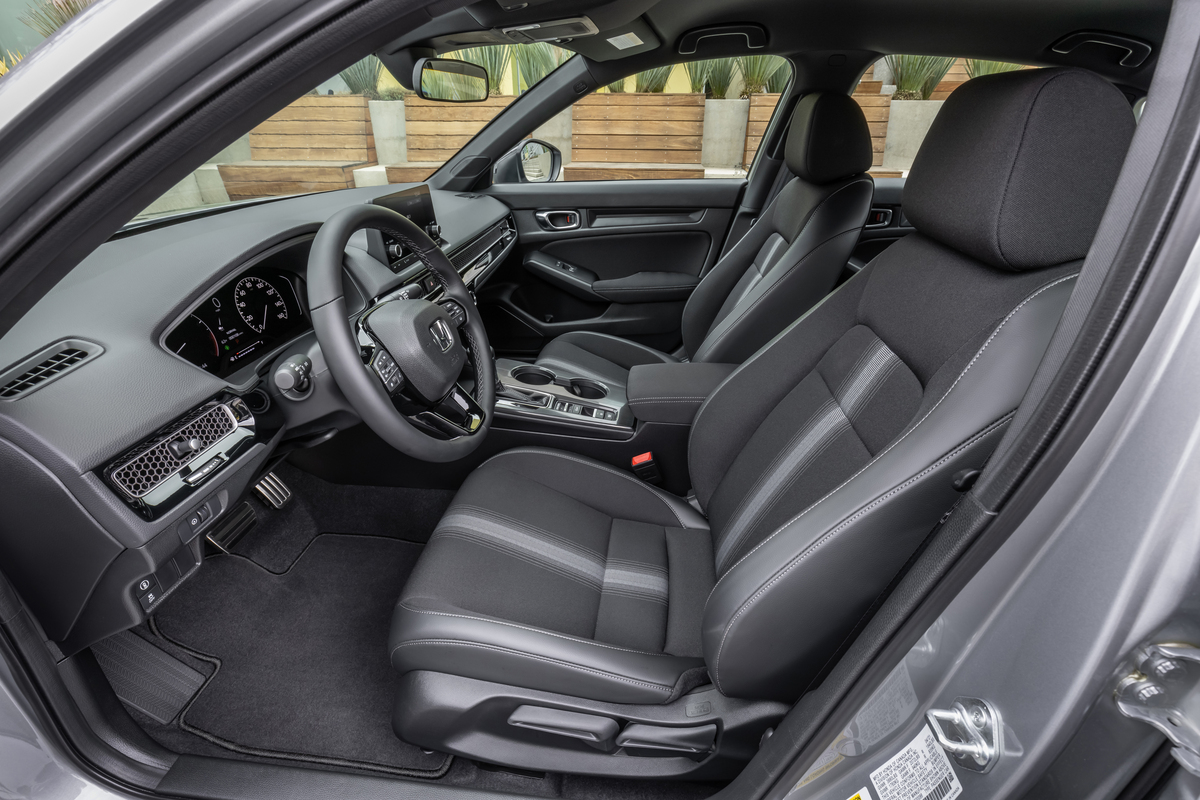
The front seats in the new Civic

The interior styling follows the “Man-Maximum, Machine-Minimum” approach.

Honda Civic Redesign

In designing the 11th-generation Civic, the stylists and engineers focused on the original Honda design approach of “Man-Maximum, Machine-Minimum.”

The pulled-back windshield pillars, low hood, flat dashboard, and hidden windshield wipers enable a windshield with clearly defined corners for a panoramic view.

Key to the Civic’s exterior redesign was moving the bottom of the windshield pillars rearward by nearly 2 inches. The revision elongates the hood for a premium silhouette. Honda says it is a subtle design element that emphasizes the wheels and tires for a stable, planted stance.

Civic's fabric front seatbacks

The fabric-vinyl upholstery is neatly stitched and the seats are supportive.

Dimensions and body structure

By size, the 2022 model is 1.3 inches longer (184 inches) but the same width and height as before, 70.9/55.7 inches.

Curb weights are up by 106 to 114 pounds across the trim levels. And trunk space was trimmed by just 0.3 cubic feet, but it is still significant at 14.8 cubic feet.

The body structure is the most rigid in Civic history, Honda says. The stiffer structure aids ride quality, reduces interior noise, and sharpens suspension response for better handling. In addition, a slightly wider rear track (0.5-inch) enhances stability.

The color touch screen

All Civics have a 7-inch (shown) or 9-inch touch screen.

Honda Civic Pricing

The Honda Civic has a choice of two four-cylinder engines in four front-wheel-drive trim levels of LX, Sport, EX 1.5, and Touring 1.5. All models have a continuously variable automatic transmission. All-wheel drive is not offered.

Starting prices range from $22,695 for the base LX with the 2.0-liter engine to $29,295 for the Touring 1.5. All MSRP pricing includes the $995 freight charge from Allison, Ontario, Canada.

Civic Sport 2.0L

The Sport model has a more aggressive exterior and interior styling and a Sport mode with paddle shifters.

The Sport is well equipped. Highlights of its standard equipment include smart-entry locking with push-button ignition, electric parking brake, eight-speaker audio system, Apple CarPlay or Android Auto infotainment, sport pedals, automatic high beams, LED headlights and taillights, and 18-inch alloy wheels with 235/40 all-season tires

My Civic Sport tester was $25,657.21, which included two accessories by Honda Performance Development:

  • HPD Kit of front, side, and rear underbody spoilers, decklid spoiler, and HPD emblem $1,417.80;
  • Honda Genuine Accessories of a gloss black H-mark, Civic, and Sport emblems $144.41.
  • The tester’s Platinum White Pearl paint added $395.

Check here for Honda Civic pricing and incentives.

A rear view of the new Civi

The Sport trim adds gloss-black side mirrors, 18-inch wheels, and chrome exhaust tips.

Powertrains and Fuel Economy

The standard engine is a 158-horsepower, 2.0-liter. The uplevel engine is a 180-hp, turbocharged and direct-injected 1.5-liter. Both engines run on 87 octane fuel and all models have a 12.4-gallon tank.

All Civic sedans use a continuously variable transmission, with paddle shifters for the Sport and Touring trim levels. There is no six-speed manual for the sedan, but a stick shift will be available for the upcoming hatchback model.

The EX 1.5 Turbo model is the mileage champ. It has EPA fuel-economy ratings of 33 mpg city, 42 highway and 36 mpg combined.

Next in line is the entry LX model at 31/40/35 mpg followed by the Touring 1.5 Turbo at 31/38/34 mpg and then the Sport 2.0L at 30/37/33 mpg.

In my week of testing a Sport 2.0L, the best average fuel economy I could manage was 30.1 to 30.6 mpg, but it was consistent from town to highway.

The 2.0-liter Civic engine

The base engine is a 158-horsepower, 2.0-liter.

Honda Civic Safety Features

The 2022 Honda Civic sedan can boast what Honda calls the world’s first application of front driver and passenger air bags designed to reduce traumatic brain and neck injuries.
The new design better controls head motions, Honda says. The driver’s air bag is donut-shaped to cradle and hold the head to reduce rotation. The passenger-side air bag uses a three-chamber design for a similar result.

Side impact protection was improved throughout. There are stiffer structures in the roof and doors, side sills and door pillars, rear wheel arches and rear window pillars.

There are a total of 10 air bags.

Driver-Assist System

The Sport model is technologically equipped for Level 2 semi-autonomous driving. The Honda Sensing system integrates Adaptive Cruise Control, Collision Mitigating Braking, Lane-Keeping Assist, Road Departure Mitigation, Traffic Jam Assist, Vehicle Stability Assist.

When activated, the system consistently keeps the car centered between the white lines. And, in my experience, there were no random shutoffs or alarming audible alerts.

Honda Civic Interior Function

Honda applies the “Man-Maximum, Machine-Minimum” approach to interior design. The focus is on “exceptional visibility, intuitive ergonomics, extraordinary passenger volume, and driver-focused technology.”

The approach works quite well and provides open sightlines over the shoulder and across the hood. New owners will discover the smart ergonomics in several areas, including the comfortably angled door-side armrests and window controls. Large visors slide, and there is a deep center armrest box.

High-quality materials are visible throughout the interior, especially on touch points. Special attention was given to the refined operation of switchgear and controls. And all trim levels have a new front seat design that holds firmly without extreme side and bottom bolstering.

There are numerous areas for small-item storage, including the door panels that can accommodate large bottles. The 7-inch touch-screen display includes buttons for volume and radio tuning.

The AC and vent controls also include dials to easily adjust temp, fan speed, and vent directions. Also rewarding is the wide span of vent flow along the face of the dashboard; prominent finger controls make it easy to readjust the airflow.

The shift console is slim but functional with large cup holders and an e-bin with a charging USB and 180-watt 12-volt plug. But despite all of the Civic Sport’s advanced technologies, wireless charging is only available with the top-line Touring model. And with multiple tries, I was unable to sync my iPhone for hands-free talking.

The top-line Civic Sedan Touring debuts a new 9-inch color touch screen and digital color instrument display. The 10.2-inch high-def panel is customizable and can be configured to show traditional round gauges or bar graphs.

The refined door panel of the new Civic

There is room in the door panel for large bottles.

Back Seat and Trunk Space

The Civic redesign attempts to make the most of back-seat roominess, but it is still a compact space.

The rear legroom of 37.4 inches is long for a small car. But the headroom of 37.1 inches will be restrictive to growing teenagers or business colleagues.

Trunk space of nearly 15 cubic feet has plenty of reach to the back seat. The trunk entry point is wide at 37 inches, but the 18-inch access opening will restrict big-box items. Fold the seatback to carry items up to about 6 feet in length.

The Civic's back seat

Back seat legroom is long at 37.4 inches. Fold the back seat for up to 6 feet in length.

Folded back seat

Civic Sport Ride and Handling

The Civic Sport ride quality is taut but not harsh. It handles well enough, but its sportiness is more in styling than performance.

The continuously variable transmission is dutiful and primed for fuel economy. Unfortunately, it also provokes engine noise on hard acceleration. Sport mode cranks up the shift response to simulate shift points, but it was almost too much enthusiasm for around-town driving.

The car rides low and the chin scrapes on driveways. In the hope of avoiding the cringeworthy occurrence, I’d make wide-angled turns into my driveway. But that only caused a scrape to the right-front alloy wheel — which was another cringeworthy moment. In my weak defense, the 18-inch Goodyear Eagle Sport all-season tires fit right to the edge of the wheel.

The Goodyears, too, have a hard treadwear rating of 560, which I blame for the maelstrom of tire noise inside the cabin at Interstate speeds.

The 18-inch tire-and-wheel package pushed the turning circle to a wide 38.1 feet versus 36.1 feet with the 16- or 17-inch wheels.

Four-wheel-disc braking is by 11.1-inch vented rotors at the front with solid 10.2-inch rotors at the rear.

2022 Civic trunk

The trunk has 14.8 cubic feet of capacity.

Why Buy the Honda Civic?

The Honda Civic’s 2020 redesign is a remarkable improvement for refinement and premium presentation. The interior is as accommodating as it can get for a compact sedan, and the exterior’s clean lines will be a big purchase motivator.

However, the Civic has no hybrid model and some of the competitors offer all-wheel-drive.

American Honda is fortunate that it has weathered the industrywide parts supply issues and has cars to sell. With the Sept. 1 sales report, Honda said that demand has been off the charts for all-new Civic sedan and dealers are selling cars as quickly as they are trucked in.

Honda Civic 2.0L Sport Specifications

Body style: compact, front-drive, 5-passenger 4-door sedan

Engine: 158-hp, 2.0-liter 4-cylinder with 16-valve DOHC i-VTEC with multiport injection and idle stop-start; 138 lb.-ft. at 4,200 rpm

Transmission: CVT with paddle shifters

Fuel economy: 30/37/33 mpg city/hwy/combined; 87 octane

BY THE NUMBERS

Fuel tank: 12.4 gallons

Trunk space: 14.8 cu. ft.

Front head/leg room: 39.3/42.3 in.

Rear head/leg room: 37.1/37.4 in.

Length/wheelbase: 184/107.7 in.

Curb weight: 2,935 lbs. (Sport)

Turning circle: 38.1 ft. (Sport)

PRICING

Base price: $24,095, including $995 freight charge; price as tested $25,657.21

Options on test vehicle: Platinum White Pearl paint $395; HPD Kit of front, side, and rear underbody spoilers, decklid spoiler and HPD emblem $1,417.80; Honda Genuine Accessories of a gloss black H-mark, Civic, and Sport emblems $144.41

Where assembled: Allison, Ontario, Canada

2016 Lamborghini Huracan Review

2016 Lamborghini Huracan Review

The rear-wheel-drive Lamborghini Huracan LP 580-2 is new for 2016 and has a shared but unique architecture with the Audi R8

The Rosso Red Lamborghini Huracan

The 2016 Lamborghini Huracan 580-2 starts at $204,595. (Photography by Mark Maynard)

Table of Contents

Pricing
Powertrain
Ride and Handling
Interior Function
Why buy the Lamborghini Huracan?
Specifications

 BY MARK MAYNARD

The Lamborghini Huracan has a reputation as a social rave, but in truth, it is a masterpiece of engineering and a daily-driver supercar.

The Huracan is Lamborghini’s smaller sports car. The exotic two-seater replaced the Gallardo in mid-2014, and the new model is a righteous successor.

New for 2016 is the rear-wheel-drive Lamborghini Huracan LP 580-2. There’s also the all-wheel-drive Huracan LP 610-4 with about 602 horsepower.

There are coupe and convertible versions of the AWD model, but only a hardtop for the 2016 RWD model. A new setup for springs and stabilizer bars on a double-wishbone suspension improves torsional rigidity by 50 percent over its predecessor, the Gallardo LP 550-2.

With positive support from parent company Volkswagen Group, the Lamborghini Huracan is a shared architecture with the Audi R8. Comparable exotics include the Ferrari 458 and McLaren 650S. But there also are new and less expensive supercars, such as the Acura NSX, Aston Martin Vantage, and even the Corvette Z06.

The Huracan driver area

The leather-lined buckets are comfortably bolstered for performance driving.

Lamborghini Huracan Pricing

The starting price of $204,595 for the Huracan LP 580-2 is a reasonable entry point for a V-10 supercar. That pricing includes the $3,495 freight charge from Modena, Italy, and the $1,300 gas-guzzler tax.

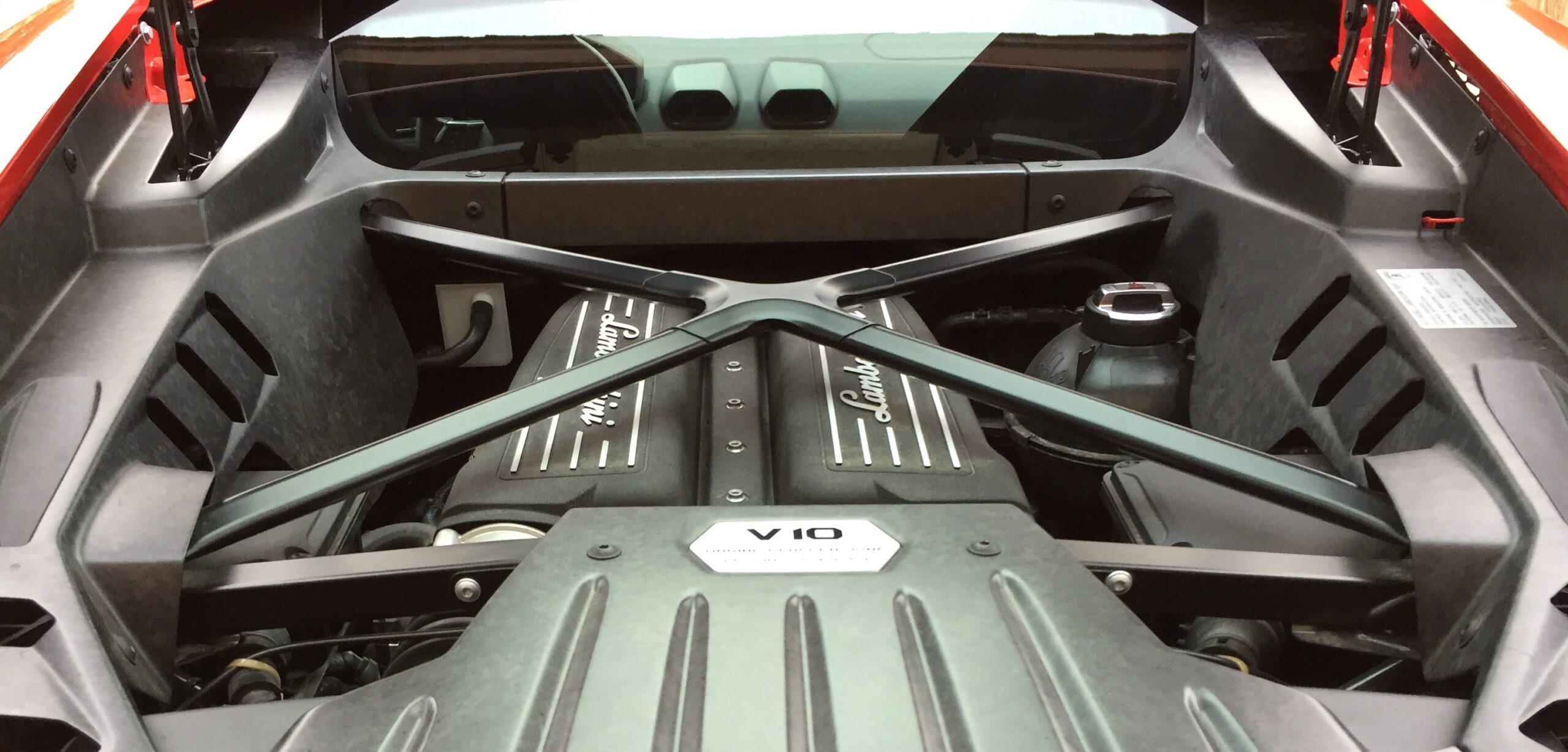
The tester was $238,795 with just two options, including the transparent engine-bay cover, $7,000. One admiring look at this car in the bright Rosso Red paint ($2,500)  and the driver is immediately guilty until proved innocent.

Despite that V-10, the Huracan’s fuel economy is not terrible. The EPA cites 17 mpg city, 21 highway and 17 mpg combined on the recommended premium fuel. On a daylong drive, I managed 19.9 mpg. But the mileage drops precipitously when the right foot goes down. The 22-gallon tank allows around 366 miles of driving with restraint.

View the current lineup of Lamborghini models here.

Front passenger seat

The seats are surprisingly comfortable for an all-day drive.

Huracan LP 580-2 Powertrain

For the starting price, the owner gets a hybrid chassis of aluminum and carbon fiber. The naturally aspirated, 572-horsepower 5.2-liter V-10 has direct injection and cylinder deactivation. And with peak torque of 398 foot-pounds at 6,500 rpm, 75 percent of the torque is available at 1,000 rpm, Lamborghini says.

The seven-speed dual-clutch transmission gives such quick shifts in Sport mode that its speed would embarrass a lightning strike. There are automatic and manual driving options and performance choices of Strada (normal), Sport, and Corsa (track).

Lamborghini cites zero to 62 mph acceleration in 3.2 seconds and a top speed of 199 mph. The 14.6-foot-long, midengine car has a dry weight of 3,062 pounds. Lamborghini does not cite “wet” curb weight, such as when loaded with fuel, but figure another 122 pounds with a tankful.

The 572-hp V-10 engine

The 572-hp, naturally aspirated 5.2-liter V-10.

Huracan LP 580-2 Ride and Handling

Sport mode opens the pipes, sharpens the shift points, and gives hefty throttle blips on downshifts. In addition, the system loosens the reins of stability and traction controls for some slide through the corners.

A hard launch brings a howitzer blast of force without torque pull left or right. The experience is straight-ahead traction in a blazing chorus of cylinders.

19 inch Pirelli tires

Low profile, high grip 19-inchPirelli tires.

There is an absolute engagement of gears from the start off to flat out. Flooring the pedal at about 30 mph is a hold-on event as the Huracan lunges like a predator in pursuit.

The magnetic ride suspension shows its superiority with sensitive adjustments in milliseconds. After six hours on the road, there was no fanny fatigue or torqued necks. The steering is light, direct, and requires just minimal inputs to clip the apex.

The standard steel brakes have supercar dimensions. The ventilated and cross-drilled rotors are 14.37 inches at the front and 14 inches rear. The aluminum monoblock calipers have eight pistons at the front and four pistons rear. From 62 mph, the stopping distance takes just 104.7 feet, which is 3.6 feet shorter than the rear-drive Gallardo predecessor.

The steering wheel as command center

The driver’s command center.

Huracan Interior Function

Breathe deep the rich cabin aroma of leather and microsuede. The interior layout is efficient and easy to access, with some console controls by Audi. The foot-wide gauge array can be electronically changed into a full video screen with a large RPM gauge and other essentials.

The Huracan interior is cockpit-compact, but this is a wide car and there is wide shoulder room of almost 55 inches door to door. There is long legroom and headroom for a 6-foot-3 driver, and maybe even taller, which is also surprising for the car’s low 46-inch roof height. But the doors are not hugely broad (unlike a Corvette) and the tight turning circle makes maneuvering easy in close quarters.

The leather-lined buckets are bolstered for performance driving but surprisingly comfortable for an all-day drive. However, the seats are heatable there is no lumbar adjustment or seat ventilation.

The LP 580-2 has a weight distribution of 40 percent front and 60 percent rear.

Why buy the Lamborghini Huracan?

I’m not sure why this car costs nearly a quarter of a million dollars. But there will be few complaints about owning this daily-driving supercar.

Whatever the Lamborghini Huracan does not have or does not do, you do not need or will find a way to do without — and like it.

The red starter button

The red push-button ignition.

Huracan LP 580-2 Specifications

Body style: 2-seat, rear-wheel-drive coupe

Chassis: Hybrid aluminum and carbon fiber

Bodyshell: Aluminum and composite material outer skin

Suspension: Aluminum double-wishbone

Springs and dampers: Steel springs and hydraulic dampers. “MagneRide”
electromagnetic damper control available as an option

Engine: 572-hp, naturally aspirated 5.2-liter V-10 with direct injection and cylinder deactivation; 398 lb.-ft. of torque at 6,500 rpm

Transmission: 7-speed dual-clutch

Fuel economy: 17/21/17 mpg city/highway/combined; premium required

Fuel tank: 22 gallons

BY THE NUMBERS

Top speed: 198.8 mph

0-62 mph acceleration: 3.2 seconds

0-200 kmh (124.27 mph) acceleration: 10.1 seconds

Brakes: Specially contoured steel discs ventilated and cross-drilled; 14.3-inch front rotors with 8-piston calipers; rear,14-inch rotors with 4-piston calipers

Steering: Electromechanical; optional variable-ratio LDS (Lamborghini Dynamic Steering)

Tires: Pirelli 245/35 19-inch front, 305/35 R19 rear

Wheels: 8.5J x 19-inches front, 11J x 19 inches rear

Length/wheelbase: 175.5/103. in.

Width/height: 88*/45.9 in. *including side mirrors

Dry weight: 3,062.2 lbs.

Turning circle: 37.7 ft.

PRICING

Base price: $204,595, including $3,495 freight charge and $1,300 gas-guzzler tax; price as tested $238,795

Options on test vehicle: transparent engine-bay cover $7,000; Rosso Red paint $2,500

Where assembled: Modena, Italy

Warranty: 36-months/unlimited mileage covering everything from the powertrain to the seats

2019 Lamborghini Urus Review

2019 Lamborghini Urus Review

With 650 horsepower, the Lamborghini Urus super-SUV is all beef and pure bull

A side view of the Urus

The 2019 Lamborghini Urus starts at $203,995 and the tester was $259,284 with 25 packages or accessories. (Photography by Mark Maynard)

Table of Contents

Overview
Pricing
Performance
Ride and Handling
Interior Function
Why buy the Lamborghini Urus?
Specifications


BY MARK MAYNARD

Go bullish or get ignored is the driving force in the so-called super SUV segment. For the Lamborghini Urus it is all about the power and presence with equal parts prestige, pampering and privilege.

There are serious players in this group:

  • Bentley’s 626-horsepower Bentayga Speed ($235,000-plus);
  • Range Rover’s 557-hp SV Coupe (two-door; $295,000);
  • The 577-hp Mercedes-AMG G63 G-wagen ($148,000);
  • The 590-hp Maserati Levante Trofeo AWD ($170,000);
  • The 541-hp Porsche Cayenne Turbo Coupe, a $131,000 four-door.

And then there’s today’s tester, the Lamborghini Urus with 650-hp and a starting price of $203,995. As tested, the price came to almost $260,000.

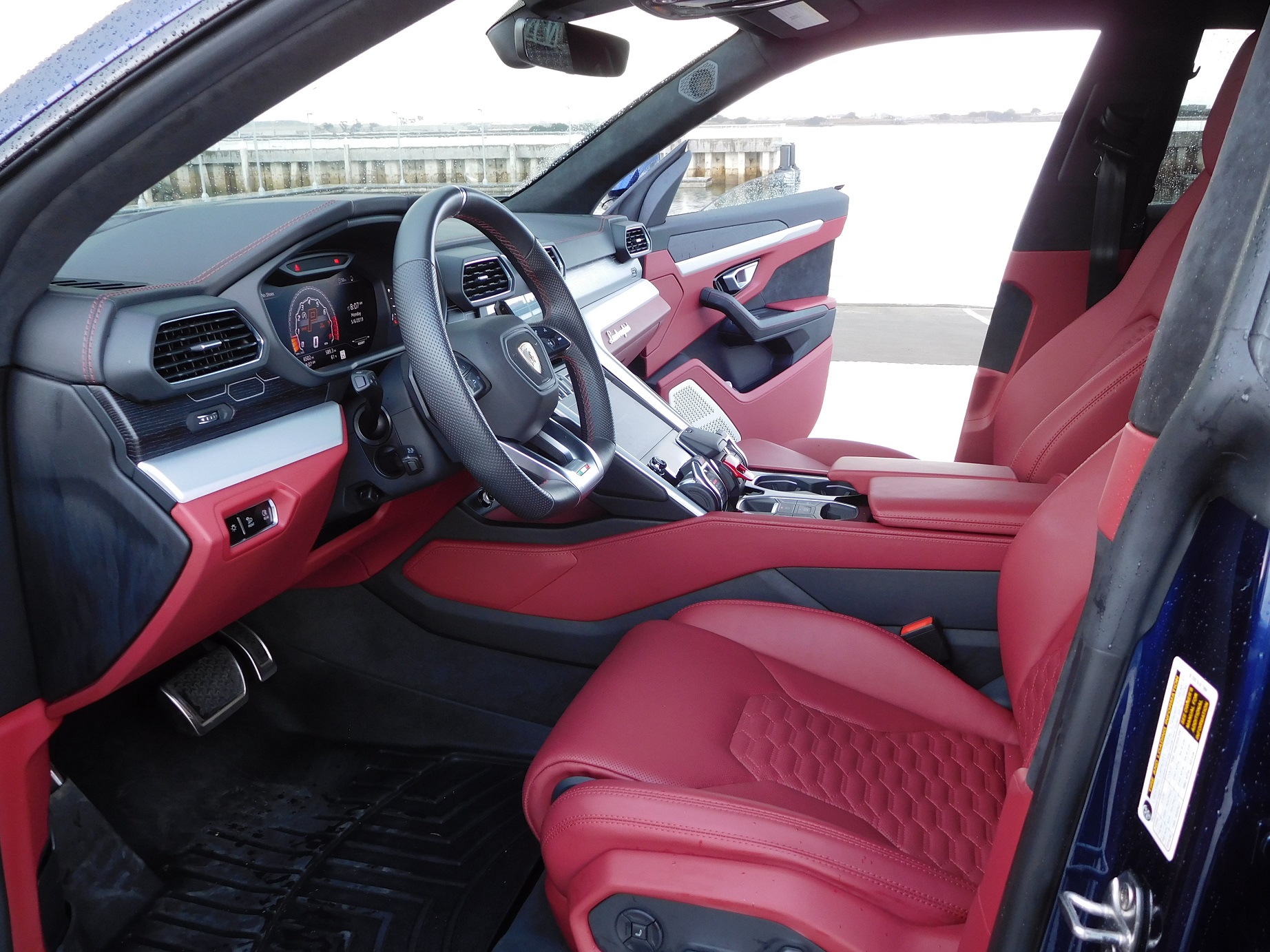
The red leather upholstery

Serious support in the sport seats.

Serious bolstering in the front seats.

Lamborghini Urus Overview

For Lamborghini, it is about having one of its Urus SUVs in the garage with one of the brand’s sports cars, and not parked next to an SUV by any other maker.

The Urus is Lamborghini’s second run at an SUV. Its first was the V-12 powered LM002 short-box pickup, aka “Rambo Lambo,” sold in the U.S. between 1986 and 1993.

The Lamborghini Urus shares nothing material with that truck. As a division of the global Volkswagen Group (including Bentley, Bugatti, Audi, Porsche, and Ducati motorcycles), the Urus takes a rib from the Audi Q7 SUV. It is an exemplary starting point well fortified with an advanced 4.0-liter V-8, eight-speed automatic, all-wheel drive, and a calm and functional cabin. And from there, the Lamborghini DNA takes hold to create a hooved beast for the track, trail, or town.

The driver area in the Urus

The driver area presents as a space-wars themed cockpit

2019 Lamborghini Urus Pricing

The tester’s sticker of $259,284 includes 25 packages or accessories, including the $3,995 freight charge from Sant’Agata Bolognese, Italy.

The add-ons ranged from a trailer hitch ($1,168) to ambient interior lighting ($3,036) to full leather upholstery ($3,157) with heated and cooled front seats ($631). The advanced driver assist system and Bang & Olufsen sound system were each $6,313.

Standard equipment includes permanent four-wheel drive with limited-slip rear differential and active torque vectoring, air suspension, full LED adaptive headlights and taillights, smart key locking and push-button ignition.

Choose your Urus here.

The steering wheel

A hands-on driving experience.

Urus Performance

Flip up the red bracket over the start-stop button on the center console and the engine fires with an open-pipe report then settles into a rumbling idle. But that gutsy V8 belts fire and brimstone with little provocation. And there are drive modes of Strada, Sport, Corsa, Sabbia, Terra and Neve (street, sport, track, sand, dirt and snow).

The twin-turbocharged, 650-horsepower V-8 with 627 foot-pounds of torque at 2,250 rpm will launch the Urus to 62 mph in a blaring 3.6 seconds. And that’s with a shaggy curb weight of 4,850 pounds.

It isn’t so much about how fast it will go, but how fast it gets to 30 mph, 60 mph, 90 mph. Be ready for the head-jerking jolt when the driver nails the throttle, even a little bit. The Urus jumps and kicks like a shock-rod to the flank of a rodeo bull. And unlike its rider trying to hold on, the controllability of the Urus makes its rider want to do it again — with respect, of course.

Fuel economy is not embarrassing at 12 mpg city, 17 highway and 14 mpg combined on the required premium fuel. I worked up to 20 mpg on a highway run while resisting Sport mode. But with a 19.8-gallon tank, there is much full-on Sport mode to be enjoyed.

 The twin-turbocharged, 650-horsepower V-8

The twin-turbocharged, 650-horsepower V-8.

Urus Ride and Handling

To handle stopping power from a top speed of 190 mph, Lamborghini says it built the world’s largest set of ventilated carbon-ceramic disc brakes for the Urus: 10-piston front calipers grip 17.3-inch rotors at the front and single-piston calipers for the rear 14.5-inch rotors.

Rear-wheel steering helps crimp the turning circle to 38.7 feet, making the Urus very urban friendly. The 360-degree camera system overcomes rear visibility issues at the small window.

The air suspension system can provide up to 9.8 inches of ground clearance for off-road use or drop the height for passenger loading. But this is the only Lambo that you will never have to remember to raise the nose when crossing a speed bump.

The 22-inch ZR-rated (street and competition) Pirelli P Zero tires are staggered, in sizes of 285/40 front and 325/35 rear. The rear rubber is nearly 13 inches wide, which benefits braking from 62 mph to zero in about 111 feet. That’s about 11 feet farther than Lamborghini’s Aventador coupe.

The big disc brakes on the Urus

The carbon-ceramic four-wheel-disc brakes are about the largest used on any car.

Urus Interior Function

Despite the competition-grade hardware, the Lamborghini Urus is a streamliner on the highway with no nervous twitching and it soars through cornering maneuvers. The cabin is well soundproofed, the steering is quick with good communication through the wheel.

The only driver element that I would change would be for steering-column-mounted shifters, rather than mounted on the steering wheel. As with other Lamborghinis, Drive is engaged by flipping the right-side paddle shifter. And when the wheel is turned, as when backing out of a driveway, the paddle is upside down on the wrong side.

The driver area presents as a space-wars themed cockpit with full electronic displays that are reasonably configured for touch-screen adjustment. The optional 18-way power-adjustable and massaging front seats are heated and cooled.

The back seat space is quite comfortable with long legroom and full climate controls. But the huge center tunnel detracts from the center-seat footroom. A two-seat “executive” option would be smart, but it’s easier to sell an SUV on the utility of five seats for a car that costs as much as a guest house.

Lamborghini doesn’t give interior dimensions but says there is front seat room to accommodate someone up to 6-feet-8 inches and someone 6-feet-2 inches should be comfortable in the back seat.

The open cargo area of the urus suv

Plenty of room for pro-league golf bags.

Why Buy the Lamborghini Urus?

The Lamborghini Urus might not be much of a rock climber. And I would cringe to throw bags of landscape materials in the back. But the Urus is the only five-seat Lamborghini with cargo room for luxury-class golf bags.

In this super-SUV segment, it isn’t so much a matter of cost but of value. And the Urus brings an easy quarter-million in value for its exclusivity, heritage, and prestige.

A rear view of the Lambo urus

The fuel economy is not embarrassing at 12 mpg city, 17 highway and 14 mpg combined .

2019 Lamborghini Urus Specifications

Body style: Full-size 5-seat, AWD SUV

Engine: 650-hp, twin-turbocharged 4.0-liter V-8; 627 lb.-ft. torque at 2,250 rpm

Transmission: 8-speed automatic with six drive modes

Fuel economy: 12/17/14 mpg city/hwy/combined; premium fuel

0-62 mph: 3.6 seconds

BY THE NUMBERS

Fuel tank: 19.8 gal.

Cargo space: 21.7 cu. ft. *behind back seat

Length/wheelbase: 201.2/118.2 in.

Width/height: 85.8/64.5 in. *width includes mirrors

Curb weight: 4,850 lbs.

Turning circle: 38.7 ft.

PRICING

Base price: $203,995, including $3,995 freight charge; price as tested $259,184

Where assembled: Sant’Agata Bolognese, Italy

Warranty: 3-years/36,000-miles including powertrain and roadside assistance