Select Page

Historic Indy Cars on the grid for the Rolex Monterey Motorsports Reunion

Historic Indy Cars on the grid for the Rolex Monterey Motorsports Reunion

Legendary Indy Cars will take part in daily exhibitions Aug. 12-15

The 1973 Eagle driven by Gordon Johncock at the Indy 500.

Motorsports fans will see this 1973 Eagle driven by Gordon Johncock at the Indy 500. (WeatherTech Raceway)

BY MARK MAYNARD

The Rolex Monterey Motorsports Reunion is staging a new historic motorsport group for the legendary event, held during the annual Monterey Car Week, Aug. 12-15.

For the first time at the Reunion, a historic Indy Car group will run in exhibition all four days at WeatherTech Raceway Laguna Seca. The motorsport champions originally competed between 1963 and 1978.

The introduction of rear-engine Indy Cars at the 1963 Indianapolis 500 changed the game, Barry Toepke, director of heritage events at WeatherTech Raceway, said in a statement.

“From 1965 on, there would not be another front-engine winner of the Indianapolis 500,” he said.

Motorsports Champions

Indy Car Champion Bobby Rahal will debut his recently restored 1966 Eagle with a 255-cubic-inch four-cam Ford V8. Beginning in 1985, Rahal won three consecutive Indy Car races at WeatherTech Raceway Laguna Seca.  His notoriety is honored at the track with the Rahal Straight.

Indianapolis 500 winners

Three winning Indy 500 cars will be at the track:

  • 1964 Watson, driven to victory by A.J. Foyt;
  • 1970 Colt, piloted by Al Unser;
  • 1973 Eagle driven by Gordon Johncock.

Other Winners

Look for the 1964 Lotus Type 34 driven by Parnelli Jones at the Trenton 200 in 1964. In 1965, A.J. Foyt drove the car to a remarkable seven poles and three victories during the 1965 USAC Championship season.

Johnny Rutherford drove the 1975 McLaren M16E-001, which was raced at three 500-mile superspeedway events. His #2 Gatorade entry had its best finish of second at the 1975 Indianapolis 500.

Joining the McLaren will be a 1968 Eagle Mk IV, which started Team Penske’s Indy Car program 53 years ago.

Also highlighted will be the 1978 Penske PC-6 driven by Tom Sneva in the 1978 USAC Championship season. Sneva posted six second-place finishes and 12 top-five finishes to win the National Championship in 1978 — without winning a single race.

“Fans will be treated to a quality collection of Indy Cars all under one tent,” said Ellen Bireley, who curated the historic Indy Car heritage display.

Single-day tickets range in price from $25 to $120, depending on the day. A three-day general admission pass with paddock admittance is $180.

Learn more at WeatherTechRaceway.com or call (831) 242-8200.

2021 Hyundai Santa Fe Calligraphy Review

2021 Hyundai Santa Fe Calligraphy Review

Stylized Penmanship Promotes Range-Topping Hyundai Santa Fe Calligraphy SUV to the Luxury Class

A front view of the 2021 Hyundai Santa Fe Calligraphy

The 2021 Hyundai Santa Fe Calligraphy starts at $43,285, including AWD. (Photos courtesy of Hyundai)

Table of Contents

Overview
New features
What was redesigned?
Pricing
Safety features
Powertrains
Ride and handling
Interior function
Back seat and cargo space
Why buy the Santa Fe Calligraphy?
Specifications


BY MARK MAYNARD

Hyundai has tended well to its midsize Santa Fe SUV moneymaker. This unibody SUV was introduced in 2001 and it would become the top-selling SUV in the brand’s 32-year history in America.

Over its lifecycle, the five-seat Santa Fe has been updated at least every two years. And major redesigns were applied every four years. And for a time, it was offered as a seven-seat Unlimited trim level.

Hyundai says it is aggressive in its updates for all vehicle lines. However, the company puts its updated models on sale sooner than most people update their smartphones.

“For mainstream high-volume priority vehicles, we never let these rest,” a spokesman said.  “The second we put out a vehicle, the engineers are working on the next generation or upcoming adjustments.”

The interior of the Santa Fe Calligraphy

Calligraphy details include Nappa leather and a 10.25-inch touch-screen.

Santa Fe Overview

Today, Hyundai has six SUV models, including electrified choices. The Santa Fe ranks No. 2 in sales, behind the compact Tucson.

The fourth-gen Santa Fe SUV debuted in 2018 and there was yet another significant refresh in 2020 for the 2021 model year.

Hyundai means “modern,” as translated, and the current Santa Fe is thoroughly equipped with advanced technologies for safety and driver assistance. And there appears to have been special care taken to create a calming and intuitive human-machine interface to access all of those electronically sophisticated systems.

While Hyundai has maintained the value choice in the entry models, it also has pushed a more “luxurious character.” The top-line models have more premium materials such as quilted Nappa leather and unique wheel designs.

Ambient lighting along the Calligraphy shift console

LED ambient lighting.

What’s New for 2021

The Hyundai Santa Fe had freshened exterior and interior designs for 2021. The updated added LED front and rear lighting, a new hybrid powertrain with all-wheel drive, and new driver safety and convenience features.

The new range-topping Calligraphy model builds upon the Santa Fe Limited. Its features include the more powerful 2.5-liter turbocharged engine with HTRAC AWD ($1,700) and exclusive-design 20-inch alloy wheels.

The Calligraphy treatment includes quilted Nappa leather, premium door and seat accent trim, eco-suede headliner, ambient lighting themes, and auto up-down rear windows. Power-folding side mirrors have puddle lamps and turn signals. Driver technologies include downhill brake control and a full-color heads-up display.

There will be no changes for the 2022 model year. But a more rugged appearance Santa Fe XRT trim was just added. Pricing starts at $32,300 for front-drive and $34,000f with AWD; pricing does not include the freight charge.

Floating center console in the Santa Fe Calligraphy

The high-position “floating” center console.

What Was Redesigned

The freshened styling has subtle exterior changes. There is a broader, three-dimensional grille and T-shaped LED lighting and daytime running lights.

The silhouette has a more horizontal cabin profile with scalloped lower door panels and a long hood with character lines. Sharp shoulder lines connect front and rear LED lights. Rear reflector accents visually link the LED rear taillights.

The interior was reworked for a more “luxurious character.” The interior space feels more open and with more natural light. In addition, a high-position “floating” center console has stealth lower shelf storage.

A multi-layered, three-dimensional instrument panel and contrasting seat stitching lend a premium presence, Hyundai says.

Santa Fe Pricing

Sold in four trim levels, starting prices for the entry SE and SEL gas-powered models range from $28,185 to $29,985 for the SEL, both with front-drive. Add $1,700 for AWD.

Moving up to the Limited, with the turbocharged engine packaged with AWD, starts at $41,635. And the new top-line Calligraphy with the turbo engine, AWD and 19-inch wheels starts at $43,435. All MSRPs include the $1,185 freight charge from Montgomery, Ala.

Today’s Calligraphy tester was $43,590, including one option for carpeted floor mats, $155.

Look for Hyundai pricing incentives and special programs here.

A door panel in the Santa Fe Calligraphy

Calligraphy details are seen and felt throughout the cabin.

Santa Fe Safety Features

The Santa Fe Calligraphy SUV has the full suite of Hyundai safety technologies. The list will compare with those features offered by top luxury brands.

I especially value Hyundai’s blind-spot view monitor. Cameras in the side mirrors switch on when using the turn signal. The image gives a clear view of what might be alongside the vehicle. On the right side, it might be a bicyclist. On the left, it could be a motorcyclist.

Hyundai’s SmartSense advanced driver assistance systems provide Level 2 semi-autonomous driving. When activated, the network of multiple radar sensors, ultrasonic sensors, and cameras do a good job of keeping the Santa Fe centered between the white lines.

But all Level 2 assist systems require two hands on the wheel and driver vigilance. The system sensors can be confused by certain daylight and road conditions that can trigger a random shutoff and then a restart. I’ve also experienced system shutoff when driving alongside white- or light-colored semitruck trailers.

Even with those few variables, the system provides guardianship protection in the event of driver distraction.

Standard Safety Features Include:

  • Blind-spot collision-avoidance assist,
  • Rear cross-traffic collision-avoidance assist,
  • Forward collision-avoidance assist with pedestrian-cyclist-junction turning detection,
  • Lane-keeping assist, highway driving assist, and lane following assist.
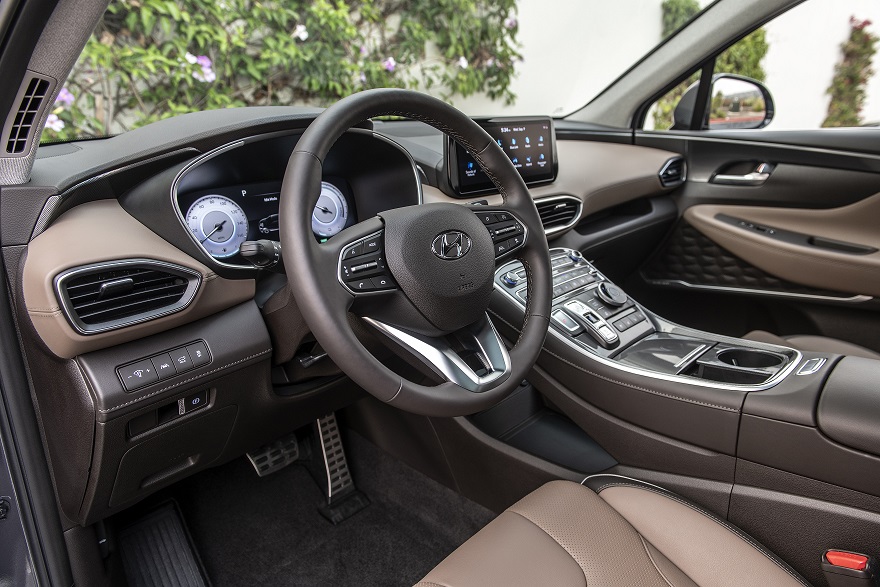
Santa Fe driver seat

There is easy functionality to the driver area.

Santa Fe Powertrains

The 2021 Santa Fe SUV is sold in gasoline and gasoline-electric hybrid models. All in front- or all-wheel-drive.

The gas models of Santa Fe have a choice of two Smartstream 2.5-liter four-cylinder engines, one of which is turbocharged. Both have direct- and multi-point fuel injection, idle stop and go, and eight-speed automatic transmissions. The base engine replaces the former 2.4-liter direct-injected engine.

The uplevel turbocharged engine replaces a 2.0-liter turbocharged engine and brings an 18 percent boost in power, now at 281-hp. This engine is paired with the more technologically advanced eight-speed “wet” dual-clutch automated manual transmission.

The 4,017-pound Calligraphy AWD has fuel economy ratings of 21/28/24 mpg city/hwy/combined; 87 octane recommended. In highway driving, I easily hit the 28-32 mpg range and about 27 mpg overall. The 18.8-gallon tank will provide a wide cruising radius.

Hybrid Models

Hyundai Santa Fe Hybrid SUV models are sold in three trim levels with starting prices ranging from $34,835 to $41,135. (Hybrid models are built in Ulsan, Korea.)

The gasoline-electric hybrid models have a new Smartstream 226-hp 1.6-liter turbocharged hybrid electric powertrain with six-speed automatic transmission and HTRAC all-wheel drive.

The base Blue fuel economy ratings are 36/31/34 mpg city/highway/combined on 87 octane. The Hybrid SEL Premium and Limited have mileage ratings of 33/30/32.

A Santa Fe plug-in hybrid is expected to be in dealerships later this summer. It has 260-hp and an electric driving range of around 30 miles. Pricing has not yet been announced but watch for updates here. https://www.hyundaiusa.com/us/en

The Calligraphy back seat

The back-seat legroom is adult class at 41.7 inches.

Santa Fe Ride and Handling

Acceleration from a start can seem hesitant as the turbo spools and the dual-clutch engages, but once rolling, the force is fluid and easily maintained. However, after a week of driving, the new owner will have adapted to the correct amount of pedal pressure to get past the initial hesitance.

The ride quality is very smooth-rolling, a testament to Hyundai engineering to eliminate friction and boost fuel economy. Much attention was given to cabin soundproofing, but the interior noise was more than I expected for a near-luxury vehicle despite the laminated windshield and side glass.

There was noticeable road noise at highway speeds that can be felt from the floor into the seat bottoms. The 19-inch Hankook Dynapro HP2 tires (235/55) might be contributors. These are all-season, low-rolling-resistance touring tires that felt hard, especially on concrete.

Braking is confident without grab from four-wheel discs. The front vented rotors are 13.6 inches and the solid rear rotors are 12 inches. Downhill brake control is included on AWD models.

Interior Function

There is an easy familiarity with just getting in and driving. The Calligraphy interior is handsome with a black microsuede headliner. Even in the tester’s basic black, the varying textures, contrast stitching, and matte-sheen of lower plastics looked more luxurious than basic. And there are no old-school wooden “accents.”

Mastering the swipe, tap, and turn of the touch-screen features does not require advanced training. Most users should be able to figure it out on the fly. The raised and angled center console is functional for knobs and switches that are just a glance away from the road.

There are numerous small-item storage areas, including the deep box in the center armrest console. The large sun visors slide and have large, covered mirrors. The wireless charging pad is cleverly positioned in a vertical slot adjacent to the cup holders. Door storage is generous and includes space for tall bottles. The front passenger has a slim shelf along the instrument panel to lay a phone and it is within reach of a charging USB.

There is a rather tall step-in height (ground clearance grew by about an inch to 8.2 inches) to the front and back seats. The front headroom is tall at 39.5 inches with the panoramic sunroof or 44.1 inches without.

The front seats are full-figured with eight-way power adjustment for the driver that includes lumbar and seat-bottom tilt for ideal positioning. Sightlines are unobstructed across the front fenders and over the shoulder. The 360-view camera gives birds-eye perspective when parking and the 37.5-foot turning circle is more compact than midsize.

Hyundai’s Smart Park Assist is a handy perk. Using the key fob, the Santa Fe driver can park and back out the vehicle from the tightest of spaces from outside the vehicle.
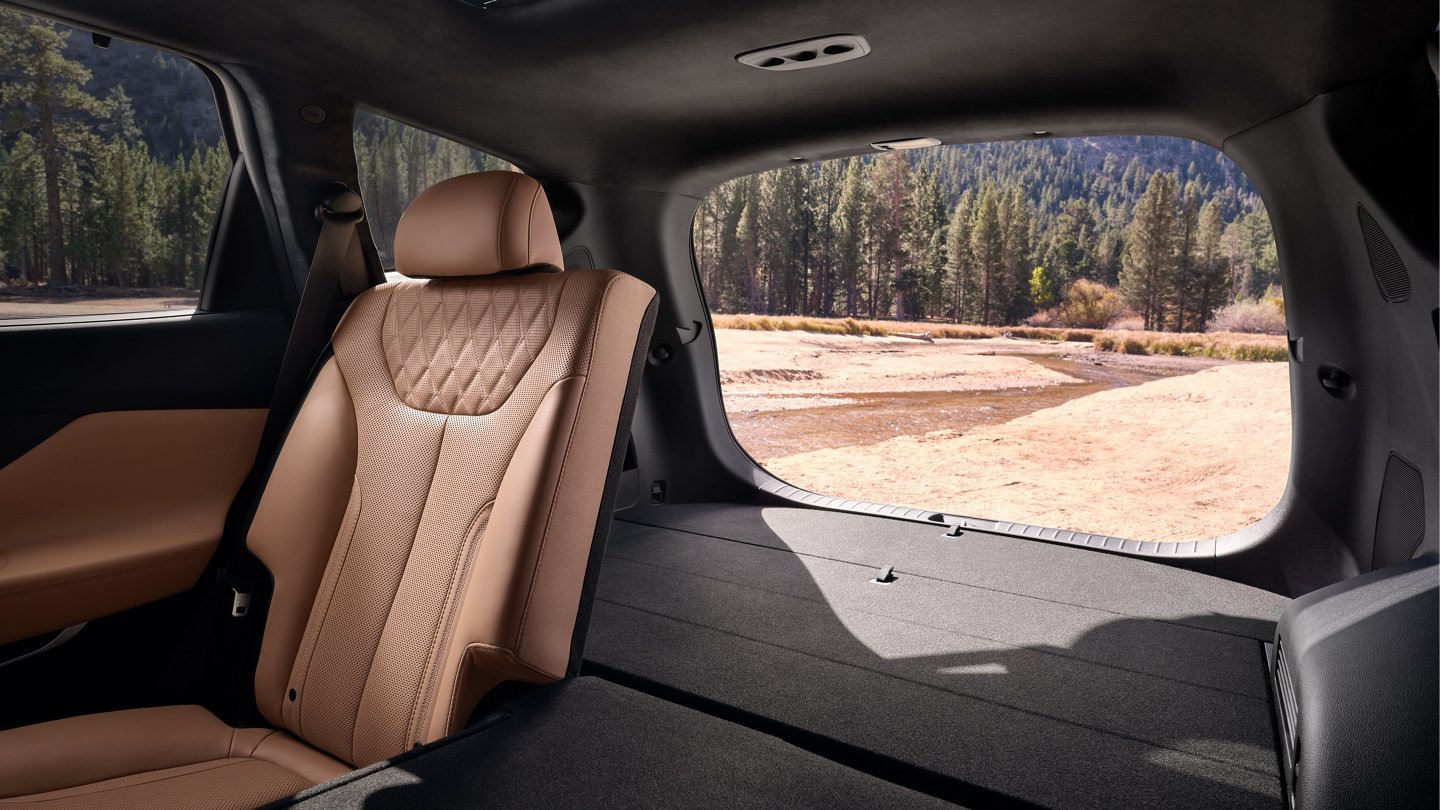
The cargo area in the Santa Fe.

The cargo area has generous space of 36.4 cubic feet behind the second row.

Back Seat and Cargo

The back seat area rides high but also benefits from a low hump to the transmission-exhaust tunnel. The commonly compromised legroom at the center seat should comfortably fit a growing teenager. Legroom is adult class at 41.7 inches, but the raised “theater” seating, with 37.8 inches of headroom, might be a tad short for taller adults.

The area is well equipped with a broad fold-down armrest, nicely padded, with cup holders and bottle storage in the door panels. Overhead grab handles include coat hooks, and there are two charging USBs and a 115-volt, 150-watt household plug.

The cargo area has a generous space of 36.4 cubic feet behind the second row, and there is usable “basement” storage.

The cargo space is wide at 45 inches and deep at 43 inches. But there is a tall lift-up to the floor of 33 inches. Fold the 60/40 back seat for 6 ½ feet in length. The seats fold flat for 5 ¾ feet of sleeping space.

A rear view of the Calligraphy

Hyundai means “modern,” as translated.

Why buy the Santa Fe Calligraphy?

The Santa Fe Calligraphy SUV has luxurious appeal and layers of attention to its design and engineering detail.

Among the Tier 1 luxury competitors, the Calligraphy is a bargain with the longest warranty for long-term ownership.

Santa Fe owners or lessors will have an attractive new choice when it’s time to renew.

Specifications

2021 Hyundai Santa Fe Calligraphy

  • Body style: midsize, 5-seat, 5-door AWD unibody SUV
  • Engine: Smartstream 281-hp, turbocharged and direct- and multi-port injection 2.5-liter 4-cylinder; 311 lb.-ft. torque at 3,500 rpm
  • Transmission: 8-speed dual-clutch (wet-type) automated manual
  • Fuel economy: 21/28/24 mpg city/hwy/combined; 87 octane recommended

By The Numbers

  • Fuel tank: 18.8 gal.
  • Cargo space: 36.4 cu. ft.
  • Front head/leg room: 39.5*/44.1 in. *41.2 w/o sunroof
  • Rear head/leg room: 37.8*/41.7 in. *39 w/o sunroof
  • Length/wheelbase: 188.4/108.9 in.
  • Curb weight: 4,017 lbs.
  • Turning circle: 37.5 ft.
  • Tow capacity: 3,500 lbs.
  • Coefficient of drag: 0.34

FEATURES

Standard equipment includes: digital key and push-button ignition, panoramic sunroof, 10.25-inch touch-screen navigation with traffic routing, smart cruise control with stop-and-go remote, 12-speaker Harman Kardon audio with Clari-Fi music restoration, Android Auto and Apple CarPlay, wireless device charging,  8-way power driver seat with 4-way lumbar, 6-way power front passenger seat, heated and ventilated front seats, blind-spot view monitor, surround-view camera with overhead and guidance lines, automatic LED headlights with LED accents and high-beam assist, LED running lights, power-folding side mirrors with puddle lights, LED cabin lights, 60/40 folding back seats with recline, heated back seats, power-folding 2nd row, and 7 air bags

PRICING

Base price: $43,435, including $1,185 freight charge; price as tested $43,590

Options on test vehicle: carpeted floor mats $155

Where assembled: Montgomery, Ala.

Warranty: 5-years/60,000-miles bumper to bumper with 24/7 roadside assistance; 10-years/100,000-miles powertrain

Automotive Ancestry

Automotive Ancestry

These black-and-white vintage photos show the pride of ownership when motor transport was still in its infancy

A photo from around 1935 shows construction of the Grand Coulee Dam in Washington state.

Construction of the Grand Coulee Dam in Washington state was a massive project to use the Columbia River to produce hydroelectric power and to provide irrigation water. According to Wikipedia,  construction was ongoing between 1933 and 1942. In this vintage photo crews work on one of two cofferdams to hold back the river.

A 1950 MG Y Type.

1950 MG YT Tourer: This vintage photo of an MG “YT,” was launched at the Earls Court Motor Show in 1948, according to the MG page in Wikipedia. It was available for export only, in right- and left-hand-drive models as a four-door sedan and limited-production open four-seat tourer versions, such as the car in the photo. At the time, a YT Tourer sold for around $1,245, during its production run of 1948-1950.

A 1928 Buick.

So stately: Could this be a 1928 Buick?


n early Harley-Davidson motorcycle.

Clean machine: Wild ones with a vintage motorcycle and sidecar. Is it a Harley-Davidson, Henderson, Indian?

A 1927 Peerless automobile.

Birthday boy! This vintage photo of a sturdy two-door appears to be about a 1927 Peerless. However, I am not able to confirm that Peerless had a coupe at that time. Thoughts as to what this classy coupe with the landaulet bars could be? I like the rock emergency parking brake.

A 1927 Peerless automobile.

Gather the family: Could this stately sedan be a 1927 Peerless?

A 1936 Pontiac touring sedan.

“Silver Streak”: A 1936 Pontiac touring sedan with the proud owner on her way with the goodies.

A Ford Model A.

Street scene: A Ford Model A, on a residential street somewhere in the western U.S. (Not sure how the hand truck with two tanks would be used.)

A pair of mid-1940s Cadillacs, a convertible and a sedan.

Living large: A brace of what appear to be a mid-1940s Cadillac Series 62 convertible and sedan.

A Boeing KC-97G “Stratofreighter.”

Cleared for takeoff: Circa 1953, this appears to be a big Boeing KC-97G “Stratofreighter.” According to the Museum of Aviation at Robins Air Force Base in Georgia, its wingspan was 141 feet, 2 inches and it was powered by four Pratt & Whitney R-4360s of 3,500 hp each and two General Electric J47s of 5,970 lbs. thrust each. At 117 feet, 5 inches long with a height of 38 feet, 4 inches, the plane weighed 153,000 lbs. max. and was capable of cruising at 230 mph with a top speed of 400 mph and had a range of 2,300 miles.

A 1931 Ford Model A roadster.No nonsense: 1931 Ford Model A roadster.

A 1954 Chevrolet One-Fifty.

Showroom fresh: Looking pretty in this vintage photo with what appears to be a 1954 Chevrolet One-Fifty (or 150). It was the economy/fleet model of the Chevrolet line from 1953 to 1957.

A new Model A Sport Coupe.“Ruth W”: The gang’s all here to break in what appears to be a new Model A Sport Coupe. Written in script with pen on the back is this caption info: “This is ‘Ruth W.’ That’s what we call the car. Ruth is in front and Eric and Edith are in the rumble seat. These pictures were taken in Prospect Park, Nov. 23 1930.”

We’ve arrived: A couple with their 1930 Model A touring sedan.

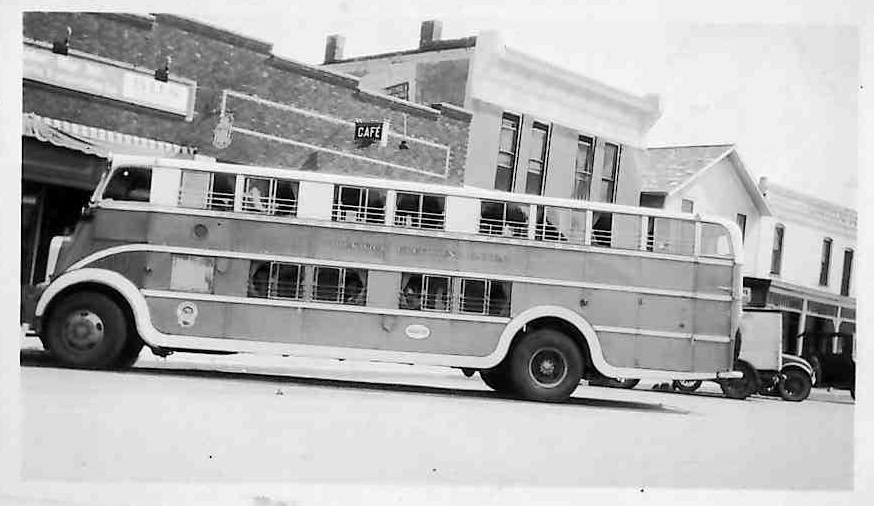
Leisure travel: Written on the back of one of the photos, with a dull pencil in uppercase letters, was this note: “This dubbel [sic] deck buss [sic] took us from Denver Col. to Salt Lake City Utah. My place was lower compartmen [sic] the open window next to the back whele [sic]. It rides just fine.”

See more vintage automotive photography here.

Airstream Launches Pottery Barn Special Edition Travel Trailer

Airstream Launches Pottery Barn Special Edition Travel Trailer
Exterior view of the Airstream x Pottery Barn Travel Trailer

The 28-foot Airstream x Pottery Barn Travel Trailer sleeps four and is stocked with hardware, soft goods and fixtures by Pottery Barn. (Photos courtesy of Airstream)

The $145,000, 28-foot special edition Airstream travel trailer is fully equipped for glamping in style by Pottery Barn’s Airstream Collection


BY MARK MAYNARD

Just the sight of a passing Airstream travel trailer being towed along a highway can spark a twinge of wanderlust. To further color that visual of the iconic “silver bullet,” Airstream and Pottery Barn today announced the launch of the Pottery Barn Special Edition Travel Trailer.

The collaboration of the two lifestyle companies is a match that makes sense in many ways, Airstream President and CEO Bob Wheeler said in a statement.

Pottery Barn table setting with linens.

Pottery Barn place setting with linens.

“Pottery Barn has this kind of magical ability to shape a space. You see it in their home interiors, where there’s a comfortable, functional beauty to even the smallest spaces. They understand how your home is this canvas where real life happens, and we love how they applied that to the Airstream lifestyle.”

Design teams from both companies approached the project as a blank canvas upon which to create something fresh and innovative, Pottery Barn President Marta Benson, said in the statement.

The custom fitted sofa

The custom-made sofa is based on Pottery Barn’s Big Sur Collection.

Coastal Vibe

The Pottery Barn influence has a coastal feel in the soft materials and colors of the ocean, fog, and sand.

Airstream salt and pepper shakers

The Pottery Barn Airstream Collection includes salt and pepper shakers, tumblers and dinnerware, cotton linens, and placemats.

Every detail was considered, she said, “from the custom-made, ultra-soft seating and sofa inspired by Pottery Barn’s Big Sur Collection, to window coverings made with oatmeal linen Emery Curtain fabric.”

The features of the special edition are based on Airstream’s International Travel Trailer. The 28-foot-long trailer has a kitchen, a bathroom, and sleeping and relaxing areas for four. The interior is finished with hardware, soft goods, fixtures, and touches from Pottery Barn collections.

The Airstream galley

The kitchen has a three-burner cooktop, gas oven, and microwave.

Heirloom Quality

The solid oak wood dinette table is an heirloom-quality piece, Benson said. It is sourced from Pottery Barn’s Benchwright Dining Collection.

Other kitchen features include a matte-black pull-down faucet, a stainless-steel flat apron sink, and a solid walnut cutting board as the sink cover. The Pottery Barn Airstream Collection includes tumblers and dinnerware, cotton table linens, salt and pepper shakers, and placemats.

Pottery Barn knives and spices in the Airstream trailer

Knives and spices are among the accessories.

The bathroom has a round vessel sink and a matte-black faucet accented with wall sconces.

The outdoor hanging table is a design-first for Airstream. Reminiscent of a vintage (but classier) drive-in diner window tray. It attaches to the trailer’s side exterior window.

Pottery Barn also put its signature touch on the exterior awning and the accessory kit. It is a standard feature and includes a 16-piece Mason Stoneware Dinnerware Set, an Indio Outdoor Folding Table and Armchair Set, and a doormat.

The trailer can sleep up to four people, and its twin or queen size bed options come with Pottery Barn Belgian Flax Linen Bedding.

Pottery Barn's hanging bar ledge on the Airstream

The hanging table is reminiscent of a vintage drive-in window tray but classier.

Pricing

The Airstream Pottery Barn Special Edition Travel Trailer has an MSRP of $145,500 and is available at dealers nationwide.

Airstream has travel trailers ranging from 16- to 33-feet long with room to sleep four to eight. Starting prices range from $40,000 to $166,000.

Learn about Airstream’s line of travel trailers and touring coaches here.

For other information visit Airstream.

The Airstream bedroom with Pottery Barn linens

The Pottery Barn influence is seen and felt in the soft colors of the ocean, fog, and sand. Twin or queen size bed options come with flax linen bedding.

470-hp Jeep Wrangler Rubicon 392 — Oh hell yes!

470-hp Jeep Wrangler Rubicon 392 — Oh hell yes!

Jeep’s Hemi-powered Wrangler Rubicon 392 is a shaggy commando of power and presence

A front view of the The 2021 Jeep Wrangler Rubicon 392 Launch Edition

The 2021 Jeep Wrangler Rubicon 392 Launch Edition has a starting price of $74,995, including the $1,495 freight charge from Toledo, Ohio. (All photos courtesy of Jeep)

Table of Contents

Overview
Pricing
Features
Interior
Options
Why buy the Rubicon 392?
Specifications

BY MARK MAYNARD

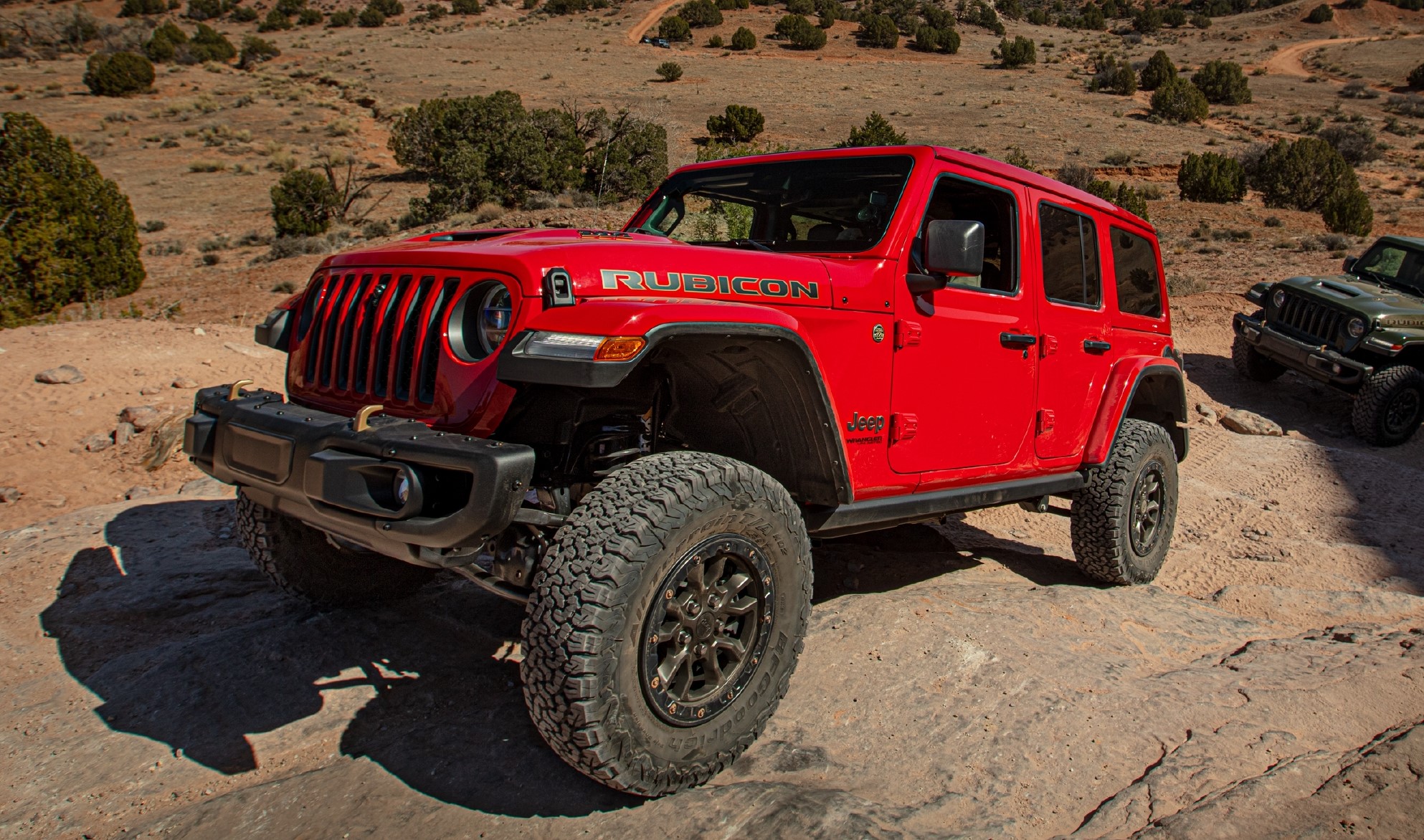
The 470-horsepower Jeep Wrangler Rubicon 392 is a shaggy commando of tire-frying, trail-crawling confidence. It roams the wilds and street as the lone wolf or the bull buffalo keeping watch over the herd. Its rumbling 6.4-liter V-8 engine is the call of the wild.

Jeepers have been shoehorning V-8s into Wranglers for years. But this Hemi honcho will get drivers out of trouble faster than they can get into it. The 392-cubic-inch pushrod V-8 can accelerate to 60 mph in 4.5 seconds, Jeep says, and pass the quarter-mile in 13 seconds. That’s a thundering accomplishment for it 5,103-pound curb weight.

With the eight-speed automatic transmission, the 6.4-liter has fuel-economy ratings of 13 mpg city, 17 highway and 14 mpg combined on the required premium fuel. The 21.6-gallon fuel tank should allow around 300 miles of driving.

The driver area of the 2021 Jeep® Wrangler Rubicon 392 interior

Interior features include heated leather seats with bronze Rubicon 392 stitching, an Alpine audio system, and a GPS navigation system.

2021 Jeep Wrangler Overview

The Rubicon 392 is plenty potent, but it’s not the torque monster of the Wrangler lineup. Instead, that honor goes to the new 4xe hybrid Wranglers with a combined engine and motor peak torque of 470 foot-pounds at 3,000 rpm.

There are a dizzying 14 trim levels of Jeep Wrangler in two- and four-door body styles with five choices for a powertrain.

Engine choices include a 270-hp 2.0-liter turbocharged four-cylinder engine. The 285-hp 3.6-liter Pentastar V-6 has mild-hybrid e-Torque technology. And the 260-hp 3.0-liter EcoDiesel churns up peak torque of 442 lb.-ft. from 1,400-2,800 rpm.

Cutting new trails are the 4xe hybrid Wranglers (and Grand Cherokee 4xe).

The Jeep Wrangler Sahara 4xe and the Jeep Wrangler Rubicon 4xe Launch Editions have starting prices of $49,490 and $53,190, including the freight charge. Pricing does not include the available $7,500 federal tax credit or other eligible state and local credits.

The Wrangler 4xe powertrain is a 375-hp turbocharged 2.0-liter four-cylinder with a combined torque rating of 470 lb.-ft. at 3,000 rpm. That’s a lot of launch power, and it’s still capable of an estimated 50 MPGe, Jeep claims, with an electric driving range of 25 miles.

The hemi v-8 in the Rubicon 392.

The 470-hp 6.4-liter Hemi V-8 can launch the Rubicon 392 to 60 mph in 4.5 seconds.

Rubicon 392 Pricing

The production version of the Wrangler Rubicon 392 Launch Edition went on sale this spring. Pricing starts at $74,995, including the $1,495 freight charge from Toledo, Ohio. But finding one can be disheartening. Pricing for those typically starts at around $90,000.

My Firecracker Red tester had a sticker of $78,545 with such extras as the tow package ($350) and trail-rail system ($195). The biggest add-on was the $2,000 Sky One-Touch Power-Top. The clear-coat paint is $245.

The Rubicon 392 is the most capable Wrangler ever, Jeep says. It is off-road ready with the Selec-Trac two-speed transfer case, full-time four-wheel drive, and 10.3 inches of ground clearance. Its heavy-duty wide track Dana 44 axles have Tru-Lock electronic locking differentials and electronic front sway-bar disconnect.

Shop all Jeep models here.

The underside of the Rubicon 392

Chassis upgrades include a 2-inch lift and FOX high-performance shocks.

 Features

  • The functional hood scoop connects to a tri-level Hydro-Guide air intake. The system feeds the V-8 with cooler outside air, and a one-way drain in the air-box separates up to 15 gallons of water a minute. The Rubicon 392 can ford water up to 32.5 inches deep — even if a bow wake washes over the hood.
  • Active dual-mode exhaust engages automatically to open valves in the exhaust system. Under higher engine loads, the open exhaust reduces back pressure. The driver can also activate the system manually.
  • Chassis changes include heavy-duty brakes, a 2-inch factory lift, upgraded frame rails, and specially calibrated suspension geometry with FOX high-performance shocks.
  • Low-speed descents use engine braking, a revised torque converter lockup control, and a 48:1 crawl ratio. The system allows the driver to manage vehicle speed without using the brake pedal.
  • Four-wheel-disc braking has 12.9-inch vented front rotors with two twin-piston floating calipers. Rear brakes have 14-inch vented rotors with two single-piston floating calipers.
The off-road tires on the Jeep Rubicon 392

Standard 33-inch tires on 17-inch beadlock-capable wheelsRubicon 392

 Interior

Inside the Rubicon 392, the interior includes leather-trimmed upholstery with bronze Rubicon 392 stitching. The leather-wrapped, performance steering wheel includes paddle shifters, a first for the Jeep Wrangler.

The Uconnect system projects on a standard 8.4-inch screen. The system includes Jeep Off-road Pages that allow owners to monitor such elements as pitch, roll, altitude, GPS coordinates, and drivetrain power distribution.

Other features include:

  • Body-color hardtop and fender flares;
  • HD electrical switch bank;
  • Steel bumper package;
  • Cold weather package;
  • LED lighting package;
  • Remote proximity entry
  • Safety Group and Advanced Safety Group
The hood of the Rubicon 392

The 392-cubic-inch pushrod V-8 has peak torque of 470 lb.-ft. at 4,300 rpm.

Rubicon 392 Options

Dual Door Group $4,395

Dual Top Group $1,300

Integrated Off-road Camera $595

Tire upgrades $195: 285/70R17C BF Goodrich KO2 All-Terrain Outline White Letter or 285/70R17C Falken Wildpeak M/T tires

Why buy the Rubicon 392?

A big Hemi V-8 might not be necessary in an off-roading Wrangler. But the more relevant question from Jeep and Mopar disciples might be why not? The V-6 can feel underpowered on the daily commute. The EcoDiesel engine can level mountains off-road, but it can be snoozy for quick power around town.

The Hemi bloodline runs deep among the Stellantis brand’s loyal owners. And placing this engine in a Wrangler teases the question of when will the Gladiator pickup get one.

For every hybrid Jeep 4xe sold, there will be one more gallon of gas for the Rubicon 392.

Pricing is the great separator. How many $90K Jeeps can be sold? Be prepared if you take a test drive. The Rubicon 392 is a charmer, and the devil on your right shoulder will want you to bring it home. The handwringing angel on your left will remind of your social responsibility and how much more rational it would be to own a Wrangler 4xe.

If you listen to that angel, you will spend the rest of your driving days remembering what you could have been.

Just wait, Jeep will make more and you won’t have to pay a hefty price premium.

A rear-end view of the Rubicon 392

The Rubicon 392 is the most capable Wrangler ever, Jeep says.2

2021 Jeep Wrangler Rubicon 392 Specifications

Body style: 5-seat, 4-door sport-utility vehicle with full-time 4WD, ladder frame and steel and aluminum body

Engine: 470-hp, 392-cubic-inch, 16-valve 6.4-liter pushrod V-8; 470 lb.-ft. torque at 4,300 rpm

Transmission: 8-speed automatic; full-time 4WD with 4WD Auto, 4WD High, Neutral and 4WD Low

Axles: Dana 44 front and rear with 3.73 ratios with Tru-Lock electronic locking

Fuel economy: 13/17/14 mpg city/hwy/combined; premium fuel required

Max tow capacity: 3,500 lbs.

BY THE NUMBERS

Suspension: Solid axle, coil springs, stabilizer bar front and rear; electronic sway-bar disconnect system; high-pressure gas-charged FOX monotube shock absorbers with hydraulic rebound stop front; rear high-pressure gas-charged FOX aluminum monotube shock

Brakes: 4-wheel ventilated discs; 12.9-inch rotors front with twin-piston floating calipers; 13.6-inch rotors rear with single-piston floating calipers

Water fording: 32.5 inches

Fuel tank: 21.5 gallons

Length/wheelbase: 188.4*/118.4 in. *including spare tire

Curb weight: 5,103 lbs.

Turning circle: 39.4 ft.

Tires and wheels: 17-inch BF Goodrich KO2 All-Terrain tires (LT285/70R17C, on/off-road); bead-lock capable, high-gloss painted cast-aluminum wheels

PRICING

Base price: $74,994, including $1,495 freight charge; price as tested $78,545
Options on test vehicle: Firecracker Red clear coat paint $245; Preferred package 27X, $350, includes trailer-tow package and class II hitch with 7- and 4-pin wiring harness; Cargo group with trail-rail system, $195, includes cargo area floor mat; Mopar all-weather floor mats $165; Sky one-touch power top $2,000; integrated off-road camera $595

Where assembled: Toledo, Ohio

Warranty: 3-years/36,000-miles basic bumper to bumper; 5-years/60,000-miles powertrain