The big reveal of the all-electric Ford F-150 Lightning was a massive moment for the automaker, said Ford President Jim Farley.

The F-150 Lightning is expected to go on sale in spring, 2022. (All photos courtesy of Ford Motor)
An electric pickup is one thing. An electric pickup that is also an emergency power generator for the home adds a whole new level of consumer usability in this complicated era of climate change.
Ford Motor pulled the camouflage from its striking, all-electric F-150 Lightning last night in a big reveal at its world headquarters in Dearborn, Mich. It was a massive moment for Ford, said Ford President and CEO Jim Farley.
The F-150 Lightning is expected to go on sale in spring, 2022. It will be sold in four series and two battery options.
The exterior styling looks traditional F-150, but much has been modified under the military-grade aluminum skin. The truck introduces an independent rear suspension, standard four-wheel drive, and dual in-board motors pushing 563 horsepower.
Two levels of lithium-ion battery packs will be offered. Ford has targeted a driving range of 230 miles with the standard-range battery and 300 miles with the extended-range battery.
A payload of 2,000 pounds is expected for base models with a max tow rating of 10,000 pounds. Official specifications will be released closer to the on-sale date.
“It’s quicker than a Raptor, with standard 4×4 and independent rear suspension,” said CEO Farley.
Ford F-150 Lightning pricing

2022 Ford F-150 Lightning Platinum, Lariat, and XLT. Available spring 2022.
The electric pickup will be sold in four series in crew-cab body styles with a 5.5-foot-long bed. The commercial-grade model starts at $39,974 before any federal or state tax credits. The mid-range XLT model starts at $52,974. Pricing was not announced for the top-line Platinum, but a spokesman said its MSRP could be around $90,000 with the extended range battery.
Pricing does not include the freight charge from the Rouge Electric Vehicle Center in Dearborn, Mich.
The 2022 F-150 Lightning can be reserved here with a $100 deposit.
Powertrain

The powertrain layout shows the two in-board motors and lithium-ion battery storage.
The powertrain of the F-150 Lightning targets 563-hp and 775 foot-pounds of near-instantaneous torque. That’s more than any F-150 ever, Ford says. Acceleration to 60 mph is in the mid-4-second range with the extended-range battery.
Power at home
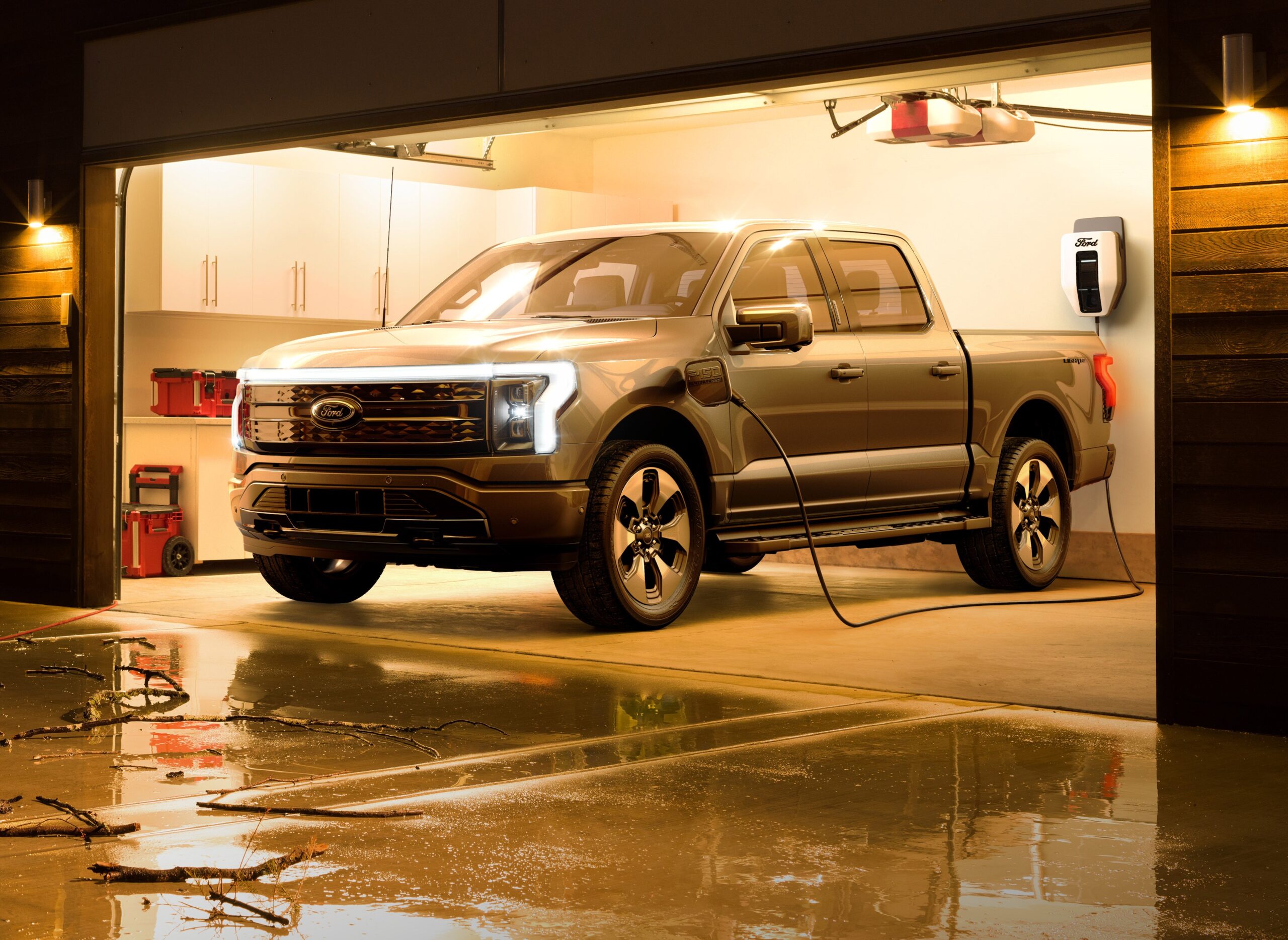
The Intelligent Backup Power system can power a home for three days, Ford says.
The debut of the Ford Intelligent Backup Power turns the truck into a substantial source of power for a home. The system can tap into 9.6 kilowatts of power — 9600 watts. That is enough backup power to maintain household lighting during an outage. It also will be enough to power other utilities, such as home appliances and security systems. (According to online reports, an average-size home in the U.S. uses about 900 kWh per month.)
The backup power system requires the optional 80-amp Ford Charge Station Pro and home management system (for which Ford can help with installation). In an emergency, the F-150 Lightning will automatically activate to power the house. Once power is restored, the truck automatically reverts to charging its battery.
Based on the average use of 30kWh per day, the entire system with an extended-range battery can provide full home power for up to three days. With careful use, the power can last as long as 10 days, Ford says.
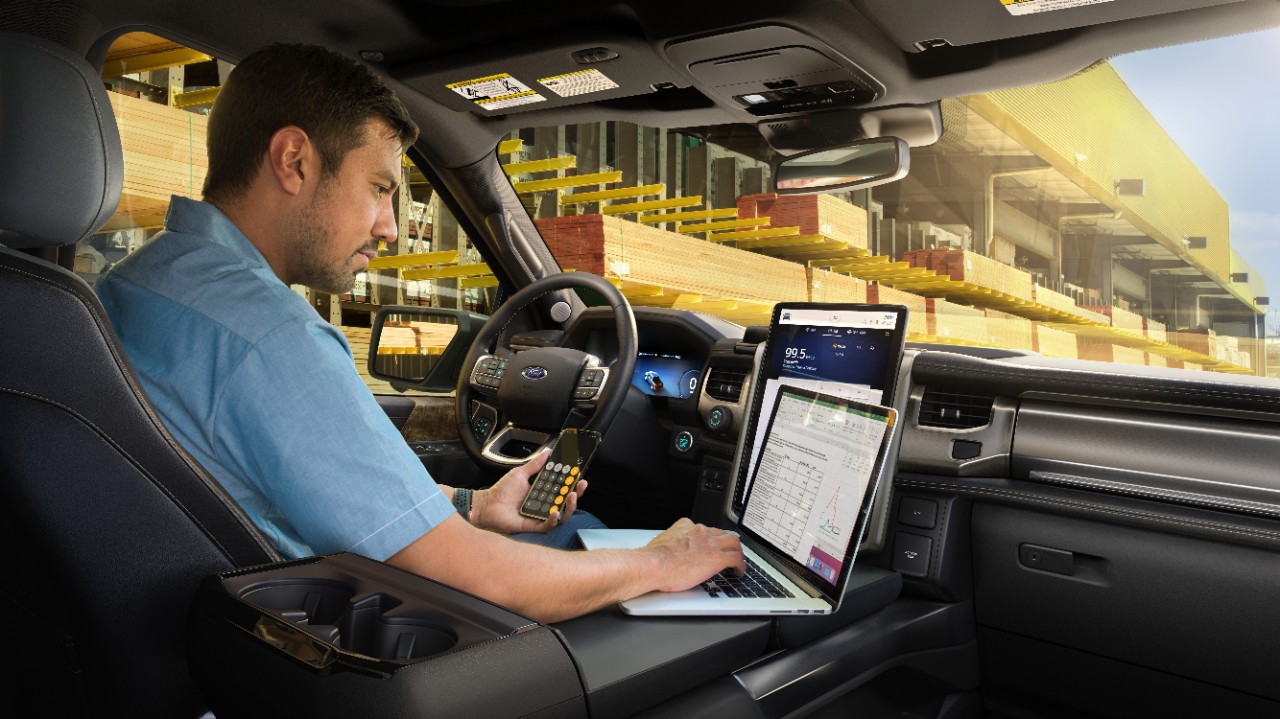
The optional fold-out Interior Work Surface.
For a later introduction, the Ford Intelligent Power system can use the truck to power homes during high-cost, peak-energy hours while taking advantage of low-cost overnight rates to charge the vehicle in time for the morning drive. The owner saves money on electricity while also taking pressure off the grid in peak usage times, Ford says.
Ford partnered with Sunrun, a leading solar company, to facilitate the installation of the 80-amp Ford Charge Station Pro and home integration system. Customers will also have the opportunity to install solar energy on their homes, tapping into clean, affordable energy and be able to charge their F-150 Lightning.
Battery power

The secure charge door.
F-150 Lightning offers two levels of battery power: a standard-range battery targets 230 miles of EPA-estimated range and the extended-range battery targets 300 miles of EPA-estimated range.
Standard with the truck is an 80-amp charge station to maintain an extended-range truck at home. This system has a dual onboard charging system that can add an average range of 30 miles per charging hour. Fully charging an extended-range truck from 15 percent to 100 percent would take about eight hours, Ford says.
On the road, users have access to the ChargePoint public charging network, considered North America’s largest system. Using FordPass, drivers will have access to more than 63,000 charging plugs and growing. On a 150-kW DC fast charger, the extended-range battery is targeted to get up to 54 miles of range in 10 minutes and charge from 15 percent to 80 percent in about 41 minutes, Ford says.
The FordPass Power My Trip function identifies charging routes in advance of an extended drive. The truck’s, Intelligent Range mode calculates range while factoring in weather, traffic, payload, and towing weights, Ford says. Cloud-connected navigation on SYNC 4 also identifies public charging locations.
Truck as generator

The optional Tailgate Work Surface.
The enhanced Pro Power Onboard provides built-in electrical outlets to power a variety of tools, electronics, and appliances. Base trims have 2.4 kilowatts of power with the option for more. Lariat and Platinum models have 9.6 kilowatts of power — a combination of up to 2.4 kilowatts available through the frunk and up to 7.2 kilowatts through outlets in the cab and bed.
Customers will receive a FordPass notification if their truck’s battery falls below a third of its total range. And the truck can be programmed to stop using Pro Power Onboard if the battery level approaches the distance to the nearest charging station.
Front trunk

The front trunk, or frunk, is power opened and closed.
The newfound space under the hood allowed for a lockable “mega power frunk” that is power opened and closed. The storage capacity has about 14 cubic feet of volume and a 400-pound payload. Ford says that’s enough space for two carry-on travel bags and one checked bag, or two sets of golf clubs.
The water-resistant space has four electrical outlets and two USB chargers. Drain holes in the floor allow the frunk to be used as a cooler. With 2.4 kilowatts of power, there’s enough electrical capacity to plug in power tools, TVs, laptops and speakers, or even a crockpot and other appliances.
Testing
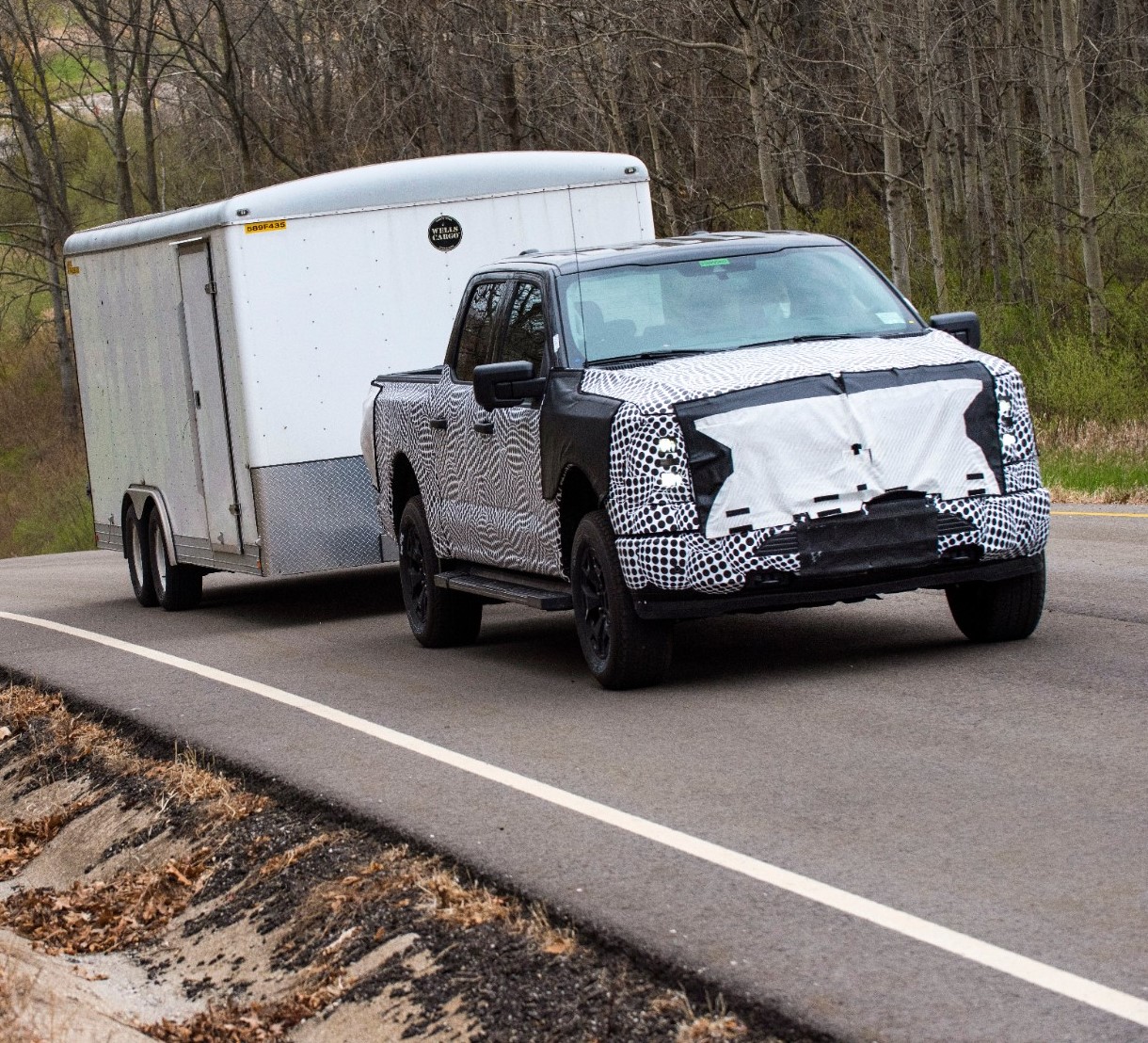
Endurance testing included running the truck through Iowa Hill, Calif.
The F-150 Lightning was put through the same endurance testing as all F-Series trucks. The military-grade aluminum-alloy body and upgraded frame were engineered to support the advanced battery. The first F-Series independent rear suspension and low center of gravity help improve noise isolation from the road and provide a more stable ride.
No compromises on space or utility were made, Ford says. The cab and bed have the same dimensions as the gas models.
The truck’s four-wheel-drive system features four selectable drive modes: Normal, Sport, Off-Road, and Tow-Haul. Metal underbody skid plates protect the battery and inboard motors. The battery itself is secured inside a waterproof casing that is surrounded by crash-absorption protection. It has been tested at temperatures as extreme as minus-40 degrees.
To maintain steady thermal conditions, the F-150 Lightning was engineered with an advanced liquid cooling system and powertrain layout to manage heat distribution.
Endurance testing included running the truck through Iowa Hill, Calif. In the testing, loaded trailers were towed for long durations up and down the steep Iowa Hill Road, where there are no safety guardrails, according to Wikipedia
Ford F-150 Lightning aerodynamics

Base models are expected to have a max tow rating of 10,000 pounds.
F-150 Lightning is the most aerodynamic F-150 ever, Ford says. Styling enhancements include newly shaped running boards, a sculpted hood to reduce drag, and grilles with a smoother, textured surface.
2022 Ford F-150 Lightning specifications
Body style: full-size, 5-seat crew-cab pickup with a 5.5-foot-long bed
Electric motors: Two inboard three-phase fixed magnet AC
Battery type: Liquid-cooled lithium-ion pouch with battery management
Targeted horsepower: 426 hp standard range; 563-hp extended range
Targeted peak torque: 775 foot-pounds for both battery packs
Onboard charger power, (input/output): 11.3 kW/10.5 kW standard range; 19.2 kW/17.6 kW extended range
Targeted EPA driving range: 230 miles standard battery; 300 miles extended range battery
TARGETED CHARGING TIMES:
Level 3 fast charge: 15%-80% in 44 minutes standard range; 41 minutes extended range
Level 2 home charging: NA
80-amp Ford Charge Station Pro: 15%-100% in 10 hours standard range; 8 hours extended range
32-amp/240-watt onboard charger: 15%-100% in 14 hours standard range; 19 hours extended range
BY THE NUMBERS
Targeted maximum payload: 2,000 lbs. standard battery; 1,800 lbs. extended-range battery
Targeted maximum towing: 7,700 lbs. with the standard battery; 10,000 lbs. with the extended-range battery
Length/wheelbase: 232.7/145.5 inches
Cab height/width: 78.9/*96 inches. *w/mirrors folded 83.6 in.
Ground clearance: 8.9 inches
Open tailgate to the ground: 37.2 inches
Front trunk liftover height: 35 inches
Curb weight: NA
Turning circle: NA
WARRANTIES
Bumper to bumper: 3-years/36,000-miles
Roadside assistance: 5-years/60,000-miles;
Electric vehicle components: 8-years or 100,000-miles, including the battery that is expected to retain a minimum of 70% of its original capacity over that period