
Select Page

Mustang Mach-E 1400 X Hot Sauce

Mustang Mach-E 1400 X Hot Sauce

Mustang Mach-E hot sauce promo.Ford Performance joined forces with Sean Evans, of the web show “Hot Ones” to turn the feeling of riding in the Mustang Mach-E 1400 into a hot sauce. (Ford) 

BY MARK MAYNARD

Ford Performance and hot sauce “heatonist” Sean Evans are playing chicken, sort of, with an eye-watering recipe. Evans, of the “Hot Ones” web show, has cooked up a blistering sauce that attempts to translate the sensation of riding in the Mustang Mach-E 1400.

The bottled sauce — too-hot-for-production or for sale — is said to have notes of smoke and charred earth from plenty of insanely hot peppers. Motorsport’s champion and fearless “fun-haver,” Vaughn Gittin Jr., took a taste test. And then Gittin Jr. took Evans for a saucy track run in the Mustang Mach-E 1400.

Both prototypes appear to have similar insane capabilities. Pass the cold milk for the hot sauce, pass the barf bag for the ride-along with Gittin. Watch the video.

Mustang Mach-E hot sauce with Vaughn Gittin and Sean Evans.

Hot sauce “heatonist” Sean Evans (left) and racing champ Vaughn Gittin Jr. sit down for an eye-watering taste test of the hot sauce. (Ford)

No rules

The Mustang Mach-E 1400 is a 1,400-horsepower, all-electric racing prototype built by Ford Racing engineers and RTR Vehicles. It’s a just-for-the-hell-of-it prototype to fathom the limits and adhesion potential for obscene electric power on the track, drag strip, or gymkhana course.
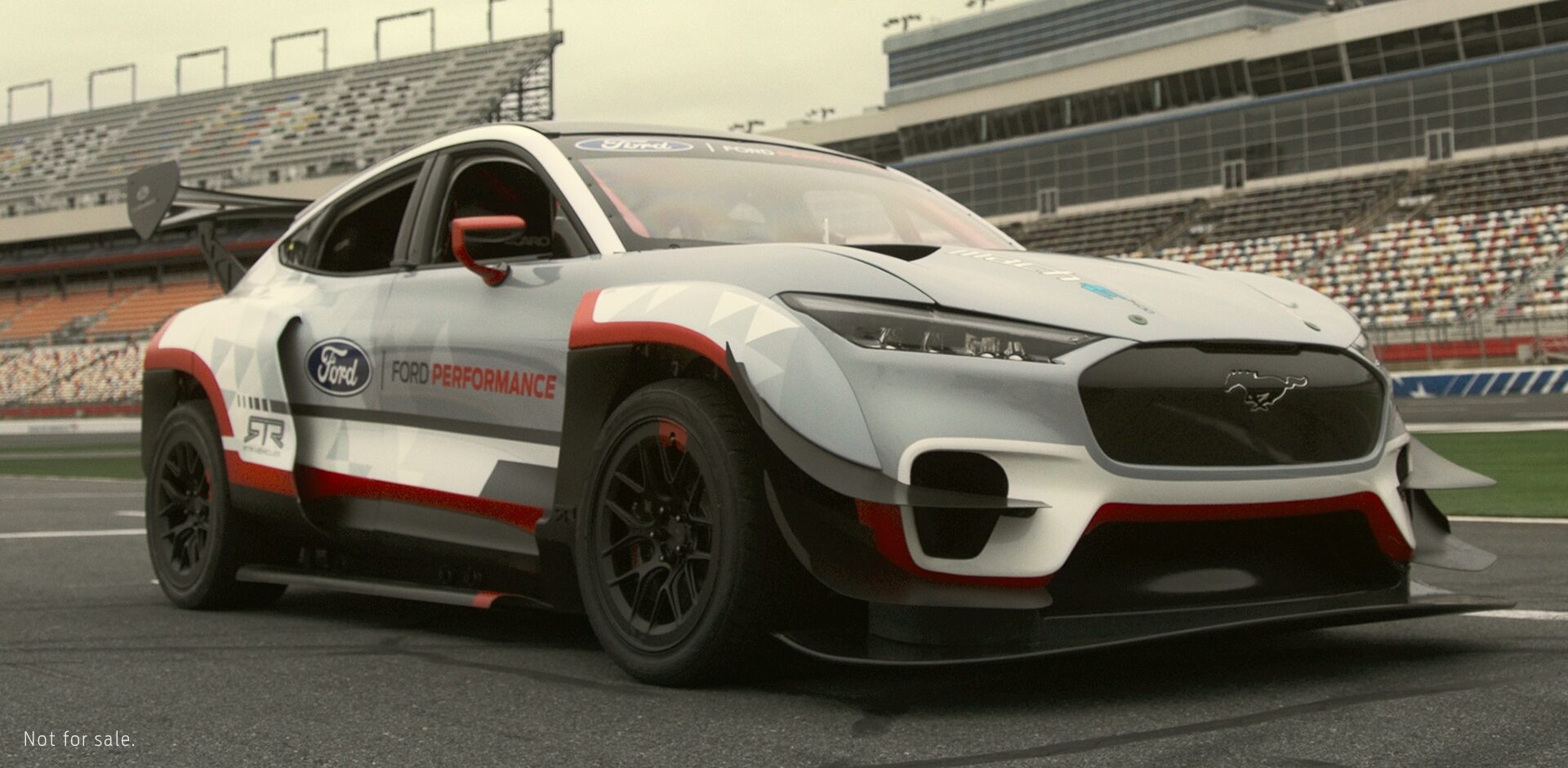
The Mach-E 1400 racing prototype.

The Mustang Mach-E 1400 is a 1,400-horsepower experiment. (Ford)

The project took 10,000 hours of collaboration to figure out what an electric vehicle can do and what customers tend to believe it can do, said Ron Heiser, chief program engineer for the Mustang Mach-E, in a release.

Mustang Mach-E Performance

Blistering power comes through seven — 7 ! — electric motors, five more than the production Mustang Mach-E GT. Three are attached to the front differential and four are attached to the rear in pancake style. A single driveshaft connects them to the differentials.

The setup has a huge range of adjustability to set the car up for everything from drifting to high-speed track racing, Heiser said.

The racecar's tire and aerodynamic fender fairing.

Aerodynamics were optimized, including unique cooling ducts. (Ford)

Battery power

The 56.8-kilowatt-hour battery is made up of nickel manganese cobalt pouch cells. The composition allows ultra-high performance at a high discharge rate. The battery system uses a di-electric coolant during charging to decrease the time needed between runs.

The project took shape without rules, according to Mark Rushbrook, motorsports director for Ford Performance. The Ford team and RTR used many of the same tools Ford uses for its race and production vehicles.
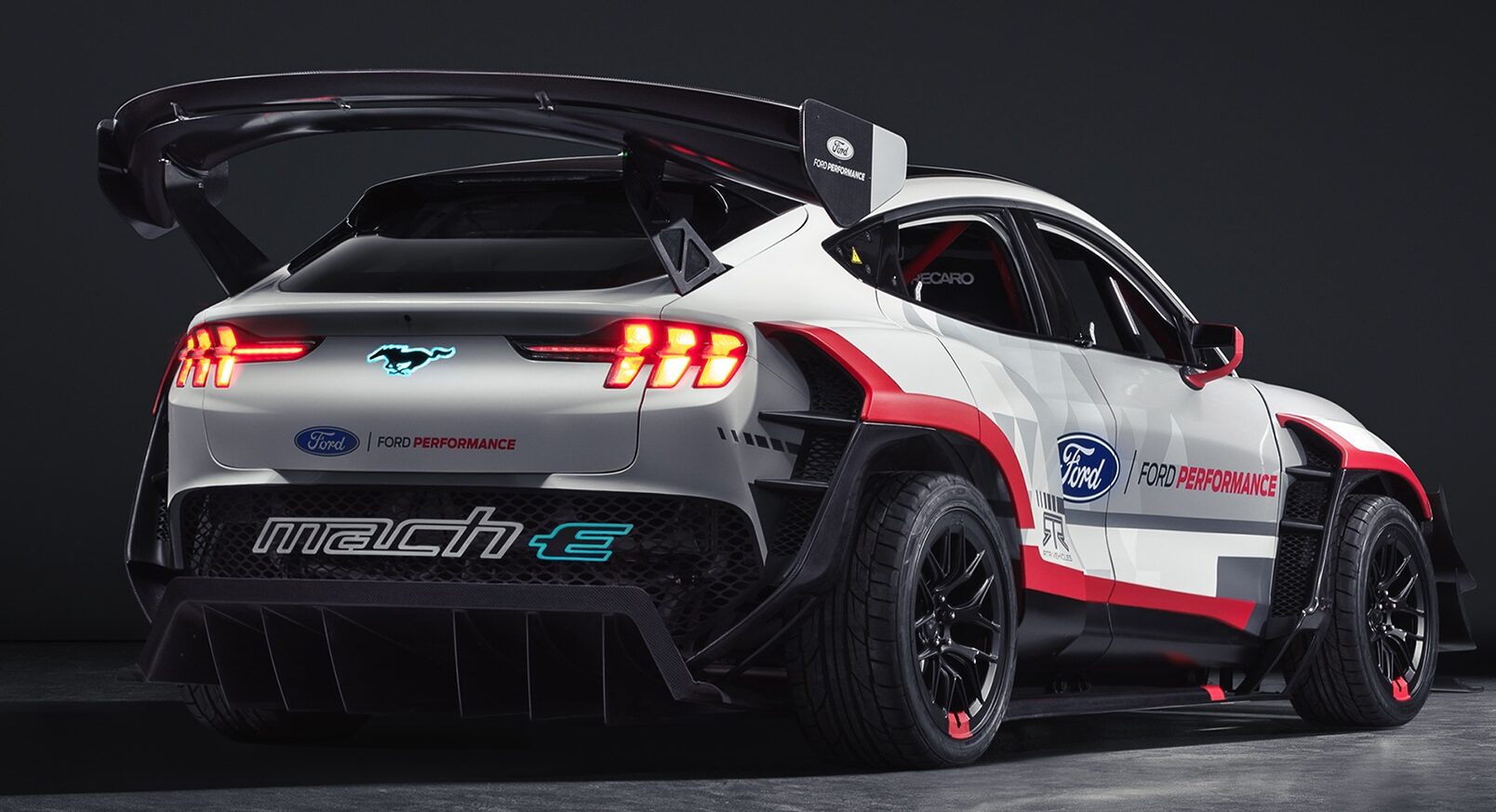
A rear view of the Ford racecar

Blistering power comes through seven electric motors. (Ford)

A winged warrior of downforce

Beginning with a Mustang Mach-E GT body-in-white, aerodynamics were optimized to create a winged warrior of downforce. The body has unique cooling ducts, a front splitter, dive planes, and a tall rear wing. Downforce is targeted at more than 2,300 pounds at 160 mph.

The chassis and powertrain were a test beds to evaluate different layouts and their effects on energy consumption and performance. There were chassis tests for rear-wheel drive, all-wheel drive, and front-wheel drive. Power delivery can be split between front and rear, or completely to one end or the other.

Drift and track setups have completely different front-end configurations,  Rushbrook said. As an example, the control arms and steering changes were calibrated to allow for the extreme steering angles in drifting.

The disc-brake system by Brembo has an integrated electronic booster. It allows series regenerative braking and is combined with ABS and stability control. A hydraulic handbrake for drifting allows the powertrain controls to shut off power to the rear motors.

“The challenge was controlling the extreme levels of power provided by the seven motors,” Rushbrook said in the release. “Mustang Mach-E 1400 is a showcase of the art of the possible with an electric vehicle.”

1948 Willys-Overland Jeepster

1948 Willys-Overland Jeepster

The Civilian Jeep

The 1948 Jeep Jeepster PR image.The 1948 Jeep Jeepster. (Photos courtesy Stellantis PR archives)

BY MARK MAYNARD

The Willys-Overland Jeepster was a clever business plan and an early example of a crossover SUV with carlike features.

Introduced in April 1948 and produced through 1950, the Jeepster was conceived as a sporty two-door, convertible sports car for veterans of World War II, according to its page in Wikipedia.

The basic Jeepster (“VJ” internally) included numerous deluxe features and a high level of standard equipment. Among its carlike extras were whitewall tires, hubcaps with chrome trim rings, sun visors, deluxe steering wheel, wind wings, locking glovebox, cigar lighter, and continental tire with fabric cover.

Slab-Sided Design

Willys-Overland lacked the machinery to form deep-drawn fenders or complicated shapes, according to the Wiki report, so the vehicle line had to use a simple and slab-sided design.

“Industrial designer Brooks Stevens styled a line of postwar vehicles for Willys using a common platform that included the Jeep pickup and station wagon, as well as a sporty two-door open car that he envisioned as a sports car for veterans of World War II.

“After World War II, Jeep trademark owner, Willys (originally pronounced WILL-is), began producing and marketing the “CJ” (for Civilian Jeep) to farmers, foresters, and others with similar utilitarian needs. It also began producing the Jeep wagon, panel utility and pickup in 1946 and the Jeep truck in 1947.

The majority of the Jeepster’s hardware carried over from the Willys station wagon, including the entire drivetrain, front end, rear suspension, steering and four-wheel drum brakes. Its flat-topped rear fenders were taken from the Jeep truck line.

The drivetrain was Willys’ World War II-proven, 63-horsepower, 2.2-liter inline-4 “Go Devil” engine. The three-speed manual transmission had standard overdrive.

The Jeepster was only offered with rear-wheel drive, which limited its appeal with other Jeep customers. With plastic side curtains, its $1,765 price was about the same as a Ford Super DeLuxe Club convertible. But the Ford had roll-down windows, fancier styling and a V-8 engine.

Jeepster Not Popular

Limited by sparse advertising and an insufficient dealer network, the Jeepster did not catch on with the intended market segment. Still, a total of almost 20,000 were manufactured through 1950, with some leftover models sold in the 1951 model year.

The Jeepster name was revived in 1966 on a new model, the C-101 Jeepster Commando. American Motors Corp., Willys-Overland’s successor, removed Jeepster from the name for 1972, and production ended after 1973.

The 1967 Jeepster Commando.

The 1967 Jeepster Commando.

Spring brings Yokohama Tire’s annual rebate promo

Spring brings Yokohama Tire’s annual rebate promo

Yokohama Tire’s annual rebate promotion

2 offers will run through May 2, 2021, for $60 or $80 prepaid cards or virtual accounts


BY MARK MAYNARD

Yokohama Tire’s annual spring rebate promotion will run through May 2, 2021, and provides tire shoppers with a $60 or $80 Yokohama Visa Prepaid card or a Visa Virtual Account after purchasing a set of four select Yokohama tires.

The list of available tires for the rebate promotion include (Pricing estimates are from TireRack.com:

For the $80 Visa prepaid card or Visa Virtual Account:

ADVAN Apex V601: Yokohama’s ultra-high performance street tire with a Y-rating for speeds up to 186 mph. The grippy rubber formula has a low 280 treadwear rating (UTQG) and it is warranted for up to 25,000 miles or 12,500 miles on staggered fitments. Available in wheel sizes of 17-20 inches. Depending on size and other dimensions, pricing ranges from about $150 to $350 per tire. Yokohama also has a 30-day trial satisfaction guarantee.

GEOLANDAR X-CV: An all-season performance tire for luxury sport crossovers and SUVs. It has a reasonably firm treadwear rating of 520 with a limited treadwear rating up to 50,000 miles. The rubber is formulated for a balance of good handling and ride comfort, with all-season capability, even in light snow. Depending on size and other dimensions, pricing ranges from about $200- to $300 per tire.

For the $60 Visa prepaid card or Visa Virtual Account:

ADVAN Sport A/S+: An ultra-high-performance all-season tire for sports cars, sporty coupes and luxury sedans. Depending on size and other dimensions, pricing ranges from about $150 to $300 per tire.

AVID Ascend GT: A grand touring all-season tire for passenger cars, crossovers and minivans. The rubber recipe is formulated for refined ride and noise comfort with long life and all-season traction, even in light snow. These tires are part of Yokohama’s BluEarth branding, to provide environmentally, human and socially friendly solutions. Depending on size and other dimensions, pricing ranges from about $90 to $215 per tire.

AVID Ascend LX: Another choice in Yokohama’s BluEarth line for a standard touring all-season tire, intended for passenger cars, crossovers and minivans. This tire has a very high (hard) 800 treadwear rating (UTQG) and has a warrantee for up to 5 years or 85,000 miles. Depending on size and other dimensions, pricing ranges from about $93 to $170 per tire.

GEOLANDAR CV G058: An all-season touring tire for small- and medium-sized crossover SUVs and minivans. Also in the eco-friendly BluEarth line, these tires have a high 740 treadwear rating and a warrantee of for 5 years or up to 65,000 miles. Depending on size and other dimensions, pricing ranges from about $133 to $210 per tire.

GEOLANDAR H/T G056: This is an all-season highway tire for trucks, SUVs and full-size vans. It is formulated for on-road, year-round use with all-weather handling and all-season traction, even in light snow. It has a warranty of 5 years or 70,000 miles for P-metric sizes or 5-years/50,000-miles for LT sizes; Half mileage for rear if different size than front. Depending on size and other dimensions, pricing ranges from about $120 to $280 per tire.

The rebates are available at participating Yokohama dealers nationwide and select authorized online dealers. Details of the promotion can be found here.

Hankook Tire tips for National Car Care Month

Hankook Tire tips for National Car Care Month

With vaccinations increasing and COVID-19 cases declining, Americans are getting back on the road. The latest Gauge Index by Hankook Tire found some interesting statistics (All photos courtesy of  NewsUSA)

BY MARK MAYNARD

You aren’t alone if it seems the daily commute is back to its pre-pandemic crush. With vaccinations increasing and COVID-19 cases declining, Americans are getting back on the road. And with April as National Car Care Month, the latest Gauge Index by Hankook Tire found some interesting statistics.

Among the tiremaker’s survey, it found that 66 percent of Americans are now driving at least a few times per week, which is more than double the 31 percent that drove regularly in April 2020. But despite more drivers on the road, the survey also found that in the last 30 days, 70 percent of Americans haven’t checked their tire pressure, 73 percent haven’t topped up their vehicle fluids and 22 percent haven’t done any car maintenance at all.

To help drivers keep the shiny side up and the rubber side down, Hankook Tire USA offer these five basic maintenance tips:

Check the Tires

Because tire pressure can change significantly as the outside temperature fluctuates, it’s important to check the tire pressure at least once a month to ensure it meets your vehicle’s recommended PSI. Low tire pressure can lead to poor performance, premature and irregular wear, and higher rolling resistance which can impact fuel efficiency. If the tires show any signs of damage, excessive wear or aging, it’s important to have them checked by a reputable service facility to ensure their safety and best performance. It might also be time for tire balancing and wheel alignment.

Spring Cleaning

Get a head start on the car-show season by giving your ride a thorough cleaning, inside and out. In colder climates or for those who have driven to the ski slopes, it’s important to wash off damaging chemicals like road salt that can corrode critical underbody components. A thorough wash, with either a waterless cleaner or a sudsy wash, will benefit the paint, but don’t overlook the wheels and wheel wells to clear away road grime. Interior cleaning will help keep debris from staining carpets and getting into seat adjustment mechanisms, floor vents, cup holders, console storage and window switches.

Under the Hood

Check that your vehicle’s fluids are at the proper levels, such as oil, washer fluid, brake fluid and coolant. And also do an around-vehicle check that all lights are in working order. If unsure about checking or adding fluid, or how to change any lamp bulbs, your local shop can usually administer these services at little expense.

Weekly Shake-Out

Take your vehicle out for a weekly drive to keep the battery charged, fluids circulated and to prevent tires from flat-spotting in the garage on the driveway. This is also a good opportunity to spot mechanical issues that may need further professional attention. Today’s highly electrified vehicles, with battery-sapping computer sensors, can drain a 12-volt cranking battery in two to three weeks if the vehicle is not driven regularly.

Prepare for Potholes

Roads take a beating after a season of inclement weather and with springtime blooms there also will be substantial potholes. The correct driving technique can help prevent damage when encountering potholes: keep plenty of distance between you and the car ahead so as to easily spot potholes. If a pothole impact is inevitable, don’t swerve, but instead safely decrease your speed, take it head-on and slowly roll over the pothole. It is always advisable to check your tires after any measurable pothole impact as it may damage the tire structure and could require replacement.
The Hankook Tire Gauge Index is a survey of American’s attitudes and opinions about driving. The latest survey, conducted Feb. 22-24, 2021, polled 2,732 randomly selected motorists age 18 and older who have a valid U.S. driver’s license.

The latest data from the Hankook Tire Gauge Index can be found at TechAndTread.com.

1961 Corvair Pickup

1961 Corvair Pickup
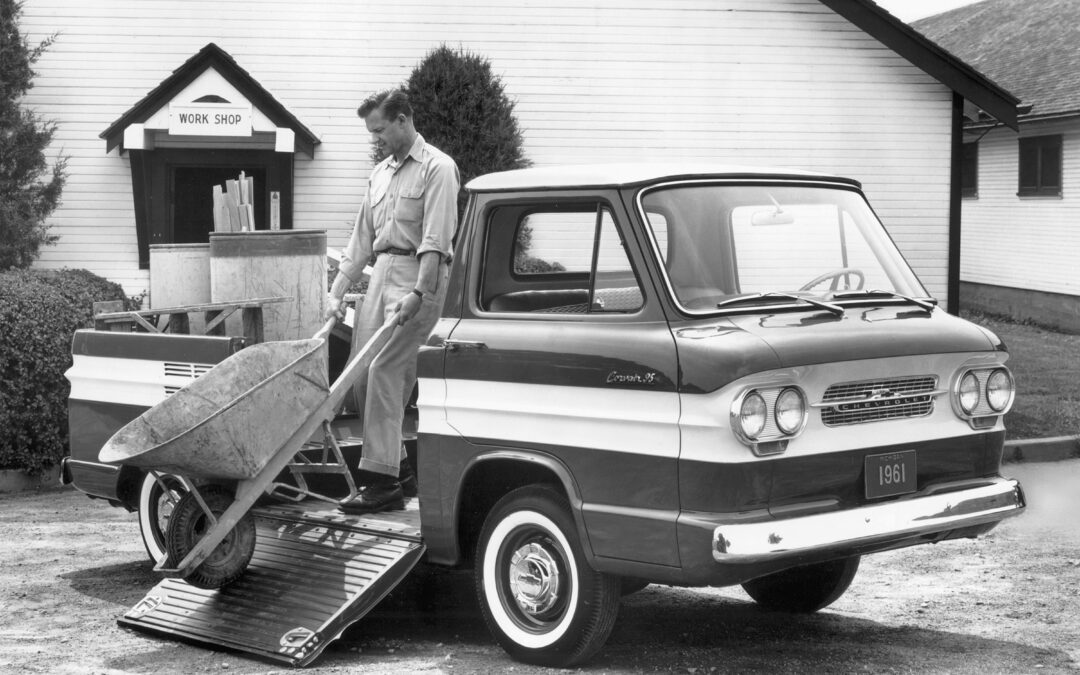
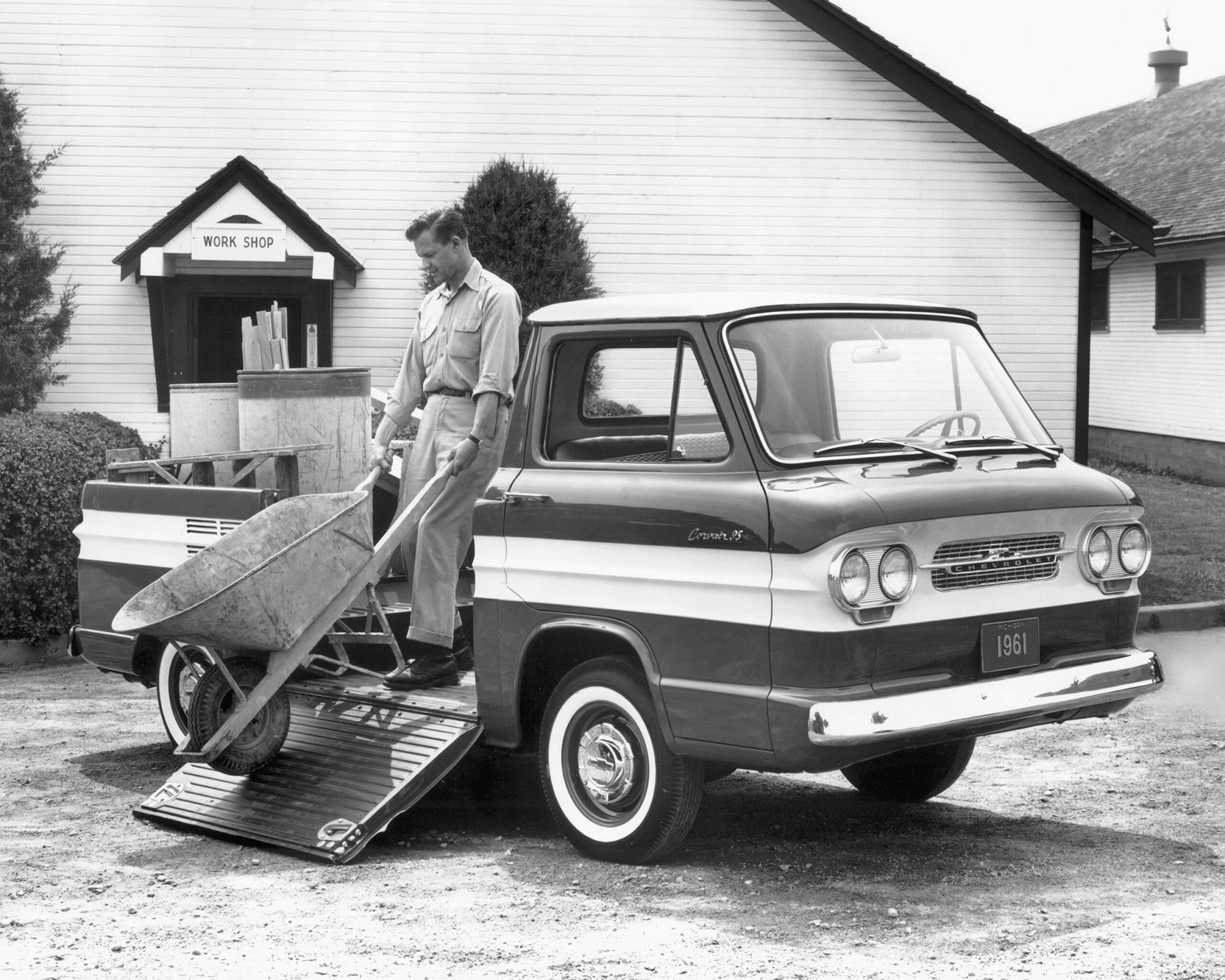
The 1961 Corvair 95 Rampside.

The 1961 Corvair 95 Rampside. (Chevrolet archives)


BY MARK MAYNARD

Although there had been a number of small pickups prior to the 1960s, the compact car boom that kicked off the decade brought with it a new crop of the so-called “forward control” body style.

Among the offerings was the Corvair 95. With its unitized body structure and rear-mounted engine, the 95 offered a lot of cargo space in a compact maneuverable package.

The Rampside model offered a side gate on the right side of the vehicle. The placement allowed easy access to the low load floor at the front of the bed.

According to the Corvair enthusiast site Corvair.org, Corvair 95s were named for their 95-inch wheelbase. GM  referred to the body style as “Light Duty-Forward Control (L.D.F.C.)” vehicles.

Marketed from 1961 to 1965, The line consisted initially of two vans and two pickups:

  • Corvan panel delivery, model R-1205
  • Greenbrier station wagon, model R-1206
  • Loadside pickup, model R-1244
  • Rampside pickup, model R-1254

Forward control referred to the positioning of the steering mechanism forward of the front axle and engendered the “Corvair FC” moniker for the line.

Although clever in design, the Corvair 95 never caught on in the showroom, and in the final model year of 1964, only 851 were sold.