Select Page

2021 Nissan Rogue review

2021 Nissan Rogue review

Family hustle, family hub

The “all-new” 2021 Nissan Rogue, in front or all-wheel drive, has starting prices of $26,745 to $37,925. (Photos courtesy of Nissan)

Table of Contents

Overview
Pricing
Design
Powertrain
Fuel Economy
Ride and Handling
Safety Features
Cargo and back seat space
Why buy the Nissan Rogue?
Specifications

BY MARK MAYNARD

It takes a rogue to survive in the cutthroat segment of compact SUVs, of which there at least a dozen in this arena. The Nissan Rogue had long been among the top three to six sellers, but its luster dimmed as the competitors were renewed.

The hierarchy will shuffle again with the complete redesign and re-engineering of the 2021 Nissan Rogue. Everything about it is new, Nissan says, from the platform, powertrain, rear multi-link suspension, electric steering system, safety, and driver-assist technologies, and exterior and interior styling. Also new is a top-line Platinum model.

Competitors include the Ford Escape, Chevrolet Equinox, Jeep Cherokee, GMC Terrain, Honda CR-V, Hyundai Tucson, Kia Sportage, Toyota RAV-4, Mazda CX-5, Mitsubishi Eclipse Cross, Subaru Forester, and VW Tiguan.

The interior design offers “family hub” utility with a premium presence.

Nissan Rogue Overview

The Rogue is all about the modern family, Nissan says, and refers to the new interior layout as the “Family Hub.”

Much design and engineering detail went into the family-friendly format.

  • More attentive engineering allows all doors to open to nearly 90 degrees. That extra space is especially helpful when buckling a child into a car seat.
  • Door panel bottle holders can hold a 32-ouncer;
  • Four charging USBs and a new wireless charging pad;
  • The new electronic shifter eliminates mechanical elements under the shifter, which allowed storage space under the new “floating” center console.
  • Standard safety technologies include the Nissan Safety Shield 360 and 10 airbags.

The new “floating” center console.

Nissan Rogue Pricing

The Nissan Rogue is sold in four trim levels (S, SV, SL, Platinum) in front- or all-wheel drive with one choice for engine and transmission. Front-drive starting prices range from $26,745 to $36,525. AWD pricing ranges from $28,145 to $37,925.  All MSRP pricing includes the $1,095 freight charge from Smyrna, Tenn.

The front-drive SL tester was $33,480 with one accessory for floor mats and a cargo mat ($385).

Look here for deals and incentives.

The shift console is a hub of function for charging.

Rogue Design

While still in the compact segment, Nissan considers Rogue more of a midsize.

The footprint is about the same as before but 1.5 inches shorter with a roofline lowered by 0.2 inches. The wheelbase and width are the same, at 106.5 and 72.4 inches. But headroom is a hair shorter, at 39.2 inches with the moonroof. And front legroom is 1.5 inches shorter, at 41.5 inches. The front shoulder room grew by a half-inch, to 57.1 inches, which helps the cabin feel open.

Unlike some swoopier SUVs in the segment, the Nissan Rogue has a roomy, more squared-off cabin. That format helps for unobstructed sightlines at the side mirrors and over the shoulder. Though the back glass might seem cropped, it is a rectangle that fills the rearview mirror. The around-view monitor on the SL is very enabling with an overhead view, front and rear.

All controls and switches are smartly arranged and simple to access.

The interior materials won’t be confused with a luxury vehicle, but the woven headliner and plastics have an appealing appearance and the panels fit with precision. The test vehicle was “preproduction” (an early run through the factory), for which I will blame the vibrations in the side mirror on the passenger side; the driver-side mirror was tight.

But for a $34K sticker price, I would have expected a wireless charging pad to be included. It is a $250 option for the SL.

Aerodynamics

The exterior styling, with the so-called “floating roof,” has the desirable qualities that define an SUV without the contrived angles and posture to create a “look.”

Integrated into the design are stealth aerodynamic features, such as the “3D” tire deflectors in the lower front fascia, an active grille shutter to control airflow into the engine compartment, special A-pillar shaping, underbody covers to manage airflow under the vehicle, and an “air curtain” that directs air from the front to the sides of the Rogue.

Rogue Powertrain

The 2.5-liter four-cylinder is the same displacement as before but with new engineering to add direct injection, which replaces multiport. The secret sauce of DI added another 11 horsepower, now at 181 hp. Torque is up by 6 foot-pounds, which peaks 800 rpms lower at 3,600 rpm for a quicker takeoff from a stop.

Automatic stop-start at idle is expected to be added later, but with this powertrain’s high fuel economy it will not be missed.

The Xtronic continuously variable automatic transmission was updated with paddle shifters and Eco and Sport modes (in addition to the Standard drive mode).

The 2.5-liter four-cylinder now with direct injection.

Rogue Fuel Economy

Fuel economy ratings are about the same but 1 mpg better in the highway mode: 26/34/29 mpg city/highway/combined, on 87 octane. AWD models are rated 26/34/29 mpg. (That’s comparable to the Toyota RAV4 XLE FWD at 28/35/30 mpg.) With the 14.5-gallon tank, it wouldn’t be difficult to have a range of 450 miles.

I worked up to 33.7 mpg in extended highway driving and averaged 24-28 mpg around town while driving in standard mode, not Eco.

The larger displacement four-cylinder without turbocharging provides a balanced ratio of power to fuel economy that should handily accommodate most buyers.

Rogue Ride and Handling

The new suspension design, including a new multi-link rear, might have the smoothest ride quality of the competitors. It steps across speed bumps and driveway transitions without whiplash to occupants.

The 19-inch Bridgestone Alenza tires (235/55) complement the well- soundproofed interior, but they spool up noise on concrete highways.

While most owners won’t push the limits of adhesion, soaring through a sweeping exit loop will bring a smile. And there is confident control in evasive maneuvers.

Driver Assist Features

Nissan’s proprietary ProPILOT Assist is among the more accurate for lane-centering on the interstate or divided highways. But keep both hands on the wheel because the system (like most others) will switch off briefly and randomly in certain conditions. And driving into bright sunlight can cause the Rogue to drift ever so slightly across the white lines or Botts’ dots before correcting course.

ProPILOT Assist with Nissan’s door-to-door navigation system adds another layer of watchful protection. Using map data, the system can proactively reduce speed for upcoming freeway curves or junctions and also help slow the vehicle for freeway exits.

Safety Features

Safety Shield 360 technologies include automatic emergency braking with pedestrian detection, blind-spot warning, rear cross-traffic alert, lane departure warning, and rear automatic braking.

Optional technologies include intelligent cruise control and the ProPILOT semi-automatic driver-assist system with blind-spot intervention and traffic sign recognition. It is included as part of the Premium package or standard on the Platinum.

Plan on spending another $39 a month for the data plan to use these advanced-driver-assist features. But once you’ve experienced them, you won’t wonder “What’s the speed limit here?”

Tire-wheel sizes range from 17-, 18- or 19-inches.

Cargo and Back Seat Space

The back seat is a comfortable place to spend time, particularly with the pano roof. There is another half-inch of back seat legroom (38.5 in.) and rear headroom grew by 1.2 inches.

Total cargo-area capacity grew by 4 cubic feet, now at 74 cu.ft. Space behind the back seat is slightly smaller but still haul-worthy at 36.5 cu. ft. Nissan’s nifty Divide-N-Hide cargo floor in the low position provides almost 5 inches more load space. The space is 45 inches wide by 32 inches to the ceiling and 35 inches deep. Fold the back seat for 6 feet of length. Release levers are a convenient detail.

The Divide-N-Hide cargo floor.

With all the new changes, and with an aluminum hood and doors, the Rogue’s weight grew by about 60 pounds across the trim levels/ Curb weights range from 3,411 to 3,512 pounds. The SL weighs 3,490 pounds.

A remarkable engineering feat was how 2.2 feet were sliced from the turning circle, now at 35.4 feet, which makes it a doughnut champ on a city street. The “floating roof” design.

Why buy the Nissan Rogue?

With the SL’s safety and driver-assist features, this Rogue will see children through their teen driving years and beyond.

The SV model is the value choice of trim levels ($28,435 FWD). But adding the niceties of the SV package, $2,660, brings the price to $31,095. The SV package adds family-friendly features of roof rails, a power liftgate, dual-panel panoramic moonroof, rear sunshades, leatherette upholstery, leather-wrapped steering wheel, heated front seats, and a heated steering wheel.

It is refreshing that Nissan cared enough to push the budget to do it right the first time. They won’t have to make excuses later.

 Specifications

2021 Nissan Rogue SL

Body style: compact, 5-seat SUV

Engine: 181-hp, direct-injection 2.5-liter 4-cylinder; 181 lb.-ft. torque at 3,600 rpm

Transmission: Xtronic CVT with manual shift mode, paddle shifters, and Eco and Sport modes

Fuel economy: 26/34/29 mpg city/hwy/combined; 87 octane

BY THE NUMBERS

Fuel tank: 14.5 gal.

Cargo space: 36.5-74.1 cu. ft.

Front head/leg room: 39.2*/41.5 in. *41.1 w/o moonroof

Rear head/leg room: 37.8/38.5 in.

Length/wheelbase: 183/ 106.5 in.

Curb weight: 3,490 lbs. (SL model)

Turning circle: 35.4 ft.

Tow capacity: 1,350 lbs.

FEATURES

Standard SL equipment includes: smart key locking and push-button ignition, leather-trimmed upholstery, Around View camera system, Intelligent Cruise Control with full speed stop and go, ProPILOT Assist, 8-way power (heated) driver seat, 4-way power (heated) front passenger seat, reclining and heated 60/40 back seat, power panoramic moonroof, leather-wrapped and heated steering wheel, 6-speaker audio system with 8-inch color display with NissanConnect, Apple CarPlay and Android Auto, Bluetooth phone and audio, 2 charging USBs (Type A, Type C), 2 rear charging USBs, Siri Eyes Free, electric parking brake, power (folding) mirrors, 19-inch alloy wheels

Safety features include 8 airbags, hill-start assist, brake assist, Intelligent Trace and Active Ride controls, automatic emergency braking with pedestrian and cyclist detection, Intelligent Forward Collision Warning and Lane Intervention, lane-departure warning, blind-spot warning, and rear cross-traffic alert,

PRICING

SL Base price: $33,095, including $1,095 freight charge; price as tested $33,480

Options on test vehicle: floor mats and cargo mat $385

Where assembled: Smyrna, Tenn.

Warranties: 3-years/36,000-miles bumper to bumper with roadside assistance; 5-years/60,000-miles powertrain
Jan. 27, 1965 – Ford Shelby GT 350 goes on sale

Jan. 27, 1965 – Ford Shelby GT 350 goes on sale
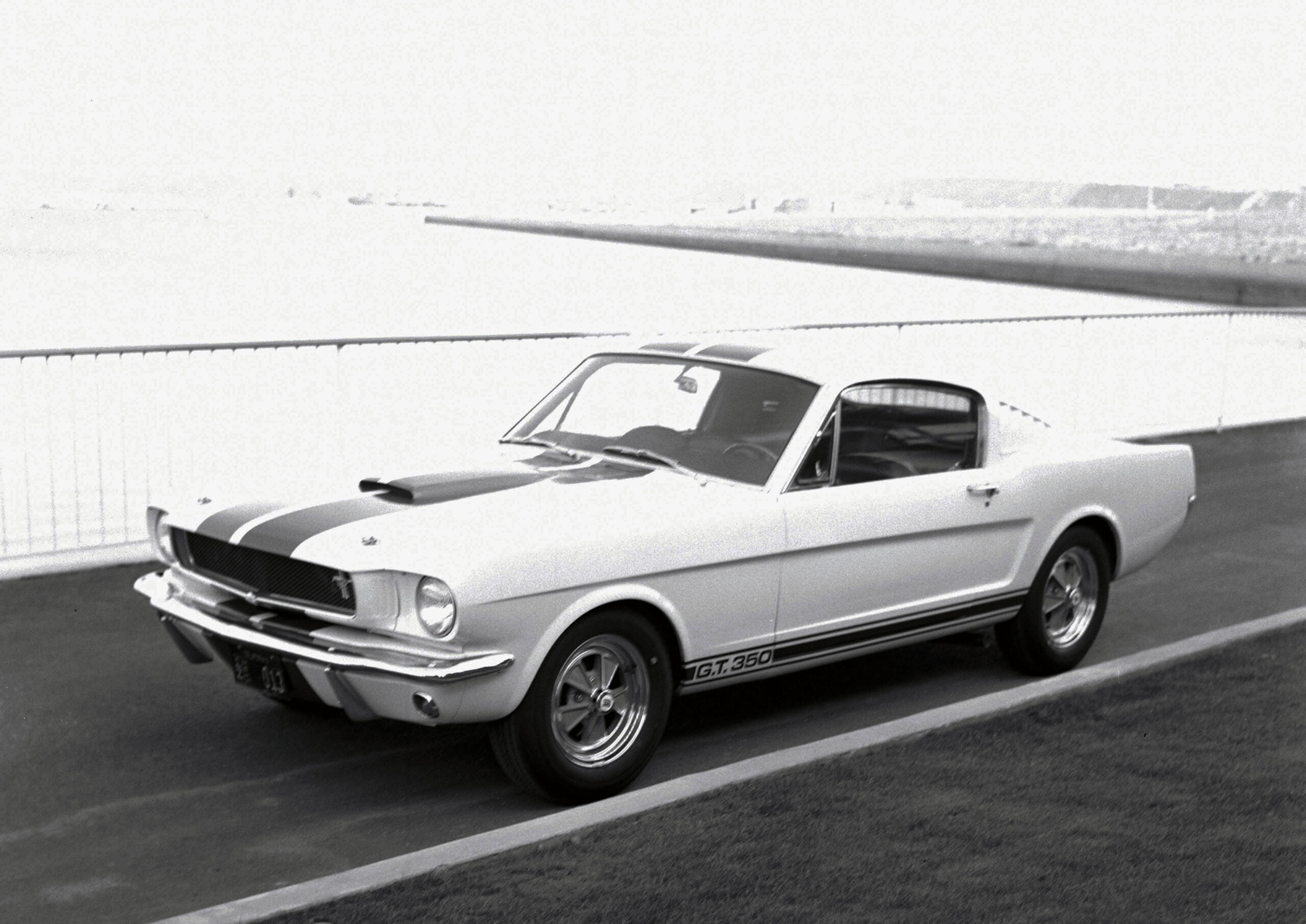
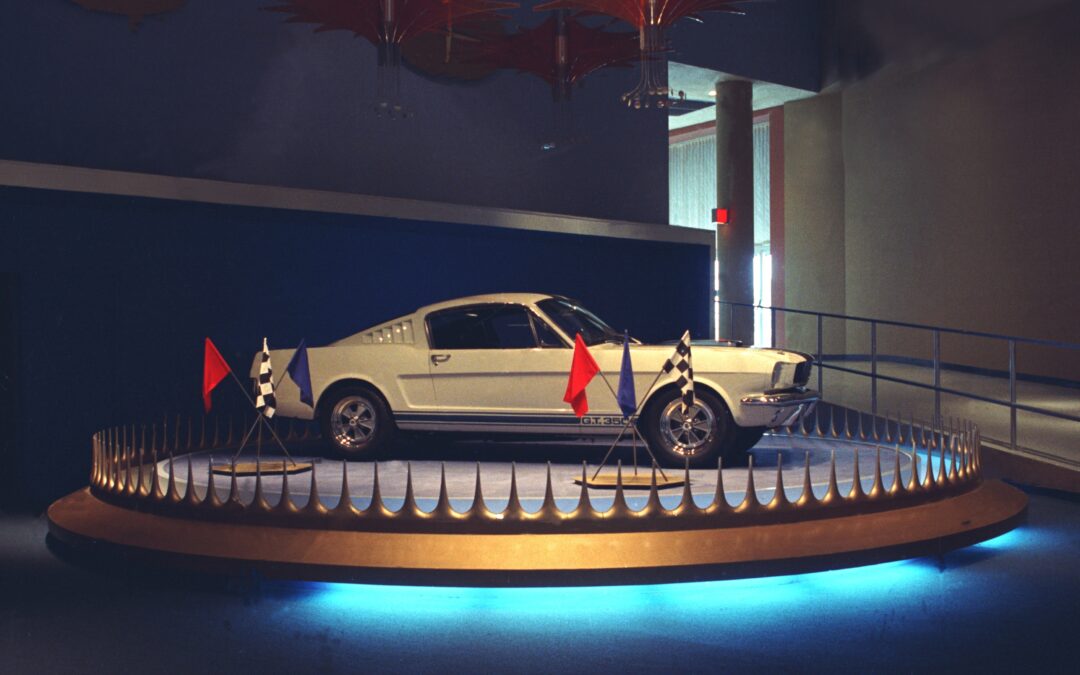
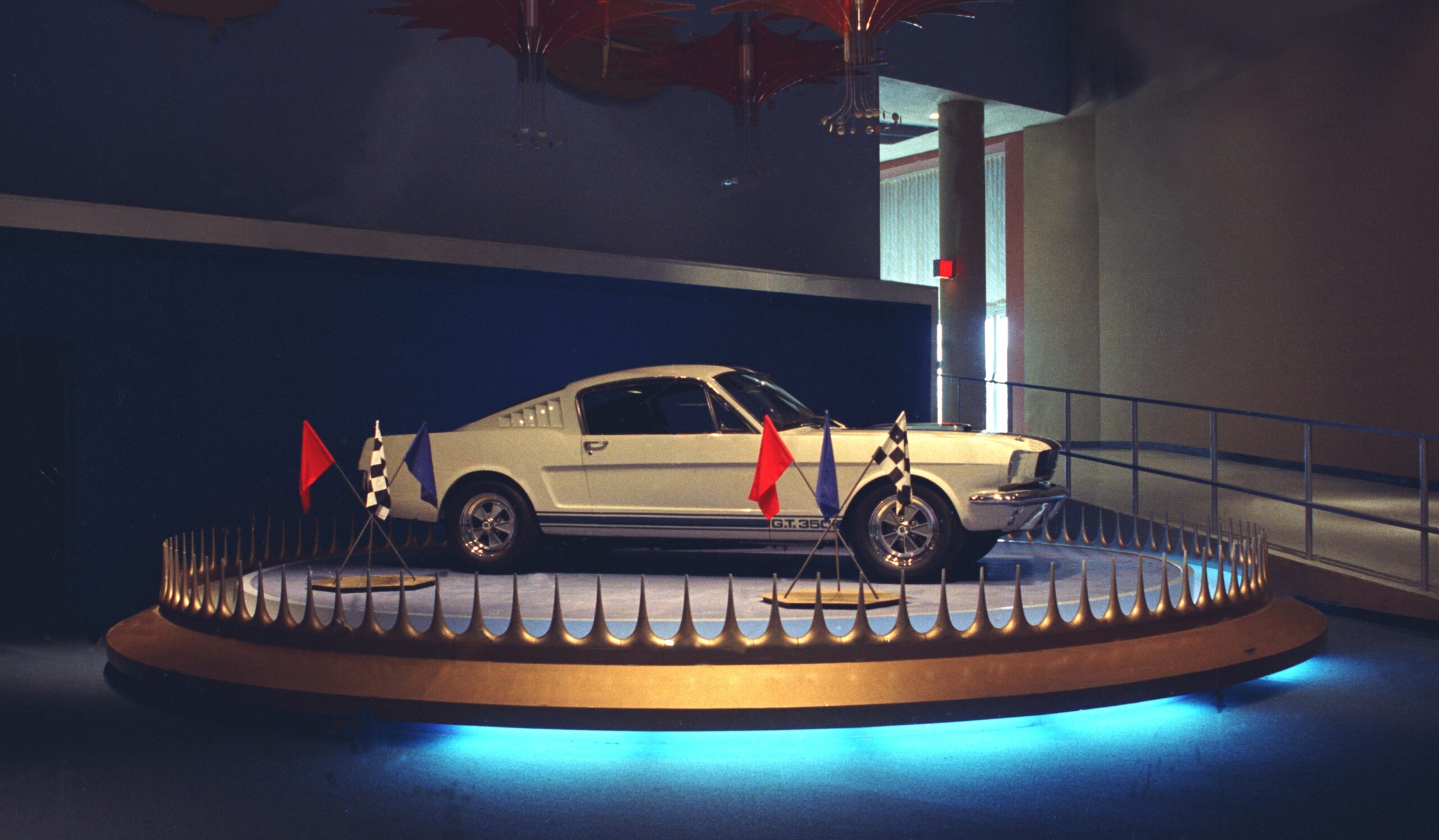
A 1965 Ford Mustang GT350 in the Ford Pavilion at the 1964 World's Fair

1965 Ford Shelby GT350 in the Ford Pavilion at the 1964 World’s Fair in New York. (Photos courtesy of Ford PR archives)

BY MARK MAYNARD

The racing circuit changed forever when sales of the 1965 Ford Shelby GT350 launched on Jan. 27, 1965, according to AutomotiveHistory.org.

“The GT was based on 1965 Ford Mustang Fastbacks that originally left the factory with a 271 HP 289 V8 and a 4 on the floor. Carroll Shelby had the stock vehicles shipped to Shelby American where his team stripped the car of weight. The car then received performance upgrades, such as high-riser intake manifolds, a four-barrel carburetor, and custom exhaust headers, boosting horsepower to 306.

A black-and-white vintage image of a 1965 Ford Shelby GT350

All 1965 Ford Shelbys (562) were painted Wimbledon White with Guardsman Blue stripes.

“In 1965 Shelby built 562 examples, all painted Wimbledon White with Guardsman Blue stripes. In 1966 the cars received updates to attract more general consumers, as opposed to strictly track racers. The 1966 GT 350 was available with optional rear vent windows and back seats and came in an array of colors. They were also equipped with a functional hood and rear brake air scoops and a three-speed automatic transmission was made available.

“Production of the first generation of Shelby Mustangs would last through 1971 with the GT 350 and GT 500.”

The quickest Bimmer yet: 2022 M5 CS sedan

The quickest Bimmer yet: 2022 M5 CS sedan

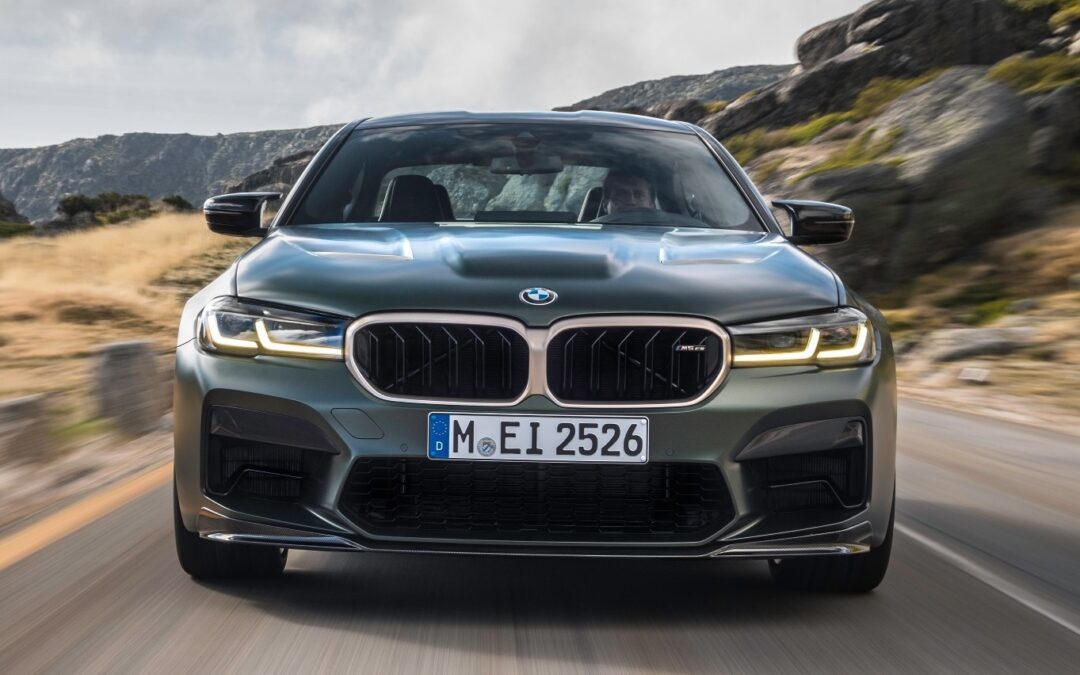
Available only for the 2022 model year, the new limited production all-wheel-drive supersedan builds on the M5. (BMW)


All-wheel-drive supersedan to start at $142,995


BY MARK MAYNARD

BMW has just announced that its 2022 M5 CS sedan is its quickest and most powerful BMW production vehicle ever. Available only for the 2022 model year, the new limited production all-wheel-drive supersedan builds on the M5, recently updated for 2021.

Interior features include power, heated M carbon front bucket seats, two-passenger rear bucket seats, Live Cockpit professional array with two 12.3-inch digital displays. (BMW)

The S63 4.4-liter M TwinPower turbo V-8 has been tuned for 627 horsepower, a boost of 10 hp over the Competition model, with 553 foot-pounds of torque from 1,800-5,950 rpm, which is 90 rpm wider than the M5 Competition.

M carbon bucket seats have integrated head rests and illuminated M5 logos. (BMW)

The power is sent through an eight-speed M Steptronic automatic transmission. Roll on the power for a launch to 60 mph in 2.9 seconds, BMW says, with a top speed of 190 mph, with the Driver’s package.

The S63 4.4-liter M TwinPower turbo V-8 has been tuned for 627 horsepower. (BMW)

Pricing starts at $142,995, including the $995 freight charge from Dingolfing, Germany.

Stand-alone options include:
• Frozen Brands Hatch grey metallic paint and Frozen Deep Green metallic paint;
• Gold painted brake calipers (no-cost option);
• Pirelli P Zero Corsa non-runflat high-performance tires (no-cost option).

Expect its U.S. arrival in the second half of 2021.

With the eight-speed M Steptronic transmission, BMW cites 0-60 mph in 2.9 seconds. (BMW)


1957 Plymouth Suburban wagon

1957 Plymouth Suburban wagon

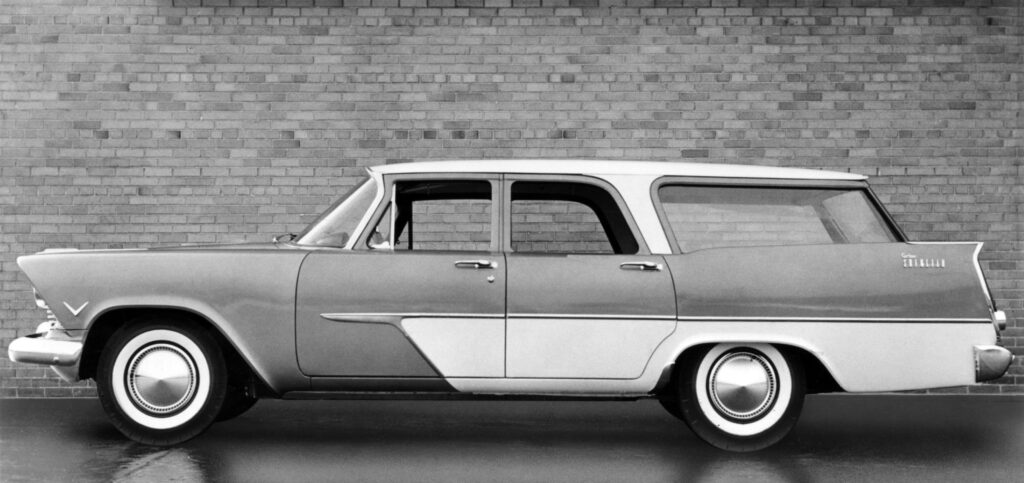
The 1957 Plymouth Suburban wagon, with the new “Forward Look” styling. (Stellantis)
BY MARK MAYNARD

A 1957 Plymouth Suburban wagon became the 10,000,000th Plymouth to roll off the production line on Jan. 24, 1957. It was a proud accomplishment for the brand, which was launched in 1928, according to Wikipedia.

“Plymouth was to compete in what was then described as the “low-priced” market segment that was dominated by Chevrolet and Ford. It became the high-volume seller for the automaker until the late 1990s.”

Parent company Chrysler killed the brand in 2001, and the models that were still in production were discontinued or rebranded as Chrysler or Dodge.

In 1957, Virgil Exner’s new Forward Look design theme, advertised by Plymouth with the tagline “Suddenly, it’s 1960,” produced cars with advanced styling compared to Chevrolet or Ford, according to Wikipedia. Plymouth cars were marketed primarily in the United States.

“The 1957 total production soared to 726,009, about 200,000 more than 1956, and the largest output yet for Plymouth. However, the 1957-1958 Forward Look models suffered from poor materials, spotty build quality, and inadequate corrosion protection; they were rust-prone and greatly damaged Chrysler’s reputation.

“The Plymouth automobile was introduced at Madison Square Garden on July 7, 1928. It was Chrysler Corporation’s first entry into the low-priced field previously dominated by Chevrolet and Ford.
“Plymouths were initially priced higher than the competition but offered standard features such as internal expanding hydraulic brakes that Ford and Chevrolet did not provide.

“Plymouths were originally sold exclusively through Chrysler dealerships, offering a low-cost alternative to the upscale Chrysler-brand cars.

“The logo featured a rear view of the ship Mayflower, which landed at Plymouth Rock in Plymouth, Mass. However, the inspiration for the Plymouth brand name came from Plymouth binder twine, produced by the Plymouth Cordage Company, also of Plymouth. The name was chosen by [corporate executive] Joe Frazer due to the popularity of the twine among farmers.”

2021 VW Arteon 2.0T Review

2021 VW Arteon 2.0T Review

Mild redesign fills in gaps for 2021 VW Arteon in its second model year 

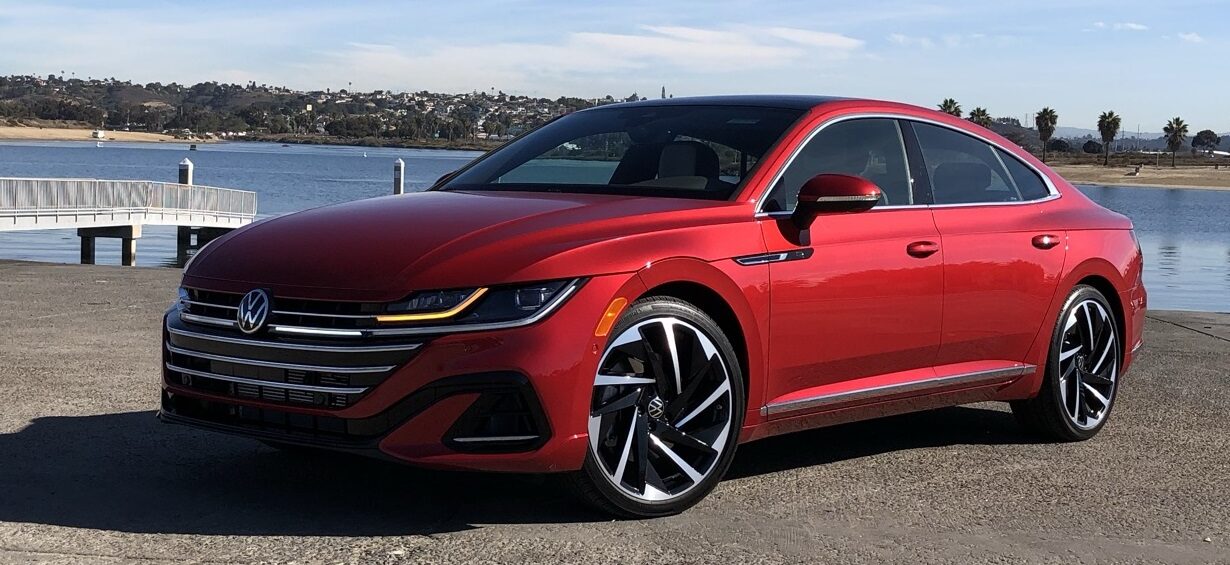
A front view of the 2021 VW Arteon

The 2021 VW Arteon has starting prices of $38,190- to $48,190, in front- or all-wheel drive. (Mark Maynard)

BY MARK MAYNARD

There is a unique presence to the driving characteristics of a German-engineered car. It telegraphs a message of confident control, which is present in a VW or a BMW — and it is an engaging spirit to just go out and drive. The redesigned 2021 VW Arteon is just such a purveyor of driving solidarity.

The large-midsize fastback Arteon is luxury-class but not luxuriously gilded. The VW Arteon debuted in the U.S. in 2019, but it barely caught the attention of SUV-hungry buyers.

Even I wasn’t overly excited about the first Arteon, but the speed-updating refresh for the 2021 model has made a vast improvement in subtle ways.

The European brands have improved their “large” or “executive” sedans, which are more of an American midsize but a few inches bigger all around. Consequently, there are few available choices, including the Acura TLX, Kia Cadenza, Nissan Maxima, and Toyota Avalon.

The Arteon driver area with Nappa leather upholstery

Standard SEL Premium equipment includes Nappa leather. (VW)

New for the VW Arteon

The refreshed Arteon features more refined front-end styling, Volkswagen says, with a redesigned cockpit. The interior has an updated dashboard design, décor trims, and Volkswagen’s Digital Cockpit. The all-new MIB3 infotainment system includes an updated navigation system and wireless app-Connect.

VW Arteon R-Line models were updated with a light bar in the grille and 30-color interior ambient lighting, wireless phone charging, and enhanced driver assistance technologies.

Other new technologies include:

  • Travel Assist, standard on R-Line models, for partially automated hands-on driving from 0 to 95 mph.
  •  Emergency Assist, also standard on R-Line, can bring the vehicle to a stop if the driver is incapacitated, or not keeping hands on the steering wheel.

And there are three new paint colors of Oryx White Pearl, Kings Red
Metallic and Lapiz Blue Metallic.

A look at the Arteon's contemporary interior styling

The cabin has a contemporary, coupe-like presence. (VW)

2021 VW Arteon Pricing

Sold in three trim levels in front- or 4Motion all-wheel drive, all VW Arteon models have a 268-horsepower, turbocharged and intercooled, direct-injection 2.0-liter four-cylinder engine. The transmission is an eight-speed Tiptronic automatic, with manual shifting.

Starting prices range from $38,190 for the front-drive SE, $42,790 for the SEL R-Line (plus $1,800 for 4Motion) to $48,190 for the SEL Premium R-Line with standard AWD; MSRP pricing includes the $1,195 freight charge from Emden, Germany.

All models feature 18-inch aluminum-alloy wheels, full LED headlights and an electronic adaptive suspension (DCC). Safety technologies include rear traffic alert, automatic post-collision braking system, forward-collision warning with autonomous emergency braking, side assist (blind-zone monitoring), and pedestrian monitoring.

Today’s tester is an SEL Premium R-Line 4Motion, $48,585 with one option for King’s Red paint, $395. VW’s warranty coverage of 4 years or 50,000 miles, includes the powertrain, with roadside assistance for 3 years or 36,000 miles.

Find current VW Arteon pricing here.

The Arteon's panoramic sunroof

A panoramic power sunroof is standard on SEL R-Line and SEL Premium R-Line models. (VW)

VW Arteon Architecture

The Arteon is now VW’s flagship sedan, though the company considers it a grand tourer. And as an architecture partner with Audi, there is some sharing of elements but without all the luxury content.

The R-Line cabin has a sporty coupe-like presence with contemporary design and horizontal lines to accentuate width.

Front headroom of 37.9 inches (with the sunroof) should accommodate those 6-foot-5 inches. And there is long front legroom of 41.6 inches. The R-Line front sport seats are firmly supportive with long thigh support. But the seats also have serious side and cushion bolsters for those drivers who push the limits of cornering.

Sightlines are clear at the side mirrors and down the hood, but the smallish back glass and sloped sides can be an issue. When parking, the wide-screen rearview camera with guidance lines enhances visibility.

Ergonomics and access to controls are smartly arranged with an easy-to-use 8-inch touch screen. As VW has stepped up to add more charging USBs, its wireless charging pad is a struggle to use. It occupies a shallow tray just ahead of the gearshift lever and it requires slender fingers to slip in a phone or pull it out, but it beats the tangle of a charging cord.

The 12.3-inch-wide digital gauge display (trickle down from Audi) is useful for its selectable elements, such as the navigation map as background or to highlight a digital speed readout or gear position.

Small storage areas include large door panels with space for bottles.

The Volkswagen Digital Cockpit (gauge array)

The Volkswagen Digital Cockpit (gauge array) is now standard. (VW)

VW Arteon Performance

The 268-hp spools up quickly for responsive acceleration with dependable passing power at 65 mph. Programmable driving modes can finesse the power and suspension settings. I frequently used Sport to keep the power on edge, but it can feel too edgy around town.

With 258 foot-pounds of torque at 1,950 rpm, few drivers would wish for a V-6. And with a potential driving range of more than 500 miles to a tank, a diesel option becomes unnecessary.

A look under the hood reveals elements of robust construction, including the plastic and rubber lines and rust-resistant connectors.

The Arteon 2.0-liter 4-cylinder engine

All models have a 268-hp, turbocharged 2.0-liter four-cylinder engine.  (Mark Maynard)

The eight-speed automatic has an electronic differential lock to keep AWD power flowing before wheel slip is detected. And there was no noticeable hesitation or electronic distraction in routing power four ways.

Fuel economy ratings of 20 mpg city, 31 highway and 24 mpg combined have improved an mpg or two since 2019, but premium fuel is required. I easily worked up to 33.9 mpg on an 80-mile highway run and continued at 24 to 26 mpg in combined driving. Oddly, front-drive models have an 18.2-gallon tank vs. 18.3 for AWD.

The AWD curb weight of 3,955 pounds (3,686 lbs. FWD) is husky and a little heavier than the competition.

VW insists the turning circle is 39 feet, but in my experience of making U-turns at my house, the arc seems more like 36 or 37 feet.

The Arteon’s drag coefficient of 0.29 is aerodynamically slick, which helps the long body slip through the air with little ruffling. Cabin soundproofing seems to have improved, too, at highway speeds with less wind and engine noise, and tire harshness.

The 20-inch Continental ProContact TX grand-touring tires, with a high treadwear rating of 500, can feel hard, but this application is well fitted for the Arteon.

The Arteon's gearshift console

The wireless charging pad, just ahead of the shifter. (VW)

Semi-autonomous driving

The addition of Travel Assist enables partially automated hands-on driving from 0 to 95 mph. The system works well to keep the vehicle centered in the lane, but like many systems, the guidance struggles to maintain the space when driving into direct sunlight on washed-out concrete highways (like all of them in California). And when the car crosses the line, the system blames the driver and gives a warning tone.

Arteon Ride and Handling

The chassis feels extremely rigid and secure, which helps the standard electronic damping system provide sharp, flat cornering. The ride quality is compliant but firm without jolt (or chin scraping) over lumpy intersections. The system manages the suspension rebound and compression at each wheel to adaptively adjust the damping force, Volkswagen says.

Braking is quite capable from 13.4-inch vented front discs and 12.2-inch solid rear rotors.

The tire and wheel package for the R-Line Arteon

The R-Line has 20-inch Continental ProContact TX touring tires. (VW)

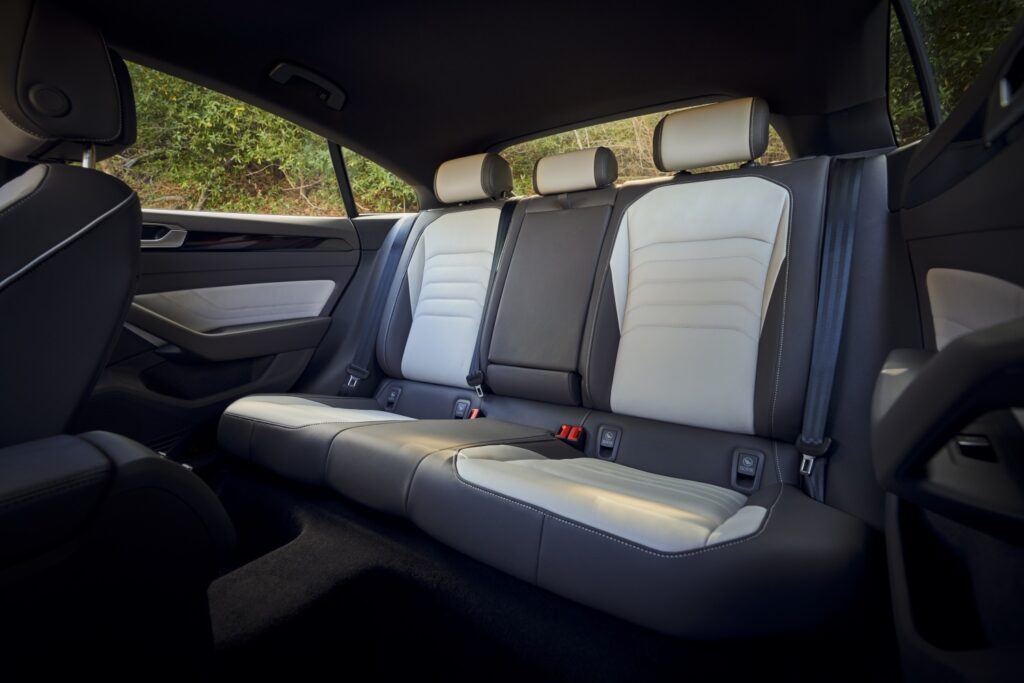
Arteon Back Seat

Access to the back seat is a bend-and-drop sequence, but legroom is grand-touring comfortable at 40.2 inches — and the window seats have adult thigh support. The tall but narrow transmission tunnel helps center-seat legroom, but the window seats are far more comfortable. There is one 12-volt plug and one charging USB.

There is a fold-down armrest and ski pass-through to the cargo area, which is wide and deep (40 inches by 45 inches wide). Fold the seatback for about 6 ½ feet in length.

Back seats in the sedan

The Arteon’s long wheelbase allows generous rear legroom, at 40.2 inches. (VW)

The Sedan Dilemma

Federal fuel mandates have compromised the typical midsize sedan, once the top-selling mode of transportation. With the ever-steeper regulations to meet fuel economy and air-quality standards, the family sedan had to be made lighter, lower for improved aerodynamics and powered by mostly small-displacement, turbocharged engines.

As engine technologies improved to adequately move the basic sedan (weighing 3,200 pounds and more), it is the lower rooflines and lower stance that have taken away the user function from a midsize.

It is easy to track buyers’ migration from low and restrictive to the more upright SUV, in any size category. But SUVs are heavier than a sedan, do not get the same fuel economy and they cost several thousands more. And, of course, buyers want four-wheel drive, whether needed or not.

The opened cargo space of the liftback.

The wide and low cargo area spans 27.2 to 56.2 cubic feet. (VW)

Why Buy the VW Arteon?

While an SUV is an appliance, valued for its view from the inside outward, the Arteon has a sophisticated presence, seen from the outside in.

It is the purposeful and balanced German engineering that is the unspoken asset of the Arteon. It is a soaring grand tourer, built for 100 mph continental cruising and arriving at your destination with impeccable style.

Drivers will value its cabin size, power, and nimble footprint for the long term.

A rear side view of the sedan.

The word “Arteon” is taken from the Latin word “artem,” which means art. (VW)

2021 Volkswagen Arteon 2.0T SEL Premium R-Line 4-Motion

Body style: large midsize, 5-seat liftback sedan

Engine: 268-hp, turbocharged and direct-injection 2.0-liter 4-cylinder; 258 lb.-ft. torque at 1,950 rpm

Transmission: 8-speed automatic with 4Motion all-wheel drive with drive modes

Fuel economy: 20/31/24 mpg city/hwy/combined; premium fuel recommended

SPECIFICATIONS

Fuel tank: 18.3 gal.

Cargo space: 27.2-56.2 cu. ft.

Front head/leg room: 37.9*/41.2 in.

Rear head/leg room: 37.1/40.2 in.

Shoulder room f/r: 56.5/54.7 in.

Length/wheelbase: 191.6/111.9 in.

Curb weight: 3,955 lbs. (3,686 lbs. FWD)

Turning circle: 39 ft.

FEATURES

Standard SEL Premium equipment includes: smart key locking and push-button ignition, electronic multi-mode adaptive suspension control, Nappa leather upholstery, digital (configurable) gauge array, rearview camera with overhead view, wireless phone charging, power tilt-slide panoramic sunroof, electric parking brake, 8-inch navigation touch screen, Harman Kardon audio system, power (heated) side mirrors), adaptive (turning) headlights, fog lights, 20-inch alloy wheels, automatic high-beam dimming, 3-zone touch electronic touch climate control, lighted cargo area with an adjustable floor and power liftgate

R-Line content, includes: leather-wrapped and heated steering wheel with redundant controls, special interior features and black headliner; R-Line style grille, bumpers and exterior trim; stainless steel pedal caps and driver’s footrest, Travel Assist (enables partially automated hands-on driving from 0 to 95 mph), Emergency Assist (can bring the vehicle to a stop if the driver is incapacitated, or not keeping hands on the steering wheel)

Safety features include: 8 air bags, Automatic Post-Collision Braking, Forward Collision Warning, Autonomous Emergency Braking, Blind Spot Monitor, Rear Traffic Alert, stability and traction controls, dynamic road sign display, park assist with park-distance control (front and rear), brake-force distribution and hydraulic brake assist, electronic differential lock, semi-automatic driving assistance, adaptive cruise control with stop-and-go, lane-keeping system, emergency assist

PRICING

Base price: $46,995, including $1,195 freight charge; price as tested $48,585

Options on test vehicle: King’s Red metallic paint $395

Where assembled: Emden, Germany

Warranties: 4-years/50,000-miles bumper to bumper including powertrain; 2-years/20,000-miles free scheduled maintenance; 3-years/36,000-miles roadside assistance