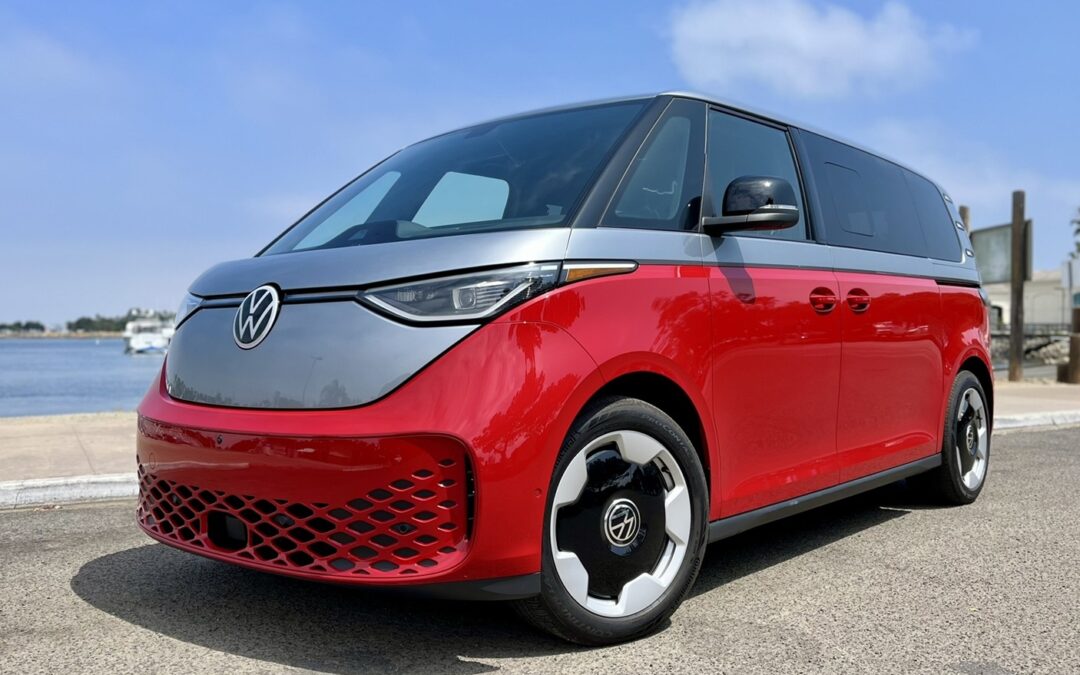
The battery-electric 2025 Volkswagen ID Buzz owns a unique niche. Its loaf shape is unapologetic and true to the original Bulli.
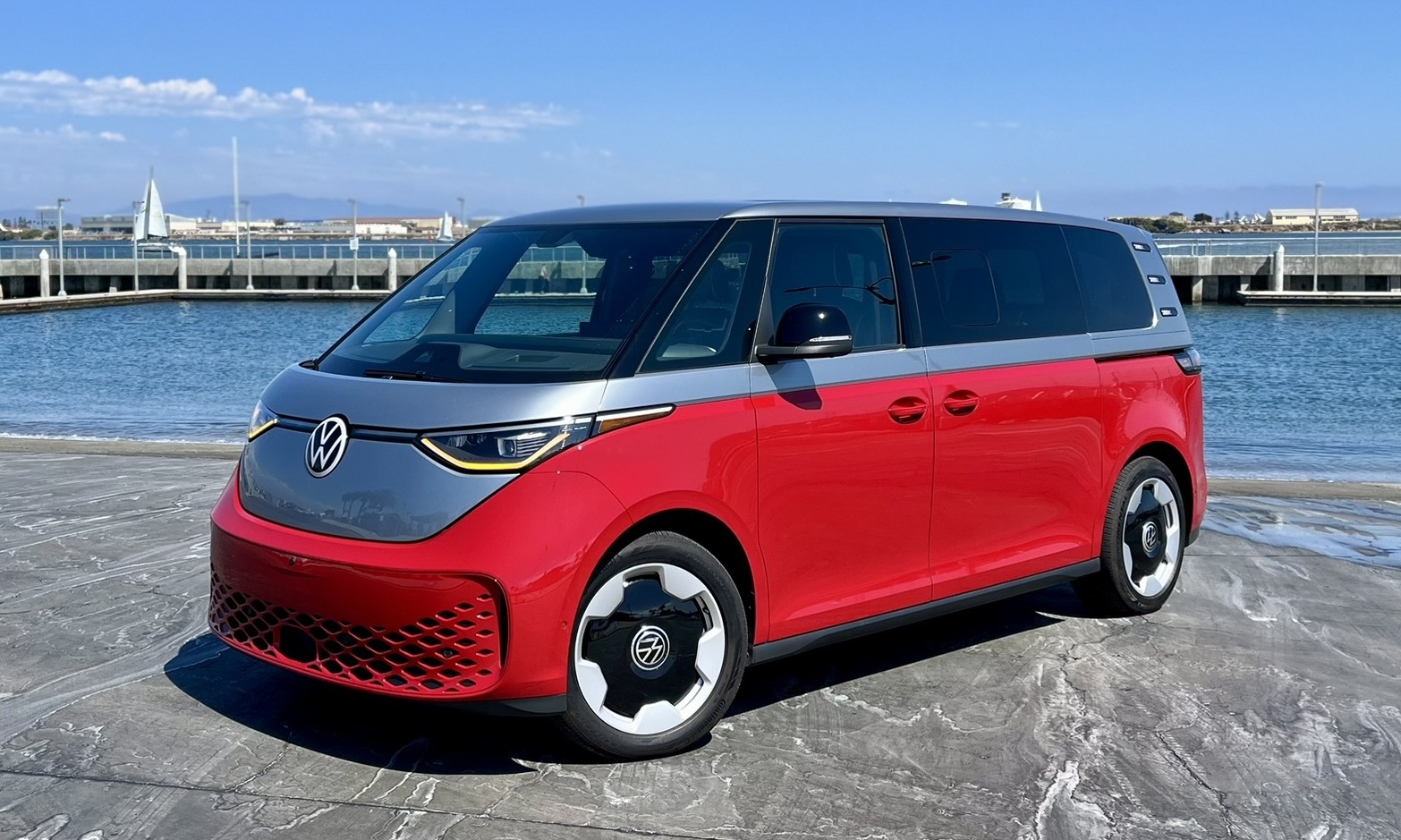
The 2025 VW ID Buzz is a battery-electric minivan with standard rear-wheel drive or the optional front-motor 4Motion AWD. Starting prices range from approximately $60,000 to $71,000. (Photography by Volkswagen of America or Mark Maynard)
Jump To Special Features
“What’s It Like?”
2025 VW ID Buzz Pricing
Clever Features
Buzz Kills
Safety Tech
Buzz Powertrain
500 kWh of Free Charging
2 Early Recalls Addressed
Why Buy the 2025 VW ID Buzz?
Specifications
BY MARK MAYNARD
It is not easy being a brought-back icon with such an international fan base as the VW ID Buzz. It is a three-ton example of expectations meeting reality. A LOT of shade has been slung at the ID Buzz, mostly for its shortish battery range and high price.
Most critics, however, focus on what the ID Buzz is not, rather than what it is. And it is impressive for its performance, ride comfort, and quiet interior.
Slipping into the shoe space of the original VW Bulli or Type 2 Transporter, the ID Buzz ain’t nuthin’ like the original. That is not to imply that the Buzz is not a well-done vehicle. It is, but it will be an enigma to the uninitiated.
As a battery-electric minivan, the Buzz owns a unique niche. Its loaf shape is unapologetic and true to the original Bulli. And with no comparable electric minivans, the Buzz gets compared to the growing segment of electric three-row SUV crossovers, such as the Hyundai Ioniq9.
The ID Buzz is not the first electric microbus. Fifty years ago, Volkswagen showcased a battery-electric T2 bus at the Hanover (Germany) Trade Fair. The electric T2 was powered by a rear-mounted electric motor and lead-acid batteries, offering a maximum range of 52.8 miles.
Today, the 2025 ID Buzz has driving ranges of 264 miles with rear-wheel drive and 231 miles with 4Motion AWD.
Long or short, the ID Buzz is a brand halo that VW hopes — expects — will draw the curious to showrooms.
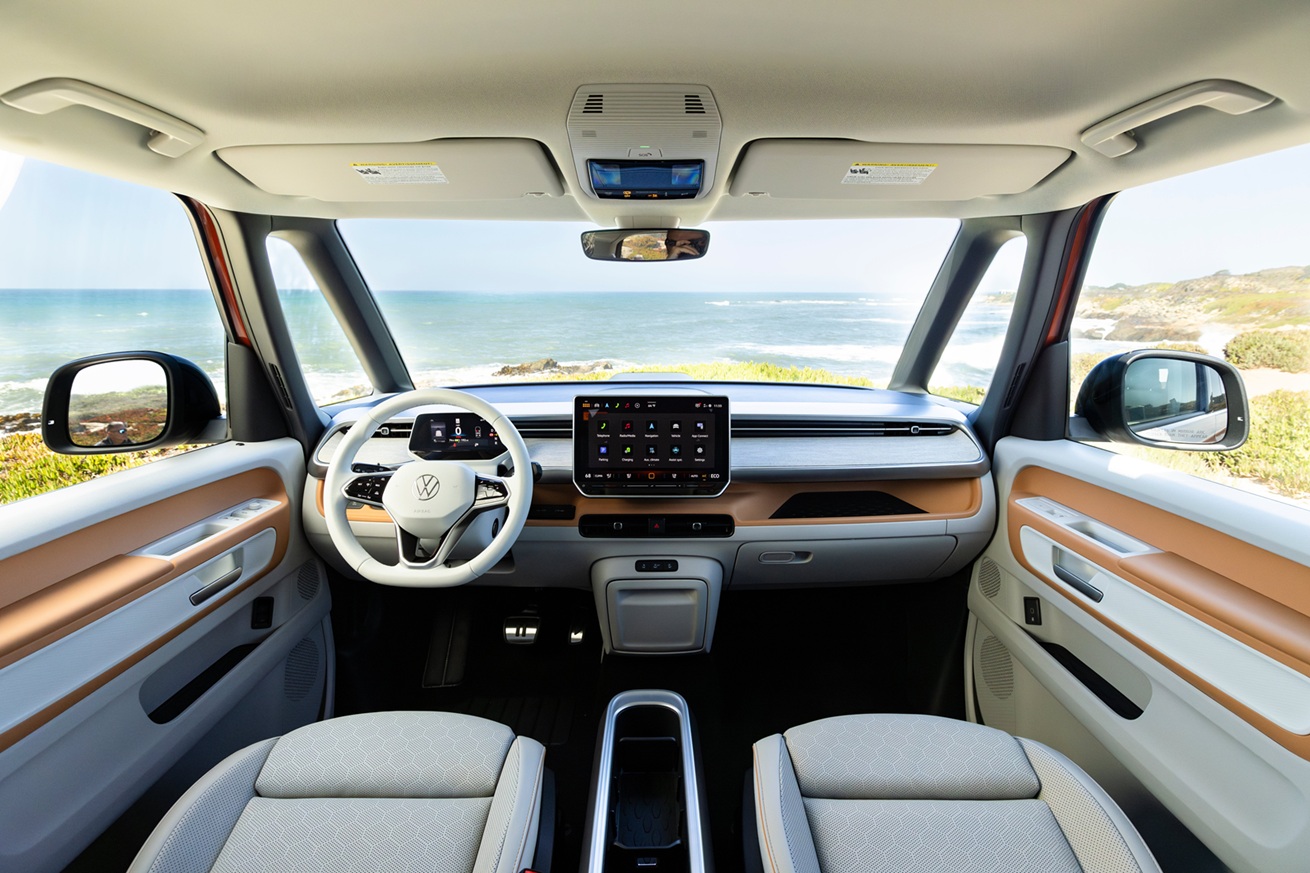
Despite the forked windshield pillars, driver sightlines are 180 degrees open.
ID Buzz Overview
The ID Buzz for North America features a single long-wheelbase configuration, available in rear- or all-wheel drive. Europe also offers a shorter wheelbase Buzz, approximately a foot shorter, as well as a cargo van. The Buzz has been on sale in Europe since 2022.
In an Automotive News report, Volkswagen of America CEO Pablo Di Si hinted at a family of ID Buzz models. One version might be a camper version with a pop-up roof.
For America, the short-wheelbase, five-seat Buzz — if and when it arrives — will have more appeal. It will be lighter and likely have a longer driving range, and cost a little less. And it will be a customizer’s canvas.
Volkswagen is also conducting an autonomous ID Buzz test fleet in Austin, Texas. Volkswagen’s Autonomous Driving Mobility & Transport (ADMT) plans to offer commercial service by the end of 2026.
Dimensionally, the ID Buzz is big, about the same length and width as the two-row VW Atlas Cross Sport SUV. Yet the ID Buzz has more interior room than the three-row Atlas SUV.
The Buzz has a long wheelbase of 127.5 inches, an overall length of 195.4 inches, and a width of 6 1/2 feet (78.1 inches).
Because the electric powertrain uses a skateboard architecture (wide and low), the ID Buzz sits about 5 inches taller than the Atlas SUV at 76.2 inches. The raised ride height, like a full-size pickup, is a big step up for shorter drivers and passengers, particularly children.
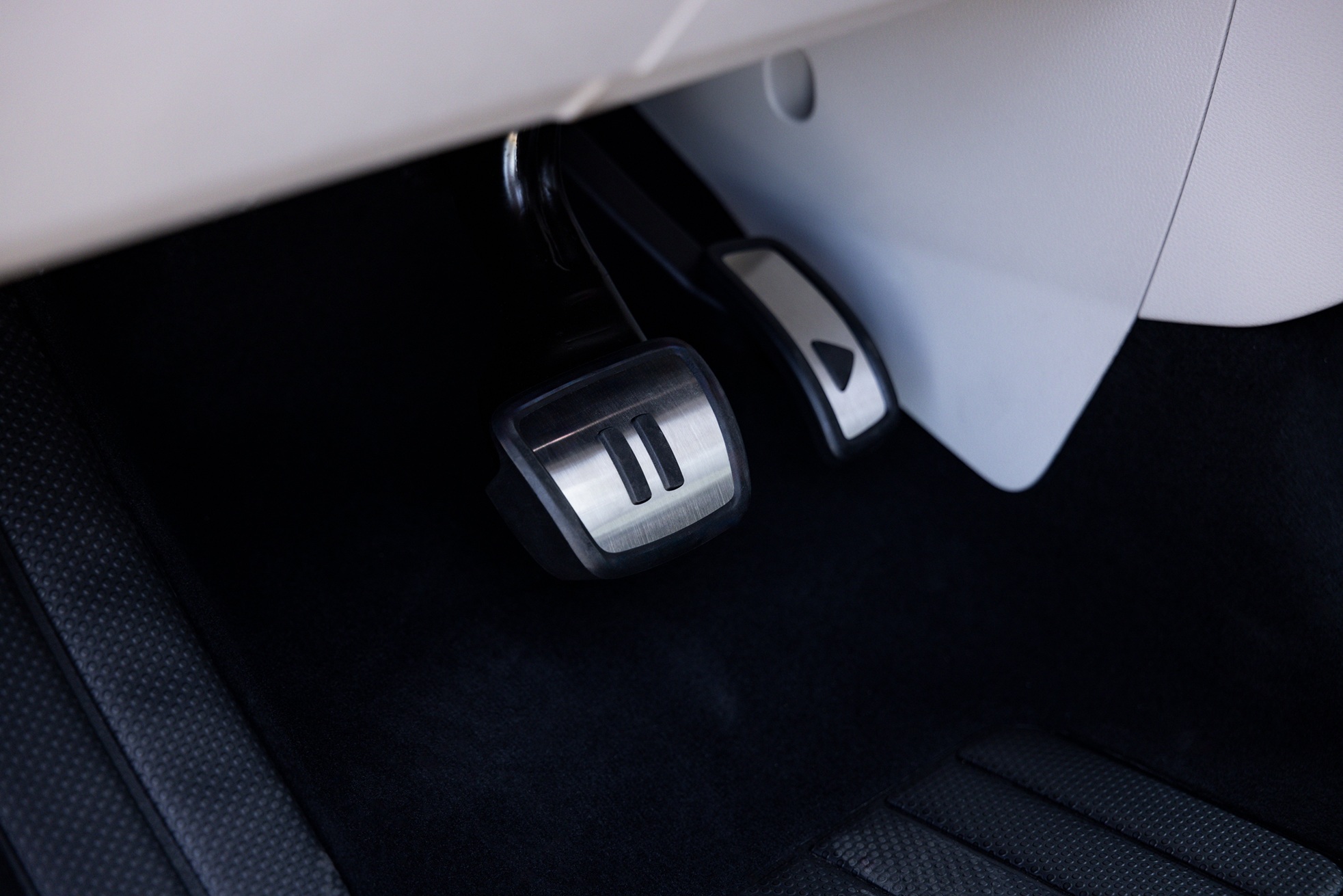
Pause and Play brake and accelerator pedals.
“What’s It Like?”
I met some of the nicest people during my test week of the ID Buzz. Each person asked, “What’s It Like?,” “Do You Like It?,” and “How Much Is It?”
My answers typically began with “Um, well …” All the ID Buzz shares with its microbus predecessor are a few throwback touches and a rear motor powertrain layout.
The Buzz lighting signature.
It is big but not imposing. The Buzz drives “smaller” than I expected. It doesn’t have that VW verve for driving, but the Buzz is quite accommodating, comfortable, and quiet on the road. It is not perfect, however, even to the Bulli pulpit.
I’m a Bulli insider. I owned a “bay window” 1968 VW Westfalia camper van. For $800, it was a charming beater. After the purchase, I shoveled $3,000 into it to make it start consistently, run (faster), stop, and steer. I loved its bus-like driver position and the big flat steering wheel. Sightlines were wide open. It had three-point seatbelts and an independent rear suspension, uncommon for American cars of that era. Throw open the one side door, and there was entry space to, maybe, shoehorn in a refrigerator. Raise the roof, and it was a cozy, wood-paneled camper. But, mercy, its clattering flat four cylinder could clear a picnic with its plume of exhaust and eye-watering exhaust emissions.
The Buzz, too, has an expansive cab-forward dashboard area, bracketed by forked windshield pillars. At first, it felt as if I was climbing aboard a space shuttle. That perception quickly transitioned into just a wonderful, open cabin space. As soon as I started driving, the broad glass greenhouse was more like a turret, providing 180-degree views.
When the question was about pricing — $60,000 to $71,000 — onlookers’ enthusiasm cooled. Expectations meeting reality.
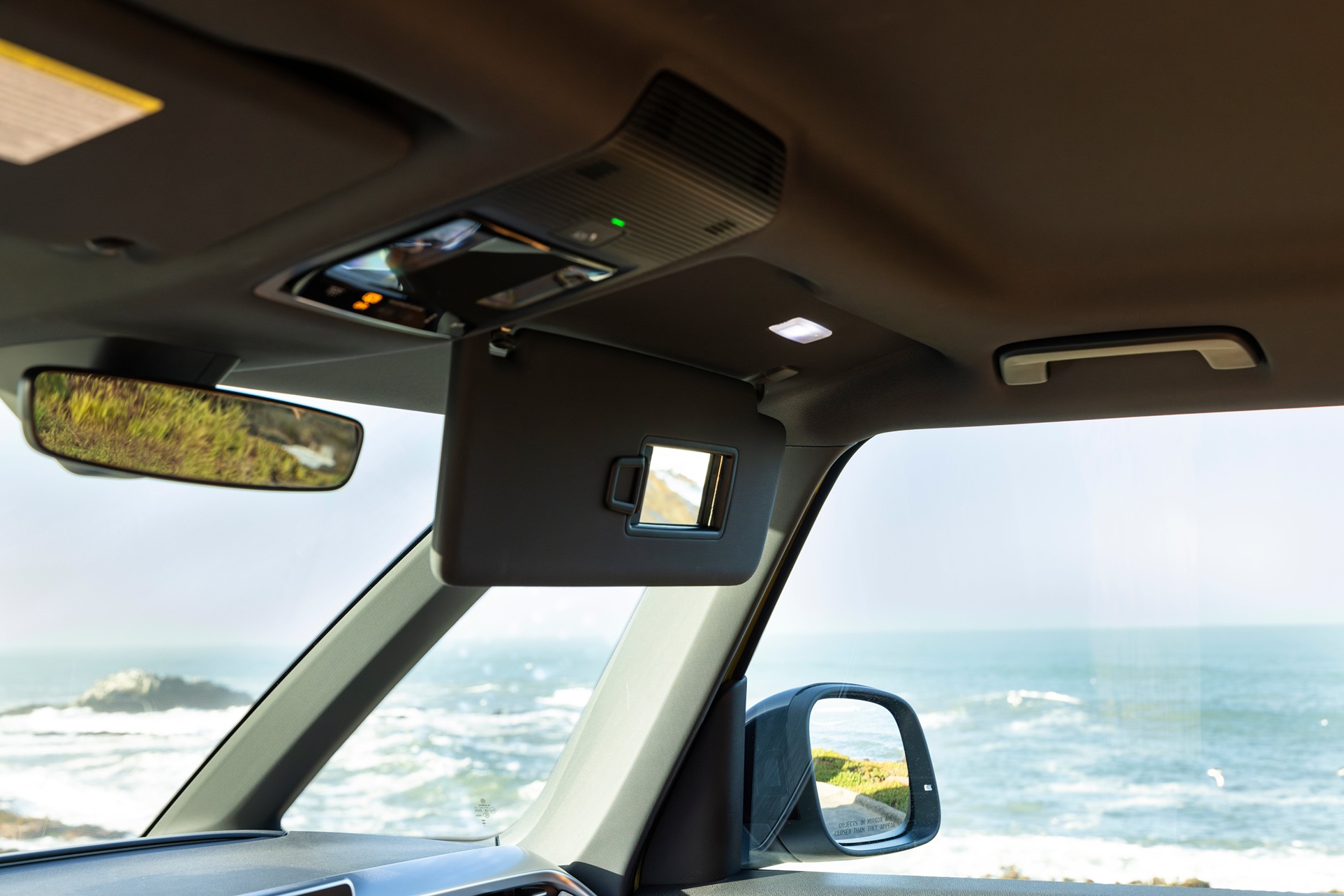
Despite the forked windshield pillars, driver sightlines are 180 degrees open.
2025 VW ID Buzz Pricing
There are two trim levels for the 2025 ID Buzz — Pro S and Pro S Plus — available in rear-wheel drive or 4Motion all-wheel drive. Rear-wheel drive models have 282 horsepower and a driving range of 264 miles. 4Motion all-wheel-drive models add a front motor, generating a total of 335 hp and a driving range of 231 miles. However, charging at home (240V) yielded 258 miles.
A launch 1st Edition features a unique wheel design with special badging and additional benefits. Among the extras are heritage floor mats and a panoramic electrochromic glass roof. 1st Edition models are available in five two-tone paint colors. Pricing for the 282-hp Buzz 1St Edition starts at $67,045. A 1st Edition with 4Motion (335 hp) starts at $71,545.
Suggested retail pricing includes the $1,550 freight charge from Hanover, Germany.
All ID Buzz models have 20-inch aluminum-alloy wheels in a retro-inspired disc. The disc-style wheels optimize airflow for minimal drag losses, VW says.
Dual power-sliding rear doors have a wide opening of 42 inches. And the doors’ side glass incorporates a power sliding window. Though small, the window is similar to some versions of the original bus.
The ID Buzz has eight eye-catching two-tone color choices, each priced at $995. Pick your preference for a Candy White upper with lowers in Energetic Orange, Pomelo Yellow, Blue Charcoal, or Cabana Blue. There’s also the Metro Silver upper with Cherry Red below, such as on today’s Buzz tester. And there are three no-cost single-tone colors: Metro Silver, Candy White, and Deep Black Pearl.
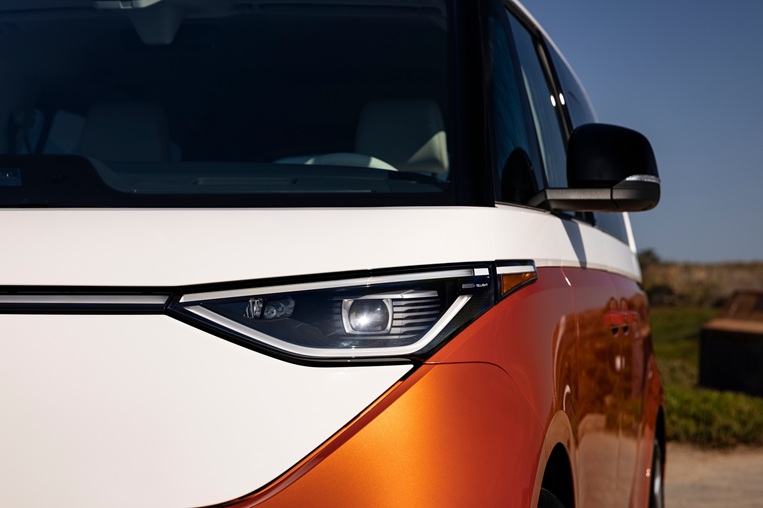
The ID Buzz has full LED lighting, including a slim lateral bar between the headlights.
The Pricing Walk
- Pro S: $61,545, single motor rear-wheel drive in solid paint color of black or white. (The popular two-tone paint scheme adds $995.)
- Pro S Plus RWD: $65,045, single motor with monotone black paint;
- Pro S Plus 4Motion: $69,545 dual motors with monotone black paint. (Its only factory options are for two-tone paint ($995) and the Electrochromic Smart Glass Roof for $1,495.
With the two-tone Cherry Red and Metro Silver paint scheme and three rows of floor mats, the tester came to $70,760.
Shop genuine ID Buzz accessories here.
Check current VW ID Buzz pricing here.
At the time of posting my story, there were two special offers for a 2025 ID Buzz:
Financing: 4.9 percent APR for 60 months, or a $2,500 customer bonus.
Lease: $699 per month for 36 months, with a down payment of $5,499 due at signing. At lease end, the owner is to pay a $395 disposition fee and a mileage range of 30,000 miles, and 20 cents a mile over 30,000 miles.
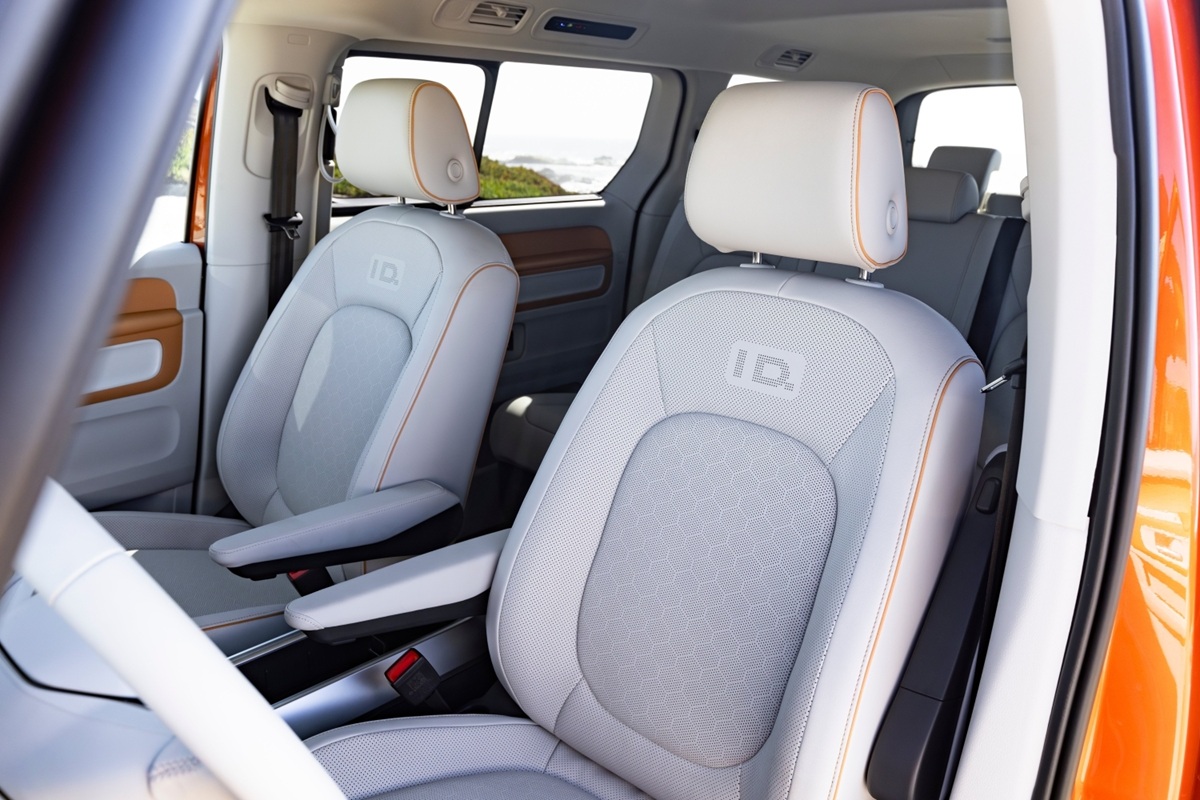
The ID Buzz Pro S Plus has 12-way power-adjustable and massaging front seats.
Buzz Interior Themes
There are three interior schemes for Buzz:
Moonlight: VW calls the “Moonlight” choice “Moody.” Dark brown leatherette seats feature white piping, blue door inserts, a dark wood-look dash, and a black headliner.
Dune: Intended as an airy, coastal-inspired interior. It pairs light gray leatherette seats with clay-colored piping, clay door inserts, and a light wood-look dash.
Copper: Mid-century modern with brown leatherette seat upholstery with yellow piping, brown door inserts, and a washed wood-look dash.
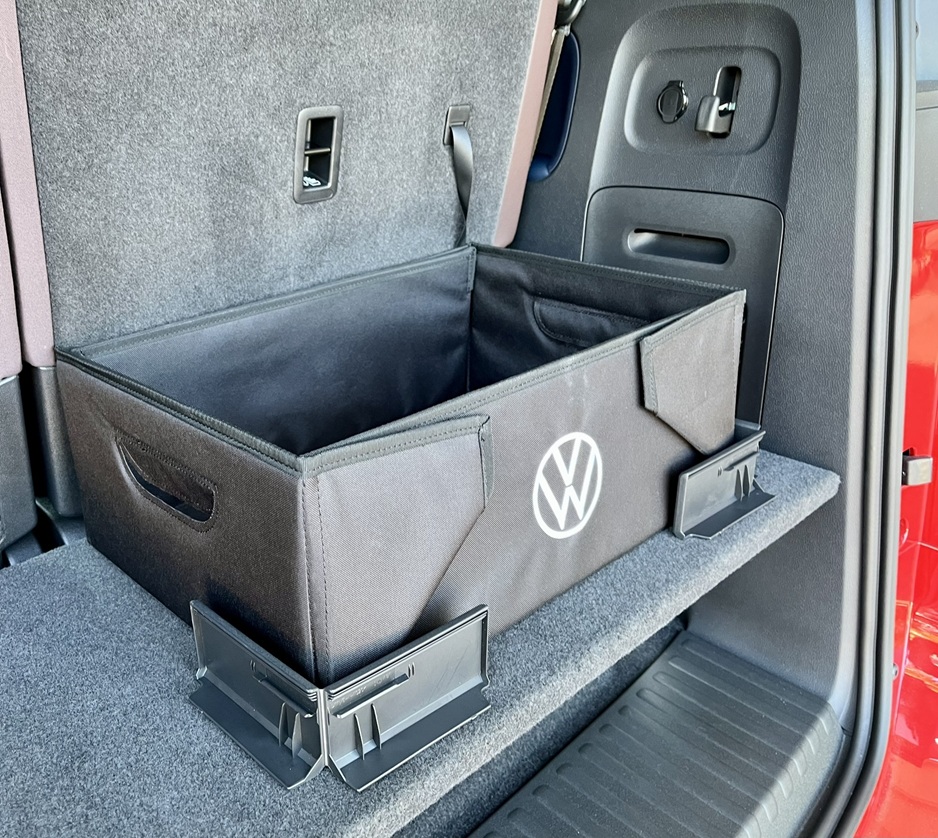
Removable corner grippers steady the bin. (Mark Maynard)
Clever Buzz Features
The ID Buzz has many cool features that are also quite accommodating:
Sit and Go Starting: Just take a seat, “smart” electronics recognize the key and activate the driving sequence. To shift into gear, place a foot on the brake pedal and twist the gear lever on the steering column. When exiting, the Buzz notes the empty driver seat and powers down the system.
Pause and Play Pedals: Stainless-steel pedal inserts mimic a media player “Pause” for the brake pedal and “Play” on the accelerator.
Removable plastic cargo grippers: On the rear side panels, foldable grippers are located that fold to 90 degrees to reinforce boxes or other gear.
Three D-pillar bar trim pieces: A reminder of the engine cooling vents of the vintage Type 2.
Loop grab handles: Look for the vintage-style grab loops at the side doors and tailgate pulldown.
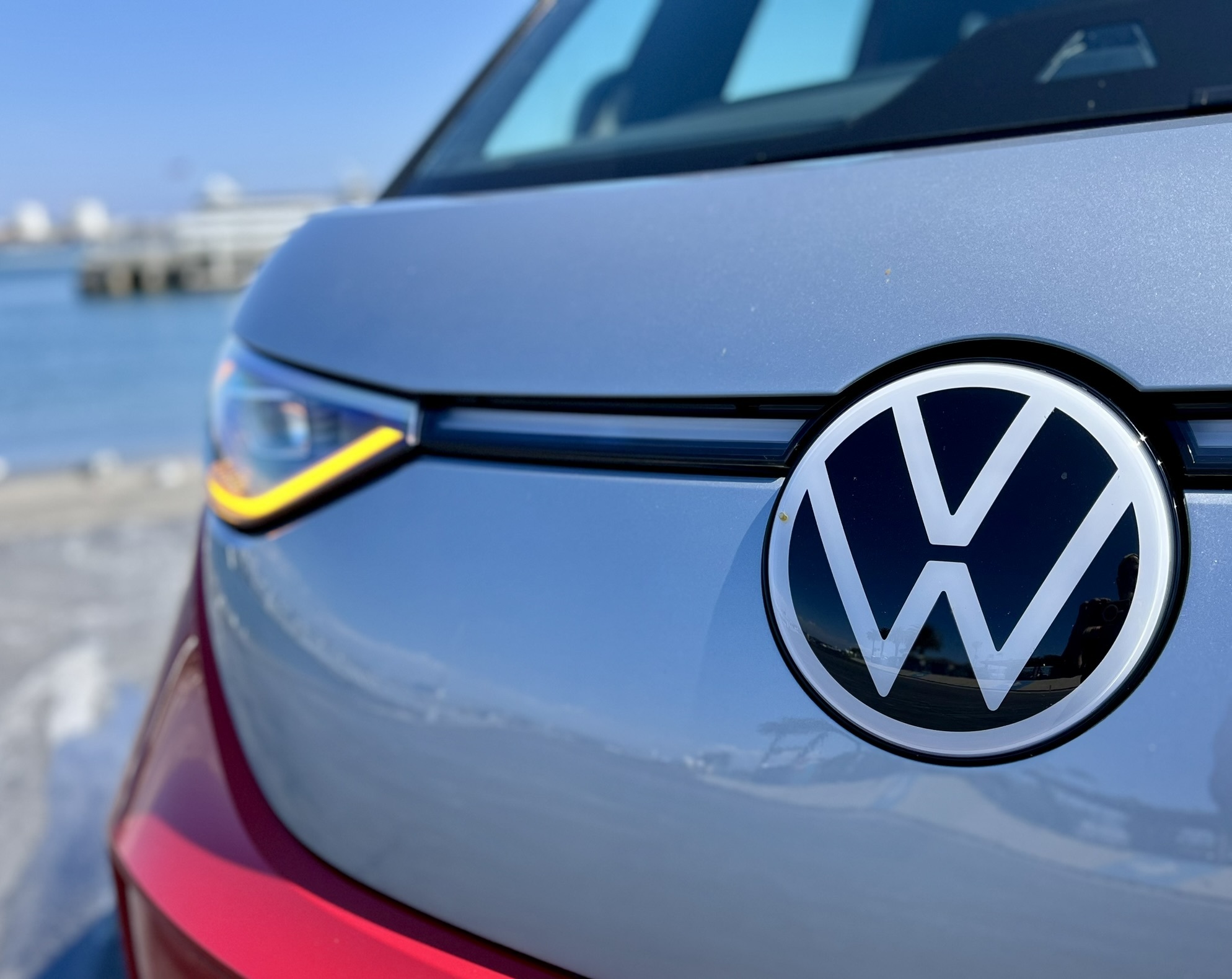
The Buzz has an oversized VW badge. (Mark Maynard)
Oversized front VW logo: The Buzz puts on a front light show when the driver approaches. The headlights, running lights, slim light bar, and VW logo give a welcoming light show.
ID Light system: A light strip located below the windshield utilizes various light pulses to signal the vehicle’s status. The pulses indicate readiness to drive, navigation turn instructions, brake prompts from driver-assistance systems, and incoming phone calls. When the Buzz is charging, the ID Light indicates the current charge level.
Buzz Box: The center floor console Buzz Box is a multitasker. It has open storage on top with two special, removable dividers. One doubles as a bottle opener, and the other can be used as an ice scraper. Below are two additional compartments, including a bottle holder. When configured with captain’s chairs, the removable center console can be relocated rearward for second-row passengers.
Buzz Kills
- For no apparent reason, the ID Buzz is not sold with a charging cable; however, an accessory charging kit is available for $350. The 2-in-1 Mobile EV Charge Cable is compatible with 240V and 120V charging.
- The ID Buzz has more USB charging ports (eight) than cup holders. There are no cup holders in the second row. However, there is a $98 accessory for a pair of single-cup holders with a phone slot. They work with the bench seat or captain’s chairs.
- Floor mats are not standard, and the accessory cost for three-row mats is $220. VW calls them Heritage mats, made of a premium woven material. There are color choices of Moonlight, Dune, or Copper to match the interiors.
- The tester’s Moonlight interior has brown V-Tec leatherette upholstery with the odd contrasting color of X-Blue on the dashboard. Brown and blue with a bold red exterior? Please give me the choice of a red interior.
- Grab handles! The elevated ride height deserves the leverage of robust grab handles at all doors. A robust bar integrated into the windshield pillars would be helpful. In the back seat, there are just two plastic loops at the second row doors. However, they do not appear strong enough to last through the warranty period.
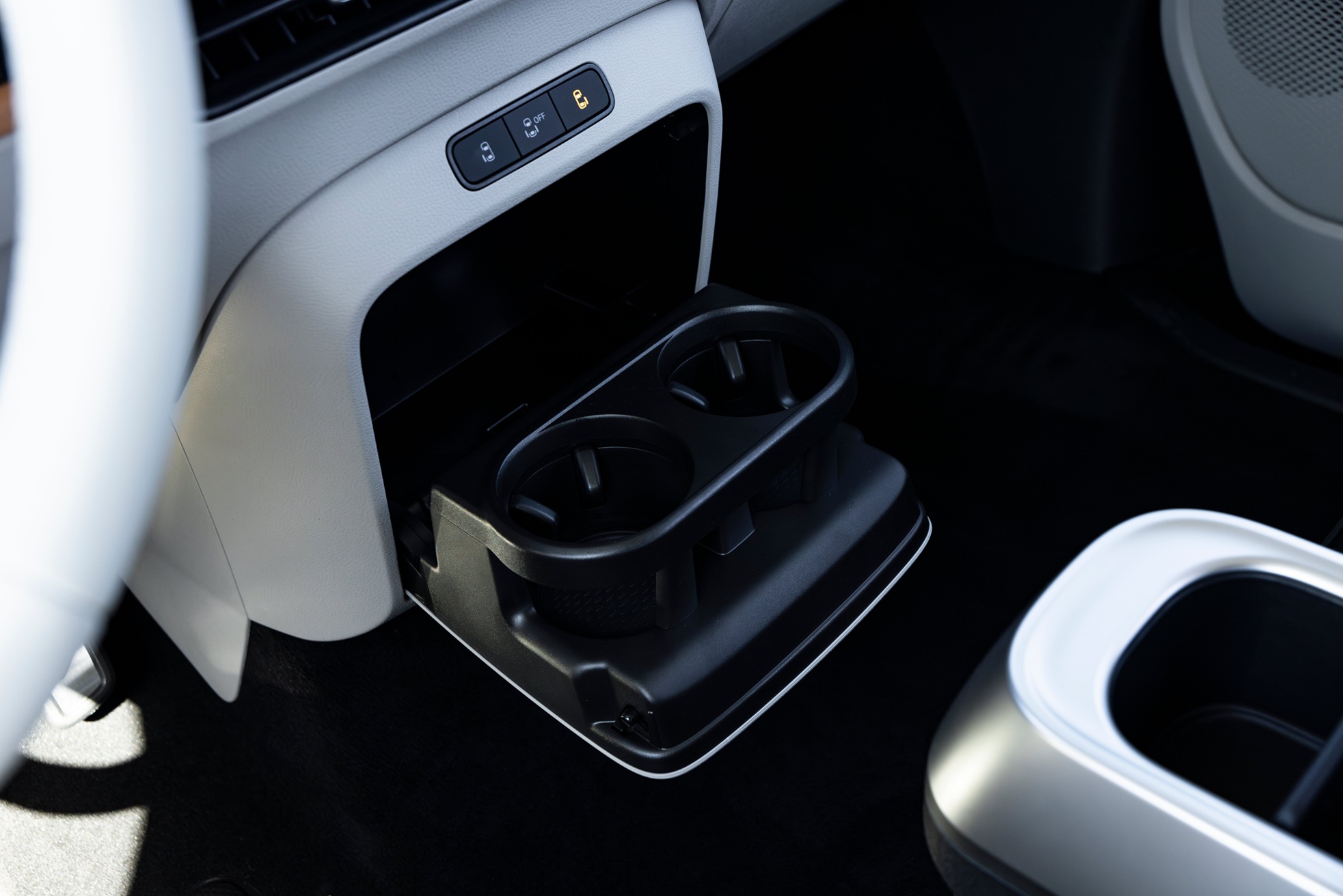
Dual drop-down front cup holders.
Interior Function
The cabin features an open design with clean lines and colors, showcasing a distinct European influence.
Front legroom of 37.5 inches might be a little short for the very tall. But the Buzz has the best second and third row legroom of any minivan or SUV: 39.9 inches in the second row and 42.4 inches in the third row.
All Buzz models have 12-way power driver and passenger seats. Each seat features dual armrests, thigh extensions, ventilation, massage, and memory functions. Second-row window seats are heated.
VW uses a unique driver armrest window switch to operate four windows. A “Rear” switch toggles between front and rear window controls. Once you figure it out, it is efficient.
VW’s ID Cockpit is a digital driver info display, replacing the traditional instrument cluster. The screen is attached to the steering column, ensuring it is always within line of sight. The display shows state of charge, range, and driving data. When mapping navigation is used, the route is displayed.
Wireless App-Connect and wireless charging are standard. The 15-watt ventilated Qi charging slot is just to the right of the steering wheel. In the nook, there are two charging USBs.
There is also a 110-volt/150-watt outlet under the passenger seat and a 12-volt power port in the cargo area.
A pair of large cup holders folds out from the lower dashboard area.
A nine-speaker audio system is standard. However, Pro S Plus and 1st Edition models upgrade to a 14-speaker, 700-watt Harman Kardon system.
The semi-floating 12.9-inch infotainment display is an iPad-like screen that controls entertainment, driver-assistance systems, and vehicle settings. Illuminated touch sliders that adjust volume and temperature are a departure from individual volume or tuning buttons; however, the sliders work well. To keep eyes on the road, the voice-recognition system is responsive to adjust the climate or audio volume. It functions well even when windows are open or the fan is blowing.
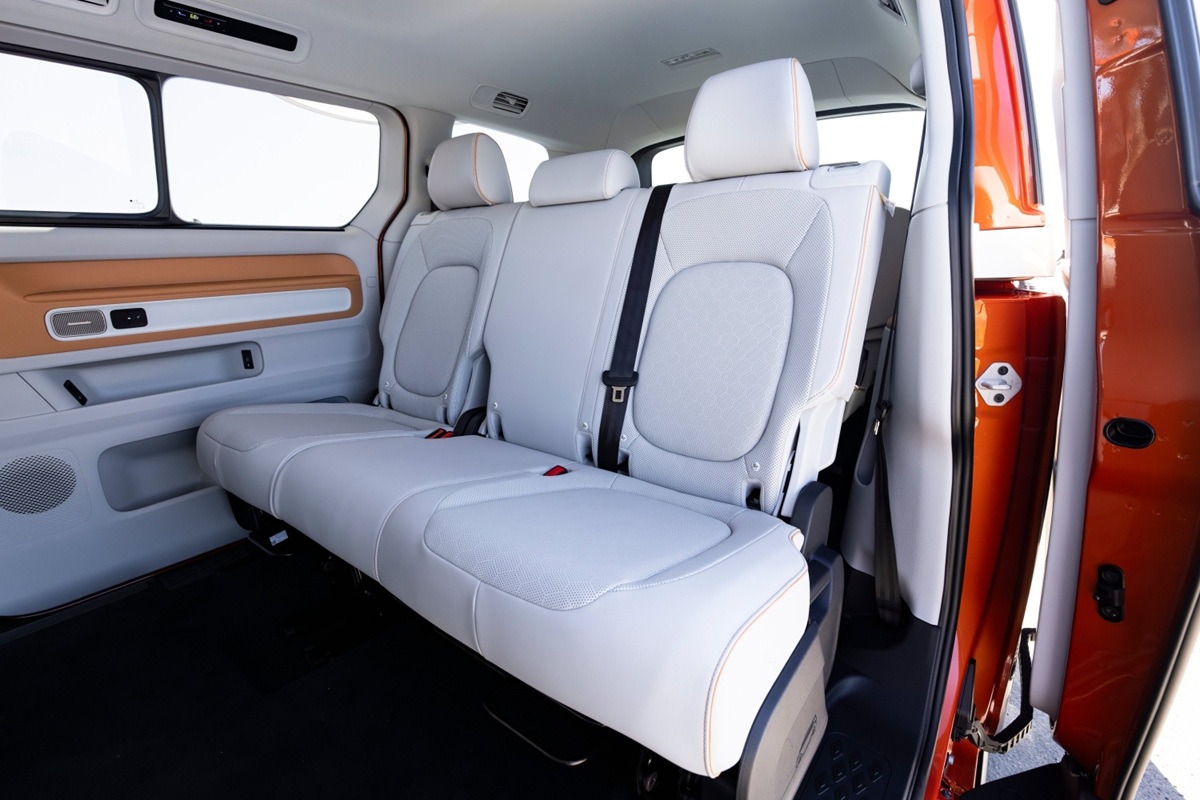
Second row captain’s chairs or the three-person bench seatback can be folded flat or split 40/60.
7 seats or 6?
Rear-wheel-drive models feature a second-row bench seat that accommodates up to seven passengers. The second-row bench can be folded flat in a 60/40 split, and the seatbacks can be reclined by 16 degrees. The bench can also be moved fore and aft by up to 7.9 inches. For third-row access, the bench window seats tilt and slide forward 4.7 inches.
Pro S Plus rear-wheel-drive models can be optioned with a second-row captain’s chair. The six-seat configuration is standard with 4Motion AWD.
Buzz models have standard child-seat (LATCH) anchors and tethers on second- and third-row seats.
Third-row seats slide fore and aft, recline, fold flat, and are individually removable. However, the seats are heavy and somewhat awkward to put back in place.
Pro S Plus and 1st Edition models include a cargo area “Flexboard” to create flat floor space when seatbacks are folded. Especially nice are two fabric storage bins that slot beneath it. Folding both rows of seatbacks, however, does not create contiguous sleeping space. There is a gap between the rows.
The third row is passenger accommodating with overhead air vents! And the pair of seats has fore-aft slide adjustment.
Cargo volume is 18.6 cubic feet behind the third row, 75.5 cubic feet behind the second row, and a massive 145.5 cubic feet with the second row seats folded and the third row removed.
Pro S Plus models feature a manually retractable tow hitch, which is completely hidden behind the rear bumper when retracted. With a braked trailer, the towing capacity is a maximum of 2,600 pounds on RWD or 3,500 pounds on 4Motion.
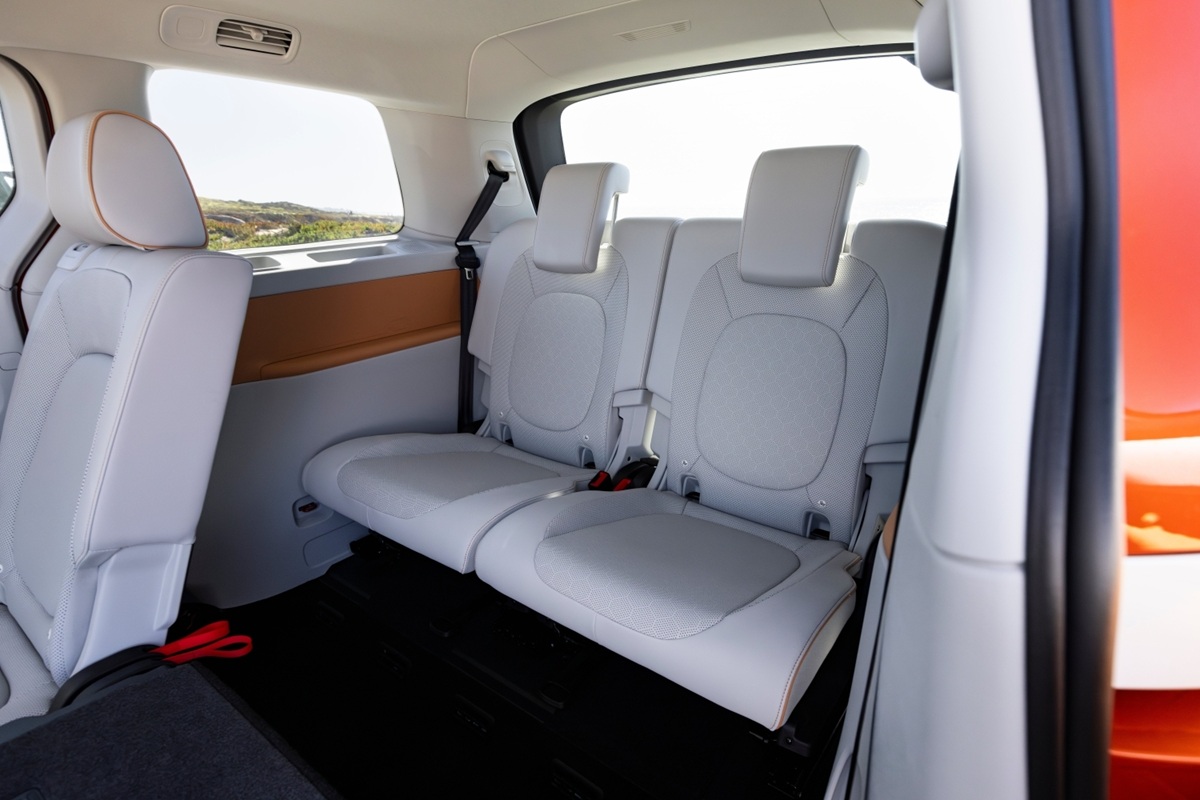
The Buzz has more third-row legroom than any SUV or traditional minivan, 42.4 inches
Buzz Safety Tech
Along with six airbags, there is a trove of safety and driver-assistance technologies. Among them:
- Adaptive Cruise Control with stop and go;
- IQ Drive with Travel Assist engages hands-on semi-automated driving assistance;
- Park Assist Plus with Memory Parking;
- Park Assist Plus with Memory Parking and Park Distance Control, front and rear;
- Rear View Camera System with an overhead view and guidelines;
- Active Blind Spot Monitor with rear traffic alert and exit warning;
- Adaptive Front Lighting System with cornering lights;
- Road Sign Recognition Display;
- Front Assist Automatic Emergency Braking with pedestrian and cyclist monitoring;
- Light Assist (high beam headlight control.
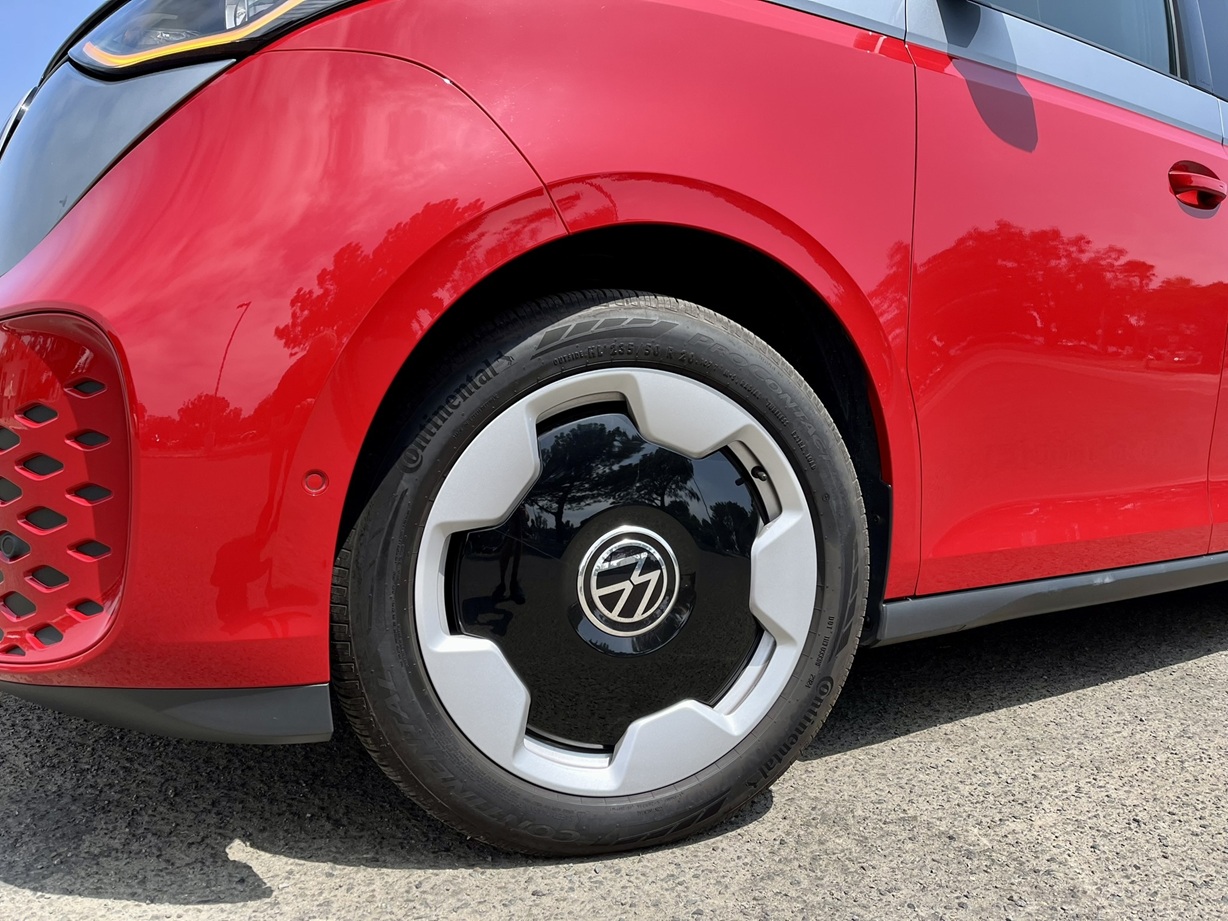
20-inch Continental ProContact tires are optimized for low rolling resistance. (Mark Maynard)
Buzz Battery Electric Powertrain
Just as the original Type 2 Bus was rear-wheel drive, the Buzz has a standard rear-mounted motor. The new APP550 rear-mounted motor is a PMS (permanent magnet synchronous) design producing 282 horsepower and 413 foot-pounds of torque. It is a VW-engineered module integrated into the rear axle, featuring a dual-stage one-speed gearbox and a pulse inverter. (The inverter converts direct current (DC) from the battery into alternating current (AC) to drive the electric motor.)
Volkswagen says the efficiency of its permanent magnet synchronous motor is “well above 90 percent in almost all driving situations.” During the manufacturing process, Volkswagen uses so-called hairpin winding. The stator’s coils are made from square copper wires, which, after bending, are visually similar to hairpins. This hairpin winding technique enables the wires to be packed more tightly. And by adding more copper to the stator, VW claims, power and torque are increased, while cooling efficiency is improved.
All-wheel-drive models add a front asynchronous motor (AKA150). It produces 107 hp and 99 lb.-ft. of torque. The combined system power of 335 hp and total torque of 512 lb.ft. provides astonishing launch force.
Top speed of the ID Buzz is electronically limited to 99 mph.
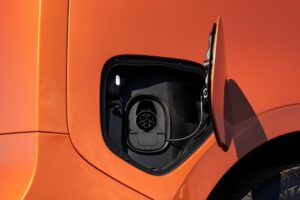
The ID Buzz charging port has a CCS plug connector for use at DC fast-charging stations.
Unlike a traditional all-wheel-drive system, there are no mechanical links between the axles. Each motor connects to the wheels through a differential and a single-speed gearbox.
The variable 4Motion all-wheel-drive system engages the rear motor for most driving situations. The system will engage the front motor only as needed, such as to control wheelspin at any corner. The motors can react within a few hundredths of a second before the driver can notice the change.
Buzz Performance Modes
The ID Buzz features four driving performance modes that adjust steering weight, throttle response, and electric drive motor settings.
Eco mode tempers throttle response.
Comfort mode is the traditional Normal performance.
Sport mode sharpens steering and throttle response. On all-wheel-drive models, the front motor stays engaged for maximum power.
Custom mode allows a driver to blend between Comfort and Sport.
All-wheel-drive models also offer Traction mode, which engages when driving on loose or slippery surfaces and also activates permanent all-wheel drive up to approximately 12 mph.
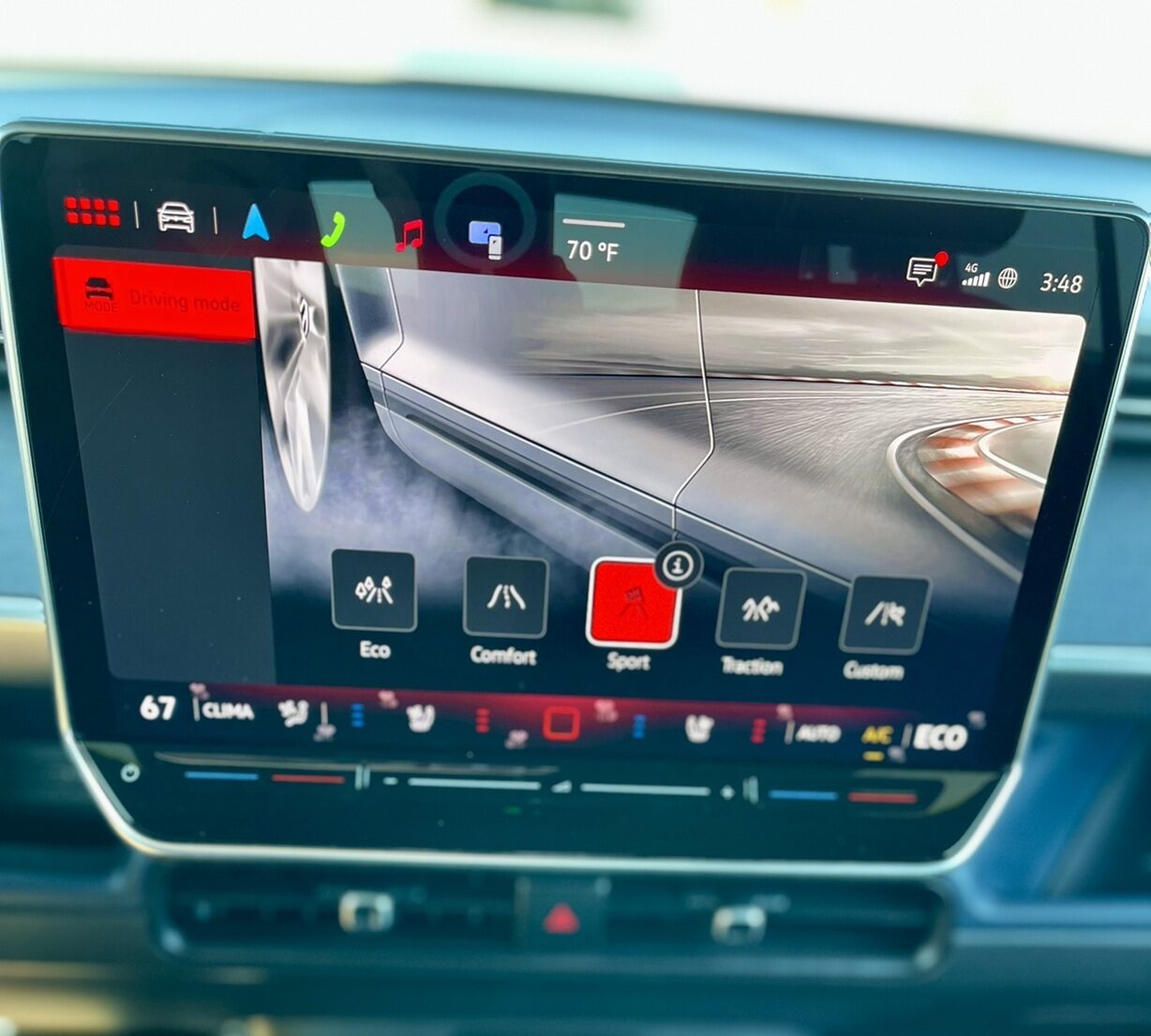
The ID Buzz has four performance modes, including Sport. (Mark Maynard)
Battery Technologies and Range
All current ID Buzz models utilize the same 91 kWh lithium-ion battery pack, comprising 208 prismatic cells. The battery pack weighs 1,230 pounds. The pack is mounted in a “skateboard” style on the Buzz floor.
Rear-drive Buzz models have an EPA-estimated range of 234 miles on a full charge. That range translates to fuel economy of 90 MPGe city, 75 MPGe highway, and 83 MPGe combined city/highway driving.
ID Buzz 4Motion models have a driving range of 231 miles and estimated fuel economy ratings of 87/74/80 MPGe (city, highway, and combined).
Volkswagen cites 0-60 mph acceleration in 7.4 seconds for rear-drive models and 6 seconds with 4Motion. Many reviewers, however, have reported achieving 60 mph in 5.7 seconds.

The loop grab handle at the side doors recall those in the vintage buses. (Mark Maynard)
Battery Charging
At DC fast-charging stations, the battery can be charged at a rate of up to 200 kW. VW says the Buzz will recharge from 10 percent to 80 percent in about 26 minutes.
A preconditioning function helps ensure the battery is prepared for the next charging stop. The battery is heated to the optimum temperature before charging stops, allowing it to accept energy at the maximum rate. VW says this function can reduce charging time by several minutes, particularly in winter.
When using the Electric Vehicle Route Planner, pre-conditioning is started automatically on the way to the next quick-charging station. Routes with up to 10 charging stops and 10 stopovers can be planned on a smartphone or the web portal and then transferred to the ID Buzz infotainment system.
The ID Buzz charging port features a CCS plug connector for use at DC fast-charging stations.
VW does not yet have access to the NACS charge port for use along the Tesla supercharger network. The NACS port will be available as an accessory, cost TBD.
The Buzz features an onboard 11 kW (AC) charging system, which is adequate for home and other Level 2 charging systems.
500 kWh of Free Charging
The 2025 ID Buzz includes 500 kWh of free juice at Electrify America stations, redeemable through the EA app. The plan includes three years of Electrify America’s Pass+ membership. Pass+ members use the EA app to find charging stations, receive notifications when a charger becomes available, and pay contact-free.
There are more than 900 Electrify America charging stations with around 4,000 chargers in North America. EA also provides “Plug&Charge” technology to capable vehicles. By activating this feature in the Electrify America app, owners will be able to plug in the ID Buzz, and once the connection is established, it will start charging.
Regenerative Braking
The regenerative braking system in the ID Buzz has two modes. The D (Drive) position is the default mode, automatically activates upon start-up. In this position, the car can coast whenever the driver’s foot is off the accelerator or brake pedal. As soon as the driver applies the brakes, energy recuperation is engaged, and the electric drive motor feeds power back into the battery.
The B (Brake) position on the gear shift enables the driver to increase the amount of regeneration. Drivers can use the rocker switch to change from the D position to B at any time. This function almost always recovers energy during lifting off the accelerator pedal.
However, regenerative braking will not bring the Buzz to a complete stop when lifting off the accelerator, which is a key feature for so-called one-pedal driving. Volkswagen believes the driver should always be in control.
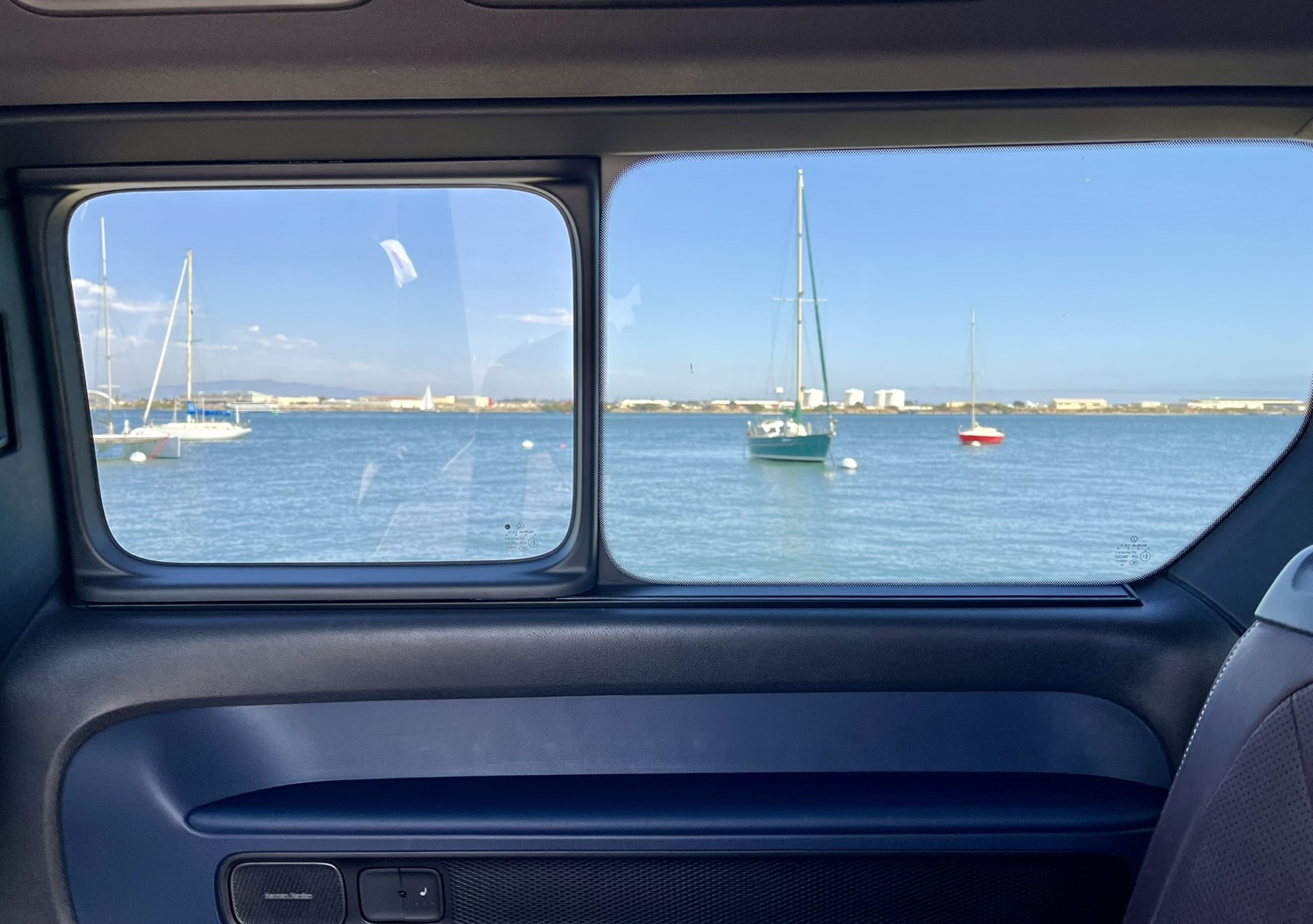
Small power side windows are reminiscent of some used in a vintage Type 2 bus. (Mark Maynard)
Buzz 4Motion Ride and Handling
The ID Buzz drives with the finesse of a gentle juggernaut. The ride on concrete interstate surfaces can be jiggly, although it is common in other big EVs. However, the suspension is impressive for how well it manages transitions of the three-ton curb weight without wallow and dive.
The well-engineered steel-spring suspension features struts at the front, coil springs, telescopic dampers, and an anti-roll bar. At the rear, a compact multi-link suspension features coil springs, telescopic dampers, and an anti-roll bar.
A combination of front disc brakes and rear drums is a departure from four-wheel discs. VW says there are friction advantages in using rear drums. Because an electric vehicle relies on regenerative braking, the rear brakes get comparatively little use. The front discs are a substantial 15 inches in diameter; the rear drums are 13 inches in diameter.
All ID Buzz models are equipped with 20-inch aluminum-alloy wheels. Aerodynamically designed disc-style wheels minimize drag losses. Smooth body sides keep the tires flush, aiding aerodynamics and resulting in a sleek drag coefficient of 0.29 Cd. That compares to the Hyundai Ioniq 9 at 0.26 or the Toyota Prius at 0.27.
Towing capacities are 1,650 pounds with unbraked trailers. Braked trailers have capacities of 2,600 pounds RWD or 3,500 pounds 4Motion.
A hidden tow hitch is tucked under the rear bumper fascia and can be released by a lever within easy reach. When finished towing, the hitch can be pushed into its hideaway position. An exposed tow hitch can add aerodynamic drag, diminishing driving range in a minuscule amount.
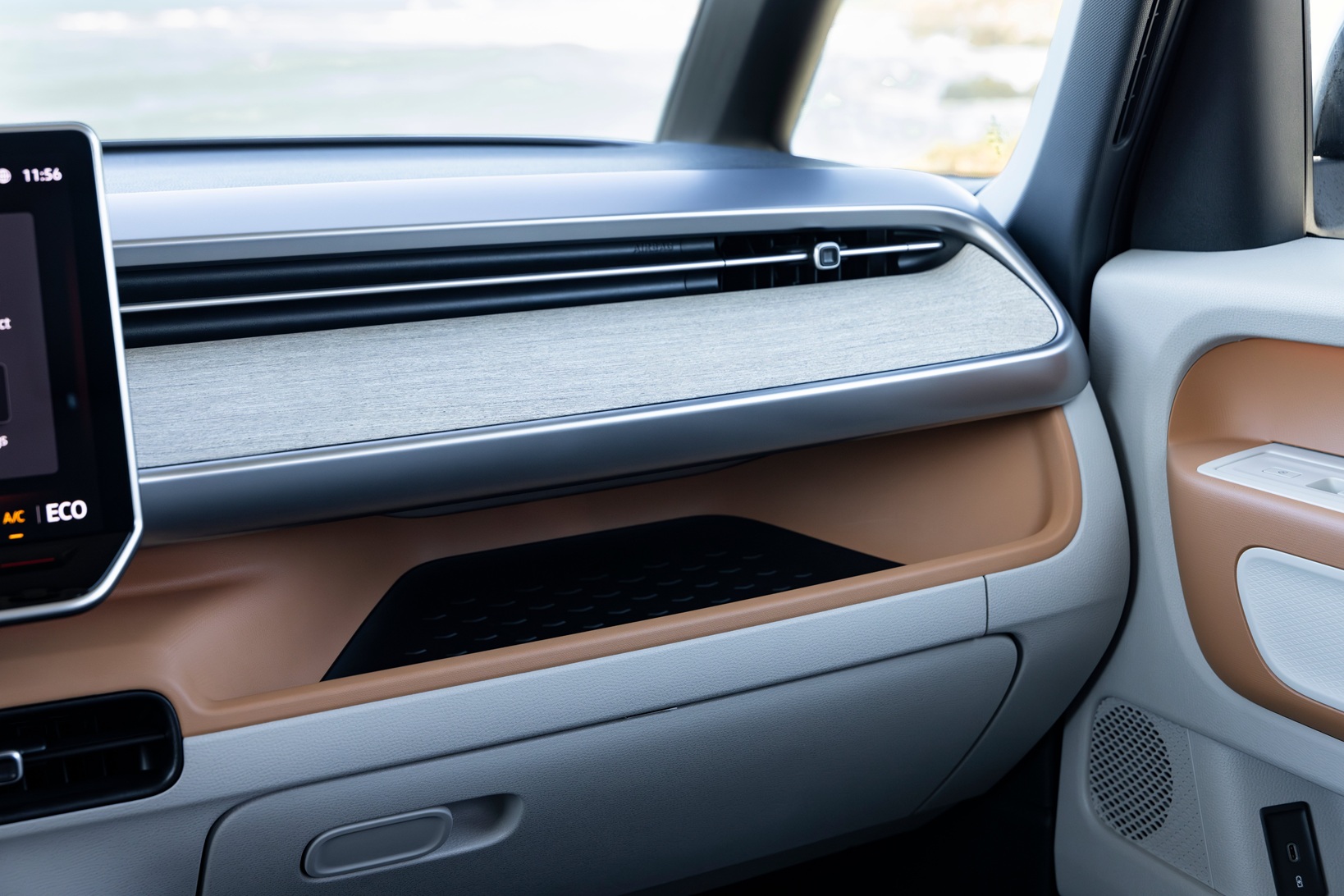
Small storage areas are notched throughout the interior.
2 Early Recalls Addressed
Volkswagen of America has fixes for a pair of unrelated recalls, according to a report in Automotive News. One recall is for third-row seating that is too wide for two passengers.
The recall halted sales of the ID Buzz in spring 2025. Sales of the electric minivan in North America began in November 2024. The stop-sale orders applied to new, unsold ID Buzz models and preowned inventory.
Under the first recall, dated April 10, 2025, the brake system warning light on the instrument panel may display an incorrect symbol and color.
VW said dealerships will perform a data container update along with a vehicle software update. The fix will take around one day to complete. The repair became available on June 6, according to a dealer communication document posted on NHTSA’s website.
Under the second recall, NHTSA stated the two-seat third-row bench is wide enough for three passengers. However, the calculated width of the seating surface exceeds the maximum specified for two passengers, according to NHTSA documents. That makes the seat noncompliant with Federal Motor Vehicle Safety Standard requirements.
VW dealerships will install fixed, unpadded trim parts to limit the width of the seating surface to two passengers.
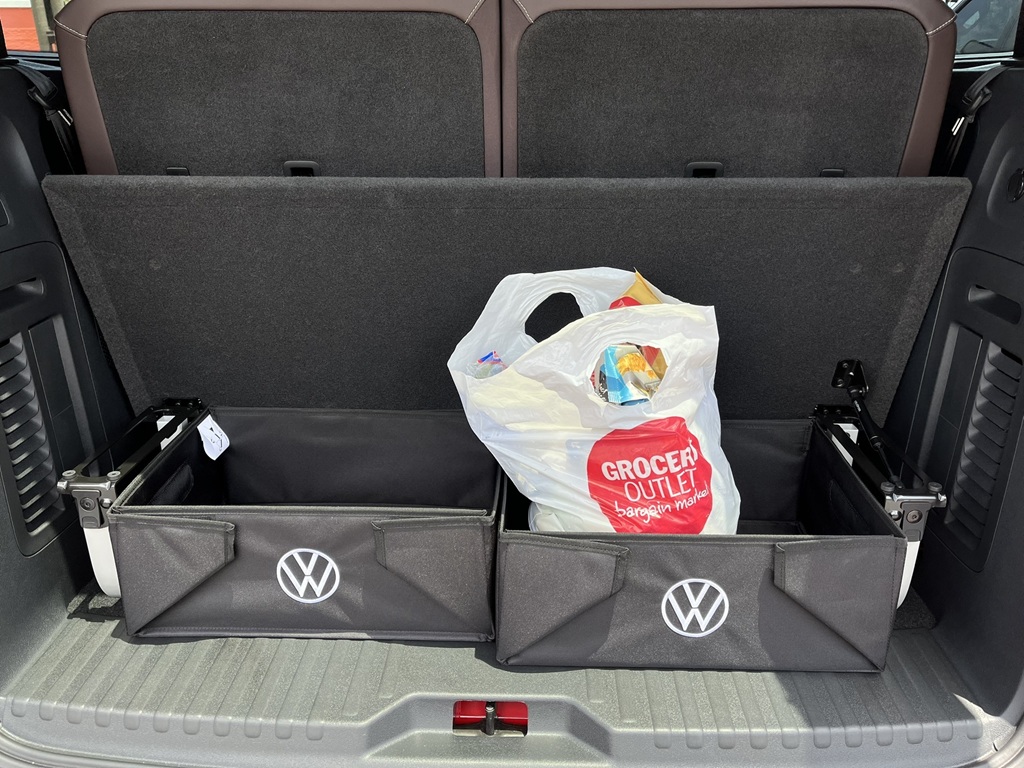
The Flexboard adjustable storage system, with two flexible bins. (Mark Maynard)
Why Buy the 2025 VW ID Buzz?
Minivans are typically family fare, but the ID Buzz seems more of a grown-up’s reward. Minivan owners who are out of the child-rearing years often keep the old, kid-worn van. It is handy for hauling junk and stuff, it’s paid for, and minivans are the ideal people mover. There might also be some emotional attachment.
The ID Buzz will be the adult ride for a night out with a bestie couple or a couple’s weekend getaway. Plus, a new Buzz will be clean, and children will always jump for a ride in the new “cool” minivan. Just keep your feet off the seats, and no eating or drinking!
Before dismissing the ID Buzz due to pundits’ criticisms, give it a fair evaluation.
Yes, it is expensive, but it is also a large vehicle, and for those with a home battery charger, the range is a non-issue. I’d rather drive the electric Buzz on a long, daily commute than a $35,000 fuel-miser econobox. The Buzz feels safe and secure, and its size matters when hustling along among semi-trucks and other large vehicles.
When seeking a dealership test drive, ask for an overnight experience. Give yourself time to get comfortable with the Buzz, and you might convince yourself that $70,000 is the new $50,000.
Read here what VW ID owners say about their experience with the Buzz and other VW battery electrics
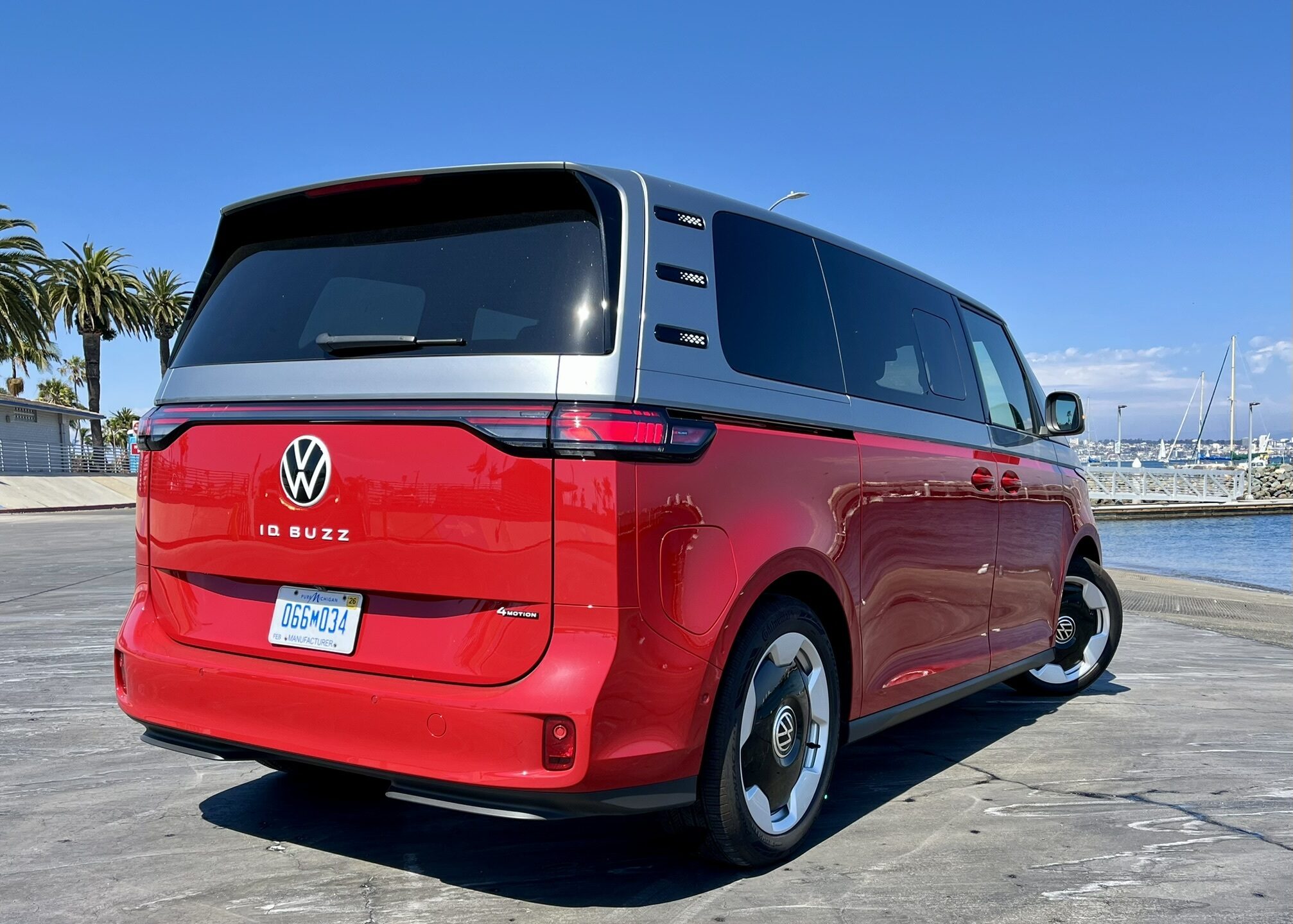
the ID Buzz has horizontally arranged LED taillights connected by a full-width light strip. (Mark Maynard)
2025 VW ID Buzz Pro S Plus 4Motion Specifications
Body style: 5-door, 6- or 7-seat AWD minivan; stamped steel panels; plastic and composite bumpers and some components
Motor: permanent magnet synchronous
Power, AWD: 335 hp, 413 lb.ft torque rear motor, 99 lb.ft. front motor; total 512 lb.-ft.
0-60 mph acceleration: 6 seconds
Battery: 91 kWh lithium ion; 208 prismatic cells
Battery weight: 1,230 pounds
Transmission: 1-speed automatic
EPA-estimated driving range: 231 miles
Fuel economy equivalent, MPGe: 87/74/80 city/hwy/combined
Onboard charger: 11 kW
CHARGING TIMES
Public DC fast charger: Recharged range in 10 minutes 79 miles
15 hours 7.2 kW AC, 0-100 percent, home or public station.
11 hours 9.6 kW, 0-100 percent, home or public station
9 hours: 11 kW charging, 0-100 percent, home or public station,
BY THE NUMBERS
Cargo space: 18.6 to 75.5 feet (behind third row and with second row folded)
Front head/leg room: 42*/37.5 inches; *40.6 in. w/o sunroof
2nd row head/leg room: 42.3*/39.9 inches; *41 inches w/o sunroof
3rd row head/leg room: 38.7/42.4 inches
Length/wheelbase: 195.4/127.5 inches
Width/height: 87*/76.2 inches; *78.1 inches w/mirrors folded
Curb weight: 6,197 pounds
Turning circle: 43 feet (37 feet with RWD)
Towing capacities: 1,650 pounds unbraked trailer; 3,500 lbs. braked
Drag coefficient: 0.29 Cd
FEATURES
Standard Buzz Pro S Plus interior equipment includes: 2nd-row manual “Captain’s Chair” bucket seats (folds flat with armrests and tip and slide 3rd-row access), 30-color ambient interior lighting, fold-down front-seat armrests, Flexboard cargo area adjustable storage system, footwell lights in front and 2nd rows, 12-way power adjustable front seats with 4-way lumbar and position memory, heated and ventilated front seats with massage function, heated multi-function steering wheel with hands-on detection and touch controls, illuminated vanity mirrors, LED reading lights, leatherette door trim inserts, perforated V-Tex leatherette upholstery, power sliding side doors, power sliding 2nd row windows, removable center console with storage.
Exterior features include: heated windshield, illuminated light lines (including front emblem and door handles), LED taillights and LED rear license plate lighting, LED Projector headlights with signature LED daytime running lights, spare tire mobility kit.
CHASSIS COMPONENTS
Brakes: Power assisted, dual circuit; 15-inch vented front rotors; rear drums, 13 inches
Steering: Electric rack-and-pinion; 36.4-foot turning circle, RWD; 42.7 feet 4Motion
Tires-wheels: 20-inch, all-season Continental ProContact; front HL 235/50 R20, rear HL 265/45
Suspension: front MacPherson strut-type with lower control arm, coil springs, telescopic dampers, anti-roll bar; rear, multi-link axle with coil springs, telescopic dampers, anti-roll bar
PRICING
Base Pro S Plus 4Motion price: $69,545, including $1,550 freight charge; price as tested $70,760
Options on test vehicle: Two-tone paint $995; three rows of floor mats $220
Where assembled: Hanover, Germany
WARRANTIES
- 4-years/50,000-miles bumper to bumper including high voltage system; 8-years/100,000-miles high-voltage battery
- Roadside assistance: 3-years/36,000-miles
- Scheduled Carefree Maintenance: first two years, at 10,000 and 20,000 miles.
- Connected-vehicle service coverage:
- Vehicle Insights 7-year plan, includes: high-voltage battery charge settings, maintenance alerts;
- Remote Access 3-year plan, includes: start-stop charging and find charging stations
- Safe & Secure 5-year plan, includes: automatic crash notifications, emergency call;
- Plus Speech with AI 3-year plan, includes: voice control of certain features using more natural language with the help of Generative AI;
- Plus Nav 3-year plan, includes: continuously updated route and traffic information. Details at vw.com/connected.