Select Page

2020 Toyota Avalon Hybrid Review

2020 Toyota Avalon Hybrid Review

Looking Sharp at 48.2 mpg

A dark blue Avalon along a boat ramp in San Diego, Calif.

The 2020 Avalon Hybrid is sold in three front-wheel drive trim levels with starting prices of $37,955 to $44,255. The Parisian Blue tester was $43,011. (Photography by Mark Maynard)

BY MARK MAYNARD

As gasoline prices roll upward despite the ongoing pandemic, drivers in need of new transportation begin seeing green. First, it’s the green of money flowing into the tank, and then wondering if the green of hybrid energy could actually help save the green from exiting the exhaust pipe. It is a complex value equation.

It has always been a point of frustration for me when I am not able to achieve the fuel economy that the EPA and manufacturers say I should be getting in whatever vehicle I’m testing. Occasionally I can achieve the combined city/highway rating, but seldom have I ever met the city and highway ratings separately.

A black and light gray front seat area

The Avalon’s wider body has a broad coupe-like feel to the cabin.

On mileage runs, I apply a cheat sheet of frugal driving techniques. I will dutifully set the cruise to the speed limit or a couple notches above to not be the laggard in the lane. I will be gentle with the gas pedal, but daily driving sometimes requires otherwise and those heavy-acceleration moments must be factored and forgiven.

I typically drive a couple hundred miles in a week’s evaluation and I note the mileage variances through the onboard computer.

The driver area and steering wheel of the Avalon Hybrid

The driver area has enough width for smart placement of switches, gauges, and controls.

The Avalon Hybrid, powered by Toyota’s 2.5-liter four-cylinder and dual motor generators, has EPA fuel economy ratings of 43 mpg city, 43 highway, and 43 combined.

On a mileage run in a 2020 Avalon Hybrid XSE, I left the house with an average mileage rating of 38.5 mpg, which certainly isn’t bad for a large-midsize sedan such as the Avalon.

Front passenger entry to the Avalon

There is near-Lexus refinement to the cabin materials.

In just a few miles the average had clicked upward to 40-plus mpg. Soon it advanced to 43 mpg and then on to 45 mpg. I kept driving just to see where it might stop. After running out of time and highway, the counter had turned to 48.2 mpg. And it might have gone higher were I using the Eco mode. But I noticed that above 70 mph, the wind resistance caused diminishing returns.

I have experienced mileage ratings approaching 50 mpg and higher, but that is typically in smaller hybrids or a plug-in hybrid. Clicking off 48.2 mpg seemed an impressive feat and an invitation to consider this large sedan as a daily commuter. With its 13.2-gallon tank, the cruising range could be close to 600 miles, which for the hyper-commuter would mean possibly just one midweek fill-up.

And with all of the Avalon’s safety equipment and driver-assist technologies, it is a much more rewarding — and comfortable — experience than having to sacrifice vehicle size for mileage.

 2020 Avalon Hybrid Pricing

The 2020 Avalon Hybrid is sold in three front-wheel drive trim levels with starting prices ranging from $37,955 for the XLE, $40,455 for the XSE (today’s tester), and $44,255 for the Limited; pricing includes the $955 freight charge. (AWD is not available.)

The XSE tester was $43,011, including the biggest extra of $1,720 for the JBL premium audio system with 14 speakers and a 9-inch infotainment touchscreen. Standard XSE equipment includes eight-way power-adjusted front seats (heated) with driver lumbar, smart key locking with push-button ignition, electric parking brake, a rearview camera with guidance lines, and wireless phone charging.

Find Toyota customer incentives here. As a Customer Support Program, the first payment can be deferred for 90 Days. Currently offered are a zero percent APR for 60 months (for buyers with Tier 1 credit ratings) or a $2,500 cash-back offer, also available for gas Avalons.

A view of the gasoline-electric engine

Toyota’s hybrid powertrain of a 2.5-liter four-cylinder and dual motor generators has EPA fuel economy ratings of 43 mpg city, 43 highway and 43 combined.

No Greenie-Weenie

There was a refreshing independence to the styling of the test car in its handsome Parisian Night Pearl paint (dark blue), gray Softex (leatherlike) Ultrasuede upholstery, and glossy graphite-gray 18-inch painted alloy wheels. The interior approaches Lexus refinement in the quality of materials and tasteful design.

It did not scream, “I’m a greenie-weenie driving a hybrid. Look at what I do for planet Earth.” Actually, I was surprised when men, mostly, stopped for a longer look. The mouthy grille is a choke point for some, but the “Godfather” cheeks are becoming ubiquitous; blame European pedestrian safety standards to create a front end that is less scythe-like. But drivers will always know the Toyota or Lexus or BMW when it pulls up behind.

The 18-inch Bridgestone Turanza EL440 touring tires have a protective lip to help guard against wheel scrapes.

18-inch Bridgestone Turanza EL440 touring tires.

2019 Avalon Redesign

The fifth-generation Avalon was redesigned completely last year. Toyota says the styling “embodies consumers’ overarching desire for high-caliber, design-centric, technologically-savvy modes of attainable, premium transportation.”

The large-midsize Avalon is designed and built in the U.S. The interior and exterior design makeover was done at Calty Design Research in Ann Arbor, Mich. Engineering work was done at Toyota’s R&D center in Saline, Mich. And production is in Georgetown, Ky.

Body Lines

Based on the Toyota New Global Architecture, the redesigned Avalon is slightly lower, wider, and longer than before, with some new steel stamping methods to get the sharp angles for the more sculpted body panels. You can see the precision in the door handles, Toyota says, and how they integrate with a distinct character line and in the lower body line at the front wheels.

The rear cabin was extended 7 inches with an elongated, downward-tapered quarter side glass. The 0.31-inch corner angle is the tightest ever for Toyota.

The roofline of the body is lower by 1 inch (now at 56.5 inches). The cowl (dashboard area) was lowered a little more than an inch and the rear deck by about ¾ of an inch. Overall width is up by 0.8 inch, now at to 72.8 inches, and the wheelbase is 2 inches longer, now at 113 inches.

A rear three quarter view of the Avalon at a boat launch

The redesigned Avalon is slightly lower, wider, and longer than before.

Elbow Room

The cabin is well-soundproofed, so there is not much engine noise at highway speeds. And because the cabin is so well soundproofed, there is some texture and hardness from the Bridgestone Turanza EL440 (235/45) all-season tires. But their sidewall design includes a lip as a slight protection against curb damage.

The wider and lower body has a broad coupe-like feel to the cabin. And despite the lower roofline, the front headroom is the same at 38.5 inches without the sunroof or 37.4 with it.

There is enough cabin space that driver sightlines are unhindered forward, side, or back. And there is the smart placement of controls, switches, and screens.

Back seat legroom is an asset, with 40.4 inches to stretch out. The seats have adult-class thigh support, a comfortable seatback angle, a padded fold-down armrest with can holders, and two USB charging ports.

The back seat is adult-class with 40 inches of legroom and a comfortable seatback angle.

The back seat is adult-class with 40 inches of legroom and a comfortable seatback angle.

The Hybrid Powertrain

The turbocharged, four-cylinder powertrain pulls like a six-cylinder in most situations, but forceful acceleration is thin above 65 mph.

Toyota’s hybrid system is so efficient it makes a traditional internal-combustion engine seem like an underachiever. It uses two permanent magnet motor generators to power the hybrid system. Motor Generator 1 functions as the engine starter and charges the hybrid battery (max. voltage AC 650-volt) MG-2 drives the front wheels and supplies regeneration during braking (88 kW).

The nickel-metal hydride battery isn’t as high-tech as the more energy-dense lithium-ion battery, but it’s not as expensive to replace, either. And Toyota now warrantees its hybrid battery for 10 years from date of first use to 150,000 miles, whichever comes first. All other hybrid components are covered for 8 years or 100,000 miles.

The electronically controlled continuously variable transmission functions without any of the typical rubber-banding as the turbo and transmission catch up and connect. There is no delay of forward motion. There are drive modes of Eco, Normal and Sport, but my mileage count was done in Normal mode and when I needed some extra kick to hold my line in traffic, Sport sharpens acceleration without being wildly aggressive.

There is a refined roll to the steering wheel and absolute stopping force, without grabbiness, from the regenerative braking system, with 12-inch ventilated front rotors and 11-inch solid rotors rear.

A mileage readout of 48.2 mpg

48.2 mpg, and more might be possible.

Safety Ratings and Features

The Avalon earns a safety rating of Top Safety Pick-Plus by the Insurance Institute of Highway Safety and an overall top five stars from the National Highway Traffic Safety Administration.

Standard safety features include 10 airbags, a blind-spot monitor with cross-traffic alert, and Toyota Safety Sense P, which includes a pre-collision system with pedestrian detection, lane-departure alert with steering assist, automatic high beams, and full-speed range dynamic radar cruise control.

Why Buy the 2020 Toyota Avalon Hybrid?

The Avalon is, essentially, a longer and bolder version of the Camry, which shares the same hybrid powertrain. But the 3.8-inch longer Avalon feels more substantial and has a much roomier back seat with 2 inches more legroom.

The Avalon costs about $10,000 more than a Camry Hybrid, but there is value in how quietly and confidently it feels protective in a turbulent world.

A view of the Avalon's 16 cubic foot trunk space

With 16 cubic feet of trunk space, there is plenty of luggage capacity for a weekend getaway with friends.

2020 Toyota Avalon Hybrid XSE Specifications


Body style: large midsize, 5-passenger, front-drive sedan

Engine: 176-hp, direct-injection 2.5-liter 4-cylinder; 163 lb.-ft. torque from 4,600-5,200 rpm


Hybrid power system: 2 permanent magnet motor generators and nickel-metal hydride battery pack


Voltage: 244.8 volts; 204 cells, 1.2-volts per cell)


Total system power: 215-hp


Transmission: Electronically controlled Continuously Variable Transmission (ECVT) with sequential shift mode


Fuel economy: 43/43/43 mpg city/hwy/combined; 87 or higher octane

BY THE NUMBERS

Fuel tank: 13.2 gal.


Trunk space: 16 cu. ft.


Front head/leg room: 38.5*42.1/ in. *37.4 in. w/moonroof


Rear head/leg room: 37.9/40.4 in


Length/wheelbase: 195.9/113 in.


Width/height: 72.8/56.6


Curb weight: 3,671 lbs. (3,704 lbs. Touring)


Turning circle: 38.7 ft.

AVALON FEATURES

Standard equipment includes: smart key entry with push-button ignition, Softex and Ultrasuede front seats, heated front seats, 8-way power front seats with driver lumbar, wireless charging, electric parking brake, 18-inch gray-painted alloy wheels with 235/45 Bridgestone Turanza EL440 all-season tires, rearview camera with guidance lines, 9-inch infotainment touch screen, 6-speaker audio system, Bluetooth phone and music, 4 USB charge ports


Safety features include: 10 air bags, stability and traction controls, blind-spot monitor with cross-traffic alert, hill-start assist, brake assist and Toyota Safety Sense P, includes precollision system with pedestrian detection, lane-departure alert with steering assist, automatic high beams, full speed range dynamic radar cruise control

AVALON PRICING

Base XSE price: $40,455, including $955 freight charge; price as tested $43,011


Options on test vehicle: Preferred accessory package, $377, includes carpeted floor mats, trunk mat, cargo tote and rear bumper applique


Where assembled: Georgetown, Ky.


Warranty: 3-years/36,000-miles bumper to bumper with 2 years free scheduled maintenance; 5-years/60,000-miles powertrain

A side view of the deep blue Avalon Hybrid with the marina office in the background

Toyota Avalon safety features include 10 air bags and Toyota Safety Sense P, with precollision system, pedestrian detection, and lane-departure alert with steering assist.
 

2021 Kia K5 First Look

2021 Kia K5 First Look

As the replacement for the Optima, the new Kia K5 sedan is a midsize ringer for Stinger

An exterior view of a blue Kia K5

Kia’s new K5 is the brand’s third-generation midsize sedan, formerly known as Optima. (Photos courtesy of Kia America)

BY MARK MAYNARD

KKia America announced June 30 via virtual media reveal that the replacement for its midsize Optima sedan will be the K5, going on sale later this summer. The fastback-styled sedan will be sold with a choice of turbocharged four-cylinder engines, eight-speed automatic transmissions and, for the first time, an option for all-wheel drive.

The K5 is such a dramatic departure [from Optima] that we had to give it a new name, said Kia’s vice president of sales Bill Peffer in the virtual reveal.

The driver area of the Kia K5 GT

The front seats are six-way manually adjustable on all models, with optional 10-way power-adjusted seats. A K5 GT is shown.

Peffer acknowledged the difficulties of bringing out a new sedan with a new name in a country dominated by new SUV choices as the world steps delicately through a coronavirus pandemic. But he is focused on the 1.5 million midsize sedans that were sold last year.

“So although this year hasn’t exactly gone the way anyone has expected, Kia is moving ahead with six new and refreshed vehicle introductions by the end of 2020,” said Peffer.

A Kia K5 steering wheel

Distinctive features include the aircraft-type shifter and a flat-bottom steering wheel.

Kia already has six SUVs from subcompact to large and has no plans to abandon sedans. The K5 is hoped to be enough of a disruptor for younger buyers to take a look.

“From our perspective, the winners in this segment will be the vehicles that stand out, demand attention and evoke emotion,” Peffer said. “What we are starting to see is that younger buyers want something different. They are not interested in driving the SUVs of their parents’ generation. Sporty, modern and bold, K5 isn’t a vehicle you buy just because it is practical. It is a vehicle you aspire to own, and drive.”

Kia has long used alpha-numeric nameplates in its Korean market, including the K9 (for the K900 large sedan in the U.S.) and the K5, which has been on sale there since late 2019. The nameplate will be used for all markets going forward, except China.

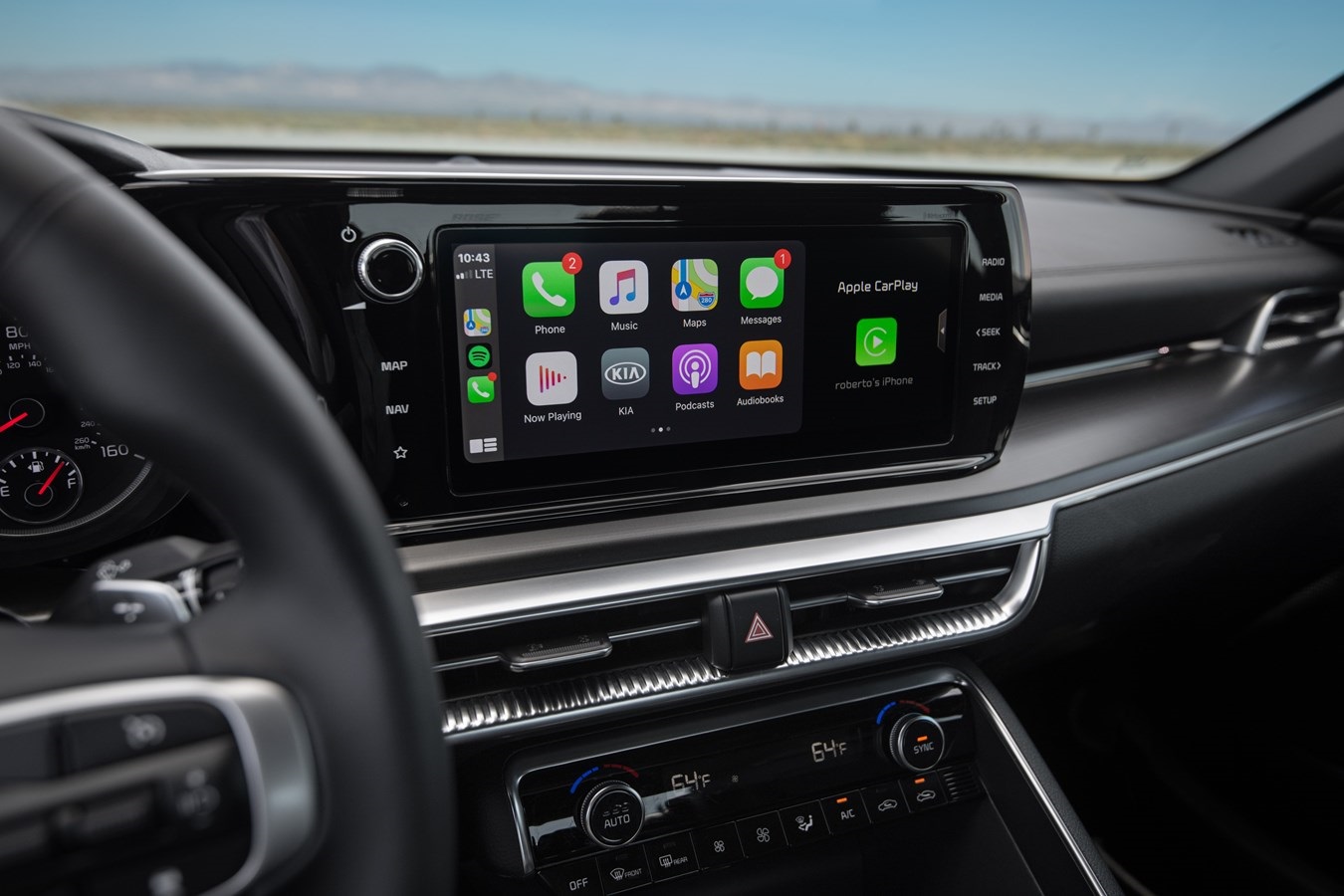
The optional infotainment touch screen in the Kia K5

The optional 10.25-inch high-resolution color touch screen features Apple CarPlay and Android Auto that connect wirelessly.

Elements and Attitude

Sold initially in four trim levels (LX, LXS, GT-Line and EX), a high-performance GT will arrive this fall.

It is built on the new “N3” platform (in its third generation), which will underpin future Kia models. The substantially stiffer architecture allowed the K5 to sit lower and wider with a reduced front overhang, lengthened wheelbase and a longer hood.

“Sporty, modern and bold, K5 isn’t a vehicle you buy just because it is practical. It is a vehicle you aspire to own, and drive.”

Bill Peffer, Kia Motors America vice president of sales.

Compared to the outgoing Optima, the K5 is 2 inches longer (193.1 inches), an inch wider (73.2 in.) with an 0.8-inch lower roofline and a wheelbase stretched 1.8 inches to 112.2 in.

K5 headroom is a little taller at 40.2 inches (without the panoramic sunroof) with long front legroom of 46.1 inches. Back seat headroom stayed the same at 37.8 inches but rear legroom was cut by 0.4 inch to 35.2 inches. Cargo capacity is slightly larger at 16 cubic feet.

2021 Kia K5 GT-Line

Built on a new N3 platform, the new model is stronger, longer, wider and lower.

Peaceful Retreat

Kia says “silence equals luxury” and wrapped the K5 in more soundproofing for a premium experience, including an acoustic laminated windshield on all models. Along with the quiet cabin, Kia offers the “Sound of Nature” ambient system, which “creates a peaceful retreat inside K5 with six calming themes.”

All models have an 8-inch or optional 10.25-inch (shown) high-resolution color touch screen with split-screen functionality. The 10.25-inch system includes server-based navigation with real-time traffic data and multi-connection Bluetooth wireless connectivity that lets two phones connect simultaneously.

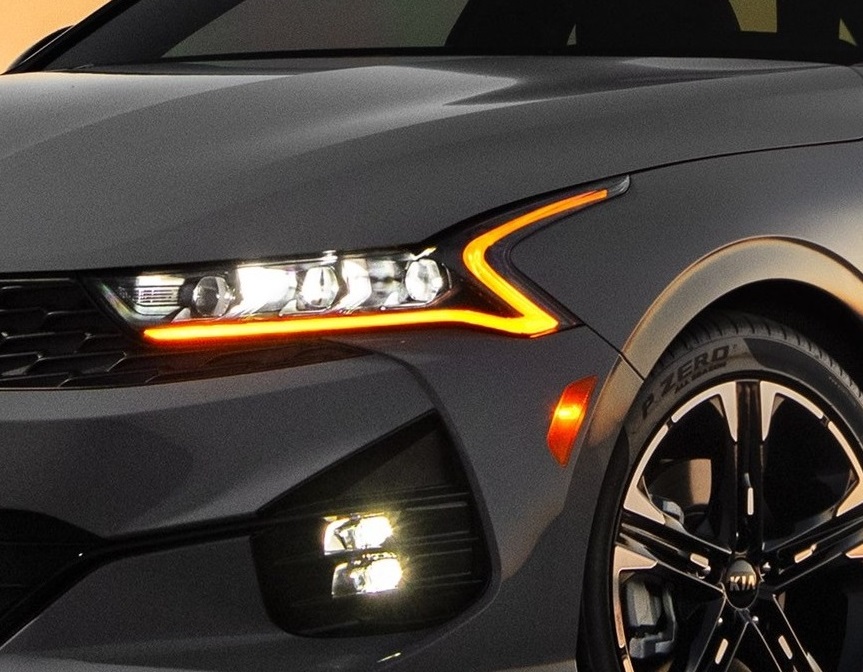
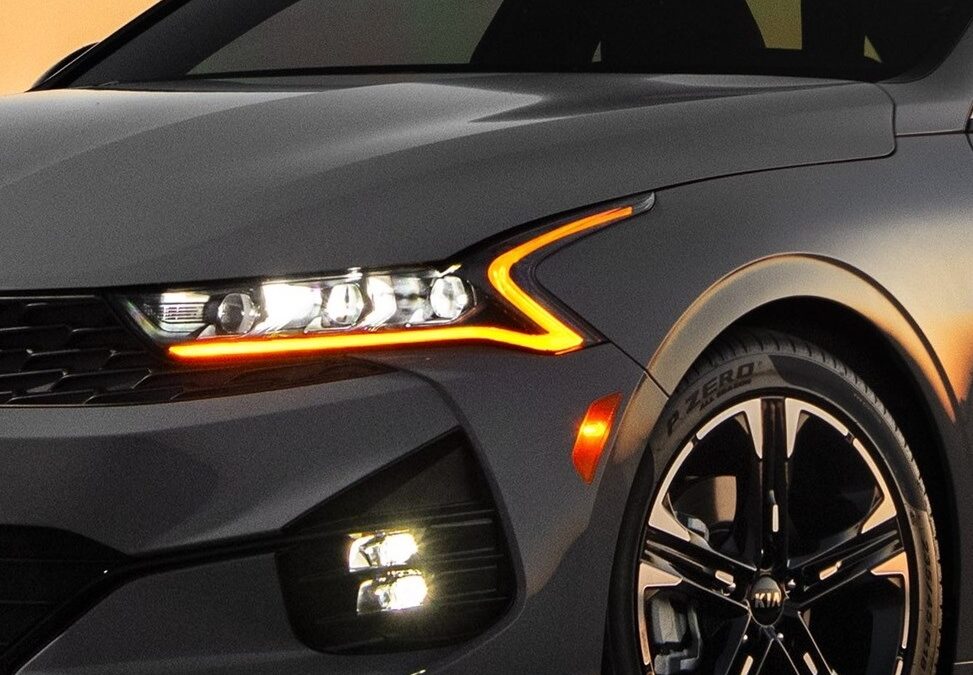
The Kia K5's “Heart Beat” daytime running lights.

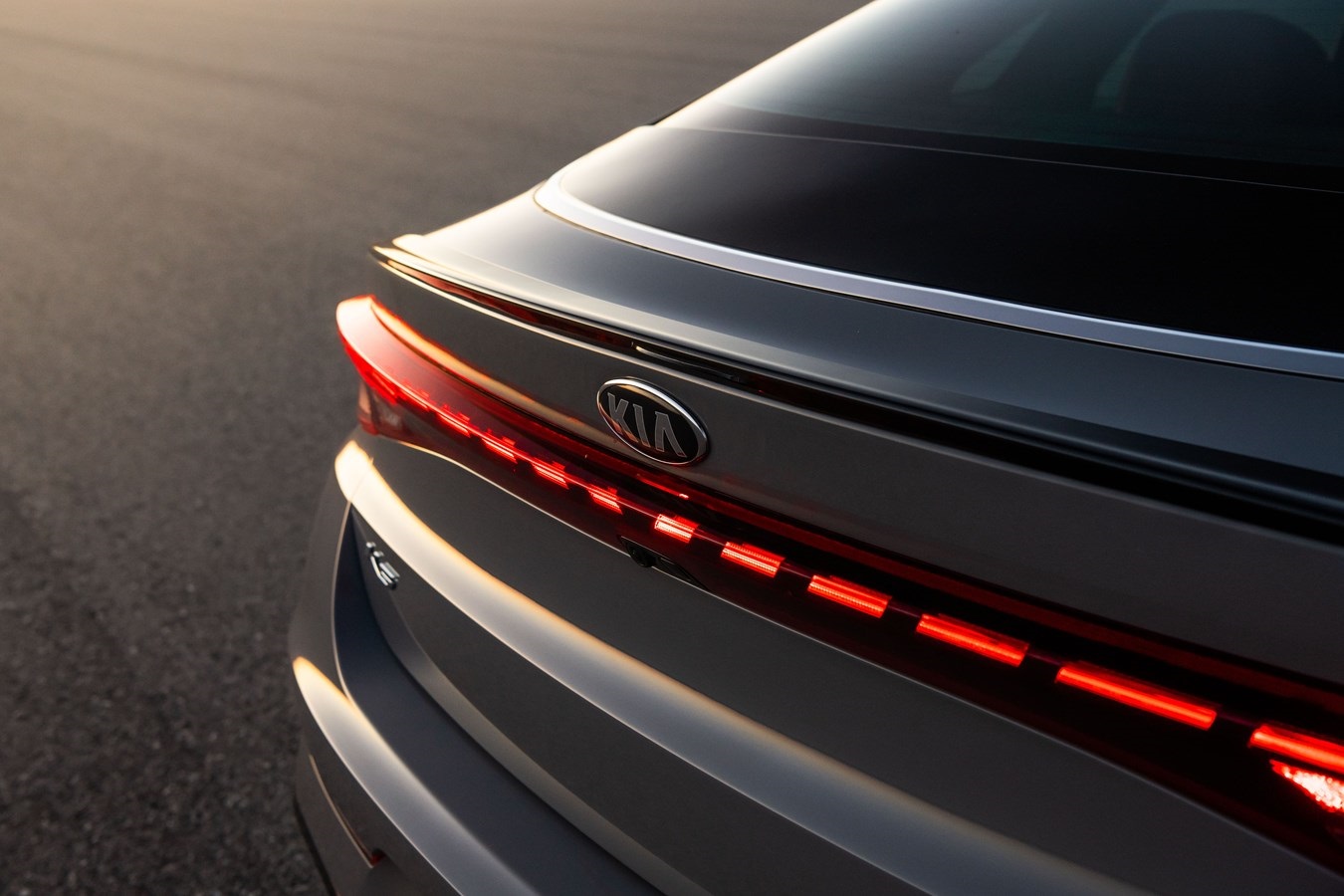
“Heart Beat” daytime running lights and LED taillight “dashes” are unique to K5.

K5 LED taillight “dashes” are unique to K5.

Kia’s UVO telematics features connected user profiles to allow different drivers to set their preferred seat position, side mirror placement and favorite radio stations.

K5 Powertrains

The standard engine is a 180-horsepower, 1.6-liter turbocharged and direct-injection four-cylinder engine producing 195 foot-pounds of torque from 1,500-4,500 rpm. The new eight-speed automatic transmission will have driver-selectable performance modes of normal, smart, sport and custom.

The optional 290-hp 2.5-liter turbocharged and direct-injection engine has 311 lb.-ft. of torque from 1,650-4.000 rpm, and will be standard with the GT. This engine is paired with a new eight-speed “wet” dual clutch (automated manual) transmission. The GT will have a Sport-plus mode for performance, making the K5 capable of 0-60 mph acceleration in 5.8 seconds, Kia says.

The K5 2.5-liter engine uses continuously variable valve duration (CVVD), an industry first. CVVD gives a performance boost and improves efficiency because of independent control of the valve duration, Kia says.

The available all-wheel-drive system, with Snow mode, will actively distribute torque between the front and rear wheels, depending on road conditions and driving situations, Kia said. Available in late 2020, the system uses electro-hydraulics for a quicker response and control of AWD coupling.

The K5 back seat in red leather

Back seat headroom stayed the same at 37.8 inches but rear legroom was cut by 0.4 inch to 35.2 inches.

K5 Fuel Economy

The base LX model with 1.6-liter engine has the top fuel economy ratings of 29/38/32 followed by the rest of the 1.6 line at 27/37/31 mpg. Mileage ratings for the GT were not available, but regular unleaded fuel is recommended for both engines.

Curb weights for front-drive models range from 3,115-3,228 pounds. GT or AWD specifications were not yet available.

All 1.6T models have four-wheel disc brakes with 12-inch ventilated rotors front and 11.2-inch sold rotors rear. The GT will have 13.6-inch ventilated front rotors and 12.8-inch sold rotors rear.

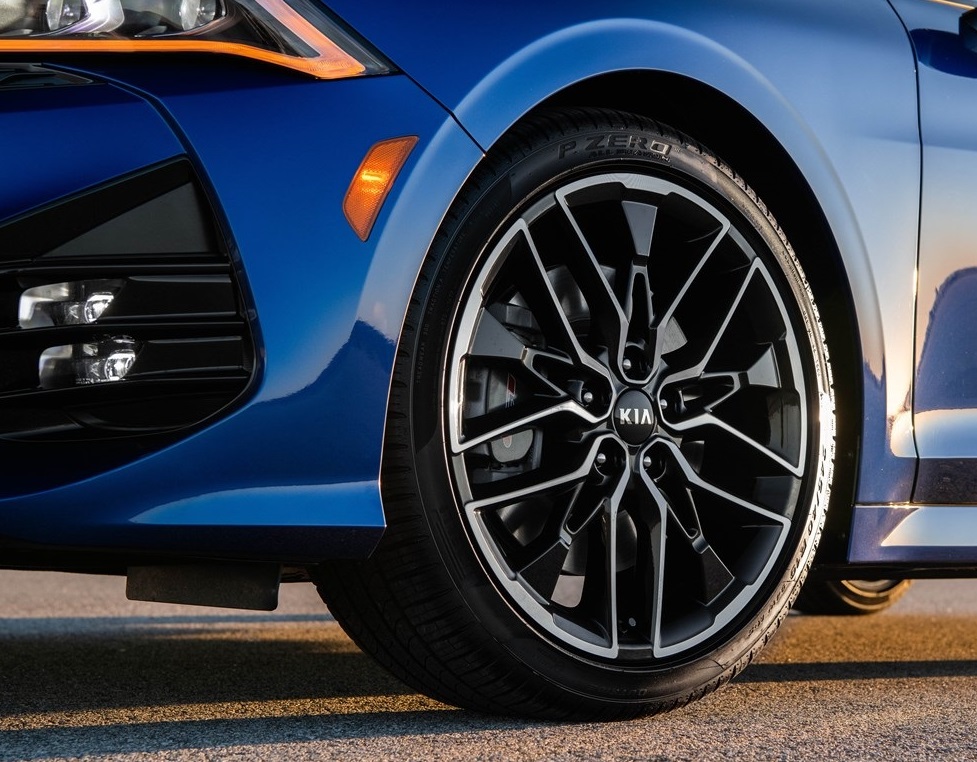
A 19-inch K5 alloy wheel

K5 has alloy wheel sizes of 16-, 18- or 19-inches.

K5 Safety Features

The “Kia Drive Wise” suite of advanced driver-assistance systems includes such standard technologies as:

Forward Collision Warning: Designed to detect a vehicle in front and in certain conditions, can calculate the distance and closing speed, and issues an alert to warn the driver if it senses a potential frontal collision.

Forward Collision-Avoidance Assist: Builds on FCW by assisting the driver in braking to help prevent a collision or lessen the effects in certain conditions if a vehicle or object is detected in front.

Lane Following Assist: Follows lane markings that the system detects and provides steering inputs to help maintain the vehicle in the center of the lane.

Optional driver-assist features include:

FCA-Cyclist: Will detect vehicles, objects, pedestrians and cyclists in front.

Leading Vehicle Departure Alert: Alerts the driver with a chime when the leading vehicle begins to move forward from a standing position.

Forward Collision-Avoidance Assist with Junction Turning: When turning left and an oncoming vehicle is approaching, the system assists the driver in braking to help prevent a collision or lessen the effects in certain conditions.

Blind Spot Collision-Avoidance Assist: Under certain conditions, the system can detect vehicles traveling in the next lane. When a vehicle is “seen” in the blind spot, the vehicle brakes the outer wheel under certain conditions to help return the vehicle to its lane.

Rear Cross-Traffic Collision-Avoidance Assist: Helps detect most approaching cross-traffic when in reverse. When approaching cross-traffic is detected, the system alerts the driver and applies brakes.

Parking Distance Warning-Reverse: Detects certain objects behind the vehicle, issuing an audible warning when an obstruction is detected. The warning tone chimes faster as the vehicle gets closer to the detected object.

Parking Collision Avoidance Assist: Uses the rearview camera and rear ultrasonic sensors to help detect most pedestrians or nearby obstacles when the vehicle backs out of a parking spot, warning drivers with a chime and can engage brakes to prevent a collision.

Navigation-based Smart Cruise Control – Curve: leverages the navigation system to lower the vehicle’s speed proactively before upcoming curves.

Highway Driving Assist: Uses federal highway speed limit information from the navigation system and, under certain conditions, will automatically adjust speed to be within the posted speed limit and maintain distance with the vehicle detected in front.

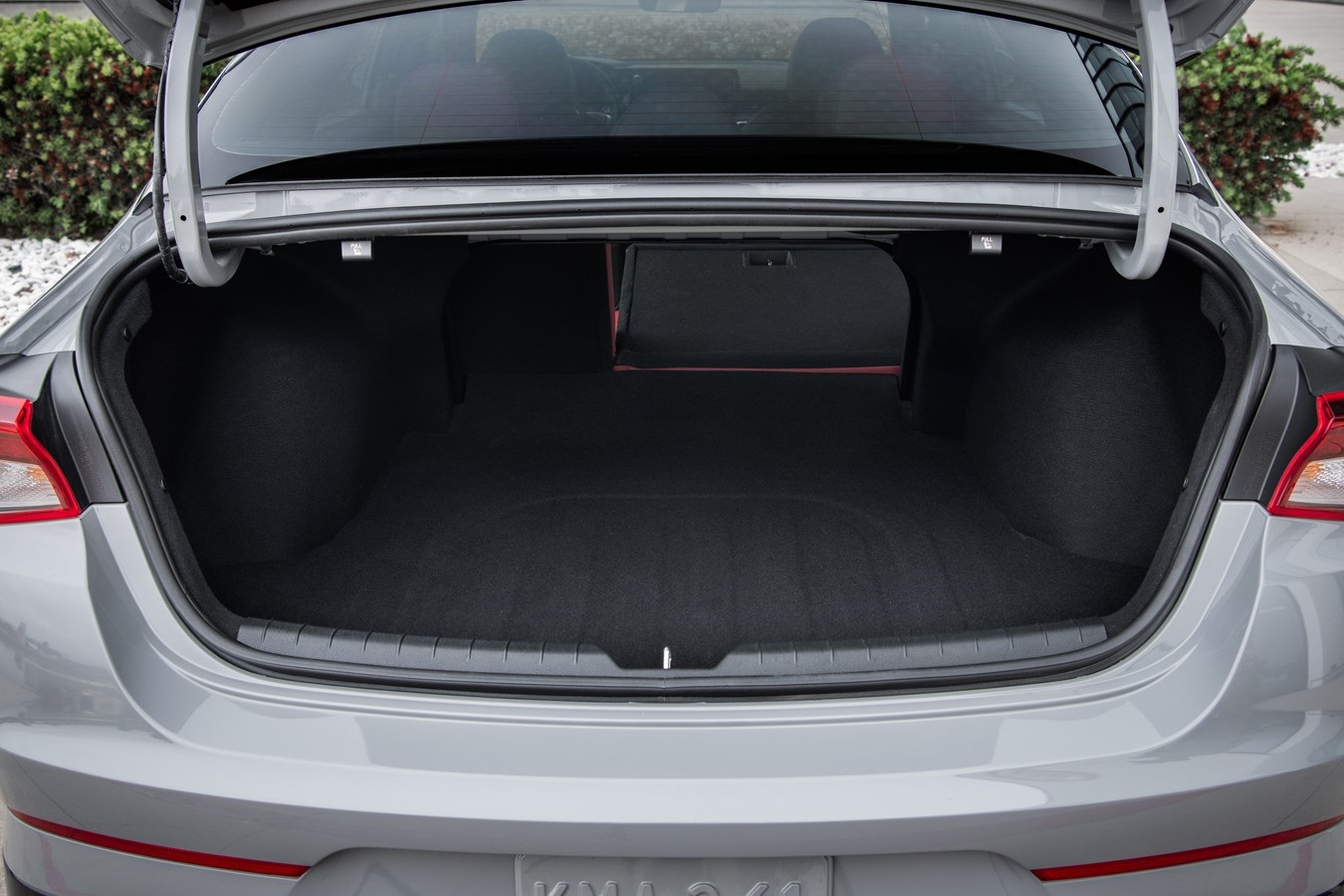
An open trunk

K5 trunk capacity is slightly larger at 16 cubic feet.

K5 Built in the USA

Built in West Point, Ga., K5 pricing will be announced closer to the on-sale date. The current 2020 Optima has starting prices that range from $24,355-$32,190. The Optima also is available as a gasoline-electric hybrid ($32,000) and as a plug-in hybrid electric, $37,000. No mention was made of hybrid systems for the K5.

Check current pricing here

Vin Car Pic: 1953 Corvette

Vin Car Pic: 1953 Corvette
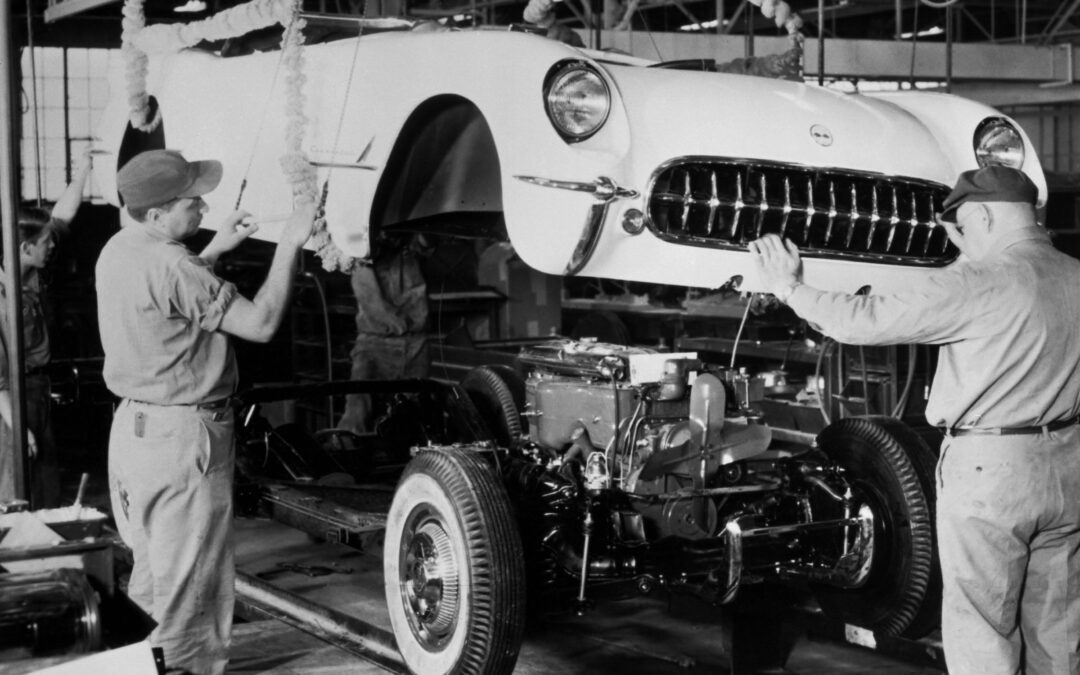
The first 300 Corvettes were largely hand-assembled. (GM archives)

The first Corvette rolled off the assembly line in Flint, Mich., on June 30, 1953, according to a report in AutomotiveHistory.org. Only 300 Corvettes were made for the 1953 model year — all Polo White with red interiors.

The first generation of the Corvette was produced through 1962 and is commonly referred to as the “solid-axle” generation, according to Wikipedia.

All 300 1953 C1 Corvettes were Polo White with red interiors. (GM archives)

“The Corvette was rushed into production for its debut model year to capitalize on the enthusiastic public reaction to the concept vehicle, but expectations for the new model were largely unfulfilled. Reviews were mixed and sales fell far short of expectations through the car’s early years. The program was nearly canceled, but Chevrolet would ultimately stay the course.

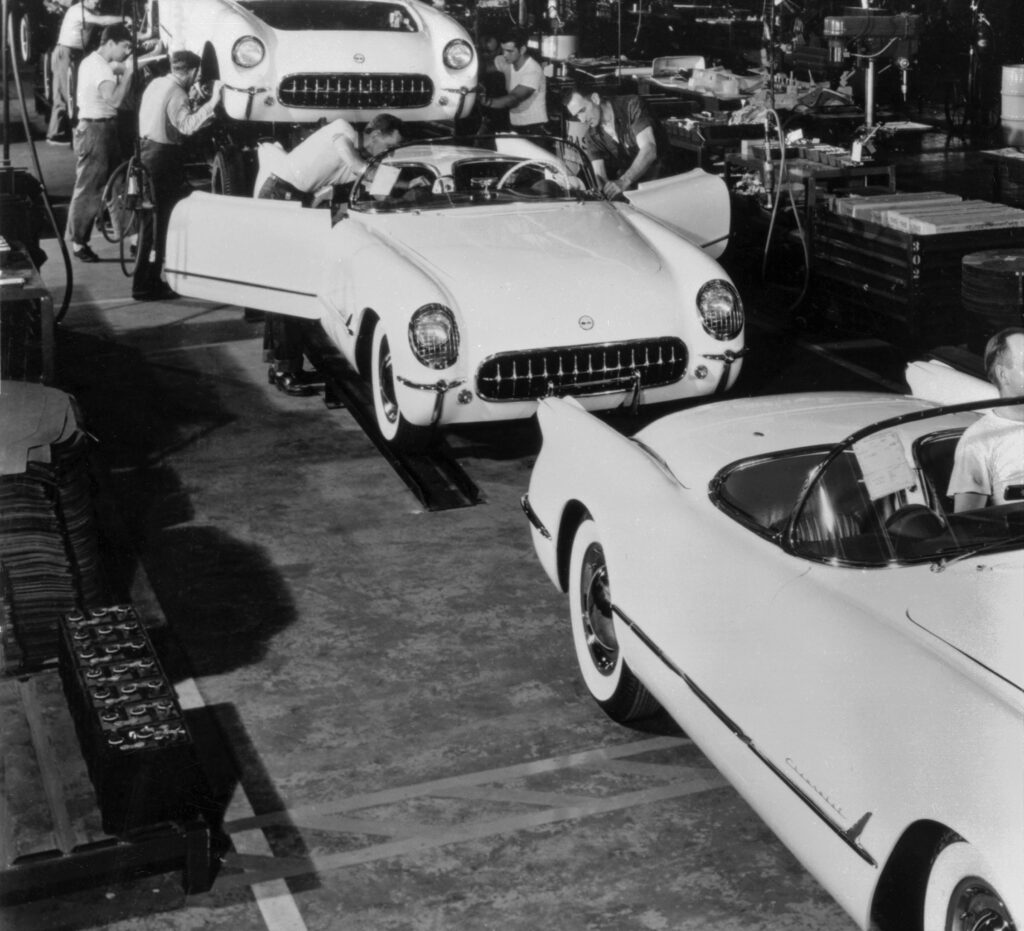
The C1 assembly line. (GM archives)

“To keep costs down, GM executive Robert F. McLean mandated off-the-shelf mechanical components, and used the chassis and suspension design from the 1949–1954 Chevrolet passenger vehicles.

“The drivetrain and passenger compartment were moved rearward to achieve a 53/47 front-to-rear weight distribution. It had a 102-inch wheelbase. The engine was a 235 cubic-inch (3.85-liter) inline six-cylinder, similar to the 235 engine that powered all other Chevrolet car models, but with a higher-compression ratio, three Carter side-draft carburetors, mechanical lifters and a higher-lift camshaft. Output was 150 horsepower.

The C1 Corvette assembly line. (GM archives)

“Because there was currently no manual transmission available to Chevrolet that was rated to handle 150 horsepower, a two-speed Powerglide automatic was used. 0-60 mph acceleration was 11.5 seconds.

1953 Chevrolet Corvette Mororama Show Car. (GM archives)

Today, the 2020 Corvette Stingray is back in normal production at the Bowling Green, Ky., assembly facility following the shutdown due to the pandemic.

According to a Chevrolet spokesman, production of the 2020 model has been extended through fall to meet demand. The MSRP for the 2021 will remain the same, he said.

An advertising image for the 1953 Chevrolet Corvette. (GM archives)

Ford stages big online reveal of ‘all-new’ 2021 Ford F-150 ahead of fall on-sale date

Ford stages big online reveal of ‘all-new’ 2021 Ford F-150 ahead of fall on-sale date
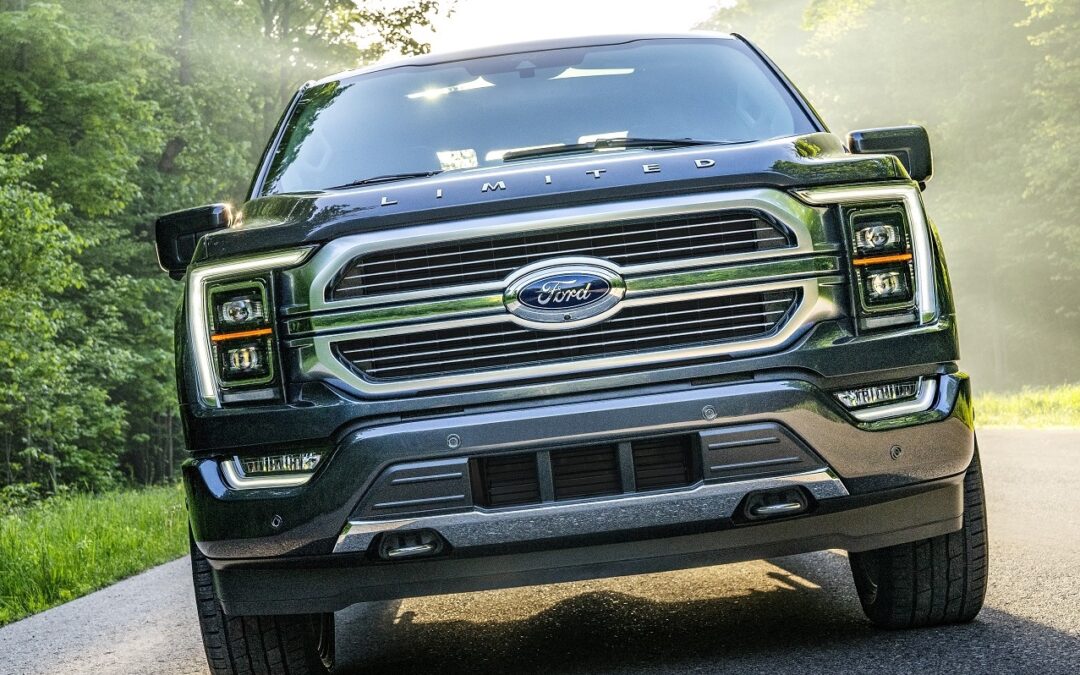
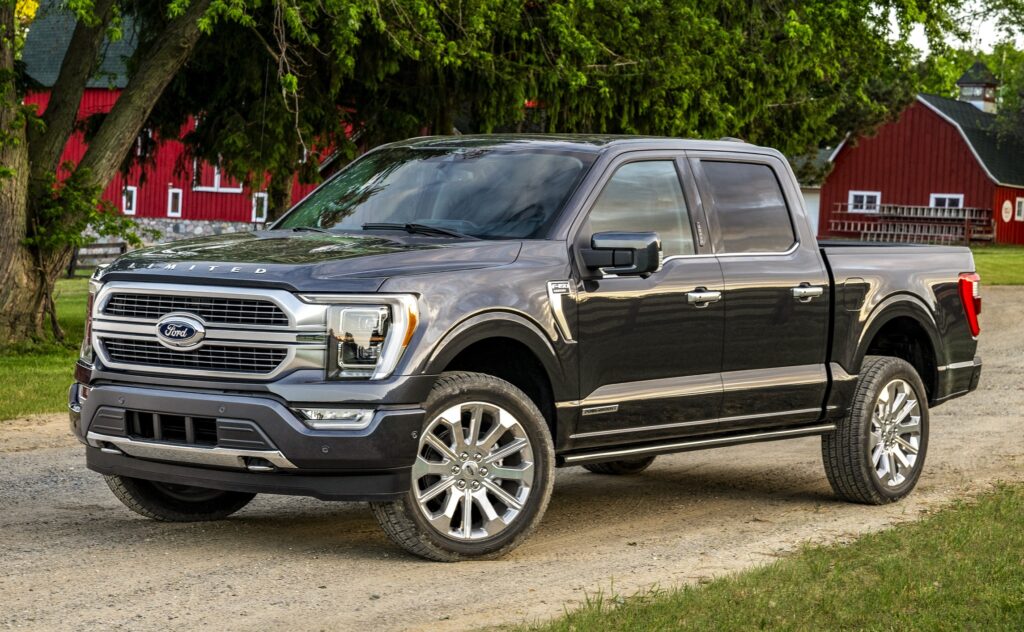
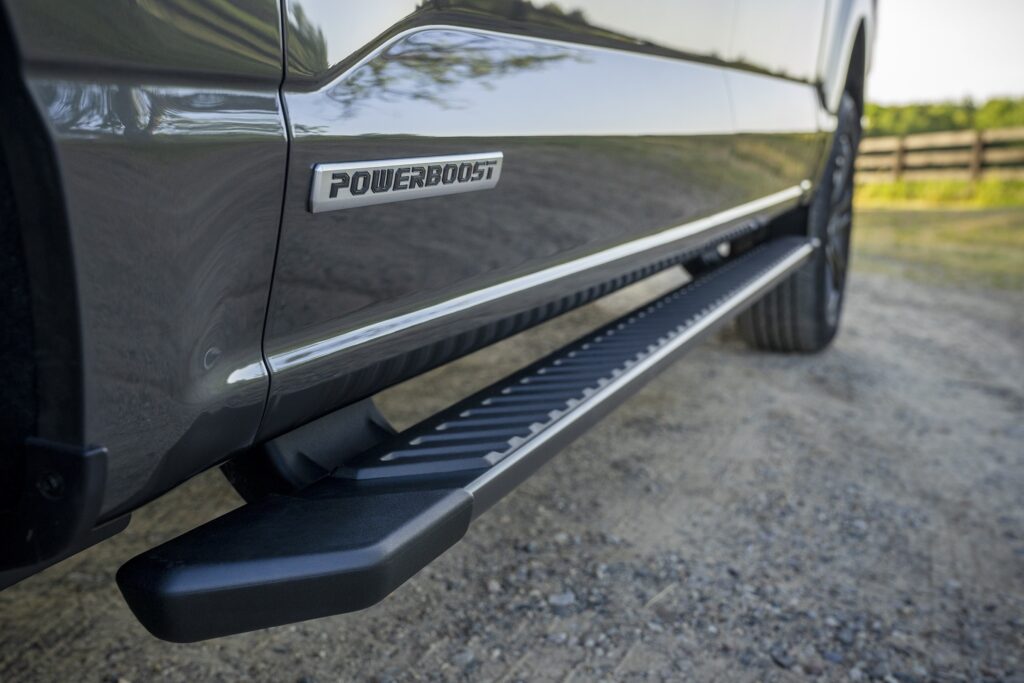
The new F-150 will include a 3.5-liter PowerBoost hybrid engine that Ford expects will have the most torque and horsepower of any light-duty full-size pickup. (Ford)

14th-generation pickup will be more connected with an ‘elevated’ interior and hybrid powertrain option

Ford Motor says its redesigned and re-engineered 2021 F-150 pickup is at the forefront of purposeful technology with such features as over-the-air vehicle updates, more driver-assist technologies, an integrated onboard generator and a 3.5-liter PowerBoost full hybrid V-6 powertrain.

The automaker made an online reveal of the 14th-generation pickup Thursday evening, June 25. But the brand’s top-selling vehicle is not expected to go on sale until the fall, COVID-19 willing. Pricing, horsepower and fuel-economy ratings will be available closer to the on-sale date.

While the “core values” of the truck were retained, many of the innovations and clever additions came from customer feedback — and were then tried and tested by the F-150 team of engineers and designers.

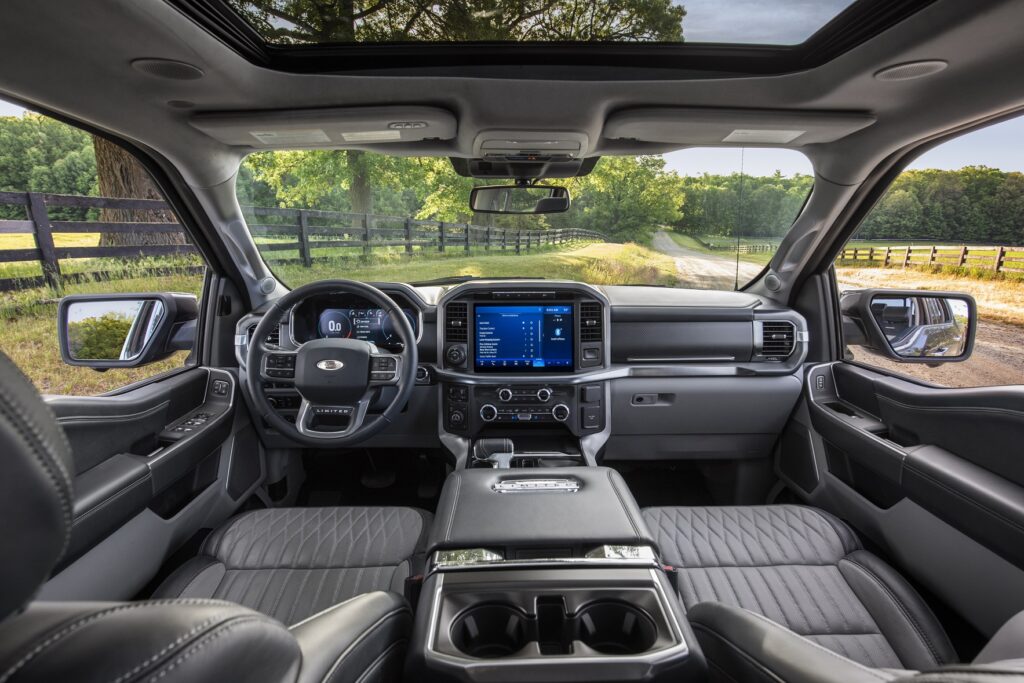
The cabin was redesigned with enhanced materials, new color choices and more storage “to elevate truck owners’ experience for style, comfort, utility and technology.” (Ford)

The “all new” light-duty pickup will be sold in three body styles — regular cab, SuperCab and SuperCrew, three box lengths and 11 grille designs and new tailgate IDs.

As before, there will be six trim levels — XL, XLT, Lariat, King Ranch, Platinum and Limited — in rear- or four-wheel drive. There was no mention of the Raptor model or when it might debut. The all-electric F-150 will be available within 24 months, Ford said.

Among the six engine choices, three are EcoBoost (turbocharged), with a naturally aspirated 5.0-liter V-8 and a PowerStroke diesel. All engines are paired with a 10-speed automatic transmission. The optional PowerBoost hybrid engine is expected to provide a 700-mile driving range.

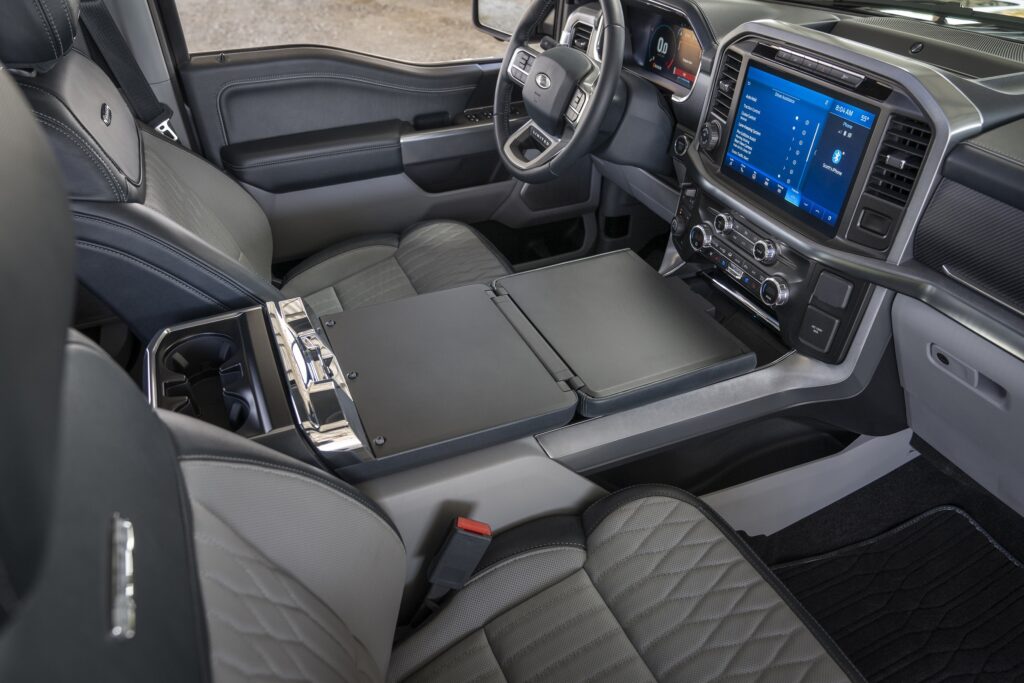
The new Interior Work Surface is a large surface that can be used for signing documents, using a laptop or as a lunch break. It will be available with a bench or captain’s seats. (Ford)
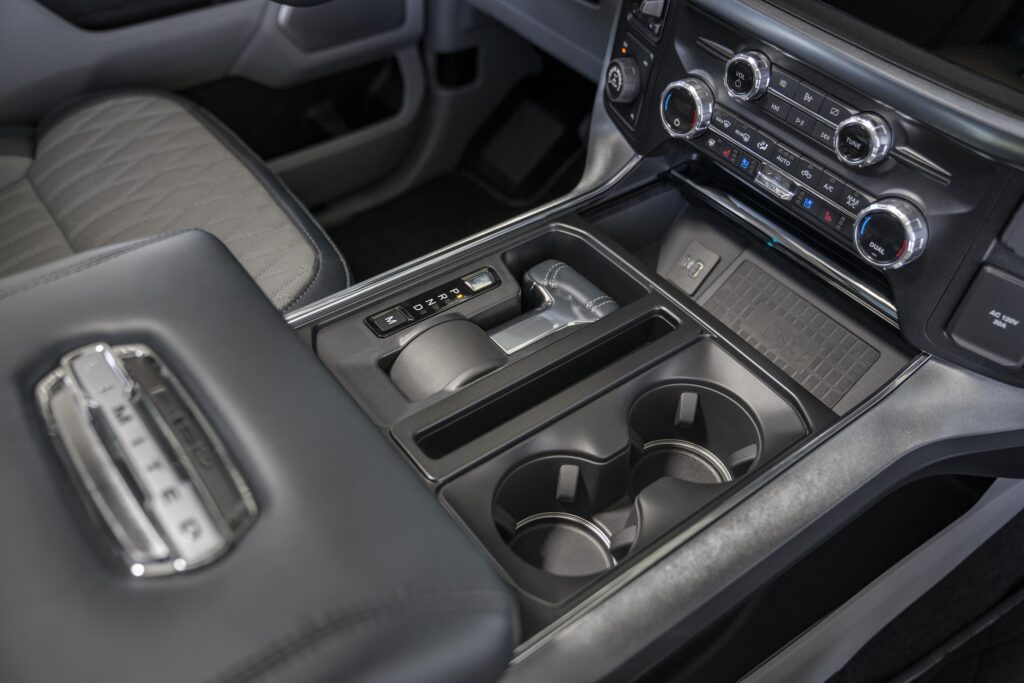
An optional stowable shifter folds into the center console to use the Interior Work Surface. (Ford)

Exterior design

The light-duty pickup continues with a boxed high-strength steel frame and a military-grade, aluminum-alloy body. The styling is familiar but every exterior panel was redesigned, including an updated “C-clamp” headlight design, power dome hood and wrap-around bumpers.

Higher front fenders, a tucked-in midsection and larger-diameter tires were pulled out ¾-inch to create a more powerful stance on and off the road, said Craig Schmatz, Ford F-150 chief engineer, during a video presentation June 23.

The restyled body geometry has more aerodynamic tweaks to reduce drag and improve fuel consumption. Of interest are active grille shutters for all engines and a new automatically deploying “active” air dam, which retracts when off-road and in low-speed driving.

Functional upgrades include LED headlights and taillights. And there will be an option for a full-length power running boards to help with a leg-up when loading or unloading from the side of the bed. And it will have kick switch for hands-free deployment.

Optional full-length power running boards give a bedside boost for loading or unloading. (Ford)

Interior design

The cabin was redesigned “to elevate truck owners’ experience with style, comfort, utility and technology,” Ford said. There are enhanced materials, new color choices and more storage, including a dual glove box.

A new 12-inch center infotainment screen — standard on XLT and higher trim levels — will allow split-screen function, such as to show navigation, music or truck features. An 8-inch touch screen will be standard on the base to midrange models.

An optional 12-inch digital gauge cluster features a large information-on-demand area, with displays for off-roading data and navigation.

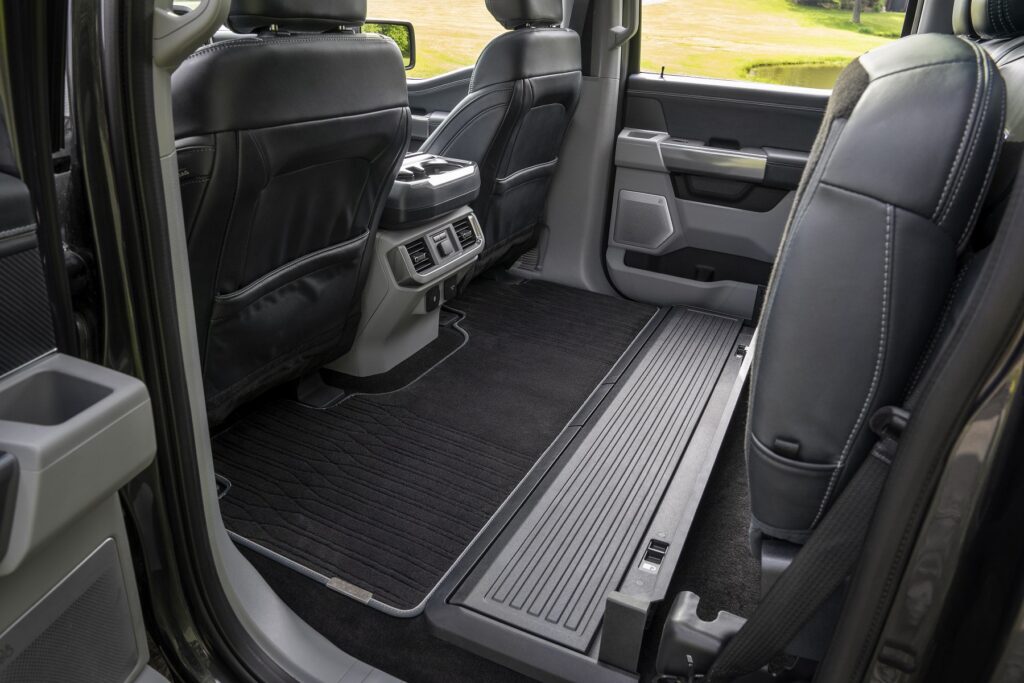
The flat back-seat floor allows secure cargo space, with an option for a lockable “vault.” (Ford)
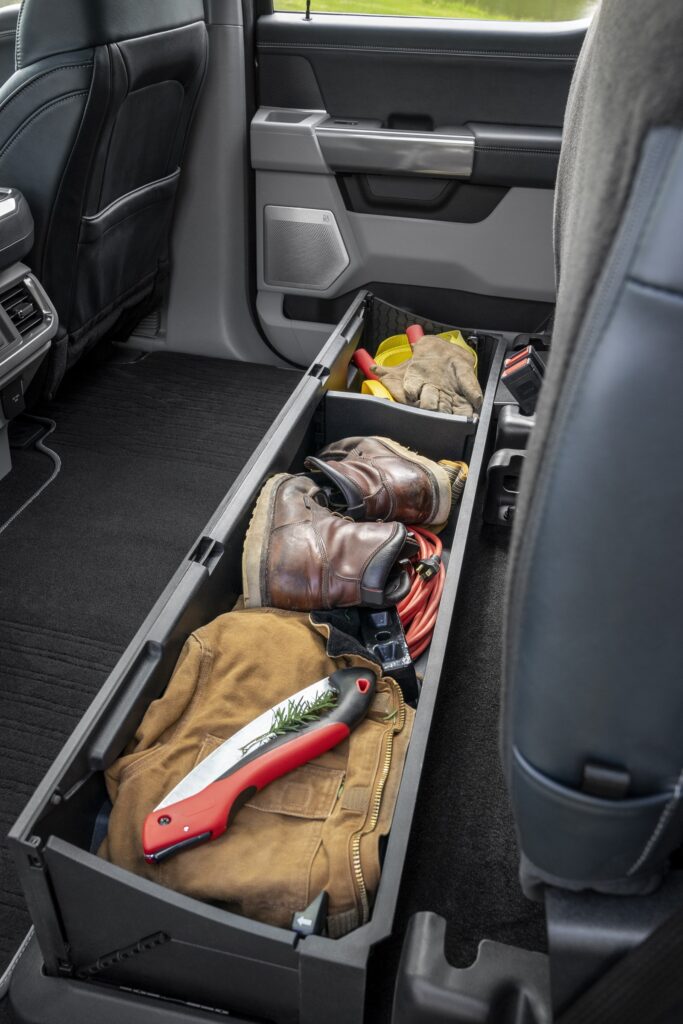
The underseat “vault” spans the width of the seat with a divider for organization. (Ford)

Hybrid model

The 3.5-liter PowerBoost full hybrid V-6 engine will be available on all SuperCab models. It integrates a 1.5kW lithium-ion liquid-cooled battery and 35kW (47-horsepower) electric motor. The electric motor works with the engine for immediate power and torque.

The battery is mounted between the frame rails below the second-row floor with a vibration isolation system. The battery placement does not impact passenger space or cargo capacity, Ford said.

The system includes electrically boosted (regenerative) braking and a high-voltage air conditioning compressor for engine-off situations.

Pro Power Onboard

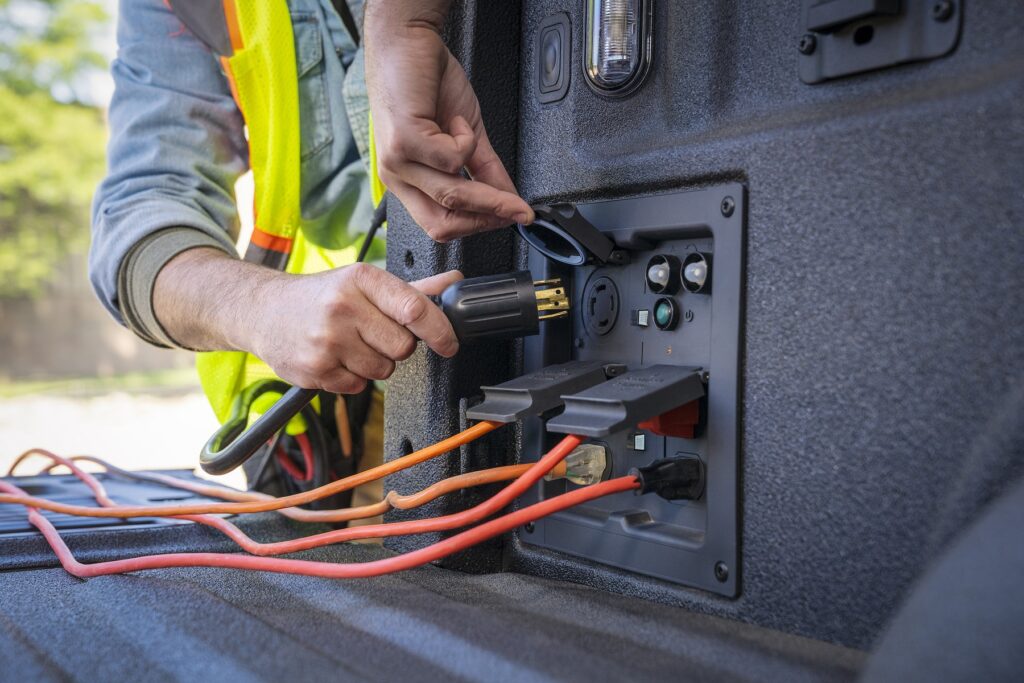
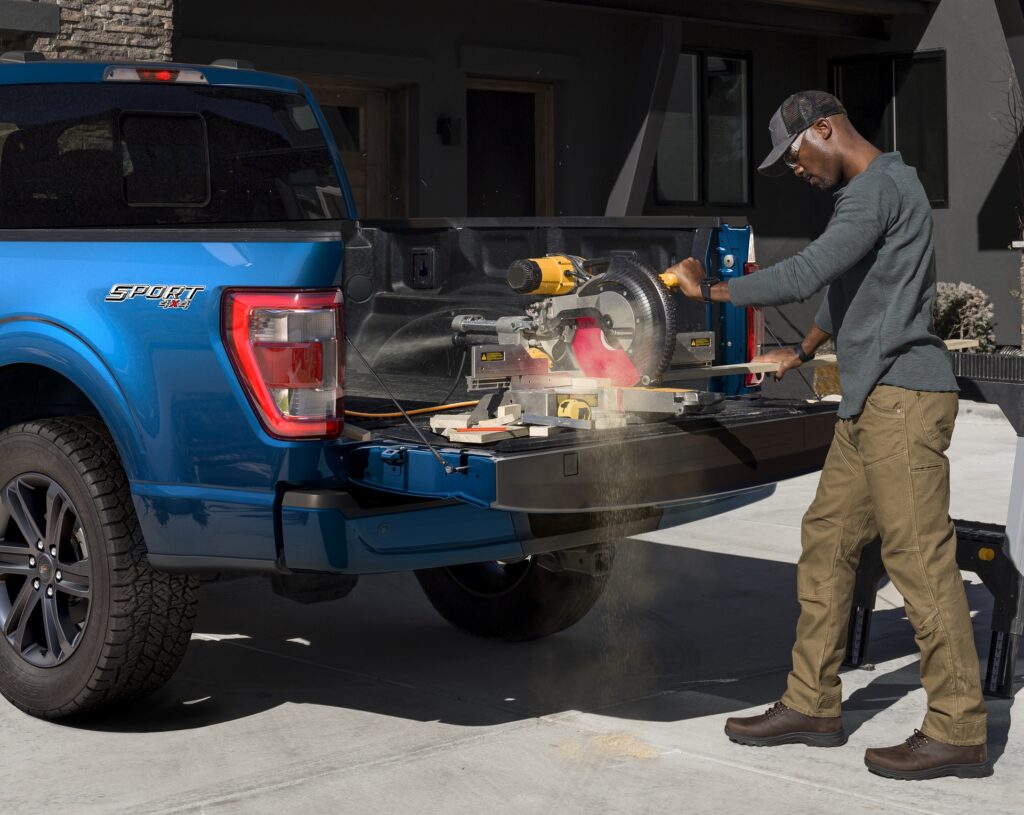
The integrated mobile generator, Pro Power Onboard, converts direct current from the high voltage battery to standard alternating current. A control panel in box allows plug-in for use of power tools or charging while on the road.

It has three levels of electrical output depending on engine choice:

2.0 kilowatts — 1,800-2,000 watts of power for simultaneous use, depending on the rating of power tools or appliances in use. Tailgating parties, for example, could handle a 600-watt electric heater, a 400-watt TV, 400 watts of portable speakers, a 200-watt blender and a 400-watt mini refrigerator. It includes dual outlets in the bed for a 120-volt 20-amp plug. It is optional with the 2.7-liter EcoBoost, 5.0-liter V-8 and 3.5-liter EcoBoost.

2.4 kW — 2,300-2,400 watts. As an example, a contractor could use a 1,200-watt power saw, a half-horsepower (1,000-watt) air compressor and a 200-watt battery charger at the same time. It has an 85-hour maximum run time on a full tank and has dual 120-volt 20-amp outlets in the bed. It will be standard on 3.5-liter PowerBoost hybrid.

7.2 kW — 7,200 watts. On a day of off-roading, this generator could recharge two electric dirt bikes of 4,800 watts, a 1,400-watt electric griddle and a 1,000-watt air compressor, at the same time. This system has a 32-hour maximum run time on a tank and has four 120-volt 20-amp outlets in the bed and one NEMA (National Electrical Manufacturers Association) L6-20 240-volt 30-amp plug. Optional for the PowerBoost hybrid.

The Pro Power Onboard generator will be available in three levels of power. The 7.2-kilowatt, shown, features four 120-volt 20-amp outlets and one NEMA L14-30R 240V 30A. (Ford)

New features

Max Recline Seats: captains’ recliners fold nearly flat to 180 degrees for shut-eye in downtime. They will be available on King Ranch, Platinum and Limited models.

Back seat flat floor: Provides secure cargo space and there’s an option for lockable, fold-flat storage “vault.”

Underseat “vault”: The divided space spans the width of the seat with a divider for organization. The space is secure for such items as fishing rods or blueprints, Ford said.

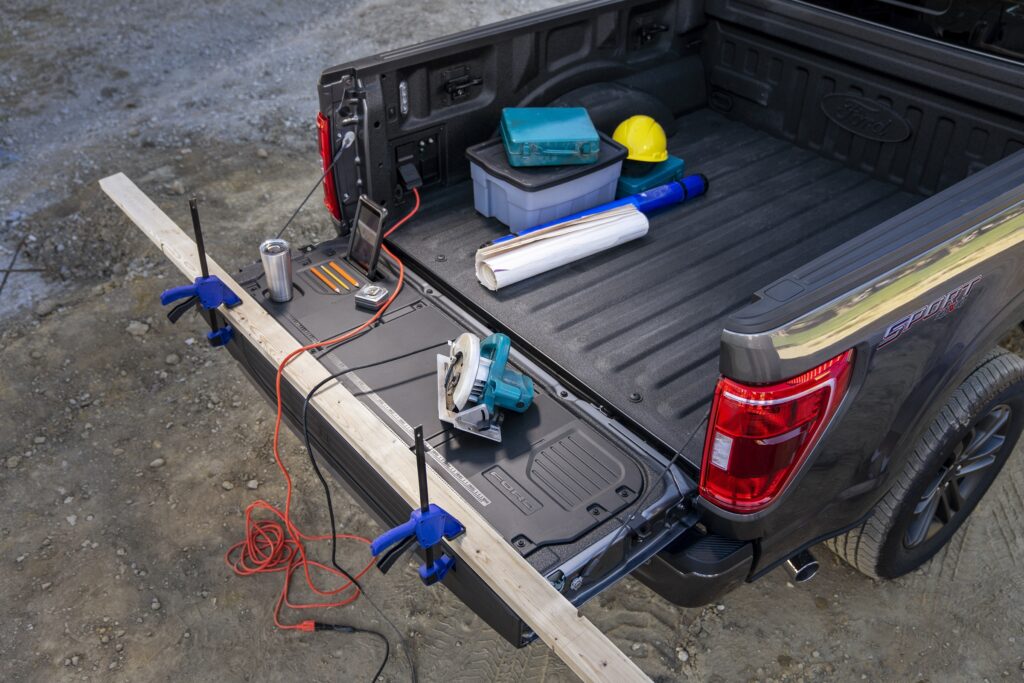
Tailgate side cleats and pockets: Standard designs that can be used as tie-down locations for extra-long items in the bed. The clamp pockets can be used to hold down materials for precision measuring, cutting or drilling.

Flat tailgate work surface: The option adds integrated rulers, a phone or tablet holder, a cup holder and indents for pencils or pens.

Tailgate side cleats and pockets can be used as tie-down locations. The clamp pockets can be used to hold down materials for measuring, cutting or drilling. (Ford)

Driver-assist technologies

There will be 10 new driver-assist features as part of Ford Co-Pilot360 2.0. Among them:

Active Drive Assist: For hands-free driving on certain sections of pre-mapped, divided highways. But to help maintain operator focus, a driver-facing camera tracks head position and the driver’s eye gaze.

Intersection Assist: Will detect oncoming traffic while the driver is attempting a left turn. If there is risk of a collision, the system will apply the brakes to avoid it or minimize impact.

Active Park Assist 2.0: Will handle all steering, shifting, braking and accelerator controls when parallel or perpendicular parking. All the driver has to do is hold down the button.

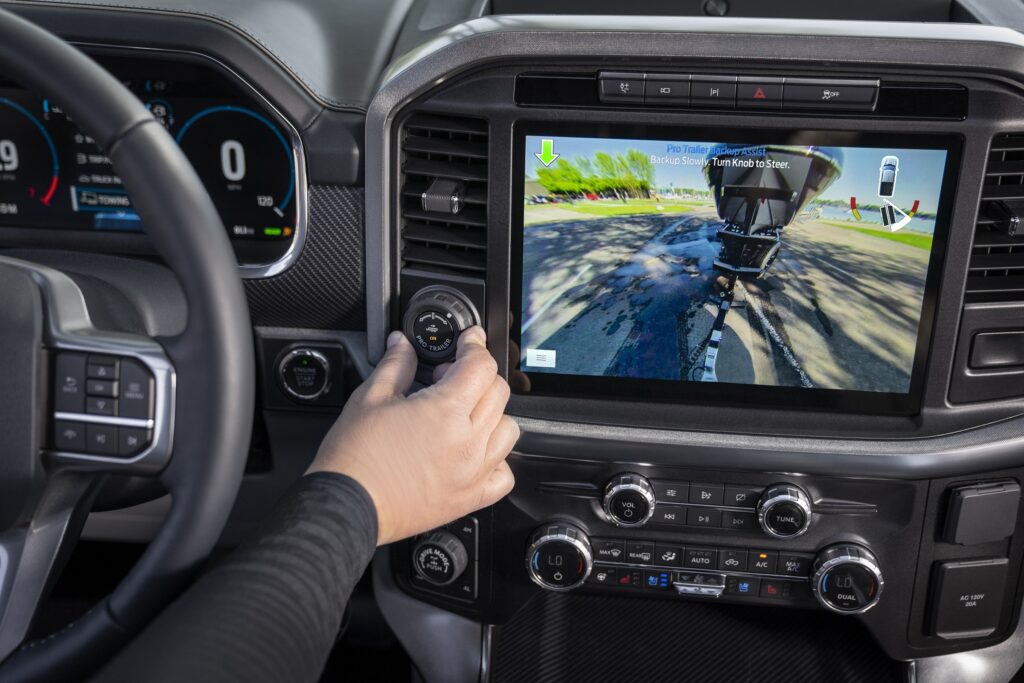
Pro Trailer Backup Assist makes backing up a trailer as easy as turning a knob. (Ford)

Trailer Reverse Guidance and Pro Trailer Backup Assist: Trailer Reverse Guidance (trickle-down from the Super Duty) uses high-resolution cameras for multiple views with graphics that tell drivers which way to turn the steering wheel while backing up. Pro Trailer Backup Assist, which makes backing up a trailer as easy as turning a dial, continues.

New safety technologies on all models includes Pre-Collision Assist with Automatic Emergency Braking and Pedestrian Detection, rearview camera with dynamic hitch assist and automatic high-beam-dimming headlights.

All F-150 models will be assembled at Ford’s Dearborn Truck Plant in Dearborn, Mich., and Kansas City Assembly Plant in Claycomo, Mo.

markmaynard@cox.net

Mopar-upfitted 2020 Jeep Gladiator Rubicon Review

Mopar-upfitted 2020 Jeep Gladiator Rubicon Review

Punk’n Metallic Jeep Gladiator Rubicon test vehicle is a showcase of $12,400 in Jeep-Mopar accessories. Final price? $58,955

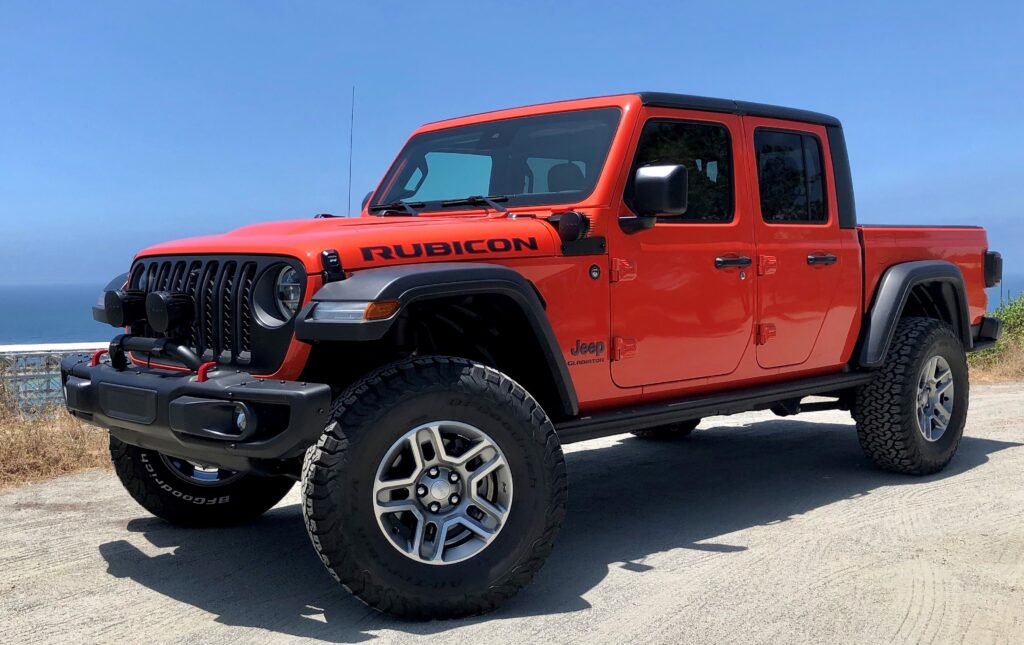
A Jeep Gladiator pickup in Punk'n Orange paint.
Starting at $45,370, the Jeep Gladiator Rubicon is the pinnacle of Trail Rated features for adventuring. (Photography by Mark Maynard)

BY MARK MAYNARD

Starting at $45,370, the Jeep Gladiator Rubicon is the pinnacle of Trail Rated features for adventuring. But the Manufacturer’s Suggested Retail Price of a new vehicle is as vague as a stoplight in Boston — a suggestion, at best.

To spark some red mist for the buyer — while ratcheting up the cost — manufacturers have aggressively pursued their catalogs of personalization and performance accessories. If you can imagine it, it’s probably offered or will be.

A 2-inch lift kit, $1,495, to add bigger tires and wheels.

Jeep and Mopar have been masterful at providing factory-sanctioned upgrades that can be ordered with their new Jeep. And the upgrades are covered by the same new vehicle warranty protections.

Most new luxury cars or SUVs are bought with $10,000 in options or packages. And sometimes a package alone is $10,000, or more.

Fox 2.0 performance shocks are standard equipment on the Rubicon.

From unique paint colors to better leather, bigger wheels, lower-profile tires, crests, badges, colored seat belts, more gratuitous performance, LED lighting, and techno-marvelous infotainment systems to extended warranties, what the customer wants, the customer gets … for a price.

Jeep has long been a champion of choice with several versions of four-wheel-drive systems, soft and hard tops, street tires or adventure treads, audio and style perks.

And then there’s the Mopar catalog with more than 200 accessories. Mopar (MOtor PARts) is the parts, service, and primary accessory seller for Stellantis brands under the Mopar brand. 

Katzkin leather seats, $1,750
Katzkin leather seats, $1,750. 

Jeep Performance Parts

Jeeps are basically a canvas and Jeep Performance Parts are the buyer’s paints for personalization. So far, there are 200 Mopar products available for the Gladiator.

I’ve just tested a Jeep Gladiator Rubicon, the top-line off-roader, that had $12,400 in Jeep/Mopar performance parts.

Jeep Gladiator Rearview camera and front-facing trail cam
Rearview camera and front-facing trail cam, $595.

At $45,370 the Gladiator Rubicon is the pinnacle of Trail Rated features, including the 4:1 Rock-Trac heavy-duty four-wheel-drive system (with an Off-Road Plus mode), locking front and rear axles, disconnecting front stabilizer bar, steel rock rails, and an appetite for adventuring.

For those serious about getting there and back in demanding off-road adventures, this is the rig to consider. But access doesn’t come cheaply.

Decked truck-bed storage system, $1,295.
Tri-fold hard tonneau cover, $950, and spray-on bedliner, $495.

With the Jeep Performance upgrades, by Chrysler FCA’s Mopar performance division, the tester had a sticker of $58,955, including the striking Punk’n Metallic paint ($245).

But there is a reprieve when buying new. The performance parts have the same basic, limited warranty as the vehicle — 3-years or 36,000-miles — and they can be rolled into the financing (with the cost of labor for parts installation).

Jeep-logo hood latches
Jeep-logo hood latches, $60.

The Jeep Gladiator Rubicon tester is a formidable pickup that includes city features. Commuters will value the adaptive cruise control with idle stop-and-go function in traffic and full-speed collision warning.

And this wide rig with a 44.8-foot turning circle benefited from the Jeep Active Safety Group, $895. The package adds blind-spot and cross-path detection and ParkSense rear park-assist system, which alerts to the nearness of an object.

Set of two 7-inch LED off-road lights, 8,000 lumens each
Set of two 7-inch LED off-road lights, 8,000 lumens each, $725.
Set of two 5-inch LED off-road lights, 4,800 lumens each
Set of two 5-inch LED off-road lights, 4,800 lumens each, $475.

The 8.4-inch Uconnect infotainment touch screen is an upright and visible display for the rearview camera, with guidance lines. But it’s even better for the front-facing trail cam, $595.

JPP accessories

The tester also included $12,400 JPP accessories for:

  • A 2-inch lift kit lift, $1,495. Created by Jeep engineers and Fox shocks so owners can add bigger tires and wheels.
  • Military-grade 7-inch off-road LED lights, $725 two-light set. The lights have an 8,000-lumens output, each. Mounting brackets, $65
Cat-back exhaust upgrade with dual tips,
Cat-back exhaust upgrade with dual tips, $1,250.
  • Military-grade 5-inch LED, $475 two-light set. Add 4,800 lumens each. A-pillar mounting brackets, $145
  • 2-inch grille/winch guard, $249
  • Cold air intake, $445. Fresh air is drawn in through the hood cut-out to increase engine performance
  • Cat-back exhaust, $1,250. Adds a loud tone and dual chrome tips
  • Jeep logo valve stem caps, $60 for four
Off road slotted wheels and tires
Off-road slotted wheels, 17-by-8.5 inches; $1,140 for four. Add five 35-inch BFG tires for around $1,250. 
Special Jeep logo valve-stem caps
Logo valve stems $19. 
  • Jeep logo hood latches, $60 a pair
  • Door sill guards, 4-piece set $75. Composite and stainless-steel door sill guards feature the Gladiator logo.
  • Beadlock-capable five-spoke wheels, $1,140 for four. Aluminum 17-inch wheels have five-spoke “gear” or five-spoke “slot” designs.

Metal-trimmed pedals and heavy duty floor matsPedal kit, $105. All-weather (slush) floor mats, $165.

Trail protection

  • Tires. Mopar/FCA dealers have a “TireWorks program” that gives access to different tire brands. The dealer can source whatever brand, model, and size (up to 35 inches) the customer prefers depending on their intended use — whether on-road, off-road or a combination.
  • Black satin grille, $325
  • Heavy-duty rock rails, $950. To help slide across objects with high-centering potential. The heavy-gauge steel rock rails are thicker and wider than stock in a non-slip powder-coat finish.
  • Tri-fold tonneau system, $950.
  • Bed storage system, $1,295. A heavy-duty pair of lockable, sliding drawers (200-pound capacity) to secure gear, supplies and tools.
Seatback storage bags in the Gladiator Rubicon
Seatback Molle design storage bags, $145 set of three.
  • Katzkin leather seats, $1,750. Embroidered with Jeep grille logo in Tungsten stitching.
  • Mopar grab handles, $39 each for first and second rows. hard-secured for increased grip.
  • Molle design storage bags, $145 set of three.
  • Jeep logo all-weather (slush) floor mats, $165. Raised edges for added water and dirt retention.
  • Metal ATX pedal covers, $105.
  • Spray-on bedliner, $495.
A Jeep Gladiator satin-black grille
Satin-black grille, $325.

Check the site for Jeep Performance Parts.

And read my first review of the Gladiator, “the mudder of midsize pickups” (July 14, 2019) here.