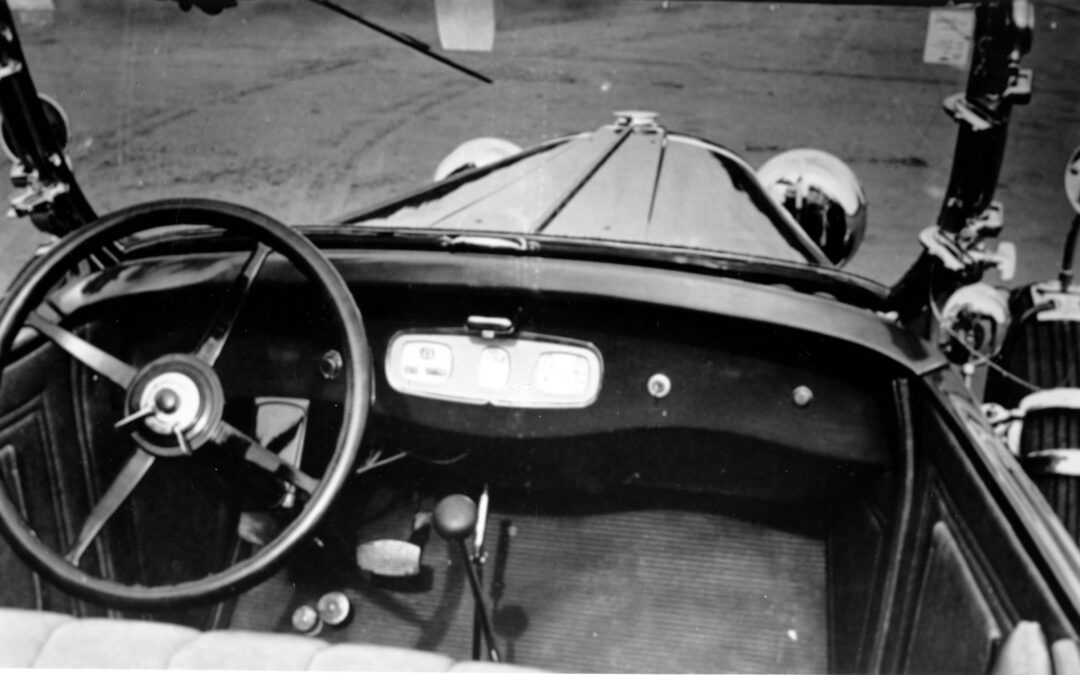
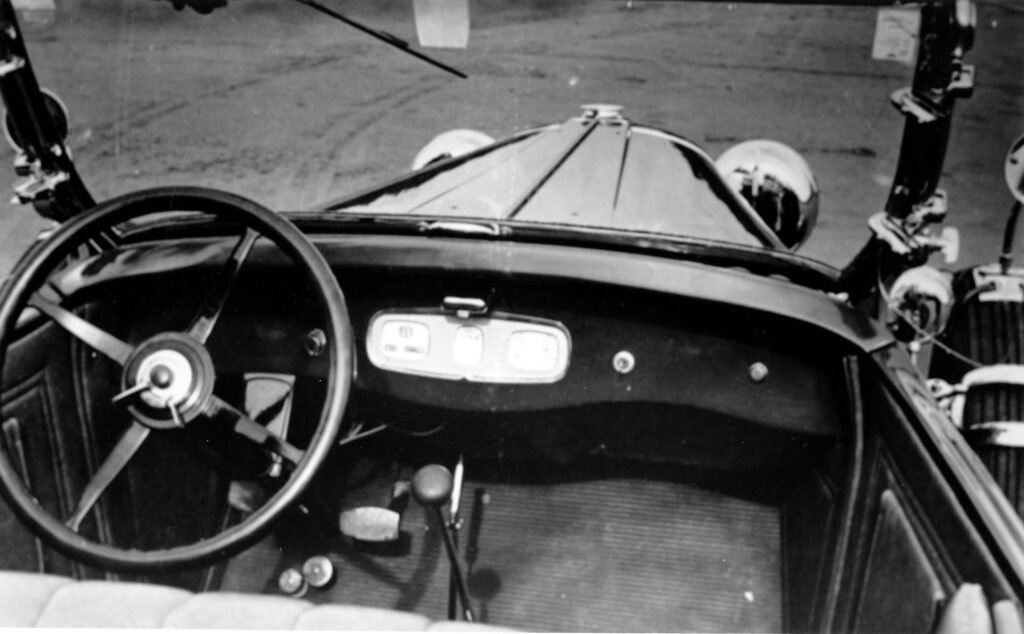
A dashboard from the new 1928 Dodge Victory Six. (Stellantis archives)
The 1928 Dodge Victory Six was offered in honor of the 10th anniversary of World War I, according to ConceptCarz.com. It was the brand’s first six-cylinder car (68 horsepower) and featured hydraulic brakes, unique for a low-priced car. It featured an all-steel body (built by Budd Manufacturing) at a time when most auto manufacturers still used composite metal and wood bodies.
The famed Schlumpf Collection of Bugatti models in France is a legendary automotive tale of obsession, wealth, and downfall for the brothers Schlumpf, Fritz, and Hans.
Breaking through a veil of secrecy in 1977, factory workers came across a secretly hoarded treasure of 427 vintage European luxury cars, most of them in showroom condition, with another 150 cars stashed away in the workshops.
Bugatti recently shared this story of an American stash of 30 cars that Fritz Schlumpf just had to have and how they were relocated in the 1960s from Illinois to France.
Fritz Schlumpf was a Bugatti enthusiast. He bought his first car, a Type 35B, at the age of 22 in 1928 and drove it on weekends and in car races. Schlumpf would stay in touch with the company, based in Alsace, France, over the coming years. But his passion for collecting didn’t really develop properly until 1961.
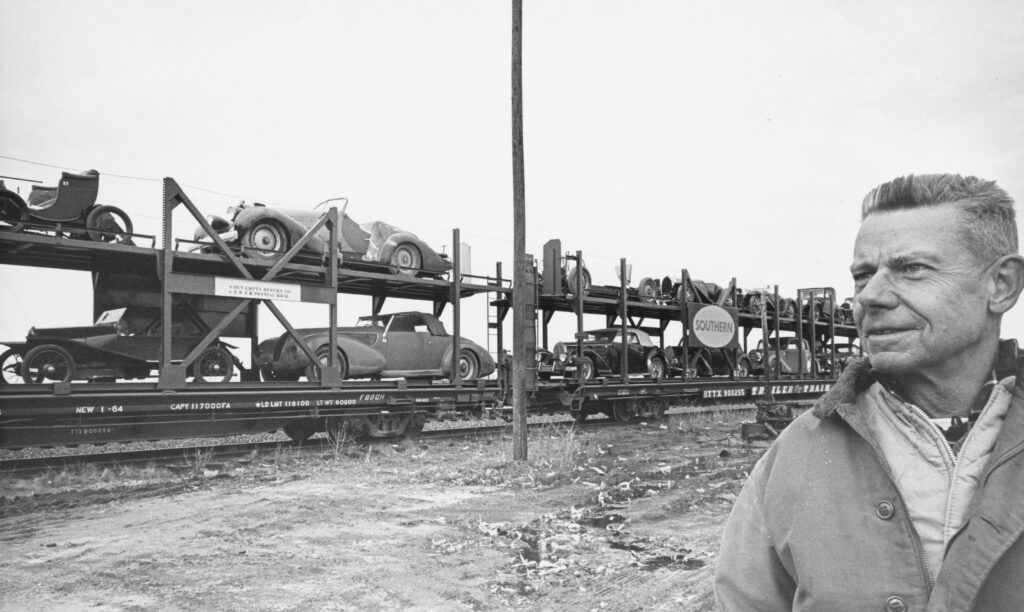
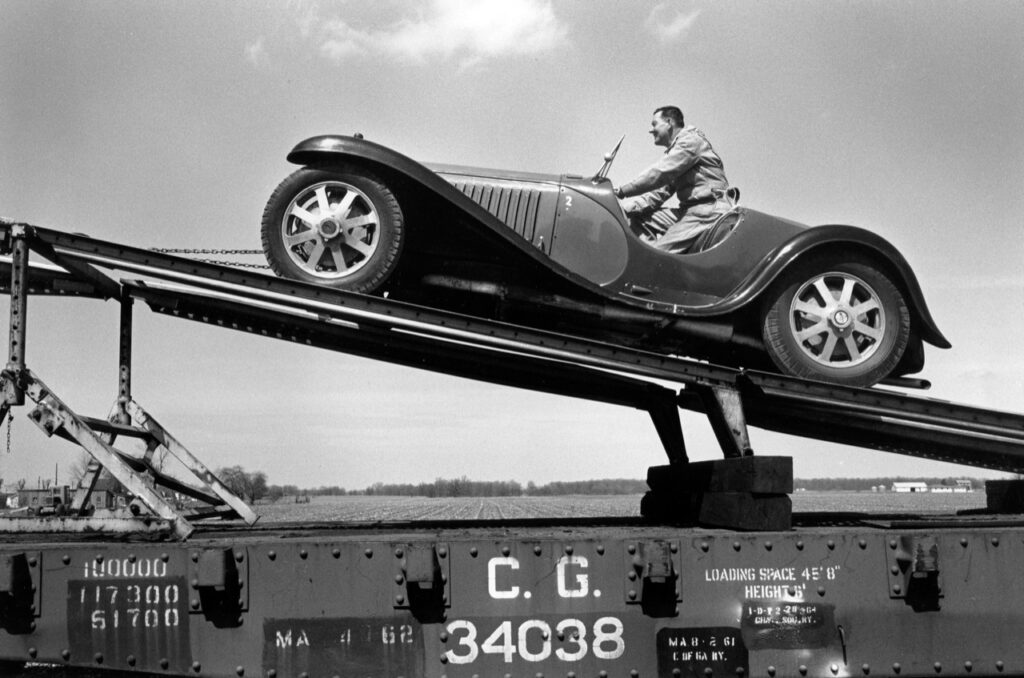
American collector John Shakespeare with his 30 Bugattis as they were loaded onto a train on March 30, 1964.
The Story Background
Schlumpf initially worked as a wool broker, and in 1929 his brother Hans — two years his senior — joined the textile company. In 1935, they founded Société Anonyme pour l’Industrie Lainière (SAIL), a limited company trading in wool. After the war, the brothers bought up several factories and spinning mills in Alsace until they almost fully dominated the textile industry in eastern France.
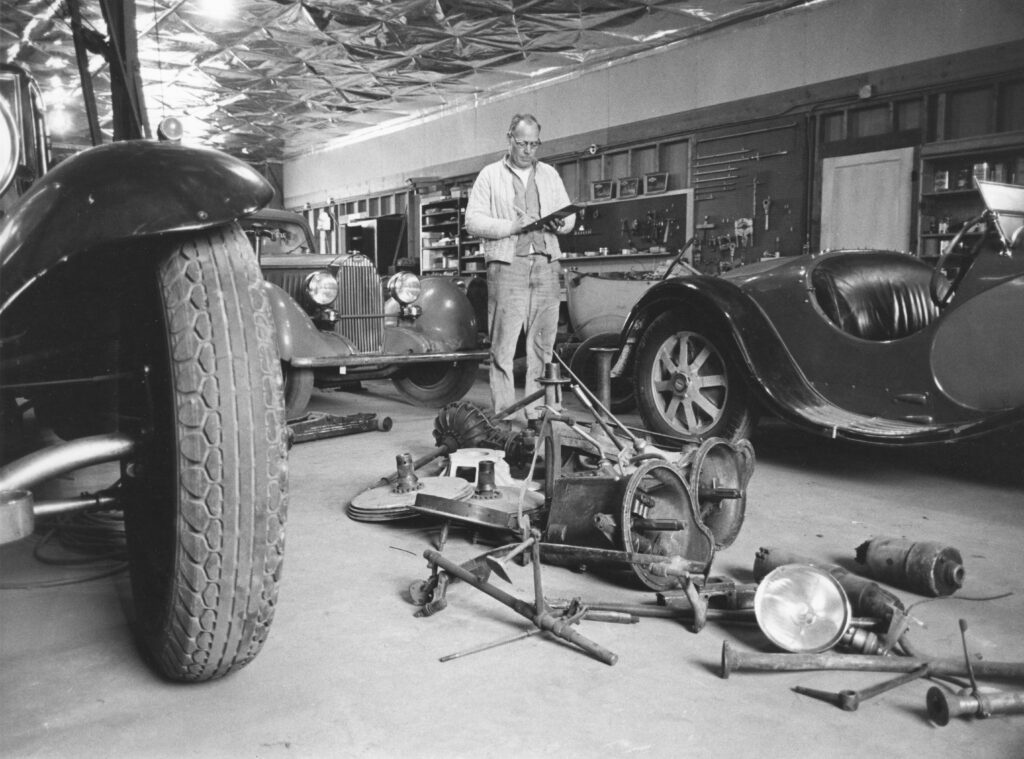
Assessing the collection.
In 1957, they acquired an idled wool factory in Mulhouse, Alsace, to build their own automobile museum. It would be in honor of their beloved mother and Bugatti founder Ettore Bugatti, but mainly it was for Fritz Schlumpf himself. After all, collecting Bugatti cars had long become his obsession.
From 1961 onward, he acquired numerous classic vehicles and eventually became the leading Bugatti collector in the world. And he wanted more.
To fuel his obsession, Schlumpf wrote to Bugatti owners worldwide in the early 1960s, sourcing addresses from a register kept by Hugh Conway of the British Bugatti Owners Club. Conway put him in touch with American collector John W. Shakespeare from Hoffman, Ill., in 1962.
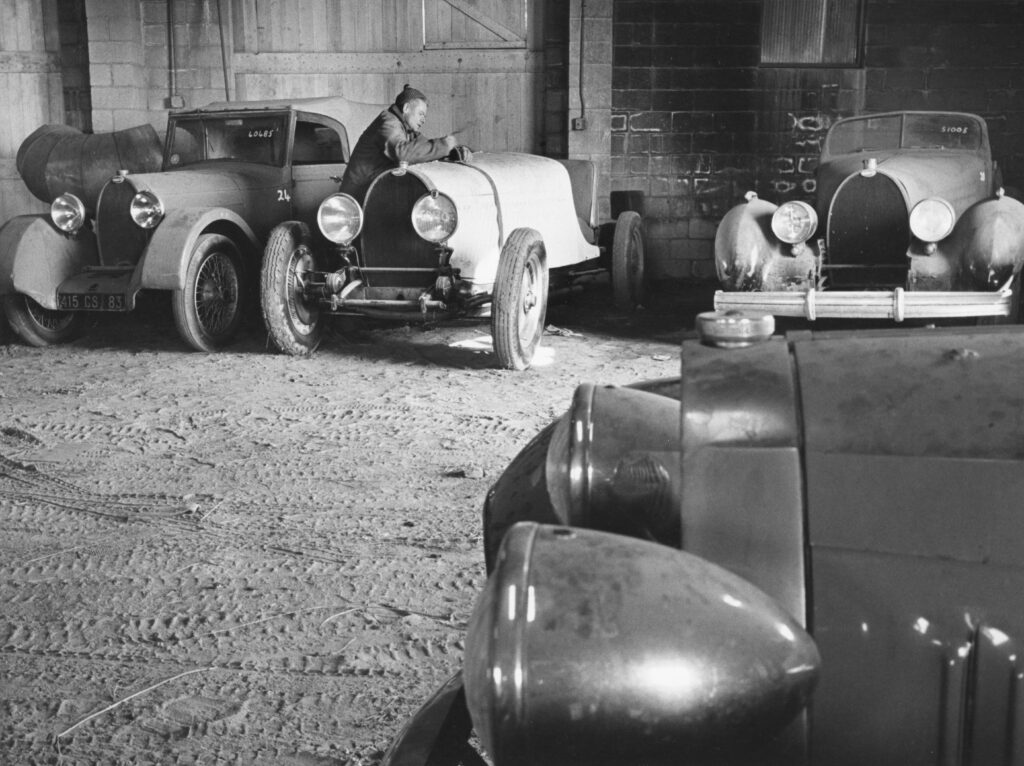
Inside Shakespeare’s dirt-floor garage.
Dedicated to Bugatti
Shakespeare had dedicated himself to collecting Bugatti vehicles since the 1950s: his first car was a 1932 Bugatti Type 55, which was followed by a Type 41 Royale Park Ward, the third and last customer car. Also in his care were a dozen Type 57s, three Type 55s and Ettore Bugatti’s personal electric car, the Type 56 dating back to 1931.
All in all, Shakespeare owned the largest Bugatti collection in the world, comprising some 30 vehicles.
Schlumpf was on a mission to get these cars and made Shakespeare an offer of $70,000. But Shakespeare demanded at least $105,000, whereupon Schlumpf had the collection assessed by Bugatti connoisseur Bob Shaw from Illinois in 1963.
Ettore Bugatti’s personal electric car Type 56 dating back to 1931.
An Unflattering Conclusion
Shaw arrived at an unflattering conclusion: “Most of the cars are kept in a part of the building with a dirty floor, broken windows, leaking roof and nesting birds. Every car is in some state of disrepair and none of them have been running for at least 18 months.”
He advised against the purchase, but Schlumpf was fully committed by this time and offered Shakespeare $80,000 for the entire collection. After tough negotiations, mutual threats, and blackmail, Schlumpf and Shakespeare finally agreed on a purchase price of $85,000 the following year (equivalent to approximately $720,000 today) — including transport to France.
From today’s point of view, it was a real bargain. Today, genuine and restored Bugattis will sell at auction from around $200,000 to tens of millions of dollars.
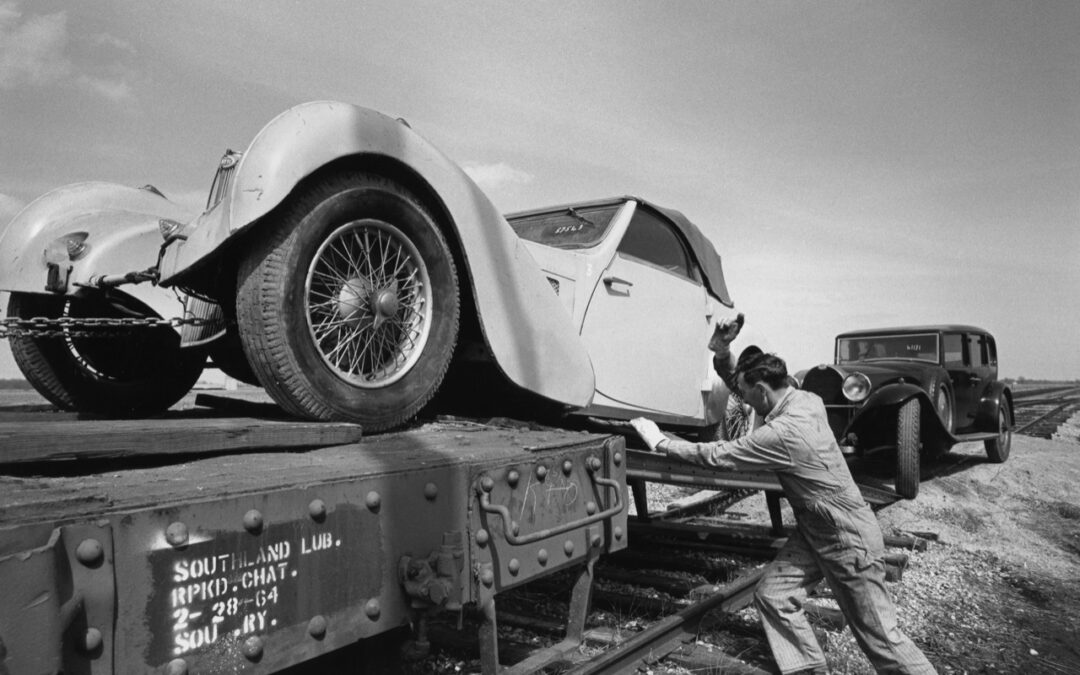
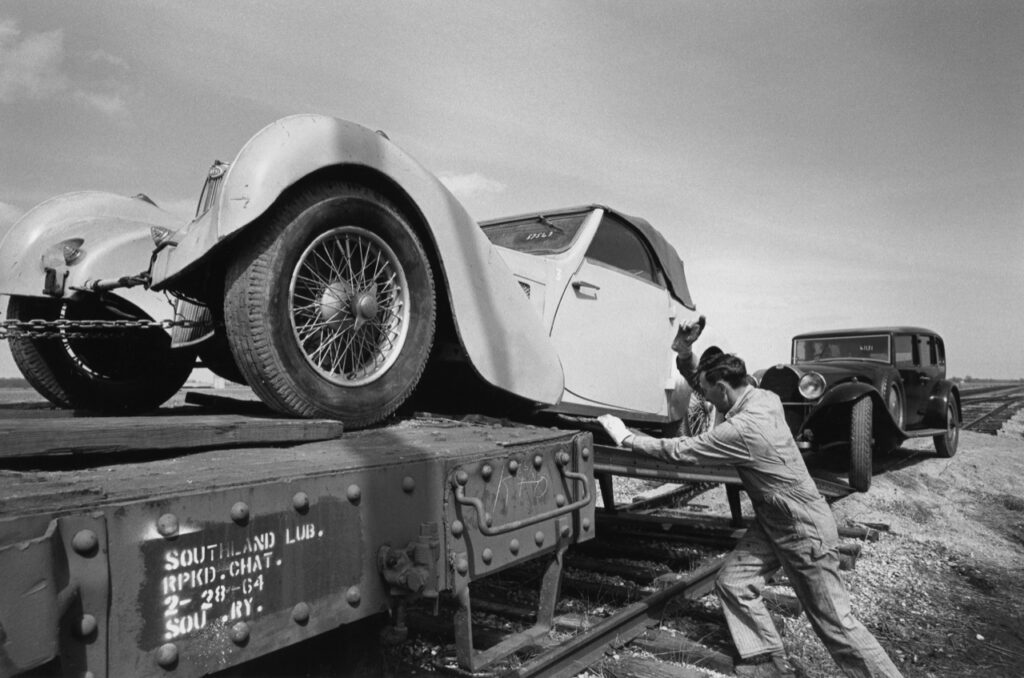
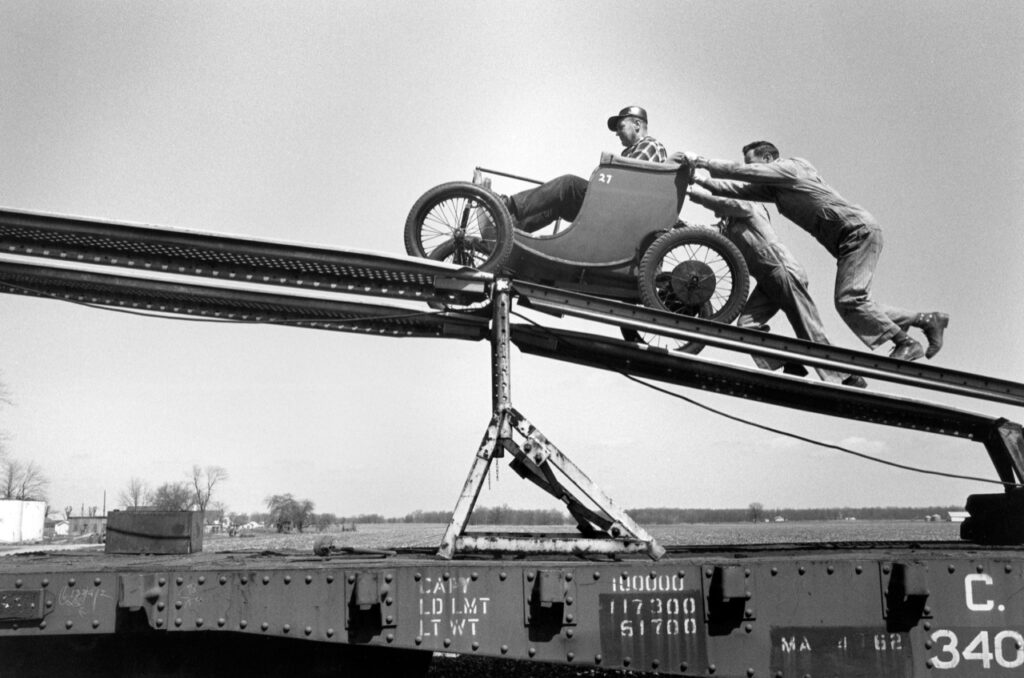
A 1932 Type 55 is loaded onto the railcar.
30 Bugattis On A Train
On March 30, 1964, the 30 Bugattis left Illinois on a Southern Railway train headed for New Orleans where they would be loaded onto a Dutch cargo ship. A photo shows the open train with the large number of rare vehicles.
A few weeks later, the freighter reached the French port of Le Havre, where Schlumpf finally received his treasure. He was now one huge step closer to achieving his goal of being the biggest Bugatti collector in the world. It wasn’t until 1965 that the Schlumpf brothers publicized their collection in a short press release — and the idea of a museum was born. But Schlumpf never officially opened it.
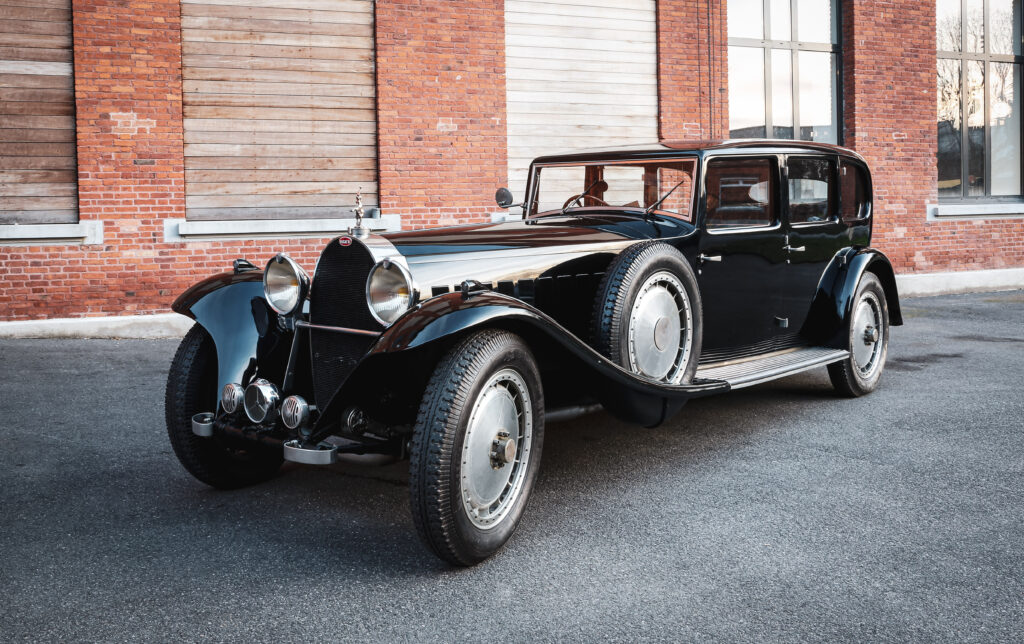
A Type 41 Royale Park Ward on display at the ‟Cité de l’Automobile” national museum in Mulhouse, France.
The Schlumpf brothers had little opportunity to enjoy their unique car collection, and their pleasure in these cars was only to last a few years. Large-scale labor strikes occurred after they engaged in questionable business practices, and the decline of the French textile industry in the 1970s eventually meant they were forced to flee to Switzerland.
The story of the amazed workers who came across the secretly hoarded treasure in 1977 has gone down in automotive history.
What remains are the exclusive vehicles, showcased in an extraordinary and unique exhibition, the Schlumpf collection is now in the “Cité de l’Automobile” national museum in Mulhouse in the heart of Alsace — the largest automobile exhibition in the world.
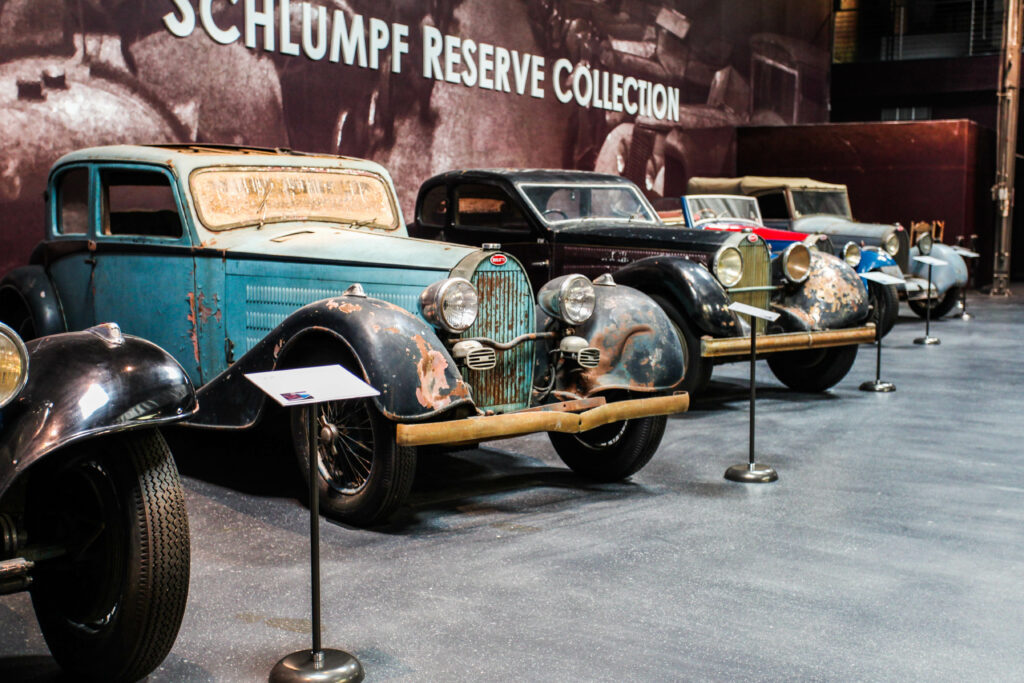
Original unrestored Bugattis from the “Shakespeare Collection” on display at the Mullin Automotive Museum in Oxnard, Calif.
The 80,000-square-foot museum comprises 400 of the world’s rarest, most magnificent, and most valuable cars — including around 100 Bugatti models, such as two of just six Type 41 Royales ever built. One of them is the former Shakespeare vehicle with the Park Ward bodywork.
The Mullin Automotive Museum
Other models from the group of 30 vehicles are to be found in their original unrestored condition at the Mullin Automotive Museum in Oxnard, Calif. There and in Alsace, visitors can admire them after their almost 60-year odyssey.
Note: The Mullin Automotive Museum in Oxnard, Calif., is open by appointment only. Learn more at www.mullinautomotivemuseum.com or email info@mullinautomotivemuseum.com
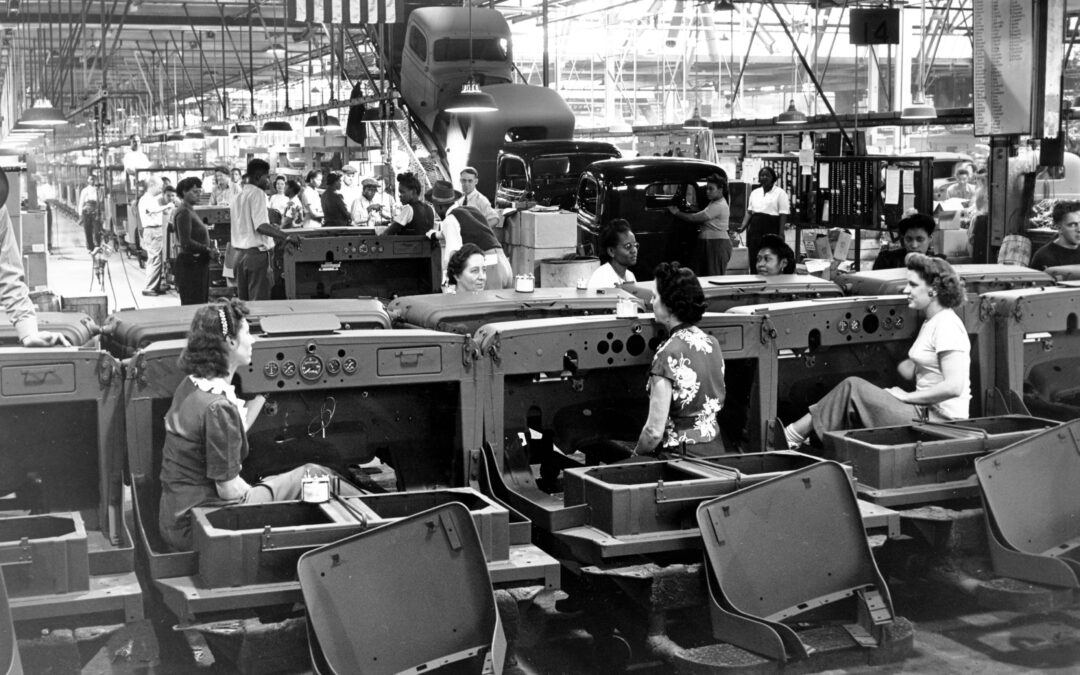
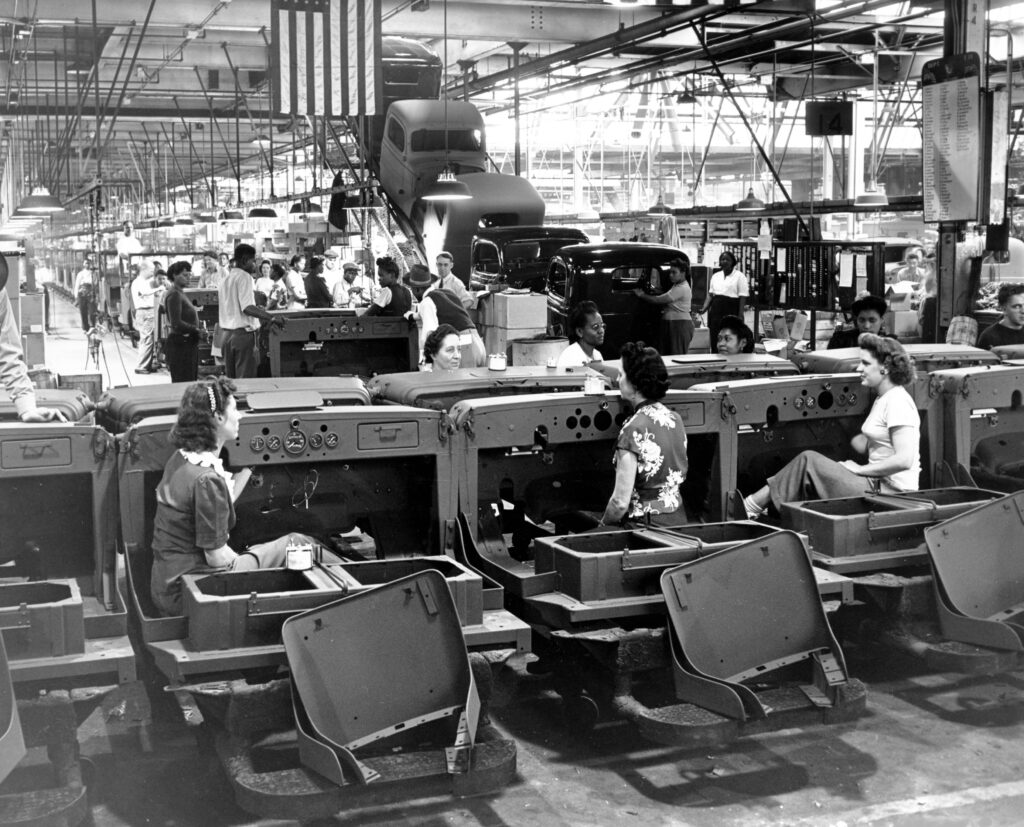
This image shows the interior of the Chrysler Group Truck Assembly Plant in the 1940s.
American women entered the workforce in unprecedented numbers during World War II, as widespread male enlistment left gaping holes in the industrial labor force. Between 1940 and 1945, the female percentage of the U.S. workforce increased from 27 percent to nearly 37 percent, and by 1945 nearly one out of every four married woman worked outside the home.
While many new-vehicle introductions are being delayed amid COVID-19 restrictions (including Corvette and Mustang Mach-E), GMC postponed the debut of its electric Hummer and Lincoln pulled the plug on a partnership with Rivian to develop a luxury electric pickup.
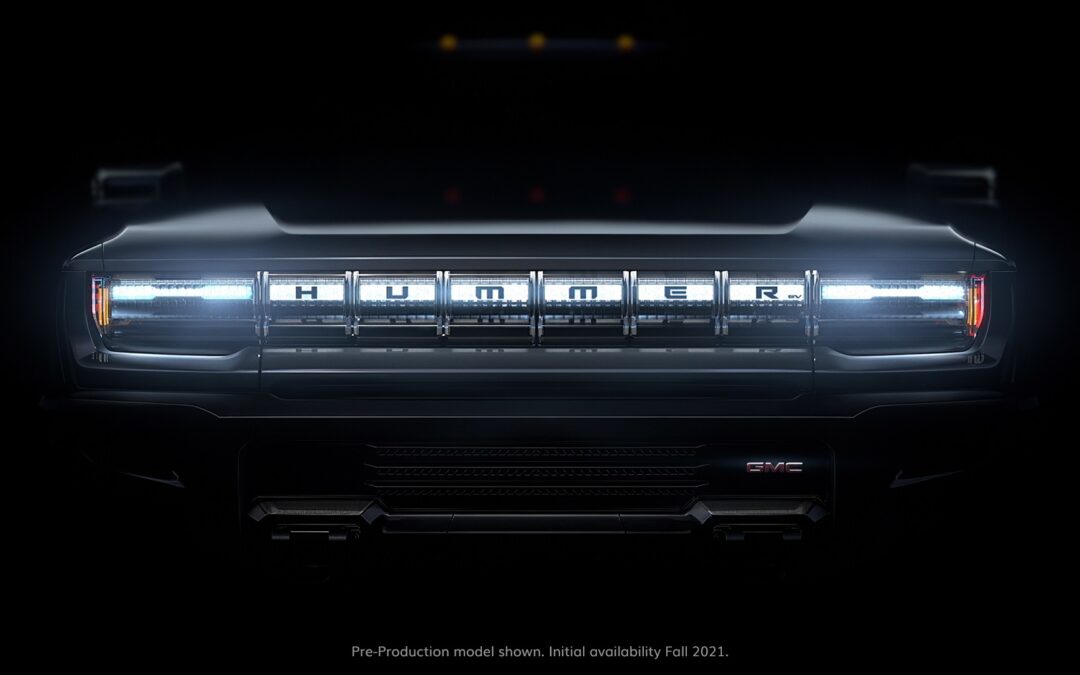
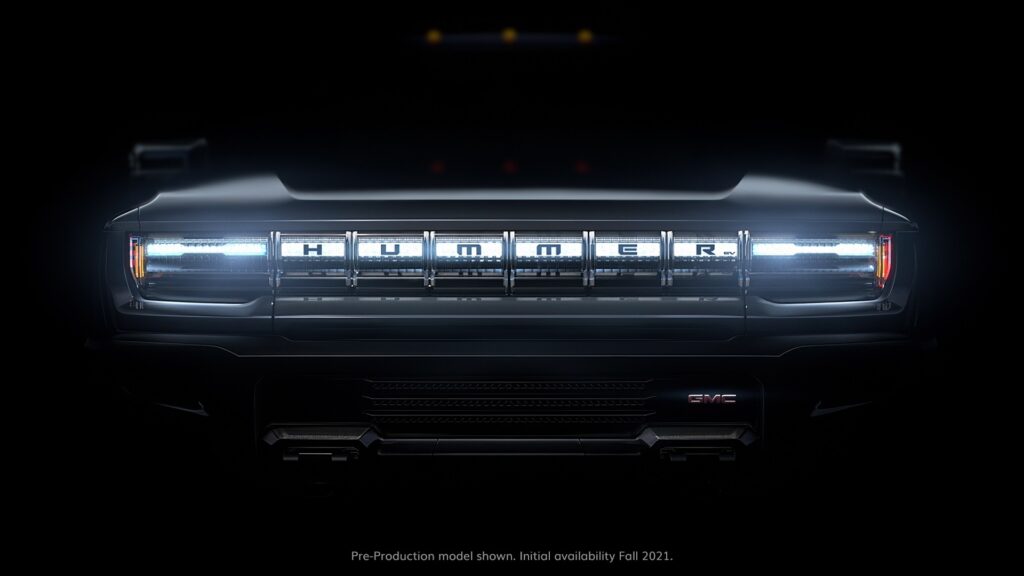
GMC announced today (April 29) that its Hummer EV reveal will be postponed from a May 20 dealer meeting in Las Vegas. In a release, GMC wrote: “While we cannot wait to show the GMC HUMMER EV to the world, we will reschedule the May 20 reveal date. In the meantime, the team’s development work continues on track and undeterred. We invite all to stay tuned for more stories on this super truck’s incredible capability leading up to its official debut. More information is available at www.gmc.com/HummerEV.
According to a report by Richard Truett in Automotive News, a spokesman said GM will look at all options, including a virtual event, when it reschedules the reveal “as the pandemic continues to affect all parts of business.”
“GM plans to build the Hummer at its Detroit-Hamtramck Assembly plant, which was being retooled to become GM’s EV manufacturing hub. Construction has been put on hold to comply with Michigan’s stay-at-home order. It’s unclear when the project will resume, but Michigan’s governor is planning to allow construction activities to resume in the state May 7.
“With GM’s designers and engineers unable to go to work at GM’s Tech Center in Warren, Mich., most development work has stopped. But GM says the Hummer pickup will go on sale in late 2021 as planned.”
Lincoln cancels Rivian EV partnership
And worse, Lincoln sent out a release on Tuesday, April 28 that it has shelved plans to develop an electric pickup with Rivian.
In the release, Lincoln said: “Given the current environment, Lincoln and Rivian have decided not to pursue the development of a fully electric vehicle based on Rivian’s skateboard platform. Ford Motor Company’s strategic commitment to Lincoln, Rivian and electrification remains unchanged and Lincoln’s future plans will include an all-electric vehicle consistent with its Quiet Flight DNA.”
According to a report by Michael Martinez in Automotive News: “Lincoln said it was still committed to its partnership with Rivian and would continue to work with the EV startup ‘on an alternative vehicle based on Rivian’s skateboard platform.’
“Ford Motor invested $500 million in Rivian last year.”
It was Jan. 29, 2020, when Lincoln shared news of the Rivian partnership to develop an all-new electric vehicle previously announced as part of Ford Motor Co.’s original investment in Rivian.
“Lincoln’s first fully electric vehicle will join the Aviator and Corsair Grand Touring plug-in hybrid vehicles, further solidifying Lincoln’s commitment to electrification,” Joy Falotico, president, The Lincoln Motor Co., said in the statement. “The zero-emissions vehicle will feature connected and intuitive technologies designed to create an effortless experience for Lincoln clients.
“Working with Rivian marks a pivotal point for Lincoln as we move toward a future that includes fully electric vehicles,” said Falotico. “This vehicle will take Quiet Flight to a new place – zero emissions, effortless performance and connected and intuitive technology. It’s going to be stunning.”
The Lincoln battery electric vehicle was to be built off of Rivian’s flexible skateboard platform. It was part of Ford’s previously announced investment of more than $11.5 billion into electrification, which includes the Mustang Mach-E and a fully electric version of the best-selling F-150 pickup.
“Our vehicle development partnership with Ford is an exciting opportunity to pair our technology with Lincoln’s vision for innovation and refinement. We are proud to collaborate on Lincoln’s first fully electric vehicle,” said Rivian CEO RJ Scaringe.
The compact-class Corsair is sold in Standard and Reserve models with starting prices of $37,000-$50,000. (Lincoln)
There cannot be two fraternal twin compact SUV crossovers that are so dramatically different than the Ford Escape and Lincoln Corsair, today’s tester. Both models
have been redesigned for 2020 and both are far more competitive than their predecessors.
But while the more utilitarian Ford doesn’t stretch any expectations, the Lincoln
does.
The Corsair has
the power, the presence and the appearance of a hand-crafted interior to slice
into the luxury competition. But its biggest nick in the blade is a high price.
As Lincoln’s
smallest SUV, the Corsair replaces the MKC and joins the midsize Nautilus,
three-row Aviator and big Navigator, all recently redesigned and renamed.
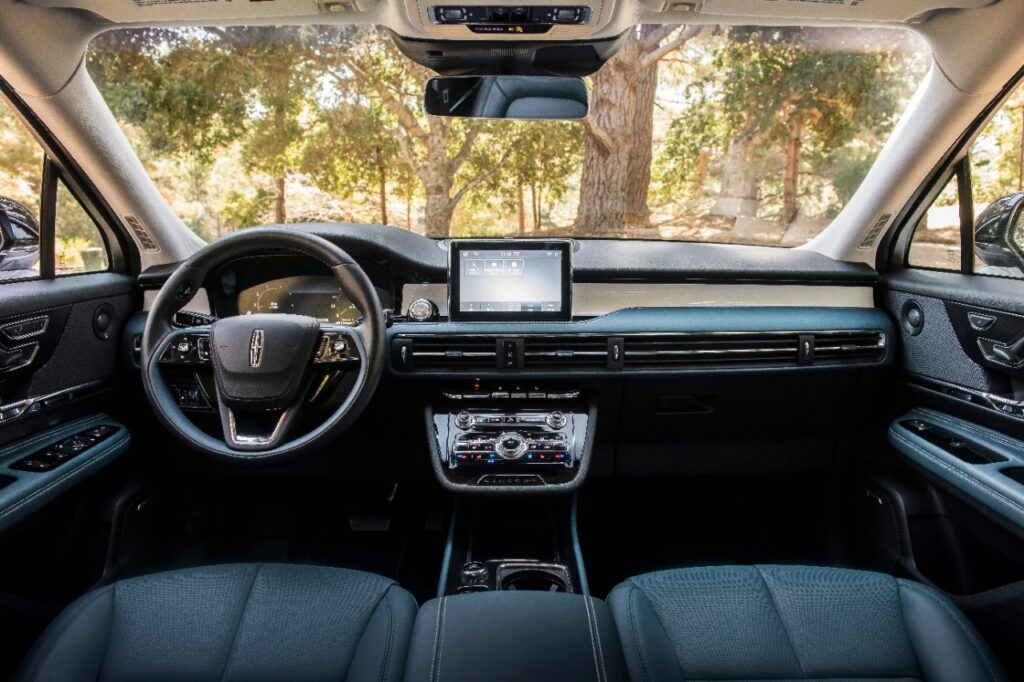
There is engaging and restrained use of chrome, piano black and metallic trim elements — and no burl walnut. (Lincoln)
The luxury competitors are many, including the Acura RDX, Alfa Romeo Stelvio, Audi Q5, BMW X3, Cadillac XT4, Lexus NX and Mercedes-Benz GLC.
The Corsair is sold
in Standard and Reserve models with a choice two turbocharged and direct
injected four-cylinder engines and an eight-speed automatic transmission. (A Grand Touring plug-in hybrid, with an estimated
25 miles of battery driving, goes on sale this summer.)
Headroom is functional at 38.7 inches with the panoramic vista roof and maximum legroom is long at 42.3 inches. (Lincoln)
The Standard front-wheel
drive model is only offered with the 250-horsepower, 2.0-liter engine and can
be optioned with automatic all-wheel drive for $2,200. Pricing starts at $36,940,
including the $995 freight charge from Louisville, Ky.
The Reserve, standard with AWD and the 2.0-liter engine, can upgraded to the 295-hp, 2.3-liter four-cylinder. Pricing starts at $43,625 with 2.0-liter engine or $50,365 with the 2.3-liter, which includes the Reserve 1 technology package of Co-Pilot360 Plus package and the Elements package (including ventilated front seats, heated back seats, heated steering wheel). Co-Pilot360 Plus package includes adaptive cruise control with traffic-jam assist (and lane centering, speed sign recognition and stop-and-go), 360-degree camera (with front camera washer), front sensing system, evasive steering assist, reverse brake assist and active park assist plus.
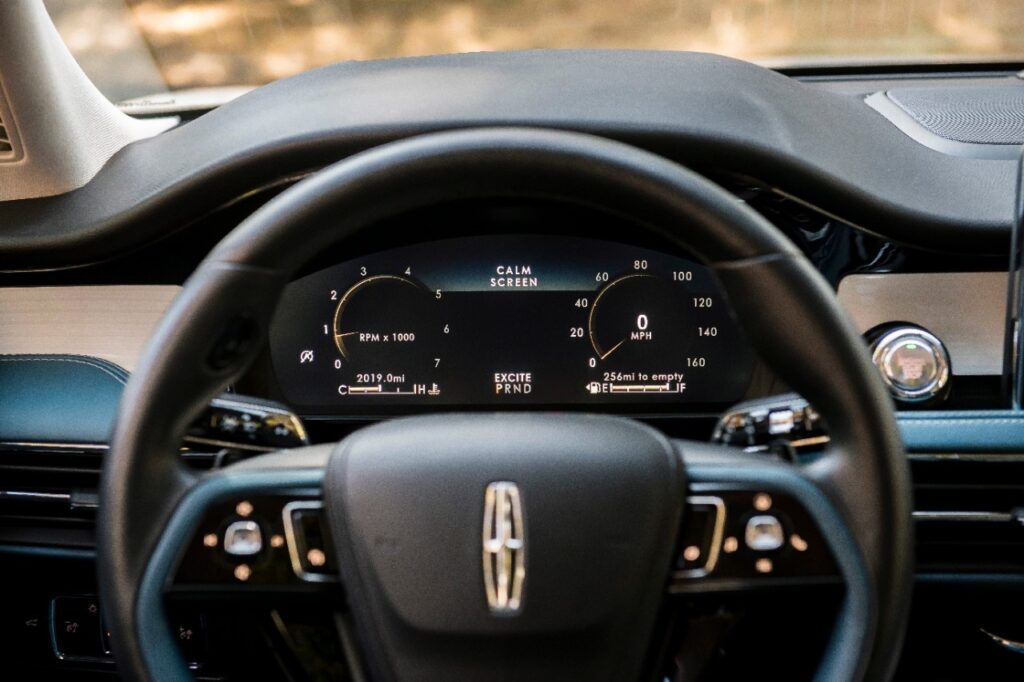
Five performance modes are named with Lincoln’s euphemistic enthusiasm of Normal, Excite, Slippery, Deep Conditions and Conserve. (Lincoln)
A sweet perk is
4 years and 50,000 miles of warranty coverage with pickup and delivery
for service.
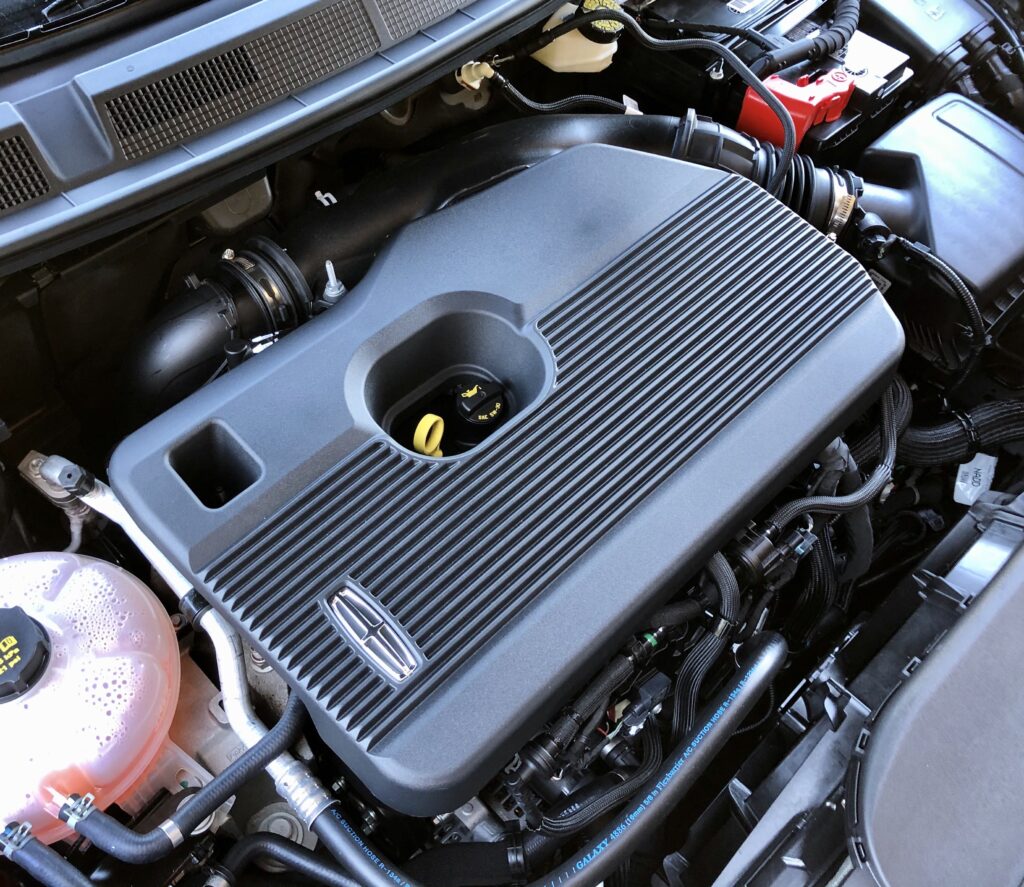
POWER I appreciated the ready power of the 2.3-liter four-cylinder. It easily motivates the curb weight of 3,851 pounds, from takeoff to guarding your space in the commute.
Fuel economy might
be hopeful at 21 mpg city, 28 highway and 24 mpg combined, on 87 octane. I
could only achieve the low- to mid-20s in a week of testing, but I don’t expect
owners will have regrets because the Corsair makes up for mileage in other
areas.
The 2.0 engine doesn’t offer much mileage incentive, with front-drive ratings of 22/29/25 mpg combined with AWD at 21/29/24 mpg.
The 2.3-liter turbocharged four-cylinder easily motivates the curb weight of 3,851 pounds, from takeoff to guarding your space in the commute. (Mark Maynard)
The eight-speed
automatic can at times feel unsteady in rolling out shifts, mostly at light or moderate
acceleration. And some of that might be in providing the varied performance in the
five drive modes, named with Lincoln’s euphemistic enthusiasm of Normal,
Excite, Slippery, Deep Conditions and Conserve.
I preferred the Normal setting because Excite was just a little too jerky unless driving hard; it increases pedal response and stiffens the suspension for handling and control.
The adaptive
air suspension provides competitive cornering. And city driving is quite civil,
without much head toss as the air springs dip to comfortably transition speed
bumps and steep driveways.
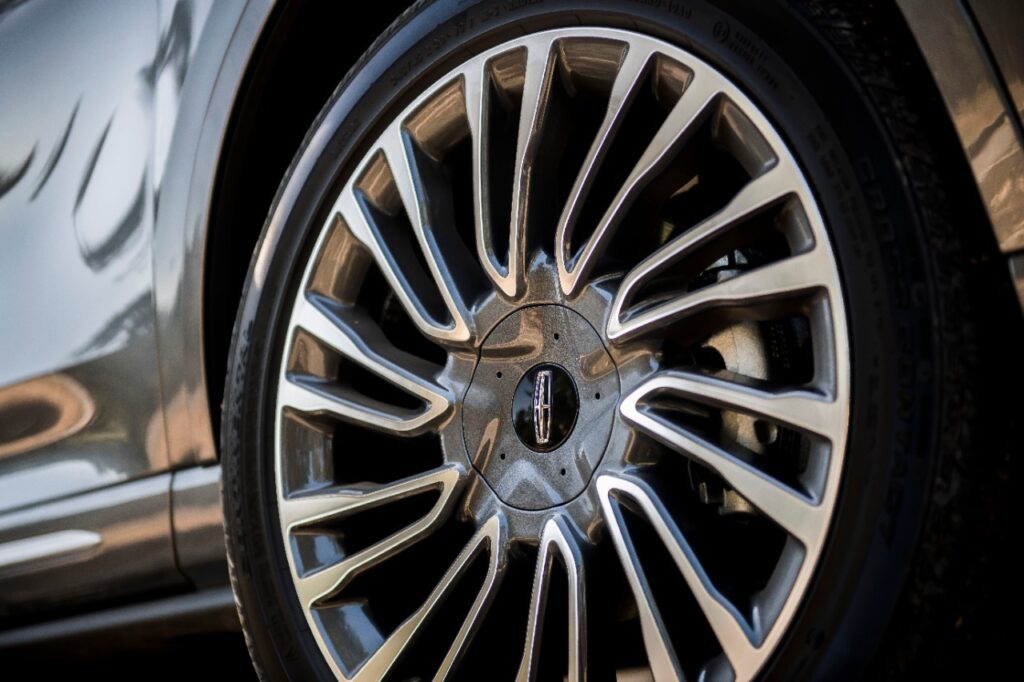
20-inch ultra-bright machined aluminum wheels are $1,150 upgrade. (Lincoln)
The CoPilot360 Plus system for semi-autonomous driving provides precision lane centering and was not prone to random cancelling due to sunlight glare or road-marking conditions. The other driver-assist and warning systems worked subtly and without frightening alerts to potential danger.
Braking is confident from 12.1-inch vented front discs and 11.9-inch solid rear discs.
TThe automatic all-wheel-drive system requires no driver input and with a disconnect feature, switches automatically from front- to all-wheel drive in response to road, speed, temperature and other conditions.
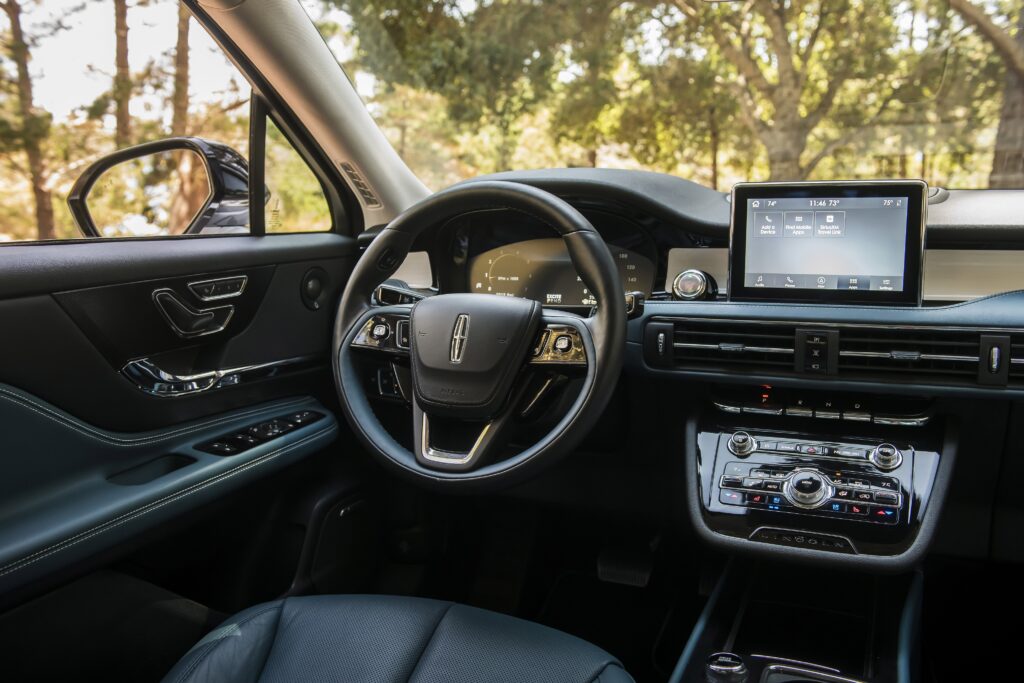
CABIN Lincoln tried to build a sanctuary in the cabin, and succeeded. There is engaging and restrained use of chrome, piano black and metallic trim elements — and no burl walnut. There is a reassuring feel of quality to the action of switches, door closings and the Bridge of Weir leather-trimmed upholstery.
With laminated windshield and side glass, dual-wall dashboard, acoustic underbody panels, wheel-arch liners and a noise-cancelling audio function, the cabin is not vault-like quiet, but the decibel count is luxury class whether driving 35 or 65 mph. Even tire noise or harshness from the 20-inch Continental Cross Contact tires was not objectionable.
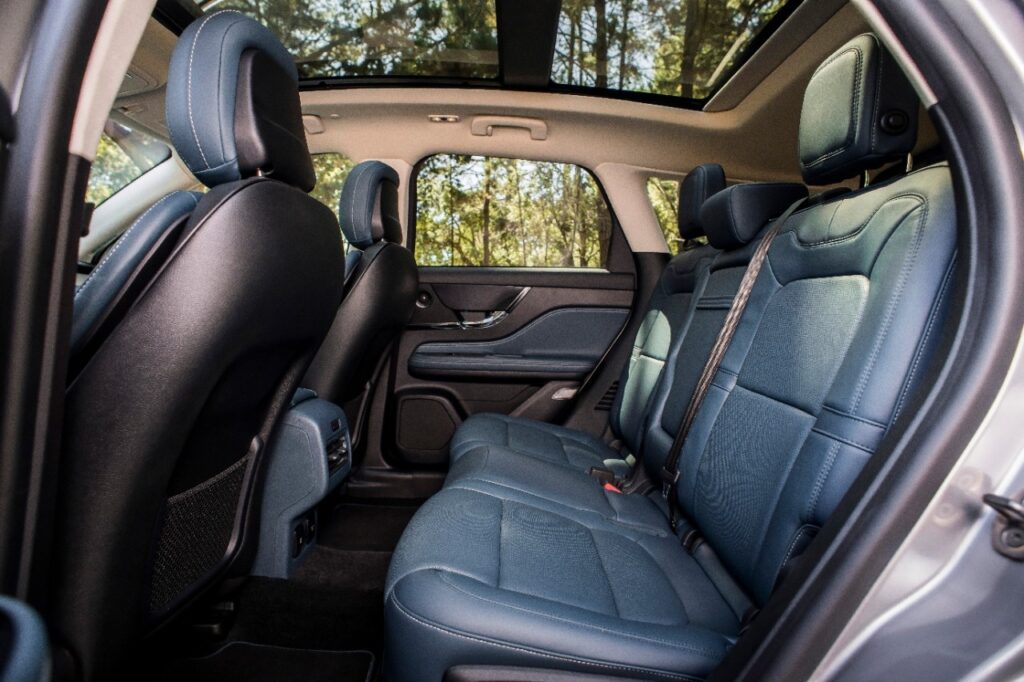
The back seat is reasonably comfortable for adults, but with the benefit of about 6 inches of fore-aft slide and seatback recline. (Lincoln)
As a compact-class vehicle, Lincoln has carved out comfortable interior space. Headroom is functional at 38.7 inches with the panoramic vista roof and maximum legroom is long at 42.3 inches. Sightlines are not compromised, though the rear glass is narrow. The tester’s optional 360-degree view camera is helpful in being able to see how badly centered you are in a parking slot or how close you parked to the garage door.
The array of driver
controls and an 8-inch touch screen display are not as difficult to master as
might seem at first view. And the 24-way Perfect Position seats should adjust for
most sizes, but the upper side bolsters might cramp large bodies.
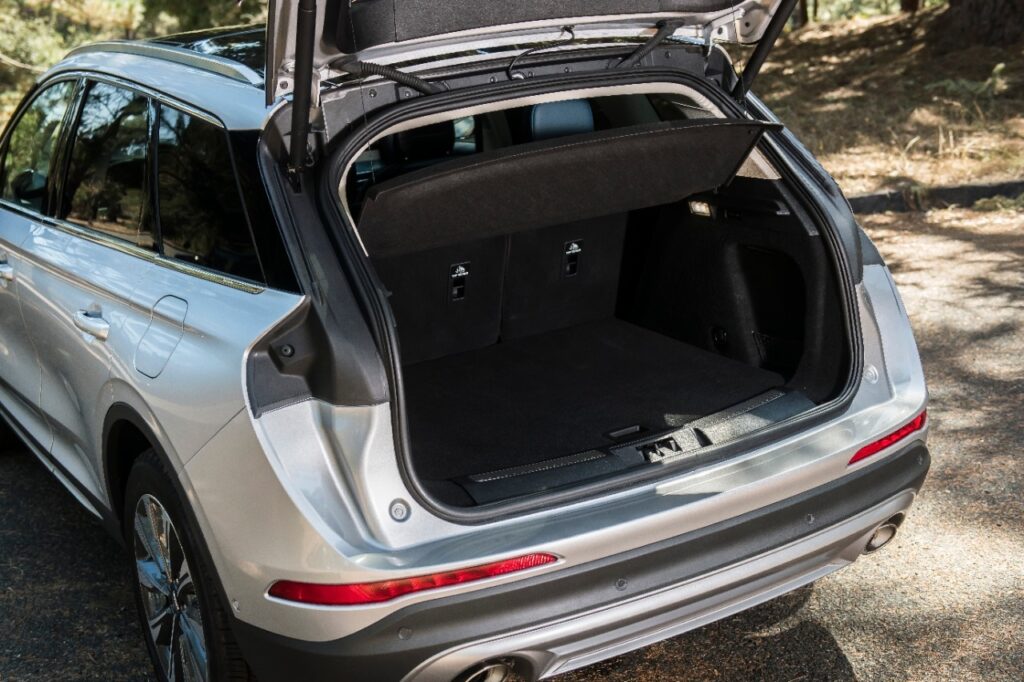
The cargo space is squared off with a wide opening of 43 inches and 33 inches to the seatback. Fold the 60/40 seats for about 5 1/2 feet of length. (Lincoln)
There seem to be no overlooked conveniences, including headlights that turn with the steering wheel, wireless charging, four USBs, keyless locking and push-button ignition, 14-speaker Revel audio system, 4G Wi-Fi, infotainment apps and approach and departure lighting (including the Lincoln logo beamed downward at the side mirrors).
Safety features
include eight air bags, blind-spot detection and precollision assist with
automatic emergency braking.
Another Lincoln signature (gimmick) are six symphonic chimes — replacing standard electronic alerts — for everything from an open fuel door to an unbuckled seat belt. The chimes, recorded by the Detroit Symphony Orchestra, add another layer to the calming soundscape of the cabin, Lincoln says.
BACK SEAT AND CARGO The back seat is reasonably comfortable for adults, but with the benefit of about 6 inches of fore-aft slide and seatback recline. The window seats are heated and he lowish transmission tunnel helps center position footroom. There are two USBs for charging and a 110-volt plug with wimpy 100-watt power.
The cargo space is squared off with a wide opening of 43 inches and 33 inches to the seatback. Fold the 60/40 seats for about 5 1/2 feet of length. Total space ranges from 27.6 cubic feet (packed to the ceiling) to 57.6 cu. ft. with seats folded.
The Corsair is
surprisingly well done throughout — and it needed to be. As a bellwether for
the brand, it will attract a new level of buyers seeking midprice luxury.
At $60,000
as-tested, buyers won’t like the price, but they will like their Corsair.
A sweet perk of ownership is 4 years and 50,000 miles of warranty coverage with pickup and delivery for service. (Lincoln)
2020 Lincoln Corsair AWD Reserve Body style: compact, 5-seat, 5-door SUV crossover with AWD Engine: 295-hp, turbocharged and direct-injection 2.3-liter 4-cylinder; 310 lb.-ft. torque at 3,000 rpm Transmission: 8-speed automatic Fuel economy: 21/28/24 mpg city/hwy/combined; 87 octane
SPECIFICATIONS Fuel tank: 16.2 gal. Cargo space: 27.6 to 57.6 cu. ft. Front head/leg room: 38.7*/43.2 in. *w/panoramic roof Rear head/leg room: 38.7/38.6 in. Length/wheelbase: 180.6/106.7 in. Curb weight: 3,851 lbs. Turning circle: 37.1 ft.
FEATURES Standard equipment includes: smart-key entry and push-button ignition, Lincoln Co-Pilot360 driver-assist technologies, Bridge of Weir leather-trimmed upholstery, 24-way power adjustable front seats, electric parking brake, rearview camera, panoramic vista roof, heated and foldable side mirrors, LED headlights-taillights-fog-running lights, 8-inch touch screen for infotainment and navigation, heated front seats, active noise control with laminated windshield and side door glass, front and rear floor mats, Lincoln Connect and Lincoln Way App, illuminated door-sill plates, power steering column, hands-free liftgate, 19-inch wheels and all-season Continental tires, approach and exit lighting
Safety features include: 8 air bags, blind-spot detection, precollision assist with automatic emergency braking, roll-stability control
PRICING Base price: $50,365, including $995 freight charge; price as tested $59,660 Options on test vehicle: Flight Blue paint $695; 20-inch wheels and 245/45 all-season tires $1,150; head-up display $1,700; Equipment group Reserve II $11,540 (including Co-Pilot360 Plus, Perfect Position 24-way power seats, adaptive suspension Where assembled: Louisville, Ky. Warranty: 4-years/50,000-miles bumper to bumper including pickup and delivery for service; 6-years/70,000-miles powertrain