The redesigned 2020 Subaru Outback has been youth-enized for the modern family

The new top-line Outback Onyx Edition XT, with 260-hp, turbocharged, 2.4-liter flat four-cylinder starts at $35,905. (Photos courtesy of Subaru)
The Subaru Outback has long been an automotive icon of independence and self-reliance — and for 2020 it gets a little nicer, a little larger and more powerful in its complete redesign. The Outback pioneered the concept of a raised all-wheel-drive wagon for adventurous trail riding. Subaru considers it an SUV, but rather than a truck-influenced utility vehicle, this fortified wagon is a pinnacle of simplicity and usability.
Most of the updates put more shine on what has been a very smartly designed vehicle. But the Outback is layered with details for long-term enjoyment, including a front-view camera, D-I-Y access to check vital engine fluids and a dedicated cargo compartment to stow the roller cover.

The driver area is smartly arranged with unobstructed sightlines.
Overview of the 2020 Outback
You might not recognize the sixth-generation 2020 Outback from its familiar styling, which makes it look a little more SUV-like than a raised wagon. It might look like an off-road adventurer, but it is just as rewarding in the busted-up infrastructure of urban survival.
The footprint is about the same as its predecessor, but it is 1.4 inches longer on the same 108.1-inch wheelbase. The cabin is a half-inch wider, but the front headroom was shaved by a half-inch, now at 37.7 inches with the moonroof or 40.1 inches without. The front legroom is a click shorter but still long at 42.9 inches. Overall, the proportions added 10 to 35 pounds, depending on the model.
Total interior volume grew by 1.1 cubic feet, which is especially appreciated in the back seat where legroom grew by almost an inch and a half to 39.5 inches. Cargo space behind the back seat is smaller by 3 cubic feet but still generously proportioned at 32.5 cu. ft. — however, the space actually grew by 2.4 cubic feet with both seats folded.

The 11.6-inch vertical tablet is a hub of colorful access, but it is prone to glare.
Pricing
Sold in five all-wheel-drive trim levels with two engine choices and a continuously variable automatic transmission. Starting prices range from $29,905 to $38,355 for the base, Premium, Limited and Touring models, all with the 182-horsepower, 2.5-liter flat four-cylinder engine.
The new top-line Onyx Edition XT (today’s tester) with the 260-hp, turbocharged, 2.4-liter flat four-cylinder starts at $35,905; all MSRPs includes the $1,010 freight charge from Indiana. The tester, a reasonable $37,750, included the only available option package, $1,845, for the Starlink infotainment system with an 11.6-inch multimedia navigation system, power moonroof, and reverse automatic braking.
Check the latest pricing and incentives here.
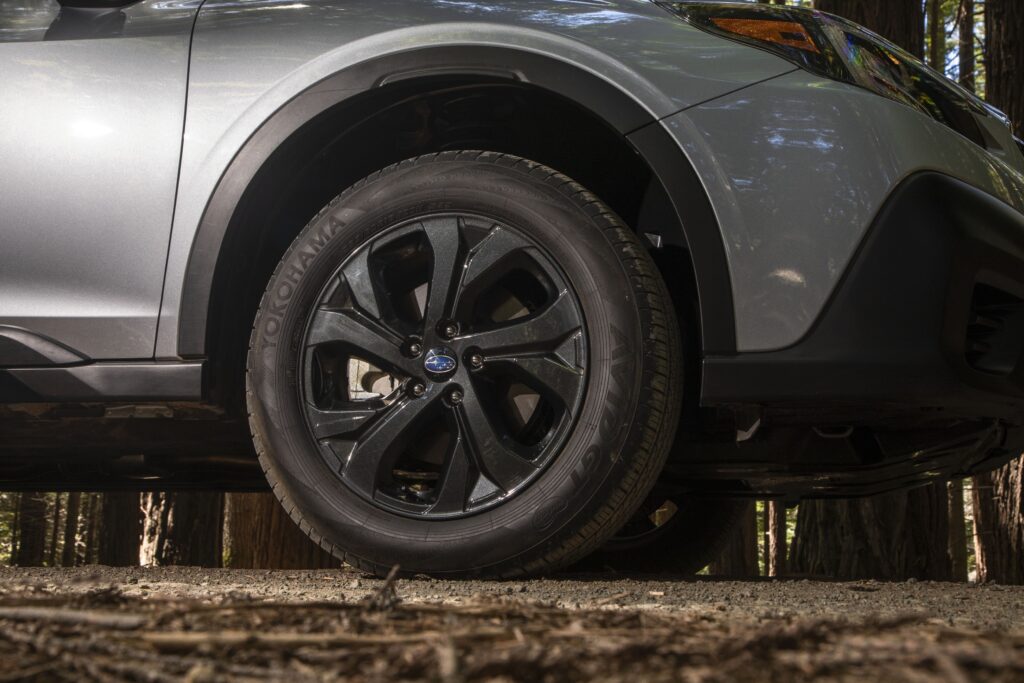
Onyx Edition XT has substantial Yokohama 225/60 18-inch tires and a full-size spare.
Performance
The new turbocharged, 260-hp 2.4-liter engine replaces a 265-hp, 3.6-liter V-6 and adds improved fuel economy. With 277 foot-pounds of torque from 2,000-4,000 rpm, the XT engine has mileage ratings of 23 mpg city, 30 highway and 26 mpg combined.

The new turbocharged, 260-hp 2.4-liter engine improved fuel economy

Vital powertrain fluids are conveniently grouped and identified in the engine bay. Even the oil filter is positioned at the top of the engine and easily changed.
The base engine has ratings of 26/33/29 mpg city/highway/combined and both engines run on regular unleaded.
For do-it-yourselfers, all vital fluids are conveniently grouped and identified in the engine bay. Even the oil filter is positioned at the top of the engine and easily changed.
The power-assisted four-wheel disc brakes engage smoothly with vented discs all around, 12.4-inches at the front with dual-piston calipers and 11.8-inch discs rear with single-piston calipers. The vented rotors will provide cooling benefits when towing. Base models can pull up to 2,700 pounds and the XT is rated for 3,500 lbs.
Subaru Outback Safety Features
Standard on all trims is Subaru’s EyeSight Driver Assist Technology that now includes advanced adaptive cruise control with lane centering. The system will provide steering assist when the vehicle veers outside its lane. Subaru’s system keeps the Outback well centered gives more fluid steering corrections than some, but always use two hands on the wheel.
Subaru’s DriverFocus Distraction Mitigation System uses an infrared camera and facial recognition technology to monitor signs of driver fatigue or distraction. You’ll know it is working when you hear the subtle pings and see a warning light on the driver-info screen.
Subaru’s full-time four-wheel-drive system, usually a 60/40 power split between the front and rear axles, moves torque to the wheels that have grip and away from the ones that are starting to slip. When sensors in the system detect a slipping wheel (in less than a revolution of that wheel), the power is redirected from the slipping wheel to wheels that still have traction. It is an invisible action and requires no driver engagement.

All Outback models have LED headlights, high and low beam.
Ride and Handling
Turbocharged power is welcome, but it would be more vital with a traditional, stepped automatic transmission that might respond more fluidly and quickly. At times the performance felt resistant to wasteful fuel usage, but when urgent demand is made through the accelerator, the boost can be an unexpectedly loud rush with just moderate force. It’s like pushing through the paywall until you hit the power switch, though the power surge is less noticeable in around-town driving. With the 18.5-gallon tank some mindful drivers could expect a range of nearly 600 miles.
The Outback’s global platform feels robust and solid with a ride quality that is comfortably compliant but capable enough for tooling through backcountry curves. The 18-inch Yokohama Avid GT tires (225/60) have a substantial sidewall for off-road cushioning, which is just as beneficial on-road. And the Onyx Edition XT has a full-size spare wheel and tire — a requirement for off-roading safety.

There is carlike comfort to the back-seat area with long legroom.
Interior Function
Inside, the cabin is well soundproofed with a sound-insulated windshield and side glass. But the raised ride height and substantial roof rack and crossbars generate some ambient noise at highway speeds.
The driver area is smartly arranged with unobstructed sightlines at the side mirrors and over the shoulder. The white-on-black dual gauge array has a driver-info panel between the dials for the digital speedometer, radio-media, fuel economy, etc.
The shifter console is compact but with an e-bin and two 2.1-amp charging USBs and wireless charging. Sliding visors have covered and well-lighted mirrors.
Base models have fabric upholstery or leather for the upper trim levels. But the Onyx Edition has Subaru’s water repellent StarTex upholstery, which is leather-like in appearance. The two-tone gray treatment is appealing with reserved use of satin metallic and chrome trim.
Front-view camera
One of my favorite features was the front-view camera. It is very helpful when off-roading or steering into a parking slot.
The big 11.6-inch vertical tablet seems like a great idea, too, but it is a two-edge paper cut. It is helpful as a plug-and-play element for manufacturers, which simplifies the grouping of cabin controls in a user-familiar iPad-like format.
Except for stand-alone knobs for radio volume and station selection, the remainder of the controls are accessed by a two-tap touch-screen process. This action will take eyes from the road until the format is mastered. And even then, some often-used features, like the seat heaters, are a deeper dive.
The big tablet display will at first seem like an overwhelming puzzle of colors and zones. And it is also prone to sunlight glare. (Base models have a simpler two-screen setup.)
The step-in height is hip-high and easy to maneuver without over-bolstered seat sides or bottoms to slide across.

The cargo area has eight tie-downs rather than the usual four.
Back Seat and Cargo Area
There is carlike comfort to the back-seat area with adult-size seating and long legroom. The broad fold-down armrest has a pair of cup holders and there are two more 2.1-amp charging USBs. There is no seatback recline, which parents value for sleeping youngsters, but dozing grown-ups should be quite comfortable.
The square cargo area has eight tie-downs rather than the usual four, with upper and lower anchor points. The deep space has seatback releases, corner nooks, and dedicated basement space to stow the roller cover when not needed. The liftgate opening is 44 inches wide by 29 inches tall at the entry opening. Fold the seatbacks for up to 7 feet of length, which means car camping is very doable.
Why Buy the Subaru Outback?
Once a symbol of modern maturity, Subaru has youth-enized the 2020 Outback for the modern family.

The Subaru is an eager off-road adventurer, but it is also at home on the broken pavement of the city.
2020 Subaru Outback Onyx Edition
• Body style: compact, 5-seat, 5-door raised wagon SUV
• Engine: 260-hp, turbocharged and direct-injected 2.4-liter 4-cylinder; 277 lb.-ft. torque from 2,000-4,000 rpm
• Transmission: High-torque Lineartronic CVT with 8-speed manual mode and steering wheel paddle shift
• Fuel economy: 23/30/26 mpg city/hwy/combined ;87 octane
• Tow capacity: 3,500 lbs., with 350-lb. trailer tongue weight
BY THE NUMBERS
Fuel tank: 18.5 galLONS
Cargo space: 32.5-75.7 cu. ft.
Front head/leg room: 37.7*/42.8 in. *40.1 in. without moonroof
Rear head/leg room: 39.1/39.5 in.
Length/wheelbase: 191.3/108.1 in
Curb weight: 3,884 lbs.
Turning circle: 36.1 ft.
FEATURES
Standard Onyx XT equipment includes: smart-key locking with push-button ignition, 11.6-inch HD multimedia tablet display, Wi-Fi hot spot, StarTex upholstery in gray two-tone interior, 10-way power (heated) driver seat, 8-way power (heated) front passenger seat, heated steering wheel, heated side mirrors and wiper de-icer), rearview and front-view cameras, insulated front door glass, full-size spare tire and wheel, four 2.1-amp USB ports, Starlink infotainment with touch screen, Apple CarPlay or Android Auto, a hands-free power liftgate, and LED headlights (high and low beams)
Safety features include: 8 air bags, EyeSight driver-assist technologies with advanced adaptive cruise control with lane centering, precollision braking, lane-departure, and sway warnings, brake assist
PRICING
• Base price: $35,905, including $1,010 freight charge; price as tested $37,750
• Options on test vehicle: Moonroof-Nav-RAB $1,845
• Where assembled: Indiana