Select Page

New car test: Hyundai Genesis 5.0 R-Spec – 429 hp bargain sport sedan

New car test: Hyundai Genesis 5.0 R-Spec – 429 hp bargain sport sedan

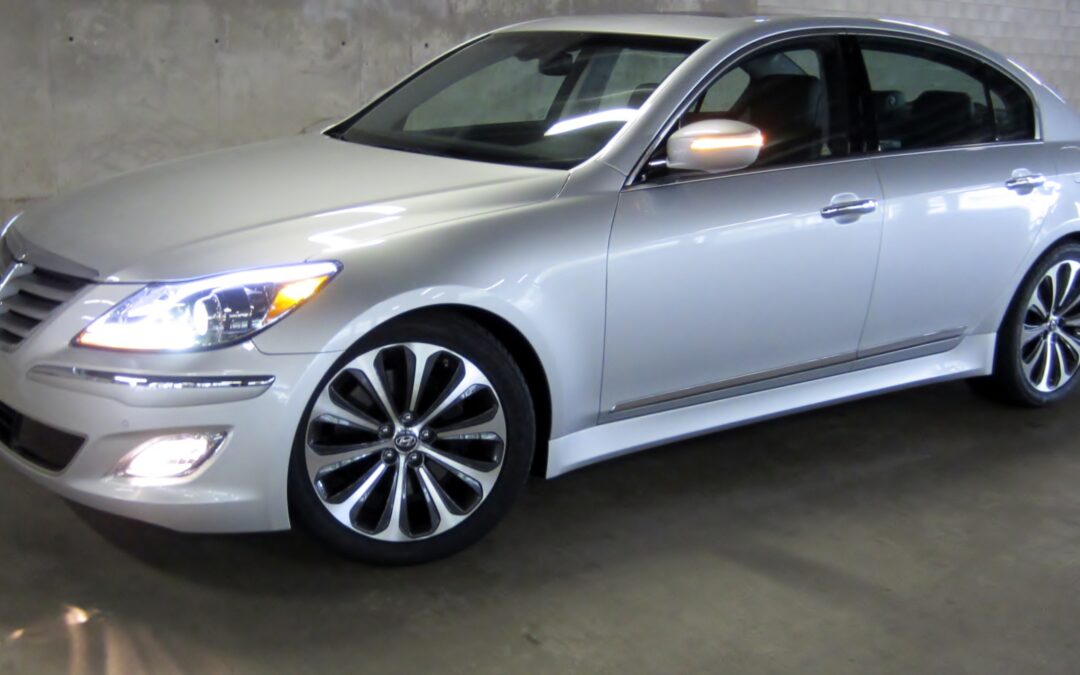
The 429-hp, Hyundai Genesis 5.0 R-Spec sedan is a halo model with global aspirations, but this car is no angel.

The 5.0 R-Spec has a tuned suspension that feels like BMW; it has the commanding substance of Mercedes-Benz; and the millimeter-tight assembly for which Lexus is known.

To these positive similarities, the Genesis adds a big, booming presence that is unique to this car. It is a collection of advanced Hyundai engineering, of which only Genesis owners are aware. The 5.0 R-Spec is an engaging sport sedan, but not a threat or comparison to cars from BMW M, Mercedes’ AMG or Audi’s S line.

You will like Hyundai’s sport treatment if you lease a sedan but want added style and performance without voiding the warranty.

And while the Hyundai Genesis may be the most unrecognized sedan on the highway, it is also the biggest full-size bargain, too. The Genesis line starts with the 333-hp, 3.8-liter V-6 and moves up to the 385-hp, 4.6-liter V-8 and on to the 5.0 R-Spec. Base pricing starts at $35,050, $45,350 and $47,350. The test car was $47,385, with just one option for a $35 iPod cable.

That additional $10,000 to $16,000 buys a badge of renown, when the Genesis doesn’t even have a badge in the grille. But what it does have, the owners will brag about.

For a gallery of the Genesis 5.0 R-Spec http://veh.cl/31w

5.0 R-Spec is a comfortable step up in performance and style

The 429-hp, Hyundai Genesis 5.0 R-Spec is a bargain sport sedan that exceeds expectations in almost all ways. Pricing starts at $47,350, but the standard equipment list includes just about everything, except an iPod cable.

R-Spec features include a navigation system, moonroof, proximity key lock/unlock and push-button starting, Lexicon 17-speaker audio system, headlights with dark chrome inserts, perforated heated and cooled front seats, heated rear seats, embroidered floor mats and three paint colors Black Noir, Titanium Gray, and Platinum Metallic, each with black leather interior and black leather, multifunction steering wheel.

Competitors such as the entry-level, six-cylinder versions of the Mercedes-Benz E-Class or BMW 5-Series have starting prices of $51,365 and $45,925, respectively.

The exterior styling is “traditional” and won’t offend, but the interior dimensions are excellent: Front headroom is a little more than 40 inches and front legroom is long at 44.3 inches. The raised back seats are richly comfortable and rear legroom is limo-like at 38.6 inches.

The interior is contemporary and upscale with no stodgy, dark wood trim. The R-Spec’s ultra-leather treatment is tender to the touch and aromatic as a tack room of English saddles.

Sightlines are good even without the rearview camera and the advanced tech features assist without interfering: Lane departure warning, smart cruise control.

Slam the doors, rock the throttle and let the R-Spec’s 429-horses run. The response isn’t what you might expect of this Korean carmaker. The aluminum, 5.0-liter V-8 is highly engineered with direct injection and the other usual, power-enhancing suspects, including dual continuously variable valve timing.

Wield this rear-drive ax through a corner, and it brings a smile – not that it could do it, but that it does it so well. Ride quality is firm but not harsh and it performs well on all surfaces. Bridgestone Potenza S-04 Pole Position summer rubber on 19-inch wheels gives a hefty stance. And behind them are 13.6-inch vented, four-piston front discs at the front and 12.4-inch, four-pot solid discs rear.

With an eight-speed Shiftronic transmission, fuel economy on the highway is a respectable 25 mpg on premium fuel, which is required for peak performance. The Genesis matches or beats the mpg of the competition and it has more power.

The transmission has a manual shift-gate, which sharpens performance to a Sport mode. But there is no dedicated Sport mode to enjoy the quickened pace. The quicker response is available only in the manual shift mode. The standard Drive setting isn’t dull, but at times when the hammer goes down, there’s a long second of communication before the engine clears its throat and roars.

The 5.0 R-spec is a hunk of power, but it is well executed for American-class comfort and drivability.
Hail ICON! Bosch storm blades are a wiper revolution

Hail ICON! Bosch storm blades are a wiper revolution

Windshield wipers have been a final frontier in automotive advancement until the fairly recent innovation of the flat-blade, beam-type blades. The age-old, steel-frame architecture with a thin strip of rubber grows wobbly and ratchety in short time, giving a streaky sweep.

Bosch has raised the level of clarity in inclement weather with its ICON wiper blades that have tensioned, internal steel springs and no external joints or brackets. That’s not entirely unique in these flat blades, but Bosch takes the design further by designing blades for the contour of the windshield. You will order blades for the driver and passenger sides – and that’s the revolution.

For those who watch the Discovery Channel’s “Storm Chasers,” look for the Bosch ICON blades on the “Dominator,” that monster SUV storm chaser.

Pricing ranges from about $13 to $25 per blade. And while that is pricey, it’s a small price to pay for clear visibility. And the installation process is as easy as any I’ve tried. It’s likely to be a tougher job removing the old blade than snapping the ICONs in place.

Info: www.BoschClearTheWay.com

Bosch ICON blades are designed to fit the curvature of the windshield, with blades for the driver and passenger sides.

2012 Nissan Versa Sedan Review

2012 Nissan Versa Sedan Review

The redesigned Nissan Versa has many virtues and a couple of vices for the price of a song

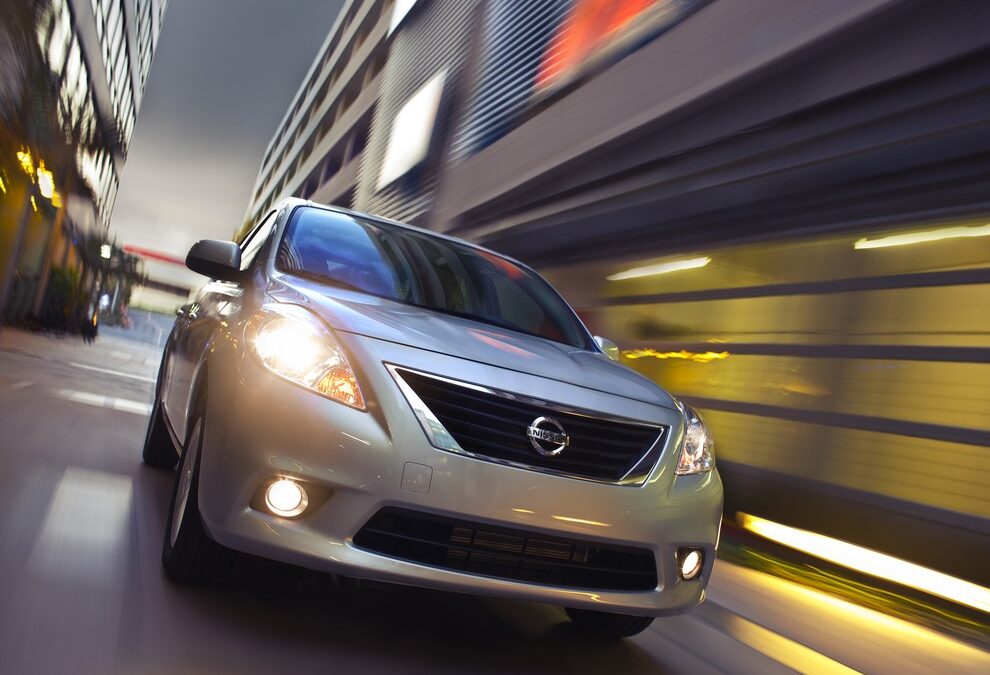
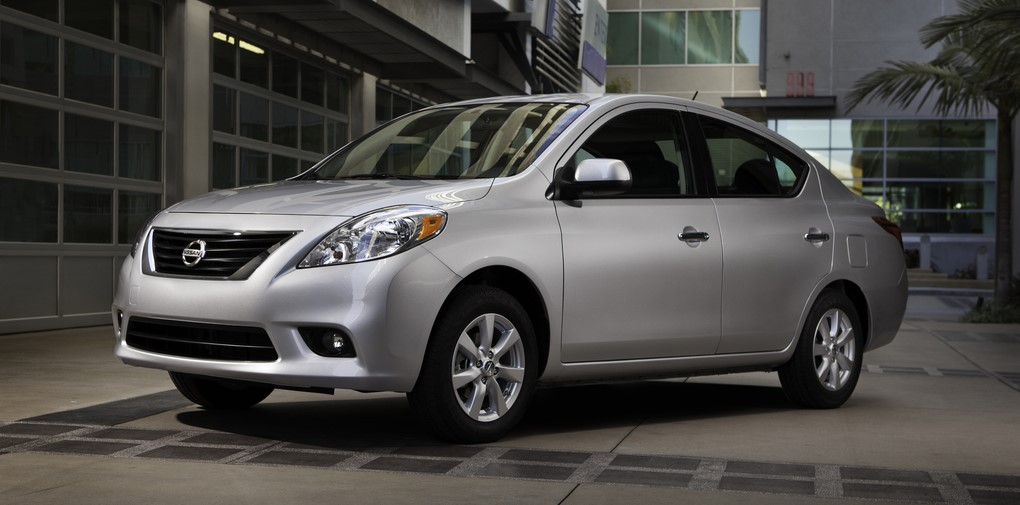
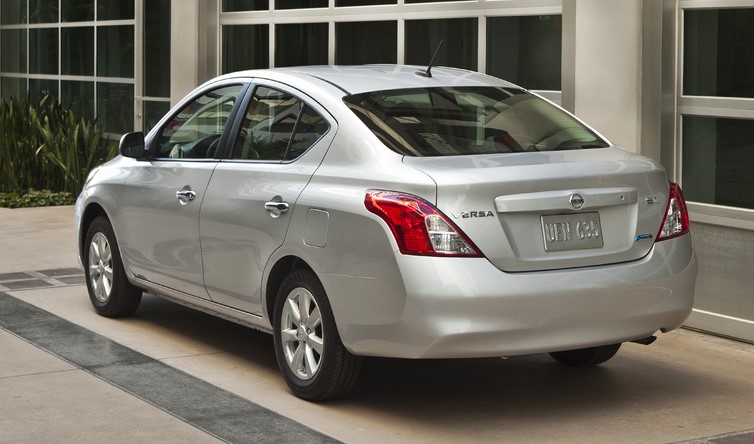
The 2012 Nissan Versa sedan

The designed 2012 Nissan Versa small sedan is a little longer with a slightly lower roofline. (Photos courtesy of Nissan)

BY MARK MAYNARD

The once subcompact Nissan Versa sedan has been re-engineered on a larger platform and restyled with enough interior capacity to push it into the compact class – but with subcompact pricing.

With starting prices ranging from $11,750 to around $18,000, Versa now has more appeal, ranging from misers to young families. It has incredible back seat room and a trunk for elephants.

Versa is still sold in hatchback body style, too, but it is unchanged for 2012.

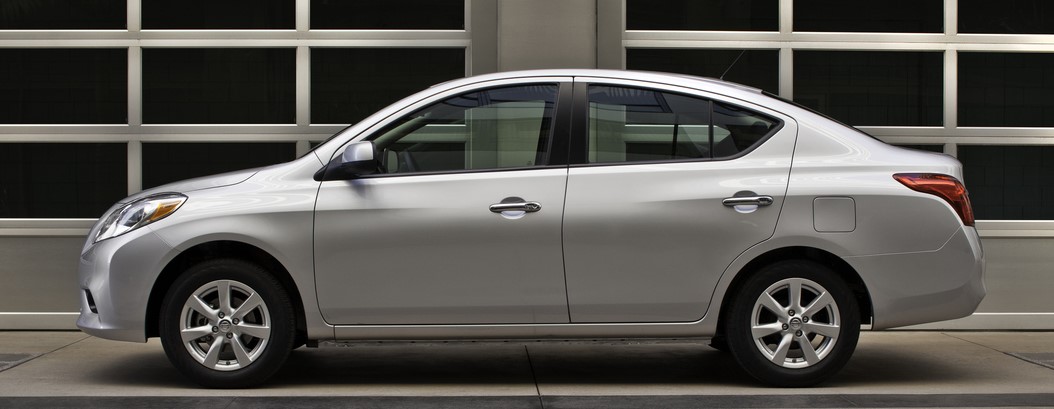
The sedan has the same width as before but is a half-inch longer and not as tall on the same wheelbase of 102.4 inches. The exterior styling may not be head-turning, but it is much more proportionately sound than the old model.

The interior is neat and tidy with some creative swirls, sweeps and arcs to break up the black plastic.

Starting prices for the Versa sedan range from $11,750 to around $18,000.

Versa sedan pricing

Pricing ranges from $11,750 to around $18,000, including the $760 freight charge.

The base model comes with a five-speed manual and air conditioning, a two-speaker audio system, stability and traction controls, and six air bags. For a baseline comparison, the base Honda Civic does not have standard AC or a radio.

The S model can be optioned with a continuously variable automatic transmission, $1,770, and such niceties as cruise control, two rear speakers, a trunk light, and some silver trim accents, which aren’t allowed on the penny-pinching base car.

Moving up to the SV with CVT, $15,320, will add more conveniences, such as cruise control, power windows and locks, remote locking, upgraded seat cloth, some chrome and silver trim accents.

The top-line SL, today’s tester, starts at $16,320 and was $17,190 as tested.

Check current Nissan Versa pricing here.

Versa sedan performance

All models are powered by a 109-hp, 1.6-liter four-cylinder engine and five-speed manual or second-generation CVT. Nissan says the continuously variable transmission has gearing typical of a seven-speed transmission.

Fuel economy is 27 mpg city, 36 highway on regular unleaded, or 30/38 mpg with the CVT. That compares to the Civic at 28/39 and the Hyundai Accent at 30/40.

Performance is decent but with some engine noise on uphill grades as the transmission adapts to the load. I made a three-hour round-trip run to LAX and could have driven longer. Ride quality is good for this class, but there is some wind push from big trucks on the highway and road noise on concrete surfaces. The high seat point helps visibility and easy entry.

Interior Features

Interior spaciousness is deceiving from the outside. There is front seat room for a 6-foot-5 male with a 6-foot male sitting comfortably in the back seat. There is no rear center headrest, but the SL model does have a split-folding back seat to boost the 14.8-cubic-foot trunk.

One of the Versa virtues of soft armrests is gone (not hard now, but not as cushy as they once were). And for long-distance commuters, an option for a front center armrest/storage box would be welcome (Hyundai does this for Accent). And don’t expect a vanity mirror on the driver’s side, only the passenger side.

There is much attention paid to a 40 mpg highway rating in the latest crop of small cars. But Versa is credible for its 30 mpg city and multi-function capacity.

A side view of the 2012 Nissan Versa

The front-seat headroom will accommodate a 6-foot-5 male with a 6-foot male sitting comfortably in the back seat.

Get a grip on paint scratch repair: ScratchPro

Get a grip on paint scratch repair: ScratchPro

I’m a great believer in the Rule of 5. A car-enthusiast friend says he won’t attempt a big repair job – car or home – unless he’ll be doing at least five similar repairs. Because, he says, the first job he’ll screw up, the second will be better and by the fifth, he will have become a passable expert.

That’s how I feel about trying to make repairs to paint – and most other automotive and household chores.

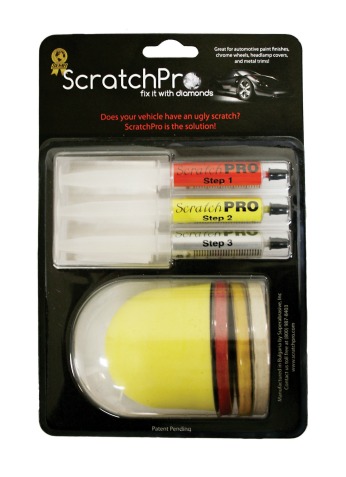
I recalled the rule when a pitch from ScratchPro paint repair landed in my inbox. The kit costs about $30 at the company website and other sites, such as  http://www.amazon.com/s/ref=nb_sb_noss?url=search-alias%3Daps&field-keywords=scratchpro

But, as a test, I gave this manual, three-step buffing-compound treatment an arm-wringing workout. There are ds. A solid rubber, dome-like applicator holds the pad securely and allows even, balanced pressure. It is a much better applicator than a cloth or paper towel, which when wet don’t provide even pressure and wad up quickly, adding to the frustration of the user.
A concern with any of these aftermarket scratch removers is the likelihood of causing more harm than good to the paint finish. The uninformed do not realize that a deep scratch, one that can be felt with a fingernail, is too deep for a home remedy. Most of the light scratches that can be repaired by ScratchPro are overlooked except by those who are fanatical about their vehicle’s finish and appearance.

For those who plunge forward for a paint repair, know that it takes patience and strict adherence to the application guide. Do a little homework and watch the how-to video at the website, www.ScratchPro.com.

The single-step process for cleaning plastic headlight lenses works well on moderate haze. And I liked that the paint areas do not have to be masked off to prevent abrasion. Buffing the paint area around the lens brightened the whole project.

I also tried ScratchPro on an aluminum wheel, but the applicator is not a help there and too large to get into nooks and corners.  I would have had to put too much time and effort into improving one wheel, let alone finding the strength for three others.

For the cost of one ScratchPro, a DIYer could take his or her vehicle to a specialist such as Bumper Doc, pay a little more and get the whole car worked on, including headlights.

Paint detail work is a craft best left to a specialist when you really love your car. If you’re doing a quickie fluff and buff for sale, ScratchPro is a good alternative.

New car test: Chrysler 300 SRT8 – the tire-smoking BIG Hemi

New car test: Chrysler 300 SRT8 – the tire-smoking BIG Hemi
Road test: 2012 Chrysler 300 SRT8

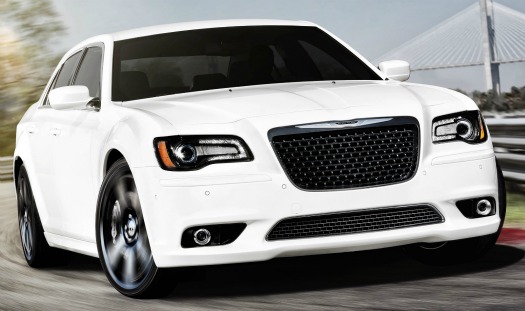
The 2012 300 SRT8 is a show of force and finesse with its 470-hp, 6.4-liter Hemi V-8 and 5-speed Auto Stick transmission.

New car test: Chrysler 300 SRT8 with the big, tire-smoking Hemi gives a big-guns salute that will make American sedan drivers sit a little taller in the seat.

This 470-horsepower, “big” Hemi, 6.4 liter V-8 is a likeable, over-the-top show of force – with luxury finesse. It will smoke the rear tires like a drag car, launch to 60 mph in less than 5 seconds and get 23 mpg on the highway on the daily commute.

Redesigned last year, the 300 sedan is an example of company survival. Engineers, designers and CEO agreed on a goal and went to work. The new styling is a revolution when it could so easily have defaulted to evolutionary change.

 For a closer look: http://veh.cl/31c

Nitpicky issues

The previous sedan, which went on sale in 2005, was a good car with nitpicky issues – weak interior quality and cheap-looking plastics not worthy of a flagship sedan. All that has been resolved and the 2012 model rolls as quietly as the best luxury European sedans.

There are 10 models of 300 with choices of rear- and all-wheel drive, the new Pentastar V-6 and two Hemi V-8s. Big news for the V-6 models is the addition of an eight-speed automatic. The extra gearing pushes V-6 highway fuel economy to 31 mpg for rear-drive cars and 23 mpg combined city and highway. AWD sedans will get a combined 21 mpg city/highway.

Pricing ranges from about $28,000 to $50,000-plus for the top-line SRT8, today’s test car.

Serious displacement

The 300 SRT8 has a big, booming drive quality. For a sedan that weighs 4,365 pounds, the beefed up hydraulic steering has a direct feel and crisp response. There is no grab from the mighty Brembo disc brakes. And power roll on is smooth and linear – but when those big guns go off, you know you’ve been hit with some serious displacement.

A new “active” exhaust system also allows straight-through  passage to mid and rear mufflers for that heavy sound ’o power.

The five-speed Auto Stick is the last of the old that needs updating, but Chrysler isn’t saying when that will be for the V-8s. Automatic shifting is aimed for fuel consumption, with the engine switching to four cylinders when possible.

Sport mode – selected on the billboard size digital screen on the center stack – amps up the excitement, but manual shifts are inelegantly performed and with no engine-rev-matching downshifts. Sport mode also stiffens the suspension nicely for enhanced grip but it, elegantly, does not hammer the occupants.

The 8.4-inch color touchscreen has a performance page that includes timers for 0-60 mph, eighth and quarter mile. There also is 60-0 mph braking distance and lateral and longitudinal g-forces. But it’s still awkward that Sport mode can only be selected on-screen and not by a handy-to-reach button.

Performance numbers

Chrysler says the 300 SRT8 will do 0-60 mph in the high 4-second range; the quarter mile in the high 12-second range; and 0-100-0 mph in less than 16 seconds. It has a top speed of 175 mph and takes 120 feet to stop from 60 mph. Also standard with any SRT8 model is a performance-driving course (www.DriveSRT.com)

And the driving is an enjoyable hands-on experience. There’s room at the steering wheel for a robust, 6-foot-4 male and even good back seat legroom for those behind. The panorama moonroof, $1,295, opens the cabin experience and can be enjoyed open at highway speeds, while most of these whip up painful buffeting.

The interior has snap and sparkle, especially with the no-cost option of red leather. Two large gauges are bright with Sapphire Blue lighting and chrome in an appealing Rolex-like treatment. The leather-wrapped and heated SRT steering wheel has a flat bottom to help thigh room.

Heated and ventilated front seats are standard (back seats are heated) and also standard are heated and cooled front cup holders. The generous 16.3 cubic-foot trunk is expandable by a 60/40 folding seatback.

The soft-touch “cast-skin” plastic used on the dash top and door panels is almost too skin-like with a rubbery-rich feel. Some of the old plastic is still visible down low in the car where it really doesn’t matter.

The 300 SRT8 sticks its big and bold Audi-like nose in the center of credible competitors from the East and West, but when the tire smoke clears, this is American performance at its best.