General Motors’ Chevrolet division has a storied history at Indianapolis Motor Speedway. Chevrolet was founded in 1911, the year of the inaugural 500-mile race. Company co-founder and namesake Louis Chevrolet, along with brothers Arthur and Gaston, competed in early Indy 500s. Arthur competed in the 1911 race and Gaston won in 1920.
Since then, nine drivers with Chevrolet engines have combined to win “The Greatest Spectacle in Racing” 11 times — Rick Mears, Emerson Fittipaldi, Arie Luyendyk, Al Unser Jr., Helio Castroneves, Tony Kanaan, Juan Pablo Montoya, Will Power and, most recently, Simon Pagenaud in 2019.
A Corvette has paced “The Greatest Spectacle in Racing” more times than any car. The 2023 race marks the 34th time for Chevrolet to pace, dating back to 1948.
Visit IMS.com for more information about this year’s schedule.
A Lineup of Historic Pace Cars
1948 Chevrolet Fleetmaster Convertible Indy 500 pace car. (Chevrolet)
1955 Chevrolet Bel Air convertible Indianapolis 500 Pace Car. (Chevrolet)
The 2020 Corvette pace car.
The 2019 Chevrolet Corvette ZR1 pace car.
The 2017 Chevrolet Corvette Grand Sport pace car. (Chris Owens/IMS for Chevy Racing)
The Corvette pace car for 2016.
The 2014 Chevrolet Camaro Z/28 pace car was piloted by three-time Indy 500 winner Dario Franchitti for the 98th running of the race.
Retired General Chuck Yeager with the 1986 C4 Corvette pace car he drove for the race.
The 1978 Chevrolet Corvette Pace Car.
The 1969 Camaro Z28.
The first-year 1967 Chevrolet Camaro RS/SS paced the 51st Indianapolis 500.
1993 Chevrolet Camaro Indy 500 Pace Car.
Nine generations of Camaro Indy 500 pace cars. (Indianapolis Motor Speedway for Chevy Racing)
The 2023 Chevrolet Corvette Z06 paces the 107th running of the Indy 500. (Photo by Chris Owens)
The 2024 Chevrolet Corvette E-Ray 3LZ coupe paced the 108th Indianapolis 500.
The Corvette E-Ray pairs two separate propulsion systems to provide naturally aspirated V-8 power with electrified responsiveness powered by eAWD.
A 6.2L V-8 is complemented by the electric motor that channels an additional 160 horsepower and 125 lb.-ft. of torque through the front wheels for 655 combined horsepower.
The addition of the electric drive unit helps the E-Ray accelerate from zero to 60 mph in 2.5 seconds before breezing through the quarter-mile in 10.5 seconds. Stealth Mode enables the Corvette E-Ray to drive on electric power for up to 4 miles at speeds up to 45 mph.
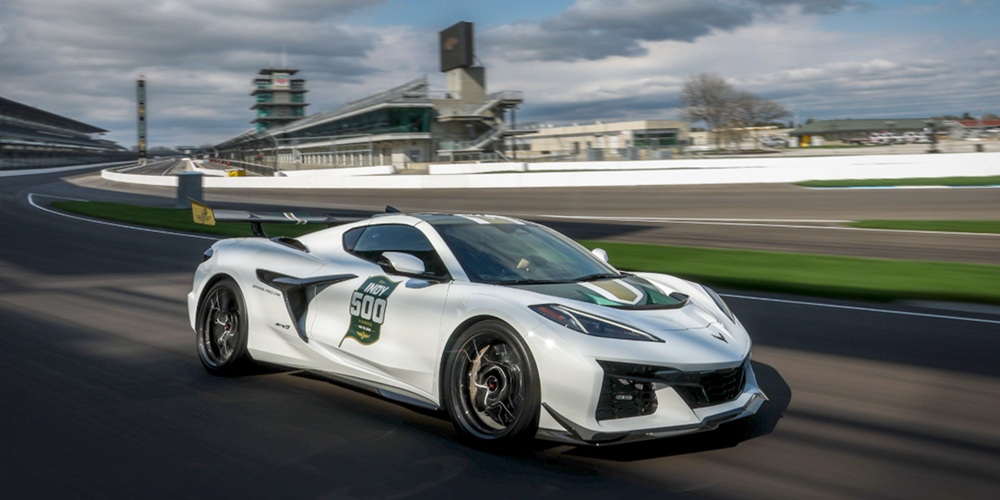
The 2025 Chevrolet Corvette ZR1 will pace the field to the green flag Sunday, May 25 with pro football legend Michael Strahan behind the wheel. Chevrolet says the 2025 Corvette ZR1 is capable of 233 mph, the highest top speed of any car ever made in America by an auto manufacturer. (IMS photo)
Chevrolet is in its open-wheelhouse battlegrounds for the 105th running of the Indianapolis 500, presented by Gainbridge, on May 30, 2021.
Leading the 33-car field to the green flag will be an Arctic White 2021 Corvette Stingray hardtop convertible. It will be the first Corvette convertible since 2008 to pace “The Greatest Spectacle in Racing.”
The Chevrolet Brothers entered two cars in the 1915 Indy 500. (Chevrolet)
The race will be televised live on NBC and the pre-race show will start at 11 a.m. The INDYCAR Radio Network will cover the race for affiliates and on Sirius 211, XM 205, Indycar.com and the INDYCAR app.
Piloting the pace car will be racing icon Danica Patrick — a veteran to the Indy 500. Leading the pack to the green flag is even more special, she said in a release, “because of the past year we have all endured, and it will be so nice to see fans back in the stands.”
Danica Patrick. (Chevrolet)
Patrick, who grew up in Roscoe, Ill., achieved numerous milestones during her eight Indianapolis 500 starts, which took place from 2005-11 and in 2018. According to IMS statistics, she achieved the best starting spot for a female driver, fourth, as a rookie in 2005 and went on to be the first female driver to lead laps in the race. She finished third in 2009 — the best result ever for a woman in the “500” — and holds the race record for laps led by a female, 29.
When not performing pace car duties, Patrick will serve as a studio analyst for NBC’s live race broadcast with host Mike Tirico and fellow analyst Jimmie Johnson.
“We’re happy to welcome back Danica to the place where she made motorsports history as the first female driver to lead ‘The Greatest Spectacle in Racing,’ ” IMS President J. Douglas Boles said.
1948 Chevrolet Fleetmaster Convertible Indy 500 pace car. (Chevrolet)
Pace Car Design
The 2021 race marks the 32nd time Chevrolet has paced the race dating back to 1948, and the 18th time since 1978 for America’s favorite sports car. Chevrolet and Corvette have led the starting field more than any other manufacturer and nameplate, respectively.
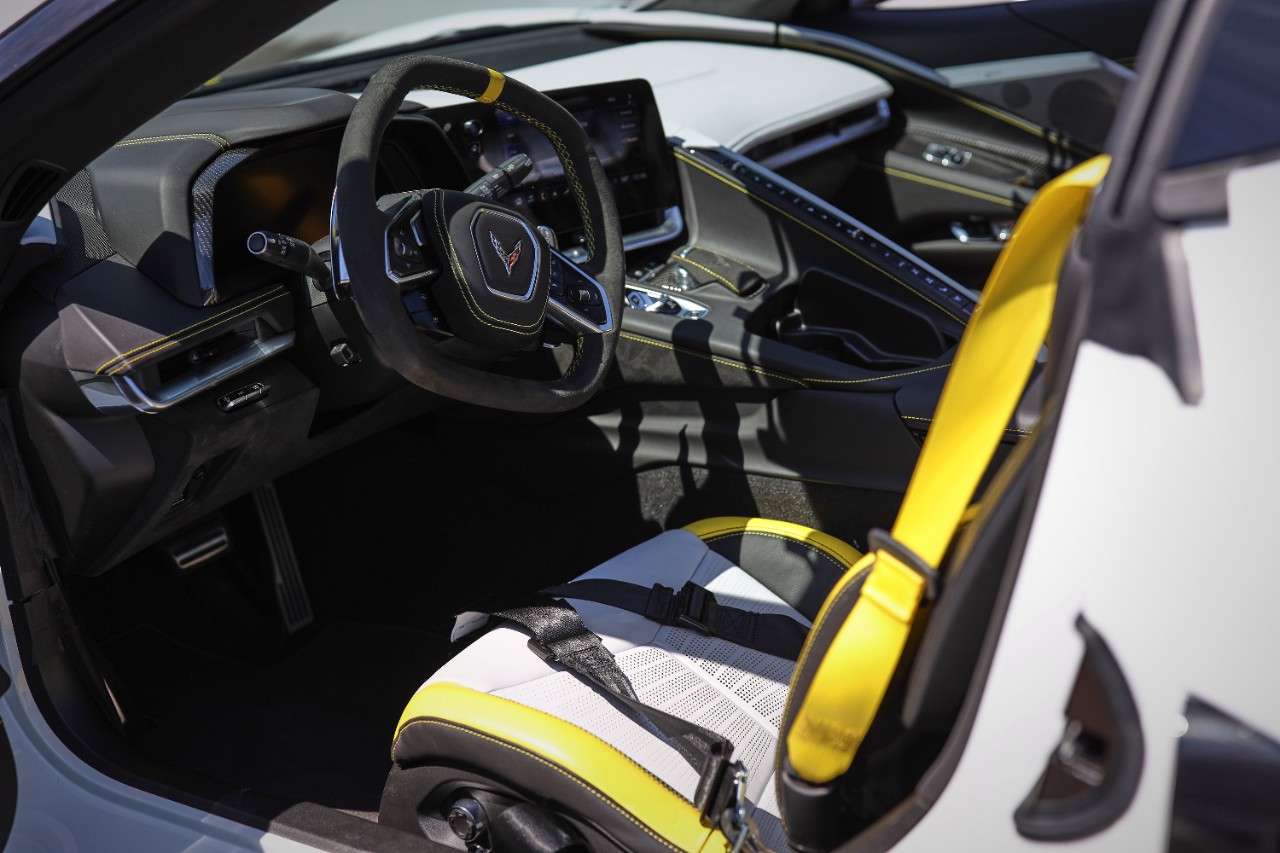
The pace car’s Sky Cool Gray and Strike Yellow interior. (Chevrolet)
“From the color scheme to the special race weekend decals and how the safety lighting is skillfully integrated into the nacelles of the hard-top convertible Corvette’s revolutionary appearance, we’re putting Chevrolet’s best on display for the fans,” said Steve Majoros, vice president of Chevrolet Marketing.
The pace-car interior — Sky Cool Gray and Strike Yellow upholstery — influenced the exterior appearance of the pace car, Majoros said. The car is clad in Indianapolis 500 logos, a special stripe package and Stingray decals and the highly visible safety lighting.
Strobe lights are positioned in the headlights, front louvers and taillights. (Chevrolet)
Corvette designers prioritized form and function of the safety lighting by incorporating four lights into each of the tonneau cover nacelles. There also are strobe lights in the headlights, front louvers and taillights. The lighting array eliminates need for a traditional lightbar.
Inspired By Fighter Jets
The mid-engine Stingray was engineered first as a convertible, Chevrolet says. Its architecture maintains the tunnel-dominant structure and high-integrity die-cast parts found in the Stingray coupe.
The Stingray design for both body styles was inspired by fighter jets. The tonneau cover features aerodynamically shaped nacelles influenced by the housing used for jet engines. The nacelles, which were also used as inspiration on the Chevrolet Engineering Research Vehicle (CERV) I and II, and the Corvette SS and SR2 concepts, help reduce air recirculation into the cabin and provide a remarkably exotic profile with the top up or down.
The tonneau integrates a power-adjustable rear window and a vent for engine cooling. The 2021 Stingray convertible is powered by the 6.2-liter small-block V-8 LT2 engine, naturally aspirated. The engine is rated for 495 horsepower with a peak torque of 470 foot-pounds at 5,150 rpm, when equipped with performance exhaust. In stock form, the engine has 490 hp and 465 ft.-lb. torque, also at 5,150 rpm.
The LT2 is paired with Chevrolet’s first eight-speed, dual-clutch automated-manual transmission. The double-paddle de-clutch feature allows the driver to disconnect the clutch by holding both paddles for more manual control.
1955 Chevrolet Bel Air convertible Indianapolis 500 Pace Car. (Chevrolet)
Indianapolis 500 History
General Motors’ Chevrolet division has a storied history at Indianapolis Motor Speedway. Chevrolet was founded in 1911, the year of the inaugural 500-mile race. Company co-founder and namesake Louis Chevrolet, along with brothers Arthur and Gaston, competed in early Indy 500s. Arthur competed in the 1911 race and Gaston won in 1920.
Since then, nine drivers with Chevrolet engines have combined to win “The Greatest Spectacle in Racing” 11 times — Rick Mears, Emerson Fittipaldi, Arie Luyendyk, Al Unser Jr., Helio Castroneves, Tony Kanaan, Juan Pablo Montoya, Will Power and, most recently, Simon Pagenaud in 2019.
Visit IMS.com for more information about this year’s schedule.
It was 61 years ago on April 17, 1964, that the Ford Mustang debuted at the World’s Fair in Flushing Meadows, New York. It was an immediate sales success — but there were many concepts, design studies, and prototypes that were considered along the way. Some of those were codenamed the “Bruce Jenner” and the “Rambo,” and there was a station wagon, a four-door, and a two-seater body style.
Ford Motor completely redesigned the Mustang for 2024, and it is now in its seventh generation. The company says its venerable pony car is the most exhilarating and visceral yet.
“Investing in another generation of Mustang is a big statement at a time when many of our competitors are exiting the business of internal combustion vehicles,” said Jim Farley, CEO of Ford Motor Company. “Ford, however, is turbocharging its ICE growth plan, adding connected technology, opinionated derivatives, and hybrid options to our most profitable and popular cars — all in the Ford Blue family — on top of investing $50 billion in electric vehicles through 2026.”
According to Ford’s internal data, the United States remains home to the strongest demand for Mustang, representing 76 percent of global sales. Other markets that saw growth in Mustang sales in 2021 include New Zealand, up 54.3 percent, Brazil, up 37.3 percent, and South Korea, up 16.6 percent.
Here are some images and captions from the Ford Motor archives that show some of the ideas that were considered. Most were wisely resisted.
1965 Mustang Four-Door
Two doors too many?
While Mustang used the platform of the compact Falcon as its starting point, the four-door Mustang could have brought the idea full circle by adding two doors to the pony car. Fortunately for Mustang fans, cooler heads prevailed.
1966 Mustang Station Wagon
In the mid-1960s, Ford designers considered at least a couple of different concepts for a Mustang station wagon, with at least one running prototype based on a 1966 coupe getting built. Another design study included elements for refreshed models that were coming later that decade. All of the known Mustang wagons were three-doors that were closer to a European “shooting brake” than a traditional American family station wagon.
1961 Avventura, Avanti, Allegro Concepts
From late 1961 into mid-1962, Ford designers tried out a wide range of themes for a sporty coupe based on the platform of the new Falcon compact. Each design was given an internal name for the purpose of discussion. One fastback design actually went through at least three different names starting with Avventura before moving on to Avanti and finally Allegro. The fastback design was originally sketched with a hatchback and rear-facing second-row seat. While this car never made it to production, a variation of the fastback profile was eventually adopted as the third body style for Mustang.
Avanti/Allegro Concept
As Avventura moved from sketch to physical design model, the hatch was replaced with a trunk and the rear seat was switched to a more conventional forward-facing orientation. Originally shown internally as Avanti, the name was eventually changed to Allegro, likely because Studebaker had introduced its own production Avanti coupe around the same time.
1962 Allegro Design Study
In 1962, the design team, led by Gene Bordinat, worked on several iterations of another design called Allegro. While the production 1965 Mustang was a very different car in almost every visual detail from Allegro, the design study established the basic proportions that would define most Mustangs for the next five decades. The notchback coupe had the same long-hood, short-deck layout with a compact greenhouse that would roll out of the Rouge factory two years later.
The Millionth Mustang
For the 1966 celebration of the millionth Mustang produced: Airline pilot Capt. Stanley Tucker, the owner of the first ordered Mustang, with Ford design chief Gene Bordinat (left), Ford President Lee Iacocca, product manager Donald Frey and an unnamed Ford exec.
1967 Allegro II Concept
In 1967, Ford designers decided to reprise one of the original Mustang design concepts from 1962 with a new form and repurposed name. Starting with the Avanti/Allegro fastback coupe, the greenhouse was removed and replaced with a low-cut speedster-style windshield, roll bar, flying buttresses on the rear deck, and a new rear end. The reworked concept was dubbed Allegro II.
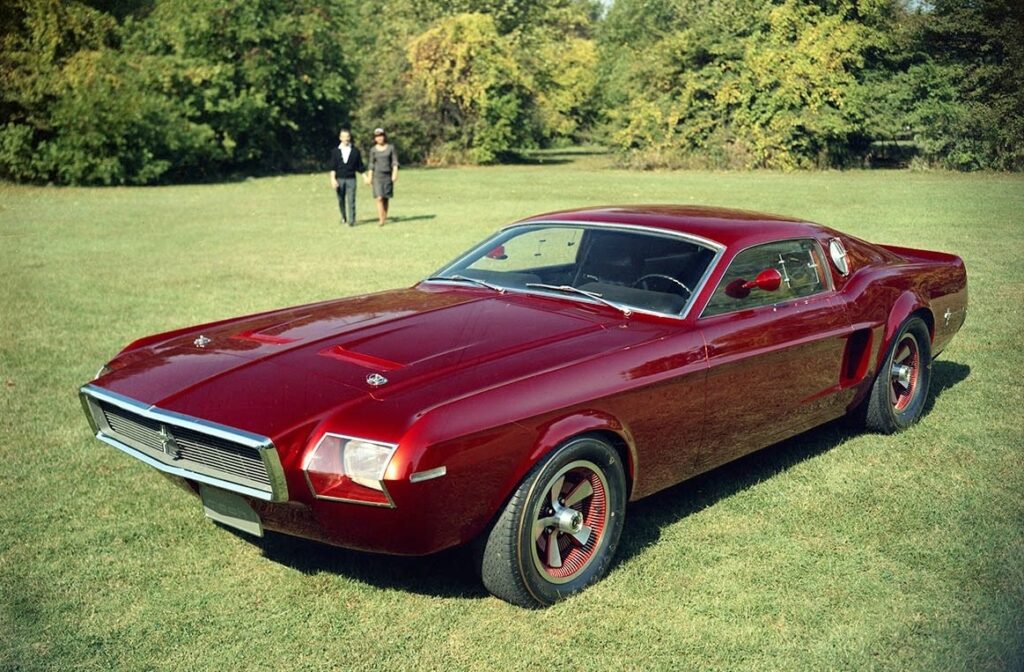
1967 Mach 2 Concept
With the Mustang having already set sales records following its launch in 1964, Ford design chief Gene Bordinat and the Special Vehicles Group decided to try rearranging the pieces for the Mach 2 concept. The 289 Hi-Po V-8 was shifted from the front to behind the two seats to evaluate the layout as a possible successor to the Shelby Cobra. Despite its midengine layout, the Mach 2 retained the long-hood, short-deck proportions of a Mustang. Unfortunately, the Mach 2 never went much beyond the auto-show circuit.
1966 Mustang Mach I Concept
Pantera-esqe?
The two-position hatchback was intended to accommodate longer objects in a near-horizontal position or open wider for cargo loading.
1969 Ford Mustang Boss 302 Engine
The high-performance 302-cubic-inch V8 used in the 1969 Ford Mustang Boss 302.
1966 Mach 1 Concept
As the first-generation model transitioned from a pony car to a larger and heavier big-block muscle car, the Mach 1 concept was created as a preview of the 1968 model. The original nose of the concept drew inspiration from the 1963 Mustang II concept.
1970 Mustang Milano
First shown publicly at the February 1970, Chicago Auto Show, the Mustang Milano concept previewed the nearly horizontal rear deck and sharp, extended nose that would be seen on the production 1971 model. However, aside from those two elements, the Milano didn’t really bear much resemblance to any production Mustang. In fact, the car that probably drew most heavily on the Milano profile was the Australian-market Falcon XB coupe of the mid-1970s.
Would this become Ford’s Torino?
‘Bruce Jenner’ design study
Too soft?
In 1990, Ford designers evaluated a number of themes to replace the long-running third-generation Mustang. The notchback and hatchback body styles would be replaced with a single fastback coupe format. After departing from many of the original design cues on the third-generation models, the upcoming fourth-generation would return elements like the galloping pony in the grille, the side scoops and the tri-bar taillamps. This softer concept, known as “Bruce Jenner” wasn’t considered aggressive enough to be a Mustang.
‘Rambo’ Design Study
Too extreme for a Mustang?
This alternative proposal dubbed, “Rambo,” was deemed too extreme for production.
1980 Mustang RSX Concept
Created in the Italian Ghia design studio, the RSX was conceived as a rally special based on the new Fox-body third-generation Mustang that debuted for the 1979 model year. With a 1-inch-wider track and 5.6-inch-shorter wheelbase than the road-going Mustang, the RSX had extra ride height that would be needed for dealing with the off-tarmac stages of European rallies.
1961-62 Two-Seater Studies
The two-seater concept.
Early in the gestation of the original Mustang, Ford designers considered a number of two-seater studies. These were seen as a more affordable return to the roots of Thunderbird, which by this time had grown into a much larger four-seater. The idea of a two-seat Mustang was something designers returned to frequently in the period between the original Mustang 1 concept and the 1992 Mach III. Aside from some track-oriented Mustangs that had the rear seats removed to save weight, there has never been a strictly two-seat production Mustang.
Honda is powered up for its April 5 Cars, Coffee & Bikes show at American Honda headquarters, 1919 Torrance Boulevard, Torrance, CA 90501. The show is themed “Racing” and will be a celebration of all forms of auto and powersports racing. It is also the kick-off party for the Acura Grand Prix of Long Beach — held the following weekend — which American Honda sponsors.
“We’ll have the biggest display of Honda and Acura auto and Honda motorcycle race vehicles yet,” said Carl C. Pulley, Honda Heritage Public Relations. Six HRC Supercross and Motocross championship bikes will be on view.
Participants can drive their own race car, bike, or other performance vehicle in the Parade of Performance.
A Racing Showcase
The April 5 bimonthly gathering of enthusiasts — Honda and non-Honda — will showcase a significant collection of race vehicles. The event honors the 75th year of Formula One, the 60th anniversary of Honda’s first F1 race win, and the 50th running of the Grand Prix of Long Beach.
Among the special exhibits and activities will be:
There will also be an IndyCar photo-op where attendees can get behind the wheel of a vintage Lola racecar to take photos. A racing simulator will show the Long Beach Grand Prix circuit.
Honda 0 Series Prototypes On View
Also featured will be the first public showing of the Honda 0 Series Saloon and SUV Prototypes. Production versions of the new 0 Series line of battery electric vehicles are expected to launch in North America in 2026, followed by global markets. Both midsize models will be built at the Honda EV Hub in Ohio.
The interior of the SUV prototype illustrates the company’s direction to offer a new value for its future Honda 0 Series EVs as a “space” for people. Both sedan and SUV will debut automated driving technologies backed by Honda’s Level 3 automated driving technology. Honda says the technology is “highly reliable.”
Honda 0 Saloon & Honda 0 SUV prototypes.
Honda C&C
The themed bimonthly shows get an average of 2,500 attendees, including entrance to the Honda museum, a live DJ, food trucks, free coffee, and special exhibits.
“The Feb. 15 show broke a record with 3,900 people showing up,” Pulley said. “The addition was most likely due to the Trailsport Adventure off-road ride-along experience in the new 2026 Passport Trailsport.”
Those attending also get free admittance to the American Honda Collection Hall.
The 20,000-square-foot museum space presents a timeline of American Honda vehicles and corporate growth since its U.S. start in 1959. More than 60 vehicles from Honda and Acura are on view, including motorcycles, power products, engines, and racing machines. The Collection Hall displays will be updated several times a year to highlight different products and themes.
The collection hall is in Honda’s U.S. headquarters lobby, 1919 Torrance Blvd., Torrance, CA 90501.
#6 Acura Team Penske Acura DPi, DPi: Juan Pablo Montoya, Dane Cameron
Upcoming 2025 Cars, Bikes & Coffee Shows
June 21: “Summer’s Here” car and bike fun in the sun
Aug. 16: “Heritage & Museums” old-school cool
Oct. 18: “Customizing” Halloween/Día de los Muertos special
Dec. 13: “Clubs & Community” holiday event with toy drive
IF YOU GO
The American Honda Collection Hall is at 1919 Torrance Boulevard, Torrance, CA 90501. Gates to the American Honda parking lot open at 7:30 a.m., with activities beginning at 9 a.m.
Learn more about the shows and the collection hall here.
When I head out to photograph a vehicle for a review on MaynardsGarage.com, I grab my detailing go-bag. In it, I keep several microfiber towels, spritz bottles of quick detailer and glass cleaner, a tape measure, and a multi-tool. I also carried a lint roller until I sampled LintZapper.
It irks me to photograph an interior and see bits of dirt, gravel, and whatever else gets dragged onto the floor mats. A lint roller is good at picking up the big stuff but not so much for getting into crevices. That’s where a sheet of 4-by-3-inch LintZapper excels. I can press it firmly on the stubborn bits and slide it into areas where the roller can’t go.
My detailing go-bag (Mark Maynard photo)
Car enthusiasts who display their rides at a show can tidy up the interior for the “Clean Car” award.
A pack of LintZapper is lightweight, compact, and much more effective than those tiny travel lint rollers.
LintZapper sheets are sold in a slim booklet of 40 sheets. A three-pack costs $8.97, not including shipping from FurZapper.com.
FurZapper for Home Bliss
Use FurZapper in the washer and dryer.
I know many of my car enthusiast friends have furry friends, too. While we seldom complain about picking hairs from clothing, a lint roller is just a part of life. However, the company that makes LintZapper also makes the FurZapper.
This simple disc-like device could smooth uncomfortable relationship discussions about too damn much fur on clothing and bedding.
The FurZapper is made of a flubber-like tacky material. It temporarily grabs onto pet fur or human hair in the washing machine. The palm-size FurZapper is about an inch thick with open dog-paw cutouts.
Toss one into the wash cycle, and FurZapper will gather loose fur and hair. In the rinse cycle, it sends the accumulated fur down the drain. Then, use it again in the dryer cycle, which sends fur to the lint trap.
The company says that FurZapper is small enough to fit between clothing as it tumbles and oscillates. What the FurZapper doesn’t remove, follow-up with a LintZapper.
The FurZapper two-pack.
The company says the specialized material does not allow any material to stick to it permanently. Nor will FurZapper stick to clothing or the sides of machines. Wipe it off after use; it could last hundreds of washer and dryer cycles.
A two-pack is $15. The company recommends using both when the pet owner has multiple shedders in the household.
Shipping is free over $35, and to help you get to that level, the company sells other fur-grabbing inventions. For example, there is the FurZapper Pet Grooming Glove, $12.99. Or opt for the Ultimate Pet Owner Bundle, $29.99, which includes two FurZappers, one Grooming Glove, and three LintZapper packs.
Learn more about the LintZapper and FurZapper here.
Special exhibition charts 71 years of Corvettes with connections to film, TV, music, games, celebrities, and the American lifestyle
The National Corvette Museum in Bowling Green, Ky., has broadened its “American Love Affair” exhibit with “Pop Culture and Corvette.” The exhibit elevated exhibit is a road trip through Corvette’s impact on entertainment and popular culture. It will be displayed through 2025. (Photos courtesy of the museum or as credited)
The National Corvette Museum has debuted a new exhibit around the Chevrolet Corvette and pop culture. Whether in film, music, TV, literature, sports, or video games, the Corvette is a powerhouse of pop culture relevance.
In tribute, the National Corvette Museum has broadened its “American Love Affair” exhibit with “Pop Culture and Corvette.” The elevated exhibit is a road trip through Corvette’s impact on entertainment and popular culture. More than a dozen Corvettes are on display with the pop culture stories that made them famous.
Opened in mid-October, the exhibit focuses on Corvettes with connections to media and the American lifestyle. Corvettes from every generation illustrate how America’s Sports Car has evolved over 71 years.
“Pop Culture and Corvette” explores how the Corvette has made its mark on everything from Hollywood blockbusters to music videos. Display elements span Elvis Presley’s 1959 Stingray Racer in “Clambake” to the Corvette-inspired characters in the “Transformers” franchise.
“Corvette has always been a pop culture icon,” Robert Maxhimer, director of curatorial affairs, said in a release. “Pop Culture and Corvette” shows how the sports car starred in moments that defined generations.
Gemini and Apollo mission astronaut Jim Lovell’s 1968 Silverstone Silver Corvette.
Exhibition Highlights
Screen Legends: A Medium Blue Metallic 1973 Corvette is featured in the reboot of “Hawaii Five-0” (2010-2020). And the “Transformers” film series introduced the Corvette-based concepts of “Crosshairs” and “Sideswipe.”
Gaming Great: A concept version of the C7 Corvette was brought to life in the virtual racing world of “Gran Turismo 6.” The gaming influence highlights how Corvette has reached new audiences.
Famous Owners: Aficionados of the nameplate might be surprised and pleased by some of the celeb’s Corvettes on view and their stories. Among them are country music icon Brad Paisley, Major League Baseball star Reggie Jackson, and rockabilly pioneer Jerry Lee Lewis.
Six Strings for the Z06 and 1960: A Z06-themed Paul Reed Smith guitar is signed by Corvette Hall of Famer Ron Fellows (2011). The six-string features the Corvette emblem and other flourishes. Also on display is a Les Paul guitar with styling cues from the 1960 Corvette signed by Zora Arkus-Duntov.
To the Moon: Astronaut Jim Lovell has shared his 1968 Silverstone Silver Corvette and artifacts from flight. Included are Lovell’s astronaut gloves and an autographed lunar navigational chart; it is on loan from the U.S. Space and Rocket Center in Huntsville.
Roy Orbison’s Rally Red 1967 Sting Ray L68, with a 427 cubic inch, 400-horsepower V-8.
Immersive Display
More than a display of cars, the exhibition is an immersion into Corvette’s cultural legacy. The exhibit includes a multimedia presentation of iconic Corvette moments in film, television, and music. The presentation shows how this automotive icon has shaped — and been influenced by — American pop culture.
The museum’s exhibits are regularly updated, deepening the storytelling that connects Corvette to American history. Exploring the intersection of Corvette and pop culture was a natural progression,” said Kaye Wagner, Chair of the National Corvette Museum Board. “With ‘Pop Culture and Corvette,’ we celebrate how Corvette has transcended the road to become a true cultural icon.”
Reggie Jackson’s 1978 Corvette Pace Car replica (center).
Take a Pop Quiz
This quiz might win you a couple of bar bets from those less informed.
In the 1967 American beach party musical “Clambake,” this actor-singer starred as Scott Hayward. An heir to an oil fortune, Hayward trades places with a water ski instructor at a Florida hotel. In the movie, Hayward drove a 1959 Stingray Racer.
This film franchise features two Corvette-inspired Autobot characters, Sideswipe and Crosshairs. Sideswipe’s design is based on the 2009 Corvette Stingray concept. Crosshairs started as a deep green and black 2014 Corvette with a distinctive rear spoiler. It was updated to a 2016 Corvette with a slightly different livery.
This video game helped introduce the Corvette to a new generation. Released in 2013, this driving simulator featured a concept version of the C7. The game provided auto racing fans a digital “drive” of the then-brand-new Corvette.
Who was the Major League Baseball Hall of Famer nicknamed “Mr. October”? This slugger is known for his postseason clutch hitting with the Oakland Athletics and the New York Yankees. He was one of the lucky few to own a 1978 “Official Pace Car of the Indianapolis 500” Corvette.
Who was the pioneer of rockabilly music nicknamed “The Killer.” His 1954 Corvette roadster was repossessed by the IRS in 1980 to cover his back taxes.
Based in Nashville, rock stars such as Jimmy Page and Slash highly regard this renowned guitar maker. This custom guitar features styling details borrowed from the 1960 Corvette and signed by Zora Arkus-Duntov. The body is Tuxedo Black with an ivory scoop similar to the car’s side “scoop” design.
The 1959 Chevrolet Corvette Stingray Racer in concept form. (Photo courtesy of Chevrolet)
IF YOU GO
“Pop Culture and Corvette: An American Love Affair” will be displayed through 2025. For more information or to plan your visit, go to corvettemuseum.org. And follow the museum on Facebook, TikTok, LinkedIn, Instagram, YouTube, and X.
About the National Corvette Museum
The National Corvette Museum is a 501(c)(3) not-for-profit foundation. The museum is an educational and research institution. It is located a mile from General Motors’ Bowling Green Assembly Plant, where the Corvette has been built since 1981. The Museum Campus has 115,000 square feet of exhibition and event space. The exhibits showcase more than 100 historically significant Corvettes, 50,000 Corvette artifacts, and the NCM Motorsports Park.