Select Page

1966 Dodge Charger — “Leader of the Dodge Rebellion”

1966 Dodge Charger — “Leader of the Dodge Rebellion”

The Dodge Charger debuted in 1966 as a midsize sporty car that would compete with the Rambler Marlin, Ford Mustang, and Plymouth Barracuda

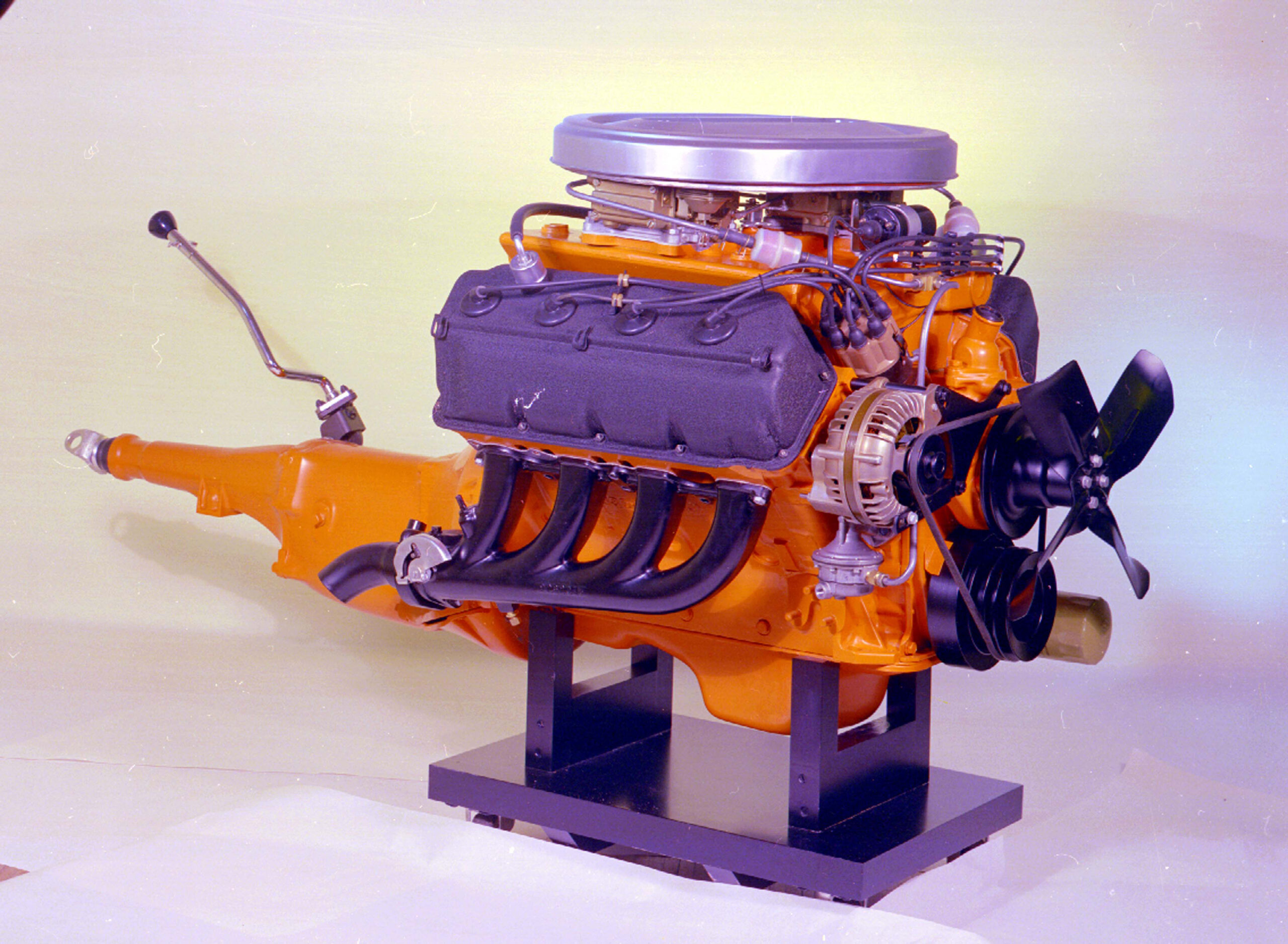
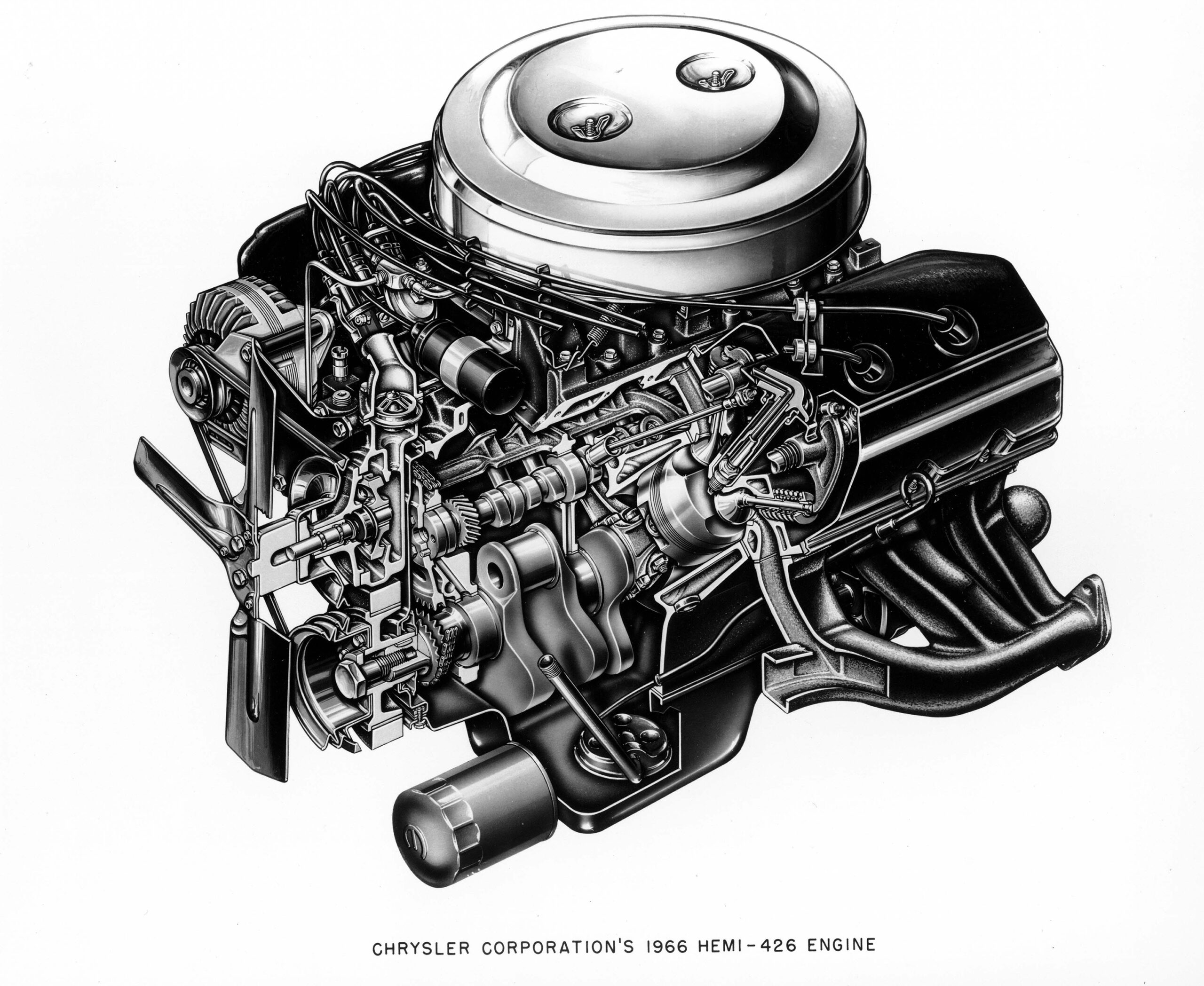
A Hemi V8 and transmission on a display stand 1966 Dodge Charger

The first generation 1966 Dodge Charger introduced a fastback roofline and pot-metal “electric shaver” grille. (Photography courtesy of Stellantis)


BY MARK MAYNARD

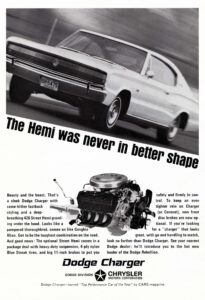
During the early-1950s, automakers were exploring new ideas in the personal luxury and specialty cars.A 1966 print ad for the Dodge Charger

The Hemi engine package included heavy-duty suspension, four-ply nylon Blue Streak tires, and “big” 11-inch brakes. According to Wikipedia, Chrysler had been slow to enter the specialty car market, but tapped its Dodge Division to enter the marketplace. Its first offering would be a midsize B-bodied Dodge Charger. It would fit between the “pony car” Ford Mustang and “personal luxury Ford Thunderbird.

The design focus was to create a fastback look while sharing as much existing company hardware as possible. The result was the Coronet-based Charger. The exterior styling was, in general, a departure from Dodge’s mainstream cars. Introduced in mid-1966, the Charger would compete with the Rambler Marlin, Ford Mustang, and Plymouth Barracuda.

The 1965 Charger concept

The 1965 Dodge Charger II Concept created the desired fastback look shared much existing company hardware.

The interior design of the Charger was different from all other cars, according to the Wiki page. It debuted a full-length center console and “all bucket seating” front and rear. Also an innovation, the rear pseudo-buckets could be folded to create more cargo space through the enormous rear hatch.

The Hemi Halo

The Charger wasn’t intended to compete head-to-head in performance with pony cars but was available with Chrysler’s famed 426 Hemi V8.
On Jan. 1, 1966, The 1966 Charger had its big public debut at the Rose Bowl as the new “Leader of the Dodge Rebellion.” The Charger’s debut was also followed midyear by a new street version of the 426 cubic-inch, 7.0-liter Chrysler Hemi engine.

The Charger wasn’t intended to compete head-to-head in performance with pony cars but was available with Chrysler’s famed 426 Hemi V8.

With the Charger, Dodge had a new model to build a performance image with this engine.

The Charger was designed by Carl “CAM” Cameron and introduced a fastback roofline and pot-metal “electric shaver” grille. Its fully rotating headlights were a feature not seen on a Chrysler product since the 1942 DeSoto. The fastback design ended over a full-width six-lamp taillight in the rear with chromed and wide-spaced “C H A R G E R” lettering.

Dodge Charger Powertrains

According to the Wiki report, Charger powertrains for 1966 consisted of V-8s with three choices of transmission.

Four engines were offered:

  • 318 cubic-inch 5.2-liter with a two-barrel carburetor for the base-model Charger;
  • 361-cubic-inch, 5.9-liter two-barrel;
  • 383 cubic-inch, 6.3-liter with a four-barrel carburetor;
  • And the new 426 Street Hemi. Only 468 Chargers were built with the 426.

A cutaway illustration of the Hemi V8

The transmissions for the 1966 Charger:

  • Three-speed steering-column mounted manual with the base engine,
  • Console-mounted four-speed manual;
  • Three-speed automatic.

Total 196 Dodge Charger production came to 37,344 units for the mid-model year introduction.

1959 Ford Country Squire with Push Button’ Station Wagon Living’ equipment

1959 Ford Country Squire with Push Button’ Station Wagon Living’ equipment

The Country Squire wagon concept packaged the car-camping essentials, including the boat and kitchen sink

The Country Squire concept packaged such camping essentials as a car-top tent with a double bed, an electric refrigerator, and a shower. (Ford)

BY MARK MAYNARD

Ford Motor cast a line for 1959 to test the waters of consumer interest for a car-camping concept based on a 1959 Ford Country Squire. The rig would provide push-button station wagon living with all the gear, including the kitchen sink.

According to Wikipedia, the U.S. and the world were emerging from the “Recession of 1958.”  And Ford marketers might have felt that consumers were ready to get out and enjoy the freedom of car camping.

That might have been so, but not so much for this outrageously sophisticated concept. I came across these two photos at the Ford media site, but there were no other details.

In this era before the modern SUV, the big Ford Squire wagon was a good starting place. Built on a bigger platform for 1959, the Country Squire body was 5 inches longer and the new 118-inch wheelbase was 2 inches longer than the 1958 model. In addition, the second and third rows were re-engineered to fold flat.

The 1959 Ford Country Squire wagon concept with Push Button ‘Station Wagon Living’ equipment and rooftop boat

The rooftop boat neatly contained the concept’s camping essentials. (Ford)

Country Squire Concept

An online search for information on this concept car brought up Shorpy.com, an American historical photo archive.

Shorpy has a news item from the Washington Post of July 3, 1958, highlighting the details.

“Travelers and sportsmen who would like to park their cars after a day’s drive and set up camp by pushing a few magic buttons may be able one day to do just that.

“With the ‘pushbutton camper,’ a specially equipped experimental Ford station wagon, a traveling couple could pull into a parking area, lower a boat from the roof top, pitch their tent and set up a kitchen unit protected by an overhead awning — almost without getting out of the car.

“One push button lifts the boat and swings it over the side so it can be easily removed for launching. A car-top tent, containing a full-sized double bed, already made up and equipped with a reading lamp, is erected by another button.

“After the tailgate is opened, a third button slides out the compact kitchen unit complete with an electric refrigerator and two-burner stove, a work table and meat cutting block, and a sink with hot and cold running water.

“The roof compartment also houses a shower head, complete with curtain. Ford has no definite plans for mass producing such a vehicle.

“If consumer demand warranted it, a company official said, the automatic equipment could be produced by independent suppliers and installed by a Ford dealer.”

‘Louie Mattar’s Fabulous Car’

The Country Squire wagon concept was a feat of engineering finesse, but it was not the first such example.

I give that credit to Louie Mattar who upfitted a 1947 Cadillac with all the comforts of home. Then, in 1952, he and two other men established a cross-country endurance record. They drove the Cadillac from San Diego to New York and back without stopping. Their trip totaled 6,320 miles and required refueling from a moving gas truck three times.

“Louie Mattar’s Fabulous Car” is on view at the San Diego Automotive Museum.

17 Years of the Lamborghini Countach

17 Years of the Lamborghini Countach

Automaker celebrates the 50th anniversary of the Lamborghini Countach in a series of four social-media videos

Five generations of the Lamborghini Countach.Five generations of the Lamborghini Countach. (Remi Dargegen)

BY MARK MAYNARD

To celebrate the 50th anniversary of the Lamborghini Countach supercar, Automobili Lamborghini is launching a series of four videos on its social media channels. Every Monday, the Italian carmaker will recount the legacy of the Lamborghini Countach, including interviews with significant personalities who shaped the car.

The first is Marcello Gandini, head of style at Carrozzeria Bertone. He sketched the futuristic lines of this supercar and added its now-iconic scissor doors.

The 1970s was one of ultimate creativity, Gandini says, and one of the important moments for design.

It was an era of individualism, the jet age, and the space race. And it embraced the geometric patterns of the period and the bright colors of fashion trends.

The Countach LP 5000 S badge.

(Remi Dargegen)

Lamborghini  Countach as style and performance icon

The Countach depicted much more than a commercial success. Images and posters of the supercar were on bedroom walls of an entire generation. The supercar also played a starring role in dozens of films.

The Lamborghini Countach fulfilled the role of style and performance icon. As a result, it rightfully won the title in the annals of world automotive history, Lamborghini says.

The Countach had a total production of 1,999 cars (not including the first LP 400 prototype).

Since the beginning of production, the Countach was exported to the U.S. But it was not until 1986, and the debut of the LP 5000 Quattrovalvole, that the Countach was officially approved for North America.

The word “Countach” is an exclamation of the Italian Piedmontese dialect that translates to astonishment and admiration for something.

1971: Countach LP 500 ‘idea car’

Lamborghini Countach LP 500.

Lamborghini Countach LP 500. (Lamborghini)

In the summer of 1970, Ferruccio Lamborghini wanted a revolutionary car to succeed the Lamborghini Miura. The new car had to be technically advanced and faster. And it had to become the sports car symbolizing the 1970s.

The 12-cylinder engine remained but with a displacement increase from 4.0 to 5.0 liters. The engine also was repositioned from rear transverse to rear longitudinal. The five-speed synchromesh manual transmission was placed in front of the engine and practically abutted the seats.

1973: First-gen Lamborghini Countach LP 400

The Countach LP 400

Countach LP 400. (Remi Dargegen)

Early road tests of the 5.0-liter engine uncovered problems that would take more time to sort. So a quick fix was for the engineers to instead use the 4.0-liter engine.

The Countach LP 400 made its official debut at the Geneva Motor Show in March 1973. It was chassis No. 1120001 car. LP 400 was a prototype very similar to what would become the production car.

The LP 400 adopted a tubular trellis frame instead and aluminum was used for the body, not steel panels.

A front view of the Countach LP 400Countach LP 400. (Remi Dargegen)

The 4.0-liter (3929cc) engine used six Weber 45 DCOE twin-body carburetors. The engine developed 375 horsepower at 8,000 rpm and could reach a top speed or 186 mph or 300 kmh.

A red LP 400 was shown at the Geneva Motor Show. It was later repainted medium green for the 1973 motor shows in Frankfurt, Paris, and Earls Court, London.

The show car was sold to a buyer in Switzerland after the show and rediscovered in the early 2000s. Today LP 400 is owned by Automobili Lamborghini. It is now on display at the company museum, the MUDETEC.

The Countach LP 400 is the most sought-after version by collectors, Lamborghini says, with 152 units produced until 1977.

1978: Lamborghini Countach LP 400 S

A red Lamborghini Countach LP400S.

Countach LP 400 S. (Remi Dargegen)

The LP 400 was replaced in 1978 by the Countach LP 400 S.

It sported lower profile and wider Pirelli P7 tires. The staggered-width tires mounted on magnesium rims had sizes of 205/50 VR 15 on the front and 345/35 VR on the rear. Wheel-arch extensions were added to contain the larger tires.

The 375-hp, 4.0-liter V-12 engine in the Countach LP 400 S.

The 375-hp, 4.0-liter V-12 engine in the Countach LP 400 S. (Remi Dargegen)

Other updates include an optional ultra-low front spoiler and a rear wing. The wing would become one of the most distinctive features of the Countach.

Never before had a “normal” car with such a racing appearance been seen on the road, Lamborghini says. It was the source of inspiration for each of the subsequent Countach series. Production of the LP 400 S totaled 235 units.

1982: Lamborghini Countach LP 5000 S

An overhead shot of the Countach LP 5000 S.

Countach LP 5000 S. (Remi Dargegen)

The 1982 Lamborghini Countach had an engine upgrade to a 5.0-liter V-12. The new LP 5000 S debuted at the Geneva Motor Show in March 1982.

The new engine developed 375 hp at 7,000 rpm, and it retained the six Weber horizontal twin-body carburetors. After import to the U.S., some cars were retrofitted with the Bosch K-Jetronic electronic injection.

With 323 cars produced, this model was replaced by the LP 5000 Quattrovalvole. It debuted at the Geneva Motor Show in March 1985.

1985: Lamborghini Countach LP 5000 Quattrovalvole

The Countach LP 5000 Quattrovalvole.

Countach LP 5000 Quattrovalvole. (Remi Dargegen)

The technical evolution of the 5.0-liter V-12 added four valves per cylinder. The Quattrovalvole (QV) engine displacement increased to 5.2 liters and the six Weber carburetors were mounted vertically, not in the horizontal position.

Cars for the U.S. market were fitted with Bosch KE-Jetronic electronic injection and a catalytic converter. As a result, horsepower rose to 455 hp at 7,000 rpm.

Aesthetic alterations were few but included a new engine hood with a more prominent bulge to contain the vertical carburetors.

There were 631 Quattrovalvole models produced until 1988.

1988: Lamborghini Countach 25th Anniversary

Countach 5000 S (left) and Countach 25th Anniversary (right).

Countach 5000 S (left) and Countach 25th Anniversary (right). (Remi Dargegen)

The Lamborghini Countach 25th Anniversary was the final evolution of the model. It debuted at the Paris Motor Show in September 1988.

The aesthetic updates were significant, but changes to the mechanics and chassis were minor. An improved cooling system updated the engine, and the chassis was modified to accommodate the new Pirelli P Zero tires. 

The Countach interior.

Countach interior. (Remi Dargegen)

The passenger compartment was updated with power windows and more comfortable power seats with less bolstering. In addition, the body style was decisively revised by young Horacio Pagani, who was working for Lamborghini at the time. He rounded the shapes and better integrated the wheel-arch extensions and the plates under the doors.

The Countach 25th Anniversary,

Countach 25th Anniversary, (Remi Dargegen)

The last Countach, a 25th Anniversary, was produced on July 4, 1990, with European specification. Its exterior was Argento Metallizzato (metallic silver) with a gray leather interior. It has not been sold and is still on display at the MUDETEC.

1950 Chevrolet Styleline Bel Air Sport Coupe

1950 Chevrolet Styleline Bel Air Sport Coupe
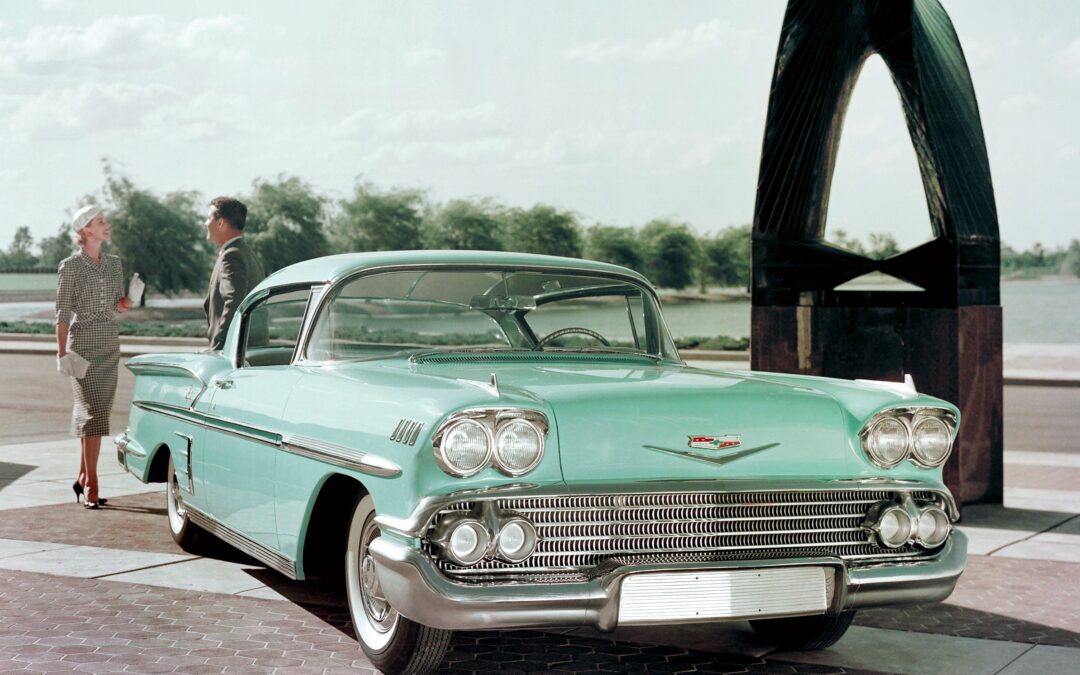
A 1950 Chevrolet Bel Air Sport Coupe

The Chevrolet Bel Air Sport Coupe was new for 1950.  (Chevrolet)

BY MARK MAYNARD

Chevrolet’s exterior styling of the 1950 Bel Air Sport Coupe was revolutionary and set a pattern for decades. According to ClassicCars.Fandom.com, “The Bel Air Hardtop (on the DeLuxe line) was styled as a convertible with a non-detachable solid roof.”

The redesign followed the 1942-1945 shutdown of vehicle production during World War II. And even as production restarted, the “new” 1946-1948 models were mildly updated carryover models from years earlier.

New for 1950

According to Hagerty.com, Chevrolet overhauled its entire lineup in 1949 and moved from prewar designs to new cars. The modern styling emphasized full-width bodies and pontoon fenders.

The exterior two-door hardtop styling might have been new, but visual changes were minimal from 1949.

Special and Deluxe models were offered in Fleetline and Styleline series. According to Hagerty’s “History of the 1949-1952 Styleline,”  a bare-bones business coupe cost as little as $1,300. Pricing rose to $2,200 for an eight-passenger station wagon.

The only powertrain available was a 216-cubic-inch six-cylinder engine. It was mated to a three-speed manual transmission. However, cars with the automatic received the 235-cubic-inch truck engine.

Bel Air Sport Coupe

The model is named for the city of Bel Air on the west side of Los Angeles.

According to Wikipedia, the Bel Air Sport Coupe name was used only from 1950 to 1952 for the two-door hardtops. The first-year production reached only 76,662.

1961 Volvo P1800 — The Car of Sainthood

1961 Volvo P1800 — The Car of Sainthood
An exterior view of a 1961 Volvo P1800

The first-generation 1961 Volvo P1800. (All photos courtesy of Volvo)

BY MARK MAYNARD

Wouldn’t there be interesting dinner conversation with past Volvo designer Pelle Petterson? He is credited with the exterior styling of the 1961 Volvo P1800. Among his other professional credits is yacht designer.

I’d like to ask how excited was the design team about this car?

Was there an awareness that its stance and style would help define the company?

Or was it merely the worldwide influence the car received as co-star with British actor Roger Moore in the “The Saint” television series

“ST 1”

The Saint character was always portrayed by Roger Moore as Simon Templar. He drove a pearl white 1967 P1800 coupe and the car had a personalized license plate of “ST 1.”

A studio photo of Roger Moore with the P1800 used in the TV series.

A studio photo of Roger Moore with the P1800 used in the TV series.

The mystery spy thriller aired from 1962 to 1969 in the U.K.  “The Saint” had its network prime-time debut in the U.S., with new color episodes, in 1966 on NBC. Prior to that, the 1962-65 black-and-white episodes aired in the U.S. in syndication. (Timeline corrected by auto expert and “Saint” fan Mike Haggerty.)

The Volvo P1800 had a production run from 1961-1973, according to its page in Wikipedia. It debuted as a 2+2 rear-drive touring coupe. The P1800 also was offered in a three-door shooting-brake (or “estate”) body style from 1972-1973.

The 1973 Volvo P1800 shooting brake

A 1973 Volvo P1800 shooting brake.

It was sportier to look at than to drive. The 2,500-pound P1800 debuted with a 100-horsepower 1800cc (1.8-liter) four-cylinder engine and four-speed manual transmission. The powertrain would be updated for more performance through its production run. The engine was replaced with a 118-hp, 2.0-liter in 1969.

Moore is the first registered owner of the now-famous 1800S. The London registration plates, NUV 648E, were issued on Jan. 20, 1967.

Moore later sold the car to actor Martin Benson, who played Mr. Solo in the James Bond film “Goldfinger” (1964). Several owners followed and in the early-2000s the car was restored to near-original condition. Volvo bought the car a few years later.

An 1800S owned by Irv Gordon (1940–2018) made history. The car was certified in 1998 as the highest mileage private vehicle driven by the original owner in non-commercial service. Gordon racked up more than 3.25 million miles.

Volvoville Convertible?

Volvo never produced a convertible version of the 1800, but you might see one at an enthusiast’s car show. The most notable purveyor of convertible P1800s was the Volvoville USA dealership in Amityville, N.Y.

A convertible version of the 1966 P1800

The Volvoville convertible.

Volvoville sold around 30 convertible P1800 models between 1964 and 1969, according to the Wiki report. The list price for a 1800S was $3,695 and the convertible cost $1,000 more.

Volvo HQ in Gothenburg was not amused over the name or the convertible so it ended the retrofitting with a compromise. Volvoville would get to keep the name but would stop making convertibles.

1972 GMC Sprint

1972 GMC Sprint

Badge-engineered from the Chevrolet El Camino, 1971-1987

The GMC Sprint shared exterior and interior elements with the Chevelle Malibu and El Camino. A 1971 Sprint is shown. (GM media archives)

BY MARK MAYNARD

I have walked among thousands of vintage vehicles at dozens of car shows, but I learned something new today while researching a 1960 GMC pickup. Trolling the GM media archives I came upon an image for a 1971 GMC Sprint.

How had I never heard of this badge-engineered version of the Chevrolet El Camino. Maybe I had just overlooked it in the years of enjoying car shows, but in my defense, surely its production numbers were a sliver of the very popular El Camino.

According to its page in Wikipedia, the GMC Sprint (a coupe utility-pickup) was produced for the 1971-1977 model years. It was renamed Caballero for the 1978 model year and produced through 1987.

“It was identical to the El Camino except for the name. The chassis for both variants was based on the Chevrolet Chevelle station wagon and four-door sedan.

“The vehicles were built on the GM A platform through 1981; for 1982, it was re-designated the G platform as the A platform switched to front-wheel drive.

Difficult Time To Debut

The Sprint’s debut in the early 1970s was not a happy time for performance cars in the United States. It was the first year for mandated lower-octane unleaded fuel, which necessitated a reduction in engine compression. GM’s A.I.R. system, a “smog pump,” was added to control tailpipe emissions.

The GMC Sprint was sold with several engine choices for 1971-72.  The base engine was a 145-hp, 250-cubic-inch OHV inline-six. Optional engines included small-block V-8s of 307 and 350 cubic inches and big-block V-8s of 402- and 454-cubic-inch displacements.

“For 1972, horsepower measurements were switched to the ‘net’ figures as installed in a vehicle with all accessories and emission controllers hooked up,” according to the Wiki report. “This change brought the horsepower ratings for 1972 down to a range from 110 horsepower for the six to 270 for the 454 V8.”

The Sprint, sold in trim levels of Standard or Custom, shared exterior and interior trims with the Chevelle Malibu and El Camino. Both years featured rear-end styling taken from the Chevelle station wagon (and were shared with El Camino). The interiors featured cloth and vinyl or all-vinyl bench seats and deep twist carpeting. All-vinyl Strato bucket seats and center console were optional.

The 1979 GMC Caballero.

The GMC Sprint Diablo package was added in 1978 as an equivalent to the El Camino’s Black Knight (1978) and then the Royal Knight, post-1978, which was an upgrade from the long-running Super Sport package.

The Royal Knight and the Diablo carried a hood graphic in a symmetrical flame pattern that resembled a demon. Diablo also came with lower-body accent paint, body-color mirrors, black-trimmed window frames. Exterior separators also included a front air dam, color-matched steel “Rally” wheels and a large “Diablo” decal on the tailgate.

Sprint SP

The GMC Sprint SP package, only offered on the Sprint Custom, was GMC’s equivalent of the Chevrolet SS package. It was designated as option package, RPO YE7, rather than a distinct model. Engines were an L48 350 four-barrel, LS3 400 (402) big block and the LS5 454 365-hp big block.

On The Auction Block

A 1972 GMC Sprint, in orange paint and black interior, will be among the vehicles slated to auctioned by Mecum at its 34th annual Indy Spring Classic, May 14-22, 2021. It will be Lot T104 and is a “Star” car.

According to the seller’s description:

•This Sprint is one of 749 SP models produced in 1972 and has the original build sheet;
•454-cubic-inch V-8, automatic transmission, disc brakes and power steering;
•Air conditioning;
•Built at Leeds plant in Kansas City, Mo.;
•Sold new at Burnett Buick