Select Page

Hyundai Sonata N Line Review

Hyundai Sonata N Line Review

The 2024 Hyundai Sonata N Line sport sedan is a subtle display of elevated, if not wicked, performance for a well-equipped $36,310

A front three quarter view of a silver N Line sedan

Hyundai has made significant updates to the midsize 2024 Sonata, with sharpened performance to the Sonata N Line. (Photography courtesy of Hyundai or as credited)

Jump To Special Features

What’s New for the 2024 Sonata?
2024 Hyundai Sonata Pricing
Extensive Safety Features
N Line Performance
Under the Hood
Ride and Handling
Why Buy the 2024 Hyundai Sonata N Line?
Specifications

BY MARK MAYNARD

Quick, before Hyundai finance managers realize that the powertrain engineering team ignored all cost restrictions for its Sonata N Line.

This popular midsize sedan has gone through a major midcycle freshening for 2024. The updates are more than the usual nips and tucks inside and out. For the first time, there is an all-wheel-drive option for one trim level. And the new Sonata N Line is a subtle display of elevated performance. For a well-equipped $36,310, I did not expect the pleasure of such punch in my week’s test drive.

The Sonata N Line is an outlier sport sedan in the midsize segment. It has no real competition except its company cousin, the Kia K5 GT, which uses the same N Line powertrain. Why is it so isolated? It might be the price point or a perception that the mainstream midsize segment is a grownups’ family car.

Sport compact sedans, however, are numerous, including Hyundai’s Elantra N Line. Among competing four-door sportsters are the Honda Civic Si, Subaru WRX, Toyota GR Corolla, and VW Jetta GLI. And there are higher performance versions for each compact, at a cost. Pricing on average for these mere sporty sedans starts in the low to mid $30,000s. Opting for one of their more notorious trim levels can add $10,000-$15,000 to the MSRP.

The incredibly well-equipped 2024 Hyundai Sonata N Line is a larger car with impressive engineering, priced at $36,310.

By EPA interior space standards, the Sonata is a “large” car.

The cabin has tech-contemporary style, centered by a new curved display screen.

The N Line cabin has tech-contemporary style, centered by a new curved display screen.

What’s New for the 2024 Sonata?

The 2024 exterior redesign leans into Hyundai’s styling language of “sensuous sportiness.” Among the influences are Sonata’s horizontal layout, signature “Seamless Horizon Lamp,” and wide-set hidden headlights. A full-width LED light strip at the hood shutline runs just above the main headlights, hidden above the air intakes.

Hyundai says a new grille and larger air intakes create a more dynamic and aggressive appearance. At the rear, stylized H-lights emphasize the wide stance. LED lighting adds a contemporary tech style. A black spoiler-shaped trunk lid and a rear lower fascia molded around dual exhaust tips set a performance tone.

The N Line’s 19-inch tire and wheel package gives a strong stance, with capability from Pirelli P Zero all-season tires. Standard Sonata wheels are 16, 17, or 18 inches.
Thanks go to the N Line model for new body reinforcements. There were also more general improvements in noise, vibration, and harshness.

Special N Line cabin details include red trim across the dashboard and air vents, with red stitching throughout. The steering wheel material was changed, and the upper seatbacks of the front seats have an embroidered N logo.

On the N Line and upper trims, there is a new curved display screen. The digital presentation links two separate 12.3-inch displays under a single pane of glass.

Other updates include:

  • Wireless Apple CarPlay and Android Auto have been expanded to all 2024 Sonata models;
  • Continuous over-the-air software updates;
  • Improved sound quality from the 12-speaker Bose Premium Sound System with new CenterPoint 360 technology.
Front sport seats with microfiber suede inserts have higher grip leatherette side bolsters.

N-Line sport seats with microfiber suede inserts and higher grip leatherette side bolsters.

2024 Hyundai Sonata Lineup

The refreshed 2004 Hyundai Sonata is available in gasoline or gas-electric hybrid models, in front- or all-wheel drive.

  • Gas-powered Sonatas have a 191-hp 2.5-liter direct-injection four-cylinder engine. On 87-octane fuel, it has fuel economy ratings of 25/36/29 mpg city/highway/combined. The transmission is an eight-speed Smartstream automatic with an overdrive lock-up torque converter.
  • Hybrid-powered Sonatas have a 192-hp 2.0-liter four-cylinder engine, 39 kW (51 hp) motor, and 270-volt lithium battery pack. The transmission is a six-speed automatic.
  •  Sonata N Line has a specially developed 290-hp turbocharged 2.5-liter engine and an eight-speed wet dual-clutch automatic with steering wheel paddle shifters.

All-Wheel Drive

Hyundai TRACtion (H-TRAC) all-wheel-drive system is now available on the entry SEL model with 2.5-liter engine. The electronically “intelligent” system reroutes power between the front and rear axles. The system will also apply subtle brake pressure to the left and right wheels to help maintain cornering control.

2024 Hyundai Sonata Pricing*

  • SEL $28,860 with carpeted floor mats ($210); add $1,500 for all-wheel drive. Standard SEL features include keyless entry with push-button ignition, fabric upholstery, heated front seats, an eight-way power driver seat, a six-way manual front passenger seat, a 12.3-inch infotainment touch screen, and a wireless phone charging pad.
  • SEL Hybrid (FWD) $31,950. The gasoline-electric powertrain achieves fuel economy ratings of 44/51/47 mpg city/highway/combined.
  • SEL Limited Hybrid $38,350. Special features include leather-trimmed upholstery, heated and ventilated front seats, and 17-inch alloy wheels with an eco-spoke design.
  • N-Line $36,310, including carpeted floor mats.

*Retail starting prices include the $1,150 freight charge from Asan, Korea.

Check current Hyundai pricing and special offers here.

Paint Colors

Hyundai says the Sonata’s exterior colors have a state-of-the-art aircraft look. The Sonata N Line’s Aero Matte Silver ($1,000) changes color from warm to cool depending on the light.

Additional exterior colors include Onyx Black Pearl, Serenity White Pearl ($470), Atlas White, Portofino Gray (matte-metallic), Transmission Blue Pearl, Carbon Blue Pearl, Ultimate Red Metallic, Cream Beige, and Aero Silver Metallic.

Interiors are trimmed in black, dark gray, and greige two-tone, or dark gray and camel two-tone. Dark gray with red stitching and N Line red paint is exclusive to the Sonata N Line model.

The open trunk of 15.6 cubic feet

This sedan has useful utility in its 15.6 cu.ft. trunk, and fold the 60/40 back seat for up to 6 feet in length.

Warranty Coverages

Hyundai has become known for its vaunted warranty coverages: 5 years or 60,000 miles bumper to bumper with roadside assistance. And new vehicles also have free maintenance for 3 years or 36,000 miles.

Hyundai repaired its early powertrain reliability with major engineering improvements and by offering a 10-year, 100,000-mile powertrain warranty. However, getting satisfaction in the event of an engine problem can be elusive, according to Consumer Reports. In a recent report ranking dealership satisfaction scores of 22 makes, Hyundai ranked third from the bottom. Kia was last, and just above is Jeep. Ouch.

The new steering wheel mounted shift lever looks odd, works well.

The new steering wheel-mounted shift lever looks odd but works well.

Interior Function

Size matters when putting controls and switches in logical order. The wide digital screen is not prone to glare or odd reflections. And there is no confusion to knobs, dials, or switches to control cabin comfort or audio.

There is enough stretch to the body that sightlines are open over the shoulder, across the hood, and at the side mirrors.

Headroom of 37.8 inches with the panoramic sunroof should fit most drivers. Taller drivers might prefer to skip the panoramic roof to get 40 inches of headroom. The front legroom is incredibly long, at 46.1 inches. With door-to-door shoulder room of 57.9 inches, the front seat area does not feel cramped.

The Sonata N Line sport seats have good comfort and thigh support due to their breathable and grippy microfiber suede centers. Higher grip leatherette side bolsters were not intrusive to entry and exit. But I would like a more pronounced D-shaped steering wheel, which helps with thigh room.

The redesign also introduces a new gearshift stalk at the steering wheel. It might look weird initially, but it functions easily with a twist up or down to engage gears. The shifter is a smart way to move a lever from the center seat console for more useful space. A switch on the console changes drive modes from Normal to Smart, Sport, and My Mode.

An e-bin at the forward console has C-Type charging USBs, a 12-volt and 180-watt power plug, and a wide charging pad.

Back Seat and Cargo Space

With just 34.8 inches of max legroom, the window seats still have a comfortable stretch with good footroom. The center seat has the typical perched position, making it more useful for its broad fold-down armrest. Conveniences include two C-type USBs, grab handles with coat hooks above each door, and slim door-panel storage.

There is good utility to this sedan with is 15.6 cubic feet of trunk space, and golf-bag capable. Or fold the 60/40 back seat for up to 6 feet in length, easily negotiated through the wide trunk opening. Trunk assets include dual seatback-release pulls and an interior light. There is no N Line spare, just a “mobility kit” of tire sealer and inflator pump.

The Sonata back seat with adequate 35.8 inches of legroom

With just 34.8 inches of max legroom, the window seats still have a comfortable stretch with good footroom.

Sonata’s Extensive Safety Features

The Hyundai Sonata has comprehensive safety technologies and features, including 5 mph bumpers. The industry bumper standard is 2.5 mph for passenger cars (not trucks, SUVs, or minivans). The federal law is intended to prevent damage to the car body and safety-related equipment at barrier impact speeds of 2.5 mph across the full width and 1.5 mph on the corners. But 2.5 seems to have little benefit.

An umbrella of circuitry also protects the Sonata and its occupants. The various systems are comprised of three radar systems, five cameras, and 13 ultrasonic sensors. All linked, the systems allow for semi-autonomous driver-assist features of standard adaptive cruise control, forward-collision braking, and lane-following assist.

The individual technologies are:

FCA 1.5: Forward Collision-Avoidance Assist 1.5;

RCCA: Rear Cross-traffic Collision-avoidance Assist;

BCA: Blind-spot Collision Assist;

SEW: Safe Exit Warning;

SEA: Safe Exit Assist;

LKA: Lane Keeping Assist;

LFA: Lane Following Assist;

SCC with S&G: Smart Cruise Control with Stop & Go;

RSPA: Remote Smart Parking Assist (enables the user to park the vehicle and exit parking spots by remotely reversing and forwarding with the smart key from outside the car;

NSCC: Navigation-based Smart Cruise Control (optional);

HDA: Highway Driving Assist to help relieve driver stress (optional).

N Line Performance

The Sonata N Line is a sleeper sport sedan — and a lot more than paint and tape. Its 290-horsepower, 2.5-liter turbocharged engine was developed specially for the N Line, and its eight-speed dual-clutch (automated manual transmission) thrives in high-rev performance.

While turbocharged 290 hp is great, the N-Line’s torque stands out. The 311 foot-pounds run steady from 1,650-4,000 rpm. In its testing, Motor Trend clocked zero to 60 mph in 5.6 seconds.

When the red mist whispers, there is Sport-Plus, just a couple of pages away in the vehicle settings. Sport-Plus mode is in the “My Mode” category. Use the slider buttons to maximize the performance of shift points and steering weight. Neither setting makes for a harsh or uncomfortable ride, but mercy, the performance is amplified to the predator level. Flicking off steering wheel paddle shifts gives instantaneous upshifts and rev-matching downshifts.

N Line Sport-Plus mode also includes launch control and rev-matching downshifts. Active Sound Design makes the engine sound more virile inside the cabin, but it still sounds ratchety.

Yet, there are those times of enthusiast driving when the N-Line could use a locking differential when the front tires lose grip and torque steer takes over.

N-Line has a console switch to toggle between comfort, Sport, and My Mode. Sport modes sharpen acceleration response and steering weight.

The eight-speed wet dual-clutch automatic gave hesitant shifts while driving around town. That action was the gears engaging in the automated manual transmission. It annoyed me, but I discovered that Sport mode eliminated the clutching action. That is how I enjoyed the rest of my drive week, regardless of fuel economy.

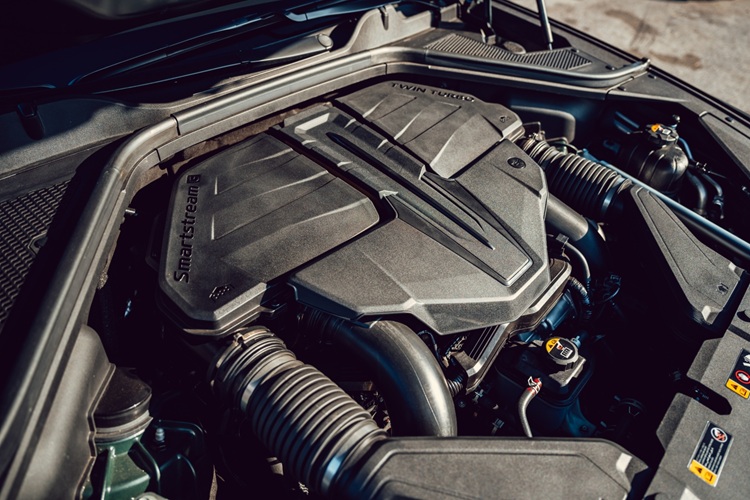
A view of the N Line’s 290-hp 2.5 liter four-cylinder engine.

The N Line’s 290-hp 2.5 liter four-cylinder engine.

Under the Hood

Pop the N Line hood, and Hyundai’s detailed engineering for serviceability and DIY maintenance becomes apparent. First, there are two robust hydraulic hood struts, not a spindly prop rod. Never mind that those struts (and tailgate struts) will wear out and need to be replaced. It is the budget for hydraulic struts that matters.

Sonata's easy to change air filter

Air filter can be changed in less than a minute!

Next, check out the huge air pipe feeding the turbocharger. It is securely routed to avoid chafing on the also-large air intake tube next to it. Then, follow the air intake feed to the air filter box. The strong black plastic box has a user-considerate design with small flipper tabs. Opening, removing, and slipping in a new filter should take less than a minute.

Thermal-sandwiched metallic pads are behind and above the hood for turbocharger heat protection.

The 12-volt battery has dual lifting handles. Both battery terminals have a cover to protect positive and negative posts, and the positive terminal has its own high-current fuse.

Look closer for the corrosion-protected engine-transmission grounding strap. The robust strap is fully covered.

The user friendly fuse panel under the hood of the Sonata.

The simple fuse-box schematic. (Peter Badore photos)

Now, eyes right to the vehicle fuse box near the right-side shock tower, clearly identified. Remove the lid, and the underside has a detailed schematic chart showing each fuse amperage and what it protects. There are also six spare fuses and a useable plastic tweezer-like tool to pull a blown fuse.

Finally, for the owner and service tech, many of the screw heads are rounded to protect knuckles.

All these added design features add cost and weight. Many carmakers in the Sonata’s price segment cut such extras from their budgets.

Fuel Economy Numbers

At 3,534 pounds, the Hyundai Sonata N Line is the second heaviest Sonata in the lineup. It slots behind the Limited at 3,687 pounds or the SEL AWD model at 3,466.

Sonata N Line has fuel economy ratings of 23 mpg city, 32 highway, and 27 mpg combined on the recommended 87 octane fuel. In my 200-mile week of driving, I saw mileage averages of 29.4 around town to 35 mpg on the highway.

However, those mileage ratings are several mpgs off those of the four-cylinder 2024 Honda Accord turbo (29/37/32 mpg) and 2024 Toyota Camry (28/39/32 mpg).

Sonata N Line Ride and Handling

The suspension stands out for its agile finesse in transferring weight. The refined engineering of suspension components is felt in the low-friction glide quality.

Modern family sedans have been made lower and wider in the hope of improving fuel economy and meeting federal mileage standards. Consequently, some new sedans ride so low that comfortable entry and exit are compromised.

Not so the Hyundai Sonata. Its ride height allows excellent forward sightlines and comfortable entry and exit. Drivers can confidently transition driveways without a chin scrape. There is no tiptoeing across lumpy intersections in concern of bottoming out. It is hard to avoid that awful “graunch” in most other sedans and some small SUVs today.

Hyundai has applied various aerodynamic designs, winglets, and air-breaking widgets to lower the drag coefficient to 0.28. The Toyota Prius, by comparison, has a Cd of 0.27. Despite more soundproofing, there is much ambient noise in the cabin at highway speeds. It did not seem to come from tire harshness or suspension points.

Complementing ride and steering control are the 19-inch 245/40 Pirelli P Zero all-season tires, on the test car. Their rubber chemistry is compliant with an upper-midrange 500 treadwear rating (UTQG). Replacements will run around $300 each (not installed), per TireRack.com.

The N Line’s 19-inch tire and wheel package with Pirelli P Zero all-season tires.

The N Line’s 19-inch tire and wheel package with Pirelli P Zero all-season tires.

Why Buy the 2024 Hyundai Sonata N Line?

Hyundai believes there is renewed interest in sedans. The Sonata offers accommodating utility and a generous budget for many useful features.

There is more to the Sonata N Line than what is typically perceived as a family sedan. Enjoying this stealthy sport sedan requires no physical sacrifice.

Now, switch off the drive assistance, take the wheel, and just enjoy driving.

A slightly overhead view of a silver Sonata N Line

The Sonata N Line is an outlier sport sedan with no real competition, except its company cousin the Kia K5 GT.

2024 Hyundai Sonata N Line Specifications

Body style: midsize, 5-seat, 4-door front-wheel-drive sedan; unibody high-strength steel

Engine: 290 hp, Smartstream 2.5-liter turbocharged and direct-injected DOHC 16-valve inline 4-cylinder; 311 lb.-ft. torque from 1,650-4,000 rpm

Transmission: 8-speed N automatic wet dual-clutch

Fuel economy: 23/32/27 mpg city/hwy/combined;

Coefficient of drag: 0.27 Cd

BY THE NUMBERS

Fuel tank: 15.9 gallons

Trunk space: 15.6 cubic feet

Front head/leg room: 37.8*/46.1 inches *40 inches w/o sunroof

Rear head/leg room: 37.4*/34.8 inches *38.4 w/o sunroof

Shoulder room, front/rear: 57.9/56.1 inches

Hip room, front/rear: 54/.6/54.4 inches

Length/wheelbase: 193.3/111.8 inches

Height/width: 56.9/73.2 (not including mirrors) inches

Curb weight: 3,534 pounds

Turning circle: 35.9 feet

FEATURES

Sonata N Line standard equipment includes: Proximity key with push-button ignition, 12.3-inch color gauge array, 12.3-inch touchscreen for navigation-audio, panoramic sunroof, surround view monitor, dual automatic temperature control, wireless Apple CarPlay and Android Auto, 12-speaker Bose audio system with satellite radio, 8-way power driver’ seat, 6-way front passenger seat, heated front seats, electric parking brake, 60/40 folding back seat, hands-free trunk, lighted vanity mirrors and visor extensions, locking and lighted glove box.

N-Line features: larger front bumper grille area, exclusive 19-inch wheels, rear spoiler, dual twin-tip exhaust, front sport seats with microfiber suede inserts and higher-grip side bolsters, leather-wrapped steering wheel, metal and rubber brake and accelerator pedals, LED map lights, red-accented stitching and cross-metal patterned trim, Active Sound Design, Launch Control, N Powershift, and rev-matching downshifts.

Sonata N-Line standard safety features include: 9 air bags, 5 mph bumpers, stability and traction controls, safe exit warning;

Safety technologies include: blind-spot collision warning with rear cross-traffic collision avoidance assist; blind-spot view monitor; forward collision-avoidance assist with pedestrian, cyclist detection and junction turning; parking collision-avoidance assist rear; high-beam assist; lane keeping assist, lane follow assist, and driver attention warning.

CHASSIS COMPONENTS

Brakes: 4-wheel disc brakes; 13.6-inch ventilated front rotors, 12.8-inch rear solid discs; 4-wheel ABS with electronic brake-force distribution with brake assist; electric parking brake

Steering: column-mounted rack and pinion; motor-driven power assist with engine rpm-sensing; turning circle 35.9 feet

Tires-wheels (on test car): 19-inch 245/40 Pirelli P Zero all-season on 5 dual-spoke wheels; tire mobility kit (no temporary spare)

Suspension: front MacPherson struts with a stabilizer bar; rear multilink with a stabilizer bar; gas shock absorbers front and rear

PRICING

Base price: $36,100, including $1,150 freight charge; price as tested $36,310

Options on test vehicle: Carpeted floor mats $210

Where assembled: Asan, Korea

Warranties: 5-years/60,000-miles bumper to bumper with roadside assistance; 3-years/36,000-miles complimentary maintenance; 10-years/100,000-miles powertrain

Lexus NX 450h+ Review

Lexus NX 450h+ Review

On-road recharging of the 2025 Lexus NX 450h+ plug-in hybrid is the missing link between a hybrid and full EV

A front three quarter view of the bold blue 2025 Lexus NX small SUV crossover

The 2025 Lexus NX is available in four powertrains, including two hybrid electric models, in front- or all-wheel drive. Starting prices range from around $42,000 to $64,000 (Photography courtesy of Lexus or as credited)

Jump To Special Features

Lexus NX Overview
What’s New for 2025?
Lexus NX Model Line Pricing
What is California Clean Assist?
NX Safety Features and Technologies
Powertrain and Performance
F Sport Ride and Handling
Interior Function
Why Buy the 2025 Lexus NX 450h PHEV?
Specifications

BY MARK MAYNARD

The on-road recharging function of the 2025 Lexus NX 450h+ plug-in hybrid is the missing link between a hybrid and full EV. Being able to recharge the small hybrid battery while driving elevates this PHEV as a one-vehicle choice for the tentative EV buyer.

The battery-electric driving range is 26 to 37 miles, which provides emissions-free driving. And because this small SUV can charge on the go, it continues to extend the driving range and fuel savings.

It is a functional system that can be used to bank battery power while running on gasoline. When the charge runs out, hit the console switch for Charge Mode. Switch to EV power to save gas when the battery is full again.

Even when driving in EV mode, the gas engine will kick in for strong acceleration or on steep hills.

Charge mode quickly adds miles while driving at interstate speeds and slower while in town. The recharging was so efficient that I did not need to plug in on my home 240-volt charger. However, on-road charging will only boost the battery to an 80 percent charge, so owners might want to plug in overnight for the full 37-mile range.

This recharging mode elevates the common plug-in hybrid to a strong daily commuter, an enviable vacation traveler, a fuel saver, and an emissions conservator. It is that spoonful of sugar that sweetens the $60,000 price tag.

Recharging on the go should be the future tech for all plug-in hybrids. So far, I have tested only a few PHEVs with this capability, including the Mazda CX-90 and McLaren Artura.

Looking over the driver seat at the red sport interior

It is easy to get comfortable in the NX driver space. A red interior is a no-cost choice.

2025 Lexus NX Overview

The Lexus NX is a compact-class, five-seat, five-door SUV crossover. It was fully redesigned from the inside out in 2022.

In the Lexus SUV lineup, the compact NX — “Nimble Crossover” — fits between the subcompact UX and the mid-size RX. You might not know by looking at it, but the Lexus NX shares a platform with the Toyota RAV4. The rakishly stylish NX has the same powertrain options and uses the same 105.9-inch wheelbase. The NX is about 2 ½ inches longer and less than a half-inch wider (due to body styling). And the NX roofline is about an inch lower than the RAV4. Still, the NX feels like a smaller compact than the RAV4.

Though nimble to drive, the NX is hampered by wide turning circles of 38 to 40 feet. And the span might be wider on the taller 20-inch tires of the F Sport models.

Comparable small SUVs to the Lexus NX include the Audi Q3, BMW X1, Mercedes-Benz GLA, and Volvo XC40.

The optional wireless charging pad is on a sliding shelf with small storage below.

The wireless charging pad is on a sliding shelf with small storage below.

What’s New for 2025?

For the 2025 model year, the NX line has just minor changes. Two new color options are available: Copper Crest (exterior) and Macadamia (interior, Luxury grade only). Inside, two USB Type-C ports are now included in the front console, and a wireless charger is available on all trim levels. Intuitive Parking Assist with Automatic Braking, Auto Rain Sensing Wipers, and a power liftgate are now standard.

Over-the-air updates offer real-time updates for mapping and media.

Looking rearward through the panoramic glass roof, a $1,600 option in the NX

The optional panoramic glass roof, $1,600, outclasses the small $1,100 power tilt-and-slide moonroof.

2025 Lexus NX Model Line Pricing

The 2025 Lexus NX is available in four powertrains, including two hybrid electric models. The starting prices listed below include the $1,175 freight charge from Miyawaka, Japan. All models are front- or all-wheel drive.

NX 250 FWD/AWD $42,140/$43,740

The 203-hp NX 250 has a naturally aspirated 2.5-liter four-cylinder engine with an eight-speed automatic transmission.

0-60 mph acceleration: 8.2 seconds (FWD), 8.6 seconds (AWD);

EPA-estimated fuel economy: FWD, 26/33/28 mpg city/hwy/combined; AWD 25/32/28. Regular unleaded fuel is recommended.

NX 350 AWD $45,900; NX 350 Premium AWD $47,825

The NX 350 gets a power boost from a turbocharged 2.4-liter four-cylinder with 275 hp and eight-speed transmission.

0-60 mph acceleration: 6.6 seconds;

EPA-estimated fuel economy: 21/28/24 mpg city/hwy/combined/ Premium fuel is recommended.

NX 350h AWD $46,600

The gasoline-electric hybrid NX 350h has a 240-hp 2.5-liter four-cylinder gasoline engine and electronic continuously variable automatic transmission. The hybrid system comprises two high-torque electric drive motor generators and a lithium-ion battery pack.

Motor generator 1 starts the engine and charges the hybrid battery.

Motor generator 2 (134-hp) drives the front wheels and provides regeneration during braking.

Rear motor generator (40 hp) drives the rear wheels when tire slippage is detected.

0-60 mph acceleration: 7.2 seconds

EPA-estimated fuel economy: 431/37/39 mpg/city/hwy; premium fuel is recommended.

NX 450h+ AWD PHEV $62,415

The NX 450h+ plug-in hybrid has an EPA-estimated 37-mile range on electric power only. The combined electric and gas-engine driving range is up to 550 miles. The hybrid system with a high-capacity lithium-ion battery is engineered for faster charging times. The system also reduces power loss when converting from AC to DC power. A full charge on a Level 2 240-volt home or public system takes around three hours. A three-prong 7 kW onboard charging cable is standard for use in a household plug.

Electronic AWD optimizes front and rear torque distribution according to the driving conditions.

0-60 mph acceleration: 6 seconds;

EPA-estimated fuel economy: 36 mpg combined, 84 mpg-e; premium fuel is recommended.

NX 450h+ F Sport Handling AWD $63,505

F Sport performance attributes include Active Variable Suspension (AVS), and front and rear performance dampers. There is no power boost, but performance can be manipulated by driving modes of Normal, Eco, EV, Sport, and Sport S+.

Exclusive F Sport features include:

  • Dark Graphite Aluminum ornamentation;
  • A unique performance gauge array;
  • Bolstered sport seats, sport steering wheel, aluminum pedals, and F Sport scuff plates.
  • Perforated interior upholstery is available in no-cost colors of black or Circuit Red NuLuxe. Sport-inspired elements and stitching enhance the appearance of seats, steering wheel, and center console.

The exterior is set off by 20-inch black alloy wheels framed by color-key over-fenders. The vehicle is also topped with black roof rails and window surrounds.

Find current Lexus NX pricing here.

Check here for current Lexus NX offers

Today’s featured NX is the top-line 450h+ F Sport Handling AWD. As tested, it cost $66,419. Among the tester’s extras are:

  • Ultrasonic Blue Mica paint $595.
  • Panoramic view color monitor, $1,070, but the package includes lane-change assist and front cross-traffic alert.
  • Wireless phone charging pad and digital key (with a 3-year trial remote connect subscription) $450. (But why is a wireless charging pad an upsell on a $60K vehicle?)
Looking at the driver side electric door release lever in the armrest

The electric door-release push lever. There also is manual lever below in case the battery dies.

Lexus New Vehicle Warranties

The Lexus NX (and all Lexus models) have warranty coverage of 4 years or 50,000 miles bumper to bumper. No-cost first and second scheduled maintenance services include a free loaner vehicle and a carwash.

Hybrid-related components that require repairs to correct defects in materials or assembly are covered for 8 years or 100,000 miles.

The hybrid battery is covered for 10 years or 150,000 miles and is transferable across ownership.

The charge door on the right rear quarter panel with the cable connected

A full charge on a Level 2 240-volt home or public system takes around three hours.

What is California Clean Assist?

Lexus and Toyota offer a special Clean Assist program for California plug-in hybrid owners. Eligible Toyota Group vehicles include the Lexus NX 450h+ and Lexus RZ BEV, Toyota Prius Plug-in, Prius Prime, or RAV4 Prime.

The program allows owners of plug-in hybrid models to offset their vehicle charging with 100 percent renewable energy. The automaker matches the electricity used to charge your plug-in or battery-electric vehicle through Renewable Energy Certificates.

Lexus will match the electricity used to charge your plug-in NX with renewable electricity to make your vehicle’s charging free of CO2 emissions.

If applicable, Lexus reports the total amount of your clean energy to state and local regulatory boards. The credits for Low Carbon Fuel Standard help promote and educate EV adoption.

Owners with a registered Lexus account can enroll in the program using the Lexus app. Tap the Clean Assist card to “Enroll Now.”

Learn more about Clean Assist here.

Looking at the 302-hp gas-electric hybrid powertrain in the Lexus NX

The 302-hp gas-electric hybrid powertrain. (Mark Maynard)

Powertrain and Performance

The gas-electric hybridization is a parallel system with a gas engine, high-voltage lithium-ion battery, and three permanent magnet electric motors. The 2.5-liter four-cylinder engine brings 181 horsepower, which jumps to 302 hp from the motors and battery.

That’s responsive power for a small SUV weighing 4,475 pounds. On average, my fuel economy was around 33 mpg, but the reward is extending battery driving.

The F Sport has drive modes of Eco, Normal, EV, Sport, and Sport S+. I drove in Eco for most of the week before I switched up. Eco is fine for in-town driving to max fuel economy. Sport is much more engaging, though.

Regenerative braking captures heat from braking and pipes it back to the battery pack. The large, ventilated four-wheel disc brakes have rewarding force without grab or dive. Lexus was not timid in providing braking force. The four-wheel ventilated brakes have 12.9-inch rotors at the front and 12.5 inches rear.

Triple beam LED headlights with washers and cornering lamps.

Triple beam LED headlights with washers and cornering lamps.

NX Safety Technologies

In addition to eight air bags and large four-wheel disc brakes, the NX has received multiple safety ratings. So far, the accolades include:

  • Five stars from the Euro NCAP;
  • Top Safety Pick+ from the Insurance Institute for Highway Safety;
  • NHTSA awarded four out of five stars in its frontal crash test and five stars in the side crash test.

I especially enjoyed and took advantage of the standard Lexus Safety System+ 3.0 driver-assistance features. (Full details are in the specs box at the end of the review.)

Typically, I only use the All-Speed Dynamic Radar Cruise Control on the highway. In this test week, I engaged DRCC in town at 25 mph, and the system almost worked as one-pedal driving. Radar and cameras watch the road ahead to maintain the preset speed and distance from vehicles ahead. The system will automatically slow or stop if the NX gets closer than the preset distance. When the road ahead clears, the vehicle returns to its preset speed.

There is a lot to explore among the sophisticated technologies of the Lexus NX.

Lexus NX F Sport features include aluminum pedals.

Lexus NX F Sport features include robust aluminum pedals.

F Sport Ride and Handling

The F Sport model has the hotted-up appearance of the urban street fighter. Except for the adaptive suspension, it’s mostly cosmetic, but the treatment spans from good to horrible. Built on Toyota’s TNGA-K platform, the NX chassis is solid and ideal for a performance suspension.

The adaptive setup is an eager partner for sporty driving, if that is your intent. But it can be tiring on every drive.

On chunky road surfaces, the suspension instantly stiffens with jarring jolts. Along twisting country roads with undulations and crumbly portions, the suspension continually adjusts and can feel unsettled.

It is a noisy ride, too. No matter how high I crank the 17-speaker Mark Levinson surround sound system, it is not enough to silence the wind and road noise. There must not be much soundproofing between the firewall and cabin, which is why I always tried to run on battery power.

The noisy ride might be from the Bridgestone Alenza run-flat tires. The tires have soft compounding (a 300 treadwear rating), which is good for performance adhesion. However, according to user reviews at TireRack.com , these tires were worn to the treadwear bars between 7,800 to 8,500 miles. Replacements will run around $385 each, not including installation, etc.

The Lexus Spindle Grille is a brand-defining style feature.

The Lexus Spindle Grille is a brand-defining style feature.

Interior Function

It is easy to get comfortable in the NX driver space, but headroom might be an issue for the big and tall. The NX is, after all, a compact. Front headroom of 38.3 inches is acceptable for most, with long legroom of 41 inches.

Drivers of shorter stature will appreciate how far forward the power seats can move.

The optional wireless charging pad is a smart design. It sits on a sliding shelf that will fit large phones and is adjacent to the USB charging ports. The clever part is that the shelf can slide forward to reveal small storage below.

There also is usable stash space in the door panels and a locking glove box.

I liked the multiview camera system, showing front, rear, and an overhead view to show how badly I parked. And all doors have a locking sensor, which is a big plus for me. It saves a second or two from having to unlock the front doors to get into the back. Seconds matter when loading children.

The NX back seat is reasonably comfortable with a couple notches of recline.

The NX back seat is reasonably comfortable with a couple notches of recline. (Mark Maynard)

Back Seat and Cargo Space

The 60/40 split bench is reasonably comfortable with a couple of notches of recline. Headroom is good at 37.1 inches. Legroom sounds good at 36.1 inches unless Uncle Long John is seated ahead.

Foot space getting in and out is tight for adults.

Back seat amenities include the fold-down armrest with can holders. There are grab handles with jack hooks above each door, two charging USBs, and a 12-volt plug.

The open cargo area with the 60/40 back seat folded

Fold the back seat for about 6 feet in length.

Cargo Space

Cargo space is functional at 22.7 cubic feet, stacking gear to the ceiling. The tailgate entry is a broad 39 inches with about 29 inches from floor to headliner. Fold the back seat for 6 feet in length, with the front seat powered forward.

Under-cargo storage has divided portions to carry the charging cable, next to the 12-volt battery. Access to the battery is convenient for the occasional jump start.

There is cargo underfloor storage for the charging cable and the folded cargo cover when not in use

Tidy underfloor storage for the charging cable, and easy access to the 12-volt battery. (Mark Maynard)

Why Buy the 2025 Lexus NX 450h PHEV?

The 2025 Lexus NX plug-in hybrid is appealing as an all-around SUV crossover. Its small size makes for an ideal navigator in congested urban centers. AWD is a plus. With the NX vault of safety features, parents can feel secure in rewarding their graduates with any level of NX.

Amping up the performance for the F Sport might be overkill. The NX is better as an electrified choice than a performance vehicle.

I am a proponent of a plug-in that can be recharged while driving. But at what cost? There is a $15,815 starting price separation between the NX 450h+ PHEV and the hybrid NX 350h AWD. Is there enough green value to the NX plug-in pricing, or will buyers bank the price difference for gasoline?

Let me know which model you would buy and why. Email me at MarkMaynard@cox.net.

A rear three quarter view of the Lexus NX

You might not know by looking at it, but the Lexus NX shares a platform with the Toyota RAV4.

2025 Lexus NX 450h Specifications

Body style: compact 5-seat, 5-door SUV crossover with full-time all-weather drive (AWD)

Engine: 181 hp A25A-FXS 2.5 liter in-line 4-cylinder with D4S port and direct fuel injection;

Hybrid power system: Series parallel system with gas engine, high-voltage battery, and electric motors; Permanent magnet motors

Total system power: 302 hp

Motor generator 1: Generator, engine starter, charges hybrid battery

Motor generator 2: Drives front wheels, regeneration during braking

Rear motor generator: Drives rear wheels, regeneration during braking

Battery: 355.2-volt lithium-ion

Transmission: E-CVT with electronic all- or front-wheel-drive control

Plug-in Hybrid fuel economy: 36 mpg combined city/hwy; 84 mpg-e fuel-economy equivalent; premium fuel required

Battery driving range: up to 37 miles

Total driving range: 550 miles electric and gas

Coefficient of drag: 0.37 Cd with 20-inch wheels

60 mph acceleration: 6 seconds; top track speed 124 mph

Charging: 12 hours to charge using a 120-volt outlet or about 2.5 hours using a 240-volt outlet.

BY THE NUMBERS

Towing capacity: 2,000 pounds

Fuel tank: 14.5 gallons

Cargo space: 22.7/46.9 cubic feet

Front head/leg room: 38.3*/41 inches *w/sunroof

Rear head/leg room: 37.1/36.1 inches

Length/wheelbase: 183.5/105.9 inches

Width/height: 73.4/65.8 inches

Track width, f/r: 63.2/64.0 inches

Curb weight: 4,475 pounds

Turning circle: 40 feet

SAFETY TECHNOLOGIES

The standard Lexus Safety System+ 3.0 includes:

Pre-Collision System with Pedestrian Detection. Using a camera and millimeter-wave radar, the pre-collision system can help detect and alert to a vehicle, pedestrian, or cyclist. If the driver does not react, the system can use automatic emergency braking between 7 and 110 mph.

Left Turn Oncoming Vehicle Detection/Braking. If turning left in front of an oncoming vehicle, the system will issue a warning alert followed by automatic braking, which is functional during daylight hours.

Risk Avoidance Emergency Steer Assist. Emergency maneuvers get an additional steering boost to prevent lane departure. The assistance functions between 25-50 mph, and the relative speed to the detected object is between 25-50 mph.

Emergency Driving Stop System. If the system detects no driver input for a time, audible warnings will alert the driver. If the driver does not respond, the system will slow the vehicle to a stop, keeping it safely in the lane. EDSS only operates when driving on expressways with DRCC and LTA activated.

Lane Departure Alert with Steering Assist. Functional above 32 mph, LDA w/SA will issue audible and visual alerts if an inadvertent lane departure is detected. If the driver does not take corrective action, the system will initiate gentle corrective steering for lane-keeping assistance.

Proactive Driving Assist. Using a camera and radar, PDA monitors distance control between a preceding vehicle, pedestrian, or bicyclist. The system will engage gentle braking and steering into curves as needed.

Road Sign Assist. A camera detects speed limit signs, stop signs, Do Not Enter signs, yield signs, and certain warning signs. A signage icon is displayed in the driver gauge array and head-up display.

All-Speed Dynamic Radar Cruise Control. Radar and cameras work to maintain the preset speed and distance from vehicles ahead. If the car gets closer than the preset distance, the system will automatically slow or stop it. When the road ahead clears, the vehicle returns to its preset speed.

Lane Tracing Assist. When Dynamic Radar Cruise Control is enabled, LTA uses the lines on the road and preceding vehicles for active driving assistance. The system will help keep the vehicle centered in its lane.

CHASSIS COMPONENTS

Brakes: 4-wheel ventilated discs; front, 12.9-inch rotors; rear rotors, 12.48 inches; 4-channel, 4-sensor ABS

Steering: Electric power-assisted; 40-foot turning circle

Tires-wheels: run-flat Bridgestone Alenza 235/50R20 standard; UTQG 300

Suspension: front, MacPherson strut type; rear, trailing arm type double-wishbone

PRICING

Base price: $63,505, including $1,175 freight charge; price as tested $66,419

Options on test vehicle: premium Ultrasonic Blue Mica paint, $595; panoramic view monitor with lane-change assist and front traffic alert, $1,070; wireless phone charging and digital key, $450; activity mount (trailer hitch), $390; illuminated cargo sills, $300; rear and side door puddle lamps, $325; illuminated door sills, $460; cargo mat, net, and key glove, $240; wheel locks $95;

Where assembled: Miyawaka, Fukuoka, Japan

Warranties:

  • Bumper to bumper, 4-years/50,000-miles for all components other than normal wear and maintenance items; wheel alignment and balancing are covered for 12 months or 12,000 miles;
  • Hybrid system: 8-years/100,000-miles for Hybrid control module, Hybrid battery control module, Hybrid battery, and inverter with converter;
  • Powertrain, 6 years/70,000 miles, covering engine, transmission and transaxle, front-wheel-drive system, and rear-wheel drive.


Genesis USA Debuts 3 2026 Prestige Black Models

Genesis USA Debuts 3 2026 Prestige Black Models

Monochrome meets modern luxury in the Genesis GV80 SUV, GV80 Coupe, and flagship G90 large sedan

A sunset group shot of the Genesis GV80 SUVs and G90 sedans in white or black paint.

The 2026 Genesis GV80 and G90 Prestige Black models are now the top trim levels, and luxury laden. (Photography courtesy of Genesis USA)

Jump To Special Features

Prestige Black Pricing and Features
375-hp GV80 Engine
409-hp G90 E-SC Engine
Genesis Warranty Coverages
Genesis Service Valet
2026 Genesis GV80 Prestige Black AWD Specifications

BY MARK MAYNARD

If you want someone’s attention, you whisper. But to command attention without making a sound, you go black for your luxury ride. Genesis has elevated its 2026 GV80 SUV and GV90 flagship sedan by cloaking them in the monochromatic Prestige Black trim. This isn’t just paint; it’s a “striking blend of sophistication and style,” designed to capture attention with a velvet hush.

The intensely monochromatic design package was previously exclusive to Korea. Genesis says the treatment creates a “striking blend of sophistication and style.”

The five-passenger Prestige Black models are now the top trim levels and are luxury-laden. Standard features include V-6 engines, eight-speed automatic transmissions, and sumptuous interiors. The whole package is wrapped in comprehensive Genesis warranties, including concierge support.

Both body styles are available in paint colors of Vik Black or Uyuni white, $650 each. Both interiors are in Obsidian Black. Genesis says Iceland’s volcanic beaches inspire its Vik Black; Uyuni White is reminiscent of Bolivia’s salt flats, also known as the Salar de Uyuni.

“North American customers are increasingly looking for vehicles that express their personal style while offering exceptional craftsmanship,” Tedros Mengiste, chief operating officer of Genesis Motor North America, said in a statement. “Prestige Black delivers exactly that.”

Prestige Black Pricing and Features

The GV80 Prestige Black (long roof) starts at $84,745, including the paint premium and a $1,495 freight charge.

Also available on the Prestige Black trim is the GV80 coupe. Its fastback roof gives a more sporting stance with some compromise in cargo height. The coupe is also a little pricier than the long-roof GV80 Prestige Black. It has a starting price of $91,545, including Vik Black or white paint.

Pricing for the 2026 Genesis G90 Prestige Black starts at $107,895, including paint and freight.

The G90 and GV80 are built in Ulsan, Korea.

Find manufacturer pricing for all 2025-2026 Genesis models here.

The hood and Genesis logo are darkened.

Exterior Prestige Black features include a darkened grille, emblems, and headlamp bezels.

Genesis GV80 Prestige Black

Whether in black or white metallic paint, the 2026 Genesis GV80 Prestige Black has a commanding presence inside and out. Its exterior features black accents and 22-inch gloss-black alloy wheels. Both colors are paired with a signature darkened grille, emblems, and headlamp bezels. All-wheel drive with Terrain Mode Select is standard.

Inside, the GV80 has an Obsidian Black Monotone interior. Select features include Black Ash open-pore wood trim and black-finished controls throughout the cabin. Five-passenger seating includes power reclining rear seats with an OLED welcome and goodbye animation.

GV80 Prestige Black features include:

Exterior Accents: Gloss black grille, door handles, fascia, roof rails, daylight opening moldings

Brakes: Black monobloc four-piston fixed front calipers, black rear calipers

Wheels: 22-inch black alloy wheels with all-season tires

Headlights: Black inner bezels

Emblems: Dark Genesis Guilloché emblem (front), dark lettering (rear)

Interior: Black monotone Nappa leather with exclusive quilting

Trim: ‘Black Ash’ open-pore wood

Black-finished controls throughout the cabin.

Black-finished controls throughout the cabin.

Controls: Black switches, air vents, buttons, shifter

Audio: Anodized black speaker grilles

Technology: OLED welcome/goodbye animation, infotainment theme, and sound

Key Fob: Prestige Black, exclusive

Inside, the GV80 has an Obsidian Black Monotone interior.

Inside, the GV80 has an Obsidian Black Monotone interior.

375-hp GV80 Engine

Powering the GV80 AWD is a 375-horsepower, direct-injected, twin-turbocharged 3.5-liter V-6 paired with an eight-speed automatic transmission. Sophisticated engineering includes hydraulic (“hydro”) motor mounts to damp noise, vibration, and harshness. The hydro mounts stabilize the engine while absorbing engine vibrations before they reach the chassis and the cabin.

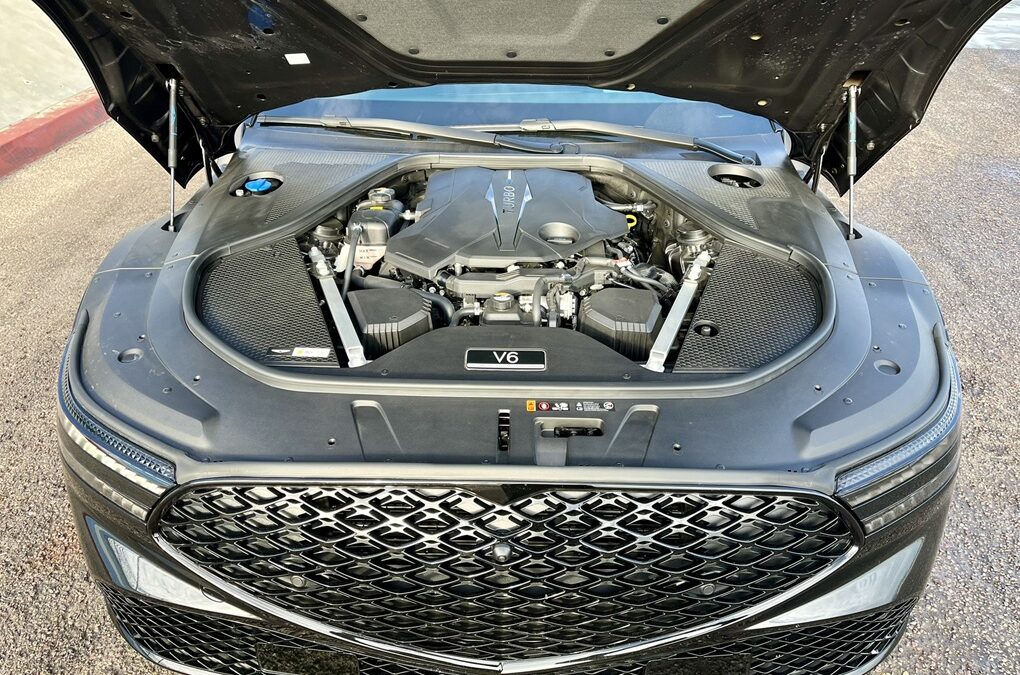
Looking at the 375 hp V6 engine in the 2026 Genesis GV80 SUV

The GV80 375-hp, twin-turbocharged V-6.

The 5,250-pound GV80 Black has mileage ratings of 16 mpg city, 22 highway, and 19 mpg combined. A 21.1-gallon fuel tank provides a considerable cruising range, using the recommended premium fuel.
Genesis G90 Prestige Black

G90 Prestige Black Flagship

A static, horizontal image of The G90 Prestige Black in Uyuni white.

The G90 Prestige Black in Uyuni white.

Genesis’s flagship G90 Prestige Black sets a standard for executive luxury, the Korean carmaker says. The large sedan’s exterior is set off by 21-inch black alloy wheels, a gloss black grille, and dark Genesis emblems. The cabin is wrapped in semi-aniline Nappa leather with exclusive quilting. Black Ash wood trim complements brass-colored G-Matrix inlays.

The G90 interior is a showcase of refinement, with black accents on switches, air vents, and anodized black speaker grilles. The LCD welcome and goodbye feature has clever technological animation.

Read my review of the 2025 Genesis G90 3.5T E-Supercharged:

https://tinyurl.com/44v3ms6e

Looking at a G90 back seat with quilted leather pattern

The G90 Prestige Black cabin is tailored in semi-aniline Nappa leather with exclusive quilting.

 409-hp G90 E-SC Engine

The Genesis G90 V-6 builds on the 3.5-liter powertrain with a 48-volt e-Supercharger for mild hybrid technology. Turbocharging and supercharging give the G90 E-SC performance lift. Its power ratings are 409 horsepower and 405 foot-pounds of torque, with torque available from a low 1,300 rpm up to 4,500 rpm. The 48-volt e-supercharger tightens launch force, closing the gap between turbo-spooling and forceful acceleration.

Fuel economy ratings are 17/22/20 mpg using the recommended premium fuel. Expect a cruising range of nearly 400 miles from its 19.3-gallon tank.

The Genesis G90 Black has a curb weight of 5,194 pounds.

Looking at the 409 hp supercharged V6 in the 2026 Genesis G90 sedan

The G90’s 409-hp twin-turbocharged and supercharged 3.5-liter V-6. (Mark Maynard photo)

G90 Prestige Black features include:

Exterior accents: Gloss black grille, door handles, fascia, daylight opening moldings

Wheels: 21-inch black alloy wheels with floating center caps

Interior: Black monotone semi-aniline Nappa leather with quilting

Trim: ‘Black Ash’ open-pore wood with brass-colored G-Matrix inlay

Controls: Black switches, air vents, buttons, shifter

Audio: Anodized black speaker grilles

Technology: LCD welcome and goodbye animation, infotainment theme, and sound

Key Fob: Prestige Black, exclusive

Brakes: Black monobloc four-piston fixed front calipers, black rear calipers

Headlights: Black inner bezels

Emblems: Dark Genesis Guilloché emblem (front), dark lettering (rear)

21 inch black wheels on the G90

The G90 Prestige Black is fitted with 21-inch black wheels.

Genesis Warranty Coverages

Genesis warranty coverage is gold class. Bumper-to-bumper new vehicle coverage is for 5 years or 60,000 miles, and powertrain coverage is for 10 years or 100,000 miles.

And there is greater gold in owner care:

  • 3-years/36,000-miles complimentary maintenance and service valet;
  • 3 years of free map updates;

And 3 years of free Genesis Connected Services, which include:

Connected Care: Safety and maintenance services, including automatic collision notification, enhanced roadside assistance, and monthly vehicle health reports.

Remote: Convenience features include Remote Start with Climate Control, Remote Door Lock/Unlock, and Stolen Vehicle Recovery.

Guidance: Navigation-related services such as Destination Search and Send-to-Car.

The connected services are accessed through the vehicle’s infotainment screen, the Genesis website, smartphone app, or Smartwatch.

For those buying a used 2023 or newer Genesis vehicle, there is still free access to safety and maintenance features. However, a subscription is required to use the convenience and remote technology features included in the Remote and Guidance packages. The cost for each of these packages is $9.90 per month or $99 per year.

For more information, visit the Genesis Owners website or contact Genesis customer support here.

A close detail image of the refined trim treatment on the inside door panel

The cabin has Black Ash open-pore wood trim and black-finished controls throughout.

 Genesis Service Valet

An outstanding buyer incentive is the Genesis Service Valet, a free program for the first three years of ownership.

Key features include:

  • Vehicle pickup and return: Schedule maintenance or repairs online or via the Genesis mobile app. A dealership representative will pick up your vehicle from your chosen location.
  • Free loaner vehicle: Genesis provides a loaner vehicle while servicing your vehicle.
  • Flexible scheduling: Choose times and locations for pickup and return of your vehicle.

For more details or to schedule a Service Valet appointment, visit the Genesis Owners website here.

2026 Genesis GV80 Prestige Black AWD Specifications

Body style: 5-passenger, 5-door midsize luxury SUV; composed primarily of advanced high-strength steel

Engine: 375-hp 3.5-liter direct-injected and twin-turbocharged V-6, 391 lb.-ft. torque from 1,300-4,500 rpm; with idle stop-start

Transmission: 8-speed shiftable automatic with terrain-mode select all-wheel drive for snow, mud, sand

Fuel economy: 16/22/19 mpg city/hwy/combined; premium fuel recommended but not required

BY THE NUMBERS

Coefficient of drag: 0.33 Cd

Fuel tank: 21.1 gallons

Cargo space: 38.7 cubic feet (behind 2nd row); 71.1 cu. ft. max

Front head/leg room: 40.2 / 41.6 inches

Rear head/leg room: 38.4 / 38.7 inches

Length/wheelbase: 194.5 / 116.3 inches

Curb weight: 5,250 pounds

Turning circle: 39.3 feet, with 22-inch tires

Towing capacity: 6,000 pounds

Safety features include:

  • 10 air bags
  • Forward collision-avoidance assist
  • Blind-spot view monitor
  • Lane keeping and lane following assist
  • Smart cruise control with stop & go
  • Surround view monitor
  • Rear cross-traffic collision-avoidance assist

CHASSIS COMPONENTS

Brakes: Monobloc front brakes with black calipers; ventilated 14.9-inch front rotors, 14.2-inch rear rotors

Steering: Electric power-assisted rack-and-pinion

Tires-wheels: 22-inch black alloy wheels with all-season tires; 265/40R22; temporary spare

Suspension: Electronically controlled four-wheel independent with front/rear stabilizer bars; with Road Preview; electronic limited-slip differential

PRICING

GV80 Prestige Black Base price: $83,250, including $1,495 freight charge; price as tested: $85,395, with metallic paint

Where assembled: Ulsan, South Korea

Warranty: 3-years/36,000-miles complimentary maintenance and service valet; 3-year map updates; free

Genesis Connected Services; 5-years/60,000-miles bumper to bumper; 10-years/100,000-miles powertrain

Veterans Day Military Appreciation

Veterans Day Military Appreciation
Print advertisement of GM's contributions to
“An Arsenal of Democracy.” Between 1942 and 1945.

Print advertisement of GM’s contributions to “An Arsenal of Democracy.” Between 1942 and 1945. (GM PR image)

BY MARK MAYNARD

As World War II began in 1939, Chevrolet and General Motors answered President Roosevelt’s call to build “An Arsenal of Democracy.”

Between 1942 and 1945, Chevrolet manufactured 60,000 Pratt & Whitney bomber and cargo plane engines; 500,000 trucks; 8 million artillery shells; 3,000 90mm cannon barrels; 1 million tons of aluminum forgings; 1 million tons of grey iron castings; 2,850 tons of magnesium forgings; and 3,800 T-17 Staghound armored scout cars.

During the war, GMC showcased its amphibious military “Ducks” in popular magazines of the day, and encouraged patriotic readers to “invest in victory” and buy war bonds and stamps.

From 1942 to 1945, sales of vehicles to civilians all but ended as manufacturing resources were redirected toward the war effort.

Kia K4 Review

Kia K4 Review

The 2025 Kia K4 is a decisive stab into the heart of the compact-sedan segment

The 2025 Kia Kr sedan in an attractive sage green being driven on a city street

The 2025 Kia K4 compact sedan has starting prices of $23,165 to $29,265 for the GT-Line Turbo, the sportiest K4 to date. (Photography courtesy of Kia or as credited)

Jump To Special Features

Disruptor Design
2025 Kia K4 Pricing
Turbo Performance
Observations and Considerations
Interior Tech
Why Buy the 2025 Kia K4?
Specifications

BY MARK MAYNARD

The 2025 Kia K4 compact is a new nameplate backed by four generations of family ties. The ancestry of this small sedan goes back to its great, great, great grandparent, the Kia Sephia. It was the brand’s first automotive export to the U.S. from South Korea.

The fledgling Sephia was cheap — and not just inexpensive. The 1994 Kia Sephia was a $10,000 econobox advertised to be used, abused, and thrown out after the warranty expired. Back then, Kia’s new-vehicle warranty was 3-year/36,000-mile. Today, the warranty is 5 years/60,000 miles and 10 years/100,000 miles for powertrain coverage.

Four years later, Sephia — derived from the Greek “sapphire” — was redesigned for a short-lived second generation. It was replaced in 2000 and renamed Spectra, which would be redesigned and renamed Kia Forte.

Fourteen years and three generations later, the Forte was retired in 2024 and replaced by the K4. The alphanumeric nameplate now aligns with Kia’s passenger car nomenclature.

It’s such a long and winding road for such a small but significant car for Kia. Each generation builds upon the predecessor for the most dynamically styled and equipped fourth-generation 2025 K4. And a five-door hatchback is coming in late 2025.

Looking at the K4 front seat area from the back seat

The K4 has comfortable shoulder room and an open-air environment.

The K4’s Disruptor Design

Among the K4 competitors are the Honda Civic, Mazda3, Toyota Corolla, and VW Jetta. It is evident that Kia benchmarked the Civic and went just a bit farther in developing the K4. The Honda Civic was the bestselling compact car in 2024, with around 242,000 cars sold. Annual sales of the 2024 Kia Forte totaled 106,050.

Kia says the K4 is the widest in the compact sedan segment and has the largest footprint. Its overall body design is distinct, with sleek aerodynamics. It is a breakaway design from the typical sedan body style. It shares its styling influence with the upcoming Kia EV4 battery-electric.

The K4 sedan has an overall length of 185.4 inches and is 72.8 inches wide. Front headroom is SUV tall at 39 inches without a sunroof or 37.3 inches with. Rear passengers have a class-leading 38 inches of legroom. Trunk space of 14.6 cubic feet is surpassed only by the Honda Civic at 14.8 cu.ft.

“By juxtaposing the K4’s fastback roofline and wide stance, we split the difference visually between the compact and midsize segments,” said Tom Kearns, chief designer, Kia Design Center America.

Exterior design elements include:

Vertically oriented LED headlights and taillights. The treatment is taken from the flagship EV9, re-creating sharp edges and bold lighting designs front and rear.

Hidden rear door handles in the C-pillar. The stealth handle placement is intended to emphasize the K4’s fastback proportions and its swept-back stance.

Rear sail panel. The K4’s rear quarter panel rises above the beltline to create a flying buttress (sail panel) treatment at the roofline. The sail panel’s angle meets the roof’s fastback slope for a contiguous style statement.

The K4 has a hidden rear door handle in the C-pillar.

The hidden rear door handle in the C-pillar.

2025 Kia K4 Pricing

The 2025 Kia K4 compact sedan is sold in five trim levels, with two four-cylinder engine choices and two transmissions. All trim levels are front-wheel drive, with no all-wheel-drive option. The suggested retail pricing below includes the $1,175 freight charge from Pesqueria, Mexico.

The K4 LX, LXS, EX, and GT-Line, with a base powertrain of a 147-horsepower 2.0-liter four-cylinder engine and CVT, start at $23,165 to $26,365. The GT-Line Turbo starts at $29,265.

Find current Kia K4 pricing here.

And check for special offers and incentives here.

The base K4 LX is well equipped with such features as:

  • 12.3-inch touchscreen infotainment screen with Kia Connect and satellite radio
  • Wireless Apple CarPlay and Android Auto
  • Smart Key with push-button start
  • 4 USB-C charging ports
  • Cloth seat upholstery
  • Bluetooth wireless phone and music with multi-device connectivity
  • Electric parking brake with auto-hold
  • Heated side mirrors
  • Rearview monitor

The K4 has Vertically oriented Cube Projection LED headlights.

Vertically oriented Cube Projection LED headlights.

K4 GT-Line

Moving up to the K4 GT-line ($26,365) gives the look of the GT-line Turbo without the power. GT-Line features include:

  • GT-Line sport steering wheel with paddle shifters
  • Multilink rear suspension
  • Unique exterior and interior design
  • Black treatment to side mirrors, window surround, wheel moldings
  • 1-inch larger rear disc brake rotors
  • 18-inch alloy wheels with black machined finish
  • GT-Line interior features include:
  • SynTex and cloth seat upholstery
  • Heated front seats
  • 10-Way power driver’s seat with two-way power lumbar
  • Wireless Phone Charger

Kia K4 GT-Line Turbo

The Kia K4 GT-Line Turbo ($29,265) is the sportiest K4 to date. It ups performance with a 190-hp, turbocharged 1.6-liter four-cylinder engine and eight-speed automatic transmission. Other K4 GT-Line Turbo upgrades include:

  • 1-inch larger front and rear disc brakes. (16-inch ventilated front rotors, 15-inch solid rear rotors)
  • Multilink rear suspension
  • LED Cube Projection Headlights, LED Tail Lights, and LED Fog Lights
  • Wide sunroof with power sunshade
  • SynTex upholstery with heated front seats
  • Alloy sport pedals
  • 8-speaker Harman Kardon audio system

Today’s Kia K4 GT-Line Turbo tester costs $32,155, with options for Snow White Pearl paint, $395, and red interior package, $295. That’s a head-turning option for the handsome red on seats, portions of the steering wheel, and door panels.

Another worthwhile option on the tester is the GT-Line Turbo Technology Package, $2,200. It completes the driver-assist technologies for Level 2 semi-autonomous driving. The package includes:

  • FCA Fusion+ for Forward Collision-Avoidance Assist
  • Parking Distance Warning — front, rear, and side
  • Blind-spot view monitor (shown in the garage array in the dials for speed and rpms when signaling left or right)
  • Two memory presets for driver seat and side mirrors
  • Ventilated front seats
  • Multicolor ambient lighting
  • Smartphone Digital Key 2.0

The K4 gauge display has large graphics that aid at-a-glance views.

Large graphics help with at-a-glance views.

K4 Safety Features and Technologies

All K4 models have eight airbags, including standard rear side airbags. Standard driver-assist technologies include:

  • Auto Emergency Braking Technology w/ Pedestrian & Cyclist Detection
  • Intelligent Speed Limit Assist
  • Smart Cruise Control with stop-and-go
  • Lane keeping and following technologies
  • High beam assist

The GT-Line Turbo’s 190-hp, turbocharged 1.6-liter 4-cylinder.

The GT-Line Turbo’s 190-hp, turbocharged 1.6-liter 4-cylinder.

2024 Kia K4 Powertrains

Base K4 models have a 147-horsepower Atkinson-cycle 2.0-liter four-cylinder engine with multi-point injection. The transmission is an Intelligent Variable Transmission (CVT) that simulates eight speeds.

The entry LX’s fuel-sipping mileage estimates are 30/40/34 mpg, dropping a blink to 29/39/33 mpg for the better-equipped EX and GT-Line.

The GT-Line Turbo has a 190-hp turbocharged 1.6-liter four-cylinder engine with a conventional (stepped) eight-speed automatic transmission.

GT-Line Turbo mileage estimates are 29/36/29 mpg using the recommended 87 octane fuel. In my 200-mile test week, I saw city fuel economy in the high 20s. I worked up to 38.7 mpg on the highway, which might have crept higher on longer commutes. Some owners have reported highway mileage of 48.3 mpg.

At 36 mpg highway, the daily commuter could expect a range of nearly 500 miles from the 12.4-gallon tank.

The 18-inch K4 tire and black wheels

18-inch Kumho Majesty grand touring tires with black machined finish wheels.

GT-Line Turbo Performance

The Turbo motor purrs at idle and never sounds harsh at highway speeds.

Driving in Normal power mode is focused on fuel economy with dutiful acceleration. Once I figured out that driving in Sport mode did not greatly impact my fuel economy, I never looked back. Sport sharpens throttle uptake for quicker starts from a stop.

At 70 mph, the Turbo engine spins at a reasonable 2,000 rpm. Cruising at 65 mph, the rpms are at a lanky 1,800 rpm, benefiting fuel economy.

The GT-Line Turbo performance does not provoke red-mist hooliganism. However, the car is well set up for enthusiastic driving. It puts its nose to the road to pull capably through fun cornering.

While there are paddle shifters, I did not feel the need to play Ricky Racer. But when I was out clipping corners, I did wish for a higher calling of Sport-plus mode. I wanted to use those paddle shifters to grab a lower gear with a hearty throttle blip to carry me through the turn.

The performance mode switch in the base of the steering wheel

A convenient performance-mode switch to toggle between Normal and Sport.

GT-Line Turbo Ride and Handling

The side mirrors, which are offset from the body, offer open cornering views. The Turbo’s 18-inch wheels make the turning circle maneuverable at 36 to 37 feet. With the base 16-inch wheels, the span drops to 35.1 feet.

A notable asset of the GT-Line Turbo is its rear multilink suspension. It is more responsive in cornering than the dutiful torsion-beam axle in the non-turbo models. All K4 models have hydraulic twin-tube, gas-charged shock absorbers.

Highway cruising is settled and comfortable, but the multilink has the mettle for enthusiastic driving. It blends well-damped ride control with fluid weight transfers when diving into and out of corners. At times, the front suspension gave agile responses, but wow, hitting a pothole head-on returns a shocking jolt. More than once, I glanced at the gauge display for a possible blown tire. There was none.

While tearing up a backroad, there was no squawky complaining from the 18-inch Kumho Majesty grand touring tires. There is no distracting tire noise or harshness transferred to the cabin. These are all-season grand touring tires with a treadwear warranty of 6 years or 45,000 miles. Replacements will cost around $220 per tire.

K4 curb weights range from 2,956 pounds for the lower trims to 3,283 pounds for the loaded GT-Line Turbo. Bigger brakes, wheels, and an independent rear suspension add weight to the Turbo model.

The wide view of the 360 degree back up camera

The 360-degree rearview camera. (Mark Maynard photo)

Highway Driving Assist 2

Kia’s Highway Driving Assist 2 provides reliable and trustworthy Level 2 semi-autonomous driving. Lane centering is accurate and steers confidently through highway turns, with few transgressions over the white lines.

HDA2 is enabled with the GT-Line Turbo Technology Package, $2,200. It includes a worthwhile grouping of Smartphone Digital Key, two driver’s seat memory presets, ventilated front seats, a surround view monitor, a blind spot view monitor, and multicolor ambient lighting.

A proper shift lever and some of the largest adjustable cup holders in a small car.

A proper shift lever and some of the largest adjustable cup holders in a small car.

Interior Function

The Kia K4 is a compact that packs midsize substance. It has comfortable shoulder room and an open-air environment. Front headroom is 39 inches, or 37.1, with a sunroof. Front legroom is long, too, at 42.3 inches.

Settle into the driver’s seat for hours-long support without aggressive and confounding side and bottom bolsters. Among the 10-way power adjustments is seat-bottom tilt, not typically applied to small cars.

The rearview camera has 360-degree views, including overhead.

The GT-Line steering wheel has heft and padding where needed for a comfortable grip. The flat top opens sightlines at the base of the windshield, and the flat bottom gives thigh room.

Kia layered on the soundproofing. The treatment helps calm the cabin with dual-layer carpet and acoustic tires on the GT-Line models. An acoustic windshield is also available on the GT-Line Turbo and in the GT-Line Premium package.

Over-the-air updates are possible using the Kia Access app or through the Kia owner’s portal.

The tester came with the optional $175 floor mats, which are of good quality.

Looking at the wireless charging pad at the front of the shifter console

The wireless charging pad and wireless Apple CarPlay and Android Auto.

Observations and Considerations

There are old-school mechanical release levers for the trunk and fuel door. However, I do not like Kia’s Smart Trunk, the hands-free opener. Just stand at the trunk with key in pocket or purse, and the trunk gives a three-second chime before opening. Apparently, I walk too slowly because the very responsive trunk calibrations triggered an opening every time I walked past. However, the Smart Trunk has its moments, such as when walking up with multiple grocery bags in the rain. Fortunately, the Smart Trunk, a standard feature, can be canceled in the user settings.

When it rains, water droplets collect on the fast slope of the back window, complicating views through the dappled glass. Understandably, there is no rear wiper-washer, but the upcoming hatchback model will sweep away that situation.

With the bounty of features in the GT-Line Turbo, there is no heated steering wheel.

Rear AC outlets only on the GT-Line Turbo. Kia says the GT-Line Turbo was designed to appeal to midsize sedan shoppers who are OK with a slightly smaller vehicle. So the feature set aligns more with the midsize sedan segment. “None of our compact sedan competitors offer rear A/C vents on any trim,” Kia says.

The GT-Line Turbo has SynTex upholstery with heated front seats. And GT-Line embossing, below.

The GT-Line Turbo has SynTex upholstery with heated front seats. And GT-Line embossing, below.

Interior Tech

Upper trim levels of the K4 get the impressive Connected Car Navigation Cockpit (ccNC). The multi-segment display cockpit spans nearly 30 inches of digital display, another trickle-down from the EV9. A Quick Controls function for frequently used features works with a swipe on the screen.The GT-Line embossing on the upper front seatbacks

The broad screenage makes a bold statement, divided into three unequal sections. However, it would be helpful if the sections could be moved around. The steering wheel obscures the left-side segment for heat-temp-AC control. The placement is of no consequence for right-hand-drive models. In this country, however, having to peer around the wheel to make adjustments gets old quickly.

Wireless Apple CarPlay and Android Auto are standard on all K4 models.

Use the Kia Connect voice assistant and say “Hey Kia” to access functions such as climate control and audio.

The K4 has a Connected Car Navigation Cockpit spans nearly 30 inches of digital display.

The Connected Car Navigation Cockpit spans nearly 30 inches of digital display.

Back Seat and Trunk Space

For ride-share drivers, the rear legroom is a long 38 inches, which eases entry and exit. The seatback has a comfortable angle, but there is no seatback recline.

The GT-Line Turbo is unique in that it has rear AC vents, which are not provided on any other trim. Passengers will appreciate that feature and the dual charging USBs just below the vents.

Rear leg room is a long 38 inches, easing entry and exit.

Rear leg room is a long 38 inches, easing entry and exit.

There is a lot of trunk space at 14.6 cubic feet, but the trunk lid opens to just 16 inches. Fortunately, most luggage roller bags can be shoved in, but bigger bags will go to the back seat. Fold the 60/40 seatback for about 6 1/2 feet in length.

Looking into the K4 trunk

Luggage capacity of 14.6 cubic feet is limited by the trunk’s narrow opening of 16 inches. A temporary spare fits below the trunk floor. (Mark Maynard photo)

Why Buy the 2025 Kia K4?

Kia has created a segment disruptor with its K4. Compact sedans are a value purchase, but the K4 injects creative zhuzh — at a value price.

The 2025 Kia K4 will chew into Civic sales, but dethroning the segment champ will take time. The only things the K4 needs to challenge the Civic capably are a hatchback body style, a hybrid powertrain, and a hot version of the GT-Line Turbo.

Tap into the K4 owners’ group, k4owners.com.

A rear three quarter view of the K4

The K4 exterior styling has aerodynamic smoothness that hints at hybrid-tech. The Kia K4 is a resounding stab into the heart of the compact sedan segment.

2025 Kia K4 GT-Line Turbo Specifications

Body style: 4-door, 5-seat front-wheel-drive compact sedan

Engine: 190-hp 1.6-liter gasoline direct injection 4-cylinder; 195 lb.-ft. torque at 1,700-4,500 rpm

Transmission: 8-speed automatic with paddle shifters

Top speed: 130 mph

Fuel economy: 26/36/29 city/hwy/combined; 87 octane recommended

Coefficient of drag: 0.27 Cd

BY THE NUMBERS

Fuel tank: 12.4 gallons

Trunk space: 14.6 cubic feet

Front head/leg room: 37.1*/42.3 inches *w/sunroof

Rear head/leg room: 37/38 inches

Length/wheelbase: 185.4/107.1 inches

Curb weight: 3,283 pounds

Turning circle: 35.1 feet

FEATURES

Standard K4 GT-Line Turbo equipment includes: power sunroof with sunshade, LED Headlights-fog lights-combination taillights, SynTex upholstery, Harmon Kardon audio system, alloy sport pedals, rear air vents

Safety features include: Eight air bags (including standard rear side bags), auto emergency braking pedestrian and cyclist detection, smart cruise control with stop and go, Lane keeping and following, high beam assist

CHASSIS COMPONENTS

Brakes: Hydraulic, vacuum power-assisted 4-wheel discs; front, 16-inch ventilated rotors; rear, 15-inch solid rotors

Steering: Column-mounted, motor driven power assist (C-MDPS)

Tires-wheels: 18-inch all-season grand touring Kumho Majesty 9 Solus TA91, 235/40R; black alloy wheels

Suspension: front MacPherson struts; rear, multilink; hydraulic twin-tube, gas-charged shock absorbers (all trim levels)

PRICING

Base price: $29,265, including $1,175 freight charge; price as tested $32,155

Options on test vehicle: Snow White Pearl paint $395; GT-Line red interior color package $295; GT-Line Turbo Technology Package $2,200

Where assembled: Pesqueria, Mexico

Warranties: 5-years/60,000-miles bumper to bumper with roadside assistance; 10-years/100,000-miles powertrain

McLaren Artura Spider Review

McLaren Artura Spider Review

Look beyond the intimidating appearance of the 2025 McLaren Artura Spider. It takes little seat time to get into the groove.

A horizontal view of a top down Artura with a marina boat launch background

The Artura expanded McLaren’s supercar range with two firsts for the company: The first series production of a high-performance hybrid and the first use of a V-6 engine. (Photography by Mark Maynard or as credited)

Jump To Special Features

Artura, for Art and Function
Hybrid Supercar Competition
Artura Spider Pricing
The Retractable Hardtop
Hybrid Powertrain
Making a Speed Run
Why Buy the 2025 McLaren Artura Spider?
Specifications

BY MARK MAYNARD

The McLaren Artura Spider is a sexjet with a top-down tanned bod with ripped washboard abs. Its bulging thighs are so strong they could crack English walnuts. Yet with all this supercar pulchritude, the Artura is fiercely friendly. It is self-assured in its 690-twin-turbocharged V-6 power, rear-wheel drive, and blazing acceleration to 60 mph in 3 seconds. With an as-tested sticker of $365,518, its option count of $77,368 could buy a nice 2025 Land Rover Defender.

Pricing, however, isn’t an issue, at least to some. “It’s a mindset,” said a young stoner who felt compelled to go out of his way to check out the car. But even with his beer pockets, his comment is accurate. Most supercar owners can drive what they wish. A $400,000 car is less impactful than the upgrade for the Gulfstream G700 or the tempting new vacation villa.

Slipping into the cockpit is not unlike having sex for the first time. Once you figure out where to put what, where, and when, it gets better with practice. Then switch on Sport mode and get it on.

Though perhaps not a daily commuter, the cabin has open elbow room and an uncanny design that allows headroom for tall drivers and passengers.

Look beyond this Spider’s intimidating appearance. It takes little warm-up time to get into the groove. This supercar has gentle manners until provoked and a fearsome response when driven to thrill on a blazing workout.

Looking into the driver seat with the roof up.

The cabin has open elbow room and an uncanny ergonomic design for headroom to fit tall occupants.

Artura, for Art and Function

Artura expanded McLaren’s supercar range with two firsts for the company: its first series production high-performance hybrid and its first use of a V-6 engine (rather than a V-8).

It also is McLaren’s first completely new street car from the ground up since the Formula 1-inspired 2011 MP4 12C. It, too, was built as a coupe and a retractable hardtop convertible with a turbocharged V-8.

Artura is the brand’s next-generation supercar, underpinned by the McLaren philosophy of super-lightweight engineering. “[Artura] showcases a full range of McLaren attributes, including distinctive design, unrivaled performance, dynamic excellence, and engineering innovation,” my McLaren source wrote in an email.
A third first is the Artura name. It is the first non-limited-edition McLaren to have an alpha name — a mashup of “art” and “future.”

“Picking a name helped differentiate [Artura] from the models that had gone before,” the rep said. “In the past few years, we have simplified the range with now just GTS, Artura, and 750, and the new W1 hypercar on the way.”

A rear view with the doors up

I counted 13 cooling and airflow vents around the exterior. The ‘Hot Vee’ is aft center in the deck.

McLaren Artura Demographics

The wireless charging pad, with the Kiwi logo, $1,600, is in tribute to company founder Bruce McLaren’s home country.

Add a wireless charging pad, included with the Technology pack, $3,110. The Kiwi logo, $1,600, is in tribute to company founder Bruce McLaren’s home country.

  • McLaren has a relatively young household demographic compared to other luxury/supercar brands, with the highest percentage under 40. However, there are many wealthy professionals in their 50s and 60s who collect McLarens and track their cars.
  • Artura has typically been more of a conquest car from competitor brands, such as Porsche and Lamborghini. The rep said the percentage of male vs. female McLaren owners/buyers is close to 80/20 male. “Realistically, most purchase decisions are couple-led. We see this at our events where both partners typically turn up with the cars.”
  • Sales since Artura’s 2020 debut are tracking at around 40 to 45 percent in the McLaren lineup.

Body by McLaren

Artura is a trailblazer, but it is not the first McLaren with a plug-in hybrid powertrain. The P1, introduced more than a decade ago, is the first such car.

A McLaren road car is, essentially, a streetable Formula 1 sports car with two bucket seats. Despite modern conveniences and full leather upholstery, the Artura weighs a trim 3,439 pounds.

It is the first McLaren model built on the company’s new carbon-fiber chassis, called MCLA, or McLaren Carbon Lightweight Architecture. The body is a carbon-fiber monocoque with aluminum front and rear frames and chassis structures. The car’s underside is fully enclosed for aerodynamics.

The McLaren Artura Carbon fiber monocoque with aluminum crash structure and rear subframe.

The McLaren Artura carbon fiber monocoque with aluminum crash structure and rear subframe. (McLaren photo)

The Hybrid Supercar Competition

It seems apparent that McLaren had the Ferrari 296 GTB in its gunsights. It, too, is a rear-wheel-drive, plug-in hybrid with a 3.0-liter V-6 and a 0-60 mph in 2.9 seconds.

Another competitor will be the new all-wheel-drive Lamborghini Temerario (replacing the Huracan). Its hybrid twin-turbo V-8 uses three motors for acceleration to 62 mph in 2.7 seconds.

And then there is the all-wheel-drive Chevrolet Corvette E-Ray hybrid. With an electric motor boost, the 6.2-liter V-8 launches the E-Ray to 60 mph in 2.5 seconds.

A 4-door McLaren?

Rumors abound online about plans for an upcoming four-door, four-seat McLaren. McLaren will not comment on “future product,” but my source said, “Our CEO has hinted that we are looking at some sort of future ‘shared performance vehicle,’ but no timeline has been discussed.”

The backup camera as seen through the top of the steering wheel

Every supercar needs a backup camera.

Thumbnail McLaren History

The brand is named for McLaren’s Formula One founder Bruce McLaren. Per Wikipedia, he was born in 1937 in Auckland, New Zealand, and was a racing hot-shoe since age 15. He went on to win many prestigious racing awards, including the U.S. Grand Prix at age 22. Driving for Jaguar and Aston Martin, he won three more Grands Prix and other races. He won the 1966 24 Hours of Le Mans with Ford.

In 1963, McLaren founded Bruce McLaren Motor Racing and steered his company into Can-Am and Formula One race series.

He was obsessed with making his racing machines lightweight and worked with some brilliant engineers. In 1970, before the prototype could be completed, McLaren died while testing a new lightweight sports car at Goodwood.

In 1980, McLaren Racing pioneered the use of carbon fiber in Formula One, which introduced new rigidity and driver safety levels. The current McLaren models all use carbon fiber in the cabin tubs and elsewhere.

McLaren Automotive is based at the McLaren Technology Centre in Woking, England. The center includes the rest of the McLaren Group and the adjacent McLaren Production Centre. An underground walkway connects the two facilities, with the MPC built partially underground to minimize its presence.

Who Owns McLaren Now?

Since 2017, Mumtalakat Holding Company, the sovereign wealth fund of the Kingdom of Bahrain, has owned McLaren Automotive and McLaren Group. However, in late 2024, CYVN Holdings, a growth equity investor in the future of mobility owned by the Government of Abu Dhabi, finalized a deal for new ownership.

“The new owners will own 100 percent of McLaren Automotive and a non-controlling interest in the McLaren Group, which includes McLaren Racing,” a McLaren rep wrote in an email. “This new ownership will help accelerate the next chapter in McLaren Automotive’s growth. It provides access to additional capital, advanced engineering expertise, and technology, especially in the field of electrification.”

A low horizontal view with doors up showing the 4.3-inch ground clearance.

Ground clearance of 4.3 inches.

2025 McLaren Artura Spider Pricing

The 2025 McLaren Artura Spider starts at $278,800, including the $5,000 freight charge from Woking, England. Compare that to the starting price of the Artura coupe at approximately $254,100.

There are several interior design themes beyond the standard Jet Black Alcantara. Alternate styles include:

  • Vision, avantgarde and sporty;
  • Performance, sporty, functional and aesthetic, and;
  • TechLux ($9,400) is sporty, functional, and aesthetic. The TechLux tester has extras such as full Nappa leather upholstery with contrast piping, brushed dark titanium trim, and gearshift paddles. It also includes McLaren-branded carpeted floor mats.

The tester included 20 options in a bespoke hue of Tokyo Cyan ($9,500), elevating the price to $365,518. The MSO bespoke division, McLaren Special Operations, offers a myriad of customer choices in trim options.

All McLaren passenger cars have a 5-year vehicle warranty with roadside assistance and a 3-year maintenance plan. The hybrid battery is covered for 6 years or 45,000 miles.

Check current McLaren pricing here.

Looking at the passenger seat with the top up.

Optional ClubSport seats have cutouts for a five-point racing harness.

It’s Only Money

When money is of little concern, how pleasurable it must be to pick and choose from the MSO list. Among the tester’s bespoke options:

  • 10-spoke lightweight forged alloy wheels ($4,950) with diamond cut finish ($2,200) and polished brake calipers with silver McLaren logo ($2,200);
  • Exterior carbon fiber pack, $10,400. Features include gloss carbon fiber door mirror casings, front fender louvers, and rear deck inlets;
  • Carbon fiber interior pack, $4,050. This pack replaces the standard Satin Black finish with lightweight carbon fiber elements on the door switch surround, central tunnel, and binnacle;
  • 60th Anniversary Kiwi Logo in silver, $1,200;
  • Electrochromic roof, $9,400;
  • Carbon fiber gloss tonneau, $9,900;
  • Technology pack, $3,110. Adds a Bowers & Wilkins 12-Speaker audio system, wireless smartphone charging, and 360-degree park assist;
  • Driving Assistant Pack, $8,350. Contains blind-spot monitoring, intelligent adaptive cruise control, and rear cross-traffic detection;
  • America’s Accessories Pack, $2,208. The pack includes a USB cable, a rear license plate frame, and a microfiber cloth (to clean the digital screens). There also are carbon valve-stem caps, tire cradles (to prevent flat spotting when long-term parked), and car cover with McLaren.

10-spoke super-lightweight forged alloy wheels ($4,950) with diamond cut finish ($2,200) and polished brake calipers with silver McLaren logo ($2,200). Wheels sizes are 19 inches front, 20 inches rear.

10-spoke super-lightweight forged alloy wheels ($4,950) with diamond cut finish ($2,200) and polished brake calipers with silver McLaren logo ($2,200). Wheels sizes are 19 inches front, 20 inches rear.

Exterior Styling

The McLaren Artura Spider looks like trouble. The tester’s Tokyo Cyan blue paint was a refreshing change from red or McLaren Orange. The approachable hue is less likely to be judged for hooniganism.

From the outside, the Artura Spider has the visceral stance of a high-power crank-cocking crossbow to bring home the big buck. Unique McLaren design elements include:

  • Shrink-wrapped sculpted bodywork;
  • Signature “hammerhead” nose;
  • Integrated front fender louvers;
  • Headlight air intakes;
  • Dihedral doors that open close to the body allow easy access and egress in tight parking spaces.
  • The powertrain cooling vents and the “hot vee” chimney (between cylinder banks) are positioned further rearward than in the coupe. This relocation was made to accommodate the hardtop mechanism and tonneau cover.

I counted 13 cooling and airflow vents around the exterior. McLaren says, “Each vent, duct, and fold — even the door mirrors — has a specific purpose in managing airflow, cooling radiators, and optimizing downforce.”

At the rear fascia, dual-centered boom-tube exhaust outlets exit through a mesh panel. Below, dramatically large diffuser ducts channel exiting airflow.

The Artura roofline is just under 4 feet tall, 3 feet 11 inches. The nose lift adds an inch of height. When parking in a home garage, the raised doors require a vertical space of 6 feet 5 inches.

Looking at the rear end and the mesh panel and dual centered exhaust tips

Can you hear me now?

The Retractable Hardtop

Artura’s retractable hardtop is a panel of carbon fiber and composite. The top can be upgraded with an electrochromic glass panel ($9,400). Using so-called “smart glass,” the surface is coated with special layers that react to an electrical charge. The panel will become translucent to block more than 99 percent of sunlight. Suspended Particle technology further reduces heat transfer into the cabin when in the darkest mode. More than 96 percent of solar energy is blocked, McLaren says.

Two motors fold the roof panel, two raise and lower the rear tonneau cover, and two control the aerodynamic covers on the leading edge of the tonneau buttresses. Another motor works the rear window, and another for the top-latching mechanism. The roof can also be raised or lowered when the car is stationary by the key fob.

It is an entertaining performance to watch for friends and neighbors.

The roof retracts in 11 seconds at speeds up to 31 mph. A power and heated window behind the seats is more about letting in an exhaust tone than for airflow.
For body rigidity, buttresses integrated with the retractable hardtop system support the rollover structure.

With top down, there is little wind turbulence to muss hairdos or sweep away conversations, even at highway speeds.

McLaren says the folding hardtop and reinforcements added 136 pounds to the Artura coupe. “These figures position the new Spider as the lightest among the convertible competition, enjoying an advantage of up to 183 pounds.”

Looking at the carbon fiber engine cover, which seals the engine bay.

There will be showing off the Artura engine, sealed with a carbon fiber cover. How about offering a transparent engine cover?

Powertrain and Performance

The 3.0-liter M630 dry-sump aluminum V-6 engine is tuned to deliver more than 197 hp per liter. At 353 pounds, it is 110 pounds lighter than a McLaren V-8.

The official horsepower count is 690, combining 596 hp from the gas engine and 94 hp from the electric motor. McLaren says electronic mapping has “optimized” the peak torque of 531 foot-pounds. Of special note to existing Artura owners: the 2025 engine recalibrations are free of charge.

McLaren says the power is focused from 4,000 rpm to redline at 8,500 rpm, “providing a marked ‘crescendo’ in performance.”

There is no turbo lag from the engine, which the electric motor fills in on drive-off. However, there is some engagement delay as the eight-speed automated manual hooks up. A special “Launch Control” algorithm will cut to the chase to build turbo boost for a 3,200-rpm race start. Check with the dealership as to how many times Launch Control can be used, possibly as few as three.

McLaren designs the engines and outsources the build to Ricardo Engineering in the UK. The finished product is then transferred for final assembly on McLaren’s Woking, England, HQ factory production line.

Standing behind the Artura showing the carbon fiber gloss tonneau, $9,900.

The carbon fiber gloss tonneau, $9,900.

The Hybrid Powertrain

Artura’s plug-in hybrid componentry consists of a 194-pound lithium-ion battery pack and a 34-pound E-motor, which together weigh just 287 pounds.

The refrigerant-cooled 7.4 kW battery gives the Artura Spider an electric range of around 18 to 21 miles. However, the official EPA range is 11 miles. The battery can charge up to 80 percent in 2.5 hours.

While there are eight forward gears in the transmission, reverse is handled by the e-motor and battery. I was concerned that I could not back into my driveway if I burned through the battery reserves. But not to worry, McLaren says. The system always ensures there is enough battery reserve to back up the car. And all McLarens come with a 12-volt trickle charger to keep the battery replenished at home or when traveling.

Driving in Sport mode will maintain the current charge, but using Track mode will recharge the battery while driving. That’s good to know when heading home for the last 10 to 15 miles.

The estimated fuel economy is 45 mpg-e or 19 mpg combined, for about 340 miles. 94- or 91-octane fuel is recommended.

Seamless Shift Gearbox

McLaren’s wet dual-clutch Seamless Shift Gearbox, or SSG, fires off eight shifts in sequential glory under hard acceleration. Gear changes can be fully automatic or paddle-shifted. The shifts are almost instantaneous. Brush the brake pedal when decelerating, and the transmission gives a resounding engine blip.

McLaren says the uninterrupted torque delivery from the hybrid powertrain provides “relentless acceleration.”

A black and white studio image of the compact twin-turbocharged V-6 engine. (McLaren photo)

A studio image of the compact twin-turbocharged V-6 engine. (McLaren photo)

Making a Speed Run

A launch control system (intended for track use) has a new “Spinning Wheel Pull-Away” feature by disengaging the electronic stability control. Hold on for what McLaren says will be “dramatic wheelspin when accelerating from a standstill with a large throttle load.”

Artura acceleration stats:

  • 0-60 mph in 3.0 seconds,
  • 0-124 mph in 8.4 seconds,
  • 0-186 mph in 21.6 seconds.
  • Maximum top speed: limited to 205 mph.

Dawdling along in daily driving, the Artura can feel docile — until you push a little harder. That’s the “shut up sauce” pouring on chills of feral ferocity amid relentless acceleration.

McLaren says the aural soundtrack of the Artura engine is a “cleaner” sound that envelops the occupants. The exhaust valves have been revised, with a tuned resonator and upward tailpipe. The conical shape cranks the engine note in the middle and higher rev range.

An optional sports exhaust system ($5,100) adds “greater driver engagement.” An exhaust “symposer” channels authentic sound waves from the tailpipe into the cabin.

Now, what Artura driver would not want such a symphony?

Ride and Handling

As a supercar, the rear-wheel-drive Artura is high-spirited but well-mannered when driven obediently. After just a few blocks of leaving home, I began to feel comfortable holding the reins. This is probably why McLaren only provides three-day loans to most journalists. By day three, I was always in Sport mode, firing off shifts and taking corners faster and faster, scaring myself.

Whether the top is up or down, the carbon fiber cabin tub has cast-iron rigidity.
The ride quality is supercar firm but not abusive to occupants, and enthusiasts enjoy that strapped-down sensation. The electro-hydraulic power steering is balanced with organic smoothness.

The big two-piece carbon ceramic disc brakes never squealed. Front brake rotors are 15.4 inches, backed up by rear 15-inch rotors. Forged aluminum calipers have front six-piston front monobloc calipers and four-piston rear.

Pirelli P-Zero Corsa tires are comfortable rollers, and wide. The front 19-inch tires (235/35/ZR) are 9.25 inches wide; the 20-inch rear 295/35/ZR tires are 11.6 inches wide. There also is an option for Pirelli P-Zero winter tires.

Those wide Pirellis helped extend the turning circle to 39 feet 4 inches, which is still less than some midsize sedans. The Artura curled easily through tight parking situations.

The nose lifter is a savior from chin scrapes. The Artura Spider could clear my driveway entry without incident or having to make a very wide-angle approach. I’ve had obnoxious scrapes from a new Honda Accord sedan.

A look into the open Artura front trunk.

This is what 5.7 cubic feet of trunk space looks like. A battery trickle charger is included.

Interior Function

The Spider’s driver-focused cabin is trimmed in performance or luxury materials, and upgrades include carbon fiber trim or powered seats. For larger drivers, the upright seatbelt anchors are within easy reach. However, the narrow driver’s foot box might be tight for size 14s, or drive barefoot.

Getting behind the wheel is a lot easier when the top is retracted, providing more leverage points to grab. It is especially useful that the top can be opened or closed by the key fob. After hoisting out, close the roof with the fob.

Inside, the ClubSport seat design will fit short and tall drivers (to at least 6 feet 3 inches). The tester’s optional seats with power lumbar and lift ($1,250) have broad fitment for most thighs and back sides. There is no need for power bolsters for snugging. The seats are smartly ergonomic for comfortable long-distance driving. There also is a no-cost choice for comfort sport seats that are power adjustable and heated with memory presets. The seats have cutouts for a five-point belt system for those going to the track.

The “clean” steering wheel is free of buttons and controls, except for the sculpted metallic battle-blade gearshift paddles. The steering wheel and driver display binnacle are power-adjustable to keep driving information in the driver’s line of sight. The array also houses the controls for handling and powertrain modes or switching from electric to hybrid drive.

Sightlines at the side mirrors and over the hood are open, providing more confidence in high-speed travel.

And, of course, there are directions on how to install a child seat.

McLaren Artura Recalls

A neighbor had a problematic 2023 model-year Artura Coupe, which McLaren ultimately bought back. The car suffered from hybrid powertrain defaults, a random loss of acceleration, and a faulty transmission, which was replaced.
The dealership, he said, had a row of three or four other Arturas waiting for repair or replacement.

He said McLaren twice sent a technician from Woking to analyze his car’s problems. Ultimately, the cause was determined to be a wiring problem. However, the owner said a replacement part would not be available for a year.

Yet, despite all that, the owner praised the dealership and McLaren for supporting him throughout the ordeal.

My source at McLaren placed the problems on” disrupted processes.” During the latter stages of Artura’s development and early production, McLaren worked through the COVID-19 pandemic and global supply chain issues.

“Since then, there has been a rigorous focus on quality and improving the issues experienced,” he said.

A close up view of the Artura rear end showing the dual center exhaust and the lower venturi treatment

Low, wide, and ferocious.

Why Buy the 2025 McLaren Artura Spider?

You will meet people who just want to peer into such a dagger-sharp car.

When out taking photos, a random guy with tattoos and no shoes walked up, raving about McLaren. Apparently, he had or has a 1997 McLaren.

“Look how sexy this thing is,” he said, asking for a photo next to the Tokyo Cyan Artura Spider. “I just want to pick it up and carry it home.”

A McLaren is serious pleasure, and that is always fun.

The friendly fierce front end in a tight crop

The friendly fierce mugshot.

2025 McLaren Artura Specifications

Body style: 2-seat longitudinal mid-engined RWD supercar with dihedral doors

Chassis: MCLA carbon fiber monocoque with aluminum front and rear frames and chassis structures. Fully enclosed under panel with front splitter and rear diffuser

Engine: 690-hp M630 twin-turbocharged 3.0-liter V-6 hybrid drivetrain with axial flux electric motor; 531 lb.-ft. torque from 2,250-7,000 rpm, plus 166 lb.ft. torque from the electric motor

Battery: 7.4 kWh lithium-ion; charge time, 2.5 hours Level 2 to 80 percent; electric-only range, 21 miles

Transmission: 8-speed SSG with electronic differential, with reverse using E-motor); performance modes of electric, comfort, sport, and track

Fuel economy: 45 mpg-e; 19 mpg gas combined; total range 340 miles, 11 miles on electric; 94- or 91-octane recommended

PERFORMANCE DATA

  • 0-60 mph: 3.0 seconds
  • 0-124 mph: 8.4 seconds
  • 0-186 mph: 21.6 seconds
  • ¼ mile: 10.8 seconds
  • Maximum speed: 205 mph, electronically limited
  • 124 mph-0 braking: 407 feet
  • 62 mph-0 braking: 102 feet

BY THE NUMBERS

Fuel tank: 17.2 gallons

Trunk space: 5.7 cubic feet

Length/wheelbase: 179/104 inches

Height/width: 47/78* inches *w/mirrors folded

Track (to contact patch center): front 65 inches, rear 64 inches

Curb weight: 3,439 pounds

Turning circle: 39.4 feet

FEATURES

Standard Artura Spider equipment includes: smart key entry with push-button ignition; portrait-screen infotainment display (for navigation, Bluetooth, and satellite radio); dual-zone climate control; active dynamic performance control panel; column-mounted driver display; electric parking brake;

Safety features include: 6 air bags, tow-away protection, electronic immobilizer, tilt sensor, hill-hold assist, emergency fuel shutoff

CHASSIS COMPONENTS

Brakes: 2-piece carbon ceramic discs with aluminum hub, 15.4-inch rotors front, 15 inches rear, with forged aluminum calipers; 6-piston front monobloc calipers; 4-piston rear

Steering: Electro-hydraulic; power-assisted; turning circle, 39 feet 4 inches

Tires-wheels: Pirelli P-Zero 235/35/ZR 19-inches front, 295/35/ZR 20-inches rear; lightweight forged alloy wheels

Suspension: Independent adaptive dampers, front: dual aluminum wishbones, rear: upper wishbone and lower multi-link setup. Proactive Damping Control with modes of comfort, sport, and track modes.

PRICING

McLaren Artura Spider base price: $278,800, including $5,000 freight charge; price as tested: $365,518

Where assembled: Woking, Surrey, UK

Warranties: 5-years/unlimited miles inclusive coverage with roadside assistance and maintenance plan; 6-years/45,000 miles hybrid battery