Select Page

Genesis GV70 AWD 3.5T Review

Genesis GV70 AWD 3.5T Review

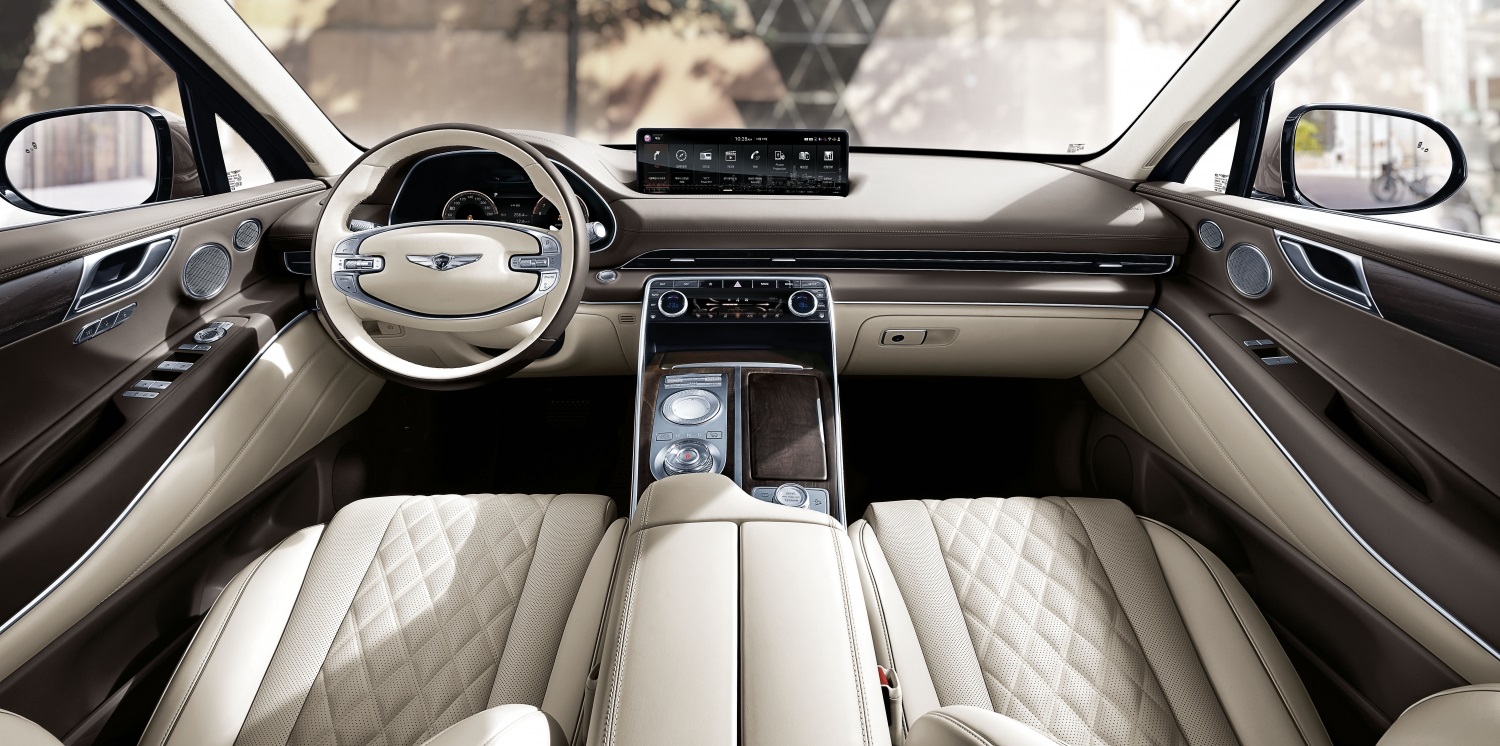
Genesis thought outside the instrument panel to create the refined and sophisticated GV70

Starting prices for the 2022 Genesis GV70 range from about $43,000 to $55,000.

Starting prices for the 2022 Genesis GV70, including all-wheel drive, range from about $43,000 to $55,000. (Mark Maynard photos)

Table of Contents

Overview
Pricing
Performance
Ride and Handling
Driver Assist Technologies
Safety Features
Interior
Back Seats and Cargo
Why Buy the Genesis GV70?
Specifications

BY MARK MAYNARD

I had been eager to test the Genesis GV70 since the company announced the arrival of its new small SUV back in early December 2020. The images presented a compelling design, but a couple of other luxury elements stood out:

• Its elite styling resisted an SUV image with unnecessary humps and bulges to reinforce an off-roading image.
• In addition to its long new-vehicle warranty, Genesis leapfrogs ultra-luxury warranties with these no-cost coverages:

1. Free scheduled maintenance and Genesis Service Valet care for 3-years/36,000-miles;
2. Free Genesis Connected Services for 3 years;
3. 3 years of free annual multimedia and navigation updates and lifetime traffic data via HD+ Traffic radio.

And this frosting of largesse can be heaped onto the new vehicle warranty of 5-years/60,000-miles bumper to bumper, and 10-years/100,000-miles for the powertrain.

The stand-out perk, however, might be the free service valet care. Genesis says, “Let us pick up and service your vehicle for you.” Genesis will perform a remote diagnostic check, then retrieve your vehicle for service and leave a loaner vehicle, then return your Genesis washed and cleaned.

Now that’s how a carmaker reassures its customers. Such a time-saver in this class could make a $60,000 compact SUV a no-regrets purchase. And there is little to regret about owning the Genesis GV70.

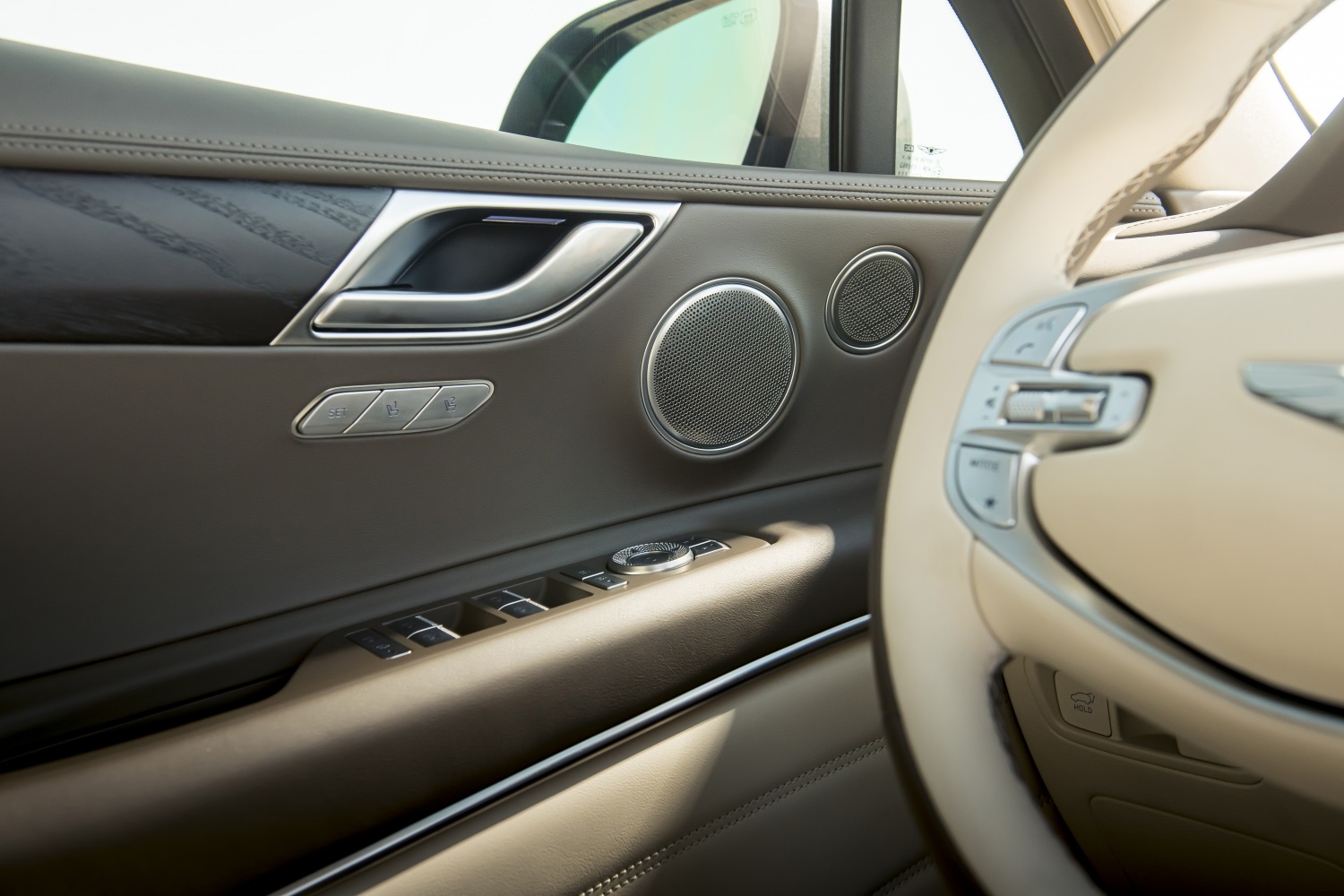
Steering wheel of the GV70

Sightlines are open across the fenders, helped by the small corner glass.

Genesis GV70 Overview

The compact-class GV70 is the second Genesis SUV, joining the midsize GV80 and the brand’s fifth model overall. The GV70 shares an architecture with the G70 sport sedan (and the Kia Stinger) making it more of a sport SUV, though Genesis has no true sport division … yet.

Every luxury-class manufacturer has at least one small SUV crossover in its lineup. Most have traditional styling treatments to remind of a rugged SUV for that great escape, which automotive marketers think is so desired by U.S. drivers.

Mercedes-Benz and the Porsche Macan are on similar trajectories for an SUV crossover that has carlike manners. Genesis thought outside the instrument panel to create the refined and sophisticated GV70.

No apology is needed for its cargo-crimping, coupe-like roofline. And the GV70 has what might be the best-looking rear-end in the business today. And the rest of the GV70 walkaround is balanced and comment-provoking, too.

The fist-forward “Athletic Elegance” design theme has a sweeping parabolic arch that slashes rearward from the headlights and descends to the center of the taillight. It is a muscular treatment without contrived bulges.

Genesis design and engineering is a progressive presentation of everything drivers have become familiar with — but smartly re-created.
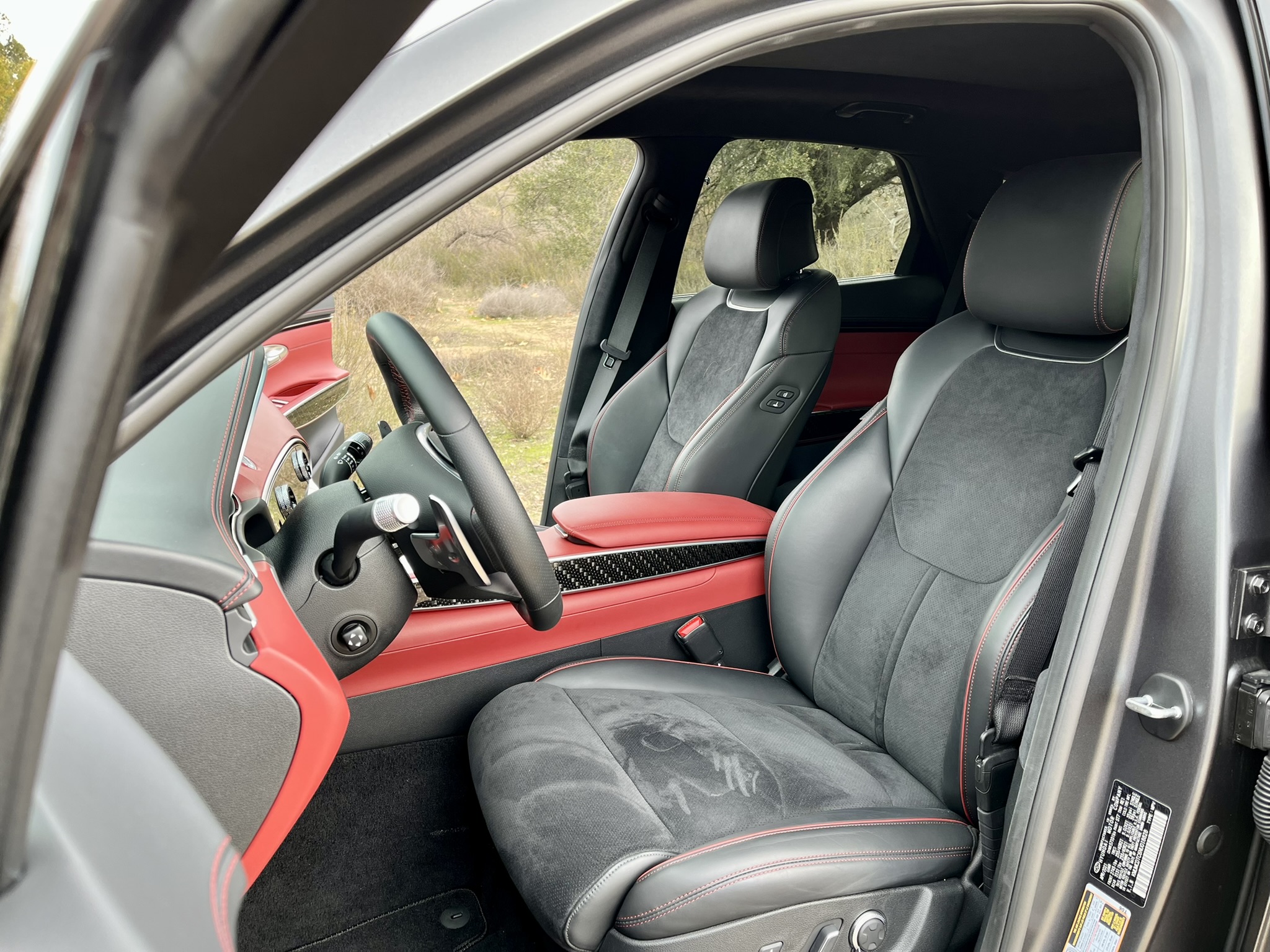
The front seats in the GV70

The Genesis GV70 shuts out the world with acoustic laminated glass.

Genesis GV70 Pricing

Globally, the GV70 drivetrain is rear-wheel drive with optional AWD. But in North America, the GV70 has standard all-wheel drive. There are two choices of turbocharged and direct-injected powertrains with eight-speed automatic transmissions. The electronic transmissions include steering wheel paddle shifters and selectable performance modes of Snow, Comfort, Eco, Sport, Sport-plus, and Custom, which allows individual preferences for steering weight, suspension firmness, etc.

GV70 2.5T AWD starts at $42,595. The 300-hp, single turbocharged 2.5-liter four-cylinder has 311 foot-pounds of peak torque from 1,650 to 4,000 rpm. Fuel-economy ratings are 22 mpg city, 28 highway, and 24 mpg combined, using the recommended premium fuel for peak performance.
GV70 3.5T starts at $54,195 and includes the standard Sport package of 19-inch alloy wheels, panoramic sunroof, and Highway Driving Assist II. The 375-hp, twin-turbocharged 3.5-liter V-6 has peak torque of 391 lb.-ft. from 1,300 to 4,500 rpm. Fuel-economy ratings are 19 mpg city, 25 highway, and 21 mpg combined, also using the recommended premium.

Today’s GV70 3.5T tester was $64,045. Options included the Melbourne Gray matte paint for $1,500, the Sport Advanced package, $5,000, and the Sport Prestige package, $4,900.

Of the 12 paint colors offered, only Alta White is a no-cost choice. The other hues are either $500 or $1,500. Interior color themes are black, red, or blue, depending on paint color.

Find current pricing and incentives for the GV70 here.

The red door panel of the GV70

There is satisfying quality to the artfully presented interior design.

GV70 3.5T Performance

I was not expecting the Genesis GV70 3.5T to be such a sleeper sport sedan, rich in visceral velocity. Dial up the performance mode of Sport-plus, pin the accelerator and the GV70 rears its beautiful head. This 4,451-pound SUV shows its German-inspired performance engineering with acceleration from 0 to 62 mph in 5.09 seconds, according to testing by Genesis Korea.

For the hot-shoe driver, there is a launch-control feature that when activated raises the engine speed to 2,000 rpm for the hole-shot.

Both GV70 engines have a manufactured “active engine sound,” but it is quite realistic. For good effect, the dual exhaust tips have downspout-sized proportions.

I did not like the V-6 engine’s auto stop-start at idle. It took just a split second too long to restart and it can be hesitant in stop-and-go traffic. In those situations, I switched off the system, but I do respect the potential for emissions and fuel savings.

Fuel Economy

Real world fuel-economy ratings are not far off the official ratings. In a week of testing, my driving averaged 16 mpg around town and I worked up to 21 mpg on the highway. Not good when crude oil is $130 a barrel. But the GV70 hauls ass when you need a defining validation for choosing the V-6.

The eight-speed automatic is almost intuitive at providing just the right gear at the right time. When driving for fun in Sport or Sport-plus, the transmission clicks off downshifts with just a brush of the brake pedal. Then the electronics hold the gear until you exit the corner and roll on power for the next twist. The transmission is so adept at being sporty that I seldom felt the need to use the steering-column shift paddles.

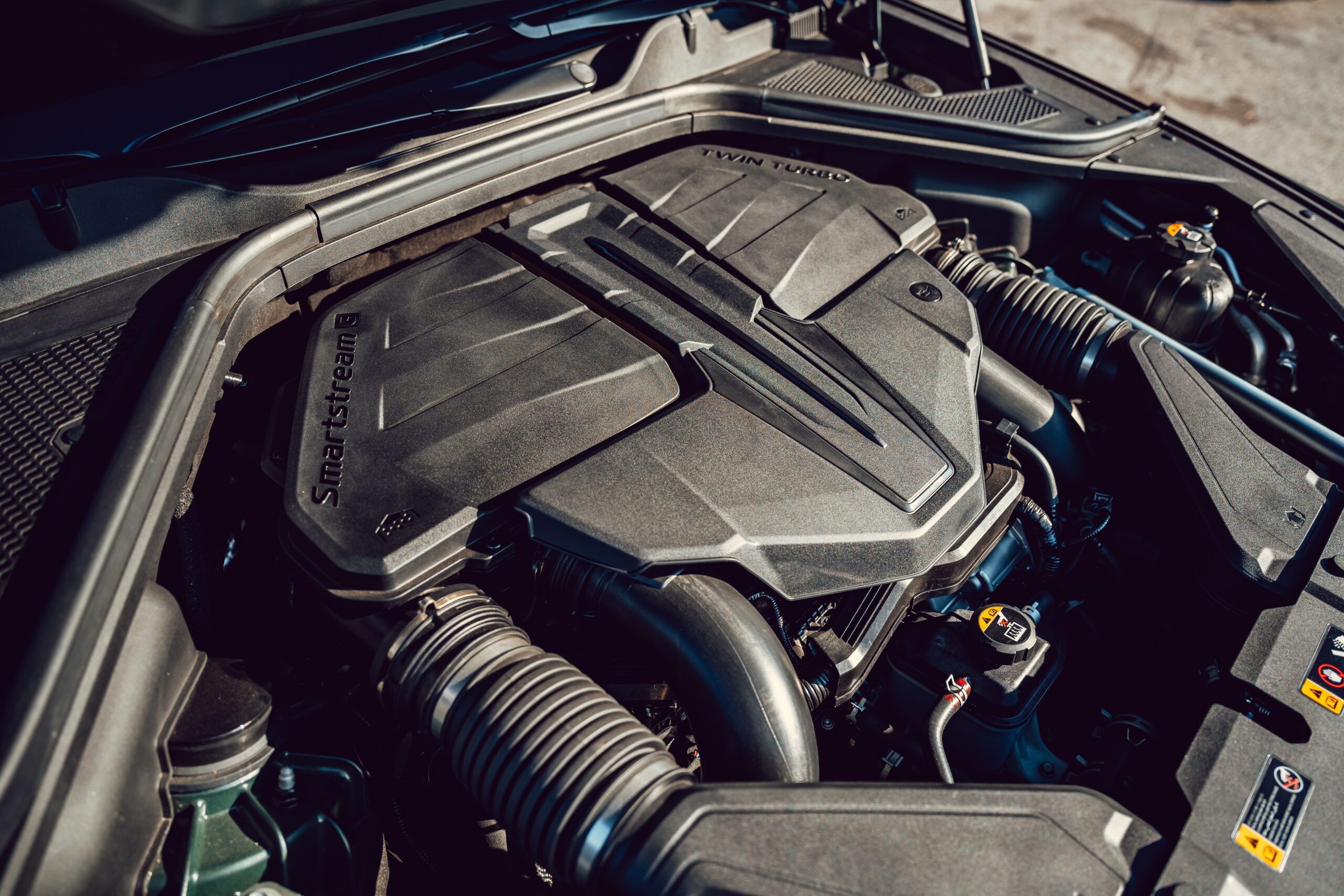
The 375-hp, twin-turbocharged 3.5-liter V-6 in the GV70 3.5T

The 375-hp, twin-turbocharged 3.5-liter V-6 in the GV70 3.5T.

GV70 3.5T Ride and Handling

Enjoy the traffic-calmed cabin, which is a good reason to buy a luxury vehicle. The Genesis GV70 shuts out the clamor with acoustic laminated glass at the windshield, front side, and rear side windows.

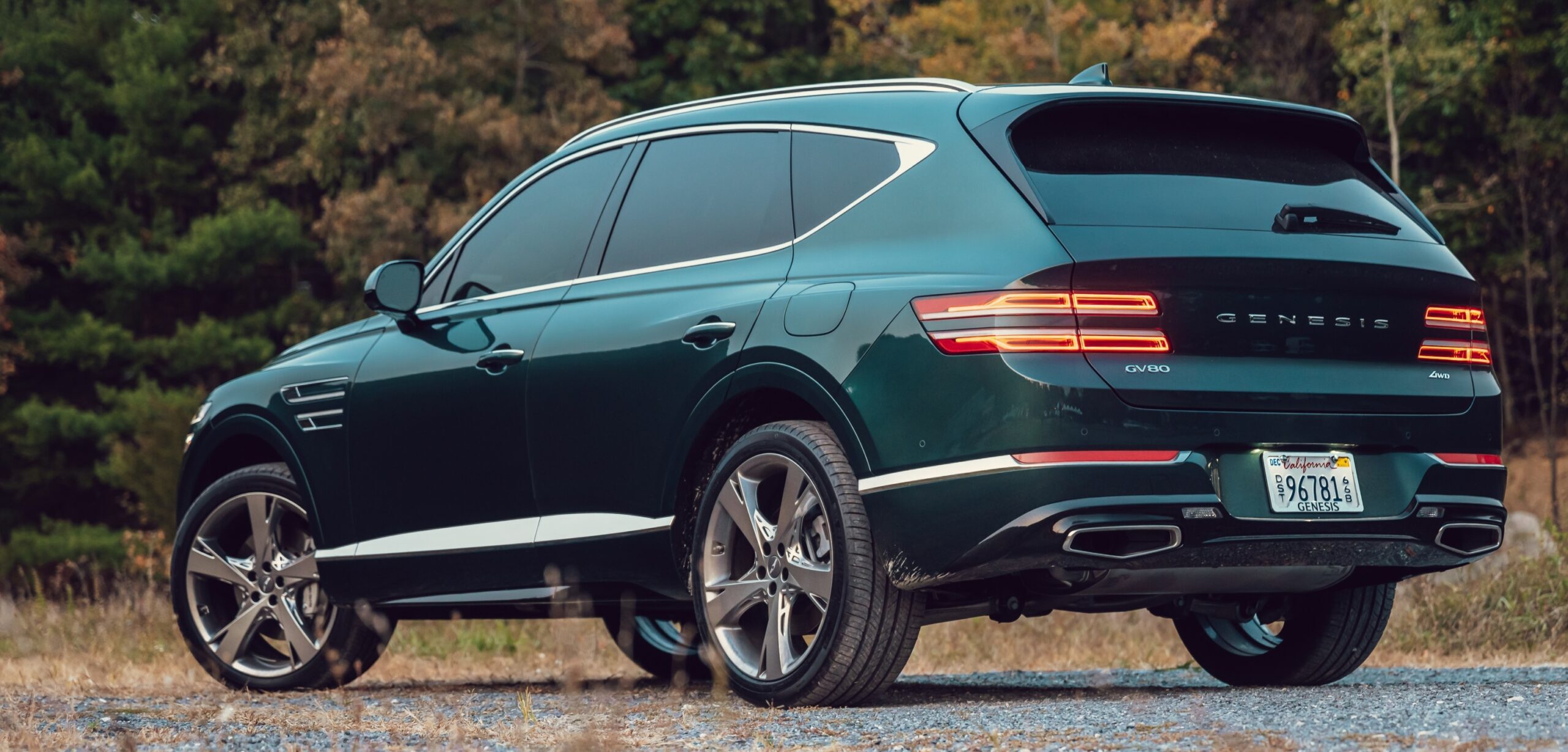
The body structure is as stiff as a full metal jacket, which reduces body flex and the resulting creaks and itchy sounds. Aerodynamic elements include the rear spoiler that helps smooth airflow at the top of the body and the front bumper air curtain that reduces airflow resistance around the sides and at the front wheels.

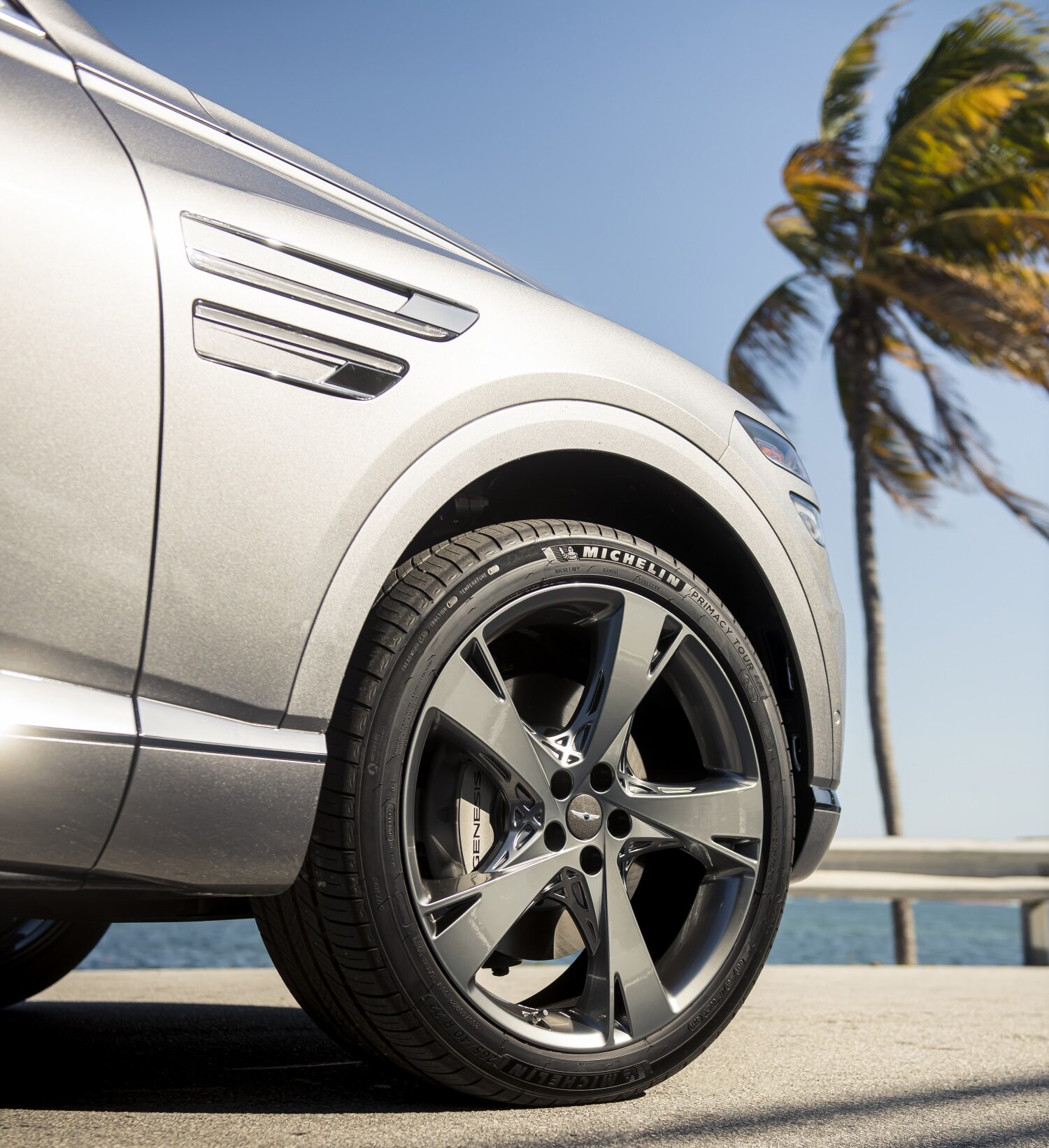
Road harshness is controlled by the tester’s 21-inch Michelin Primacy Touring tires, 255/40. The optional five-spoke sport alloy wheels — with sort of a twisted, waffled imprint — looked street wily with the Melbourne Gray paint.

E-Suspension

Genesis uses an electronically controlled suspension to minimize the vehicle’s body lean when cornering. And with electronic limited-slip differentials (part of the $4,900 Sport Prestige package), cornering levels are increased by distributing power left and right to the rear wheels, according to the road surface and driving conditions.

The e-suspension uses adaptive dampers with a road-preview feature. The system scans the road ahead and the sensors process that information in milliseconds to balance ride quality.

In my driving experience, the e-suspension gave precise turn-in responses, but it is not as magically smooth as a magnetorheological damper, such as is used in some performance vehicles. I experienced a few unexpected jolts along rough patches and noticeable head-toss across speed bumps.

With its towing capacity of 3,500 pounds and a full-bodied curb weight of 4,451 pounds, good brakes are essential. And the GV70 3.5T is prepared with ventilated four-wheel discs with 14.2-inch rotors at the front and 13.6-inch rotors rear. (2.5T models also have vented discs, with rotors that are 13.6 inches front, and 12.8 inches rear.

21-inch GV70 tire and wheel

Road harshness is well controlled by the Michelin Primacy Touring tires.

Driver Assist Technologies

Using a Level 2 driver-assist function is always helpful in heavy highway commuting. These systems keep watch when the driver doesn’t.

The Genesis system is reasonably consistent, but it will allow the vehicle to drift wide in a highway curve, crossing the white highway lines or Botts dots. The mapping for steering adjustments isn’t quite smooth and seems like an action of connecting the dots.

But I did appreciate the heads-up display (part of the Sport Prestige package). When using the driver-assist system, the HUD shows red alerts for side traffic. It is more visible during the day than warning lights in the side mirrors. And the heads-up display also shows gray profiles of nearby vehicles ahead and on either side.

Driver assist screen in the GV70

The Level 2 driver-assist system shows red alerts for side traffic.

GV70 Safety Features

The Insurance Institute for Highway Safety rated the Genesis GV70 a Top Safety Pick+ for 2021. The IIHS also gives Top Safety Pick+ ratings for the GV80 SUV, G80 executive sedan, and G90 flagship sedan.

The 2022 awards mark the third year in a row that the entire Genesis lineup of eligible vehicles has earned top honors.

All Genesis models are equipped with a comprehensive suite of state-of-the-art driver assistance and safety technologies including Forward Collision-Avoidance Assist with Pedestrian Detection, Lane Keeping Assist, and Blind-Spot Collision-Avoidance Assist.

Among eight air bags (including a front center air bag), other standard GV70 safety features include:

  • Forward Collision-Avoidance Assist with Junction Crossing and Turning. The system is intended to mitigate the risk of impacts when turning or crossing through an intersection;
  • Blind-Spot Collision-Avoidance Assist. This feature helps reduce the chance of potential impact with a moving vehicle when departing a parallel parking spot.
  • Advanced Rear Occupant Alert technology. Genesis says the GV70 is the first vehicle to feature radar-based detection of passengers in the rear seat, Genesis says. To alert drivers when a child or sleeping infant has been left in their seat, cabin sensors can detect when back-seat passengers move, and they can also detect small respiratory movements.
Double-line quad LED headlights on the GV70

Double-line quad LED headlights are intended to add a sense of speed.

GV70 Interior Function

There is a sweet spot of roominess in the GV70 cabin. Headroom with the panoramic sunroof is about 38 inches and should accommodate 95 percent of drivers; especially with legroom of 41.3 inches.

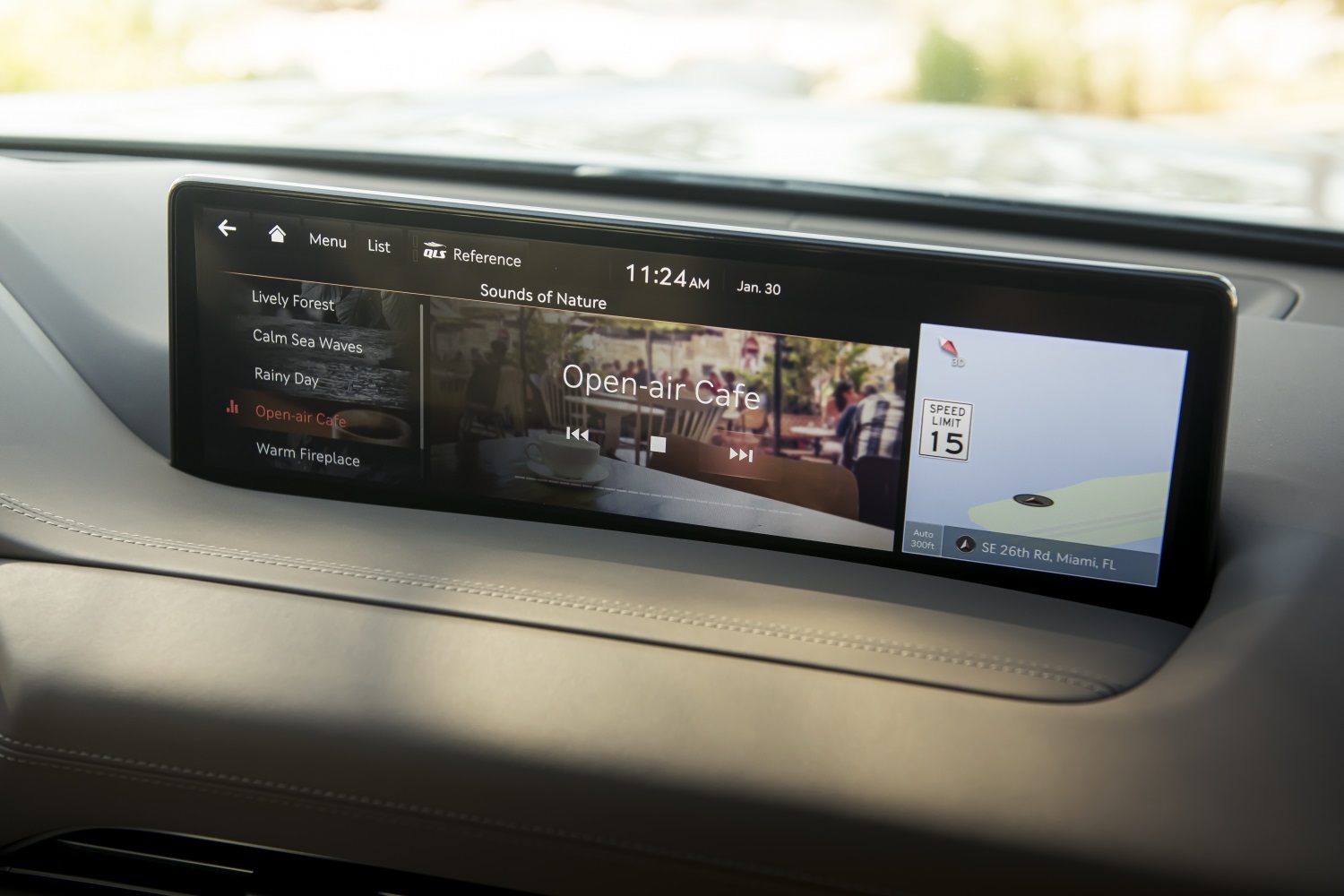
Sightlines are open across the fenders, with help from small corner glass at the windshield pillars. Over-the-shoulder views are somewhat slim but no worries when parking — the surround-view camera system with guidance lines has billboard proportions from the 14.5-inch high-definition infotainment screen at the top of the instrument panel.

The standard 16-way power driver seat can be electronically positioned by the optional Smart posture control. The feature will set an optimal position based on the driver’s height and weight. It also sets positions for the steering wheel, side mirrors, and head-up display. See the function here.

The front passenger has eight-away power adjustment — and both front seats are heated and ventilated. The passenger seat includes a “walk-in device,” which is merely a power switch for a back-seat occupant to move the seat forward for more legroom; it is a trickle-down feature from chauffeur-driven sedans.

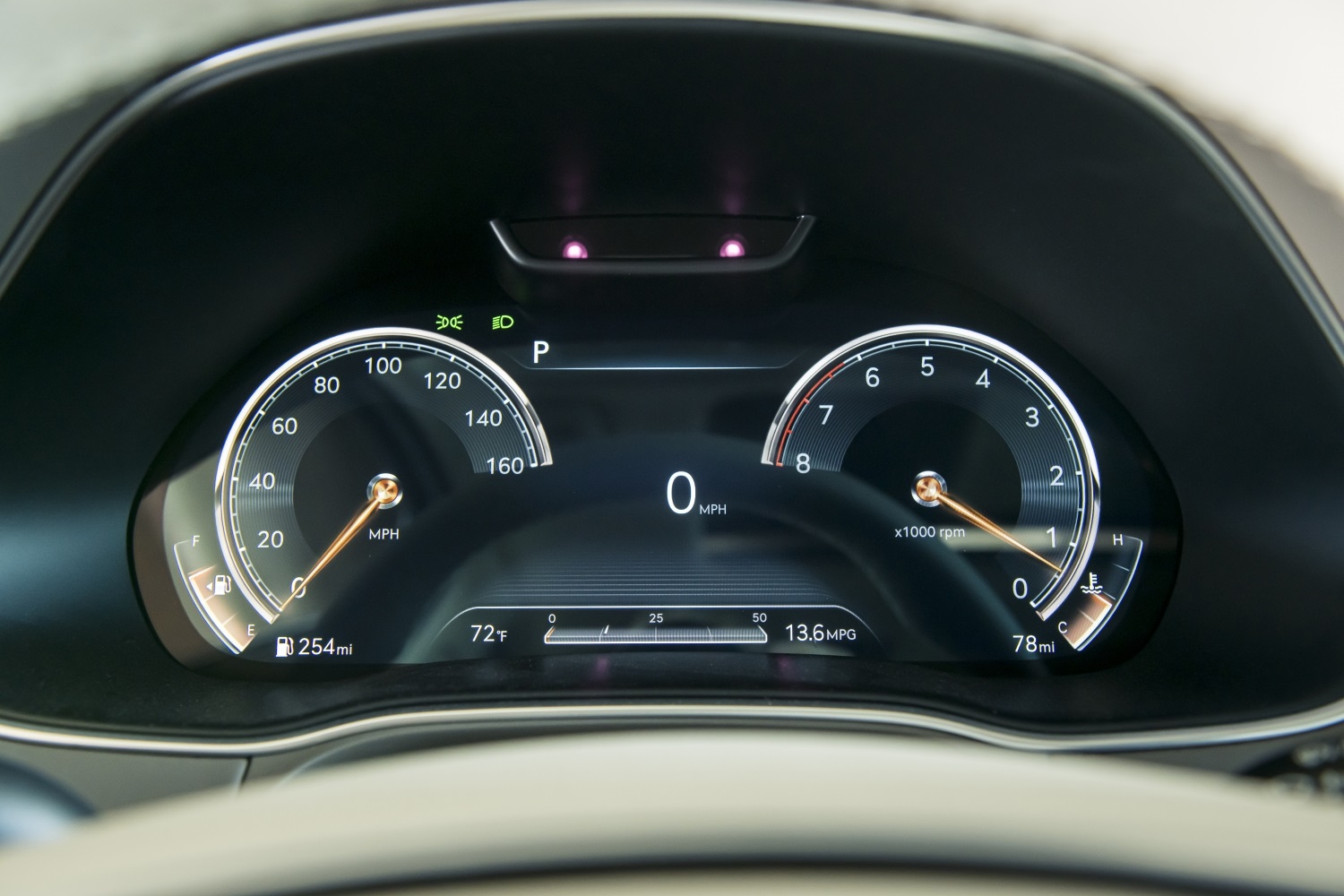
The 3D electronic gauge array is unique with large dials for the speedometer and tachometer. The tach might have merit for the V-6 engine, but it is also is wasted space for most drivers.

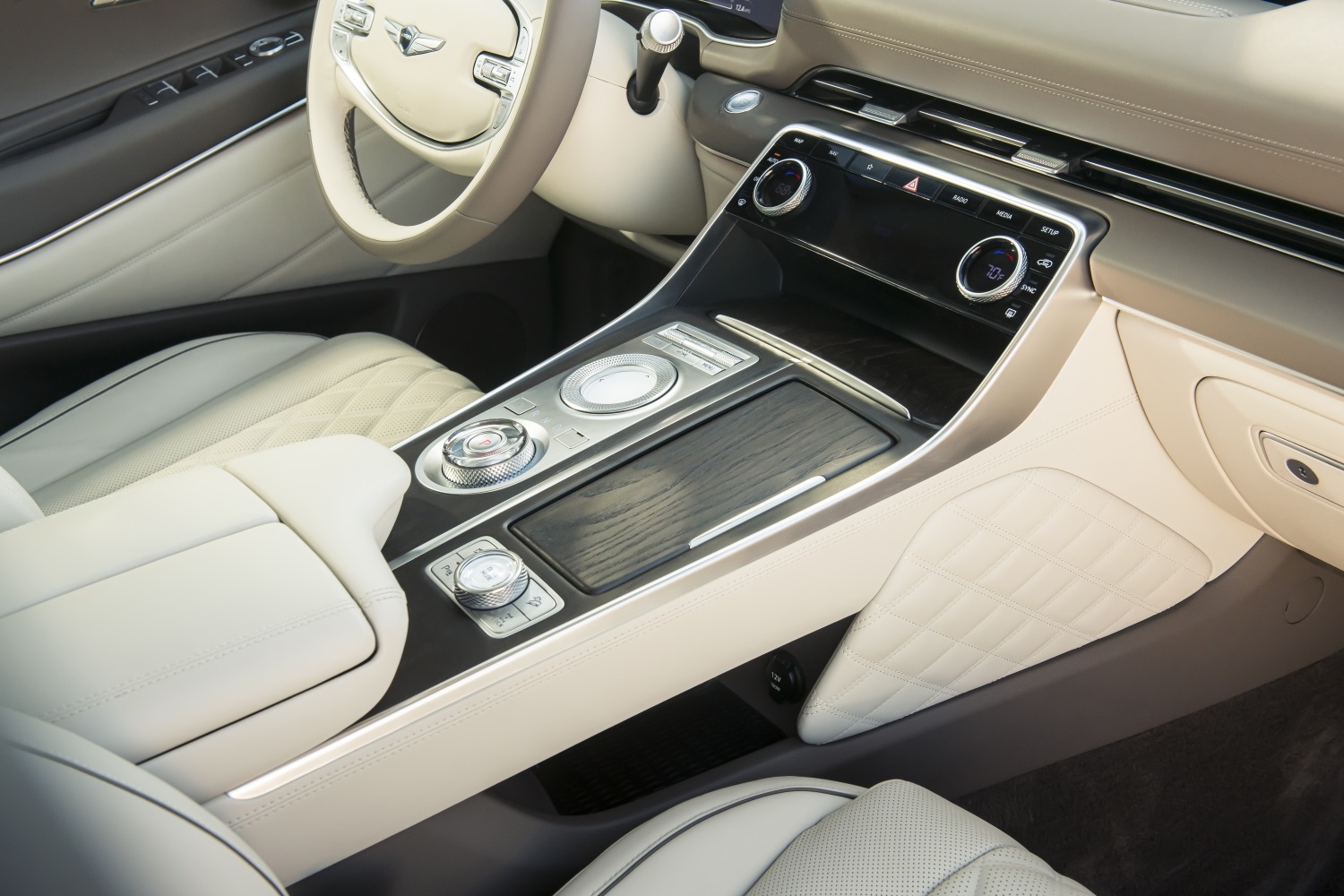
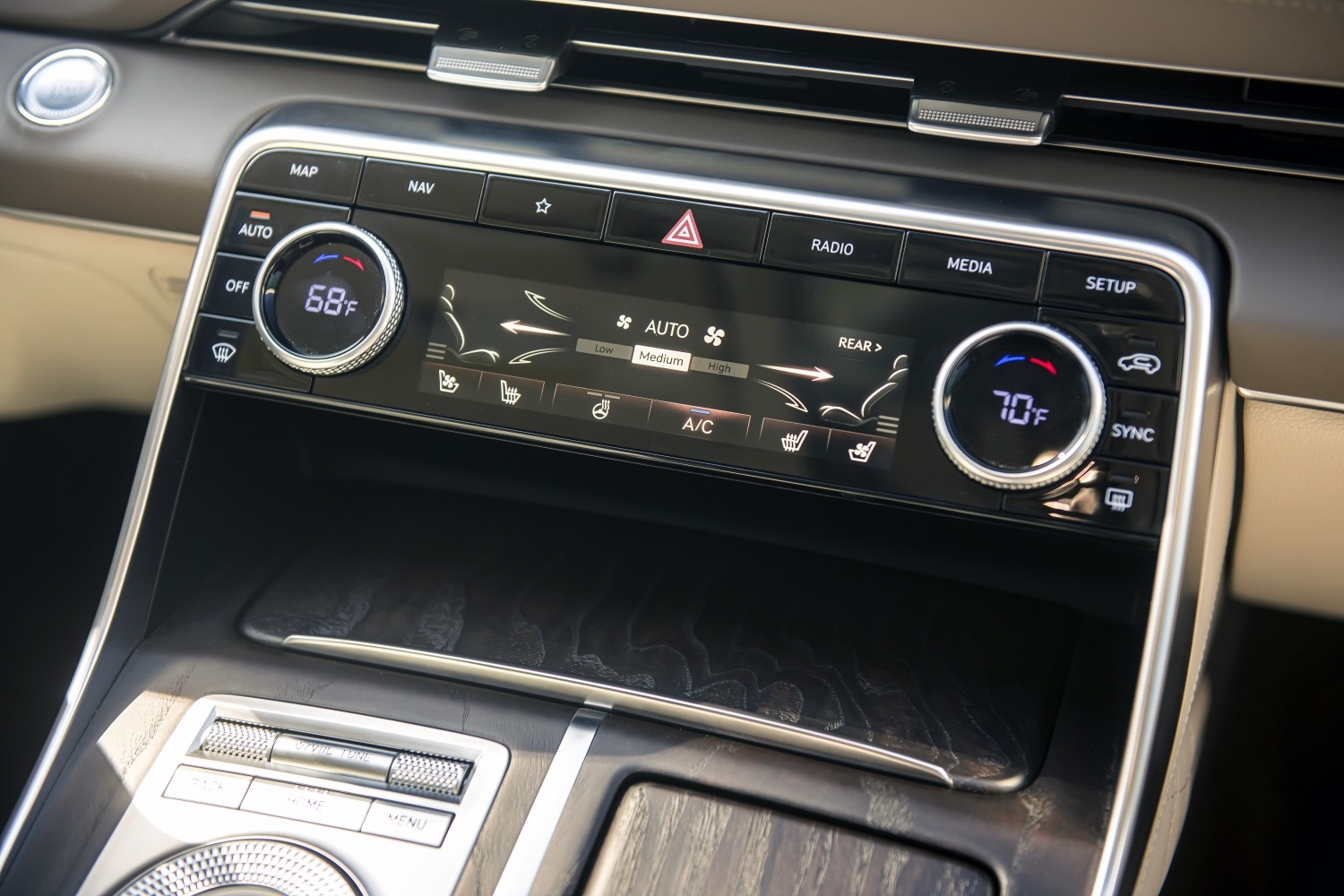
There are two large flat dials on the shift console: one for the transmission and the other to access cabin functions, audio, and infotainment. The dials are similar in size, and in the first four days of driving my hand naturally fell to the dial for cabin function. In time, owners will gain the muscle memory to go straight for the shift dial.

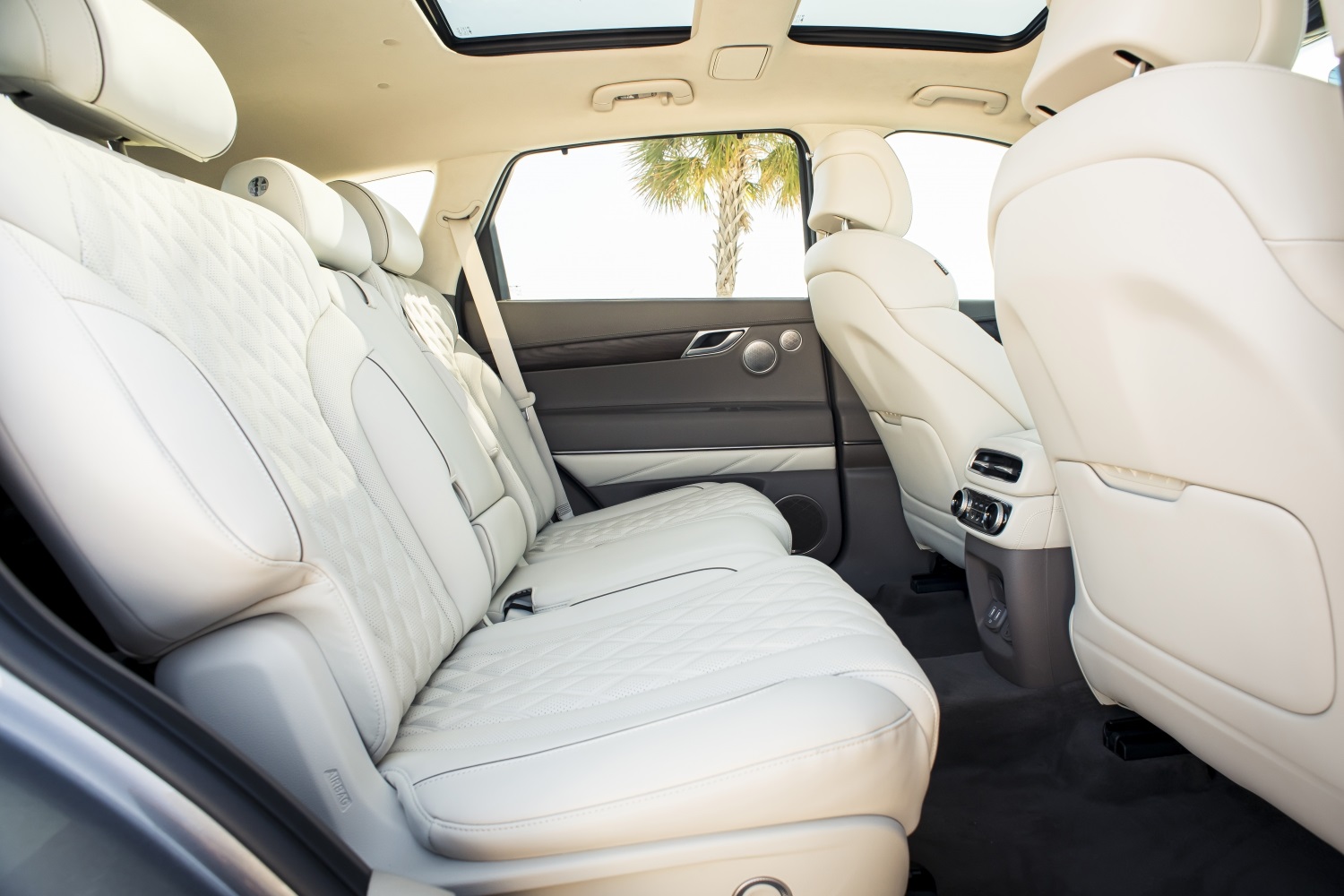
GV70 back seat.

Rear legroom is adequate at 37.2 inches.

Back Seat and Cargo Space

Genesis provides a full luxury treatment to the back seat when some brands back off on the details and even soundproofing. Legroom is adequate at 37.2 inches — but hope for short people in the front seats. However, the doors open to near-90 degrees for easy entry, and the seats are comfortably supportive.

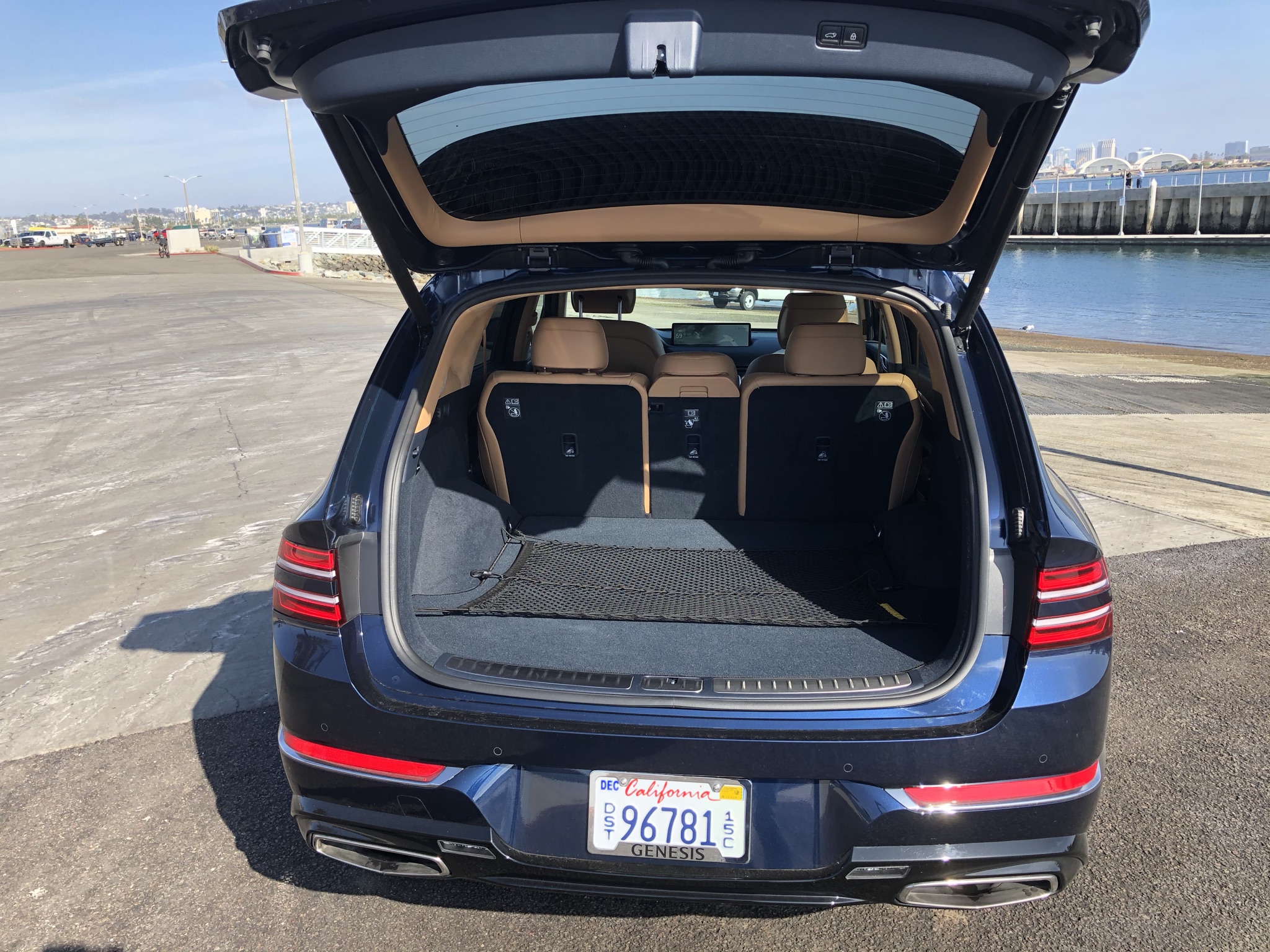
Cargo area of the GV70

Fold the back seat for 6 feet of length.

Cargo capacity is slightly compromised by the sloping roofline, but there is nearly 29 cubic feet of space behind the back seat, stacked to the headliner. The cargo opening is wide at 41 inches, and fold the 60/40 back seat for about 6 feet in length.

The area is finished in quality carpeting, with a pair of large side lights, and a slim storage area under the cargo floor.

Despite the $64K price, a cargo roller cover is not included but is available for $200. However, carpeted floor mats are included.

Sidelights in the cargo area of the GV70

Thick pile carpeting, large side lights (2), and robust seatback releases.

Why Buy the Genesis GV70 3.5T?

The Genesis brand is still an outlier among luxury auto buyers who might be more comfortable committing to an Audi, BMW, Lexus, or Mercedes-Benz. But, in 2020, J.D. Power named Genesis the most dependable automotive brand, and in 2021 the brand was lauded as the most technologically innovative in North America.

Time is money and the extensive warranty package is a time-saving answer to the GV70 $64,000 question.

A rear view of the Genesis GV70

Aerodynamic elements include the rear spoiler that helps smooth airflow.

Genesis GV70 3.5T Specifications

Body style: Compact, 5-seat 5-door SUV crossover in rear- or all-wheel drive

Engine: 375-hp, twin-turbocharged and direct-injected 3.5-liter V-6 with auto stop-start at idle; 391 lb.-ft. torque from 1,300-4,500 rpm

Transmission: 8-speed automatic with paddle shifters and 5 drive modes

Fuel economy: 19/25/21 mpg city/hwy/combined; premium fuel recommended for peak power

Max. towing capacity: 3,500 lbs. with trailer brakes

BY THE NUMBERS

Fuel tank: 17.43 gallons

Cargo space: 28.9 to 56.9 cubic feet

Front head/leg room: 39.6*/41.3 in. *without moonroof

Rear head/leg room: 39.1/37.2 in.

Length/wheelbase: 185.6/113.2 in.

Curb weight: 4,451 lbs.

Turning circle: 37.7 ft.

FEATURES

3.5T Standard equipment includes: Smartkey entry and locking with push-button ignition, with Nappa leather-trimmed upholstery, 16-way power driver seat (with power side bolsters and seat cushion), 14.5-inch high-definition infotainment screen, 12.3-inch 3D digital gauge array, 8-way power front passenger seat (with walk-in device), heated and ventilated front seats, 2 front USBs (data and charge) and 2 rear charging USBs, 9-speaker audio system with Android Auto and Apple CarPlay, electric parking brake with automatic hold, full LED lighting (headlights, taillights, running lights, and side mirror turn signals), power folding and heated (with a timer) side mirrors, outside approach lights with Genesis logo (at side mirrors), power one-touch panoramic sunroof, solar control tinted side and rear glass, acoustic laminated glass (windshield, front side and rear side windows), carpeted floor mats, power tilt-telescoping steering wheel, smart cruise control with stop-and-go, wireless charging, locking glove box, surround-view camera system with guidance lines

Packages on tester

Sport Advanced package, $5,000: Nappa Leather Seating Surfaces with Sport Pattern Quilting; Layered Edge Backlit Trim; Leatherette Upper Instrument and Door Panels; Suede Headliner; Heated Steering Wheel; Genesis Digital Key; Surround View Monitor; Blind-Spot View Monitor; Remote Smart Parking Assist
Parking Distance Warning – Front; Parking Collision-Avoidance Assist – Rear; Lexicon Premium Audio with 16-Speakers

Sport Prestige package, $4,900: 21-inch Sport Alloy Wheels; Electronic Limited Slip Differential; Nappa Leather Seating Surfaces with Suede Insert; Carbon Fiber Trim; Heated 2nd Row Seats; Manual Rear Side Sunshades; Acoustic Rear Door Glass; 3-Zone Climate control; 12.3-inch 3D Digital Cluster
Heads-Up Display

Safety features include: 8 air bags, Forward Collision Avoidance-Assist with Pedestrian and Cyclist Detection, Lane-Change Oncoming, and Junction Turning Highway Driving Assist; Driver Attention Warning; Lane Keeping Assist and Lane Following Assist; Blind-Spot Collision-Avoidance Assist; Rear Cross-Traffic Collision-Avoidance Assist; Safe Exit Assist; Intelligent Speed Limit Assist; Park Distance Warning – Rear; Launch Control and Hill Start Assist Control Vehicle Stability Management with stability and traction controls

PRICING

Base price: $53,645, including $1,045 freight charge; price as tested $64,045

Options on test vehicle: Melbourne Gray matte paint $500; Sport Advanced package, $5,000; Sport Prestige package, $4,900;

Where assembled: Ulsan, Korea

Warranties: 5-years/60,000-miles bumper to bumper; 10-years/100,000-miles powertrain; Genesis Service Valet for 3 years or 36,000 miles provides a remote diagnostic check, vehicle pick up, and a loaner vehicle and return of the vehicle
2021 Genesis GV80 Review

2021 Genesis GV80 Review

The Genesis GV80 is a 5- or 7-seat carlike SUV that is a defining statement of luxurious refinement

The Genesis GV80 SUV

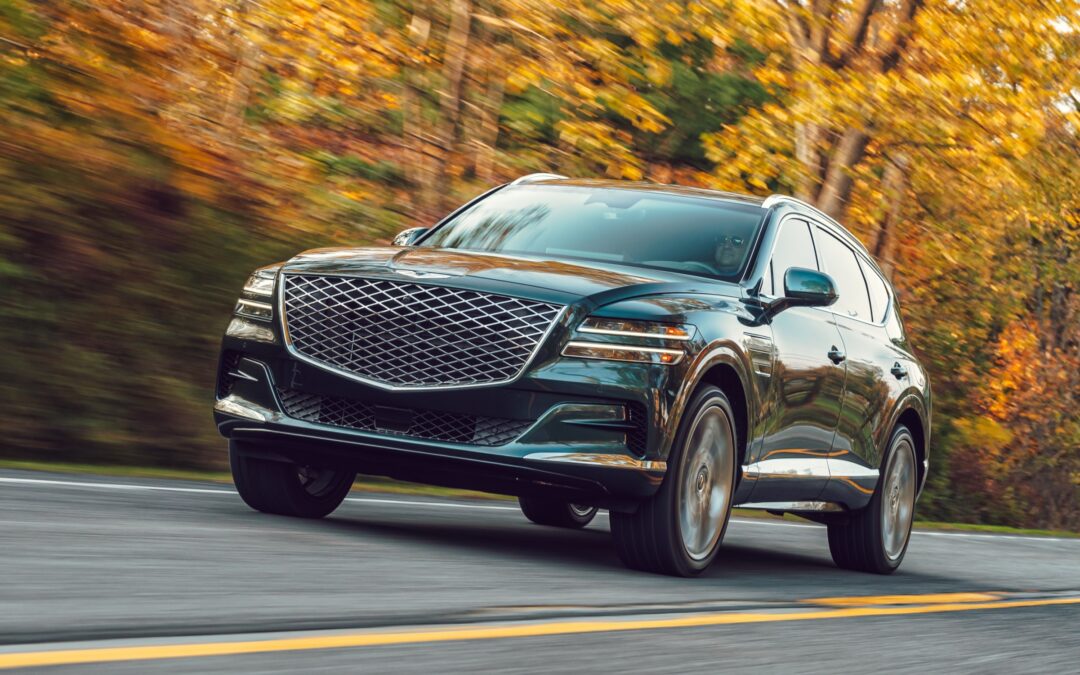
The GV80 is sold in rear- or all-wheel drive versions with a choice of two turbocharged engines. (Genesis)

BY MARK MAYNARD

Not every SUV-intender wants to climb every mountain, spool-up rooster tails in a desert pre-run or clip apexes on a road course in high-speed pursuit to define themselves or at least who they like to think they are.

Some SUV shoppers just want the spaciousness and comfort they once had in a large family sedan, which has joined the dinosaurs in an evolving world.

The front seat space has wide shoulder room and tall front headroom of almost 40 inches. (Genesis)

For them, there is the vital newcomer by a largely unrecognized brand, the Genesis GV80. The brand, a luxury spinoff from South Korean parent company Hyundai, actually launched in the U.S. in late 2016. But its debut vehicles were the G80 and G90 midsize and large sedans, which were largely overlooked by a lack of advertising, balky customer service and this country’s obsession with tall and large vehicles.

Those who did buy into the brand became fast believers. The cars were very well turned out with refined luxury and strong performance credentials. But always in the business plan was a lineup of SUVS: large, midsize, compact, “coupes” and electrified versions.

The 12.3-inch 3D instrument cluster recognizes the driver’s eyes. (Genesis)

Covid Delays

Due to COVID-19-related delays in the U.S, the logjam broke late last year with the debut of the redesigned large G80 sedan and the GV80 SUV, today’s tester.

This five- or seven-seat carlike SUV is a defining statement of elite luxury — at pricing that will send the luxury competitors back to their calculators.

The 14.5-inch, split-screen infotainment display does not interfere with the driver’s sightline. (Genesis)

GV80 Pricing

The Genesis GV80 is sold in rear- or all-wheel-drive versions with either a 300-horsepower, 2.5-liter turbocharged four-cylinder engine or 375-hp, twin-turbocharged 3.5-liter V-6, with standard AWD.

Both engines are paired with an eight-speed automatic transmission with paddle shifters and selectable driving modes of Comfort, Smart, Eco, Sport and Custom.

The GV80 2.5T (RWD or AWD) is offered in three trim levels with starting prices that range from $49,925 to $64,425.

The 3.5T is sold in four trim levels with starting prices of $60,175 to $71,975. All MSRPs include the $1,025 freight charge from Ulsan, Korea.

The center shift console has fresh function by using a low shifter dial and a large and flat dial for infotainment and other selections. (Genesis)

The top-line 3.5T Prestige tester was $72,375 with the two factory option packages (Advance and Prestige) and $400 for the gorgeous Adriatic Blue metallic paint.

Full package contents are listed in the specifications box at the end of the story.

The electronic climate system features capacitive touch controls with tactile feedback. (Genesis)

Genesis Warranties

  • 10-years/100,000-miles powertrain with enhanced roadside assistance and concierge services;
  • 3-years/36,000-miles of scheduled maintenance;
  • 3-years/36,000-miles of complimentary Genesis Service Valet care;
  • 3 years of free Genesis connected services;
  • 3 months of free SiriusXM satellite radio all access
  • 3 years of free annual multimedia and navigation updates and lifetime complimentary traffic data via HD+ Traffic radio.

And here’s the perk for which I’d pay extra: the free Genesis Service Valet for 3 years or 36,000 miles will perform a remote diagnostic check, pick up your vehicle, send a courtesy car and return your Genesis – cleaned and washed.

Find current Genesis GV80 pricing here.

In up-level models, soft materials cover every surface, from the inside of the door handles to the quilted knee pads along the console. (Genesis)

GV80 Safety Features

Among the 10 air bags is an active safety-first innovation, Genesis says. The front center air bag, located between the driver’s seat and center console, deploys in 0.3 seconds in the event of a side collision to help prevent the two front passengers from colliding with each other or with vehicle components. The feature is standard on all GV80 models.

Power lines above each wheel emphasize stance and presence. (Genesis)

Defining Features

The GV80 is not an original idea, but it is a fresh presentation of what was and what it could be for a much wider range of motorists.

There is an eye for beauty in the exterior styling. The compelling design is lean, fit and balanced. The chassis lowers the body and the center of gravity for a wider cabin and secure drivability. Its 16.2-foot-long architecture sits confidently on its wheels, which neatly fill the arches. There are no replicated kinks, gimmicky bulges or Godfather jowls. Yet it is well adorned with chrome, an American staple.

Roof cross-members, transmission tunnel, front chassis extensions and parts of the rear structure are made of ultra-high-strength steel. The cowl, floor panels, rear wheel housings and other components are high-strength steel. For light-weighting, aluminum is used for the doors, hood and rear decklid, for a 90-pound savings. The top-line, all-wheel-drive tester weighs in at 5,084 pounds.

The 375-hp, twin-turbocharged 3.5-liter V-6 is paired with an eight-speed automatic transmission. (Genesis)

Genesis Attention to Detail

“The precise proportions and attention to every detail denote that GV80 is authentic to Genesis design principles,” said Hyundai Motor design chief Luc Donckerwolke.

Under the shapely exterior is a brain trust of advanced safety and driver-assist technologies. The so-called “machine learning” technologies merge, refreshingly for the user, without a fearsome curve of learning.

By activating the Smart Cruise Control and Highway Driving Assist (and its bank of camera and sensor arrays) the GV80 will steer, brake, corner, evade, warn the driver and find its way home.

And it can park itself, as you stand outside the vehicle, in spaces too narrow to open the door on exit.

While many of the highway steering-assist systems are still somewhat rudimentary in how they watch the road and make somewhat jerky connect-the-dots steering course. The GV80 has more refined and more-fluid steering calibrations. And while some systems will let the vehicle drift wide in sweeping corners — crossing the Botts dots or white lines — the GV80 held true to the arc, in my testing. And the guidance gave no random shut-offs, such as in bright sunlight or on California’s light gray concrete interstates, which confuse many of these systems.

Still, it is still a hands-on system, so don’t think you are in the rocking-chair position and can sit back and read e-mail.

The Prestige package ($6,600) includes 22-inch alloy wheels with Michelin Primacy all-season tires. (Genesis)

GV80 Interior Function

When a new house is built by a team that works as a united front, the plans are thorough to provide the function, details and strength to sell quickly in its segment. The GV80 is that house. It has the needed electrical outlets, storage areas, ergonomic comfort and fortitude for long-term ownership.

For me, it was love at first … user experience, in the 3.5T Prestige, which is the king of that castle. Think Audi interior, but with even more finesse, or Volvo XC90, but even more ergonomic.

The GV80’s full Nappa leather upgrade, quilted and meticulously stitched, is impressive and inviting to the touch. The microsuede upgrade is used extensively from the headliner to the roof pillars and beyond.

It is a completely soft-touch environment, with progressive treatments for wood-like graining and metallic trim elements. And the cabin is well soundproofed for the 21-speaker Lexicon audio system.

Driver sightlines are open over the shoulder and at the front corners (handily provided by small corner glass at the base of the windshield pillars and side mirrors, which stand out from the body.

With front headroom at almost 40 inches (with the panoramic sunroof) and a long 41.6 inches of legroom, there is a 16-way power driver’s seat with adjustable side bolsters and cushion extension and four-way power lumbar, massaging driver’s seat. The passenger has a 12-way power seat with four-way power lumbar. Both front seats are heated and ventilated. And the Advance package adds the Ergo Motion (massaging) driver seat.

Roomy Interior

The large-midsize cabin has plenty of real estate for prime placement of controls and storage areas, including purse-size capacity under the shift console. The broad center shift console has fresh function by using a low shifter dial and a large and flat dial for infotainment, audio and navi selections, without eyes leaving the road. There’s also a handwriting sensor pad in the dial, for those competent in writing and driving (not me). A generous e-bin, with a sliding cover, includes a wireless charging pad and a pair of charging USBs.

I liked the 3D electronic presentation of the 12.3-inch digital gauge cluster and it is of ideal width for the dual blind-spot view monitors, which trigger a rearview image for right or left turns, filling either the speedometer or tach dials.

The 14.5-inch touch screen atop the center dashboard has a low profile that is not subject to sunlight glare and it does not get in the way of the driver’s view. But it also has good width for the surround-view monitor, which includes front and overhead views. I am not precise when fitting between the parking lines, so the overhead takes away the guesswork.

The second row in the GV80

The second row has full temperature control, heated-ventilated window seats, and power recline. (Genesis)

GV80 Back Seat

Seating in the second row might be slightly more compact than some of the competition. But it is a gorgeous space (in the Prestige tester). Some of the features include ceiling-integrated flip-down vanity mirrors, full temperature control, heated and ventilated window seats, and power seat recline. There’s also a chauffeur-style power fore-aft adjuster for more legroom when needed.

The third-row option will be limited to the grandkids, with knee-crunching legroom of 30.3 inches.

There is plenty of cargo room for the long road trip. Fold the second-row seatback for about 6 ½ feet of board room. (Mark Maynard)

GV80 Cargo

There is plenty of cargo room for the long road trip. Fold a section of the 40/20/40 seatbacks for about 6 ½ feet of board space. The opening is wide at 45 inches by 43 inches with the back seat in position and 30 inches to the headliner. The roller covers stows neatly in its own compartment under the cargo floor.

Ride and Handling

The steering weight is light and steady, but controlled at high speed. You might be surprised at how this SUV pulls through a big cornering maneuver with a flat and calculated effort, with no complaining from the big Michelins. The turning circle of 39.3 feet is wide but not unwieldy when tooling the shopping mall parking wars.

At 2 ½ tons, it is comfortable with its weight. The electronically controlled suspension automatically adjusts to trim body movement and harsh hits to the tires and wheel. A new feature called Road Preview, and standard on the GV80 3.5T, uses the front-facing camera to sniff the road ahead to prepare in advance of speed bumps and potholes.

The ride quality can be lush but never wallowy, and helped by the broad contact patch of the 22-inch Michelin Primacy (265/40) all-season touring tires. Head-toss is low over chunks and bumps, but because of the ride height and heft, it is not as svelte as a large luxury sedan, such as the G80.

2 New Engines

Both gasoline engines feature a dual fuel injection system that combines direction injection and multi-port injection. Combining both improves fuel efficiency, performance and reduced exhaust emissions, Genesis says.

Fuel economy, using the recommended premium fuel, for the 2.0-liter engine is 21 mpg city, 25 highway and 23 mpg for rear-drive and 21/25/22 mpg for AWD.

The 3.5T AWD has ratings of 18/23/20. I averaged 19.5 mpg in combined city and highway driving, and the onboard computer indicated a long-term 18.8 mpg overall average. With the 21.5-gallon tank, there should be a cruising range of around 380 miles.

The mileage ratings are competitive with comparable versions of the Audi Q7, BMW X5 and Mercedes-Benz GLE. But the Bimmer and Benz squeeze out two to three more mpgs per category, and they have slightly larger fuel tanks.

Driver-Assist Technologies

The Genesis GV80 is fluent in machine learning technology and is a conduit for advanced systems you did not know were necessary.

The bank of advanced driver-assistance systems includes:

  • Highway Driving Assist II: This second-gen system now gives assist during lane change maneuvers — when the turn signal is used — and when other vehicles merge in front of you.
  • Smart Cruise Control with Machine Learning: A world first, Genesis says, that helps the car learn the driving characteristics of — and assist — its driver.
  • Forward Collision-Avoidance Assist: This system is intended to automatically stop the vehicle in certain situations where there is a risk of collision with an approaching vehicle detected on the left or right side of the intersection. The system may also help detect potential collision risks in certain situations where a pedestrian is sensed in close proximity to the vehicle while in motion, for example.
  • Lane Side: LS helps prevent side collisions when merging into another lane with the ability to see two lanes over.
  • Blind-Spot Collision-Avoidance Assist: BCA is essentially a Blind Spot Monitor that can alert the driver if a vehicle is detected in the driver’s blind-spot
  • Lane Follow Assist: LFA helps maintain vehicle position in the center of its lane by recognizing both lane markers and vehicles traveling ahead.
  • Lane-Change Oncoming: The so-called LO helps prevent collisions with vehicles in opposing lanes on non-divided highways or roads.
  • Junction Turning: JT automatically applies the brakes if an oncoming vehicle is detected in the opposite lane when making a left turn at an intersection.
  • Junction Crossing: JC automatically applies the brakes if a vehicle crossing from the left or the right is detected when entering an intersection.
  • Evasive Steering Torque Assist: ESA assists in avoidance maneuvers by applying steering torque once the driver has initiated steering input.
  • Rear Cross-Traffic Collision Avoidance-Assist: RCCA warns of vehicles coming from the left or right while backing up and automatically engages braking if a collision seems imminent.

Accolades

Genesis was ranked the No. 1 premium brand in the industry for the fourth consecutive year by J.D. Power’s 2020 Initial Quality Study and No. 1 overall in the J.D. Power 2020 Vehicle Dependability Study.

Consumer Reports ranked it the No. 2 brand in its annual 2020 Report Card.

And, the Insurance Institute for Highway Safety awarded all three 2020 Genesis vehicles — G70, G80 and G90 — with their highest rating of Top Safety Pick+. With those rankings, the company claims it is the only brand in the industry with an entire lineup that is rated a Top Safety Pick+.

Building the Brand

The genesis of Genesis goes back to the Hyundai Equus, the large, V8-powered sedan intended for the ultraluxury segment, competing with such established stars as the BMW 7-series, Lexus LS, and Mercedes-Benz S-Class. The U.S. model was heralded at the 2009 Pebble Beach Concours d’Elegance and unveiled at the 2010 New York Auto Show.

While stylistically and technologically competitive with the competing marques, the Equus was a dark horse in the race, and not widely accepted by the mainstream U.S. motorist. The well-turned-out product was bumping against a glass ceiling of perception: that Hyundai was a value brand, without the cache of prestige.

Some reviewers considered the Equus to be cut-rate luxury and were more comfortable with the familiar and accepted stars, as if this new model could never reach its zenith.

Seasoned Industry Professionals

But Hyundai’s leaders in Korea and the U.S. were betting otherwise and would establish an independent and elevated standalone brand. And a dream team of seasoned industry professionals were hired:

Luc Donckerwolke, former design director of Volkswagen Group’s Bentley, Lamborghini and Audi, is chief creative officer.

Mark del Rosso, former president of Audi of America, is CEO of Genesis North America.

Sang-Yup Lee, former designer of the Bentley Continental GT and C-6 Chevrolet Corvette, is head of design.

Filippo Perini, former Lamborghini head of design, is chief designer.

Peter Schreyer, formerly at Volkswagen and principal designer of the VW Golf, New Beetle and the Audi TT, is a president and heads design management.

Albert Biermann, former head of the BMW M performance division, oversees tuning and performance as executive vice president of performance development and high-performance vehicles.

Fayez Rahman, former development leader at BMW, is vice-president of architecture development.

Andrea Jensen, former designer at Škoda and Volkswagen, heads color and trim.

U.S company headquarters are in Fountain Valley, Calif., in the sprawling O.C. (Orange County). Vehicles are designed in Rüsselsheim, Germany; Namyang, South Korea, and Irvine, Calif. The vehicles are built in Ulsan, South Korea.

The GV80 SUV joins the lineup of G70, G80 and G90 sedans, with the slightly smaller GV70 SUV to follow later this year. (Genesis)

Why Buy the Genesis GV80?

Luxury should not be an IQ test to learn AI — Artificial Intelligence. Some of the other highly electronic luxury SUVs are intimidating to learn. Genesis smooths those learning curves with a glossy coat of empowering polish.

All of the GV80’s sophisticated displays, assist features and drivability work to lift the driver into an elevated ownership experience.

2021 Genesis GV80 AWD 3.5T Prestige

Body style: large, 5-seat, 5-door SUV

Engine: 375-hp, turbocharged and direct-injected 3.5-liter V-6 with idle stop-start; 391 lb.-ft. torque from 1,300-4,500 rpm

Transmission: 8-speed automatic with paddle shifters

Fuel economy: 18/23/20 mpg city/hwy/combined; premium fuel recommended

BY THE NUMBERS

Fuel tank: 21.1 gallons

Cargo space: 34.9-84 cu. ft. (11.6 cu. ft. behind 3rd row)

Front head/leg room: 40.2/41.6 in.

Rear head/leg room: 38.4/38.7 in. (3rd row: 34.3/30.3 in.)

Length/wheelbase: 194.7/116.3 in.

Width/height: 77.8/67.5 in.

Curb weight: 5,038 lbs.

Turning circle: 39.3 ft.

Max. towing: 6,000 lbs.

FEATURES

Standard equipment includes: Smart key locking and push-button ignition, Nappa leather, 21-speaker Lexicon Quantum Logic surround-sound audio system with satellite radio, 16-way power driver’s seat with adjustable side bolsters and cushion extension and 4-way power lumbar, massaging driver’s seat, 12-way power front passenger’s seat with 4-way power-adjustable lumbar support, heated and ventilated front seats, electric parking brake with auto hold, electronically controlled suspension with road preview, 22-inch 265/40 Michelin Primacy all-season touring tires and alloy wheels, tire mobility kit (in place of a temporary spare tire), carpeted floor mats, power back seat sunshades

Safety features include: 10 air bags, hill-start assist, stability and traction controls, blind-spot collision-avoidance assist with rear cross-traffic collision-avoidance assist, blind-spot view monitor, lane departure warning with lane keeping assist and lane following assist, forward collision-avoidance assist with pedestrian detection, lane-change oncoming, junction turning, junction crossing, lane-change side and evasive steering torque assist, parking collision-avoidance assist rear, forward attention warning

PRICING

Base price: $60,175, including $1,025 freight charge; price as tested $72,375

Options on test vehicle: Advance package, $5,200, includes full-leather upholstery, surround-view monitor and blind-spot view monitor, remote smart-parking assist, parking collision avoidance assist (rear), 21-speaker Lexicon audio system, head-up windshield display, power driver seat bolster and cushion extension, Ergo Motion (massaging) driver seat and heated second-row window seats

Prestige package, $6,600, added 22-inch alloy wheels with Michelin Primacy all-season tires, electronic limited slip differential, Nappa leather seating surfaces, microfiber suede headliner and roof pillars, 12.3-inch digital cluster, Road Active Noise Cancellation, power second-row seat recline-slide-cushion tilt, forward attention warning, power rear side window shades, ventilated second-row window seats, second-row vanity mirrors and power door closers.

Where assembled: Ulsan, Korea