Select Page

Hyundai Tucson Hybrid Review

Hyundai Tucson Hybrid Review

2026 Hyundai Tucson Hybrid takes a victory lap before 2027 redesign
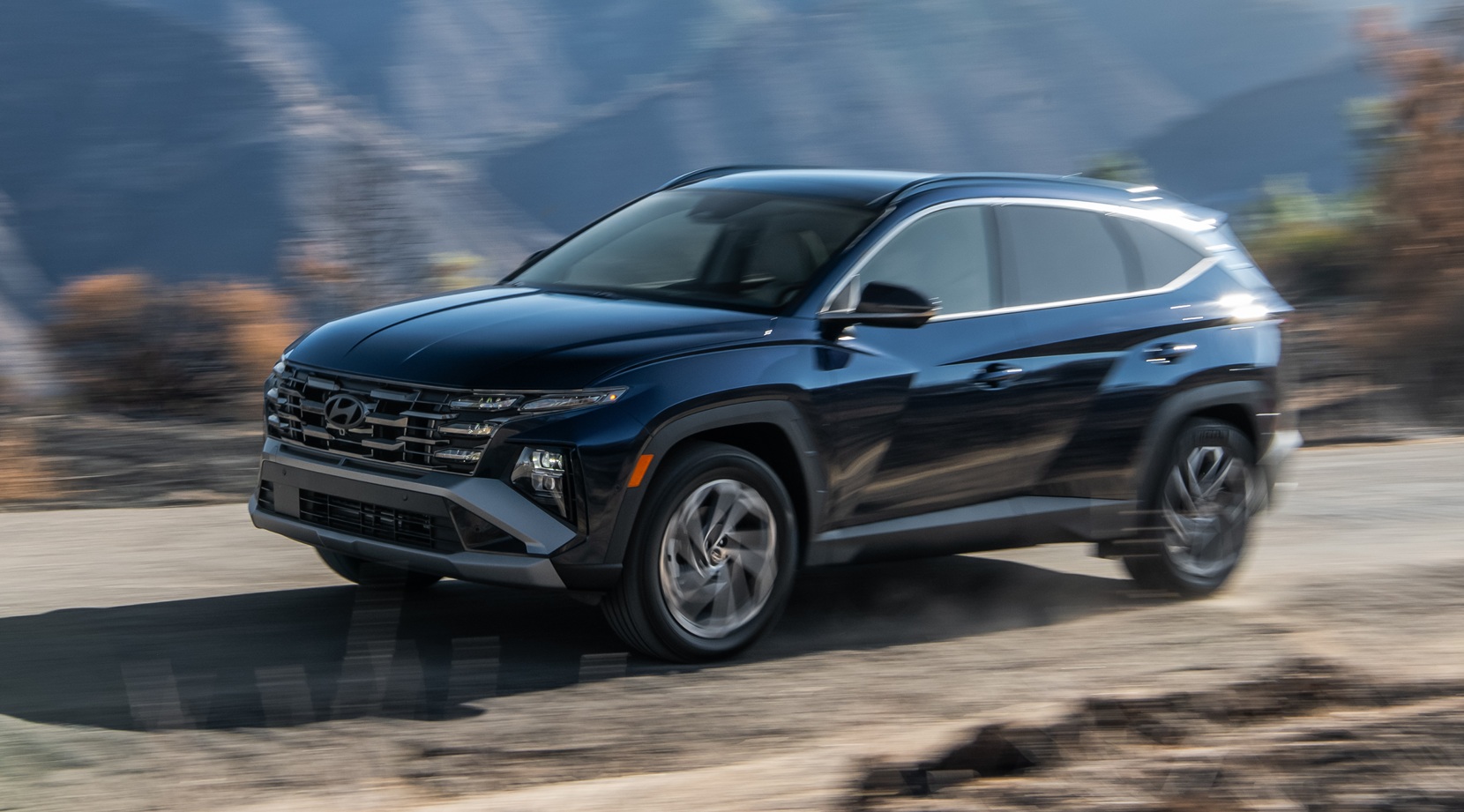
The fourth-generation 2026 Hyundai Tucson makes a value statement before a completely redesigned model debuts late this year for 2027.

The fourth-generation 2026 Hyundai Tucson makes a value statement before a completely redesigned model debuts late this year for 2027. (Photography courtesy of Hyundai USA or as credited)

Jump To Special Features

Hyundai Tucson Separators
What’s New for 2026?
The Alphabet Soup of Safety
Hybrid Performance and Fuel Economy
If the 12-Volt Dies
2026 Hyundai Tucson Hybrid Pricing
Hybrid Warranty Protections
High Priority 2025-2026 Recalls
Why Buy the 2026 Hyundai Tucson Hybrid?
Specifications

BY MARK MAYNARD

The 2026 Hyundai Tucson is wrapping up its fourth generation, which launched in the U.S. in 2005. The compact SUV graduates to the fifth generation with a complete redesign for the 2027 model year, expected by late 2026.

There are more than 15 non-luxury compact SUVs on sale in 2026, but just a few offer hybrid powertrains. The Toyota RAV4 is the top-selling model, followed by the Honda CR-V, the Mazda CX-50, and Subaru Forester Hybrid. The Tucson tucks in at No. 5, while leveraging a value play for “standard features per dollar.”

Hyundai maintains a rapid update cadence for its vehicles, typically including a major “refresh” every two years. The 2025 Tucson had one of those major updates, giving it a strong competitive boost in its twilight years.

Hyundai Tucson Separators

A major differentiator for the Tucson Hybrid from its competitors is its attention to refined materials, including plastics, metals, and fabrics. Much thought has gone into creating a livable and accommodating space. I particularly appreciate the bridge treatment of the front center armrest console. It puts the phone charging pad and cup holders in easy reach, with open stash space below.

The body style provides an open interior atmosphere with clear sightlines front, side, and over the shoulder. The Limited model’s acoustic windshield and front side glass are luxury-class. However, there is still noticeable road harshness inside at highway speeds. The suspension will also give a strong jolt at speed bumps and considerable head toss when transitioning entries and driveways.

Interior quality and refinement are rewarding, and the top Limited model has near-luxury finesse. It is also set off by a three-tone interior color and texture scheme for a sophisticated style. Up front and commanding, a panoramic curved display links two high-resolution 12.3-inch displays. One covers the digital instrument cluster, the other presents a wide view for navigation. This screen also has a split-screen for 360-degree camera views. A return to hard buttons for volume, tuning, and climate controls helps keep eyes on the road when adjusting. But even the digital buttons are easy to navigate.

While Tucson’s exterior styling has some character bulges and upswept lines, they do not impede headroom or cargo capacity. A dual-level cargo floor is a welcome asset.
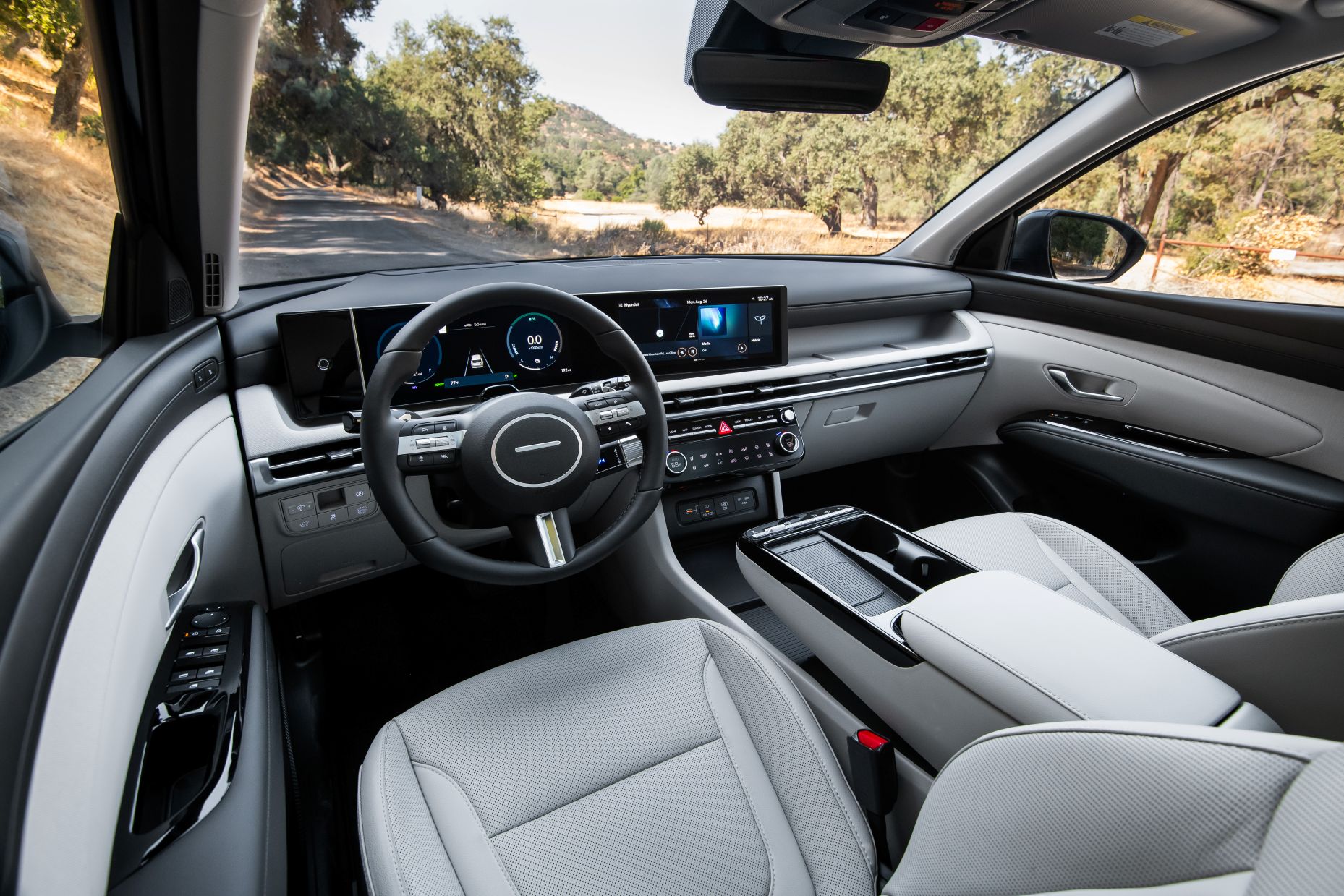
Looking at the light gray and black front seat area

The Tucson cabin is designed around a “software-defined” architecture.

What’s New for 2026?

Hyundai has made several adjustments to the lineup to improve value and accessibility:

Free AWD: All trim levels have standard HTRAC all-wheel drive.

New Entry Trim: The Blue SE trim has been added as the new base model, lowering the starting price for a gasoline-electric hybrid.

Trim Renaming: The previous “Blue” trim is now the SEL; the “SEL Convenience” has been renamed SEL Premium (on some non-hybrid configurations). The renaming better reflects an upgraded feature set, Hyundai says.

Discontinued Trims: The sporty N-Line hybrid trim has been dropped for the 2026 model year. (But a new high-performance trim level could be added for 2027, keeping pace with the new Toyota RAV4.)

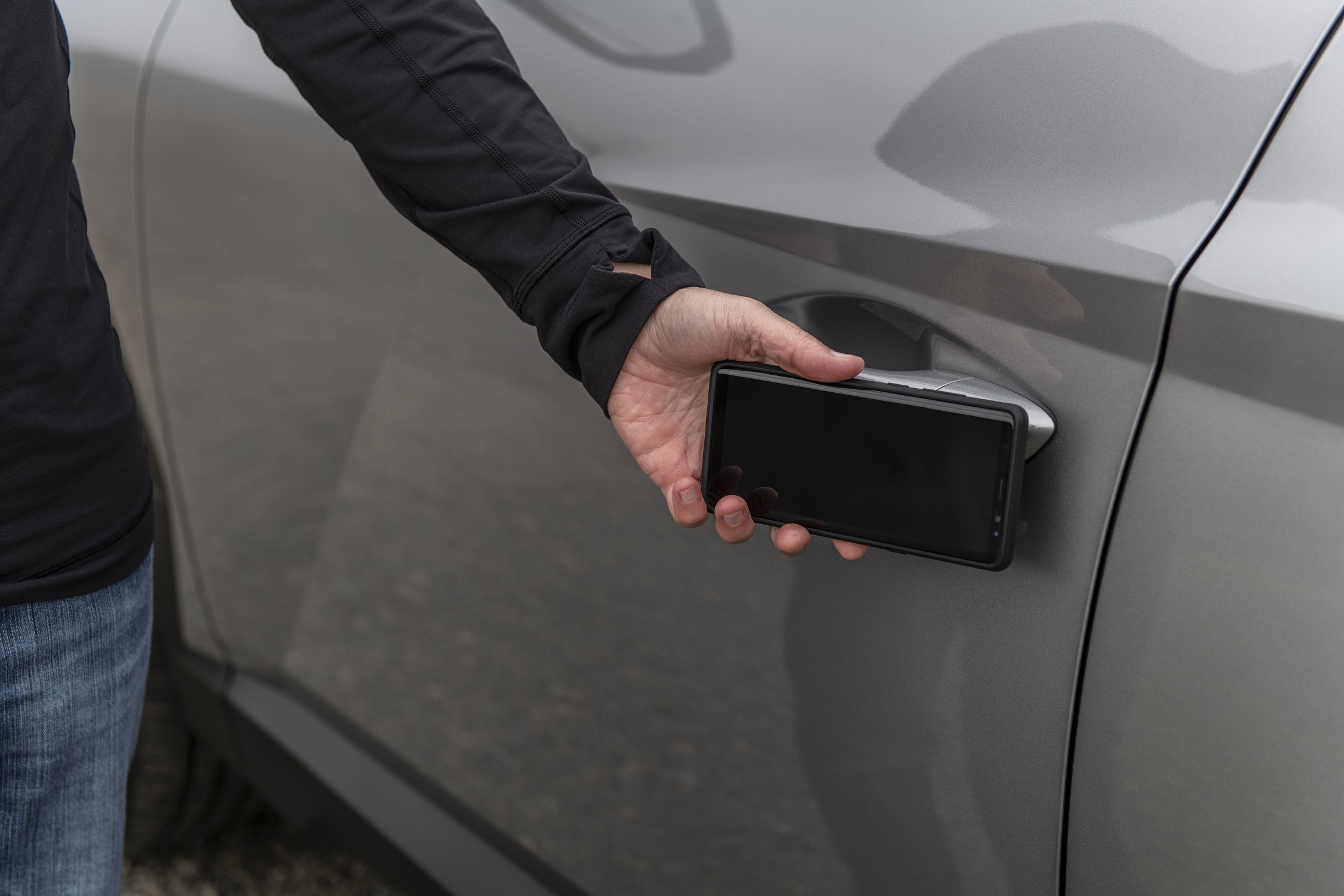
Tech Tweaks: Features such as Digital Key 2 (using your phone as a key) are now available across more trim levels. However, the fingerprint scanner used on earlier high-end models has been removed.
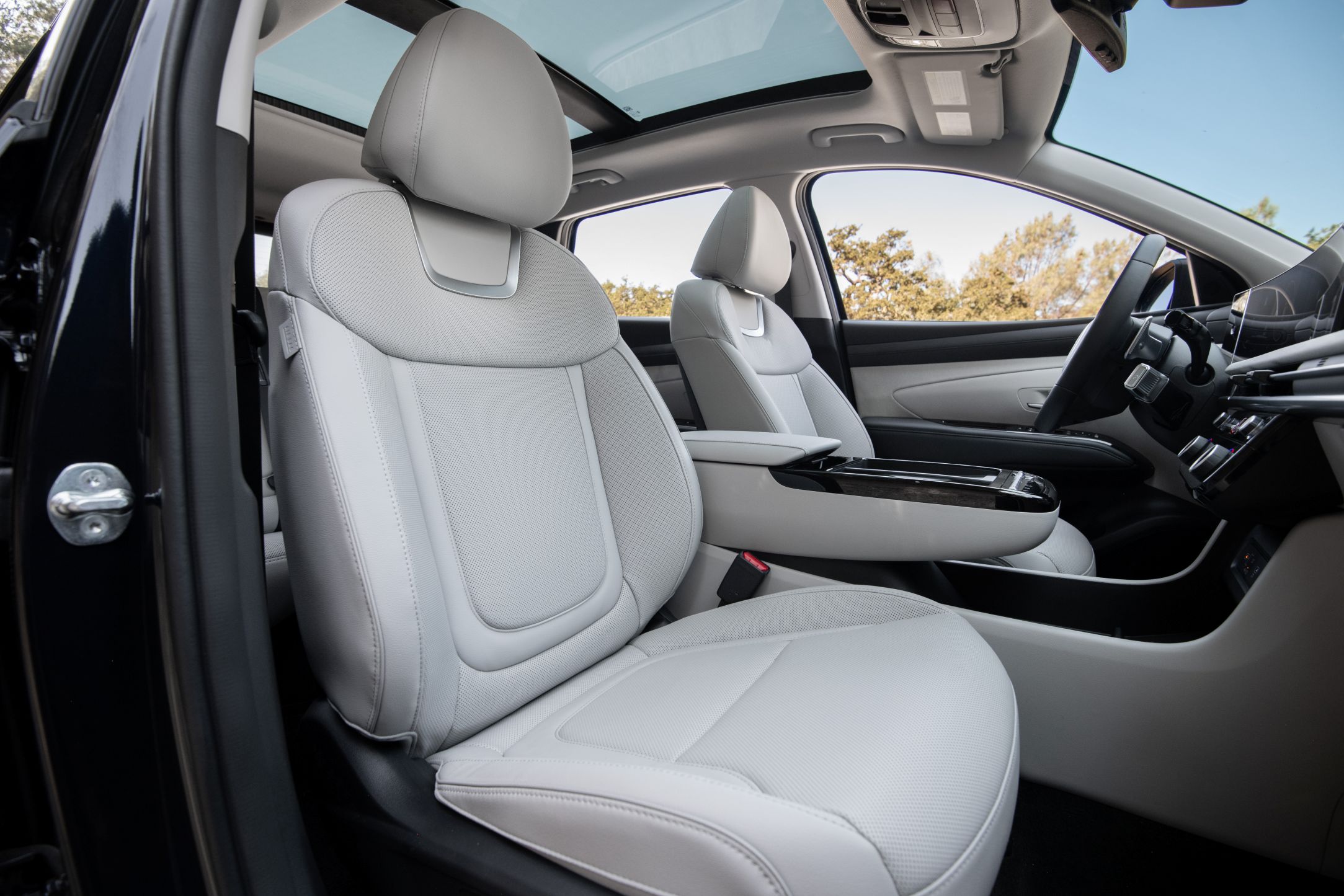
Looking into the passenger door of the Tucson hybrid at the neatly leather-trimmed seat

Eight-way power front passenger seat, too.

The Alphabet Soup of Safety

As much as Tucson is a value statement, it is a testament to advanced safety technologies. The 2025-26 Hyundai Tucson has earned the top IIHS Top Safety Pick+ rating and a five-star overall rating from the NHTSA.

The 2026 Hyundai Tucson standardizes an extensive safety suite, with infrared-based driver monitoring. The safety system, known as Hyundai SmartSense, uses a combination of radar, ultrasonic sensors, and cameras to provide 360-degree protection.

Among the updates:

Central Air Bag: Located between the front passengers, the bag is intended to prevent head-to-head contact during side-impact collisions.

Smart Cruise Control 2: An evolution of the standard system that now monitors driver responsiveness. If the driver is unresponsive, the system can bring the vehicle to a complete stop, activate hazard lights, and engage the electronic parking brake.
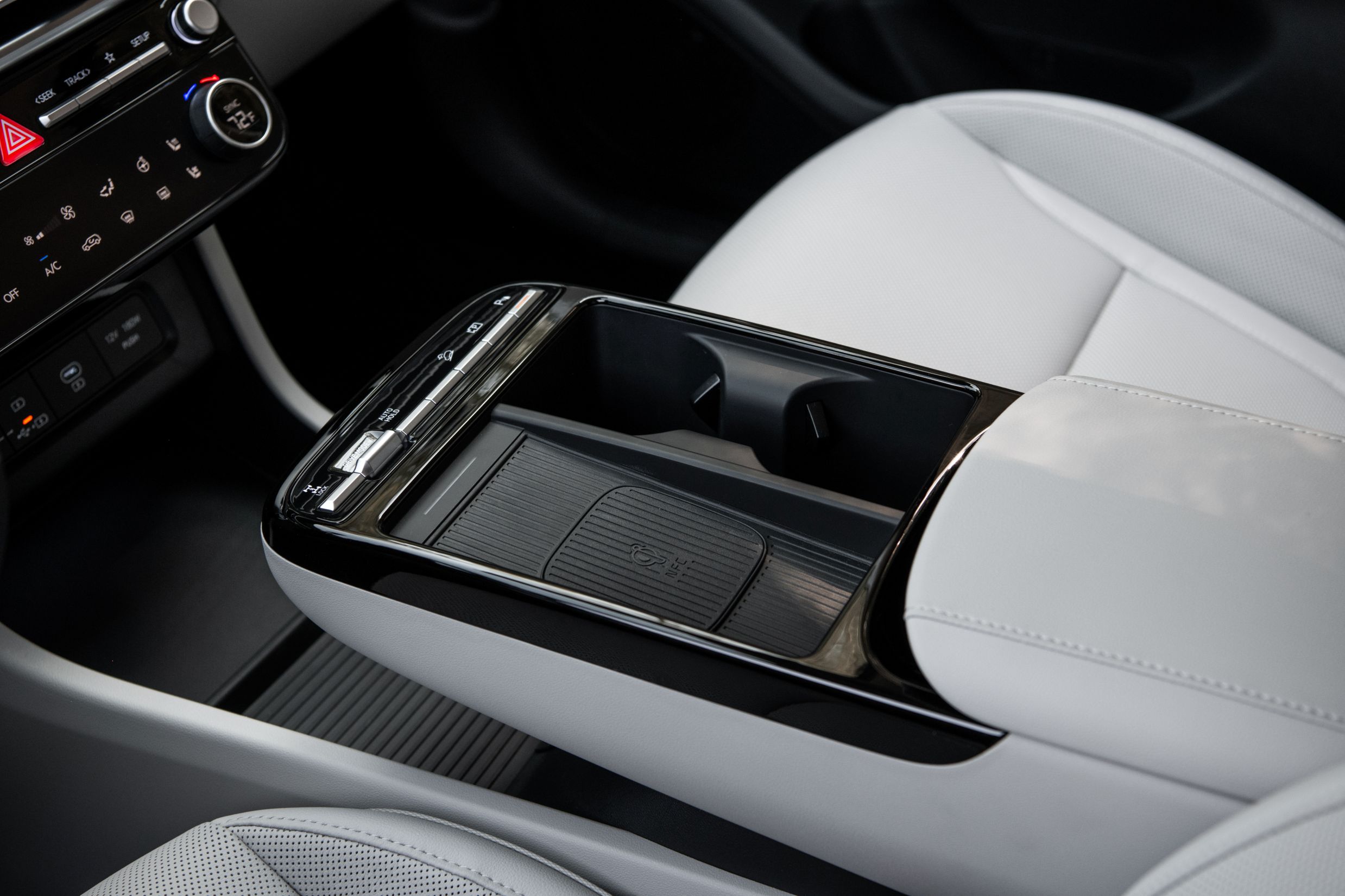
Looking down at the front center bridge console with wireless charging pad

Wireless charging pad and cup holders in easy reach.

Driver Assistance Technologies

FAW — Forward Attention Warning: An infrared camera mounted on the steering column monitors the driver’s eye gaze and attention levels.

DAW — Driver Attention Warning: Monitors driving patterns for signs of drowsiness or distraction.

FCA — Forward Collision-Avoidance Assist: Now includes detection for pedestrians, cyclists, and Junction Turning. The system can apply the brakes if it detects an oncoming vehicle while you are making a left turn.

LKA and LFA — Lane Keeping Assist and Lane Following Assist: LKA prevents unintentional drifting, while LFA provides active steering input to keep the car centered in its lane.

BCW — Blind-Spot Collision Warning: Alerts the driver to vehicles in a blind spot and can intervene if attempting a lane change.

RCCA — Rear Cross-Traffic Collision-Avoidance Assist: Detects vehicles approaching from the side while reversing and can automatically apply the brakes.

ISLA — Intelligent Speed Limit Assist: Map-data-based and camera-based to display speed signage.

SEW — Safe Exit Warning: Alerts passengers if a vehicle is approaching from behind before they open their door.
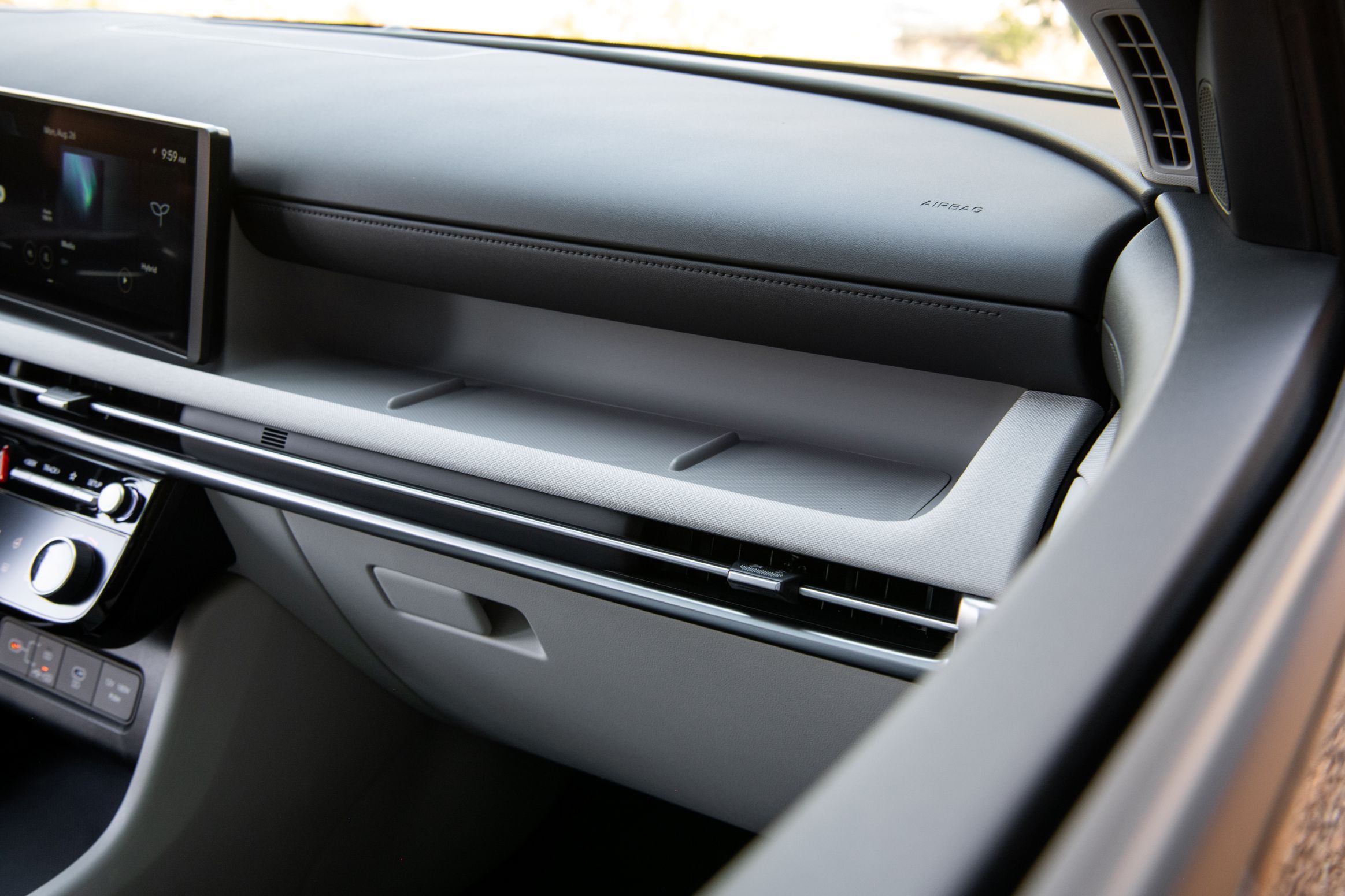
A segment shelf in the Tucson's instrument panel where a passenger could lay a phone

A useful design for passengers to lay a phone or other device.

Optional Safety Technologies

These features are typically found on higher trims like the Limited or as part of the SEL Convenience package:

HDA — Highway Driving Assist: A semi-autonomous system that combines Lane Following Assist and Smart Cruise Control to maintain speed and lane position on the highway.

RSPA — Remote Smart Parking Assist: While standing outside the car, the driver can move the vehicle into or out of a tight parking space using just the buttons on the key fob.

BVM — Blind-Spot View Monitor: Displays a live video feed of your blind spot in the digital instrument cluster when the turn signal is used.

SVM — Surround View Monitor: Provides a 360-degree bird’s-eye view of the vehicle to assist with parking and maneuvering.

PCA-R — Parking Collision-Avoidance Assist – Reverse: Specifically monitors for obstacles behind the car while backing into a spot and applies brakes if necessary.
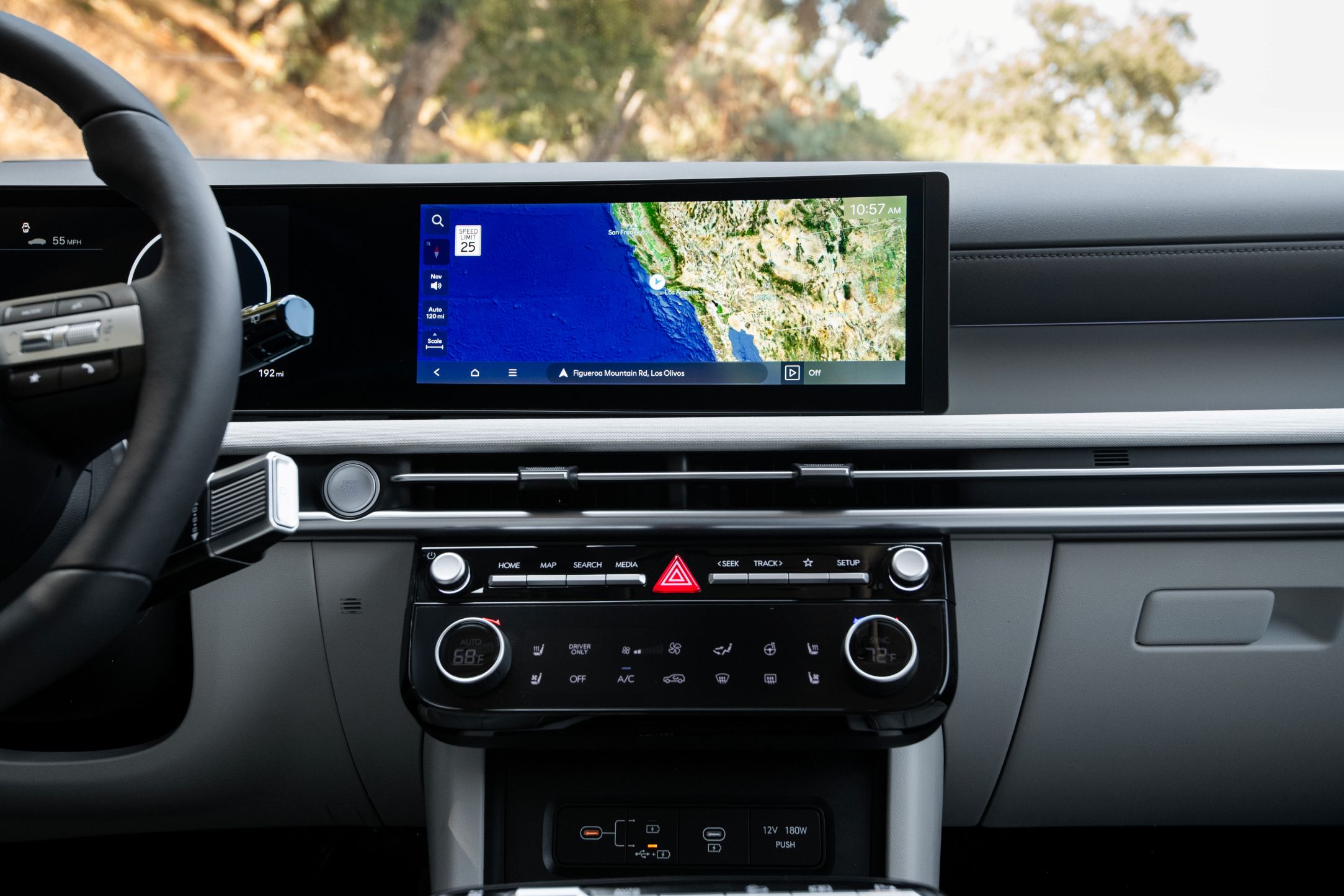
Looking at the wide navigation screen

Wide views for navigation, and a split screen for 360-degree camera views.

Hyundai Bluelink+

Hyundai Bluelink+ is a connected vehicle system that links an owner’s smartphone or smartwatch to the vehicle. The service is free for the original owner with no expiration.

Key Features:

Remote Services: Start the engine, adjust climate control (heat or cool the cabin), lock/unlock doors, and flash lights or honk the horn to find your car in a parking lot;

Safety & Security: Automatic collision notification (calls for help if air bags deploy), SOS emergency assistance, and stolen vehicle recovery/slowdown;

Vehicle Health: Receive monthly diagnostic reports, maintenance reminders, and “on-demand” diagnostic checks via the car’s touchscreen;

Navigation and Guidance: Send a destination from your phone directly to the car’s navigation system and use voice commands to find points of interest;

EV Specifics: For electric models, the owner can set start/stop charging, set charging schedules for off-peak hours, and monitor battery range.

 Tucson Hybrid Performance and Fuel Economy

Hyundai’s hybrid system in the 2026 Tucson features a 1.6-liter Smartstream turbocharged and direct-injected four-cylinder gasoline engine. It is paired with a 47.7 kW (64 hp) electric motor. Together, this hybrid system puts out 231 horsepower and 271 foot-pounds of torque.

A special feature of Hyundai’s hybrid powertrain is a six-speed automatic transmission rather than a mushy continuously variable automatic. Hyundai says the stepped six-speed better integrates with the electric motor. And those who enjoy driving will appreciate this transmission’s quicker acceleration.

I also appreciated that the 1.49 kWh lithium-ion battery allows considerable battery driving at low speeds. It pays green rewards for creeping through commuting traffic or tooling the mall parking lot.

New for the 2026 update is e-Motion torque vectoring. This system uses the electric motor to apply braking or torque to specific wheels to improve cornering and stability.
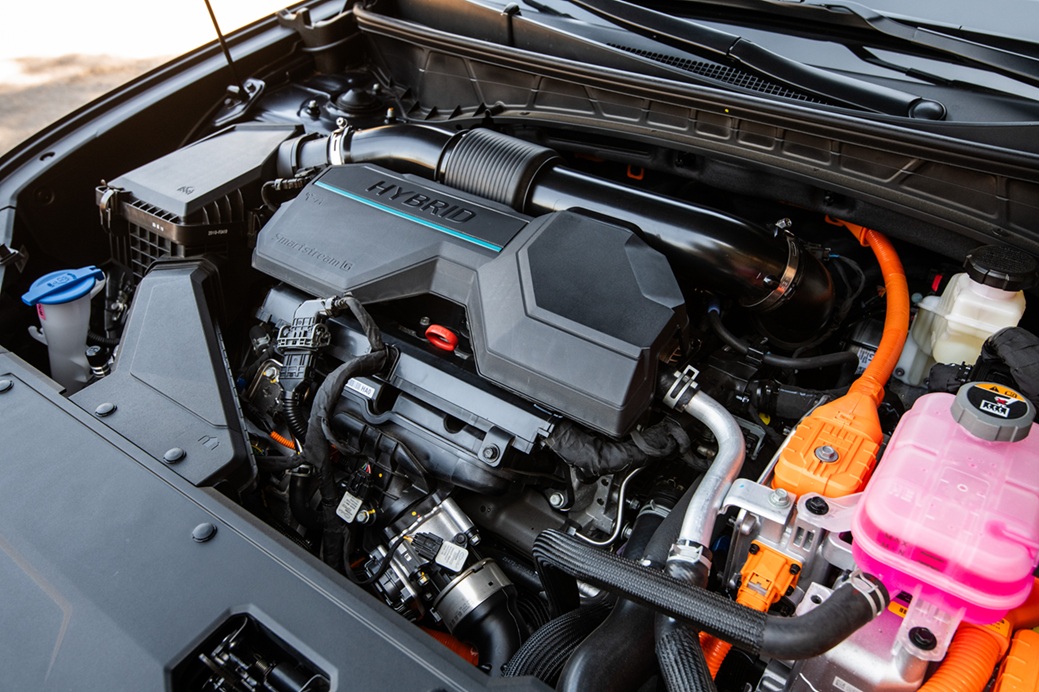
Looking at the engine bay and the tucson's hybrid engine

The Tucson Hybrid engine has fuel economy ratings of 36/37/36 mpg city/hwy/combined.

Hybrid Performance and Fuel Economy

Commuters seeking max fuel mileage should consider the Blue SE entry trim. It is the most fuel-efficient (and lightest) trim level, achieving an EPA-estimated 38 mpg combined. My Limited tester has mileage ratings of 36/37/36 mpg, using the recommended 87 octane fuel. On a highway drive with the cruise control set to 67 mph, the mileage climbed to 38.3 mpg. Around town, it was common to see mileage in the mid to high-20s.

Acceleration can be quite brisk, and it’s amplified in Sport mode. It gives a pronounced jump in throttle responsiveness, which I typically use when commuting to guard my line.
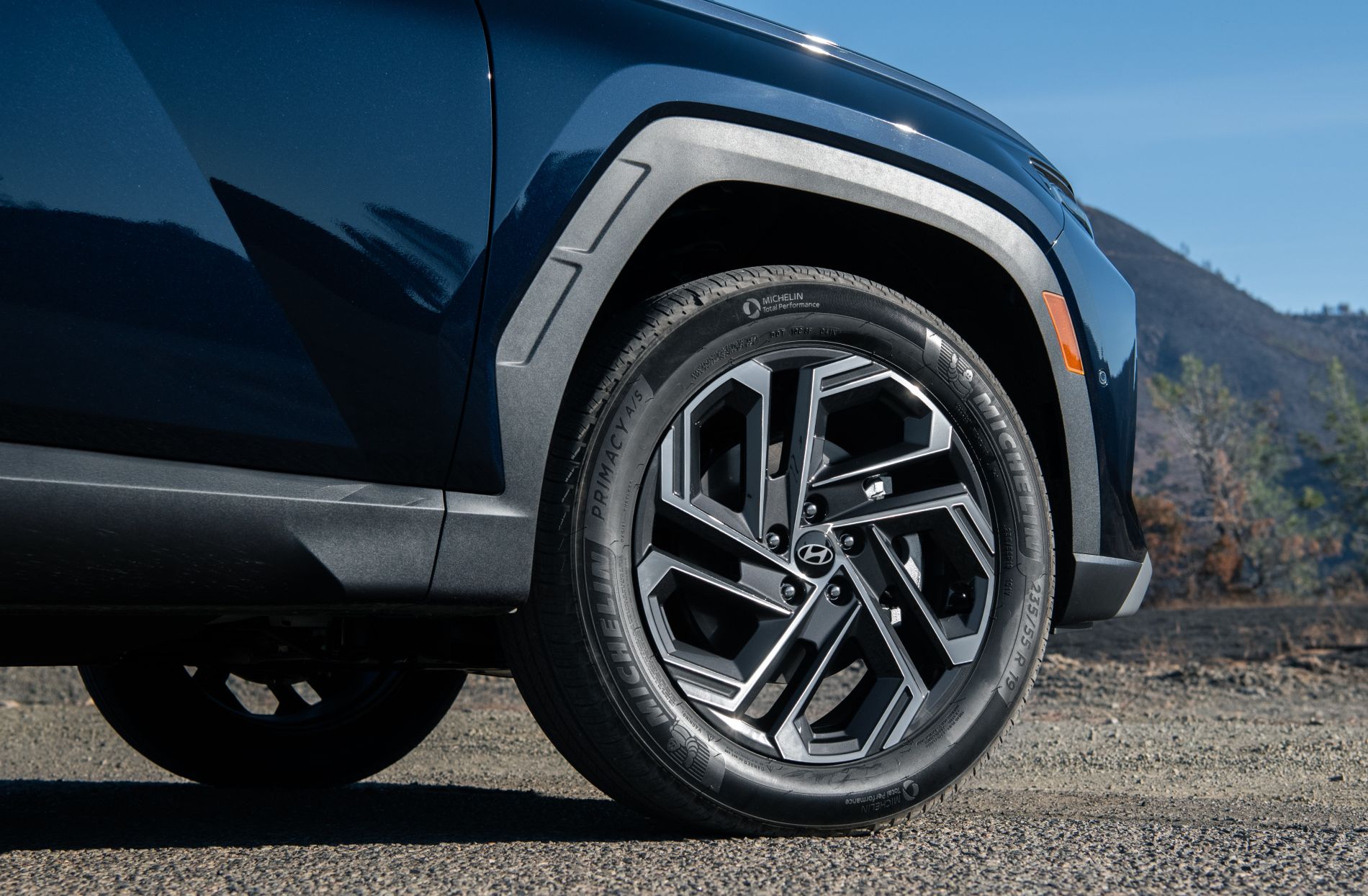
Looking at the right front tire and wheel of the Tucson hybrid

The Limited tester was fitted with 19-inch Michelin Primacy all-season tires.

If the 12-Volt Dies

Dead 12-volt batteries happen, and it is a special pain in a hybrid. With a dead 12-volt battery, there can be no cabin functions, such as unlocking doors or using interior lights. Hyundai simplifies charging a dead 12-volt with a battery reset button on the lower instrument panel. Rather than a separate 12-volt battery, Hyundai integrates a lithium-ion 12-volt battery with the high-voltage hybrid battery pack.

To protect this battery from draining completely (such as if a light is left on), the system will “disconnect” it. If the charge drops too low, making the car appear completely dead, it is a straightforward process to get started again.

How to Use It

1. Unlock the Car: If the battery is dead, use the mechanical key stowed inside the key fob to unlock the driver’s door.

2. Press the Reset Button: Once inside, press the 12V Battery Reset button. You may hear a “click” as the system reconnects.

3. Start the Engine: You have 15 seconds after pressing the button to start the vehicle.

4. Recharge: Once the car is in “Ready” mode, the high-voltage battery will automatically begin recharging the 12V system. The car should then be driven, or idled, for at least 30 minutes to ensure a full recharge.

Important Safety Note: If the car does not start after attempting a reset, it might need a traditional jump start using jumper cables. However, never use the 12V Battery Reset button while the vehicle is being jump-started; it could damage the electrical system.
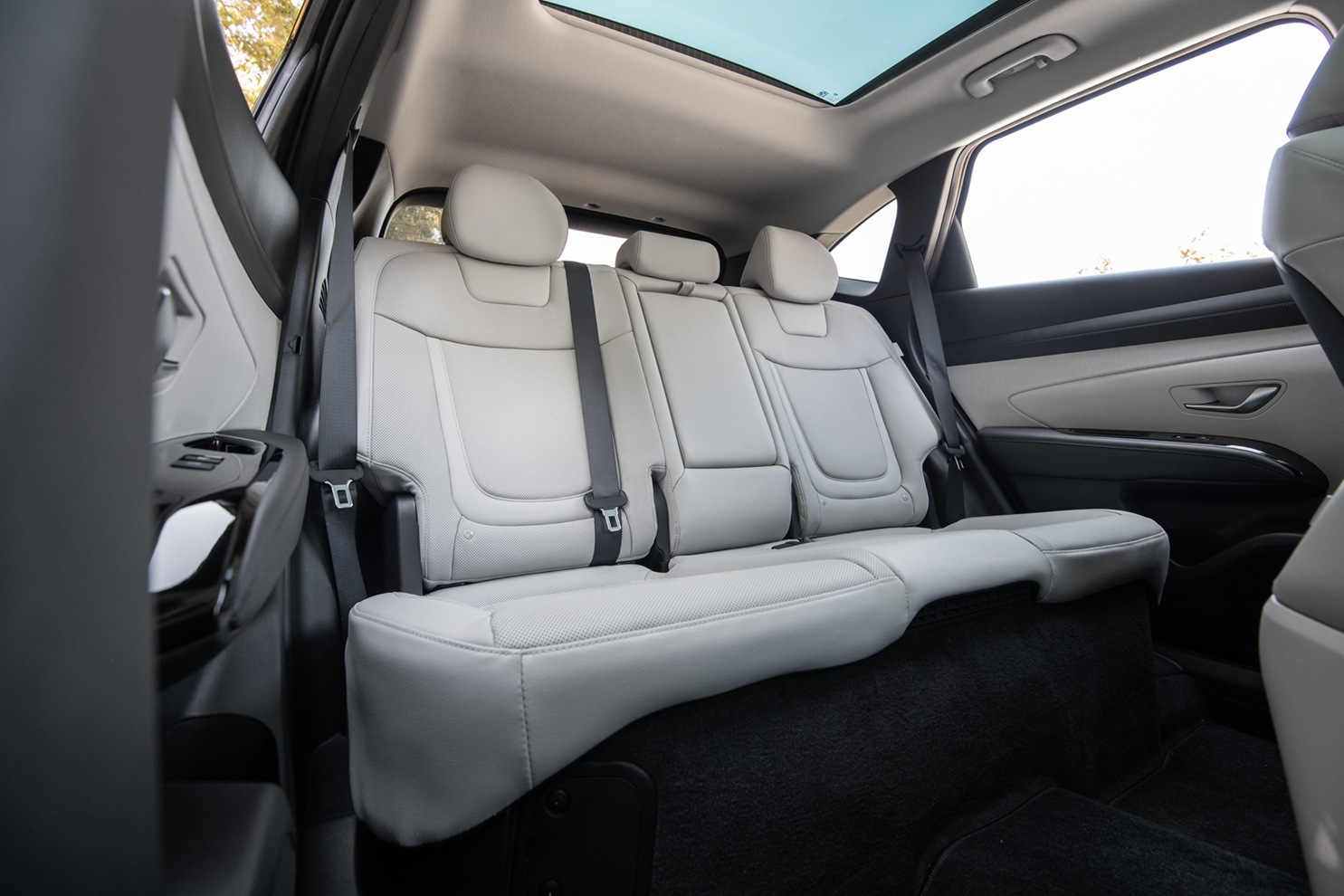
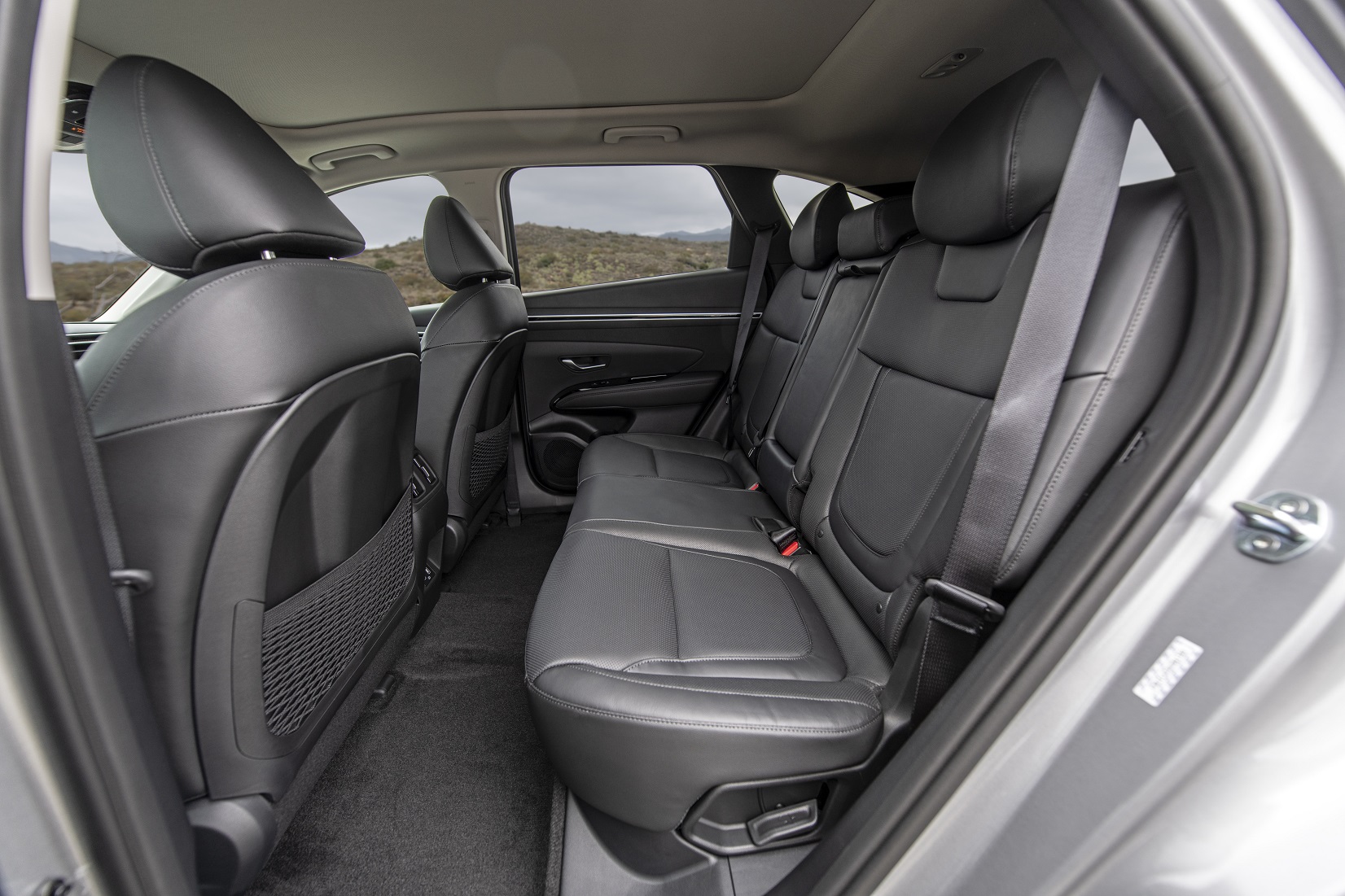
The three position back seat

The hybrid battery is located under the rear passenger seat to maximize cargo space and lower the vehicle’s center of gravity.

Hybrid vs. Plug-in Hybrid

If you are looking for more power, the 2026 Tucson Plug-in Hybrid could be the answer. The PHEV has a more powerful 72 kW (97 hp) electric motor and a larger 13.8 kWh battery. The combination increases total output to 268 horsepower while maintaining the same 271 lb.-ft. torque. of torque.

Because the PHEV has a larger battery, it has an EPA-estimated driving range of 32 miles on battery power. When starting with a full charge and a full tank of gas, the total driving range is approximately 420 miles. The plug-in’s fuel tank is smaller than the hybrid’s at 11.1 gallons. (On a road trip, the Tucson Hybrid could approach 500 miles of range with careful acceleration.)

Tucson Plug-in Hybrid pricing starts at $50,650 for the Limited and $42,425 for the SEL trim.

2026 Hyundai Tucson Hybrid Pricing

The 2026 Hyundai Tucson Hybrid is sold in four trim levels, all with standard HTRAC all-wheel drive. Retail starting prices below include the $1,600 U.S. freight charge from Ulsan, Korea.

Blue SE: $34,050. Key features include 17-inch alloy wheels, 12.3-inch touchscreen, Smart Cruise Control;

SEL: $36,000, including heated front seats, hands-free power liftgate, wireless charging;

SEL Convenience: $37,000, including panoramic sunroof, navigation, 19-inch wheels;

Limited: $43,675, including Bose premium audio, ventilated seats, and a surround-view monitor. (An extended list of standard features is below in the specifications chart.) My Limited tester came to $43,665 with carpeted floor mats, $240, which appear to be of good quality. Most buyers will also want to opt for the roller cargo cover ($205) to shield from prying eyes.

Check current Hyundai pricing here. And look here for special offers and promotions.
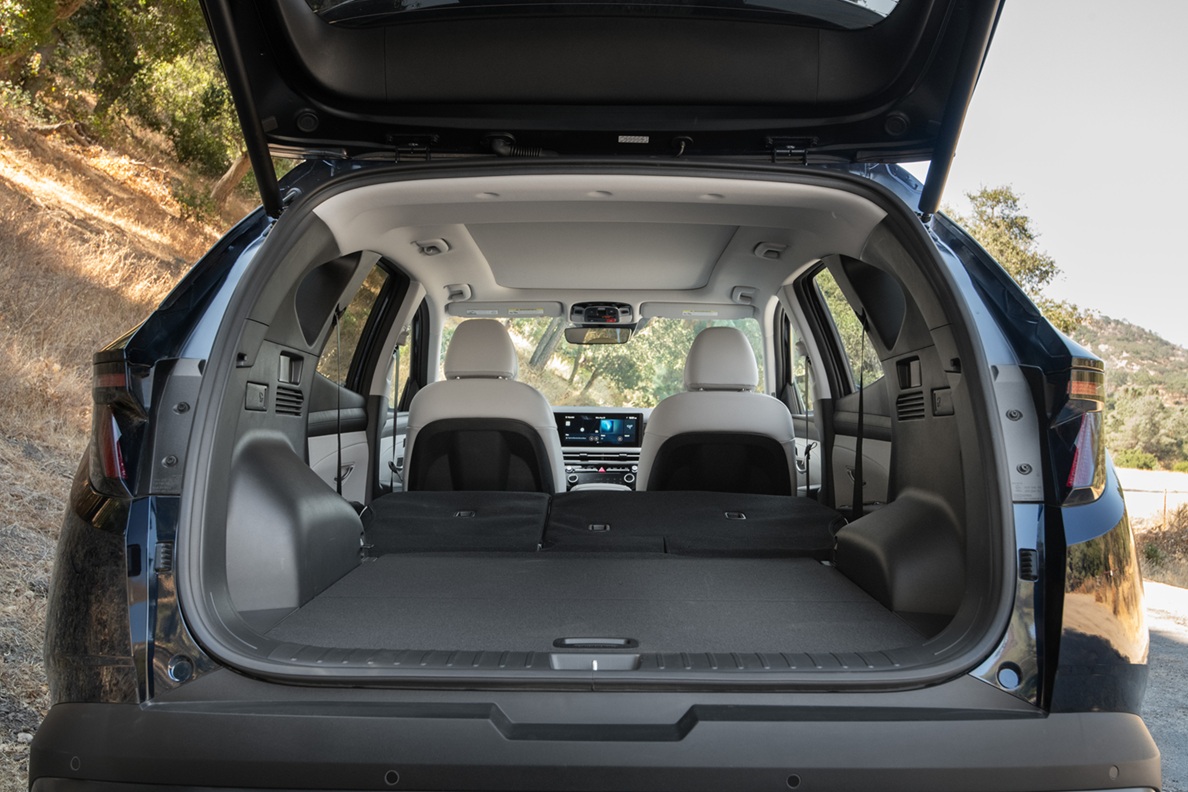
Looking into the tucson's cargo area with the back seat folded

The Tucson’s cargo space is large and open, with a dual-level load floor.

Hyundai Warranty Coverages

Powertrain Limited Warranty: 10 years or 100,000 miles (for original owners only). This covers the major mechanical components, such as the engine, transmission, and drivetrain.

New Vehicle Limited Warranty (bumper to bumper): 5 years or 60,000 miles. It covers nearly all major systems, including electronics, climate control, and suspension, against manufacturing defects.

Anti-Perforation: 7 years and unlimited miles. This specifically protects against rust that perforates body panels from the inside out.

Hybrid Warranty Protections

Hybrid/EV Battery: 10 years or 100,000 miles. This covers the high-voltage battery and related defects.

Hybrid System Components: 10 years or 100,000 miles; coverage includes such items as the hybrid starter, generator, and power control unit.

Capacity Guarantee: Hyundai guarantees the hybrid battery will not degrade below 70 percent of its original capacity during the 10-year/100,000-mile period.

Additional Benefits

24/7 Roadside Assistance: 5 years and unlimited miles. Services include towing to the nearest dealer, battery jump-starts, flat tire changes, and gas delivery.

Emissions: 12-month/12,000-mile replacement parts coverage and an 8-year/80,000-mile federal emission performance warranty.

Note on Ownership: The 10-year/100,000-mile powertrain warranty is typically only available to the original owner. If the vehicle is sold, subsequent owners usually receive the remaining balance of the 5-year/60,000-mile limited warranty for powertrain issues.
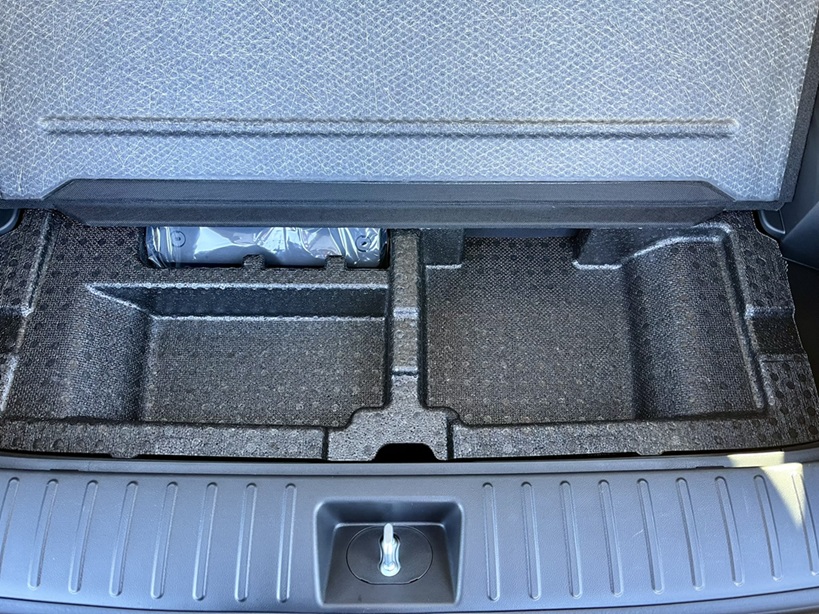
Looking at he space under the cargo floor where the spare tire inflation system is stored until needed

There is no spare tire but an inflator system, tucked under the cargo floor. (Mark Maynard)

High Priority 2025-2026 Recalls

The Hyundai Tucson Hybrid with 1.6L SmartStream turbo engine is generally considered more reliable than older Hyundai models. However, there are a few “growing pains” and technical issues to consider:

Engine Connecting Rods: In late 2025, Hyundai recalled a small number of 2025-2026 Tucson Hybrids due to improperly tightened connecting rod bolts. If these come loose, they can cause a sudden loss of power, engine knocking, or even a fire due to oil leaks. Hyundai’s fix is a complete engine replacement. Be sure to keep all dealership records when having this problem evaluated.

Instrument Cluster Software: A 2026 recall affects the digital dash, which may go blank while driving, preventing you from seeing your speed or warning lights.

Common Engine and Mechanical Issues

The 1.6L Turbo engine in the Tucson Hybrid is newer than the older “Theta” engines, which were notorious for fires. However, owners have reported:

“Check Hybrid System” Warning: Some owners have experienced a sudden loss of power accompanied by this warning. This is often linked to software glitches or sensors in the hybrid powertrain rather than a mechanical engine malfunction.

Carbon Buildup: Because this is a gasoline direct injection (GDI) engine, carbon can accumulate on the intake valves, typically after 60,000 miles. When this occurs, drivers will notice a rough idle or reduced fuel economy.

Oil Dilution: Like many small turbo engines used for short trips, fuel can sometimes mix with the engine oil. It is highly recommended to change the oil every 5,000 miles rather than the longer intervals the manual might suggest.

Jerky Shifting: Some drivers report “hunting” for gears or a jerky feeling at low speeds. The hybrid uses a traditional six-speed automatic rather than the dual-clutch found in the gas-only turbo. The six-speed is generally more durable but can still feel “clunky” if the software isn’t updated.

For more information on government recalls, visit NHTSA.gov/recalls.

Why Buy the 2026 Hyundai Tucson Hybrid?

In its last four years of production, the 2026 Hyundai Tucson is as good as it gets. And what has been learned and evolved for the 2026 model will carry over to the 2027 model.

The Tucson Hybrid will impress with its very well-soundproofed cabin and refined interior materials that feel near-luxury.

Whether buying a certified pre-owned 2025 model or a new 2026 model, ensure all engine and drivetrain updates have been completed. To be safe, consider one of Hyundai’s extended warranty plans. Learn more here.
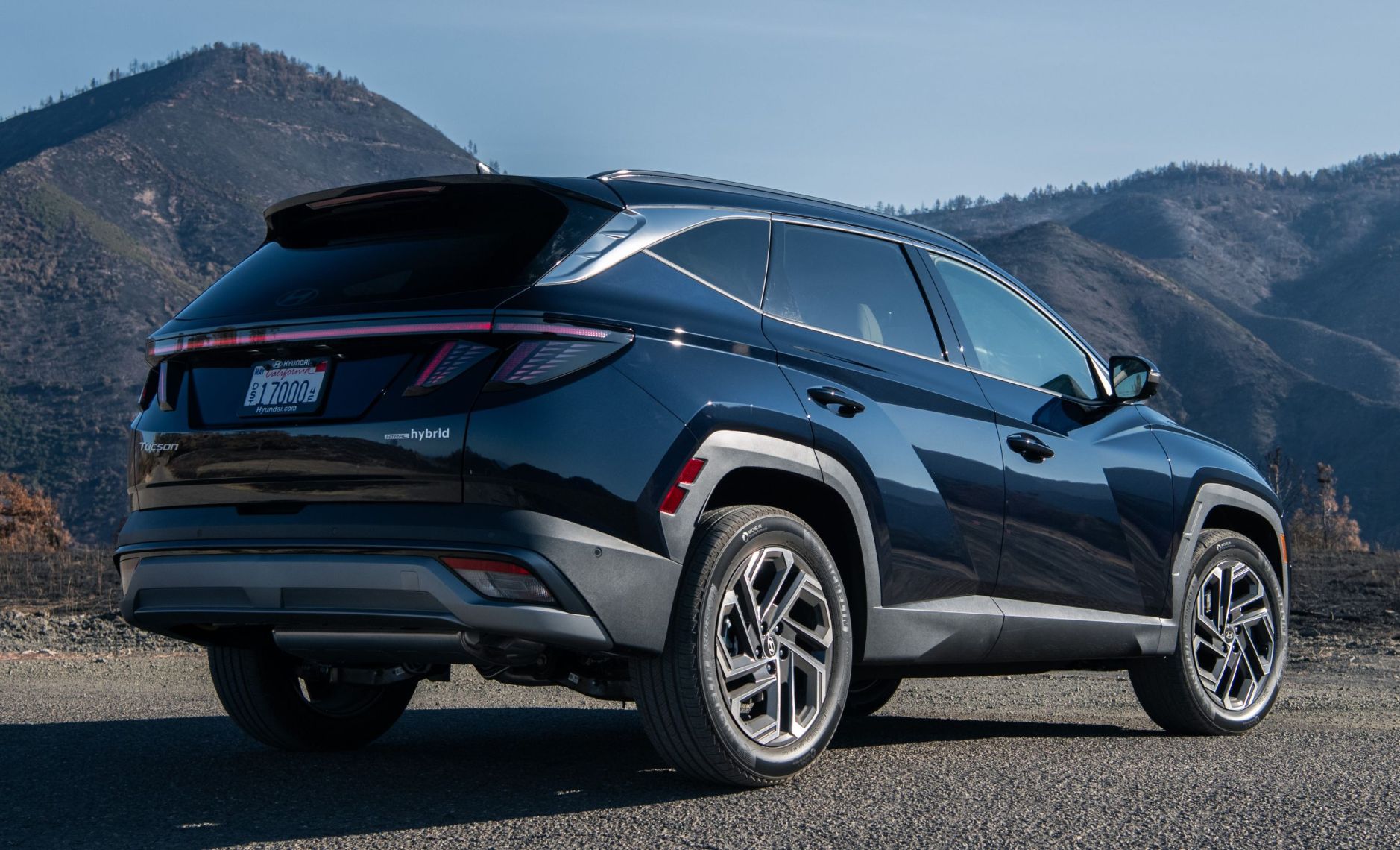
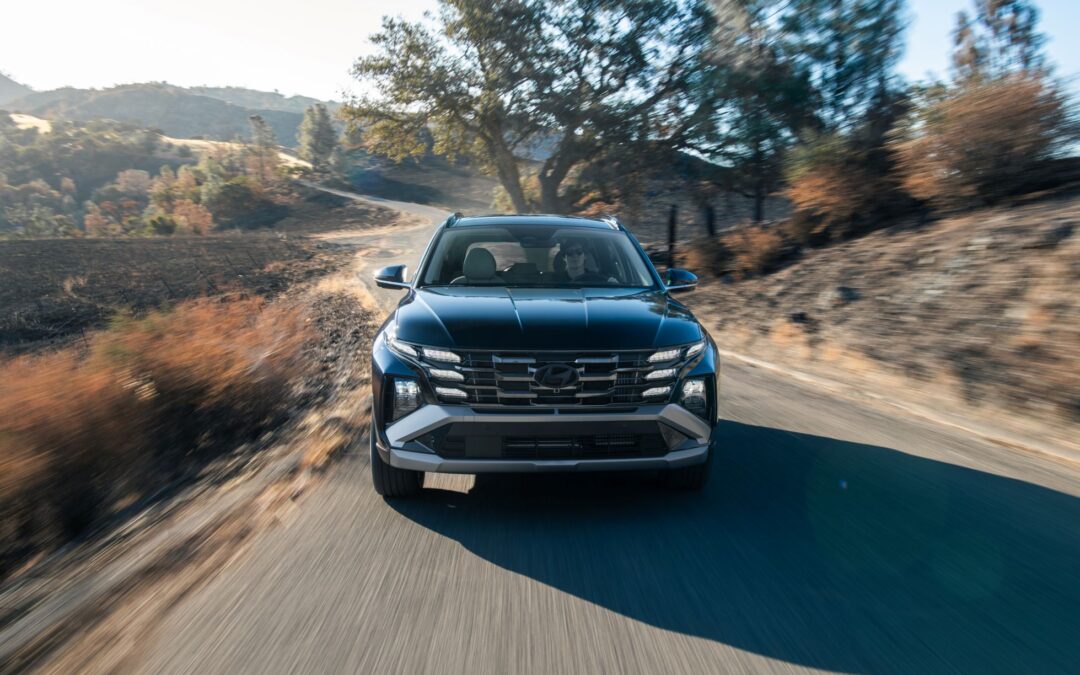
A rear view of a black Tucson Hybrod SUV

All trim levels of the 2026 Hyundai Tucson include standard HTRAC all-wheel drive.

2026 Hyundai Tucson Hybrid Specifications

Body style: compact class 5-door, 5-seat AWD SUV

Engine: 178-hp, 1.6-liter turbocharged and direct-injected, DOHC 16-valve inline 4-cylinder; 195 lb.-ft. torque from 1,500-4,500 rpm

Electric motor: Permanent magnet synchronous motor; 47.7 kW (64 hp) from 1,800–2,100 rpm; 195 lb.-ft. at 1,700 rpm

Combined hp and torque: 231 hp/271 lb.ft. torque

Hybrid battery: lithium-ion, 64 kW, 270 volts

Transmission: 6-speed automatic torque converter, active on-demand HTRAC AWD; steering-wheel paddle shift levers

Fuel economy: 36/37/36 mpg city/hwy/combined, 87 octane recommended

Towing capacity: 2,000 pounds, with a braked trailer

Coefficient of drag: 0.33 Cd

BY THE NUMBERS

Fuel tank: 13.7 gallons

Cargo space: 31.9-66.3 cubic feet (stacked floor to headliner)

Front head/leg room: 38.1*/41.4 inches *40.1 in. w/o sunroof

Rear head/leg room: 38.76/41.3 inches

Length/wheelbase: 182.7/108.5 inches

Curb weight: 3,920 pounds

Turning circle: 38.5 feet

STANDARD LIMITED FEATURES

Limited equipment includes: smart key locking and push-button start,12.3-inch color navigation touchscreen, 4.2-inch driver info display, smart cruise control with stop and go, wireless phone charging, heated tilt-telescopic steering wheel, 8-speaker Bose audio system, wireless Apple CarPlay and Android Auto, 3-month satellite radio subscription, OTA map and multimedia updates, leather-trimmed upholstery, heated and ventilated power front seats, 8-way power driver and front passenger seats (w/2 position driver seat presets), panoramic sunroof with one-touch open and rear sunshade, ambient lighting, dual front USB Type-C data-charge ports, dual rear charging ports, 60/40 split folding back seat, reclining rear seatback, seatback bag hook, roof side rails, full LED lighting with bi-LED headlights (high and low beams), automatic with high-beam assist (dimming), acoustic laminated windshield and front side glass, solar glass windshield and front doors,

CHASSIS COMPONENTS

Brakes: 4-wheel discs, 12.8-inch vented front rotors; rear 12-inch solid rotors; with 4-wheel ABS and electronic brake-force distribution; with driver-selectable downhill brake control (DBC), hill-start assist (HAC), brake assist; electric parking brake

Steering: motor-driver power assist rack and pinion; 38.5-foot turning circle

Tires-wheels: 19-inch alloy wheels and 235/55 19-inch all-season tires, with tire-mobility kit

Suspension: Front MacPherson struts with coil springs, stabilizer bar, and gas-pressurized shock absorbers; rear multilink with gas shocks and stabilizer bar

PRICING

Limited base price: $43,425, including $1,600 freight charge; price as tested $43,665

Options on test vehicle: Carpeted floor mats $240

Where assembled: Ulsan, Korea

Hyundai Sonata N Line Review

Hyundai Sonata N Line Review

The 2024 Hyundai Sonata N Line sport sedan is a subtle display of elevated, if not wicked, performance for a well-equipped $36,310

A front three quarter view of a silver N Line sedan

Hyundai has made significant updates to the midsize 2024 Sonata, with sharpened performance to the Sonata N Line. (Photography courtesy of Hyundai or as credited)

Jump To Special Features

What’s New for the 2024 Sonata?
2024 Hyundai Sonata Pricing
Extensive Safety Features
N Line Performance
Under the Hood
Ride and Handling
Why Buy the 2024 Hyundai Sonata N Line?
Specifications

BY MARK MAYNARD

Quick, before Hyundai finance managers realize that the powertrain engineering team ignored all cost restrictions for its Sonata N Line.

This popular midsize sedan has gone through a major midcycle freshening for 2024. The updates are more than the usual nips and tucks inside and out. For the first time, there is an all-wheel-drive option for one trim level. And the new Sonata N Line is a subtle display of elevated performance. For a well-equipped $36,310, I did not expect the pleasure of such punch in my week’s test drive.

The Sonata N Line is an outlier sport sedan in the midsize segment. It has no real competition except its company cousin, the Kia K5 GT, which uses the same N Line powertrain. Why is it so isolated? It might be the price point or a perception that the mainstream midsize segment is a grownups’ family car.

Sport compact sedans, however, are numerous, including Hyundai’s Elantra N Line. Among competing four-door sportsters are the Honda Civic Si, Subaru WRX, Toyota GR Corolla, and VW Jetta GLI. And there are higher performance versions for each compact, at a cost. Pricing on average for these mere sporty sedans starts in the low to mid $30,000s. Opting for one of their more notorious trim levels can add $10,000-$15,000 to the MSRP.

The incredibly well-equipped 2024 Hyundai Sonata N Line is a larger car with impressive engineering, priced at $36,310.

By EPA interior space standards, the Sonata is a “large” car.

The cabin has tech-contemporary style, centered by a new curved display screen.

The N Line cabin has tech-contemporary style, centered by a new curved display screen.

What’s New for the 2024 Sonata?

The 2024 exterior redesign leans into Hyundai’s styling language of “sensuous sportiness.” Among the influences are Sonata’s horizontal layout, signature “Seamless Horizon Lamp,” and wide-set hidden headlights. A full-width LED light strip at the hood shutline runs just above the main headlights, hidden above the air intakes.

Hyundai says a new grille and larger air intakes create a more dynamic and aggressive appearance. At the rear, stylized H-lights emphasize the wide stance. LED lighting adds a contemporary tech style. A black spoiler-shaped trunk lid and a rear lower fascia molded around dual exhaust tips set a performance tone.

The N Line’s 19-inch tire and wheel package gives a strong stance, with capability from Pirelli P Zero all-season tires. Standard Sonata wheels are 16, 17, or 18 inches.
Thanks go to the N Line model for new body reinforcements. There were also more general improvements in noise, vibration, and harshness.

Special N Line cabin details include red trim across the dashboard and air vents, with red stitching throughout. The steering wheel material was changed, and the upper seatbacks of the front seats have an embroidered N logo.

On the N Line and upper trims, there is a new curved display screen. The digital presentation links two separate 12.3-inch displays under a single pane of glass.

Other updates include:

  • Wireless Apple CarPlay and Android Auto have been expanded to all 2024 Sonata models;
  • Continuous over-the-air software updates;
  • Improved sound quality from the 12-speaker Bose Premium Sound System with new CenterPoint 360 technology.
Front sport seats with microfiber suede inserts have higher grip leatherette side bolsters.

N-Line sport seats with microfiber suede inserts and higher grip leatherette side bolsters.

2024 Hyundai Sonata Lineup

The refreshed 2004 Hyundai Sonata is available in gasoline or gas-electric hybrid models, in front- or all-wheel drive.

  • Gas-powered Sonatas have a 191-hp 2.5-liter direct-injection four-cylinder engine. On 87-octane fuel, it has fuel economy ratings of 25/36/29 mpg city/highway/combined. The transmission is an eight-speed Smartstream automatic with an overdrive lock-up torque converter.
  • Hybrid-powered Sonatas have a 192-hp 2.0-liter four-cylinder engine, 39 kW (51 hp) motor, and 270-volt lithium battery pack. The transmission is a six-speed automatic.
  •  Sonata N Line has a specially developed 290-hp turbocharged 2.5-liter engine and an eight-speed wet dual-clutch automatic with steering wheel paddle shifters.

All-Wheel Drive

Hyundai TRACtion (H-TRAC) all-wheel-drive system is now available on the entry SEL model with 2.5-liter engine. The electronically “intelligent” system reroutes power between the front and rear axles. The system will also apply subtle brake pressure to the left and right wheels to help maintain cornering control.

2024 Hyundai Sonata Pricing*

  • SEL $28,860 with carpeted floor mats ($210); add $1,500 for all-wheel drive. Standard SEL features include keyless entry with push-button ignition, fabric upholstery, heated front seats, an eight-way power driver seat, a six-way manual front passenger seat, a 12.3-inch infotainment touch screen, and a wireless phone charging pad.
  • SEL Hybrid (FWD) $31,950. The gasoline-electric powertrain achieves fuel economy ratings of 44/51/47 mpg city/highway/combined.
  • SEL Limited Hybrid $38,350. Special features include leather-trimmed upholstery, heated and ventilated front seats, and 17-inch alloy wheels with an eco-spoke design.
  • N-Line $36,310, including carpeted floor mats.

*Retail starting prices include the $1,150 freight charge from Asan, Korea.

Check current Hyundai pricing and special offers here.

Paint Colors

Hyundai says the Sonata’s exterior colors have a state-of-the-art aircraft look. The Sonata N Line’s Aero Matte Silver ($1,000) changes color from warm to cool depending on the light.

Additional exterior colors include Onyx Black Pearl, Serenity White Pearl ($470), Atlas White, Portofino Gray (matte-metallic), Transmission Blue Pearl, Carbon Blue Pearl, Ultimate Red Metallic, Cream Beige, and Aero Silver Metallic.

Interiors are trimmed in black, dark gray, and greige two-tone, or dark gray and camel two-tone. Dark gray with red stitching and N Line red paint is exclusive to the Sonata N Line model.

The open trunk of 15.6 cubic feet

This sedan has useful utility in its 15.6 cu.ft. trunk, and fold the 60/40 back seat for up to 6 feet in length.

Warranty Coverages

Hyundai has become known for its vaunted warranty coverages: 5 years or 60,000 miles bumper to bumper with roadside assistance. And new vehicles also have free maintenance for 3 years or 36,000 miles.

Hyundai repaired its early powertrain reliability with major engineering improvements and by offering a 10-year, 100,000-mile powertrain warranty. However, getting satisfaction in the event of an engine problem can be elusive, according to Consumer Reports. In a recent report ranking dealership satisfaction scores of 22 makes, Hyundai ranked third from the bottom. Kia was last, and just above is Jeep. Ouch.

The new steering wheel mounted shift lever looks odd, works well.

The new steering wheel-mounted shift lever looks odd but works well.

Interior Function

Size matters when putting controls and switches in logical order. The wide digital screen is not prone to glare or odd reflections. And there is no confusion to knobs, dials, or switches to control cabin comfort or audio.

There is enough stretch to the body that sightlines are open over the shoulder, across the hood, and at the side mirrors.

Headroom of 37.8 inches with the panoramic sunroof should fit most drivers. Taller drivers might prefer to skip the panoramic roof to get 40 inches of headroom. The front legroom is incredibly long, at 46.1 inches. With door-to-door shoulder room of 57.9 inches, the front seat area does not feel cramped.

The Sonata N Line sport seats have good comfort and thigh support due to their breathable and grippy microfiber suede centers. Higher grip leatherette side bolsters were not intrusive to entry and exit. But I would like a more pronounced D-shaped steering wheel, which helps with thigh room.

The redesign also introduces a new gearshift stalk at the steering wheel. It might look weird initially, but it functions easily with a twist up or down to engage gears. The shifter is a smart way to move a lever from the center seat console for more useful space. A switch on the console changes drive modes from Normal to Smart, Sport, and My Mode.

An e-bin at the forward console has C-Type charging USBs, a 12-volt and 180-watt power plug, and a wide charging pad.

Back Seat and Cargo Space

With just 34.8 inches of max legroom, the window seats still have a comfortable stretch with good footroom. The center seat has the typical perched position, making it more useful for its broad fold-down armrest. Conveniences include two C-type USBs, grab handles with coat hooks above each door, and slim door-panel storage.

There is good utility to this sedan with is 15.6 cubic feet of trunk space, and golf-bag capable. Or fold the 60/40 back seat for up to 6 feet in length, easily negotiated through the wide trunk opening. Trunk assets include dual seatback-release pulls and an interior light. There is no N Line spare, just a “mobility kit” of tire sealer and inflator pump.

The Sonata back seat with adequate 35.8 inches of legroom

With just 34.8 inches of max legroom, the window seats still have a comfortable stretch with good footroom.

Sonata’s Extensive Safety Features

The Hyundai Sonata has comprehensive safety technologies and features, including 5 mph bumpers. The industry bumper standard is 2.5 mph for passenger cars (not trucks, SUVs, or minivans). The federal law is intended to prevent damage to the car body and safety-related equipment at barrier impact speeds of 2.5 mph across the full width and 1.5 mph on the corners. But 2.5 seems to have little benefit.

An umbrella of circuitry also protects the Sonata and its occupants. The various systems are comprised of three radar systems, five cameras, and 13 ultrasonic sensors. All linked, the systems allow for semi-autonomous driver-assist features of standard adaptive cruise control, forward-collision braking, and lane-following assist.

The individual technologies are:

FCA 1.5: Forward Collision-Avoidance Assist 1.5;

RCCA: Rear Cross-traffic Collision-avoidance Assist;

BCA: Blind-spot Collision Assist;

SEW: Safe Exit Warning;

SEA: Safe Exit Assist;

LKA: Lane Keeping Assist;

LFA: Lane Following Assist;

SCC with S&G: Smart Cruise Control with Stop & Go;

RSPA: Remote Smart Parking Assist (enables the user to park the vehicle and exit parking spots by remotely reversing and forwarding with the smart key from outside the car;

NSCC: Navigation-based Smart Cruise Control (optional);

HDA: Highway Driving Assist to help relieve driver stress (optional).

N Line Performance

The Sonata N Line is a sleeper sport sedan — and a lot more than paint and tape. Its 290-horsepower, 2.5-liter turbocharged engine was developed specially for the N Line, and its eight-speed dual-clutch (automated manual transmission) thrives in high-rev performance.

While turbocharged 290 hp is great, the N-Line’s torque stands out. The 311 foot-pounds run steady from 1,650-4,000 rpm. In its testing, Motor Trend clocked zero to 60 mph in 5.6 seconds.

When the red mist whispers, there is Sport-Plus, just a couple of pages away in the vehicle settings. Sport-Plus mode is in the “My Mode” category. Use the slider buttons to maximize the performance of shift points and steering weight. Neither setting makes for a harsh or uncomfortable ride, but mercy, the performance is amplified to the predator level. Flicking off steering wheel paddle shifts gives instantaneous upshifts and rev-matching downshifts.

N Line Sport-Plus mode also includes launch control and rev-matching downshifts. Active Sound Design makes the engine sound more virile inside the cabin, but it still sounds ratchety.

Yet, there are those times of enthusiast driving when the N-Line could use a locking differential when the front tires lose grip and torque steer takes over.

N-Line has a console switch to toggle between comfort, Sport, and My Mode. Sport modes sharpen acceleration response and steering weight.

The eight-speed wet dual-clutch automatic gave hesitant shifts while driving around town. That action was the gears engaging in the automated manual transmission. It annoyed me, but I discovered that Sport mode eliminated the clutching action. That is how I enjoyed the rest of my drive week, regardless of fuel economy.

A view of the N Line’s 290-hp 2.5 liter four-cylinder engine.

The N Line’s 290-hp 2.5 liter four-cylinder engine.

Under the Hood

Pop the N Line hood, and Hyundai’s detailed engineering for serviceability and DIY maintenance becomes apparent. First, there are two robust hydraulic hood struts, not a spindly prop rod. Never mind that those struts (and tailgate struts) will wear out and need to be replaced. It is the budget for hydraulic struts that matters.

Sonata's easy to change air filter

Air filter can be changed in less than a minute!

Next, check out the huge air pipe feeding the turbocharger. It is securely routed to avoid chafing on the also-large air intake tube next to it. Then, follow the air intake feed to the air filter box. The strong black plastic box has a user-considerate design with small flipper tabs. Opening, removing, and slipping in a new filter should take less than a minute.

Thermal-sandwiched metallic pads are behind and above the hood for turbocharger heat protection.

The 12-volt battery has dual lifting handles. Both battery terminals have a cover to protect positive and negative posts, and the positive terminal has its own high-current fuse.

Look closer for the corrosion-protected engine-transmission grounding strap. The robust strap is fully covered.

The user friendly fuse panel under the hood of the Sonata.

The simple fuse-box schematic. (Peter Badore photos)

Now, eyes right to the vehicle fuse box near the right-side shock tower, clearly identified. Remove the lid, and the underside has a detailed schematic chart showing each fuse amperage and what it protects. There are also six spare fuses and a useable plastic tweezer-like tool to pull a blown fuse.

Finally, for the owner and service tech, many of the screw heads are rounded to protect knuckles.

All these added design features add cost and weight. Many carmakers in the Sonata’s price segment cut such extras from their budgets.

Fuel Economy Numbers

At 3,534 pounds, the Hyundai Sonata N Line is the second heaviest Sonata in the lineup. It slots behind the Limited at 3,687 pounds or the SEL AWD model at 3,466.

Sonata N Line has fuel economy ratings of 23 mpg city, 32 highway, and 27 mpg combined on the recommended 87 octane fuel. In my 200-mile week of driving, I saw mileage averages of 29.4 around town to 35 mpg on the highway.

However, those mileage ratings are several mpgs off those of the four-cylinder 2024 Honda Accord turbo (29/37/32 mpg) and 2024 Toyota Camry (28/39/32 mpg).

Sonata N Line Ride and Handling

The suspension stands out for its agile finesse in transferring weight. The refined engineering of suspension components is felt in the low-friction glide quality.

Modern family sedans have been made lower and wider in the hope of improving fuel economy and meeting federal mileage standards. Consequently, some new sedans ride so low that comfortable entry and exit are compromised.

Not so the Hyundai Sonata. Its ride height allows excellent forward sightlines and comfortable entry and exit. Drivers can confidently transition driveways without a chin scrape. There is no tiptoeing across lumpy intersections in concern of bottoming out. It is hard to avoid that awful “graunch” in most other sedans and some small SUVs today.

Hyundai has applied various aerodynamic designs, winglets, and air-breaking widgets to lower the drag coefficient to 0.28. The Toyota Prius, by comparison, has a Cd of 0.27. Despite more soundproofing, there is much ambient noise in the cabin at highway speeds. It did not seem to come from tire harshness or suspension points.

Complementing ride and steering control are the 19-inch 245/40 Pirelli P Zero all-season tires, on the test car. Their rubber chemistry is compliant with an upper-midrange 500 treadwear rating (UTQG). Replacements will run around $300 each (not installed), per TireRack.com.

The N Line’s 19-inch tire and wheel package with Pirelli P Zero all-season tires.

The N Line’s 19-inch tire and wheel package with Pirelli P Zero all-season tires.

Why Buy the 2024 Hyundai Sonata N Line?

Hyundai believes there is renewed interest in sedans. The Sonata offers accommodating utility and a generous budget for many useful features.

There is more to the Sonata N Line than what is typically perceived as a family sedan. Enjoying this stealthy sport sedan requires no physical sacrifice.

Now, switch off the drive assistance, take the wheel, and just enjoy driving.

A slightly overhead view of a silver Sonata N Line

The Sonata N Line is an outlier sport sedan with no real competition, except its company cousin the Kia K5 GT.

2024 Hyundai Sonata N Line Specifications

Body style: midsize, 5-seat, 4-door front-wheel-drive sedan; unibody high-strength steel

Engine: 290 hp, Smartstream 2.5-liter turbocharged and direct-injected DOHC 16-valve inline 4-cylinder; 311 lb.-ft. torque from 1,650-4,000 rpm

Transmission: 8-speed N automatic wet dual-clutch

Fuel economy: 23/32/27 mpg city/hwy/combined;

Coefficient of drag: 0.27 Cd

BY THE NUMBERS

Fuel tank: 15.9 gallons

Trunk space: 15.6 cubic feet

Front head/leg room: 37.8*/46.1 inches *40 inches w/o sunroof

Rear head/leg room: 37.4*/34.8 inches *38.4 w/o sunroof

Shoulder room, front/rear: 57.9/56.1 inches

Hip room, front/rear: 54/.6/54.4 inches

Length/wheelbase: 193.3/111.8 inches

Height/width: 56.9/73.2 (not including mirrors) inches

Curb weight: 3,534 pounds

Turning circle: 35.9 feet

FEATURES

Sonata N Line standard equipment includes: Proximity key with push-button ignition, 12.3-inch color gauge array, 12.3-inch touchscreen for navigation-audio, panoramic sunroof, surround view monitor, dual automatic temperature control, wireless Apple CarPlay and Android Auto, 12-speaker Bose audio system with satellite radio, 8-way power driver’ seat, 6-way front passenger seat, heated front seats, electric parking brake, 60/40 folding back seat, hands-free trunk, lighted vanity mirrors and visor extensions, locking and lighted glove box.

N-Line features: larger front bumper grille area, exclusive 19-inch wheels, rear spoiler, dual twin-tip exhaust, front sport seats with microfiber suede inserts and higher-grip side bolsters, leather-wrapped steering wheel, metal and rubber brake and accelerator pedals, LED map lights, red-accented stitching and cross-metal patterned trim, Active Sound Design, Launch Control, N Powershift, and rev-matching downshifts.

Sonata N-Line standard safety features include: 9 air bags, 5 mph bumpers, stability and traction controls, safe exit warning;

Safety technologies include: blind-spot collision warning with rear cross-traffic collision avoidance assist; blind-spot view monitor; forward collision-avoidance assist with pedestrian, cyclist detection and junction turning; parking collision-avoidance assist rear; high-beam assist; lane keeping assist, lane follow assist, and driver attention warning.

CHASSIS COMPONENTS

Brakes: 4-wheel disc brakes; 13.6-inch ventilated front rotors, 12.8-inch rear solid discs; 4-wheel ABS with electronic brake-force distribution with brake assist; electric parking brake

Steering: column-mounted rack and pinion; motor-driven power assist with engine rpm-sensing; turning circle 35.9 feet

Tires-wheels (on test car): 19-inch 245/40 Pirelli P Zero all-season on 5 dual-spoke wheels; tire mobility kit (no temporary spare)

Suspension: front MacPherson struts with a stabilizer bar; rear multilink with a stabilizer bar; gas shock absorbers front and rear

PRICING

Base price: $36,100, including $1,150 freight charge; price as tested $36,310

Options on test vehicle: Carpeted floor mats $210

Where assembled: Asan, Korea

Warranties: 5-years/60,000-miles bumper to bumper with roadside assistance; 3-years/36,000-miles complimentary maintenance; 10-years/100,000-miles powertrain

2025 Hyundai Santa Fe Hybrid Review

2025 Hyundai Santa Fe Hybrid Review

Cue the road trip for 578 miles on a tankful in the 2025 Hyundai Santa Fe Hybrid

A dark bronze colored Hyundai Santa Fe Calligraphy with black wheels.

The 2025 Santa Fe Hybrid is sold in three trim levels in front- or all-wheel drive. Starting prices range from around $40,000 to $50,000. (Photography courtesy of Hyundai USA and as credited.)

Jump To Special Features

Commando-Ready Stance
7 Special Features
2025 Santa Fe Pricing
Safety Features
2 Powertrains and Fuel Economy
Interior Comfort and Conveniences
Ride and Handling
Santa Fe Recalls
Why Buy the 2025 Hyundai Santa Fe Hybrid?
Specifications

BY MARK MAYNARD

If the devil is in the details, the 2025 Hyundai Santa Fe Hybrid is a mileage leader on a crusade for long-term ownership. The dramatically restyled Santa Fe is packed with innovations and smart conveniences. Now, cue the road trip for 578 miles on a tankful — with no stops to recharge.

Redesigned for 2024, the Santa Fe was given a thorough shakeout for a determined way forward. This midsize family-class SUV crossover is built on a longer wheelbase to add a third row of seats. The body is just 1.8 inches longer but the same width as before (74.8 inches).

Of special interest is increased cargo capacity. The roof was raised by 2.4 inches, providing a vertical space of 69.7 inches. Hyundai says the reconfigured space can fit three road bikes with the front wheels removed. The cargo entry is wider, too, now at 4 feet. For campers, there is wide space to roll out a sleeping bag. Large dog crates can be strapped down behind the second row, and there is a rear fan speed control.

The interior is sleek and refined with subtle “H” accents among meticulous fit and finish of trim materials. The modern cabin also was updated with more premium features. Among the additions are relaxation seats with leg rests, a UV-C sterilization compartment, and dual charging pads. Upper trim levels have a 2-foot-wide curved panoramic infotainment display.

Also new for 2024 was the choice of front-wheel drive.

A broad view of the Calligraphy front seats and instrument panel

The Calligraphy cabin is well-dressed with Nappa leather-trimmed upholstery.

Commando-Ready Stance

Developed under the “Open for More” concept, the Santa Fe is city-friendly but adventure-ready, Hyundai says. The styling intends to connect “urban customer activities with natural environments.”

Boldly blunt exterior styling has an industrial tech design ethos, providing a photo-op for several passersby. Oversized and squared-off wheel arches give a fist punch of ruggedness. A second tier of gloss black plastic is form-fitted to the arch undersides, connecting with a wide margin to span the lower body. The treatment diminishes the perception of bulk and heaviness. Black wheels add to a stance of invincibility for a stance that looks commando-ready.

There are many three-row Santa Fe competitors, including the GMC Acadia, Honda Pilot, Jeep Grand Cherokee L, and VW Atlas. However, there are just two other non-luxury SUV crossovers that offer a gasoline-electric powertrain: the Toyota Grand Highlander and the Mazda CX-90.

Looking into the front seats from the passenger door

The passenger seat is 6-way adjustable with the relaxation leg rest.

7 Special Features

UV-C sanitizer compartment. A light in the wide and narrow compartment claims to sanitize such items as a phone, a face mask, or a baby’s pacifier. This unusual feature is pandemic-ready;

With its origins in the pandemic, the sanitizing compartment can be used for such items as a phone, a face mask, or a baby’s pacifier.

The UV sanitizing compartment.

Relaxation seats. Power leg rests on both front seats raise “to optimize body pressure distribution for a feeling of weightlessness,” Hyundai says;

Dual pad wireless phone charging. It is open and accessible on the front center console with three more USB charge ports;

Dual charging pads on the wide center console.

Dual charging pads with an e-bin of charge ports.

Power fold and dive second-row captain’s chairs that recline and have seat-bottom tilt;

Exterior C-pillar assist handle. The lockable grab handle above the rear tire gives a hand up to load things on the roof rails;

Bi-directional front center console lid opens at the front or rear for 2nd row passenger access. A deep drawer on the back side gives storage.

Hyundai Pay for in-vehicle e-commerce purchases. Drivers can now pay for parking, charging, and fuel on the app screen. More than 5,800 filling stations are available, Hyundai says.

A partially raised leg rest of the driver's relaxation seat

“Relaxation” driver and passenger seats are elevated leg rests.

Hyundai Santa Fe Blood Line

Now in its fifth generation, the first Santa Fe had its U.S. debut for the 2001 model year. It would become Hyundai’s top-selling model for many years, with updates every four to five years.

Hyundai’s most recent full redesign of the Santa Fe was in 2019. It adopted a bolder design language and new safety, comfort, and convenience technologies. More cabin storage space was added, and driver sightlines were improved. With the larger Palisade SUV on the way, the Santa Fe Sport name was dropped.

Hyundai added more features for the 2020 Santa Fe. Among the upgrades were the safety features of a rear occupant alert and blind view monitor. Wireless device charging was made standard on more trims.

In just its third year on sale, Hyundai gave a major refresh design to the 2021 Santa Fe SUV. A new hybrid powertrain with all-wheel drive was the first application in the Hyundai SUV lineup. Santa Fe went upscale with the new Calligraphy trim. A Santa Fe Plug-in Hybrid would debut later in 2021.

The 2022 Santa Fe was a carryover, except for a new outdoor lifestyle XRT trim. It has a dark tone treatment of lower fascias, skid plates, 18-inch all-terrain tires, side steps, and roof cross rails.

No changes were made for the 2023 Santa Fe as the radically restyled 2024 model was on the way.

As a redesigned model for 2024, there is just one change for model year 2025: Atlantis Blue paint, no cost.

A rear mugshot of the Santa Fe showing the H style rear lights

H marks the spots in Hyundai’s design “language.”

2025 Santa Fe Hybrid Pricing

Hyundai’s 2025 Santa Fe Hybrid is sold in three trim levels. All manufacturer suggested retail pricing includes the $1,415 freight charge from Ulsan, Korea. HTRAC AWD adds $1,800.

  • Santa Fe Hybrid SEL FWD $39,085; SEL Hybrid AWD $40,415;
  • Santa Fe Hybrid Limited FWD $45,515; Limited Hybrid AWD $47,315;
  • Santa Fe Hybrid Calligraphy FWD $48,665; Hybrid Calligraphy AWD $50,465.

The 2025 Calligraphy Hybrid AWD tester came to $50,675 with one option for carpeted floormats ($210).

A Santa Fe plug-in hybrid was available in 2022 and 2023, but a 2024-25 PHEV has yet to be offered. And Hyundai says, “We have nothing to announce about a future plug-in.” But just wait.

The lighted front grille with H themes.

The lighted front grille with more H themes.

2025 Hyundai Santa Fe ICE Pricing

Hyundai offers gas powered Santa Fe models in four front-wheel drive trim levels and five trims with AWD. The Santa Fe ICE has a 277-hp 2.5-liter turbocharged four-cylinder and eight-speed wet dual-clutch automated manual transmission.

Santa Fe ICE front-wheel-drive starting prices range from $35,615 to $48,165. AWD Santa Fe models range in price from $37,415 to $49,965. Santa Fe internal combustion models are produced at Hyundai Motor Manufacturing Alabama.

Depending on the trim level, the 2025 Santa Fe Hybrid has a choice of eight to 11 colors. The Limited and Calligraphy are available in 11 hues, four of which are added cost. Serenity White and Ultimate Red are $470 each; Earthy Brass Matte and Ecotronic Gray Matte are $1,000 each.

Check current Hyundai Santa Fe pricing here.

At publication, Hyundai offered 4.49 percent financing for up to 60 months (to well-qualified buyers). Or a $500 Dealer Choice Bonus Cash was available on new 2025 Santa Fe Hybrid Calligraphy purchases.

Find Hyundai’s special offers here.

Get a leg up with the lockable grab handle above the rear tire.

Get a leg up with the lockable grab handle above the rear tire.

Santa Fe Safety Systems

Even the entry Santa Fe has the essential safety features and technologies. All models have nine air bags and hefty four-wheel-disc brakes with 12.8-inch front rotors and solid 12.8-inch rotors rear.

Standard safety technologies include:

  • Blind-Spot Collision-Avoidance Warning;
  • Rear Cross-Traffic Collision-Avoidance Assist;
  • Park Distance Warning, Forward and Reverse;
  • Forward Collision-Avoidance Assist with Pedestrian, Cyclist, and Junction Turning Detection;
  • Lane Keeping Assist;
  • Lane Following Assist;

Trim levels from the SRT and upward include semi-autonomous, hands-on-the-wheel driving assist, known as HDA1. The Calligraphy trims pack the top Highway Driving Assist 2. HDA2 includes adaptive cruise control with stop-and-go capability, leading-vehicle distance, and a lane-centering assistance system. The HDA2 brains also have lane-change assistance and machine learning capability. I am not keen on lane-change assistance, which initiates a lane change when the turn signal is used. And I’ve never experienced machine learning that was better than my human learning.

The SQ7 4.0 liter v8 engine

The improved hybrid powertrain has front-drive mileage estimates of 36/35/36 mpg and 35/34/34 mpg AWD. (Mark Maynard photo)

2 Powertrains and Fuel Economy

As before, the new Santa Fe has two turbocharged four-cylinder engines for front- or all-wheel drive. Gas-powered models have a 277-horsepower 2.5-liter direct-injected engine and an eight-speed dual-clutch transmission.

Hybrids have a 1.6-liter direct-injected engine with a six-speed automatic. The 178-hp Smartstream 1.6-liter has 195 foot-pounds of torque from 1,500-4,500 rpm. A permanent magnet synchronous motor of 44.2 kW adds an estimated 60 hp from 1,600-2,100 rpm. The lithium-ion hybrid traction battery of 1.49 kWh has a max of 270 volts.

Total combined hybrid power is 231 hp (gas engine and electric motor), with a total combined torque of 271 lb.-ft. from 1,000-4,100 rpm.

The 2024-25 Santa Fe Hybrid uses an improved powertrain from the 2021 redesign. There is a “new cooling design and a high-efficiency permanent magnet to improve the performance of the hybrid starter generator.” Shift-regen paddles at the steering wheel can adjust brake-force energy recuperation. In Sport mode, the electronic paddles revert to manual shifts.

A digital reading of 578 miles to empty

Fill the 17.7-gallon tank for 578 miles of road trip cruising.

Fuel Economy

Curb weights for the 2024-25 Santa Fe are up by 371 pounds with AWD. Gas-powered models have curb weights of 4,343 pounds for front-wheel drive and 4,486 pounds for AWD. Hybrids have curb weights of 4,431/4,575 pounds FWD/AWD. Also, in 2024, the 17.7-gallon fuel tank will be the same for gas or hybrid models.

The heavier model challenged fuel economy ratings. The 2025 gas-powered, front-drive Santa Fe has fuel economy ratings of 20/29/24 mpg city/highway/combined. (That compares to 22/28/25 mpg in 2023.) AWD models have mileage ratings of 20/28/23 mpg, compared to 21/28/24 mpg for 2023.

The Santa Fe Hybrid is the mileage all-star. FWD models have mileage estimates of 36/35/36 mpg, and AWD models return mileage of 35/34/34 mpg. The 2023 Santa Fe Hybrid AWD has mileage ratings of 33/30/32 mpg.

All Santa Fe models use 87-octane fuel. Fill the 17.7-gallon tank for about 578 miles of range.

Even with the new square-jaw mug, the new Santa Fe has sleeker aerodynamics for a 0.294 drag coefficient vs. 0.33 cd in previous hybrid models. Active air flaps in the grille close for aerodynamics or open for engine cooling.

A view of the front 20 inch tire and black wheel. The tire is 10 inches wide!~

Santa Fe Hybrid models have 20-inch all-season tires with a 10-inch wide footprint.

Hybrid Performance

There is enough fuel-saving functionality in Hyundai’s hybrid system to dissuade some buyers from the added cost of a plug-in system.

Depending on driving conditions, the hybrid system will operate between the engine and the electric motor or both at the same time. The high-voltage hybrid battery drives the motor and air conditioner. The hybrid battery with the 12-volt battery (under the cargo floor) operate the ignition, lights, wipers, and audio system.

I drove with normal acceleration force, always in Eco mode, and at highway speeds of 68 to 70 mph. I did not baby the system to coax miles. The standard Eco mode performance was potent when needed and was always responsive to light pedal inputs. Sport mode gave abrupt force that seemed unnecessary in daily driving.

In-town or creeping along on the commute allows a significant range on battery power. When the test vehicle was delivered from Los Angeles, it had an average mpg readout of 28.2. After a few days of in-town driving, the average progressed to 29 mpg. After two 80-mile interstate runs, the average mpg rose to 30.7. And I might have been able to push it higher had I not had to turn in the vehicle.

Calibrations for semi-autonomous driving provide consistent monitoring without sensitivity to blasting alerts. Lane centering is exact, keeping the Santa Fe between the white lines and never veered wide in my experience.

Interior Comfort and Conveniences

Major improvements to the fifth-generation Santa Fe are in seat comfort, suspension response, and soundproofing.

Front headroom is tall at 40.2 inches or 41.1 without the sunroof, and legroom is very long at 44.4 inches. A tall shoulder line at the sides creates the impression of a closed cabin. Sightlines, however, are quite functional. Side mirrors are offset from the body and a small triangle corner glass gives helpful snippets of cornering views.

The more I drove, the more comfortable I became with the side views. And when parking or backing, the 360-degree camera gives an overhead view. The turning circle is tight at 37.9 feet, especially for a vehicle that is nearly 16 feet long. I could make a U-turn on my residential street without fear of scraping the right front wheel. (A tight turning circle is a high priority in any vehicle I buy. I abhor making three- or four-point turnarounds.)

An impressive curved panoramic display links two 12.3-inch screens. One display gives driver info, speed, and mileage. The other screen groups navigation displays and connections for phones, music, and apps. Climate controls are just below on a 6.6-inch screen.

Entry to the Santa Fe is a comfortable step-in height. And the gorgeous Calligraphy seats provide full-body support without unnecessary bolstering to complicate entry and exit. The driver seat is eight-way power adjustable, with lumbar. The front passenger seat has six-way power adjustment. “Relaxation” driver and passenger seats, standard on Calligraphy, are a power-raised leg rest that might seem unnecessary until experienced. It adds thigh support, and the elevated rest is relaxing on a long drive.

Power folding second row captain's chairs have seatback recline and seat-bottom tilt.

Power folding second-row captain’s chairs have seatback recline and seat-bottom tilt.

EV Trickle-Down Design

Santa Fe’s interior spaciousness is influenced by electric vehicle cabins. For example, the center “bridge” style console has a large open space below.

The cabin design treatment is lean and light in coloration with creative metallic trim and etching treatments. There is no faux wood here. A bead of ambient lighting is masterfully integrated along the lower instrument panel. The bead kicks up at the ends to bracket the panel with more “H” elements.

A Hyundai design genius instituted the dual phone charging pads on the broad center console. The space also integrates three USB charge ports.

The two-seat third row of seats

The third row has the uncommon feature of AC fan controls with a side vent.

2nd and 3rd Row Seats

Captain’s chairs in the six-seat Calligraphy are heated and power-adjustable, including seat bottom tilt. It’s a useful function to help long legs find a comfort spot. B-pillar vents — not common to all SUVs — are helpful for air flow to those sensitive to motion.

The third row might be short on legroom (30 inches), but it is no penalty box. Passengers in the two-seat space can access rear AC fan controls with a special side vent, a charging USB, and a 115-volt, 150-watt household outlet. Side armrests have multi-use square cupholders that will fit a mug or a box of French fries.

The Santa Fe cargo area with both rows folded for about 6 ¾ feet in length

Fold both rows for about 6 ¾ feet in length.

Liftgate entry is now 50.2 inches wide, or 5.7 inches wider than before. Fold both rows of seats for about 6.75 feet long with a 32-inch entry height. In seven-passenger configurations, the contiguous flat space could be used for sleeping.

Fold the third row for flat and square space of 40.5 cubic feet (stacked to the headliner).

However, the dang power liftgate opens when walking slowly behind the vehicle. Once it begins opening, you’ll have to wait until it opens far enough to hit the close switch. Oddly, the liftgate can be opened, but the system does not unlock the side doors at the same time.

Rear AC fan controls in the third row area.

Rear AC controls are a smart and uncommon addition for humans or pet transport.

Hybrid’s Ride and Handling

Santa Fe Calligraphy models are attractively dressed in 20- or 21-inch tires. Gas models roll with 21-inch 245/45 tires. Hyundai says hybrids are on 20-inch 255/45 tires for efficiency.

Pirelli Scorpion touring tires on the tester have a substantial footprint of just over 10 inches wide. Powering hot into an exit loop can bring a smile when the driver might be expecting lean and heave. The Hybrid tracked confidently through the turn.

The tires are “electric vehicle tuned” and designed for “Severe Snow Service.” Replacements will run around $400 per tire, not including stems, installation, etc. The good, however, is that the tires have a treadwear rating of 500 and a warranty of 50,000 miles. However, the tires’ tough formulation for extended range is not hard or harsh on the Santa Fe Hybrid.

Combined with Hyundai’s E-Ride suspension, the Santa Fe Hybrid has a carpet-comfortable ride. Struts and shock absorbers electronically adjust damping to the vehicle’s pitch and angle. The immediate action soften impacts and provides support in cornering. E-Ride is less complex than an air suspension and gives more consistent damping and control.

"Chauffeur" seat control on the front passenger seatback.

Helpful back seat features include bag hooks, “chauffeur” seat controls, and seatback USB ports.

Observations and Considerations

Unnecessary cost items:

  • Carpeted floor mats $210;
  • Roller cargo cover $190;
  • Roof rack cross bars $349. Hyundai provides standard roof side rails but leaves the owner to pay for cross bars. Not all owners plan to use the rails and crossbars, which generate wind noise in the cabin. But for a $50,000 vehicle, shouldn’t cross bars, floor mats, and a roller cover be included?

For the $50K Calligraphy, there should also be door lock-unlock sensors on the rear side doors.

Santa Fe NHTSA Recalls

Thousands of Hyundai owners registered complaints about excessive oil consumption in the 2.5 L Theta and Gamma engine families. Those years cover at least from 2015 to 2023 in various models, including Santa Fe. However, thousands of owners had no engine issues.

According to Miles Johnson, senior product relations manager, Hyundai had an entire team working on the Theta II engine issues. One remedy was to offer new engines to some owners. However, he said there was a “bandwagon effect” of people trying to get new engines. There were instances of abuse, such as engine oil that had not been changed in 30,000 miles.

The second-generation Theta II and Gamma II engines have been updated to their third generation, III.

The root cause of the engine problem, he said, was determined to be “flash” in the manifold during production, which been corrected. Santa Fe online forums also cite valve ports that were not drilled out all the way. Follow up at SantaFeForums.

Fortunately, Johnson said, “We haven’t seen anything [problems] on the new Santa Fe. Theta II issues are behind us, but that’s not to say that there aren’t some out there that need to be replaced,” Johnson said.

Bag hooks on the front seatbacks.

Bag hooks on the front seatbacks.

2024 Santa Fe Recalls

There are two recalls (so far) for the 2024 Hyundai Santa Fe.

No. 1: Air bag deployment issues. Hyundai has recalled 49,719 2024 Hyundai Santa Fe and Santa Fe Hybrid SUVs due to potential air-bag issues. The main floor wiring harness might be damaged, causing the air bags to deploy unexpectedly or fail to deploy in a crash. Owner notification letters were mailed Aug. 22, 2024. Dealers will inspect and repair the wiring harness for free.

No. 2: Transmission control unit software error. A software error in the transmission control unit may cause the vehicle to roll away when in Park.

To check if your vehicle has outstanding recalls, use the VIN search at NHTSA.gov/recalls.

A rear three-quarter view of a bronze colored Calligraphy

Redesigned for 2024, Santa Fe has just one update for 2025: no-cost Atlantis Blue paint.

Why Buy the 2025 Hyundai Santa Fe Hybrid?

Styling, interior refinement, and fuel economy will be the big sellers for the Santa Fe Hybrid. The price difference between gas and hybrid models is less than $1,000. The eye-opening hybrid difference in fuel economy is 13 mpg more than ICE.

With care and regular maintenance, the Santa Fe Hybrid could outlive its factory warranties.

2025 Hyundai Santa Fe Hybrid Specifications

Body style: midsize 3-row SUV with seats for 6 or 7; unibody construction
of high-strength steel (primary)

Engine: 178-hp Smartstream 1.6-liter turbocharged and direct-injected DOHC 16-valve inline 4-cylinder; 195 lb.-ft. torque from 1,500-4,500 rpm

Motor: Permanent magnet synchronous; 44.2 kW (est. 60 hp) from 1,600-2,100 rpm

Total combined power: 231 hp (gas engine and electric motor)

Total combined torque: 271 lb.-ft. from 1,000-4,100 rpm

Battery: 1.49 kWh lithium-ion; 270 volts, max;

Transmission: 6-speed automatic; shift by wire with manual shift paddles; manually selected downhill brake control

Fuel economy: FWD, 36/35/36 mpg city/hwy/combined; 35/34/34 AWD; 87 octane recommended

BY THE NUMBERS

Maximum trailer weight: 2,000 pounds w/trailer brakes; 1,650 lbs. w/o trailer brakes

Fuel tank: 17.7 gallons (hybrid or ICE)

Cargo space: 14.6 to 40.5 cubic feet behind third/second rows

Front head/leg room: 40.2*/44.4 inches *41.1 w/o sunroof;

2nd-row head/leg room: 39.6*/41.5** inches *40.6 w/o sunroof ** 42.3 for ICE

3rd-row head/leg room: 37.7/30 inches

Shoulder/hip room: front, 59.5/56.5 inches

Length/wheelbase: 190.2/110.8 inches

Width/height: 74.8/67.7* inches, *69.7 with roof side rails

Curb weight FWD/AWD: 4,431/4,575 pounds

Turning circle: 37.9 feet

Coefficient of drag: 0.294 cd

FEATURES

Calligraphy standard equipment includes: Digital key and push-button ignition, Nappa leather-trimmed upholstery, 8-way power driver seat with 4-way power lumbar and memory presets, driver relaxation seat, 6-way power passenger seat, EcoSuede headliner, head-up display, 12.3-inch digital instrument cluster, 12.3-inch navigation-audio-infotainment systems, surround-view monitor, UV-C sanitizer compartment, Bluelink all-inclusive connected services (with enrollment), Bluelink map and multimedia over-the-air updates, satellite radio 90-day subscription, digital rearview mirror, Bose premium audio system, wireless Android Auto and Apple CarPlay, interior ambient lighting (64 colors), dual wireless phone charger, high-power USB charging ports 2 front, 2 second row), 3rd row USB charging ports, in all three rows, electric parking brake with auto vehicle hold, heated steering wheel, heated front and second-row seats, ventilated front seats, 50/50 split-folding third row;

Exterior features: dual-pane sunroof, 20-inch Calligraphy-exclusive wheels, LED headlights-taillights-running lights, power-folding side mirrors with turn-signal indicators, roof side rails, power liftgate with extra-wide opening

Safety features include: 9 air bags, hill-start assist, electric parking brake with auto vehicle hold; electric stability and traction controls with brake assist.

CALLIGRAPHY SAFETY TECHNOLOGIES

  • BCW: Blind-Spot Collision-Avoidance Warning;
  • BCA: Blind-Spot Collision-Avoidance Assist
  • Rear Cross-Traffic Collision-Avoidance Assist;
  • Parking Collision-Avoidance Assist – Reverse;
  • PDW: F/R: Park Distance Warning – Forward / Reverse;
  • PDW: F/S/R: Park Distance Warning – Forward / Side / Reverse;
  • RSPA: Remote Smart Parking Assist Entry / Fore and Aft;
  • Advanced Rear Occupant Alert (with ultrasonic sensor and Bluelink integration);
  • Forward Collision-Avoidance Assist with Pedestrian, Cyclist, and Junction Turning Detection;
  • Lane Keeping Assist;
  • Driver Attention Warning;
  • Safe Exit Assist;
  • Highway Driving Assist 2;
  • Lane Following Assist.

CHASSIS COMPONENTS

Brakes: 4-wheel disc; vented 12.8-inch rotors front; 12.8-inch solid rotors rear; with 4-channel 4-sensor ABS with electronic brake-force distribution

Steering: Motor driven rack-and-pinion power steering; column mounted; 37.9-foot turning circle

Tires-wheels: Hybrid Calligraphy Pirelli Scorpion MS 255/45 20-inch; tire-repair kit

Suspension: front, MacPherson struts with coil springs, stabilizer bar, and gas-pressurized shock absorbers, with advanced valving; Rear, multi-link Independent with separated springs and gas-pressurized shock absorbers, advanced valving.

PRICING

Hybrid Calligraphy base price: $50,465, including $1,415 freight charge; price as tested $50,675.

Options on test vehicle: Carpeted floor mats $210

Where assembled: Ulsan, Korea

Warranties: 3-years/36,000-miles free scheduled maintenance; 5-years/60,000-miles bumper to bumper; 5-years/unlimited mileage roadside assistance; 10-years/100,000-miles powertrain; 10-years/100,000-miles hybrid system components.


Hyundai Ioniq 6 Review

Hyundai Ioniq 6 Review

There is nothing “traditional” about the midsize Ioniq 6, but its features and technologies are familiar, with welcome engagement for driver and occupants.

A side view of the Hyundai Ioniq 6 electric sedan

The 2024 Hyundai Ioniq 6 is sold in four trim levels in rear or all-wheel drive with standard and long-range battery options. Starting prices range from $42,715 to $57,215. (Photos courtesy of Hyundai USA or as credited)

Table of Contents

Who Will Buy the Ioniq 6?
Choices of Power and Driving Ranges
Charging the Ioniq 6
2024 Ioniq 6 Pricing
Touchy Feely Design
The Human Experience
Enter the Living Space
Clever Function
Ride and Handling
Driver Assist Technologies
Back Seats and Cargo
Why Buy the Hyundai Ioniq 6?
2024 Hyundai Ioniq 6 Specifications

BY MARK MAYNARD

The Hyundai Ioniq 6 is not just a benchmark electric car; it is a well-done passenger car without gimmicks or compromise to comfort or drivability.

For those considering an electric vehicle, the Ioniq 6 treats you right, from its gracious ride quality to its ease of entry and exit and many appreciated details. Its potential as an emergency power source is not the least among its assets.

The midsize “coupe sedan” has been a breakout star for Hyundai. The Ioniq 6 debuted last year and is a “carryover” model with no changes for 2024.

Exterior styling of the Ioniq 6 has stirred controversy. The rear end is very busy with two spoilers, vertical metallic accent bars, and “parametric pixel” cubes liberally applied in the lighting.

Front views are sleek and refined, with a smooth slope to the hood, centered between the curvaceous fenders. The dramatic slope is key to aerodynamics, but at a compromise to space in the front trunk. The frunk’s 0.5 cu.ft. shows good use of space, but the space is long and shallow but lighted. How an owner would use this leftover space? For gloves? A microfiber towel? Christmas gift hiding place?

Trimming the height of the frunk was likely to allow the steep slant of the nose, contributing to low aerodynamic drag. Intended or not, the slope of the hood also allows open sightlines. The slant design treatment has been compared to the 1980s Porsche 911 Turbo S “slantnose.” The Porsche “Flachbau,” or flat front design, had a low front aerodynamic flow for its race cars.

Driver information comes from two side-by-side, 12.3-inch digital screens with white backgrounds.

Driver information comes from two side-by-side, 12.3-inch digital screens.

Who Will Buy the Ioniq 6?

Hyundai’s marketing research has decided that the focus buyer for the Ioniq 6 will be:

  • Millennial professionals who are confident in their choices and looking to transition to electric;
  • Accomplished singles or couples who are typically urban. They are comfortable standing apart and differing from the status quo. They seek to make an informed choice for their next vehicle;
  • They are looking to reward themselves with an EV that makes a statement of confidence and doesn’t compromise on a premium interior, advanced technology (safety and connectivity), or limit (through charging and range) their active lifestyle.
The front seatbacks gently cradle with modest cushion bolstering that does not give a goodbye wedgie when exiting.

The front seatbacks gently cradle with modest cushion bolstering.

Choices of Power and Driving Ranges

The 2024 Hyundai Ioniq 6 is sold in four trim levels in rear or all-wheel drive with standard and long-range battery options:

Standard range RWD with a 53-kWh battery pack of 264 cells; 149-hp (111kW); up to 240-mile range; 0-62 mph 9 seconds.

Long range RWD with a 77.4 kWh battery pack of 384 cells; 225 hp (168kW); up to 361-mile range; 0-62 mph 7.4 seconds.

Dual-Motor HTRAC AWD long range, with 77.4 kWh battery; 320 hp (239 kW), up to 316-mile range; 0-62 mph 5.1 seconds.

The single-speed transmission has four driving modes of Eco, Normal, Sport, Snow, and Custom, with a dedicated eAWD torque split for each drive mode.

The power closing charge door on the right rear flank.

The power closing charge door on the right rear flank. (Mark Maynard photo)

Charging the Ioniq 6

According to Hyundai, the Ioniq 6 battery pack will charge from 10 percent to 80 percent in 18 minutes at an ultra-fast 800V charging facility. Connecting to the more common 350-kW Level 3 fast charger can add as much as 65 miles of range in 5 minutes.

Hyundai includes a 10.9-kW onboard charger as standard equipment so owners can plug it into a household outlet or a 240V Level 2 home charger. Charging a depleted battery at home on a Level 2 charger would take around seven hours. I plugged in at home with 150 miles remaining on the charge, and it took about 4 hours to reach 100 percent.

Here are the official charging times, up to 80 percent:

Level II standard 120-volt: 6 hours 55 minutes

50kW: 73 minutes;

Rapid Charging, 350kW: 18 minutes.

Hyundai’s Multi-Charging System

Hyundai has patented its multi-charging system, calling it world-first technology. The system enables the motor and inverter to boost 400V to 800V for stable charging compatibility.

The technology includes “reverse compatibility,” also known as bidirectional. This added level of engineering — Vehicle to Load (V2L) — allows the Ioniq 6 battery to be used as an alternate power source. V2L is handy in the event of a significant power outage. It has enough power to operate small appliances, recharge electronic devices, or boost another EV.

The shift-by-wire gear selector.

The no-confusion shift-by-wire gear selector.

Recharging an EV on vacation travel is still a time-management effort, no matter if the EV has a range of 600 miles. The recharge still requires a break for a meal or shopping.

Hyundai has partnered with Electrify America to provide free fast-charge sessions. The plan is provided to any new all-electric Hyundai model. For the Kona small SUV, owners will receive up to 250kWh or about 1,000 miles of driving. Buyers of the Ioniq 5 and Ioniq 6 get two years of 30-minute DC fast-charging sessions.

2024 Hyundai Ioniq 6 Pricing

Starting prices include the $1,115 freight charge from Asan, Korea; add $3,500 for AWD:

SE RWD standard range: $42,715;

SE RWD long range: $46,615;

SEL: $48,815 (RWD 305-mile range, AWD 270-mile range);

Limited RWD: $53,715, up to 305-mile range;

Limited AWD, $57,215, up to 270-mile range.

The Limited AWD Long Range tester cost $58,425 with Gravity Gold matte paint ($1,000) and carpeted floor mats ($210).

Find current Hyundai pricing here.

Hyundai’s new-vehicle warranties include 10 years or 60,000 miles bumper to bumper and 10 years or 100,000 miles for the powertrain and electric vehicle systems.

The front door panel grip rail with ambient lighting.

The front door panel grip rail with ambient lighting.

Hyundai Ioniq 6 Incentives and Rebates

Leasing a 2023 and 2024 Hyundai Ioniq 6 qualifies for up to $7,500 in an IRS credit. The incentive is only available on a lease, and other qualifiers can apply. Learn more here.

There is a California Clean Fuel Reward of $2,000, but participants are eligible based on gross annual income, as stated on their federal tax return. Details are here.

Find federal and state laws or incentives here.

And the Ioniq 6 qualifies for High-Occupancy-Vehicle freeway access, with the green DMV decal

A front trunk of 0.5 cu.ft. shows good use of space, but how would an owner use it? For gloves? A microfiber towel? Christmas gift hiding place?

How would an owner use this shallow but lighted front trunk? (Mark Maynard photo)

Touchy Feely Design

Hyundai went far left coast in planning the Ioniq 6 interior. In the big wall map of features to be considered, Hyundai designers came up with many categories including “Mindful Cocoon,” “Ethical Design,” and “Emotional Efficiency.”

The cabin is referred to as “Living Space” and is defined by a cab-forward exterior design, a stretched cabin, and a low hood for a streamlined silhouette. The cabin as “Living Space” would have “Transparent Accents,” “Light Reflection,” “Parametric Pixel,” and “Eco Materials,” for “Sustainability.”

That’s a touchy-feely marketing focus that doesn’t mean a whole lot to an owner, but Hyundai neatly ties it all together. Perhaps most apparent is the “Parametric Pixel.” In, out, and around the Ioniq 6 are series of cube pixel-like accents, such as in the taillights, the trunk-lid spoiler, and on the steering wheel. There is no badge for Hyundai or Ioniq on the wheel, just a row of four, square pixels that light up when charging; they show the state of charge, whether one, two, or four squares.

The dashboard ‘winglet’ design.

The dashboard’s‘winglet’ design.

The Human Experience

Popular magazine reviews of the Hyundai Ioniq 6 go deep into its powertrain kilowattage, 0-60 acceleration, and charging times. The Ioniq 6 aces those categories, which an owner will quickly accept and appreciate. However, there is a bigger presence of thoughtfulness toward the human experience. That aspect will be a pleasant discovery period for the many surprise-and-delight features throughout the living space.

Achieving max aerodynamic flow can mean lowering the car’s ride height. That’s good for the manufacturer’s fuel-efficiency standards but damning to the driver and occupants who must drop into a seat while peering into the taillights of the vehicle ahead. Ride height is one reason SUVs have become so popular. Hyundai, however, managed to give the Ioniq 6 a comfortable step-in height with a commanding forward view. Most modern sedans are now notorious for chin-scraping on driveways and dips in the road, but the Ioniq 6 has none of those tendencies.

Those attributes alone make the Ioniq 6 a “buy.”

An artsy view from the back seat forward showing the wide sunroof

Enter the Living Space

Modern low-riding sedans lost buyers because of trimmed headroom. Hyundai went upward with Ioniq 6 headroom, providing (tall for a car) 40.2 inches of hair space without the wide sunroof or 38.3 inches with it.

Seat design is another strong selling point, whether in the front or back. Hyundai’s H-Tex leatherette upholstery feels rich to the touch and is more compliant than leather hides. The front seatbacks gently cradle with modest cushion bolstering that does not give a goodbye wedgie when exiting. Thigh support is full-bodied and suitable for those tall enough to need all 45.4 inches of the car’s very long legroom.

The tester’s interior was basic black but refined by meticulously neat stitching, patterns, textures, and translucent plastics in the lower areas of the cabin. I liked the robust driver’s footrest, and the metal-trimmed pedals fit well with the interior design and black microsuede headliner.

And the greenhouse of the living space is a lighthouse of unobstructed views at the side mirrors, over the shoulder, and the somewhat cropped back glass.

A winglet-design dashboard is unique with 90-degree angles at each end by the windows. The dashboard looks like a plug-and-play unit, but it all works — though it will look odd for the first few drives.

Driver information comes from two side-by-side, 12.3-inch digital screens with white backgrounds. The driver’s instrument cluster with EV display is visible in all lighting conditions with text and graphics that are an easy read.

The HD touch-screen navigation screen includes a split screen for the around-view camera system. The screen anchors at least a dozen categories with icons for connecting a phone, media, climate, and charging.

The “bridge” center console with storage shelf below.

The “bridge” console with storage shelf below.

Clever Function

A “bridge” console extends from the base of the instrument panel and divides the front seats, with unique storage. The upper level has cup holders, a wireless charging pad, window lift switches, and door locks. An armrest box has useful storage and conceals two Type C USB ports, and there is an old-style USB-A next to the wireless charging pad.

Below the bridge is a long, open storage space with low sides for a purse or take-out food bags.

Without a space-robbing gearshift lever, the designers rethought what could be. Placing window and lock controls on the console is different, but I adapted quickly. Moving the switches from the traditional door panel allowed the designer to create a long, padded armrest with an integrated grab rail for closing the door. On opening, the grab rail — with a bead of ambient lighting — provides the ideal leverage point to control the door from punching the car next to it.

Hyundai gives owners a 3-month trial for the Wi-Fi hotspot, followed by a $20 per month Verizon data plan. Or the owner can add the Ioniq 6 to their phone plan.

Mercifully, the digital infotainment touchscreen has various buttons and switches for such oft-used features as volume, tuning, fan speed, and temp control.

All controls were intuitive for me to quickly figure out and use — a degree in IT is not required. Also smartly designed is the steering-column mounted, shift-by-wire gear selector. The sturdy stalk is clearly marked D-N-R, with a Park button at the end. Turning the tab-end of the stalk was never confusing to select D or R.

an image of the Ioniq's 20-inch Pirelli tire and alloy wheel

The Ioniq 6 Limited has 20-inch Pirelli P Zero Elect all-season tires. (Mark Maynard photo)

Ioniq 6 AWD Ride and Handling

Underpinned by a seemingly unsophisticated steel suspension, there is outstanding control from the front MacPherson struts and rear multi-link. The setup provides capable finesse in enthusiastic driving, but the main asset is how the suspension absorbs the jarring roughness of crappy road surfaces and potholes. The ride is luxurious without a complex air ride system or electronic control.

On the Interstate with cruise set and Hyundai Drive Assist engaged, the Ioniq 6 settles in and tracks like a streamliner. The ride quality is consistently unruffled over California’s cantankerous concrete highways, but the ride is carpet smooth on blacktop.

The Hyundai Ioniq 6 is among the aerodynamic slipperiest cars on sale today. Models with 18-inch wheels have a drag coefficient of 0.20, while 20-inch models rise to 0.27 (matching the 2023 Toyota Prius). Other aerodynamically sleek cars include the Mercedes-Benz EQS and Mercedes-Benz EQE (0.20), Lucid Air (0.21cd), and Porsche Taycan (0.22 cd).

Ioniq 6 back seat

The Ioniq 6 has a comfortable stretch of back legroom.

Driver Assist Technologies

The Ioniq 6 has all the expected safety features, including six air bags and a full spectrum of advanced technologies, including Hyundai’s Highway Driving Assist 2.

This evolved system is reliably accurate for Level 2 semi-autonomous driving. When engaged, the lane-centering function is spot-on and keeps the car from drifting wide across the white lines or Botts dots. However, some stretches of light-colored Interstate highway can play tricks on the cameras, causing brief slowdowns.

The evolved technologies now allow Lane Change Assistance. It can be activated when the turn signal is held for a left or right move and the driver has hands on the steering wheel. In my experience, the response was too slow, and I intervened to make the lane change. This function is just one more layer of technology toward fully autonomous driving.

More relevant in the evolved HDA is how it now can respond to low-speed cut-ins of other vehicles or motorcyclists. The system also will adjust the car’s position in the lane if another vehicle in the adjacent lane moves too close.

Also evolved is the Smart Cruise Control with Machine Learning. This electronic “intelligence” mimics the driver’s acceleration style and spacing with the vehicle ahead. I’m too much of an actual driver to give up this type of control.

Other advanced driving-assist technologies include:

  • Blind-spot collision-avoidance assist and Blind-Spot View Monitor;
  • Rear Cross-Traffic Collision-Avoidance Assist;
  • Parking Distance Warning, reverse and forward;
  • Parking Collision-Avoidance Assist (reverse, forward, side);
  • Remote Smart Parking Assist 2;
  • Forward Collision-Avoidance Assist with Car/Ped/Cyclist Detection and Junction Turning;
  • Lane Keeping and Lane Following Assist;
  • Intelligent Speed Limit Assist.
Fold the 60/40 rear seatback for 6 feet in length. (Mark Maynard photo)

Fold the 60/40 rear seatback for 6 feet in length. (Mark Maynard photo)

Back Seat and Cargo Space

The Ioniq 6 is too nice to use as a ride-share sedan, but what a lovely back seat it has.

A comfortable stretch of back legroom seems longer than its specification of 34.7 inches. Headroom is adult accommodating for all but the very tall, somewhat cropped by the trailing arc of the roofline.

A completely flat floor provides exceptional three-across footroom. The bench seat has good thigh support and a relaxed seatback angle. The door panel has a bottle slot and a uniquely integrated niche as a small catchall for gum wrappers and other bits. The door also has the armrest rail for easy closing.

Other occupant amenities include a fold-down center armrest with dual can holders, two USB-C ports, center air vents with left and right flow, and grab handles above each door with a jacket hook on the driver side.

Trunk space is wide and low, looking more spacious than its 11.2 cubic feet. But fold the 60/40 seatback for up to six feet in ladder or ski length. A power trunk closer is a bonus for the Ioniq 6 Limited.

Charging cable storage under the trunk floor.

Charging cable storage under the trunk floor. (Mark Maynard photo)

Why Buy the Hyundai Ioniq 6?

For those who have said good riddance to a modern midsize sedan, the Hyundai Ioniq 6 could be a mind-changer, not just a game-changer.

The average price of a new midsize sedan is around $32,000, which compares to $48,000 for a midsize SUV, according to MoneyGeek.

Spending a little more upfront for the Ioniq 6 — charging at home is a lot cheaper than buying gasoline — buys a no-compromises family car, with the added incentive of it being a power source for emergency support or pleasurable activities.

A rear view of the Ioniq 6

The Limited AWD Long Range tester cost $58,425 with Gravity Gold matte paint ($1,000) and carpeted floor mats ($210).

2024 Hyundai Ioniq 6 Limited Specifications

Body style: midsize 5-seat, 4-door coupe-sedan in rear- or all-wheel drive

Motor: Permanent magnet synchronous

Power, AWD: 320 hp, 74 kW + 165 kW; 446 lb.-ft. torque

Battery: 77.4 kWh lithium-ion, 697 volts; output 277 kW

Transmission: Single-speed reduction gear

EPA-estimated driving range: 316 miles

Fuel economy equivalent, MPGe: AWD 111/94/103 city/hwy/combined); RWD
129/105/117

Charging, up to 80%:

Level II standard 120-volt: 6 hours 55 minutes

50kW: 73 minutes;

Rapid Charging, 350kW: 18 minutes;

BY THE NUMBERS

Coefficient of drag: 0.22 cd

Trunk space, rear: 11.2 cubic feet; 0.5 cu.ft. front trunk

Front head/leg room: 38.3*/45.4 inches *w/sunroof

Rear head/leg room: 36.9/34.7 inches

Length/wheelbase: 191.1/116.1 inches

Width/height: 74/58.9 inches

Curb weight: 4,616 pounds

Turning circle: 38.8 feet

FEATURES

Standard Limited equipment includes: smart key locking and push-button ignition, 12.3-inch HD touchscreen navigation system, 12.3-inch digital instrument cluster with EV display, Hyundai digital key (smartphone access), surround-view monitor, wireless device charging, Bose audio system with satellite radio, Android Auto or Apple CarPlay infotainment, Bluetooth phone and audio, H-Tex upholstery, 8-way power front seats with lumbar, heated and ventilated front seats, heated steering wheel, 60/40-split folding rear seats with armrest and cup holders;

Exterior features: wide sunroof, solar glass on front doors and windshield, acoustic windshield;

Safety features include: 6 air bags, electronic stability and traction controls, Brake Assist;

Advanced safety technologies, include:

  • Smart Cruise Control (SCC) with Stop & Go + Machine Learning;
  • Remote Smart Parking Assist 2;
  • Blind-spot collision-avoidance assist;
  • Blind-Spot View Monitor;
  • Rear Cross-Traffic Collision-Avoidance Assist;
  • Parking Distance Warning, reverse and forward;
  • Parking Collision-Avoidance Assist (reverse, forward, side);
  • Forward Collision-Avoidance Assist with Car/Ped/Cyclist Detection and Junction Turning;
  • Lane Keeping Assist;
  • Lane Following Assist;
  • Intelligent Speed Limit Assist;
  • Highway Driving Assist II;

CHASSIS COMPONENTS

Tires and wheels: 20-inch 245/40 Pirelli P Zero elect all season tires;

Braking: 4-wheel regenerative with brake-level control paddles;

Steering: Motor-driven power-assisted, 38.9-foot turning circle;

Chassis: Monocoque high-strength steel unibody;

Suspension: Front MacPherson struts with coil springs and gas shock absorbers; rear multi-link

PRICING

Base Limited price: $53,715, including $1,115 freight charge; price as tested $58,425

Options on test vehicle: Gravity Gold matte paint $1,000; carpeted floor mats $210

Where assembled: Asan, Korea

Warranties: 10-years/60,000-miles bumper to bumper; 10-years/100,000-miles powertrain and electric vehicle systems; 3-years/36,000-miles free scheduled maintenance; 5-years/unlimited mileage roadside assistance

Hyundai Tucson Plug-In Hybrid Review

Hyundai Tucson Plug-In Hybrid Review

With 30-35 miles of battery-electric range, driving the 2022 Tucson plug-in is like getting a free gallon of gas every morning

An exterior view of the Hyundai Tucson plug-in SUV

The 2022 Hyundai Tucson Plug-in hybrid is sold in two all-wheel-drive trim levels. The starting prices are $40,745 and $43,945. (Photos courtesy of Hyundai USA or the author)

Table of Contents

Overview
Pricing
Hybrid Vehicle Incentives and Rebates
Performance
Ride and Handling
Interior Function
Back Seats and Cargo
Why Buy the Hyundai Tucson PHEV?
Specifications

BY MARK MAYNARD

The 2022 Hyundai Tucson plug-in hybrid is an effective shield from surging gas prices. It is not as effective as a full battery-electric vehicle, but the latest PHEVs have a valid real-world driving range without the high cost for drivers not quite ready to cut the gasoline hose.

Among the mainstream choices for a plug-in hybrid:*

Ford Escape PHEV, $35,185, with 38 miles of EV driving range and 600 miles total combined gas and electric range. Sold in front-wheel drive only.

Toyota RAV4 Prime, $41,015, with 42 miles of EV driving range, in front- or all-wheel drive.

Mitsubishi Outlander PHEV (2023), $37,000, estimated: The new Outlander PHEV, with standard all-wheel drive, will debut in the U.S. in the second half of 2022. Industry reports estimate it will be capable of 35-plus miles of all-electric driving.

*Starting MSRPs include the freight charge but no federal, state, or local incentives. See below for those details.

An interior view of the Tucson front seat area

The elegant dual-cockpit presentation.

Hyundai Tucson PHEV Overview

The compact-class Tucson SUV is Hyundai’s top seller among its 13 models. A year ago, Hyundai debuted a completely redesigned Tucson SUV, which was followed this year by the sporty Tucson N Line and Tucson Plug-in Hybrid models.

So far, the Hyundai Tucson Plug-in is sold only in California and 10 other states with increased emissions standards — Colorado, Connecticut, Maine, Maryland, Massachusetts, New Jersey, New York, Oregon, Rhode Island, and Vermont.

The hybrid powertrain in the 2022 Tucson plug-in is comprised of a 180-horsepower, 1.6-liter turbocharged and direct-injected four-cylinder engine that is integrated with a 90-hp, 66.9kW electric drive motor. Total system power is 261-hp.

The lithium-ion hybrid battery has 13.8 kWh of power, which provides an all-electric range of 30-35 miles. But careful driving can yield more miles on battery power.

The combined city/highway fuel economy rating of 35 mpg is impressive because it factors all-wheel drive and curb weights of 4,081 to 4,235 pounds. And Hyundai did not cheat on the level of engineering and the quality and appearance of interior materials or engineering.

A side view of the Tucson front seats

Seat comfort is supportive without aggressive bolstering.

Tucson PHEV Pricing

The 2022 Hyundai Tucson plug-in is sold in two all-wheel-drive trim levels of SEL Convenience and Limited. The starting prices are $36,645 and $43,200, including the $1,245 freight charge from Ulsan, Korea.

Today’s Limited tester was $45,040, which included $400 for metallic Deep Sea (blue) paint and $195 for two rows of carpeted floor mats.

Standard equipment for the Limited includes:

  • Smart-key locking and push-button ignition.
  • Rearview monitor with guidance lines.
  • Bose audio system.
  • Heated rear seats.
  • Leather-trimmed upholstery.
  • Panoramic sunroof.

See the standard and optional equipment list in the specs box at the end of this story.

The elegantly designed door panel

Slim, dual metallic lines, separated by a band of piano black, span the dashboard and carry into the upper door panels. (Mark Maynard)

Hyundai Special Purchase Offers

Currently, there is a $500 Dealer Choice Cash offer for both 2022 Hyundai Tucson plug-in models through May 31. But the vehicle must be purchased from dealer stock, and it must be financed through Hyundai Motor Finance.

The bigger catch is the availability of either Tucson PHEV. As of this writing, dealer deliveries of Tucson PHEVs were a month or farther out. If you visit a dealership, the sales rep will add your name to a list of potential buyers. A San Diego dealer told me that it is not possible (in most cases) to order a vehicle with your preferences. Hyundai specs out the vehicles and ships them to the dealership, a few at a time. When vehicles arrive, the dealer will call with details on what is available with the trim level, paint color, and options. Take it, leave it, or wait a while.

Get current Hyundai Tucson pricing here.

Smartphone app for accessing the vehicle

Use the Hyundai Digital Key to unlock doors, start the engine, and precondition the cabin.

Hybrid Vehicle Incentives and Rebates

Plug-in hybrid, and fuel cell electric vehicles purchased new in 2023 or after may be eligible for a federal income tax credit of up to $7,500. However, the availability of the credit will depend on several factors. Among the criteria are:

  • The vehicle’s MSRP;
  • Its final assembly location;
  • Battery component and/or critical minerals sourcing;
  • And the buyer’s modified adjusted gross income.

Learn more about the new federal tax credits at FuelEconomy.gov.

And the Tucson PHEV qualifies for High-Occupancy-Vehicle freeway access with the green DMV decal ($22).
Find federal and state laws or incentives here.

Tucson PHEV Performance

Unlike most plug-in hybrid models that use a continuously variable automatic transmission, the Tucson plug-in hybrid delivers smooth and consistent power through its stepped six-speed automatic transmission. Hyundai says the transmission is tuned to support the greater performance demands of a hybrid SUV.

There are three driving modes of Automatic, Electric, and Hybrid. Electric mode prioritizes EV usage. It functions, essentially, as an EV except in heavy acceleration or when driving above 70 mph or so. Otherwise, the operation of the PHEV system is fully automatic and applies the most efficient mode, whether gasoline, electric or hybrid.

In my driving experience, it is a sad moment when the battery power drains and the engine fires. The transition is hardly noticeable, but acceleration with electric boost feels more responsive. But with a full tank, there is still another 330 to potentially 400 miles of gasoline driving range.

The battery pack can be fully charged in less than two hours using a home Level 2 240-volt charger.

Tucson PHEV engine and motor

The 261-hp hybrid powertrain in the 2022 Tucson plug-in.

Tucson PHEV Ride and Handling

Suspension engineering is not always simple for the heavier curb weights of an electrified compact SUV. But the Tucson PHEV suspension uses Hyundai’s sophisticated e-handling technology.

When a driver steerw into a corner, the motor system applies incremental braking to the front wheels, which increases the tire contact patch for enhanced traction and steering. Then, as the vehicle exits the corner, the electric motor applies torque to the rear axle, which increases the rear tire grip for control accelerating out of the corner.

The ride is comfortably steady without the objectionable jostle of head toss over street transitions and speed bumps. Evasive or emergency maneuvers are well controlled by the front MacPherson struts with coil springs, the rear multilink, and gas-pressurized shock absorbers front and rear.

Regenerative braking functions without lag or nosedive. The four-wheel discs have 12.8-inch ventilated discs at the front and 12-inch solid discs rear. Whether braking, coasting on the highway or going downhill, the battery gets an incremental recharge.

Both Tucson PHEV models have aero-attractive 19-inch wheels and 235/55 Michelin Primacy all-season tires.

The Tucson (and Santa Fe SUV) hybrids have standard, mechanical HTRAC AWD. Hyundai says the fully automatic HTRAC system monitors 50 vehicle inputs over 100 times per second to calculate the torque needed for each wheel. If it detects slippage, power is rerouted between the front and rear axles and applies subtle braking pressure to the left and right wheels to help maintain traction.

The 19-inch front tire and wheel

Both Tucson PHEV models have 19-inch aero wheels.

Tucson PHEV Interior Function

Hyundai’s design treatment of the Tucson PHEV Limited has an almost elegant dual-cockpit influence. Slim, dual metallic lines, separated by a band of piano black, span the dashboard and carry into the upper door panels. Just below is a swath of fabric that adds another dimension of up-class detail. It is a level of refinement with precise fit that your friends will notice.

A diffusing mode to the ventilation system wafts air flow and reduces the direct blast to the face and hands on the steering wheel. Unfortunately, the fan is very noisy.

It takes just a finger’s reach from the center armrest to make adjustments on the 10-inch touchscreen. The shift console integrates a wireless charging pad with USB charging and data ports and a 12-volt, 180-watt household plug.

There also is a slip space of storage along the sides of the shift console and a deep center storage box.

Sliding visors have large and lighted mirrors. The glove box is large but not lockable. And the panoramic sunroof is the speediest to open and close of any I’ve tested.

Seat comfort is supportive without aggressive side or cushion bolstering. The Limited has an eight-way power driver’s seat — including seat-bottom tilt — and a six-way power front passenger seat. The seats are heated and ventilated, and there’s a heated steering wheel.

Driver sightlines are accommodating at the side mirrors, across the hood, and over the shoulder. Headroom of 38.1 inches, with the panoramic sunroof, will accommodate most taller drivers. (Tucsons without the pano roof have taller headroom of 41.1 inches.)

Except for the noisy fan, the cabin is luxury-class and traffic calmed.

The roomy back seat area

The Tucson has one of the more comfortable back seats of a compact SUV.

Tucson Back Seat and Cargo Space

The Hyundai Tucson has one of the more comfortable back-seat areas of a compact SUV. And the panoramic sunroof creates an inviting space to watch the sky roll by. However, the sunshade cannot be fully opened without also opening the sunroof.

Back seat occupants have a long 39.5 inches of legroom and good footroom even when the front seats are in a low position. A low transmission hump aids three-across footroom, and there are several inches of recline to the seatback, with a 60/40 split.

The doors open to nearly 90 degrees for simplified adult entry and exit. And shoulder room of 56 inches (door to door) is also adult class. Amenities (on the Limited) include two-stage heated window seats, a nicely padded fold-down center armrest with can holders, plus bottle storage in the doors.

The open cargo area with seats folded

Fold the seatback for 5.5 to 6 feet in length. (Mark Maynard)

Cargo space in the Hyundai Tucson plug-in is slightly less than in the non-PHEV Tucson because of the underfloor battery placement. Consequently, the cargo entry opening is 29.5 inches. The cargo opening is wide at 43 inches by 38 inches to the back seat. Fold the seatback for 5.5 to 6 feet in length.

There is subfloor storage for the flat tire inflator kit (there is no spare) and a section for the coiled charging cable. Other extras include left and right seatback releases and a 12-volt, 180-watt plug.

A roller cover is not included, even on the Limited, but is available for $190. Floor mats are extra, too, adding $195 for both rows.

A Tucson PHEV plugged in to charge

Using a home Level 2 240-volt charger, the battery pack can be fully charged in less than two hours.

Why Buy the Hyundai Tucson PHEV?

None of the currently available mainstream plug-in hybrid SUVs is as luxuriously appointed as the Tucson Limited PHEV.

The frugal buyer might prefer a few more miles of electric driving, but it seems irrelevant if you drive less than 30 miles a day and have a home charger. Your Tucson plug-in will always be topped off in the morning after charging overnight at the lowest rates.

But do not expect to negotiate a selling price. Vehicles are in tight supply and most dealers are tacking on a premium, sometimes as much as $3,000. And if not a price overage, the dealer is adding an upsell package, such as an alarm system and paint protection, for a flat $1,000.

If the Hyundai Tucson plug-in you want is not at the dealership, just wait. Hyundai will make more.

Underfloor storage in the cargo area

The Tucson cargo area has subfloor storage for the flat tire inflator kit, wth a section for the coiled charging cable. (Mark Maynard)

Hyundai Tucson Limited PHEV Specifications

Body style: compact, 5-seat, 5-door unibody SUV crossover with AWD; primary body materials of advanced high strength steels and high tensile steel

Engine: 180-hp, 1.6-liter turbocharged and direct-injection 4-cylinder; 195 lb.-ft. torque from 1,500-4,500 rpm

Motor: 66.9kW (90 hp) permanent magnet synchronous with 224 lb.-ft. torque

Battery type: 13.8kWh lithium-Ion polymer

Battery output: 88kW

Total system output: 261 hp and 258 lb.-ft. torque

On-board charger: 7.2kW; 2-hour charge time on Level 2, 240-volt charger

Transmission: 6-speed automatic with paddle shifters

Fuel economy: 35 mpg combined city/hwy; 80 MPGe

Electric driving range: 32 miles; 420 miles total range, gas with battery

BY THE NUMBERS

Fuel tank: 11.1 gallons

Cargo space: 31.9-66.3 cubic feet

Front head/leg room: 38.1*/41.1 inches *40.1 inches without panoramic sunroof

Rear head/leg room: 38.7/39.5 inches

Shoulder room, front/rear: 57.6/56 inches

Length/wheelbase: 182.3/108.5 inches

Curb weight: 4,235 pounds (Limited model)

Turning circle: 38.6 feet

Tow capacity: 2,000 pounds for trailers with brakes; 1,650 lbs. without trailer brakes

FEATURES

Standard equipment includes: smart-key locking and push-button ignition, rearview monitor with guidance lines, 8-way power driver’s seat with seat-bottom tilt, power passenger seat, heated and ventilated front seats, Bose audio system, satellite radio with a 3-month subscription, heated rear seats, heated side mirrors with turn signals, leather-trimmed upholstery with driver’s memory presets, leather-wrapped and heated steering wheel, ambient interior lighting, electric parking brake, panoramic sunroof, 60/40 split-folding back seat with recline, dual front and rear charging USB ports and 2 12-volt (180-watt) outlets

Electronic convenience features: smart cruise control with stop-and-go, Hyundai digital key, surround-view monitor and blind-view monitor, 10.25-inch digital instrument cluster, 10.25-inch navigation screen with Android Auto and Apple CarPlay, wireless device charging, remote smart park assist, Blue Link connected services for 3-years, Blue Link remote start for 3-year subscription

Exterior features: 19-inch alloy wheels, automatic LED taillights and headlights with high-beam assist, body-color rear spoiler with LED brake light, LED running lights, premium grille finish

Safety features include: 6 air bags, forward collision avoidance assist, lane-keeping and lane-following assists, blind spot collision avoidance assist, rear cross-traffic collision-avoidance assist, downhill brake control, hill-start assist, brake assist, stability, and traction controls

PRICING

Base price: $43,945, including $1,245 freight charge; price as tested $44,540

Options on test vehicle: Carpeted floor mats $195; metallic Deep Sea (blue) paint $400

Where assembled: Ulsan, Korea

WARRANTIES

  • Powertrain, 10-years/100,000-miles
  • Hybrid system components, 10-years/100,000-miles ;
  • Hybrid electric battery, 10-years/100,000-miles ;
  • New vehicle limited warranty, 5-years/60,000-miles
  • Free scheduled maintenance for 3-years/36-000 miles for oil changes and tire rotations;
  • Anti-perforation warranty, 7-years

Hyundai IONIQ 5 Review

Hyundai IONIQ 5 Review

The 2022 Hyundai IONIQ 5 is an elevated experience of what can be expected in an electric vehicle

The 2022 Hyundai IONIQ 5 battery-electric SUV crossover is sold in rear- or all-wheel drive powertrains with driving ranges of 303 to 256 miles. Available incentives and rebates can total $10,250. (Photos courtesy of Hyundai)

Table of Contents

Next Level Design
10 IONIQ 5 Innovations
Pricing
Incentives and Rebates
Charging Times
Performance
Driver Assistance Systems
Ride and Handling
IONIQ 5 Interior Function
Back Seats and Cargo
Hyundai IONIQ 5 Awards
Why Buy the Hyundai IONIQ 5?
Specifications

BY MARK MAYNARD

The new Hyundai IONIQ 5 is almost iconic in how well it does everything. It’s not just a well-engineered electric vehicle, it is a well-designed car for family or executives.

The IONIQ 5 is Hyundai’s first dedicated electric vehicle and built on the Hyundai Electric Global Modular Platform (E-GMP). It and other electrified vehicles to follow will be marketed under the IONIQ subbrand. The upcoming battery-electric lineup will include the IONIQ 6 midsize sedan and IONIQ 7 large SUV.

At 118.1 inches, the IONIQ 5 has the longest wheelbase in Hyundai’s U.S. product lineup. It is almost 4 inches longer than the Hyundai Palisade large-midsize SUV, but the IONIQ’s overall length is nearly 14 inches shorter.

And Hyundai says the IONIQ 5 has more passenger volume (106.5 cubic feet) than the Ford Mustang Mach-E (101.1 cu. ft.) and the Volkswagen ID.4 (99.9 cu. ft.).

Sales currently are in the zero-emissions vehicle states of the Northeast plus Texas, Florida, Illinois, Pennsylvania, Arizona, Virginia, and Washington state. There will be a broader rollout later in 2022, Hyundai says.

Front seat area of the IONIQ5

The driver area is digitally sophisticated but easy to use.

Next Level Design

The IONIQ 5 exterior design is next level as a contemporary EV. Crafting a cohesive exterior appearance is a challenge when the electric powertrain is configured in a so-called “skateboard” layout. The battery-electric elements form a low and flat foundation. But the design challenge has been to build a body that doesn’t look like it is grafted onto the skateboard foundation.

Because that foundation raises the ride height of the vehicle, designers have adopted an SUV format. Adding SUV features to the body is one way to disguise the awkward foundation.

For the majority of mainstream EVs, exterior styling is a ground-up exercise. But the Hyundai designers appear to have created a top-down style for its IONIQ 5. From the outside, it looks more cosmic space shuttle than bulky SUV. And if there is such a thing as an open floor plan for a vehicle, the IONIQ 5 has it. The flat floor, spacious front-seat area, and long roofline create a light and inviting space.

Dual 12-inch digital screens in the IONIQ 5

Dual 12-inch screens with white backgrounds add to the lightness of the cabin. To the far left is the magnetic note board.

10 IONIQ 5 Innovations

Flush Mounted Automatic Door Handles. As an owner with the key nears the IONIQ 5, the door handles pivot outward. The design is for clean surface styling and enhanced aerodynamics. But the lever-type handle gives more leverage on opening and eliminates the fingernail scratches in the paint from a traditionally styled pull handle.

Sliding Center Console. The so-called Universal Island moveable center console can slide back and forth 5.5 inches.

Magnetic Note Board, for photos or a shopping list.

Power Reclining Driver’s Seat with Footrest. So thoughtful when killing time at a public charging station.

Fast Charging. IONIQ 5’s E-GMP architecture can support 400-volt and 800-volt fast-charging. The platform offers 800-V charging capability as standard, and it can accommodate 400-V charging without additional adapters. Hyundai says the multi-charging system is a world first.

Ownership by Subscription. A planned subscription service will feature a single, all-inclusive monthly payment, covering the vehicle, insurance, and maintenance.

Over-the-Air Updates. IONIQ 5 is the first Hyundai vehicle to offer free over-the-air wireless updates for maps and multimedia software.

V2L charging ability

The Vehicle-to-Load function creates a power source on wheels.

Vehicle-to-Load (V2L) Function. As a high-capacity electric source, the IONIQ 5 is part survival tool and charger on wheels. V2L allows charging of electric devices, such as electric bicycles, scooters, or camping equipment. Or it can be used to charge a stranded EV.

The 1.9 kW of peak power is tapped through a standard 120-volt outlet. The function won’t power an entire home, but it can power necessities during a power outage, tailgate parties, or outdoor projects.

Using the V2L function requires an optional accessory adaptor ($220) that plugs into the outside charging port. The Limited model also has an interior V2L outlet at the base of the back row seat for charging laptops, phones, and other devices.

Augmented Reality Head-Up Display. The IONIQ 5 head-up display uses an Augmented Reality mode, which essentially turns the windshield into a display screen. The projection appears to be nearly 4 feet in front of the driver’s line of sight and can include various information, such as turn-by-turn navigation, posted speed limits, and advanced safety alerts.

Free Fast Charging for 2 Years. Hyundai and Electrify America collaborated to provide 250 kWh of free DC fast charging for new owners of the IONIQ 5 or Hyundai Kona EV. Charging via app will be offered in unlimited 30-minute charging sessions for two years from the date of purchase.

Electrify America

Electrify America has about 800 charging stations with more than 3,500 ultra-fast chargers either open or in development, Hyundai says. See Electrify America’s plan for the

The movable center console

The Universal Island center console can slide back and forth 5.5 inches.

Suggested Retail Pricing

The IONIQ 5 is sold in three trim levels in rear- or dual-motor all-wheel drive with a lithium-ion polymer battery pack. Starting prices include the $1,245 freight charge from Ulsan, Korea.

Rear-drive models have a 168 kW, 225-hp motor with 258 foot-pounds of torque and battery capacity of 77.4 kWh for a driving range of 303 miles. AWD trims package a 74 kW front motor and a 165 kW rear motor for 320-hp with 446 ft.-lbs. of torque.

The Limited AWD tester was $55,940 with one option for carpeted floor mats, $195.

IONIQ 5 SE RWD starts at $44,895;

IONIQ 5 SEL RWD: $47,145;

IONIQ 5 Limited RWD: $51,845;

IONIQ 5 SE AWD: $48,395;

IONIQ 5 SEL AWD: $50,645;

IONIQ 5 Limited AWD: $55,745.

Available later this year will be the entry IONIQ 5 SE Standard; offered only in rear-wheel drive. It has a smaller electric motor — 125 kW, 168-hp — and smaller battery capacity (58 kWh) with fewer creature comforts but a full complement of safety and driver-assist technologies. It has a starting price of $39,700 and a driving range of 220 miles.

IONIQ 5 electric motor

The top box, above the AWD motor, has about a cubic foot of storage space.

Paint and Interior Colors

There are six paint colors, including five nature-inspired hues exclusive to IONIQ 5. The color choices are Phantom Black (Pearl), Cyber Gray (Metallic), Atlas White (Solid), Digital Teal (Green Pearl), Lucid Blue (Pearl), Shooting Star (Gray Matte).

The Digital Teal is a color-changing metallic paint. In various light conditions, it can look aquamarine, silver, or gray.

The interior has three color options Obsidian Black Monotone, Dark Pebble Gray/Dove Gray, Dark Teal/Dove Gray.

There is a lot of easily digested information in the digital gauge array.

There is a lot of easily digested information in the digital gauge array.

IONIQ 5 Incentives and Rebates

The 2022 Hyundai IONIQ 5 qualifies for up to $10,250 in federal and state rebates or incentives.

Federal Electric Vehicle Tax Credit: $7,500. IRS tax forms are here.

California Clean Fuel Reward: $750. Available toward the purchase or lease of a new electric vehicle with a battery capacity greater than 5. The customer must register the vehicle in California and the customer must reside in California.

California Clean Vehicle Rebate: $2,000.  Participants are eligible based on gross annual income, as stated on their federal tax return.

Find federal and state laws or incentives here.

And the IONIQ 5 qualifies for High-Occupancy-Vehicle freeway access, with the green DMV decal .

The Limited includes a V2L plug in the back seat

The Limited includes a V2L plug in the back seat

Ownership by Subscription

To help EV-intenders get comfortable with ownership, Hyundai plans to offer a simple automobile subscription service; it is now in the pilot phase. The subscription will have an all-inclusive monthly payment, covering the vehicle, insurance, and maintenance.

Parametic Pixel LED lighting.

Parametic Pixel LED lighting.

IONIQ 5 Charging Times

Rapid DC 150kW (400V): 25 minutes, estimated, from 10 percent to 80 percent charge

Rapid DC 250kW (800V): 18 minutes, from 10 percent to 80 percent

Level 2 240-volt home unit: 6 hours, 43 minutes

Hyundai Bluelink

Bluelink is a car-connectivity system on all new Hyundai models that gives drivers remote access to their vehicles. The Bluelink app for IONIQ vehicles has redesigned home-screen displays for driving range, battery state, and charging times when plugged into public or private chargers.

Users can access an advanced battery management system to select charging times, particularly for off-peak electricity rates.

Remote Climate Control allows scheduled pre-heating or pre-cooling when the IONIQ 5 is connected to a power source. It helps save battery power that would otherwise be needed to heat or cool the vehicle on the road.

The map section of the app has also been redesigned to let customers filter between charger providers and charge type. It also will show the availability of a charger when the driver arrives.

IONIQ 5 front seats

Eight-way power-adjustable seats for driver and passenger.

IONIQ 5 AWD Performance

The dual motors of the IONIQ 5 Limited AWD provide smooth uptake from the start and give strong acceleration when needed. There are performance modes of Eco, Normal, and Sport. And when you try a full-on launch in Sport mode, the digital gauge array turns red and the force of acceleration is bristling. Hyundai cites 0-60 acceleration in less than 5 seconds.

All models have a top speed of 115 mph and can tow up to 1,650 pounds.

The i-Pedal regeneration system helps recupe de-acceleration energy simply by lifting off of the accelerator. It is especially handy around town. With careful driving, the i-Pedal function can almost take the place of slow-speed, stop-and-go braking. The force of the regeneration can be adjusted with the steering wheel paddles.

IONIQ 5 Ride and Handling

Electric SUVs are heavier than internal-combustion vehicles, mainly because of the large battery pack needed to achieve 300 miles. The IONIQ 5 Limited AWD weighs 4,662 pounds. By comparison, the seven-passenger Palisade with all-wheel drive at 4,387 pounds. The Tesla Model X SUV weighs around 5,441 pounds. And the VW ID.4 weighs 4,824 pounds.

Hyundai achieved a lower weight without extensive use of aluminum in the body. Instead, the body is comprised of advanced high-strength steel and high tensile steel.

The Limited’s 20-inch aero-optimized wheels.

Aero-optimized wheels in sizes of 19 or 20 inches.

Suspension

The engineering challenge in hefting upward of 3 tons in a smallish vehicle is to provide a comfortable ride. It is common for an EV suspension to clunk and jolt over rough patches.

Hyundai engineers applied some secret sauce in its steel-spring suspension that mitigates the clunks and jolts. The setup of MacPherson struts at the front and a rear multilink includes high-performance shock absorbers.

Credit the long wheelbase for the smooth highway ride. Only a couple of times over very lumpy highway section did I notice any heave to the ride, but never a clunk. And that is without any electronics to quicken the suspension response time.

Brakes, Tires, and Wheels

Four-wheel-disc brakes have ventilated 12.8-inch front rotors and 12.8-inch solid rear rotors. The regenerative braking system includes brake control paddles at the steering wheel to maximize downhill regeneration.

With careful driving and attention to regen braking, the driving range can be extended by a few miles.

Highway road and wind noise are well controlled, aided by the 20-inch Michelin Primacy Touring “Acoustic” touring tires (255/45). For this tire, Michelin’s noise-reduction tuning combines frequency canceling shoulder grooves and block chamfers with ultra-smooth belts. I’d never before experienced these “acoustic” tires but highly recommend them. With a midrange treadwear rating of 540 (rubber hardness), the tires have a warranty of 55,000 miles and a standard limited warranty of 6 years. That coverage is important because the hefty EV curb weights tend to wear out tires sooner than expected, owners say.

The large 20-inch alloy wheels are aero-optimized for reduced turbulence. The wheels are also positioned at the very edge of the body to help block wind from entering the wheel well. And special aero-optimized fender overriders also help break up airflow and reduce drag.

There are many aerodynamic details to the IONIQ 5 body, such as the slash marks along the fender overriders.

There are many small aerodynamic elements on the body to trim drag, such as these slash marks on the fender overriders.

Driver-Assist Systems

The IONIQ 5 debuts Highway Driving Assist 2 as the next level of Hyundai’s SmartSense driver assistance systems. When driving on a highway, HDA 2 actively responds to close-range low-speed cut-ins by other drivers and motorcycles. The system also will automatically assist lane changes in certain conditions when the driver uses the turn signal. HDA 2 also adjusts the steering weight according to drive mode.

In my experience, the driver-assist systems functioned reliably and kept the IONIQ 5 well centered in the lane. That precision is reassuring in heavy commuting. I experienced no random system shut-offs, which can be caused by shadows, bright sunlight directly into the forward camera, and even white semi-trucks with white trailers. Because these systems are not foolproof, it is best to drive with both hands on the wheel, despite what some Tesla owners seem to believe.

Other driving-assistance systems include:

Smart Cruise Control with Machine Learning. The system tries to mimic the driver’s tendencies for acceleration and spacing with the vehicle ahead;

Forward Collision-Avoidance Assist;

Blind-Spot Collision-Avoidance Assist;

Intelligent Speed Limit Assist, to match the posted speed;

Blind-Spot View Monitor, uses side mirror-mounted cameras to show the driver views to the left and the right of the vehicle. The image is displayed in the digital gauge cluster screen when the turn signal is activated.

The gear selector is located behind the steering wheel.

The gear selector is located behind the steering wheel.

Interior Function

EV interior design is evolving and each manufacturer finds new ways to innovate and use space.

Slip behind the wheel of the IONIQ 5 and the dual 12-inch digital screens with white backgrounds are different, even alien. But after some exploration, the screens become completely functional and easy on the eyes.

The contiguous 2-foot span of screens connects gauges and infotainment with cabin controls. But at driver’s left is a magnetic board that extends the contiguous span to about 30 inches. Hyundai says the magnetic surface, about 5-by-5 inches, is ideal for posting pictures and notes just like on a refrigerator.

Many interior touchpoints in the IONIQ 5 — seats, headliner, door trim, floor, and armrest — are of sustainably sourced materials. These materials include recycled PET bottles, plant-based (bio PET) yarns and natural wool yarns and bio paint with plant extracts.

The raised ride height provides comfortable entry and exit. And the open interior of the IONIQ 5 has wide open driver visibility, across the hood or over the shoulder. Front headroom of 39.1 inches, with the panoramic roof, and legroom of 41.7 inches should accommodate taller drivers.

Both front seats in the Limited are eight-way power-adjustable and seat support is comfortable for the entire driving range. The leatherette upholstery with perforated centers is supple and neatly stitched.

Cabin audio and climate controls are not difficult to master through the infotainment screen, but I wished for external screen access for the heated seats or the Limited’s heated steering wheel and ventilated front seats. A rear wiper and washer are missing, but Hyundai says it will address that feature in the future.

The interior’s most notable feature might be the moveable Universal Island center console; it can slide back and forth 5.5 inches. The armrest of the sliding console also helps accommodate elbows of short and tall drivers. The open console also packages cup holders, a 15-watt wireless phone charger, and USB ports. The base of the console is big enough to hold a large handbag or a drive-through bag of food.

The console’s adjustability, flat floor, and gear selector located behind the steering wheel allow easier driver access if shoehorned into a narrow spot. Or just use the automated Remote Smart Parking Assist parking feature to solve the problem.

Also smart are the long door-side armrests that allow varied leverage points for closing the door. And just as important, the long grip helps control the force of opening the door and avoiding a ding in an adjacent vehicle.

The Surround View Monitor uses an array of cameras to give a 360-degree view of the area surrounding the vehicle. With guidance lines, it is helpful when parking to stay in the lines.

Back seat space is comfortable with 39.4 inches of legroom and adult-length thigh support.

The back seat has adult-length thigh support and max legroom of 39.4 inches.

Back Seat and Cargo Space

Back-seat roominess is a standout in the IONIQ 5. The door opening is large, the doors open wide, and there are 39.4 inches of max legroom (depending on who is sitting in front).

The second-row seats can slide forward up to 5.3 inches, recline, and have a 60/40 seatback fold.

The Limited’s panoramic glass roof is an extra-large sky view that makes the space feel very open. The fabric sunshade is divided in the middle and one half rolls open toward the front and the other rolls backward for full daydreaming capability. The light provided by the glass roof is helpful to those sensitive to motion or who are claustrophobic, particularly children and my girlfriend. And vertical b-pillar vents keep a friendly flow of air to trim that occasional urpy feeling.

With 57.7 inches of shoulder room (door to door) and the flat floor, three-across seating is reasonably comfortable. The bench seat has adult-class thigh support and there are a few inches of seatback recline.

Back-seat extras include a fold-down armrest with can holders, large door-panel storage with bottle slots, above-door grab handles (with a jacket hook on the left handle), two USB charging ports. And the Limited adds manual side-glass sunshades.

Cargo space is flexible and accommodating for weekend getaways. But the space is modestly cropped by the tall cargo floor and angle of the back glass and tailgate. The opening is 41 inches wide by 38 inches to the seatback for 27.2 cubic feet of space. Fold the 60/40 seatback for 6 feet of flat capacity. There also is slim subfloor storage for the tire-mobility kit and charging cable.

Fold the 60/40 seatback for 6 feet of flat cargo capacity.

Fold the 60/40 seatback for 6 feet of cargo length.

Hyundai IONIQ 5 Awards

The Hyundai IONIQ 5 was revealed globally on Feb. 23, 2021, and since its debut has earned many 2022 car-of-the-year awards. Among them:

  • New Zealand Car of The Year;
  • German Car Of The Year;
  • Best Import Cars of the Year, by Auto Bild, in the “Electric Car” category;
  • No.1 Electric Car by Auto Zeitung, receiving the highest score among electric cars;
  • Car of the Year 2021, Mid-size Company Car of the Year 2021; and Premium Electric Car of the Year 2021, by Auto Express;
  • 2021 IDEA Design Award’ Gold prize;
  • Best Design at the TopGear Electric Awards 2021.

Source: Wikipedia

Why Buy the Hyundai IONIQ 5?

Despite more than two dozen electric vehicles headed to market in the next two years, EVs are still in their pioneering stages of development.

For its ease of use, voluminous interior, and driving range, the IONIQ 5 is an elevated experience of what can be expected in an EV, and what more evolution will follow — by Hyundai and others.

The transition to a battery-electric vehicle will be an expensive lifestyle adjustment, including the purchase of a home charger. But the security of always having a full tank when you leave home will pay dividends as owners wave bye-bye to weekly visits to the neighborhood filling station.

The biggest obstacle to overcome will be explaining to friends why you choose not to drive around on 15 gallons of flammable liquid.

The rear view of the IONIQ 5

Every 2022 Hyundai IONIQ 5 (and 2022 Hyundai Kona Electric) includes 250 kWh of free DC fast charging through Electrify America.

Hyundai IONIQ 5 Limited AWD Specifications

Body style: Compact class 5-door crossover SUV; unibody construction of advanced high-strength steel and high tensile steel

Motors: Permanent-Magnet Synchronous; 165 kW rear motor, 74 kW front motor for AWD

Battery: 77.4 kWh lithium-ion polymer, 697 volts; 272kW output

Power: 320-hp with 446 ft.-lbs. of torque.

Transmission: Single-speed reduction gear with drive modes of Eco, Comfort, Sport, and Snow); steering-wheel-button selectable

Top speed: 115 mph

0-60 mph acceleration: less than 5 seconds in Sport mode

Driving range: 256 miles, AWD

MPGe: 110/87/98 mpg city/hwy/combined

CHARGING TIMES

Rapid DC 150kW (400V): 25 minutes, estimated, from 10 percent to 80 percent charge

Rapid DC 250kW (800V): 18 minutes, from 10 percent to 80 percent

Level 2 240-volt: 6 hours, 43 minutes

Onboard charger: 10.9kW

BY THE NUMBERS

Coefficient of Drag: 0.288

Cargo space: 27.2-59.3 cubic feet

Front head/leg room: 39.1*/41.7 inches *w/sunroof

Rear head/leg room: 37.5/39.4 inches

Length/wheelbase: 182.5/118.1 in.

Height/width: 63/74.4 inches

Curb weight: 4,662 pounds

Turning circle: 39.3 ft.

Maximum trailer weight: 1,650 pounds, with or without trailer brakes (towing not recommended for Standard Range RWD model)

FEATURES

Standard Limited equipment includes: Surround View Monitor, Driver Seat with “Relaxation” function, Blind-Spot View Monitor, premium door sill plates, reverse sliding center console, rear-door sunshades, panoramic fixed glass sunroof with power shade, Vehicle to Load (V2L) two-way onboard charger (2nd row), heads-up display with augmented reality functions, roller cargo cover, integrated memory system for driver seat, Digital Key, 8-way power front seats (heated and ventilated), remote smart parking assist, Bose Premium 8-speaker Audio, electric parking brake, 20-inch alloy wheels, battery heater, and heat pump

Safety features include: 6 air bags, blind-spot collision avoidance, lane-keeping assist and lane-following assist, rear cross-traffic-collision avoidance assist, high-beam assist, front and rear parking sensors, parking collision avoidance assist, hill-start assist, 4-channel ABS with brake-force distribution, brake assist and regen brake control paddles

PRICING

Limited AWD base price: $55,745, including $1,245 freight charge; price as tested $55,940

Options on test vehicle: carpeted floor mats $195

Where assembled: Ulsan, South Korea

Warranties: 10-years/100,000-miles electric-vehicle system; 10-years/100,000-miles powertrain limited warranty; 5-years/60,000-miles new vehicle limited warranty and 7-year anti-perforation warranty; free scheduled maintenance for 3-years/36-000 miles