Select Page

2023 Honda Pilot TrailSport Review

2023 Honda Pilot TrailSport Review

Honda answers the call to the wild with a sleeves-rolled-up 2023 Pilot TrailSport

The Honda Pilot TrailSport parked along a dirt road with a big California oak in the background

The exterior design of the 2023 Honda Pilot TrailSport is somewhat distinct from the rest of the Pilot line with a large upright grille, longer hood, flared fenders, a wider stance, and larger tires. (Photos by Honda or Mark Maynard)

Table of Contents

TrailSport Defining Features
2023 Honda Pilot Pricing
Safety Features
V-6 Powertrain and Fuel Economy
i-VTM4 All-Wheel Drive
Ride and Handling
Interior Function
Back Seats and Cargo
Observations and Considerations
Why Buy the 2023 Honda Pilot TrailSport?
Specifications

BY MARK MAYNARD

There are places I remember where dirt roads eat cars alive, juddering them to junk along hardpack washboard, mudholes, and washouts. Tread lightly has new relevance to those new to these backcountry minefields.

Blame covid for shooing city folk to the hinterland to try homesteading or just to work from home on the range.

Manufacturers have answered that call to the wild with new adventure-type vehicles. Long the territory of Jeep and Subaru, just about all carmakers now have an upfitted SUV, pickup, or minivan — whether needed or not.

Honda has taken its place at this trailhead with its midsize 2023 Pilot TrailSport, a three-row, all-wheel-drive SUV. It is based on the completely redesigned fourth-generation Honda Pilot.

The Pilot TrailSport is ideal for those who live in or have property in rural areas with unpaved roads. Or the TrailSport buyer might just like its packaging and style treatments. It looks tough and feels solid — but owners aren’t likely to bash it down the Rubicon Trail.

The TrailSport’s panoramic moonroof.

The TrailSport’s panoramic moonroof. (Mark Maynard)

Honda TrailSport Defining Features

The three-row midsize SUV is essentially the family wagon or minivan. There are more than a dozen choices, including the Chevrolet Traverse, Kia Telluride, Toyota Highlander, and Subaru Ascent.

Most “off-road ready” SUVs are strictly light duty. They have all-wheel drive but not a dedicated four-wheel-drive system or decoupling suspensions for more extended wheel travel.

Honda’s TrailSport is also light duty but a brawny sleeves-rolled-up effort. TrailSport is a seven-seater (not eight) with second-row captain’s chairs. Its exterior design is somewhat distinct from the rest of the Pilot line, with a large upright grille, longer hood, flared fenders, a wider stance, and larger tires.

Among the TrailSport’s unique off-road details are:

  • Off-road tuned suspension;
  • 8.3 inches of ground clearance, an inch more than standard Pilot trims;
  • 18-inch all-terrain tires
  • 3 underbody steel skid plates;
  • Tow hitch and gloss black rack-ready roof rails;
  • Sand and trail modes specific to the i-VTM4 all-wheel drive system;
  • And a TrailCam.
A front TrailSport tire resting on a large rock

18-inch Continental TerrainContact all-terrain tires (265/60).

2023 Honda Pilot Pricing

The fourth-generation 2023 Honda Pilot is sold in six two- or all-wheel-drive trim levels: LX, Sport, EX-L, TrailSport, Touring, and Elite. Honda says the top-line Elite, new for 2023, is the most luxurious Pilot ever.

Pilot starting prices range from $37,295 for the two-wheel-drive LX to $43,295 for the mid-range EX-L 2WD (add $2,100 for AWD). The Elite starts at $53,375 with standard AWD. All 2023 MSRP pricing includes the $1,345 freight charge from Lincoln, Ala.

Today’s 2023 Pilot TrailSport starts at $49,695 and was $50,150, with one option for Diffused Sky Blue metallic paint, $455.

TrailSport standard equipment includes:

  • Heated steering wheel and heated front seats;
  • 7-inch digital instrument display;
  • 9-inch color touchscreen with wireless Apple CarPlay and Android Auto compatibility;
  • Navigation system with smartphone integration;
  • Qi-compatible wireless charging;
  • Multiview camera system:
  • All-season floor mats with the TrailSport logo;
  • Leatherette upholstery with orange stitching;
  • Panoramic sunroof.

A Pilot TrailSport Launch Package ($1,695) adds a hood decal, fender flares, side skirts, crossbars, cargo tray, and seatback protectors.

Check here for current pricing and offers.

Orange stitching on the leatherette seats.

TrailSport’s Interior design includes orange contrast stitching. (Mark Maynard)

Honda Pilot Safety Features

Despite its off-road direction, the TrailSport is fully decked with safety features and driver-assist technologies, known as the Honda Sensing suite.

Among the essentials are eight air bags, hill-descent control and hill-start assist, and four-wheel disc brakes large enough to stop a 5,000-pound trailer on a mountain descent — 13.8-inch ventilated front discs and 13-inch solid rear discs.

Level 2 driver-assist systems are among the most accurate for lane-centering. The collection of advanced technologies is trustworthy in the crush of commuting traffic while keeping both hands on the wheel. Cornering precision is the weak point of most systems, but in my experience, Honda’s calibrations kept the TrailSport from crossing the white line or Botts dots.

Adaptive cruise control with low-speed follow works with Traffic Jam Assist. For use in heavy commuting traffic, TJA provides lane-keeping functions at speeds below approximately 45 mph to a standstill and back up to speed.

I have become a believer in Traffic Sign Recognition, which is almost a ticket-prevention device. System cameras “see” the signs and post the speed limit in the driver gauge array. Data rates apply, but it’s still cheaper than the cost of a speeding ticket.
The other elements in the Honda Sensing suite are in the specs chart below.

A view of the TrailCam showing the dirt road ahead

Keep an eye on trail conditions with the TrailCam. (Mark Maynard)

Honda Pilot V-6 Powertrain

There is just one desirable choice of engine and transmission for the Pilot and TrailSport.

Honda says the 285-horsepower 3.5-liter V-6 is the most powerful Honda V-6 ever offered in the U.S. market. With direct and multistage injection, the engine produces 262 foot-pounds of torque at 5,000 rpm. The engine is built at Honda’s auto plant in Lincoln, Ala.

With cylinder management, the V-6 can run on three cylinders while coasting and in light power situations. Active grille shutters in the lower grille reduce aerodynamic drag — especially at cruising speeds — to the benefit of fuel economy

The engine connects with Pilot’s first 10-speed shift-by-wire automatic transmission. The version for TrailSport has drive modes of Normal, Econ, Sport, Snow, Tow, and Trail-Sand.

Shift points roll out smoothly, but Normal mode maximizes fuel economy and can be resistant to kick down for power. Sport mode gives a noticeable jump in acceleration response but holds lower gears a bit too long as if the driver is powering through a slalom course.

The Honda Pilot V6 with hood open

The 285-hp V-6 has an ultra-low CARB emissions rating of LEV3-SULEV30. (Mark Maynard)

TrailSport Fuel Economy

The Pilot TrailSport has fuel-economy ratings of 18 mpg city, 23 highway, and 20 mpg combined on the recommended 87 octane. I was able to click past the highway rating at 23.2 mpg in lengthy freeway driving. Around town, my average mileage ranged from 13 to 20 mpg. The 18.5-gallon tank could give up to 425 miles of range.

Fuel economy is adversely affected by the curb weight of 4,685 pounds, the heaviest in the Pilot line. The TrailSport’s tires and tall new grille might be mileage blockers, too. But after a week of driving, the remaining DTE — Distance to Empty — did not seem as bad as the official mileage numbers would imply. Could the grille shutters and variable cylinder management make such a mileage difference?

i-VTM4 All-Wheel Drive

Honda’s second-generation all-wheel-drive system was reinforced and has a 30 percent faster response. The revised AWD system benefits on-road traction but is especially capable in slick conditions and off-road.

The i-VTM4 system progressively distributes torque front to rear and between left and right rear wheels. Up to 70 percent of engine power can be sent to the rear axle, and 100 percent can be distributed to either rear wheel.

When cornering, i-VTM4 puts power to the outside rear wheel for more accurate turns with reduced understeer.

Trail and Sand Modes

TrailSport’s TrailMode seems to function as a low-range alternative to a traditional four-wheel-drive system. Along low-speed trails or traversing obstacles, TrailMode is effective when only two tires have traction, Honda says.

The TrailWatch camera system activates when Trail Mode is engaged. Four exterior cameras give a 360-degree view of the vehicle through the central display. A camera button on the end of the windshield wiper stalk changes camera views. There is also a front camera washer that works with the windshield washer switch on the wiper stalk.

The camera’s front view also can be used for parking views.

Sand Mode brings a quicker throttle response and allows more wheel slip to maintain momentum. Upshifts are delayed.

A front door panel showing the tiers of storage areas.

Levels of stash space, such as for gloves. (Mark Maynard)

TrailSport Ride and Handling

On dirt roads, the suspension is the great grader of washboard. Its suspension seemingly sweeps the dirt road to level the teeth-chattering vibration of washboard.

At highway speeds, I noticed some slight bobble in ride quality on irregular surfaces. After a few days of driving, however, it became a nonissue. The inch-taller ride height might cause that effect, or the 18-inch Continental TerrainContact all-terrain tires (265/60).

These tires have a tough-truck appearance along the sidewall, but the tread face has more of an all-season footprint than the deeper lugs of a true off-road tire. Tall sidewalls, however, allow good air-down grip and some protection for wheels from trail rash. The 18-inch wheels look rugged and have inset spokes to protect from trail damage.

When banging around off-road, the TrailSport underbelly has three steel skid plates to protect the oil pan, transmission, and gas tank. Honda says the skid plates can support the entire weight of the Pilot TrailSport crashing down on a rock. The plates are designed to minimize snagging of trail debris. And the front skid plate is vented to allow underbody airflow without debris intrusion.

The back seat as shown through open doors.

The max 40.8 inches of second-row legroom is roomy even with a tall driver ahead. (Mark Maynard)

On-Road Handling

Getting to the trail at high speed is controlled and predictable in the TrailSport. The steel-spring suspension helps the driver power through ribbon-candy S-turns — a bit above posted speeds — without drama.

The steering gives measured and controlled turn-in, despite its 6-foot height and 16.6-foot length.

Often, SUVs have an awkward balance that causes understeer (push at the front wheels), but there was no tire squeal in my testing or wacky rebound returning to center.

The TrailSport’s turning circle of 37.7 feet is a half-foot shorter than the Honda Accord Hybrid sedan, which is 16.3 feet long.

The front seat area of the TrailSport as seen through the open driver's door.

The TrailSport driver area has appealing design elements but nothing flashy.

Pilot’s Interior Function

Honda does its interiors with straightforward design and logical placement of controls, buttons, and switches. Therefore, the TrailSport cabin has appealing design elements but nothing flashy.

The instrument panel is a refreshing reprieve from wide digital screens with double-tap functions. Instead, Honda gives owners dials, knobs, and pushbuttons. Such ergonomic design helps keep eyes on the road.

The midsize cabin is wide and long enough that sightlines are open across the hood — essential when off-roading — and over the shoulder and out the tall rear glass.

Leatherette seat upholstery looks very leatherlike but might be more durable over time.

Honda’s front Body Stabilizing Seats are designed to support the entire body. A resin mat gives added support from the pelvis to the lumbar spine for a more stable and solid seating feel.

The driver seat has 10-way power adjustment, which includes seat-bottom tilt that is important for an ideal position. The front passenger seat is just four-way power, an unfortunate budget cut in a $50K vehicle. Front seat passengers should have height adjustment and lumbar, and the other eight power adjustments of the driver.

Heated front seats and a heated steering wheel are part of the TrailSport package. But ventilated front seats would be welcome, too.

Pilot Touring and Elite trims have a removable center section of the 40/20/40 bench — the removed seat stores neatly in the space under the cargo floor. For TrailSport with second-row captain’s chairs, there is a flat base between the seats.

The TraillSport cargo space with third row folded

Almost 4 feet wide at the cargo-area opening. (Mark Maynard)

Abundant Storage Areas

Honda gave its new Pilot the storage capacity of its Odyssey minivan.

  • The front seat armrest console has a deep bin that can fit a full-size tablet;
  • Passenger-side instrument panel shelf, handy for sunglasses, earbuds, and small items;
  • Shift console e-bin, wide and deep enough to lay two smartphones side-by-side;
  • 14 cup holders, including eight that will fit 32-ounce bottles;
  • Door panels have tiers and slots, useful to stash gloves, maps, tire-pressure gauge.

Extensive Cabin Soundproofing

Honda went deep into soundproofing the new Pilot. The vehicle architecture is a study in body sealants, structural glue, and electronics to blunt the vibration and noise from wind, the engine, and the road. Among the noise abatement treatments are:

Sound insulation: Sound-deadening material is applied under the floors and hood, in the lower dashboard, over the center transmission-exhaust tunnel, in the ceiling and doors, inside the front and rear wheel wells, and in the doors. Elite models get additional sound-deadening material throughout the cabin.

Acoustic spray foam: Foam is piped into hollow windshield and roof pillars.

Melt sheet: High-density, sound-deadening “melt sheet” is applied to floor areas, including under all the seats and in the footwells of all three rows.

Thicker carpet: All Pilot models receive denser carpeting for additional sound deadening. And the Elite’s carpet is even denser.

Acoustic glass: TrailSport, EX-L, Touring, and Elite have acoustic laminate glass windshields. Touring and Elite also have acoustic front-side windows.

Active Noise Cancellation: Intrusive background noise is electronically reduced by cabin microphones through the audio system. Honda says it is especially useful when the V-6 engine runs in cylinder deactivation mode. The ANC system and a second layer of Active Sound Control use cabin speakers to enhance the vehicle’s engine, intake, and exhaust sounds. The audio system does not have to be on for noise cancellation.

Back seat temperature and fan controls in the TrailSport

Electronic temperature and fan controls in the second row. (Mark Maynard)

TrailSport Back Seats and Cargo

Second-row legroom is up by 2.4 inches, now at 40.8 inches, which is roomy even with a tall driver ahead. Headroom is also tall at 40.2 inches, and the second-row seats have up to 10 angles of recline (an additional 4 degrees of rearward recline compared to the outgoing Pilot).

A flat floor is helpful for foot space and storing gear crosswise.

Tip and slide seats give easy entry to the third row. Legroom is typically third-row tight but an inch longer than some other SUVs at 32.5 inches. More accessible LATCH anchors make installing front and rear-facing child seats easier. Additional forward tilt range improves entry and exit to the third row.

The base of the third row is raised by about 2 inches for a more natural seating position, Honda says. But it also is a key enhancement to improve views and to trim motion sensitivity for children traveling in the way back.

The third row is well stocked with large drink holders, air vents, and a USB charging port.

Third row seats large cup holders and a USB charge port

The third row is well stocked with large drink holders, air vents, and a USB charging port.

Cargo Space

There are a couple of capacity considerations with the seven-seat 2023 Honda Pilot TrailSport. The cargo space has a tall floor with a lower entry height of 31 inches. With both back seats folded, there is 7 feet in length, which is good for packing gear. But because the 40/20/40 second row needs the center seat, there is a wide gap between the seatbacks, which means no sleeping in the cargo area. And campers do use the back end of their vehicles for shelter when needed.

There is a 110-volt power outlet in the second row, but off-roaders might also prefer a household plug in the cargo area. It would be a handy location to plug in an inflator for airing-up tires, inflating air mattresses, or for campsite tunes and lighting. However, serious off-roaders use a stronger AC compressor that connects to the vehicle’s cranking battery.

Fold both back seats for 7 feet in length. (Mark Maynard)

Fold both back seats for 7 feet in length. (Mark Maynard)

TrailSport Observations and Considerations

If you can’t sleep in the cargo area, there is a Honda tent accessory, $408. The 10-by-10-foot tent claims to sleep six and includes a rainfly (6-by-6 feet) that also serves as an entry canopy.

Four of six paint colors are a $455 upsell, including the Diffused Sky Blue Pearl on the tester. Diffused Sky Blue is bright and attractive (reminding me of Petty Blue), but it also is a metallic paint and almost too pretty to “pinstripe” with trail brush.

A roller cargo cover is not among the standard equipment, but a Function Package ($405) adds a cover, cargo net, and first-aid kit.

A Towing Package, necessary for the 5,000-pound towing capacity, includes the trailer hitch harness and hitch ball mount, $305.

A usable underfloor storage bine

Usable space under the cargo floor. On other trim levels, this is where the 2nd-row center seat can be stored. (Mark Maynard)

Why Buy the 2023 Honda Pilot TrailSport?

I liked the dust-devil durability of the Pilot TrailSport. The more I drove it, the more I liked solid it feels, how quietly it rolls, and how tight it can turn on a trail.

Whether the owner goes camping or not, the treatment is just as functional in town as on the trail. And it cleans up nicely when needed.

A bright blue TrailSport sideways in a dirt road with a mountain back drop amid blue skies

The TrailSport is not an aggressive off-roading vehicle, but it has credible driving characteristics.

2023 Honda Pilot TrailSport Specifications

Body style: midsize, 3-row, 7-seat SUV with AWD

Engine: 285-hp, direct-injected 3.5-liter V-6 with variable cylinder management; 262 lb.-ft. torque at 5,000 rpm

Transmission: 10-speed shift-by-wire automatic transmission with Trail Torque Logic; Intelligent Variable Torque Management AWD System with drive modes of Normal, Econ, Sport, Snow, Tow, and Trail-Sand

Fuel economy: 18/23/20 mpg city/hwy/combined; 87 octane fuel recommended

BY THE NUMBERS

Fuel tank: 18.5 gallons

Cargo space: 18.6 cubic feet behind 3rd row; 48.5 cu.ft. 2nd row folded;

Front head/leg room: 40.5/41 inches

2nd-row head/leg room: 40.2/40.8 inches

3rd-row head/leg room: 39.3/32.5inches

Length/wheelbase: 200.2/113.8 inches

Width/height: 78.5/72 inches

Track: 67.2/67.4 inches (slightly less than standard Pilot)

Approach-departure angles: 19.8/19 degrees front/rear

Front-rear overhangs: 40.1/46.3 front-rear (slightly longer rear overhang than standard Pilot)

Towing capacity: 5,000 pounds

Curb weight: 4,685 pounds

Turning circle: 37.7 feet

BRAKES, TIRES-WHEELS, STEERING, SUSPENSION

Suspension: Front MacPherson struts and multilink rear; front tubular stabilizer bar of 24.2 mm and rear solid 18 mm;

Steering: electric power assist; turning circle 37.7 feet;

Brakes: 13.8-inch ventilated front discs and 13-inch solid rear discs;

Wheels and tires: 18-inch Shark Gray fully painted alloy wheels with black lug nuts; rugged terrain tires 265/60, with a full-size spare

FEATURES

Standard equipment includes: Smartkey locking and push-button ignition, smart entry with walk away auto-lock (all doors), electric parking brake, panoramic moonroof (tilt and slide), tri-zone climate system, 12-speaker Bose audio system with subwoofer, 5 2.5-Amp USB Type-A charging ports, 1 3.0 front Amp USB Type-A charging ports, CabinTalk in-car PA system, lockable glove box, 10-way power driver seat, 4-way power front passenger seat, flat-folding 2nd-row 40/20/40 seats, 60/40 flat-folding 3rd-row bench seat, 2nd-row door sunshades, LED map lights all rows, heavy-duty floor mats (all rows), LED exterior lighting, acoustic laminate windshield and front side glass, heated windshield, power liftgate with hands-free access, 3 underbody skid plates with front recovery point, trailer hitch receiver with rear recovery point;

Safety features include: 8 air bags, stability and traction controls, hill-descent control and hill-start assist, auto high-beam headlights, parking sensors (4 front and 4 rear);

Driver-assist technologies: Adaptive cruise control with low-speed follow, Collision Mitigation Braking, Road Departure Mitigation, Forward Collision Warning, Lane Departure Warning, Lane Keeping Assist, Traffic Sign Recognition, Traffic Jam Assist, Low-Speed Braking Control, Blind Spot Information System, Cross Traffic Monitor, Driver Attention Monitor.

2023 HONDA PILOT TRAILSPORT PRICING

Base price: $49,695, including a $1,345 freight charge; price as tested $50,150

Options on test vehicle: Diffused Sky paint $455

Where assembled: Lincoln, Ala

Warranty: 3-years/36,000-miles with roadside assistance

2023 Honda CR-V Hybrid Review

2023 Honda CR-V Hybrid Review

The Honda CR-V is as likable and friendly as a Golden Retriever. The compact SUV’s 2023 redesign went deep to hone its qualities with much attention to detail.

A dark blue honda CR v with a background of yellow spring wildflowers

The Honda CR-V went on sale in 1997 for the 1998 model year. This stalwart small SUV has gone on to be the best-selling crossover in America, Honda says. (Photos by Mark Maynard)

Table of Contents

Small Vehicle, Large Role
What’s New for 2023?
Soundproofed To the Max!
7 Outstanding Features
2023 Honda CR-V Pricing
Hybrid Warranty Coverage
CR-V Hybrid Powertrain and Fuel Economy
Safety Features and Technologies
Interior Function
Likes and Don’t Likes
Why Buy the 2023 Honda CR-V Hybrid?
Specifications

BY MARK MAYNARD

Has it really been 25 years since Honda launched the first CR-V? I remember being on the first media drive in 1997. First impressions were not overwhelmingly positive at the time. This new breed of small SUV looked spindly, especially from the rear view showing its trailing arm multilink suspension bars. But it was cute. And it had a cargo-floor card table that could be removed for camping or soccer-game snack duty. The folding table had a center hole for an umbrella, and a “jug” size indent was in the tailgate door.

In the Beginning

The little CR-V was the “I think I can” of small SUVs. From its humble beginning, the Honda CR-V has thrived. The CR-V is the outright best-selling crossover in America for over a quarter century, Honda says.

The first-generation Honda CR-V, codenamed RD1, was Honda’s first in-house designed sport utility vehicle, per its page in Wikipedia. First sold in Japan, the CR-V was built to exceed the Japanese government’s compact-car regulations. To avoid more expensive road-use taxes, vehicle width could not be more than 66.9 inches or just about 5 1/2 feet. And that explains its spindly stance. Today, the CR-V width is a full-bodied 73.5 inches.

There were few choices in the dawning of the CUV segment or compact utility. Among the nameplates were the Kia Sportage, Suzuki Vitara, Subaru Forester, and Toyota RAV4.

Honda’s new compact CR-V brought a rethinking for American motorists. Accustomed to that era’s large and midsize SUVs, the CR-V launched in one trim level with a 126-horsepower, 2.0-liter four-cylinder engine and a four-speed automatic transmission. The powertrain included the then-innovative Real Time all-wheel-drive system. It is the same type of system today but much evolved.

The driver area has headspace and elbow room for tall drivers.

Headspace and elbow room for tall drivers.

Small Vehicle, Big Role

The CR-V has played a critical role in Honda’s past, but what’s significant about the new CR-V is its important role in Honda’s future, Mike Kistemaker, assistant vice president of Honda sales at American Honda, said in a release. He expects the new CR-V Hybrid to represent about 50 percent of sales.

And 50 percent of 2023 CR-V sales will be significant. Last year, sales of the CR-V totaled 238,155. And so far in 2023, CR-V sales are a robust 67,241, according to GoodCarBadCar.net

In May, the new CR-V sold more than 30,000 units for the second straight month with hybrid sales of 18,264 units, Honda said in its monthly sales report.

The Honda CR-V is as likable and friendly as a Golden Retriever. It’s almost impossible not to like it, owners say. It has been a favorite for young families, parents transitioning from a minivan to something more convenient, and the hand-me-down to teen drivers.

It was already a stalwart SUV, so the 2023 redesign went deep to hone its qualities with much attention to detail.

Many small SUVs have gone slash-happy for trend-setting appeal but at a cost to cabin function and driver sightlines. The CR-V has real credibility without the glitz and gimmicks of dazzling light shows or sounds of nature mood music.

A view of the front passenger seat in gray leather-trimmed upholstery

Body Stabilizing Seats.

What’s New for the 2023 CR-V?

Now in its sixth generation, the 2023 CR-V has been completely redesigned. Its length is a mere 2.7 inches longer with less than a half inch (0.5 inch) in width, but it gives much wider appeal to a broader group of buyers.

The new body is 15 percent stiffer, which helps eliminate the flex that can transfer harsh sounds to the cabin. And the wheelbase was lengthened by 1.6 inches, which gives the CR-V a steadier highway ride that is less prone to highway surface irregularities and wandering caused by rain grooves.

A 0.4-inch wider front and rear tracks contribute to cornering and emergency maneuvers stability.

Most noticeable for owners of older models and new customers will be the premium treatment of interior materials, especially on touchpoints. The remodel gave attention to the operation of all switchgear and controls, including the click and heft of knobs, stalks, and switches. And turn signal and windshield wiper stalks are reshaped to be easier to see behind the steering wheel spokes.

The wide instrument panel has contemporary styling without arcs and curves. Rather than old-timer’s wood trim, an attractive honeycomb-embossed pattern hides fingerprints and scratches. Metallic trim has a satisfying appeal.

Trendy 19 inch black wheels can get scraped and ugly over time.

The CR-V Hybrid Sport models have 19-inch black wheels.

Soundproofed To the Max

Everyone who rode with me in my test week commented on the quiet and calm cabin. That’s a selling point for me, which might be why Honda went deep on soundproofing.

Road noise is significantly reduced with new sound-absorbing non-woven fabric front and rear fender liners and the front floor undercover. New sound-absorbing insulation covers the floor, with spray-type urethane foam improving noise insulation by reducing the body gap at the base of the pillars. Sport Touring models also feature noise-reducing wheel liners.

New isolators on the inner and outer firewall reduce engine noise inside the cabin. Sport and Sport Touring hybrid models feature additional insulators on the underside of the hood and cowl, inside the fenders, underneath the instrument panel, and around the cargo opening.

To reduce wind noise, CR-V EX, EX-L, and Sport feature thicker front side glass, while EX-L and Sport Touring add an acoustic windshield, and Sport Touring has acoustic front side glass.

Active Noise Control through the audio system further reduces ambient (booming) noise in the cabin.

An over-the-shoulder view of the cabin

A noise-canceling system and sound-absorption materials insulate the cabin from most encroaching sounds.

CR-V Exterior Redesign

The CR-V is no sex jet in its exterior styling, but it is shapely enough while maintaining a broad and open cabin from the front seats to the cargo area. However, the CR-V Hybrid Sport and Sport Touring have a somewhat gaudy “godfather” treatment to the lower grille valance.

With the 2023 updates, the CR-V is a remarkable transformation from what was already a well-loved compact SUV. Honda says the redesigned 2023 CR-V is 2.7 inches longer but less than an inch wider with a significantly broader stance.

It looks big, mainly from the roofline and horizontal body line, but it still drives small.

Noteworthy in the redesign are the windshield A-pillars. They are positioned 4.7 inches rearward, 2.8 inches outward, and 1.4 inches lower. With new door-mounted side mirrors, the changes improve visibility across the hood and at the side mirrors when turning in an intersection.

Hybrid models have more attitude in the front and rear fascias. The grille has a mesh treatment with a gloss-black accent. Sport trims have a lower bumper design in piano black and platinum colored on Sport Touring. Sport and Sport Touring trims also get polished stainless steel exhaust finishers and black roof rails. The underside of the rear spoiler is matte black for Sport and piano black for Sport Touring.

Looking through the steering wheel to the 7 inch wide driver info gauges

Sport models have orange stitching on the wheel and seats.

7 Outstanding CR-V Features

These seven bullet points are what I look for in vehicle evaluations. And the redesigned 2023 Honda CR-V Hybrid exceeds expectations.

Soundproofing: Honda has applied every technique in the engineer’s manual to give the CR-V the quietest ride of the segment.

Suspension: It is a simple steel-spring, independent setup with a luxurious ride quality. And more importantly, the suspension irons out rough, pock-marked roads with a carpet ride.

Steering: The turning circle is tight at 37.3 feet, and the wheel has smooth rotation. The leathery material that wraps the steering wheel feels almost sensual in the hands — a reward for keeping hands on the wheel.

Door openings: The engineers gave a few degrees more access to the doors, a space that reaches 90 or almost 90 degrees. Wider is better for back doors when buckling children into car seats.

Sightlines: The repositioned windshield and side mirrors give unobstructed sightlines. Rear views are open, too, with a large rear glass.

B-Mode regenerative braking: The CR-V can be driven with one-pedal control while deceleration pipes energy back to the hybrid battery.

Fuel economy: I swear I was getting better mileage than the official estimates of 40 mpg city, 34 highway, and 37 mpg combined. Honda integrates so many electronic enhancements into the CR-V Hybrid that it rivals a plug-in hybrid for fuel economy. The total driving range is 518 miles — possibly more with careful driving.

A 9-inch information screen atop the dashboard

A 9-inch information screen.

2023 Honda CR-V Pricing

The CR-V is available in trim levels of LX, EX, EX-L, and hybrid models of CR-V Sport and Sport Touring, today’s tester. The hybrid models are the new top-of-the-line models.

A CR-V hybrid model is available with front-wheel drive for the first time. The CR-V Sport is available with front or all-wheel drive. Real Time AWD drive is standard on the CR-V Sport Touring.

CR-V gas models have powertrains of a 190-hp, 1.5-liter turbocharged and direct-injected four-cylinder engine and e-CVT. Starting prices range from $29,705 to $35,005.

Pricing for the CR-V Sport Hybrid starts at $33,695, and $40,395 for the CR-V Hybrid Sport Touring.

The CR-V Sport Touring Hybrid is well equipped with limited factory options for metallic paint colors, $455, and utility and interior protection packages. Accessory choices range from bike and kayak racks to a tent ($408).

The Sport treatment has a black headliner and orange contrast stitching on the black cloth seats, console, door panels, leather-wrapped steering wheel, and shifter. The dash trim is matte black.

The top-of-the-line Sport Touring gets standard leather-trimmed upholstery in black or gray with black accent panels and orange contrast stitching on the seats, steering wheel, doors, console, and shifter. The power window switches have silver trim, with piano black along the dash.

The 2023 CR-V and CR-V hybrid models are manufactured in three plants in Ohio, Indiana, and Canada. My tester, with no options or accessories, was assembled in Alliston, Ontario, Canada.

Check here for current pricing and offers.

The door panel has good storage for a bottle and more

Plenty of storage areas throughout the cabin.

Up-Market Features

The CR-V Hybrid Sport Touring has the expected up-market features to support its $40,000 price. Among the desirable features are: Smartkey entry with push-button ignition, leather-trimmed upholstery, electric parking brake, wireless Apple CarPlay and Android Auto, a multi-angle rearview camera with guidelines,12-speaker Bose audio system, power moonroof with tilt, heated front seats, heated steering-wheel, 10-way power driver’s seat with two-way lumbar, four-way power front passenger seat. A more complete list is below in the specifications sidebar.

Vacation trips will be more comfortable with the new Body Stabilizing Seats. The design treatment is to help reduce fatigue and improve posture. Among the seat innovations:

  • A resin mat that supports the area from the pelvis to the lumbar spine for a more stable and solid seating feel.
  • Forward and lateral pelvic tilt are reduced by the new curve of the seat bottom.
  • The seat also centers the upper body over the pelvis, helping stabilize the upper arms and the driver’s eyesight.

CR-V Hybrid Warranty Coverage

Honda’s new-vehicle warranty covers just 3 years or 36,000 miles with 2 years of free maintenance, but there is significant coverage for the hybrid elements.

For states that have adopted California emissions standards, hybrid components have a warranty of 15 years and 150,000 miles. The hybrid battery has coverage for 10 years and 150,000 miles.

Included in the warranty coverage are the following:

  • Hybrid Battery module and internal components
  • Drive and Motor Generator stators and rotors;
  • Drive motor control module, including software;
  • Battery control module, including internal components and software updates;
  • High-voltage and bypass contactors, resistor, and fuse;
  • High-voltage power cables;
  • Battery current sensor.
The XR V Hybrid engine.

204 hp combined hybrid-gas power. Mileage ratings are 40/34/37 mpg city/highway/combined.

CR-V Hybrid Powertrain

Honda hybrids have a unique powertrain. The Atkinson-cycle 2-liter four-cylinder has new direct- and multistage injection. The two-part system improves cleaner combustion for reduced carbon buildup over time.

Combined power ratings are 204 hp and 247 foot-pounds of torque.

I don’t like most continuously variable transmissions because of their rev-and-wail performance as the belt catches up with engine power. However, Honda’s e-CVT has Step Shift programming that simulates gear changes and gives downshifts during braking. Acceleration has absolute launch force without lag or obnoxious engine sounds.

A new “B” transmission setting amplifies regenerative and engine braking to put power back into the battery for more electric driving. B mode also allows “one pedal” driving (common among battery-electric vehicles) for deceleration. Paddles at the steering wheel can increase the level of slowdown.

Honda’s Real Time AWD system is simple and intelligent. It functions in front-wheel drive until conditions deteriorate; then up to 50 percent of engine torque can be sent to the rear wheels. When starting on snow, for example, the system quickly sends power to the rear wheels to minimize the potential for front wheel spin. Dive into a corner — or in an emergency maneuver — and the system can also send power rearward for stability.

CVT Drive Modes

There are four drive modes of CVT performance, but I spent most of my week in Normal.

Normal: A balance between fuel efficiency and driving performance;

ECON: Fuel efficiency is prioritized by changing the ratio of pedal input-throttle opening. Air conditioning is set to a more efficient cycle. (ECON performance was maddingly resistant to acceleration and not worth its incremental benefit.)

Sport: This Hybrid-only mode sharpens throttle response, and the Active Sound Control opens the muffler for a sporty tone, though I did not notice a tone difference. Sport mode is my quickness tool in heavy traffic to guard against other drivers trying to sneak in.

Snow: For low traction surfaces, Snow mode softens throttle response and adjusts the transmission and Real Time 4WD. Idle start-stop is disabled, and engine braking is increased.

Two-motor hybrid system

Since 2014, Honda has used a two-motor hybrid system. One motor is for driving, and the other is for generating power for the hybrid battery.

The two electric motors are now side-by-side rather than in-line. The new positioning has multiple benefits, Honda says. Among them is a larger, more powerful propulsion motor. It has increased torque of 247 lb.-ft., an additional 15 lb.-ft. than before. And more torque gives a stronger launch force from a stop.

When idling and at low speed on battery power, the hybrid system emits an Acoustic Vehicle Alerting System. It sounds like a machined angel chorus, but it effectively alerts pedestrians.

CR-V Fuel Economy Ratings

Front-wheel-drive gas-powered Honda CR-V models have fuel-economy ratings of 28 mpg city, 34 highway, and 30 mpg combined, or 27/32/29 mpg with all-wheel drive. All CR-V models use 87-octane fuel.

Hybrid models have mileage ratings of 43/36/40 mpg for the Sport front-drive and 40/34/37 mpg with AWD. The all-wheel-drive Hybrid Sport Touring (with standard AWD) has ratings of 40/34/37 mpg.

In my week of testing a Sport Touring Hybrid, the onboard computer showed fuel economy around town in the mid-20s to mid-30s and up to 41.1 mpg on extended highway drives.

The navigation system helps to stretch mileage in the CR-V Sport and Sport Touring with Predictive Eco Assist. The navigation system can predict when regen energy will be optimized, such as on downhill slopes, and it also prioritizes EV assist in maximizing efficiency.

A view through both open back doors of the new CR V

Wide door openings are helpful when putting kids in car seats.

Safety Features and Technologies

In addition to 10 air bags, the 2023 CR-V is bristling with safety features and driver-assist technologies in the Honda Sensing system.

Its new features include a front sensor camera and radar, Traffic Jam Assist (in stop-and-go cruise control), and Traffic Sign Recognition. With TSR, the front camera reads traffic signs and displays them through the instrument cluster, infotainment screen, or head-up display. It is a ticket-saver when speed signs are so far and few between.

Other driver-assist features include:

  • Low-Speed Braking Control;
  • Updated Adaptive Cruise Control;
  • Lane Keeping Assist;
  • And a new blind spot information system.

The elements in Honda Sensing combine to provide Level 2 semi-autonomous driving. The system will steer, accelerate, and stop when activated with advanced cruise control. In my experience, Honda’s system gave precise control in highway cornering and never let the CR-V drift wide across the lines or Botts dots. Not all such systems are as accurate.

Traffic Jam Assist will be of value for commuters in high-stress traffic. When activated, the system will keep pace with traffic, slow and accelerate as needed, or stop, then start again.

CR-V Interior Function

Slide behind the steering wheel and enjoy the wedgie-free bolstering of the front seats. The front seats have width and thigh support for even large adults. Tall adults will have head clearance of 38.2 inches — with the sunroof.

Honda designers resisted the temptation to load the instrument panel with wide digital screens for cabin controls and infotainment. There is a 9-inch screen to access all the deep dives for navigation, camera system, phone, audio, and vehicle settings. But behold, Honda gave us knobs, dials, and push-buttons, oh my. It is an easy reach to adjust the temperature, fan speed, or audio volume.

The shift console neatly packages the sturdy shifter, drive-mode controls, and an e-bin with a charging pad, USB ports, and a 12-volt plug. There’s enough space next to the charging pad for a passenger’s phone to plug in.

The feel to switchgear and other cabin controls was refined, including the click action and heft of knobs, stalks, and switches.

Back Seat and Cargo Space

Some of the added length to the CR-V went to a half-inch more back seat legroom, now at 41 inches. Seatbacks can recline in eight angles (up from two angles), which is an asset for parents to make sleepy children comfortable. And improved LATCH anchors make it easier for parents to quickly and properly install front and rear-facing child seats.

Cargo space grew by more than 6 cubic feet to 39.3 cu.ft. behind the second row and 76.5 cubic feet with the second row folded. The space is broad and rectangular. The cargo opening is 44 inches wide, 33 ½ inches tall, with 6 feet in length with the back seat folded.

There is no understorage because of the hybrid battery. Nor is there space for a temporary spare. Instead, a tire-inflator system is stored in the cargo area’s left side.

The cargo area of the CR-V with the back seat folded

Fold the back seat for 6 feet in length and 33 inches in height at the entry.

Likes and Don’t Likes

There was not much I did not like about the 2023 CR-V — and I did not feel that way about the previous model.

I might have wished for ventilated front seats or a front view to the camera when parking (though it does have overhead and curb views).

It seems cheap not to include a cargo-area roller cover because any parcel or bag exposed today tempts a smash-and-grab theft. The accessory is $180.

The Sport’s black alloy wheels are another problem. Once you scrape one, the silver alloy shines through, looking uglier with time. And if a buyer wants a hybrid trim level, both Sport trim levels have black wheels and the bolder fascia treatment.

Why Buy the 2023 Honda CR-V Hybrid?

My test week put me in a quandary. I plan to buy a compact-class SUV to replace our 2008 Ford Escape Hybrid. It has 135,000 miles and a replaced hybrid battery.

My preference had been a plug-in hybrid. I like the idea of a plug-in because I have a home charger, and the girlfriend-wife could do an entire week’s driving in battery mode.

Top of my list was the Hyundai Tucson Plug-in, with 33 miles of battery driving. I liked almost everything about it, especially its luxe interior treatment of the Tucson Limited. (Here’s my review: https://maynardsgarage.com/?s=hyundai+tucson)

I also considered the Toyota RAV4 Prime for its 42 miles of battery driving. But it was $5,000 more than the Tucson PHEV, and the RAV4 did not have the driving or interior refinement.

We tend to keep vehicles longer than the new-vehicle and hybrid-element warranties. Because of that, I would lease a plug-in because of battery life and its expensive replacement cost. But I would purchase the CR-V Hybrid.

Crunch the mileage numbers, and the CR-V Hybrid’s total range (518 miles) is two to three gallons shorter than the RAV4 Prime at 600 miles. And the Honda Hybrid goes farther than the Tucson PHEV’s 480 miles.

After a week with the CR-V Hybrid, I learned I might not need a plug-in. It is more efficient for driving trips, and it would be a long-term keeper.

Check the mileage ratings of other vehicles at FuelEconomy.gov.

A rear three quarter view of the blue CR V

The 2023 Honda CR-V is 15 percent stiffer than previous models.

2023 Honda CR-V Hybrid AWD Sport Touring Specifications

Body style: compact, 5-door, 5-seat SUV

Hybrid engine: 145-hp, direct- and multistage 2.0-liter Atkinson cycle 4-cylinder, with active grille shutters;

Electric motor: 181-hp, AC Synchronous permanent-magnet electric motor

Combined power: 204 hp, 247 lb.-ft. torque

Battery: high-voltage lithium-Ion;

Transmission: e-CVT with drive modes of Econ, Normal, Sport, Snow

Fuel economy: 40/34/37 mpg city/hwy/combined; 87 octane recommended; with capless fuel filler

Towing capacity: 1,000 pounds

BY THE NUMBERS

Fuel tank: 14 gallons

Cargo space: 39.3 to 76.5 cubic feet

Front head/leg room: 38.2/41.3 inches

Rear head/leg room: 38.2/41 inches

Length/wheelbase: 184.8/106.3 inches

Height/width: 66.5/73.5 inches

Curb weight: 3,926 pounds

Turning circle: 37.3 feet

FEATURES

Standard CR-V Sport Touring equipment includes: Smartkey entry with push-button ignition, leather-trimmed upholstery, electric parking brake, wireless Apple CarPlay and Android Auto, 9-inch color touch screen with navigation and voice recognition, a multi-angle rearview camera with guidelines,12-speaker Bose audio system, power moonroof with tilt, LED headlights and taillights, wireless charging pad, heated front seats, heated steering-wheel, 10-way power driver’s seat with 2-way lumbar, 4-way power front passenger seat, rear window wiper-washer (reverse-linked) with heated wiper zone, heated and power side mirrors with LED turn indicators, hands-free power tailgate, lockable glove compartment, LED map lights, 19-inch gloss black alloy wheels with 235/55 19-inch all-season tires, floor mats, reclining fold-down 60/40 rear seatback;

Safety features include: 10 air bags, stability and traction controls, brake assist, blind-spot monitoring, front and rear parking sensors;

Advanced safety technologies: Forward Collision Warning, Lane Departure Warning, Collision Mitigation Braking, Road Departure Mitigation, Acoustic Vehicle Alerting System;

Driver-Assist technologies: Adaptive Cruise Control with Low-Speed Follow, Lane Keeping Assist, Traffic Jam Assist, Traffic Sign Recognition, Auto High-Beam Headlights, Blind Spot Information with Cross Traffic Monitor, Low-Speed Braking Control, Parking Sensors front and rear.

CR-V Hybrid Braking, Suspension, Steering

Brakes: Ventilated 12.3-inch front discs; solid 12.2-inch rear discs.

Tires and Wheels: CR-V Sport trims have Berlina Black 18-inch 10-spoke alloy wheels. Sport Touring trims have Berlina Black 19-inch split 5-spoke alloys. The Sport Touring tester was fitted with Continental CrossContact LX Sport all-season tires, 235/55.

Suspension: Front MacPherson struts with a multi-link double wishbone rear and stabilizer bars front and rear.

PRICING

Hybrid Sport Touring base price: $40,395, including $1,295 freight charge

Options on test vehicle: none

Where assembled: Alliston, Ontario, Canada

Warranty: 3-years/36,000-miles bumper to bumper with 2 years of free maintenance; 5-years/60,000-miles powertrain

April 26, 1948: Ford begins 1949 model-year production

April 26, 1948: Ford begins 1949 model-year production

Nicknamed “Shoebox Ford,” the 1949 Ford debuted the first post-WWII major redesign

A black and white photo of a new 1949 Ford club coupe

Redesigned from the ground up in many ways, the new Ford retained the drivetrain of previous Ford models. A 226 cubic inch six-cylinder came standard, while an optional 239 cubic inch flathead V-8. (Photos courtesy of Ford PR archives)

BY MARK MAYNARD

The 1949 Ford was the first all-new automobile design introduced by the Big Three after World War II, according to its page in Wikipedia 
Civilian production had been suspended during the war, and the 1946 through 1948 models from Ford, GM, and Chrysler were updates of their pre-war models.

The 1949 Ford would come to market in June, beating Chevrolet by about six months and Plymouth by about nine, according to AutomotiveHistory.org.

A 1951 Ford Country Squire woodie wagon at a construction site with a steam shovel in the background

The 1949 Ford ‘ponton’ styling would continue through the 1951 model year, with an updated design offered in 1952.

New Fords bore model names such as the Custom or Standard Tudor or Fordor, referencing the number of doors on the car. The new models came in coupe, sedan, and convertible body styles, with steel and woody wagon variations.

Redesigned from the ground up in many ways, the new Ford did retain the drivetrain of previous Ford models. A 226 cubic inch six-cylinder came standard, while an optional 239 cubic inch flathead V-8 made the car more fun.

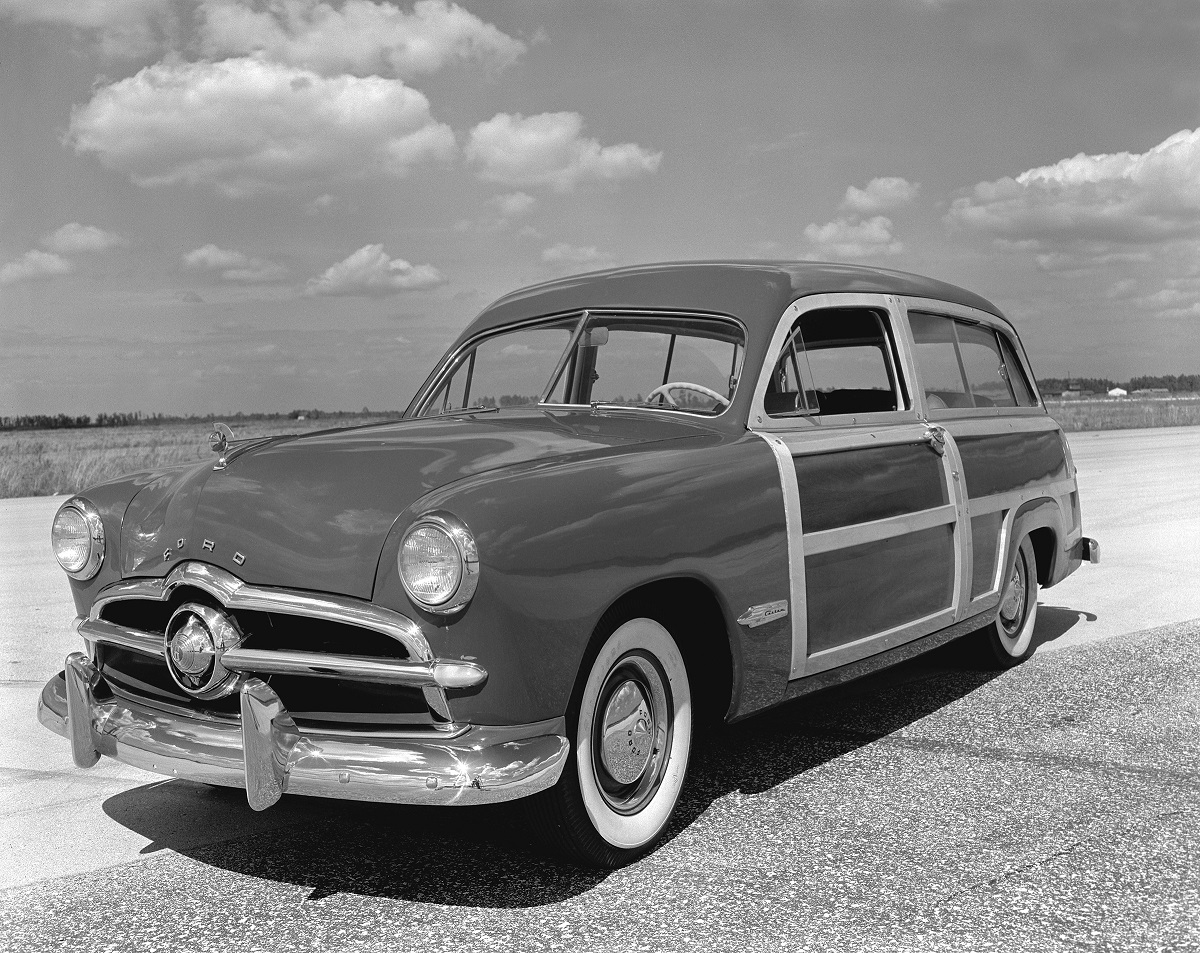
A 1949 Ford woodie wagon

New-for-1949 models came in coupe, sedan, and convertible body styles, with steel and woody wagon variations.


The “Shoebox” Design

According to Wikipedia, the ’49 Ford body style became known as “Shoebox Ford” for its slab-sided “ponton” design. But the 1949 Ford is credited with saving Ford and ushering in modern, streamlined car design with changes such as integrated fenders.

This design would continue through the 1951 model year, with an updated design offered in 1952. Frank L. Engle designed the crest.

A color photo of a 1949 Mercury convertible

The redesigned Mercury Eight for 1949 also debuted the “ponton” styling of the new Fords. The fresh styling was a sales success for both brands.

The redesigned Mercury Eight for 1949 also debuted the “ponton” styling of the new Fords. The fresh design ended the monotony of warmed-over pre-war style, which helped differentiate Mercury from its comparable Ford cousin, a trick that spelled sales success. Sales figures for both Ford and Mercury broke records in 1949.

See more photos and stories about classic cars here

2023 Nissan Pathfinder Platinum Review

2023 Nissan Pathfinder Platinum Review

The fifth-generation 2023 Nissan Pathfinder feels built for the long haul. Nothing about it seemed budget constrained or cheap. Many of its design features are helping hands for parents.

A side view of a red Nissan Pathfinder

The fifth-generation Nissan Pathfinder follows in the tracks of the nameplate’s first U.S. hardbody model from 1986. (Photos courtesy of NissanUSA or as credited)

Table of Contents

Pathfinder Through the Years
7 Cool Features
Oddities and Observations
What’s New for 2023?
2023 Nissan Pathfinder Pricing
How Is It To Drive?
Brakes, Steering, Suspension
Back Seats and Cargo Space
Why Buy the 2023 Nissan Pathfinder?
Specifications

BY MARK MAYNARD

The Nissan Pathfinder has traveled many paths since it debuted as a “hardbody” in 1986.

The first-generation Pathfinder was introduced for model year 1987 as a two-door body-on-frame SUV. Built on a ladder-type frame, Pathfinder shared styling and most components with the Nissan Hardbody pickup.

Pathfinder’s optional 4WD system was considered unique at the time because it could be engaged electronically — “shift on the fly” — while the vehicle was moving. All versions of Pathfinder were available in two-wheel drive or manually engaged 4WD configurations. Base models had modest power from a 106-horsepower, 2.4-liter four-cylinder engine or an optional 143-hp 3.0-liter V-6.

Nissan’s new SUV was in response to the growing competition: Chevrolet Blazer, Ford Bronco II, Jeep Cherokee, and import SUVs such as the Toyota 4Runner, Honda Passport, and the 1989 to 2004 Isuzu MU.

Today, there are more three-row SUV competitors than ever. Among the choices for 2023 are the Chevrolet Traverse, Honda Pilot, Hyundai Palisade, Jeep Grand Cherokee L, Kia Telluride, Mitsubishi Outlander, Toyota Highlander, and VW Atlas.

The front seat area of the 2023 nissanp pathfinder

A roomy driver area with headroom of 41.1 inches with the panoramic moonroof.

Pathfinder Through the Years

Nissan tended dutifully over the years to keep Pathfinder current and competitive. It was ahead of its time for some features, but not all variants endured the tests of owners.

It was October 1989 when Nissan debuted the four-door Pathfinder. Then, in late 1995, the second-generation Pathfinder was introduced with revised styling. There was another mild redesign in 2002.

A completely redesigned, third-generation Pathfinder debuted in late 2004 for the 2005 model year.

Model year 2013 brought a critical shift for the fourth-generation Pathfinder. The body-on-frame, truck-based SUV was replaced with a unibody design and sleek new (aerodynamic) exterior styling. It used the same platform as the Infiniti QX60, Altima, Maxima, Murano, and Quest minivan.

Nissan launched a short-lived gasoline-electric hybrid Pathfinder in 2014. Its powertrain was a supercharged 2.5-liter four-cylinder gasoline engine and an electric motor paired with a compact lithium-ion battery. The hybrid model, however, was a one-year-only offering. Owners complained they could not get gas mileage close to the advertised 25 to 28 mpg.

The fifth-generation Pathfinder was unveiled in early February 2021 as a 2022 model, skipping the 2021 model year.

Nissan brought back more emphasis on the current Pathfinder as a family adventure vehicle. The more squared-off styling — and what might be the best-looking rear end of any new SUV — ever-so-slightly goes back to the roots of Pathfinder.

There is an active forum for Pathfinder owners at PathfinderTalk.com. Owners — some of whom are lifelong Nissan faithful — post their problems, remedies, and praise.

the view from the third row of the pathfinder panoramic moonroof

The panoramic moonroof is standard on the Platinum.

7 Features Owners Will Value

Nissan engineers and designers sweat the small details and provide many enhancements and innovations. Some of these emerge only after time on the road.

Auto on-off LED headlights linked to windshield wiper use. In California and other states, it is the law to use headlights with wipers in the rain. With Nissan’s auto function, drivers will know they are always compliant.

Capacitive touch lock-unlock rear side doors. Such a simple convenience, but many others save some budget and omit that access to the rear side doors. Walking up to the back doors with an armful of kid or groceries, the driver gains quick access with a touch of the door handle. Too often, back-door entry requires first touching a front-door handle.

“Bridge” storage. Nissan makes the most of the front center console with a deep bin and “bridge” under-storage space. The pass-through bridge is also convenient for the passenger. Most other shift consoles are solid, which wastes the extra storage potential.

The pathfinder's 'bridge' storage in the lower center console

‘Bridge’ storage below and above the shift console, with a phone-audio e-bin.

Storage shelf above the glove compartment. The slim shelf will fit any generation iPhone, Nissan says. It is also mostly out of sight and sunshine.

2nd-row pushbutton seat release. Loading kids into the third row is so simple any kid can do it. The pushbutton release at the door-side seat base of the captain’s chair boosts the chair up and forward for third-row access.

the second row captain's chairs

The Captain’s Chairs package with removable center console.

54.1-liter luggage box. The undercargo floor storage compartment (1.9 cubic feet) has a hinged lid and dividers to separate the good-sized compartments. It’s part of the Cargo package, $345, and worth it.

10-way power passenger seat for Pathfinder SL and Platinum. Some imports don’t even provide height adjustment for the passenger — and nobody likes being low in the front seat.

6,000-pound towing capacity. Base models can pull a trailer up to 3,500 pounds, but the Rock Creek and Platinum models are uprated to a 3-ton capacity.

the understorage of the pathfinder

The underfloor storage box is made more functional with the section dividers from the optional Cargo package. (Mark Maynard photo)

 Oddities and Observations

Transmission unexpectedly went into Park while sitting at a stoplight. I don’t believe I bumped the electronic shifter’s Park button atop the shifter grip, yet the Pathfinder transmission went into Park at a stoplight near my home. I didn’t discover the issue until the light turned green. The problem never occurred again in my test week.

Tilt-down mirror confused. When engaging reverse, the passenger side mirror is supposed to tilt down to show the curb and then go back into position when Drive or Park are engaged. The tilt-down can work on either left or right-side mirrors. The driver must select the left or right mirror control on the door panel. I tried both sides, and each time, the side mirror tilted up, not down.

Slow response to infotainment screen. Making a selection on the infotainment screen would take a second or two to activate. Of course, I’d tap the selection again, thinking I’d missed the icon. Nope, it’s just slow.

No wireless Android Auto. While Apple CarPlay has wireless connectivity, Android users must use the access cable.

ProPILOT Assist vagueness. This Level 2 driver-assist system was once at the vanguard of semi-autonomous driving. But the advanced technologies that go into Level 2 have been honed by others to be more accurate, especially in lane centering. In my experience, the system allowed the Pathfinder to drift wide in cornering, crossing the white lines, and then giving me an alert. It also seemed the Pathfinder was closer to the lane marking on the right than the left. Still, ProPILOT is welcome backup in heavy commuting, but  keep both hands on the wheel.

The pathfinder has an around view camera system

The Intelligent Around View Monitor with Moving Object Detection.

What’s New for 2023 Pathfinder?

Nissan brought back the off-roading ready Pathfinder Rock Creek for 2023. Among its adventuring credentials are standard Intelligent 4WD, an off-road-tuned suspension, and a 5/8-inch suspension lift.

Using premium fuel gives the 3.5-liter V-6 engine a power boost of 11 horsepower and 11 foot pounds of torque. A Nissan spokesman explained that the bump in power for Pathfinder Rock Creek is by engine software programming to take advantage of the extra octane in premium fuel. “The engine computer senses the extra octane and adjusts accordingly. The other Pathfinder models don’t get this programming, so they won’t get a horsepower boost like the Rock Creek.”

I suggested that Nissan consider adding that engine-software programming as an option. How much would you pay for 11 more hp?

Other Rock Creek upgrades include:

  • 18-inch beadlock-style wheels with all-terrain tires;
  • Tubular roof rack with a 220-pound capacity;
  • Tow hitch receiver and harness with 6,000-pound maximum towing capability;
  • LED fog lights;
  • Intelligent Around View Monitor with Off-Road Mode. A front-view camera shows the terrain ahead, with a side view, all of which help driver’s place the tires where there is solid ground;
  • Orange interior stitching and second-row captain’s chairs.
  • Rock Creek pricing starts at $44,355.

The 12-inch digital 'dashboard' gauge array

The 12-inch digital dashboard.

Other 2023 Pathfinder Upgrades

  1. The upper-range SL trim levels now have a standard wireless phone charging pad;
  2. Pathfinder Platinum has a new captain’s chairs package, which adds a removable console between the second-row chairs. And it can be easily removed if needed for step-through access to the third row.
  3. 10-way power passenger seat for Pathfinder SL and Platinum. Hooray. Not all Japanese makes provide such adjustability for the front passenger.

The pathfinder third row

Third-row seating is kid class, but access is easy with pushbutton release of the second row.

2023 Nissan Pathfinder Pricing

There are five trim levels for the 2023 Nissan Pathfinder in front- or four-wheel drive. All trims have a 284-hp, 3.5-liter V-6 and a nine-speed automatic transmission. Starting prices below include the $1,335 freight charge from Smyrna, Tenn.

Pathfinder S: $36,535 2WD, $38,435 4WD (add $1,900 for 4WD)

Key S trim features include:

  • Nissan Safety Shield 360, driver-assist system;
  • Tri-zone automatic temperature control;
  • Apple CarPlay connectivity;
  • EZ FLEX seating system featuring Latch And Glide and 3rd-row 60/40-split fold-flat reclining bench seat.

Pathfinder SV: $39,355 2WD, $41,255 4WD

Key SV features include:

  • Heated front seats;
  • ProPILOT driver-assist system;
  • Intelligent Lane Intervention;
  • Intelligent Blind Spot Intervention;
  • 10-way power driver’s seat with 2-way power lumbar;
  • Remote Engine Start System with Intelligent Climate Control.

Pathfinder SL: $44,855

Key SL features include:

  • Four-wheel drive;
  • Leather-trimmed seats in first and second rows;
  • NissanConnect 9-inch color infotainment touch-screen display;
  • Intelligent Around View Monitor;
  • Wireless Apple CarPlay integration;
  • Wireless charger;
  • ProPILOT Assist with Navi-link.

Pathfinder Platinum: $49,505 2WD, $51,405 4WD

Key Platinum features include:

  • 20-inch aluminum-alloy wheels;
  • Heated and ventilated front seats;
  • Panoramic moonroof;
  • Head-up windshield display;
  • Bose premium audio system with 13 speakers, including dual woofers;
  • Tow-hitch receiver with 4-pin wiring harness.

Check here for current pricing and special offers.

The Pathfinder Platinum tester was $55,035 with seven options, including special paint for $790 and $550 for the Captain’s Chairs package, with the removable center console. But the most impressive (usable) option to me is the Cargo package, $345. Among its assets are heavy-duty rubber cargo floor and seatback protectors.

All of the tester’s options and pricing are in the specifications chart below.

Safety Features and Technologies

Every Pathfinder has the Nissan Safety Shield 360. This collection of technologies includes Automatic Emergency Braking with Pedestrian Detection, Blind Spot Warning, Rear Cross Traffic Alert, Lane Departure Warning, High Beam Assist, and Rear Automatic Braking.

And all versions of Pathfinder have 10 air bags, but there is an added driver-seat front-center bag on the Platinum.

Other safety features are in the specs chart below.

Dial-up performance modes from Sand to Sport.

Dial-up performance modes from Sand to Sport.

How Is It To Drive?

The 2023 Nissan Pathfinder feels big and wide, though it has about the same size footprint as its competition. Nissan gave Pathfinder all the power and suspension elements to be driver-engaging, but the result is more fundamental than fun-demental. Most users wouldn’t pile in the family and head out to tear up some back roads.

The turning circle with 20-inch tires is a manageable 38.7 feet, with driver assists from the around-view camera when parking.

The sole powertrain is a 284-hp, direct-injected 3.5-liter V-6 with a nine-speed automatic. Hallelujah, Nissan ditched the continuously variable automatic for this nine-speed, and few will be looking back. Shift points are well-timed but sluggish to downshift when going up hills. Overall acceleration, however, was quick enough that I didn’t feel the need to engage Sport mode. (However, I do use Sport when plugging along in the heavy commute. The quicker Sport kick is helpful to ward off those cretins who try to dive into the too-small space between you and the car ahead.)

With 259 foot-pounds of torque at 4,800 rpm, there is adequate force to handle the Pathfinder Platinum’s 4,625 pounds, not including occupants.

Fuel economy estimates of 20 mpg city and 25 mpg highway might be hopeful; 87 octane is recommended for all models but Rock Creek. Around town in my week of driving, my average fuel economy hovered between 11 to 16 mpg. I worked up to 22 mpg on more extended highway driving, meeting the EPA estimate.

The pathfinder's v6 engine

The 284-hp 3.5-liter V-6 for all Pathfinder trim levels.

Braking, Steering, Suspension

Pathfinder’s foundation feels robust and substantial, essential for towing and adventuring off the highway. The ride quality is comfortable but gives an unexpected sport-tuned jolt over rough road. Inputs to steering and braking are refined and steady.

But there is noticeable ambient cabin noise at highway speeds, which I attributed to the prominent roof rail cross bars.

The 6,000-pound towing capacity for Platinum and Rock Creek requires the Class III receiver hitch, the seven-pin connector for trailer braking, and the factory-installed transmission oil cooler. The upgrade is part of the Premium Package on the SV and SL models. The SV Premium Package is $2,170, and the SL Premium Package is $2,990.

Braking: Four-wheel disc brakes have vented rotors front and rear with 13.8-inch rotors front and 13-inch rotors rear.

Steering: electric power assist with vehicle-speed assist,

Suspension: four-wheel independent with front struts and rear multi-link setup; solid stabilizer bar front, hollow rear. Twin tube, dual-flow path shock absorbers;

Tires-Wheels: 255/50 20-inch all-season tires on machined aluminum-alloy wheels with a dark metallic gray finish. A temporary spare stows underbody at the cargo area;

The Pathfinder Platinum is well dressed in 20-inch all-season tires on machined aluminum-alloy wheels with a dark metallic gray finish.

The Pathfinder Platinum is well dressed in 20-inch all-season tires on aluminum-alloy wheels.

Back Seats and Cargo Space

Raised back seat height in the Pathfinder is very kid friendly for open views and helpful to ward off motion

electronic back seat ac and vent controls

Electronic climate controls for the second row.

queasiness. Also beneficial are ceiling vents just above each side window, with reading lights. There also is a lot of seatback recline, another parenting asset for sleeping youngsters.

A flat floor in the second and third rows is the great enabler for comfortable foot space, uncompromised by a transmission tunnel. Adult legroom in the second row is functional at 35.5 inches, which can be stretched a bit with a few inches of fore-aft slide.

And there is plenty of big-bottle space in the door panels.

a pair of chilld seats in the second row

Captain kids’ chairs.

Parents will appreciate the pushbutton spring release to slide forward the second-row seat for third-row access. And there’s a one-arm push to lock down the seat. As with most midsize, three-row SUVs, the way back is best for small children.

Cargo capacity ranges from grocery bag and gym bag space behind the third row (16.6 cubic feet) to family vacation capacity of 45 cu.ft. with the third row folded.

The liftgate opening is 49 inches wide, or 4 feet, 1 inch. With both rows folded, there is about 6 ½ feet in length for a wide bay of 80.5 cu.ft. Other cargo area features include two grocery bag hooks, four tie downs, lighting, and a 12-volt plug.

Cargo space behind the third row is 16.6 cubic feet

Check out the heavy-duty rubber cargo mat and seatback protector, both are part of the $345 Cargo package, and worth it. (Mark Maynard photos)

Both rows of seats are folded for big and open cargo space

Fold both back seats for 6 ½ feet-plus in length.

Why Buy the 2023 Nissan Pathfinder?

The fifth-generation Nissan Pathfinder feels built for the long haul. Nothing about it seemed budget constrained or cheap. Many of its design features were helping hands for parents, at least for those who resist the “M” word for minivan. And the details of Nissan’s design and engineering will bring years of “Gee, I like that little extra.”

Pathfinder’s next midcycle freshening is planned for 2025, so there are long legs for the current model. But shop wisely for the most value.

The Platinum model has an appreciable load of standard features. However, you can step down a grade to the Pathfinder SL and add options that mimic the Platinum for a sticker of $48,190. I prefer a monotone paint scheme, saving $790. And to save another $395, stay away from optional paint colors, such as Scarlet Ember Tintcoat (a gorgeous red) or Pearl White TriCoat, for $395 each. Then save another $390 if you won’t use the (wind-noise generating) roof rail cross bars.

Add it up, and the Pathfinder SL 4WD, with leather-trimmed upholstery, saves nearly $7,000 over the Platinum. And that savings will buy a lot of gas for a driving vacation.

The good look rear end of the new pathfinder

Starting prices for the 2023 Nissan Pathfinder range from $36,535 to $50,000.

2023 Nissan Pathfinder Platinum Specifications

Body style: large-midsize, 3-row, 7-seat SUV with 4WD

Engine: 284-hp, naturally aspirated and direct-injection 3.5-liter V-6; 259 lb.-ft. torque at 4,800 rpm

Transmission: 9-speed automatic with manual shift mode paddle shifters, and electronic shift-by-wire drive selector; Intelligent 4WD with 7-position Drive and Terrain Mode

Fuel economy: 20/25/22 mpg city/hwy/combined; 87 octane

Tow capacity: up to 6,000 pounds; class III tow hitch with harness and 4-pin prewiring; trailer-sway control

BY THE NUMBERS

Fuel tank: 18.5 gallons

Cargo space: 16.6 cubic feet behind 3rd row; 45 cu.ft. 3rd row folded; 80.5 with both rows folded

Front head/leg room: 41.1*/44.3 inches *42.3 inches w/o moonroof

2nd-row head/leg room: 39.6/35.5 inches

3rd-row head/leg room: 37.8/28 inches

Length/wheelbase: 197.7/114.2 inches

Curb weight: 4,625 pounds

Turning circle: 38.7 feet

FEATURES

Standard equipment includes: Nissan Intelligent Key with push-button ignition, Intelligent cruise control, panoramic moonroof (with one-touch power tilt-sliding glass with shade), tri-zone climate control, wireless phone charging pad, 12.3-inch gauge display, head-up driver windshield display, 9-inch color navigation-infotainment touch display, 13-speaker Bose premium audio system with subwoofer, 10-way power adjusted front seats, heated and ventilated front seats, sun visors with extenders and vanity mirrors, heated 2nd-row window seats, quilted semi-aniline leather-trimmed upholstery in first and second rows, power tilt-telescopic steering column, two-driver memory presets, automatic LED headlights (high and low beams), LED running lights and fog lights, body-color power-folding and heated side mirrors with reverse tilt-down, privacy glass (rear-side windows and liftgate window), silver-finish roof rails, motion-activated power liftgate, 2 12-volt DC power outlets (1 front console, 1 in cargo area);

Safety features include: 11 air bags (including for Platinum, a driver seat-mounted front-center bag), dynamic traction control, hill-start assist with hill-hold control and hill-descent control, brake-force distribution, brake assist, 4-wheel ABS; LED side mirror-mounted turn signals;

Driver-assist technologies include: ProPILOT Assist semi-autonomous driver assist with Navi-link, blind-spot warning and blind-spot intervention, rear cross-traffic alert, automatic emergency braking with pedestrian detection, automatic rear braking, Intelligent forward-collision warning, Intelligent lane intervention.

PRICING

Base Platinum MSRP: $51,405, including $1,335 freight charge; price as tested $55,035

Options on test vehicle: Two-tone paint $790; captain chair’s package $550; roof-rail crossbars $390; LED fog lights $345; lighting package (without running boards $945; carpeted floor mats with captain’s chairs (4-piece set) $265; cargo package $345

Where assembled: Smyrna, Tenn.

Warranties: 3-years/36,000-miles bumper to bumper with 24/7 roadside assistance; 5-years/60,000-miles powertrain

Toyota Corolla Cross Hybrid First Drive

Toyota Corolla Cross Hybrid First Drive

The subcompact 2023 Corolla Cross Hybrid racks up 45 mpg in town, 38 on the highway, and 42 mpg combined — with standard all-wheel drive

A gold-colored Toyota Corolla Cross Hybrid horizonal view

The new 2023 Toyota Corolla Cross Hybrid has fuel economy estimates of 45 mpg city, 38 highway, and 42 mpg combined. Pricing starts at $30,000, including automatic all-wheel drive. (Photos courtesy of ToyotaUSA)

Table of Contents

Notes from the Test Drive
Interior Function
The Hybrid Powertrain
Pricing
Standard Features By Trim
Warranty Coverage
Safety Technologies
Suspension, Steering, Brakes
Specifications

BY MARK MAYNARD

Toyota’s Corolla Cross is a likable small SUV — and it’s even more likable now that it is available in a gasoline-electric hybrid model. The hybrid model joins the front-wheel-drive, gas-engine Corolla Cross, which went on sale last year.

If there ever was a no-brainer choice for a first-time small ute buyer, the Corolla Cross is it. Its functional body style reminds of a mini-me RAV4, which has grown significantly in size and price. And it is a serious fuel miser with EPA estimated ratings of 45/38/42 mpg city, highway, and combined.

Toyota was in the Carlsbad, Calif., area of San Diego County for the first U.S. journalist drives of the 2023 Corolla Cross Hybrid. Journalists had drive time in the three trim levels of the Corolla Cross Hybrid.

Experiencing the range of trim levels with standard all-wheel drive gave me a good first-drive overview. Based on my first taste of the Corolla Cross Hybrid, I’d like to explore it more on an at-home evaluation for a proper review.

The driver area of the Corolla Cross

Entry-level models have an 8-inch touchscreen and smart key access.

Notes From the Test Drive

Toyota calls the Corolla Cross Hybrid’s exterior styling “approachable” with a higher line-of-sight. The sturdy stance disguises the upright interior, with open sightlines across the hood and over the shoulder.

Unique front and rear styling and optional two-tone paint choices visually separate the gas and hybrid models.

Standard all-wheel drive seems unusual, but after the wicked weather this winter and spring, the automatic AWD system could be a lifesaver and high on a buyer’s wish list of features.

Of the three trim levels, the base Corolla Cross Hybrid S is ideal for buyers who can live without a moonroof, power liftgate, two-tone paint, adaptive (turning) headlights, or a potent JBL audio system. The only factory choice is for special paint, a $425 cost.

Among the standard features are two USB-C charge ports and a multimedia audio system. It has all the connectivity features, including wireless Apple CarPlay and Android Auto. The multimedia system also allows over-the-air updates.

The driver seat has six-way manual adjustment and four-way for the front passenger.

I was more comfortable in the fabric-trimmed seats of the S rather than the sportier fabric seats in the SE. But the Softex-trimmed (synthetic leather) upholstery in the XSE adds heated front seats and a power driver’s seat.

The view from the open front passenger door showing the upholstery and dashboard

Cabin materials show Toyota’s newfound attention to using more refined materials and textures.

The Corolla Cross Hybrid Powertrain

Both models of Corolla Cross have a 2.0-liter Dynamic Force four-cylinder engine and an electronic continuously controlled automatic transmission.

Powertrain similarities end there, however.

The gas Corolla Cross has 169 horsepower with front-drive fuel-economy ratings of 31/33/32 mpg city/highway/combined and 29/32/30 AWD.

Performance from the Corolla Cross Hybrid jumps to 169 hp, which Toyota says makes it capable of launching to 60 mph in 8 seconds. If only its 10.6-gallon tank were larger to stretch the time between fill-ups, but placing the hybrid battery under the back seat took up the space. Still, the range is good at around 450 miles.

The open hood showing the engine

169-hp from the combined power of the engine and hybrid system.

Interior Function

The interior is not flamboyantly designed but has all the right toughness where it is needed. The materials show Toyota’s newfound attention to using more refined materials and textures.

Smart packaging of the Corolla Cross provides tall front headroom and back-seat space for a young family. Back-seat legroom, however, is grade-schooler-tight at 32 inches. Cargo space has square dimensions for friends-helping-friends move into the new condo.

The CVT shifter in the Corolla Cross

The e-CVT with Sport mode and hill-start assist.

Toyota Corolla Cross Hybrid Pricing

Expect the 2023 Toyota Corolla Cross Hybrid in dealerships this June. It is offered in S, XSE, and XSE trim levels. Starting prices by trim level:

S $29,065;

SE $29,290;

XSE $32,160.

Manufacturer Suggested Retail Pricing includes the $1,095 freight charge from the new Mazda Toyota Manufacturing plant in Huntsville, Ala.

Check here for current pricing and special offers.

An LED headlight of the Corolla Cross

LED headlights are standard on the Corolla Cross Hybrid S and SE models. Adaptive (turning) headlights are a $615 option for the XSE.

Standard Features By Trim Level

The S and SE trim levels have 17-inch alloy wheels, an 8-inch touchscreen, sport-tuned suspension, LED headlamps, and smart key access. The only factory option for the S is optional paint colors, which cost $425.

Moving up to the SE Corolla Cross Hybrid adds privacy glass, roof rails, and paddle shifters. A blind-spot monitor and rear cross-traffic alert add to the standard roster of safety features (highlighted below).

The top-line XSE is the sportiest offering, with such extras as:

  • 18-inch alloy wheels;
  • LED headlamps, taillamps, and fog lamps;
  • Softex-trimmed (synthetic leather) upholstery with heated front seats and a power driver’s seat.

An 18 inch alloy on the topline XSE model.

The XSE has 18-inch alloy wheels with a black-painted machined finish and 225/55 all-season tires.

Warranty Coverage

Toyota’s basic new-vehicle warranty coverage covers 3 years or 36,000 miles bumper to bumper and 5 years or 60,000 miles for the powertrain.

Hybrid-related components that require repairs to correct defects in materials or workmanship are covered for 8 years or 100,000 miles, whichever comes first from the original date of first use when sold as new.

The hybrid battery is covered for 10 years or 150,000 miles, whichever comes first, and is transferable across ownership.

The warranty package includes ToyotaCare, covering factory-scheduled maintenance for two years or 25,000 miles with 2 years of roadside assistance.

Paint Color Choices

The SE and XSE levels of the Corolla Cross Hybrid have special two-tone combinations, $500 each:

  • Sonic Silver with a black roof;
  • Barcelona Red with a black roof;
  • Blue Crush Metallic and black roof, and;
  • Acidic Blast (gold) and black roof. Acidic Blast is a new color.

Standard monochromatic paint colors include:

  • Jet Black Mica;
  • Cypress (forest green);
  • Celestite (sky blue);
  • Wind Chill Pearl (off-white; $425 extra)

a view of the back seat through an open side door

Back-seat legroom is grade-schooler tight at 32 inches.

 Corolla Cross Safety Technologies

Including nine air bags, the Corolla Cross Hybrid has substantial standard safety features, anchored by Toyota Safety Sense 3.0. Among the advanced technologies are:

PCS w/PD — Pre-Collision System with Pedestrian Detection;

DRCC — Dynamic Radar Cruise Control;

LDA w/SA — Lane Departure Alert with Steering Assist;

LTA — Lane Tracing Assist;

LCA — Lane Change Assist;

FCT — Front Cross Traffic Alert;

RSA — Road Sign Assist.

Star Safety System includes:

VSC — Enhanced Vehicle Stability Control;

TRAC — Traction Control;

ABS — Anti-lock Brake System;

EBD — Electronic Brake-force Distribution;

BA — Brake Assist;

SST — Smart Stop Technology;

AHB — Automatic High Beams;

PDA — Proactive Driving Assist.

A rear view of a gold colored Corolla Cross Hybrid

The Corolla Cross Hybrid model has unique front and rear styling, and optional two-tone paint choices, $500 each. AcidicBlast paint color is shown.

Suspension, Steering, Brakes

Suspension: Four-wheel independent with front sport-tuned MacPherson struts with stabilizer bar, coil springs, and hydraulic shock absorbers; Rear, sport-tuned double-wishbone multi-link rear with coil springs, trailing arms, stabilizer bar and hydraulic shock absorbers;

Steering: Electric power-assisted rack-and-pinion;

Brakes: Front ventilated 12-inch diameter rotors; rear solid 11.1-inch rotors.

Wheels and Tires

S and SE: 17-inch silver-colored alloy wheels with 215/65 all-season tire;

XSE: 18-inch alloy wheels with black-painted machined finish with 225/55R all-season tires;

There is a tire-inflation system, no spare tire.

Curb weights

S — 3,395 pounds;

SE — 3,385 pounds;

XSE — 3,430 pounds.

A view of the open cargo area with the tailgate raised

Cargo space of 40.3 cu.ft. behind the back seat. All-weather floor liners (three) are a $179 accessory.

The open cargo space with the back seat folded

Fold the back seat and load it up for friends-helping-friends move into the new condo.

2023 Toyota Corolla Cross Hybrid Specifications

Body style: All-wheel-drive 5-seat, 5-door small SUV

Engine: 150-hp 2.0-liter with direct- and multiport injection; 139 lb.-ft. torque at 4,400 rpm

Transmission: E-CVT with electronic on-demand AWD

Fuel economy: 45/38/42 mpg; 87 octane or higher recommended

Max towing capacity: 1,500 pounds

0-60 mph acceleration: 8 seconds, per Toyota

COROLLA CROSS HYBRID SYSTEM

Electric motor: permanent magnet synchronous; 152 lb.-ft. torque

Battery: 222-volt lithium-ion; 4.08 Ahr

System voltage: DC600V

Combined system power: 196 hp

BY THE NUMBERS

Fuel tank: 10.6 gallons

Cargo space: 40.3 to 61.8 cubic feet

Front head/leg room: 39.5 inches*/42.9 inches

Rear head/leg room: 39.1/32 inches

Length/wheelbase: 176.8/103.9 inches

Turning circle: 35.4 feet

PRICING

Base prices, including the $1,095 freight charge:

S $29,065;

SE $29,290;

XSE $32,160

Where assembled: Huntsville, Ala.

Warranties: 3-years/36,000-miles bumper to bumper; 5-years/60,000-miles powertrain; hybrid components are covered for 8 years or 100,000 miles, and the hybrid battery is covered for 10 years or 150,000 miles.

Included in the warranty package is ToyotaCare, covering factory-scheduled maintenance for two years or 25,000 miles, with 2 years of roadside assistance.

2023 Toyota Prius Prime First Drive

2023 Toyota Prius Prime First Drive

Re-engineered and stylishly redesigned, the 2023 Toyota Prius Prime plug-in hybrid has more power and up to 44 miles of battery-only driving. But it is also much more expensive.

A Supersonic Red Prius Prime

The redesigned 2023 Toyota Prius Prime is more powerful, with up to 44 miles of battery-electric driving. (Photos courtesy of ToyotaUSA)

Table of Contents

3 Cool Features
‘Sexy’ New Body Style
The Refined Interior
Plug-in Hybrid Powertrain
Charging at Home
Can You Name These Safety Abbreviations
2023 Prius Prime Pricing
Standard Features By Trim Level
Specifications

BY MARK MAYNARD

Owners of the previous-generation Toyota Prius Prime will not be happy if, just for the heck of it, they test drive a 2023 Prime model, a plug-in hybrid. Comparing the old model with the completely redesigned and re-engineered 2023 Prius Prime is like comparing a canoe with a streamliner.

Improvements in power, ride quality, and interior accommodations are near-luxury in a more rewarding presentation. And now, with a larger electric-drive motor and a larger four-cylinder engine, the battery driving range was improved to 39 to 44 miles, from 25 miles in the previous model.

Built on the second-generation TNGA-C platform, the 2023 Prius Prime has a lower center of gravity, reduced weight, and increased body rigidity compared to the previous generation. Toyota says the position of the hybrid traction battery was also moved to under the rear seat, yielding a lower center of gravity and a little more trunk space.

Toyota was recently in the Carlsbad, Calif., area of San Diego County for the first U.S. journalist drives of the 2023 Prius Prime PHEV and Corolla Cross Hybrid. Journalists had drive time along short routes in various trim levels of both vehicles. Soon, I will have more time for a proper review, but my time in the vehicles gave a good first-drive overview.

A leather-trimmed heated steering wheel in the entry SE model.

A leather-trimmed heated steering wheel in the entry SE model.

3 Cool Features

Traffic Jam Assist: For those on the daily commute of heavy traffic, Traffic Jam Assist can help take some of the stress from low-speed, stop-and-go driving. Here’s how it works: While driving on a highway with Dynamic Radar Cruise Control and Lane-Trace Assist activated, system sensors will detect when traffic is slowing. If operating conditions are OK, the assist system will provide acceleration, braking, and hands-free steering control under the active supervision of the driver. This system will only operate at speeds lower than 25 mph. The driver monitoring camera also must confirm the driver has their eyes on the road to allow for hands-free operation. The driver will get a prompt to resume control when traffic clears, or the speed drops below 25 mph.

Solar Roof: The 185-watt solar roof option ($640) can charge the drive battery incrementally while parked. Solar charging also supplies power to auxiliary functions while driving. Information about power generation is shown in the vehicle’s multi-information display.

Predictive Efficient Drive with Predictive Deceleration Support: This all-seeing system optimizes range by observing the driver’s stopping patterns on frequently driven routes. The system will then suggest when to let off the accelerator. Predictive Efficient Drive is a standard feature on all trim levels, but it requires a subscription for cloud navigation. The XSE Premium gets one free year of service, but the lower trim levels require an additional Drive Connect subscription.

XSE Premium 12.3-inch Touchscreen and JBL Premium Audio.

XSE Premium 12.3-inch Touchscreen and JBL Premium Audio.

‘Sexy’ New Body Style

The new Prius Prime builds upon the foundation of the standard five-seat and front-wheel-drive gasoline-electric hybrid Prius sedan. The body is 2 inches lower, an inch wider, and an inch longer than the previous generation. The smooth, aerodynamic shape has a “hammerhead nose,” lower roofline, and widened rear.

Wheel sizes are also vital to efficient performance. The entry SE model has 17-inch wheels, which Toyota says yields 44 miles of battery-electric driving. Moving up to the Prius Prime XSE trim levels adds 19-inch wheels but drops the battery driving range to 39 miles.

Curb weights are up by about 100 to 200 pounds vs. the 2022 model, which affected fuel-economy ratings, too. The 2022 Prius Prime has mileage ratings of 55/53/54 mpg city, highway, and combined. Those estimates compare to the 2023 Prius Prime at 53/51/52 mpg city/highway/combined for the base model to 50/47/48 mpg for the mid and top-line models.

The previous Prius Prime also has a farther total driving range of 640 miles compared to 550 to 600 miles for the new model.

Despite the Prime’s sleek shape (Toyota calls it “sexy”), its drag coefficient is a couple of hundredths less efficient: 0.27 vs. 0.25 for the outgoing model.

SofTex-trimmed heated and ventilated front seats in the XSE Premium.

SofTex-trimmed heated and ventilated front seats in the XSE Premium.

The Refined Prime Interior

Subtle elements of red and red ambient lighting enhance higher-quality materials in the cabin. The wider cabin benefits shoulder room by just over 1 inch and legroom stay the same at 43.2 inches. But the lower roofline trims the front headroom by 1.4 inches, which is notable in the cabin.

The driver position still has the same gauge-viewing complexity as the Prius hybrid. The more extended steering column and smallish gauge array with many details seem far away for easy viewing. However, there is a functional workaround with attention to seatback angle and steering-wheel height.

Back-seat space took a more significant trim of headroom, losing nearly three-quarters of an inch (now at 38 inches). Rear legroom grew by a noticeable 1.4 inches. With the lower headroom, however, the back seat is no place for large adults.

Trunk space increased, but by less than a cubic foot. But the wide and flat cargo capacity is very usable and expandable by the folding back seat for up to 26.7 cu. ft.

The back seat space is tight in the Prius Prime

Back seat headroom and legroom are snug at 36.4 and 34.8 inches, respectively.

Plug-in Hybrid Powertrain

Toyota’s fifth-generation hybrid powertrain pairs the M20A-FXS 2.0-liter four-cylinder Atkinson-cycle gas engine with two motor generators (MG1 and MG2). The transmission is a planetary-type E-CVT, continuously variable automatic.

The engine works with the electric motor MG2 to drive the front wheels and to boost performance as needed. Both motors work to charge the lithium-ion battery.

Combined power from the gas engine (150 horsepower) and electric motors is 220 hp. When driving in Hybrid Mode, Toyota cites an estimated 0-60 acceleration in 6.6 seconds — compared to 10.2 seconds for the outgoing model.

More powertrain details are in the specifications chart below.

An open hood view of the prime engine and electrification elements

Toyota’s fifth-generation hybrid powertrain pairs the 2.0-liter four-cylinder gas engine with two motor generators (MG1 and MG2) through a continuously variable transmission.

Finessing the Power

The Prius Prime has three drive modes that allow drivers to finesse battery reserves or power: EV Mode, HV/EV Auto Mode, and Hybrid Mode.

EV Auto Mode — relies on the battery for driving around town.

HV/EV Auto Mode — the engine will engage where it is more efficient, such as up steep hills or at higher speeds.

Hybrid Mode —automatically switches between the gasoline engine and the electric motor.

There also are selectable performance modes of Eco, Normal, and Sport.

the open charge door of the Prime

It will take about 11 hours to recharge the Prius Prime using a household outlet or four hours with a 240-volt Level 2 charger.

Charging at Home

There is no special equipment needed for home charging. The Prius Prime comes with a charging cable, but an optional 240-volt charging system will be quicker to recharge.

The battery will recharge on a standard 120-volt home outlet in about 11 hours. (Toyota recommends using a dedicated GFI 15-amp outlet). Charging with a 240-volt, Level 2 charger will take about 4 hours.

Can You Name The Safety Abbreviations?

Prius Prime’s standard safety features and technologies include eight air bags and:

TJA — Traffic Jam Assist;

SEA — Safe Exit Assist.

Toyota Safety Sense 3.0 includes:

PCS w/PD — Pre-Collision System with Pedestrian Detection;

DRCC — Dynamic Radar Cruise Control;

LDA w/SA — Lane Departure Alert with Steering Assist;

LTA — Lane Tracing Assist;

LCA — Lane Change Assist;

FCT — Front Cross Traffic Alert;

RSA — Road Sign Assist.

Star Safety System includes:

VSC — Enhanced Vehicle Stability Control;

TRAC — Traction Control;

ABS — Anti-lock Brake System;

EBD — Electronic Brake-force Distribution;

BA — Brake Assist;

SST — Smart Stop Technology;

AHB — Automatic High Beams;

PDA — Proactive Driving Assist.

19-inch Michelin Primacy all-season tires on the XSE model.

19-inch Michelin Primacy all-season tires on the XSE model.

Ride and Handling

Improvements to the suspension, steering, and braking will make an immediate impression — and not just for owners of the prior-gen Prime.

There is complete smoothness to pedal response in regenerative braking, rather than a stop-start, on-off action. And the damping effect of the suspension has an almost-sporty feel. The steel-spring suspension eliminates the jounce and heavy feel of hefting a 3,500-pound small car. The hybrid battery weighs 284 pounds — just 19 pounds heavier — or 287 pounds with the solar roof.

Electric-assist steering has some actual road feel, and the sturdy, three-spoke wheel glides through the hands. Turning circles, however, are wider by a foot, now at 34.4 for the SE and 35.4 feet for the XSE.

More hardware stats are in the specs box below.

Seats folded in the Prime cargo hold

Trunk space is wide, flat, and expandable by the folding back seat for up to 26.7 cu. ft.

A view of the rear cargo compartment

2023 Toyota Prius Prime Pricing

The redesigned 2023 Toyota Prius Prime is expected in dealerships next month, May 2023.

As before, there are three trim levels, renamed SE, XSE, and XSE Premium. And MSRPs are significantly higher than the outgoing model — by $3,580 for the SE, $5,050 for the XSE, and $4,620 for the XSE Premium.

2023 Prius Prime Manufacturer’s Suggested Retail Prices:

SE $33,445;
XSE $36,695;
XSE Premium $40,265.

Retail prices include the $1,095 freight charge from the Tsutsumi Plant, in Aichi, Japan.

Check here for updated Prius Prime pricing and special offers.

For comparison, the Toyota 2023 Prius hybrid has starting prices across six trim levels in front- or all-wheel drive that range from $28,545 to $36,960.

2023 Prius Prime paint colors:

  • Cutting Edge (light gray)
  • Guardian Gray
  • Midnight Black Metallic
  • Reservoir Blue
  • Wind Chill Pearl (white; $425 premium)
  • Supersonic Red ($425 premium)

The clever side slot for phone charging on the center console.

The clever side slot for phone charging on the center console.

Standard Features By Trim Level

SE equipment includes:

Dark gray 17-inch alloy wheels with wheel covers;

8-inch Toyota Audio Multimedia touchscreen;

6-way adjustable fabric front seats in black with red trim;

6 USB-c ports;

Electric parking brake;

Leather-trimmed heated steering wheel;

8 air bags and blind spot monitor with rear cross-traffic alert

Optional features include front and rear parking assist with automatic braking.

XSE equipment builds on SE features and includes:

Machine-finished 19-inch alloy wheels;

8-way adjustable heated power driver’s SofTex-trimmed seat. Black upholstery has red trim;

Smart key entry and push-button ignition;

Wireless phone charger;

Front and rear parking assist with automatic braking;

Available options include a 12.3-inch high-resolution touchscreen display, fixed glass roof, and Digital Key.

The XSE Premium layers onto the SE and XSE features, adding:

8-speaker, JBL Premium audio system;

12.3-inch touchscreen display;

The new Prius Prime has an optional solar roof for $640. This image shows a corner of the solar roof title

The 185-watt solar roof option ($640) for the XSE Premium can charge the drive battery while parked. The solar charger also supplies power to auxiliary functions while driving.

Fixed glass roof;

SofTex-trimmed heated and ventilated front seats;

Power rear liftback;

Digital Key.

Available options include a Panoramic View Monitor, Digital Rearview Mirror, heated rear seats, and Advanced Park. The parking system helps the driver steer into a parking space, whether parallel or backing into a perpendicular space. A combination of cameras and sensors recognizes the vehicle’s surroundings.

A rear view of a Supersonic Red Prius Prime

The more polished and stylish 2023 Prius Prime has improvements in power, ride quality, and interior accommodations

2023 Toyota Prius Prime Specifications

Body style: compact, 5-seat, 5-door, front-wheel-drive plug-in hybrid sedan

Engine: 150-hp, Atkinson-cycle, 16-valve VVT-I 2.0-liter 4-cylinder; 139 lb.-ft. torque

Motor Generator 2: Drives front wheels, regeneration during braking: Permanent Magnet AC Synchronous, 160-hp, 120 kW

Combined system power: 220 hp

Transmission: E-CVT

Plug-in hybrid battery pack: 13.6 kWh (51 Ahr) lithium-ion

Battery weight: 284 pounds (287 with solar roof)

Onboard charger capacity: 3.5 kW

Charge times: Approximately 4 hours on 240 volts; 11 hours on 120 volt

Emission certification: SULEV30 with Transitional Zero Emission Vehicle (TZEV)

MILEAGE AND DRIVING RANGE

EPA estimated fuel economy ratings; 87 octane recommended:

SE — 53/51/52 mpg city/hwy/combined;

XSE, XSE Premium — 50/47/48;

EPA estimated MPGe (combined): 127 SE; 114 XSE, XSE Premium

Estimated total driving range: 600 miles SE; 550 miles XSE, XSE Premium

EV Driving Range (up to 84 mph): up to 44 miles SE; up to 39 miles XSE, XSE Premium

0-60 mph acceleration: 6.6 seconds, in Hybrid Mode

HARDWARE EQUIPMENT

Suspension: 4-wheel independent; front MacPherson struts with stabilizer bar; rear multi-link stabilizer bar;

Braking: four-wheel disc brakes with ABS; 12-inch ventilated front discs; solid 11-inch rear discs with integrated regenerative braking and Star Safety System;

Steering: electric power-assisted rack-and-pinion.

BY THE NUMBERS

Drag coefficient: 0.27 with 17-inch wheels

Fuel tank: 10.6 gallons

Cargo space: 20.3-26.7 cubic feet

Front head/leg room: 38/43.2 inches

Rear head/leg room: 36.4/34.8 inches

Length/wheelbase: 181.1/108.3 inches

Curb weights: SE 3,461 pounds; XSE 3,516 lbs.; XSE Premium 3,571

Turning circles: 34.4 feet SE; 35.4 feet XSE, XSE Premium

Where assembled: Tsutsumi Plant, Aichi, Japan

Warranties: 3-years/36,000-miles bumper to bumper; 5-years/60,000-miles powertrain; and 10-years/150,000-miles for the hybrid battery