Select Page

VW ID4 Review

VW ID4 Review

The wide and low 2022 VW ID4 is a study in aerodynamic styling — most of it smartly achieved
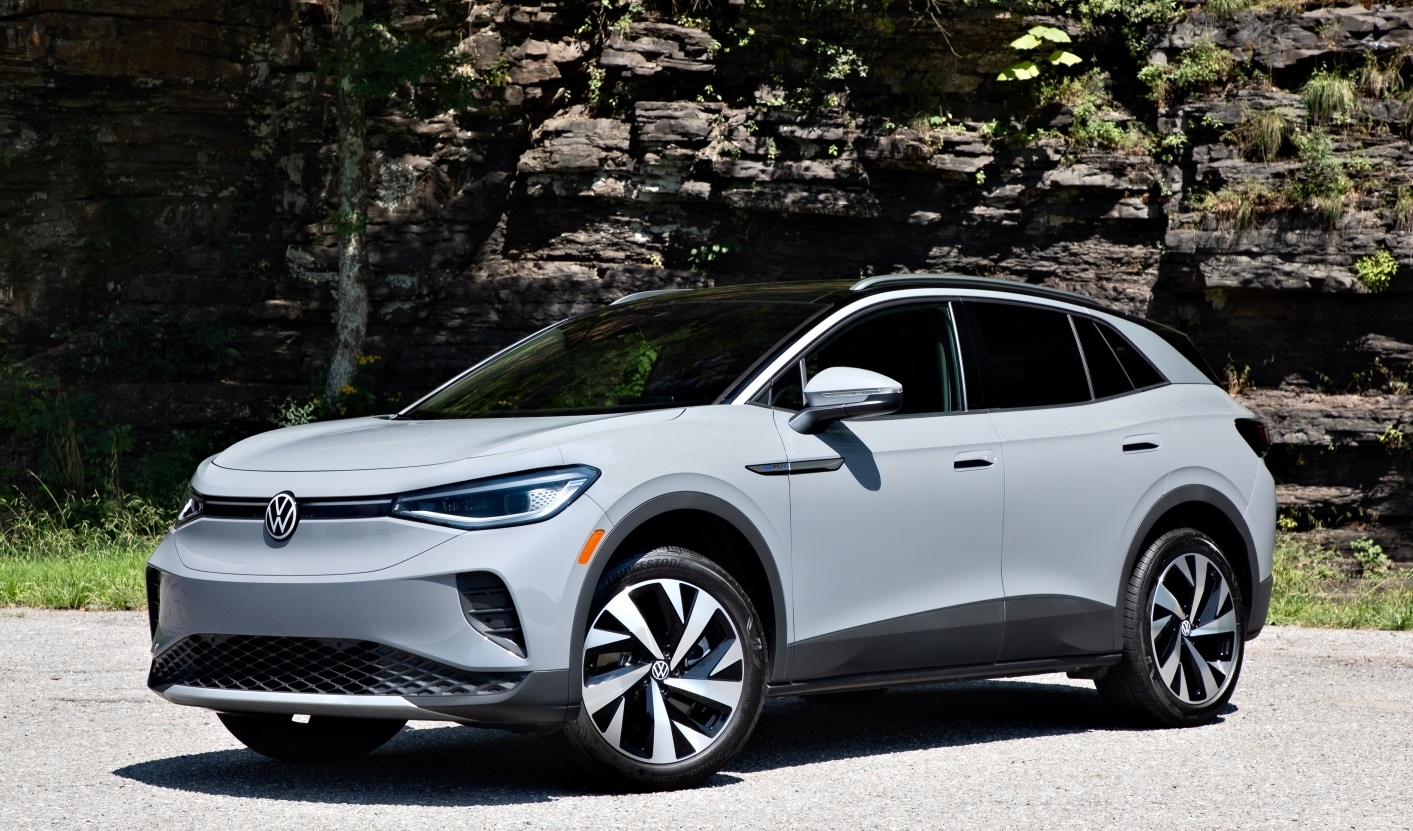
An exterior view of the 2022 VW ID4 electric SUV

The battery-electric 2022 VW ID4 is available in rear- or all-wheel drive with a driving range of 280 miles. (Photos courtesy of VW of America)

Table of Contents

Overview
5 Cool Things
Driving Range
Motors and Battery Powertrain
Charging Times
Safety Features
Pricing
Interior Function
Back Seats and Cargo
Ride and Handling
Driver-Assist Systems
Why Buy the VW ID.4?
Specifications

BY MARK MAYNARD

Miles matter in an EV. The VW ID4 electric SUV made its debut in September 2020 as a 2021 model and already the engineers have boosted the driving range and made improvements to the charging system. Pricing, too, went up for 2022, but the ID4 is still a bit of a bargain for price shoppers.

Such is the way of electrification for new vehicles.

The 2022 ID.4 is available in rear- or all-wheel-drive powertrains in three trim levels of Pro, Pro S, and Pro S Gradient. Starting prices range from about $42,000 to $51,000. And unlike some new electric vehicles, the ID.4 is sold in all 50 states.

Pro S models of ID4 include brown leatherette trim on the dashboard and door panels.

Pro S models include brown leatherette on the dashboard and door panels.

VW ID4 Overview

The ID4 is Volkswagen’s first all-electric SUV and the brand’s first global EV. It is built on Volkswagen’s modular electric drive architecture or MEB. It brings a rethinking and re-execution of body design, interior design, and packaging of the powertrain.

The ID4 exterior is a study in aerodynamics for sleek airflow, which helps extend the driving range.

As do the majority of new electric vehicles, the battery pack is assembled in a flat and low “skateboard” format. It forms the foundation of the vehicle, and from there the designers are tasked to craft an attractive body style. Because the “skateboard” raises the ride height, many designers default to the more upright SUV body style.

For a compact-class SUV, the VW ID4 has a very sleek drag coefficient of 0.28 (for RWD models). Finding ways to deter and reroute wind resistance forms the ID4’s wide stance, fast angle to the windshield, tall sides, and arching but somewhat lowered roofline. It is a motion-at-rest shape, at a slight cost to a sense of spacious in the cabin.

The wide and low ID4 is a study in aerodynamic styling.

The wide and low ID4 is a study in aerodynamic styling.

VW ID4 By the Numbers

At 180.5 inches long the ID.4 is 4.6 inches shorter than the compact-class Volkswagen Tiguan. And it has a slightly shorter wheelbase (0.9 inch) of 108.9 inches. The ID4 is 1.9 inches lower than Tiguan at 64.6 inches tall, and 0.5 inches wider, at 72.9 inches.

By EV comparison, the Hyundai IONIQ 5 is 182.5 inches long on a wheelbase of 118.1 inches. Its body is 74.4 inches wide and the roofline is 63 inches tall. Cargo space is less, too, at 72.2 cubic feet. The IONIQ 5 has headroom of 39.1 inches (with the sunroof) and legroom of 41.7 inches. And its all-wheel-drive curb weight is 4,662 pounds.

The ID4 cabin is a vertical environment. Sightlines are cramped at the side mirrors and rear views are cropped by the slim back glass.

Sightlines are cramped at the side mirrors and rear views are cropped by the slim back glass.

5 Cool Things about ID4

The VW ID4 is a neural network of advanced technologies to enhance ownership. Here are five cool things about the car.

Gesture control. Menus in the infotainment screen can be moved by a swipe of the hand in front of the screen. Sliders for volume and temperature adjustment are located on the inclined surface below the display.

“Hello ID” natural voice control. The car responds to instructions spoken by the driver and passengers. “Hello ID” is capable of understanding such commands as “Hello ID., I’m cold” to turn up the heat.

ID Light system. A thin line of 54 multicolored LEDs runs below the windshield and uses pulses of light to communicate several types of messages. Using color and patterns, ID Light can signal readiness to drive, turn instructions from the navigation system, brake prompts from driver-assistance systems and incoming phone calls. When using voice commands, ID Light signals that it is listening, similar to how voice activation on mobile phones or virtual assistants. When the ID.4 is plugged in to charge, the ID. Light shows the current charge level.

3 years of free DC fast charging. To sweeten the deal of EV ownership, Volkswagen includes three years of unlimited charging at Electrify America DC fast chargers. Charging will be managed through the Electrify America app. Electrify America has more than 650 DC fast-charging stations and around 3,500 DC fast chargers in the U.S. The company promotes its charging network with two cross-country routes from Washington D.C. to L.A and Jacksonville to San Diego.

The 12-inch infotainment screen.

The 12-inch infotainment screen with gesture control.

ID4 Driving Range

Volkswagen said driving-range improvements to the 2022 ID4 came from “minor refinement and component maturity, such as more refined fit and finish over time in production.”

The rear-wheel-drive 2022 ID.4 Pro now has an EPA-estimated battery-driving range of 280 miles. That is an increase of 20 miles from the 2021 model.

The 2022 ID4 Pro S was improved to 268 miles, up from 250 miles for the 2021 model.

All-wheel-drive models are now rated for 251 miles of range in the Pro and 245 miles for Pro S. Those are increases of 2 miles and 5 miles over the 2021 AWD versions.
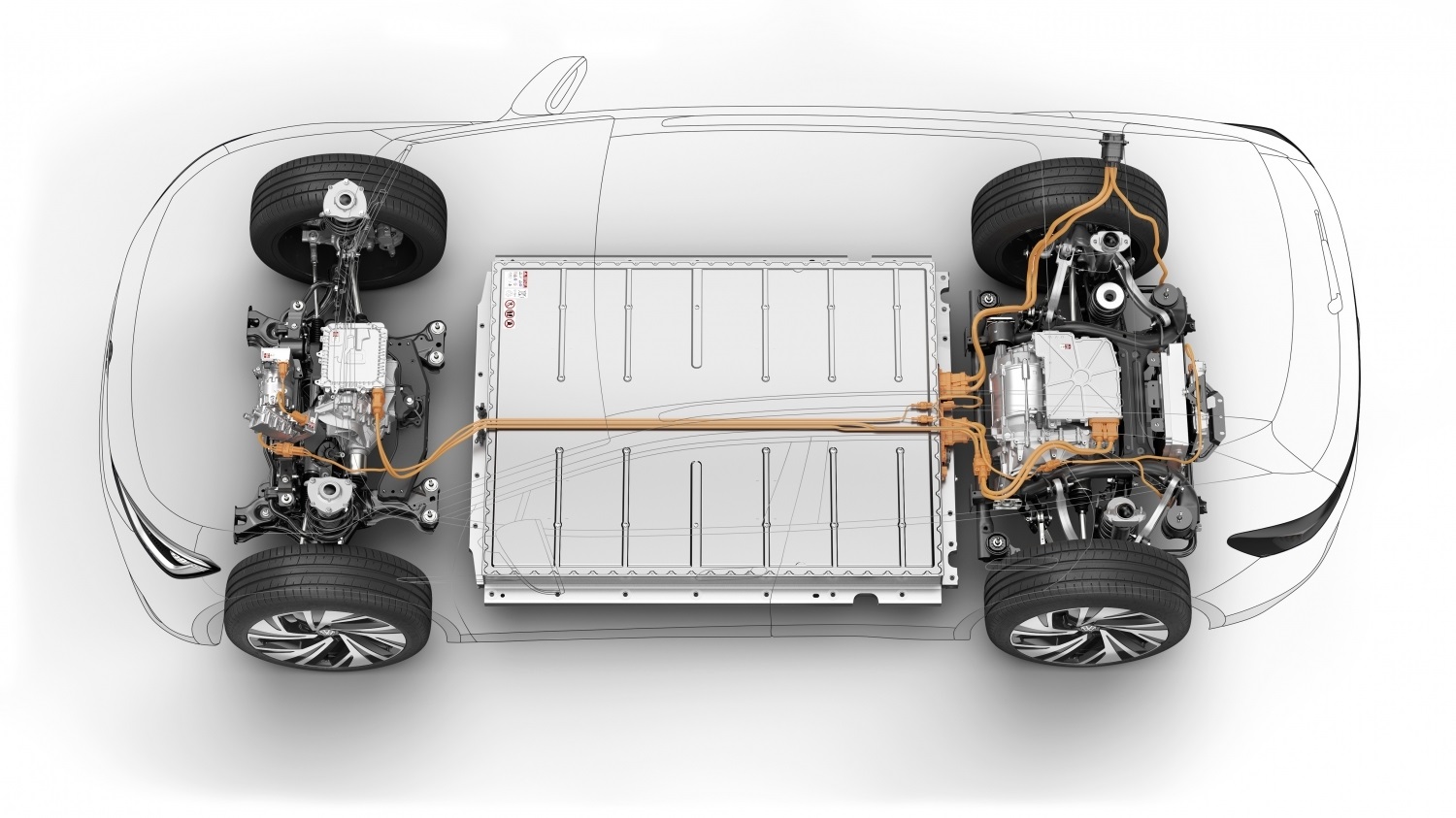
The skateboard schematic showing battery placement

The primary 201-hp electric motor is at the rear of the ID4. The motor for AWD is at the front.

Motors and Battery Powertrain

The primary electric motor is at the rear of the ID4, for standard rear-wheel drive. The 201-horsepower permanent magnet synchronous motor has 229 foot-pounds of torque.

The ID.4 AWD adds an asynchronous electric motor on the front axle. Volkswagen says, an asynchronous motor has less demand on the system compared to the synchronous motor, which is more efficient and more expensive.

The dual-motor system has a maximum output of 295 hp and 339 lb.-ft. of torque.

Power for both drivetrains is channeled through a two-stage single-speed gearbox.

In the rear-drive ID4, acceleration to 60 mph takes 7.7 seconds, according to testing by Edmunds.com. And the dual-motor ID.4 AWD Pro can make the same run in 5.4 seconds, VW says.

The liquid-cooled lithium-ion packs a max of 82 kWh, but 77 kWh is usable power, VW says, for prolonged life. The battery pack is made up of 288 pouch cells in 12 modules.

At 1,087 pounds the battery makes up a significant addition to the ID4’s AWD curb weight of 4,927 pounds.

The gear selector rocker switch is at the upper right corner of the digital ID Cockpit.

The gear selector rocker switch is at the upper right corner of the ID Cockpit.

VW ID4 Charging Times

Volkswagen recommends charging to 80 percent for daily driving and increasing it to 100 percent for longer trips.

Level 2 charger, home or public: 7.5 hours for a depleted battery;

125 kW fast charging: from 5 to 80 percent in about 38 minutes.

Battery Recycling

Volkswagen is setting up a battery cell production facility with the Swedish company Northvolt. At the end of the usage phase for the lithium-ion batteries, VW anticipates that the ID.4 battery can be reused in second-life concepts or turned into a source of raw materials through recycling. A pilot recycling plant is being built at Salzgitter, Germany.

Charging Station Struggles

For a weekend drive, I hooked up at an EVgo fast-charging station. The ID4 had an 80 percent charge and 215 miles of range and it took 35 minutes to get to 100 percent for 266 miles. My cost was $10.45, but that included an outrageous 0.58 cents (per kWh) plus a $2.99 user fee.

I had checked the EVgo website that morning for costs. It appeared the San Diego rate for “pay-as-you-go” charging (without a membership) was 39 cents a kilowatt-hour for “off-peak” charging. Also added is a $1.99 “session fee.” I was charging at 11 a.m. and expected to receive the rate of 29 to 40 cents kWh. The “on-peak” rate from 4 to 9 p.m. is 38 to 52 cents per kWh.

I’ve had two bad experiences at this EVgo charging station, but it is the closest fast-charging to my home. Apparently, the “session fee” is for me to call EVgo and bitch that once again I was not able to connect. The officious customer-service rep took my credit-card info and connected the charger remotely.

At one of my charging events, a female customer approached me with a phone in hand. She, too, was calling for connection help. And she was an EVgo member using the EVgo app to connect. She was on hold but got disconnected as we griped about the poor service and poor customer relations.

And it’s not just the charging hassle with EVgo, both locations of chargers have dirty cables and grimy stations.

I will seek out Electrify America public charging try next time.

20-inch tire and wheel package in the Gradient Package.

The robust 20-inch tire and wheel package in the Gradient Package.

VW ID4 Safety features

The VW ID4 rear-wheel-drive has earned a “5-Star” overall safety rating from NHTSA. The National Highway Traffic Safety Administration runs the government’s New Car Assessment Program.

Among its standard safety features is the IQ Drive system of assistive technologies. Included in the package are:

Travel Assist, semi-automated driving assistance.

Adaptive cruise control with stop-and-go.

Lane assist, lane-keeping system.

Emergency assist, which will brake the vehicle to a stop in a medical emergency; sensors detect if the driver’s hands are not on the wheel and the driver has not responded to a series of alerts.

Front assist, forward collision warning, and automatic emergency braking with pedestrian monitoring.

Active side assist, with a blind-spot monitor and rear traffic alert.

LED projector headlights on the Pro models with Volkswagen’s Adaptive Front-lighting System. The lights turn a few degrees with steering wheel input.

LED projector headlights on the Pro models with Volkswagen’s Adaptive Front-lighting System. The lights turn a few degrees with steering inputs.

VW ID4 Pricing

Starting prices include the $1,195 from Zwickau, Germany, but 2023 model-year vehicles will be built in Chattanooga, Tenn. AWD adds $3,680.

  1. ID4 Pro: $41,955
  2. ID4 Pro S: $46,455
  3. ID4 Pros S Gradient: $47,955

The VW ID4 AWD Pro S Gradient was $51,635, including freight, and had no options.

The Gradient package adds a black roof with silver rails and accents; silver accents on the front and rear bumpers; 20-inch wheels and Bridgestone Alenza luxury performance all-season tires (255/45).

All models have a long list of standard equipment, and there are just a few factory options. Choices include:

Protection & Convenience Package, $380. Included are four Monster Mats with the ID4 logo, a heavy-duty trunk liner with CarGo organizer blocks, an EV roadside assistance kit with a warning triangle, an LED flashlight, emergency poncho, pair of work gloves, and tire-pressure gauge, and a first-aid kit.

Enhanced Rear View Mirror, $375. It features a frameless design, an electronic compass, auto-dimming, and three HomeLink buttons.

Trailer Hitch Extras, $345. Included are a 2-inch hitch ball and a 1¼-inch ball mount. It is rated for a 270-pound maximum tongue weight to tow a maximum of 2,700 pounds.

Find current VW ID4 pricing here.

Incentives and Rebates

The 2022 VW ID4 qualifies for up to $10,250 in federal and state rebates or incentives.

Federal Electric Vehicle Tax Credit: $7,500.  IRS tax forms are here.

California Clean Fuel Reward: $750. Available toward the purchase or lease of a new electric vehicle with a battery capacity greater than 5. The customer must register the vehicle in California and the customer must reside in California.

California Clean Vehicle Rebate: $2,000. Eligibility is based on gross annual income, as stated on the latest federal tax return.

Find federal and state laws or incentives here.

And the ID4 qualifies for High-Occupancy-Vehicle freeway access, with the green DMV decal

Paint Colors

The base VW ID4 Pro model has a choice of four no-cost paint colors (three metallic, one solid). The base interior upholstery is fabric, but V-Tex leatherette is standard on pricier models.

Upper trims are available in six colors: Glacier White Metallic, Mythos Black Metallic, Moonstone Grey, Scale Silver Metallic, Blue Dusk Metallic, and King’s Red Metallic.

All models have a body-color roof and black roof rails as standard.

AWD Pro models add a tow hitch with a towing capacity of 2,700 pounds with a braked trailer and a heated windshield. Pro S and AWD Pro S models add a panoramic fixed-glass roof and power-folding side mirrors with a diamond-pattern puddle lamp signature. Pro S also adds brown leatherette trim on the dashboard and door panels.

Interior colors are Galaxy Black or Lunar Gray.

The 5.3-inch ID Cockpit

The 5.3-inch ID Cockpit

ID4 Interior Function

The ID4 cabin is a vertical environment. The tall doors, rearward sloping roofline, and rather narrow back glass create a snug and secure feeling. Headroom is quite tall at 41.1 inches, and that is with a 0.5-inch benefit from the panoramic glass roof. But very tall drivers will have to duck on entry and might have to recline the seatback for clear visibility through the windshield. Sightlines are cramped at the side mirrors and rear views are cropped by the slim back glass.

The driver faces a small digital gauge array, the ID Cockpit, with the gear selector rocker switch at the upper right corner. Upon unlocking the driver’s door, the EV is ready to go, just buckle up, engage a gear and go. End your drive by selecting Park and pressing the ignition button off switch on the steering column.

In the center of the dashboard, a Discover Pro touch infotainment display functions by touch or voice control. There are very actual buttons. Base models have a 10-inch display and the upper trims are upgraded to a 12-inch screen.

From the display screen, the driver has access to the navigation system, entertainment, driver-assistance systems, and vehicle settings. Menus can be moved using gesture control, but it takes practice to master. And sometimes the action of the swipe or touch is touchy.

Volkswagen’s “We Connect ID” app works through a smartphone for remote vehicle functions. The app can be used to set cabin temperatures, monitor current charge level, and plan drive routes, including charging stops.
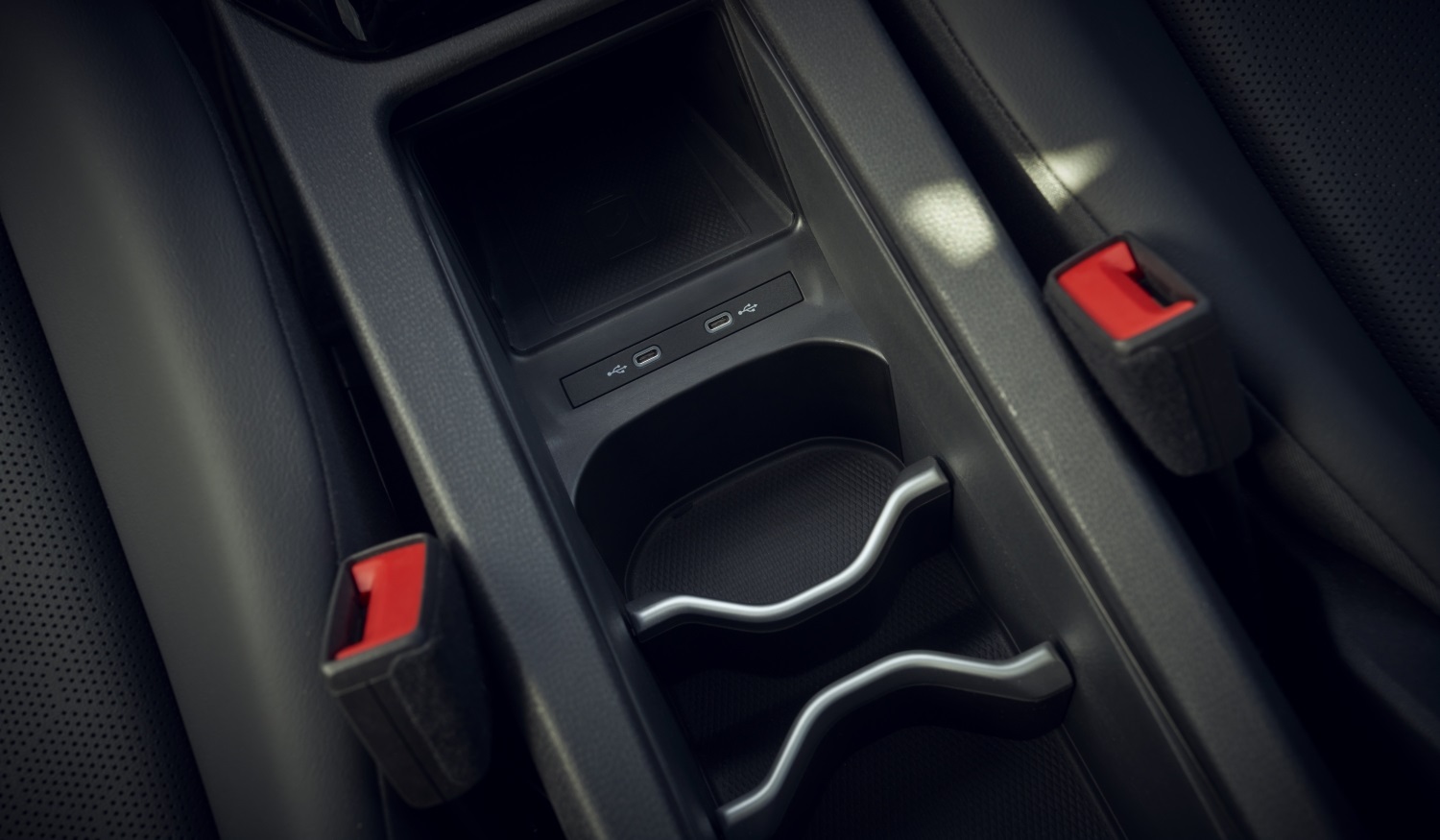
Between the front seats is a clever and convertable cupholder space.

Between the front seats is a clever and convertible cupholder space.

Cabin Comfort

The ID4 Pro S interior includes handsome brown leatherette on the dash and door panels with satin metal and some piano black elements. It neatly breaks up the black plastics, but some of which in lower areas are SUV durable.

Massaging 12-way power front seats in the Pro S have adult thigh support, and comfort that will last at least through a full battery charge. The V-Tex leatherette is supple and handsome, with perforated centers. The seats are heated but not ventilated.

With no bulky transmission protruding into the cabin, there are plenty of storage spaces. The cupholders in the center floor console are deep and versatile with a removable insert to create an open bin. There is also under console storage for a small handbag or parcel.

Another deep box between the seats includes the wireless charging pad and two charging USBs. The box design includes a pair of bracketlike inserts that can be flipped to hold a Big Gulp or removed to place your bag of takeout food.

VW went deep on soundproofing. Helping to calm the cabin are “aero-acoustics,” such as the shape of the side mirror housings and the acoustic windshield. And there is special insulation for the body to reduce wind noise and intrusive sounds from the drivetrain, running gear, and tires. The sound-isolating treatment works well around town, but there is still noticeable ambient noise at highway speeds.

The flat floor is a back-seat asset for foot space not constricted by a tall AWD tunnel.

The flat floor is a back-seat asset for three-across foot space.

ID4 Back Seat and Cargo Space

The flat floor is a back-seat asset for foot space not constricted by a tall AWD tunnel. Legroom of 37.6 inches seems longer than its dimensions would suggest. While the seatback does not recline, it has a relaxed angle. And the expansive panoramic roof is an engaging picture window.

Cell phone pockets in the backs of the front seats are a nifty idea, with a pair of USBs in the floor console.

Cargo space behind the second row is 30.3 cubic feet, measured from floor to ceiling. The space is cropped somewhat by the rake of the tailgate. But fold the 60/40 seatback, with a ski-passthrough, for a very usable 5 ½ to 6 feet of length. Oddly, there are no seatback releases in the cargo area, so owners will have to step around to the back door and reach in to release the seatback.

The cargo opening is wide at 43 inches but not tall at 27 inches (because of the battery below). However, the Pro models add an adjustable trunk floor, that can be repositioned a few inches down to allow for taller items. And there is below-floor space for the charging cable.

While the seatback does not recline, it has a relaxed angle.

While the seatback does not recline, it has a relaxed angle.

ID4 Pro S AWD Ride and Handling

Sadly, the ID4 lacks the VW driving DNA that elevates their gas-powered vehicles. But replicating an electronic driving soul has been elusive for most mainstream EVs.

Weight is the enemy of an electric vehicle and the ID4 is heavy, more than 5,000 pounds with a brace of passengers. The quick uptake of torque helps get the ID4 moving, but it can be a reserved start before acceleration builds with intensity. There is no Sport mode, so the driver just has to push harder on the accelerator to get stronger performance.

It will take the driver some time to adapt for smooth acceleration and braking. While there is plenty of stopping power, the brake system has considerable mass to stop. The first few times I drove, it was sort of a “Whoa, Nelly!” experience as I neared a stop. And then there was a bit of nose dive and resettling.

The brake system is not the usual setup. VW uses front discs and rear drums because disc brakes on the rear can be less effective than drums after long periods of not being put to heavy use. The front discs on rear-drive models are 13.4 inches in diameter and 14.1 inches on AWD models.

The two-stage gearbox includes a Braking mode to recapture more energy when slowing or on downhills. To use the B mode, the driver must use the gear selector rocker switch at the upper right corner of the 5.3-inch gauge display, called the ID Cockpit.

B braking is a little awkward to use, but it does provide noticeable braking-regen force, though B will not bring the vehicle to a complete stop. I would prefer an e-pedal experience, activated through the accelerator pedal. For me, it is easier to use and seems a little safer.

Suspension

The ID4 has a strut-type front suspension and a rear multilink, both ends have coil springs, telescopic shock absorbers, and anti-roll bars. All-wheel-drive models have a half-inch taller ride height and firmer springs and dampers and thicker anti-roll bars.

But something more is needed. The all-wheel-drive tester did not feel steady when making simple maneuvers; there was noticeable sway and quick rebound.

The girlfriend-wife accused me of careless driving that was making her nauseous. “Really, it’s the car,” I insisted.

On the highway, the steering lacked solid tracking and required continual inputs. The ride even felt squishy on rain-grooved concrete highways. At those times, I was thankful for the many eyes and steering inputs of Travel Assist.

I can’t blame the 20-inch Bridgestone Alenza tires. The luxury performance all-season tires are robust in size and footprint, (255/45). But they also are not the quietest at highway speeds. These tires have a very high (hard) treadwear rating of 800 and a tread-life warranty of 5-years/80,000-miles.

VW engineers were able to create a very tidy turning circle of 31.5 feet on RWD and 36.4 feet on AWD. That is an appreciable asset with 19- or 20-inch tires and a wheelbase of 108.9 inches.

Travel Assist enables Level 2 partially automated driving from 0 to 95 mph.

Travel Assist enables Level 2 partially automated driving from 0 to 95 mph.

ID4 Driver-Assist Systems

Volkswagen’s IQ DRIVE advanced driver assistance technology includes hands-on semi-automated driving or Travel Assist.

IQ DRIVE is a package of integrated technologies. It “sees” road conditions through a front radar, front camera, two rear radars, and eight ultrasound sensors to collect data from the surrounding area

Its advanced technologies include:

Front Assist (Forward Collision Warning and Autonomous Emergency Braking with Pedestrian Monitoring);

Active Side Assist (with Blind Spot Monitor);

Rear Traffic Alert;

Adaptive Cruise Control (ACC) with Stop and Go;

Lane Assist (Lane Keeping System);

Emergency Assist (semi-automated vehicle assistance in a medical emergency). If the system does not detect driver input, it engages a series of warnings (visual, audible, and brake jolts). If still no input is detected, Emergency Assist will slow the vehicle to a gradual stop in its own lane.

Travel Assist enables Level 2 partially automated driving from 0 to 95 mph. The systems are intended for use on divided highways and the driver must keep a light touch on the steering wheel with both hands. The assist system uses Adaptive Cruise Control and Lane Keeping Assist to help steer, accelerate and brake the vehicle in response to traffic and center the vehicle within lane markings.

On the highway, IQ DRIVE provides very accurate lane centering. I highly recommend it for driving in the congested commute. The eyes of the sensors are ever ready to guard the driver’s line, even when the driver is distracted.

The ID4 exterior is a study in aerodynamics for sleek airflow, which helps extend the driving range.

The ID4 exterior is a study in aerodynamics for sleek airflow.

Why Buy the VW ID.4?

With up to $10,250 in various incentives and rebates, the ID4 pricing is enticing to the skeptic or price-point shopper.

I’d recommend all-wheel-drive for its power even with the reduced driving range. It becomes a non-argument with a Level 2 home charger. And owners will appreciate that perk of off-peak charging, and always having a full tank to start the day.

However the gasoline price war settles out, the pricing won’t go back to what we once thought was acceptable.

2022 VW ID.4 AWD Pro S Specifications

Body style: 5-seat, 5-door compact SUV; unibody construction with stamped steel panels, plastic, and composite bumpers

Motors: Rear, 201-hp permanent magnet synchronous; 229 lb.-ft. torque; Front, asynchronous 107-hp electric motor on the front axle; 119 lb.-ft. torque

Total system power: 295 hp and 339 lb.-ft. torque

Transmission: single-speed automatic

0-60 mph: 5.4 seconds

Battery: 82 kWh liquid-cooled lithium-ion (77 kWh usable power); 288 pouch cells in 12 modules

Electric range: 245 miles

AWD MPGe: 100/90/95 city/highway/combined

On-board Charging: 11 kW onboard charger for home or public AC systems; 135 kW max for DC public charging

CHARGING TIMES

Level 2 charger home or public, 7.5 hours for depleted battery;

125 kW fast charging: from 5 to 80 percent in about 38 minutes;

Volkswagen recommends charging to 80 percent for daily driving and increasing it to 100 percent for longer travel.

BY THE NUMBERS

Cargo space: 30.3-64 cubic feet

Front head/leg room: 41.1*/41.1 in. *40.6 in. w/o glass roof

Rear head/leg room: 38.4/37.6 in.

Length/wheelbase: 180.5/108.9 in.

Curb weight: 4,927 pounds

Turning circle: 36.4 feet (31.5 ft. w/RWD)

Max tow capacity: 2,700 pounds, w/braked trailer; 1,650 lbs. w/o brake

FEATURES

ID.4 AWD Pro S standard equipment includes: KESSY keyless access, panoramic fixed-glass room for power sunshade, 12-way power seats (with massaging lumbar and memory), ID. Cockpit (digital driver display), Pro Max touchscreen navigation system with 12-inch color display, rear-view camera system, leather-wrapped and heated multi-function touch steering wheel, V-Tex leatherette upholstery, heated steering wheel and heated front seats, heated side mirrors and washer nozzles, heated windshield (standard on AWD models), electric resistance cabin heater, 30-color customizable enhanced interior ambient lighting, high beam dimming control, wireless smartphone charger and Bluetooth streaming audio

Driver-assist features: adaptive cruise control, blind-spot monitor (Side Assist), rear traffic alert, dynamic road sign display, front assist with pedestrian monitoring, park distance control (front and rear), Travel Assist with lane assist, emergency assist,

Safety features include: 6 air bags, anti-slip regulation, electronic differential lock, intelligent crash response system, automatic post-collision braking, brake-force distribution, brake assist, stability control

PRICING

AWD Pro S base price: $51,635, including $1,195 freight charge; price as tested $51,635

Where assembled: Zwickau, Germany

Warranties: 4-years/50,000-miles bumper to bumper (transferable to a subsequent owner); high voltage system 4-years/50,000-miles; high-voltage battery 8-years/100,000-miles (10-years/150,000 miles in California); 2-years/24,000-miles free scheduled maintenance; 3-years/36,000-miles 24-hour roadside assistance

Hyundai IONIQ 5 Review

Hyundai IONIQ 5 Review

The 2022 Hyundai IONIQ 5 is an elevated experience of what can be expected in an electric vehicle

The 2022 Hyundai IONIQ 5 battery-electric SUV crossover is sold in rear- or all-wheel drive powertrains with driving ranges of 303 to 256 miles. Available incentives and rebates can total $10,250. (Photos courtesy of Hyundai)

Table of Contents

Next Level Design
10 IONIQ 5 Innovations
Pricing
Incentives and Rebates
Charging Times
Performance
Driver Assistance Systems
Ride and Handling
IONIQ 5 Interior Function
Back Seats and Cargo
Hyundai IONIQ 5 Awards
Why Buy the Hyundai IONIQ 5?
Specifications

BY MARK MAYNARD

The new Hyundai IONIQ 5 is almost iconic in how well it does everything. It’s not just a well-engineered electric vehicle, it is a well-designed car for family or executives.

The IONIQ 5 is Hyundai’s first dedicated electric vehicle and built on the Hyundai Electric Global Modular Platform (E-GMP). It and other electrified vehicles to follow will be marketed under the IONIQ subbrand. The upcoming battery-electric lineup will include the IONIQ 6 midsize sedan and IONIQ 7 large SUV.

At 118.1 inches, the IONIQ 5 has the longest wheelbase in Hyundai’s U.S. product lineup. It is almost 4 inches longer than the Hyundai Palisade large-midsize SUV, but the IONIQ’s overall length is nearly 14 inches shorter.

And Hyundai says the IONIQ 5 has more passenger volume (106.5 cubic feet) than the Ford Mustang Mach-E (101.1 cu. ft.) and the Volkswagen ID.4 (99.9 cu. ft.).

Sales currently are in the zero-emissions vehicle states of the Northeast plus Texas, Florida, Illinois, Pennsylvania, Arizona, Virginia, and Washington state. There will be a broader rollout later in 2022, Hyundai says.

Front seat area of the IONIQ5

The driver area is digitally sophisticated but easy to use.

Next Level Design

The IONIQ 5 exterior design is next level as a contemporary EV. Crafting a cohesive exterior appearance is a challenge when the electric powertrain is configured in a so-called “skateboard” layout. The battery-electric elements form a low and flat foundation. But the design challenge has been to build a body that doesn’t look like it is grafted onto the skateboard foundation.

Because that foundation raises the ride height of the vehicle, designers have adopted an SUV format. Adding SUV features to the body is one way to disguise the awkward foundation.

For the majority of mainstream EVs, exterior styling is a ground-up exercise. But the Hyundai designers appear to have created a top-down style for its IONIQ 5. From the outside, it looks more cosmic space shuttle than bulky SUV. And if there is such a thing as an open floor plan for a vehicle, the IONIQ 5 has it. The flat floor, spacious front-seat area, and long roofline create a light and inviting space.

Dual 12-inch digital screens in the IONIQ 5

Dual 12-inch screens with white backgrounds add to the lightness of the cabin. To the far left is the magnetic note board.

10 IONIQ 5 Innovations

Flush Mounted Automatic Door Handles. As an owner with the key nears the IONIQ 5, the door handles pivot outward. The design is for clean surface styling and enhanced aerodynamics. But the lever-type handle gives more leverage on opening and eliminates the fingernail scratches in the paint from a traditionally styled pull handle.

Sliding Center Console. The so-called Universal Island moveable center console can slide back and forth 5.5 inches.

Magnetic Note Board, for photos or a shopping list.

Power Reclining Driver’s Seat with Footrest. So thoughtful when killing time at a public charging station.

Fast Charging. IONIQ 5’s E-GMP architecture can support 400-volt and 800-volt fast-charging. The platform offers 800-V charging capability as standard, and it can accommodate 400-V charging without additional adapters. Hyundai says the multi-charging system is a world first.

Ownership by Subscription. A planned subscription service will feature a single, all-inclusive monthly payment, covering the vehicle, insurance, and maintenance.

Over-the-Air Updates. IONIQ 5 is the first Hyundai vehicle to offer free over-the-air wireless updates for maps and multimedia software.

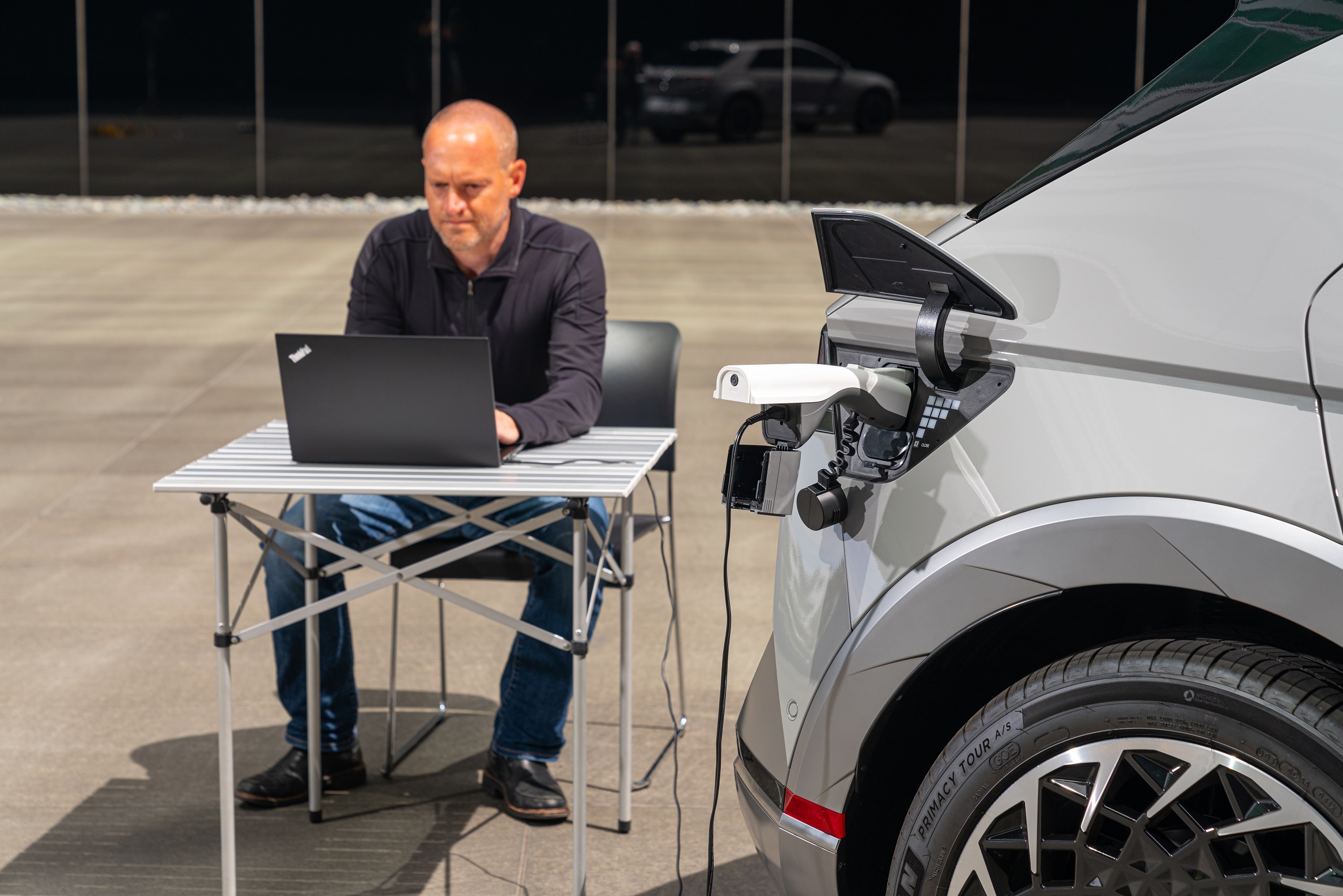
V2L charging ability

The Vehicle-to-Load function creates a power source on wheels.

Vehicle-to-Load (V2L) Function. As a high-capacity electric source, the IONIQ 5 is part survival tool and charger on wheels. V2L allows charging of electric devices, such as electric bicycles, scooters, or camping equipment. Or it can be used to charge a stranded EV.

The 1.9 kW of peak power is tapped through a standard 120-volt outlet. The function won’t power an entire home, but it can power necessities during a power outage, tailgate parties, or outdoor projects.

Using the V2L function requires an optional accessory adaptor ($220) that plugs into the outside charging port. The Limited model also has an interior V2L outlet at the base of the back row seat for charging laptops, phones, and other devices.

Augmented Reality Head-Up Display. The IONIQ 5 head-up display uses an Augmented Reality mode, which essentially turns the windshield into a display screen. The projection appears to be nearly 4 feet in front of the driver’s line of sight and can include various information, such as turn-by-turn navigation, posted speed limits, and advanced safety alerts.

Free Fast Charging for 2 Years. Hyundai and Electrify America collaborated to provide 250 kWh of free DC fast charging for new owners of the IONIQ 5 or Hyundai Kona EV. Charging via app will be offered in unlimited 30-minute charging sessions for two years from the date of purchase.

Electrify America

Electrify America has about 800 charging stations with more than 3,500 ultra-fast chargers either open or in development, Hyundai says. See Electrify America’s plan for the

The movable center console

The Universal Island center console can slide back and forth 5.5 inches.

Suggested Retail Pricing

The IONIQ 5 is sold in three trim levels in rear- or dual-motor all-wheel drive with a lithium-ion polymer battery pack. Starting prices include the $1,245 freight charge from Ulsan, Korea.

Rear-drive models have a 168 kW, 225-hp motor with 258 foot-pounds of torque and battery capacity of 77.4 kWh for a driving range of 303 miles. AWD trims package a 74 kW front motor and a 165 kW rear motor for 320-hp with 446 ft.-lbs. of torque.

The Limited AWD tester was $55,940 with one option for carpeted floor mats, $195.

IONIQ 5 SE RWD starts at $44,895;

IONIQ 5 SEL RWD: $47,145;

IONIQ 5 Limited RWD: $51,845;

IONIQ 5 SE AWD: $48,395;

IONIQ 5 SEL AWD: $50,645;

IONIQ 5 Limited AWD: $55,745.

Available later this year will be the entry IONIQ 5 SE Standard; offered only in rear-wheel drive. It has a smaller electric motor — 125 kW, 168-hp — and smaller battery capacity (58 kWh) with fewer creature comforts but a full complement of safety and driver-assist technologies. It has a starting price of $39,700 and a driving range of 220 miles.

IONIQ 5 electric motor

The top box, above the AWD motor, has about a cubic foot of storage space.

Paint and Interior Colors

There are six paint colors, including five nature-inspired hues exclusive to IONIQ 5. The color choices are Phantom Black (Pearl), Cyber Gray (Metallic), Atlas White (Solid), Digital Teal (Green Pearl), Lucid Blue (Pearl), Shooting Star (Gray Matte).

The Digital Teal is a color-changing metallic paint. In various light conditions, it can look aquamarine, silver, or gray.

The interior has three color options Obsidian Black Monotone, Dark Pebble Gray/Dove Gray, Dark Teal/Dove Gray.

There is a lot of easily digested information in the digital gauge array.

There is a lot of easily digested information in the digital gauge array.

IONIQ 5 Incentives and Rebates

The 2022 Hyundai IONIQ 5 qualifies for up to $10,250 in federal and state rebates or incentives.

Federal Electric Vehicle Tax Credit: $7,500. IRS tax forms are here.

California Clean Fuel Reward: $750. Available toward the purchase or lease of a new electric vehicle with a battery capacity greater than 5. The customer must register the vehicle in California and the customer must reside in California.

California Clean Vehicle Rebate: $2,000.  Participants are eligible based on gross annual income, as stated on their federal tax return.

Find federal and state laws or incentives here.

And the IONIQ 5 qualifies for High-Occupancy-Vehicle freeway access, with the green DMV decal .

The Limited includes a V2L plug in the back seat

The Limited includes a V2L plug in the back seat

Ownership by Subscription

To help EV-intenders get comfortable with ownership, Hyundai plans to offer a simple automobile subscription service; it is now in the pilot phase. The subscription will have an all-inclusive monthly payment, covering the vehicle, insurance, and maintenance.

Parametic Pixel LED lighting.

Parametic Pixel LED lighting.

IONIQ 5 Charging Times

Rapid DC 150kW (400V): 25 minutes, estimated, from 10 percent to 80 percent charge

Rapid DC 250kW (800V): 18 minutes, from 10 percent to 80 percent

Level 2 240-volt home unit: 6 hours, 43 minutes

Hyundai Bluelink

Bluelink is a car-connectivity system on all new Hyundai models that gives drivers remote access to their vehicles. The Bluelink app for IONIQ vehicles has redesigned home-screen displays for driving range, battery state, and charging times when plugged into public or private chargers.

Users can access an advanced battery management system to select charging times, particularly for off-peak electricity rates.

Remote Climate Control allows scheduled pre-heating or pre-cooling when the IONIQ 5 is connected to a power source. It helps save battery power that would otherwise be needed to heat or cool the vehicle on the road.

The map section of the app has also been redesigned to let customers filter between charger providers and charge type. It also will show the availability of a charger when the driver arrives.

IONIQ 5 front seats

Eight-way power-adjustable seats for driver and passenger.

IONIQ 5 AWD Performance

The dual motors of the IONIQ 5 Limited AWD provide smooth uptake from the start and give strong acceleration when needed. There are performance modes of Eco, Normal, and Sport. And when you try a full-on launch in Sport mode, the digital gauge array turns red and the force of acceleration is bristling. Hyundai cites 0-60 acceleration in less than 5 seconds.

All models have a top speed of 115 mph and can tow up to 1,650 pounds.

The i-Pedal regeneration system helps recupe de-acceleration energy simply by lifting off of the accelerator. It is especially handy around town. With careful driving, the i-Pedal function can almost take the place of slow-speed, stop-and-go braking. The force of the regeneration can be adjusted with the steering wheel paddles.

IONIQ 5 Ride and Handling

Electric SUVs are heavier than internal-combustion vehicles, mainly because of the large battery pack needed to achieve 300 miles. The IONIQ 5 Limited AWD weighs 4,662 pounds. By comparison, the seven-passenger Palisade with all-wheel drive at 4,387 pounds. The Tesla Model X SUV weighs around 5,441 pounds. And the VW ID.4 weighs 4,824 pounds.

Hyundai achieved a lower weight without extensive use of aluminum in the body. Instead, the body is comprised of advanced high-strength steel and high tensile steel.

The Limited’s 20-inch aero-optimized wheels.

Aero-optimized wheels in sizes of 19 or 20 inches.

Suspension

The engineering challenge in hefting upward of 3 tons in a smallish vehicle is to provide a comfortable ride. It is common for an EV suspension to clunk and jolt over rough patches.

Hyundai engineers applied some secret sauce in its steel-spring suspension that mitigates the clunks and jolts. The setup of MacPherson struts at the front and a rear multilink includes high-performance shock absorbers.

Credit the long wheelbase for the smooth highway ride. Only a couple of times over very lumpy highway section did I notice any heave to the ride, but never a clunk. And that is without any electronics to quicken the suspension response time.

Brakes, Tires, and Wheels

Four-wheel-disc brakes have ventilated 12.8-inch front rotors and 12.8-inch solid rear rotors. The regenerative braking system includes brake control paddles at the steering wheel to maximize downhill regeneration.

With careful driving and attention to regen braking, the driving range can be extended by a few miles.

Highway road and wind noise are well controlled, aided by the 20-inch Michelin Primacy Touring “Acoustic” touring tires (255/45). For this tire, Michelin’s noise-reduction tuning combines frequency canceling shoulder grooves and block chamfers with ultra-smooth belts. I’d never before experienced these “acoustic” tires but highly recommend them. With a midrange treadwear rating of 540 (rubber hardness), the tires have a warranty of 55,000 miles and a standard limited warranty of 6 years. That coverage is important because the hefty EV curb weights tend to wear out tires sooner than expected, owners say.

The large 20-inch alloy wheels are aero-optimized for reduced turbulence. The wheels are also positioned at the very edge of the body to help block wind from entering the wheel well. And special aero-optimized fender overriders also help break up airflow and reduce drag.

There are many aerodynamic details to the IONIQ 5 body, such as the slash marks along the fender overriders.

There are many small aerodynamic elements on the body to trim drag, such as these slash marks on the fender overriders.

Driver-Assist Systems

The IONIQ 5 debuts Highway Driving Assist 2 as the next level of Hyundai’s SmartSense driver assistance systems. When driving on a highway, HDA 2 actively responds to close-range low-speed cut-ins by other drivers and motorcycles. The system also will automatically assist lane changes in certain conditions when the driver uses the turn signal. HDA 2 also adjusts the steering weight according to drive mode.

In my experience, the driver-assist systems functioned reliably and kept the IONIQ 5 well centered in the lane. That precision is reassuring in heavy commuting. I experienced no random system shut-offs, which can be caused by shadows, bright sunlight directly into the forward camera, and even white semi-trucks with white trailers. Because these systems are not foolproof, it is best to drive with both hands on the wheel, despite what some Tesla owners seem to believe.

Other driving-assistance systems include:

Smart Cruise Control with Machine Learning. The system tries to mimic the driver’s tendencies for acceleration and spacing with the vehicle ahead;

Forward Collision-Avoidance Assist;

Blind-Spot Collision-Avoidance Assist;

Intelligent Speed Limit Assist, to match the posted speed;

Blind-Spot View Monitor, uses side mirror-mounted cameras to show the driver views to the left and the right of the vehicle. The image is displayed in the digital gauge cluster screen when the turn signal is activated.

The gear selector is located behind the steering wheel.

The gear selector is located behind the steering wheel.

Interior Function

EV interior design is evolving and each manufacturer finds new ways to innovate and use space.

Slip behind the wheel of the IONIQ 5 and the dual 12-inch digital screens with white backgrounds are different, even alien. But after some exploration, the screens become completely functional and easy on the eyes.

The contiguous 2-foot span of screens connects gauges and infotainment with cabin controls. But at driver’s left is a magnetic board that extends the contiguous span to about 30 inches. Hyundai says the magnetic surface, about 5-by-5 inches, is ideal for posting pictures and notes just like on a refrigerator.

Many interior touchpoints in the IONIQ 5 — seats, headliner, door trim, floor, and armrest — are of sustainably sourced materials. These materials include recycled PET bottles, plant-based (bio PET) yarns and natural wool yarns and bio paint with plant extracts.

The raised ride height provides comfortable entry and exit. And the open interior of the IONIQ 5 has wide open driver visibility, across the hood or over the shoulder. Front headroom of 39.1 inches, with the panoramic roof, and legroom of 41.7 inches should accommodate taller drivers.

Both front seats in the Limited are eight-way power-adjustable and seat support is comfortable for the entire driving range. The leatherette upholstery with perforated centers is supple and neatly stitched.

Cabin audio and climate controls are not difficult to master through the infotainment screen, but I wished for external screen access for the heated seats or the Limited’s heated steering wheel and ventilated front seats. A rear wiper and washer are missing, but Hyundai says it will address that feature in the future.

The interior’s most notable feature might be the moveable Universal Island center console; it can slide back and forth 5.5 inches. The armrest of the sliding console also helps accommodate elbows of short and tall drivers. The open console also packages cup holders, a 15-watt wireless phone charger, and USB ports. The base of the console is big enough to hold a large handbag or a drive-through bag of food.

The console’s adjustability, flat floor, and gear selector located behind the steering wheel allow easier driver access if shoehorned into a narrow spot. Or just use the automated Remote Smart Parking Assist parking feature to solve the problem.

Also smart are the long door-side armrests that allow varied leverage points for closing the door. And just as important, the long grip helps control the force of opening the door and avoiding a ding in an adjacent vehicle.

The Surround View Monitor uses an array of cameras to give a 360-degree view of the area surrounding the vehicle. With guidance lines, it is helpful when parking to stay in the lines.

Back seat space is comfortable with 39.4 inches of legroom and adult-length thigh support.

The back seat has adult-length thigh support and max legroom of 39.4 inches.

Back Seat and Cargo Space

Back-seat roominess is a standout in the IONIQ 5. The door opening is large, the doors open wide, and there are 39.4 inches of max legroom (depending on who is sitting in front).

The second-row seats can slide forward up to 5.3 inches, recline, and have a 60/40 seatback fold.

The Limited’s panoramic glass roof is an extra-large sky view that makes the space feel very open. The fabric sunshade is divided in the middle and one half rolls open toward the front and the other rolls backward for full daydreaming capability. The light provided by the glass roof is helpful to those sensitive to motion or who are claustrophobic, particularly children and my girlfriend. And vertical b-pillar vents keep a friendly flow of air to trim that occasional urpy feeling.

With 57.7 inches of shoulder room (door to door) and the flat floor, three-across seating is reasonably comfortable. The bench seat has adult-class thigh support and there are a few inches of seatback recline.

Back-seat extras include a fold-down armrest with can holders, large door-panel storage with bottle slots, above-door grab handles (with a jacket hook on the left handle), two USB charging ports. And the Limited adds manual side-glass sunshades.

Cargo space is flexible and accommodating for weekend getaways. But the space is modestly cropped by the tall cargo floor and angle of the back glass and tailgate. The opening is 41 inches wide by 38 inches to the seatback for 27.2 cubic feet of space. Fold the 60/40 seatback for 6 feet of flat capacity. There also is slim subfloor storage for the tire-mobility kit and charging cable.

Fold the 60/40 seatback for 6 feet of flat cargo capacity.

Fold the 60/40 seatback for 6 feet of cargo length.

Hyundai IONIQ 5 Awards

The Hyundai IONIQ 5 was revealed globally on Feb. 23, 2021, and since its debut has earned many 2022 car-of-the-year awards. Among them:

  • New Zealand Car of The Year;
  • German Car Of The Year;
  • Best Import Cars of the Year, by Auto Bild, in the “Electric Car” category;
  • No.1 Electric Car by Auto Zeitung, receiving the highest score among electric cars;
  • Car of the Year 2021, Mid-size Company Car of the Year 2021; and Premium Electric Car of the Year 2021, by Auto Express;
  • 2021 IDEA Design Award’ Gold prize;
  • Best Design at the TopGear Electric Awards 2021.

Source: Wikipedia

Why Buy the Hyundai IONIQ 5?

Despite more than two dozen electric vehicles headed to market in the next two years, EVs are still in their pioneering stages of development.

For its ease of use, voluminous interior, and driving range, the IONIQ 5 is an elevated experience of what can be expected in an EV, and what more evolution will follow — by Hyundai and others.

The transition to a battery-electric vehicle will be an expensive lifestyle adjustment, including the purchase of a home charger. But the security of always having a full tank when you leave home will pay dividends as owners wave bye-bye to weekly visits to the neighborhood filling station.

The biggest obstacle to overcome will be explaining to friends why you choose not to drive around on 15 gallons of flammable liquid.

The rear view of the IONIQ 5

Every 2022 Hyundai IONIQ 5 (and 2022 Hyundai Kona Electric) includes 250 kWh of free DC fast charging through Electrify America.

Hyundai IONIQ 5 Limited AWD Specifications

Body style: Compact class 5-door crossover SUV; unibody construction of advanced high-strength steel and high tensile steel

Motors: Permanent-Magnet Synchronous; 165 kW rear motor, 74 kW front motor for AWD

Battery: 77.4 kWh lithium-ion polymer, 697 volts; 272kW output

Power: 320-hp with 446 ft.-lbs. of torque.

Transmission: Single-speed reduction gear with drive modes of Eco, Comfort, Sport, and Snow); steering-wheel-button selectable

Top speed: 115 mph

0-60 mph acceleration: less than 5 seconds in Sport mode

Driving range: 256 miles, AWD

MPGe: 110/87/98 mpg city/hwy/combined

CHARGING TIMES

Rapid DC 150kW (400V): 25 minutes, estimated, from 10 percent to 80 percent charge

Rapid DC 250kW (800V): 18 minutes, from 10 percent to 80 percent

Level 2 240-volt: 6 hours, 43 minutes

Onboard charger: 10.9kW

BY THE NUMBERS

Coefficient of Drag: 0.288

Cargo space: 27.2-59.3 cubic feet

Front head/leg room: 39.1*/41.7 inches *w/sunroof

Rear head/leg room: 37.5/39.4 inches

Length/wheelbase: 182.5/118.1 in.

Height/width: 63/74.4 inches

Curb weight: 4,662 pounds

Turning circle: 39.3 ft.

Maximum trailer weight: 1,650 pounds, with or without trailer brakes (towing not recommended for Standard Range RWD model)

FEATURES

Standard Limited equipment includes: Surround View Monitor, Driver Seat with “Relaxation” function, Blind-Spot View Monitor, premium door sill plates, reverse sliding center console, rear-door sunshades, panoramic fixed glass sunroof with power shade, Vehicle to Load (V2L) two-way onboard charger (2nd row), heads-up display with augmented reality functions, roller cargo cover, integrated memory system for driver seat, Digital Key, 8-way power front seats (heated and ventilated), remote smart parking assist, Bose Premium 8-speaker Audio, electric parking brake, 20-inch alloy wheels, battery heater, and heat pump

Safety features include: 6 air bags, blind-spot collision avoidance, lane-keeping assist and lane-following assist, rear cross-traffic-collision avoidance assist, high-beam assist, front and rear parking sensors, parking collision avoidance assist, hill-start assist, 4-channel ABS with brake-force distribution, brake assist and regen brake control paddles

PRICING

Limited AWD base price: $55,745, including $1,245 freight charge; price as tested $55,940

Options on test vehicle: carpeted floor mats $195

Where assembled: Ulsan, South Korea

Warranties: 10-years/100,000-miles electric-vehicle system; 10-years/100,000-miles powertrain limited warranty; 5-years/60,000-miles new vehicle limited warranty and 7-year anti-perforation warranty; free scheduled maintenance for 3-years/36-000 miles

Electrify America Shows Charging Station of the Future

Electrify America Shows Charging Station of the Future

Electrify America has plans to create a customer oasis with ultra-fast charging

Electrify America says its plans for unique charging stations will be influenced by the surrounding communities. (Photos courtesy of Electrify America)

BY MARK MAYNARD

Electrify America today announced a new design vision for some of its future charging stations. The customer-focused design is to exceed electric vehicle customer expectations as they transition to electric mobility, the company says. The company also plans to introduce its next-generation charger that will improve the hands-on charging experience for the customer.

The format of the “Charging Station of the Future, Today” will add elements such as solar canopies and awnings, customer waiting areas and other services at select locations.

The company plans to showcase this transition in 2022 and 2023 with installations in select new flagship charging facilities in California cities of San Diego (Fashion Valley), Santa Barbara, San Francisco, and Beverly Hills. Also planned are new flagship facilities in New York within Manhattan and Brooklyn. Currently, the company has flagship California charging stations in Baker (on the interstate to Las Vegas!) and Santa Clara.

The renderings for future stations evoke a dynamic new environment for electric vehicle charging, Giovanni Palazzo, president and CEO of Electrify America, said in a press release.

An Electrify America future charging station with valet charging.

A rendering of a Beverly Hills charging station that might offer valet service.

Customer-Centric Experience

Some of the new showcase stations will feature up to 20 ultra-fast DC chargers, the company says. Special features can include:

  • Customer lounges, electric vehicle showcase areas, dedicated event space;
  • Overhead solar canopies to shield customers from the sun and inclement weather;
  • Security cameras and additional lighting;
  • Valet charging and curbside delivery options at select shopping locations.
A planned San Diego charging station.

A planned charging station in San Diego’s Fashion Valley neighborhood.

Electrify America Next-Generation Charger

Electrify America will also begin the rollout of a redesigned and simplified electric vehicle charger. Features of the ultra-fast chargers, with up to 150 and 350 kilowatts, will also feature:

  • The new design of the Electrify America ultra fast charger.

    A redesigned Electrify America ultra-fast charger.

    A new design that refines the look and reduces the footprint of the charger;

  • A recessed and brighter digital screen to help reduce the glare from sunlight. The new style will make it easier for users to view the operational instructions and charging progress;
  • An easier-to-use single connector cable to ease the effort to plug in the cable, no matter the location of the charging port on a vehicle.

“The momentum moving us closer to an electric transportation system is accelerating with consumers finding more and more choices of EVs from virtually every manufacturer,” Palazzo said. “Our customer research shows the need to transition to a more inviting charging experience that accommodates the human experience with waiting areas and other conveniences.”

An enclosed charging station San Francisco.

An enclosed charging station in San Francisco might look like this.

DEUS Automobiles To Debut Electric Hypercar Concept

DEUS Automobiles To Debut Electric Hypercar Concept

New Electrifying Hypercar Concept to debut at the upcoming New York International Auto Show

Teaser image for DEUS Automobiles

EDITED BY MARK MAYNARD

Vienna, Austria, March 16, 2022 – DEUS Automobiles GmbH – established in Vienna, Austria, in 2020 – aims to stand out in the increasingly competitive hypercar sector by offering its fresh and objective vision and innovative concepts in terms of luxury, performance, and exclusivity.

The DEUS lightning bolt aligns with the company’s focus on 100-percent electric propulsion technology. The electrified ultra-limited, high-performance hypercars to be built by DEUS Automobiles have technical support from Italdesign and Williams Advanced Engineering.

Italdesign was founded in 1968 and is well known for its association with famed co-founder Giorgetto Giugiaro. Based in Torino, Italy, Italdesign has more than 50 years of expertise developing pre-series and limited and ultra-limited production vehicles at its headquarters.

Italdesign has offered DEUS Automobiles the strategic and technical support necessary to help get its creative visions ready for the road. The design and engineering firm enables and integrates emerging and innovative vehicle technologies.

Williams Advanced Engineering has provided its ground-breaking innovation and product development capability covering advanced battery and electrification technologies. The engineering company was established in 2010 as a subsidiary of Williams F1, well-regarded for its application of race technology. Most recently, its work was seen in the Paralympic Sit-Ski. The monoski made its debut at the recent Beijing 2022 Paralympics and was championed by Toyota and its paralympic downhill ski team.

DEUS Automobiles

DEUS Automobiles is part of a group of businesses with more than 30 years of success. The group of supporting industries ranges from publishing to packaging. The group also is active in today’s broader mobility ecosystem, committed to an exploratory approach toward new products, business, and collaborative innovation.

The company will debut its DEUS hypercar concept at the upcoming New York International Auto Show. Media days will be April 13-14 and public days will be April 15-24.

Follow DEUS Automobiles and Italdesign for updates on the concept vehicle.

Genesis GV70 AWD 3.5T Review

Genesis GV70 AWD 3.5T Review

Genesis thought outside the instrument panel to create the refined and sophisticated GV70

Starting prices for the 2022 Genesis GV70 range from about $43,000 to $55,000.

Starting prices for the 2022 Genesis GV70, including all-wheel drive, range from about $43,000 to $55,000. (Mark Maynard photos)

Table of Contents

Overview
Pricing
Performance
Ride and Handling
Driver Assist Technologies
Safety Features
Interior
Back Seats and Cargo
Why Buy the Genesis GV70?
Specifications

BY MARK MAYNARD

I had been eager to test the Genesis GV70 since the company announced the arrival of its new small SUV back in early December 2020. The images presented a compelling design, but a couple of other luxury elements stood out:

• Its elite styling resisted an SUV image with unnecessary humps and bulges to reinforce an off-roading image.
• In addition to its long new-vehicle warranty, Genesis leapfrogs ultra-luxury warranties with these no-cost coverages:

1. Free scheduled maintenance and Genesis Service Valet care for 3-years/36,000-miles;
2. Free Genesis Connected Services for 3 years;
3. 3 years of free annual multimedia and navigation updates and lifetime traffic data via HD+ Traffic radio.

And this frosting of largesse can be heaped onto the new vehicle warranty of 5-years/60,000-miles bumper to bumper, and 10-years/100,000-miles for the powertrain.

The stand-out perk, however, might be the free service valet care. Genesis says, “Let us pick up and service your vehicle for you.” Genesis will perform a remote diagnostic check, then retrieve your vehicle for service and leave a loaner vehicle, then return your Genesis washed and cleaned.

Now that’s how a carmaker reassures its customers. Such a time-saver in this class could make a $60,000 compact SUV a no-regrets purchase. And there is little to regret about owning the Genesis GV70.

Steering wheel of the GV70

Sightlines are open across the fenders, helped by the small corner glass.

Genesis GV70 Overview

The compact-class GV70 is the second Genesis SUV, joining the midsize GV80 and the brand’s fifth model overall. The GV70 shares an architecture with the G70 sport sedan (and the Kia Stinger) making it more of a sport SUV, though Genesis has no true sport division … yet.

Every luxury-class manufacturer has at least one small SUV crossover in its lineup. Most have traditional styling treatments to remind of a rugged SUV for that great escape, which automotive marketers think is so desired by U.S. drivers.

Mercedes-Benz and the Porsche Macan are on similar trajectories for an SUV crossover that has carlike manners. Genesis thought outside the instrument panel to create the refined and sophisticated GV70.

No apology is needed for its cargo-crimping, coupe-like roofline. And the GV70 has what might be the best-looking rear-end in the business today. And the rest of the GV70 walkaround is balanced and comment-provoking, too.

The fist-forward “Athletic Elegance” design theme has a sweeping parabolic arch that slashes rearward from the headlights and descends to the center of the taillight. It is a muscular treatment without contrived bulges.

Genesis design and engineering is a progressive presentation of everything drivers have become familiar with — but smartly re-created.

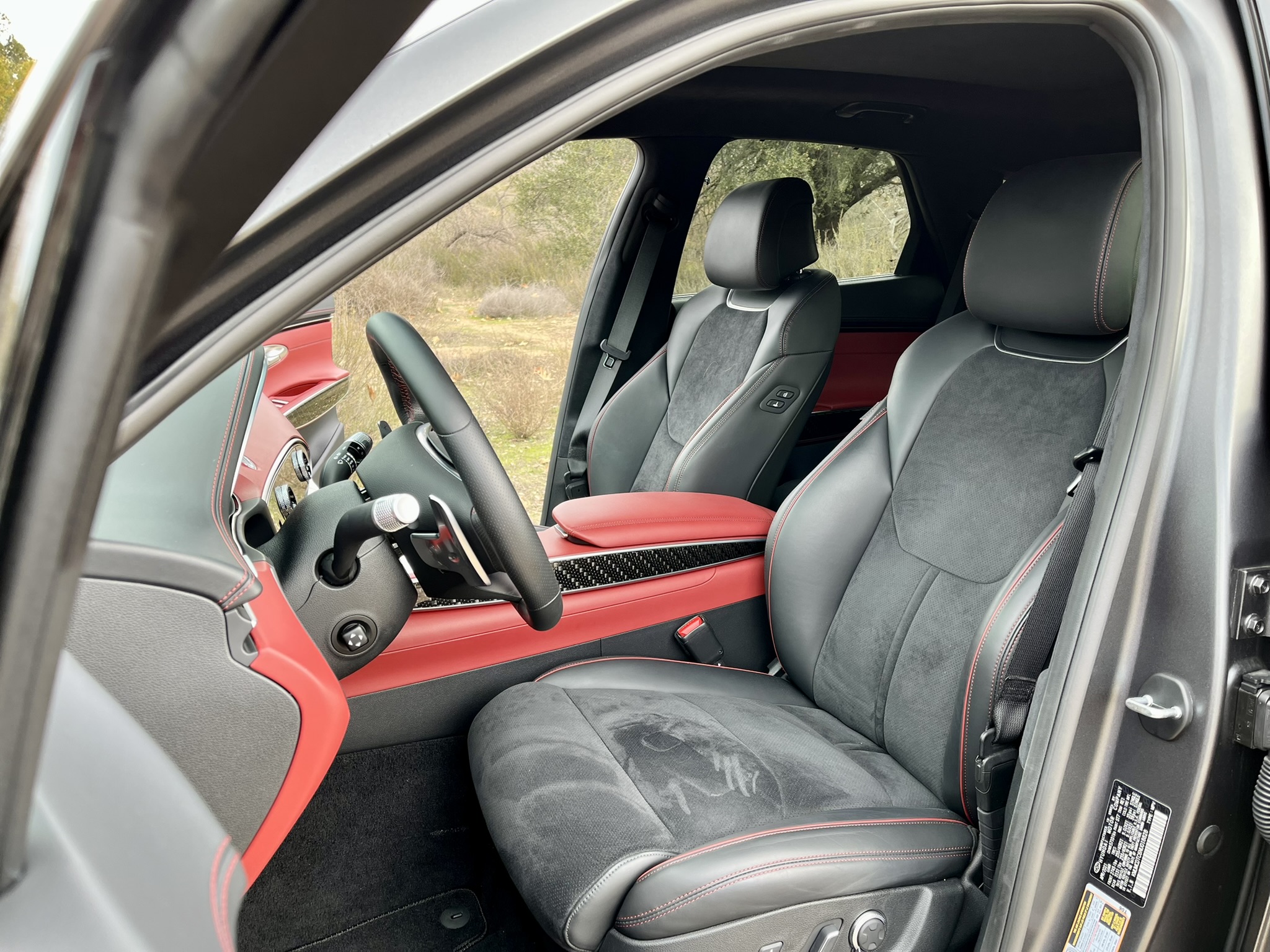
The front seats in the GV70

The Genesis GV70 shuts out the world with acoustic laminated glass.

Genesis GV70 Pricing

Globally, the GV70 drivetrain is rear-wheel drive with optional AWD. But in North America, the GV70 has standard all-wheel drive. There are two choices of turbocharged and direct-injected powertrains with eight-speed automatic transmissions. The electronic transmissions include steering wheel paddle shifters and selectable performance modes of Snow, Comfort, Eco, Sport, Sport-plus, and Custom, which allows individual preferences for steering weight, suspension firmness, etc.

GV70 2.5T AWD starts at $42,595. The 300-hp, single turbocharged 2.5-liter four-cylinder has 311 foot-pounds of peak torque from 1,650 to 4,000 rpm. Fuel-economy ratings are 22 mpg city, 28 highway, and 24 mpg combined, using the recommended premium fuel for peak performance.
GV70 3.5T starts at $54,195 and includes the standard Sport package of 19-inch alloy wheels, panoramic sunroof, and Highway Driving Assist II. The 375-hp, twin-turbocharged 3.5-liter V-6 has peak torque of 391 lb.-ft. from 1,300 to 4,500 rpm. Fuel-economy ratings are 19 mpg city, 25 highway, and 21 mpg combined, also using the recommended premium.

Today’s GV70 3.5T tester was $64,045. Options included the Melbourne Gray matte paint for $1,500, the Sport Advanced package, $5,000, and the Sport Prestige package, $4,900.

Of the 12 paint colors offered, only Alta White is a no-cost choice. The other hues are either $500 or $1,500. Interior color themes are black, red, or blue, depending on paint color.

Find current pricing and incentives for the GV70 here.

The red door panel of the GV70

There is satisfying quality to the artfully presented interior design.

GV70 3.5T Performance

I was not expecting the Genesis GV70 3.5T to be such a sleeper sport sedan, rich in visceral velocity. Dial up the performance mode of Sport-plus, pin the accelerator and the GV70 rears its beautiful head. This 4,451-pound SUV shows its German-inspired performance engineering with acceleration from 0 to 62 mph in 5.09 seconds, according to testing by Genesis Korea.

For the hot-shoe driver, there is a launch-control feature that when activated raises the engine speed to 2,000 rpm for the hole-shot.

Both GV70 engines have a manufactured “active engine sound,” but it is quite realistic. For good effect, the dual exhaust tips have downspout-sized proportions.

I did not like the V-6 engine’s auto stop-start at idle. It took just a split second too long to restart and it can be hesitant in stop-and-go traffic. In those situations, I switched off the system, but I do respect the potential for emissions and fuel savings.

Fuel Economy

Real world fuel-economy ratings are not far off the official ratings. In a week of testing, my driving averaged 16 mpg around town and I worked up to 21 mpg on the highway. Not good when crude oil is $130 a barrel. But the GV70 hauls ass when you need a defining validation for choosing the V-6.

The eight-speed automatic is almost intuitive at providing just the right gear at the right time. When driving for fun in Sport or Sport-plus, the transmission clicks off downshifts with just a brush of the brake pedal. Then the electronics hold the gear until you exit the corner and roll on power for the next twist. The transmission is so adept at being sporty that I seldom felt the need to use the steering-column shift paddles.

The 375-hp, twin-turbocharged 3.5-liter V-6 in the GV70 3.5T

The 375-hp, twin-turbocharged 3.5-liter V-6 in the GV70 3.5T.

GV70 3.5T Ride and Handling

Enjoy the traffic-calmed cabin, which is a good reason to buy a luxury vehicle. The Genesis GV70 shuts out the clamor with acoustic laminated glass at the windshield, front side, and rear side windows.

The body structure is as stiff as a full metal jacket, which reduces body flex and the resulting creaks and itchy sounds. Aerodynamic elements include the rear spoiler that helps smooth airflow at the top of the body and the front bumper air curtain that reduces airflow resistance around the sides and at the front wheels.

Road harshness is controlled by the tester’s 21-inch Michelin Primacy Touring tires, 255/40. The optional five-spoke sport alloy wheels — with sort of a twisted, waffled imprint — looked street wily with the Melbourne Gray paint.

E-Suspension

Genesis uses an electronically controlled suspension to minimize the vehicle’s body lean when cornering. And with electronic limited-slip differentials (part of the $4,900 Sport Prestige package), cornering levels are increased by distributing power left and right to the rear wheels, according to the road surface and driving conditions.

The e-suspension uses adaptive dampers with a road-preview feature. The system scans the road ahead and the sensors process that information in milliseconds to balance ride quality.

In my driving experience, the e-suspension gave precise turn-in responses, but it is not as magically smooth as a magnetorheological damper, such as is used in some performance vehicles. I experienced a few unexpected jolts along rough patches and noticeable head-toss across speed bumps.

With its towing capacity of 3,500 pounds and a full-bodied curb weight of 4,451 pounds, good brakes are essential. And the GV70 3.5T is prepared with ventilated four-wheel discs with 14.2-inch rotors at the front and 13.6-inch rotors rear. (2.5T models also have vented discs, with rotors that are 13.6 inches front, and 12.8 inches rear.

21-inch GV70 tire and wheel

Road harshness is well controlled by the Michelin Primacy Touring tires.

Driver Assist Technologies

Using a Level 2 driver-assist function is always helpful in heavy highway commuting. These systems keep watch when the driver doesn’t.

The Genesis system is reasonably consistent, but it will allow the vehicle to drift wide in a highway curve, crossing the white highway lines or Botts dots. The mapping for steering adjustments isn’t quite smooth and seems like an action of connecting the dots.

But I did appreciate the heads-up display (part of the Sport Prestige package). When using the driver-assist system, the HUD shows red alerts for side traffic. It is more visible during the day than warning lights in the side mirrors. And the heads-up display also shows gray profiles of nearby vehicles ahead and on either side.

Driver assist screen in the GV70

The Level 2 driver-assist system shows red alerts for side traffic.

GV70 Safety Features

The Insurance Institute for Highway Safety rated the Genesis GV70 a Top Safety Pick+ for 2021. The IIHS also gives Top Safety Pick+ ratings for the GV80 SUV, G80 executive sedan, and G90 flagship sedan.

The 2022 awards mark the third year in a row that the entire Genesis lineup of eligible vehicles has earned top honors.

All Genesis models are equipped with a comprehensive suite of state-of-the-art driver assistance and safety technologies including Forward Collision-Avoidance Assist with Pedestrian Detection, Lane Keeping Assist, and Blind-Spot Collision-Avoidance Assist.

Among eight air bags (including a front center air bag), other standard GV70 safety features include:

  • Forward Collision-Avoidance Assist with Junction Crossing and Turning. The system is intended to mitigate the risk of impacts when turning or crossing through an intersection;
  • Blind-Spot Collision-Avoidance Assist. This feature helps reduce the chance of potential impact with a moving vehicle when departing a parallel parking spot.
  • Advanced Rear Occupant Alert technology. Genesis says the GV70 is the first vehicle to feature radar-based detection of passengers in the rear seat, Genesis says. To alert drivers when a child or sleeping infant has been left in their seat, cabin sensors can detect when back-seat passengers move, and they can also detect small respiratory movements.
Double-line quad LED headlights on the GV70

Double-line quad LED headlights are intended to add a sense of speed.

GV70 Interior Function

There is a sweet spot of roominess in the GV70 cabin. Headroom with the panoramic sunroof is about 38 inches and should accommodate 95 percent of drivers; especially with legroom of 41.3 inches.

Sightlines are open across the fenders, with help from small corner glass at the windshield pillars. Over-the-shoulder views are somewhat slim but no worries when parking — the surround-view camera system with guidance lines has billboard proportions from the 14.5-inch high-definition infotainment screen at the top of the instrument panel.

The standard 16-way power driver seat can be electronically positioned by the optional Smart posture control. The feature will set an optimal position based on the driver’s height and weight. It also sets positions for the steering wheel, side mirrors, and head-up display. See the function here.

The front passenger has eight-away power adjustment — and both front seats are heated and ventilated. The passenger seat includes a “walk-in device,” which is merely a power switch for a back-seat occupant to move the seat forward for more legroom; it is a trickle-down feature from chauffeur-driven sedans.

The 3D electronic gauge array is unique with large dials for the speedometer and tachometer. The tach might have merit for the V-6 engine, but it is also is wasted space for most drivers.

There are two large flat dials on the shift console: one for the transmission and the other to access cabin functions, audio, and infotainment. The dials are similar in size, and in the first four days of driving my hand naturally fell to the dial for cabin function. In time, owners will gain the muscle memory to go straight for the shift dial.

GV70 back seat.

Rear legroom is adequate at 37.2 inches.

Back Seat and Cargo Space

Genesis provides a full luxury treatment to the back seat when some brands back off on the details and even soundproofing. Legroom is adequate at 37.2 inches — but hope for short people in the front seats. However, the doors open to near-90 degrees for easy entry, and the seats are comfortably supportive.

Cargo area of the GV70

Fold the back seat for 6 feet of length.

Cargo capacity is slightly compromised by the sloping roofline, but there is nearly 29 cubic feet of space behind the back seat, stacked to the headliner. The cargo opening is wide at 41 inches, and fold the 60/40 back seat for about 6 feet in length.

The area is finished in quality carpeting, with a pair of large side lights, and a slim storage area under the cargo floor.

Despite the $64K price, a cargo roller cover is not included but is available for $200. However, carpeted floor mats are included.

Sidelights in the cargo area of the GV70

Thick pile carpeting, large side lights (2), and robust seatback releases.

Why Buy the Genesis GV70 3.5T?

The Genesis brand is still an outlier among luxury auto buyers who might be more comfortable committing to an Audi, BMW, Lexus, or Mercedes-Benz. But, in 2020, J.D. Power named Genesis the most dependable automotive brand, and in 2021 the brand was lauded as the most technologically innovative in North America.

Time is money and the extensive warranty package is a time-saving answer to the GV70 $64,000 question.

A rear view of the Genesis GV70

Aerodynamic elements include the rear spoiler that helps smooth airflow.

Genesis GV70 3.5T Specifications

Body style: Compact, 5-seat 5-door SUV crossover in rear- or all-wheel drive

Engine: 375-hp, twin-turbocharged and direct-injected 3.5-liter V-6 with auto stop-start at idle; 391 lb.-ft. torque from 1,300-4,500 rpm

Transmission: 8-speed automatic with paddle shifters and 5 drive modes

Fuel economy: 19/25/21 mpg city/hwy/combined; premium fuel recommended for peak power

Max. towing capacity: 3,500 lbs. with trailer brakes

BY THE NUMBERS

Fuel tank: 17.43 gallons

Cargo space: 28.9 to 56.9 cubic feet

Front head/leg room: 39.6*/41.3 in. *without moonroof

Rear head/leg room: 39.1/37.2 in.

Length/wheelbase: 185.6/113.2 in.

Curb weight: 4,451 lbs.

Turning circle: 37.7 ft.

FEATURES

3.5T Standard equipment includes: Smartkey entry and locking with push-button ignition, with Nappa leather-trimmed upholstery, 16-way power driver seat (with power side bolsters and seat cushion), 14.5-inch high-definition infotainment screen, 12.3-inch 3D digital gauge array, 8-way power front passenger seat (with walk-in device), heated and ventilated front seats, 2 front USBs (data and charge) and 2 rear charging USBs, 9-speaker audio system with Android Auto and Apple CarPlay, electric parking brake with automatic hold, full LED lighting (headlights, taillights, running lights, and side mirror turn signals), power folding and heated (with a timer) side mirrors, outside approach lights with Genesis logo (at side mirrors), power one-touch panoramic sunroof, solar control tinted side and rear glass, acoustic laminated glass (windshield, front side and rear side windows), carpeted floor mats, power tilt-telescoping steering wheel, smart cruise control with stop-and-go, wireless charging, locking glove box, surround-view camera system with guidance lines

Packages on tester

Sport Advanced package, $5,000: Nappa Leather Seating Surfaces with Sport Pattern Quilting; Layered Edge Backlit Trim; Leatherette Upper Instrument and Door Panels; Suede Headliner; Heated Steering Wheel; Genesis Digital Key; Surround View Monitor; Blind-Spot View Monitor; Remote Smart Parking Assist
Parking Distance Warning – Front; Parking Collision-Avoidance Assist – Rear; Lexicon Premium Audio with 16-Speakers

Sport Prestige package, $4,900: 21-inch Sport Alloy Wheels; Electronic Limited Slip Differential; Nappa Leather Seating Surfaces with Suede Insert; Carbon Fiber Trim; Heated 2nd Row Seats; Manual Rear Side Sunshades; Acoustic Rear Door Glass; 3-Zone Climate control; 12.3-inch 3D Digital Cluster
Heads-Up Display

Safety features include: 8 air bags, Forward Collision Avoidance-Assist with Pedestrian and Cyclist Detection, Lane-Change Oncoming, and Junction Turning Highway Driving Assist; Driver Attention Warning; Lane Keeping Assist and Lane Following Assist; Blind-Spot Collision-Avoidance Assist; Rear Cross-Traffic Collision-Avoidance Assist; Safe Exit Assist; Intelligent Speed Limit Assist; Park Distance Warning – Rear; Launch Control and Hill Start Assist Control Vehicle Stability Management with stability and traction controls

PRICING

Base price: $53,645, including $1,045 freight charge; price as tested $64,045

Options on test vehicle: Melbourne Gray matte paint $500; Sport Advanced package, $5,000; Sport Prestige package, $4,900;

Where assembled: Ulsan, Korea

Warranties: 5-years/60,000-miles bumper to bumper; 10-years/100,000-miles powertrain; Genesis Service Valet for 3 years or 36,000 miles provides a remote diagnostic check, vehicle pick up, and a loaner vehicle and return of the vehicle