Select Page

Maserati Boomerang Turns 50

Maserati Boomerang Turns 50
Maser Boomerang concept

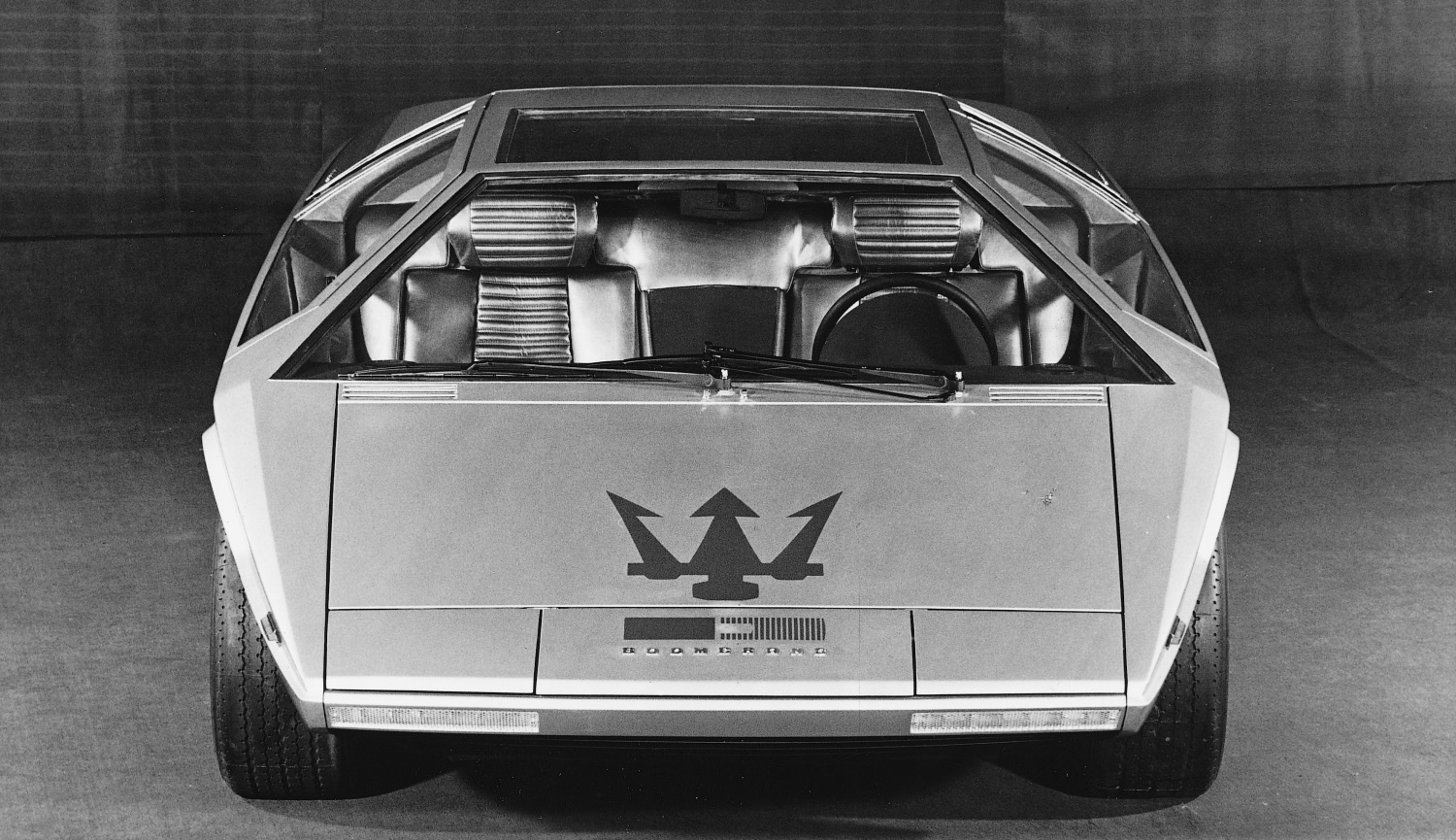
The 1972 Maserati Boomerang concept conveyed an image of penetration, power and speed. (Photos courtesy of Maserati)

The Maserati Boomerang concept defined Maserati as a brand of iconic and avant-garde cars that  pioneered technology and style

BY MARK MAYNARD

A half century has passed since the Maserati Boomerang debuted at the Geneva Motor Show on March 9, 1972. It was a one-off concept created by the renowned Giorgetto Giugiaro and produced by Italdesign. Only one car was ever produced.

The Maserati Boomerang concept made an appearance at the 1971 Turin Motor Show.  And it was presented at the Geneva motor show in 1972 as a registered vehicle that ran perfectly, Maserati said in a release.

Italdesign started with the Maserati Bora for the Boomerang’s chassis and mechanics. The powertrain was a rear-mounted, 90-degree 4.7-liter V-8 engine. Channeled through a five-speed ZF manual gearbox, the 310-hp Bora would have a top speed of almost 186 mph (300 km/h).

A red Maserati Bora

The Maserati Bora.

The two-seat Maserati Boomerang sports coupé never went into production. But its stylistic legacy continued Giugiaro’s later creations. And it was inspiration for other automakers in Europe and the United States.

The influence of the Boomerang’s wedge shape can be seen in the 1973 Audi Asso di Picche concept, 1973 VW Passat Mk1, 1974 VW Golf Mk1, 1976 Lotus Esprit and Medici II show car, 1979 Lancia Delta and Maserati Quattroporte III, and 1976 designed and 1981 launched DeLorean.

Maserati Boomerang side view

The Maserati Bora was used for the Boomerang’s foundation.

Design Elements

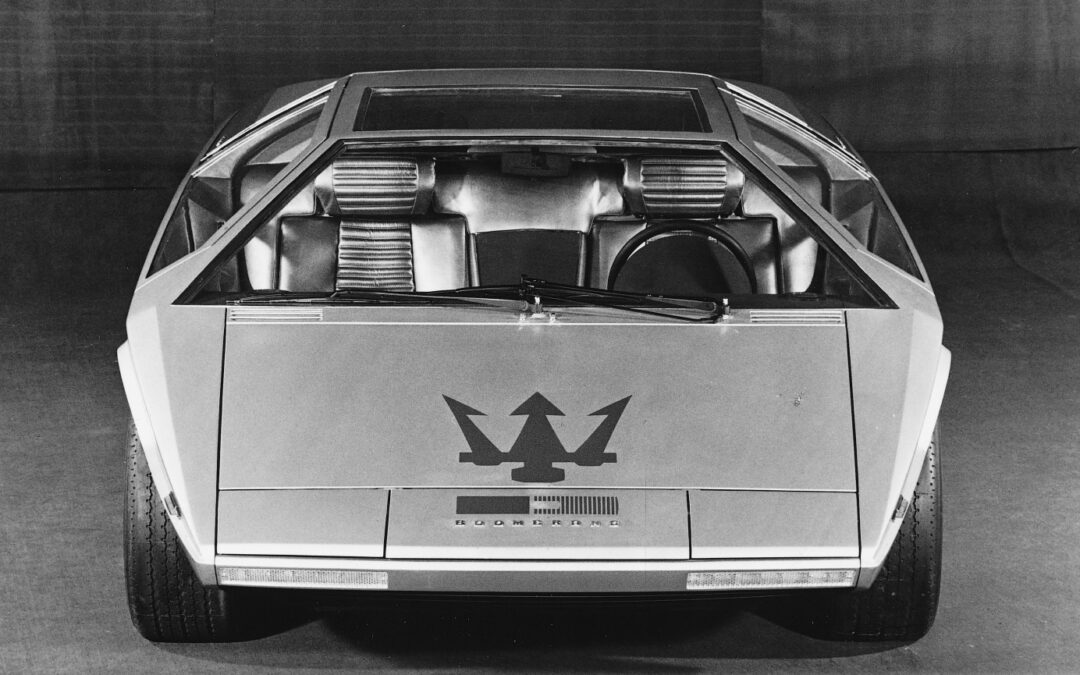
The originality of the Maserati Boomerang was in its wedge shape and bold lines. The stance conveyed an image of penetration, power, and speed.

Stylistically, a horizontal line divided the Boomerang in two with a sloping windscreen and a panoramic sunroof. The original windows of the doors were divided by a metal strip. And the retractable square headlamps stood out, with horizontal lights in the rear.

A head-on view of the Boomerage

The Boomerang’s dashboard instruments were built into the spokeless steering wheel and the wheel rotated around the stationary gauges.

The interior was extremely modern and introduced fresh ideas. For example, the dashboard instruments were built into the spokeless steering wheel, and the seats were positioned very low.

The one production version of the Boomerang made other appearances in international competitions. It would change hands between various owners, and ended up as the feature car in a number of auctions; it was even used in commercials.

Considered by many to be a work of art, the Maserati Boomerang was revolutionary and influenced the designs of successive cars. It continued to define Maserati as a brand capable of creating unique automotive concepts, iconic and avant-garde cars that acted as pioneers of technology and style.

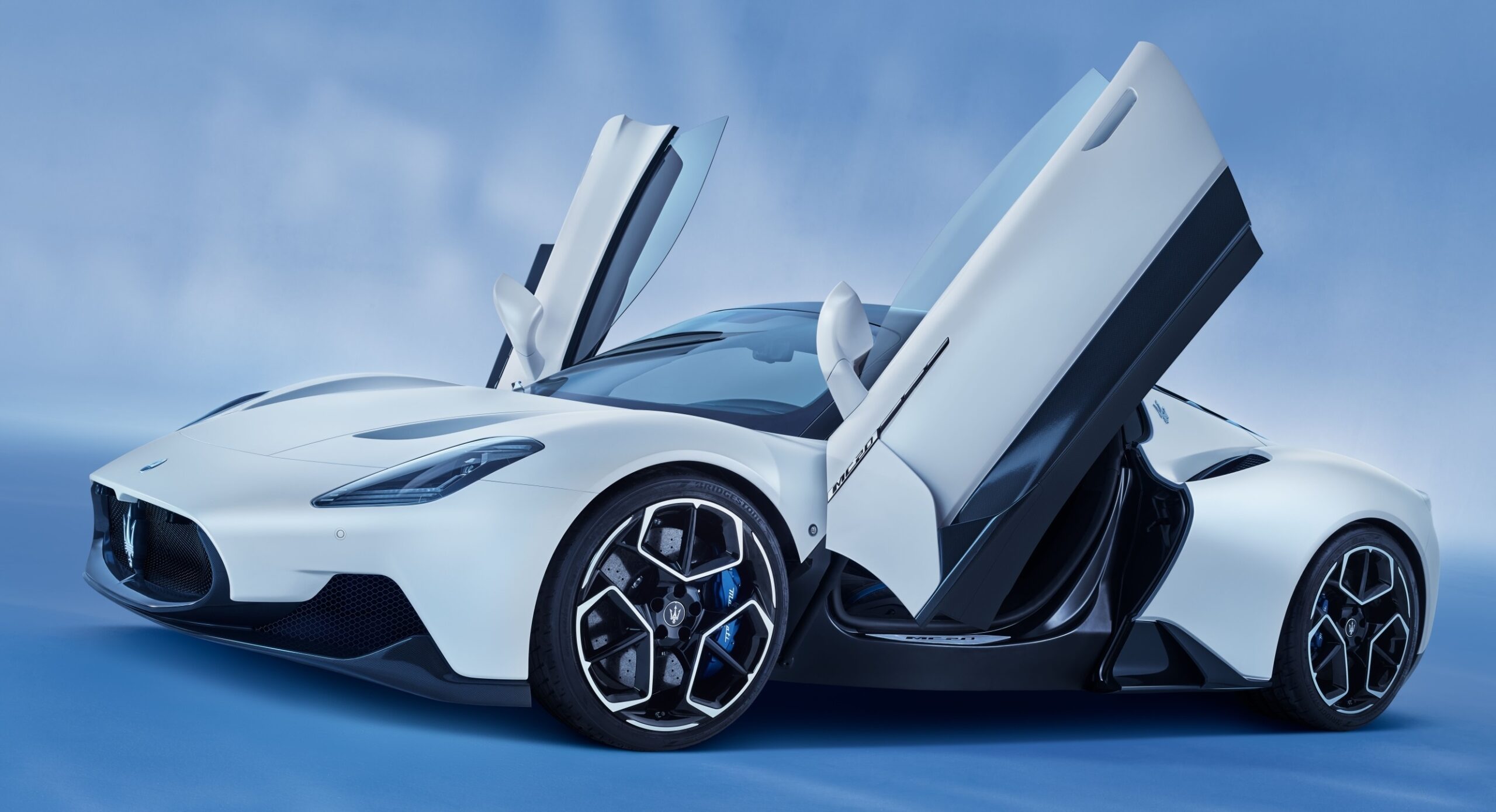
The Maserati MC20 supercar.

The Maserati MC20 supercar.

The Future for Maserati

Now more than ever, Maserati is unique for its design and innovation. It is moving forward with the new Grecale SUV and the 621-hp, MC20 super sports car. The 2022 MC20 debuts Maserati’s in-house designed new 3.0-liter V-6 Nettuno engine  that applies F1 technology for a road car. MC20 pricing starts at $212,000.

The Maserati Grecale prototype in camouflage.

Details for the Maserati Grecale small SUV will be released March 22.

VW ID Buzz World Premiere

VW ID Buzz World Premiere

European models of the VW ID Buzz go on sale this year, followed by a long-wheelbase passenger model for North America in 2024

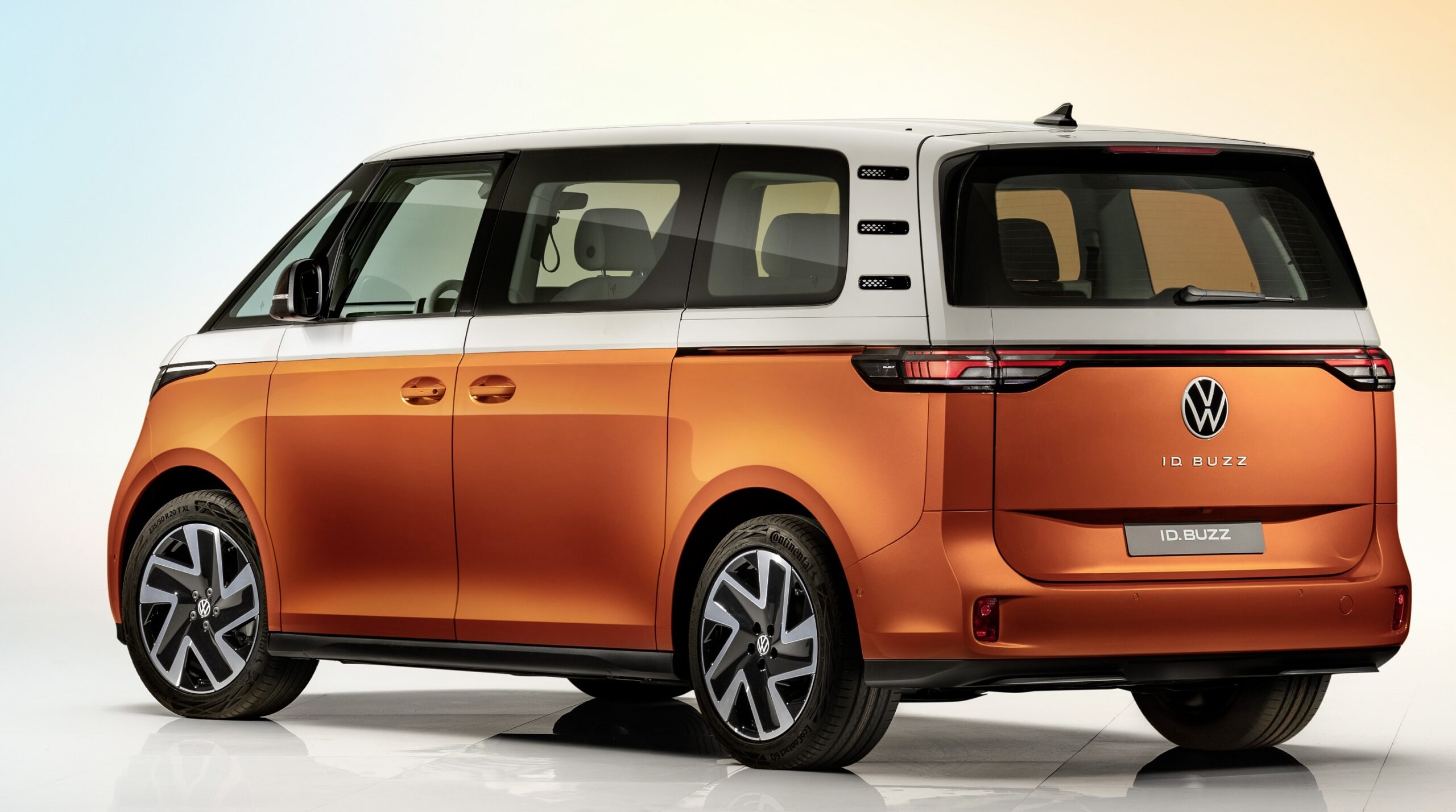
An ID.Buzz in two-tone Energetic Orange and Candy White

Two-tone VW ID Buzz models will have the roof, upper areas and hood finished in Candy White. Areas below the character line are in a choice of four shades, such as this hue of Energetic Orange. (Photos courtesy of Volkswagen)

Table of Contents

Powertrain
Dimensions
Paint Colors
Interior Design
Cabin Electronics
Interactive ‘ID Light’
Driver Assist Systems
Sustainability

BY MARK MAYNARD

Official photos and many details were released today, March 9, for the much-anticipated debut of the electric-powered VW ID Buzz and ID Buzz Cargo. Both body styles, passenger and cargo variants, will go on sale in European markets in the third quarter of this year. For the U.S., a long-wheelbase passenger model will debut in 2023 and go on sale in 2024.

The zero-tailpipe emission vehicles transfer the design of the iconic 1950 Type 2 Microbus to the era of electric mobility. However, the ID Buzz is not the first microbus with an electric drivetrain. Fifty years ago at the Hannover Trade Fair Volkswagen showed a T2 bus powered by a rear-mounted electric motor with a maximum range of 52.8 miles.

ID Buzz Powertrain

European versions of the VW ID Buzz and ID Buzz Cargo will come to market with a high-voltage lithium-ion battery providing gross energy content of 82 kWh (77 kWh usable). With its 12 modules, the battery system supplies a 201 horsepower electric motor, driving the rear axle, with maximum torque of 229 foot-pounds. The top speed is limited to 90 mph.

The electric driving range of either model of VW ID Buzz has not been released. But industry sources report that the U.S. version will have a larger battery and electric driving range of around 260 miles. A dual-motor, all-wheel-drive configuration is expected to be added later. Details for the U.S. version will be available closer to launch.

The battery is mounted in the floor of the vehicle. An 11 kW (AC) charger is included for home and Level 2 systems. The ID Buzz also will have a CCS plug connector for use at DC fast-charging stations, at which the charging power increases to as much as 170 kW.

With DC-fast charging, the battery charge level rises from 5 to 80 percent in just 30 minutes, Volkswagen says. In the future, a Plug & Charge function will be offered.

For Europe, bi-directional charging will enable the VW ID Buzz and ID Buzz Cargo to feed power that they don’t need into the domestic grid (vehicle-to-home). VW says this can also make the power available for stabilizing the power grid. The power transfer and communication take place via an optional DC bi-directional wall box.

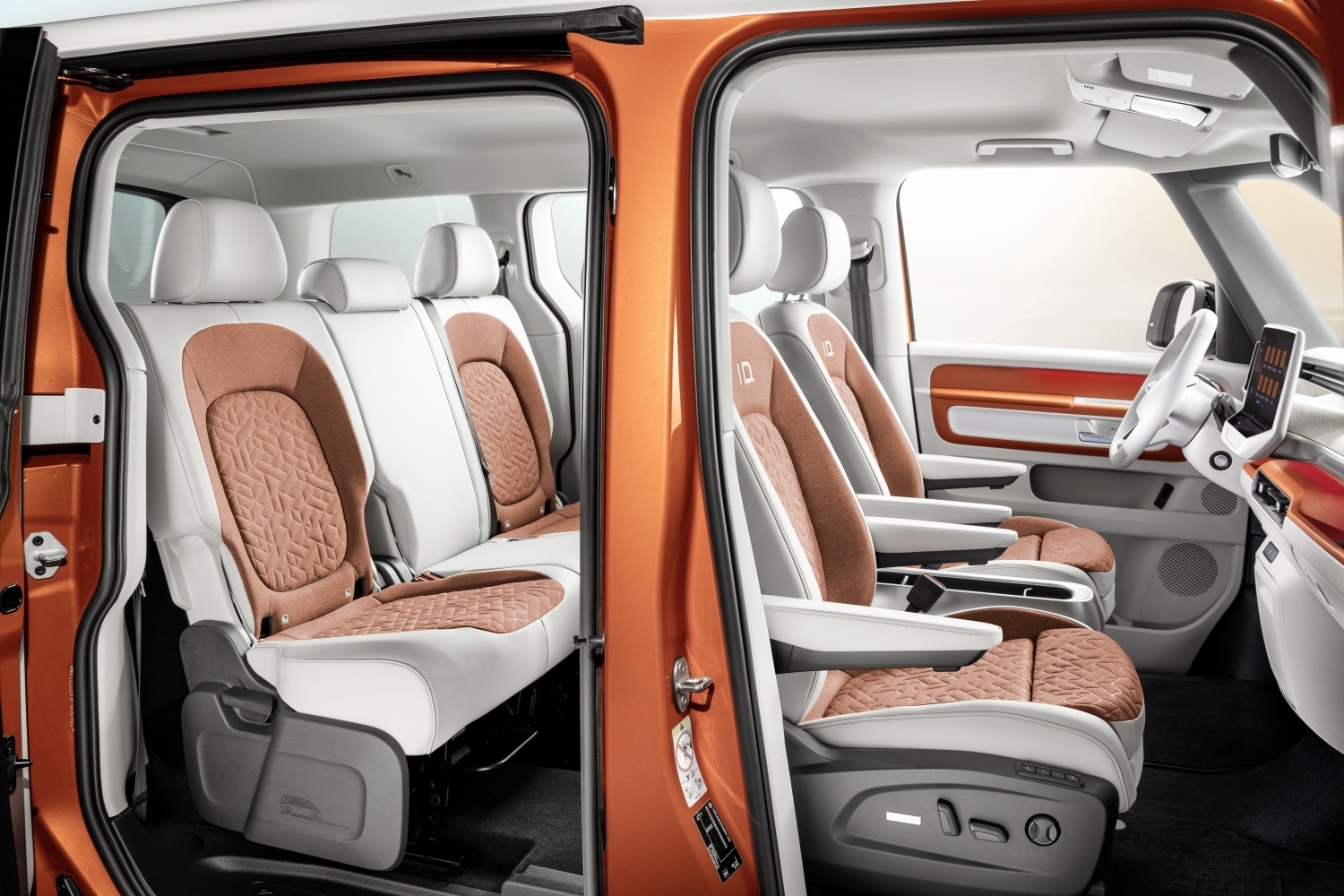
VW ID Buzz front seats

Sustainability measures include replacing leather with non-animal material.

ID Buzz Dimensions

On a wheelbase of 117.6 inches, both ID Buzz models are 185.5 inches long, 76.3 inches tall, and 78.1 inches wide, not including the side mirrors.

The ID Buzz has full LED lighting. At the front, are charismatically styled headlights, daytime running lights, and a slim lateral bar between the headlights.

In an homage to the original microbus, the VW logo is much larger than all other current Volkswagens. At the back, the ID Buzz has horizontally arranged LED taillights, which are connected by a full-width light strip.

ID Buzz Paint Colors

European versions of the passenger and cargo models will be available in base colors or two-tone styles. The spectrum consists of 11 single-color choices of Candy White (nonmetallic), Mono Silver, Lime Yellow, Starlight Blue, Energetic Orange, Bay Leaf Green, and Deep Black.

There will be four two-tone options. On two-tone ID Buzz models, the upper section, including roof and V-shaped hood, is finished in Candy White, while the areas below the character line are in a choice of four shades: Lime Yellow, Starlight Blue, Energetic Orange or Bay Leaf Green. Side mirrors and door handles are finished in body color.

Both European ID Buzz versions will come with 18-inch steel wheels as standard. On passenger vehicle models, aluminum-alloy wheels are available in sizes ranging from 18 to 21 inches.

ID Buzz two-tone paint colors

At the back, horizontal LED taillights are connected by a full-width light strip.

Interior Design

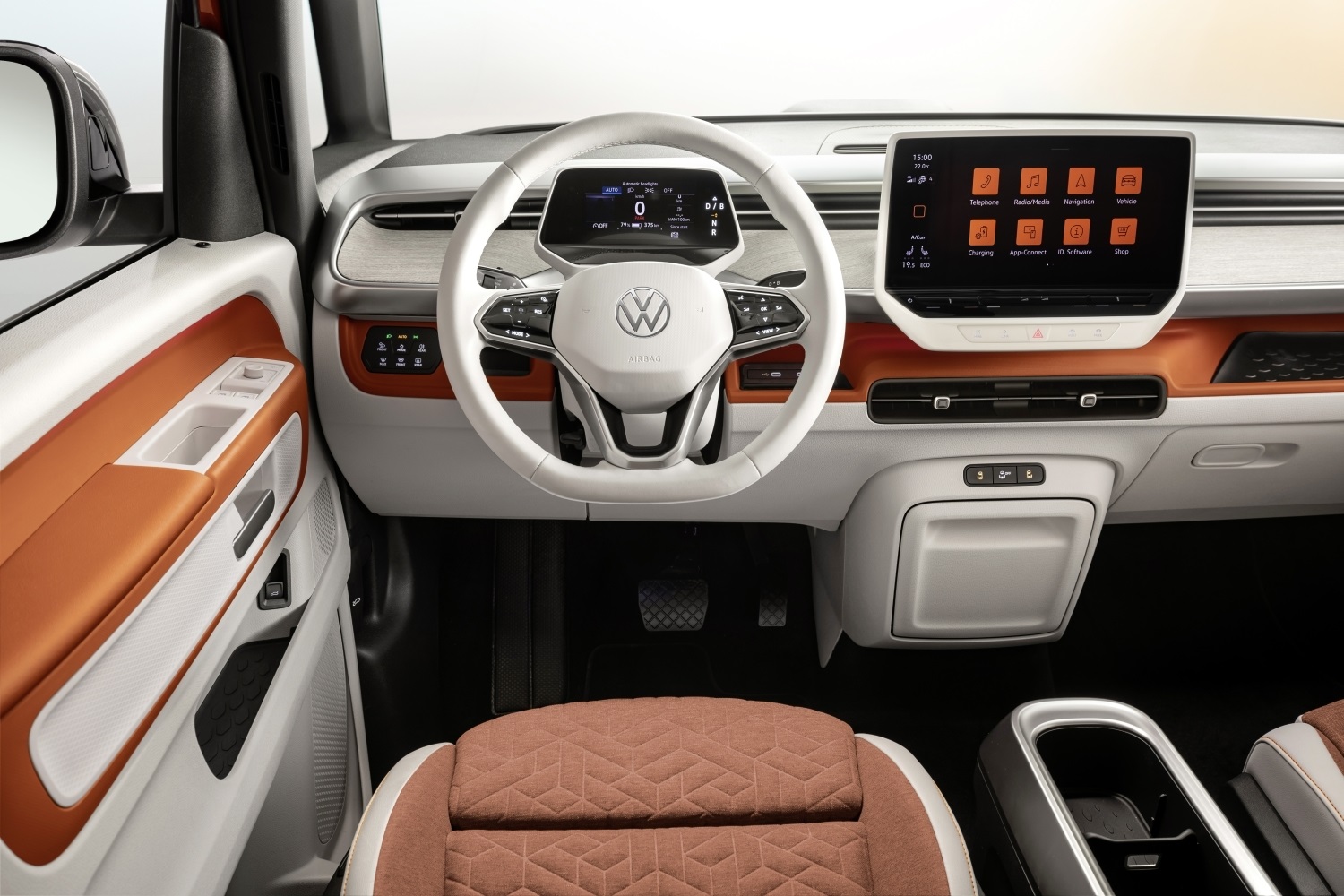
For passenger models of the ID Buzz, drivers will face a standard 10-inch Digital Cockpit display, which is paired with a 10-inch infotainment system centrally positioned in the dashboard. A 12-inch display with navigation is optional.

Both the Digital Cockpit and infotainment system are connected with the instrument panel only at the bottom, looking like free-floating tablets.

Beneath the infotainment system is a control bar with digital buttons and touch sliders to regulate temperature and audio volume. The digital buttons provide direct access to menus for the dual-zone Climatronic settings, driver assist systems, driving profiles, and parking functions.

The ID Buzz Cargo will launch with three seats in the cab as standard. The extended wheelbase version for North America will have a seven-seat configuration in three rows of 2/3/2 arrangement. The three-person bench in the second row can be folded flat or split 60/40, and it can be moved lengthways 5.9 inches.

Cargo capacity of 39.6 cubic feet will be expandable by an optional height-adjustable cargo floor to create a level load surface. Two side sliding doors are fitted as standard.

Driver area of the Buzz

The Digital Cockpit and infotainment screens appear as free-floating tablets.

Cabin Electronics

To the left of the multifunction steering wheel, there is an island of digital controls for activating the light functions, heating, and defrost for the windshield and rear window. To the right of the steering wheel are two USB-C plugs and a tray for wireless charging (wireless App-Connect is also standard).

In the center console, there are, depending on specification, two more USB-C plugs; there is a fifth in the front passenger door, another in each of the two sliding doors, and one by the rearview mirror for a dashcam.

Two cupholders fold out from the lower dashboard area. In the ID Buzz Cargo, there are two more cupholders near the A-pillars.

Side entry of the new VW microbus

U.S. models of the ID.Buzz will have three rows and seven seats.

Interactive ‘ID Light’

As with other models of Volkswagen’s all-electric vehicle family, the new ID Buzz comes with the interactive ID Light. It stretches across in front of the windshield in the driver’s field of vision above the instrument panel. The head-up style of display gives the driver information based on the color and position of the light signal. For example, a signal in the right-hand area of the strip advises of obstructions in this area or corresponds with a navigation instruction to change lanes. When the ID Light goes red, it is signaling danger and the need to brake.

Driver Assist Systems

European five-seater ID Buzz models are equipped with standard Front Assist, Lane Assist, and Dynamic Road Sign Display. Optional systems include Adaptive Cruise Control, Side Assist, Travel Assist, Emergency Assist, Park Assist, Light Assist, and Area View.

The open cargo area

An optional height-adjustable cargo floor will create a level load surface.

Sustainability

Both versions of ID Buzz are designed with sustainable measures, such as not using leather in the vehicle. The steering wheel cover is made of polyurethane but has a high-quality appearance and feels like leather.

Seat-cover materials, floor coverings, and the headliner of the ID Buzz incorporate recycled material. There will be a fabric made of what is known as Seaqual yarn. Its fibers consist of 10 percent collected ocean plastic and 90 percent recycled plastic bottles.

The two ID Buzz models will also use organically based vehicle paint and forgo cobalt in the high-voltage battery. The company’s sustainability measures include a plant that recycles the high-voltage batteries at the end of their automotive life cycle to prepare them for a second use.

The VW ID Buzz and ID Buzz Cargo models are being produced by Volkswagen Commercial Vehicles at its main plant in Hannover, Germany.

Toyota Sit-Ski Debuts at Paralympic Winter Games

Toyota Sit-Ski Debuts at Paralympic Winter Games
Two-time Paralympic medalist and Global Team Toyota Athlete Andrew Kurka is one of the two Team USA alpine skiers set to compete in the Toyota Sit-Ski at the Beijing 2022 Paralympic Winter Games.

Two Team USA alpine skiers will use the Toyota Sit-Ski at the Beijing 2022 Paralympic Winter Games. (Photos courtesy of Toyota USA)

Toyota Motor North America and Toyota Racing Development Create Sit-Ski for Use by U.S. Paralympics Alpine Skiing

BY MARK MAYNARD

Toyota announced today on the opening of the Beijing 2022 Paralympic Winter Games its technologically advanced Toyota Sit-Ski.

Seven-time Paralympic medalist Laurie Stephens and two-time Paralympic medalist Andrew Kurka are the two Team USA alpine skiers who are set to compete in the Toyota Sit-Ski at the Beijing 2022 Paralympic Winter Games. The competitions begin today and will run through March 13.

“There is no better global event than the Paralympics for Toyota to reinforce our passionate belief that everyone has the right to freedom of movement in an inclusive society,” Lisa Materazzo, group vice president, Toyota Marketing, Toyota Motor North America, said in a release.

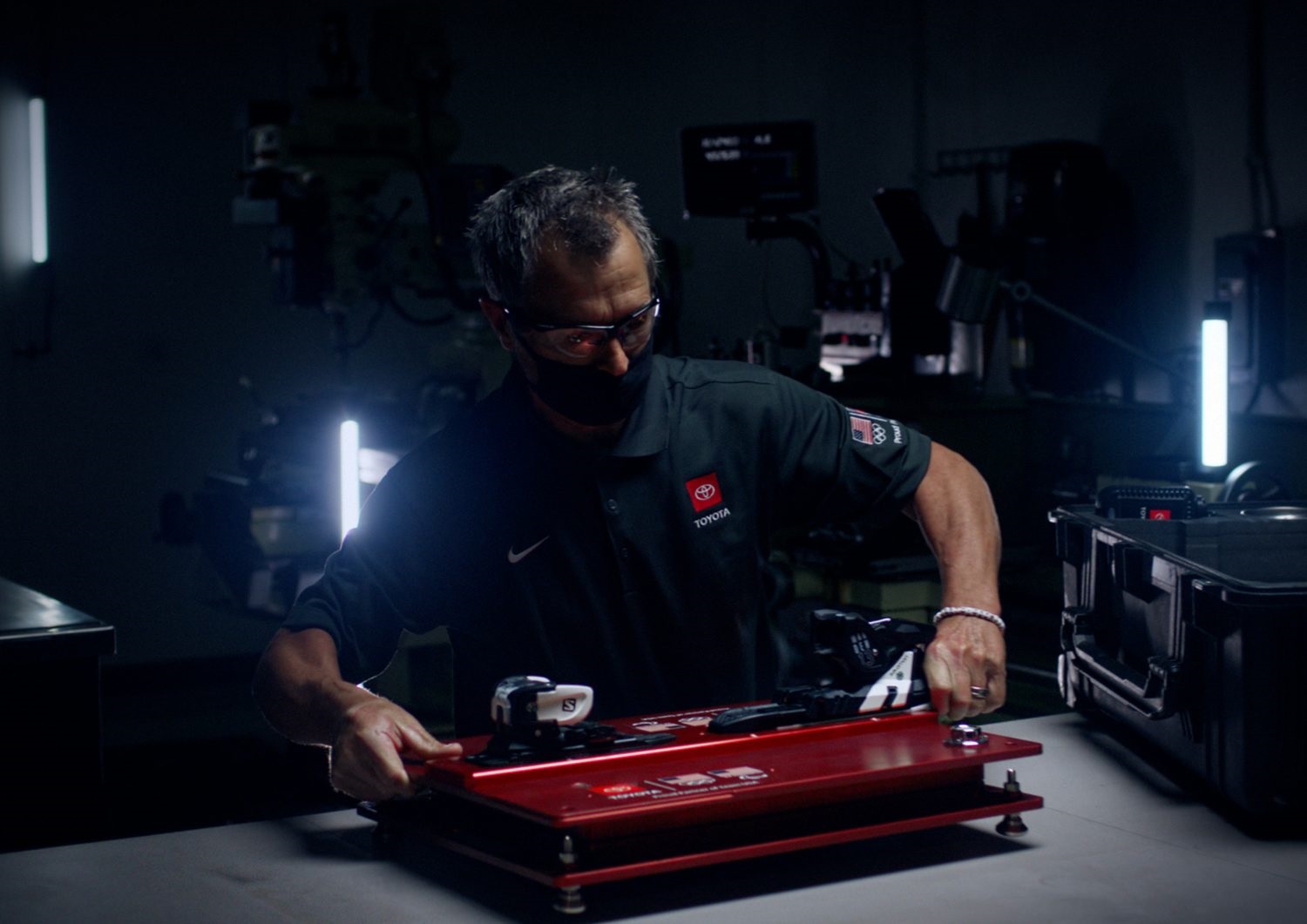
A team of engineers and technicians developed a sit-ski from the bottom up.

The monoski was developed by Toyota Motor North America and Toyota Racing Development USA. A behind-the-scenes look at the engineering and technology that went into the rig can be viewed at ToyotaSitSki.com. The multi-episode video series was created in partnership with Media.Monks, a Toyota production partner in the U.S.

“There’s a lot of pressure on me especially going into Beijing to not only win but to represent my country and to set myself up for the future,” said Kurka, who is also a Team Toyota athlete. “I’m a very particular sit-skier because my life is on the line when I’m out there and I want to make sure that not only am I safe, but I’m fast. Win, lose or draw, the Toyota Sit-Ski is an awesome monoski.”

Toyota is giving sports fans and racing enthusiasts an exclusive, behind-the-scenes look at the development of the Toyota Sit-Ski project in a new multi-episode video series.

Toyota created a multi-episode video series about sit-ski project.

Real-World Testing

Testing of the monoski began in late 2019. Five-time Paralympian Chris Devlin-Young lent his expertise in testing the sit-ski and providing feedback along the way. Project focus areas include the suspension system, seating position and fit, and mechanical changes based on the disciplines within para-alpine skiing.

“It will be an incredible moment when we see the Toyota Sit-Ski come down the hill for the first time in Paralympic competition given the team’s heart and soul that has gone into this project,” David Wilson, group vice president and president, Toyota Racing Development USA, said in the release.

Paralympic medalist Andrew Kurka talks with the team at Toyota Racing Development USA about the Toyota Sit-Ski project.

Paralympian Andrew Kurka contributes to the Toyota Sit-Ski project.

Toyota and the Paralympic Movement

Toyota has been an active supporter of Paralympic athletes and adaptive sports.

In 2015, the company became the official worldwide mobility partner of the Olympic and Paralympic Committees for the 2017-2024 period.

In addition, Toyota is a proud partner of Team USA and several Paralympic National Governing Bodies and Paralympic national teams, including:

Toyota also has long-standing relationships with Adaptive Action Sports  and Challenged Athletes Foundation. In addition, Toyota has featured two U.S. Paralympians in Big Game commercials (Amy Purdy in 2015 and Jessica Long in 2021).

The innovative Toyota Sit-Ski in action.

Toyota U.S. Paralympic Fund

To date, more than 430 U.S. Paralympic athletes and hopefuls have received direct support from the more than $4.9 million raised for the Toyota U.S. Paralympic Fund. Toyota is also offering opportunities to athletes named to the U.S. Paralympic Team for the Tokyo and Beijing Games.

Volvo XC40 Recharge Review

Volvo XC40 Recharge Review

The XC40 Recharge is the best of Volvo’s past and the brightest from Volvo’s future, the company says

The 2022 Volvo XC40 Recharge small SUV.

The 2022 Volvo XC40 Recharge is sold in two trim levels of Plus and Ultimate with permanent all-wheel drive. Pricing starts at $56,395. (Volvo Cars photos)

Table of Contents

Overview
Pricing
Rebates and Incentives
Electric Power
Performance
Charging
Safety Features
Interior Function
Back Seats and Cargo
The Good, the Bad, and the Awkward
Why Buy the Volvo XC40 Recharge?
Specifications

BY MARK MAYNARD

To look at the Volvo XC40 Recharge, you might not see a 402-horsepower all-wheel-drive electric SUV. But at 4.7 seconds to 60 mph, it is a new-age muscle car with Swedish politeness. The XC40 Recharge is quicker to 60 than most of its EV colleagues — and even a few gasoline-powered muscle cars.

Volvo says the XC40 Recharge will accelerate from 0-60 mph in 4.7 seconds.

But with quickness comes compromise. Despite Volvo’s posted driving range of 233 miles, the XC40’s two 201-hp electric motors suck the juice at a concerning rate. Along the way, however, the XC40 Recharge is a real charmer — at a price.

Welcome to Volvoland. Things here are not always as they seem.

Interior design is minimalist.

XC40 Recharge Overview

The XC40 Recharge is Volvo’s first battery-electric vehicle. It debuted in 2020 as “the future of Volvo Cars,” and it is the company’s most decisive step to date on its drive toward being “climate neutral” by 2040.

“Rather than just building and selling premium cars, we will provide our customers with the freedom to move in a personal, sustainable and safe way,” Volvo Car Group CEO Håkan Samuelsson said in the press kit.

Volvo C40 Recharge EV

The Volvo C40 Recharge.

Joining Volvo’s campaign to all-out electrification is the just-released 2022 C40 Recharge. It is a sport-roof variant of the XC40 and has a one-trim-level comprehensive starting price of $59,845. Its battery powertrain and driving range are the same as the XC40 Recharge.
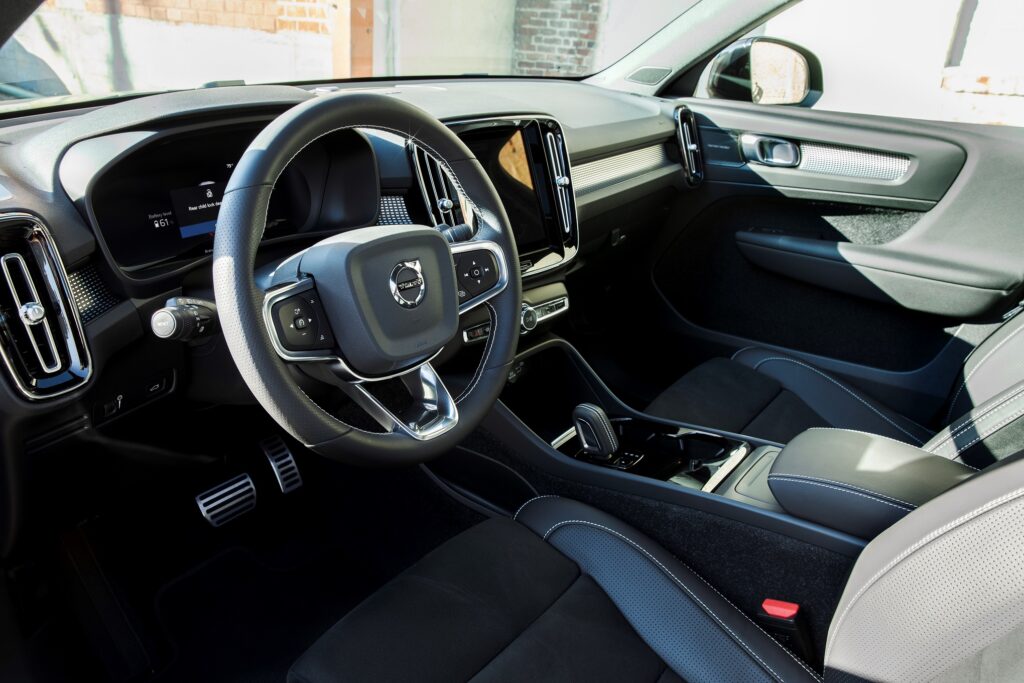
Driver area of the XC40

Headroom is surprisingly accommodating for tall drivers.

Swedish Unique

Volvo’s XC40 began life as a 2019 model with a turbocharged four-cylinder gas-powered engine. When I tested that version, its interior gave the impression of an electric vehicle — lean and open with reconfigured space. Most obvious was the open door-panel storage. The audio speakers were moved from the lower door panels to create voluminous storage space.

The XC40 Recharge slips into those same shoes, with its own innovations. My first excursion behind the wheel was an awakening. There is no ignition button. The driver’s weight on the seat starts the car. Just buckle up and go. To turn off the car, just step out and lock the door.

And there is no physical parking brake. It engages automatically when parked and releases on driveaway.

This utterly new procedure seemed odd and more of a gimmick than an enhancement. But after a few days’ experience, it seemed a smart bypass to get me on the move a few seconds quicker.

Volvo design applies some of the more thoughtful features in a vehicle. One example is the little wastebasket in the front center armrest console. It is so much classier than wadding up papers and stuffing them into a cup holder, or door panel. And then there are the jacket hooks built onto the B-pillars, or the folding hook on the glove compartment door to hold take-out bags.

Volvo claims to be the first major automaker to bring Google Services into the car, which Volvo says is a paradigm shift in the way people interact with their vehicles. It is a suite of Google Maps, Google Voice, Google Assistant, and Google Play Store.

XC40 Panoramic roof

The panoramic moonroof is a standard feature.

XC40 Recharge Pricing

The XC40 Recharge is sold in two trim levels of Plus and Ultimate with permanent all-wheel drive. The Plus starts at $56,395, including the $1,095 freight charge from Ghent, Belgium. The Ultimate, today’s tester, is a $2,850 package. Included with the MSRP are 250kW of DC Fast Charging and a year’s subscription to discounted energy with Electrify America.

Both models are luxury class in standard equipment and include such features as keyless entry with push-button ignition, Nubuck and fabric upholstery, heated front seats, front seat cushion extenders, high-performance audio system with Bluetooth phone and audio, smartphone charging, and a laminated panoramic moonroof.

Features in the Ultimate package include keyless entry and keyless drive; a heat pump for cabin heating (rather than electric heating); 360-degree surround-view camera; Harmon Kardon audio system; removable and folding cargo floor; a power tailgate; power front passenger seat; headlight pressure washing and heated washer nozzles; Pilot Assist driver-assistance system; adaptive cruise control; heated rear seats; and 20-inch black-diamond cut alloy wheels

The new-vehicle warranty covers 4 years or 50,000 miles with roadside assistance. And there is free factory scheduled maintenance and wear coverage for the first 4 years or 40,000 miles. Among the wear items are brake rotors and brake pads (as needed), and, front and rear wiper blades.

Charging cable storage in the front trunk.

Charging cable storage in the front trunk.

Rebates and Incentives

Easing some sticker shock of the XC40 Recharge is a still-available $7,500 federal tax credit. And there also might be regional rebates, such as the Clean Fuel Reward of $750, presented by the California Air Resources Board.

Also available for low- and moderate-income residents in San Diego County is the MAAC Electric Vehicle Access Program (Metropolitan Area Advisory Committee). Interested buyers can apply for incentives and rebates of up to $11,000 to lower the purchase price of pre-owned and new EVs, including plug-in hybrids.

In addition, a $1,000 point-of-sale rebate is available from San Diego Gas & Electric to teachers and first responders in San Diego County.

XC40 Recharge Electric Power

Powered by two 201 horsepower electric motors, the XC40 Recharge has a total system output of 402 horsepower. And the robust 486 foot-pounds of torque are instantly available. As with most all-wheel-drive electric vehicles, one motor powers the front wheels, and the other drives the rear. The motors, controller, and battery are liquid-cooled.

The 78 kWh lithium battery pack, of which 75 kWh is usable, is EPA-rated for a driving range of 223 miles. But that range is when the battery is charged to 100 percent, which Volvo does not recommend. To prolong battery life, Volvo recommends charging to 90 percent, which translates to a driving range of around 190 miles. But that range will vary with the terrain or driver enthusiasm.

Comprised of 78 modules of 12 cells each in three parallel stacks, lithium battery pack is integrated into the floor and what was the exhaust-AWD tube). The modules are individually repairable, Volvo says. And the battery pack is protected by an extruded aluminum safety cage.

Volvo XC40 Recharge driveline.

A second view of the skateboard battery showing the seats.

What Is a Heat Pump?

The entry-level Volvo XC40 Recharge has an electric cabin heater, but the Ultimate model gets a heat pump. The difference might be a bit more range with the heat pump, which draws less electrical power from the battery pack.

EVs don’t produce much heat and require special heating systems. Heat pumps prevent excess heat created by an EV’s battery and drivetrain from going to waste. They absorb the excess heat generated by the EV‘s battery and drivetrain to improve the car‘s efficiency, range, and driving experience.

The heat pump functions somewhat like an air conditioner in reverse. This means that the EV doesn’t need to use its battery to power a traditional resistive or electric heater to warm the cabin. The heat pump helps maintain optimal battery temperature and, thereby some real-world range.

Unfortunately, whatever energy conservation is provided by the heat pump, its savings are not reflected in EPA testing.

XC40 Recharge Fuel Economy

For electric vehicles, the EPA includes a miles-per-gallon equivalent or MPGe. The XC40 Recharge is rated for 85 MPGe combined, 92 MPGe city, and 79 MPGe highway. That compares to the gas-powered, front-wheel drive XC40 at 26 mpg combined, 23 city, and 32 mpg highway on the recommended regular fuel. The XC40 AWD has ratings of 25/22/30 mpg, on the recommended premium fuel.

XC40 Recharge Performance

The quickness of the XC40 Recharge is easy to control with the so-called one-pedal driving. The electronic function integrates regenerative braking and electric motors. Just by lifting the gas pedal, the driver can slow the car to a stop without using the brake pedal. It can even hold the car on an incline.

Or, the system can be switched off for traditional driving. In this mode, there is greater benefit from the car’s rolling kinetic energy when driving at higher speeds on a highway, Volvo says. And this setting allows the “creep” function, as when the car starts to roll forward when the brake pedal is released.

The AWD setup of the XC40 Recharge is rear-wheel biased. During acceleration, more torque goes to the rear for traction. And when decelerating, the front wheels recapture more energy.
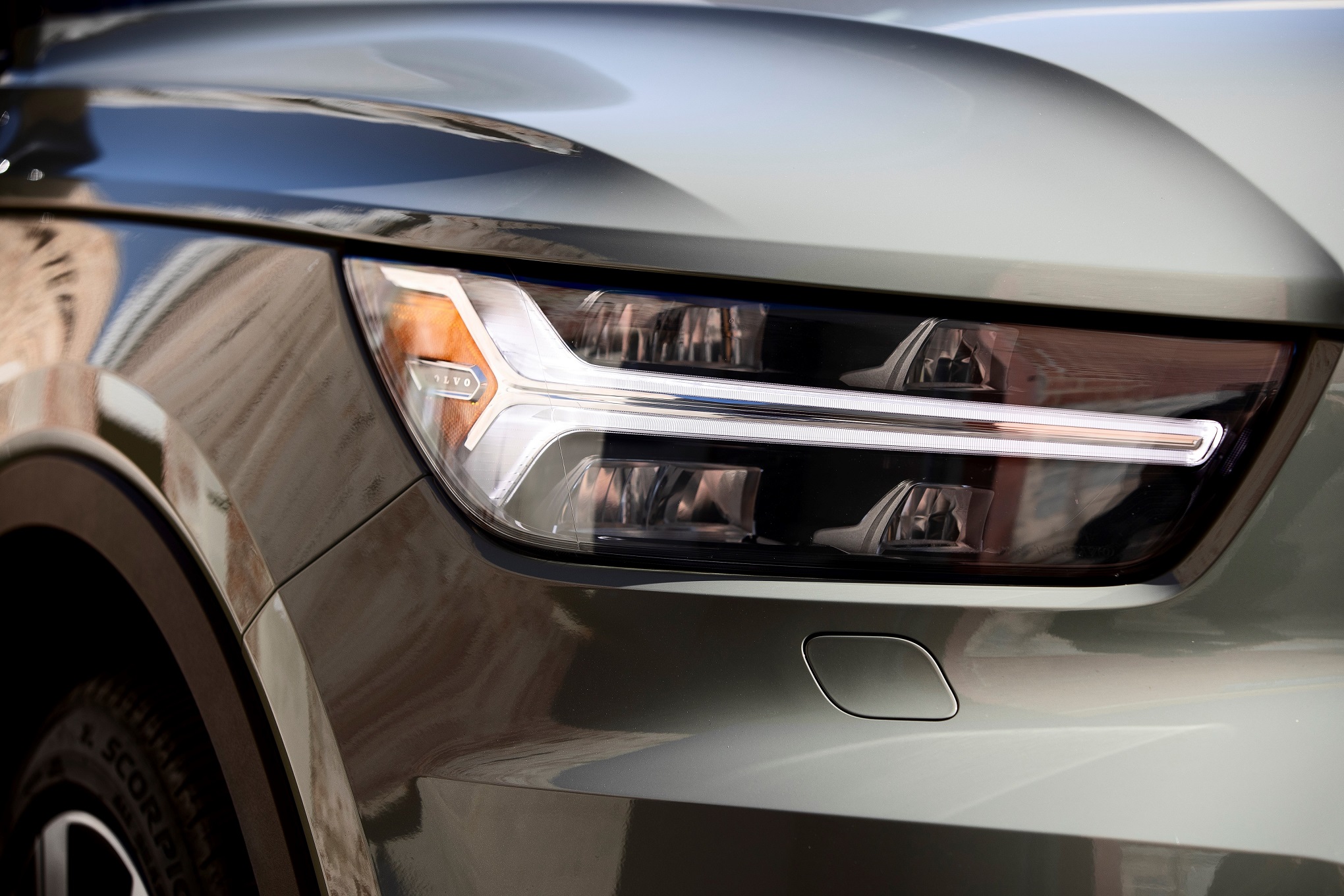
LED lighting with Thor’s Hammer detail

LED lighting with Thor’s Hammer detail.

XC40 Recharge Ride and Handling

With a minimum curb weight of 4,741 pounds, the XC40 Recharge feels heavy on takeoff but lightens as it gets rolling. From about 30 mph, torque is the driver’s friend. Mash the pedal to impress friends with the potent acceleration. And the quickness is sharp at 50-70 mph on the highway when defending your space.

The XC40 Recharge is not sporty to drive, but it is comfortably sprung. It can be a clunky ride, too. Managing the curb weight of a short (174.1 inches) and tall (65 inches) vehicle challenges the suspension of front MacPherson struts and a multi-link rear. And it has a lot of highway noise in the cabin.

The electric steering has adjustable steering weight, but the standard “firm” setting felt light to me. But the car’s rather long wheelbase of 106.4 inches and the Ultimate’s 20-inch tires created a wide turning circle, which Volvo says is 37.4 ft with 19-inch tires.

Four-wheel-disc brakes of 13.6-inch front rotors and 13.4-inch rotors rear are large for a small SUV but necessary to ensure braking force for the 2,000-pound tow capacity.
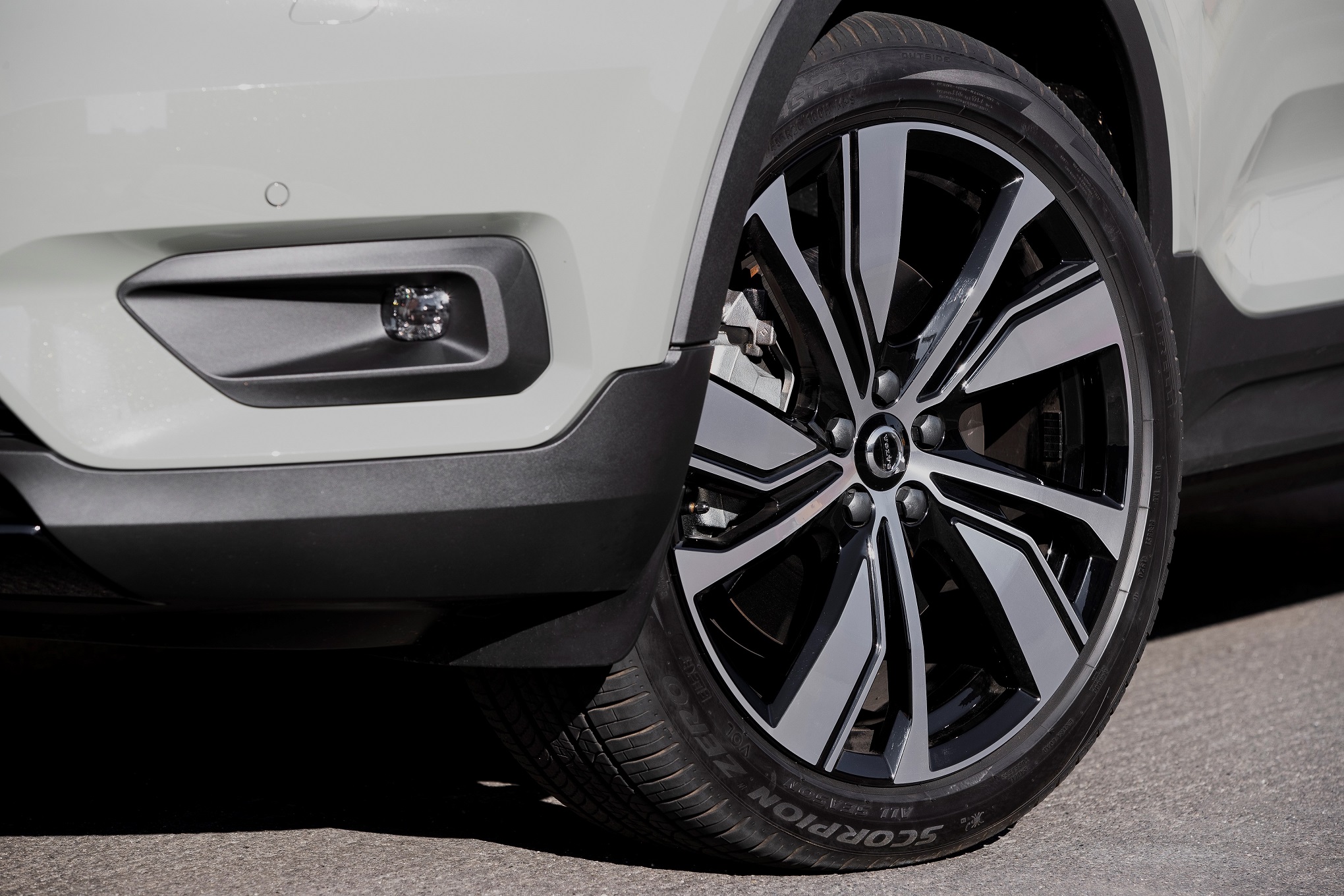
XC40 tire and wheel

The Ultimate package adds 20-inch Pirelli Scorpion Zero tires.

Charging the XC40 Recharge

Volvo’s XC40 Recharge uses the CCS charging standard, which consists of a combined AC and DC inlet port. The top portion of the inlet is for the Type 2 connector for charging at home or public stations.

Both sockets are used when using rapid DC charging from a CCS connector.

The XC40 Recharge has an 11 kW onboard charger that can be used with a standard household 110-volt outlet. Charging on 110 is slow, like filling a swimming pool through a drinking straw. Newer homes with 220-volt circuits can provide about 4 to 8 miles of range per hour.

An 11kW AC wall box or public charging point will provide about 31-37 miles of range per hour.

A DC fast-charging station will provide between 19 and 62 miles of range in 10 minutes, depending on wattage. Charging from zero to 80 percent at a 150kW DC fast charging station will take approximately 40 minutes, Volvo says. But those are not easy to find.

Public Charging

I charged at two 50kW public charging stations, Blink (Level 2) and EV Go.

The Blink charger, which is swipe-a-credit-card easy, gave a 4 percent charge in 47 minutes for a cost of $3.54. A day later I visited an EV Go fast charger, which boosted the battery reserve from 83 percent to 90 percent in 11 minutes for a cost of $6.77. But the EV Go chargers, six of them in a parking garage, were filthy and the hoses were gritty and grimy.

That poor upkeep would be motivation for me to buy a home charger. A ChargePoint Home Flex charger starts at about $700, not including installation. The 240-volt charger is nine times faster than a normal wall outlet, Volvo says.

A U.S. federal tax credit might be available, too, which covers 30 percent of the costs of a home charger and installation (up to $1,000). Check to see if you can combine this credit with other incentives in your area. Learn more here.

Charge port on the XC40

The XC40 Recharge has a combined charging socket for AC and DC.

XC40 Recharge Safety Features

Standard XC40 safety features and technologies include seven air bags, low- and high-speed collision mitigation (which detects vehicles and pedestrians/cyclists), automatic braking after a collision, run-off-road protection and run-off-road mitigation, lane-departure warning and lane-keeping assist.

And when electronic updates are required, the XC40 Recharge can receive over-the-air updates. As with smartphone OS updates, the user can schedule the update or let it occur automatically.

The XC40 Recharge is also the first Volvo model equipped with the new Advanced Driver Assistance Systems sensor platform. The system combines cameras, radar, and ultrasonic sensors. And those software systems can be updated for future autonomous-driving technologies.

XC40 Recharge Interior Function

Volvo does good design engineering to make a subcompact cabin feel larger than it is — at least for those in the front seats.

Cabin design is a minimalist presentation. Most cabin controls are accessed on the large, vertical touchscreen, or steering wheel controls. Frequently used climate controls settings are conveniently accessed on a strip just below the touchscreen. And there are separate audio volume and tuning knobs.

Opening and closing the pano roof is by a touch-sensitive switch.

The leather-free Nubuck upholstery looks like leather and is supple and attractive. Interior plastics are generally pleasing in appearance and their graining, but not completely for a $60,000 car.

Front headroom of 37.6 inches with the panoramic roof is somehow surprisingly accommodating for taller drivers. And the seats, with seat-bottom tilt, provide all-day support for butt and thighs, with a seat-cushion extender on the Ultimate.

Sightlines are open over the hood and fenders, but less so over the shoulder with the upswept rear door skins. Saving the day for parking visibility is the 360-degree camera in the Ultimate, which helps navigate tight spaces, and it includes a curb view.

Cargo space in the XC40

Square cargo space of 20.4 cubic feet. (Mark Maynard photo)

XC40 Recharge Back Seat and Cargo

The back seats are where the XC40 Recharge feels subcompact. Rear headroom is good at 38.3 inches, but legroom of 36.1 inches is cramped with a tall driver in the front seat. The seat bottoms are very short (to help legroom).

The center tunnel for battery storage takes from the precious three-across foot room. And shoulder room is impacted by the bench that is inset a few inches from the doors. That’s a benefit for side-impact protection, but the whole back seat area feels downsized.

Conveniences include a fold-down center armrest and charging USBs.

Cargo space is flip-and-fold functional with the folding back seat and folding cargo floor, which is useful to corral grocery bags. Fold the seatback for almost 5 feet of length, with 29.4 inches floor to headliner.

Fold the back seat for about 5 feet of length.

The Good, the Bad, and the Awkward

There is still much resistance to those uninitiated to the intangible pleasures of driving a battery-electric vehicle. Among the big impediments are the driving range that is less than in a gas-powered vehicle and battery manufacturing that is bad for the environment.

“I couldn’t live with less than 300 miles,” a businesswoman said to me when asking about the XC40 Recharge. And she followed up with: “And EV batteries are so bad for the environment.”

All vehicle manufacturing creates emissions and waste. But it is less invasive for electrics, which concentrate the effects of pollution in a central location, which aids in clean up. And the energy is not being trucked to a network of fuel stations.

In the manufacturing process, electric vehicles will produce more global warming emissions than the average gasoline vehicle, because electric cars’ large lithium-ion batteries require a lot of materials and energy to build. (For example, manufacturing a midsized electric car with an 84-mile range, results in 15 percent more emissions.)

However, once the vehicles get on the road, it’s a whole different energy story, according to EarthJustice.org.

Reducing Greenhouse Gases

Electric vehicles make up for their higher manufacturing emissions within, at most, 18 months of driving — and continue to outperform gasoline cars until the end of their lives

An electric car on average has the same greenhouse-gas emissions as a car getting 88 miles per gallon. And that is far greater than the average new gasoline-powered car (31 mpg) or truck (21 mpg), according to analysis by the Union of Concerned Scientists.

And there are major concerns with sourcing the minerals. Mining is a destructive industry, long responsible for human rights abuses and environmental devastation, according to EarthWorks.org.  And lithium, cobalt, and nickel are key elements used to make the lithium-ion batteries for use in electric vehicles,

Battery Recycling

End-of-life battery recycling is limited but gaining attention. Ford Motor Co. and Volvo Cars are the first automakers to directly support a program to recycle EV batteries.

The automakers are working with Nevada-based Redwood Materials. The company recycles batteries, electronics, and other end-of-life products “with environmentally sound processing and refining technologies to produce key elements for circular supply chains,” according to its website.

According to the release, the program will begin in California and will accept all lithium-ion and nickel-metal hydride batteries in the state.

Why Buy the Volvo XC40 Recharge?

Driving range becomes very manageable because your vehicle can always be topped off at home. Power companies offer reduced rates for off-peak charging. And a driver who has solar panels at home will reap additional savings.

The XC40 Recharge is very convincing to go electric. But the buyer would have to be very committed to Volvo to buy or lease a $60,000 small SUV.

In time, sitting on 15 gallons of flammable gasoline will seem ludicrous.

A rear view of the Volvo XC40 Recharge small SUV

Welcome to Volvoland.

Volvo XC40 Recharge Twin Ultimate Specifications

Body style: compact, 5-seat, 5-door battery-electric AWD SUV crossover

Motors: Two water-cooled 150kW permanent magnet synchronic electric motors; 402 total horsepower; each motor is fed by one of two 500A inverters, to convert DC current from the battery to AC current for the motor; 486 lb.-ft. torque from 0 to 4,350 rpm

Battery: 78kWh (or 75kWh usable) lithium-ion (liquid-cooled)

Transmission: 1-speed automatic

0-60 mph: 4.7 seconds; 112 mph top speed

Driving range: up to 223 miles at 100 percent charge; or about 200 miles on the recommended 90 percent charge to help preserve battery life

Charging times

DC 50-150kW: 40 minutes, to 80 percent

Household plug: 34 hours

Home 240-volt: 7-10 hours

BY THE NUMBERS

Max trailer weight: 2,000 pounds

Cargo space: 16-31.5 cubic feet

Front trunk space: 1 cubic foot

Front head/leg room: 37.6/40.9 inches

Rear head/leg room: 38.3/36.1 inches

Length/wheelbase: 174.1/106.4 inches

Curb weight: 4,741 lbs.

Turning circle: 37.4 ft.

FEATURES

Standard equipment includes: keyless entry with push-button ignition, Nubuck textile upholstery, heated front seats, front seat cushion extenders, high-performance audio system with Bluetooth phone and audio, rear park assist camera, charcoal headliner, inductive smartphone charging, laminated panoramic moonroof with power sunshade, 12-inch driver gauge display (w/2 appearance modes), 9-inch center infotainment display, 360-degree camera system, LED exterior lighting, 4-year subscription to Google Automotive Services, Google Maps, and Google Play, tinted side and rear glass

Ultimate equipment: heat pump for cabin heating, 360-degree surround-view camera, Harmon Kardon premium audio system removable and folding cargo load floor, keyless entry and keyless drive, power tailgate, Homelink controls, front and rear park assist, power passenger seat, headlight pressure washing and heated washer nozzles, Pilot Assist driver-assistance system, adaptive cruise control, heated rear seats, 20-inch black-diamond cut alloy wheels

Safety features include: 7 air bags, low- and high-speed collision mitigation (detects vehicles and pedestrian/cyclists), automatic braking after collision, run-off-road protection and run-off-road mitigation, lane departure warning, lane-keeping assist, road-sign information,

PRICING

Base price: $59,245, including $1,095 freight charge; price as tested $60,090

Options on test vehicle: Thunder Grey metallic paint $695; heated steering wheel $150

Where assembled: Ghent, Belgium

Warranty: 4-years/50,000-miles bumper to bumper with roadside assistance; free factory scheduled maintenance and wear coverage for the first 4 years or 40,000 miles; 8-years/100,000-miles limited drive battery coverage (or 10-years/150,000-miles in California)

Lexus ES 300h F Sport Review

Lexus ES 300h F Sport Review

Sometimes it takes money to save (gas) money

A side view of the Lexus ES 300h

The 2022 Lexus ES was given a light exterior refresh, new safety and performance features, and updates to the multimedia systems. (Toyota)

Table of Contents

2022 Lexus ES Updates
Pricing
Interior Function
Back Seats and Trunk
Performance and Fuel Economy
Ride and Handling
Safety and Driver-Assist Systems
Why Buy the Lexus ES 300h F Sport?
Specifications

BY MARK MAYNARD

The bold metallic blue Lexus ES 300h hybrid delivered to my driveway had a sport-sedan stance in black 19-inch alloy wheels and low-profile tires. The look called out a swaggering F Sport attitude. And this from a gasoline-electric hybrid? It surely was not an expected presentation by this elite luxury brand.

The midsize ES sedan, now in its seventh generation, has been the mature choice for luxurious style — and the more of its luxe, the better. Of the 11 nameplates in the Lexus lineup, the ES ranks fourth in sales, behind three SUVs, the midsize RX, large LX, and compact NX.

And seven of those 11 nameplates are available as a hybrid, including a new plug-in NX SUV hybrid.

The Lexus ES 300h hybrid is a sugar cube of civil obedience. It is elegant, efficient, and somewhat expected of polite company. But the new-for-2022 F Sport package rocks the teacup, which Lexus hopes will tempt younger buyers.

Once a platform partner with the Toyota Camry, the ES was moved to the Toyota Avalon architecture in 2012. That separation for the ES added a longer wheelbase (now at 113 inches) and 3.8 inches in length. The cabin is a bit wider and lower, both by 0.4 inch.

The Camry and Avalon also are available in hybrid powertrains, and both have liberally shared interior elements.

ES 300h front seats

The F Sport front seats are comfortably bolstered. (Mark Maynard)

2022 Lexus ES Updates

With a complete redesign expected for 2025, the 2022 Lexus ES was given a light exterior refresh with a few new exterior and interior colors. However, more significant updates were made to the multimedia system, touchscreen controls, and touchpad. In addition, safety and performance features were enhanced. And while Lexus has offered its F Sport package throughout the lineup, the ES 300h F Sport is new for 2022.

Among the exterior updates are a new mesh-pattern grille and redesigned bi-LED headlights. But the F Sport gets its own mesh grille treatment with a dark border. And the rear suspension was tightened with a new brace for torsional rigidity.

The ES brake system was tweaked on both gas and hybrid models. The brake pedal shape was enlarged for foot stability. On gas-engine models, the brake system master cylinder and booster were refined for more linear brake pedal feel and response. And the hybrid’s regenerative and hydraulic brake system was improved for pedal feel when the brake pedal is released.

optional 12.3-inch color multimedia in the ES 300h

Multimedia displays were moved forward 4.3-inches. (Mark Maynard)

Lexus ES Multimedia Updates

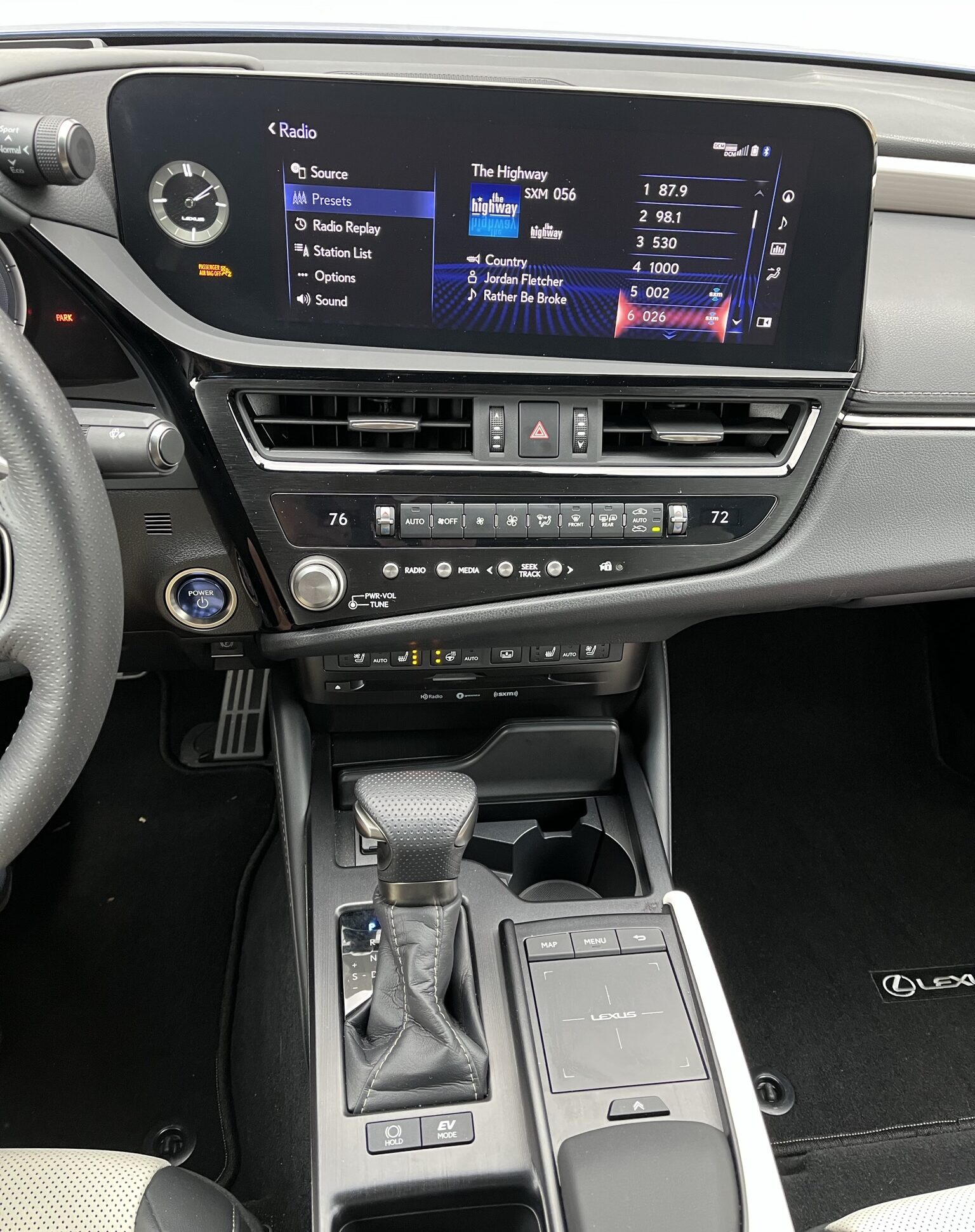
The standard 8.0-inch and optional 12.3-inch color multimedia displays were moved forward 4.3-inches and have touchscreen functionality. And the remote touchpad on the shift console was recalibrated for a less touchy response.

Additional interior updates for 2022 include a streamlined instrument panel design to make it easier for the front passenger to adjust cabin functions.

The wireless phone charger is tucked away in the front armrest console box. (Mark Maynard)

The improved interior technologies are so much easier to use now, though it might not seem so at first look. A lot of information is displayed on the two touchscreens, plus the upper and lower tiers of controls on the center console stack.

The presentation is almost information overload. But tiers of switches and buttons are very handy to make cabin adjustments without using the touchpad or the touchscreen.

Lexus ES Pricing and Warranties

The ES is available in eight trim levels with three powertrain choices:

  • 203-horsepower, 2.5-liter four-cylinder engine;
  • 302-hp 3.5 liter V-6;
  • 215-hp, 2.5-liter Atkinson-cycle four-cylinder and lithium-ion battery pack.

All-wheel-drive is available in the entry ES 250 AWD. Gas-powered models have an eight-speed automatic transmission and the hybrid trims have a continuously variable automatic.

Starting prices range from $42,950 for the ES 250 AWD with the 2.5-liter engine and V-6npowered ES 350. The ES 300h starts at $44,050 or $47,600 for ES 300h F Sport. Pricing includes the freight charge from Georgetown, Ky.

The ES 300h F Sport tester was $52,260 with nine options, including $595 for the Ultrasonic Blue 2.0 paint. (View standard equipment and option details in the specs chart at the end of this story.)

Lexus ES starting prices are comparable to the BMW 330e and Mercedes-Benz C-Class. But the BMW is a plug-in hybrid and Mercedes doesn’t offer a C-Class hybrid.

Check current ES hybrid pricing and incentives here.

Basic vehicle warranty coverage is for 4-years/50,000-miles bumper to bumper and 6-years/70,000-miles for the powertrain. The hybrid components are covered for 8-years/100,000-miles, including the hybrid battery voltage sensor, power management control module, and inverter with converter. The Lexus hybrid battery warranty coverage is for 10-years/150,000-miles.

A front interior door panel of the ES 300h

The F Sport’s dramatic slash of white, leatherlike NuLuxe. (Mark Maynard)

Lexus ES Interior Function

While the ES is richly appointed in areas seen and touched, there are some Toyota-grade plastics with some rough edges in the lower areas.

Those initial observations will fade as the Lexus ES finds its high-fidelity groove in your daily life.

The styling stance of the ES is more sport sedan than family car. Front headroom of 37.5 inches with the moonroof could be limiting to some big-and-tall drivers. But the structure provides clear sightlines at the side mirrors and over the shoulder.

The F Sport front seats are bolstered but not so much as to complicate comfortable entry and exit. And their design has long road-trip support and comfort.

F-Sport Style

The F Sport influence is contemporary, with no wood trim anywhere. The headliner and roof pillars are black, and the three-spoke steering wheel has a solid fit in hand. Hadori-style satin-metallic trim wraps from the top of the doors across the span of the instrument panel. And the slash of white NuLuxe (leatherlike) in the door panels is unusual but attractive.

The sun visors seem oddly short and are not always effective, but they do slide. And another oddity is a single-disc CD player in the audio system.

There are a few small item storage areas, a small door panel stash space, and a locking glove box.

Cup holders on the shift console have two levels for tall or grande beverages. There is another cup holder and a phone slot just ahead of the shifter, with a module with two charging USBs and a 12-volt plug.

Trunk space is wide, low and open at 13.9 cubic feet.

Trunk space is wide and low with golf-bag space. (Mark Maynard)

Lexus ES Back Seat and Trunk

Maximum back-seat legroom of 39.3 inches is long unless Daddy Long Legs is in the driver’s seat. But the seats are quite comfortable if a little short on thigh support for tall adults. A wide, padded fold-down armrest has two deep cup holders. There is usable door-panel storage and a pair of charging USBs, and a 12-volt plug.

The back seat does not fold, but there is a ski pass-through.

Trunk space of 13.9 cubic feet is wide with a comfortable liftover for heavy luggage. The trunk has a kick-activated sensor and a power lid closer.

ES 300 h back seat

Maximum back-seat legroom is long at 39.3 inches. (Mark Maynard)

Lexus ES 300h Performance

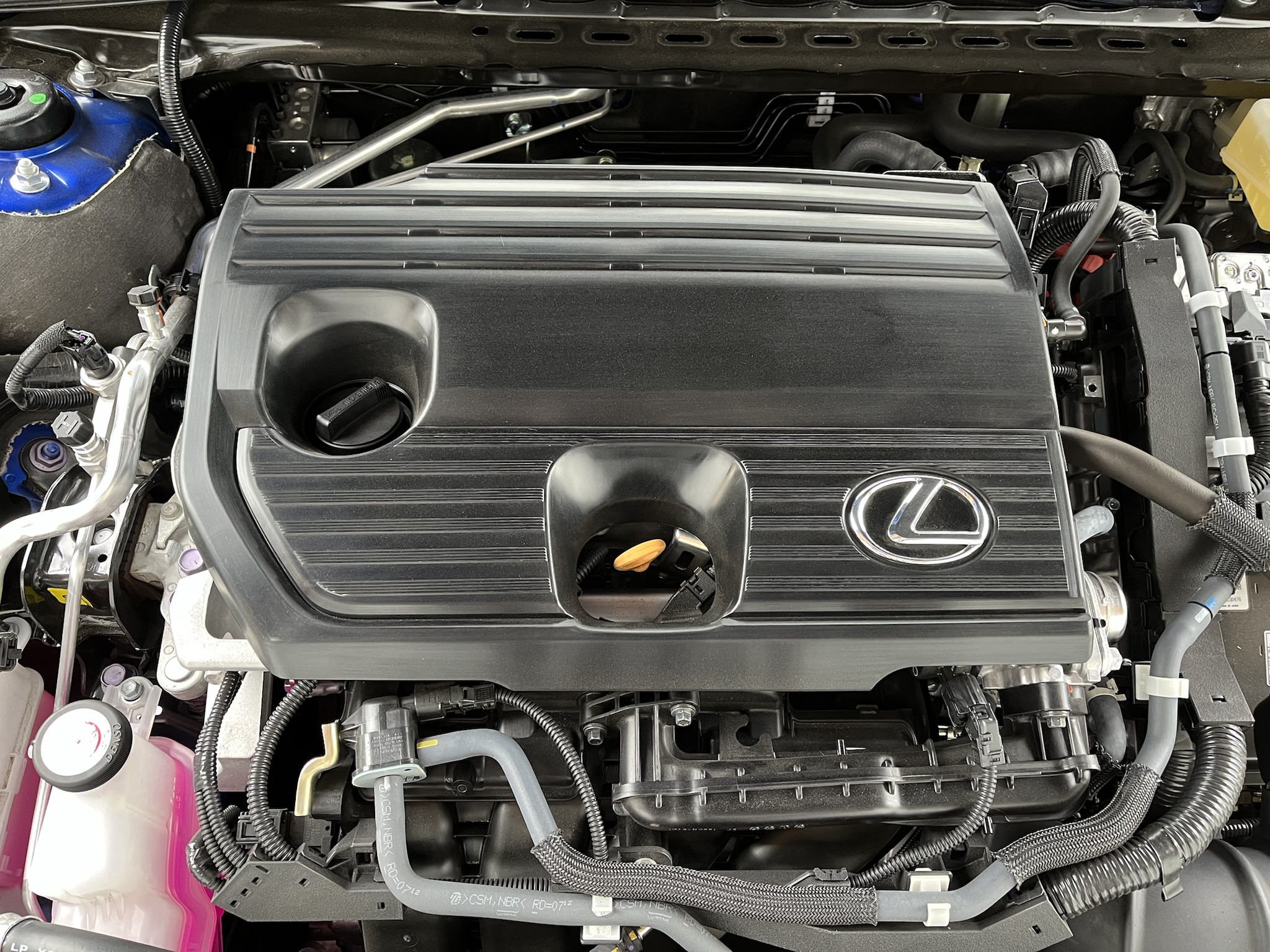
The gasoline-electric powertrain integrates a 176-hp Atkinson-cycle 2.5-liter four-cylinder with an electric motor, and a 39-hp, 29.1 kW lithium-ion battery pack. With total system power of 215-hp, Lexus cites 0-60 mph acceleration in 8.1 seconds.

The eCVT helps give quick uptake of acceleration away from the light. But passing power is thin at highway speeds. However, the transmission has almost no lag as the CVT builds power.

Fuel Economy

Official fuel economy ratings are 43 mpg city, 44 highway, and 44 mpg combined, on 87 octane fuel. However, my week of driving did not come close to the official ratings. I averaged around 35 mpg in around-town driving and up to 37.3 mpg on a 129-mile highway run.

For comparison, the ES 250 AWD (2.5-liter) has mileage ratings of 25/34/28 mpg. The ES 350 V-6 is rated 22/32/26 mpg, followed by the ES 350 F Sport nonhybrid at 22/31/25 mpg.

The hybrid engine of the Lexus ES 300h

Lexus cites 0-60 mph acceleration in 8.1 seconds. (Mark Maynard)

ES 300h F Sport Ride and Handling

The F Sport-tuned suspension is taut, sometimes with a jolt, but never harsh. It is far different from the ultraluxe ride of the other ES models.

Four-wheel power-assisted disc brakes have generously sized 12-inch ventilated front rotors and 11.1-inch solid rear rotors. This year’s refinement to the regen braking system has taken away some of the on-off response to the pedal. But there is still that push-through point that can cause hesitation when nosing into a parking stall or the home garage.

The tester was upfitted with 19-inch Michelin Primacy MXM4 235/40 all-season tires. Other grades of the ES have 17- or 18-inch tires. A good feature of this tire design is how the outer lip of the tire extends about a half-inch beyond the alloy. That’s is a bit of protection from curb rash.

The grand-touring Michelins complement the ride with their smooth rolling and low tire noise.

19-inch F Sport all-season grand-touring Michelins complement the ride with smooth rolling and reduced tire noise.

F Sport suspension tuning and 19-inch black alloy wheels. (Mark Maynard)

Safety and Driver-Assist Features

Lexus has been a leader in providing advanced technology safety features, and it continues the evolution for 2022.

The pre-collision system’s camera and millimeter-wave radar elements have a broader response range. The system also integrates Frontal Collision Warning and Automatic Emergency Braking, Pedestrian Detection, and Bicyclist Detection.

The Lexus Safety System+2.5 has added Intersection Turning Assist and Emergency Steering Assist to the Pre-Collision System. Under certain conditions, the system can recognize an oncoming vehicle or a pedestrian when making turns. The system also will activate PCS functions if needed. In addition, the new Emergency Steering Assist is designed to help prevent lane departure during an evasive steering maneuver.

All-Speed Dynamic Radar Cruise Control can be activated above 30 mph. It is designed for vehicle-to-vehicle distance controls down to 0 mph and can resume from a stop.

Also new is Curve Speed Reduction, which can automatically reduce vehicle speed, if needed, through certain types of curves.

Those advanced technologies with dynamic cruise control create a reliable Level 2 semi-autonomous driver-assist mode. Lane centering is well calibrated and I experienced no drifting across the white lines or Botts dots, which can be common in other such systems. This system is like a 360-degree view to help the driver avoid an unintended meeting with another driver in heavy commuting traffic.

A sunset view of the ES 300h rear end.

The 2022 Lexus ES F Sport is more sport sedan than family car.

Why Buy the Lexus ES 300h F Sport?

The styling stance of the ES is more sport sedan than family car. But the F Sport package adds no horsepower, only cosmetic upgrades. Depending on the model, the package can add $3,550 to $4,650 to the ES MSRP. But visually engaging elements in the package are strong separators from the luxury image of the ES line.

There are no fatal flaws in the design and engineering of the Lexus ES. It is a welcoming car that conforms to the hustle of the owner’s lifestyle.

Life is complicated; cars shouldn’t be. And the Lexus ES 300h F Sport is easy to live with.

Lexus ES 300h F Sport Specifications

Body style: midsize, 5-seat, front-wheel-drive sedan

Engine: 176-hp, direct and port injection 2.5-liter Atkinson-cycle 4-cylinder w/auto stop-start at idle; 163 lb.-ft. torque from 3,600-5,200 rpm

Hybrid system: Permanent magnet electric motor with 39-hp, 29.1 kW lithium-ion battery pack; 244.8 volts, 204 cells

Total system power: 215-hp

Transmission: CVT

0-60 mph acceleration: 8.1 seconds

Fuel economy: 43/44/44 city/hwy/combined; 87 octane

BY THE NUMBERS

Fuel tank: 13.2 gallons

Cargo space: 13.9 cubic feet

Front head/leg room: 37.5*/42.4 inches *w/moonroof

Rear head/leg room: 37.8/39.2 inches

Length/wheelbase: 195.9/113 inches

Curb weight: 3,682 pounds

Turning circle: 38.8 feet

FEATURES

Standard equipment includes: smart-key locking and push-button ignition (SmartAccess), perforated NuLuxe upholstery and trim, navigation system with all-speed radar cruise control,12.3-inch touchscreen with Amazon Alexa and Android Auto compatibility, Lexus Enform Wi-Fi with free 4GM 3-month trial, 10-way power front seats, 8-inch color multi-information gauge display, 10-inch color head-up display, single-disc CD player, wireless phone charging, dual-zone automatic climate control with interior air filters and smog sensor, voice command with Bluetooth and USB smartphone connectivity, power rear sunshade, intuitive parking assist, power trunk lid with kick sensor, triple-beam LED headlights

F Sport equipment: bolstered heated and ventilated front seats, Hadori aluminum trim and pedals, heated and leather-trimmed steering wheel with windshield de-icer and fast-response interior heater, black headliner, suspension tuning with performance dampers front and rear,19-inch gloss-black alloy wheels and 235/40 all-season tires, unique front bumper and grille

Safety features include: 10 air bags, pre-collision system with pedestrian detection, lane-departure alert with steering assist, lane-tracing assist, intelligent high beams, road-sign assist

PRICING

Base price: $46,525, including $1,075 freight charge; price as tested $52,260

Options on test vehicle: Intuitive Parking Assist $565

  • Head-Up Display $500
  • Triple Beam Headlamps $1,215
  • Power Rear Sunshade $210
  • Navigation Package $1,820
  • Power Trunk $550
  • Heated F SPORT Steering Wheel + Deicer $180
  • Key Card $100
  • Premium Ultrasonic Blue 2.0 metallic paint $595

Where assembled: Georgetown, Ky.

Warranty: 4-years/50,000-miles basic bumper to bumper; 6-years/70,000-miles powertrain; 8-years/100,000-miles hybrid components (including hybrid battery voltage sensor, power management control module, and inverter with converter; the Lexus hybrid battery warranty coverage is for 10-years/150,000-miles)