Select Page

2026 San Diego International Auto Show

2026 San Diego International Auto Show

• The annual auto show opens in the San Diego Convention Center on Thursday, Jan. 1, and runs through 6 p.m. Sunday, Jan. 4, 2026.

• Ticket prices remain the same as last year, $18 for adults.

• Technology, design, and an expanded, multi-brand indoor EV Test Track.

The cars are the stars at the San Diego International Auto Show. Image shows a big gold star on royal blue carpet with a stacked three-row icon for San Diego International Auto Show

The cars are the stars at the San Diego International Auto Show. (Mark Maynard image from 2025)

BY MARK MAYNARD

The annual San Diego International Auto Show opens in the San Diego Convention Center on Thursday, Jan. 1, 2026, and runs through 6 p.m. Jan. 4. The convention center is at 111 W. Harbor Drive, San Diego, 92101.

I got the low-down on the highlights of the 2026 show from Scott Webb, president of the New Car Dealers Association San Diego County, which owns and operates the auto show.

“We partner strategically with vehicle manufacturers so they bring their best to San Diego. We’re excited that show visitors will have the opportunity to get to know several new brands, which, previously, haven’t exhibited in San Diego.”

Webb shared these show insights:

Stellantis

“Stellantis is bringing the heat this year with a 15,000 square foot exhibit, and there will be a Ram world debut unveiled on Jan. 1,” Webb said in an email. A sampling of all Stellantis brands will be on display: Alfa Romeo, Chrysler, Dodge, Fiat, Jeep, and Ram. And he said they are even bringing several of their recent debut vehicles to the show, including:

  • The 2026 Dodge Charger Scat Pack
  • 2026 Jeep Cherokee and 2026 Jeep Grand Cherokee;
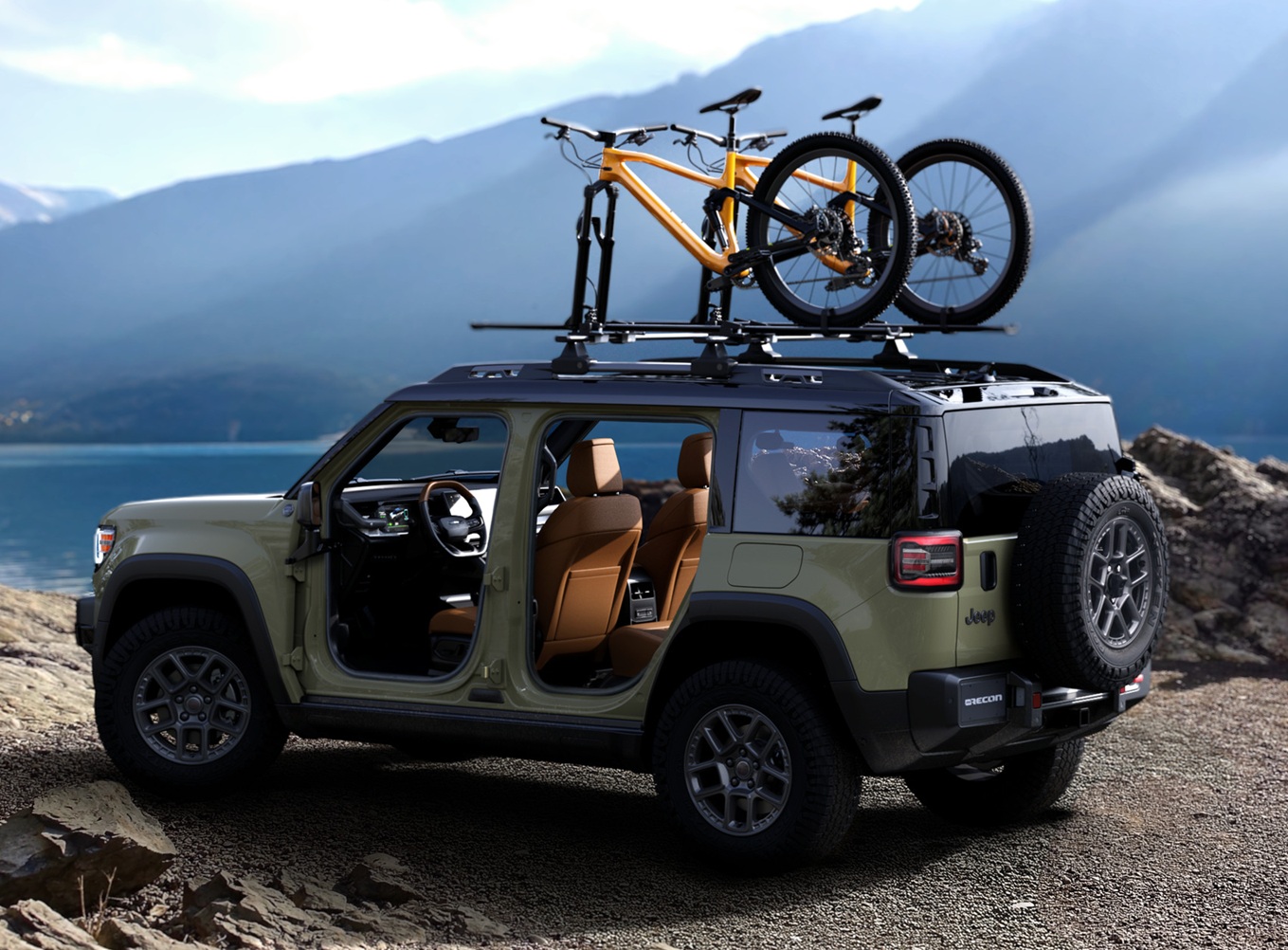
  • 2026 Jeep Recon, an all-new, fully electric SUV that serves as Jeep’s first “Trail Rated” EV. The Jeep Recon draws heavily on the Wrangler’s design — including removable doors and windows. It is a unibody vehicle built on the STLA Large platform, intended to balance off-road capability with daily on-road comfort.
  • 2026 Jeep Grand Wagoneer
  • 2026 Ram 1500 HEMI.

Stellantis is providing show-goers with the opportunity to test-drive 10 vehicles: Alfa Romeo Giulia, Alfa Romeo Tonale PHEV, Chrysler Pacifica PHEV, Dodge Durango SRT, Fiat 500e, Jeep Gladiator, Jeep Grand Cherokee L, Jeep Wrangler, Ram 1500, and Ram 2500.

The electric 2026 Jeep Recon shown with side doors removed and a pair of mountain bikes mounted on a roof top carrier.,

The electric 2026 Jeep Recon. (Stellantis)

Toyota

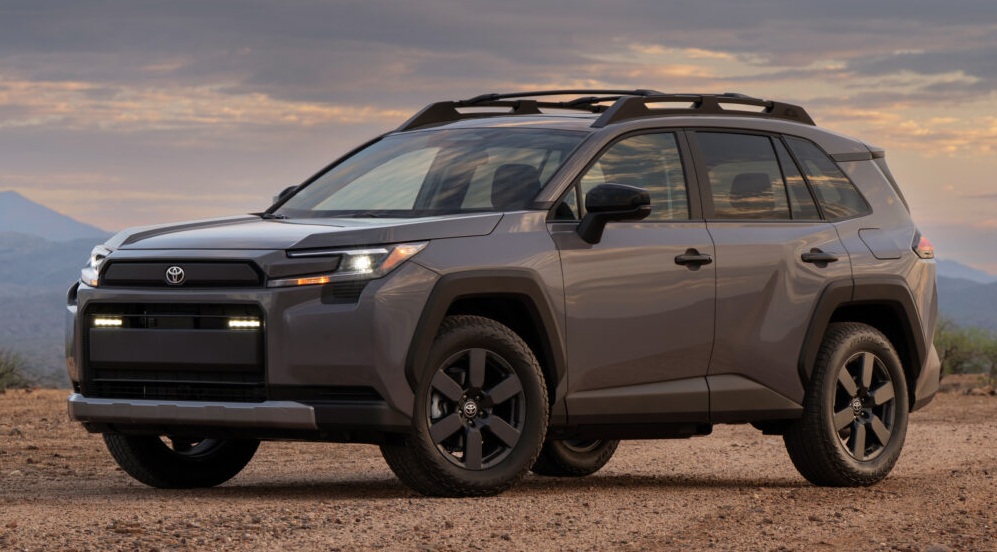
I am especially interested in the redesigned and re-engineered 2026 Toyota RAV4. The entire lineup is either gasoline-electric or PHEV, plug-in hybrid.

Webb gave these updates on the Toyota display (and Toyota always packs one of the large auto-show displays.

“As for Toyota, they will have the all-new 2026 RAV4 on display in two trim levels, Woodland and Limited. They’ll also have the new 2026 C-HR and 2026 bZ EVs in the exhibit, the latter of which will be available for test drives, along with the Grand Highlander Hybrid XLE, Toyota Prius PHEV XSE Premium, Toyota RAV4 Hybrid Woodland (2025), and Toyota Tacoma TRD Pro.

The 2026 Toyota RAV4 Woodland all-wheel drive in the new paint color or UrbanRock

2026 Toyota RAV4 Woodland all-wheel drive. (Toyota)

Debuts & New Releases

Webb also teased cool vehicles on the show’s Debuts & New Releases list. Among those, he said, include: the 2027 Chevrolet Bolt, 2026 Honda Prelude, 2026 Kia K4 Hatchback, 2027 Kia Telluride (now with an available 329-hp turbo-hybrid), 2026 Nissan Leaf, 2026 Nissan Rogue Plug-in Hybrid, and 2026 Nissan Sentra.

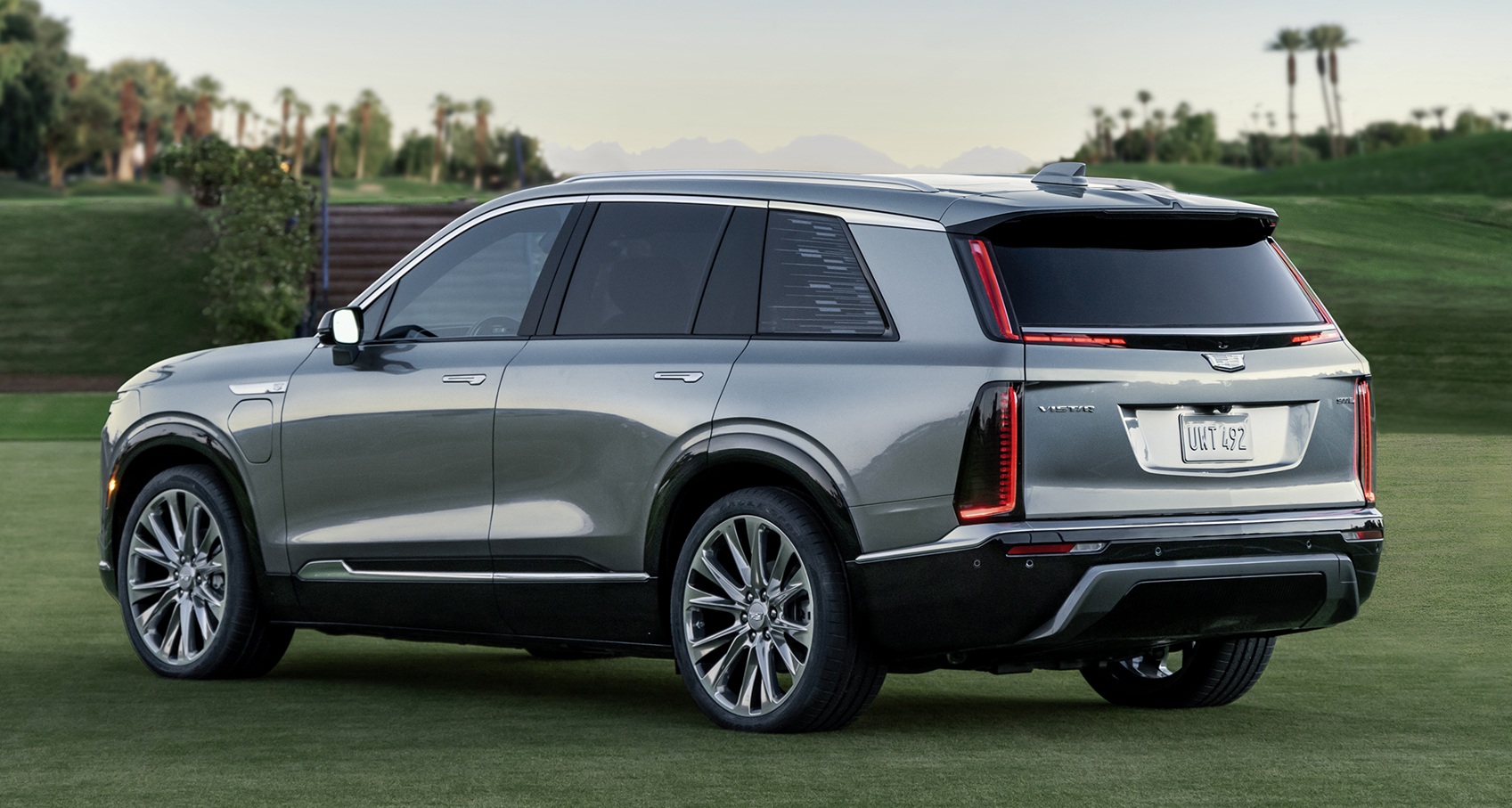
Other updates, he said, include: “Cadillac and Ford are back on the EV Test Track. Cadillac will offer thrill rides in the Escalade IQ, VISTIQ, OPTIQ, and LYRIQ. Ford will provide rides in the F-150 Lightning and Mustang Mach-E.”

The 2026 Cadillac VISTIQ electric SUV. in Argent Silver.

The 2026 Cadillac VISTIQ electric SUV, in Argent Silver. (Cadillac)

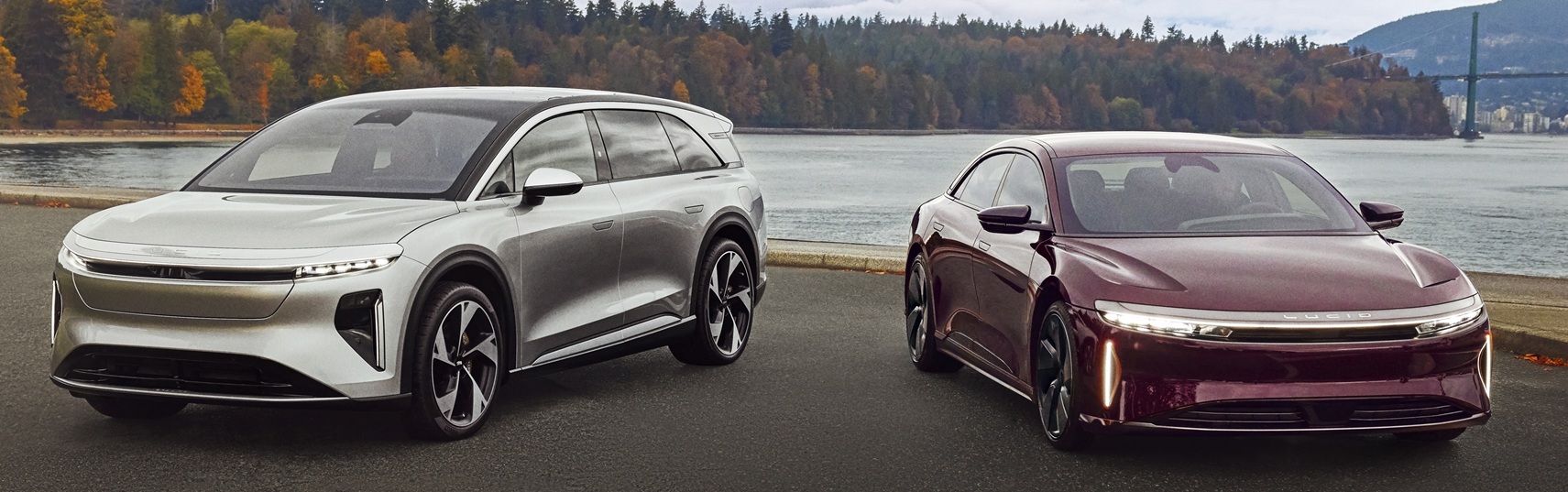
VinFast and Lucid have just confirmed to bring their latest EVs for Street Test Drives. The VinFast VF8 and VF9 (two- and three-row SUVs), the Lucid Air (four-door sedan), and the Gravity (an 800 hp family three-row SUV) will be available for test drives.

2026 Lucid Gravity SUV and the Air sedan, both models are battery electric vehicls

2026 Lucid Gravity SUV and the Air sedan. (Lucid)

Enduring Showgoer Favorites

Toyota Military Appreciation: The auto show has partnered with the San Diego County Toyota Dealers to offer free show tickets to honor active and retired military personnel. Tickets will be available (while supplies last) at San Diego County Toyota Dealers. Toyota is also providing $500 rebates to eligible U.S. military personnel, including their household members (and Gold Star families), U.S. military retirees, and U.S. military veterans (within 2 years of discharge). Learn more here.

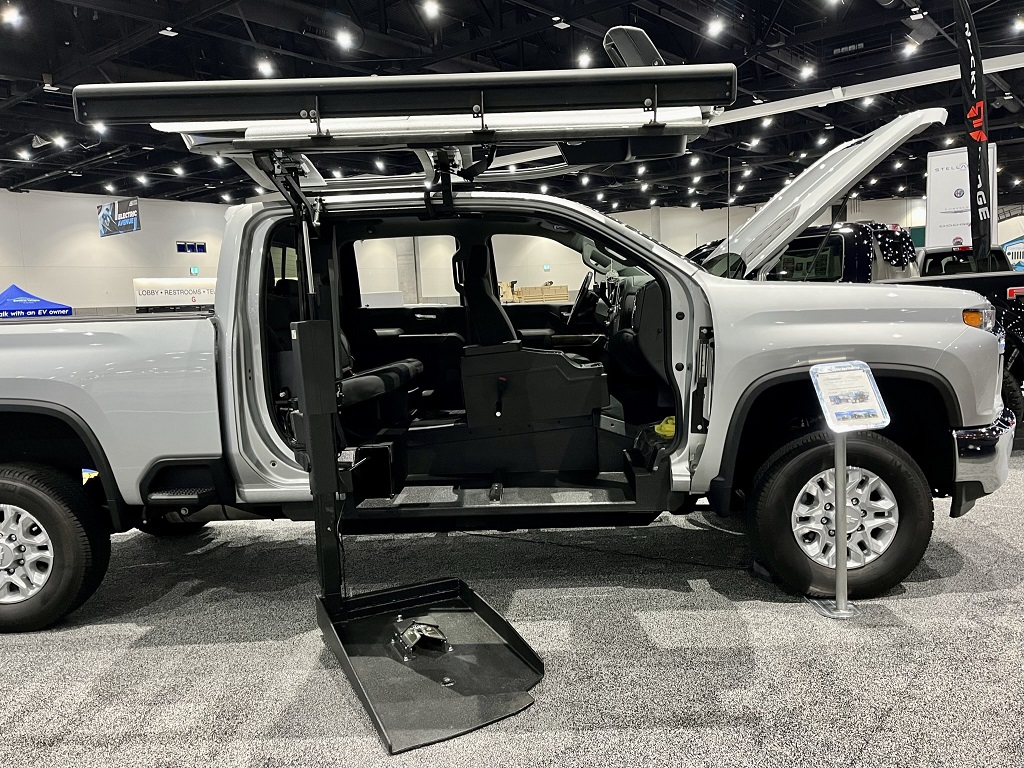
Mobility Zone: Golden Boy Mobility in Poway will again provide accessibility-modified vehicles and expert information on special features to promote and provide accessibility.

Family Day: On Sunday, Jan. 4, children are admitted free with an accompanying paid adult admission. Family Day has become a great tradition to spend a few hours of the holiday season at the auto show. Typically, multiple generations enjoy the auto show, Webb said.

A Golden Boy modified four-door Chevrolet Silverado. Both passenger side doors are open and showing a lift system to the front seats.

A Golden Boy modified four-door Chevrolet Silverado. (Mark Maynard)

IF YOU GO

Ticket Prices:

Auto show tickets are on sale now and are only available online at www.sdautoshow.com/. Purchased tickets may be printed at home or shown and scanned on smartphones at the show entrance.

  • Adult, ages 13-61, $18;
  • Military (active-duty w/ID) $15 (one ticket per ID);
  • Seniors, 62 and older, $15
  • Child, ages 7-12, $12;
  • Children 6 and younger are admitted free with a paying adult.
  • Children 12 and younger will be admitted free on Family Day, Sunday, Dec. 29, when accompanied by a paid adult.

Show Hours:

  • 10 a.m. to 9 p.m., Thursday, Jan. 1, 2026, through Saturday, Jan. 4;
  • 10 a.m. to 6 p.m. Sunday, Jan. 4

About the San Diego International Auto Show

Owned, produced, and presented by the New Car Dealers Association San Diego County, the San Diego International Auto Show remains the second-largest auto show in California and one of the best-attended public events at the San Diego Convention Center.

The dealership association provides critical community support. Among its efforts is a dealership sales training course. Participants are taught professionalism through education with an emphasis on product knowledge, ethical behavior, and customer service.

The Auto Outlook Report is also of interest to consumers. The quarterly report provides an expanded look at new-vehicle registrations, sales trends and projections, and pre-owned-vehicle sales throughout the county.

Learn more online at NCDA.com.

VW ID Buzz 4Motion Review

VW ID Buzz 4Motion Review

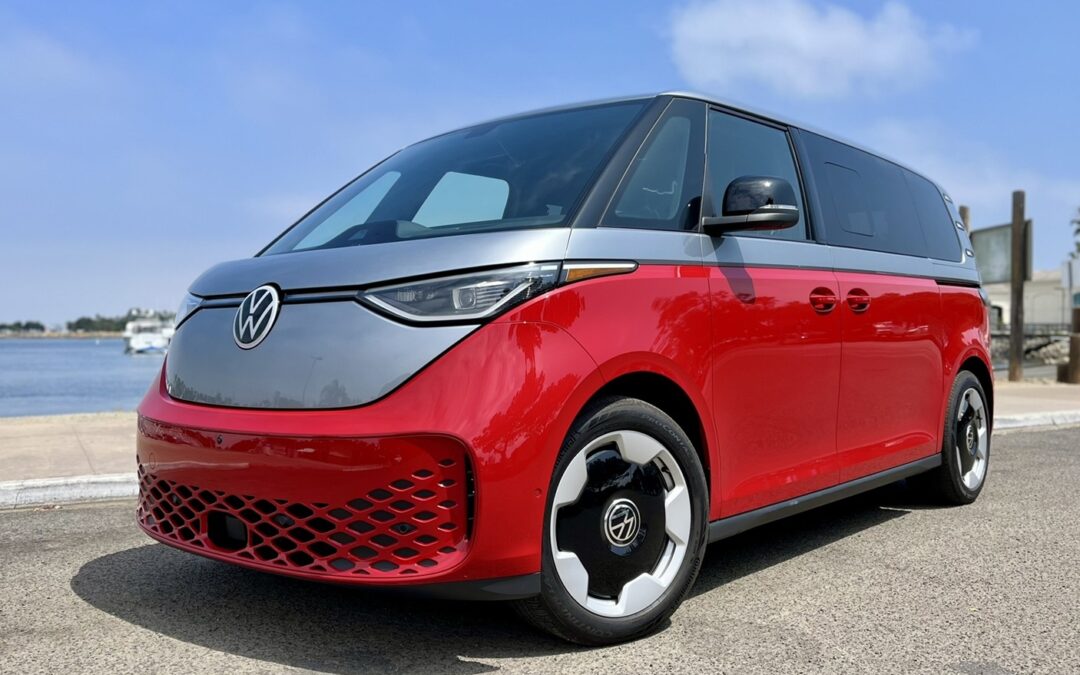
The battery-electric 2025 Volkswagen ID Buzz owns a unique niche. Its loaf shape is unapologetic and true to the original Bulli.
A two tone silver upper and red lower VW ID Buzz along a shelter island boat launch in San Diego

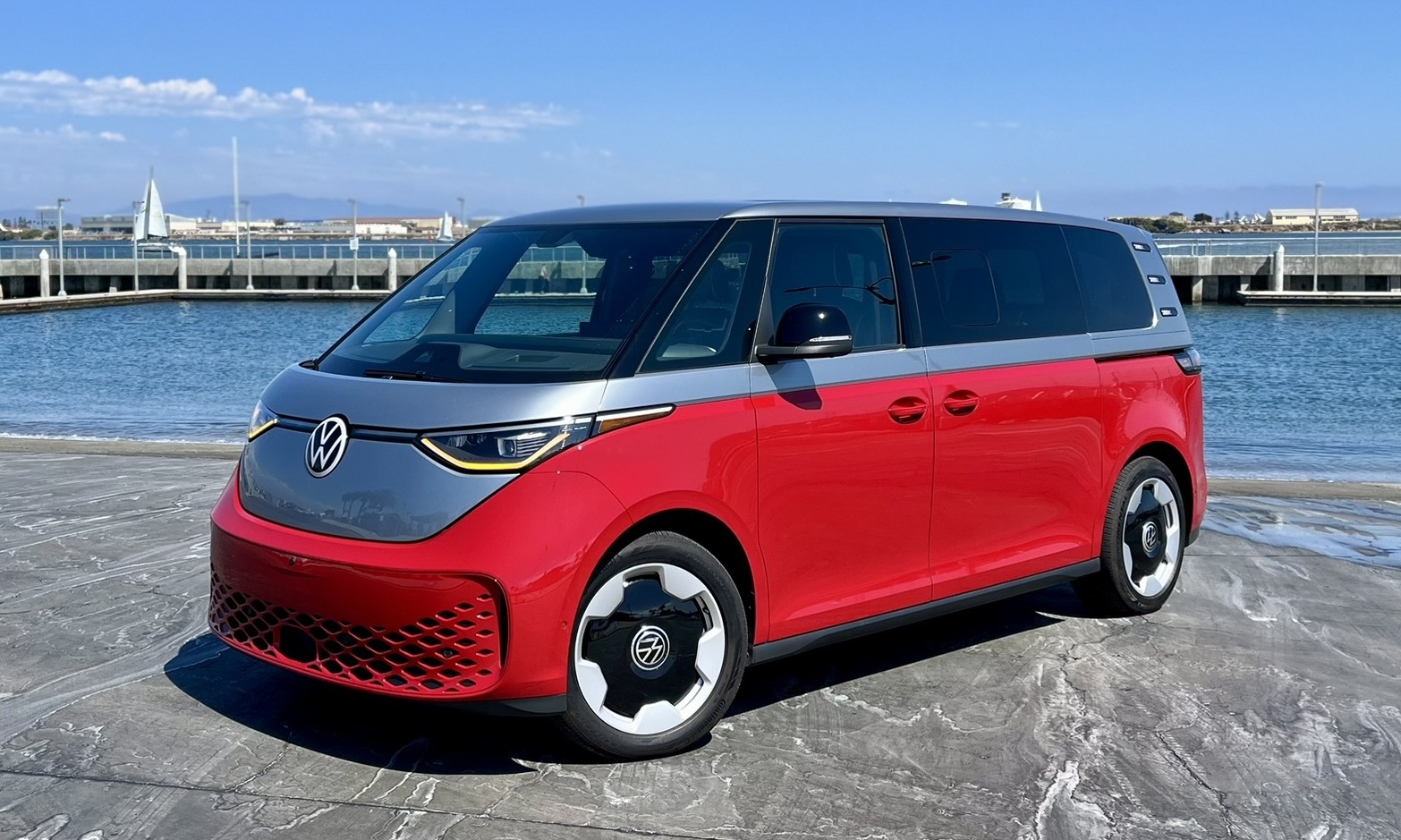
The 2025 VW ID Buzz is a battery-electric minivan with standard rear-wheel drive or the optional front-motor 4Motion AWD. Starting prices range from approximately $60,000 to $71,000. (Photography by Volkswagen of America or Mark Maynard)

Jump To Special Features

“What’s It Like?”
2025 VW ID Buzz Pricing
Clever Features
Buzz Kills
Safety Tech
Buzz Powertrain
500 kWh of Free Charging
2 Early Recalls Addressed
Why Buy the 2025 VW ID Buzz?
Specifications

 BY MARK MAYNARD

It is not easy being a brought-back icon with such an international fan base as the VW ID Buzz. It is a three-ton example of expectations meeting reality. A LOT of shade has been slung at the ID Buzz, mostly for its shortish battery range and high price.

Most critics, however, focus on what the ID Buzz is not, rather than what it is. And it is impressive for its performance, ride comfort, and quiet interior.

Slipping into the shoe space of the original VW Bulli or Type 2 Transporter, the ID Buzz ain’t nuthin’ like the original. That is not to imply that the Buzz is not a well-done vehicle. It is, but it will be an enigma to the uninitiated.

As a battery-electric minivan, the Buzz owns a unique niche. Its loaf shape is unapologetic and true to the original Bulli. And with no comparable electric minivans, the Buzz gets compared to the growing segment of electric three-row SUV crossovers, such as the Hyundai Ioniq9.

The ID Buzz is not the first electric microbus. Fifty years ago, Volkswagen showcased a battery-electric T2 bus at the Hanover (Germany) Trade Fair. The electric T2 was powered by a rear-mounted electric motor and lead-acid batteries, offering a maximum range of 52.8 miles.

Today, the 2025 ID Buzz has driving ranges of 264 miles with rear-wheel drive and 231 miles with 4Motion AWD.

Long or short, the ID Buzz is a brand halo that VW hopes — expects — will draw the curious to showrooms.
looking out the windshield with a full view of the dashboard and an ocean view beyond

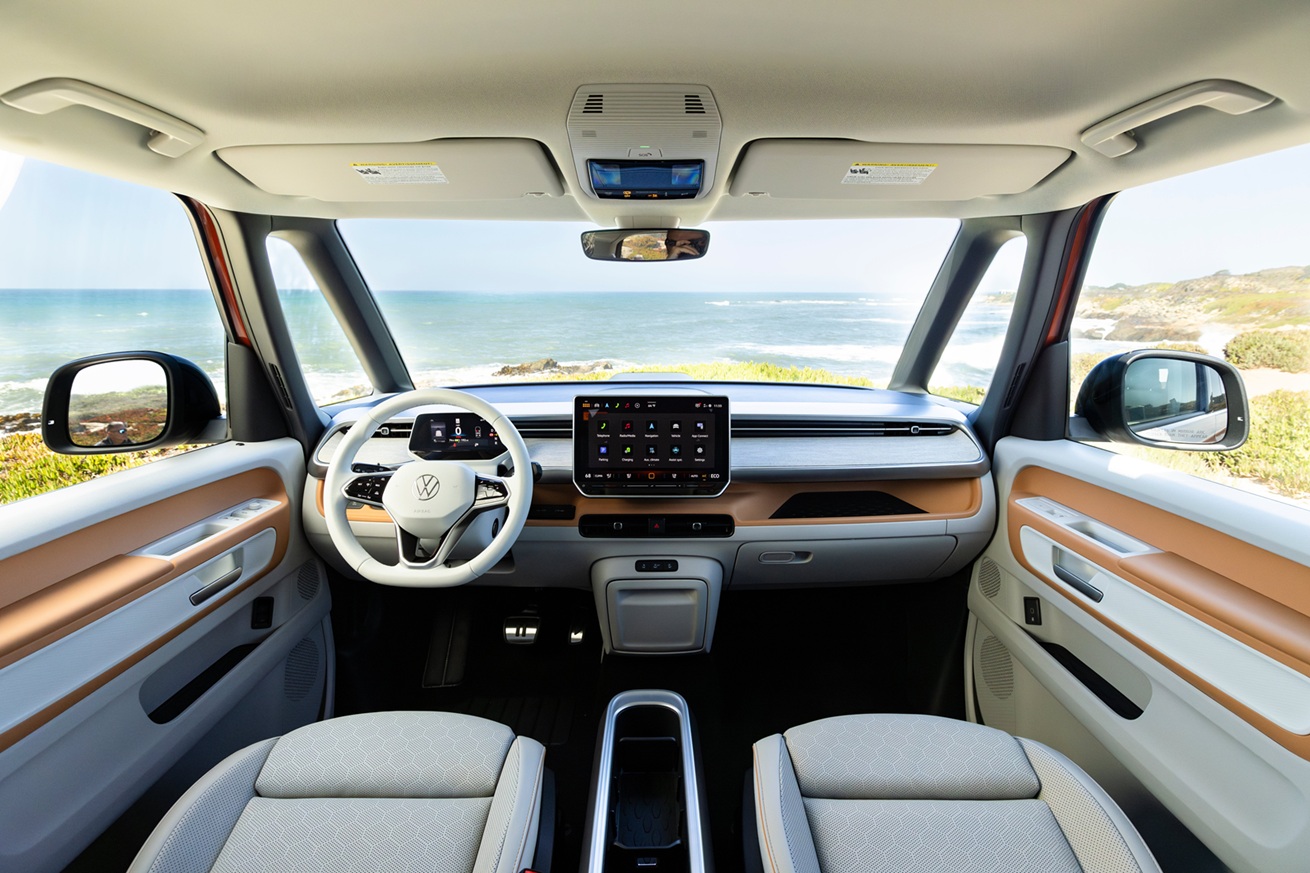
Despite the forked windshield pillars, driver sightlines are 180 degrees open.

ID Buzz Overview

The ID Buzz for North America features a single long-wheelbase configuration, available in rear- or all-wheel drive. Europe also offers a shorter wheelbase Buzz, approximately a foot shorter, as well as a cargo van. The Buzz has been on sale in Europe since 2022.

In an Automotive News report, Volkswagen of America CEO Pablo Di Si hinted at a family of ID Buzz models. One version might be a camper version with a pop-up roof.

For America, the short-wheelbase, five-seat Buzz — if and when it arrives — will have more appeal. It will be lighter and likely have a longer driving range, and cost a little less. And it will be a customizer’s canvas.

Volkswagen is also conducting an autonomous ID Buzz test fleet in Austin, Texas. Volkswagen’s Autonomous Driving Mobility & Transport (ADMT) plans to offer commercial service by the end of 2026.

Dimensionally, the ID Buzz is big, about the same length and width as the two-row VW Atlas Cross Sport SUV. Yet the ID Buzz has more interior room than the three-row Atlas SUV.

The Buzz has a long wheelbase of 127.5 inches, an overall length of 195.4 inches, and a width of 6 1/2 feet (78.1 inches).

Because the electric powertrain uses a skateboard architecture (wide and low), the ID Buzz sits about 5 inches taller than the Atlas SUV at 76.2 inches. The raised ride height, like a full-size pickup, is a big step up for shorter drivers and passengers, particularly children.
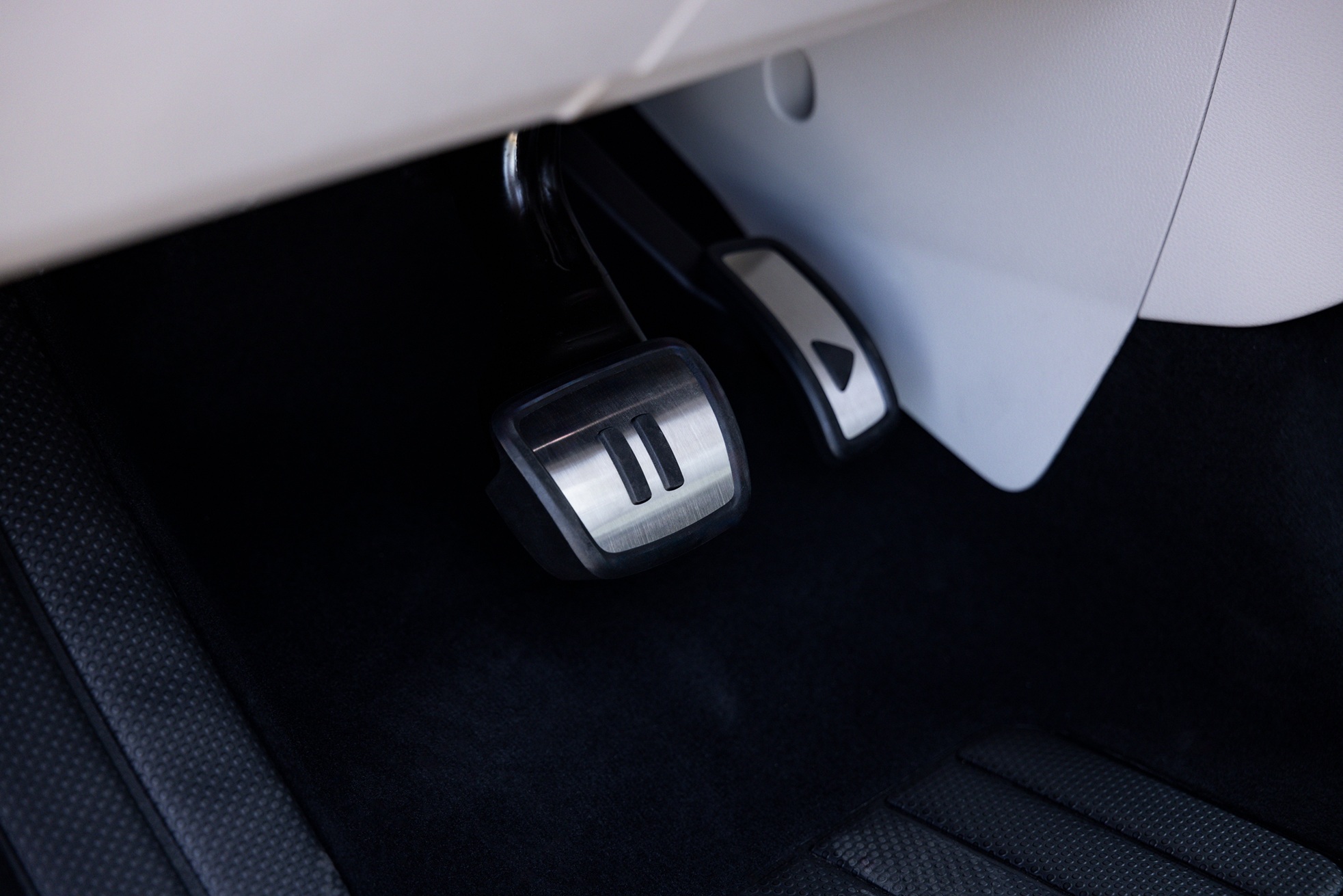
The ID Buzz has Pause and Play brake and accelerator pedals.

Pause and Play brake and accelerator pedals.

“What’s It Like?”

I met some of the nicest people during my test week of the ID Buzz. Each person asked, “What’s It Like?,” “Do You Like It?,” and “How Much Is It?”

My answers typically began with “Um, well …” All the ID Buzz shares with its microbus predecessor are a few throwback touches and a rear motor powertrain layout.

The Buzz light signature.

The Buzz lighting signature.

It is big but not imposing. The Buzz drives “smaller” than I expected. It doesn’t have that VW verve for driving, but the Buzz is quite accommodating, comfortable, and quiet on the road. It is not perfect, however, even to the Bulli pulpit.

I’m a Bulli insider. I owned a “bay window” 1968 VW Westfalia camper van. For $800, it was a charming beater. After the purchase, I shoveled $3,000 into it to make it start consistently, run (faster), stop, and steer. I loved its bus-like driver position and the big flat steering wheel. Sightlines were wide open. It had three-point seatbelts and an independent rear suspension, uncommon for American cars of that era. Throw open the one side door, and there was entry space to, maybe, shoehorn in a refrigerator. Raise the roof, and it was a cozy, wood-paneled camper. But, mercy, its clattering flat four cylinder could clear a picnic with its plume of exhaust and eye-watering exhaust emissions.

The Buzz, too, has an expansive cab-forward dashboard area, bracketed by forked windshield pillars. At first, it felt as if I was climbing aboard a space shuttle. That perception quickly transitioned into just a wonderful, open cabin space. As soon as I started driving, the broad glass greenhouse was more like a turret, providing 180-degree views.

When the question was about pricing — $60,000 to $71,000 — onlookers’ enthusiasm cooled. Expectations meeting reality.
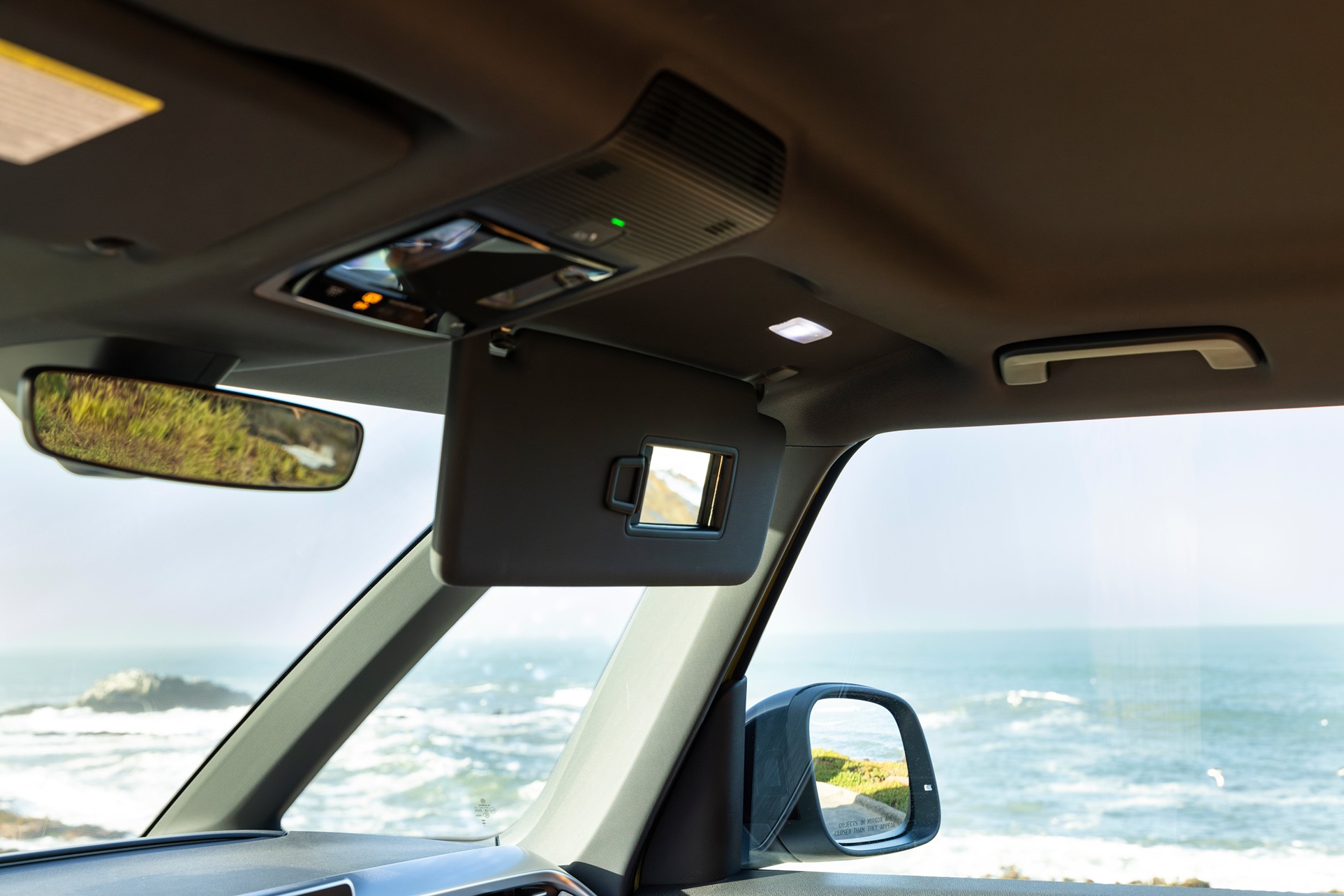
Despite the forked windshield pillars, driver sightlines are 180 degrees open.

Despite the forked windshield pillars, driver sightlines are 180 degrees open.

2025 VW ID Buzz Pricing

There are two trim levels for the 2025 ID Buzz — Pro S and Pro S Plus — available in rear-wheel drive or 4Motion all-wheel drive. Rear-wheel drive models have 282 horsepower and a driving range of 264 miles. 4Motion all-wheel-drive models add a front motor, generating a total of 335 hp and a driving range of 231 miles. However, charging at home (240V) yielded 258 miles.

A launch 1st Edition features a unique wheel design with special badging and additional benefits. Among the extras are heritage floor mats and a panoramic electrochromic glass roof. 1st Edition models are available in five two-tone paint colors. Pricing for the 282-hp Buzz 1St Edition starts at $67,045. A 1st Edition with 4Motion (335 hp) starts at $71,545.

Suggested retail pricing includes the $1,550 freight charge from Hanover, Germany.

All ID Buzz models have 20-inch aluminum-alloy wheels in a retro-inspired disc. The disc-style wheels optimize airflow for minimal drag losses, VW says.

Dual power-sliding rear doors have a wide opening of 42 inches. And the doors’ side glass incorporates a power sliding window. Though small, the window is similar to some versions of the original bus.

The ID Buzz has eight eye-catching two-tone color choices, each priced at $995. Pick your preference for a Candy White upper with lowers in Energetic Orange, Pomelo Yellow, Blue Charcoal, or Cabana Blue. There’s also the Metro Silver upper with Cherry Red below, such as on today’s Buzz tester. And there are three no-cost single-tone colors: Metro Silver, Candy White, and Deep Black Pearl.
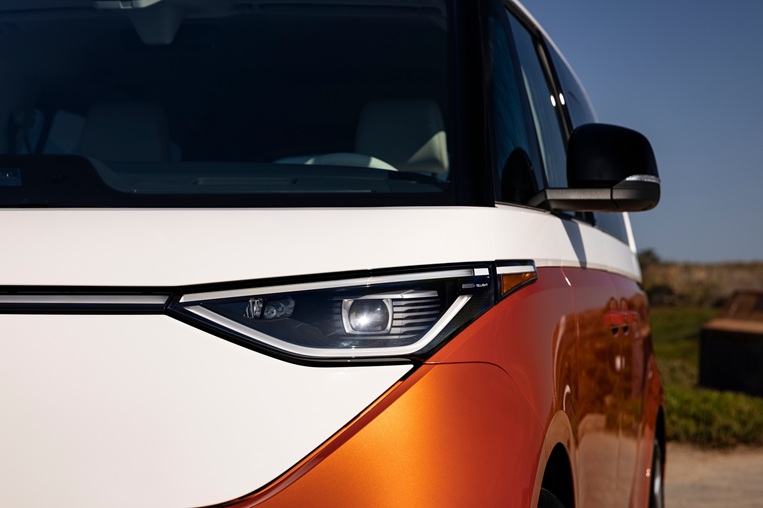
The ID Buzz has full LED lighting, including a slim lateral bar between the headlights.

The ID Buzz has full LED lighting, including a slim lateral bar between the headlights.

The Pricing Walk

  • Pro S: $61,545, single motor rear-wheel drive in solid paint color of black or white. (The popular two-tone paint scheme adds $995.)
  • Pro S Plus RWD: $65,045, single motor with monotone black paint;
  • Pro S Plus 4Motion: $69,545 dual motors with monotone black paint. (Its only factory options are for two-tone paint ($995) and the Electrochromic Smart Glass Roof for $1,495.

With the two-tone Cherry Red and Metro Silver paint scheme and three rows of floor mats, the tester came to $70,760.

Shop genuine ID Buzz accessories here.

Check current VW ID Buzz pricing here.

At the time of posting my story, there were two special offers for a 2025 ID Buzz:

Financing: 4.9 percent APR for 60 months, or a $2,500 customer bonus.

Lease: $699 per month for 36 months, with a down payment of $5,499 due at signing. At lease end, the owner is to pay a $395 disposition fee and a mileage range of 30,000 miles, and 20 cents a mile over 30,000 miles.
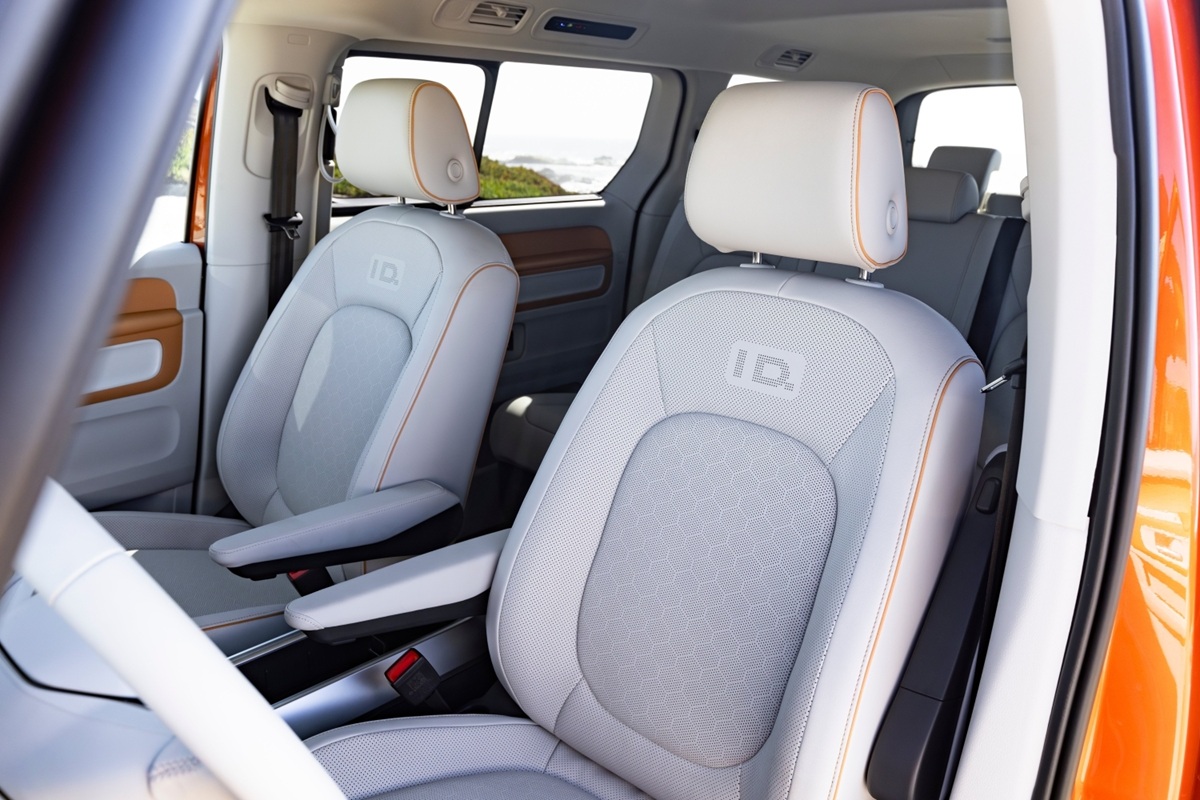
The ID Buzz Pro S Plus has 12-way power-adjustable and massaging front seats.

The ID Buzz Pro S Plus has 12-way power-adjustable and massaging front seats.

Buzz Interior Themes

There are three interior schemes for Buzz:

Moonlight: VW calls the “Moonlight” choice “Moody.” Dark brown leatherette seats feature white piping, blue door inserts, a dark wood-look dash, and a black headliner.

Dune: Intended as an airy, coastal-inspired interior. It pairs light gray leatherette seats with clay-colored piping, clay door inserts, and a light wood-look dash.

Copper: Mid-century modern with brown leatherette seat upholstery with yellow piping, brown door inserts, and a washed wood-look dash.
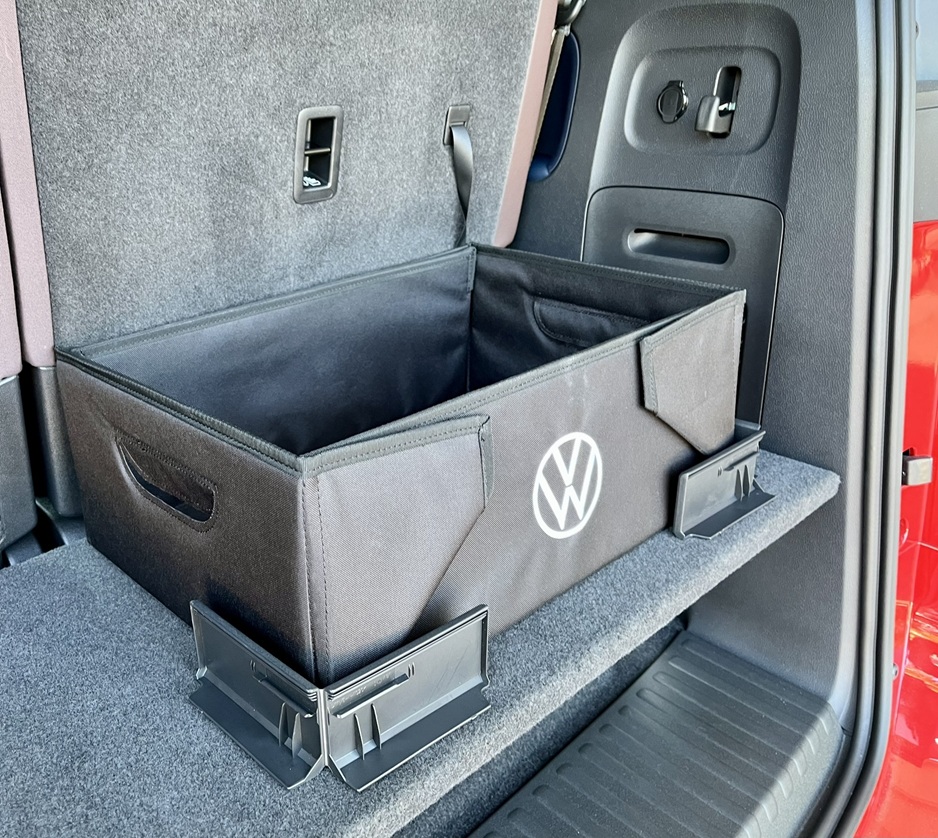
Showing the nifty foldable grippers that secure boxes on the rear flexboard

Removable corner grippers steady the bin. (Mark Maynard)

Clever Buzz Features

The ID Buzz has many cool features that are also quite accommodating:

Sit and Go Starting: Just take a seat, “smart” electronics recognize the key and activate the driving sequence. To shift into gear, place a foot on the brake pedal and twist the gear lever on the steering column. When exiting, the Buzz notes the empty driver seat and powers down the system.

Pause and Play Pedals: Stainless-steel pedal inserts mimic a media player “Pause” for the brake pedal and “Play” on the accelerator.

Removable plastic cargo grippers: On the rear side panels, foldable grippers are located that fold to 90 degrees to reinforce boxes or other gear.

Three D-pillar bar trim pieces: A reminder of the engine cooling vents of the vintage Type 2.

Loop grab handles: Look for the vintage-style grab loops at the side doors and tailgate pulldown.
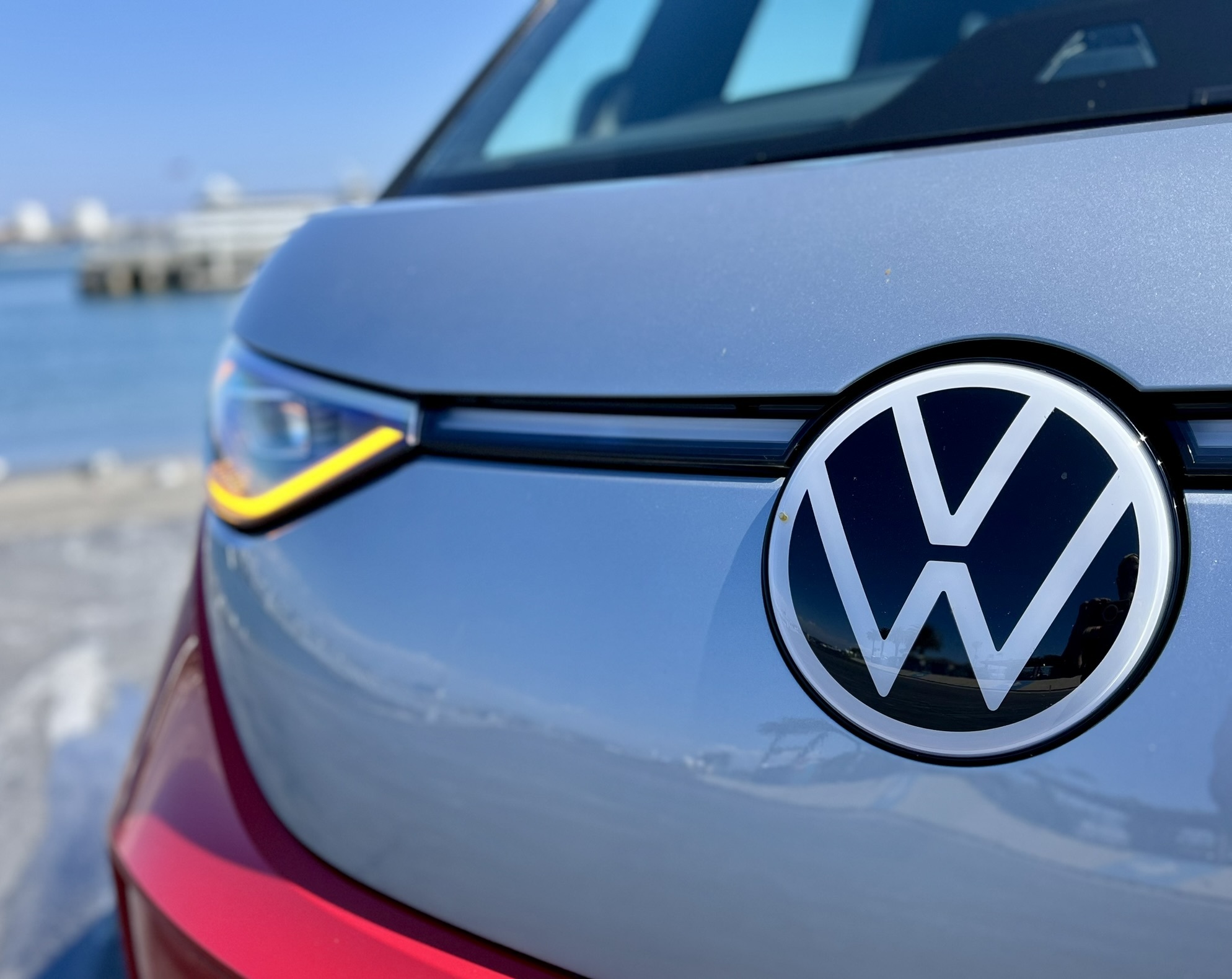
Looking at the oversized VW logo on the hood.

The Buzz has an oversized VW badge. (Mark Maynard)

Oversized front VW logo: The Buzz puts on a front light show when the driver approaches. The headlights, running lights, slim light bar, and VW logo give a welcoming light show.

ID Light system: A light strip located below the windshield utilizes various light pulses to signal the vehicle’s status. The pulses indicate readiness to drive, navigation turn instructions, brake prompts from driver-assistance systems, and incoming phone calls. When the Buzz is charging, the ID Light indicates the current charge level.

Buzz Box: The center floor console Buzz Box is a multitasker. It has open storage on top with two special, removable dividers. One doubles as a bottle opener, and the other can be used as an ice scraper. Below are two additional compartments, including a bottle holder. When configured with captain’s chairs, the removable center console can be relocated rearward for second-row passengers.

Buzz Kills

  1. For no apparent reason, the ID Buzz is not sold with a charging cable; however, an accessory charging kit is available for $350. The 2-in-1 Mobile EV Charge Cable is compatible with 240V and 120V charging.
  2. The ID Buzz has more USB charging ports (eight) than cup holders. There are no cup holders in the second row. However, there is a $98 accessory for a pair of single-cup holders with a phone slot. They work with the bench seat or captain’s chairs.
  3. Floor mats are not standard, and the accessory cost for three-row mats is $220. VW calls them Heritage mats, made of a premium woven material. There are color choices of Moonlight, Dune, or Copper to match the interiors.
  4. The tester’s Moonlight interior has brown V-Tec leatherette upholstery with the odd contrasting color of X-Blue on the dashboard. Brown and blue with a bold red exterior? Please give me the choice of a red interior.
  5. Grab handles! The elevated ride height deserves the leverage of robust grab handles at all doors. A robust bar integrated into the windshield pillars would be helpful. In the back seat, there are just two plastic loops at the second row doors. However, they do not appear strong enough to last through the warranty period.
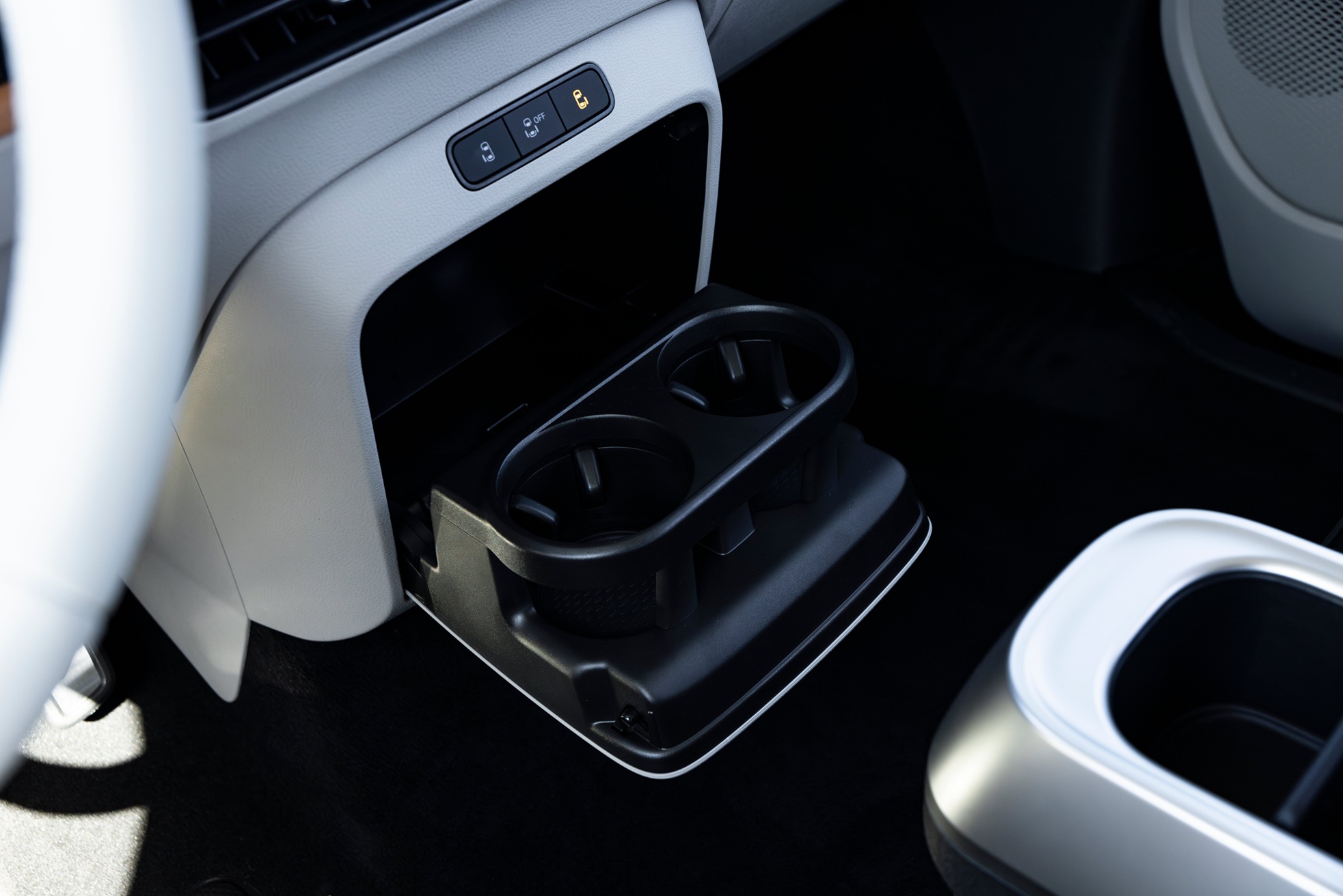
Dual drop-down front cup holders.

Dual drop-down front cup holders.

Interior Function

The cabin features an open design with clean lines and colors, showcasing a distinct European influence.

Front legroom of 37.5 inches might be a little short for the very tall. But the Buzz has the best second and third row legroom of any minivan or SUV: 39.9 inches in the second row and 42.4 inches in the third row.

All Buzz models have 12-way power driver and passenger seats. Each seat features dual armrests, thigh extensions, ventilation, massage, and memory functions. Second-row window seats are heated.

VW uses a unique driver armrest window switch to operate four windows. A “Rear” switch toggles between front and rear window controls. Once you figure it out, it is efficient.

VW’s ID Cockpit is a digital driver info display, replacing the traditional instrument cluster. The screen is attached to the steering column, ensuring it is always within line of sight. The display shows state of charge, range, and driving data. When mapping navigation is used, the route is displayed.

Wireless App-Connect and wireless charging are standard. The 15-watt ventilated Qi charging slot is just to the right of the steering wheel. In the nook, there are two charging USBs.

There is also a 110-volt/150-watt outlet under the passenger seat and a 12-volt power port in the cargo area.

A pair of large cup holders folds out from the lower dashboard area.

A nine-speaker audio system is standard. However, Pro S Plus and 1st Edition models upgrade to a 14-speaker, 700-watt Harman Kardon system.

The semi-floating 12.9-inch infotainment display is an iPad-like screen that controls entertainment, driver-assistance systems, and vehicle settings. Illuminated touch sliders that adjust volume and temperature are a departure from individual volume or tuning buttons; however, the sliders work well. To keep eyes on the road, the voice-recognition system is responsive to adjust the climate or audio volume. It functions well even when windows are open or the fan is blowing.
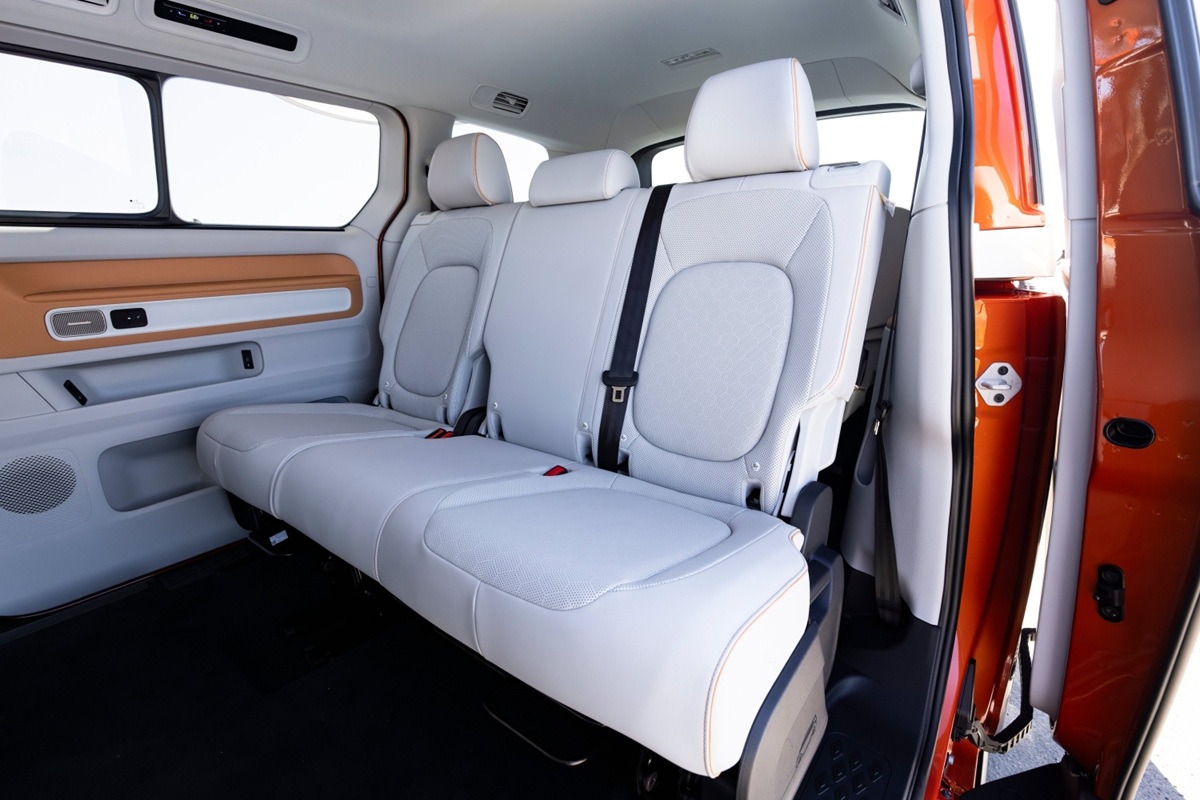
Second row captain’s chairs or the three-person bench seatback can be folded flat or split 40/60.

Second row captain’s chairs or the three-person bench seatback can be folded flat or split 40/60.

7 seats or 6?

Rear-wheel-drive models feature a second-row bench seat that accommodates up to seven passengers. The second-row bench can be folded flat in a 60/40 split, and the seatbacks can be reclined by 16 degrees. The bench can also be moved fore and aft by up to 7.9 inches. For third-row access, the bench window seats tilt and slide forward 4.7 inches.

Pro S Plus rear-wheel-drive models can be optioned with a second-row captain’s chair. The six-seat configuration is standard with 4Motion AWD.

Buzz models have standard child-seat (LATCH) anchors and tethers on second- and third-row seats.

Third-row seats slide fore and aft, recline, fold flat, and are individually removable. However, the seats are heavy and somewhat awkward to put back in place.

Pro S Plus and 1st Edition models include a cargo area “Flexboard” to create flat floor space when seatbacks are folded. Especially nice are two fabric storage bins that slot beneath it. Folding both rows of seatbacks, however, does not create contiguous sleeping space. There is a gap between the rows.

The third row is passenger accommodating with overhead air vents! And the pair of seats has fore-aft slide adjustment.

Cargo volume is 18.6 cubic feet behind the third row, 75.5 cubic feet behind the second row, and a massive 145.5 cubic feet with the second row seats folded and the third row removed.

Pro S Plus models feature a manually retractable tow hitch, which is completely hidden behind the rear bumper when retracted. With a braked trailer, the towing capacity is a maximum of 2,600 pounds on RWD or 3,500 pounds on 4Motion.
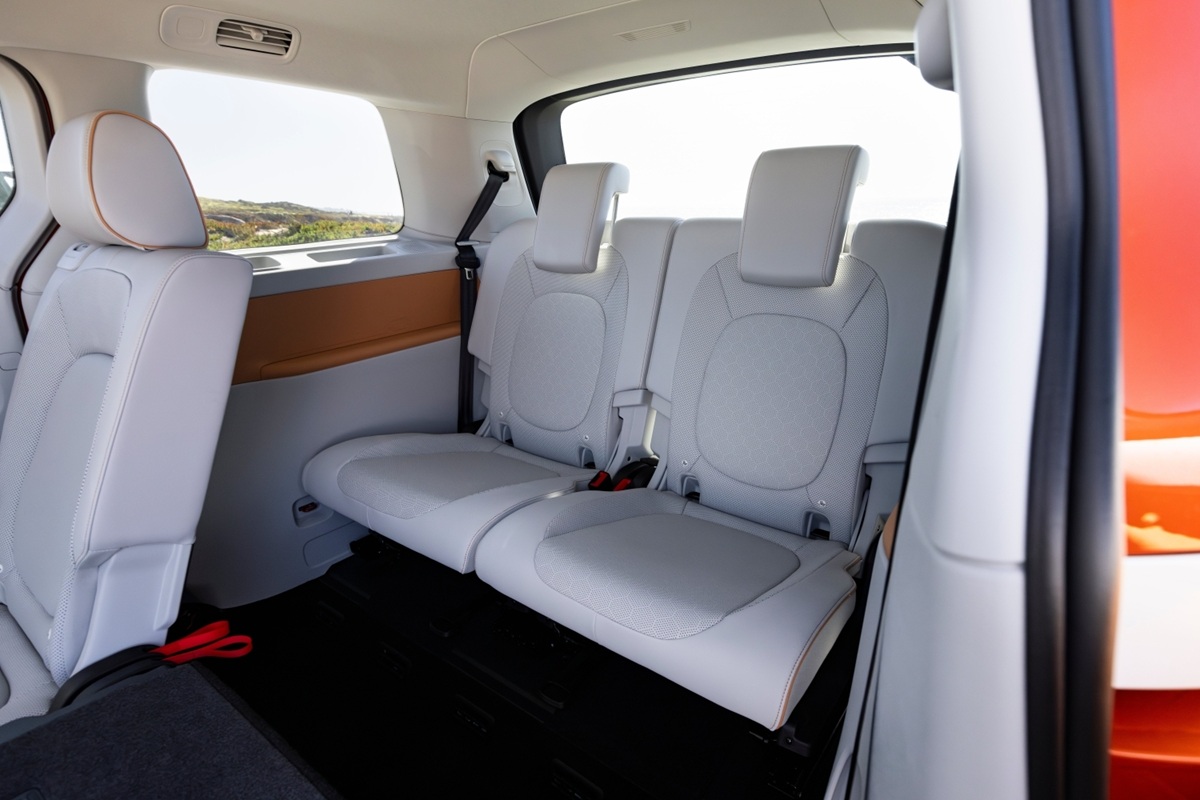
Looking at the pair of third row seats.

The Buzz has more third-row legroom than any SUV or traditional minivan, 42.4 inches

Buzz Safety Tech

Along with six airbags, there is a trove of safety and driver-assistance technologies. Among them:

  • Adaptive Cruise Control with stop and go;
  • IQ Drive with Travel Assist engages hands-on semi-automated driving assistance;
  • Park Assist Plus with Memory Parking;
  • Park Assist Plus with Memory Parking and Park Distance Control, front and rear;
  • Rear View Camera System with an overhead view and guidelines;
  • Active Blind Spot Monitor with rear traffic alert and exit warning;
  • Adaptive Front Lighting System with cornering lights;
  • Road Sign Recognition Display;
  • Front Assist Automatic Emergency Braking with pedestrian and cyclist monitoring;
  • Light Assist (high beam headlight control.
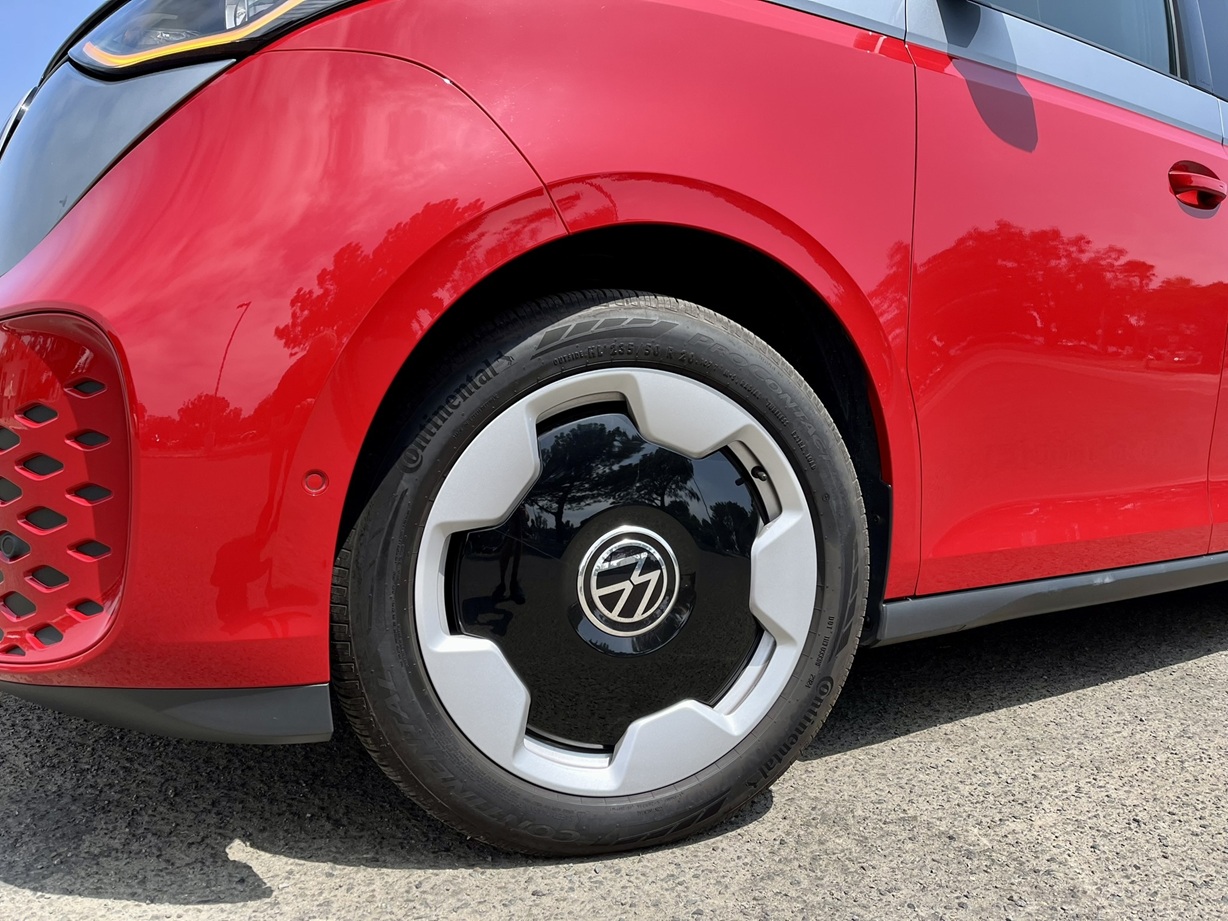
20-inch Continental ProContact tires are optimized for low rolling resistance. Silver wheels with a gloss black disc recall the original VW Microbus.

20-inch Continental ProContact tires are optimized for low rolling resistance. (Mark Maynard)

Buzz Battery Electric Powertrain

Just as the original Type 2 Bus was rear-wheel drive, the Buzz has a standard rear-mounted motor. The new APP550 rear-mounted motor is a PMS (permanent magnet synchronous) design producing 282 horsepower and 413 foot-pounds of torque. It is a VW-engineered module integrated into the rear axle, featuring a dual-stage one-speed gearbox and a pulse inverter. (The inverter converts direct current (DC) from the battery into alternating current (AC) to drive the electric motor.)

Volkswagen says the efficiency of its permanent magnet synchronous motor is “well above 90 percent in almost all driving situations.” During the manufacturing process, Volkswagen uses so-called hairpin winding. The stator’s coils are made from square copper wires, which, after bending, are visually similar to hairpins. This hairpin winding technique enables the wires to be packed more tightly. And by adding more copper to the stator, VW claims, power and torque are increased, while cooling efficiency is improved.

All-wheel-drive models add a front asynchronous motor (AKA150). It produces 107 hp and 99 lb.-ft. of torque. The combined system power of 335 hp and total torque of 512 lb.ft. provides astonishing launch force.

Top speed of the ID Buzz is electronically limited to 99 mph.

Showing the open charge door on the right rear. The ID Buzz charging port has a CCS plug connector for use at DC fast-charging stations.

The ID Buzz charging port has a CCS plug connector for use at DC fast-charging stations.

Unlike a traditional all-wheel-drive system, there are no mechanical links between the axles. Each motor connects to the wheels through a differential and a single-speed gearbox.

The variable 4Motion all-wheel-drive system engages the rear motor for most driving situations. The system will engage the front motor only as needed, such as to control wheelspin at any corner. The motors can react within a few hundredths of a second before the driver can notice the change.

Buzz Performance Modes

The ID Buzz features four driving performance modes that adjust steering weight, throttle response, and electric drive motor settings.

Eco mode tempers throttle response.

Comfort mode is the traditional Normal performance.

Sport mode sharpens steering and throttle response. On all-wheel-drive models, the front motor stays engaged for maximum power.

Custom mode allows a driver to blend between Comfort and Sport.

All-wheel-drive models also offer Traction mode, which engages when driving on loose or slippery surfaces and also activates permanent all-wheel drive up to approximately 12 mph.
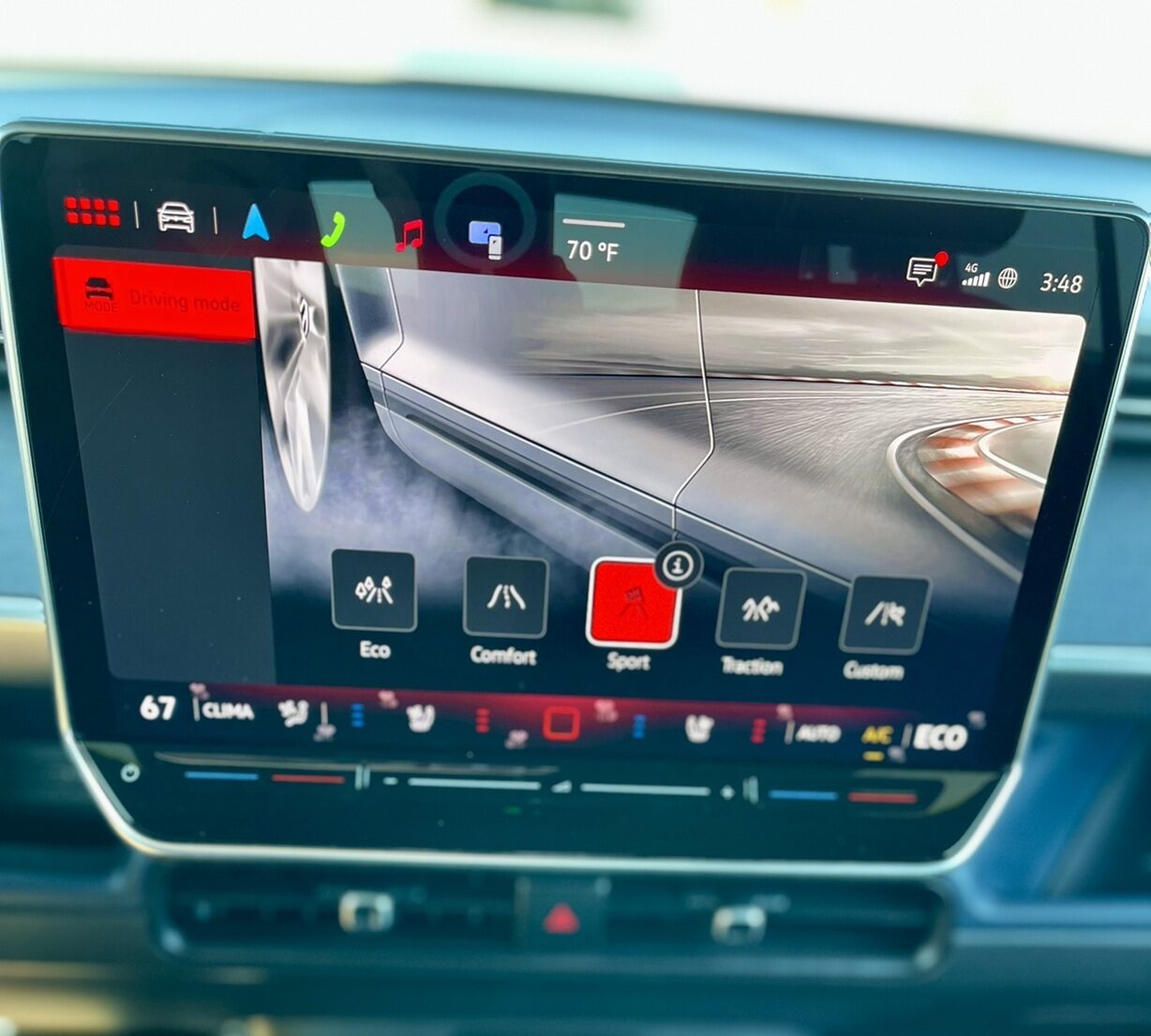
The Sport mode driving screen with red graphics

The ID Buzz has four performance modes, including Sport. (Mark Maynard)

Battery Technologies and Range

All current ID Buzz models utilize the same 91 kWh lithium-ion battery pack, comprising 208 prismatic cells. The battery pack weighs 1,230 pounds. The pack is mounted in a “skateboard” style on the Buzz floor.

Rear-drive Buzz models have an EPA-estimated range of 234 miles on a full charge. That range translates to fuel economy of 90 MPGe city, 75 MPGe highway, and 83 MPGe combined city/highway driving.

ID Buzz 4Motion models have a driving range of 231 miles and estimated fuel economy ratings of 87/74/80 MPGe (city, highway, and combined).

Volkswagen cites 0-60 mph acceleration in 7.4 seconds for rear-drive models and 6 seconds with 4Motion. Many reviewers, however, have reported achieving 60 mph in 5.7 seconds.

The loop grab handle at the side doors recall those in the vintage buses.

The loop grab handle at the side doors recall those in the vintage buses. (Mark Maynard)

Battery Charging

At DC fast-charging stations, the battery can be charged at a rate of up to 200 kW. VW says the Buzz will recharge from 10 percent to 80 percent in about 26 minutes.

A preconditioning function helps ensure the battery is prepared for the next charging stop. The battery is heated to the optimum temperature before charging stops, allowing it to accept energy at the maximum rate. VW says this function can reduce charging time by several minutes, particularly in winter.

When using the Electric Vehicle Route Planner, pre-conditioning is started automatically on the way to the next quick-charging station. Routes with up to 10 charging stops and 10 stopovers can be planned on a smartphone or the web portal and then transferred to the ID Buzz infotainment system.

The ID Buzz charging port features a CCS plug connector for use at DC fast-charging stations.

VW does not yet have access to the NACS charge port for use along the Tesla supercharger network. The NACS port will be available as an accessory, cost TBD.

The Buzz features an onboard 11 kW (AC) charging system, which is adequate for home and other Level 2 charging systems.

500 kWh of Free Charging

The 2025 ID Buzz includes 500 kWh of free juice at Electrify America stations, redeemable through the EA app. The plan includes three years of Electrify America’s Pass+ membership. Pass+ members use the EA app to find charging stations, receive notifications when a charger becomes available, and pay contact-free.

There are more than 900 Electrify America charging stations with around 4,000 chargers in North America. EA also provides “Plug&Charge”  technology to capable vehicles. By activating this feature in the Electrify America app, owners will be able to plug in the ID Buzz, and once the connection is established, it will start charging.

Regenerative Braking

The regenerative braking system in the ID Buzz has two modes. The D (Drive) position is the default mode, automatically activates upon start-up. In this position, the car can coast whenever the driver’s foot is off the accelerator or brake pedal. As soon as the driver applies the brakes, energy recuperation is engaged, and the electric drive motor feeds power back into the battery.

The B (Brake) position on the gear shift enables the driver to increase the amount of regeneration. Drivers can use the rocker switch to change from the D position to B at any time. This function almost always recovers energy during lifting off the accelerator pedal.

However, regenerative braking will not bring the Buzz to a complete stop when lifting off the accelerator, which is a key feature for so-called one-pedal driving. Volkswagen believes the driver should always be in control.
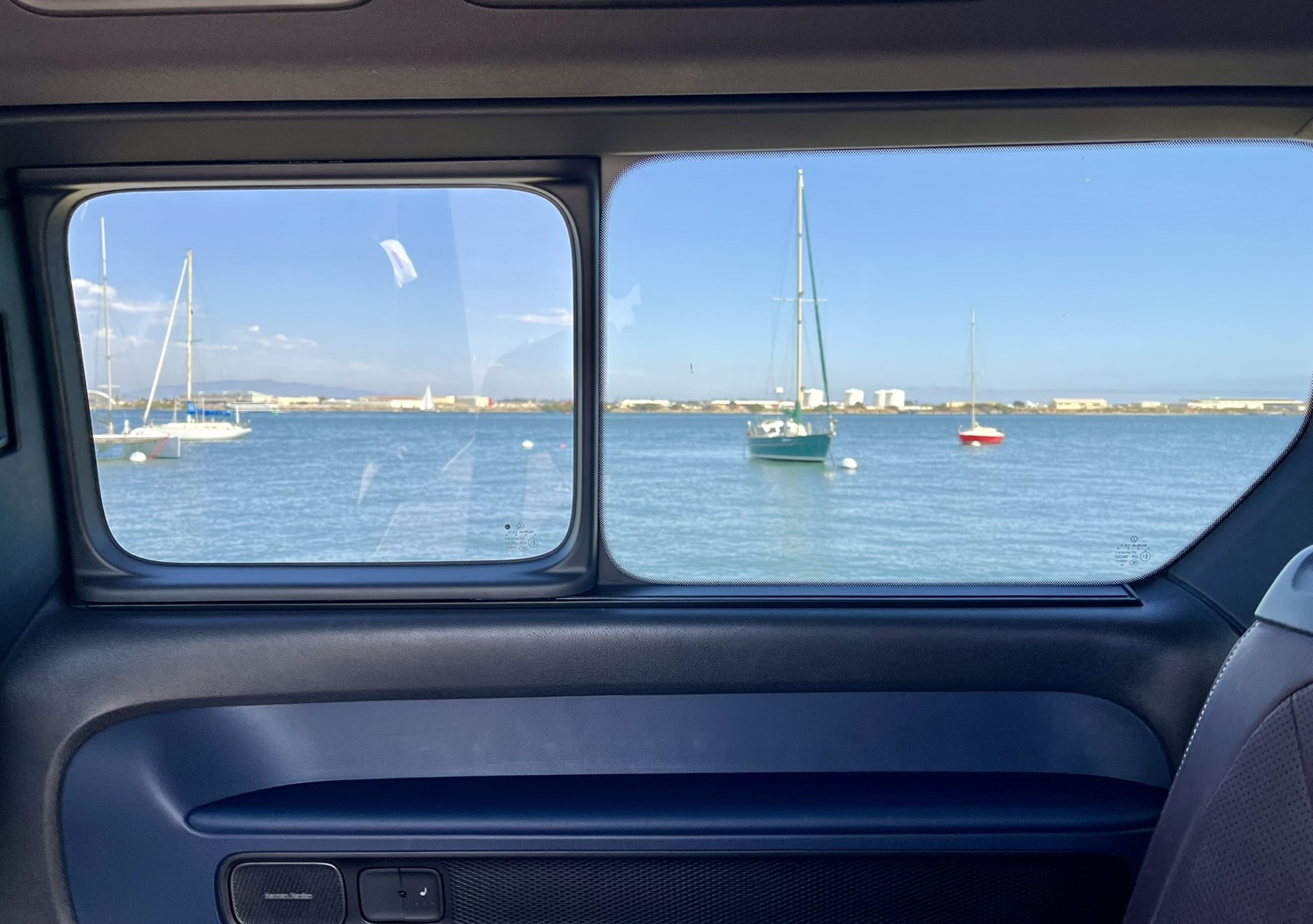
Small power side windows are reminiscent of some used in a vintage Type 2 bus.

Small power side windows are reminiscent of some used in a vintage Type 2 bus. (Mark Maynard)

Buzz 4Motion Ride and Handling

The ID Buzz drives with the finesse of a gentle juggernaut. The ride on concrete interstate surfaces can be jiggly, although it is common in other big EVs. However, the suspension is impressive for how well it manages transitions of the three-ton curb weight without wallow and dive.

The well-engineered steel-spring suspension features struts at the front, coil springs, telescopic dampers, and an anti-roll bar. At the rear, a compact multi-link suspension features coil springs, telescopic dampers, and an anti-roll bar.

A combination of front disc brakes and rear drums is a departure from four-wheel discs. VW says there are friction advantages in using rear drums. Because an electric vehicle relies on regenerative braking, the rear brakes get comparatively little use. The front discs are a substantial 15 inches in diameter; the rear drums are 13 inches in diameter.

All ID Buzz models are equipped with 20-inch aluminum-alloy wheels. Aerodynamically designed disc-style wheels minimize drag losses. Smooth body sides keep the tires flush, aiding aerodynamics and resulting in a sleek drag coefficient of 0.29 Cd. That compares to the Hyundai Ioniq 9 at 0.26 or the Toyota Prius at 0.27.

Towing capacities are 1,650 pounds with unbraked trailers. Braked trailers have capacities of 2,600 pounds RWD or 3,500 pounds 4Motion.

A hidden tow hitch is tucked under the rear bumper fascia and can be released by a lever within easy reach. When finished towing, the hitch can be pushed into its hideaway position. An exposed tow hitch can add aerodynamic drag, diminishing driving range in a minuscule amount.
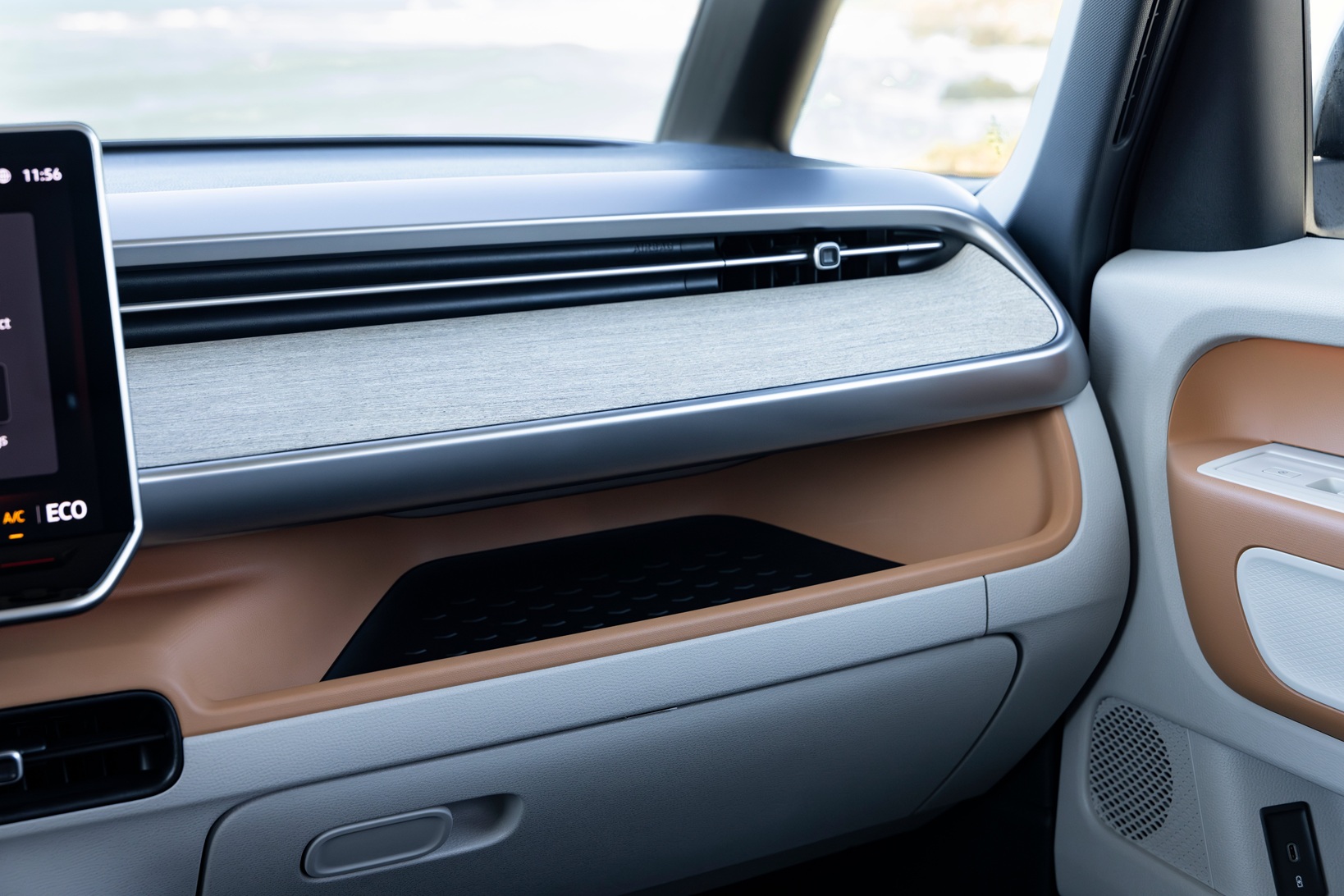
Small storage areas are notched throughout the interior, like this one on the passenger side of the dashboard

Small storage areas are notched throughout the interior.

2 Early Recalls Addressed

Volkswagen of America has fixes for a pair of unrelated recalls, according to a report in Automotive News. One recall is for third-row seating that is too wide for two passengers.

The recall halted sales of the ID Buzz in spring 2025. Sales of the electric minivan in North America began in November 2024. The stop-sale orders applied to new, unsold ID Buzz models and preowned inventory.

Under the first recall, dated April 10, 2025, the brake system warning light on the instrument panel may display an incorrect symbol and color.

VW said dealerships will perform a data container update along with a vehicle software update. The fix will take around one day to complete. The repair became available on June 6, according to a dealer communication document posted on NHTSA’s website.

Under the second recall, NHTSA stated the two-seat third-row bench is wide enough for three passengers. However, the calculated width of the seating surface exceeds the maximum specified for two passengers, according to NHTSA documents. That makes the seat noncompliant with Federal Motor Vehicle Safety Standard requirements.

VW dealerships will install fixed, unpadded trim parts to limit the width of the seating surface to two passengers.

The Flexboard adjustable storage system, with two flexible bins.

The Flexboard adjustable storage system, with two flexible bins. (Mark Maynard)

Why Buy the 2025 VW ID Buzz?

Minivans are typically family fare, but the ID Buzz seems more of a grown-up’s reward. Minivan owners who are out of the child-rearing years often keep the old, kid-worn van. It is handy for hauling junk and stuff, it’s paid for, and minivans are the ideal people mover. There might also be some emotional attachment.

The ID Buzz will be the adult ride for a night out with a bestie couple or a couple’s weekend getaway. Plus, a new Buzz will be clean, and children will always jump for a ride in the new “cool” minivan. Just keep your feet off the seats, and no eating or drinking!

Before dismissing the ID Buzz due to pundits’ criticisms, give it a fair evaluation.

Yes, it is expensive, but it is also a large vehicle, and for those with a home battery charger, the range is a non-issue. I’d rather drive the electric Buzz on a long, daily commute than a $35,000 fuel-miser econobox. The Buzz feels safe and secure, and its size matters when hustling along among semi-trucks and other large vehicles.

When seeking a dealership test drive, ask for an overnight experience. Give yourself time to get comfortable with the Buzz, and you might convince yourself that $70,000 is the new $50,000.

Read here what VW ID owners say about their experience with the Buzz and other VW battery electrics
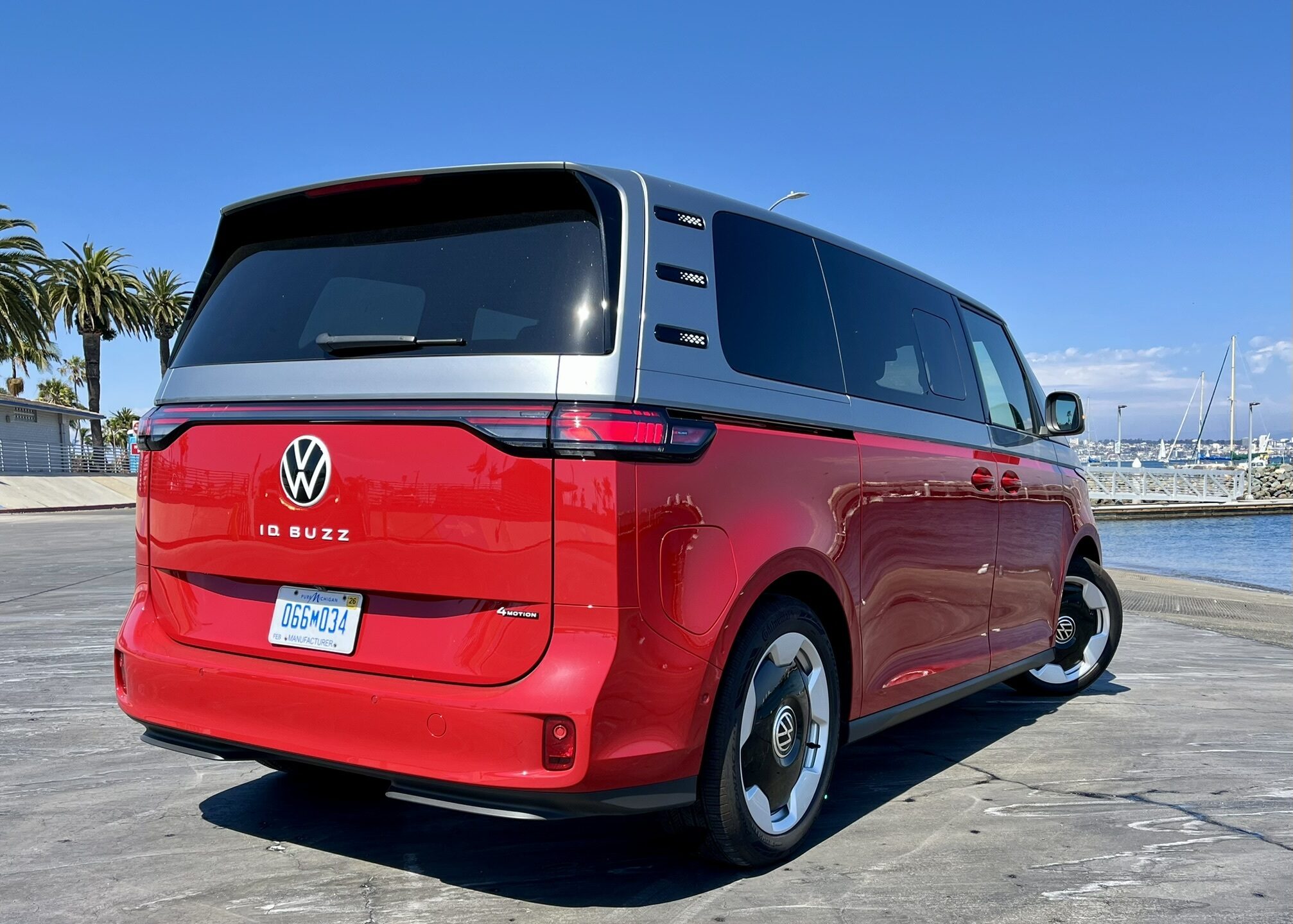
The rear of the ID Buzz has horizontally arranged LED taillights connected by a full-width light strip.

the ID Buzz has horizontally arranged LED taillights connected by a full-width light strip. (Mark Maynard)

2025 VW ID Buzz Pro S Plus 4Motion Specifications

Body style: 5-door, 6- or 7-seat AWD minivan; stamped steel panels; plastic and composite bumpers and some components

Motor: permanent magnet synchronous

Power, AWD: 335 hp, 413 lb.ft torque rear motor, 99 lb.ft. front motor; total 512 lb.-ft.

0-60 mph acceleration: 6 seconds

Battery: 91 kWh lithium ion; 208 prismatic cells

Battery weight: 1,230 pounds

Transmission: 1-speed automatic

EPA-estimated driving range: 231 miles

Fuel economy equivalent, MPGe: 87/74/80 city/hwy/combined

Onboard charger: 11 kW

CHARGING TIMES

Public DC fast charger: Recharged range in 10 minutes 79 miles

15 hours 7.2 kW AC, 0-100 percent, home or public station.

11 hours 9.6 kW, 0-100 percent, home or public station

9 hours: 11 kW charging, 0-100 percent, home or public station,

BY THE NUMBERS

Cargo space: 18.6 to 75.5 feet (behind third row and with second row folded)

Front head/leg room: 42*/37.5 inches; *40.6 in. w/o sunroof

2nd row head/leg room: 42.3*/39.9 inches; *41 inches w/o sunroof

3rd row head/leg room: 38.7/42.4 inches

Length/wheelbase: 195.4/127.5 inches

Width/height: 87*/76.2 inches; *78.1 inches w/mirrors folded

Curb weight: 6,197 pounds

Turning circle: 43 feet (37 feet with RWD)

Towing capacities: 1,650 pounds unbraked trailer; 3,500 lbs. braked

Drag coefficient: 0.29 Cd

FEATURES

Standard Buzz Pro S Plus interior equipment includes: 2nd-row manual “Captain’s Chair” bucket seats (folds flat with armrests and tip and slide 3rd-row access), 30-color ambient interior lighting, fold-down front-seat armrests, Flexboard cargo area adjustable storage system, footwell lights in front and 2nd rows, 12-way power adjustable front seats with 4-way lumbar and position memory, heated and ventilated front seats with massage function, heated multi-function steering wheel with hands-on detection and touch controls, illuminated vanity mirrors, LED reading lights, leatherette door trim inserts, perforated V-Tex leatherette upholstery, power sliding side doors, power sliding 2nd row windows, removable center console with storage.

Exterior features include: heated windshield, illuminated light lines (including front emblem and door handles), LED taillights and LED rear license plate lighting, LED Projector headlights with signature LED daytime running lights, spare tire mobility kit.

CHASSIS COMPONENTS

Brakes: Power assisted, dual circuit; 15-inch vented front rotors; rear drums, 13 inches

Steering: Electric rack-and-pinion; 36.4-foot turning circle, RWD; 42.7 feet 4Motion

Tires-wheels: 20-inch, all-season Continental ProContact; front HL 235/50 R20, rear HL 265/45

Suspension: front MacPherson strut-type with lower control arm, coil springs, telescopic dampers, anti-roll bar; rear, multi-link axle with coil springs, telescopic dampers, anti-roll bar

PRICING

Base Pro S Plus 4Motion price: $69,545, including $1,550 freight charge; price as tested $70,760

Options on test vehicle: Two-tone paint $995; three rows of floor mats $220

Where assembled: Hanover, Germany

WARRANTIES

  • 4-years/50,000-miles bumper to bumper including high voltage system; 8-years/100,000-miles high-voltage battery
  • Roadside assistance: 3-years/36,000-miles
  • Scheduled Carefree Maintenance: first two years, at 10,000 and 20,000 miles.
  • Connected-vehicle service coverage:
  • Vehicle Insights 7-year plan, includes: high-voltage battery charge settings, maintenance alerts;
  • Remote Access 3-year plan, includes: start-stop charging and find charging stations
  • Safe & Secure 5-year plan, includes: automatic crash notifications, emergency call;
  • Plus Speech with AI 3-year plan, includes: voice control of certain features using more natural language with the help of Generative AI;
  • Plus Nav 3-year plan, includes: continuously updated route and traffic information. Details at vw.com/connected.

Kia Carnival Hybrid Review

Kia Carnival Hybrid Review

Kia America adds a 2025 Carnival Hybrid MPV with mileage ratings of 34 mpg city, 31 highway, and 33 mpg combined

A silver Kia Carnival parked amid a forest setting

The 2025 Kia Carnival Hybrid powertrain has mileage ratings of 34/31/33 mpg city/highway/combined. (Photography by Kia or as credited)

Jump To Special Features

What’s New about Carnival for 2025?
Carnival HEV Powertrain
An Evolved Hybrid
2025 Kia Carnival Pricing
Carnival’s Driver Assistance Technologies
Chillin’ In the Lounge
Why Buy the Kia Carnival Hybrid?
Kia Carnival Hybrid Specifications

BY MARK MAYNARD

The Kia Carnival MPV can do almost everything an SUV can do — while dancing backward in high heels. Kia calls its Carnival a multi-purpose vehicle, not a minivan, though it is. It is an ideal people mover for most stages of life.

In its basic form, the Carnival is built for family duty and has many innovative details and features. In its top trim, the Carnival is experiential amid luxurious materials and modernistic design style. Consider it “business elite, not business as usual.”

The Carnival ride brings the comfort of a big sedan, the easy maneuverability of a midsize, and more utility than an SUV.

Kia expanded its Carnival lineup for 2025 with a hybrid powertrain, adding to the standard 290-horsepower V-6. The front-wheel-drive Carnival is not available with all-wheel drive.

In my week’s test of a topline Carnival SX Prestige Hybrid, it defined the EPA’s estimated fuel economy of 34 mpg city, 31 highway, and 33 mpg combined. My overall mileage was 33.7 mpg, and I broke 42.7 mpg on extended highway driving. With the 19-gallon fuel tank, a driver could see a cruising range of more than 600 miles. A road trip awaits.

Today, there are just four minivan choices, including the Carnival: the Chrysler Pacifica, Honda Odyssey, and Toyota Sienna. Of those, only the Honda does not have a hybrid or all-wheel-drive option.

Looking from the second row forward in the Carnival front seats

Spacious accommodations in the front seat area.

What’s New About Carnival for 2025?

Kia has sold a minivan called Sedona in the U.S. since 2002. It was unremarkable compared to the competition at the time, but it did get high marks for safety from NHTSA and IIHS.

Undeterred, Kia moved forward with a second generation in 2005 as a 2006. A third generation came along in 2014 as a 2015. And now, the fourth generation debuted in North America in Feb. 2021 as a 2022 model. The 2022 redesign included adding Kia’s global nameplate Carnival MPV.

Kia updated the 2025 Carnival with new front and rear fascias, redesigned headlights, and taillights. The liftgate was also cleaned up by removing the visible handle release.

The Carnival interior was revamped with an updated center console and new switchgear. The more compelling update is the new hybrid powertrain.

A close of the Carnival's front end with headlights illuminated

The Carnival’s new front fascia. Below, the restyled rear fascia. (Mark Maynard photo)

Looking at the Carnival rear end and the illuminated taillights

The Last Honest Vehicle

Unlike the SUV, the minivan is the last honest vehicle made today. Minivans don’t have to be anything other than what they were intended. They don’t need sport bucket seats with their annoying in-your-crack bottom bolsters, paddle shifters, a tachometer cluttering the driver’s gauge display, or a Sport mode turning the gauge display red.

Manufacturers have tried to sportify the minivan to little avail. Swoops and bulges did not disguise the maternity mode. Aerodynamic fairings and flashy wheels just added to the cost.

There isn’t a beauty competition for a minivan — it just can’t be ugly. Except for the Kia Carnival, there is dowdy minivan DNA in the competitors’ exterior styling. See it mainly in the big hips and broad beam. The Kia Carnival is sleek and nimble to drive.

The view forward from the second row with 37.6 inches of headroom.

The view forward from the second row with 37.6 inches of headroom. (Mark Maynard photo)

Carnival HEV Powertrain

The Kia Carnival Hybrid has a 1.6-liter turbo-hybrid engine, a 54kW motor, and a six-speed automatic transmission. The powertrain’s combined output is 242 hp and 271 foot-pounds of torque.

Other features exclusive to the Carnival Hybrid include 17-inch aerodynamic wheels (standard on the LXS trim), standard active air flaps integrated into the front fascia, and paddle regenerative braking.

Hybrid performance upgrades unique to the Carnival Hybrid include

  • Electrification-Vehicle Motion Control (E-VMC). The paddle shift levers allow you to adjust the amount of regenerative braking with a three-level deceleration control.
  • E-Handling. Stabilizes suspension response when entering and exiting a corner;
  • E-Ride. Specially tuned shock absorbers help smooth bumpy rides;
  • E-Evasive Handling Assist. Helps control vehicle movement during emergency steering.
  • Aerodynamic 17-inch or 19-inch wheels.

I appreciated how much battery driving was available at speeds up to nearly 30 mph.

The gasoline-powered Carnival has a direct-injected 3.5-liter V-6 and an eight-speed automatic transmission. Carnival V-6 has a towing capacity of 3,500 pounds vs. 2,500 lbs. for the Carnival Hybrid. Its fuel economy ratings are an EPA-estimated 18/26/21 mpg city/highway/combined, using the recommended 87 octane fuel.

Looking at the engine bay of the Kia Carnival

The Carnival’s hybrid powertrain has a combined output of 242 horsepower. (Mark Maynard photo)

An Evolved Hybrid

Kia has sophisticated engineering for its gasoline-electric hybrid system. An electrified vehicle’s 12-volt battery is the weak link, whether in a hybrid or a full battery electric. It is common for the 12-volt battery to run down when using features when the engine is not running. I looked for the 12-volt in the Kia Carnival and found none. I did find a 12-volt charging port under the hood.

In researching the system in the owner’s manual, I learned that Kia’s hybrid system has three batteries. The 12-volt AGM (absorbent glass mat) battery is integrated with the lithium-ion hybrid battery pack.

Kia has had this setup since the 2017 Niro hybrid.

An image of the passenger view and talk camera system

How the passenger view appears in the main screen. (Mark Maynard photo)

Auxiliary Parking Battery

The Carnival Hybrid has a secondary lithium battery as an auxiliary parking battery. The 12-volt P-LBM (parking lithium battery module) supports power to modules that need power after the ignition is turned off. Some of those modules include the anti-theft system, entry lighting (which activates the side mirrors when approaching with the key), and the power side doors and liftgate. This battery is charged when the ignition is on.

Parents waiting to pick up children from school or the practice field have a second safeguard against AGM battery rundown. In such cases, Kia says to use “Ready” mode. In Ready mode, the high-voltage battery keeps the 12-volt battery voltage at its operational level. If the high-voltage battery runs low, the engine kicks in to charge it.

The 12-volt battery has a lifespan of three to five years or longer for an AGM battery. When the Kia hybrid battery needs to be replaced, it requires a dealership appointment. Specific steps must be followed during the removal and installation process.

In all new vehicles today, the 12-volt battery must be factory-calibrated when replaced. That means going to the dealership or a repair facility with the (expensive) computer program. If not, the battery will quickly run down.

The hybrid battery and components have warranty coverage of 10 years or 100,000 miles, or 150,000 miles in California.

Dual 12.3-inch displays for driver info and navigation.

Dual 12.3-inch displays for driver info and navigation.

2025 Kia Carnival Pricing

The 2025 Carnival Hybrid is available in four trim levels of LXS, EX, SX, and SX Prestige. MSRP starting prices range from $42,235 to $54,335.

Gas-powered Carnivals are offered in five trims of LX, LXS, EX, SX, and SX Prestige. Starting prices range from $38,235 to $52,335.

The manufacturer suggested retail pricing includes the $1,435 freight charge from Gwangmyeong, Korea.

Today’s tester, a Carnival HEV SX Prestige, cost $57,595 with three options:

  • Ceramic Silver paint, $495,
  • Rear-seat entertainment package, $2,500. The package includes dual seatback screens, second-row VIP power seats with leg support, heated and ventilated seats, and ambient lighting.
  • Carpet floor mats, $265.

Check current Kia Carnival pricing here.

And find special offers and incentives here.

Looking through the steering wheel at the gauge display showing the blind-spot view turn signal image

Blind spot view monitors activate with turn signals.

Carnival’s Driver Assistance Technologies

Central to the Carnival’s advanced driver assist technology is standard Forward Collision-Avoidance Assist, which now includes:

  • Junction Crossing (FCA-JC);
  • Lange-Change Oncoming (FCA-LO);
  • Lange-Change Side (FCA-LS);
  • Evasive Steering Assist (FCA-ESA) on SX models and above.

Carnival SX trims and above also get standard Highway Driving Assist 2. The hands-on semi-autonomous driving technology can maintain a set distance from the vehicle ahead. The system also centers the vehicle within lane markers and will assist in lane changes under certain conditions.

In my test of the Carnival Hybrid’s semi-autonomous driving, the lane centering was consistent, with only an occasional wide swing across the lane lines. The system’s composure was not prone to loud safety alerts.

Spacious accommodations in the front seat area.

Spacious accommodations in the front seat area.

Carnival Interior Function

Space is a minivan’s luxurious frontier. While the Kia Carnival is not a luxury vehicle, its refinement of interior materials, switchgear, and touchpoints is rewarding.

The Carnival cabin has big-and-tall front headroom of 40.9 inches. Front shoulder room (door to door) of 64.2 inches is 2.6 inches wider than the Kia Telluride SUV.

Driver sightlines are unobstructed at the side mirrors and across the hood. Of special value is the around-view camera with overhead and forward views. The camera can be switched on when inching forward in a parking slot or the garage.

There is no stress to step in and buckle up, and definitely no need for running boards. An elevated ride height provides a clear view down the road.

The interior design is fresh, with no faux wood trim, just clean metallic elements. All controls are smartly placed and ergonomically designed.

The shift console is a functional work zone with cup holders divided by a phone slot. A charging e-bin includes a wireless pad and USB charging ports. Small storage areas, including a large armrest box, are handily placed throughout. The side-door panels have large cup holders.

Rather than a flip-down conversation mirror to keep an eye on children, Kia has a video view and talk function. It is accessed through the main 12.3-inch wide screen. It also can be programmed as a one-touch button on the steering wheel.

Dual power sunroofs are standard on the Carnival SX Prestige.

Dual power sunroofs are standard on the Carnival SX Prestige. (Mark Maynard photo)

Carnival Hybrid Ride and Handling

One of the most endearing aspects of minivan ownership is the generally forgiving ride quality. The Kia Carnival is especially adept at not tossing heads when pulling into driveways or transitioning speed bumps. The setup is well-tuned for side-to-side stability. The Carnival rolls along with uncommon quiet and smoothness. However, it can send a shocking jolt over a pothole and rough pavement.

The suspension is a well-engineered four-wheel independent setup with steel springs and gas-charged shock absorbers. There are MacPherson struts at the front and a multi-link rear.

Ride quality with the 19-inch Goodyear Assurance Finesse tires (235/55) was poised and carpet smooth. These tires are affordable, costing between $220 and $250 each when replaced.

Advantageous is the lightweight of the steering and very compact turning circle of 38 feet. It is possible to make a U-turn on most residential streets. Steering control, though light, is entirely on track while cruising at speed.

Four-wheel-disc braking engages with uncommon smoothness and direct engagement. Front and rear rotors are 12.8 inches, with ventilated discs at the front and solid discs rear. These discs are comparable to the competition’s and seem fit to handle a 2,500-pound trailer with brakes.

Looking at the driver side front tire and black wheel

19-inch dark alloy wheels are part of the Carnival HEV SX package. (Mark Maynard photo)

Back Seats and Cargo Space

Sliding side doors are a parent’s friend — power-operated and foot-activated. The openness of the doors allows a parent to get close to the child seat for buckling without hoisting a child up into an SUV’s seating position.

Either power side door can be opened from the driver seat, which is helpful for the school taxi, especially when there is rain or snow.

I would prefer the standard three-position second row; it has more family function than the VIP Lounge seats, which are exclusive to the SX Prestige. With the eight-seat configuration, the second-row seats can be removed, or just the center seat removed for an aisle pass-through to the third row.

Kia adds a nifty feature of slide-flex seat adjustment. Both window seats can be moved manually inward by a couple of inches. The side movement is beneficial with the VIP Lounge seats, which cannot be removed and do not have a fold-and-tumble design for third-row access. The side flex is not much, but it doesn’t take much for a kid to slip by and into the third row.

Lounge seats in full upright positionThere is adult legroom in the second row — 40.5 inches if a tall person is not sitting ahead.

A special feature in the eight-passenger Kia Carnival is a second row “child minding seat.” The center seat can be moved forward on tracks to install a child seat. In that position, a parent in the front row can reach the child. Or just fold the center seat for a tablelike surface, which also can be used by those in the third row.

With the second row removed there is four feet in width for hauling sheets of plywood and tools

Second-row seats in the eight-passenger model can be removed for open cargo capacity, 4 feet wide.

Chillin’ In the Lounge

VIP Lounge seats are impressive and entertaining to friends and family, however, the appeal might not last. The seats should not be used in a reclined position while the Carnival is in motion. In the event of emergency braking, the shoulder belt would unlikely hold the occupant in position.

The reclining loungers cannot be removed, such as for romper room cargo function. Heated and ventilated second-row seats are only offered with the $2,500 package.

2nd row VIP lounge seating with leg support extended

2nd row VIP lounge seating with power controls.

Carnival’s Third Row

There is no shortage of details for those in the third row. There are charging ports, an inset for cups or juice boxes, and a phone slot.

Headroom of 38.6 inches is adequate for adults of average size. However, the max legroom of 35.6 inches is up to 3 inches less than in some competitors.

All Carnival models have a deep well of storage space behind the third row.

All Carnival models have a deep well of storage space behind the third row.

Carnival Cargo Space

Carnival earns its cargo salt with the obligatory 4-foot width, as if owners will load sheets of plywood. As with most minivans, the waaay back has multi-function.

With the third-row seats in place, there is a deep well of steamer-trunk capacity that neatly corrals a multitude of grocery bags or whatever. Fold the 60/40 seatbacks to drop flat into the cargo well and a parent could roll in bikes and trikes or strap down a large dog kennel. The interior height of 40 inches is taller than that in most midsize SUVs. Fold the third row for 5 feet of flat space.

Why Buy the Kia Carnival Hybrid?

Save face while saving fuel and emissions.

Minivans are a stage-of-life vehicle. For parents, the Carnival’s utility and function are as rewarding as having a housekeeper. Yet, its styling does not announce we are in a family way.

A rear side view of the Ceramic Silver Carnival

The Kia Carnival has a compact turning circle of 38 feet.

2025 Kia Carnival HEV SX Prestige Specifications

Body style: large 7- to 8-passenger front-wheel-drive minivan

Engine: 242-hp 1.6-liter turbo gasoline direct injection 4-cylinder; 270 lb.-ft. torque

Transmission: 6-speed automatic with steering wheel regenerative braking paddles

Fuel economy: 34/31/33 mpg city/hwy/combined; 86 octane recommended

Motor: 18 hp permanent magnet synchronous

Battery: 270-volt, 5.5 Ah lithium-ion with 64.0 kWh

BY THE NUMBERS

Towing capacity: 2,500 pounds (braked trailer), 1,000 lbs. unbraked

Fuel tank: 19 gallons

Cargo space: 40.2 cubic feet

Front head/leg room: 39.7*/41.1 inches *40.9 in. w/o sunroof

2nd row head/leg room: 37.6/40.5 inches

3rd row head/leg room: 36.5/35.6 inches

Length/wheelbase: 203/121.7 inches

Width/height: 89.2*/68.5** inches *w/side mirrors *w/o roof rails

Curb weight: 4,967 pounds (7-seats); 4,852 lbs. w/8 seats

Turning circle: 38 feet

FEATURES

Standard Carnival equipment includes: smart-key entry and push-button ignition, dual 12.3-inch digital panoramic display, 8-passenger seating with 2nd row child minding seat, SynTex upholstery, electric parking brake, wireless Android Auto and Apple CarPlay, Kia Connect with 3-year Ultimate, satellite radio with 3-mongh subscription, Passenger View and Passenger Talk, dual smart power sliding side doors, tri-zone automatic climate control, wireless phone charger, heated and ventilated power front seats, smartphone digital key

Exterior features include: 19-inch alloy wheels, smart power liftgate, dual power sunroofs, multi LED headlights-fog lights-DRLs, roof rails, rear spoiler, rear privacy glass, tire mobility kit (no spare tire included)

HEV SX Prestige features include: Leather-trimmed upholstery, Dark Edition alloy wheels and exterior accents, LED projector headlights and rear combination taillights, head-up windshield display, Bose premium audio system, heated steering wheel, digital rearview mirror-camera

Safety features include: 7 air bags (including driver’s knee bag), rear occupant alert with ultrasonic sensors, parking distance warning forward and reverse

Driver-assist technologies, include: navigation-based smart cruise control with stop-and-go, forward collision-avoidance assist with cyclist and junction turning; blind-spot collision-avoidance assist; rear cross-traffic collision-avoidance assist; driver attention warning; high-beam assist; lane-keeping assist and lane-following assist; parking collision-avoidance assist reverse; safe exist assist; highway driving assist.

CHASSIS COMPONENTS

Brakes: 4-wheel discs; front, 12.8-inch ventilated rotors; rear, 12.8-inch solid rotors

Steering: Column-mounted electric power steering; 38-foot turning circle

Tires-wheels: 19-inch Goodyear Assurance Finesse tires (235/55); tire-mobility kit; dark alloy wheels

Suspension: front, MacPherson struts with gas shocks; rear, multilink w/gas shocks

PRICING

Base price: $54,335, including $1,435 freight charge; price as tested $57,595

Options on test vehicle: Ceramic Silver paint, $495; Rear-seat entertainment package, $2,500 includes dual screen system, 7-passenger seating, 2nd row power seats with leg support, heated and ventilated 2nd row seats, ambient lighting, glossy interior trim; carpet floor mats, $265.

Where assembled: Gwangmyeong, Korea

Warranties: 10-years/100,000-miles powertrain; 5-years/60,000-miles bumper to bumper with roadside assistance; 10-years/100,000-miles hybrid battery (150,000 miles in California)

2025 Kia Sorento PHEV Overview

2025 Kia Sorento PHEV Overview

 The 2025 Sorento plug-in hybrid has a battery-electric driving range of 30 to 32 miles

The 2025 Kia Sorento lineup of gas, hybrid, and plug-in hybrid models

The 2025 Kia Sorento family, left to right: Sorento ICE, Sorento HEV, and 2025 Sorento PHEV. (Photography courtesy of Kia America)

Jump To Special Features

What’s New for the 2025 Kia Sorentos?
Kia Sorento Gas Model Pricing
Kia Sorento Hybrid Pricing
Sorento’s 3 Row Competition
2025 Kia Sorento PHEV Specifications

BY MARK MAYNARD

Kia America has completed its trio of Sorento SUV powertrains with the 2025 Sorento PHEV plug-in hybrid. All versions of the midsize Sorento SUV have three rows of seats and drive configurations of front- or all-wheel drive.

The 2025 Sorento plug-in hybrid is now on sale with a battery-electric driving range of 30-32 mpg. In addition to the new powertrain variant, Kia has updated the 2025 Sorento PHEV and Hybrid models with a range of enhancements. Kia says that many of the updates aim to cater to the digital needs of today’s consumers.

The Sorento’s PHEV powertrain integrates a 1.6-liter turbocharged four-cylinder engine, a 66.9 kW electric motor, and a 13.8 kWh battery. The Sorento PHEV has an EPA-estimated 74 MPGe combined and an EPA-estimated all-electric range of 30 miles. A six-speed automatic transmission and all-wheel drive are standard.

For 2025, the Sorento PHEV is sold in two trim levels of EX and SX Prestige. Pricing for the 2025 Sorento PHEV EX starts at $49,365, and the PHEV SX Prestige starts at $54,465. Manufacturer suggested retail pricing includes the $1,375 freight charge from Hwasung, Korea. While gasoline-powered Sorentos are built in West Point, Ga., the electrified models are built in Korea. Check current Sorento PHEV pricing here.

The 2025 Kia Sorento in the new paint color of Volcanic Sand

The mildly refreshed 2025 Kia Sorento PHEV has a sleeker appearance from new standard lighting elements, including Kia’s signature Star Map lighting.

Kia Sorento Background

Now in its fourth generation in the U.S., the Kia Sorento debuted in February 2002; the first generation Sorento was a traditional truck-based body-on-frame SUV. The Kia Sorento transitioned from a body-on-frame to a unibody chassis in 2011 with the second generation of the vehicle. Kia maintained its popular-selling Sorento with redesigns, fresh engineering, or facelifts about every two years.

The current 2025 Sorento was completely redesigned and re-engineered in 2020. It was made larger on a longer wheelbase and offered a hybrid or gas engine. A mild refresh for the 2024 model year added vertically stacked and slimmer LED headlights and a smoother front bumper design aligned with the grille. The front lights are reminiscent of the EV9 and the 2025 Carnival, influenced by Kia’s new design language. The rear lights and bumper had minor tweaks.

The Sorento fits into the Kia lineup between the smaller Sportage and the larger Telluride.

What’s New for the 2025 Kia Sorentos?

Kia says the 2025 Sorento PHEV and Sorento Hybrid were updated for a sleeker appearance, using new standard lighting elements. Among the lighting updates include Kia’s signature Star Map lighting in the front and rear, and amber daytime running lights.

Plug-in and HEV models also have special paint colors: Cityscape Green, Mineral Blue, and Volcanic Sand. Also new is a Dust Blue interior hue and 19-inch alloy wheels.

Interior enhancements feature many digital elements. A standard panoramic instrument panel has a 4.3-inch TFT (Thin Film Transistor) and a 12.3-inch infotainment screen. The SX-Prestige is upgraded to a curved panoramic panel linking two 12.3-inch dual screens. This display unlocks Kia’s Connected Car Navigation Cockpit operating system. Kia says the new OS has faster processing speeds and over-the-air update capability. Wireless Android Auto and Apple CarPlay are standard, as are USB-C ports throughout all three rows. The SX-Prestige adds such luxury elements as a suede headliner, ventilated front seats, and Advanced Digital Key 2.0.

Notable driver convenience systems added to the 2025 Sorento models include available Smart Cruise Control-Machine Learning. Kia says SCC Machine Learning will monitor about 1-2 hours of the user’s driving. The system will then use that data to set preferences such as following distance, rates of acceleration and deceleration, and reaction speed. The result is a more intuitive and personalized driving experience.

Smart Cruise functions with Kia’s Highway Driving Assist 2. Its features include automatic lane change to help the vehicle maintain a set distance from the vehicle detected ahead. It also helps the vehicle stay within lane markers on select highways and aids in lane changes.

Among the 2025 Sorento updates is a curved panoramic panel linking two 12.3-inch screens.

Among the 2025 Sorento updates is a curved panoramic panel linking two 12.3-inch screens.

Kia Sorento Gas Model Pricing

The gasoline-powered Sorento complements the 2025 refreshed turbo hybrid and plug-in hybrid models.

Gas (ICE) versions of the Sorento are offered in two 2.5-liter four-cylinder powertrains with eight-speed automatic transmissions. All Sorentos have a choice of front- or all-wheel drive.

Base models have a 191-horsepower, direct-injected 2.4-liter four-cylinder. Mid- and upper-range 2025 Sorento trim levels have turbocharged versions of the 2.4-liter with 281 hp.

Fuel economy estimates for the base models are 26 mpg city, 31 highway, and 23 mpg combined. AWD mileage estimates are 23/28/25 mpg city/highway/combined. Regular unleaded fuel is recommended.

Towing capacities are 1,650 pounds for unbraked trailers or 2,000 pounds for a braked trailer. Adding the optional towing package increases trailering capacity to 3,500 pounds. The top-line X-Pro SX Prestige AWD has a tow rating of 4,500 pounds.

Look for the current Kia Sorento pricing offers and incentives here.

Amber daytime running lights are among the Sorento’s exterior updates.

Amber daytime running lights are among the Sorento’s exterior updates.

Kia Sorento Hybrid Pricing

Sorento gasoline-electric models are available in trims of EX and SX Prestige. All-wheel-drive is an $1,800 option for the Sorento EX. AWD is standard on the SX Prestige.

Sorento’s hybrid (HEV) models are offered in two trim levels with a six-speed automatic transmission. Sorento EX pricing starts at $40,065 and the SX Prestige at $48,265.

The HEV powertrain consists of:

  • 177.5-hp 1.6-liter turbocharged and direct-injected four-cylinder engine;
  • 1.5 kWh lithium-ion-polymer battery;
  • 44.2 kW electric motor;
  • Total system power is 227 hp and 258 lb.-ft. of torque.

EPA-estimated fuel economy for the front-drive Sorento Hybrid is 36 mpg city, 36 highway, and 36 mpg combined. AWD hybrid models have mileage estimates of 34/34/34 city/highway/combined. Regular unleaded fuel is recommended. The 17.7-gallon fuel tank could provide up to 637 miles for front-wheel drive or 602 miles for AWD.

Unbraked trailering capacity is 1,654 pounds.

Sorento’s 3-Row Competition

Competing midsize SUVs with the Kia Sorento include:

  • Toyota Grand Highlander;
  • Mazda CX-90;
  • Hyundai Santa Fe (corporate partner to the Sorento);
  • Mitsubishi Outlander;
  • Subaru Ascent.
A rear view of a Sorento plug in hybrid in the paint color of Volcanic Sand

2025 Sorento PHEV

2025 Kia Sorento PHEV Specifications

Body style: midsize, three-row plug-in hybrid SUV in front- or all-wheel drive

Powertrain: 1.6-liter turbocharged four-cylinder engine, 66.9 kW electric motor, and 13.8 kWh battery

Motor: 89.7-hp permanent magnet synchronous

Battery: 38 Ah lithium-ion polymer

Battery weight: 322 pounds

Total system power: 261 hp; 270 lb.-ft. torque

Transmission: 6-speed automatic

Fuel economy: 74 MPGe combined

EPA-estimated all-electric range: 30-32 miles

Fuel tank: 12.4 gallons; total driving range 460 miles

BY THE NUMBERS

Length/wheelbase: 189.6/ 110.8 inches

Width/height: 74.8/66.7 inches

Curb weight: 4,652 pounds

Cargo space: 12.6 to 38.5 cubic feet

Front head/leg room: 40.3*/41.4 inches *w/o sunroof

2nd row head/leg room: 39.140.3/ inches

3rd row head/leg room: 36.8/29.6 inches

Turning circle: 38 feet

FEATURES

Standard PHEV exterior features include: Torque vectoring AWD with center-locking differential, 19-inch alloy wheels, LED projector headlights and LED fog lights, roof rails, smart power liftgate with auto-close, front and rear parking sensors.

Standard interior features include: 6-passenger seating with 2nd-row captain’s chairs, SynTex upholstery, heated front seats, 10-way power driver’s seat with 2-way lumbar, 12.3-inch touchscreen display with navigation, Kia Connect, and satellite radio, wireless Apple CarPlay and Android Auto, Smart Key entry and locking with push button start and remote start, 8 USB charging ports, wireless phone charging pad, auto-dimming rearview mirror, electric parking brake with auto-hold.

Driver Assistance Technologies include:

  • Auto Emergency Braking Technology with pedestrian, cyclist, and junction turning detection
  • Blind-Spot detection technology
  • Highway Driving Assist
  • Lane Keeping and Following Assist Technology
  • Rear Cross-Traffic Collision-Avoidance Assist
  • Driver Attention Warning w/ Leading Vehicle Departure Alert
  • Safe Exit Assist
  • Rear Occupant Alert

Where assembled: Hwasung, Korea.

Warranties: 5-years/60,000-miles bumper to bumper with assistance; 10-years/100,000-miles powertrain; 10-years/100,000-miles hybrid/electric system components and hybrid traction battery.

Fiat 500e Review

Fiat 500e Review

The mini-subcompact 2024 Fiat 500e is best enjoyed as a city or suburban runabout. However, its electric driving range is 143 to 162 miles.

A front three quarter view of a red Fiat 500e with blue sky in the background.

The 2024 Fiat 500e is sold in four trim levels with starting prices ranging from $34,095 to $37,595. (Photography by Fiat/Stellantis or Mark Maynard)

Jump To Special Features

The Fiat 500e Italian-American
2024 Fiat 500e Pricing
500e Warranties
Feeling Inspi(RED)?
Cool 500e Features
Fiat 500e Performance
Charging the 500e
Why Buy the Fiat 500e?
Specifications

BY MARK MAYNARD

The 2024 Fiat 500e is proof that battery-electric cars do not have to look weird. This clever and cute electric four-seater is best enjoyed as a city or suburban runabout. It has an electric driving range of 143 to 162 miles. And the best part is how quickly it recharges, and every Fiat 500e is available with a 240-volt home battery charger.

The Fiat 500 legacy began in 1957 in Italy as a roomy gas miser. It had a tiny engine at the rear, a four-speed manual transmission, and rear-wheel drive. The Cinquecento putted along until a 1965 redesign gave it styling panache that helped push sales to nearly a million. Fiat 500 production from 1957 to 1975 totaled 3,893,294 cars.

With its 5.8-gallon gas tank, the 21-horsepower, half-liter, two-cylinder engine had a fuel economy rating of 33 mpg. At the time, the average price for a gallon of gas was about 31 cents, according to ConceptCarz.   A full tank could possibly provide around 191 miles of driving.

The original 1957 Fiat 500 and its 2024 electric re-creation, 500e.

The original 1957 Fiat 500 and its 2024 electric re-creation, 500e.

The Fiat 500e Italian-American

Ever the thrifty small car, the modern rebirth of the Fiat 500e is true to its roots. It is the first battery-electric vehicle from Stellantis. However, a previous Fiat 500e was available in California and Oregon from 2013 to 2019. The completely redesigned and re-engineered 2024 500e is a much-improved car.

With a curb weight of just 2,952 pounds, the Fiat 500e is the lightest battery-electric vehicle in the segment. It is a little wider and longer than the previous gasoline-powered Fiat 500. Its more sculpted exterior gives it a solid, huggable stance. The styling is more charming than cutesy, the type of car that owners will give nicknames. The interior has been improved for materials, shoulder room, and storage.

For those who deal with cramped parking garages, the 500e has a turning circle of 31.5 feet. That span is 3.3 feet shorter than the electric Kia Niro and nearly four feet tighter than the two-door Mini Cooper electric. Another comparable to the 500e is the Hyundai Kona small SUV.

I like the honesty in the Fiat 500e design and performance. It won’t be judged on how fast to 60 mph or how it handles a slalom course. It cannot be compared with EVs boasting a 300-mile range. And its stubby wheelbase of 91.4 inches will bounce occupants like peas in a frying pan along lumpy road surfaces.

This iteration of the Fiat 500 is more Italian-American than its U.S. past as an Americanized Italian. The Fiat 500e is as fun as it is functional. It should just be used and enjoyed as it is. And I still wish I had one in my garage.

2024 FIAT (500e) RED interior of black fabric upholstery with bright red piping.

Durable black fabric upholstery with bright red piping.

2024 Fiat 500e Pricing

Four trim levels of the 2024 500e are available by lease or purchase.

  • Fiat INSPI(RED) RED, starting at $34,095, with a no-cost of paint colors in white, red, or black.
  • Inspired By Beauty, starting at $37,595, in the exclusive Rose Gold paint and “vegan” leather upholstery.
  • Inspired By Music, starting at $37,595, in Tuxedo Black paint only.

All retail pricing includes the $1,595 freight charge from the Mirafiori Assembly Plant in Turin, Italy.

Durable black fabric upholstery with bright red piping. 500e is embossed in the upper seatbacks.

Durable black fabric upholstery with bright red piping. 500e is embossed in the upper seatbacks.

Lease or Purchase?

I’d opt for leasing over purchasing an electric vehicle with its myriad electronic sensors. And the Fiat warranties are impressive.

There is no rollout period for the Fiat 500e. It is available in all 50 states. It is not eligible for the federal EV tax credit, but at $34,000 to $38,000 with a free home charger, it is of no consequence.

However, Fiat’s parent company, Stellantis, offers a $7,500 EV lease incentive through a Stellantis Preferred Lender. The mileage term is 7,500 miles a year. The incentive — for extremely qualified lessees — will be factored into the lease calculation with possible additional state incentives. A down payment of $4,915 is due at lease signing, with no security deposit required.

FIAT creates a new digital shopping experience with FIAT Live Store. Separate from FiatUsa.com, the Live Store presents more options in the purchase and ownership process.

Find current Fiat pricing here. And find Fiat incentives here.

The two-spoke steering wheel recalls that of the original Fiat 500.

The two-spoke steering wheel recalls that of the original Fiat 500.

500e Warranties

The Fiat 500e is an economy choice, but its warranty coverage is luxury class.

The basic new-vehicle warranty covers the vehicle for 4 years or 50,000 miles bumper to bumper. The electric powertrain has coverage of 8 years or 100,000 miles. The high-voltage battery is covered for 8 years or 100,000 miles (10 years/150,000 miles in California).

For those concerned about owning a Fiat, roadside assistance is for 8 years or 100,000 miles. I have not seen that time span offered on any luxury vehicle.

A see-through graphic showing the 2024 FIAT 500e powertrain system and battery placement in the floor

The modest 42 kW lithium ion and nickel manganese cobalt battery packs 352 volts.

Feeling Inspi(RED)?

Today’s tester is the INSPI(RED), which has no available factory options. It is a simple build order, similar to what shoppers might find on the dealership lot.

Paint color choices are red, black, or white. The interior is black fabric and embossed with 500e in the upper seatbacks. The driver seat has six-way manual adjustment, with four-way for the front passenger. The seats have supportive thigh support and durable stitching with red accents. The back seat folds 50/50.
The center armrest console is leather-covered, and the front floor mats are also embossed with 500e.

The wireless charging pad, with another “Easter” egg motif.

The wireless charging pad, with an “Easter” egg motif.

The only audio-infotainment choice is the capable Uconnect 5 NAV with a six-speaker audio system. Uconnect 5 Nav is displayed through a 10.25-inch touch screen display, which displays music information and climate controls. It also gives a wide view of the back-up camera. Integrated voice commands allow hands-free calling, streaming audio, and navigation. The system includes Apple CarPlay and Android Auto. Traffic sign readouts in the gauge array are by data subscription.

Entry is by Keyless Enter’ n Go with push-button ignition.

About the only choice for buyers is tires, summer or all-season (205/45) on 17-inch alloy wheels.

Safety features include seven air bags, lane-departure warning, Intelligent Speed Assist, ParkSense rear park-assist system, and ParkView back-up camera.

My six foot six son standing next to the 5.25-foot tall 500e

My six-foot-six son standing next to the 5.25-foot tall 500e. (Mark Maynard)

Interior Design

There isn’t much inside that reminds of Italian design. However, there is a nod to the original 1957 Fiat 500 in the gloss-painted dashboard face, round gauge cluster, and two-spoke steering wheel.

The cabin does not feel as subcompact as the previous gas-powered Fiat 500. There are 39.2 inches of front headroom and 41.8 inches of legroom.

A smart mix of digital-manual controls includes “piano” keys for gear selection in a row of PRNDL. There is also a row of switches for AC-heat-vent controls. The wireless phone charger has a separate nook just below the HVAC controls with a USB port.

For perspective, my 6-foot-6 tall son fit behind the wheel and could see out through the top of the windshield. However, he said someone 6-foot-4 would be more comfortable.

Interior space showing a 6-foot-6 tall driver behind the wheel.

Front seat space is roomy with 39.2 of headroom and 41.8 inches of legroom.

And my 6-foot-6 son behind the wheel. “Someone 6-foot-4 would be more comfortable,” he said.

And my 6-foot-6 son behind the wheel. “Someone 6-foot-4 would be more comfortable,” he said.

Diminutive sun visors have no vanity mirror for the driver, just on the passenger side.

Back seat headroom and legroom — 35.3/29.4 inches — are tight but usable for the school carpool.

Cargo space is more functional than you might think. Trunk space of just 7.51 cubic feet will work for runs to the home improvement store or garden nursery. The space is expandable by folding the rear seatbacks.

7.5 cubic feet of trunk space with luggage.

This is what 7.5 cubic feet of trunk space looks like. (Mark Maynard photos)

And trunk space after a run to the garden nursery, showing a big bag of soil, and an assortment of vegetable plants.

And trunk space after a run to the garden nursery.

Cool 500e Features

Singing: Alert System. To alert pedestrians to an approaching 500e, an Acoustic Vehicle Alert System “sings” “The Sound of 500.” The music is by Flavio Ibba-Marco Gualdi https://www.redroseproductions.net/the-team.
Door locking. Interior electric door releases are a cool statement, by a lighted dial on the door panels. Once outside the car, the driver has 2 seconds to pull the door handle to ensure the door is locked.

Manual door release. In the event of a dead battery, the electric door releases can be bypassed by a clearly marked red lever in the door panel.

An "easter egg" fiat image in the door grab pocket.

Another “Easter” egg in the door grab pocket.

The tricolore colors of the Italian flag in the front turn signals.

Look for the Italian tricolore flag in the turn signals.

Easter Eggs. Look for subtle Fiat imagery in the front door-grab pocket and the wireless charging pad. The front turn signals show the Italian tricolore flag, and “Made in Torino” is embossed in the taillights.

Pirelli Cinturato tires. From the 1950s through the 1970s, the Italian-bred Pirelli Cinturato was the original equipment tire for many exotic Italian cars. The 2024 500e rolls on Cinturato P7 all-season (or summer) run-flat tires, 205/45. Gloss black alloy wheels have a diamond finish. These Pirelli replacements are reasonably priced, about $263.24 each before installation, or $1,053 for four.

Fiat 500e Performance

Powering the 500e is an AC three-phase motor with a permanent magnet rotor. The modest 42 kW lithium ion and nickel manganese cobalt battery packs 352 volts. (The battery weighs 649 pounds.)

The powertrain has 117 horsepower and 163 foot-pounds of torque, translating to a fuel economy equivalent of 116 mpg-e. The top speed is 94 mph.

The one-speed transmission has drive modes of Normal, Range, and Sherpa.

The EPA-estimated driving range is 143-162 miles.

The 117-hp AC three-phase motor with permanent magnetic rotor. Top speed is 94 mph.

The 117-hp AC three-phase motor with permanent magnetic rotor. Top speed is 94 mph.

3 Drive Modes

Normal — This is the Sport driving mode with more immediate acceleration.

Range — Activates one-pedal-drive function and maximizes regenerative braking to capture more energy when coasting.

Sherpa —This is the “Eco” mode to maximize thrift. Among the Sherpa adjustments are limiting top speed to 50 mph and reducing power from 87 kW to 57 kW. Full throttle delivers full power when needed. The climate control system and seat heaters are also automatically deactivated but can be manually reactivated if needed.

One-pedal driving uses the electric motor and regenerative braking for stop-and-go function using only the accelerator pedal. The technology pairs with E-coasting and deceleration to preserve driving range. It is ideal for navigating city traffic.

Also useful is cabin preconditioning, which allows drivers to cool or heat the cabin while still plugged in. It does not deplete the initial state of charge. The preconditioning function can be set via the vehicle settings screen.

Pirelli Cinturato P7 all-season (or summer) runflat tires, 205/45.

An Italian connection from Pirelli Cinturato P7 all-season (or summer) runflat tires, 205/45.

Charging the 500e

Every Fiat 500e includes a Level 2 charging wall unit. Fiat says its 85-kW fast charger system can provide 31 miles of range in 5 minutes. For those with a Level 2 charging station or don’t need one at home, the Free2move Charge Go package provides $600 in charging credits for public charging stations.

Fiat says the lithium-ion battery is designed to last the life of the vehicle. I take that to mean that regular use of a high-capacity charger will not hasten battery degradation. Most automakers agree that charging on a 240-volt system is the safest way to recharge for the battery’s life.

Back seat legroom of 29.4 inches is typical of a mini-subcompact. Shown, is the 500e Inspired By Music back seat.

Back seat legroom of 29.4 inches is typical of a mini-subcompact. Shown, is the 500e Inspired By Music back seat.

Why Buy the Fiat 500e?

For motorists fed up with complicated cars — gas or electric — the Fiat 500e is a charming example of how simple driving can be.

What nickname will you give your 500e?

A three quarter rear view of the 500e

The 2024 Fiat 500e has new front and rear LED lighting, e-latch aero door handles, and an updated grille.

2024 Fiat 500e Specifications

Body style: Mini-compact, 2-door unibody 4-seat, front-wheel drive battery electric coupe

Motor: AC three-phase with permanent magnetic rotor

Power: 117-hp, 163 lb.-ft. torque

Battery: lithium ion nickel manganese cobalt; 42 kW 352 volts

Battery weight: 649 pounds

Transmission: one speed with modes of Normal, Range, and Sherpa

EPA-estimated driving range: 143-162 miles

Fuel economy equivalent, MPGe: 116 mpg-e

Top speed: 94 mph

Drag coefficient: 0.324 Cd

CHARGING TIMES

Level II 240-volt, 48 amp: 6 hours zero to 100 percent

85kW: 35 minutes from 0 to 80 percent;

BY THE NUMBERS

Trunk space: 7.51 cubic feet

Front head/leg room: 39.2/41.8 inches

Rear head/leg room: 35.3/29.4 inches

Length/wheelbase: 142.9/91.4 inches

Height/width: 66.3/74.1* including mirrors

Curb weight: 2,952 pounds

Turning circle: 31.5 feet

FEATURES

Standard equipment includes: keyless entry with push-button ignition, 6-way manual driver seat, 4-way manual front passenger seat, 6-speaker audio system with Uconnect5 Nav system with 10.35-inch touchscreen display, 7-inch color gauge display, center armrest console (leather covered), power windows, wireless charging pad with USB port, front floor mats with “500” logo, power side mirrors with red caps, LED (automatic) headlights (low and high beam), LED taillights, trunk light, rear window washer and wiper, and 50/50 split-folding back seat.

Safety features include: 7 air bags, electronic stability control, drowsy driver detection, Intelligent Speed Assist, Lane-Departure Warning Plus, ParkSense rear park-assist system, and ParkView rear back-up camera.

CHASSIS COMPONENTS

Brakes: front vented rotors 11.6-inches; rear drums 7.9 inches

Steering: Electric power steering; 31.5-foot turning circle

Tires-wheels: 17-inch Pirelli Cinturato P7 all-season, 205/45; gloss black with diamond finish

Suspension: front MacPherson struts; rear twist-beam axle

PRICING

Base price: $34,095, including $1,595 freight charge; price as tested $34,095
Where assembled: Mirafiori Assembly Plant, Turin, Italy

Warranties: 4-years/50,000-miles bumper to bumper; 8-years/100,000-miles electric powertrain; 8-years/100,000-miles high-voltage battery (10-years/150,000-miles in California); 8-years/100,000-miles roadside assistance.