Select Page

Maserati Boomerang Turns 50

Maserati Boomerang Turns 50
Maser Boomerang concept

The 1972 Maserati Boomerang concept conveyed an image of penetration, power and speed. (Photos courtesy of Maserati)

The Maserati Boomerang concept defined Maserati as a brand of iconic and avant-garde cars that  pioneered technology and style

BY MARK MAYNARD

A half century has passed since the Maserati Boomerang debuted at the Geneva Motor Show on March 9, 1972. It was a one-off concept created by the renowned Giorgetto Giugiaro and produced by Italdesign. Only one car was ever produced.

The Maserati Boomerang concept made an appearance at the 1971 Turin Motor Show.  And it was presented at the Geneva motor show in 1972 as a registered vehicle that ran perfectly, Maserati said in a release.

Italdesign started with the Maserati Bora for the Boomerang’s chassis and mechanics. The powertrain was a rear-mounted, 90-degree 4.7-liter V-8 engine. Channeled through a five-speed ZF manual gearbox, the 310-hp Bora would have a top speed of almost 186 mph (300 km/h).

A red Maserati Bora

The Maserati Bora.

The two-seat Maserati Boomerang sports coupé never went into production. But its stylistic legacy continued Giugiaro’s later creations. And it was inspiration for other automakers in Europe and the United States.

The influence of the Boomerang’s wedge shape can be seen in the 1973 Audi Asso di Picche concept, 1973 VW Passat Mk1, 1974 VW Golf Mk1, 1976 Lotus Esprit and Medici II show car, 1979 Lancia Delta and Maserati Quattroporte III, and 1976 designed and 1981 launched DeLorean.

Maserati Boomerang side view

The Maserati Bora was used for the Boomerang’s foundation.

Design Elements

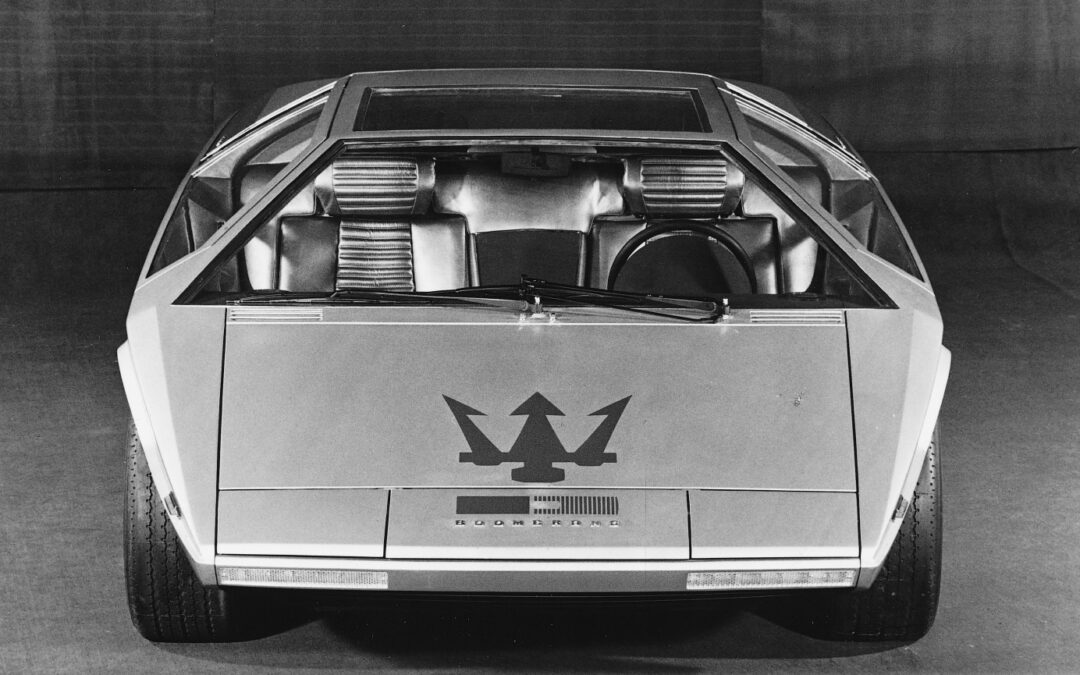
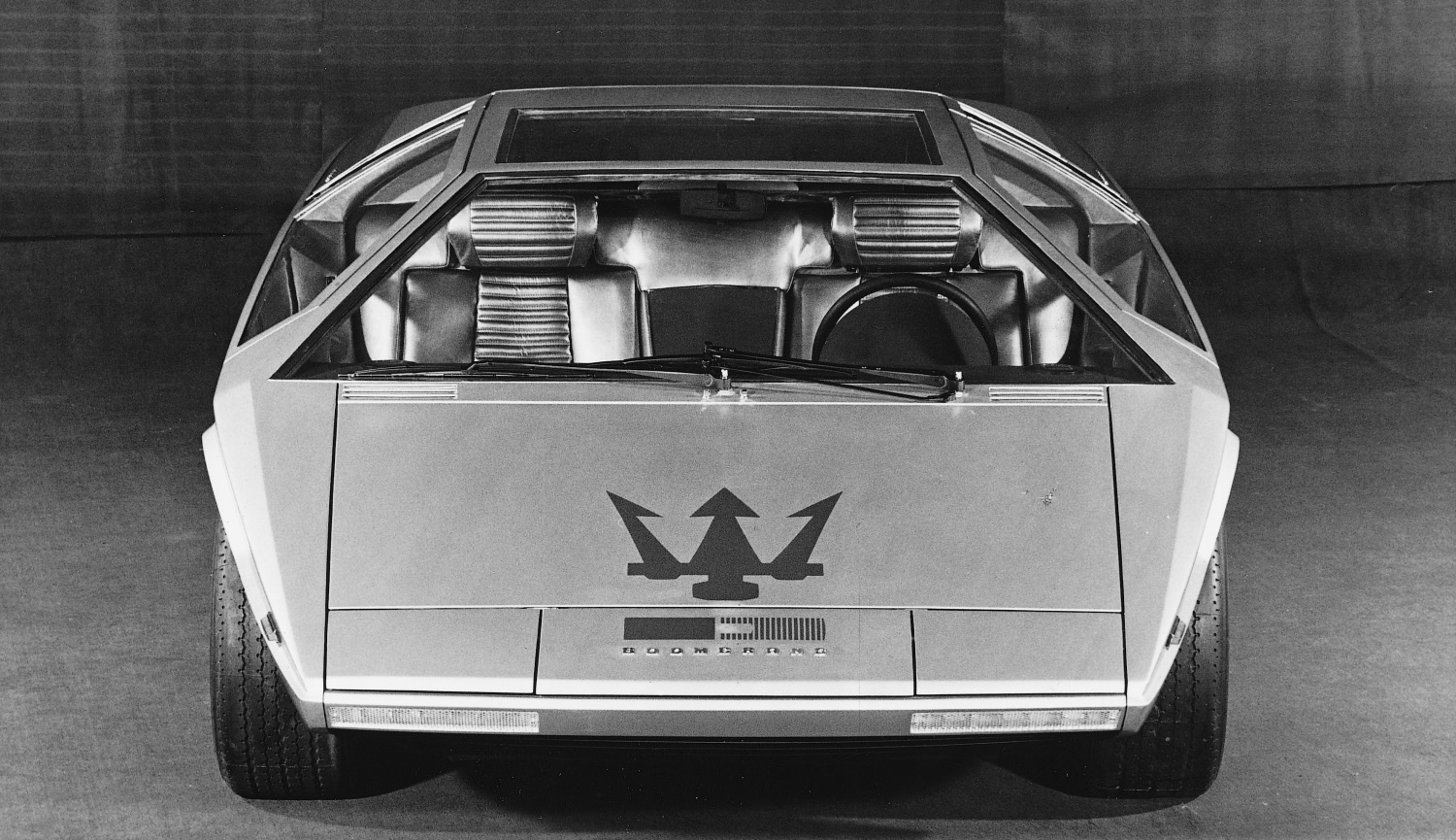
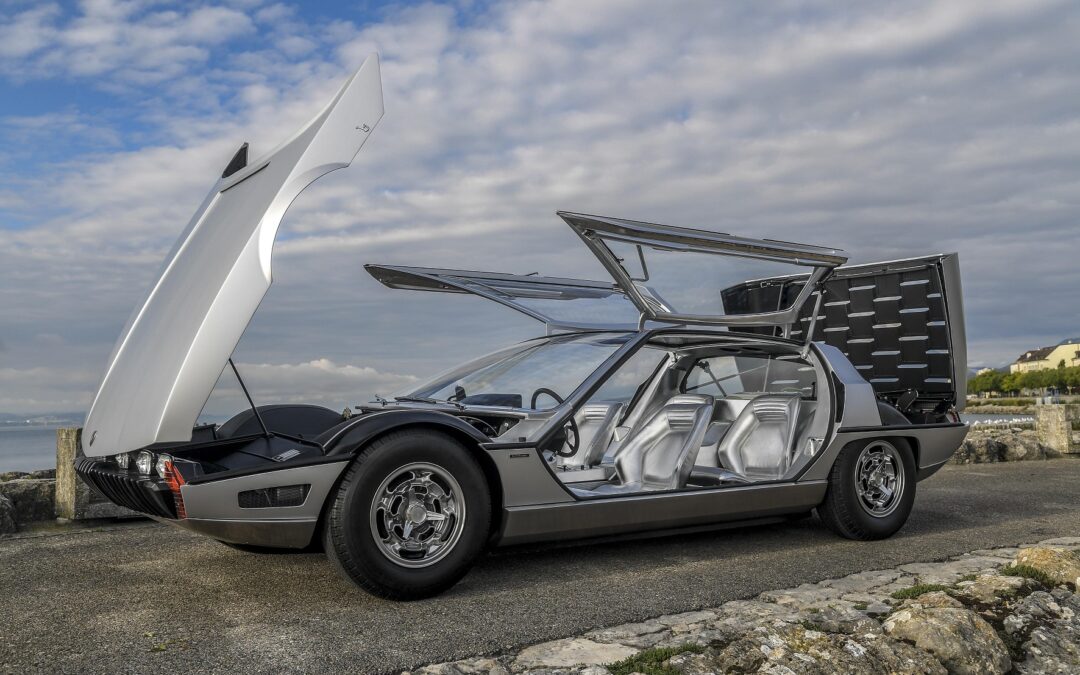
The originality of the Maserati Boomerang was in its wedge shape and bold lines. The stance conveyed an image of penetration, power, and speed.

Stylistically, a horizontal line divided the Boomerang in two with a sloping windscreen and a panoramic sunroof. The original windows of the doors were divided by a metal strip. And the retractable square headlamps stood out, with horizontal lights in the rear.

A head-on view of the Boomerage

The Boomerang’s dashboard instruments were built into the spokeless steering wheel and the wheel rotated around the stationary gauges.

The interior was extremely modern and introduced fresh ideas. For example, the dashboard instruments were built into the spokeless steering wheel, and the seats were positioned very low.

The one production version of the Boomerang made other appearances in international competitions. It would change hands between various owners, and ended up as the feature car in a number of auctions; it was even used in commercials.

Considered by many to be a work of art, the Maserati Boomerang was revolutionary and influenced the designs of successive cars. It continued to define Maserati as a brand capable of creating unique automotive concepts, iconic and avant-garde cars that acted as pioneers of technology and style.

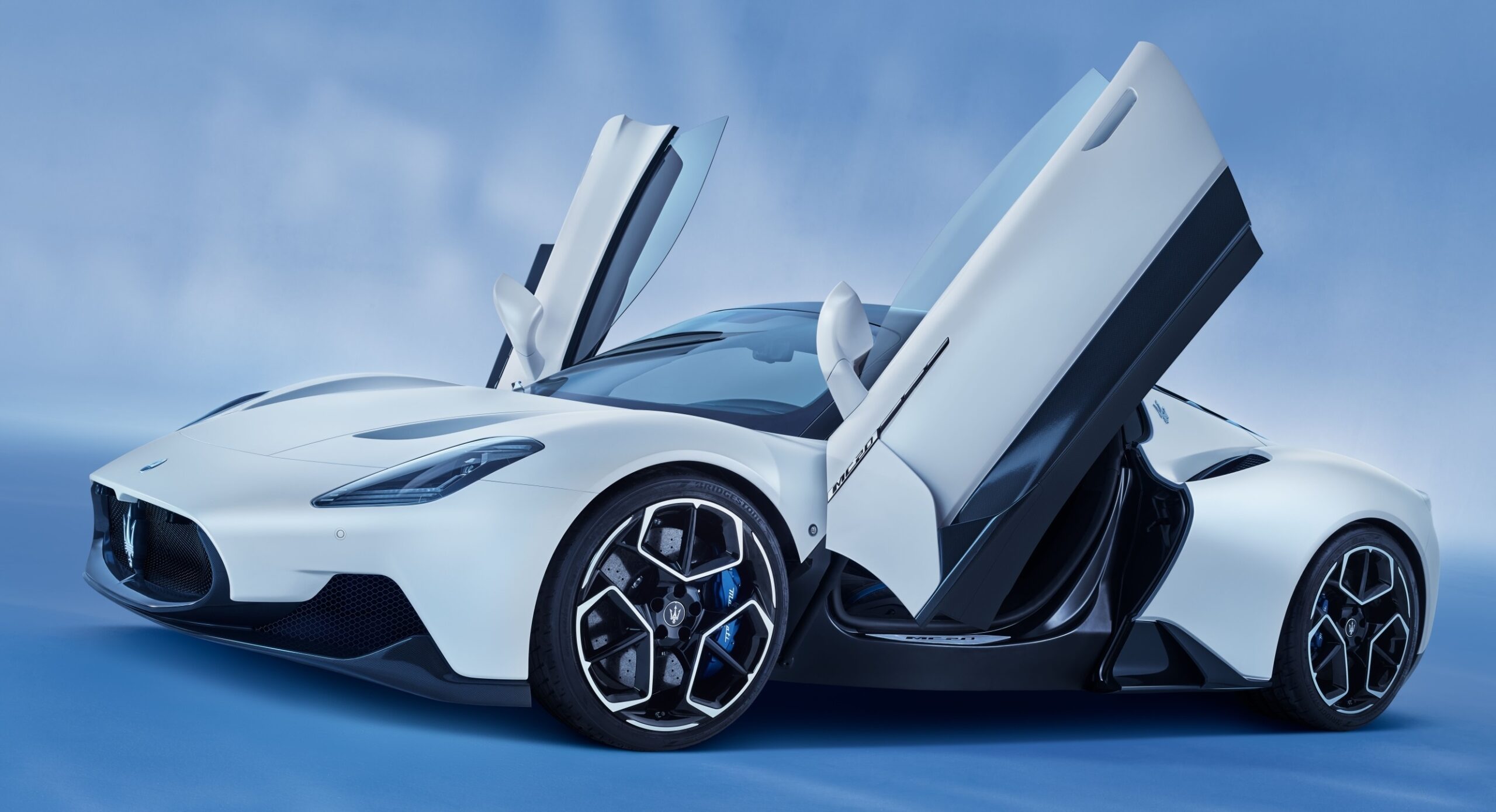
The Maserati MC20 supercar.

The Maserati MC20 supercar.

The Future for Maserati

Now more than ever, Maserati is unique for its design and innovation. It is moving forward with the new Grecale SUV and the 621-hp, MC20 super sports car. The 2022 MC20 debuts Maserati’s in-house designed new 3.0-liter V-6 Nettuno engine  that applies F1 technology for a road car. MC20 pricing starts at $212,000.

The Maserati Grecale prototype in camouflage.

Details for the Maserati Grecale small SUV will be released March 22.

VW ID Buzz World Premiere

VW ID Buzz World Premiere

European models of the VW ID Buzz go on sale this year, followed by a long-wheelbase passenger model for North America in 2024

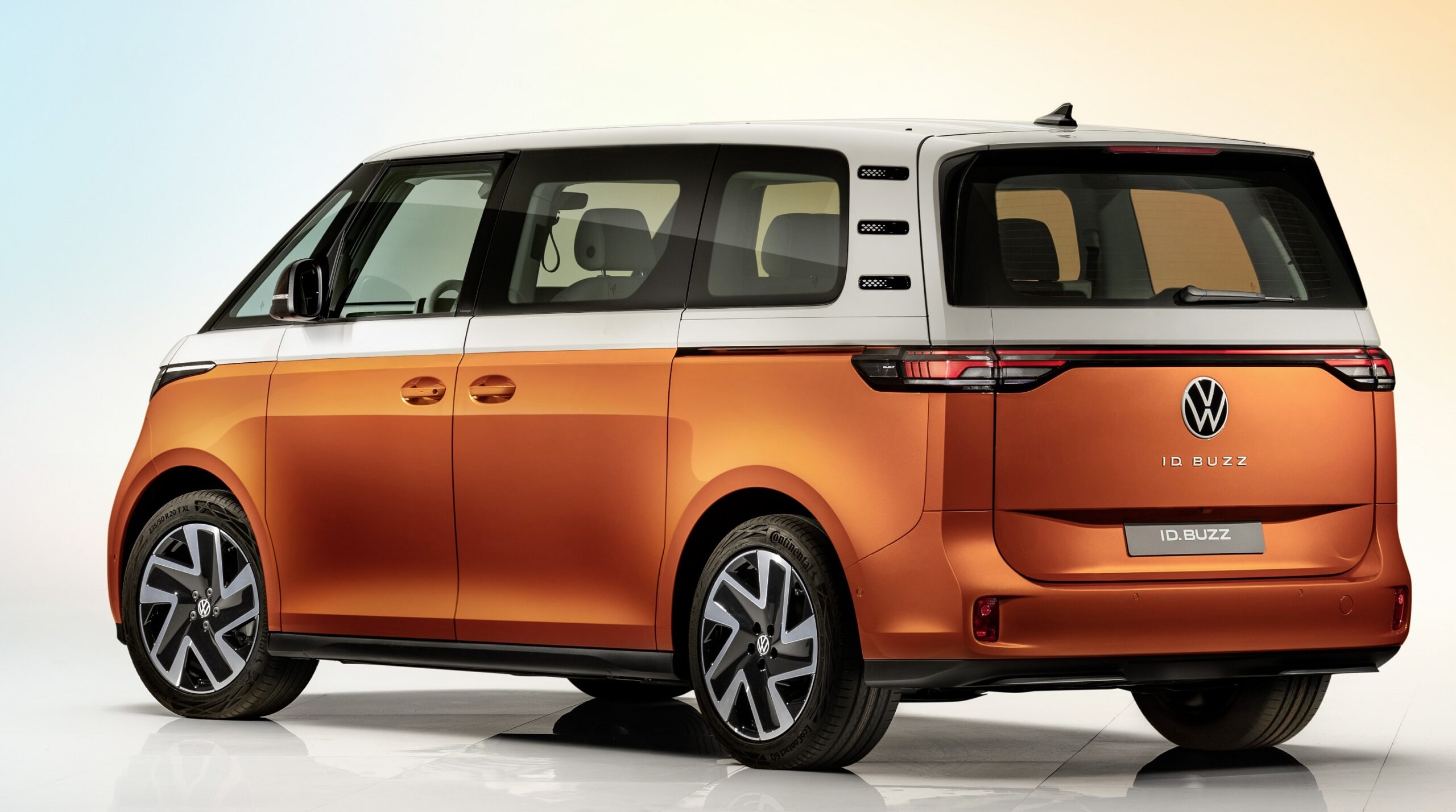
An ID.Buzz in two-tone Energetic Orange and Candy White

Two-tone VW ID Buzz models will have the roof, upper areas and hood finished in Candy White. Areas below the character line are in a choice of four shades, such as this hue of Energetic Orange. (Photos courtesy of Volkswagen)

Table of Contents

Powertrain
Dimensions
Paint Colors
Interior Design
Cabin Electronics
Interactive ‘ID Light’
Driver Assist Systems
Sustainability

BY MARK MAYNARD

Official photos and many details were released today, March 9, for the much-anticipated debut of the electric-powered VW ID Buzz and ID Buzz Cargo. Both body styles, passenger and cargo variants, will go on sale in European markets in the third quarter of this year. For the U.S., a long-wheelbase passenger model will debut in 2023 and go on sale in 2024.

The zero-tailpipe emission vehicles transfer the design of the iconic 1950 Type 2 Microbus to the era of electric mobility. However, the ID Buzz is not the first microbus with an electric drivetrain. Fifty years ago at the Hannover Trade Fair Volkswagen showed a T2 bus powered by a rear-mounted electric motor with a maximum range of 52.8 miles.

ID Buzz Powertrain

European versions of the VW ID Buzz and ID Buzz Cargo will come to market with a high-voltage lithium-ion battery providing gross energy content of 82 kWh (77 kWh usable). With its 12 modules, the battery system supplies a 201 horsepower electric motor, driving the rear axle, with maximum torque of 229 foot-pounds. The top speed is limited to 90 mph.

The electric driving range of either model of VW ID Buzz has not been released. But industry sources report that the U.S. version will have a larger battery and electric driving range of around 260 miles. A dual-motor, all-wheel-drive configuration is expected to be added later. Details for the U.S. version will be available closer to launch.

The battery is mounted in the floor of the vehicle. An 11 kW (AC) charger is included for home and Level 2 systems. The ID Buzz also will have a CCS plug connector for use at DC fast-charging stations, at which the charging power increases to as much as 170 kW.

With DC-fast charging, the battery charge level rises from 5 to 80 percent in just 30 minutes, Volkswagen says. In the future, a Plug & Charge function will be offered.

For Europe, bi-directional charging will enable the VW ID Buzz and ID Buzz Cargo to feed power that they don’t need into the domestic grid (vehicle-to-home). VW says this can also make the power available for stabilizing the power grid. The power transfer and communication take place via an optional DC bi-directional wall box.

VW ID Buzz front seats

Sustainability measures include replacing leather with non-animal material.

ID Buzz Dimensions

On a wheelbase of 117.6 inches, both ID Buzz models are 185.5 inches long, 76.3 inches tall, and 78.1 inches wide, not including the side mirrors.

The ID Buzz has full LED lighting. At the front, are charismatically styled headlights, daytime running lights, and a slim lateral bar between the headlights.

In an homage to the original microbus, the VW logo is much larger than all other current Volkswagens. At the back, the ID Buzz has horizontally arranged LED taillights, which are connected by a full-width light strip.

ID Buzz Paint Colors

European versions of the passenger and cargo models will be available in base colors or two-tone styles. The spectrum consists of 11 single-color choices of Candy White (nonmetallic), Mono Silver, Lime Yellow, Starlight Blue, Energetic Orange, Bay Leaf Green, and Deep Black.

There will be four two-tone options. On two-tone ID Buzz models, the upper section, including roof and V-shaped hood, is finished in Candy White, while the areas below the character line are in a choice of four shades: Lime Yellow, Starlight Blue, Energetic Orange or Bay Leaf Green. Side mirrors and door handles are finished in body color.

Both European ID Buzz versions will come with 18-inch steel wheels as standard. On passenger vehicle models, aluminum-alloy wheels are available in sizes ranging from 18 to 21 inches.

ID Buzz two-tone paint colors

At the back, horizontal LED taillights are connected by a full-width light strip.

Interior Design

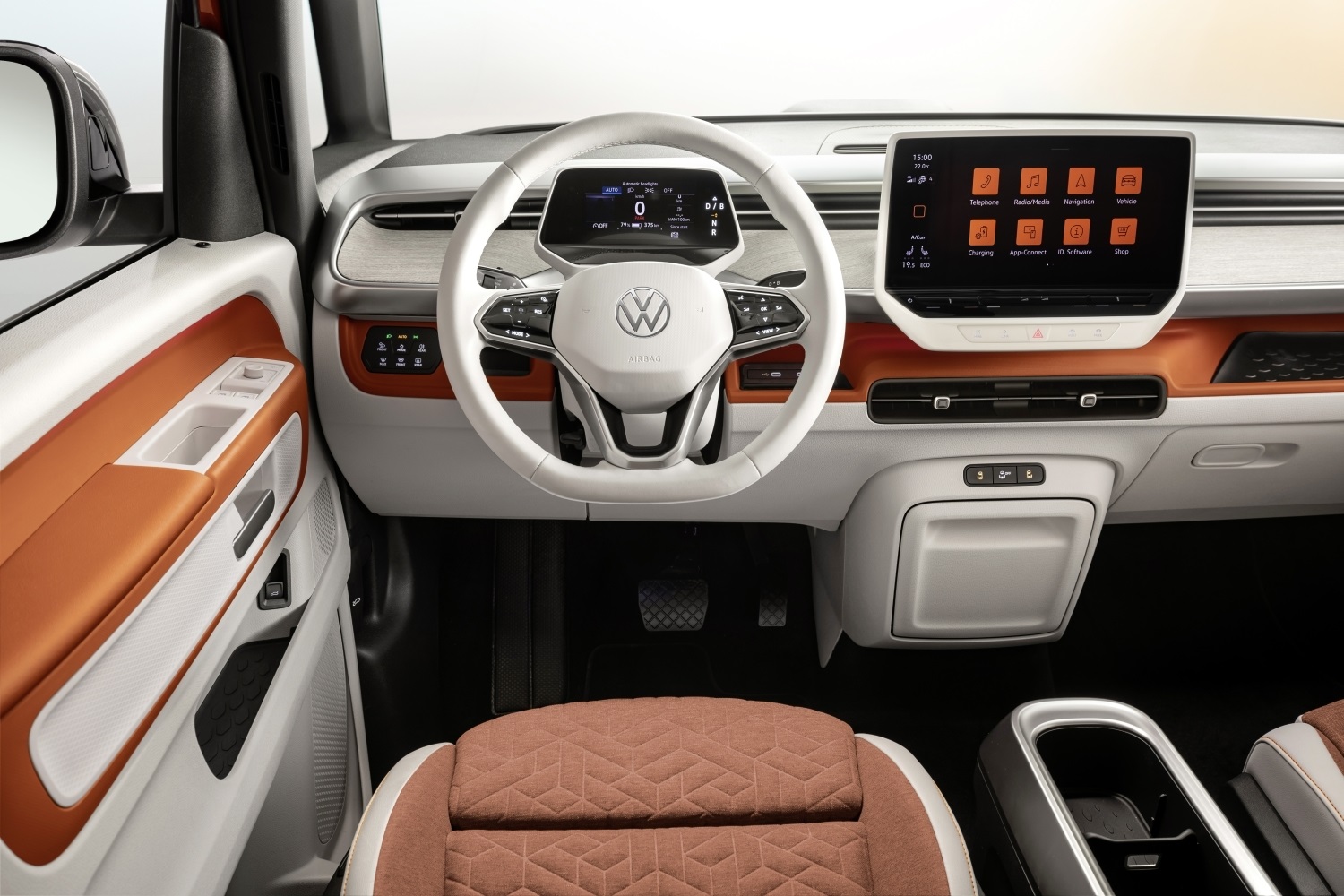
For passenger models of the ID Buzz, drivers will face a standard 10-inch Digital Cockpit display, which is paired with a 10-inch infotainment system centrally positioned in the dashboard. A 12-inch display with navigation is optional.

Both the Digital Cockpit and infotainment system are connected with the instrument panel only at the bottom, looking like free-floating tablets.

Beneath the infotainment system is a control bar with digital buttons and touch sliders to regulate temperature and audio volume. The digital buttons provide direct access to menus for the dual-zone Climatronic settings, driver assist systems, driving profiles, and parking functions.

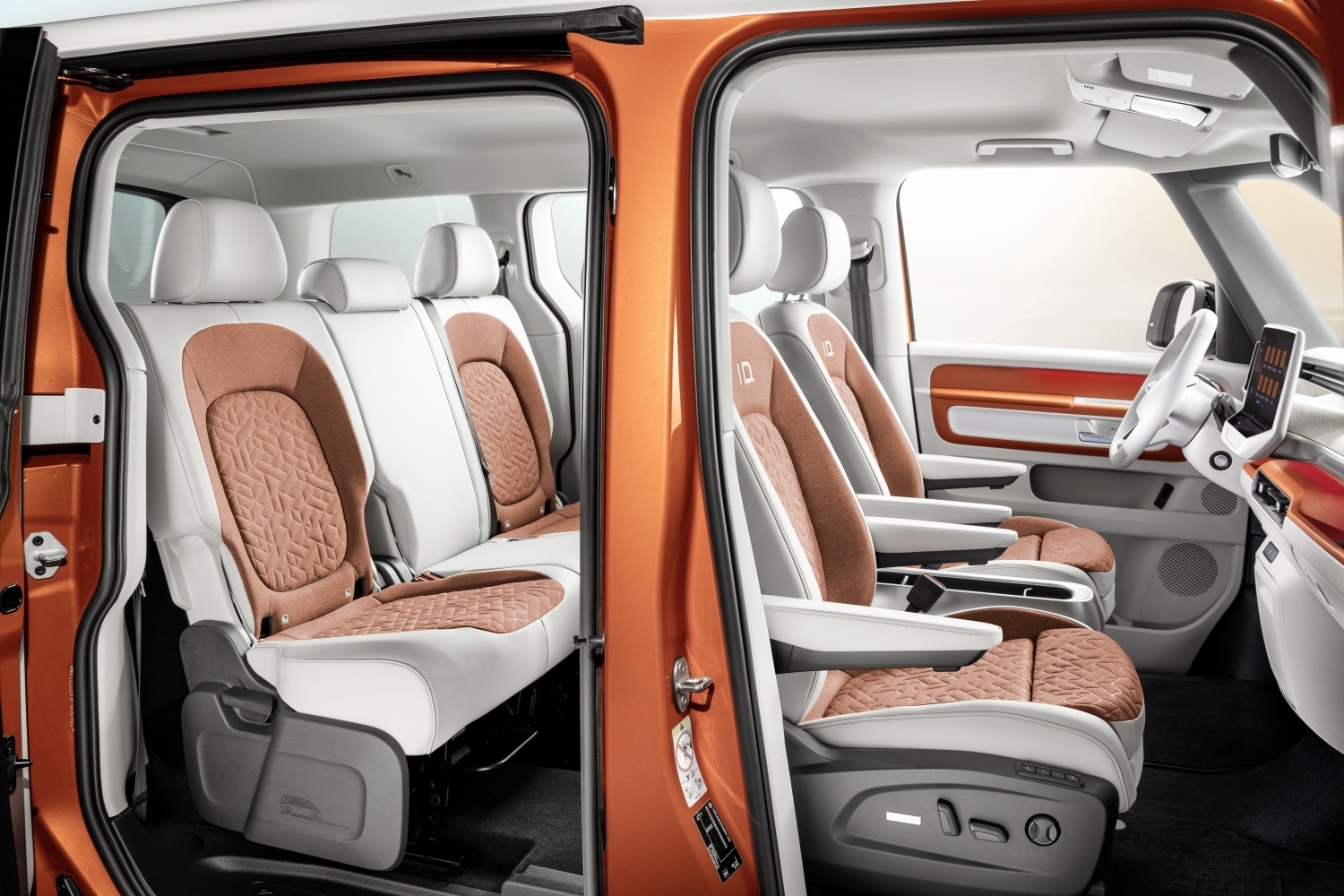
The ID Buzz Cargo will launch with three seats in the cab as standard. The extended wheelbase version for North America will have a seven-seat configuration in three rows of 2/3/2 arrangement. The three-person bench in the second row can be folded flat or split 60/40, and it can be moved lengthways 5.9 inches.

Cargo capacity of 39.6 cubic feet will be expandable by an optional height-adjustable cargo floor to create a level load surface. Two side sliding doors are fitted as standard.

Driver area of the Buzz

The Digital Cockpit and infotainment screens appear as free-floating tablets.

Cabin Electronics

To the left of the multifunction steering wheel, there is an island of digital controls for activating the light functions, heating, and defrost for the windshield and rear window. To the right of the steering wheel are two USB-C plugs and a tray for wireless charging (wireless App-Connect is also standard).

In the center console, there are, depending on specification, two more USB-C plugs; there is a fifth in the front passenger door, another in each of the two sliding doors, and one by the rearview mirror for a dashcam.

Two cupholders fold out from the lower dashboard area. In the ID Buzz Cargo, there are two more cupholders near the A-pillars.

Side entry of the new VW microbus

U.S. models of the ID.Buzz will have three rows and seven seats.

Interactive ‘ID Light’

As with other models of Volkswagen’s all-electric vehicle family, the new ID Buzz comes with the interactive ID Light. It stretches across in front of the windshield in the driver’s field of vision above the instrument panel. The head-up style of display gives the driver information based on the color and position of the light signal. For example, a signal in the right-hand area of the strip advises of obstructions in this area or corresponds with a navigation instruction to change lanes. When the ID Light goes red, it is signaling danger and the need to brake.

Driver Assist Systems

European five-seater ID Buzz models are equipped with standard Front Assist, Lane Assist, and Dynamic Road Sign Display. Optional systems include Adaptive Cruise Control, Side Assist, Travel Assist, Emergency Assist, Park Assist, Light Assist, and Area View.

The open cargo area

An optional height-adjustable cargo floor will create a level load surface.

Sustainability

Both versions of ID Buzz are designed with sustainable measures, such as not using leather in the vehicle. The steering wheel cover is made of polyurethane but has a high-quality appearance and feels like leather.

Seat-cover materials, floor coverings, and the headliner of the ID Buzz incorporate recycled material. There will be a fabric made of what is known as Seaqual yarn. Its fibers consist of 10 percent collected ocean plastic and 90 percent recycled plastic bottles.

The two ID Buzz models will also use organically based vehicle paint and forgo cobalt in the high-voltage battery. The company’s sustainability measures include a plant that recycles the high-voltage batteries at the end of their automotive life cycle to prepare them for a second use.

The VW ID Buzz and ID Buzz Cargo models are being produced by Volkswagen Commercial Vehicles at its main plant in Hannover, Germany.

1967 Lamborghini Marzal Concept

1967 Lamborghini Marzal Concept

The 1967 Lamborghini Marzal concept car is distinctive for its expansive glass roof, spanning 48.4 square feet

The 1967 Marzal with doors open

The four-seat Lamborghini Marzal was created as a concept for a true four-seat grand-tourer. (Photos courtesy of Lamborghini)


BY MARK MAYNARD

The 1967 Lamborghini Marzal was a one-off show car that became a worldwide icon of style and design. The ultramodern four-seat Marzal was designed by Marcello Gandini for Carrozzeria Bertone https://en.wikipedia.org/wiki/Gruppo_Bertone
Among its many special design elements were:

  • An interior upholstered in silver-colored leather;
  • A hexagonal central design theme. The geometric shape was repeated in the dashboard, the rear window, and in the console cut-out;
  • 6 narrow S.E.V. Marchal headlamps in the thin, wedge-shaped nose;
  • The extensive glass surface covers 4.5 square meters, reaching from the gullwing doors to the roof.

Lamborghini calls the Marzal “a fully operational show car with the largest glass surface in history.”

The hexagonal design theme.

The central design theme for the Marzal centered around the hexagon.

4 Seat Grand Tourer

Lamborghini president Ferruccio Lamborghini had the Marzal created as a concept for a true four-seat grand touring car. In his lineup already were the 400GT 2+2 and the Miura.

The Marzal remained a one-off, though the general shape and many of the ideas would later be used in the Lamborghini Espada.
According to the Marzal page in Wikipedia, Ferruccio Lamborghini initially viewed the creation of the Marzal as advertising rather than a production model.

“The Marzal was not developed as a production car. If you present a car like the Marzal at automobile shows such as Geneva, Turin, and Frankfurt, all the magazines report on the first page about it. You would rather spend 100 million lire for building such an automobile which is still less expensive than paying for all the advertising. That would cost almost a billion lire. So it compensates in any case to build such a throwaway car.”

The silver leather interior

The Marzal interior is entirely upholstered in silver-colored leather.

Lamborghini Marzal Specifications

The rear-engine and rear-wheel-drive Marzal was a relative lightweight at 2,960 pounds on a 103.1-inch wheelbase. It was 14.6 feet long (175.2 inches) and stood 43.3 inches tall by 66.9 inches wide. The concept car shared a chassis, suspension, steering, and brakes with the Miura.

The Marzal is powered by half of the Lamborghini 4.0-liter V-12 engine. The 175-horsepower, 2.0-liter inline-six-cylinder engine produced peak torque of 132 foot-pounds at 4,600 rpm. Top speed was estimated at 118 miles per hour (190 kmh).

The Marzal from behind

Lamborghini President Ferruccio Lamborghini had the Marzal created as a concept for a true four-seat grand touring car.

Lamborghini Marzal History

The Lamborghini Marzal made its public debut at the 1967 Monaco Grand Prix. Prince Rainier III, accompanied by his wife, Princess Grace, drove the car on his traditional parade lap before the start of the race.

The car made a second public appearance at the 1996 Concorso Italiano in Monterey, Calif.,  in honor of Carrozzeria Bertone. The Bertone-designed Lamborghini Athon concept was also exhibited at the ’96 Concorso Italiano.

Later the Athon was driven by Prince Albert II during the opening ceremony of the 2018 Historic Grand Prix of Monaco.

The Marzal had been maintained in the Bertone Design Study Museum until it closed in 2014.  The Marzal was then sold at RM Sotheby’s Villa d’Este auction on May 21, 2011, for $1,750,449.96 (1,512,000 Euros) including buyer’s premium.

The Marzal on the track in 1967

The Lamborghini Marzal at the 1967 Monaco Grand Prix.

Lamborghini Marzal Lap of Honor

On May 7, 1967, shortly before the Monte Carlo Formula 1 Grand Prix, His Serene Highness Rainier III, Prince of Monaco, completed the lap of honor on the track in a legendary car: the Lamborghini Marzal. Its glazed gullwing doors provided an almost unimpeded view of the interior and the silver leather upholstery.

Princess Grace sat in the passenger seat, next to Prince Rainier. Photos of the couple in the Marzal traveled all around the world, turning this unique car into a legend.

Fifty-one years since its first track appearance, the Lamborghini Marzal was displayed at the Grand Prix de Monaco Historique. Lamborghini Polo Storico, celebrating its history with several laps on the same roads as in 1967.

On display at the 2018 Monaco Grand Prix historics.

The Lamborghini Marzal and Espada as displayed at the 2018 Grand Prix of Monaco.

2016 Lamborghini Huracan Review

2016 Lamborghini Huracan Review

The rear-wheel-drive Lamborghini Huracan LP 580-2 is new for 2016 and has a shared but unique architecture with the Audi R8

The Rosso Red Lamborghini Huracan

The 2016 Lamborghini Huracan 580-2 starts at $204,595. (Photography by Mark Maynard)

Table of Contents

Pricing
Powertrain
Ride and Handling
Interior Function
Why buy the Lamborghini Huracan?
Specifications

 BY MARK MAYNARD

The Lamborghini Huracan has a reputation as a social rave, but in truth, it is a masterpiece of engineering and a daily-driver supercar.

The Huracan is Lamborghini’s smaller sports car. The exotic two-seater replaced the Gallardo in mid-2014, and the new model is a righteous successor.

New for 2016 is the rear-wheel-drive Lamborghini Huracan LP 580-2. There’s also the all-wheel-drive Huracan LP 610-4 with about 602 horsepower.

There are coupe and convertible versions of the AWD model, but only a hardtop for the 2016 RWD model. A new setup for springs and stabilizer bars on a double-wishbone suspension improves torsional rigidity by 50 percent over its predecessor, the Gallardo LP 550-2.

With positive support from parent company Volkswagen Group, the Lamborghini Huracan is a shared architecture with the Audi R8. Comparable exotics include the Ferrari 458 and McLaren 650S. But there also are new and less expensive supercars, such as the Acura NSX, Aston Martin Vantage, and even the Corvette Z06.

The Huracan driver area

The leather-lined buckets are comfortably bolstered for performance driving.

Lamborghini Huracan Pricing

The starting price of $204,595 for the Huracan LP 580-2 is a reasonable entry point for a V-10 supercar. That pricing includes the $3,495 freight charge from Modena, Italy, and the $1,300 gas-guzzler tax.

The tester was $238,795 with just two options, including the transparent engine-bay cover, $7,000. One admiring look at this car in the bright Rosso Red paint ($2,500)  and the driver is immediately guilty until proved innocent.

Despite that V-10, the Huracan’s fuel economy is not terrible. The EPA cites 17 mpg city, 21 highway and 17 mpg combined on the recommended premium fuel. On a daylong drive, I managed 19.9 mpg. But the mileage drops precipitously when the right foot goes down. The 22-gallon tank allows around 366 miles of driving with restraint.

View the current lineup of Lamborghini models here.

Front passenger seat

The seats are surprisingly comfortable for an all-day drive.

Huracan LP 580-2 Powertrain

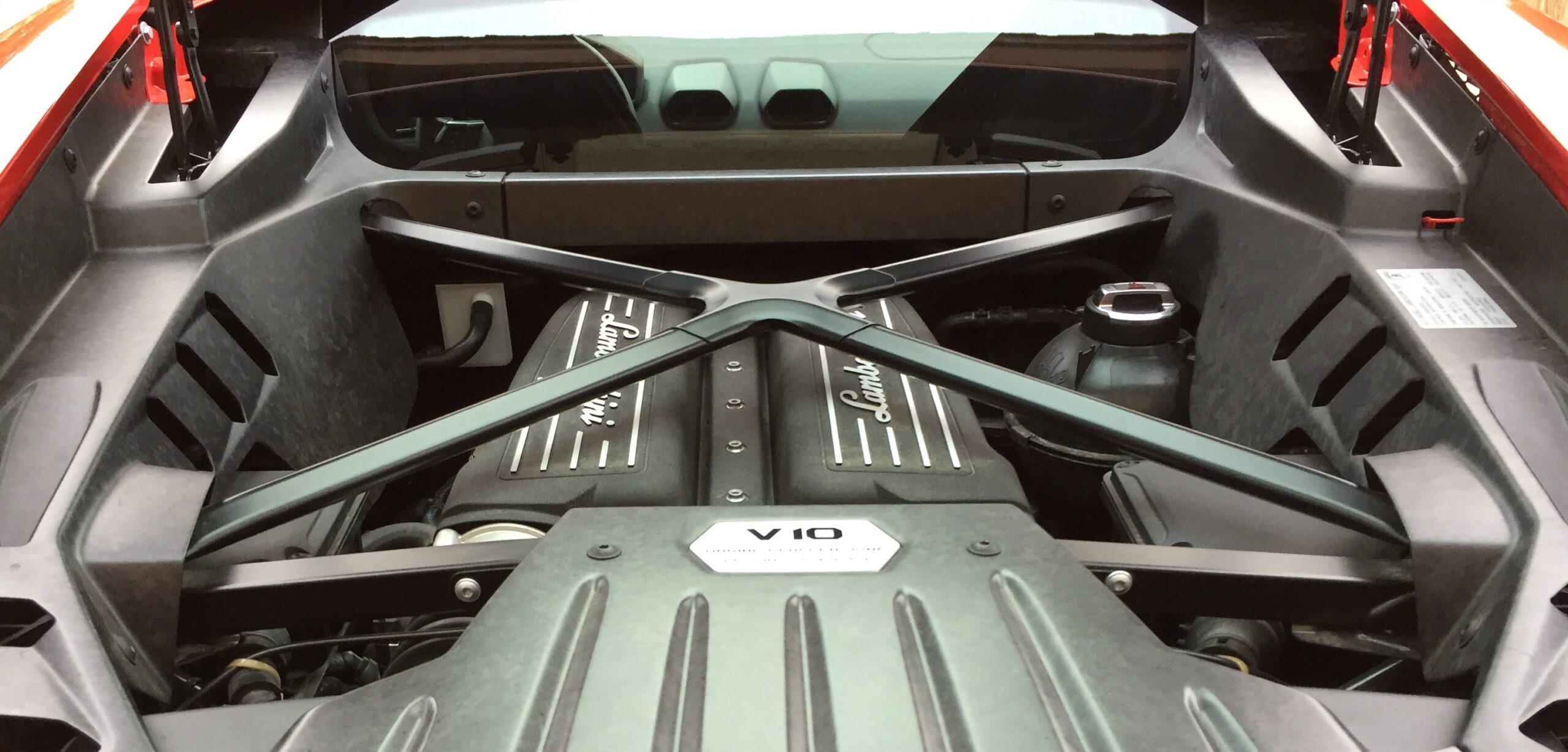
For the starting price, the owner gets a hybrid chassis of aluminum and carbon fiber. The naturally aspirated, 572-horsepower 5.2-liter V-10 has direct injection and cylinder deactivation. And with peak torque of 398 foot-pounds at 6,500 rpm, 75 percent of the torque is available at 1,000 rpm, Lamborghini says.

The seven-speed dual-clutch transmission gives such quick shifts in Sport mode that its speed would embarrass a lightning strike. There are automatic and manual driving options and performance choices of Strada (normal), Sport, and Corsa (track).

Lamborghini cites zero to 62 mph acceleration in 3.2 seconds and a top speed of 199 mph. The 14.6-foot-long, midengine car has a dry weight of 3,062 pounds. Lamborghini does not cite “wet” curb weight, such as when loaded with fuel, but figure another 122 pounds with a tankful.
The 572-hp V-10 engine

The 572-hp, naturally aspirated 5.2-liter V-10.

Huracan LP 580-2 Ride and Handling

Sport mode opens the pipes, sharpens the shift points, and gives hefty throttle blips on downshifts. In addition, the system loosens the reins of stability and traction controls for some slide through the corners.

A hard launch brings a howitzer blast of force without torque pull left or right. The experience is straight-ahead traction in a blazing chorus of cylinders.

19 inch Pirelli tires

Low profile, high grip 19-inchPirelli tires.

There is an absolute engagement of gears from the start off to flat out. Flooring the pedal at about 30 mph is a hold-on event as the Huracan lunges like a predator in pursuit.

The magnetic ride suspension shows its superiority with sensitive adjustments in milliseconds. After six hours on the road, there was no fanny fatigue or torqued necks. The steering is light, direct, and requires just minimal inputs to clip the apex.

The standard steel brakes have supercar dimensions. The ventilated and cross-drilled rotors are 14.37 inches at the front and 14 inches rear. The aluminum monoblock calipers have eight pistons at the front and four pistons rear. From 62 mph, the stopping distance takes just 104.7 feet, which is 3.6 feet shorter than the rear-drive Gallardo predecessor.

The steering wheel as command center

The driver’s command center.

Huracan Interior Function

Breathe deep the rich cabin aroma of leather and microsuede. The interior layout is efficient and easy to access, with some console controls by Audi. The foot-wide gauge array can be electronically changed into a full video screen with a large RPM gauge and other essentials.

The Huracan interior is cockpit-compact, but this is a wide car and there is wide shoulder room of almost 55 inches door to door. There is long legroom and headroom for a 6-foot-3 driver, and maybe even taller, which is also surprising for the car’s low 46-inch roof height. But the doors are not hugely broad (unlike a Corvette) and the tight turning circle makes maneuvering easy in close quarters.

The leather-lined buckets are bolstered for performance driving but surprisingly comfortable for an all-day drive. However, the seats are heatable there is no lumbar adjustment or seat ventilation.

The LP 580-2 has a weight distribution of 40 percent front and 60 percent rear.

Why buy the Lamborghini Huracan?

I’m not sure why this car costs nearly a quarter of a million dollars. But there will be few complaints about owning this daily-driving supercar.

Whatever the Lamborghini Huracan does not have or does not do, you do not need or will find a way to do without — and like it.

The red starter button

The red push-button ignition.

Huracan LP 580-2 Specifications

Body style: 2-seat, rear-wheel-drive coupe

Chassis: Hybrid aluminum and carbon fiber

Bodyshell: Aluminum and composite material outer skin

Suspension: Aluminum double-wishbone

Springs and dampers: Steel springs and hydraulic dampers. “MagneRide”
electromagnetic damper control available as an option

Engine: 572-hp, naturally aspirated 5.2-liter V-10 with direct injection and cylinder deactivation; 398 lb.-ft. of torque at 6,500 rpm

Transmission: 7-speed dual-clutch

Fuel economy: 17/21/17 mpg city/highway/combined; premium required

Fuel tank: 22 gallons

BY THE NUMBERS

Top speed: 198.8 mph

0-62 mph acceleration: 3.2 seconds

0-200 kmh (124.27 mph) acceleration: 10.1 seconds

Brakes: Specially contoured steel discs ventilated and cross-drilled; 14.3-inch front rotors with 8-piston calipers; rear,14-inch rotors with 4-piston calipers

Steering: Electromechanical; optional variable-ratio LDS (Lamborghini Dynamic Steering)

Tires: Pirelli 245/35 19-inch front, 305/35 R19 rear

Wheels: 8.5J x 19-inches front, 11J x 19 inches rear

Length/wheelbase: 175.5/103. in.

Width/height: 88*/45.9 in. *including side mirrors

Dry weight: 3,062.2 lbs.

Turning circle: 37.7 ft.

PRICING

Base price: $204,595, including $3,495 freight charge and $1,300 gas-guzzler tax; price as tested $238,795

Options on test vehicle: transparent engine-bay cover $7,000; Rosso Red paint $2,500

Where assembled: Modena, Italy

Warranty: 36-months/unlimited mileage covering everything from the powertrain to the seats

Aston Martin Valkyrie Spider Reveal

Aston Martin Valkyrie Spider Reveal

Aston Martin says its Valkyrie Spider “delivers the most comparable experience to that of an F1 car, not limited to the track”

ston Martin's new Valkyrie Spider with doors up

Aston Martin says its Valkyrie Spider is one of the world’s most extreme hypercars. (Photos courtesy of Aston Martin)

BY MARK MAYNARD

The new Aston Martin Valkyrie Spider, unveiled Friday, Aug. 10 at the Pebble Beach Concours d’Elegance, is called one of the world’s most extreme hypercars. “One that delivers the most comparable experience to that of an F1 car, not limited to the track,” Aston Martin said in a release.

Production is limited to 85 units worldwide in left and right-hand drive derivatives. But all 85 cars are “over subscribed,” and deliveries are scheduled to begin H2 2022, Aston Martin said in a statement.

The Valkyrie Spider is powered by a 6.5-liter V-12 hybrid system. It has a combined power output of 1,160 horsepower with 664 foot-pounds of torque.

“The sound of that 6.5-litre V12 engine revving to over 11,000 rpm with the roof removed is something I cannot wait to hear,” Aston Martin Chief Executive Officer Tobias Moers said in a release.

Pricing was not stated, but news reports claim the Aston Martin Valkyrie hardtop coupe has a price of around $3 million. So, how much does the price go up when the roof comes off?

Side by side view of the Spider with the dihedral doors raised.

The Valkyrie Spider is the fastest open-top, road-legal Aston Martin ever built.

Valkyrie Spider construction

The Valkyrie Spider is the fastest and most extreme open-top, road-legal Aston Martin ever built. It has a top speed of 330 kmh-plus (205 mph) with the roof panel removed or 350 kmh-plus (217.5 mph) with the roof panel in place.

The ultra-lightweight construction and high downforce aerodynamics use Formula One technology. The upper body surfaces of the teardrop-shaped cockpit and lower tub contours follow the envelope of space between the huge full-length Venturi tunnels that run either side of the cockpit floor.

The tunnels draw huge quantities of air beneath the car to feed the rear diffuser. The venturis are the key to generating the Valkyrie Spider’s extraordinary levels of downforce, Aston Martin said in the release. At 240 kmh (149 mph) in Track mode the aerodynamics can produce 3,086.47 pounds (1400 kg) of downforce. It is the F1-type construction that “keeps the upper body surfaces free from additional aerodynamic devices that would spoil the purity of the open-top styling,” Aston Martin said in the release.

A side view of the Valkyrie

The huge full-length Venturi tunnels run on either side of the cockpit floor.

Design elements

The removable carbon-fiber roof panel latches onto the tub at the rear and to the front windshield surround. A pair of polycarbonate windows are hinged on either side. On opening the doors, the roof can be lifted off and stowed.

The front-hinged dihedral doors are unique to Valkyrie Spider and are designed to tilt forward.

A front view of the Aston Martin Valkyrie Spider with the doors up

The front-hinged dihedral doors tilt forward.

The driver-focused cabin has a low, F1-inspired hip-to-heel height. In addition, the near-central seat positioning and six-point safety harness are safety elements for the driver.

A center rear-view camera system and front and rear parking sensors have screen displays just above the instrument panel.

Follow the development of the Valkyrie Spider at Aston Martin.