Select Page

Hyundai IONIQ 5 Review

Hyundai IONIQ 5 Review

The 2022 Hyundai IONIQ 5 is an elevated experience of what can be expected in an electric vehicle

The 2022 Hyundai IONIQ 5 battery-electric SUV crossover is sold in rear- or all-wheel drive powertrains with driving ranges of 303 to 256 miles. Available incentives and rebates can total $10,250. (Photos courtesy of Hyundai)

Table of Contents

Next Level Design
10 IONIQ 5 Innovations
Pricing
Incentives and Rebates
Charging Times
Performance
Driver Assistance Systems
Ride and Handling
IONIQ 5 Interior Function
Back Seats and Cargo
Hyundai IONIQ 5 Awards
Why Buy the Hyundai IONIQ 5?
Specifications

BY MARK MAYNARD

The new Hyundai IONIQ 5 is almost iconic in how well it does everything. It’s not just a well-engineered electric vehicle, it is a well-designed car for family or executives.

The IONIQ 5 is Hyundai’s first dedicated electric vehicle and built on the Hyundai Electric Global Modular Platform (E-GMP). It and other electrified vehicles to follow will be marketed under the IONIQ subbrand. The upcoming battery-electric lineup will include the IONIQ 6 midsize sedan and IONIQ 7 large SUV.

At 118.1 inches, the IONIQ 5 has the longest wheelbase in Hyundai’s U.S. product lineup. It is almost 4 inches longer than the Hyundai Palisade large-midsize SUV, but the IONIQ’s overall length is nearly 14 inches shorter.

And Hyundai says the IONIQ 5 has more passenger volume (106.5 cubic feet) than the Ford Mustang Mach-E (101.1 cu. ft.) and the Volkswagen ID.4 (99.9 cu. ft.).

Sales currently are in the zero-emissions vehicle states of the Northeast plus Texas, Florida, Illinois, Pennsylvania, Arizona, Virginia, and Washington state. There will be a broader rollout later in 2022, Hyundai says.

Front seat area of the IONIQ5

The driver area is digitally sophisticated but easy to use.

Next Level Design

The IONIQ 5 exterior design is next level as a contemporary EV. Crafting a cohesive exterior appearance is a challenge when the electric powertrain is configured in a so-called “skateboard” layout. The battery-electric elements form a low and flat foundation. But the design challenge has been to build a body that doesn’t look like it is grafted onto the skateboard foundation.

Because that foundation raises the ride height of the vehicle, designers have adopted an SUV format. Adding SUV features to the body is one way to disguise the awkward foundation.

For the majority of mainstream EVs, exterior styling is a ground-up exercise. But the Hyundai designers appear to have created a top-down style for its IONIQ 5. From the outside, it looks more cosmic space shuttle than bulky SUV. And if there is such a thing as an open floor plan for a vehicle, the IONIQ 5 has it. The flat floor, spacious front-seat area, and long roofline create a light and inviting space.

Dual 12-inch digital screens in the IONIQ 5

Dual 12-inch screens with white backgrounds add to the lightness of the cabin. To the far left is the magnetic note board.

10 IONIQ 5 Innovations

Flush Mounted Automatic Door Handles. As an owner with the key nears the IONIQ 5, the door handles pivot outward. The design is for clean surface styling and enhanced aerodynamics. But the lever-type handle gives more leverage on opening and eliminates the fingernail scratches in the paint from a traditionally styled pull handle.

Sliding Center Console. The so-called Universal Island moveable center console can slide back and forth 5.5 inches.

Magnetic Note Board, for photos or a shopping list.

Power Reclining Driver’s Seat with Footrest. So thoughtful when killing time at a public charging station.

Fast Charging. IONIQ 5’s E-GMP architecture can support 400-volt and 800-volt fast-charging. The platform offers 800-V charging capability as standard, and it can accommodate 400-V charging without additional adapters. Hyundai says the multi-charging system is a world first.

Ownership by Subscription. A planned subscription service will feature a single, all-inclusive monthly payment, covering the vehicle, insurance, and maintenance.

Over-the-Air Updates. IONIQ 5 is the first Hyundai vehicle to offer free over-the-air wireless updates for maps and multimedia software.
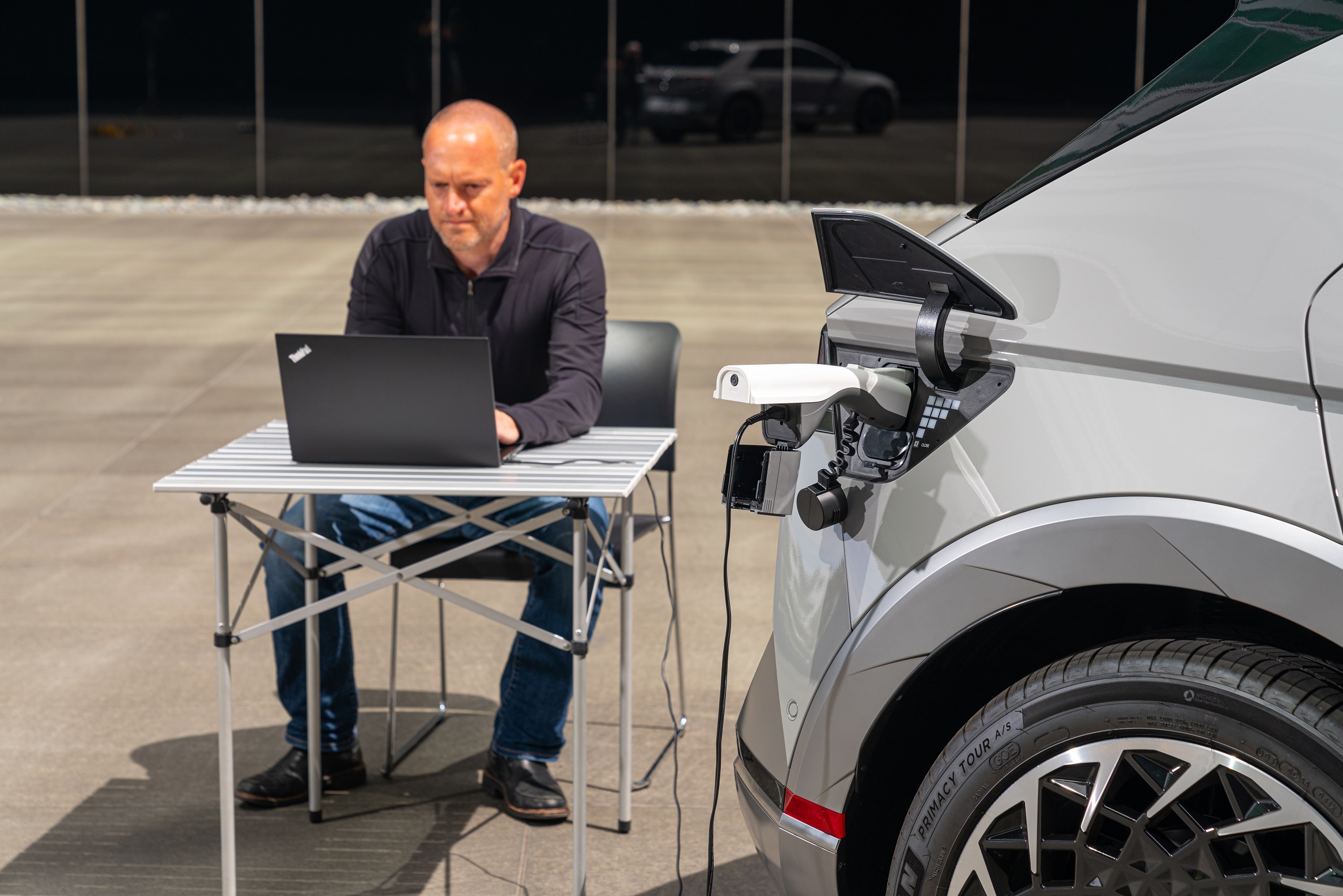
V2L charging ability

The Vehicle-to-Load function creates a power source on wheels.

Vehicle-to-Load (V2L) Function. As a high-capacity electric source, the IONIQ 5 is part survival tool and charger on wheels. V2L allows charging of electric devices, such as electric bicycles, scooters, or camping equipment. Or it can be used to charge a stranded EV.

The 1.9 kW of peak power is tapped through a standard 120-volt outlet. The function won’t power an entire home, but it can power necessities during a power outage, tailgate parties, or outdoor projects.

Using the V2L function requires an optional accessory adaptor ($220) that plugs into the outside charging port. The Limited model also has an interior V2L outlet at the base of the back row seat for charging laptops, phones, and other devices.

Augmented Reality Head-Up Display. The IONIQ 5 head-up display uses an Augmented Reality mode, which essentially turns the windshield into a display screen. The projection appears to be nearly 4 feet in front of the driver’s line of sight and can include various information, such as turn-by-turn navigation, posted speed limits, and advanced safety alerts.

Free Fast Charging for 2 Years. Hyundai and Electrify America collaborated to provide 250 kWh of free DC fast charging for new owners of the IONIQ 5 or Hyundai Kona EV. Charging via app will be offered in unlimited 30-minute charging sessions for two years from the date of purchase.

Electrify America

Electrify America has about 800 charging stations with more than 3,500 ultra-fast chargers either open or in development, Hyundai says. See Electrify America’s plan for the

The movable center console

The Universal Island center console can slide back and forth 5.5 inches.

Suggested Retail Pricing

The IONIQ 5 is sold in three trim levels in rear- or dual-motor all-wheel drive with a lithium-ion polymer battery pack. Starting prices include the $1,245 freight charge from Ulsan, Korea.

Rear-drive models have a 168 kW, 225-hp motor with 258 foot-pounds of torque and battery capacity of 77.4 kWh for a driving range of 303 miles. AWD trims package a 74 kW front motor and a 165 kW rear motor for 320-hp with 446 ft.-lbs. of torque.

The Limited AWD tester was $55,940 with one option for carpeted floor mats, $195.

IONIQ 5 SE RWD starts at $44,895;

IONIQ 5 SEL RWD: $47,145;

IONIQ 5 Limited RWD: $51,845;

IONIQ 5 SE AWD: $48,395;

IONIQ 5 SEL AWD: $50,645;

IONIQ 5 Limited AWD: $55,745.

Available later this year will be the entry IONIQ 5 SE Standard; offered only in rear-wheel drive. It has a smaller electric motor — 125 kW, 168-hp — and smaller battery capacity (58 kWh) with fewer creature comforts but a full complement of safety and driver-assist technologies. It has a starting price of $39,700 and a driving range of 220 miles.

IONIQ 5 electric motor

The top box, above the AWD motor, has about a cubic foot of storage space.

Paint and Interior Colors

There are six paint colors, including five nature-inspired hues exclusive to IONIQ 5. The color choices are Phantom Black (Pearl), Cyber Gray (Metallic), Atlas White (Solid), Digital Teal (Green Pearl), Lucid Blue (Pearl), Shooting Star (Gray Matte).

The Digital Teal is a color-changing metallic paint. In various light conditions, it can look aquamarine, silver, or gray.

The interior has three color options Obsidian Black Monotone, Dark Pebble Gray/Dove Gray, Dark Teal/Dove Gray.

There is a lot of easily digested information in the digital gauge array.

There is a lot of easily digested information in the digital gauge array.

IONIQ 5 Incentives and Rebates

The 2022 Hyundai IONIQ 5 qualifies for up to $10,250 in federal and state rebates or incentives.

Federal Electric Vehicle Tax Credit: $7,500. IRS tax forms are here.

California Clean Fuel Reward: $750. Available toward the purchase or lease of a new electric vehicle with a battery capacity greater than 5. The customer must register the vehicle in California and the customer must reside in California.

California Clean Vehicle Rebate: $2,000.  Participants are eligible based on gross annual income, as stated on their federal tax return.

Find federal and state laws or incentives here.

And the IONIQ 5 qualifies for High-Occupancy-Vehicle freeway access, with the green DMV decal .

The Limited includes a V2L plug in the back seat

The Limited includes a V2L plug in the back seat

Ownership by Subscription

To help EV-intenders get comfortable with ownership, Hyundai plans to offer a simple automobile subscription service; it is now in the pilot phase. The subscription will have an all-inclusive monthly payment, covering the vehicle, insurance, and maintenance.

Parametic Pixel LED lighting.

Parametic Pixel LED lighting.

IONIQ 5 Charging Times

Rapid DC 150kW (400V): 25 minutes, estimated, from 10 percent to 80 percent charge

Rapid DC 250kW (800V): 18 minutes, from 10 percent to 80 percent

Level 2 240-volt home unit: 6 hours, 43 minutes

Hyundai Bluelink

Bluelink is a car-connectivity system on all new Hyundai models that gives drivers remote access to their vehicles. The Bluelink app for IONIQ vehicles has redesigned home-screen displays for driving range, battery state, and charging times when plugged into public or private chargers.

Users can access an advanced battery management system to select charging times, particularly for off-peak electricity rates.

Remote Climate Control allows scheduled pre-heating or pre-cooling when the IONIQ 5 is connected to a power source. It helps save battery power that would otherwise be needed to heat or cool the vehicle on the road.

The map section of the app has also been redesigned to let customers filter between charger providers and charge type. It also will show the availability of a charger when the driver arrives.

IONIQ 5 front seats

Eight-way power-adjustable seats for driver and passenger.

IONIQ 5 AWD Performance

The dual motors of the IONIQ 5 Limited AWD provide smooth uptake from the start and give strong acceleration when needed. There are performance modes of Eco, Normal, and Sport. And when you try a full-on launch in Sport mode, the digital gauge array turns red and the force of acceleration is bristling. Hyundai cites 0-60 acceleration in less than 5 seconds.

All models have a top speed of 115 mph and can tow up to 1,650 pounds.

The i-Pedal regeneration system helps recupe de-acceleration energy simply by lifting off of the accelerator. It is especially handy around town. With careful driving, the i-Pedal function can almost take the place of slow-speed, stop-and-go braking. The force of the regeneration can be adjusted with the steering wheel paddles.

IONIQ 5 Ride and Handling

Electric SUVs are heavier than internal-combustion vehicles, mainly because of the large battery pack needed to achieve 300 miles. The IONIQ 5 Limited AWD weighs 4,662 pounds. By comparison, the seven-passenger Palisade with all-wheel drive at 4,387 pounds. The Tesla Model X SUV weighs around 5,441 pounds. And the VW ID.4 weighs 4,824 pounds.

Hyundai achieved a lower weight without extensive use of aluminum in the body. Instead, the body is comprised of advanced high-strength steel and high tensile steel.

The Limited’s 20-inch aero-optimized wheels.

Aero-optimized wheels in sizes of 19 or 20 inches.

Suspension

The engineering challenge in hefting upward of 3 tons in a smallish vehicle is to provide a comfortable ride. It is common for an EV suspension to clunk and jolt over rough patches.

Hyundai engineers applied some secret sauce in its steel-spring suspension that mitigates the clunks and jolts. The setup of MacPherson struts at the front and a rear multilink includes high-performance shock absorbers.

Credit the long wheelbase for the smooth highway ride. Only a couple of times over very lumpy highway section did I notice any heave to the ride, but never a clunk. And that is without any electronics to quicken the suspension response time.

Brakes, Tires, and Wheels

Four-wheel-disc brakes have ventilated 12.8-inch front rotors and 12.8-inch solid rear rotors. The regenerative braking system includes brake control paddles at the steering wheel to maximize downhill regeneration.

With careful driving and attention to regen braking, the driving range can be extended by a few miles.

Highway road and wind noise are well controlled, aided by the 20-inch Michelin Primacy Touring “Acoustic” touring tires (255/45). For this tire, Michelin’s noise-reduction tuning combines frequency canceling shoulder grooves and block chamfers with ultra-smooth belts. I’d never before experienced these “acoustic” tires but highly recommend them. With a midrange treadwear rating of 540 (rubber hardness), the tires have a warranty of 55,000 miles and a standard limited warranty of 6 years. That coverage is important because the hefty EV curb weights tend to wear out tires sooner than expected, owners say.

The large 20-inch alloy wheels are aero-optimized for reduced turbulence. The wheels are also positioned at the very edge of the body to help block wind from entering the wheel well. And special aero-optimized fender overriders also help break up airflow and reduce drag.

There are many aerodynamic details to the IONIQ 5 body, such as the slash marks along the fender overriders.

There are many small aerodynamic elements on the body to trim drag, such as these slash marks on the fender overriders.

Driver-Assist Systems

The IONIQ 5 debuts Highway Driving Assist 2 as the next level of Hyundai’s SmartSense driver assistance systems. When driving on a highway, HDA 2 actively responds to close-range low-speed cut-ins by other drivers and motorcycles. The system also will automatically assist lane changes in certain conditions when the driver uses the turn signal. HDA 2 also adjusts the steering weight according to drive mode.

In my experience, the driver-assist systems functioned reliably and kept the IONIQ 5 well centered in the lane. That precision is reassuring in heavy commuting. I experienced no random system shut-offs, which can be caused by shadows, bright sunlight directly into the forward camera, and even white semi-trucks with white trailers. Because these systems are not foolproof, it is best to drive with both hands on the wheel, despite what some Tesla owners seem to believe.

Other driving-assistance systems include:

Smart Cruise Control with Machine Learning. The system tries to mimic the driver’s tendencies for acceleration and spacing with the vehicle ahead;

Forward Collision-Avoidance Assist;

Blind-Spot Collision-Avoidance Assist;

Intelligent Speed Limit Assist, to match the posted speed;

Blind-Spot View Monitor, uses side mirror-mounted cameras to show the driver views to the left and the right of the vehicle. The image is displayed in the digital gauge cluster screen when the turn signal is activated.

The gear selector is located behind the steering wheel.

The gear selector is located behind the steering wheel.

Interior Function

EV interior design is evolving and each manufacturer finds new ways to innovate and use space.

Slip behind the wheel of the IONIQ 5 and the dual 12-inch digital screens with white backgrounds are different, even alien. But after some exploration, the screens become completely functional and easy on the eyes.

The contiguous 2-foot span of screens connects gauges and infotainment with cabin controls. But at driver’s left is a magnetic board that extends the contiguous span to about 30 inches. Hyundai says the magnetic surface, about 5-by-5 inches, is ideal for posting pictures and notes just like on a refrigerator.

Many interior touchpoints in the IONIQ 5 — seats, headliner, door trim, floor, and armrest — are of sustainably sourced materials. These materials include recycled PET bottles, plant-based (bio PET) yarns and natural wool yarns and bio paint with plant extracts.

The raised ride height provides comfortable entry and exit. And the open interior of the IONIQ 5 has wide open driver visibility, across the hood or over the shoulder. Front headroom of 39.1 inches, with the panoramic roof, and legroom of 41.7 inches should accommodate taller drivers.

Both front seats in the Limited are eight-way power-adjustable and seat support is comfortable for the entire driving range. The leatherette upholstery with perforated centers is supple and neatly stitched.

Cabin audio and climate controls are not difficult to master through the infotainment screen, but I wished for external screen access for the heated seats or the Limited’s heated steering wheel and ventilated front seats. A rear wiper and washer are missing, but Hyundai says it will address that feature in the future.

The interior’s most notable feature might be the moveable Universal Island center console; it can slide back and forth 5.5 inches. The armrest of the sliding console also helps accommodate elbows of short and tall drivers. The open console also packages cup holders, a 15-watt wireless phone charger, and USB ports. The base of the console is big enough to hold a large handbag or a drive-through bag of food.

The console’s adjustability, flat floor, and gear selector located behind the steering wheel allow easier driver access if shoehorned into a narrow spot. Or just use the automated Remote Smart Parking Assist parking feature to solve the problem.

Also smart are the long door-side armrests that allow varied leverage points for closing the door. And just as important, the long grip helps control the force of opening the door and avoiding a ding in an adjacent vehicle.

The Surround View Monitor uses an array of cameras to give a 360-degree view of the area surrounding the vehicle. With guidance lines, it is helpful when parking to stay in the lines.

Back seat space is comfortable with 39.4 inches of legroom and adult-length thigh support.

The back seat has adult-length thigh support and max legroom of 39.4 inches.

Back Seat and Cargo Space

Back-seat roominess is a standout in the IONIQ 5. The door opening is large, the doors open wide, and there are 39.4 inches of max legroom (depending on who is sitting in front).

The second-row seats can slide forward up to 5.3 inches, recline, and have a 60/40 seatback fold.

The Limited’s panoramic glass roof is an extra-large sky view that makes the space feel very open. The fabric sunshade is divided in the middle and one half rolls open toward the front and the other rolls backward for full daydreaming capability. The light provided by the glass roof is helpful to those sensitive to motion or who are claustrophobic, particularly children and my girlfriend. And vertical b-pillar vents keep a friendly flow of air to trim that occasional urpy feeling.

With 57.7 inches of shoulder room (door to door) and the flat floor, three-across seating is reasonably comfortable. The bench seat has adult-class thigh support and there are a few inches of seatback recline.

Back-seat extras include a fold-down armrest with can holders, large door-panel storage with bottle slots, above-door grab handles (with a jacket hook on the left handle), two USB charging ports. And the Limited adds manual side-glass sunshades.

Cargo space is flexible and accommodating for weekend getaways. But the space is modestly cropped by the tall cargo floor and angle of the back glass and tailgate. The opening is 41 inches wide by 38 inches to the seatback for 27.2 cubic feet of space. Fold the 60/40 seatback for 6 feet of flat capacity. There also is slim subfloor storage for the tire-mobility kit and charging cable.

Fold the 60/40 seatback for 6 feet of flat cargo capacity.

Fold the 60/40 seatback for 6 feet of cargo length.

Hyundai IONIQ 5 Awards

The Hyundai IONIQ 5 was revealed globally on Feb. 23, 2021, and since its debut has earned many 2022 car-of-the-year awards. Among them:

  • New Zealand Car of The Year;
  • German Car Of The Year;
  • Best Import Cars of the Year, by Auto Bild, in the “Electric Car” category;
  • No.1 Electric Car by Auto Zeitung, receiving the highest score among electric cars;
  • Car of the Year 2021, Mid-size Company Car of the Year 2021; and Premium Electric Car of the Year 2021, by Auto Express;
  • 2021 IDEA Design Award’ Gold prize;
  • Best Design at the TopGear Electric Awards 2021.

Source: Wikipedia

Why Buy the Hyundai IONIQ 5?

Despite more than two dozen electric vehicles headed to market in the next two years, EVs are still in their pioneering stages of development.

For its ease of use, voluminous interior, and driving range, the IONIQ 5 is an elevated experience of what can be expected in an EV, and what more evolution will follow — by Hyundai and others.

The transition to a battery-electric vehicle will be an expensive lifestyle adjustment, including the purchase of a home charger. But the security of always having a full tank when you leave home will pay dividends as owners wave bye-bye to weekly visits to the neighborhood filling station.

The biggest obstacle to overcome will be explaining to friends why you choose not to drive around on 15 gallons of flammable liquid.

The rear view of the IONIQ 5

Every 2022 Hyundai IONIQ 5 (and 2022 Hyundai Kona Electric) includes 250 kWh of free DC fast charging through Electrify America.

Hyundai IONIQ 5 Limited AWD Specifications

Body style: Compact class 5-door crossover SUV; unibody construction of advanced high-strength steel and high tensile steel

Motors: Permanent-Magnet Synchronous; 165 kW rear motor, 74 kW front motor for AWD

Battery: 77.4 kWh lithium-ion polymer, 697 volts; 272kW output

Power: 320-hp with 446 ft.-lbs. of torque.

Transmission: Single-speed reduction gear with drive modes of Eco, Comfort, Sport, and Snow); steering-wheel-button selectable

Top speed: 115 mph

0-60 mph acceleration: less than 5 seconds in Sport mode

Driving range: 256 miles, AWD

MPGe: 110/87/98 mpg city/hwy/combined

CHARGING TIMES

Rapid DC 150kW (400V): 25 minutes, estimated, from 10 percent to 80 percent charge

Rapid DC 250kW (800V): 18 minutes, from 10 percent to 80 percent

Level 2 240-volt: 6 hours, 43 minutes

Onboard charger: 10.9kW

BY THE NUMBERS

Coefficient of Drag: 0.288

Cargo space: 27.2-59.3 cubic feet

Front head/leg room: 39.1*/41.7 inches *w/sunroof

Rear head/leg room: 37.5/39.4 inches

Length/wheelbase: 182.5/118.1 in.

Height/width: 63/74.4 inches

Curb weight: 4,662 pounds

Turning circle: 39.3 ft.

Maximum trailer weight: 1,650 pounds, with or without trailer brakes (towing not recommended for Standard Range RWD model)

FEATURES

Standard Limited equipment includes: Surround View Monitor, Driver Seat with “Relaxation” function, Blind-Spot View Monitor, premium door sill plates, reverse sliding center console, rear-door sunshades, panoramic fixed glass sunroof with power shade, Vehicle to Load (V2L) two-way onboard charger (2nd row), heads-up display with augmented reality functions, roller cargo cover, integrated memory system for driver seat, Digital Key, 8-way power front seats (heated and ventilated), remote smart parking assist, Bose Premium 8-speaker Audio, electric parking brake, 20-inch alloy wheels, battery heater, and heat pump

Safety features include: 6 air bags, blind-spot collision avoidance, lane-keeping assist and lane-following assist, rear cross-traffic-collision avoidance assist, high-beam assist, front and rear parking sensors, parking collision avoidance assist, hill-start assist, 4-channel ABS with brake-force distribution, brake assist and regen brake control paddles

PRICING

Limited AWD base price: $55,745, including $1,245 freight charge; price as tested $55,940

Options on test vehicle: carpeted floor mats $195

Where assembled: Ulsan, South Korea

Warranties: 10-years/100,000-miles electric-vehicle system; 10-years/100,000-miles powertrain limited warranty; 5-years/60,000-miles new vehicle limited warranty and 7-year anti-perforation warranty; free scheduled maintenance for 3-years/36-000 miles

2022 Mitsubishi Eclipse Cross Review

2022 Mitsubishi Eclipse Cross Review

The 2022 Eclipse Cross was redesigned for a sportier and more futuristic appearance, Mitsubishi says. (Photos courtesy of Mitsubishi)

Mitsubishi gave its 2022 Eclipse Cross an uptown redesign that added 5 inches in length, new styling front and rear, more standard safety features, and simplified infotainment systems

Table of Contents

Overview
Pricing and Warranties
Exterior and Interior Redesign
Safety Features
Interior Function
Back Seats and Cargo
Ride and Handling
Performance and Fuel Economy
Why Buy the Mitsubishi Eclipse Cross?
Specifications

BY MARK MAYNARD

Mitsubishi gave its 2022 Eclipse Cross an uptown redesign for it to be more relevant in the growing subcompact segment of SUV crossovers. The major midcycle update added 5 inches to accommodate new styling front and rear, more standard safety technologies, a new interior color, and simplified infotainment systems.

Most notable in the redesign is the “Dynamic Shield” face and tailgate styling, which eliminates the split-window hatch that was dramatically bisected by the taillight bar.

While Mitsubishi considers the Eclipse Cross a subcompact SUV, it is a tweener-compact in its size — but priced more as a subcompact. Competitors include Chevrolet Trailblazer, Honda HR-V, Mazda CX-30, Kia Seltos, Toyota Corolla Cross, and VW Taos.

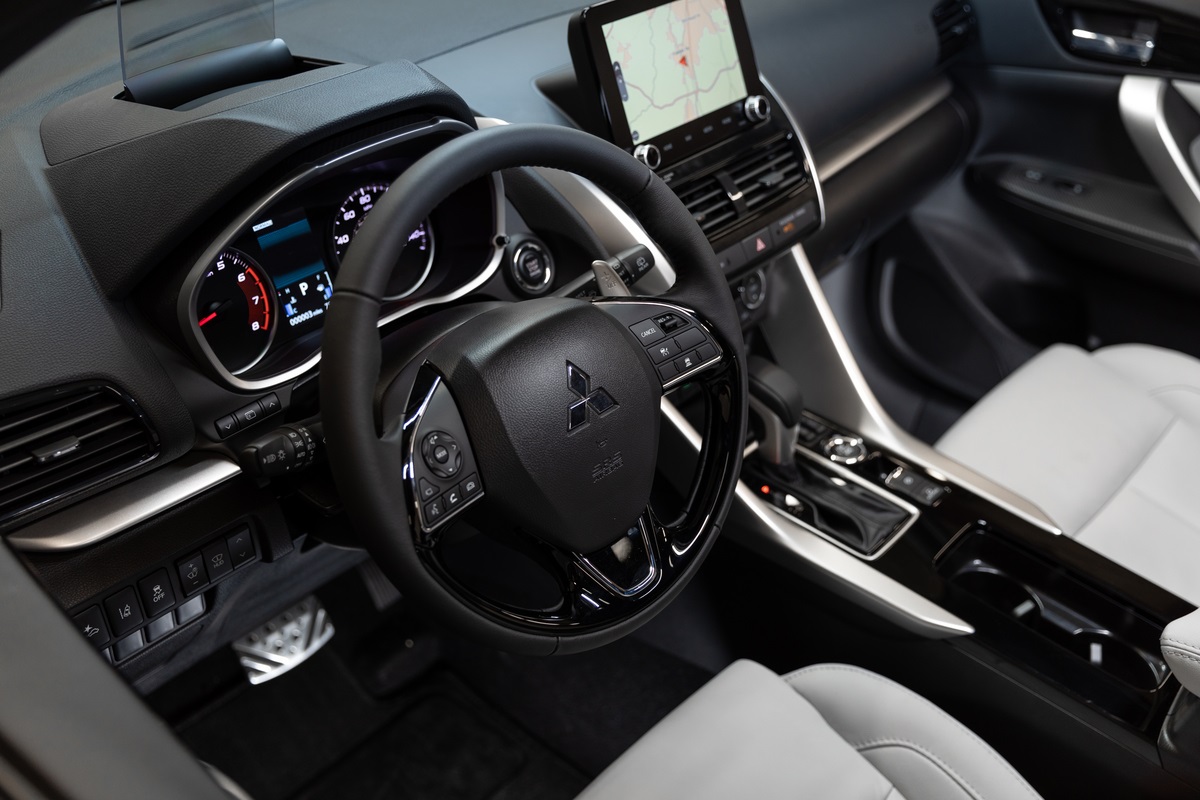
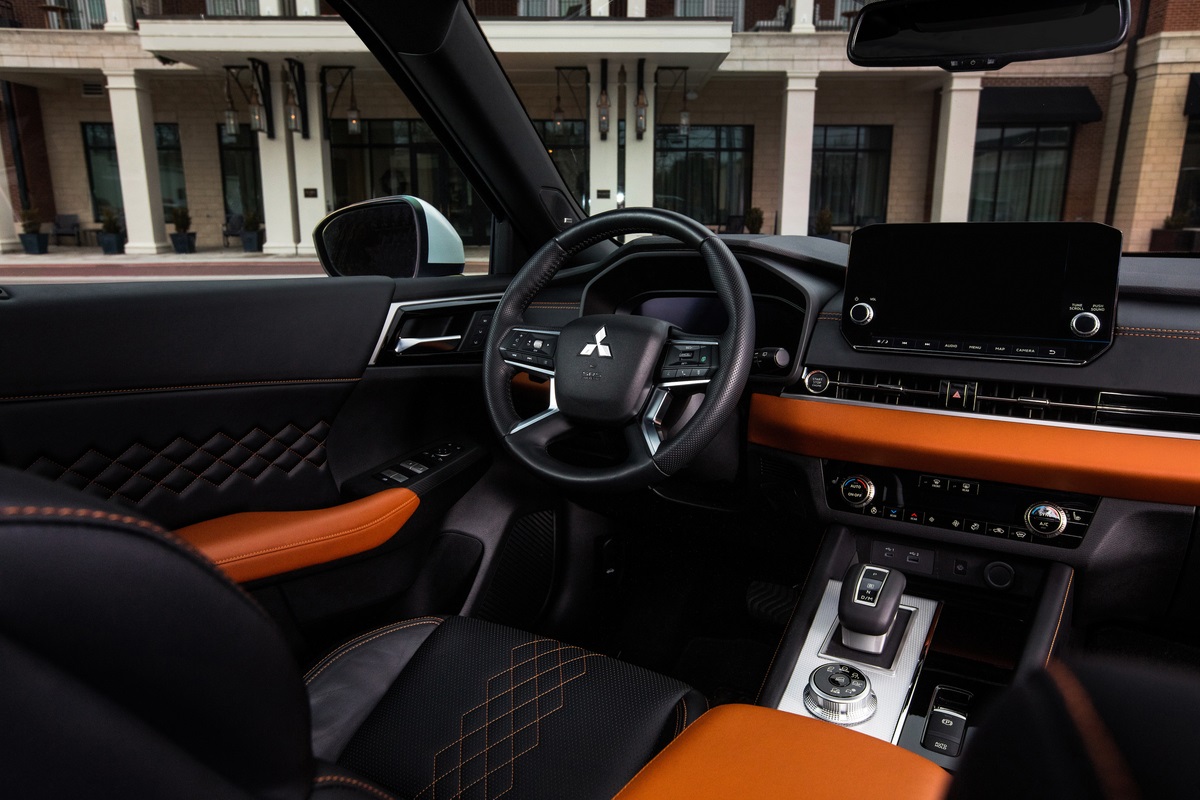
The driver area

Standard SEL features include leather-trimmed upholstery, fast-key entry with push-button ignition, multiview camera system, 8-inch navigation system with smartphone link, and 8-way power front seats.

Mitsubishi Eclipse Cross Overview

The Eclipse Cross is a thrifty SUV crossover powered by a 152 horsepower, turbocharged 1.5-liter four-cylinder engine. Its continuously variable transmission has an eight-step, manual-shift sport mode.

Starting prices range from about $25,000 to $31,000. Mitsubishi is not stingy with the standard features, and the comprehensive new-vehicle warranty is a convincing purchase incentive.

With the North American debut of the Eclipse Cross in 2018, there were a few updates for 2020. But the pandemic and resulting supply shortage canceled the 2021 model year. Mitsubishi is making up lost time with the 2022 major redesign, but more still needs to be done.

The extensive redesign of the 2022 Mitsubishi Eclipse Cross added more than 5 inches in overall length, now measuring 178.9 inches long. The length provides about another cubic foot of cargo space.

Vehicle width and height carryover at 71.1 inches wide and 66.3 or 66.5 inches tall in 2WD or 4WD. And the wheelbase remains unchanged at 105.1 inches.

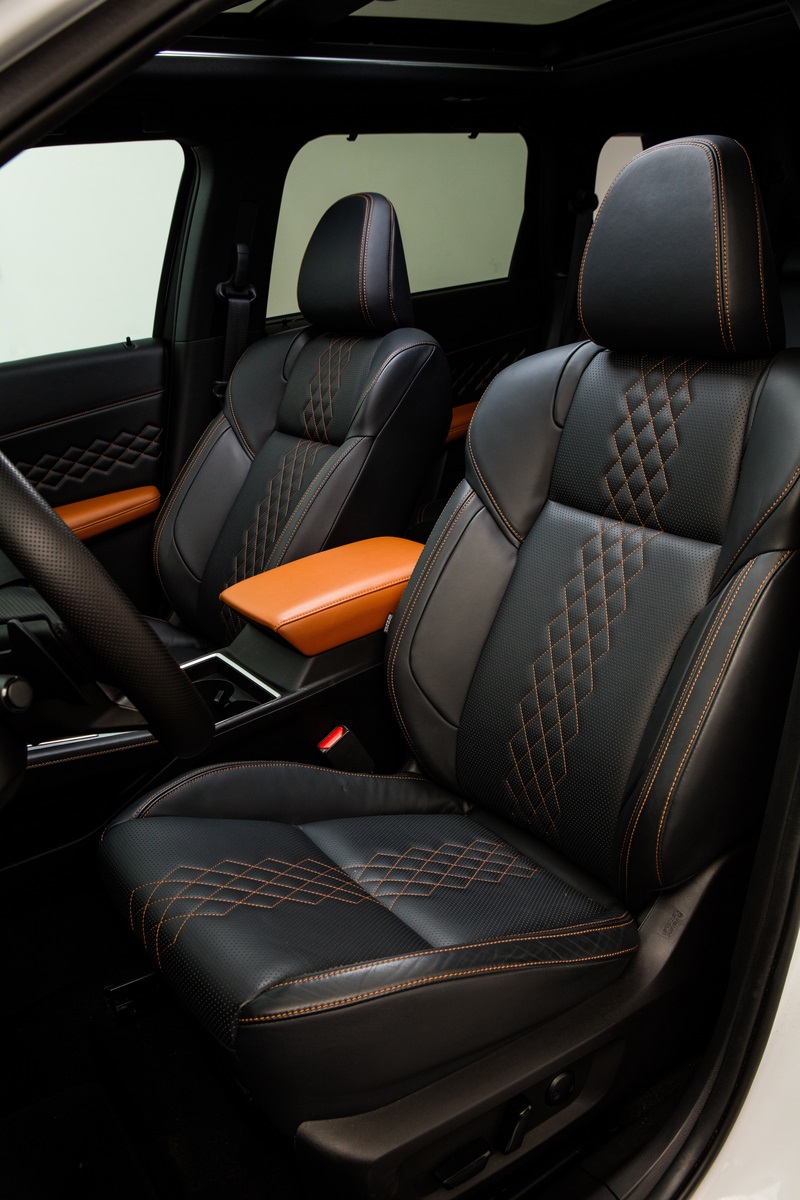
Also new is an optional 8-way power passenger seat

Also new is an optional 8-way power passenger seat, available on SEL models.

Eclipse Cross Pricing and Warranties

The 2022 Mitsubishi Eclipse Cross is sold in four trim levels in standard front-wheel drive or optional Super All Wheel Control all-wheel drive. All models have one powertrain of a 152 hp, turbocharged and direct-injected 1.5-liter 4-cylinder, and continuously variable automatic transmission with eight-step sport mode and paddle shifters.

All MSRP pricing includes the $1,245 freight charge from Okazaki, Japan. Add $1,600 for all-wheel drive.

  • ES 1.5T $24,940;
  • LE 1.5T $26,290;
  • SE 1.5T $27,690;
  • SEL 1.5T $28,940.

(Since the 2022 model went on sale a year ago Feb. 2021, starting prices have increased by $300 and the freight charge by $50.)

Today’s Eclipse Cross SEL S-AWC tester was $34,425. Find options and accessories in the specifications box at the end of this story.

Find current Mitsubishi pricing and incentives here.

Mitsubishi New-Vehicle Warranties

Mitsubishi provides one of the most comprehensive new-vehicle warranties:

  • 10-years/100,000-miles for the powertrain;
  • 5-years/60,000-miles basic bumper to bumper coverage;
  • 5-years/unlimited mileage roadside assistance;
  • 7-years/100,000-miles anti-corrosion/perforation limited warranty.

Interior and Exterior Redesign

Mitsubishi says the exterior makeover of the 2022 Eclipse Cross creates a sportier and more futuristic appearance.

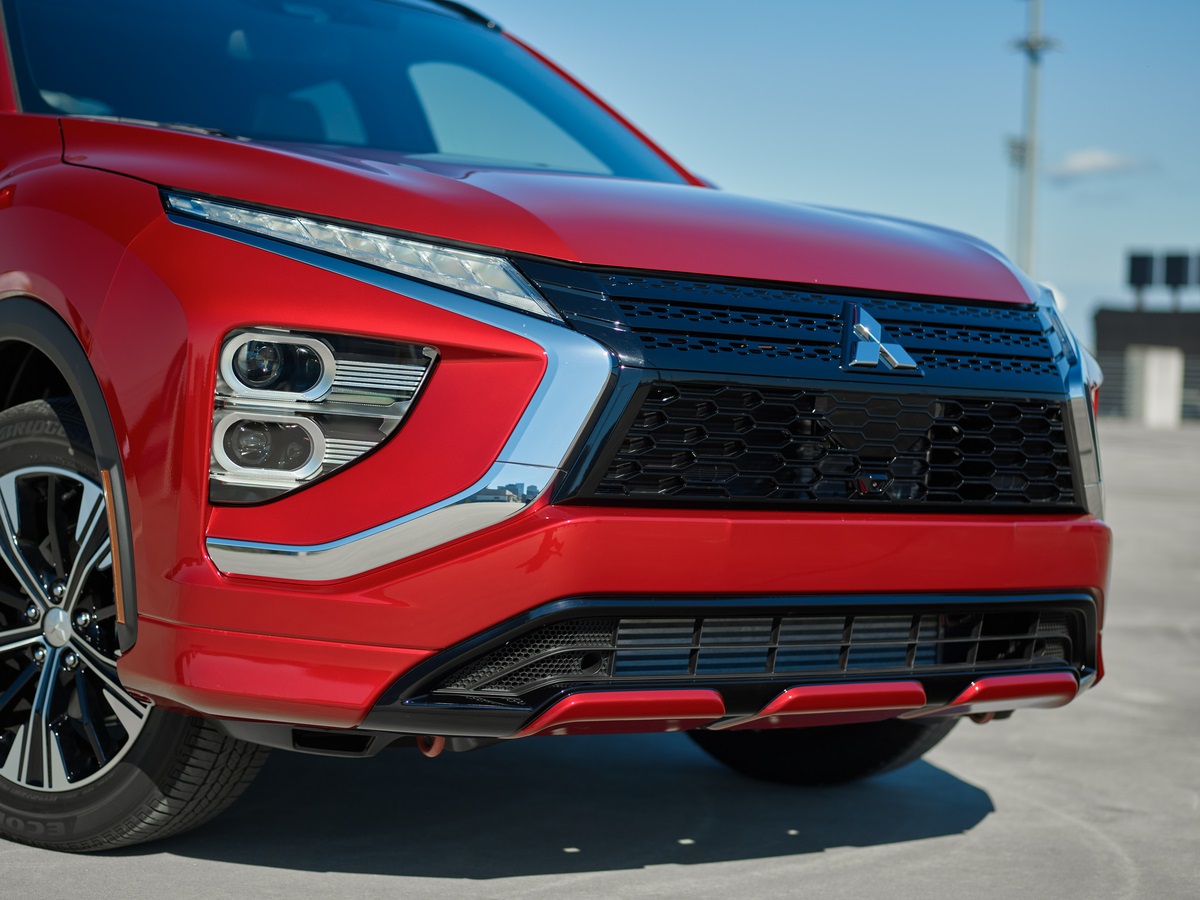
At the front is a new bumper and the latest version of the brand’s Dynamic Shield grille. New bisected lighting features thin, high-mounted LED daytime running lights at the leading edge of the hood with integrated turn signal lamps just below. The stacked-and-recessed lighting combines headlamp and fog lamp in a low-mounted position for optimal visibility, Mitsubishi says.

The rear end has a completely restyled hatch and window — cleaning up the initial split window design. The single-piece rear window and new hatch design added almost 2 cubic feet of space. Available space now is still shy of some competitors, but there is a maximum of 50.1 cubic feet with the second row folded and 23.4 cubic feet behind the second row.

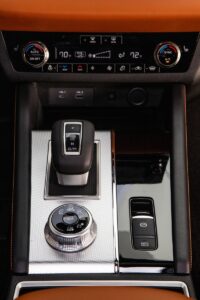
The shift console of the Eclipse Cross

The CVT has an eight-step, manual-shift sport mode.

New Interior Design

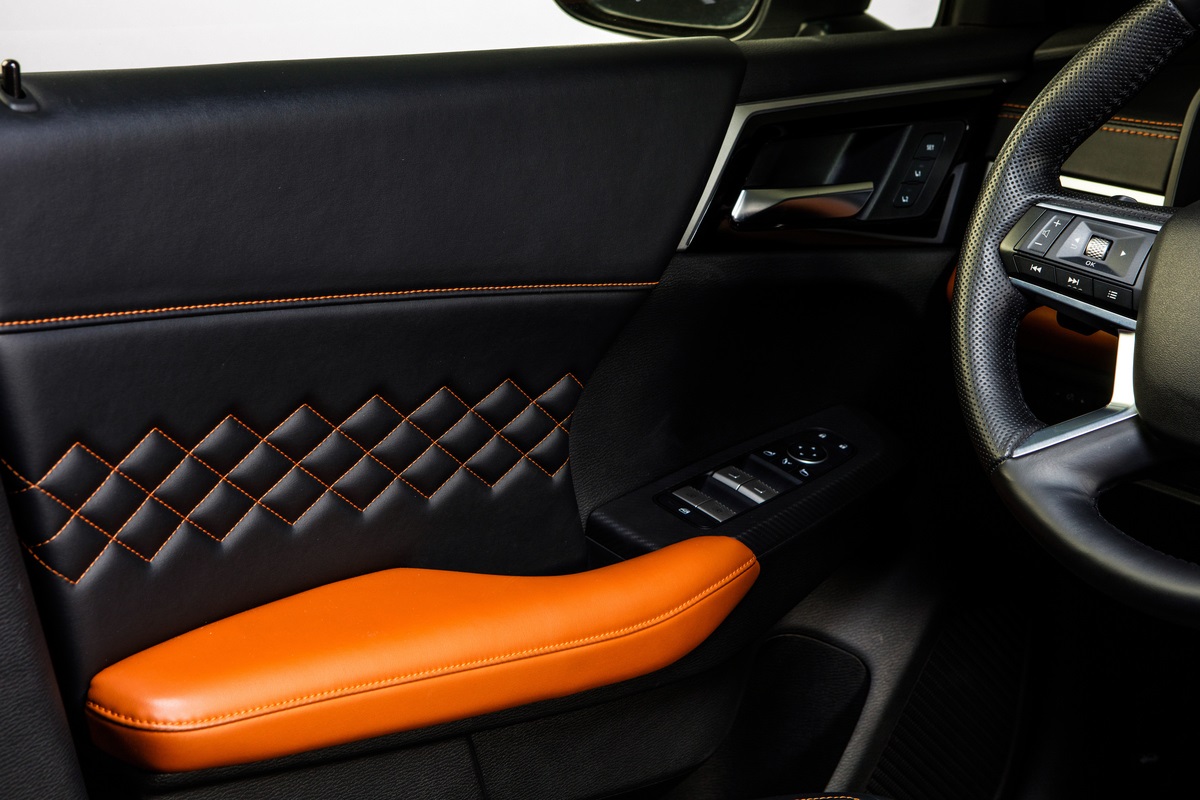
The updated Eclipse Cross interior is now available with a light gray leather seat option with black accents. But the interior color choice is only available on the SEL trim.

Mitsubishi says that the gray trim package helps create a more refined interior aesthetic. Previously, black-on-black was the interior color theme. Also new is an optional power passenger seat, available on SEL models.

Driver and front passenger heated seats are standard on LE, SE, and SEL trims. In addition, a heated steering wheel is standard on the SEL trim, while the SEL with Touring package adds heated rear seats. The reclining rear seats have nine positions.

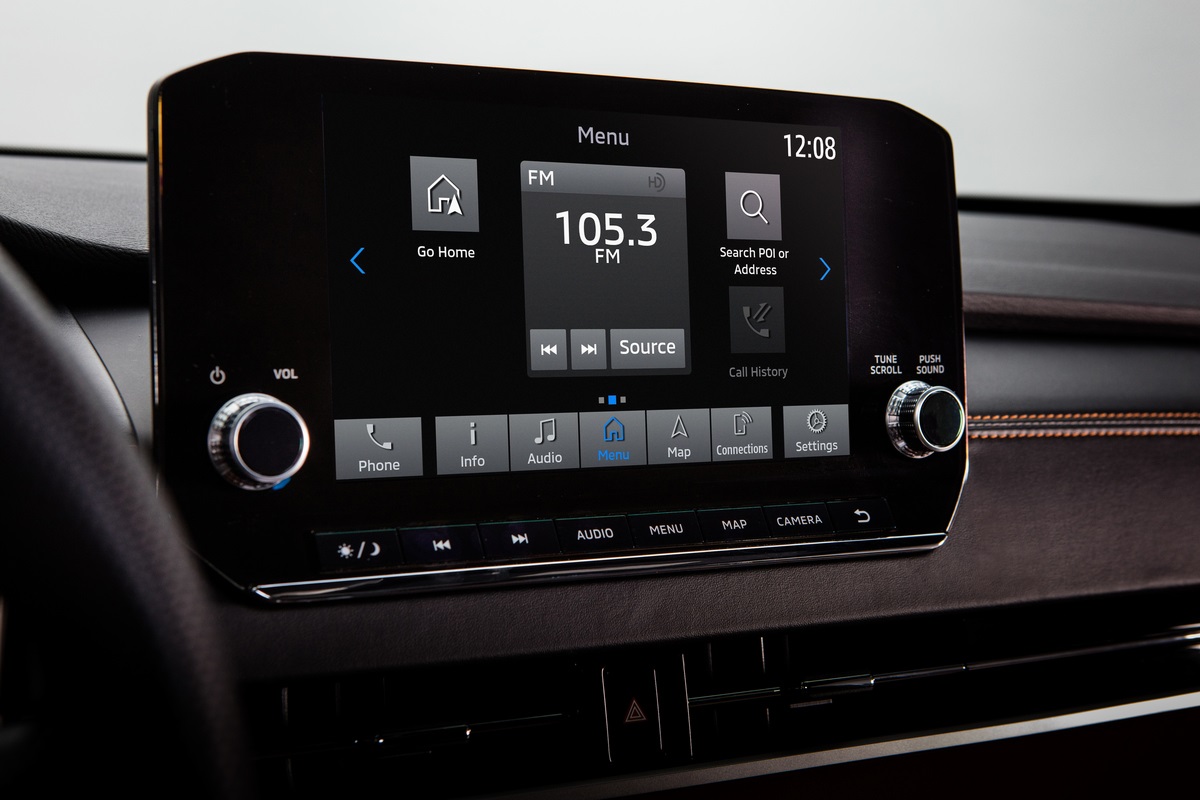
The 8-inch infotainment touchscreen

The touchscreen has been moved 2 inches closer to the driver.

Redesigned Infotainment

Highlighting the upgraded interior is a new 8-inch Smartphone-link display audio system, available on LE, SE, and SEL trims. The touchscreen has been moved 2 inches closer to the driver and features volume and tuning knobs for easier use. The previous center console touchpad is gone.

Apple CarPlay and Android Auto integration are included with the 8-inch screen. ES trims have a 7-inch display audio touchscreen.

An onboard navigation system with embedded “what3words” integration is standard on Eclipse Cross SE and SEL. Mitsubishi says the 2022 Eclipse Cross is the first production vehicle to be offered with what3words embedded directly into its navigation system.

The navigation screen

The navigation system is embedded with ‘what3words’ integration.

As a global addressing system, what3words divides the world into a grid of 3-meter-by-3-meter squares. Each square is assigned a unique what3words address. Mitsubishi says that the system allows pinpoint navigation, even in remote, unpopulated areas. The system allows greater accuracy than systems using street addresses.

The optional navigation system includes TomTom live traffic information and mapping.

Revised Suspension and Handling

The longer Eclipse Cross required some suspension finesse to maintain balance and control. As a result, the suspension was re-engineered with retuned shocks and springs, including larger rear shock shafts for better ride control. Engineers also addressed bounce and rebound control for more consistent ride quality.

Additional changes include connecting the rear suspension cross member to a double vibration insulator. Mitsubishi says that the more rigid connection provides a more planted feel than the previous bushing setup.

18-inch all-season Bridgestone Ecopia H/L tires (225/55) and two-tone wheels on the Eclipse Cross SEL.

18-inch  Bridgestone Ecopia tires (225/55) and two-tone wheels on the SEL.

Eclipse Cross Safety Features

The 2022 Mitsubishi Eclipse Cross recently received the highest-possible 5-Star Overall Safety Rating from the National Highway Traffic Safety Administration.

All 2022 Eclipse Cross models receive standard advanced driver assistance systems, including Forward Collision Mitigation with Pedestrian Detection and Lane Departure Warning.

Automatic high-beam-assist headlights and rain-sensing wipers are standard on LE, SE, and SEL trim levels. SE and above trims also include Blind Spot Warning with Lane Change Assist and Rear Cross-Traffic Alert.

Other standard safety features include seven air bags, active stability and traction controls, and hill-start assist.

A new bisected lighting design features thin, high-mounted LED daytime running lights.

A bisected lighting design features thin LED daytime running lights.

Eclipse Cross SEL Interior Function

The cabin space is quite tall and accessible. The doors open wide (wider than some economy vehicles), and headroom is a generous 39.5 inches with the panoramic roof.

Sightlines are good at the fenders and side mirrors but very cropped over the shoulder at the rear window pillars. Fortunately, the SEL includes a multiview camera system that takes the guesswork out of parking or backing up.

Both SEL front seats are eight-way power adjustable and heated, with a heated steering wheel.

The instrument panel and center console stack are tight on space, but most controls are intuitive to figure out. I found the optional head-up-display screen too much in my line of sight, but the screen can be switched off and lowered. The clear plastic panel rises from the back of the gauge array and highlights the speed and other elements. (The head-up display is part of the $2,100 SEL Touring Package.)

Eclipse Cross Back Seat and Cargo

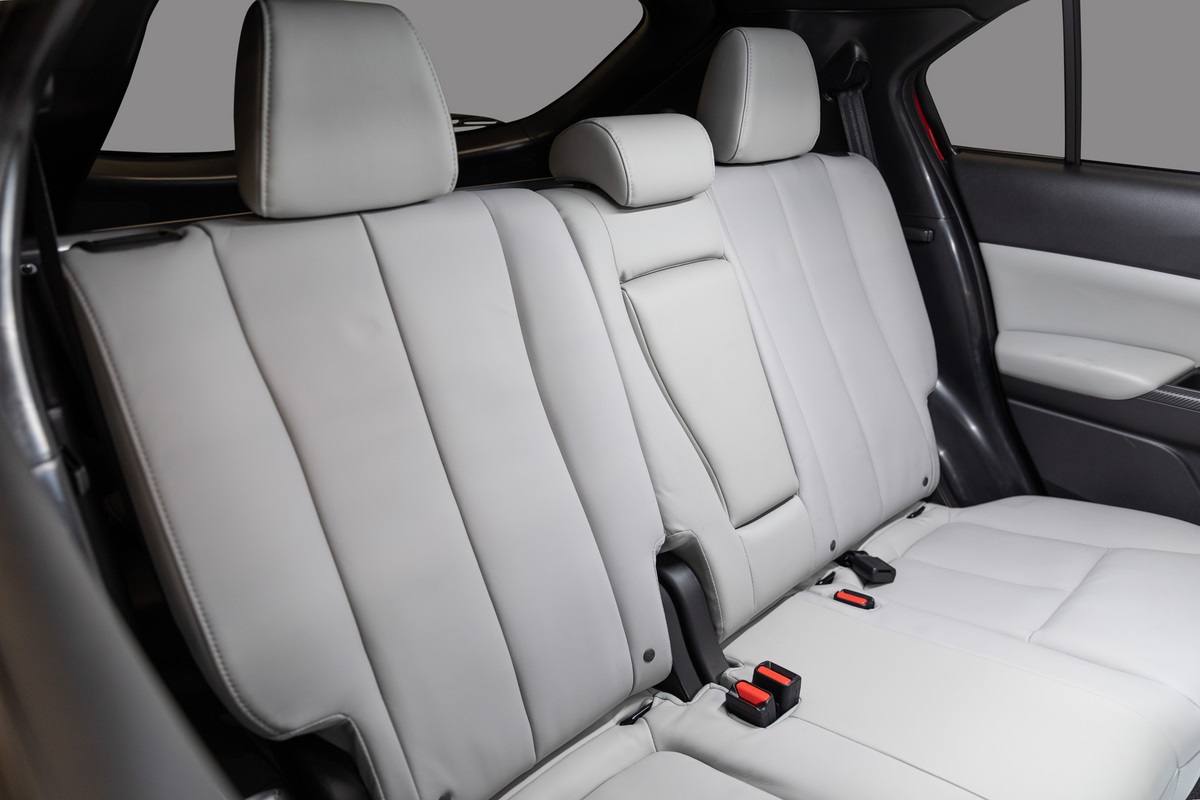
The back seat space is upright with decent legroom of 35.3 inches. However, tall occupants in front will significantly cut the leg space. The transmission-exhaust tunnel is a low hump, which helps with three-across footroom. The broad fold-down center armrest is an asset, as are overhead grab handles with a coat hook. In addition, the SEL model includes heated window seats.

The new liftgate might be heavy for some to raise and the lift to the cargo floor is tall. Cargo space is broad and deep, but the sport-roof design crops space for large and square items. Bicycles and other such gear will have to be mounted on the roof.

The back seat.

The back seat space feels upright but with legroom of 35.3 inches.

Eclipse Cross Ride and Handling

The Eclipse Cross is more of a people-mover than a people play toy despite many new suspension adjustments. The ride quality for a weekend drive is smooth and comfortable, but it also can be bouncy. And sections of rough road can provoke the occasional clunk. Around town, there is some stiff head tossing when crossing speed bumps or pulling into driveways with an angled approach.

It is not the most soundproofed highway ride. Some of that is wind noise from the upright stance, but the tires have some harshness. The 18-inch Bridgestone Ecopia H/L all-season tires (235/55) have a wear-like-iron treadwear rating of 700. The higher the rating (UTQG), the harder the rubber compound, which here qualifies for about a 70,000-mile warranty.

The four-wheel disc brakes are large to handle the 1,500-pound tow rating: 11.6-inch front ventilated rotors and solid 11.9-inch rotors rear.

Performance and Fuel Economy

The Eclipse Cross has the power to cruise at 80 mph all day. And with 184 foot-pounds of torque from 2,000-3,500 rpm, there is adequate zip to get out of trouble, but with slight turbo and CVT delay. There are Normal and Eco performance modes, but the fuel-sipping Eco gives such slow CVT uptake that I resorted to flipping gears with the paddle shifters. It would have been more fun with more horsepower, but I was missing the point of eco-driving.

Official fuel economy estimates with all-wheel drive (S-AWC) are 25 mpg city, 26 highway, and 25 combined, on the recommended 87 octane fuel. My around-town mileage was around 20 mpg, and on the highway, I progressed to 30.3 mpg, but one stretch was a 6 percent downhill grade for more than 10 miles.

The 15.8-gallon tank is above average in size for the segment.

Why Buy the Mitsubishi Eclipse Cross?

The Eclipse Cross is easy to enjoy with a teacup turning circle of 34.8 feet. Its price and small footprint will appeal to younger, socially connected buyers who like to pack up friends and gear for a weekend outing. Buyers in high-density urban areas with limited parking will appreciate its nimbleness.

It might be of interest that the Eclipse Cross won AutoPacific’s 2021 Vehicle Satisfaction Award in the compact crossover SUV segment. Owners of the 2020 model-year Mitsubishi Eclipse Cross rated their cars higher overall than owners of any other vehicle in the segment.

AutoPacific’s Vehicle Satisfaction Award measures owner satisfaction within individual categories ranging from driving performance and usability of features to seat comfort and interior design.

The Mitsubishi Eclipse Cross equaled or surpassed competitors in 32 of the 36 measured attributes. In addition, it received strong praise for safety features and safety ratings, and owners’ perception of durability and quality.

While the AutoPacific award was for the 2020 model, the company believes the redesigned 2022 Eclipse Cross will repeat this success.

There are many critics of new vehicles, but no evaluation is so valued as that of an owner.

New three-dimensional taillights create a broad and stable presence, Mitsubishi says.

New three-dimensional taillights create a broad and stable presence.

2022 Mitsubishi Eclipse Cross SEL Specifications

Body style: subcompact, 5-seat, 5-door SUV crossover

Engine: 152 hp, turbocharged and direct-injected 1.5-liter 4-cylinder; 184 lb.-ft. torque from 2,000-3,500 rpm

Transmission: CVT with 8-step sport mode with paddle shifters; Super All-Wheel Control with yaw control

Fuel economy: 25/26/25 mpg city/hwy/combined; 87 octane

BY THE NUMBERS

Towing capacity: 1,500 pounds.

Fuel tank: 15.8 gallons

Cargo space: 23.4 to 50.1 cubic feet

Front head/leg room: 39.5*/40.9 inches *w/panoramic roof

Rear head/leg room: 37.3/35.3 inches

Length/wheelbase: 179/105.1 inches

Curb weight: 3,428 pounds

Turning circle: 34.8 feet

FEATURES

Standard SEL equipment includes: Fast-key entry system with push-button ignition, multiview camera system, dual front USB ports, 8-inch navigation system with smartphone link, Apple CarPlay and Android Auto, 6-speaker audio system with satellite radio and Bluetooth phone and audio, steering wheel controls for voice recognition, audio-phone leather-trimmed upholstery, micron air filter, extended front (lighted) sun visors with mirrors, black headliner and roof pillars, LED exterior lighting (headlights, taillights, fog lights, and running lights), automatic headlights, tilt-telescopic steering wheel, 8-way adjustable front seats, heated front seats and steering wheel, leather-wrapped steering wheel, faux-leather wrapped shifter, 60/40 folding back seat, 18-inch two-tone alloy wheels with 225/55 all-season tires

Standard safety features include: 7 air bags, active stability control, Forward Collision Mitigation with Pedestrian Detection, hill-start assist, lane-departure warning,

PRICING

SEL base price: $30,540, including $1,245 freight charge; price as tested $34,425

OPTIONS ON TEST VEHICLE:

Popular Value Package $295, include metal-trimmed sport pedals, rear bumper step protector, and roadside assistance kit (includes jumper cables, tools, reflective triangle, and other items);

Hood nameplate in black $110;

Welcome Package $190 ;

SEL Touring Exterior Package $995, adds black front and rear corner extensions and side extensions;

SEL Touring Package $2,100, includes Forward Collision Mitigation with High Speed Braking capability with Pedestrian Detection, head-up display, heated rear seats, adaptive cruise control, 8-speaker Mitsubishi Power Sound System, auto-dimming rearview mirror with HomeLink, body-colored front and rear bumpers with body-color side door trim, power panoramic sunroof, and black roof rails;

Tonneau cover $195;

Where assembled: Okazaki, Japan

Warranties: 5-years/60,000-miles bumper to bumper with unlimited mileage roadside assistance; 10-years/100,000-miles powertrain

2022 Mitsubishi Outlander Review

2022 Mitsubishi Outlander Review

The redesigned and re-engineered 2022 Mitsubishi Outlander packs about everything that can be expected into a compact family-duty SUV

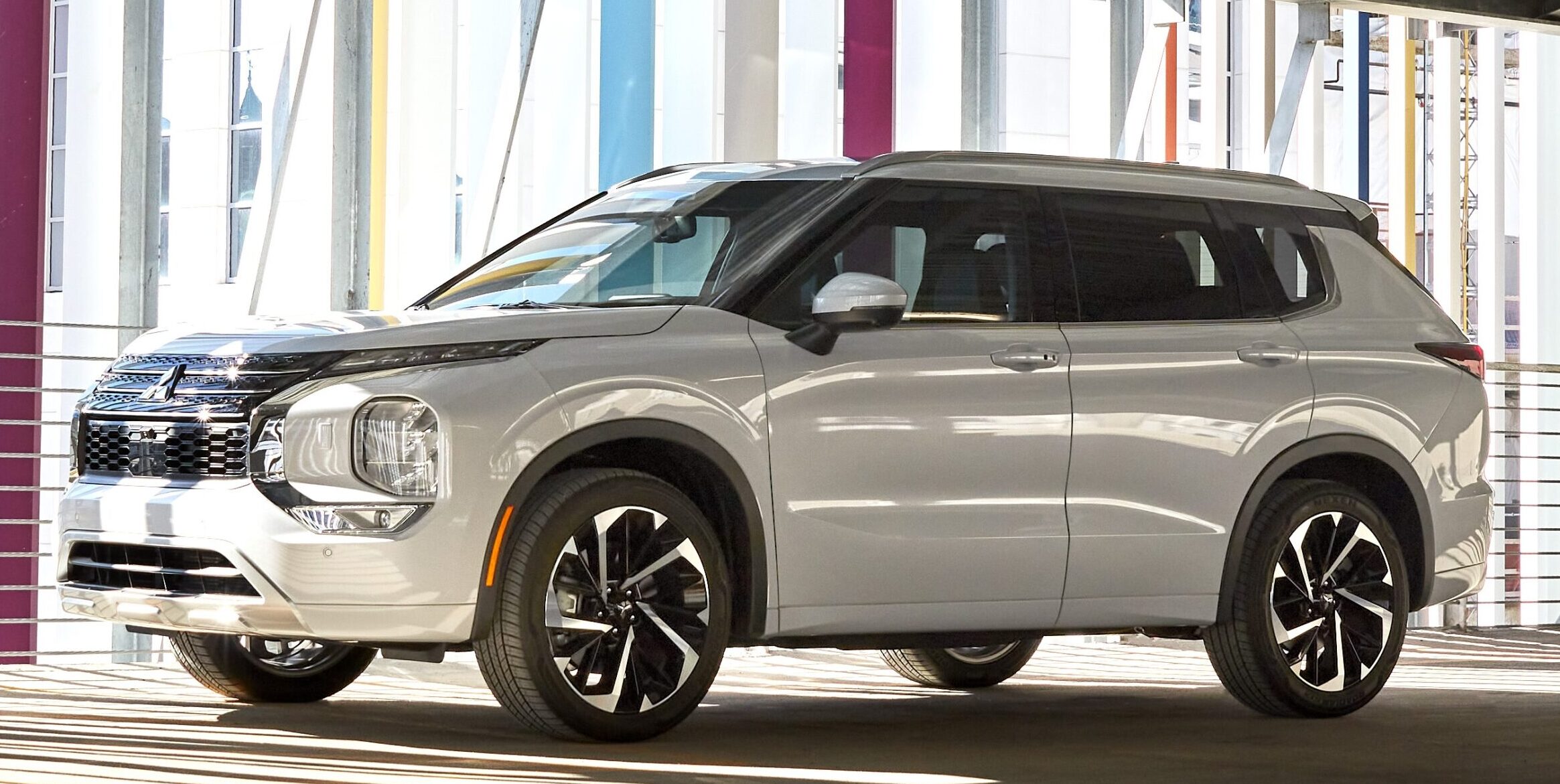
Exterior view of the 2022 Mitsubishi Outlander

The 2022 Mitsubishi Outlander has starting prices that range from $27,500 to $35,645 for the top-line SEL trim level with all-wheel drive. (Mitsubishi photos)

Table of Contents

Outlander Overview
Most-Improved Brand
What’s New for 2022?
Outlander Redesign
Pricing
Performance and Fuel Economy
Ride and Handling
Safety Features
Interior
Back Seats and Cargo
Why Buy the Mitsubishi Outlander?
Specifications


BY MARK MAYNARD

The redesigned and re-engineered 2022 Mitsubishi Outlander packs about everything that can be expected into a midsize, family-duty SUV, including a third row of seats.

The compact-class Outlander has long been a hallmark of refined engineering. And the redesigned 2022 Outlander appears to have had a development budget beyond meeting the lowest price point.

The 2022 Outlander has been named a Wards 10 Best Interiors Winner for 2021. Mitsubishi says that the all-new Outlander is the best-equipped, most connected vehicle Mitsubishi has ever sold in the U.S. and signals a new direction for the brand.

The driver area is a well-organized and ergonomic command center

The driver area is a well-organized and ergonomic command center.

Outlander Overview

Now starting its fourth generation, the Outlander arrived in 2003 in North America and replaced the Mitsubishi Montero Sport. A 2018 redesign made the Outlander slightly larger than the previous model, but most of the size increase went to cabin space, which was widened by 2 inches. A plug-in hybrid model was added then and is still available.

The Outlander is the brand’s flagship SUV crossover, but it is more super-compact in size and almost midsize in its new, slightly larger proportions. In addition, a new-generation, plug-in hybrid 2023 Outlander PHEV will roll out in the U.S. in the second half of 2022.

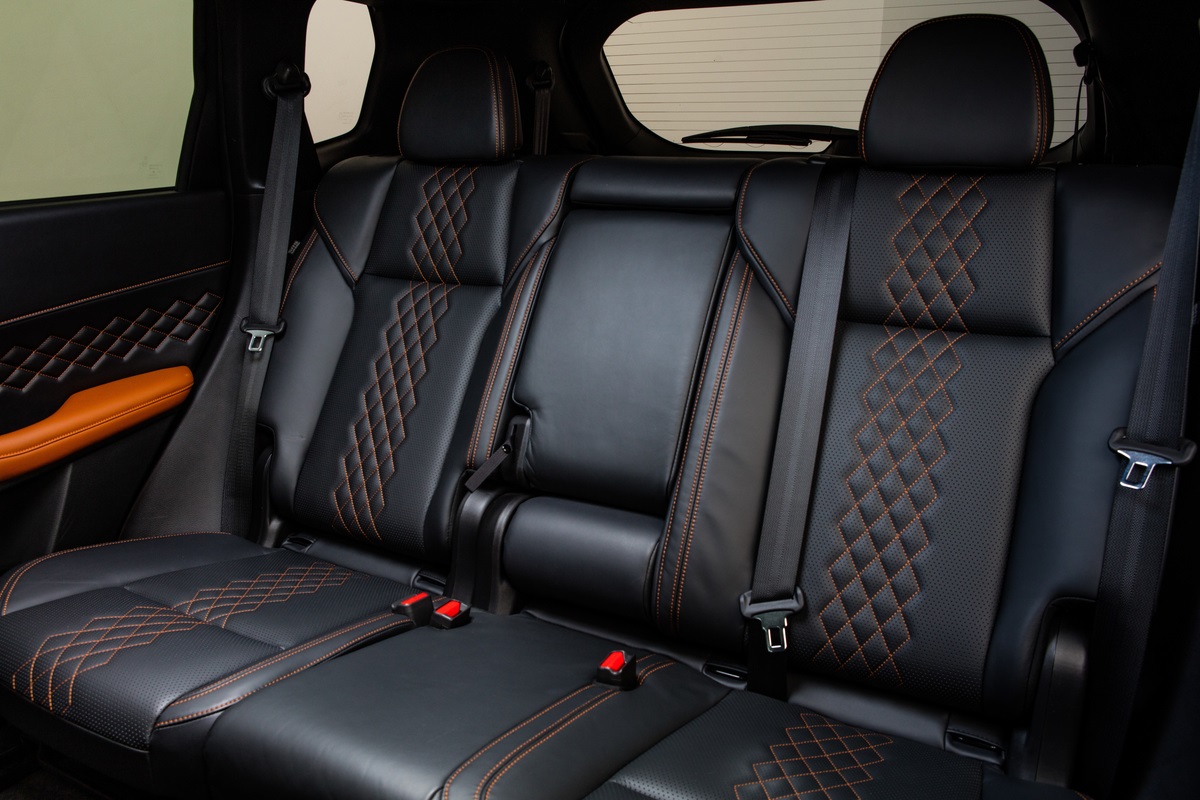
The quilted leather upholstery

The SEL Touring package includes semi-aniline leather-trimmed upholstery with quilted black-and-tan trim.

Most-Improved Brand

Mitsubishi Motors North America was the most improved U.S. brand in the “2021 Automotive Reputation Report” from Reputation, an online analytical research firm. The annual report included an analysis of 35,000 automotive OEM brands, dealer groups, and dealerships across the United States, Canada, and Europe. Graded on a 1,000-point scale, Mitsubishi Motors ranked fourth in 2021 among 19 non-luxury automotive brands. In addition, the carmaker improved from 17th place in 2020, posting a 58-point improvement.

A front door panel pocket in the Outlander What’s New for 2022?

For 2022, the cabin space was reshuffled to provide a third row. Outlander is the only compact-class SUV with a third row and seats for seven.

The added 1.5 inches in body length was just enough to add the third row. Its legroom is kid-class, but the 50/50 divided seats fold flat into the floor for substantial cargo space of 33.5 cubic feet (stacked to the headliner). The 11.7 cubic feet behind the third-row seats is plenty to corral bags of groceries. And there is underfloor storage, such as to stow the standard cargo roller cover.

A wider stance bolstered drivability; the front track is 2.1 inches wider and the rear is 2.5 inches wider. Alloy wheels and all-season tires are standard on all models. Entry-level models have 18-inch 235/60 tires, with 20-inch 255/45 tires on upper trims.

For improved visibility, the space between the windshield pillars and the side mirrors was expanded for better cornering views. In addition, the washer nozzles are now built into the wiper arms, which gives more consistent spray action and saves on fluid.

The 9-inch infotainment touchscreen

The 9-inch infotainment touchscreen.

2022 Outlander Redesign

The Outlander’s exterior styling was amped to the next level with the so-called “Bold Stride” design theme. It is intended to show width and stability, Mitsubishi says. The face is unmistakable. The prominent headlight nacelles are “Godfather” bold and intend to convey a fearless expression, Mitsubishi says.

2022 Outlander Pricing

The gasoline-powered Outlander is sold in three trim levels of ES, SE, and SEL. Front-wheel drive is standard, but Mitsubishi’s sophisticated Super All-Wheel Control 4WD is an affordable $1,800.

Starting prices range from $27,500 to $35,645 for the top-line SEL trim level with all-wheel drive. MSRP pricing includes the $1,245 freight charge from Okazaki, Japan.

Premium paint colors of White Diamond, Black Diamond, and Red Diamond are a $395 upgrade.

All trim levels have the same powertrain: a 181-horsepower, direct-injected 2.5-liter four-cylinder engine and continuously variable transmission. The CVT masterfully imitates an eight-speed stepped transmission.

Today’s tester is an Outlander SEL 2.5 S-AWC that was $38,345, including the SEL Touring package, $2,700. The package includes:

  • Heated steering wheel;
  • Synthetic leather door inserts with quilted black-and-tan trim elements;
  • Semi-aniline leather-trimmed upholstery;
  • 10.8-inch head-up windshield display;
  • 10-speaker Bose audio system;
  • Power panoramic sunroof;
  • Rear side door pull-up sunshades.

Also included in the tester’s price is a roller tonneau cover ($195) and the Welcome Package ($160), which adds carpeted floor mats, a touch-up paint pen, and a mat for the center console tray.

The 2022 Outlander PHEV has a starting price of $38,400. Pricing for the 2023 Outlander PHEV will be announced closer to the on-sale date.

Mitsubishi provides an excellent warranty package of 5 years or 60,000-miles for basic coverage with roadside assistance and 10 years or 100,000-miles for the powertrain. Also included is a 2-year subscription for Mitsubishi Connect for remote and safeguard services.

Find current pricing and incentives here.

The shift console in the Outlander

The wide shift console.

Outlander Performance and Fuel Economy

A look under the hood can reveal much about the construction of a vehicle, whether the hoses, connectors, and various lines feel flimsy or tenuous. The Outlander’s assembly, parts, and plastics appear robust, and the metals are treated to resist rusting. Still, pennies were saved by not adding a dress-up engine kit.

The Outlander’s 2.5-liter engine (replacing a 2.4 liter) is newly developed by the Alliance, meaning the newly formed auto group of Renault, Nissan, and Mitsubishi. The global triumvirate allows shared costs for design, engineering, and technology. And looking closely at the Outlander, you might see a resemblance to the Nissan Rogue (but not its powertrain).

With 181 foot-pounds of torque, the four-cylinder engine has good force without turbocharging. The acceleration was so responsive that I did not feel the need to exercise the paddle shifters.

Braking is confident and controlled from ventilated four-wheel disc brakes. The front rotors are 13.8 inches, with 13-inch rotors at the rear.

Somehow, the Mitsu engineers trimmed 441 pounds from the 2022 curb weight, now at 3,803 pounds, and lighter weight is better for fuel economy.

The Outlander AWD has impressive, if difficult to achieve, mileage ratings of 24 mpg city, 30 highway, and 26 mpg combined on 87 octane fuel. In my week of testing, I worked up to 25.5 mpg combined, and it might have gone higher with a longer commute. The 14.5-gallon tank is good for up to 400 miles of range.

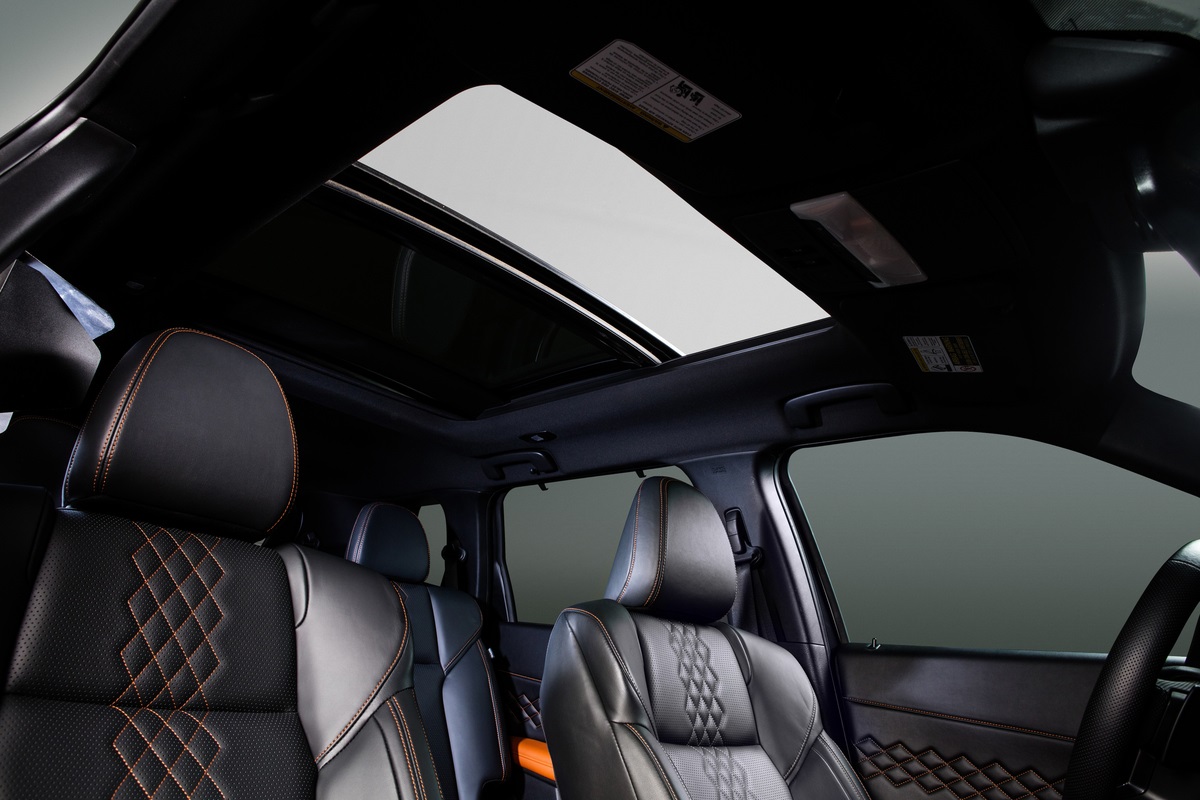
The Outlander's panoramic sunroof

The panoramic sunroof is part of the SEL package.

Mitsubishi Outlander Ride and Handling

The independent suspension (front MacPherson struts and rear multilink with stabilizer bars) can feel stiff with the occasional jolt. But that firmness also adds to a feeling of stability and security in fast cornering and evasive maneuvers.

Despite sound-insulating glass in the front doors and windshield, the cabin can be noisy at highway speeds. The white noise could be induced in part by the 20-inch Bridgestone Ecopia H/L 422 Plus all-season tires. Bridgestone tires wear like iron, but the Ecopia is a low rolling resistance tire to maximize mileage. Consequently, it has a hard treadwear rating of 600. The good news is that the tire has a tread life warranty of five years or 70,000 miles.

The Outlander's second row

Second-row legroom is quite comfortable at 39.9 inches.

Driver-Assist and Safety Features

Nearly all trim levels of Outlander include a full set of advanced safety technologies and features. Among the driver-assist features is MI-Pilot Assist for semi-autonomous driver-assist driving. Pilot assist is intended for long-distance driving and in the stop-and-go commute. The system uses Navi-Link adaptive cruise control with stop and go, lane-keep assist, lane-departure prevention, and traffic sign recognition.

The Mitsubishi system is well calibrated for lane centering, and Pilot Assist can be a welcome drive partner, but always keep hands on the steering wheel. It is the highway markings that determine — and undermine — effectiveness. Faded white lines on light gray California Interstates can cause confusion and a random shutoff. Low sunlight into the grille sensor also can cause a shutoff, as can driving alongside a white semitrailer.

Standard Outlander safety features include 11 air bags, forward collision mitigation, blind-spot warning with lane-change assist, rear cross-traffic alert and rear emergency braking, and trailer-stability assist.

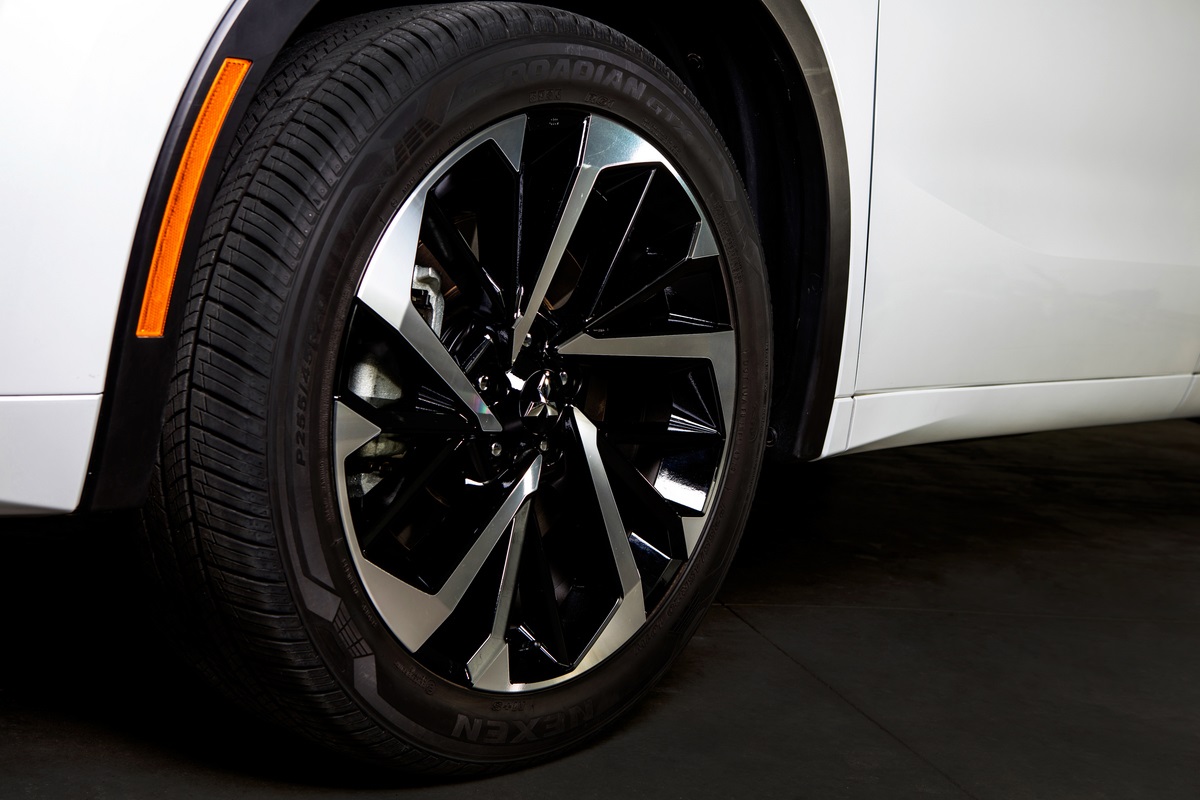
The 20-inch Outlander alloy wheel and all-season tire.

20-inch 255/45 all-season tires are standard on upper trim levels.

Outlander Interior Function

Outlander’s driver area is well-organized and has an ergonomic command center. Front headroom is tall at 38.8 inches with the panoramic sunroof or 40.6 inches without. A 12.3-inch digital driver gauge display is bold, bright, and easily readable with large text and graphics. And, the 9-inch infotainment touchscreen is upright in the instrument panel but not prone to glare; large graphics make the screen easy to read in all lighting conditions.

Sightlines are mostly unhindered over the front fenders and over the shoulder. Small corner windows at the rear tailgate pillars help with a peek of visibility. The glass also helps the third row feel more spacious.

The bigger enabler to visibility is the SEL’s multiview camera that displays the vehicle’s front, rear, and sides. I found the curb view especially helpful to avoid scraping the wheels. In addition, the Outlander’s tight turning circle of 36.1 feet is nimble in close parking structures or making a quick U-turn.

Eight-way power seats are standard for the SEL driver, but the passenger gets just a four-way power seat. Mitsubishi says the two-layer seat construction provides a soft initial touch while preventing fatigue on long drives.

The wide shift console could have been designed for more drop space, such as for the passenger’s phone. Wireless phone charging is standard on most trim levels, and the e-bin area includes two USB ports (1 C-type), an aux-in and a 12-volt plug. The armrest console has a small storage box.

Sun visors are deep and slide for more coverage, but their effectiveness is shorted at the windshield pillars.

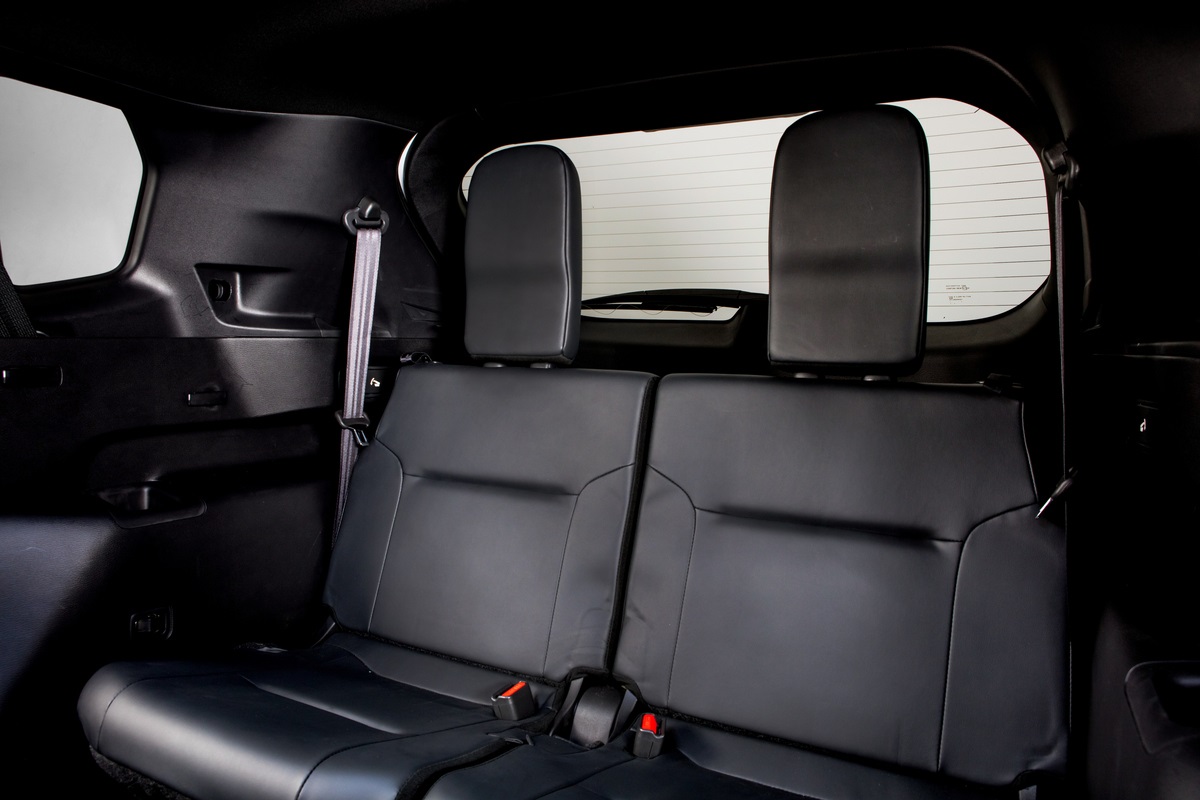
The Outlander's third row of seating.

The third row is as-needed seating. But the seats fold flat when not needed.

Rear Seats and Cargo Space

Second-row legroom is quite comfortable at 39.9 inches. The seats recline and have several inches of fore-aft slide, which is helpful to add a bit more legroom to the third row. In addition, a lowish exhaust-AWD tunnel helps with three-across seating.

The front seatbacks have a clever arrangement of two small storage pockets above the larger main pocket. Other conveniences include:
•Seat heaters and temperature control.
•Side-glass manual sunshades.
•Reading lights on either side of the pano roof.
There is bottle storage in the doors, and the center fold-down armrest also has cup holders.

The third row is as-needed seating, primarily for kids on the school commute or the grandkids. Legroom is a squeeze at 18.7 inches and headroom is low at 34.5 inches.

The third row has an easy sequence of manual fold and pull-back from the cargo area.

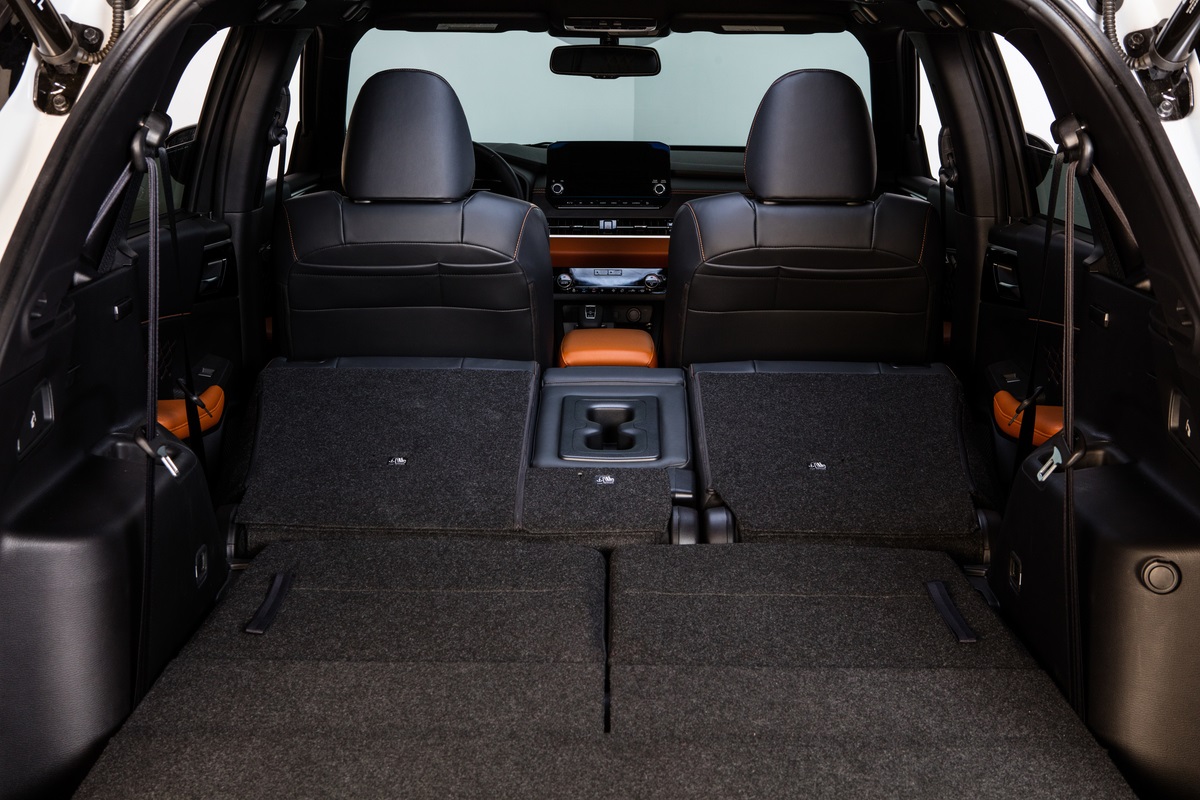
The cargo-area opening is wide at 45 inches by 31 inches tall. Fold the second and third rows for 6 feet of length. And there is subfloor storage for the roller cover.

The open cargo area in the Outlander

Fold the second and third rows for 6 feet of cargo length.

Why Buy the 2022 Mitsubishi Outlander?

The redesigned Outlander pushes its size limits. It looks large from the outside and is roomy inside, but it drives small.

The assembly and materials have a satisfying quality, and the well-equipped SEL tester has luxury appeal with enduring family function.

The Outlander’s small-is-large format will work for young families or empty-nesters ready to downsize — but with room for the grandkids.

My most significant takeaway from this test is Outlander’s long list of technologies, standard safety features, and the pile-on of lux-class extras —  for the as-tested price of $38,700. Put the same level of content on a compact luxury SUV and the sticker would be $58,000 to $65,000.

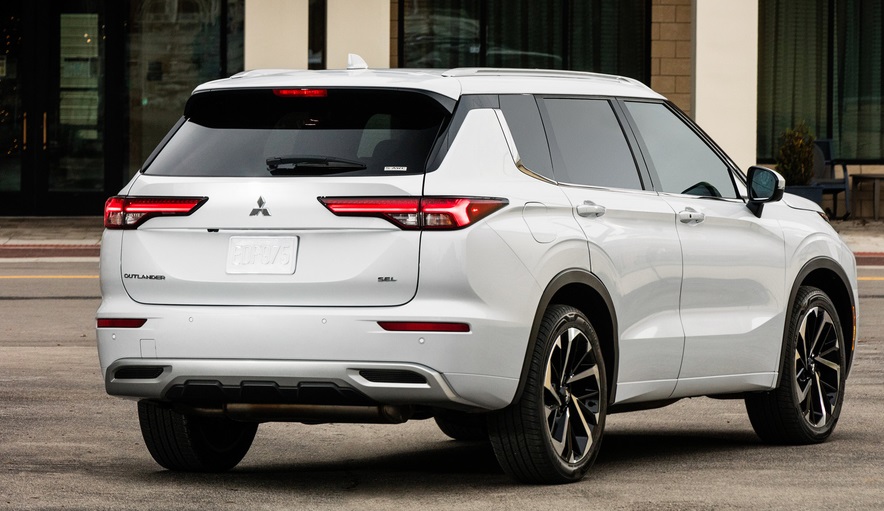
A rear view of the Outlander

The tailgate design is meant to mimic the image of the spare tire mounted on the back of SUVs past.

2022 Mitsubishi Outlander SEL Specifications

Body style: midsize, 7-seat, 5-door SUV with Super All-Wheel Drive

Engine: 181-hp, direct-injection, DOHC 2.5-liter 4-cylinder; 181 lb.-ft. torque at 3,600 rpm

Transmission: 8-speed CVT with Sport mode and paddle shifters

Fuel economy: 24/30/26 mpg city/hwy/combined; 87 octane

BY THE NUMBERS

Towing capacity: 2,000 lbs.

Fuel tank: 14.5 gallons

Cargo space: 11.7-33.5 cubic feet

Front head/leg room: 38.8*/41.7 in. *40.6 w/o sunroof

2nd-row head/leg room: 37.4*/39.9 in. *39.1 w/o sunroof

3rd-row head/leg room: 34.5/18.7 in.

Length/wheelbase: 185.4/106.5 in.

Curb weight: 3,803 lbs.

Turning circle: 36.1 ft.

FEATURES

Standard equipment includes: SmartKey locking and push-button ignition, MI-PILOT Assist with navigation with traffic sign recognition, adaptive cruise control with stop-and-go, 9-inch navigation screen with smartphone link, wireless charging, multiview camera system, electric parking brake, 4 USBs (including 2 C-type), 8-way power driver’s seat, 4-way power front passenger seat, 6-speaker audio system with wireless Apple CarPlay and Android Auto, heated front and 2nd-row seats, front parking sensors, 20-inch alloy wheels with 255/45 all-season tires, 40/20/40 folding 2nd row, LED headlights-running lights-fog lights, automatic headlights, heated and power-folding side mirrors, front wiper de-icer, and a hands-free power liftgate

Safety features include: 11 air bags, lane-keep assist, forward collision mitigation, lane-departure prevention, blind-spot warning with lane-change assist, rear cross-traffic alert and rear emergency braking, brake-force distribution, brake assist, hill-start assist, active stability control, trailer-stability assist

PRICING

Base price: $35,645, including Mitsubishi Connect Subscription for 2 years and $1,245 freight charge; price as tested $38,700

Options on test vehicle: SEL Touring Package, $2,700, includes a heated steering wheel, synthetic leather door inserts with black and tan quilting, semi-aniline leather-trimmed upholstery, 10.8-inch head-up display, 10-speaker Bose audio system, panoramic sunroof, rear side window sunshades

  • Tonneau cover $195
  • Welcome package $160, includes carpeted floor mats, touch-up paint pen, center console tray mat

Where assembled: Okazaki, Japan

Warranty: 5-years/60,000-miles basic coverage with roadside assistance; 10-years/100,000-miles powertrain

2022 Volvo XC60 B6 AWD R-Design Review

2022 Volvo XC60 B6 AWD R-Design Review

The Volvo XC60 SUV has polite manners and efficient engine technology, but its purity of Volvoness separates this SUV from the competition

An exterior view of a white Volvo XC60 SUV crossover.

The Volvo XC60 SUV has had a few exterior updates for 2022 and some significant advanced technology additions, such as CleanZone air filtration. (Photos courtesy of Volvo unless otherwise credited.)

Table of Contents

Volvo XC60 Overview
New for 2022
2 New Engines
Pricing
Volvo Vehicle Warranty
Performance and Fuel Economy
Pilot Assist
Ride and Handling
Safety Features
CleanZone Air Filtration
Interior Function
Back Seats and Cargo
Why buy the Volvo XC60 B6?
Specifications

BY MARK MAYNARD

The Crystal White metallic paint of the 2022 Volvo XC60 tester is a popular conversation starter. The handsomely styled XC60 prompted comments of praise by several female passers-by as it sat parked in my driveway. It is an approachable and tastefully styled midsize SUV crossover.

Volvo says the XC60 was not designed to look down on others but to drive. In some ways, it is the missing link that merges a car with an SUV for uncompromising Scandinavian design. This five-seat SUV crossover has polite manners, efficient engine technology, and family function. But its allure is more than function and style; it is its purity of Volvoness that resonates.

The front seats of the XC60

The 10-way power seats are gently contoured and supportive for the long haul.

Volvo XC60 Overview

The first-generation XC60 for North America debuted in 2010, and it has continued as Volvo’s top-selling model — around the world. The second-gen debuted for 2018 and was made 1.8 inches longer and about the same width, but with a roofline that is 2.1 inches lower. In addition, the wheelbase lengthened by 3.6 inches, now at 112.8 inches.

The freshened 2022 model builds on that midsize footprint and adds a few significant updates. While the exterior changes for 2022 are subtle, Volvo’s attention to detail and some unique extras reinforce ownership.

The gas-engine XC60 models now have “mild hybrid” engines helping Volvo reach its goal of total electrification by 2030. By then, the company intends to sell only fully electric cars and phase out any vehicle in its global portfolio with an internal combustion engine, including hybrids.

And a unique addition is Volvo’s CleanZone air filtration system. The system can stop up to 95 percent of pollutants from entering the passenger compartment.

An overhead view from the multiview camera

The 360-degree surround view camera system includes overhead.

New for 2022

Highlights of the 2022 changes include:

  • Updated grille with updated and heated logo (for a clear Pilot Assist camera in all weather conditions);
  • Restyled front fascia with stronger horizontal lines in the lower fascia and a restyled rear fascia with hidden tailpipes;
  • New wheel designs and some new paint colors, including Silver Dawn Metallic;
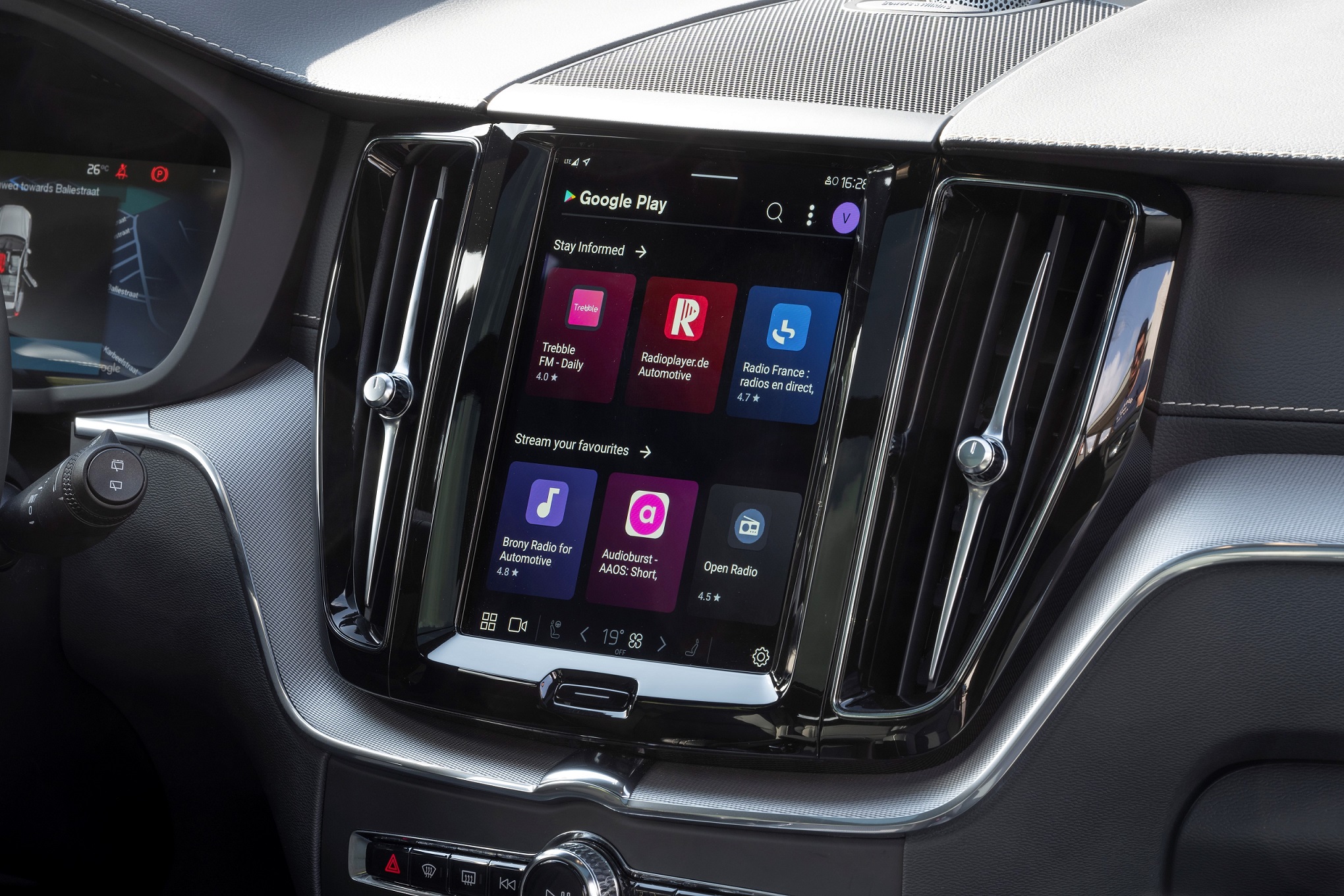
  • Next-generation Android infotainment system integrated with Google. Included are Google Assistant with natural voice recognition, Google Maps with real-time traffic information, Google Play Store for media apps, and Bluetooth audio and phone connectivity.
  • Over-the-air software updates using the Volvo Cars app for such areas as propulsion systems, new features, bug fixes, and infotainment enhancements. In addition, Volvo says drivers of the pure electric XC40 Recharge should see an improved driving range. Its Range App will help maximize battery usage and give cold weather warnings for optimal battery performance.

Other XC60 infotainment features include 4G LTE connectivity with Wi-Fi hotspot, USB input, Google keyboard, and full Apple iPhone compatibility

The engine bay of the XC60

The 295-hp 2.0-liter 4-cylinder B6 engine is turbocharged and supercharged.

2 New Gas Engines

The Volvo XC60 is sold in gas-powered or gasoline-electric plug-in hybrid models.

Two new 2.0-liter four-cylinder gasoline engines debut mild hybrid electrification through a new 48-volt system. The system combines a 13-hp ISG or Integrated Starter Generator.

The ISG is notable for a couple of reasons. First, it provides a silent, fast and refined start/stop function, Volvo says. And it facilitates the engines’ idle stop-start operation and gives a torque boost at low speed.

What were engine designations of T5 and T6 are now B5 and B6. As before, the B5 engine is turbocharged, and the B6 is turbocharged and supercharged. The B5 has 247 horsepower and 258 foot-pounds of torque from 1,800 to 4,800 rpm.

The 295-hp B6 engine gets a new electric supercharger, or e-Charger, which replaces a mechanical supercharger. The e-Charger is quieter and provides enhanced engine response, Volvo says.

In addition, the B5 and the B6 now have electronic shifting and braking “by wire.” The latter allows brake energy to be banked and used to boost overall efficiency and fuel economy.

Volvo’s thoughtful engineering includes one of the most orderly engine bays I’ve seen. The engine shows off with a large, black plastic shroud and the secondary hood release is easy to find. Dual struts easily raise the hood to a near-vertical position.

The midsize Volvo SUV's back seats.

Back seat space has adult-class legroom of 38 inches.

Volvo XC60 Pricing

The gas XC60 is sold three trim levels of Momentum, Inscription, and R-Design. All models have a choice of B5 or B6 2.0-liter four-cylinder engines and Volvo’s eight-speed Geartronic automatic transmission.

Front-wheel drive is the standard drive layout with the optional advanced AWD system. (The AWD system has “instant on,” with little chance for the wheels to begin slipping on startup.)

Starting MSRPs range from $43,745 to $51,245 to $49,895. Today’s tester is the XC60 B6 AWD R-Design that was $65,890. Pricing includes the $1,095 freight charge from Gothenburg, Sweden.

The price difference between the B5 engine and the B6 is about $6,500. AWD adds $2,300.

The plug-in hybrid XC60 Recharge is sold in three 400-horsepower trim levels with starting prices ranging from $55,345 for the Inscription to $61,495 for the R-Design and up to $70,595 for the 415 hp XC60 Polestar T8 eAWD. The hybrid system allows about 19 miles of electric driving before switching to the 2.0-liter gas engine.

Check here for current pricing and incentives.

Volvo New Vehicle Warranty

The Volvo warranty package is for four years or 50,000 miles with roadside assistance and free scheduled maintenance for 3-years/36,000-miles. Also unique is that Volvo pays for four years of Google Assistant and Google Maps with its ever-helpful road sign information.
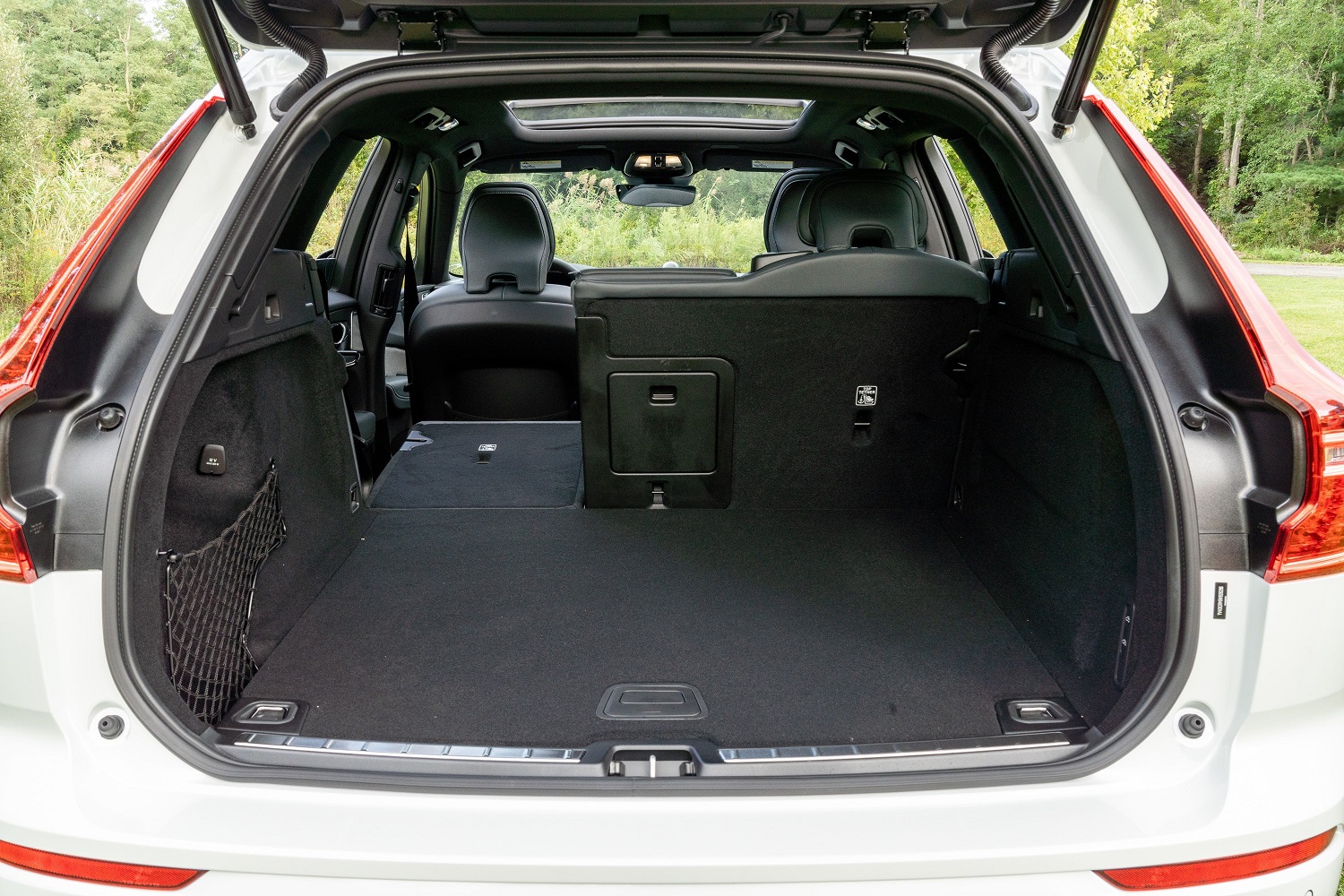
A seats folded view of the cargo area

Cargo space is wide and square.

Underfloor storage of the cargo area.

The 48-volt lithium-ion battery is in the upper left corner below the cargo floor. (Mark Maynard photo)

XC60 B6 Performance and Fuel Economy

Dual “charging” of the B6 engine gets the most out of its 2.0-liter engine. But moving away from a stop can seem sluggish — the tester weighs 4,238 pounds — until the e-supercharger kicks in. Then, the turbocharger carries the power into the higher rpms.

Once moving, the acceleration is responsive at all speeds. The eight-speed automatic gives easy downshifts, though timed to maximize fuel economy.

Dial up Sport mode and the performance attitude sharpens, but it is not hell-bent. I used the Sport mode in traffic to keep the power on point and then dialed back to Comfort on the open road for more fuel economy.

Fuel economy estimates for the B6 AWD are 21 mpg city, 27 highway and 24 mpg combined, on the recommended premium. I was averaging 23.4 to 24 mpg. Front-drive models have mileage ratings of 23/30/26 mpg. And the 18.8-gallon tank gives a substantial cruising range.

The electric steering has smooth rotation with adequate road feedback. In addition, the level of steering-wheel resistance can be made lighter or heavier by accessing the drive mode categories through the touchscreen. The turning circle is tight at 37.4 feet — an engineering accomplishment with all-wheel drive, the long wheelbase and 21-inch Pirelli Scorpion tires (an R-Design upgrade).

XC60 Pilot Assist

The Pilot Assist (part of the $2,050 Advanced package) is a suite of driver-assist systems for hands-on-the-wheel semi-autonomous driving. The assist system works on highways and at speeds up to 80 mph, and does not require a car in front to follow. The system will steer, accelerate and brake as needed.

The guidance calibrations work well enough, but the vehicle still crossed over the white line a few times and then gave me loud tones as a warning (as if I did something wrong). That’s why the driver must always stay vigilant and keep hands on the steering wheel. Pilot Assist is best used on major highways in stop-and-go commuter traffic.

These systems can also be prone to shutoff in low-light or shadowy conditions (such as under a highway overpass) and low sunlight into the camera, such as sunset. I’ve also experienced assist cancellations when traveling alongside a white semi-trailer. And California’s light gray concrete can confuse when the white lines are faded or disrupted.

XC60 R-Design Ride and Handling

Among the significant options on the tester was the four-corner air suspension, a stand-alone extra at $1,800. Volvo’s active chassis maintains ride height automatically and adapts each shock absorber to current road and driving conditions.

The suspension gently yields when stepping over speed bumps or along sections of broken road. Power hard into a corner and the nose follows the trajectory with a flat attitude and no unwieldy suspension rebound. But under light load on lumpy or crumbling road surfaces, the air suspension gets busy trying to balance the heaves and unevenness.

At higher speeds, the air suspension lowers the vehicle automatically to reduce drag and enhance stability. In addition, an Off-Road mode increases ground clearance. And loading or unloading cargo or tailgating, the cargo height can be lowered by 3 inches by pushing a button inside the load area.

The cabin is well soundproofed and the big Pirellis are a delicious upgrade for quiet rolling and supple grip. Braking is absolute and without grab or dive from 12.7-inch front discs, 11.9-inch rear.

XC60 Safety Features

Volvo is a safety champion, but I’m still not a supporter of the iPadlike touchscreen. The vertical screen in the center of the instrument panel is used to access just about everything, although there is a knob for audio volume. But making adjustments to temperature, fan speed, or seat heaters is a two-touch process, which usually takes eyes from the road.

However, the XC60 has an arsenal of other safety features, including City Safety. The collision avoidance system recognizes pedestrians, cyclists, and large animals. It also adds lane-keep assist and oncoming lane mitigation, which will take over steering if needed to avoid a head-on or front-corner impact.

Other standard safety features include six air bags, blind-spot warning, and cross-traffic alert, lane-keeping steering assist, oncoming lane mitigation (with steering assist), and hill-descent control.

The 9-inch touchscreen in the Volvo instrument panel

Hey Google!

CleanZone Air Filtration

For people prone to breathing ailments, Volvo’s CleanZone air filtration system can mean the difference between going out and staying.

The advanced filter system (a world first, the company says) will trap airborne particles as small as 2.5 microns (PM 2.5). There are about 25,000 microns in an inch. The widths of the larger particles in the PM 2.5 size range would be about 30 times smaller than a human hair. The smaller particles are so small that several thousand could fit on the period at the end of this sentence.

The system’s multifilter also helps reduce dust, pollen, particles, and chemical odors.

The cabin can be pre-cleaned before entering the car using the Volvo Cars app. And on a warm day, the automatic CleanZone helps ventilate the passenger compartment when the vehicle is unlocked.

XC60 Interior Function

The interior design is artful but functional — mostly. The cabin is roomy with considerable headroom of 38 inches, even with the panoramic roof. Sightlines are unobstructed across the hood or over the shoulder. And the 360-degree surround-view camera system is a worthwhile addition to the Advanced package, $2,050, which includes Pilot Assist with adaptive cruise control.

The 10-way power seats, including seat-bottom tilt, are gently contoured and supportive for the long haul.

The switch controls for the front map lights and sunroof are touch-sensitive and require just a light touch to activate.

There is open access to the wireless charging pad on the shift console. Storage areas are somewhat limited, but there is a huge, nonlocking glove box and door panels with separate spaces for a large bottle and catchall space. The center armrest has a small storage box, which houses two USBs, including one C-type.

The 12.3-inch driver gauge array.

12.3-inch configurable driver gauge array.

Back Seat and Cargo Space

Back seat space has adult-class legroom of 38 inches, but with a slight butts-down, knees-up position with no seatback recline. There are numerous conveniences, including the coat hooks on the B-pillars. The broad, fold-down armrest is padded with pop-forward cup holders and covered but slim storage.

Back-seat B pillars have a vertical vent that provides airflow that is so helpful for passengers prone to motion discomfort. And there also is a pair of vents in the center floor console, along with fan and temperature controls, seat-heater switches, and a USB. Overhead grab handles include a hook for dry cleaning.

Cargo space is wide and square, with 17.1 cubic feet of space behind the second row or up to 29.4 cu.ft. with the back seat folded. The 60/40 split rear seat has release tabs in the cargo that drop easily. A handy hook and strap are provided to hold up the cargo floor when looking for the jack and flat-tire inflator. There also are dual side lights and a 12-volt plug. A side storage space has about a cubic foot of stash space, separated by a net.

Road Sign Information

How often do we drive and see no or very few speed-limit signs? Enter the eye-in-the-sky Road Sign Information. It might be one of those extras that the uninitiated might see as unnecessary. And Volvo pays for the subscription for the length of the warranty. The system alerts to speed limits, “no passing,” “do not enter,” and various types of supplementary signs.

The road sign is displayed on the speedometer or in the head-up display. It can also inform you about speed cameras. And if you drive in the wrong direction on a one-way street, you’ll be alerted with a no-entry sign icon.

Panoramic Moonroof

The dark-tinted laminated glass roof has a front section that opens or tilts and a power-operated fabric sunshade. When the vehicle is parked outside in hot weather, the sunshade closes automatically when the outside temperature reaches 77 degrees. And the roof can be closed from outside the vehicle with the remote key.

The panoramic roof in the XC60

The dark-tinted laminated glass roof has a front section that opens or tilts and a power-operated fabric sunshade.

What’s not to like?

  • For the as-tested price of nearly $67,000, savvy luxury-segment drivers might expect ventilated seats to go with the optional heated front seats.
  • A cargo area roller cover is a $295 option.
  • Modest fuel economy.
  • The sun visors are inadequate on driver’s left. The lower left edge is contoured to fit neatly into the headliner, which leaves a wide margin of the windshield where the sun invariably shines through.
  • Volvo’s distinctive head restraints, somewhat forward-leaning, can bother some taller occupants.

Why Buy the Volvo XC60 B6 R-Design?

A statement of style is important to this owner, and there is a genuine resonance to the gentleness of Volvo design and engineering.

While the Inscription trim level is luxurious, I prefer the sportier tone of the R-Design. I’d fret less about children scuffing the interior and I’d feel less guilt using it as a utility vehicle, as the Norse god Thor intended.

At nearly $67,000, the tester was fully priced, but it also has unique pleasures to relieve the price-point pain.

A rearview of the XC60

The 2022 Volvo XC60 has a restyled rear fascia with hidden tailpipes.

Volvo XC60 B6 AWD R-Design Specifications

Body style: midsize, 5-seat AWD

Engine: 295-hp, direct Injected and turbocharged and supercharged 2.0-liter 4-cylinder with idle stop-start; 310 lb.-ft. torque from 2,100-4,800 rpm

Transmission: 8-speed Geartronic

Fuel economy: 21/27/24 mpg city/hwy/combined; premium required

0-60 mph acceleration: 5.9 seconds

Coefficient of drag: 0.32

BY THE NUMBERS

Fuel tank: 18.8 gallons

Cargo space: 17.1-29.4 cubic feet

Front head/leg room: 38/41.5 in.

Rear head/leg room: 38*/38 in. *w/panoramic roof

Length/wheelbase: 185.4/112.8 inches

Curb weight: 4,238 lbs.

Turning circle: 37.4 ft.

Tow capacity: 3,500 lbs. braked trailer; 1,600 lbs. unbraked

FEATURES

Standard equipment includes: keyless locking with push-button ignition, 12.3-inch configurable driver gauge array, surround-view camera with front parking assist, adaptive cruise control, wireless smartphone charging, heated steering wheel, illuminated door handles, laminated panoramic moonroof with power sunshade, heated grille emblem (to help optimize front camera visibility in all conditions), head-up display, headlight washers, front cornering fog lights, park assist (front, rear, and sides), spray-arm wipers

R-Design Features: Front park assist, power-folding rear head restraints, HomeLink garage door transmitter, tailored dashboard, high-level interior illumination, 4-zone climate control with CleanZone, charcoal headliner, 10-way power (heated) front seats with lumbar and memory presets, 19-inch R-Design wheels, Nappa leather front sport seats, and leatherette rear seats, leather gear shift grip and metal-trimmed pedals, sport tailored steering wheel, high gloss black window trim, and mirror caps, high gloss black grille

Safety features include: 6 air bags, blind-spot warning and cross-traffic alert, Pilot assist (to help keep the vehicle centered in its lane and at a set speed), lane-keeping steering assist, oncoming lane mitigation (with steering assist), hill-descent control

PRICING

B6 AWD R-Design base price: $57,290, including $1,095 freight charge; price as tested $65,890

Options on test vehicle: Climate package, $750, includes headlight washers, heated rear seats and heated steering wheel; Advanced package, $2,050, includes head-up display, Pilot Assist driver-assistance system with adaptive cruise control, 360-degree surround-view camera, a 12-volt outlet in the cargo area, air quality with advanced air cleaner; metallic Crystal White paint $695; 4-corner air suspension $1,800; power tailgate $200; 21-inch double-spoke black diamond-cut alloy wheels $1,000; 15-speaker Bowers & Wilkins premium audio $3,200

Where assembled: Gothenburg, Sweden

Toyota RAV4 25th Anniversary Overview

Toyota RAV4 25th Anniversary Overview

Toyota Celebrates 25 Years of the RAV4 in North America; introduces New SE Hybrid model for 2022

Table of Contents

RAV4 History
RAV4 By Generations
The Current Generation RAV4
What’s New for 2022?
Specifications

A 2022 Toyota RAV4 SE Hybrid

For 2022, Toyota has freshened the RAV4 lineup with some exterior and interior updates and a new, less-expensive SE Hybrid model. (Photos courtesy of Toyota)

BY MARK MAYNARD

The 25th anniversary of the Toyota RAV4 is a coming-of-age story in North America. The small SUV crossover debuted in 1996 when midsize and large SUVs were the dominant herd on American highways.

Small vehicles were suspect, particularly in the U.S., for their safety structure as drivers navigated among the greater truck-based vehicles. The market segment for small SUVs had barely formed in 1996. And most of these were quirky import transplants with few changes for the preferences of North American drivers.

Among the early small SUV choices were the 1988 Daihatsu Rocky, the 1989 Geo Tracker (aka Suzuki Sidekick and Chevrolet Tracker), and the 1990 Isuzu Amigo. The offerings grew in 1996 with the diminutive two-door, two-seat 1996 Suzuki X-90 and the Kia Sportage (which brought the industry’s first knee air bag).

Today, there are around 20 small SUVs in the small SUV segment, and most manufacturers now offer one or two choices.

The driver area of a new RAV4

The RAV4 has reasonably tall front headroom of 37.7 inches, with a moonroof.

Toyota RAV4 History

The first Toyota RAV4 was available as five-door and three-door models. However, the four-door version dominated sales in the U.S. It was the only body style to return with the second-generation RAV4 in 2000.

Toyota refers to the RAV4 as the original small SUV. Now in its fifth generation, the RAV4 has become the best-selling Toyota model in the country. And in its 25-year history, it is on track for 5 million sales this fall.

RAV4 By Generations

  • The First RAV4, 1996-2000
  • Second Generation: 2000-2005
  • Third Generation: 2006-2012
  • Fourth Generation: 2013-2018
  • Fifth and Current Generation: 2019-
A view of the RAV4 front seats from the passenger side

Standard features include fabric-trimmed seats and a 7-inch touchscreen with a six-speaker audio system.

The Current Generation RAV4

The fifth-generation RAV4, introduced for 2019, offers the model’s widest selection to date. Model choices include:

  • The first RAV4 TRD Off-Road.
  • Gasoline-electric RAV4 Hybrid.
  • Flagship RAV4 Prime plug-in hybrid (PHEV). The RAV4 Prime has an EPA-estimated rating of 42 miles on battery power alone.
A gauge display of the RAV4 Hybrid

The 2021 RAV4 Hybrid has mileage ratings of 41/38/40 mpg city/hwy/combined on the recommended 87 octane.

RAV4 Powertrains

In gas-engine models, the 203-horsepower Dynamic Force 2.5-liter four-cylinder is paired with an eight-speed Direct-Shift, continuously variable automatic transmission. This powertrain has an EPA-estimated 28 mpg city, 35 highway, and 30 mpg combined for the front-wheel-drive LE model — the best ever for a gas RAV4, Toyota says.

RAV4 Hybrid models have a 40-mpg combined EPA-estimated rating, which is nearly a 30-percent improvement over the previous hybrid. Likewise, the hybrid’s e-AWD improves over the previous system. Its new independent rear motor operates proactively to maintain traction even before front-tire slippage is detected.

At the top of the model line, the RAV4 Prime PHEV (plug-in hybrid) is both the performance and efficiency leader. Available in SE and XSE trim levels with standard e-AWD, the RAV4 Prime has an EPA-estimated 94 MPGe rating. And it has an all-electric driving range of 42 miles on a single charge. When driven in hybrid mode, the RAV4 Prime powertrain can generate a combined 302 hp and is capable of 0-60 mph in 5.7 seconds. That acceleration makes it the second quickest Toyota in the lineup behind Supra.

The 18-inch tire and wheel of a RAV4

The RAV4 received a few new wheel colors and designs. All RAV4 models have standard aluminum wheels and 17- or 18-inch tires.

What’s New for 2022?

For 2022, the RAV4 will be available in a new SE Hybrid grade, and all RAV4 trim levels have been given some exterior and interior updates.

The 2022 RAV4 SE Hybrid model pares back some of the features built into the topline SLE model. For example, the SE Hybrid will be offered in a monotone paint scheme, fabric-trimmed seats, a six-speaker audio system, and a 7-inch touch screen.

Available options for the SE Hybrid include the weather package, which adds a heated and leather-wrapped steering wheel, heated front seats, and rain-sensing windshield wipers with a de-icer function.

The convenience package includes a moonroof, height-adjustable power liftgate, and Audio Plus with a 9-inch touchscreen.

Super sleek headlights on the topline RAV4

RAV4 headlights were updated for style and capability. And the XSE Hybrid gets the super sleek vertical lights that debuted on the XSE Prime in 2021.

Exterior Updates

Calvary Blue with a black roof (shown in the exterior photos) is a new paint-scheme choice for select RAV4 models, including the new SE Hybrid and TRD Off-Road.

There are a few new wheel colors and designs, and the headlights were updated for style and capability. New LED fog lamps are optional for XLE Premium, Limited, Adventure, and TRD Off-Road.

The XSE Hybrid also gets sleek vertical lights that debuted on the XSE Prime in 2021.

Interior updates are also found across the model line:

• All models now have a locking glove box and LED interior lights;

• XLE and above get illuminated interior switches;

• Limited grade gets an eight-way power passenger seat.

The RAV4 back seat

Back-seat legroom is midsize for a compact SUV at 37.8 inches.

RAV4 Pricing

The 2022 RAV4 Hybrid goes on this December. Toyota will release pricing and more details on the 2022 RAV4 in mid-December.

For comparison, the 2021 RAV4 Hybrid is sold with standard all-wheel drive in trim levels of LE, XLE, XLE Premium, XSE Premium, and Limited. Starting MSRPs range from $28,800 to $37,330, not including the $995 freight charge from Georgetown, Ky.

Pricing for the RAV4 Prime PHEV, sold in trims of SE and XSE, has starting prices of $38,250 and $41,575.

The price-step between 2021 RAV4 Hybrid models is about $2,000. If carried through for the 2022 RAV4 SE Hybrid, its starting price could be close to $26,800.

Check current Toyota-model pricing and incentives here.

A rear view of the 2022 RAV4

Calvary Blue with a black roof is a new paint-scheme choice for select RAV4 models, including the new SE Hybrid and TRD Off-Road.

2021 Toyota RAV4 Hybrid Specifications

Body style: compact, 5-seat, 5-door small SUV with e-AWD

Engine: 176-hp, 2.5-liter direct-injected Dynamic Force 4-cylinder with 16-valves, dual overhead camshafts, intelligent variable valve timing by an electric motor on the intake and exhaust camshafts

Electric motor: Permanent magnet synchronous

Combined power: 219-hp

Battery pack: Lithium-ion with 244.8-volts and a maximum of 650V

Transmission: electronically controlled CVT with sequential shift mode and electronic on-demand AWD

Fuel economy: 41/38/40 mpg city/hwy/combined on the recommended 87 octane;

Braking: Power-assisted, 12-inch front ventilated discs; solid 11.1-inch rear discs; electronic parking brake

Max towing capacity: 1,750 lbs.

BY THE NUMBERS

Fuel tank: 14.5 gallons

Cargo space: 37.6 to 69.8 cu. ft.

Front head/leg room: 37.7*/41 in. *with moonroof

Rear head/leg room: 39.5/37.8 in.

Length/wheelbase: 180.9/105.9 in.

Curb weights: 3,690 to 3,780 lbs.

Turning circle: 36.1 ft.

Where assembled: Georgetown, Ky.