Select Page

2026 Toyota RAV4 Overview

2026 Toyota RAV4 Overview

The king of the compact SUV hill evolves with an all-hybrid lineup, refined styling and materials, and a new high-performance RAV4 GR Sport
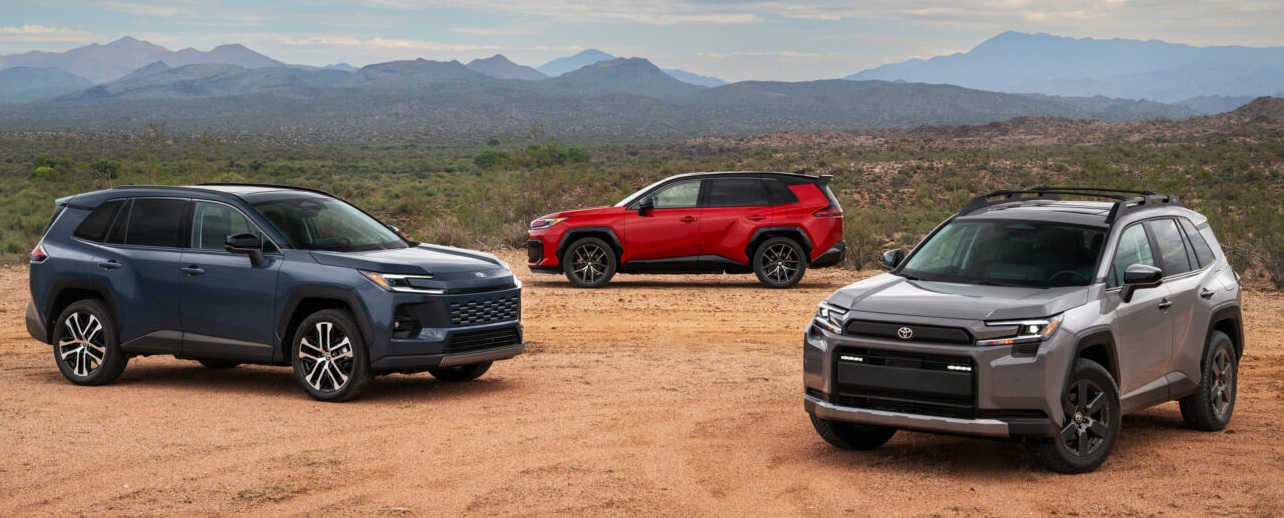
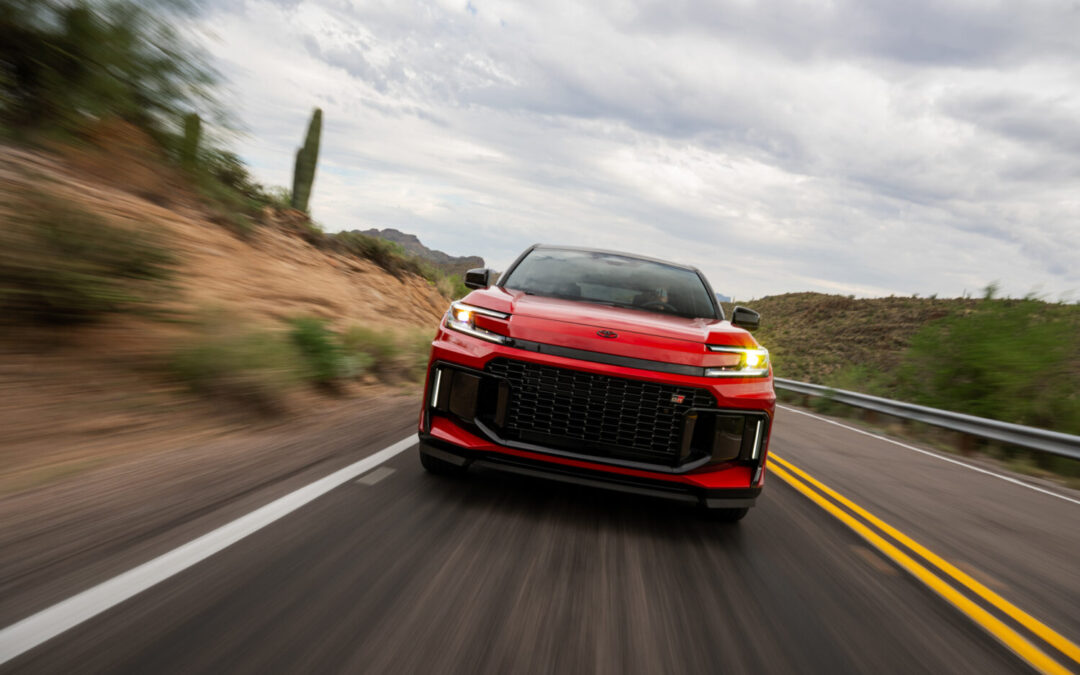
For 2026, the new RAV4 is offered in three exterior design treatment, emphasizing different lifestyles: Core, Rugged, and Sport.

The redesigned 2026 Toyota RAV4 is offered in three exterior design treatments, emphasizing different lifestyles: Core, Rugged, and Sport. (Photos courtesy of Toyota USA)

Jump To Special Features

3 RAV Personalities
2026 RAV4 Pricing
Battery and Hybrid Component Warranties
Hybrid and Plug-In Hybrid Powertrains
The New Digital Hub
The RAV4 By Grades
The RAV-ing Mad 324-hp GR Sport
Observations and Considerations
2026 Toyota RAV4 Limited AWD Specifications

BY MARK MAYNARD

Toyota appears to have gone all-in for the redesign and marketing of its 2026 RAV4, and for good reason. In the United States, 42 compact or subcompact SUV models were available for sale in 2025. The compact-class RAV4 is Toyota’s top-selling model. It was also the third-best-selling vehicle in the U.S. in 2025, behind the Ford F-150 (No. 1) and the Chevrolet Silverado.
So, after three decades of dominating driveways and trailheads, the Toyota reworked the RAV4 from “rubber to roof.” It steps out with an all-hybrid lineup, including a 324-horsepower RAV4 GR Sport Plug-in Hybrid.

In a notable shift for the model line, all 2026 RAV4 Hybrid trims will be offered with front-wheel drive for the first time. Previously, the hybrid powertrain was paired with all-wheel drive in many configurations. Adding two-wheel drive boosts fuel economy and a lower starting price point.

Toyota expects a sales mix of 90 percent LE, XLE Premium, SE, XSE, and Limited grades. The remainder of the mix will fall to GR Sport and outdoorsy Woodland.

The 2026 RAV4 Hybrid models are now arriving at U.S. dealerships. The Plug-in Hybrid (PHEV) models will arrive this spring. U.S. RAV4 models are built in Georgetown, Ky. Batteries for North American-built models are increasingly supported by Toyota’s North Carolina battery plant.

Here is an overview of a RAV4 for which you might be shopping.
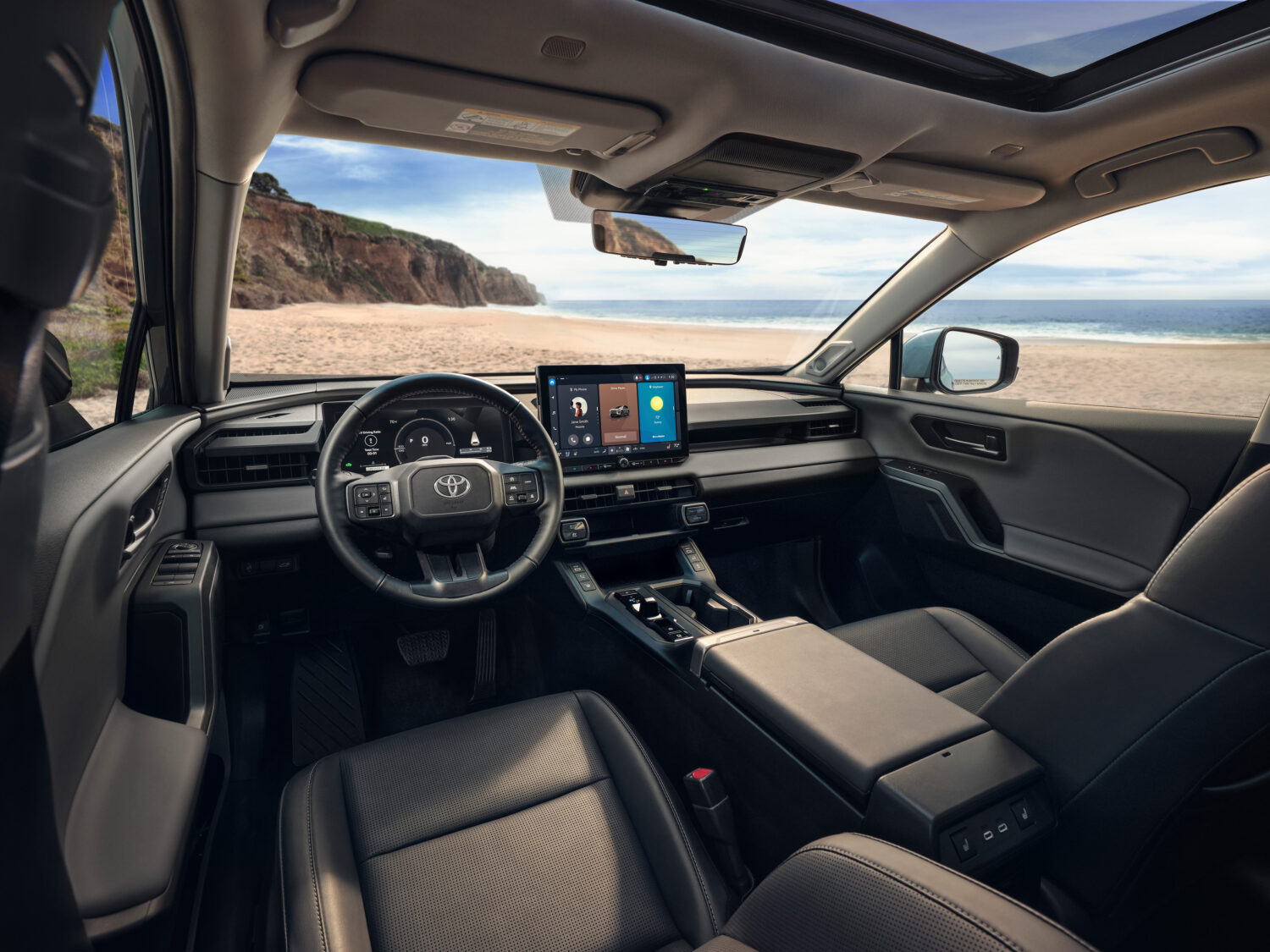
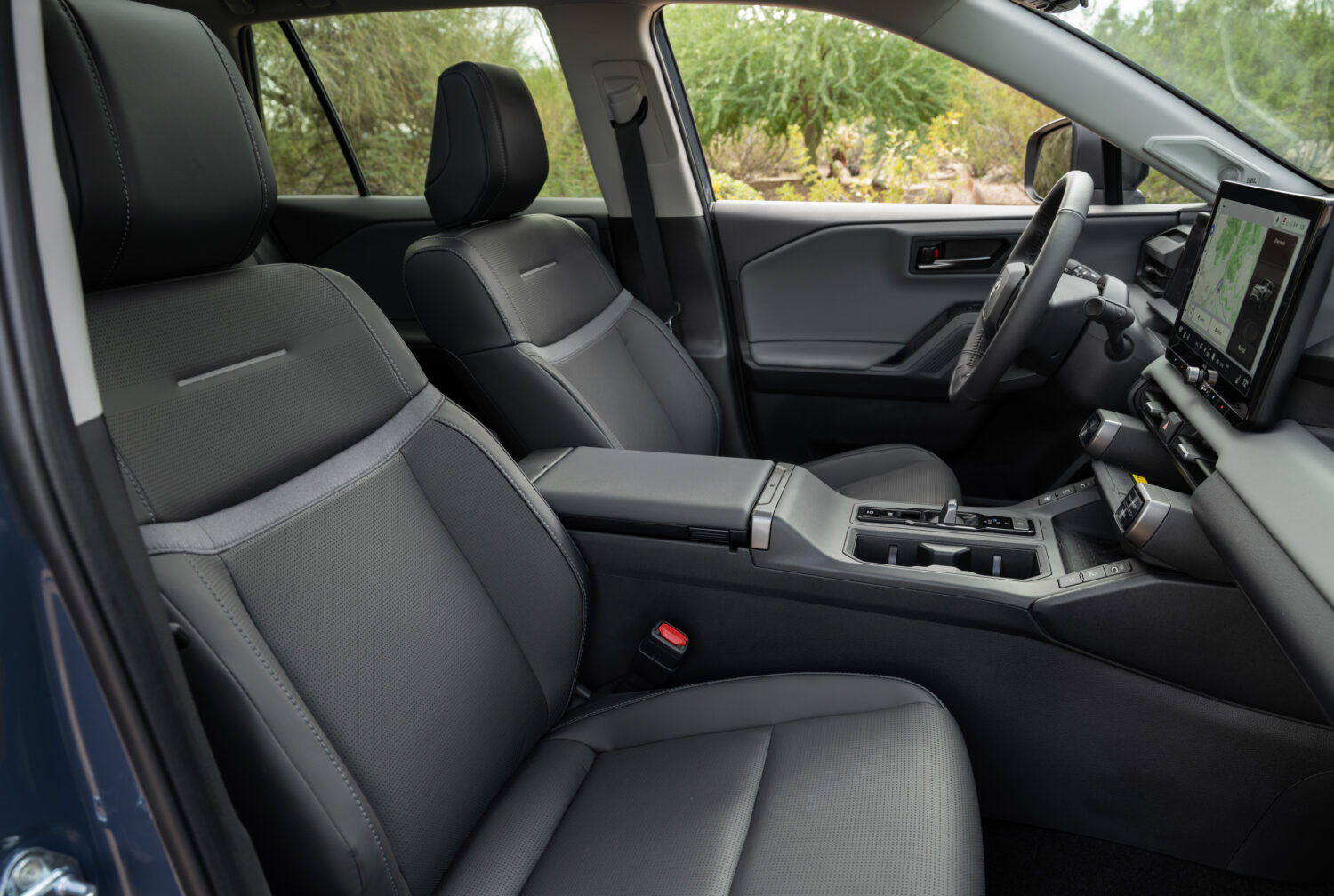
Seating materials and accents vary by grade to match the vehicle’s specific “personality.” A Storm Cloud Gray Limited model is shown.

Seating materials and accents vary by grade to match the vehicle’s specific “personality.” A Limited model is shown.

3 RAV Personalities

For 2026, the RAV4 offers three exterior design treatments aimed at different lifestyles: Core, Rugged, and Sport. All grades have standard Toyota Safety Sense 4.0.

Core: Designed for refined daily living, this includes the LE, XLE Premium, and Limited grades.

Rugged: Built for the trail, the new Woodland grade features the new Urban Rock exterior color and increased ground clearance of 8.6 inches (vs. 8.1 for standard grades).

Sport: Engineered for performance, this lineup includes the SE, XSE, and the first RAV4 GR Sport, only available as an AWD plug-in hybrid.

Woodland driving lights

Woodland driving lights.

2026 RAV4 Pricing

Toyota showed restraint in manufacturer retail pricing for the start of the 2026 model year. When freight is excluded, the 2026 RAV4 Hybrid LE AWD starts at the same price as the 2025: $31,900. However, the 2026 freight charge is now $1,450, up $55 from 2025.
Retail pricing below includes the $1,450 freight charge from Georgetown, Ky. Plug-in models are built in Japan; PHEV pricing will be announced in the first half of 2026.

2026 MSRP RAV4 starting prices, including freight charge:

  • LE FWD: $33,350
  • LE AWD: $34,750
  • SE FWD $36,150
  • SE AWD $37,550
  • Woodland AWD $41,350
  • XLE Premium FWD $37,550
  • XLE Premium AWD $38,950
  • XSE AWD $41,300
  • RAV4 Limited AWD $44,750
  • 2025 RAV4 Plug-in Hybrid SE $46,265, with AWD
  • 2025 RAV4 Plug-in Hybrid XSE $50,135, with AWD

Note: RAV4 GR SPORT pricing will be available in late February 2026.

Check current pricing and options here.
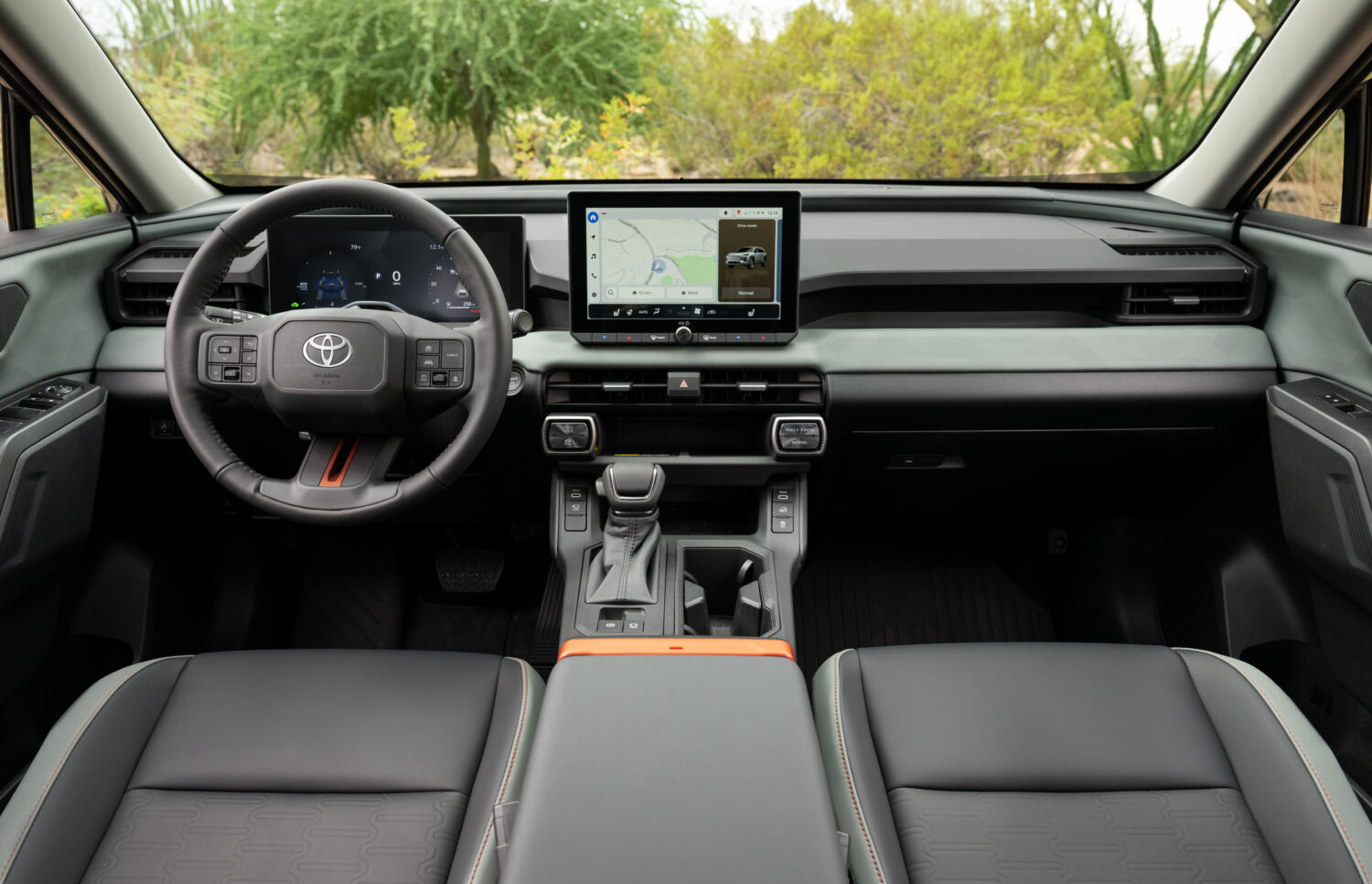
The exclusive Mineral SofTex interior of the Woodland with orange accents

The exclusive Mineral SofTex interior of the Woodland.

Expanded Color Palette

Toyota is also refreshing the visual lineup with 10 exterior color options, including four new distinct hues.

New Additions: Meteor Shower (metallic bronze-gray), Everest (dark green), and Storm Cloud (blue-gray), all at no cost.

 Exclusive Paint: The adventure-themed Woodland grade receives an exclusive (no cost) “Urban Rock” gray.

Two-Tone Options: The XSE grade adds a Meteor Shower with Black Roof combination ($500). GR Sport features a Supersonic Red with Black Roof pairing.

Carrying over for 2026 are Ice Cap, Wind Chill Pearl ($425), Midnight Black Metallic, Ruby Flare Pearl ($425), and Blueprint (deep midnight blue).

Interior colors are black SofTex, Light Gray SofTex, Harvest Beige SofTex (Limited only), or Mineral SofTex (Woodland only).
To blunt the transfer of noise and harshness to the cabin, high-damping adhesive has been applied to footwells and wheelhouses. Side mirrors and door seals have been reshaped to reduce wind noise.

To blunt the transfer of noise and harshness to the cabin, high-damping adhesive has been applied to footwells and wheelhouses. Side mirrors and door seals have been reshaped to reduce wind noise.

Battery and Hybrid Component Warranties

Toyota’s warranty coverage emphasizes long-term protection for new hybrid and plug-in hybrid components. For the powertrain and key battery systems, the limited warranty terms are extensive:

Hybrid Component Coverage: Coverage for hybrid components lasts up to 8 years or 100,000 miles, whichever comes first. This applies to repairs needed to correct defects in materials or workmanship.

Hybrid Battery Coverage: The core hybrid battery receives even longer protection, covered for 10 years or 150,000 miles, whichever comes first. This coverage is transferable to subsequent owners.

Powertrain Coverage: The conventional powertrain warranty remains at 60 months or 60,000 miles.

And the standard new-vehicle coverage:

Basic Warranty: 3-years/36,000-miles limited warranty covers all vehicle components except normal wear and maintenance items.

Corrosion Warranty: 60 months with no mileage limitation.

ToyotaCare: Normal factory-scheduled maintenance is covered for 2 years/25,000 miles. Roadside assistance is included for 2 years and unlimited mileage.
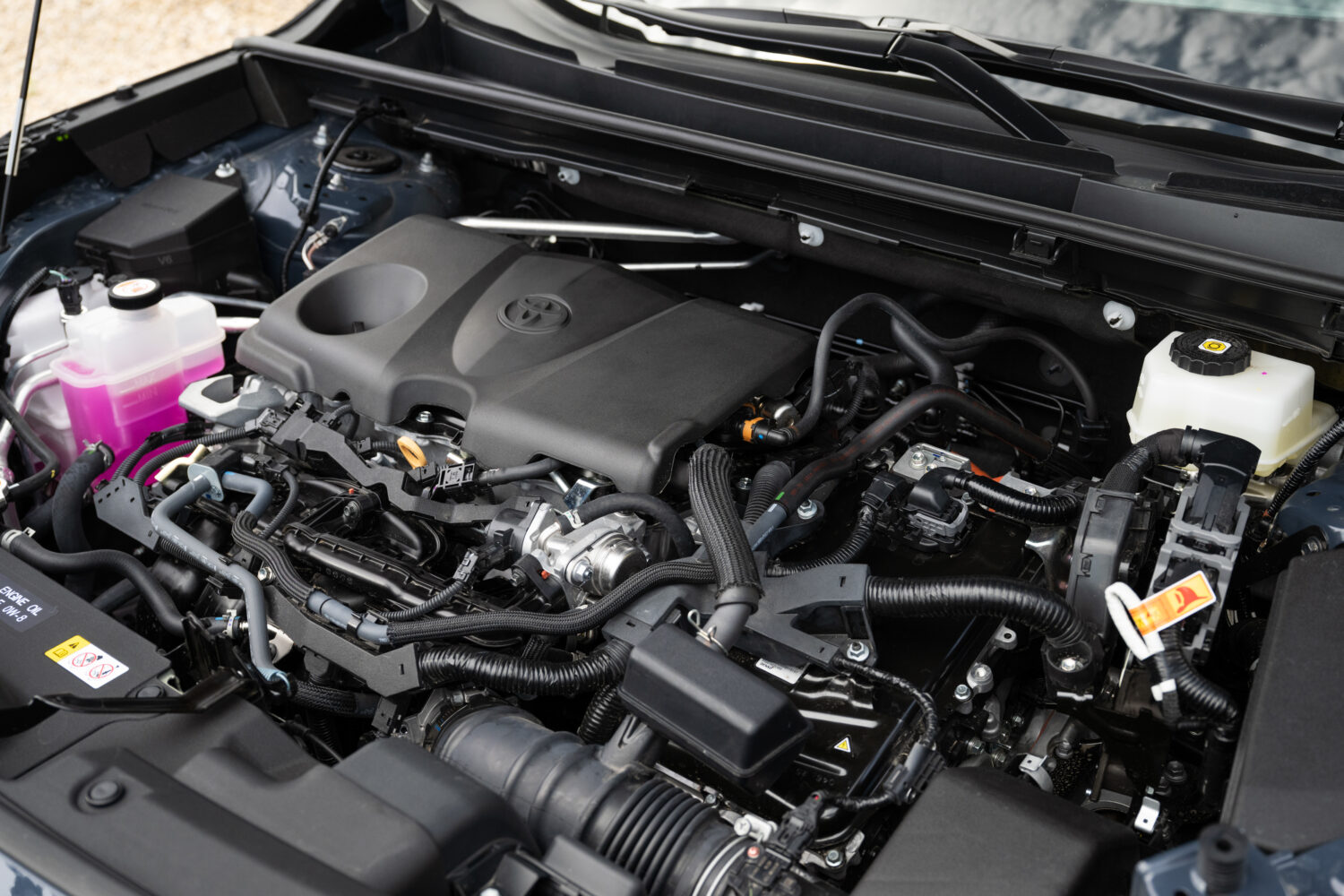
The 2026 RAV4 builds on the 5th Generation Hybrid (HEV) powertrain. It consists of a 2.5-liter inline-four gas engine with two motor-generators. The battery is a sealed lithium-ion of 247.5 volts and 4.1 ampere hour.

The 2026 RAV4 builds on the 5th Generation Hybrid (HEV) powertrain. It consists of a 2.5-liter inline-four gas engine with two motor-generators. The battery is a sealed lithium-ion of 247.5 volts and 4.1 ampere hour.

RAV4 Refined

Far from its 1996 origins as a Corolla-based compact, the 2026 Toyota RAV4 is much evolved for its sixth generation. Its exterior styling has a new “hammerhead” front end flanked by angular fenders and a contoured hood. The side profile shows a flat roofline and sculpted door panels. Creatively styled tech-forward LED signature taillights set off its wider, stouter rear end.

Size and Dimensions

The redesigned 2026 Toyota RAV4 maintains a similar footprint to the 2025 model. The 2026 model, however, is slightly heavier and wider because of its all-hybrid lineup and rugged features on some grades.

Exterior dimensions vary slightly by trim level, but the 2026 model retains the 105.9-inch wheelbase of the 2025 model. The turning circle grew by just 0.8 feet to 36.9 ft. curb to curb.

Length: Standard models remain at 180.9 inches, but Woodland and GR Sport trims are slightly longer at 181.8 inches due to aggressive bumper designs.

Ground Clearance: The 2026 Woodland Edition features a raised suspension with 8.5 inches of ground clearance, while the other hybrid trims have 8.1 inches;

Curb Weight Differences

Weight is the most notable change because Toyota has discontinued the gas-only engine for 2026.

2025 RAV4: The gas-only front-drive models were the lightest, starting at approximately 3,370 lbs.;

2026 RAV4: The base Hybrid front-drive model has a curb weight of 3,640 pounds, rising to 3,920 lbs. for the Limited AWD.
Interior Versatility;

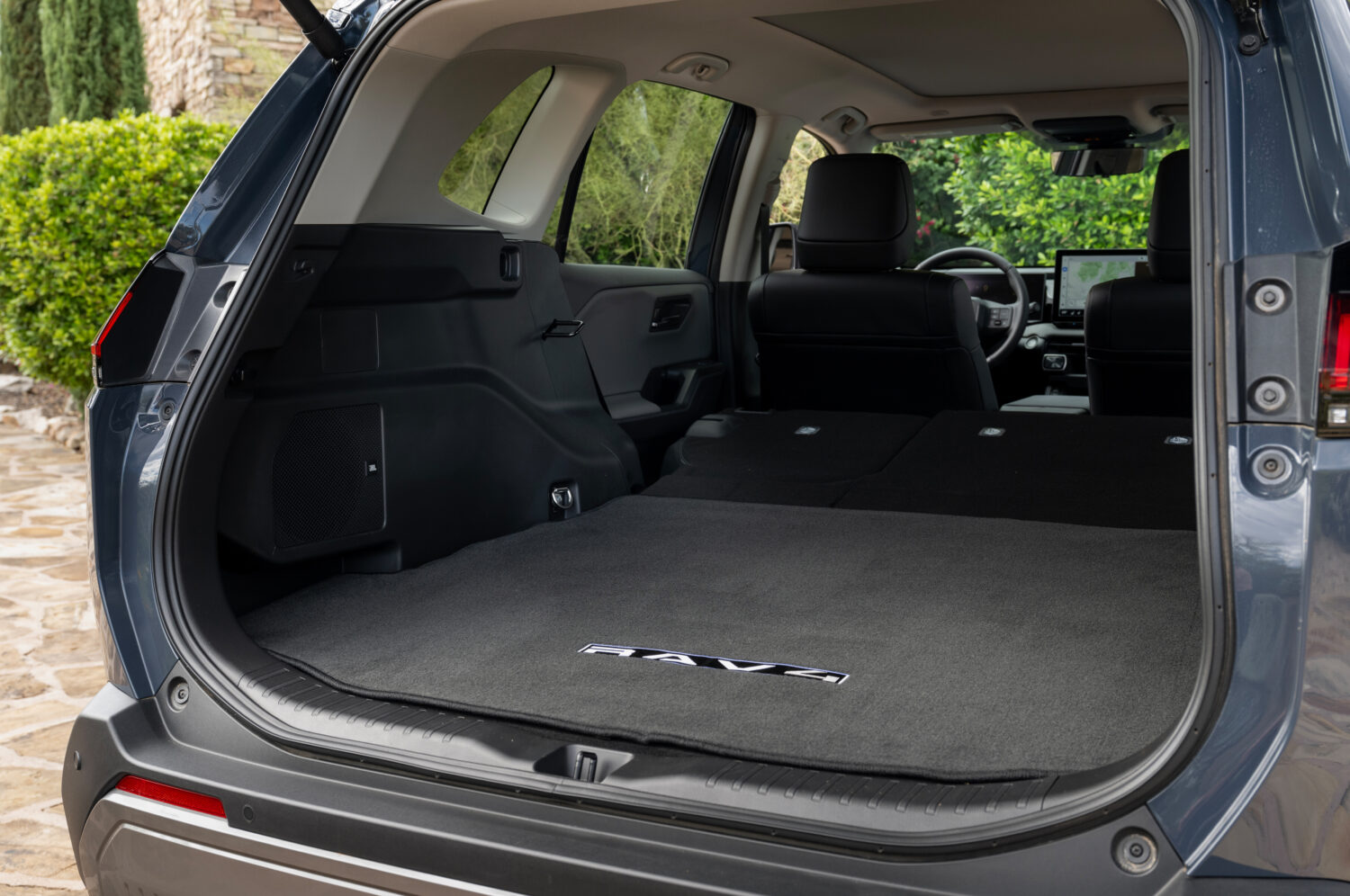
Inside, Toyota says it has prioritized versatility. The cabin features a newly designed rear seatback that folds completely flat, maximizing cargo volume for larger hauls. Seating materials and accents vary by grade to match the vehicle’s specific “personality.”
Interior Versatility

Inside, Toyota says it has prioritized versatility. The cabin features a newly designed rear seatback that folds completely flat, maximizing cargo volume for larger hauls. Seating materials and accents vary by grade to match the vehicle’s specific “personality.”

Interior utility remains nearly identical. Both generations offer roughly 37.6 cubic feet of space behind the second row and up to 69.8 cubic feet with the seats folded down.

Interior utility remains nearly identical. Both generations offer roughly 37.6 cubic feet of space behind the second row and up to 69.8 cubic feet with the seats folded down.

Cargo Capacity

Despite the redesign and new hybrid components, the interior utility remains nearly identical. Both generations offer roughly 37.6 cubic feet of space behind the second row and up to 69.8 cubic feet with the seats folded down.

Some grade levels of the new RAV4 have a height-adjustable deck board. Toyota also says the cargo opening has an expanded width of 4.9 feet at the entry.

Next-Gen Architecture

The 2026 RAV4 is built on the Toyota Next Generation Architecture-K (TNGA-K), a unibody platform. Toyota engineers have significantly increased frame rigidity by reinforcing suspension mounting points, the front cowl, and the A-pillars of the windshield.

To blunt the transfer of noise and harshness to the cabin, high-damping adhesive has been applied to footwells and wheelhouses. Side mirrors and door seals have been reshaped to reduce wind noise.

Driving dynamics were improved in several areas:

Retuned Suspension: Redesigned coil springs and shock absorbers for a flatter, smoother ride;

Aerodynamics: An active front aerodynamic spat adjusts based on speed and terrain;

Braking Innovation: A new electronically controlled brake system and Vehicle Braking Posture Control (VBPC) reduce body roll during cornering.
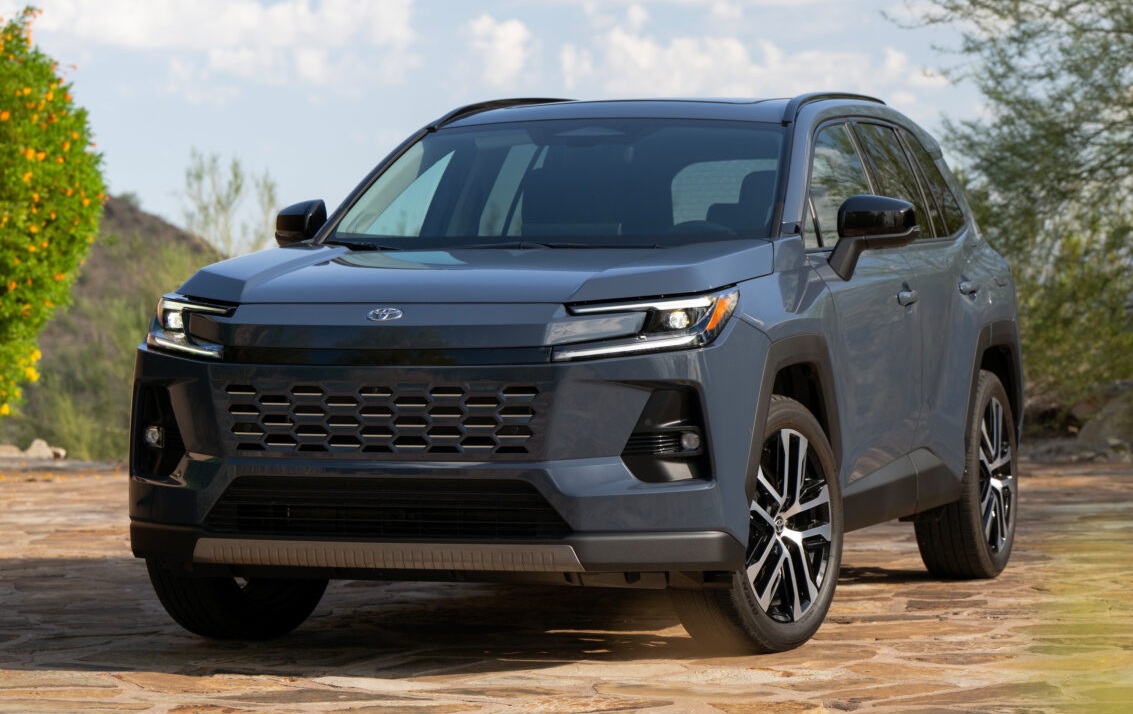
The 2026 RAV4 Hybrid in Storm Cloud gray.

The 2026 RAV4 Hybrid in Storm Cloud gray.

The Hybrid and Plug-In Hybrid Powertrains

The RAV4 builds on the 5th-generation Hybrid (HEV) powertrain, which has been substantially upgraded for 2026.
Engine: 2.5-liter inline-four with two motor-generators;

Transmission: Electronically controlled continuously variable automatic (ECVT) with sequential shift mode. Core grades have a traditional physical gear shifter; XSE and Limited grades have a new toggle switch shift-by-wire gear selector;

Battery: Sealed lithium-ion (Li-ion); 247.5 volts; 4.1 ampere hour;

Performance: 226 net combined hp with front-wheel drive, and 236 net combined hp with AWD. (2025 combined net hp was 219 with front-drive.);

Mileage: Up to 44 mpg combined for FWD, which compares to 40 mpg combined in 2025.

Hybrid Performance Modes

Every RAV4 has selectable drive modes, where hybrid or plug-in hybrid:

NORMAL: Factory default. All systems are calibrated for balanced, everyday driving.

ECO: Helps lower fuel consumption during trips that involve frequent acceleration and braking.

SPORT: Throttle and steering are more responsive, and transmission shifts at higher rpms.

CUSTOM: Adjusts vehicle systems to the driver’s preferred settings.

EV Mode: The RAV4 Hybrid EV mode enables battery-only driving for short distances at low speeds. How far depends on certain conditions, such as battery charge level. EV mode is useful for navigating parking lots and indoor parking garages, and for creeping along in commuter traffic.
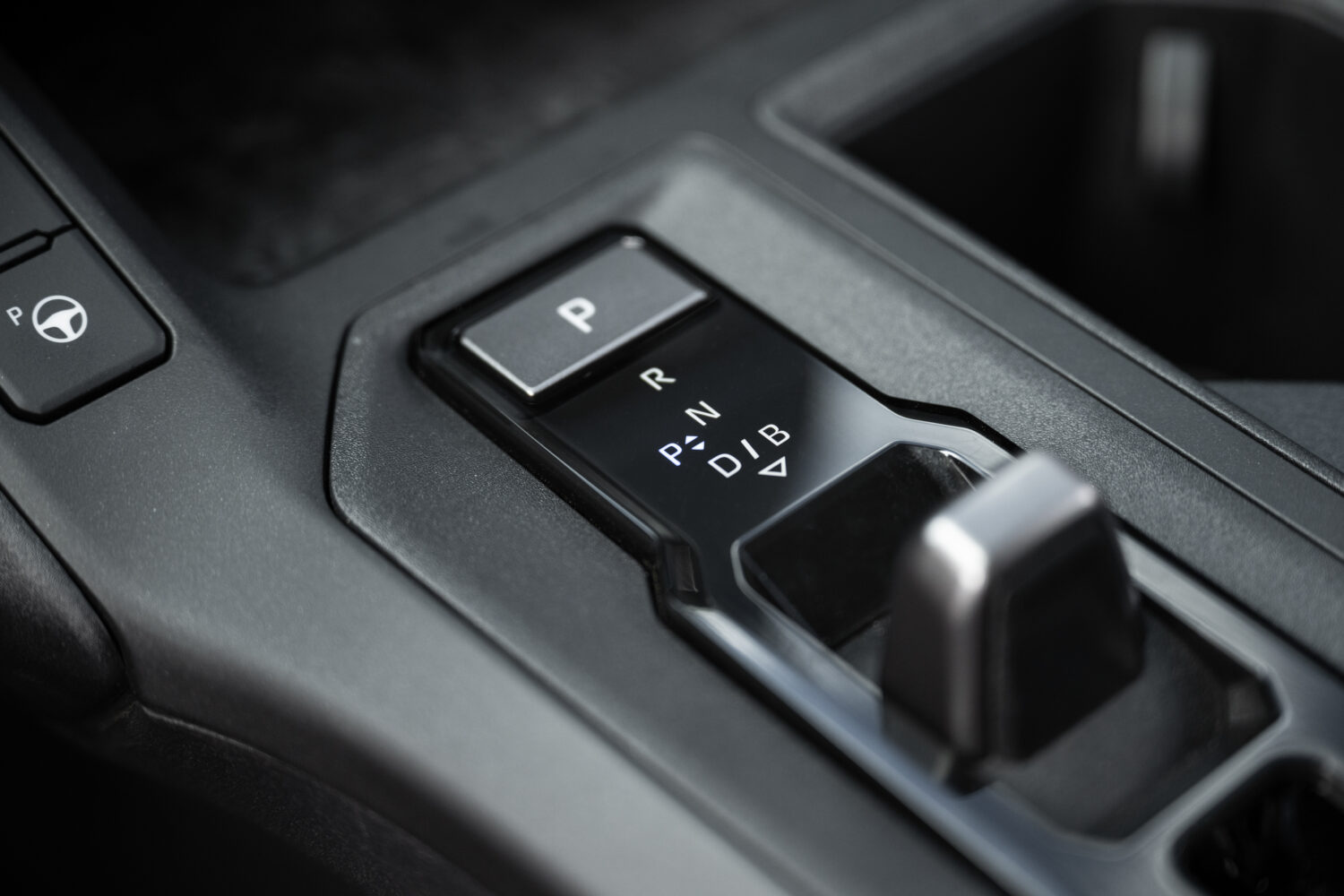
The Limited has a toggle switch shift-by-wire gear selector.

The Limited has a toggle switch shift-by-wire gear selector.

Electronic On-Demand AWD

The available electronic on-demand all-wheel drive system returns with sophisticated updates to power the rear wheels. Rather than heavy mechanical driveshafts, the RAV4 Hybrid and PHEV models use a high-output Interior Permanent Magnet (IPM) electric motor.

Intelligent Torque Distribution

Toyota’s so-called Intelligent Torque Distribution system is designed to be proactive rather than reactive. Using data from wheel speed sensors, steering inputs, and throttle position, the system preemptively distributes torque to the rear axle.

According to Toyota, the system creates precise electronic control over front-rear torque distribution. Doing so allows the RAV4 to instantly adapt to slippery road conditions or spirited driving without driver intervention.
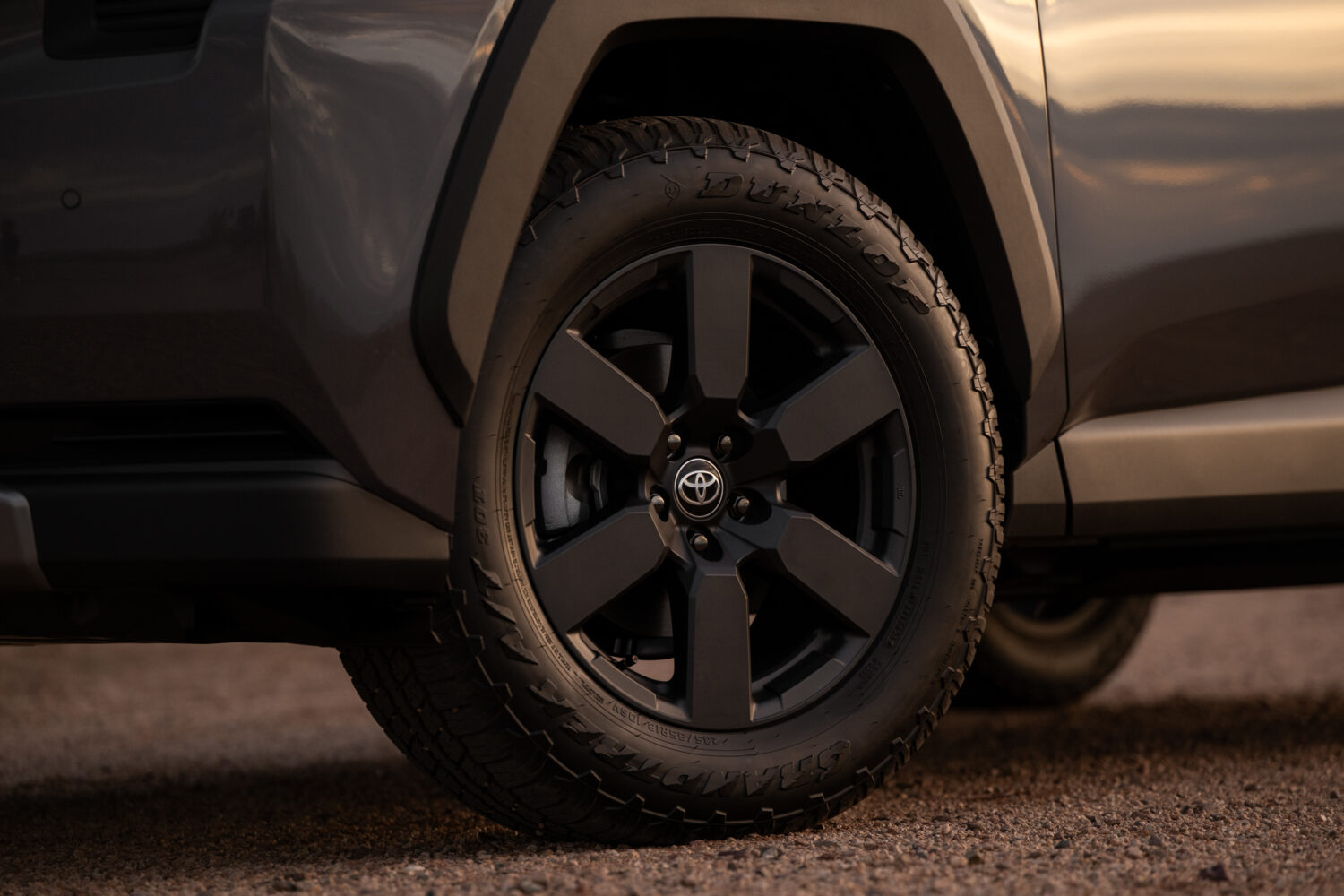
The RAV4 Woodland has Dunlop GrandTrek all-terrain tires on 18-inch matte metallic gray alloy wheels.

The RAV4 Woodland has Dunlop GrandTrek all-terrain tires on 18-inch matte metallic gray alloy wheels.

6th Generation Plug-in Hybrid (PHEV)

The heart of the plug-in hybrid system is the 2.5-liter four-cylinder engine, two front electric motors, and a rear motor. The result is a substantial jump in power: a net combined 324 horsepower. The electric drive motor (MG2) contributes 203 horsepower and 201 foot-pounds of torque. The rear motor adds another 91 lb.-ft. To support the added power and torque, Toyota uses silicon carbide semiconductors in the front axle. This bit of technology is used to miniaturize components and reduce energy loss.

Performance: 324 net combined hp (a 22-hp increase), but with as yet-unstated 0-60 mph acceleration;

EV-Driving Range: A 23 percent increase in all-electric driving range, now up to 52 miles on a charge. Due to its heavier weight, the Woodland grade has an estimated EV range of 49 miles and a combined 38 mpg. The performance-tuned GR Sport delivers 48 miles of EV range and 37 mpg combined, using 87 or higher octane fuel.

Mileage: Up to 41 mpg combined in hybrid mode.
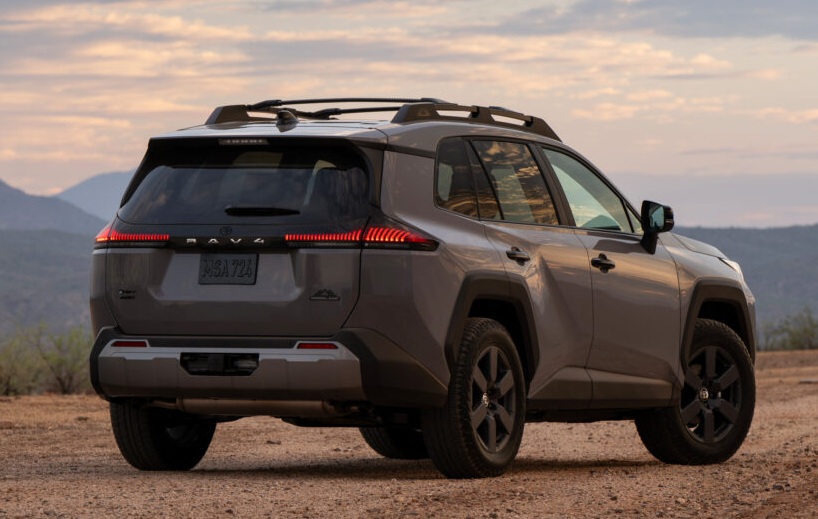
The RAV’s wider, stouter rear end is accented by tech-forward LED taillights.

The RAV’s wider, stouter rear end is accented by tech-forward LED taillights.

PHEV DC Fast Charging

Perhaps the most significant 2026 upgrade is the introduction of DC fast charging, a feature uncommon in plug-in hybrids. XSE and Woodland grades have an 11-kW onboard DC fast charger. Charging from 10 percent to 80 percent takes around 30 minutes, Toyota says. SE and GR Sport use a 7-kW charger with a standard J1772 port. Level Two charging (240 volt) will take approximately 4 hours to reach 80 percent capacity.

All models will include a dual-voltage charging cable compatible with standard 120v and 240v home outlets.

The New Digital Hub

The new 2026 RAV4 debuts Toyota’s most advanced connectivity and safety suite to date, Toyota says. Connectivity features integrate 5G network connectivity and debut the brand’s all-new, software-defined vehicle platform. Toyota calls it a fundamental shift for a fully integrated digital hub between the owner’s smartphone and digital life.

Next-Gen Multimedia and Arene Software, developed in North America, are the latest Toyota Audio Multimedia systems. Using AT&T’s 5G network, the software system allows Toyota to push over-the-air updates to improve safety features and infotainment. Updates will keep coming even after the car has been sold. The system uses a smartphone-like interface, customizable widgets, and an enhanced “Hey Toyota” voice assistant. Toyota says commands are processed more quickly than before.

Toyota’s safety and entertainment features have significant upgrades:

Drive Recorder: The standard built-in Drive Recorder functions as an integrated dashcam. Exterior cameras to capture 20-second clips of manual or triggered events;

Navigation: The turn-by-turn navigation system can now display full-screen directions in the digital gauge cluster, a first for Toyota Audio Multimedia;

Entertainment: Connectivity is enhanced with SiriusXM with 360L and newly available integrated streaming for Spotify (with a subscription);

The system includes standard wireless Apple CarPlay and Android Auto compatibility, as well as simultaneous dual Bluetooth phone connectivity.
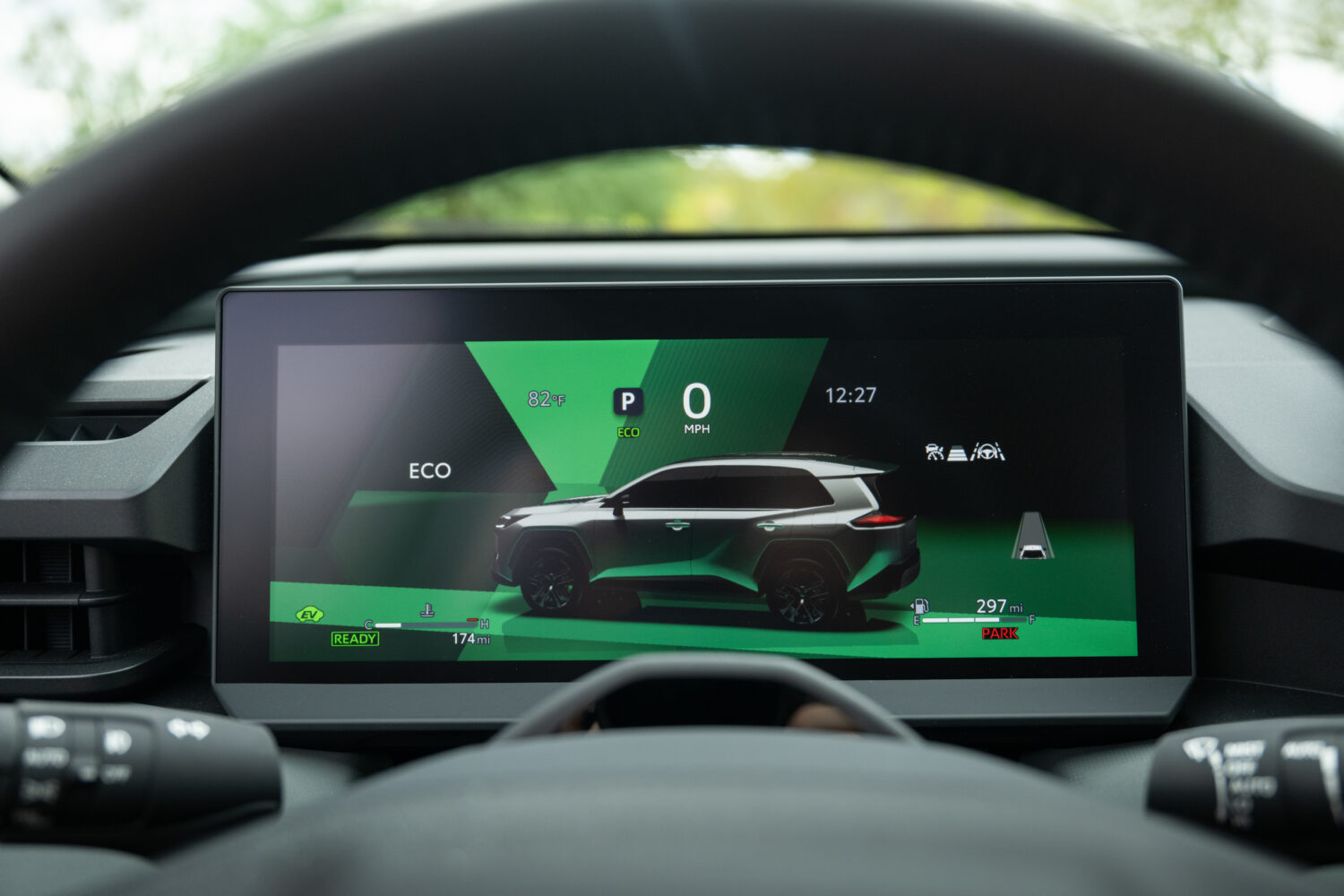
The Woodland has a 3D panoramic view monitor with multi-terrain monitor.

The Woodland has a 3D panoramic view monitor with a multi-terrain monitor.

Toyota Safety Sense 4.0

In addition to eight air bags, every 2026 RAV4 is equipped with the updated Toyota Safety Sense (TSS 4.0) suite. The system was updated with hardware improvements and enhanced detection capabilities. TSS 4.0 technologies include:

Proactive Driving Assist (PDA): Provides gentle braking and steering support for distance control in traffic;

Pre-Collision System with Pedestrian Detection (PCS w/PD): Enhanced detection of vehicles, pedestrians, bicyclists, and motorcyclists;

Full-Speed Range Dynamic Radar Cruise Control (DRCC): Adaptive cruise control capable of operating across the full speed range;

Lane Tracing Assist (LTA): To help keep the vehicle centered in its lane while using DRCC;

Road Sign Assist (RSA): Reads and displays road signs, such as speed limits.

Among other standard safety features are a blind-spot monitor with rear cross-traffic alert and a rear-seat reminder system. RAV4 options include a panoramic view monitor and front and rear parking assist with automatic braking.

Drivers will find the standard built-in dashcam and full-screen navigation useful.
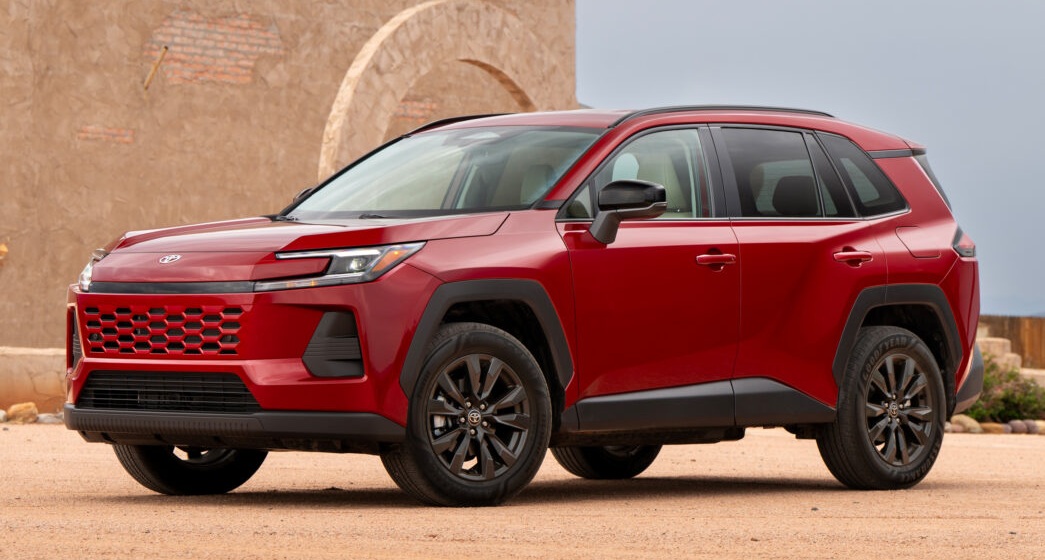
The XLE Premium adds more luxury features and dramatically increases the maximum AWD towing capacity to 3,500 pounds. Ruby Flare Pearl paint, shown on this RAV4, is a $425 upgrade.

The XLE Premium adds more luxury features and dramatically increases the maximum AWD towing capacity to 3,500 pounds. Ruby Flare Pearl paint, shown on this RAV4, is a $425 upgrade.

The RAV4 By Grades

Toyota is targeting mass-market appeal with the RAV4 “Core” models, which include the LE, XLE Premium, and Limited grades. These trims establish a new baseline for the segment, making the hybrid-electric powertrain standard across all three models.
Exterior Core design emphasizes classic SUV proportions with an elevated ride height and color-matched grilles. Standard exterior features on the base LE grade include 17-inch alloy wheels, low-profile roof rails, and Satin Black lower cladding and mirrors. LED projector headlights with DRL (Daytime Running Light) functionality are standard.

Significant Core grade technologies include:

Display: A standard 10.5-inch Toyota Audio Multimedia display is paired with a 12.3-inch digital gauge cluster (a size previously reserved for higher grades);

Connectivity: The LE has three USB-C charging ports and a media port in the center console.

Convenience: Standard features include push-button start, a tonneau cover for the cargo area, and fabric-trimmed seating.
Among the Toyota Safety Sense features are a backup camera with dynamic guidelines and a blind-spot monitor with rear cross-traffic alert.

Luxury Rises: RAV4 XLE Premium and Limited

Stepping up from the base LE, the RAV4 XLE Premium and Limited grades have a more luxury-focused interior. With AWD,

XLE Premium: The mid-tier XLE Premium grade with the standard hybrid powertrain has an increased AWD tow rating of 3,500 pounds. Other features include:

  • SofTex-trimmed seats with an eight-way power adjustable driver’s seat and standard heated front seats.
  • Leather-wrapped shift knob and steering wheel.
  • A Qi-compatible wireless phone charger and a total of five USB-C charging ports (front, console, and rear).

Exterior standard enhancements include 18-inch alloy wheels, a power liftgate, and heated, piano-black rearview mirrors with turn signal indicators. A helpful safety feature adds front and rear parking assist with automatic braking.

RAV4 Limited

The flagship luxury grade includes all-wheel drive and has a manufacturer-estimated combined fuel economy rating of 42 mpg. The Limited focuses heavily on luxury and distinct styling. The exterior is dressed up with a color-keyed grille in Satin Chrome and silver-painted lower bumper valances (front and rear). A revised rear spoiler has Piano Black sides.

  • Upgraded LED headlamps have distinctive LED DRLs (Daytime Running Lights) with integrated turn signals. LED front fog lights are standard.
  • A standard power tilt and slide panoramic glass roof and a hands-free power liftgate.
  • Power side mirrors are upgraded with a puddle lamp and camera functions.
  • Limited Grade Interior Features
  • 12.9-inch Toyota audio multimedia;
  • Nine-Speaker JBL audio with amplifier and subwoofer;
  • SofTex-trimmed seats with power eight-way adjustable front seats for driver and passenger;
  • Heated and ventilated front seats;
  • Heated rear window seats;
  • Toggle switch shift-by-wire gear selector;
  • Leather-wrapped heated steering wheel;
  • Digital rearview mirror with HomeLink garage door opener;
  • 5 USB-C Ports: 2 front USB-C charging ports, one center console media and charging port, and two rear USB-C charging ports;
    2 Qi-compatible wireless phone chargers;
  • Windshield deicer;
  • Automatic rain-sensing windshield wipers.
  • Limited Grade Safety Features

Toyota Safety Sense 4.0 with advanced driver assist systems, including:

  • 3D panoramic view monitor;
  • Advanced Park;
  • Front cross-traffic alert;
  • Lane change assist;
  • Traffic Jam Assist (requires an active Drive Connect trial or subscription, 1-year trial included).
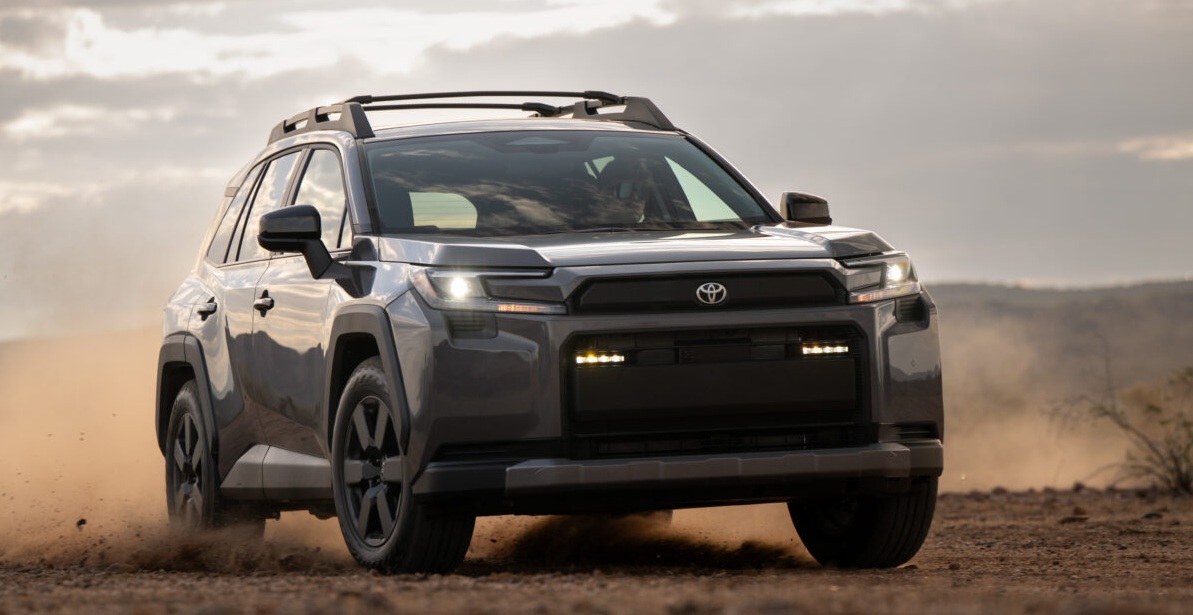
New exterior styling is punched up with a “hammerhead” front end, flanked by angular fenders and a contoured hood.

New exterior styling is punched up with a “hammerhead” front end, flanked by angular fenders and a contoured hood.

The Woodland Grade

For camping enthusiasts and off-road adventurers, Toyota offers the updated Woodland grade. A few specific engineering upgrades add to the capability and increased utility:

  • Ground clearance is increased to 8.5 inches for improved trail driving;
  • Dunlop GrandTrek All-Terrain Tires mounted on unique 18-inch matte metallic grey alloy wheels. (Note: a full-size spare tire is not available.);
  • Standard 2-inch rear tow hitch receiver with a wiring harness and a towing capacity of 3,500 pounds;Other Woodland Designs include:
  • Satin Black “hammerhead” grille;
  • Wide Satin Black overfenders;
  • Unique raised roof rails with cross bars.

Exclusive to the Woodland is the new Urban Rock exterior color.

Woodland Interior Features

  • SofTex-trimmed seats and an exclusive Black and Mineral color option.
  • Functional features for outdoor activities include:
  • A 120V 1500-Watt AC power outlet in the rear cargo area;
  • Red-Orange interior accents, including contrast stitching on the steering wheel and center console lid;
  • Woodland-branded all-weather floor mats and cargo mat are standard.

Woodland Safety and Driver Assistance

Along with the full suite of Toyota Safety Sense (TSS 4.0), the Woodland also gains several advanced driver assist systems:
Front and rear parking assist with automatic braking;

  • 3D panoramic-view monitor with multi-terrain mode. (It functions as a “virtual spotter,” providing real-time views of the ground and obstacles immediately surrounding the RAV4.);
  • Front cross-traffic alert and lane change assist. (When the system is engaged, the vehicle will provide steering input to physically move the car into the adjacent lane once it determines the path is clear;
  • Traffic Jam Assist (available via Drive Connect subscription).

Sport Grade Lineup

The 2026 RAV4 SE and XSE Sport grades have a mildly athletic appearance with dark chrome trim and blacked-out components. The SE features 18-inch multi-spoke black sport alloy wheels, Piano Black overfenders and rocker panels, and dark chrome grille accents. The interior features fabric-trimmed sport seats with blue stitching accents. AWD models have a 3,500-pound towing capacity, up from 1,750 lbs. for front-drive models.

The base SE grade is available with front- or all-wheel-drive powertrains: a 226-hp FWD or a 236-hp AWD. AWD is standard for the SE plug-in model.

SE PHEV Highlights: 324 net combined horsepower, a 52-mile all-electric range, and a 7-kW onboard AC charger.

Sport XSE Grade: The performance flagship XSE has standard AWD with either powertrain. The XSE can be optioned with two-tone paint (black roof) and larger 20-inch multi-spoke black sport alloy wheels. Also standard are a power moonroof and LED headlamps with distinctive DRLs.

Charging Advantage (XSE PHEV): The XSE PHEV upgrades to an 11-kW onboard AC charger and adds DC charging capability, significantly speeding up charging times.

RAV4 XSE Sport Interior

Inside, the XSE has premium Ultrasuede and SofTex trimmed seats, with heated and ventilated front seats. The front seats are power-adjustable with memory and a standard 12.9-inch Toyota audio multimedia display.

Convenience features include a hands-free power liftgate and an auto-dimming rearview mirror with HomeLink. The PHEV model can also be optioned with a 120-volt, 1500-watt AC power outlet in the cargo area.

Both Sport grades add a 3D panoramic view monitor, trailer sway control, front cross-traffic alert, and lane change assist. Traffic Jam Assist is available via subscription.
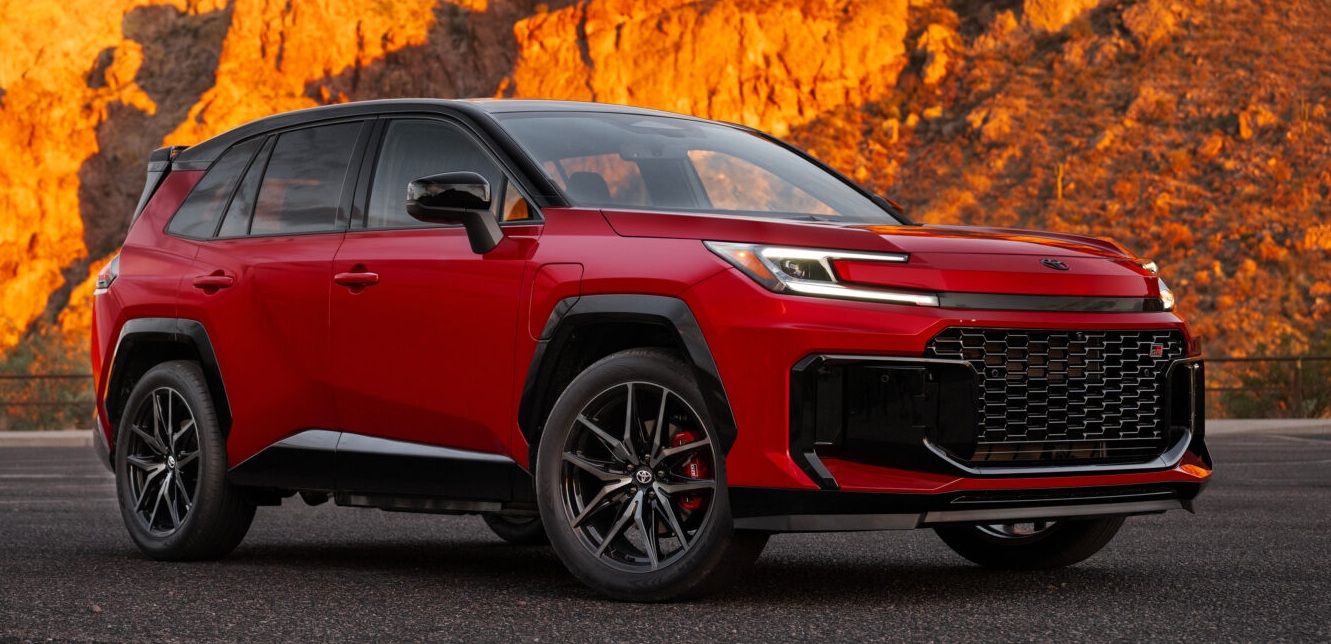
To differentiate the GR Sport from the standard RAV4 lineup, engineers focused on chassis rigidity and handling response.

To differentiate the GR Sport from the standard RAV4 lineup, engineers focused on chassis rigidity and handling response.

The RAV-ing Mad 324-hp GR Sport

With engineering from (Toyota) Gazoo Racing, the RAV4 GR Sport might be a helluva lotta fun. The performance icon traces its roots to Toyota Chair Akio Toyoda’s participation in the 24 Hours of Nürburgring. For a road-going SUV, GR engineers built on the endurance experience with hardware, lightweighting, and finesse.

More than an aesthetics package, the RAV4 GR Sport brings genuine mechanical enhancements to sharpen handling and driving dynamics. The model is available exclusively with the high-output plug-in hybrid powertrain.

With 324 horsepower, the GR Sport achieves a manufacturer-estimated 37 mpg combined rating and an all-electric driving range of 48 miles.
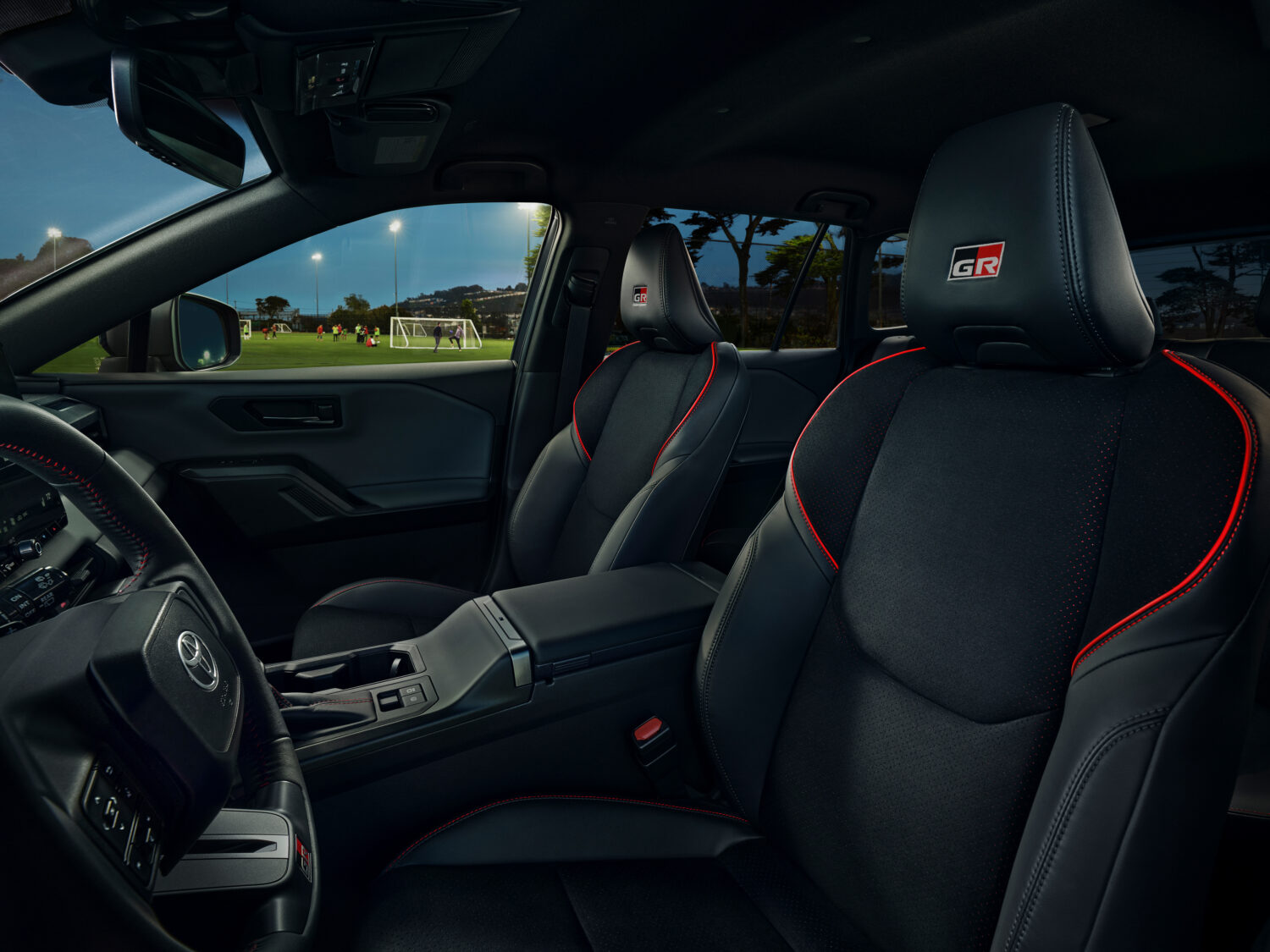
Wider bolsters hold occupants in place during a back-country run.

Wider bolsters hold occupants in place during a back-country run.

GR Sport Chassis and Suspension

To differentiate the GR Sport from the standard RAV4 lineup, engineers focused on chassis rigidity and handling response. Key mechanical updates include:

Tuned Suspension: Dedicated damper tuning, stiffer coil springs, and a front performance damper;

Lower Center of Gravity: The ride height has been lowered by 15mm (0.59 inch), resulting in 7.5 inches of ground clearance. Also, the placement of the hybrid battery was optimized for stability;

Reinforced Frame: The rear suspension cross-member is reinforced to stiffen the chassis;

Performance Tires: The GR Sport rides on offset 20-inch wheels with Dunlop Sportmaxx summer performance tires. The lightweight wheels are approximately 4.8 pounds lighter compared to the standard XSE model.
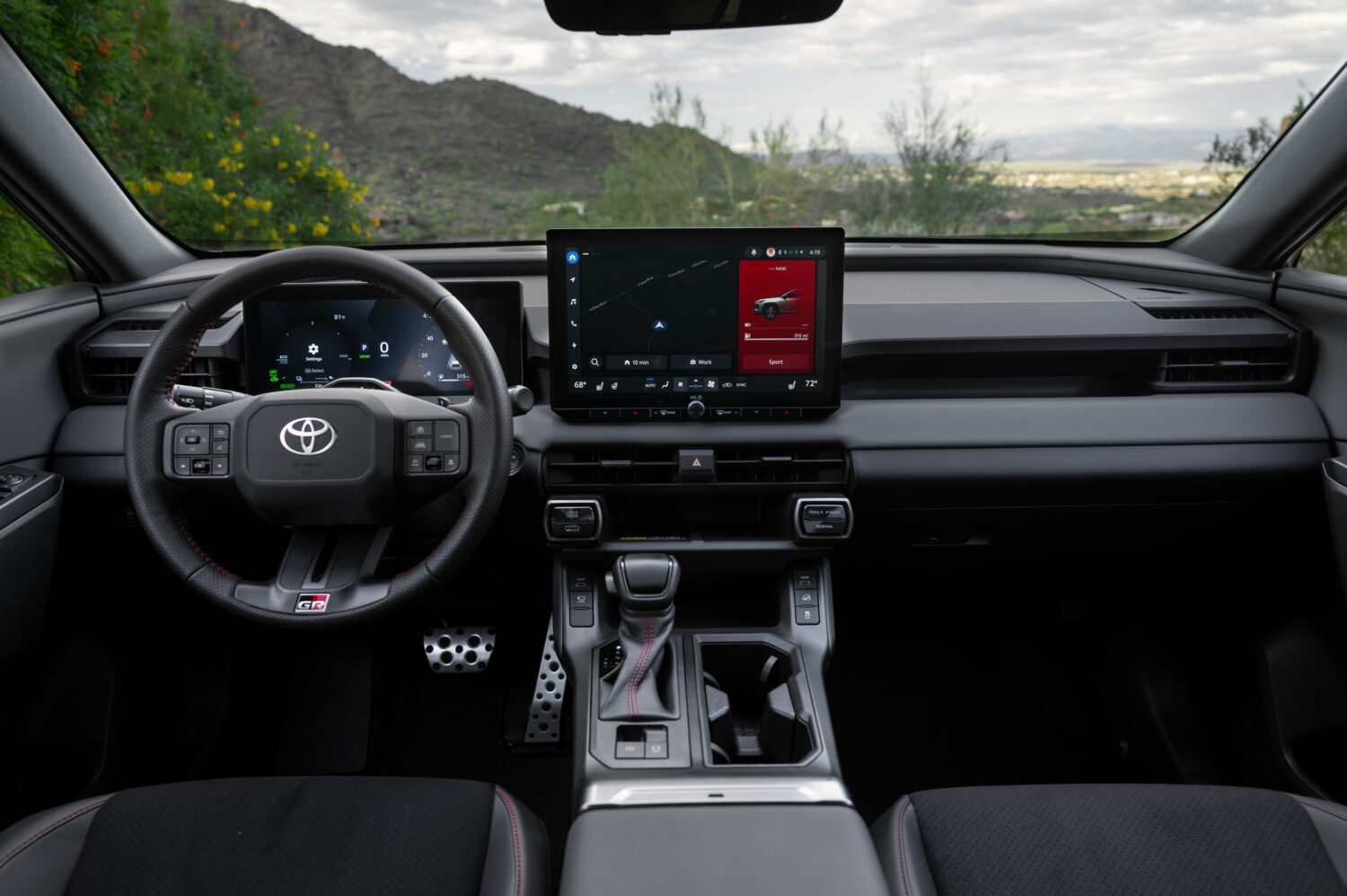
The GR Sport interior has “Brin Naub” synthetic suede and SofTex sport seats.

The GR Sport interior has “Brin Naub” synthetic suede and SofTex sport seats.

GR Sport Functional Aerodynamics

The exterior design changes are functional rather than purely cosmetic. The front fascia features a “GR Functional Matrix Grille” with active cooling ducts to manage airflow. A front lip spoiler, rear wing spoiler, and rear diffuser all help to balance downforce and reduce drag. The vehicle’s track is slightly wider due to aggressive fender flares, adding one inch to the overall width.

GR Sport Interior Appointments

Inside, the cabin reflects the GR brand’s motorsport heritage. The interior features “Brin Naub” synthetic suede and SofTex sport seats. Wider bolsters hold occupants in place during a backcountry run.

A 12.3-inch digital gauge cluster offers an exclusive GR start-up screen, while the leather-wrapped steering wheel includes sport paddle shifters.

The plug-in hybrid engine in the GR Sport has a net combined 324 horsepower. The system delivers 48 miles of EV range and 37 mpg combined, city and highway.

The plug-in hybrid engine in the GR Sport has a net combined 324 horsepower. The system delivers 48 miles of EV range and 37 mpg combined, city and highway.

Observations and Considerations

Though I have not yet driven any of the 2026 RAV4 grades, they all look good on paper. I like that the base 2026 RAV4 LE is still an economical choice for long-term reliability and reduced maintenance costs. Its features will be quite acceptable for many buyers, without feeling dumbed down. All-wheel drive can be added for $1,400.

Built-in drive recorder: Of interest is the new built-in drive recorder (on all grades), which captures video from exterior cameras. No more having to buy the optional CarMate camera systems, saving up to $570.

A high-performance Toyota RAV4?

I don’t know who asked for a high-performance RAV4, but their wish is granted. Coming online this spring will be the 324-hp 2026 RAV4 GR Sport. I look forward to a test drive to grab this rascal by the scruff of the neck and make its high-performance tires cry out.

Could a new RAV4 be for me?

I have been shopping for a compact SUV to replace our 2008 Ford Escape Hybrid, which has a Toyota hybrid powertrain. At 146,000 miles, it is time. I have replaced the hybrid battery and its cooling fans, costing more than $4,000. At my stage in life, my next new vehicle could be my last. But that still leaves room for fun, not-new cars.

For a few reasons, my pick of the 2026 RAV4 line would be the Limited grade in Wind Chill Pearl. The girlfriend-wife favors white cars. To keep happiness flowing, an eight-way power front passenger seat is mandatory for both of us. Power front seats are included with the Limited, but optional on the RAV4 XSE. I would also choose the Harvest Beige SofTex interior because neither of us is fond of gray or black interiors. And I would opt for the cargo mat package ($339) and carpet floor mats ($199).

With standard AWD and the freight charge, my Limited “build” came to $45,713.

I spec’d out the RAV4 XSE at the consumer website, but it would cost $615 more to match the Limited’s content.

Which 2026 RAV4 would you choose?

2026 Toyota RAV4 Limited AWD Specifications

Body style: 5-door, 5-seat all-wheel drive compact SUV

Fuel tank: 14.5 gallons

Cargo space: 37.8 cubic feet (behind back seat)

Front head/leg room: 37.9/41.0 inches

Rear head/leg room: 39.5/37.8 inches

Length/wheelbase: 181/105.9 inches

Width/height: 73/66.7 inches (with antenna)

Ground clearance: 8.1 inches

Curb weight: 3,920 pounds

Turning circle: 36.9 feet

CHASSIS COMPONENTS

Brakes: front, 12-inch power-assisted ventilated discs; rear, 11.1-inch solid discs; electronic parking brake

Steering: rack-mounted parallel-type, electric power steering (EPS); turning circle, 36.9 ft. (37 feet Woodland)

Tires-wheels: Standard 18-inch aluminum alloy wheels with 235/60R18 all-season tires; temporary spare

Suspension: Front, independent MacPherson strut front suspension with stabilizer bar; rear, multi-link with stabilizer bar

PRICING

Limited AWD base price: $44,750, including $1,450 freight charge; price as configured $45,71

Options on test vehicle: Wind Chill Pearl paint $425; all-weather liner package $339; carpet floor mats $199;

Where assembled: Georgetown, Ky.

Mazda CX-50 Hybrid Review

Mazda CX-50 Hybrid Review

Attention to detail and value pricing separate the Mazda CX-50 Hybrid from competitors, but hybridization missed the Mazda zoom-zoom

An Ingot Blue Mazda CX-50 Hybrid SUV crossover at a marina boat launch

The 2025 Mazda CX-50 Hybrid is sold in three trim levels with starting prices ranging from $35,390 to $41,470. Today’s tester is this Ingot Blue Metallic 2025 CX-50 Hybrid Premium Plus, with no added packages or accessories, for $41,470. (Mark Maynard photography)

Jump To Special Features

CX-50 or CX-5?
Hybridization: It’s Complicated
Standard Features per Dollar
Mazda Dependability Rises
A Missing Link for Greatness
CX-50 Hybrid Powertrain and Fuel Economy Ratings
CX-50 Special Assets and Considerations
EV Mode
Why Buy the 2025 Mazda CX-50 Hybrid?
Specifications

BY MARK MAYNARD

The 2025 Mazda CX-50 is a good, honest SUV crossover engineered for long-term ownership. The compact-class CX-50 has many endearing details, making it an ideal family or adventure SUV. Of special interest to car shoppers will be the new Mazda CX-50 Hybrid, with claimed fuel-sipping highway mileage of 37 mpg.

The Mazda CX-50 is a milestone joint venture with Toyota. The two Japanese car companies shook hands on a partnership deal in 2015. It gives vital support to Mazda Motor Corp., which is still the sole owner of the Mazda brand. Vehicle development is costly, and both manufacturers have found synergies for growth. The comprehensive plan is to develop electric vehicles, connected car innovations, and advanced safety technologies jointly.

The alliance has provided Mazda with Toyota’s hybrid system for the 2025 CX-50. And the two companies built the new Mazda Toyota Manufacturing plant in Huntsville, Ala.   Construction began in 2018 and was completed in 2021. So far,  the Mazda CX-50 and Toyota Corolla Cross have been built there. Other cost savings will be met by supplying each other with components and shared technologies.

The CX-50 interior layout is ergonomically designed and straightforward to use.

The CX-50 interior layout is ergonomically designed and straightforward to use.

CX-50 or CX-5?

Based on the front-wheel-drive Mazda3 and the CX-30, the CX-50 is sold alongside the slightly smaller CX-5. When the bigger and more refined CX-50 debuted for 2022, it was expected that the CX-5 would be phased out. However, that has not occurred. The less expensive CX-5 is still racking up big sales (popular in rental fleets), making it the brand’s top-selling model. As a separator, marketing for the larger CX-50 presents it as an off-road adventure vehicle.

Competitors to the Mazda CX-50 include the Honda CR-V, Hyundai Tucson, Nissan Rogue, Subaru Forester, Kia Sportage, and Toyota RAV4.

The CX-50 Hybrid, however, has fewer competitors, which include the Honda CR-V, Kia Sportage, Hyundai Tucson, and Mitsubishi Outlander. And like Subaru, all Mazda CX-50 models are all-wheel drive.

The CX-50 has analog gauges are bold and bright with white numerals on a black background

Analog gauges are bold and bright.

It’s Complicated

Mazda offers a variety of hybrid and plug-in vehicles in the U.S., including the CX-30, CX-70, and CX-90. However, the CX-50 Hybrid was complicated. Creating an affordable family-class small SUV with Mazda Zoom and great fuel economy is not easy. One of those factors got pinched in adapting Toyota’s hybrid system.

I like Mazda’s philosophy of engineering vehicles for a horse-and-rider bond of control. It is flank-slapping enjoyable in the CX-50 2.5 Turbo model, but the horse escaped the barn for the CX-50 Hybrid. It is more of a workhorse for fuel economy than spirited driving.

Most buyers shopping for a small, hybrid SUV look for styling, features per dollar, and fuel economy. They might not notice or care about this hybrid’s dutiful driving attitude. However, there are a few other compromises to the CX-50 Hybrid that don’t make horse sense, especially for its near-$40,000 starting price.

The CX-50 has the styling. The CX-50 Hybrid is packed with desirable features. However, I was not able to achieve the official fuel economy ratings.

But above all, there is no denying Mazda reliability.

Looking up through the panorama roof, viewed from the front seats rearward to the rest of the vehicle

A panoramic moonroof is standard on the CX-50 Hybrid.

Mazda Dependability Rises

Mazda USA has risen to the No.2 position in the latest J.D. Power Vehicle Dependability Study. The brand earned notable recognition for several models.

With a score of 161 problems per 100 vehicles (PP100), Mazda has improved by 24 PP100 from the previous year. Mazda has advanced by four positions in the mass market segment.

The 2022 Mazda CX-9 has been recognized as one of the top three vehicles in the Upper Midsize SUV category. The 2022 Mazda CX-5 earned a top 3 spot in the Compact SUV category.

“We’re pleased to see Mazda’s commitment to quality and reliability reflected in our strong performance in this year’s J.D. Power study,” said Mazda North American Operations President and CEO Tom Donnelly. “This recognition, coupled with the improved ranking across the brand, speaks to the dedication of our engineers and our focus on delivering the best driving and owner experience for our customers.”

This achievement highlights the brand’s ongoing commitment to delivering vehicles that offer long-term reliability and exceptional quality for owners.

The 2025 dependability study evaluates 2022 model-year vehicles after three years of ownership. The study measures 184 potential problem areas across nine categories, including infotainment, driving assistance, and powertrain. Mazda’s strong performance in this year’s study is a testament to the continued reliability of the brand’s vehicles,

Mazda’s improvement is notable despite the industry’s ongoing challenges with software complexity and supply chain disruptions.

Leather with copper-colored baseball-type stitching spans the dashboard face and upper door panels.

Leather with copper-colored baseball-type stitching spans the dashboard face and upper door panels.

Mazda Awarded IIHS Top Safety Picks

In the annual presentation of awards by the Insurance Institute for Highway Safety, Mazda received eight Top Safety Pick+ awards. The awarded vehicles include the 2025 Mazda3, CX-30, CX-50 and CX-50 Hybrid, CX-70 and CX-70 PHEV, CX-90 and CX-90 PHEV.

To earn the awards, vehicles must achieve top ratings in IIHS’s front and side crash tests and pedestrian front crash prevention assessments and come with standard acceptable- or good-rated headlights.

IIHS strengthens the award criteria each year, making the 2025 awards program the toughest yet, said IIHS President David Harkey.

“The success of our awards program depends on automakers’ commitment to safety,” he said. “Kudos to Mazda for meeting this challenge with eight top safety pick+ winners, the most of any brand.”

2025 Mazda CX-50 Pricing

Shoppers can choose from 10 trim levels for the 2025 Mazda CX-50 between gas and hybrid powertrains. There are seven choices for the gasoline-powered CX-50 and three trims for the CX-50 Hybrid.

Starting prices for the CX-50 gasoline range from $31,720 to $44,720, in turbocharged or non-turbo four-cylinder engines.

The CX-50 Hybrid is available in Preferred, Premium, and Premium Plus trim levels. Hybrid starting prices range from $35,390 to $41,470. The suggested manufacturer’s retail pricing includes the $1,420 freight charge from Huntsville, Ala., a joint Mazda Toyota manufacturing plant.

Today’s tester is a 2025 CX-50 Hybrid Premium Plus with no added packages or accessories for $41,470. Buyers might also want to consider such accessories as a carpet cargo mat ($125), a retractable cargo cover ($225), or a cargo net ($60).

Adventure travelers will want the black crossbars ($350) for lashing gear to the roof. There’s also the Outdoor Adventure Backpack Kit, $225. It is packed with a bungee cord, water reservoir (for hiker’s hydration), cable ties, folding shovel, and waterproof matches.

The CX-50 Hybrid has a max towing capacity of 1,500 pounds, with the factory tow hitch and wiring harness ($589).

Another useful Mazda accessory is the Weather Package, $390, adding a cargo liner with seatback protection and all-weather floor mats. A  roadside assistance kit ($90) adds a folding reflective triangle, flashlight, tire pressure gauge, emergency blanket, and rain poncho.

And there are several pet accessories including a ramp ($300), back seat protector ($225), and dog restraint ($40).

Check current Mazda CX-50 pricing here.
And check for special incentives and offers here.

The center stack of controls uses buttons and switches for commonly used cabin functions.

Buttons and switches for commonly used cabin functions.

Standard Features per Dollar

Base hybrid models are well equipped with desirable features, including:

  • Keyless entry and push button start
  • Electric parking brake
  • Heated front seats with 3-level adjustment
  • Half leatherette-trimmed seats
  • LED headlights (auto on/off)
  • Rear power liftgate with programmable height adjustment
  • Mazda Connect Infotainment System with a 10.25-inch center display, with voice command and multifunction Commander control
  • Rearview camera monitor with guiding lines
  • Alexa Built-In
  • Wireless Apple CarPlay and Android Auto
  • Wireless phone charger
  • Bluetooth hands-free phone and audio capability
  • 8-way power-adjustable driver’s seat with power lumbar support
  • 4-way manual adjustable front passenger seat
  • 17-inch alloy wheels with P225/65 R17 all-season tires
  • Power (heated) side mirrors with LED turn signal indicators
  • Windshield wiper de-icer
  • 8-speaker audio system with automatic level control
  • Dual front USB (Type C) audio inputs and dual rear USB (Type C) charging ports
The open driver's door shows a water bottle and reporter's notebook in the side panel

Texture and color for a premium appearance.

CX-50 Hybrid Premium Plus features include:

  • Automatic power-folding side mirrors
  • Panoramic sunroof
  • 19-inch aluminum alloy wheels, machine cut with black metallic finish
    P225/55 R19 all-season tires
  • Heated and ventilated front seats (3 levels)
  • Heads-up windshield-projected Active Driving Display
  • Auto-dimming rearview mirror with HomeLink
  • Black metallic interior trim and contrast stitching
  • Aluminum roof rails in satin chrome finish
  • Dual exhaust outlets with chrome tips
  • Mazda CX-50 Safety Features

Standard safety features on all Mazda CX-50 models include:

  • 10 air bags
  • Radar cruise control with stop-and-go
  • Lane Departure Warning with Lane-keep Assist
  • Emergency Lane Keeping
  • Blind spot monitoring
  • Rear cross traffic alert

A Missing Link for Greatness

As complete as the safety technologies appear, one crucial link is missing: Cruising and Traffic. That piece of technology connects the other driver-assistance features to allow semi-autonomous, Level 2 hands-on-the-wheel driving. The CX-50 Hybrid is an excellent commuting vehicle, and Level 2 assist would be a welcome safeguard. A complete package of advanced driving technologies is expected on a $40,000 vehicle.

Unfortunately, Cruising & Traffic Support is only available on the 2.5T Premium and Premium Plus models, not the hybrid ones.

Adding Level 2 drivability bumps into Mazda’s philosophy that the driver should always be in control of the vehicle. It is also a price point dilemma, a spokesperson said.

“Mazda’s initial data showed that hybrid customers and Mazda customers interested in hybrid vehicles were also more budget conscious than [CX-50] 2.5T buyers, who want all the toys. Hence, there were some tough decisions in terms of what features were in or out for the vehicle,” he said. “We are always evaluating and looking into what our customers want and expect from their vehicles.”

CX-50 Special Assets and Considerations

  • Side mirrors power fold on shutoff
  • A spare tire (temporary) is when most electrified vehicles only have an inflator system.
  • All doors open to nearly 90 degrees, easing entry and exit.
  • Back seat release levers in the cargo area, a detail not all makers provide.
  • Analog gauges are bold and bright, with white numerals on a black background.
  • Spray-arm wipers keep the fluid where it is needed.
  • Large side mirrors provide excellent visibility range on the highway.
Looking at the under cargo space of the spare tire for the CX-50 Hybrid has a spare tire, unusual among electrified vehicles.

The CX-50 Hybrid has a spare tire, unusual among electrified vehicles.

CX-50 Considerations

  • Large side mirrors can block cornering views of pedestrians in crosswalks and turning vehicles
  • Wide turning circle of 39 feet
  • Narrow back window for visibility
  • Short back-seat legroom
  • No interior tailgate release, only at the tailgate and the key fob.
  • No heated steering wheel.
  • No Cruising and Traffic support for semi-autonomous driving
  • No 360-degree-view monitor

Hybrid Powertrain and Fuel Economy Ratings

Mazda’s CX-50 hybrid powertrain is the same one used in the Toyota RAV4 Hybrid but with some specific Mazda re-engineering. The Toyota Hybrid System integrates a 2.5-liter four-cylinder engine, a nickel-metal hydride EV battery, and three electric motors.

Two electric motor generators are on the front transaxle. One motor starts the engine and charges the hybrid battery. Motor-generator two drives the front wheels and provides regeneration during braking. When tire slippage is detected, a smaller rear motor drives the rear axle for eAWD.  (More powertrain details are highlighted in the specifications chart at the end of the review.)

Looking at the speedometer and the battery charge meter just below

The battery charge meter is entertaining but has no significance for driving.

The transmission is a continuously variable automatic (eCVT), with electric AWD (eAWD).

This setup is good for 219 horsepower and 163 foot-pounds of torque on regular 87-octane fuel. EPA estimated mileage ratings are 39 mpg city, 37 highway, and 38 mpg combined. Mazda says that is a boost of 40 percent above the base CX-50 2.5 S. The 14.5-gallon tank could provide around 477 to 536 miles of range.

I, however, could only work up to 32.9 mpg while on two 80-mile highway runs with the cruise set at 67 mph. Perhaps my mileage results are forgivable with all-wheel drive, a raised ride height, and a curb weight of 4,008 pounds.

Looking into the engine bay of the CX-50 Hybrid

The 219 horsepower Toyota Hybrid System.

Intelligent Drive Select

Mazda’s Intelligent Drive Select (Mi-Drive) has driving modes of Normal, Power, and Trail. I switched up to Power for its more direct hookup from a stop. Trail mode works through the AWD system to prevent wheelspin on rough roads. It felt like a traditional Eco mode with reduced acceleration force. Mazda says to use Trail mode only on rough roads.

EV Mode

I appreciate how the hybrid system allows a useable amount of low-speed battery driving. The small 1.6 kWh battery pack does not need to be plugged in for recharging. EV mode allows full battery driving up to about 25 miles per hour, depending on the battery’s state of charge. A small bar graphic in the gauge array’s center shows the battery reserve’s rise and fall. It is entertaining to observe but has no significance for driving.

“Off-throttle coasting, brake regen, and the engine charge the [battery] pack in normal operation,” Mazda says. “In the right driving conditions, you can squeeze maybe 2-3 miles of low-speed EV range out of it.”

Looking at the right front tire and wheel.

19-inch Goodyear Eagle Touring tires, electric vehicle tuned.

CX-50 Hybrid Ride and Handling

The CX-50 cabin is reasonably calmed from wind noise, but it is not the quietest ride at highway speeds. At low speeds there is a tire-drumming sound.

In my test of the 2025 CX-50 Hybrid, the highway ride was on glide control. It rode solid and steady with little variance, whether along California’s grooved concrete or blacktop. The ride is less compliant on back roads where I noticed un-Mazdalike body lean in cornering.

Mazda’s G-Vectoring traction-control system uses the center and rear differentials to control weight transfer, which is helpful on-road or off.

As comfortably as the CX-50 rolls on the interstate, the ride is less svelte around town. The suspension is firm, even hard. I expect Mazda strapped down the CX-50 for sporty handling, but the ride can be jarring over bad pavement and potholes. The rear torsion beam rear suspension could be the culprit for the hard jolts. Torsion beams are flat in design, which benefits cargo space, but the rear ride quality can feel clunky over bumps.

Mazda also stepped up and gave the CX-50 four-wheel disc brakes a millimeter or three larger than the competition. There are 12.8-inch ventilated rotors in front and 12.8-inch solid rotors rear.

i-Activ AWD

Mazda’s i-Activ all-wheel-drive system is masterful at anticipating wheel slip before barely an inch of traction is lost. Mazda says it is a predictive system that monitors 27 sensors more than 200 times a second.

Rather than moving power “from the wheels that slip to the wheels that grip,” the i-Active system directs engine torque to the necessary wheel to maintain forward momentum.

It is a reassuring AWD system whether in snow, rain, or dirt.

A low angle front view of the CX-50 showing the LED headlights

Standard LED headlights.

CX-50 Interior Function

The CX-50 interior layout is ergonomically designed and straightforward to use. There are buttons and switches for commonly used cabin functions, such as audio volume and tuning, temp, and air.

More detailed functions lie in Mazda’s Connect Infotainment System with a 10.25-inch center display. A multifunction Commander control gives dial-and-click access for audio selections, phone, navigation, and vehicle settings and preferences.

Front headroom of 38.6 inches, with the panoramic sunroof, is about an inch less than in CX-50 competitors.

Sightlines are open across the hood and over the shoulder. The liftgate glass, however, has narrow visibility, which is complicated by the back seat center head restraint.

The rearview camera with guidelines has a wide view in the 10.25-inch center display. Unfortunately, Mazda’s 360-degree-view monitor, which would assist in tight parking situations, is not offered for the CX-50 Hybrid. The camera’s see-through view is an asset when trailering or when the cargo space is adventure-packed to the headliner.

Also not offered for the CX-50 Hybrid is a heated steering wheel, but it is available on 2.5T trim levels.

Large side mirrors provide excellent visibility range on the highway. Around town, however, the expansive mirrors can block side views of pedestrians in crosswalks and turning vehicles.

Interior textures and colors enhance a premium appearance. The tester’s black leather upholstery, with perforated centers, is handsomely set off with copper-colored baseball-type stitching. The stitching also spans the dashboard face and upper door panels.

Not so enjoyable are the nagging and insistent alerts to buckle up or when using left-foot braking with the accelerator. I got busted by the “Pedal Abuse Alert” when the brake and accelerator are used at the same time. I’d not heard of such a warning before.

Looking into the back seat of the Mazda CX-50 Hybrid

Space throughout the back seat feels more subcompact than compact.

Back Seat and Cargo Space

Space throughout the back seat feels more subcompact than compact. The space is nicely finished amid a lot of black plastic but with an appealing appearance and textures. The door grab handles are uniquely styled with finger ridges. Leave it to Mazda to focus on the human interface.

Despite wide-opening doors, fitting big feet through the door opening can be clumsy, for good reason. Integrating the battery pack below the cargo space shortened back seat legroom by 2 inches, now at 37.8 inches.

Raise the liftgate, and the cargo space looks square and spacious. That’s 29.2 cubic feet (stacked to the headliner) or 56.3 cu.ft. with the back seat folded.  But try stacking crates in the space and you’ll see the angle of the fifth door crops the height.

However, fold the 60/40 seatback for 6 feet in length. Seatback release levers on each cargo side give a quick fold to the seats.

Even by locating the battery under the cargo floor, Mazda found a way to include a temporary spare tire. That is an uncommon feature in any vehicle today.

Cargo space in the CX-50 Hybrid is wide with folding rear seatbacks

Fold the back seat for 6 feet in length.

Why Buy the 2025 Mazda CX-50 Hybrid?

Attention to detail and value pricing enhance ownership of the Mazda CX-50 Hybrid. Using Toyota’s hybrid system is smart, especially with the nickel-metal hydride battery pack. I’ve experienced that same basic system in my 2008 Ford Escape Hybrid, which functioned without fault until 140,000 miles. A replacement was around $4,400 in 2021 from Green Tec Auto, with a 3-year warranty.

The CX-50 Hybrid does not overachieve but emphasizes value and simplicity. It is mainstream with finesse.

A rear three quarter view of the Ingot Blue 2025 Mazda CX-50 Hybrid

The 2025 CX-50 has many endearing details that make it an ideal family or adventure SUV.

2025 Mazda CX-50 Hybrid Specifications

Body style: Compact 5-seat, 5-door SUV crossover with standard all-wheel drive

Engine: 219-hp, Atkinson cycle 2.5-liter gasoline-electric hybrid with direct and port injection; 163 lb.-ft. torque from 3,600 to 5,200 rpm

Electric motors: Permanent magnet, 650 volts; 118-hp front, 54 hp rear

Battery: Nickel-metal hydride, 244.8 volts; 1.59 kWh

Transmission: eCVT with EV mode and Mazda Intelligent Drive Select for Normal, Power, and Trail modes

Fuel economy: 39/37/38 city/hwy/combined; 87 octane recommended

Emissions rating: LEV 3 SULEV 30/T3 Bin 30

BY THE NUMBERS

Towing capacity: 1,500 pounds

Fuel tank: 14.5 gallons

Cargo space: 29.2 to 56.3 cubic feet

Cargo dimensions: 29.6 inches floor to headliner; 29.8 inches ground to cargo floor; 41.7 inches wide tailgate entry; 55.6 inches across, and 40.3 inches between wheel housings

Front head/leg room: 38.6*/41.7 inches *with panoramic moonroof

Rear head/leg room: 36.7/37.8 inches

Length/wheelbase: 186.1/110.8 inches

Width/height: 72.9*/65.8  *mirror to mirror

Curb weight: 4,008 pounds

Turning circle: 38.8 feet

FEATURES

Standard equipment includes: Keyless entry with push-button ignition, leather-trimmed upholstery with camel stitching, 8-way power driver’s seat with 2 memory presets, wireless phone charging pad, 6-way power front passenger seat, 7-inch LCD gauge display, head-up driving display, Bose 12-speaker audio system, Bluetooth hands-free phone and streaming music, heated front seats (w/3 settings), ventilated front seats, power liftgate, extendable sun visors with vanity mirrors, 4 USB-C charging ports (2 front, 2 rear)

Safety features include: 8 air bags, ABS with electronic brake force distribution, traction control, hill launch assist, dynamic stability control

Advanced safety technologies include: Driver attention alert, blind spot monitoring, rear cross-traffic alert, rear seat reminder alert, vehicle exit warning, radar cruise control with stop and go, lane departure warning with lane-keep assist, emergency lane keeping with road-keep assist, smart brake support forward with head-on collision mitigation, secondary collision reduction

CHASSIS COMPONENTS

Brakes: 4-wheel discs with diagonal hydraulic distribution (front axle, rear axle); front ventilated discs with 12.8-inch rotors, solid rear discs with 12.8-inch rotors

Steering: electric rack and pinion; turning circle 38.8 feet

Tires-wheels: 19-inch Goodyear Eagle Touring tires (225/55), electric vehicle tuned. Machine-cut aluminum alloy wheels with black metallic finish

Suspension: 4-wheel independent; front MacPherson struts with stabilizer bar; rear torsion beam

PRICING

Base price: $41,470, including $1,420 freight charge; price as tested $41,470

Options on test vehicle: none

Where assembled: Huntsville (Madison), Ala.

Warranties: 3-years/36,000-miles bumper to bumper with roadside assistance; hybrid components 8-years/100,000-miles; powertrain 5-years/60,000-miles

Lexus UX 300h Review

Lexus UX 300h Review

The 2025 Lexus UX 300h is an ideal choice for young, well-employed motorists living in a planned development without parking or slim garage space

The 2025 Lexus UX 300h gets more power, a new lightweight lithium-ion battery, updated technologies and safety features.

The 2025 Lexus UX 300h gets more power, a new lightweight lithium-ion battery, updated technologies and safety features. (Photography courtesy of Lexus or as credited)

Jump To Special Features

2025 Lexus UX 300h Pricing
F Sport Handling Features
Consider These Accessories
UX 300h Powertrain and Fuel Economy
Interior Function
Safety Features and Technologies
Ride and Handling
Back Seats and Cargo Space
Why Buy the 2025 Lexus UX 300h?
Specifications

BY MARK MAYNARD

The Lexus UX 300h is a sip of teacup luxury among small, hybrid crossovers — but it is not everybody’s cuppa. This littlest Lexus in the U.S. goes where bigger SUVs rub shoulders in a crowded urban landscape. Its nameplate defines its mission as an “Urban Explorer.” The UXh earns respect for its gasoline-electric hybrid mileage ratings of 44 mpg city, 40 highway, and 42 mpg combined.

It is ideal for young, well-employed motorists living in a planned development with no parking or slim garage space. The UX is a sturdy small car built on Toyota’s TNGA-C platform, shared with the Toyota Corolla Cross (among other models). Both vehicles are five-seat, five-door subcompact crossover SUVs that use the Toyota Prius drivetrain.

The UX 300h is more luxurious than the more practical and affordable Corolla Cross.

Sharing a Toyota architecture provides an extensive network of standard safety features and technologies, including Proactive Parking Assist. Engage this technological shoehorn when trolling for a slot to fit the 14.7-foot-long UXh. This advanced driver assistance system uses sensors, cameras, and software to help squeeze into a space.

Lexus UXh hybrid competitors include the Alfa Romeo Tonale, BMW X1, Mercedes-Benz GLB, and Volvo XC40.

The driver area of the UX 300h is smartly designed for hands-on and heads-up driving. (Mark Maynard)

The driver area of the UX 300h is smartly designed for hands-on and heads-up driving. (Mark Maynard)

UXh Body Style

Flared front and rear fenders and large wheels pushed to the corners present a strong stance. And the expansive spindle grille can only be Lexus.

The bobbed rear-end styling is somewhat awkward, but the “Aero Stabilizing Blade Lights” are unique. The lighting treatment begins at the top of the rear fenders and spans the vehicle’s rear. Red taillight lenses stick upward like a fin. At night, a sequence of 120 LEDs taper toward the center.

The rear fascia guides airflow around the rear of the UXh to reduce turbulence and lift. A wing-type spoiler at the roof’s rear edge and a flat underbody contribute to aerodynamics for fuel efficiency.

Lightweighting is achieved by using aluminum for the side doors, fenders, and hood. Composite materials are used for the tailgate.

Looking down at the slim gearshift console

The center shift console makes the most of its slim design. (Mark Maynard)

2025 Lexus UX 300h Pricing

The 2025 Lexus UX 300h lineup consists of four trim levels in front- or all-wheel drive. All variants have the same hybrid powertrain and a continuously variable transmission with an EV mode.

2025 UXh starting prices range from $37,715 to $47,750. For $1,570, you can add all-wheel drive to any trim level. Suggested retail pricing includes the $1,175 freight charge from Miyawaka, Fukoka, Japan.

Standard 2025 Lexus UXh equipment is below the specifications chart.

Today’s tester is the topline 300h F Sport Handling AWD, which costs $49,670. It has four options: a $900 head-up display, $595 premium paint (Ultrasonic Blue Mica), and $350 bi-tone paint. The kicker is another $75 for a wireless charging pad. But why? Shouldn’t that be among the standard features of a nearly $50,000 subcompact SUV crossover?

The UX 300h F Sport Handling has just two factory packages. The Cold Area package, $100, adds a windshield wiper de-icer, and the Special Appearance Package, $180, adds a rear black emblem overlay and black window trim surround.

F Sport Handling Upgrades

UX 300h F Sport Handling is the top trim level for 2025. It has some desirable features, including:

  • Power moonroof;
  • NuLuxe trimmed upholstery and Washi dashboard trim (styled on the grain of a paper, known as ‘washi,’ familiar from the ‘shoji’ paper sliding doors of traditional Japanese houses.
  • Heated and ventilated front seats and heated steering wheel;
  • Power front seats with driver memory presets;
  • Aluminum front door scuff plates;
  • Power adjustable steering column;
  • Adaptive variable suspension;
  • 18-inch split-five-spoke alloy wheels with black and machined finish and run-flat tires;
  • LEF fog and cornering lights;
  • Power rear tailgate with kick sensor;
  • Body color fender overriders;
  • 12.3-inch digital instrument cluster;
  • Intuitive parking assist;
  • Power folding and heated side mirrors;
  • Digital key with three-year trial (requires remote connect subscription).
The flat bottom F Sport steering wheel helps thigh room. (Mark Maynard)

The flat bottom F Sport steering wheel helps thigh room. (Mark Maynard)

Lease Offers

At the time of publication, there were two low-mileage lease offers for a 2025 UX 300h front-wheel drive:

  • $339 per month for 42 months, with $3,999 due at signing. The security deposit will be waived, and the lease includes a $2,000 cash incentive.
  • $359 per month for 36 months, with $3,999 due at signing. The security deposit will be waived, and the lease includes a $2,000 cash incentive.

There also was a financing option offering 5.99 percent APR up to 72
months.

And there is a $2,000 lease cash offer for just about all UX trim levels.

Find current Lexus UX pricing and accessories here.

Look for special Lexus UX offers here. There were a few finance or lease offers at the time of publication. A $2,000 lease cash offer was available for many 2025 UX models, including the UX 300h F Sport Handling AWD or FWD.

The 8-inch touchscreen display presents a clear rear view.

The 8-inch touchscreen display presents a clear backing view. (Mark Maynard)

Consider These Accessories

Carmate DC4000RA Dashcam 360 Parking Assist, $85. The dashcam acts as a guardian after you have switched off the engine and left the. The camera will automatically turn on when an impact or bump is detected to record the incident. Plus, a built-in voltage monitor will alert when the vehicle battery is getting weak and will shut down to save battery power.

Owners can step up the camera surveillance with a three-camera system:

Carmate DC4000RA Dashcam 360, $570. Front and rear cameras record license plate numbers, door dings, or rear-ending incidents. A built-in infrared LED enables recording inside the vehicle, even at night. Footage provides a simultaneous three-camera view, including swipe and zoom functions. Users can view the recording on the PC app.

There are also more than a dozen pet accessories from name-brand makers. Among the choices are:

  • Happy Ride Folding Pet Ramp, $90;
  • Kurgo Backseat Barrier, $58;
  • Kurgo Tru-Fit Smart Five-Point Harness with seatbelt tether, $43. Various sizes are available.

Warranties

The Lexus UXh (and all Lexus hybrid models) are covered for 4 years or 50,000 miles bumper to bumper. The first and second scheduled maintenance services are free, including a free loaner vehicle and a carwash.

Hybrid-related components that require repairs to correct defects in materials or assembly are covered for 8 years or 100,000 miles, whichever comes first from the original date of first use when sold as new.

The hybrid battery is covered for 10 years or 150,000 miles, whichever comes first, and is transferable across ownership.

Looking at the 196 horsepower hybrid engine

All UX 300h trim levels have the same 196-hp hybrid powertrain. (Mark Maynard)

UX 300h Powertrain and Fuel Economy

The fifth-generation Lexus Hybrid System pairs the inline 2.0-liter four-cylinder gas engine with two motor generators or three for all-wheel drive. The e-CVT uses shift-by-wire technology, which converts shift operations into electrical signals. Lexus says this setup helps enable quicker and more seamless shifting.

Both electric motors charge the lithium-ion battery (an upgrade from last year’s nickel-metal hydride battery). The 60-cell battery is under the rear seat.

With the 83 kW front motor and the rear 30 kW motor, total horsepower is 196. With that, Lexus cites 0-60 acceleration in 7.9 seconds AWD and 8.0 seconds FWD.

The e-CVT has drive modes of ECO, Normal, and Sport. An EV drive mode allows battery driving at low speeds for short distances. The F Sport Handling adds paddle shifters and drive modes of Sport S, Sport S+, and Custom.

Unfortunately, the F Sport handling did not whisper to punch up Sport or Sport+. Instead, my performance level in Normal was just fine.

The E-Four all-wheel-drive system connects through a permanent synchronous motor at the rear axle. Lexus claims near-instantaneous power, even in low-grip situations.

Fuel economy estimates are 44 mpg city, 40 highway, and 42 mpg combined. In a week of mostly urban driving, I was happy with 39.1 mpg. But the previous best mpg for the test car was 44.8.

With the 10.6-gallon tank, a cruising range of 400 miles is possible. 87 octane fuel is recommended.

18-inch Bridgestone Turanza EL450 grand-touring all-season run-flats on the UXh F Sport Handling.

18-inch Bridgestone Turanza EL450 grand-touring all-season run-flats. (Mark Maynard)

UX 300h F Sport Ride and Handling

The UX 300h isn’t particularly fun to drive when jockeying for lane space on the interstate. But the fun of its personality emerges in how slick it scoots around town. The adaptive F Sport-tuned suspension gives nimble handling, but the ride is a mix of soft springs and stiff shock absorbers. It is jolting over rough streets.

Standard on all UXh models are 18-inch run-flat tires.

The UX 300h F Sport was not quiet at highway speeds, something even a cranked audio system could not block out. Maybe it’s the Bridgestone Turanza run-flats?

Interior Function

The driver area is smartly designed with easy-to-see and touch controls. The driver has open sightlines across the hood, at the side mirrors, and over the shoulder.

Its subcompact space will be limiting to taller drivers, but the flat-bottom F Sport steering wheel helps with thigh space. Headroom with the moonroof is just 35.75 inches, or 37.28 without.

There are five USB ports, two Type C in the front shift console and two in the back, with a Type A in the front armrest console. But a wireless charging pad is a $75 option?

The bench seat is short on thigh support, and there is narrow footroom through the doorway.

The bench seat is short on thigh support, and there is narrow footroom through the doorway. (Mark Maynard)

Back Seat and Cargo Space

The Lexus treatment is slightly more luxurious in the front seat, but second-row materials are full Toyota and look cheap in a $40K car. Conveniences include two charging USBs, grab handles with jacket hooks, and a center armrest with can holders.

I would not recommend the UXh as a ride-share vehicle. The bench seat is short on thigh support, and there is narrow footroom through the doorway. Legroom of 33 inches is only OK if the front seat is pushed forward, so everybody is cramped.

Front-drive UX trim levels get the nifty 2-level double-decker rear cargo deckboard, adding around 3 cubic feet of space. However, the adjustable deckboard is unavailable on AWD models, which use the space for the third electric motor. Consequently, the usable space is shallow, but folding the seatbacks adds a broad, flat space.

Cargo space of 17.2 cubic feet has shallow usable space.

Cargo space of 17.2 cubic feet has shallow usable space. (Mark Maynard)

Safety Features and Technologies

Including 10 air bags, the Lexus UXh is well-armed for city and highway driving by the Lexus Safety System+3.0. Among its advanced technologies are:

Pre-Collision System (PCS) with Pedestrian Detection. To help detect a vehicle, pedestrian, bicyclist, or motorcyclist, provide an audio-visual forward collision warning. If the driver does not react, the system will engage automatic emergency braking at speeds between approximately 7-110 mph ;

All-speed Dynamic Radar Cruise Control (DRCC). Radar and camera technologies help keep the vehicle at a preset speed and distance from vehicles ahead, even in stop-and-go traffic;

Risk Avoidance Emergency Steer Assist. Adds more steering force during an emergency maneuver;

Left Turn Oncoming Vehicle Detection/Braking. Gives a warning and automatic braking if turning left in front of an oncoming vehicle in certain daytime conditions.

Lane Tracing Assist (LTA). Provides active steering assistance and helps keep the vehicle centered in its lane;

Lane Departure Alert with Steering Assist, LDA w/SA.

Star Safety System includes:

VSC — Enhanced Vehicle Stability Control;

TRAC — Traction Control;

ABS — Anti-lock Brake System;

EBD — Electronic Brake-force Distribution;

BA — Brake Assist;

SST — Smart Stop Technology;

AHB — Automatic High Beams;

PDA — Proactive Driving Assist.

Why Buy the 2025 Lexus UX 300h?

Rather than going full F Sport Handling, with its hard ride and overkill performance features, consider the UX 300h F Sport Design. Starting at $43,235. It gets all the desirable F Sport design treatment without the sport-tuned suspension.

For a young person getting out of a hand-me-down Camry, the Lexus UX 300h will be a prestigious upgrade. Lease it for a couple of years, then trade up to the Lexus NX 350h or NX 450h plug-in hybrid. This compact-class SUV crossover has starting prices of about $42,000 to $50,000, including an F Sport Handling AWD.

The “Aero Stabilizing Blade Lights” feature a nighttime sequence of 120 LEDs that taper toward the center.

The “Aero Stabilizing Blade Lights” feature a nighttime sequence of 120 LEDs that taper toward the center.

2025 Lexus UX 300h F Sport Handling Specifications

Body style: subcompact, 5-seat, 5-door SUV crossover in front- or all-wheel drive

Engine: 150-hp 16-valve DOHC Atkinson-cycle 2.0-liter 4-cylinder; 139 lb.-ft. torque from 4,400-5,200 rpm

Hybrid system: Permanent magnet synchronous motors, front and rear (AWD);

Max output: 111 hp front, 40 hp rear

Total system power: 196 hp

Battery: 60-cell lithium-ion, 222 volts

Transmission: CVT

Acceleration to 60 mph: 8 seconds (AWD); top speed 177 mph

Fuel economy: 44/40/42 mpg city/hwy/combined; 87 octane recommended

Coefficient of Drag: 0.33 Cd

BY THE NUMBERS

Fuel tank: 10.6 gallons

Cargo space: 17.2 cubic feet

Front head/leg room: 35.7*/42 inches *w/moonroof

Rear head/leg room: 36.38/33 inches

Length/wheelbase: 176.9/103.9 inches

Curb weight: 3,575* pounds *w/AWD (3,455 lbs. FWD)

Turning circle: 34.2 feet

FEATURES

Standard UX 300h equipment includes: SmartAccess with push-button start-stop, backup camera, electric parking brake leather-trimmed steering wheel and shift knob, dual-zone climate control with interior air filter, 8-way power-adjustable front seats, 60/40-split folding rear seats, folding tonneau cover and 2-level double-decker rear cargo deckboard (but not on AWD models), Washi dashboard trim, 6-speaker audio system, Lexus Interface with 8-inch touchscreen display, wireless Apple CarPlay or Android integration, Bluetooth connectivity and five USB-C ports

Subscription technologies include:

  • Drive Connect with Cloud Navigation, Intelligent Assistant and Destination Assist. (4G network dependent);
  • Lexus app (includes remote connect engine start, service scheduling, vehicle health reports and alerts.
  • Wi-Fi Connect (AT&T hotspot) up to 30-day/3GB trial.

Safety features include: 10 air bags, blind spot monitor with rear-cross traffic alert, Lexus Safety System 3.0, and Star Safety System

CHASSIS and BODY COMPONENTS

Brakes: 4-wheel discs, vented 12-inch rotors front; rear, solid 11.06-inch rotors; electric parking brake

Steering: power rack-pinion; turning circle, 34.2 feet

Tires-wheels: 18-inch split-five-spoke alloy wheels and Bridgestone Turanza EL450 grand-touring all-season run-flats

Suspension: F Sport Handling Active Variable Suspension.

2025 Hyundai Santa Fe Hybrid Review

2025 Hyundai Santa Fe Hybrid Review

Cue the road trip for 578 miles on a tankful in the 2025 Hyundai Santa Fe Hybrid

A dark bronze colored Hyundai Santa Fe Calligraphy with black wheels.

The 2025 Santa Fe Hybrid is sold in three trim levels in front- or all-wheel drive. Starting prices range from around $40,000 to $50,000. (Photography courtesy of Hyundai USA and as credited.)

Jump To Special Features

Commando-Ready Stance
7 Special Features
2025 Santa Fe Pricing
Safety Features
2 Powertrains and Fuel Economy
Interior Comfort and Conveniences
Ride and Handling
Santa Fe Recalls
Why Buy the 2025 Hyundai Santa Fe Hybrid?
Specifications

BY MARK MAYNARD

If the devil is in the details, the 2025 Hyundai Santa Fe Hybrid is a mileage leader on a crusade for long-term ownership. The dramatically restyled Santa Fe is packed with innovations and smart conveniences. Now, cue the road trip for 578 miles on a tankful — with no stops to recharge.

Redesigned for 2024, the Santa Fe was given a thorough shakeout for a determined way forward. This midsize family-class SUV crossover is built on a longer wheelbase to add a third row of seats. The body is just 1.8 inches longer but the same width as before (74.8 inches).

Of special interest is increased cargo capacity. The roof was raised by 2.4 inches, providing a vertical space of 69.7 inches. Hyundai says the reconfigured space can fit three road bikes with the front wheels removed. The cargo entry is wider, too, now at 4 feet. For campers, there is wide space to roll out a sleeping bag. Large dog crates can be strapped down behind the second row, and there is a rear fan speed control.

The interior is sleek and refined with subtle “H” accents among meticulous fit and finish of trim materials. The modern cabin also was updated with more premium features. Among the additions are relaxation seats with leg rests, a UV-C sterilization compartment, and dual charging pads. Upper trim levels have a 2-foot-wide curved panoramic infotainment display.

Also new for 2024 was the choice of front-wheel drive.

A broad view of the Calligraphy front seats and instrument panel

The Calligraphy cabin is well-dressed with Nappa leather-trimmed upholstery.

Commando-Ready Stance

Developed under the “Open for More” concept, the Santa Fe is city-friendly but adventure-ready, Hyundai says. The styling intends to connect “urban customer activities with natural environments.”

Boldly blunt exterior styling has an industrial tech design ethos, providing a photo-op for several passersby. Oversized and squared-off wheel arches give a fist punch of ruggedness. A second tier of gloss black plastic is form-fitted to the arch undersides, connecting with a wide margin to span the lower body. The treatment diminishes the perception of bulk and heaviness. Black wheels add to a stance of invincibility for a stance that looks commando-ready.

There are many three-row Santa Fe competitors, including the GMC Acadia, Honda Pilot, Jeep Grand Cherokee L, and VW Atlas. However, there are just two other non-luxury SUV crossovers that offer a gasoline-electric powertrain: the Toyota Grand Highlander and the Mazda CX-90.

Looking into the front seats from the passenger door

The passenger seat is 6-way adjustable with the relaxation leg rest.

7 Special Features

UV-C sanitizer compartment. A light in the wide and narrow compartment claims to sanitize such items as a phone, a face mask, or a baby’s pacifier. This unusual feature is pandemic-ready;

With its origins in the pandemic, the sanitizing compartment can be used for such items as a phone, a face mask, or a baby’s pacifier.

The UV sanitizing compartment.

Relaxation seats. Power leg rests on both front seats raise “to optimize body pressure distribution for a feeling of weightlessness,” Hyundai says;

Dual pad wireless phone charging. It is open and accessible on the front center console with three more USB charge ports;

Dual charging pads on the wide center console.

Dual charging pads with an e-bin of charge ports.

Power fold and dive second-row captain’s chairs that recline and have seat-bottom tilt;

Exterior C-pillar assist handle. The lockable grab handle above the rear tire gives a hand up to load things on the roof rails;

Bi-directional front center console lid opens at the front or rear for 2nd row passenger access. A deep drawer on the back side gives storage.

Hyundai Pay for in-vehicle e-commerce purchases. Drivers can now pay for parking, charging, and fuel on the app screen. More than 5,800 filling stations are available, Hyundai says.

A partially raised leg rest of the driver's relaxation seat

“Relaxation” driver and passenger seats are elevated leg rests.

Hyundai Santa Fe Blood Line

Now in its fifth generation, the first Santa Fe had its U.S. debut for the 2001 model year. It would become Hyundai’s top-selling model for many years, with updates every four to five years.

Hyundai’s most recent full redesign of the Santa Fe was in 2019. It adopted a bolder design language and new safety, comfort, and convenience technologies. More cabin storage space was added, and driver sightlines were improved. With the larger Palisade SUV on the way, the Santa Fe Sport name was dropped.

Hyundai added more features for the 2020 Santa Fe. Among the upgrades were the safety features of a rear occupant alert and blind view monitor. Wireless device charging was made standard on more trims.

In just its third year on sale, Hyundai gave a major refresh design to the 2021 Santa Fe SUV. A new hybrid powertrain with all-wheel drive was the first application in the Hyundai SUV lineup. Santa Fe went upscale with the new Calligraphy trim. A Santa Fe Plug-in Hybrid would debut later in 2021.

The 2022 Santa Fe was a carryover, except for a new outdoor lifestyle XRT trim. It has a dark tone treatment of lower fascias, skid plates, 18-inch all-terrain tires, side steps, and roof cross rails.

No changes were made for the 2023 Santa Fe as the radically restyled 2024 model was on the way.

As a redesigned model for 2024, there is just one change for model year 2025: Atlantis Blue paint, no cost.

A rear mugshot of the Santa Fe showing the H style rear lights

H marks the spots in Hyundai’s design “language.”

2025 Santa Fe Hybrid Pricing

Hyundai’s 2025 Santa Fe Hybrid is sold in three trim levels. All manufacturer suggested retail pricing includes the $1,415 freight charge from Ulsan, Korea. HTRAC AWD adds $1,800.

  • Santa Fe Hybrid SEL FWD $39,085; SEL Hybrid AWD $40,415;
  • Santa Fe Hybrid Limited FWD $45,515; Limited Hybrid AWD $47,315;
  • Santa Fe Hybrid Calligraphy FWD $48,665; Hybrid Calligraphy AWD $50,465.

The 2025 Calligraphy Hybrid AWD tester came to $50,675 with one option for carpeted floormats ($210).

A Santa Fe plug-in hybrid was available in 2022 and 2023, but a 2024-25 PHEV has yet to be offered. And Hyundai says, “We have nothing to announce about a future plug-in.” But just wait.

The lighted front grille with H themes.

The lighted front grille with more H themes.

2025 Hyundai Santa Fe ICE Pricing

Hyundai offers gas powered Santa Fe models in four front-wheel drive trim levels and five trims with AWD. The Santa Fe ICE has a 277-hp 2.5-liter turbocharged four-cylinder and eight-speed wet dual-clutch automated manual transmission.

Santa Fe ICE front-wheel-drive starting prices range from $35,615 to $48,165. AWD Santa Fe models range in price from $37,415 to $49,965. Santa Fe internal combustion models are produced at Hyundai Motor Manufacturing Alabama.

Depending on the trim level, the 2025 Santa Fe Hybrid has a choice of eight to 11 colors. The Limited and Calligraphy are available in 11 hues, four of which are added cost. Serenity White and Ultimate Red are $470 each; Earthy Brass Matte and Ecotronic Gray Matte are $1,000 each.

Check current Hyundai Santa Fe pricing here.

At publication, Hyundai offered 4.49 percent financing for up to 60 months (to well-qualified buyers). Or a $500 Dealer Choice Bonus Cash was available on new 2025 Santa Fe Hybrid Calligraphy purchases.

Find Hyundai’s special offers here.

Get a leg up with the lockable grab handle above the rear tire.

Get a leg up with the lockable grab handle above the rear tire.

Santa Fe Safety Systems

Even the entry Santa Fe has the essential safety features and technologies. All models have nine air bags and hefty four-wheel-disc brakes with 12.8-inch front rotors and solid 12.8-inch rotors rear.

Standard safety technologies include:

  • Blind-Spot Collision-Avoidance Warning;
  • Rear Cross-Traffic Collision-Avoidance Assist;
  • Park Distance Warning, Forward and Reverse;
  • Forward Collision-Avoidance Assist with Pedestrian, Cyclist, and Junction Turning Detection;
  • Lane Keeping Assist;
  • Lane Following Assist;

Trim levels from the SRT and upward include semi-autonomous, hands-on-the-wheel driving assist, known as HDA1. The Calligraphy trims pack the top Highway Driving Assist 2. HDA2 includes adaptive cruise control with stop-and-go capability, leading-vehicle distance, and a lane-centering assistance system. The HDA2 brains also have lane-change assistance and machine learning capability. I am not keen on lane-change assistance, which initiates a lane change when the turn signal is used. And I’ve never experienced machine learning that was better than my human learning.

The SQ7 4.0 liter v8 engine

The improved hybrid powertrain has front-drive mileage estimates of 36/35/36 mpg and 35/34/34 mpg AWD. (Mark Maynard photo)

2 Powertrains and Fuel Economy

As before, the new Santa Fe has two turbocharged four-cylinder engines for front- or all-wheel drive. Gas-powered models have a 277-horsepower 2.5-liter direct-injected engine and an eight-speed dual-clutch transmission.

Hybrids have a 1.6-liter direct-injected engine with a six-speed automatic. The 178-hp Smartstream 1.6-liter has 195 foot-pounds of torque from 1,500-4,500 rpm. A permanent magnet synchronous motor of 44.2 kW adds an estimated 60 hp from 1,600-2,100 rpm. The lithium-ion hybrid traction battery of 1.49 kWh has a max of 270 volts.

Total combined hybrid power is 231 hp (gas engine and electric motor), with a total combined torque of 271 lb.-ft. from 1,000-4,100 rpm.

The 2024-25 Santa Fe Hybrid uses an improved powertrain from the 2021 redesign. There is a “new cooling design and a high-efficiency permanent magnet to improve the performance of the hybrid starter generator.” Shift-regen paddles at the steering wheel can adjust brake-force energy recuperation. In Sport mode, the electronic paddles revert to manual shifts.

A digital reading of 578 miles to empty

Fill the 17.7-gallon tank for 578 miles of road trip cruising.

Fuel Economy

Curb weights for the 2024-25 Santa Fe are up by 371 pounds with AWD. Gas-powered models have curb weights of 4,343 pounds for front-wheel drive and 4,486 pounds for AWD. Hybrids have curb weights of 4,431/4,575 pounds FWD/AWD. Also, in 2024, the 17.7-gallon fuel tank will be the same for gas or hybrid models.

The heavier model challenged fuel economy ratings. The 2025 gas-powered, front-drive Santa Fe has fuel economy ratings of 20/29/24 mpg city/highway/combined. (That compares to 22/28/25 mpg in 2023.) AWD models have mileage ratings of 20/28/23 mpg, compared to 21/28/24 mpg for 2023.

The Santa Fe Hybrid is the mileage all-star. FWD models have mileage estimates of 36/35/36 mpg, and AWD models return mileage of 35/34/34 mpg. The 2023 Santa Fe Hybrid AWD has mileage ratings of 33/30/32 mpg.

All Santa Fe models use 87-octane fuel. Fill the 17.7-gallon tank for about 578 miles of range.

Even with the new square-jaw mug, the new Santa Fe has sleeker aerodynamics for a 0.294 drag coefficient vs. 0.33 cd in previous hybrid models. Active air flaps in the grille close for aerodynamics or open for engine cooling.

A view of the front 20 inch tire and black wheel. The tire is 10 inches wide!~

Santa Fe Hybrid models have 20-inch all-season tires with a 10-inch wide footprint.

Hybrid Performance

There is enough fuel-saving functionality in Hyundai’s hybrid system to dissuade some buyers from the added cost of a plug-in system.

Depending on driving conditions, the hybrid system will operate between the engine and the electric motor or both at the same time. The high-voltage hybrid battery drives the motor and air conditioner. The hybrid battery with the 12-volt battery (under the cargo floor) operate the ignition, lights, wipers, and audio system.

I drove with normal acceleration force, always in Eco mode, and at highway speeds of 68 to 70 mph. I did not baby the system to coax miles. The standard Eco mode performance was potent when needed and was always responsive to light pedal inputs. Sport mode gave abrupt force that seemed unnecessary in daily driving.

In-town or creeping along on the commute allows a significant range on battery power. When the test vehicle was delivered from Los Angeles, it had an average mpg readout of 28.2. After a few days of in-town driving, the average progressed to 29 mpg. After two 80-mile interstate runs, the average mpg rose to 30.7. And I might have been able to push it higher had I not had to turn in the vehicle.

Calibrations for semi-autonomous driving provide consistent monitoring without sensitivity to blasting alerts. Lane centering is exact, keeping the Santa Fe between the white lines and never veered wide in my experience.

Interior Comfort and Conveniences

Major improvements to the fifth-generation Santa Fe are in seat comfort, suspension response, and soundproofing.

Front headroom is tall at 40.2 inches or 41.1 without the sunroof, and legroom is very long at 44.4 inches. A tall shoulder line at the sides creates the impression of a closed cabin. Sightlines, however, are quite functional. Side mirrors are offset from the body and a small triangle corner glass gives helpful snippets of cornering views.

The more I drove, the more comfortable I became with the side views. And when parking or backing, the 360-degree camera gives an overhead view. The turning circle is tight at 37.9 feet, especially for a vehicle that is nearly 16 feet long. I could make a U-turn on my residential street without fear of scraping the right front wheel. (A tight turning circle is a high priority in any vehicle I buy. I abhor making three- or four-point turnarounds.)

An impressive curved panoramic display links two 12.3-inch screens. One display gives driver info, speed, and mileage. The other screen groups navigation displays and connections for phones, music, and apps. Climate controls are just below on a 6.6-inch screen.

Entry to the Santa Fe is a comfortable step-in height. And the gorgeous Calligraphy seats provide full-body support without unnecessary bolstering to complicate entry and exit. The driver seat is eight-way power adjustable, with lumbar. The front passenger seat has six-way power adjustment. “Relaxation” driver and passenger seats, standard on Calligraphy, are a power-raised leg rest that might seem unnecessary until experienced. It adds thigh support, and the elevated rest is relaxing on a long drive.

Power folding second row captain's chairs have seatback recline and seat-bottom tilt.

Power folding second-row captain’s chairs have seatback recline and seat-bottom tilt.

EV Trickle-Down Design

Santa Fe’s interior spaciousness is influenced by electric vehicle cabins. For example, the center “bridge” style console has a large open space below.

The cabin design treatment is lean and light in coloration with creative metallic trim and etching treatments. There is no faux wood here. A bead of ambient lighting is masterfully integrated along the lower instrument panel. The bead kicks up at the ends to bracket the panel with more “H” elements.

A Hyundai design genius instituted the dual phone charging pads on the broad center console. The space also integrates three USB charge ports.

The two-seat third row of seats

The third row has the uncommon feature of AC fan controls with a side vent.

2nd and 3rd Row Seats

Captain’s chairs in the six-seat Calligraphy are heated and power-adjustable, including seat bottom tilt. It’s a useful function to help long legs find a comfort spot. B-pillar vents — not common to all SUVs — are helpful for air flow to those sensitive to motion.

The third row might be short on legroom (30 inches), but it is no penalty box. Passengers in the two-seat space can access rear AC fan controls with a special side vent, a charging USB, and a 115-volt, 150-watt household outlet. Side armrests have multi-use square cupholders that will fit a mug or a box of French fries.

The Santa Fe cargo area with both rows folded for about 6 ¾ feet in length

Fold both rows for about 6 ¾ feet in length.

Liftgate entry is now 50.2 inches wide, or 5.7 inches wider than before. Fold both rows of seats for about 6.75 feet long with a 32-inch entry height. In seven-passenger configurations, the contiguous flat space could be used for sleeping.

Fold the third row for flat and square space of 40.5 cubic feet (stacked to the headliner).

However, the dang power liftgate opens when walking slowly behind the vehicle. Once it begins opening, you’ll have to wait until it opens far enough to hit the close switch. Oddly, the liftgate can be opened, but the system does not unlock the side doors at the same time.

Rear AC fan controls in the third row area.

Rear AC controls are a smart and uncommon addition for humans or pet transport.

Hybrid’s Ride and Handling

Santa Fe Calligraphy models are attractively dressed in 20- or 21-inch tires. Gas models roll with 21-inch 245/45 tires. Hyundai says hybrids are on 20-inch 255/45 tires for efficiency.

Pirelli Scorpion touring tires on the tester have a substantial footprint of just over 10 inches wide. Powering hot into an exit loop can bring a smile when the driver might be expecting lean and heave. The Hybrid tracked confidently through the turn.

The tires are “electric vehicle tuned” and designed for “Severe Snow Service.” Replacements will run around $400 per tire, not including stems, installation, etc. The good, however, is that the tires have a treadwear rating of 500 and a warranty of 50,000 miles. However, the tires’ tough formulation for extended range is not hard or harsh on the Santa Fe Hybrid.

Combined with Hyundai’s E-Ride suspension, the Santa Fe Hybrid has a carpet-comfortable ride. Struts and shock absorbers electronically adjust damping to the vehicle’s pitch and angle. The immediate action soften impacts and provides support in cornering. E-Ride is less complex than an air suspension and gives more consistent damping and control.

"Chauffeur" seat control on the front passenger seatback.

Helpful back seat features include bag hooks, “chauffeur” seat controls, and seatback USB ports.

Observations and Considerations

Unnecessary cost items:

  • Carpeted floor mats $210;
  • Roller cargo cover $190;
  • Roof rack cross bars $349. Hyundai provides standard roof side rails but leaves the owner to pay for cross bars. Not all owners plan to use the rails and crossbars, which generate wind noise in the cabin. But for a $50,000 vehicle, shouldn’t cross bars, floor mats, and a roller cover be included?

For the $50K Calligraphy, there should also be door lock-unlock sensors on the rear side doors.

Santa Fe NHTSA Recalls

Thousands of Hyundai owners registered complaints about excessive oil consumption in the 2.5 L Theta and Gamma engine families. Those years cover at least from 2015 to 2023 in various models, including Santa Fe. However, thousands of owners had no engine issues.

According to Miles Johnson, senior product relations manager, Hyundai had an entire team working on the Theta II engine issues. One remedy was to offer new engines to some owners. However, he said there was a “bandwagon effect” of people trying to get new engines. There were instances of abuse, such as engine oil that had not been changed in 30,000 miles.

The second-generation Theta II and Gamma II engines have been updated to their third generation, III.

The root cause of the engine problem, he said, was determined to be “flash” in the manifold during production, which been corrected. Santa Fe online forums also cite valve ports that were not drilled out all the way. Follow up at SantaFeForums.

Fortunately, Johnson said, “We haven’t seen anything [problems] on the new Santa Fe. Theta II issues are behind us, but that’s not to say that there aren’t some out there that need to be replaced,” Johnson said.

Bag hooks on the front seatbacks.

Bag hooks on the front seatbacks.

2024 Santa Fe Recalls

There are two recalls (so far) for the 2024 Hyundai Santa Fe.

No. 1: Air bag deployment issues. Hyundai has recalled 49,719 2024 Hyundai Santa Fe and Santa Fe Hybrid SUVs due to potential air-bag issues. The main floor wiring harness might be damaged, causing the air bags to deploy unexpectedly or fail to deploy in a crash. Owner notification letters were mailed Aug. 22, 2024. Dealers will inspect and repair the wiring harness for free.

No. 2: Transmission control unit software error. A software error in the transmission control unit may cause the vehicle to roll away when in Park.

To check if your vehicle has outstanding recalls, use the VIN search at NHTSA.gov/recalls.

A rear three-quarter view of a bronze colored Calligraphy

Redesigned for 2024, Santa Fe has just one update for 2025: no-cost Atlantis Blue paint.

Why Buy the 2025 Hyundai Santa Fe Hybrid?

Styling, interior refinement, and fuel economy will be the big sellers for the Santa Fe Hybrid. The price difference between gas and hybrid models is less than $1,000. The eye-opening hybrid difference in fuel economy is 13 mpg more than ICE.

With care and regular maintenance, the Santa Fe Hybrid could outlive its factory warranties.

2025 Hyundai Santa Fe Hybrid Specifications

Body style: midsize 3-row SUV with seats for 6 or 7; unibody construction
of high-strength steel (primary)

Engine: 178-hp Smartstream 1.6-liter turbocharged and direct-injected DOHC 16-valve inline 4-cylinder; 195 lb.-ft. torque from 1,500-4,500 rpm

Motor: Permanent magnet synchronous; 44.2 kW (est. 60 hp) from 1,600-2,100 rpm

Total combined power: 231 hp (gas engine and electric motor)

Total combined torque: 271 lb.-ft. from 1,000-4,100 rpm

Battery: 1.49 kWh lithium-ion; 270 volts, max;

Transmission: 6-speed automatic; shift by wire with manual shift paddles; manually selected downhill brake control

Fuel economy: FWD, 36/35/36 mpg city/hwy/combined; 35/34/34 AWD; 87 octane recommended

BY THE NUMBERS

Maximum trailer weight: 2,000 pounds w/trailer brakes; 1,650 lbs. w/o trailer brakes

Fuel tank: 17.7 gallons (hybrid or ICE)

Cargo space: 14.6 to 40.5 cubic feet behind third/second rows

Front head/leg room: 40.2*/44.4 inches *41.1 w/o sunroof;

2nd-row head/leg room: 39.6*/41.5** inches *40.6 w/o sunroof ** 42.3 for ICE

3rd-row head/leg room: 37.7/30 inches

Shoulder/hip room: front, 59.5/56.5 inches

Length/wheelbase: 190.2/110.8 inches

Width/height: 74.8/67.7* inches, *69.7 with roof side rails

Curb weight FWD/AWD: 4,431/4,575 pounds

Turning circle: 37.9 feet

Coefficient of drag: 0.294 cd

FEATURES

Calligraphy standard equipment includes: Digital key and push-button ignition, Nappa leather-trimmed upholstery, 8-way power driver seat with 4-way power lumbar and memory presets, driver relaxation seat, 6-way power passenger seat, EcoSuede headliner, head-up display, 12.3-inch digital instrument cluster, 12.3-inch navigation-audio-infotainment systems, surround-view monitor, UV-C sanitizer compartment, Bluelink all-inclusive connected services (with enrollment), Bluelink map and multimedia over-the-air updates, satellite radio 90-day subscription, digital rearview mirror, Bose premium audio system, wireless Android Auto and Apple CarPlay, interior ambient lighting (64 colors), dual wireless phone charger, high-power USB charging ports 2 front, 2 second row), 3rd row USB charging ports, in all three rows, electric parking brake with auto vehicle hold, heated steering wheel, heated front and second-row seats, ventilated front seats, 50/50 split-folding third row;

Exterior features: dual-pane sunroof, 20-inch Calligraphy-exclusive wheels, LED headlights-taillights-running lights, power-folding side mirrors with turn-signal indicators, roof side rails, power liftgate with extra-wide opening

Safety features include: 9 air bags, hill-start assist, electric parking brake with auto vehicle hold; electric stability and traction controls with brake assist.

CALLIGRAPHY SAFETY TECHNOLOGIES

  • BCW: Blind-Spot Collision-Avoidance Warning;
  • BCA: Blind-Spot Collision-Avoidance Assist
  • Rear Cross-Traffic Collision-Avoidance Assist;
  • Parking Collision-Avoidance Assist – Reverse;
  • PDW: F/R: Park Distance Warning – Forward / Reverse;
  • PDW: F/S/R: Park Distance Warning – Forward / Side / Reverse;
  • RSPA: Remote Smart Parking Assist Entry / Fore and Aft;
  • Advanced Rear Occupant Alert (with ultrasonic sensor and Bluelink integration);
  • Forward Collision-Avoidance Assist with Pedestrian, Cyclist, and Junction Turning Detection;
  • Lane Keeping Assist;
  • Driver Attention Warning;
  • Safe Exit Assist;
  • Highway Driving Assist 2;
  • Lane Following Assist.

CHASSIS COMPONENTS

Brakes: 4-wheel disc; vented 12.8-inch rotors front; 12.8-inch solid rotors rear; with 4-channel 4-sensor ABS with electronic brake-force distribution

Steering: Motor driven rack-and-pinion power steering; column mounted; 37.9-foot turning circle

Tires-wheels: Hybrid Calligraphy Pirelli Scorpion MS 255/45 20-inch; tire-repair kit

Suspension: front, MacPherson struts with coil springs, stabilizer bar, and gas-pressurized shock absorbers, with advanced valving; Rear, multi-link Independent with separated springs and gas-pressurized shock absorbers, advanced valving.

PRICING

Hybrid Calligraphy base price: $50,465, including $1,415 freight charge; price as tested $50,675.

Options on test vehicle: Carpeted floor mats $210

Where assembled: Ulsan, Korea

Warranties: 3-years/36,000-miles free scheduled maintenance; 5-years/60,000-miles bumper to bumper; 5-years/unlimited mileage roadside assistance; 10-years/100,000-miles powertrain; 10-years/100,000-miles hybrid system components.


Volvo V60 Cross Country Review

Volvo V60 Cross Country Review

The 2024 Volvo V60 Cross Country runs into collateral damage as the brand charges full-speed into a full-electric lineup by 2030

A silver Volvo V60 Cross Country along a dirt road with yellow springtime flowers behind.

The 2024 Volvo V60 Cross Country is a raised, all-wheel-drive wagon with a ‘mild hybrid’ 48-volt powertrain and eight-speed transmission. Starting prices range from $52,000 to $57,000. (Photography by Mark Maynard)

Jump To Special Features

The Winter of EV Discontent
V Is for Versatile
V60 Pricing
From Suburbs to Skogen
Volvo Safety
Mild Hybrid Powertrain
Cross Country Ride and Handling
Interior Function
Why Buy the Volvo V60 Cross Country?
Specifications

BY MARK MAYNARD

It must be lonely on death row for the Volvo V60 Cross Country. This adaptable midsize wagon has nothing terribly wrong, but the company is leaving it behind. Volvo is charging full speed into a full-electric lineup by 2030.

According to a recent report in Automotive News, “Volvo will not sell a single car that is not full-electric after 2030, regardless of market,” said the brand’s chief commercial officer, Björn Annwall. “There’s no ifs, no buts.”

Vehicles in Volvo’s fossil-fueled lineup will limp along, but “we’re not investing in their base technology; there is no deep R&D,” Anwall said. “But we can upgrade infotainment, software [and] some exterior, interior design.”

Annwall’s tone is absolute when many automakers have backed off on a full transition to full-electric lineups. There are just too many variables in building a pure EV business plan. Too many regions of North America (and Europe) do not have an established infrastructure for public charging, and there won’t be in the immediate future. Developing reliable public charging stations has been a struggle in the U.S.

The front seat area showing the steering wheel, shift console and the goofy 9 inch vertical tablet for infotainment

V60 Ultimate features include a Harman Kardon audio system, tailored (stitched) leather dashboard, crystal Orrefors shift knob, and 10-way power-adjustable, heated and ventilated front seats.

The Winter of EV Discontent

Many EV-intending motorists hit the pause button after the winter’s deep freeze. Blame the well-televised reports of EV owners left in the cold at traffic-jammed charging stations. Couple that unpleasantness with the electric vehicle’s reduced range in cold weather and the typically dismal upkeep of charging stations. Public chargers are often poorly maintained, grimy, and faulty. At least gasoline stations have an attendant who might occasionally wipe down the pumps and hoses.

Public charging will get better. But countless apartment and condo dwellers have no access to “home” charging. The high MSRP of electrics is yet another steep step to mainstream EV adoption.

To paraphrase Mr. McGuire’s one word of encouragement to Dustin Hoffman (Benjamin) in the classic 1967 film “The Graduate:” Hybrids. And Volvo has several plug-in and mild hybrids, including the V60 Cross Country. However, the larger mild-hybrid Volvo V90 Cross Country is also on its way out, likely next year.

The Swedish automaker has told dealers that it expects to launch seven new and redesigned electrified models, including five battery-electric vehicles. On the doorstep are the large EX90 and subcompact EX30. And among the battery-electrics could be a crossover-like electric replacement of the V60 Cross Country in late 2027.

The 48-volt, “mild hybrid” V60 Cross Country would be an ideal “electrified” choice in cold regions without public charging. A 48V hybrid system is complex but almost required for powering the many electronics in a new vehicle. A mild hybrid goes beyond reduced fuel consumption and emissions, it gives notably better performance than a full hybrid system. But it also is more expensive.

The 9-inch vertical touch screen combines car functions, but the rearview image is too small and low on the screen.

The 9-inch vertical touch screen combines car functions, but the rearview image is too small.

V Is for Versatile

Volvo’s lineup of Cross Country wagons began with the 1998 V70 XC, or Cross Country. The 2024 V60 Cross Country and larger V90 Cross Country models are their descendants, each based on a Volvo station wagon.

The Volvo V60 wagon (V for versatile, 60 for the midsize body style) was first released in 2010 and given a facelift in 2014. The V60 Cross Country, with a body lift of 2.4 inches, came out in 2015, and the redesigned second-generation model came out in 2018 for the 2019 model year. The second-gen V60 was a full redesign based on the then-new Volvo Scalable Product Architecture, or SPA.

From 2021, the V60 is only available as the Cross Country. Then, in 2022, Volvo refreshed the styling of the V60 Cross Country and platform partner S60 sedan. But it was just a new front grille design and updated rear bumper inserts. New colors, wheels, and interior options, such as leather-free materials, were made available across the range in almost every model.

An upgrade to the infotainment system starting in 2023 included the capability for over-the-air updates. New Volvo vehicles can receive and install software upgrades remotely. As software updates roll out, Volvo says each car will continue to improve over its lifetime.

The Swedish automaker has told dealers that it expects to launch seven new and redesigned electrified models, including five battery-electric vehicles. On the doorstep are the large EX90 and subcompact EX30. And among the battery-electrics could be a crossover-like electric replacement of the V60 Cross Country in late 2027.

The open passenger door

Interior plastics are durable but not completely premium in appearance or feel.

2024 V60 Cross Country Pricing

There are two versions of the V60 wagon: the Cross Country and the high-performance, 455-hp Polestar-engineered V60 Recharge plug-in hybrid. At $72,645, the latter is $10,000 more expensive than today’s tester, a top-line V60 Cross Country Ultimate.

In 2022, Volvo reduced the V60 Cross Country trim-level choices to Plus and Ultimate and trimmed the optional extras to streamline the production process.

All 2024 V60 Cross Country models have standard all-wheel drive and a panoramic roof. Free factory-scheduled maintenance is included. Coverage is for the first three services at 10,000, 20,000, and 30,000 miles, up to 36,000 miles. The following retail pricing includes the $1,195 freight charge from Torslanda, Sweden.

V60 Cross Country Plus pricing starts at $51,695. Standard features include a power tailgate, leather upholstery, 12-inch digital gauge display, 360-degree camera, adaptive cruise control and Pilot Assist, blind-spot monitor, cross-traffic alert, and 18-inch wheels.

The Orrefors crystal gear selector knob is by the Swedish glass design company.

The Orrefors crystal gear selector knob is by the Swedish glass design company.

Ultimate pricing starts at $56,795. Its features build on the Plus, with such extras as a Harman Kardon audio system, tailored (stitched) leather dashboard, crystal Orrefors shift knob https://www.orrefors.us/ , air purifier, power-folding rear headrests, and 10-way power-adjustable front seats that are heated and ventilated.

And how refreshing that the nine metallic or pearl paint colors are all a no-cost choice.

A three-year lease was available for the V60 CC Ultimate at the time of publication. With a $4,035 down payment, the monthly payment would be $685. But annual mileage is limited to just 10,000 miles and .25 cents a mile afterward.

Find current Volvo pricing here.

Volvo-specific 19-inch Pirelli P Zero all-season tires, 235/45, on five-spoke diamond finish wheels.

Volvo-specific 19-inch Pirelli P Zero all-season tires, 235/45, on five-spoke diamond finish wheels.

Suburbs to Skogen

The V60 Cross Country personifies the Swedish family crossover utility vehicle. Volvo’s V60 catchphrase is from the suburb to the skogen (Swedish for forest).
The V60 is a comfortable and functional wagon born for the mean city streets to snowy roads to the mountains for outdoor fun. Its off-road ability is not at the SUV level for the rutted track.

This attractively styled wagon does many things right in its midsize footprint. Its electronic features were state-of-the-art six years ago, and its interior function is good but not great. The cabin is due for a major remodel (which it will not get) to carve out more interior space and improve storage areas.

My Ultimate tester totaled $62,780 with five options:

  • Climate Package $750, which adds headlight washers, a heated steering wheel, and heated rear seats;
    Trailer hitch $1,650;
  • Luggage roller cover $385;
  • 15-speaker Bowers & Wilkins premium audio system with 1,410-watt output $3,200;
  • Power tailgate with kick sensor $200.

No buyer in this price segment would NOT want the cargo roller cover as a safety feature from thieving eyes. And $200 for a tailgate with a kick sensor is gratuitous upsell when it should be included for $57,000.

All Ultimate features are in the specifications chart at the end of this story.

Luxury Wagon Alternatives

There are a couple of luxury alternatives to the Volvo V60 Cross Country:

Audi A6 allroad, $70,000-$75,000;

Mercedes-Benz E 450 4MATIC All-Terrain Wagon, $80,000-$85,000.

Volvo Safety

Volvo has long been a vehicle safety advocate. It was Volvo engineer Nils Bohlin  who invented the modern three-point safety belt in 1959. Volvo then gave the patent to the world for free, and now the three-point belt is found in every vehicle, including tractors.

The V60 Cross Country continues that advocacy by thoroughly integrating advanced safety technologies. Standard V60 safety features include seven airbags, blind-spot information with steering assist, cross-traffic alert with auto brake, lane-keeping aid, forward collision warning, and post-impact braking.
Volvo’s standard City Safety with Autobrake is a collision-avoidance system with camera eyes to recognize pedestrians, cyclists, and large animals.

A vintage volvo photo showing a female connecting a 3 point seatbelt which was designed by Volvo in 1959

The three-point seatbelt was designed by Volvo in 1959. (Volvo photo archives)

Driver assistance technologies include Pilot Assist with adaptive cruise control for Level 2 semiautonomous driving; collision avoidance system of low- and high-speed collision mitigation; vehicle-pedestrian-animal detection; oncoming lane mitigation braking; and run-off road mitigation.

The Pilot Assist system does a respectable job of highway centering without drifting across the white lines in cornering. When engaged, the system can steer, accelerate, and brake on well-marked roads up to 80 mph. “Well-marked” is key because these systems tend to flake out on roads with crumbling surfaces and poorly marked lanes.

I experienced the absolute slam-stop of cross-traffic alert with autobrake when just backing into my driveway. The system thought it saw something. It was nothing, but such quick driver support can be appreciated. In tight parking situations, bumping a car or a wall is so easy.

Cross Country Interior Function

Volvo’s interior design is artful and mostly functional. The front-seat area feels roomy with headroom of 38 inches, with the panoramic roof. Sightlines are unobstructed at the side mirrors or over the shoulder.

The raised ride height allows comfortable entry and exit. The front seats, with 10-way power adjustment, conform to tall drivers with a seat-cushion extender.

The starter switch on the shift console is odd, but owners will adapt. And another uniqueness is the crystal Oreffors shift knob, made by the Swedish glass design company.

The driver faces a 12-inch-wide digital gauge display with two display modes. The Nav choice displays the map, and the “calm” mode shows black space between the left speedometer and the right tachometer.

Of questionable function and safety is the 9.0-inch vertically oriented touch screen. The tablet-like touchscreen combines car functions, navigation, connected services, and entertainment apps such as Spotify and Pandora.

Volvo likes this vertical screen arrangement, claiming the portrait view gives easy and fast access to features. But like a tablet device, it works well when sitting at home. On the road, it takes eyes from the road to hunt and peck. There is a dial for volume control at the base of the screen, but changing temperature and fan speed requires a tap or two on the screen.

Worse, the camera view is narrow and low on the screen, and the image is convex and rounded at the corners.

There is also no wireless charging pad or dedicated place to lay or prop a phone except in the cup holder. The shift console has a slim, covered storage tray, but it is best for spare change.

The back seat in the V60 cross country

Back seat legroom is short at 35.2 inches, and the transmission tunnel is awkwardly tall and wide.

Back Seat and Cargo Space

If the V60 were to be redesigned, a couple of inches of cargo space could be sacrificed to add legroom to the back seat. Back seat space is compact for adults, with just 35.2 inches of legroom, and shoe tips are stuffed under the seat ahead. The very wide and tall transmission-exhaust tunnel obliterates center seat foot space.

Cargo space is plentiful behind the 60/40 folding back seat, with 25.5 to 60.5 cubic feet stacked to the headliner. Unlike most SUVs, the load height is a manageable 26.7 inches from the ground to the cargo floor. The entry opening is wide at 43.7 inches, with almost 41 inches wide between the wheel housings. There are a couple of bag hooks and a corner nook with a net.

A full-size temporary spare with all the jacking tools fits neatly below the cargo floor. This is a much better spare tire location than the typical SUV, which carries the spare under the vehicle.

The raised hood showing the engine

The 247-hp, turbocharged 2.0-liter 4-cylinder 48-volt mild hybrid engine. (Note how upright the hood raises.)

The Mild Hybrid Powertrain

No Sport mode, no steering wheel paddle shifters, no problem.

Volvo’s V60 Cross Country powertrain consists of a turbocharged 2.0-liter four-cylinder engine and eight-speed Geartronic transmission. It is a sophisticated powertrain that integrates a 48-volt motor and battery. The so-called “mild hybrid” system is a half-step toward full gasoline-electric hybridization. It is an elaborate and expensive setup but with worthwhile assets. The system provides auto start-stop at idle and gives some instant acceleration boost from a stop. There is no turbo lag on takeoff, and the acceleration fills strongly into the mid-RPM range.

According to Volvo specs, the 48V system helps clock a 0-60 mph launch in 6.6 seconds. That is a reasonably responsible pull for the 4,100-pound all-wheel-drive V60 Cross Country.

The 48-volt mild hybrid powertrain has fuel economy ratings of 24 mpg city, 31 highway, and 27 mpg combined. But achieving those numbers requires premium fuel. I observed 24 to 27 mpg in my week of driving. With that range, the 15.9-gallon tank should provide well over 400 miles.

The eight-speed Geartronic rolls easily through gear changes. The transmission has a manual shift mode but no paddle shifters or Sport mode.

The cargo space behind the 60/40 folding back seat is wide and low. Below it are the full-size temporary spare and jacking tools.

The cargo space behind the 60/40 folding back seat is wide and low. Below it are the full-size temporary spare and jacking tools.

Spare tire storage below the cargo floor

Cross Country Ride and Handling

Volvo does suspensions differently for its Cross Country ride and handling. The so-called Cross Chassis suspension refers to a single rear transverse leaf spring. Whatever it does, the ride quality is well-supported and gives flat handling in fast cornering. That is important when hefting two-plus tons on a lifted chassis.

The four-wheel independent suspension has front MacPherson struts and a rear multi-link. The setup smoothes broken road surfaces and limits road harshness from permeating the cabin.

A drag coefficient of 0.24.8 cd is remarkably low and slipperier than a Toyota Prius. However, there is noticeable wind noise at highway speeds.

Complimenting ride control are the Volvo-specific 19-inch Pirelli P Zero all-season tires, 235/45.

Large four-wheel disc brakes engage without grab or dive. The front rotors are 13.6 inches and 12.6 inches rear. Volvo cites a braking distance from 62 mph in 115 feet. That stopping distance is 19 feet shorter on average for midsized and luxury SUVs, per Consumer Reports.

The steering is comfortable and well-weighted, but it is not overly communicative to the driver. Volvo claims a curb-to-curb turning circle of 37.1 feet, which is nimble for a midsize sedan. The Ultimate’s 19-inch wheel package might push the distance a bit, but it was still handy in my experience.

Why Buy the Volvo V60 Cross Country?

The 2024 Volvo V60 Cross Country exemplifies “new-old stock.” You might not care if there is no wireless charging. It is the V60’s knife-edge styling and comfortable cabin that might have more meaning.
A three-year lease deal will make for an enjoyable skogen run, until there is an electric V60.

New owners can find online support through Volvo Forums.

A rear three quarter view

The all-wheel-drive V60 Cross Country is on a suspension raised 2.4 inches.

2024 Volvo V60 Cross Country Ultimate Specifications

Body style: midsize 5-seat, 5-door all-wheel-drive raised wagon

Engine: 247-hp, turbocharged 2.0-liter 4-cylinder mild hybrid with 48-volt ; 258 lb.-ft. torque from 1,800 to 4,800 rpm; redline 6,200 rpm

Transmission: 8-speed Geartronic with start-stop at idle

Fuel economy: 24/31/27 mpg city/hwy/combined; premium fuel required

Coefficient of drag: 0.24.8 cd

0-60 mph: 6.6 seconds; 112 mph top speed

Trailering capacity: 2,000 pounds with trailer hitch ($1,650)

BY THE NUMBERS

Ground clearance: 8.1 inches* 7.8 in. w/1 occupant

Wading capability: 11.8 inches

Fuel tank: 15.9 gallons

Cargo space: 25.5 to 60.5 cubic feet

Front head/leg room: 39.1*/42.3 inches *40.1 w/o panoramic roof

Rear head/leg room: 38/35.2 inches

Length/wheelbase: 188.5/113.2 inches

Curb weight: 4,082 pounds

Turning circle: 37.1 feet

FEATURES

V60 Ultimate standard equipment includes: ventilated Nappa leather upholstery, front seat power lumbar and power side bolsters, driver power cushion extender, power passenger seat with memory preset, Driftwood trim decor, crystal gear selector knob by Orrefors, head-up driver display, 14-speaker 600-watt Harman Kardon audio system, 19-inch wheels with 5 double spoke diamond finish wheels, and side scuff plates;

Safety features include: 7 air bags, blind-spot information with steering assist, cross-traffic alert, lane-keeping aid, forward collision warning, post-impact braking;

Driver assistance technologies include: Pilot Assist with adaptive cruise control for Level 2 semiautonomous driving; collision avoidance system of low- and high-speed collision mitigation; vehicle-pedestrian-animal detection; oncoming mitigation braking.

PRICING

V60 Ultimate base price: $56,795, including $1,195 freight charge; price as tested $62,780

Options on test vehicle: Climate Package $750 (headlight washers, heated steering wheel, heated rear seats); trailer hitch $1,650; luggage roller cover $385; 15-speaker Bowers & Wilkins premium audio system with 1,410-watt output $3,200; power tailgate $200

Where assembled: Torslanda, Sweden

Warranties: 4-years/50,000-miles bumper to bumper and roadside assistance; 3-years/36,000-miles free scheduled maintenance