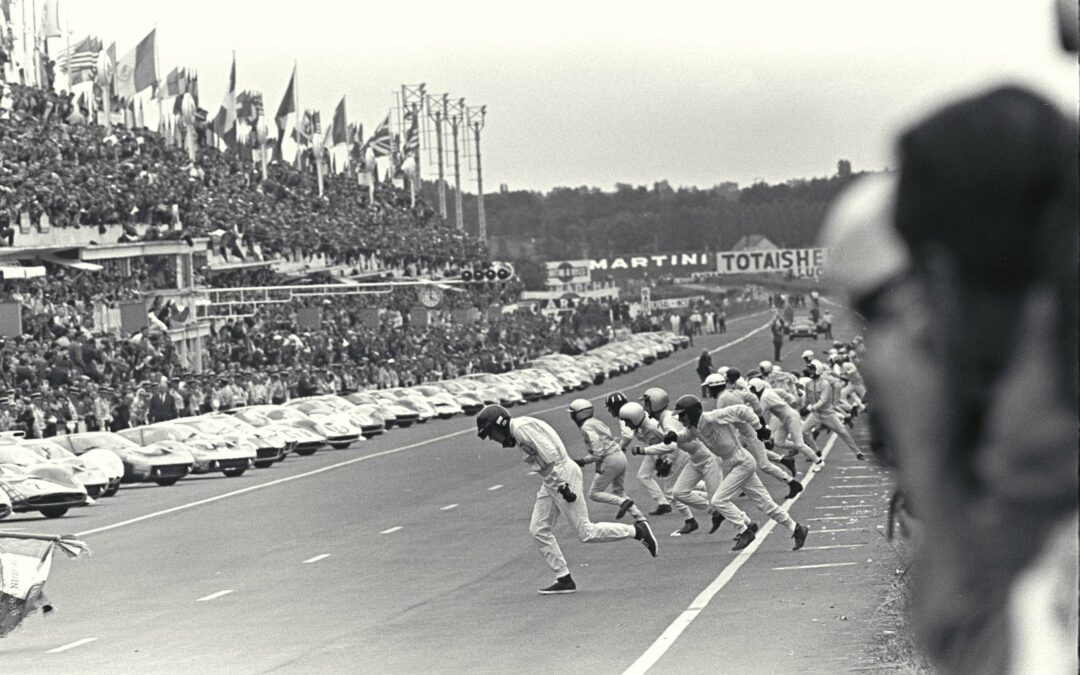
Perhaps overlooked in the Juneteenth celebrations this year was the historic win for Ford Motor at the 24 Hours of Le Mans. It was June 19, 1966, when Ford won the endurance race, placing first, second and third, according to a post at AutomotiveHistory.org.
“When the 1966 24 Hours of Le Mans came to an end on this day in 1966 it was a Ford GT40 in first, second and third place, marking the first time an American automobile won the race. With the three Mk. II Fords so far out in front.”
89th edition of the 24 Hours of Le Mans
After last year’s closed-door event, the 2021 24 Hours of Le Mans will take place Aug. 21-22 with trackside spectators. Tickets went on sale today, June 21. Learn more at the track’s website.
2021 ticket prices
Race Week General Enclosure Pass: $106.05 (€89)
Weekend General Enclosure Pass: $94.13 (€79)
Practice/Qualifying Pass (valid for Wednesday and Thursday: $58.38 (€49)
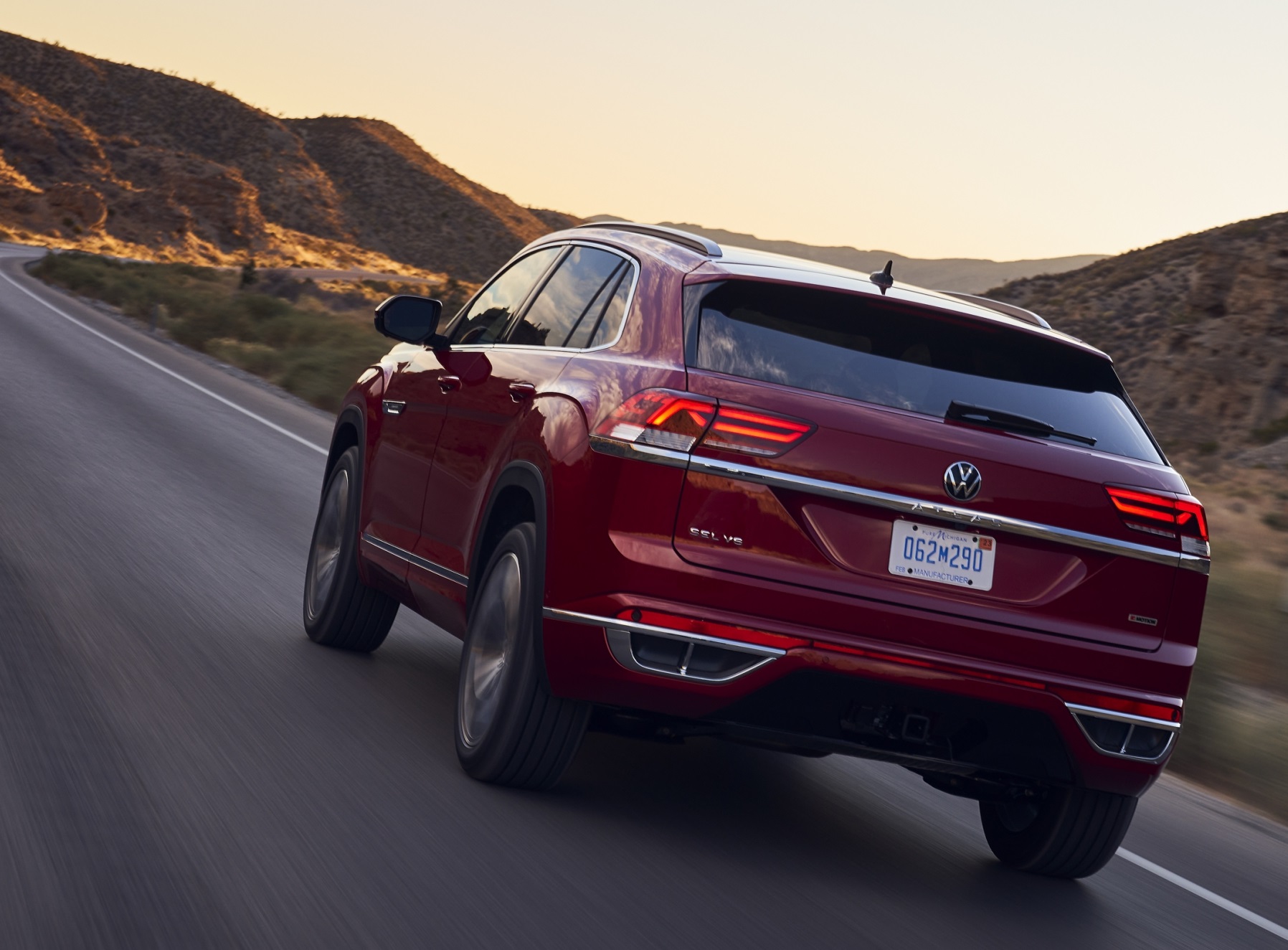
Volkswagen’s new Atlas Cross Sport shares a rich bloodline that also underpins the Lamborghini Urus, Audi Q8 and Porsche Cayenne Coupe, if not other nameplates in the VW Group global family. Consider it the sporting alter ego to the three-row, seven-passenger Atlas SUV.
Using the footprint of the family-oriented Atlas, the Cross Sport adopts a shaved roofline with a styling slant at the rear with redistributed back seat space for a long 40.4 inches of legroom.
Compared to the full-size Atlas, the Cross Sport is 5.2 inches shorter with a roofline lowered by 2.2 inches. Front headroom is still tall at 39.4 inches with a long 41.6 inches for legs. And even the cargo space is fully functional at 40.3 cubic feet behind the back seat (stacked to the ceiling) and 77.8 cu. ft. with the 60/40 back seat folded.
The cabin has broad front shoulder room of 61.5 inches and tall headroom of 39.4 inches.(VW)
New for 2021
The Cross Sport was new for 2020 and received a few technology updates for 2021. The next-generation MIB3 infotainment system with wireless app-connect and multi-phone pairing is now standard on SE models and above. And VW’s newest driver-assistance features of Travel Assist and Emergency Assist were added to SEL models and above.
Travel Assist is a semi-autonomous driving system that when activated will steer, accelerate and brake the vehicle when driving on a divided highway. The system is good at lane centering, but, as with many of these semi-autonomous systems, the vehicle will drift wide along sweeping highway corners.
The electronic Digital Cockpit (gauge display) can be configured to include the navigation map.(VW)
Atlas Cross Sport Pricing
The Cross Sport is sold in eight trim levels — S, SE, SE with Technology, SE with Technology R-Line, SEL, SEL R-Line, SEL Premium, and SEL Premium R-Line — in front- or 4Motion all-wheel drive.
Starting prices range from $32,050 for the entry front-drive model to $51,220 for the top-line V6 SEL Premium R-Line 4Motion (today’s tester); pricing includes the $1,195 freight charge from Chattanooga, Tenn. The tester, in Aurora Red metallic paint ($395), was $51,615.
The bumper-to-bumper warranty (including powertrain) of 4-years/50,000-miles includes free maintenance for 2 years or 20,000 miles.
Standard equipment on all models includes power and heated side mirrors, LED headlights-taillights-running lights, 18-inch alloy wheels, six-way adjustable driver’s seat, rearview camera, 6.5-inch color touch screen and 11 cup holders.
Find Atlas and Atlas Sport lease and financing incentives here.
The seats are Euro firm and the seat bottoms will feel hard after a couple of hours on the road.(VW)
Cross Sport Safety Features
Among the standard VW Cross Sport safety features are six air bags, forward collision warning and autonomous emergency braking. In addition, there is pedestrian monitoring, a blind-spot monitor, and rear traffic alert.
The 2020 and 2021 Atlas and Atlas Cross Sport received NHTSA five-Star overall crash safety ratings.
The 276-hp, direct-injection 3.6-liter VR6 and eight-speed automatic is rated for towing up to 5,000 pounds. (VW)
Cross Sport Powertrains
Powertrain choices are either a 235-horsepower, turbocharged and direct-injected 2.0-liter four-cylinder engine or 276-hp, direct-injected 3.6-liter VR6. Both engines are paired with an eight-speed automatic transmission.
Fellow car critics say the turbocharged 2.0-liter engine will be adequate for most needs. But those who tow will want the V-6. And there’s not much incentive to go for the four.
The 2.0-liter has fuel economy ratings of 21/24/22 mpg and nearly the same with AWD at 20/24/22 mpg.
The V-6 has EPA ratings of 18/23/20 mpg front-drive or 17/23/29 mpg AWD, using premium fuel for maximum power, but 87 octane is acceptable. In highway driving, I worked up to 24.2 mpg, but around-town mileage was typically between 15-18 mpg. The 19.5-gallon tank should provide commuters around 400 or more miles before refueling.
There is chauffeur-class appeal to the second row.(VW)
Cross Sport Interior Function
The SEL Premium cabin is well stocked with creature comforts and useful technologies, which made it easy to forgive the liberal use of black plastic in lower areas; it’s tough looking but not with a cheap finish.
The SEL’s heated seats and steering wheel have three heat settings, which I’d not seen before on a steering wheel. The e-bin on the shift console has two charging USB ports and a wireless pad, but the pad was fussy for my iPhone 8 and wouldn’t function unless I removed its official Apple cover. The deep center armrest console hides another USB port.
I bonded with the lush rotation of the electric steering and how easily I trolled the mall parking in search of a space. The official turning circle is 40.5 feet, but it seems much tighter as the big SUV curls easily into parking slots. The wide-screen camera with an overhead view is helpful when parking, but a front view would be more helpful.
There is solid assembly and contemporary styling elements to the interior, despite the liberal use of black plastic in lower areas.(VW)
Steel-slab security
There is a strong sense of steel-slab security in the architecture. There is a generous space inset from the doors, which is functional as crush space in a side impact.
Sightlines are somewhat complicated by large side mirrors and the broad base of the windshield pillars, which are good for roof-crush standards — but the mirrors can block views of vehicles and pedestrians when turning at intersections. Over-the-shoulder views are unimpeded and I had no issue with seeing out the slimmer back glass.
The e-bin on the shift console has two charging USB ports and a wireless pad, but it was fussy for my iPhone 8.(VW)
After a couple of hours on the road, the seat bottoms will feel hard — so much so that I wanted to pull the wallet from my back pocket. The driver’s seat helps compensate with 10-way power adjustment, though I would have preferred some up-and-down adjustment to the lumbar. The passenger has an eight-way power seat.
The sliding visors have large coverage and there is equally large door-panel storage, with a large, locking glove box.
The all-season, 21-inch Pirelli Scorpion Zero tires roll quite smoothly.(VW)
Ride and Handling
There is bullish durability in how solidly the Cross Sport V-6 feels on the road and yet how deftly it managed the tester’s hefty all-wheel-drive curb weight of 4,484 pounds.
It is not quick in its handling and in standard drive mode the ride quality is soft, for a German-engineered SUV, with some bounding over intersection transitions, but it is comfortable. Switch to Sport mode and the shifts become aggressive (almost too much for in-town) and the suspension tightens significantly.
Braking is solid with four-wheel disc brakes, 13.2-inch vented rotors front and 2.2-inch solid rear rotors. The all-season, 21-inch Pirelli Scorpion Zero tires (265/45) have a wide footprint and roll quite smoothly.
The long doors ease access to the second row. (VW)
Cross Sport Back Seat
There is damn-nice back-seat space accommodations that are almost too nice for children. No parent has the arm length to reach back to subdue squabbles. There is a limousine-class 40.4 inches of legroom and a slightly cropped 37.8 inches of headroom with just a low hump at the transmission tunnel. The seatbacks recline and there is generous two-level stash space in the door panels. There are a pair of vents in the rear of the console, but no fan speed or temp controls.
The back seats, which recline, have 40.4 inches of leisurely legroom.(VW)
There is lots of black plastic and the leather isn’t a showpiece but the tester’s window seats were heated and have a perforated back and cushions. The pull-down armrest has cup-can holders and there are two charging USBs and a 150-watt 115-volt household plug.
Cargo Area
There is a tall lift-up to the cargo floor, which has huge cubic footage behind the second row — 40.3 to 77.8 cu. ft. with the back seat folded. The space is 47 inches wide by 46 inches deep with a height-challenged 29 inches to the headliner.
Cargo space is 47 inches wide by 46 inches deep with a height-challenged 29 inches to the headliner.(VW)
Why Buy the Atlas Cross Sport?
Way back in the 1990s, carmakers would offer two-door versions of their midsize SUVs as the sportier variant. Those short-wheelbase models didn’t fare well in evasive maneuvers or ride quality. Today, the trend is the more rakishly styled five-door SUV variant with the sloped roof to make it look sporty. Basically, it’s an ego purchase in which the buyer pays more and gets less (space) for a still-functional format.
For $51k, the topline V-6 SEL Premium R-Line, is loaded with desirable features and details, but it is not without its quirks. Elements as simple as floor mats and a cargo area roller cover are options, $105 and $180. Its fuel economy is among the lowest among the towing-capable competitors (including the Chevrolet Blazer, Jeep Grand Cherokee, Ford Explorer or Honda Pilot), but its good German engineering is an engaging separator.
But it might not be stylistically different enough from the seven-seat Atlas to be a convincing purchase.
A top-line seven-seat Atlas SEL Premium comparably equipped to the Cross Sport tester works out to be about $1,000 less. But the seven-seater also has the option for second-row captain’s chairs ($695), which are not offered for the Cross Sport.
VW might be missing out on not offering an “Executive Black” seating format and promoting the Cross Sport as the prestigious dressed-for-success SUV.
There is bullish durability in how solidly the Cross Sport V6 feels on the road. (VW)
2021 Atlas Cross Sport V6 SEL Premium R-Line
Body style: midsize, 5-seat, 5-door AWD SUV
Engine: 276-hp, direct-injection 3.6-liter VR6 with auto stop-start at idle; 266 lb.-ft. torque at 3,500 rpm
Transmission: 8-speed automatic with 4MOTION permanent all-wheel drive with four performance modes
Fuel economy: 17/23/19 mpg city/hwy/combined; premium preferred for peak power but 87 octane recommended
BY THE NUMBERS
Fuel tank: 19.5 gallons
Cargo space: 40.3-77.8 cu. ft.
Front head/leg room: 39.4/41.6 in.
Rear head/leg room: 37.8/40.4 in.
Length/wheelbase: 195.5/117.3 in.
Curb weight: 4,484 lbs.
Turning circle: 40.5 ft.
Tow capacity: 2,000 lbs. or 5,000-lbs. with tow package ($550)
FEATURES
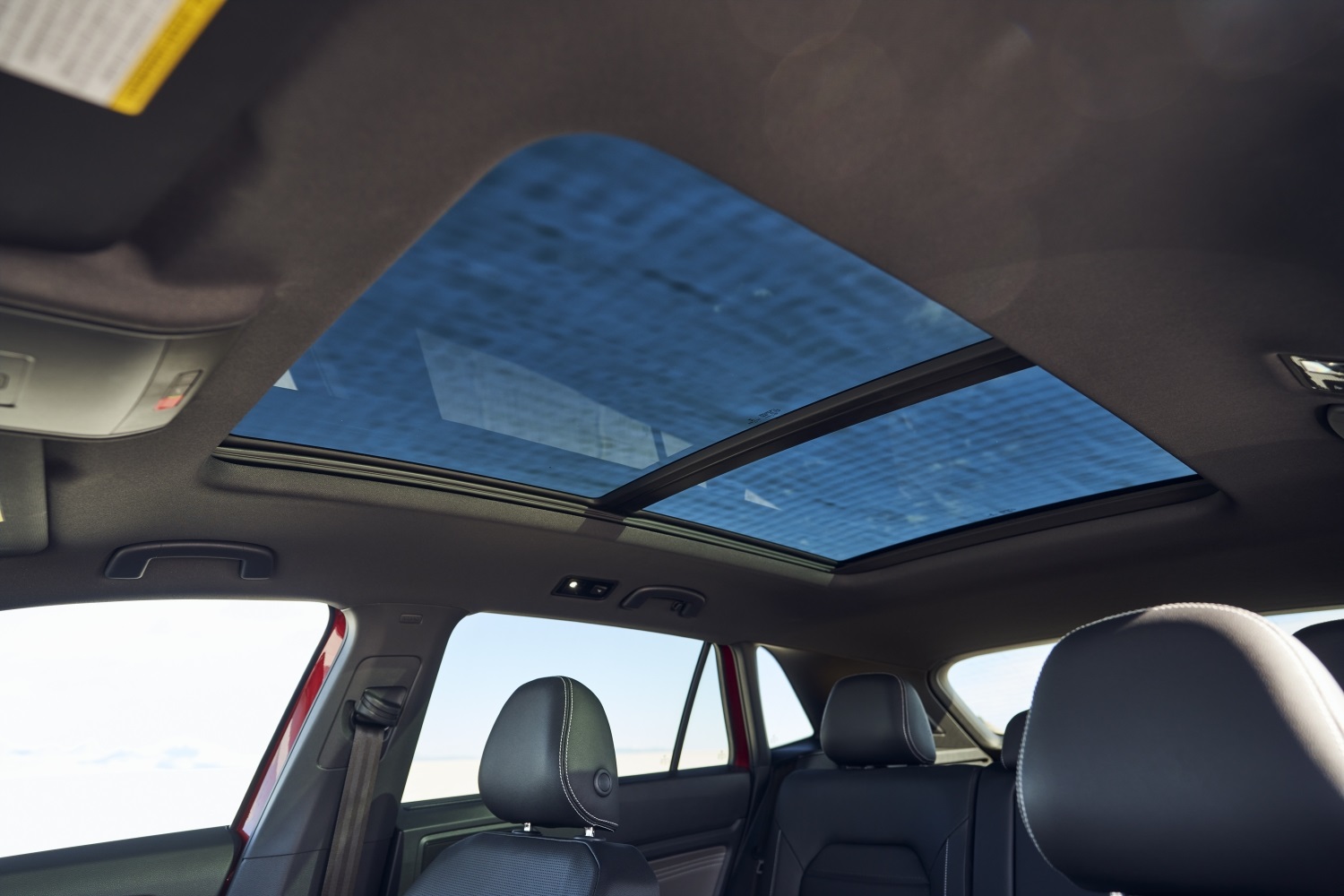
Standard equipment includes: smart-key locking and push-button ignition, power tilt-and-slide panoramic sunroof, heated and ventilated front seats, 10-way power driver’s seat, 8-way power front passenger seat, 17 cup holders, heated rear (window) seats, electric parking brake, Digital Cockpit (gauge display), power (heated) side mirrors with turn signals, Park Assist with steering assistant, park-distance control front and rear with tones, rearview camera with overhead view, 8-inch touch screen display for navigation-audio-apps, 12-speaker Fender premium audio system with satellite radio, Climatronic dual-zone cabin temperature control, e-bin with 2 USB charging ports and wireless pad, manual lift-up rear window sunshades, ambient cabin lighting, lighted and covered vanity mirrors with sliding visors, stainless-steel pedal covers, 21-inch wheels with 21-inch Pirelli Scorpion Zero tires (265/45), LED headlights-taillights-fog-running lights, trailer hitch, R-Line bumpers-badging-trim, rain-sensing wipers with heated nozzles
Safety features include: 6 air bags, engine-brake assist and electronic differential lock, hill hold and hill-descent control, automatic post-collision braking
IQ.Drive features: Travel Assist (semi-autonomous driver assist), adaptive cruise control with stop-and-go, Lane Assist lane-keeping system, semi-automated Emergency Assist, forward collision warning and autonomous emergency braking and pedestrian monitoring, Active Side assist (blind-spot monitor) and rear traffic alert
PRICING
Base price: $51,220, including $1,195 freight charge; price as tested $51,615
Options on test vehicle: Aurora Red Metallic paint $395
Where assembled: Chattanooga, Tenn.
Warranty: 4-years/50,000-miles includes the powertrain and free maintenance for 2-years or 20,000 miles.
The 2021 Chevrolet Trailblazer is a social climber in a steep segment of small SUVs. The new Trailblazer expands the perception and function of a subcompact vehicle. It makes the most of a small space and scoots around on a choice of two turbocharged three-cylinder engines.
The new model revives the nameplate previously applied to the midsize model discontinued in 2009. However, the 2021 Chevrolet Trailblazer is a fresh start throughout. It fits in the lineup between the slightly smaller Chevy Trax and compact-class Equinox. It also shares much with the Buick Encore GX. While the Encore is a more “premium” choice, the Trailblazer is “sporty” with optional all-wheel drive and an Activ trim level that is toughened up for some trail driving.
Competitors include the Honda HR-V, Hyundai Kona, Jeep Renegade, Mazda CX30, Nissan Kicks, and Toyota C-HR.
The upright cabin design feels roomy, for a subcompact. (Chevrolet)
The 2021 Chevrolet Trailblazer is sold in five trim levels in front- or all-wheel drive: L, LS, LT, Activ and RS. The RS has street-sporty features of black trim elements, a black mesh grille and dual exhaust outlets with chrome tips. The Activ is burlier with 17-inch all-terrain-styled tires, a raised lower section for ground clearance, and underbody skid shields.
All front-drive models have a continuously variable transmission and 137-hp, turbocharged and direct-injected 1.2-liter Ecotec three-cylinder engine. Upgrading to AWD adds the nine-speed automatic and the 155-hp, 1.3-liter engine.
Driver controls are large and easily viewed. (Chevrolet)
2021 Chevrolet Trailblazer Pricing
Starting prices for front-drive Trailblazer models range from $19,995 to $24,695, including the $995 freight charge from Incheon, South Korea. The L and LS models are basic runabouts and couriers but ideal for the task with a large cargo area, a tall 40 inches of headroom, and a folding back seat; the L is available only in white paint with a black interior and 16-inch wheels with wheel covers.
At the time of this posting, there was a customer-cash incentive of $550 applied when building the 2021 Chevrolet Trailblazer online. Find current pricing incentives here for all Chevy models.
The seats are full-bodied and supportive. (Chevrolet)
Standard Trailblazer Features
The LT, RS, and Activ will have the desirable convenience and audio features expected of a car costing $26,000 and up. The RS and Activ with AWD and 1.3-liter engine start at $27,445. The Activ AWD tester was $32,995 with all three of the major packages, plus $645 for Iridescent Pearl Tricoat paint and Zeus Bronze metallic roof. (There are six other no-charge paint colors, including a non-metallic white and five metallic hues, including Blue, Dark Copper, and Zeus Metallic.
Standard equipment on the Activ includes smart-key locking and push-button ignition, 10-way power driver’s seat with lumbar, leatherette upholstery and leather-wrapped steering wheel, flat-folding front passenger seat, power (manually folding) side mirrors, LED taillights-foglights-running lights, IntelliBeam (auto-dimming) headlights, power windows, 60/40 folding back seat, rear center armrest, 17-inch sport-terrain tires and alloy wheels and underbody skid plates.
The Sun and Liftgate package, $1,770, includes a dual-pane panoramic sunroof. (Mark Maynard)
Safety features include 10 air bags with advanced technologies for Automatic Emergency Braking, Front Pedestrian Braking, Lane Keep Assist with Lane Departure Warning, Forward Collision Alert, Following Distance Indicator.
It is the option packages that run up the price, and the tester’s $33,000 sticker seemed plenty — but it created a car to enjoy for the long term.
The interior materials are of appealing quality, the design is contemporary, and so are the infotainment options. Among its clever features is a fold-flat front passenger seat, which will allow boards and gear up to 8.5 feet long. The four-wheel-disc brakes, 12.6-inch front, and 11.3-inches rear should be adequate for its 1,000-pound tow rating. And the Trailblazer can be dolly-towed behind a motor home.
Powertrain
I have not driven a 2021 Chevrolet Trailblazer with the 1.2-liter engine, but pulling around a 3,030-pound SUV with a 135-hp three-cylinder and CVT could be an experience of underpowered frustration of turbo spooling and CVT rubber-banding.
There’s not much of a fuel economy advantage, either. Front-drive models are rated for 28 mpg city, 31 highway, and 29 mpg combined on the recommended 87 octane. The 1.3-liter has mileage ratings of 29/33/31 mpg or 26/30/28 mpg with AWD.
The “big” engine has more force than you might imagine from a 1.3-liter, and the nine-speed automatic easily manipulates the engine’s 174 foot-pounds of torque from a reasonably low 1,600 rpm. Using sport mode can sharpen launch force and shift points, but I zipped around in the standard mode. My average fuel economy ranged from 21.3 to 34.3 mpg.
Compared to a four-cylinder, there is a little more engine vibration at idle, but it’s not concerning. And there is a more abrupt start-up after a stop-start at idle.
An impressive 155-hp from three turbocharged cylinders. (Mark Maynard)
Interior Function
The Trailblazer is a small SUV and will limit access to some drivers of the big-and-tall club, but front headroom of 38 inches, with the sunroof and legroom of almost 41 inches, will accommodate many in the height range of 6 feet.
A roomy back seat area has a long 39.3 inches of legroom. (Mark Maynard)
Sightlines are unobstructed over the hood, at the side mirrors, and over the shoulder. The turning circle of 37.3 feet is a little wide but not unwieldy in tight parking —and the wide rearview camera is empowering in tight parking situations.
The driver area is well-designed for the modern driver. The controls are large and easily viewed, and there are several areas for small-item storage. The shift console integrates a handy e-bin with wireless charging and two USB charging ports, one Type C.
It’s a tall lift to the two-level cargo floor. (Chevrolet)
Fold the 60/40 seatback for about 8.5 feet in length. (Chevrolet)
Ride and Handling
The Hankook tires look the part for off-roading but feel hard on the highway. (Mark Maynard)
The Trailblazer feels robust and durable, not dainty, with a trail pass for light-duty excursions. On road, the ride quality is sporty-firm but not rough, though there is head-toss when transitioning driveways or speed bumps.
The Hankook Dynapro AT2 (225/60) tires, with their all-terrain sidewall blocks and a hard 660 treadwear rating, can be noisy on concrete highways and you will feel every little seam. But a hard tire benefits fuel economy and the tires have a tread-life warranty of six years or 60,000 miles.
Why Buy the Chevrolet Trailblazer?
The Trailblazer is a puddle-jumper of fun, whether whomping along busted American streets or scrambling to a trailhead. It might be marketed to young drivers, but mature drivers will value the ride height, roomy cabin and range of conveniences and comfort features.
I liked the fold-flat front seat, two-level cargo floor, and the latest in device-charging ports.
Several of the subcompact SUVs sold in the U.S. have been sourced from global or Asian markets. And some of them aren’t always well retrofitted or redesigned for how American drivers prefer their vehicles. The 2021 Chevrolet Trailblazer was developed by GM Korea, and it seems to be a pure translation for an American audience, at least on the higher trim levels.
The 2021 Chevrolet Trailblazer can be dolly-towed behind a motor home. (Chevrolet)
2021 Chevrolet Trailblazer Activ AWD Specifications
Body style: subcompact, 5-seat, 5-door SUV crossover, with AWD
Engine: 155-hp, 1.3-liter direct-injection, turbocharged 4-cylinder with auto stop-start at idle; 174 lb.-ft. torque at 1,600 rpm
Standard equipment includes: smart-key locking and push-button ignition, 10-way power driver’s seat with lumbar, 4-way manual front passenger seat, leatherette upholstery and leather-wrapped steering wheel, flat-folding front passenger seat, power (manually folding) side mirrors, LED taillights-foglights-running lights, power windows, 60/40 folding back seat, rear center armrest, 17-inch sport-terrain tires, and alloy wheels and underbody skid plates
Safety features include: 10 air bags, Automatic Emergency Braking, Front Pedestrian Braking, Lane Keep Assist with Lane Departure Warning, Forward Collision Alert, Following Distance Indicator, IntelliBeam (auto-dimming) headlights
PRICING
Base price: $27,995, including $995 freight charge; price as tested $32,995
Options on test vehicle: Iridescent Pearl Tricoat paint $645; Sun and liftgate package, $1,770, adds a power dual-pane sunroof and hands-free power liftgate with LED logo lighting; Technology package, $1,620, includes wireless Apple CarPlay or Android Auto connectivity, wireless charging, adaptive cruise control, LED headlights, 7-speaker Bose audio system, HD rearview camera; Convenience package, $620, includes automatic air conditioning, auto-dimming rearview mirror, sliding visors with lighted and covered mirrors, a 120-volt power outlet, back seat charging USBs (A and C); Driver Confidence package, $345, adds rear park assist, rear cross-traffic alert and lane-change alert with side blind-zone alert
Where assembled: Incheon, South Korea
Warranty: 3-years/36,000-miles bumper to bumper with a free first scheduled maintenance; 5-years/60,000-miles powertrain and roadside assistance with courtesy transportation
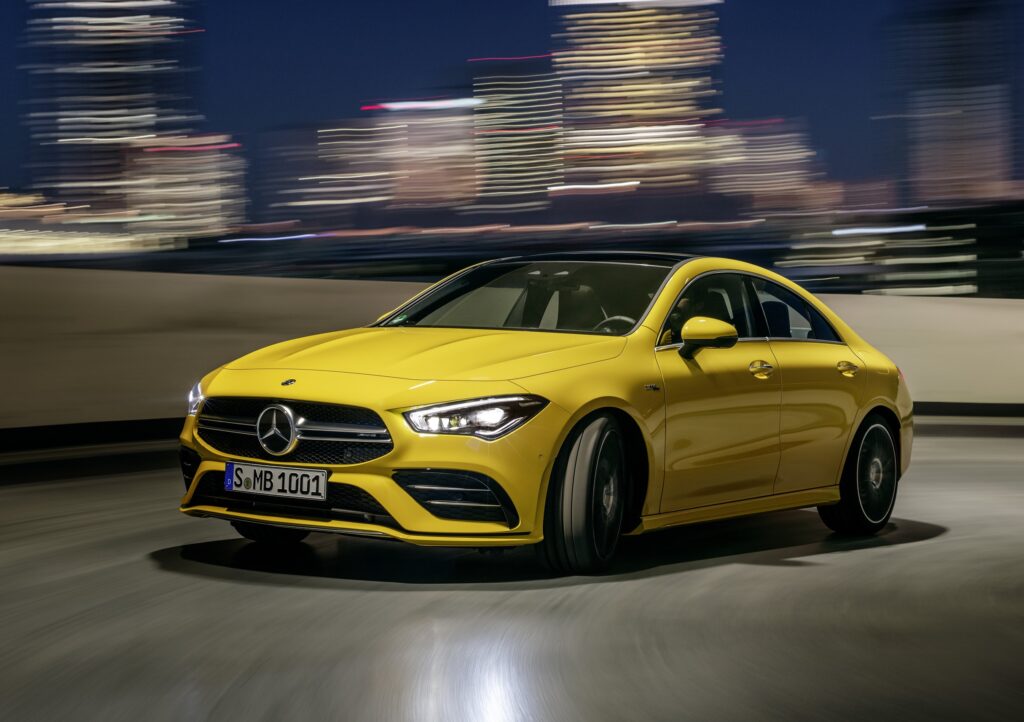
The Mercedes-AMG CLA 35 has a starting price of $47,895 for the performance-tuned 302-hp, 2.0-liter. As equipped, the Sun Yellow tester was $61,335. (Mercedes-AMG)
Strategic precision in a compact four-door “coupe”
BY MARK MAYNARD
Highland Valley Road is a tangled black shoelace of two-lane country road in northeastern San Diego County. It’s a favorite for car-club runs and leisure drives to get some fresh air. The meandering road leads past acres of growing land for landscape nurseries and pine-tree farms before ascending to an area of vineyards and wineries. Mature scrub oaks form shaded canopies along stretches amid a background of boulder-strewn mountainscapes.
The road is unforgiving of reckless driving but a strategic 13 miles or so with blind corners, decreasing radius turns and rollercoaster drops and rises. (Midday and midweek will have the lightest traffic.)
In this environment, the compact Mercedes-AMG CLA35 carves the road with surgical precision. The fortified focus of Sport and Sport-plus modes opens the pipes, tightens the shift points and lets the horses run. The 302-horsepower, AMG-enhanced turbocharged 2.0-liter four-cylinder pulls with breathy force, digging into its 295 foot-pounds of torque from 3,000-4,000 rpm.
The seven-speed AMG Speedshift transmission, a dual-clutch automated manual, clicks off sequential shifts with Formula One intensity. And the variable 4Matic all-wheel-drive system provides the push-back of rear-wheel drive and in aggressive cornering lays down a quick and consistent pull to redline. Mercedes-AMG cites 0-60 mph in an estimated 4.6 seconds — it just feels quicker. A hard launch brings a bristling response.
The driver area is centered by a widescreen layout of HD graphic displays. (Mercedes-AMG)
About the CLA
The compact-class CLA is now in its second-generation after a major update in 2019 for the 2020 model year. Launched in 2013, it was the first compact Mercedes sold in the U.S. and its first front-wheel-drive model.
Because of its arching roofline Mercedes refers to the CLA as a four-door coupe — and it feels the part with its frameless door glass and a cockpit driver area.
With seats for five, it was intended to be a segment disruptor with appeal for its sporty lines, which Mercedes-Benz says pulled many younger buyers from competitors. On average, CLA customers in the U.S. are around 10 years younger than the brand’s typical buyer, the company says.
Sizewise, the CLA slots above the subcompact A-Class, the brand’s smallest and less-expensive sedan, and below the midsize C-Class.
The redesigned CLA is 2 inches wider and almost 2 inches longer and a whisker lower on a wheelbase stretched 1.1 inches, now at 107.4 inches.
The styling is more cohesive now and smoother with a GT stance ready to pounce. The revised size is especially notable in the front seats with 38.5 inches of headroom, legroom of almost 42 inches and more shoulder room. Back-seat width is now family-class comfortable with more legroom (33.9 inches). Trunk space is down but still wide and roomy at 11.6 cubic feet. And the trunk opening was made 10.3 inches wider.
With the gear shift lever relocated as a stalk on the steering column, the center console was freed up for functional space to include a charging bin, deep cup holders and a touch pad for cabin or performance controls. (Mercedes-AMG)
Pricing
The CLA is sold as the CLA 250 in front-drive or 4Matic all-wheel drive with high-performance versions in the AMG CLA 35 (today’s tester) and the AMG 45.
All models have versions of a turbocharged 2.0-liter turbocharged four-cylinder engine and seven-speed dual-clutch automatic transmission. Pricing starts at $36,650 for the 221-hp CLA 250 or $38,650 with 4Matic AWD.
The 302-hp AMG CLA 35 starts at $46,900 and the CLA45 (382-hp and 0-60 mph in 4 seconds) at $54,800. The CLA35 tester was $61,355 with options, including the $995 freight charge from Kecskemet, Hungary.
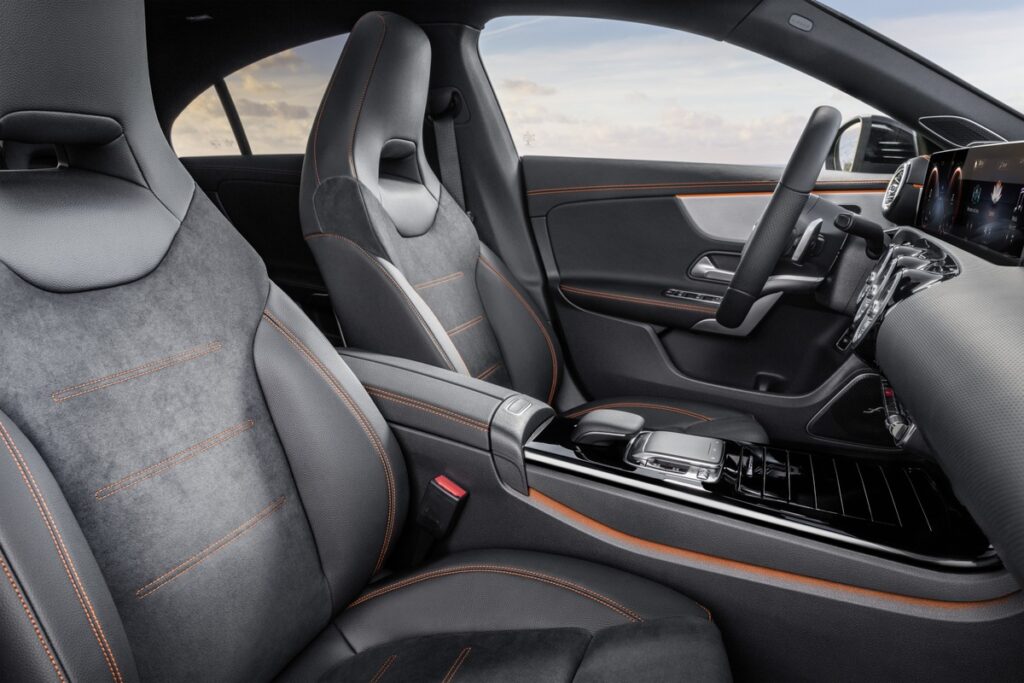
Recaro sport seats in MB-Tex and microfiber Dinamica are available in black with red contrasting stitching and red seat belts or black and digital gray in MB-Tex leatherette. (Mercedes-AMG)
Cabin features
The cabin is dressed to impress with MB-Tex leatherette and Dinamica microfiber upholstery and contemporary materials and trim. Recaro sport seats in front are power adjustable with lumbar and a manual thigh extension.
The flat-bottom, three-spoke AMG steering wheel also functions as an alternate desktop, with thumb controls for navigation, audio and phone a touch-sensitive button to scroll through various screens of information. (Mercedes-AMG)
Sightlines are open and there is enough cabin width to smartly place all controls. The functional center floor console integrates a forward e-bin for wireless or corded phone charging, a pair of deep cup holders and a touch pad to page through the various vehicle systems. It has a steady haptic touch and its use becomes relatively intuitive after a couple hundred miles into ownership. Gear engagement is by a stalk on the steering column.
The flat-bottom, three-spoke AMG steering wheel ($500) wrapped in Dinamica fits sweetly in the hand and also functions as an alternate desktop. The left arm groups cruise control and autonomous drive features. The right arm gives redundant access to navigation and phone. And both groups have a touch-sensitive thumb button to scroll through various screens of information.
Trunk entry is 10.3 inches wider now and the luggage space is large for a compact car at 11.6 cubic feet. (Mark Maynard)
Digital widescreen
The cabin is highly electrified with a widescreen-cockpit presentation to facilitate the Mercedes-Benz User Experience — MBUX. The driver faces a 10.25-inch-wide digital gauge array with a choice of configurations for a traditional layout, a supersport mode or a muted presentation. Supersport focuses the performance with a central, round rev counter and other information in graph bars to the left and right. Via the AMG menu, the driver can call up various special displays such as Warm-up, Set-up, G-Force and Engine Data.
Cabin controls are accessed by another 10.25-inch touch-screen display with voice control or even hand gestures. The “Hey Mercedes” keyword for voice control has been refined to focus on the driver and to filter out other conversations in the cabin.
There also is a tier of manual controls for often-used adjustments, such as fan speed, temp and air flow, plus a console controller for audio volume.
Cabin controls are accessed by the 10.25-inch touch-screen display with voice control or hand gestures. (Mercedes-AMG)
Drivability
AMG puts a fistful of secret sauce into that turbocharged 2.0-liter to wring out 302-hp (or the CLA 45’s 382-hp), when the base engine has a capable 221-hp.
I like that the CLA 35 experience is not all ate-up with horsepower, which can blow past the pleasures of feeling the suspension transition through cornering and how the transmission holds gears through the esses and uphills.
The structure of the car feels tight and nimble, which makes it accommodating for throttle-steering with the accelerator pedal. The roll-on of acceleration is visceral but balanced. Downshift into a corner to raise the revs and then push the nose out a bit or pull it back by subtle lifting. The refined control will make you smile.
The AMG-enhanced 2.0-liter four-cylinder has 302 horsepower that will propel the 3,505-pound CLA35 to 60 mph in 4.6 seconds. (Mercedes-AMG)
Around town, there will be a delay in forward motion as the turbo spools and the dual-clutch engages, but Sport or Sport-plus modes will cut the delay when powering up. The auto stop-start at idle function can be cancelled.
Braking, is immediate but measured for absolute control without grab or lunge. A hard response is flat and composed. The front brakes have four-piston, 13.8-inch vented rotors, backed by single piston, 13-inch vented discs rear.
Even with the bigger brake discs and AMG upgrades, the curb weight is up just 22 pounds compared with a CLA 250 4Matic. Fuel economy estimates are 23 mpg city, 29 highway and 25 mpg combined on the recommended premium fuel.
The tester was optioned with 19-inch matte black AMG wheels ($800) and Michelin Pilot Sport 4S tires (245/35) with a ZR rating. The tires are very sticky with a 300 treadwear rating and resisted squeals of complaint in my backcountry run.
The AMG Ride Control suspension, a worthy $850 upgrade, has three firmness control modes. The Comfort setting can be too firm for the non-enthusiast, but Sport and even Sport-Plus, give impressive turn-in and control.
The tester was optioned with 19-inch matte black AMG wheels ($800) and Michelin Pilot Sport 4S tires (245/35) with a ZR rating. (Mercedes-AMG)
Semi-autonomous driving
New in the redesign is the option for semi-autonomous driving. Using map and navigation data for assistance, elements of the Driver Assistance Package ($2,250) allow the CLA to steer, stop, brake and resume speed, in certain highway configurations — and with the driver’s hands on the wheel. The system functioned with precision to keep the car centered in the lane, while many systems are less precisely calibrated, which will allow the car to wander before a correction is made.
The package adds active brake assist with cross-traffic function, Active Distance Assist Distronic, active steering assist, active blind-spot assist, active lane keeping assist, active lane assist, active speed limit assist, active emergency stop assist, evasive steering assist, Pre-Safe Plus, Route Based Speed Adaptation, and extended restart in stop-and-go traffic.
Active speed limit assist is useful to automatically adapt the car’s speed to an identified speed limit. I discovered this while on the Interstate and was driving through a construction area that was to the far right in merging lanes. When I drove past the reduced speed sign of 55 mph, the cruise control immediately dropped my set speed to 55 mph from 69 mph. And we all know that speeding fines are increased in construction zones.
New in the redesign is the option for semi-autonomous driving using map and navigation data for assistance that allow the CLA to steer, stop, brake and resume speed, in certain highway configurations. (Mercedes-Benz)
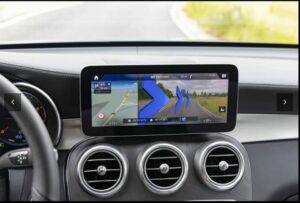
Augmented Video/Reality for Navigation is a hand-holder to guide the way, with blue arrows pointing to the destination. (Mercedes-Benz)
The effect of Route Based Speed Adaptation is the eye in the sky of GPS and the adaptive cruise control system. The system uses map data ahead to reduce speed in anticipation of curves, junctions, roundabouts, toll booths, exit roads, etc.
And for the directionally challenged — even when using a navigation system — the Augmented Video/Reality for Navigation feature is a hand-holder to guide the way. When using the navigation system, a camera in front of the rearview mirror captures a video image of the surroundings and displays arrows or house numbers onto the image in the media display screen. The helpful blue arrows point the way to a street or house number, traffic signs or street names.
And when stopped at a traffic signal, the system uses the front camera to display live video of the intersection on the center screen. It helps the driver see if anyone or anything is in the crosswalk.
Standard safety features include eight air bags, hill-start assist and brake-hold function, crosswind assist and attention assist, for driver awareness.
Why CLA35?
The CLA 35 can be as hands-on or as hands-off as the driver desires. Hands-on was my preferred mode — and none of the assist systems got in the way of a good time.
But if $60K as-tested is too rich for the budget, the same powertrain option and engineering are also available in the subcompact AMG A 35 sedan, starting at about $45,000, and it has access to all the options and upgrades of the CLA 35.
Because of its arching roofline Mercedes refers to the CLA as a four-door coupe — and it feels the part with its frameless door glass and a cockpit driver area. (Mercedes-AMG)
2020 Mercedes-AMG CLA 35 4Matic Body style: compact, five-seat, four-door coupe with variable torque AWD Engine: 302-hp, AMG-enhanced turbocharged 2.0-liter 4-cylinder with cancellable auto stop-start at idle; 295 lb.-ft. torque from 3,000-4,000 rpm Transmission: 7 speed AMG Speedshift dual-clutch automated manual 0-60 mph: 4.8 seconds, estimated Fuel economy: 23/29/25 mpg city/hwy/combined; premium fuel
SPECIFICATIONS Fuel tank: 13.5 gal. Trunk space: 11.6 cu. ft. Front head/leg room: 38.5/41.8 in. Rear head/leg room: 35.7/33.9 in. Length/wheelbase: 184.8/107.4 in. Curb weight: 3,505 lbs. Turning circle: 37 ft., estimated
FEATURES Standard equipment includes: Keyless Go locking with push-button ignition, panoramic sunroof, M-B Tex leatherette upholstery, electric parking brake, rearview camera, 10.25-inch touch-screen display, 10.25-inch digital gauge array, power front seats with lumbar and memory presets, Apple CarPlay or Android Auto Bluetooth connectivity, 40/20/40 folding back seat, LED headlights and taillights AMG 35 special features, include: Speedshift 7-Speed (dual clutch transmission with performance 4MATIC AWD, sport suspension, sport exhaust, 3-stage electronic stability program, Recaro sport seats with integrated headrests and metal-trimmed pedals
Safety features, include: 8 air bags, active brake assist, adaptive braking with hill-start assist and brake-hold function, crosswind assist, attention assist (for driver awareness)
CLA 35 competitors: Audi S3, BMW M240i xDrive; front-drive CLA models compare to the BMW 2-series and Acura ILX
PRICING Base price: $47,895, including $995 freight charge; price as tested $61,335 Options on test vehicle, included: AMG performance steering wheel in Nappa leather and Dinamica $500; 19-inch AMG matte black alloy wheels $800; Parktronic with advanced parking assist $970; AMG ride control sport suspension $850; satellite radio trial subscription $460; Burmester surround-sound audio $850; wireless charging $200; rear side air bags $420 (with a one-time $250 special order fee);
• Driver assistance package, $2,250, includes active brake assist with cross-traffic function, active distance assist Distronic, active steering assist, active blind-spot assist, active lane keeping assist, active lane assist, active speed limit assist, active emergency stop assist, evasive steering assist, Pre-Safe Plus, route based speed adaptation, extended restart in stop-and-go traffic;
• Multimedia package, $1,150, includes navigation and services, including map updates for 3 years, MBUX augmented reality for navigation and speed-limit assist;
• AMG Night package, $750, includes front splitter, grille trim and louvres in outer air intakes, AMG side panel inserts, beltline and window line trim strips in gloss black, black side mirrors and tailpipe trim;
• Performance seat package, $3,270, includes multicontour, heated Recaro seats
Where assembled: Kecskemet, Hungary Warranty: 4-years/50,000-miles bumper to bumper with roadside assistance
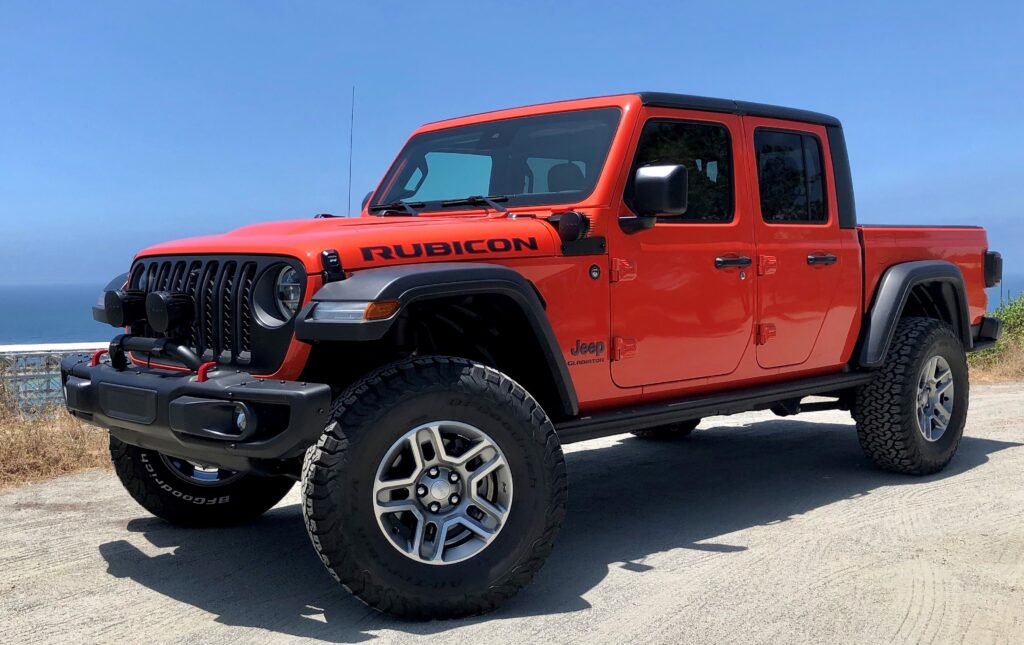
Starting at $45,370, the Jeep Gladiator Rubicon is the pinnacle of Trail Rated features for adventuring. But the Manufacturer’s Suggested Retail Price of a new vehicle is as vague as a stoplight in Boston — a suggestion, at best.
To spark some red mist for the buyer — while ratcheting up the cost — manufacturers have aggressively pursued their catalogs of personalization and performance accessories. If you can imagine it, it’s probably offered or will be.
A 2-inch lift kit, $1,495, to add bigger tires and wheels.
Jeep and Mopar have been masterful at providing factory-sanctioned upgrades that can be ordered with their new Jeep. And the upgrades are covered by the same new vehicle warranty protections.
Most new luxury cars or SUVs are bought with $10,000 in options or packages. And sometimes a package alone is $10,000, or more.
Fox 2.0 performance shocks are standard equipment on the Rubicon.
From unique paint colors to better leather, bigger wheels, lower-profile tires, crests, badges, colored seat belts, more gratuitous performance, LED lighting, and techno-marvelous infotainment systems to extended warranties, what the customer wants, the customer gets … for a price.
Jeep has long been a champion of choice with several versions of four-wheel-drive systems, soft and hard tops, street tires or adventure treads, audio and style perks.
And then there’s the Mopar catalog with more than 200 accessories. Mopar (MOtor PARts) is the parts, service, and primary accessory seller for Stellantis brands under the Mopar brand.
Katzkin leather seats, $1,750.
Jeep Performance Parts
Jeeps are basically a canvas and Jeep Performance Parts are the buyer’s paints for personalization. So far, there are 200 Mopar products available for the Gladiator.
I’ve just tested a Jeep Gladiator Rubicon, the top-line off-roader, that had $12,400 in Jeep/Mopar performance parts.
Rearview camera and front-facing trail cam, $595.
At $45,370 the Gladiator Rubicon is the pinnacle of Trail Rated features, including the 4:1 Rock-Trac heavy-duty four-wheel-drive system (with an Off-Road Plus mode), locking front and rear axles, disconnecting front stabilizer bar, steel rock rails, and an appetite for adventuring.
For those serious about getting there and back in demanding off-road adventures, this is the rig to consider. But access doesn’t come cheaply.
Decked truck-bed storage system, $1,295.Tri-fold hard tonneau cover, $950, and spray-on bedliner, $495.
With the Jeep Performance upgrades, by Chrysler FCA’s Mopar performance division, the tester had a sticker of $58,955, including the striking Punk’n Metallic paint ($245).
But there is a reprieve when buying new. The performance parts have the same basic, limited warranty as the vehicle — 3-years or 36,000-miles — and they can be rolled into the financing (with the cost of labor for parts installation).
Jeep-logo hood latches, $60.
The Jeep Gladiator Rubicon tester is a formidable pickup that includes city features. Commuters will value the adaptive cruise control with idle stop-and-go function in traffic and full-speed collision warning.
And this wide rig with a 44.8-foot turning circle benefited from the Jeep Active Safety Group, $895. The package adds blind-spot and cross-path detection and ParkSense rear park-assist system, which alerts to the nearness of an object.
Set of two 7-inch LED off-road lights, 8,000 lumens each, $725.Set of two 5-inch LED off-road lights, 4,800 lumens each, $475.
The 8.4-inch Uconnect infotainment touch screen is an upright and visible display for the rearview camera, with guidance lines. But it’s even better for the front-facing trail cam, $595.
JPP accessories
The tester also included $12,400 JPP accessories for:
A 2-inch lift kit lift, $1,495. Created by Jeep engineers and Fox shocks so owners can add bigger tires and wheels.
Military-grade 7-inch off-road LED lights, $725 two-light set. The lights have an 8,000-lumens output, each. Mounting brackets, $65
Tires. Mopar/FCA dealers have a “TireWorks program” that gives access to different tire brands. The dealer can source whatever brand, model, and size (up to 35 inches) the customer prefers depending on their intended use — whether on-road, off-road or a combination.
Black satin grille, $325
Heavy-duty rock rails, $950. To help slide across objects with high-centering potential. The heavy-gauge steel rock rails are thicker and wider than stock in a non-slip powder-coat finish.
Tri-fold tonneau system, $950.
Bed storage system, $1,295. A heavy-duty pair of lockable, sliding drawers (200-pound capacity) to secure gear, supplies and tools.
Seatback Molle design storage bags, $145 set of three.
Katzkin leather seats, $1,750. Embroidered with Jeep grille logo in Tungsten stitching.
Mopar grab handles, $39 each for first and second rows. hard-secured for increased grip.







 The 2021 Chevrolet Trailblazer can be dolly-towed behind a motor home. (Chevrolet)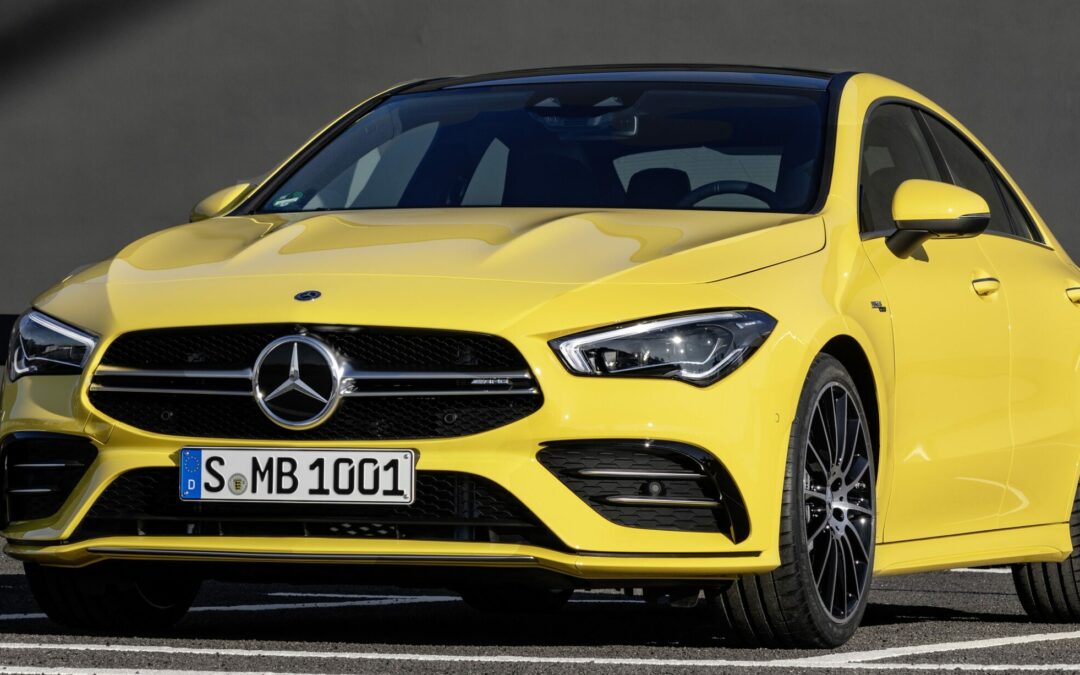








 Pedal kit, $105. All-weather (slush) floor mats, $165.

