Select Page

8 Generations of the Golf GTI

8 Generations of the Golf GTI
A graphic sketch timeline of the eight generations of the VW GTI

(All photos courtesy VWoA)

BY MARK MAYNARD

Volkswagen didn’t know it at the time, but when it debuted the first Golf GTI in 1976 it was like tossing a lighted match to gasoline — the hot-hatch segment of sporty front-wheel-drive compact cars was born.

TV advertising taunted performance enthusiasts with the German-tinged tune of “Little GTI,” their remake of the iconic “Little GTO,” by Ronnie and the Daytona’s. And with the “Fly GTI” ad campaign, an image was seared into American consciousness that fun cars did exist in the age of increased emissions standards and rising fuel prices.

The Golf GTI — now in its eighth generation — created a worldwide, cult following. Originally, 5,000 units had been planned, but sales of the Golf GTI Mk1 totaled 461,690 units.

Though Volkswagen ended Golf production for the U.S. this year, it will preserve the GTI fan club. The Golf family name will carry on in model year 2022 with the introduction of the all-new Mk 8 Golf GTI and Golf R, arriving this Fall.

In tribute to its survival, VWoA released today for #TBT this visual DNA of the GTI and how the car has developed over the past half century. Commentary is provided by Marco Pavone, head of exterior design for the new Golf GTI.

Golf GTI Mk 1

The first generation VW Golf GTI

An everyday talent with a dash of “brutishness” – all signs of the revolutionary design concept of the first Golf GTI.

The original GTI hit the scene in Europe in 1976, full of confidence, sporting a front grille with a red border and a simple design. The inside of the black radiator grille on the original GTI features 11 thin horizontal lines. The headlights, protruding from under the hood of the lightweight compact car, form the external end points. The early GTI can be identified by the narrow bumper that was replaced by broader, plastic-covered bumpers in 1978. The first GTI emblem is chrome and intentionally presents a stark contrast with the black Volkswagen logo. “Even with the original GTI, all the design elements already reflect a clear attitude,” says Pavone.

Golf GTI Mk 2

The Golf GTI Mk 2

The second generation of Golf GTI has a more aggressive look: the side, in particular, gives it a more “broad-shouldered” appearance.

“The design of the second-generation Golf GTI is a fascinating development,” says Pavone. Initially sporting twin headlights, like its predecessor, the 16-valve version of the second-generation GTI came with integrated fog lights from 1988 — each located next to the headlights. The grille is still outlined in red, while the bumper itself also features a red GTI line. Under this, for the first time, comes an additional air intake. On the whole, the design continues the conceptual course of the first generation: it is larger, wider and more comfortable. The Volkswagen logo remains black.

Golf GTI Mk 3

The third generation Golf GTI Mk 3

The improved comfort is clear to see from the third GTI. For the first time, the front spoiler and radiator grille are the same color as the car.

The third GTI is somewhat softer and has even more of a wedge shape. “This backs up the sporty character of the Golf GTI,” Pavone says. The front features a striking modification: the double headlamps of the second-generation GTI disappear under a combined diffuser lens, replaced by a collective diffuser. They give the radiator grille, which now consists of just three thick horizontal bars, a narrower appearance. The front spoiler is finished in the same color as the car, and is once again lowered and broader. This lower area also features a split air intake, which becomes a typical feature of generations 4 through 6. Another new feature is the striking red line below the halogen lighting unit, while the GTI emblem, now in red, is moved closer toward the chrome Volkswagen logo, which is now in chrome.

Golf GTI Mk 4

The Golf 4 GTI set new benchmarks in terms of individuality

The Golf 4 GTI set new benchmarks in terms of individuality, quality and speed, says design chief Marco Pavone.

“Launched in 1998, the Golf 4 GTI has a more modest appearance. For example, it is the first and only GTI not to sport the red stripe on the radiator grille. And yet the model is celebrated to this day as the starting point for a new, clean era of vehicle design. It also set new benchmarks in terms of individuality, quality and speed,” says Pavone. From the designer’s perspective, the European 25th-anniversary edition was particularly striking. “It was thanks to that model that I was bitten by the GTI bug,” says Pavone, who was born in Brazil. “The brilliant clear-glass headlights and wide sills were particularly distinctive!”

However, even in the production GTI, the lighting units (including the turn signals and fog lights) were installed in a compact module. The front and rear aprons, side sills and roof-edge spoilers were painted the same color as the car itself, while many elements were once again broader than those of its predecessor. The GTI logo shifted from the right to the left for the first time.

Golf GTI Mk 5

Generation 5 of the VW GTI

GTI No. 5 saw the iconic honeycomb pattern introduced to the sports compact from Wolfsburg for the first time.

“The design of the fifth-generation GTI is once again far more self-contained and takes inspiration from the first GTI,” says Pavone, describing the development. This is particularly clear from the red trim around the radiator grille. One new and emotional style element is the honeycomb design of the grille: Pavone says, “Even today, it is still hard to imagine a GTI without it!”

The round twin headlights are back, grouped in a unit behind dark glass. Just like its ancestor, the fog lights are located low down in the front apron.

Golf GTI Mk 6

The Mk 6

A throwback to the original GTI, directed by two parallel red GTI lines, sharper edges and new, black fins in the front apron.

The sixth generation of the Golf GTI transported the tradition of the original version into the future. Two fine red trim lines run across the grille and link the bi-xenon headlamps. The spoiler is now adorned with striking air intakes with three sharp fins on each side. The vertical fog lights are also located low. The spoiler takes up the central alignment of its predecessor, but broadens it. A splitter is also installed for the first time. “That gives the Golf 6 GTI the most powerful, modern and angular appearance to date,” says Pavone.

Golf GTI Mk 7

The seventh generation had full-LED headlights.

For the first time, the GTI trim runs into full-LED headlights.

“This was the first GTI on which I was allowed to let my creative juices flow as a designer,” says Pavone. “For me, it remains the very best, with an iconic quality — no GTI had ever been as stylish.”

The continuous red GTI trim on the seventh generation runs confidently into the slim, full-LED headlights. The hood arches right down to the grille, while sharp lines run from the headlights up to the A pillar. One particularly characteristic element is the daytime running light with its “Wings” design, which also features the red GTI trim. The broader side sills emphasize the fact that this ‘power’ Golf is a dynamic beast. However, the front spoiler, with its typical GTI honeycomb pattern, also impresses with wider bumpers extending further outwards.

Golf GTI Mk 8

The MK8 mug illustration

The  MK8 uses the honeycomb pattern to hide the optional fog lights, in an X formation, for the first time.

The deep-set headlights are enough to set the eighth-generation GTI apart and reinforce that light is the new chrome. “This Golf GTI has become an icon of the modern era and bears the unmistakable design DNA of its predecessors. However, it embodies these attributes in a more progressive and digital manner than ever before, with a particularly powerful and dynamic stance,” says Pavone. Immediately below the hood, we find the familiar red GTI trim. While the predecessor’s bumper was divided by fins, the honeycomb design is now completely open. Located to the left and right are the new GTI wings, which charismatically integrate the optional LED fog lights in an X shaped and create a completely new impression.

2022 Volkswagen Golf R

The 2022 Volkswagen Golf R on snow

When it goes on sale late this year, the all-new 2022 Volkswagen Golf R will be the most powerful Golf R to date — 315 hp, 310 lb.-ft. torque and a new 4Motion all-wheel-drive system with rear-axle torque vectoring. (VWoA)

A rear view of the 2022 Golf R

Mark Maynard

2023 Toyota GR Corolla Core Review

2023 Toyota GR Corolla Core Review

The 300-hp, 3-cylinder all-wheel-drive 2023 Toyota GR Corolla is a $40K teacup supercar that speaks loudly and rolls on wide Michelin Pilot Sport 4 tires

An exterior three quarter view of a supersonic red 300-horsepower, three-cylinder 2023 Toyota GR Corolla

The 300-horsepower, three-cylinder 2023 Toyota GR Corolla is a skunkworks project with Toyota GAZOO Racing team. (Photos courtesy of Toyota)

Table of Contents

Toyota Racing
Engineering by GAZOO
My Favorite Sport Compacts
Pricing for the 3 GR Corolla Editions
Safety Features and Technologies
Corolla GR Core Ride and Handling
Why Buy the 2023 Toyota GR Corolla?
Specifications

BY MARK MAYNARD

I heard the growl of the GR Corolla before the Toyota driver rounded the corner to my house to deliver the week’s test car. The gutty exhaust tone was not the usual pitter-patter of little Corolla feet. The 300-horsepower, all-wheel-drive 2023 Toyota GR Corolla speaks loudly and rolls on wide Michelin Pilot Sport tires.

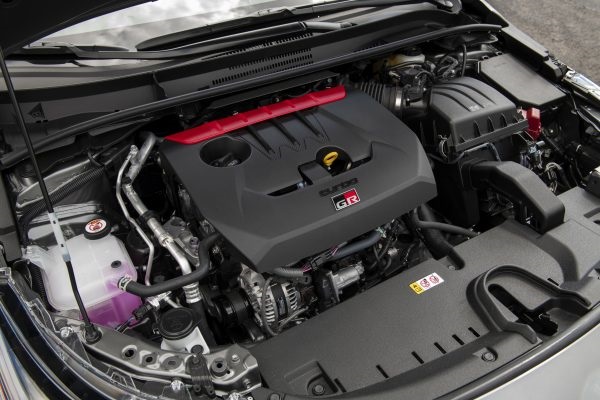
What is remarkable about this 300-hp is that it comes from a three-cylinder engine. The teacup powerplant is Toyota’s G16E-GTS engine with direct and port injection. The 1.6-liter turbocharged engine is tuned “for snappy acceleration out of the corners,” Toyota says. Peak torque runs steadily from 3,000 to 5,500 rpm. The max 300 horsepower comes on at 6,500 rpm. The only transmission offered is a six-speed manual. And the all-wheel-drive system has driver-manipulated torque split front to rear.

Triple exhaust tips reduce back pressure for maximum power and are a subtle show of weaponry.

If it even matters, the fuel economy is 21 mpg city, 28 highway, and 24 mpg combined using the required premium fuel. The 13.2-gallon fuel tank is the same size as in all Toyota Corollas.

GR Corolla interior features include metal-trimmed pedals, 6-way adjustable driver’s seat, and an 8-inch multimedia display with 6-speaker audio system.

GR Corolla interior features include metal-trimmed pedals, a 6-way adjustable driver’s seat, and an 8-inch multimedia display with 6-speaker audio system.

Toyota Racing Background

The GR Corolla is a wicked little dart of marketing. It promotes another side of this juggernaut automaker, the second-largest automaker in the world (just behind VW Group).

Toyota has been racing professionally for more than 41 years in American events. It has teams in the Baja 1000, NASCAR, NHRA, Formula Drift, World Rally, and even Midget racing. But the transfer of racing technology hasn’t bled so visibly onto Toyota’s retail vehicle development.

The GR Corolla is a special project granted corporate approval from Toyota Motor Corp. President Akio “Morizo” Toyoda, now 67. He is the founder’s grandson, but he has become better known as Toyota’s chief test driver. He is a skilled racetrack veteran and an advocate for corporate-backed racing.

Because Toyoda was so hands-on in race-testing Toyotas, he took the pseudonym of “Morizo” to disguise his activities from the corporate naysayers. It’s a fun story, found here.

The open hood shows the 300 hp turbocharged three cylinder engine

The GR Corolla’s 300-hp, G16E-GTS 3-cylinder turbocharged engine, tuned “for snappy acceleration out of the corners.”

Engineering by GAZOO Racing

Toyoda worked with its Toyota GAZOO Racing team to get this project right. It is this skunkworks group that develops technologies for Toyota’s GR sub-brand.

The mild-mannered Corolla is built on Toyota’s GA-C platform, accommodating front- and all-wheel-drive powertrains. But before the power goes in, the Corolla gets a workover at the GR factory at Toyota’s Motomachi plant. The accommodating five-door hatch is transformed with frame reinforcements, functional air vents for the engine and brakes, and other aerodynamic tweaks for stability at speed.

The GR Corolla is Toyota GAZOO Racing’s first wholly developed and manufactured model for the North American market. Their work is also available in the Toyota GR86 ($29,000) and the GR Supra ($45,000). Enthusiasts in Japan, Europe, and other countries also have access to the subcompact Toyota GR Yaris. It scoops up 261 hp from the same GR Corolla engine, but the GR Yaris is 430 pounds lighter.

The six-speed shifter with rev-matching downshifts.

The six-speed shifter with rev-matching downshifts.

The team’s detail-obsessed engineering created a race-pedigreed and street-legal track car sold at Toyota dealerships with the standard new-vehicle warranty of 3 years or 36,000 miles bumper to bumper and 5 years or 60,000 miles for the powertrain.

Coverage includes “responsible driving on track days,” Toyota says, but it also stresses induvial responsibility. To help protect the car, Toyota offers GR Corolla buyers a one-year membership to the National Auto Sport Association, with a free, coached track day session.

Comparable cars include the 315-hp Honda Civic Type R, 276-hp Hyundai Elantra N, 271-hp Subaru WRX, and 315-hp VW Golf R.

The 12.3-inch driver information screen has digital gauges for power settings and turbo pressure, a center tach, and gear position indicator lights.

The 12.3-inch driver information screen has digital gauges for power settings and turbo pressure, a center tach, and gear position indicator lights.

My Favorite Sport Compact Cars

The GR Corolla reminded me of the most fun sport-compact cars I have tested. It’s not just about power; it’s the delivery, and the connectedness of the car to the driver.:

1997 Acura Integra Type R;

1998 Ford Contour SVT;

2017-2019 Ford Fiesta ST;

2009 Fiat 500 Abarth;

2018 Hyundai Elantra GT;

2019 Hyundai Veloster N;

2003-2005 Dodge Neon SRT-4;

2004 Mazdaspeed Miata;

2010 Mazdaspeed3 5-door;

2004 Subaru Impreza WRX sedan;

VW GTI or Golf R any year;

And now the 2023 Toyota GR Corolla.

GR Corolla Editions Pricing

There are three performance levels for the 2023 GR Corolla. And buyers of each receive a 1-year membership to the National Auto Sport Association. Included is a free High Performance Driving Experience .

I tested the entry GR Corolla Core. Core pricing starts at $36,995, including the $1,095 freight charge from Japan. There is a choice of three paint colors: black, white, and Supersonic red, a $425 option.

My Core tester had two of the three available factory options:

Performance package, $1,180, includes front and rear Torsen limited-slip differentials, 4-piston aluminum fixed-caliper disc brakes with red-painted calipers and GR logo (front), 2-piston aluminum fixed-caliper disc brakes with red-painted calipers and GR logo (rear)

Technology package, $770, includes 8-speaker JBL audio system with dynamic navigation (with 3-year trial), including 8-inch touchscreen, Android Auto and Apple CarPlay compatible, one USB media port, wireless smartphone charging pad.

Supersonic Red paint added $425.

Also available is a Cold Weather package, $500, which adds heated front seats and steering wheel.

The GR Corolla Circuit Edition has Brin-Naub synthetic leather-trimmed sport seats with red stitching.

The GR Corolla Circuit Edition has Brin-Naub synthetic leather-trimmed seats with red stitching.

GR Corolla Circuit Edition, $43,995

There is no shame in owning the entry GR Corolla Core. It is a showcase of performance engineering, but it might not compare well to a friend who stepped up to the Circuit Edition. This rascal gets serious about higher performance.

Circuit Edition standard features include a forged carbon fiber roof and an aluminum hood with a bulge and gloss-black air vents. Its disc brakes are the same size as the Core but with red-painted calipers and GR logo.

Rather than the Core’s open differential, the Circuit Edition has Torsen limited slip differentials front are rear.

And there are more gloss black body trim elements, rather than the Core’s matte black.

Circuit Edition interior features include Brin-Naub and synthetic leather-trimmed sport seats with red stitching, red mesh inserts, and GR-badged headrests. It also includes the cold weather package of heated front seats and heated leather steering wheel.

The optional carbon fiber roof saves a few ounces of weight

A carbon-fiber roof is standard on the Circuit and Morizo Editions.

GR Corolla Morizo Edition, $50,995

Finding a track-ready GR Corolla Morizo Edition won’t be easy: only 200 were built for 2023.

The two-seat Morizo Edition is the lightest and most powerful of the three trim levels. Its engine gets a 22 lb.-ft. torque boost to 295 foot-pounds from 3,250-4,600 rpm.

Lightweighting comes from several areas. GR engineers removed nearly 100 pounds of weight versus the Circuit Edition, now estimated to be 3,186 pounds. Most weight savings came from removing the back seat, rear speakers, and window lifts. Even the rear wiper and motor were pulled.

The hood and front door panels are aluminum, which saves weight and slightly lowers the center of gravity.

To further stiffen the hatchback body, the engineers added two more floor braces and one more rear strut brace. The frame has an additional 349 spot welds, with more than 19 ½ feet (6 meters) of structural adhesive applied.

Other Morizo modifications range from a close-ratio transmission and shorter differential gears to front brake ducts and mono-tube shock absorbers. Unique forged wheels have wider Michelin Pilot Sport Cup 2 tires.

Check here for current pricing and offers

To lighten the GR Corolla Morizo Edition, engineers pulled over 100 pounds of content for a curb estimated to be 3,186 pounds.

To lighten the GR Corolla Morizo Edition, engineers pulled over 100 pounds of content for a curb estimated to be 3,186 pounds.

GR Corolla Safety Technologies

The GR Corolla is a legitimate, five-door sport-compact car with an expansive tech safety package that gives it Level 2 semi-autonomous driving capability. Toyota’s semi-autonomous driving is among the most accurate I’ve tested. Lane guidance is precise and did not let the car drift wide through highway cornering or cross the white lines.

Among the safety features are 10 air bags, a blind spot monitor with rear cross-traffic alert, and Toyota’s Star Safety System, which includes enhanced stability and traction controls.

Advanced safety technologies include Toyota Safety Sense 3.0, which includes:

  • Pre-collision system with pedestrian detection;
  • Lane departure alert with steering assist;
  • Lane tracing assist;
  • Automatic high beams;
  • Dynamic radar cruise control;
  • Road Sign Assist.
All GR Corollas have 14-inch ventilated front discs with four-piston calipers and rear 11.7-inch rear ventilated discs with two-piston calipers.

All GR Corollas have 14-inch ventilated front discs with four-piston calipers and rear 11.7-inch rear ventilated discs with two-piston calipers.

GR Corolla Core Ride and Handling

Choose the Core for its pure fun of rev, shift, and terrorize friends and the school carpool. As with any elite performance model today, the GR Corolla Core has a split personality. Toss the key to anybody who can work a stick shift, and they will have an easy time getting started. Make them aware that there is plenty of sporty fun within legal speed limits. It is on the upper end of engine revs that requires more focus from the driver.

Driving is friendly and unintimidating, but be ready when you engage Sport mode and roll on the power. The engine has bullish torque and acceleration to 60 mph scoots by un 4.99 seconds (same for the Circuit Edition). The lightened and more heavily braced Morizo Edition shaves a couple of tenths at 4.92 seconds.

The clutch has a medium-weight engagement, though never tiring. The shifter has refined gear engagement with a steely machined response. The gearbox is so NOT Corolla.

For all trim levels of GR Corolla, the GR-FOUR AWD has three driver-selectable torque-split settings, front-to-rear: Street 60/40, Touring 30:70), Track 50/50

The suspension is protective of occupants in daily driving but hit a surprise pothole and feel the painful jolt. I’d check the gauges for the flat tire icon on some hits, but I never had a blowout. And those remarkably responsive Michelins will cost around $250 each to replace. The tire has a sticky treadwear rating (UTQG) of 300, which pencils out to a warranty of 30,000 miles. The owner, however, will have waaay too much fun for the rubber to last that long.

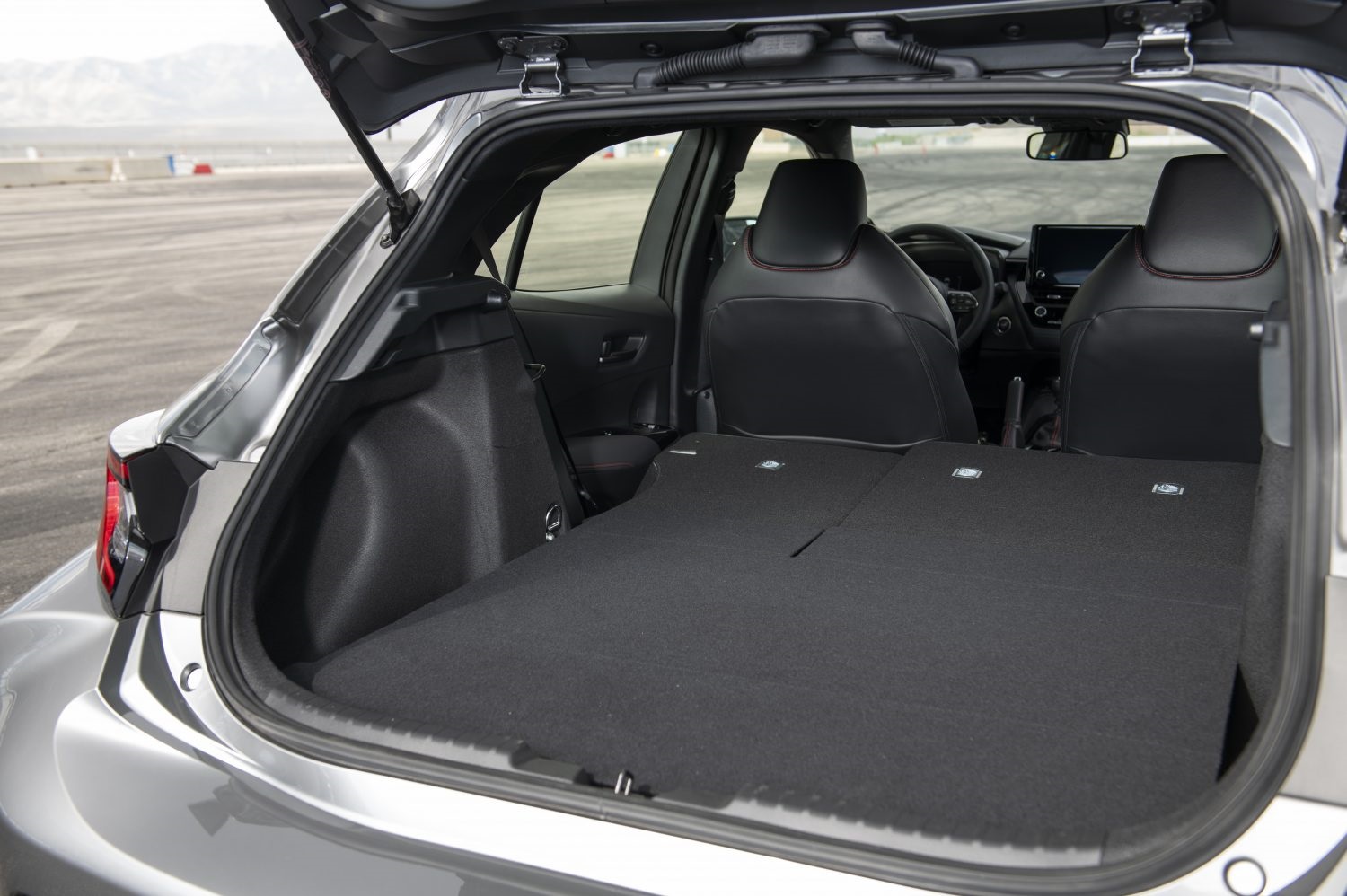
The open cargo door shows plenty of space for groceries and track gear

Plenty of space for groceries or track gear.

Why Buy the 2023 Toyota GR Corolla?

The GR Corolla is a pocket-class supercar. It would not be my choice as a road-trip car, but it makes for a helluva fun everything else. It is a performance bargain at less than $40,000. But with a first-year build of around 6,600 cars, pricing competition is rampant.

Many dealership markups are ridiculous. Reports by GR Corolla shoppers have quoted “Limited Market Value” markups of $10,000 to $20,000 for a Core model. And the greed rises exponentially for the Circuit Edition and Morizo editions.

However, according to threads on the GR Corolla forum, there are dealers doing MSRP. “You just have to do the research and find them.”

Toyota does what it can to police those exorbitant dealer addendums, a spokesman said.

“We do our best to have a conversation with the dealer and try to get them to look long-term,” he said. “The GR Corolla will always be somewhat limited in volume, but over time enough supply will help alleviate the current dealer markup situation. “

Toyota has not announced its 2024 lineup yet, but it has said the GR Corolla Circuit Edition will continue for model year 2024. And my source said there would be future GR Corollas.

You’ll just have to do the research to find them.

A rear three quarter view of a SuperSonic red GR Corolla hatchback

The GR Corolla is a wicked little dart of marketing that promotes a more daring side of juggernaut automaker Toyota, known more for its mass-produced dependability.

2023 Toyota GR Corolla Core Specifications

Body style: compact, 5-door, 5-seat AWD hatchback

Engine: 300-hp, turbocharged direct and port injection, 1.6-liter 3-cylinder with rev-matching downshifts; 273 lb.-ft. from 3,000-5,500 rpm

Compression ratio: 10.5:1

Max boost pressure: 25.2 PSI (Core Grade and Circuit Edition); 26.3 PSI (Morizo Edition)

Transmission: 6-speed manual with rev-matching downshifts

GR-FOUR AWD: 3 driver-selectable torque-split settings, front-to-rear: Street 60/40, Touring 30:70), Track 50/50

Differential type: Open (Core Grade); front and rear Torsen limited-slip differentials Circuit Edition and Morizo

0-60 mph acceleration, manufacturer estimated: 4.99 seconds (Core and Circuit Edition); 4.92-sec. (Morizo Edition)

Top speed: 142.9 mph

Fuel economy: 21/28/24 mpg city/hwy/combined; premium fuel required

CHASSIS HARDWARE

Suspension: MacPherson-type struts front, rear double wishbone-type multilink with stabilizer bars front and rear, 26.5mm front, 24mm rear.

Brakes, all models: 14-inch ventilated front discs with 4-piston calipers; 11.7-inch rear ventilated discs with 2-piston calipers.

Wheels: 18-inch cast alloy gloss black 15 spoke, Core Grade and
Circuit Edition; 18-inch, 10-spoke forged alloy wheels in a matte black finish, Morizo Edition.

Tires: 18-inch 235/40R Michelin Pilot Sport 4, Core Grade and Circuit Edition; 245/40R Michelin Pilot Sport Cup 2, Morizo Edition.

Track width, front/rear: 62.6 inches, Core and Circuit Edition; 62.6/63.7 inches, Morizo Edition.

Curb weights: 3,252 pounds Core; 3,262 lbs. with dual limited-slip diffs

Coefficient of drag: 0.35

BY THE NUMBERS

Fuel tank: 13.2 gallons

Cargo space: 17.8 cubic feet

Front head/leg room: 38.4/42 inches

Rear head/leg room: 37.6/29.9 inches

Length/wheelbase: 173.6/103.9 inches

Turning circle: 36.1 feet

FEATURES

GR upgrades include:

  • Wide body front and rear fender flares
  • Fabric sport seats with GR logo
  • Matte black front grille with GR badge
  • Rear bumper with air vents and gloss black front fender vents
  • Stainless steel triple exhaust tips
  • GR leather-trimmed steering wheel.

Standard GR Corolla features include: smart-key locking with GR push-button ignition, a rearview camera with parking aid lines, a 12.3-inch driver info display, an 8-inch multimedia display with six-speaker audio system, wireless Apple CarPlay and Android Auto compatibility, 60/40 split folding back seat, gloss black 15-spoke 18-inch wheels with 235/40 Michelin Pilot Sport4 tires; 14-inch 4-piston vented front disc brakes and 11.7-inch 2-piston vented rear discs.

Safety features include: 10 air bags, blind spot monitor with rear cross-traffic alert, Star Safety System of enhanced vehicle stability control, traction
control, 4-wheel ABS, electronic brake-force distribution, brake assist, and Smart Stop Technology;

Advanced safety technologies: Toyota Safety Sense 3.0 includes:

  • Pre-collision system with pedestrian detection;
  • Lane departure alert with steering assist;
  • Lane tracing assist;
  • Automatic high beams;
  • Dynamic radar cruise control;
  • Road Sign Assist.

PRICING

GR Corolla Core base price: $35,900, including $1,095 freight charge; price as tested $39,659

Options on test vehicle: SuperSonic paint $425; carpet cargo mat $110; carpet floor mats $179;

Performance package, $1,180, adds front and rear limited-slip differentials with red-painted brake calipers and GR logo

Technology package, $770, adds premium 8-speaker JBL audio with a wireless phone charging pad

Where assembled: Aichi, Japan

Warranties: 3-years/36,000-miles bumper to bumper with roadside assistance; 2-years/25,000-miles free scheduled maintenance; 5-years/60,000-miles powertrain

Jeep Wrangler Rubicon 392 20th Anniversary

Jeep Wrangler Rubicon 392 20th Anniversary

2023 Jeep Wrangler Rubicon 392 20th Anniversary celebrates a rugged nameplate. With just 150 models built, getting one will require resources

A Sting-Gray Jeep Rubicon 392 20th Anniversary on a dirt trail in the san diego backcountry

The 2023 Jeep Wrangler Rubicon 392 20th Anniversary is a tribute to two decades of off-road capability. But just 150 units were built, each with a starting price of $92,690. (Photography by Mark Maynard unless otherwise credited)

Table of Contents

20th Anniversary Regalia
Jeep’s ‘Lunatic Fringe’
2023 Jeep Wrangler Pricing
Rubicon 392 Hemi Powertrain
Rubicon 392 Hardware
Ride and Handling
Interior Function
Why Buy the Rubicon 392 20th Anniversary?
Specifications

BY MARK MAYNARD

I smile like a 10-year-old holding his favorite Tonka truck whenever I hoist aboard a Jeep Wrangler Rubicon 392. The view through the Gorilla Glass windshield, the rumble of the Hemi V-8, and its lock-and-load power are ridiculously gratifying.

In celebration of the Rubicon nameplate, the four-door 2023 Jeep Wrangler Rubicon 392 20th Anniversary is even more outrageous. It has the look of a four-star general in full dress uniform. Give a salute to its gold-tone tow hooks, the Xtreme 35-inch tire package with bronze bead-lock capable wheels, and the barrage of black-and-gold Rubicon 392 20th Anniversary graphics.

This Jeep is thoroughly badass — in appearance and performance. If a carmaker is going to build such a beyond-expectations vehicle, the 470-horsepower Rubicon 392 20th Anniversary is how to do it.

For most Jeep enthusiasts, however, the Rubicon 392 20th Anniversary is “unobtanium.” Production was limited to just 150 units, and you’ll have to know a dealer to get one — and pay a substantial “market value” premium. Or spend an astronomical auction amount.

The Wrangler Rubicon 392 20th Anniversary has a starting price of $92,690, including the $1,795 freight charge from Toledo, Ohio. My tester was $95,385 with options for Sting-Gray clearcoat paint ($495) and a Sky one-touch power top ($2,200).

The view through the Gorilla Glass windshield to the high desert scrub beyond

The view through the Gorilla Glass windshield.

20th Anniversary Regalia

Jeep opened the Mopar parts catalog to upfit this 20th-anniversary showcase. Among its special features are:

  • 20th Anniversary graphics: hood decals, swing gate plaque, and shifter medallion;
  • Half-inch suspension lift, which gives another 0.5-inch of water fording depth, now at 32 inches; and another 0.4-inch of ground clearance, now at 11.2 inches;
  • Triple hoop grille guard. (It feels more solid and robust than any aftermarket grille guard you can buy.);
  • Steel bumpers (winch-ready at the front);
  • 35-inch BFGoodrich All-Terrain T/A KO2 tires on 7.5-inch-wide beadlock-capable wheels;
  • 83-piece tool kit with canvas bag;
  • Front off-road trail camera;
  • Heavy-duty steel rock sliders;
  • Gorilla glass windshield;
  • Red-and-black Nappa leather seats;
  • Red leather-wrapped instrument panel bolster;
  • Auxiliary switches, such as for electrically disconnecting sway bars or locking the differentials;
  • All-weather slush mats.
A vjew from the driver side through the open passenger door

All the comforts of luxury cars, including Nappa leather upholstery.

Jeep Wrangler Rubicon 4xe 20th Anniversary

There is a more conscionable choice in the also-extreme 2023 Jeep Wrangler Rubicon 4xe 20th Anniversary.

With a price of $71,380, the Rubicon 4xe has about the same hardware upgrades as the 392 model but with 33-inch tires and hood decals and graphics in electric blue.

A red Rubicon 392 4xe hood with blue graphics

Blue graphics for the Wrangler Rubicon 4xe 20th Anniversary. (Stellantis/Jeep)

The Wrangler Rubicon 4xe is a 375-hp plug-in hybrid with a battery-driving range of 21 miles and combined fuel mileage of 49 MPGe. The dual-motor powertrain and lithium-ion battery work with a turbocharged 2.0-liter four-cylinder. The combined torque rating of 470 foot-pounds at 3,000 rpm churns up a lot of launch power to heft its curb weight of 5,222 pounds, which is 124 pounds heavier than the Rubicon 392. Consequently, Rubicon 4xe acceleration to 60 mph takes about 6.3 seconds, according to online estimates, vs. 4.5 seconds for the 392 Hemi.

However, the Rubicon 4xe has relevant assets of an eight-speed automatic transmission (not a CVT) and a tow rating of 3,500 pounds. But most important, the driver can save the battery charge to use on the trail for silent running, except for the pleasant crunch of trail dirt or the graunch of metal on rocks.

Jeep’s ‘Lunatic Fringe’

Rubicon is the off-roading pinnacle of the Jeep Wrangler line. The nameplate was initiated “as an internal underground project, led by a small group of passionate Jeep engineers” known as the “Lunatic Fringe.” Their test bed included the Rubicon Trail in the California High Sierra. The team of trail jockeys wanted a more off-road-focused Wrangler, one they would buy.

Their work yielded the 2003 Jeep Wrangler Rubicon. It was introduced in the spring of 2002 to the brand’s legion of faithful followers at the Easter Jeep Safari in Moab, Utah.

The first Wrangler Rubicon started production in summer 2002 and went on to beat all sales expectations, Jeep says. Each successive evolution of the Wrangler Rubicon gets more capability. Hundreds of tested Mopar options and accessories are among the upgrades, all backed by a full warranty. And those extras can be factored into the financing when buying a new Wrangler Rubicon.

Red leather, red seat belts, and red accents are part of the 20th Anniversary package.

Red leather, red seat belts, and red accents are part of the 20th Anniversary package.

2023 Jeep Wrangler Pricing

There are a dozen trim levels of the Jeep Wrangler, eight with two doors and a six-speed manual or eight-speed automatic transmission on some trim levels. All have some level of four-wheel drive.

Engine choices are a standard 285 horsepower, 3.6-liter Pentastar V-6, an optional 270-hp direct-injected and turbocharged 2.0-liter four-cylinder, or the mighty 470-hp, 6.4-liter Hemi only for the Wrangler Rubicon 392. (The 3.0-liter EcoDiesel V-6 is ending production for 2023 in North America. See the “Farout” below.)

Starting prices range from about $33,000 for the entry two-door Sport with six-speed manual transmission (add $4,000 for four doors) to $57,000 for the four-door Wrangler High Altitude.

Today’s tester is the 2023 Jeep Wrangler Rubicon 392 20th Anniversary.

Without the anniversary regalia, a 2023 Jeep Wrangler Rubicon 392 starts at $84,290. And there are dozens of Mopar accessories and upgrades to ratchet the price.

Shop all Jeep Wrangler models here.

A look into the front seat area through the open passenger door showing two grab handles to hoist aboard

Full-bodied bucket seats and a pair of ever-helpful grab bars.

American Expedition Vehicles Package

As tough as these Rubicon anniversary models are, Jeep worked with aftermarket firm American Expedition Vehicles for an adventure-tested hardware upfit.

A special shock absorber by American Expedition Vehicles

The 15-piece upgrade package by American Expedition Vehicles includes the 2.5-inch DualSport RT Suspension System with Bilstein 5100 shocks. (Stellantis/Jeep).

Exclusive to the Rubicon 20th Anniversary editions, the Level II upfit by American Expedition Vehicles is an off-roader’s dream list of content. Among the 15 total upfit features are:

  • 37-inch BFGoodrich All-Terrain T/A KO2 tires;
  • Warn VR EVO 10-S winch;
  • AEV 17-inch Savegre II wheels;
  • AEV 2.5-inch DualSport RT Suspension System with Bilstein 5100 shocks;
  • AEV 7000 Series off-road lights;
  • Benefits of the complete AEV upfit package include:
  • 14.2 inches of ground clearance;
  • 37.1 inches water fording;
  • 50-degree approach angle;
  • 33-degree breakover angle;
  • 43-degree departure angle.

The AEV Level II packages are pricey at $22,978 for the 20th Anniversary Wrangler Rubicon 4xe and $21,130 for the 20th Anniversary Wrangler Rubicon 392. Pricing includes a $995 installation fee.

Rubicon 392 Hemi Powertrain

The Hemi V-8 is a cornerstone engine in the annals of muscle-car fame. For the Rubicon Wrangler 392, the 6.4-liter engine has 470 hp at 6,000 rpm and peak torque of 470 lb.-ft. at 4,300 rpm. The engine redlines at 6,400 rpm.

The 392-cubic-inch V-8 breathes through sequential multipoint injection and pushrod-operated overhead valves. The engine has 16 valves with sodium-filled exhaust valves and hollow-stem intake valves. All 16 hydraulic lifters have roller tips.

A heavy-duty 8HP75 eight-speed overdrive connects with the full-time Selec-Trac 4WD. This sophisticated system has 4WD Auto, 4WD High, Neutral, and 4WD Low. True-Lok axles front and rear provide tractor-like grunt.

Jeep says the two-and-half-ton (5,098 pounds) Rubicon 392 can power to 60 mph in 4.5 seconds and stampede through the quarter mile in 13.0 seconds.

This rewarding hunk of  Hemi delivers official fuel economy ratings of 13 mpg city, 17 highway, and 14 mpg combined, using the required premium fuel for max power. I saw 14.4 mpg in highway driving, but so what.

If you think the Rubicon 392 has bad mileage, ask your V-8 4WD pickup-driving friends for their honest guestimates for fuel economy for their truck. It might be better by 2 or 3 mpgs, but hundreds of thousands more gas-guzzling pickups are sold than this radical Rubicon.

Keep watch for filling stations on the way to the trail. The 21.5-gallon tank gives a range of 301 miles, on a good day.

Check your vehicle’s mileage here.

The 470-hp 6.4-liter Hemi V-8 can launch the Rubicon 392 to 60 mph in 4.5 seconds.

The 470-hp 6.4-liter Hemi V-8 can launch the Rubicon 392 to 60 mph in 4.5 seconds. (Stellantis/Jeep)

Last Call for Wrangler Diesel

The 3.0-liter EcoDiesel V-6, once available for the Wrangler, will end production this year (2023) in North America. However, the diesel-engine option will be available a while longer for the Gladiator pickup.

Jeep will send off the Motori diesel with the special edition Jeep Wrangler Rubicon FarOut. Based on the Wrangler Rubicon four-door, the FarOut edition features a “Diesel 3.0L” hood graphic, “3.0 D” badging, and a unique wheel style. Pricing starts at about $70,000.

The reinforced tailgate (to secure the 35- or 37-inch spare tires) integrates a Mopar air compressor. To the right is a commemorative build plate.

The reinforced tailgate (to secure the 35- or 37-inch spare tires) integrates a Mopar air compressor. To the right is a commemorative build plate.

Rubicon 392 Hardware

The Rubicon 392 can ford water up to 32.5 inches deep — even if a bow wake washes over the hood. Instead of an external snorkel, a functional hood scoop connects to a tri-level Hydro-Guide air intake. The system feeds the V-8 with cooler outside air, and a one-way drain in the air box can separate up to 15 gallons of water a minute.

Active dual-mode exhaust engages automatically to open valves in the exhaust system. Under higher engine loads, the open exhaust reduces back pressure. The driver can also hit a switch to open the pipes manually.

Chassis changes include:
•Heavy-duty brakes.
•2-inch factory lift.
•Upgraded frame rails.
•Specially calibrated suspension geometry with FOX high-performance shocks.

Low-speed descents use engine braking, a revised torque converter lockup control, and a 48:1 crawl ratio. The system allows the driver to manage vehicle speed without using the brake pedal.

Four-wheel-disc braking has 12.9-inch vented front rotors with two twin-piston floating calipers. The rear brakes have 14-inch vented rotors with two single-piston floating calipers.

The Xtreme 35-inch tire package with bronze bead-lock capable wheels.

Rubicon 392 20th Anniversary adds unique hood graphics. Also in the package are 35-inch BFGoodrich All-Terrain T/A KO2 tires on 7.5-inch-wide beadlock-capable wheels.

Rubicon 392 20th Anniversary adds unique hood graphics. Also in the package are 35-inch BFGoodrich All-Terrain T/A KO2 tires on 7.5-inch-wide beadlock-capable wheels.

Rubicon 392 Ride and Handling

With the steely upgrades for the Rubicon 392 20th Anniversary, it is not such a shaggy beast to drive.

Acceleration, of course, is breathtaking, as in “Yikes, watch the fuel gauge drop.” Throttle tip-in is responsive, and the Hemi shrugs off any sluggishness that might come with hefting two-and-a-half tons.

The exhaust tone is deliciously ’60s Plymouth Road Runner and music to the enthusiast’s soul. There is an electronic switch to open the pipes to neighbor-angering boldness. But the open pipes also resonate boldly through the cabin, so I didn’t feel the need.

Besides, there’s enough wind and blunt-shape noise at highway speeds. However, the nine-speaker Alpine audio system, with an all-weather subwoofer and 552-watt amplifier, has plenty of clarity for easy listening at 65 mph.

Jeep claims a turning circle of 38.9 feet, it just seems tighter as the Rubicon 392 pivots around tight corners. And it must have a helluva strong power steering pump to turn 35-inch tires so easily, with no cavitation in lock-to-lock turns.

While there is plenty of sidewall to protect those 17-inch wheels, the black “beadlock” band will show rock scrapes allowing the aluminum to shine through.

The Sky roof is the easiest to enjoy of any of the four-door Wranglers’ sunroof choices. It might be expensive, but you will enjoy it more often.

An underside view of the Rubicon 392 shows the heavy duty steel components

Heavy gauge steel components to withstand a beating on the Rubicon Trail.

Interior Function

The Wrangler cabin is a vertical environment, beginning with the short, flat windshield and stacked controls. Sightlines are open across the hood and over the shoulder.

Inside the Rubicon 392, the interior includes leather-trimmed upholstery with bronze Rubicon 392 stitching. The leather-wrapped, performance steering wheel has paddle shifters, a first for the Jeep Wrangler.

Because of the tall tires and broad fenders, foot space up front might be cramped for size 14 shoes. I wished for an actual driver’s footrest, but there just isn’t room for it.

The Uconnect system projects on a standard 8.4-inch screen, which is small for at-a-glass views. The system includes Jeep Off-road Pages that allow owners to monitor such elements as pitch, roll, altitude, GPS coordinates, and drivetrain power distribution.

The open driver's door showing mirror controls and a lower storage slot with net

Power mirror controls on removable doors.

Safety Features and Technologies

For a vehicle with such raw potential for off-roading survival, it is somewhat surprising that there are so many comfort and safety features.

All Jeep Wranglers have front and seat-mounted side air bags, all-speed traction control, electronic stability control, hill-descent control, and hill-start assist.

A pair of safety groups add the advanced technologies:

Jeep Active Safety Group: ParkSense rear park assist, blind-spot
monitoring, rear cross path detection, and LED taillamps;

Jeep Advanced Safety Group includes: adaptive cruise control and forward collision warning.

The Wrangler Rubicon back seat with center armrest down

Back-seat legroom is long at 38.3 inches. Note the clever multi-function to the center-position armrest.

The open cargo area of the Wrangler Rubicon

Cargo capacity of 31.7 to 72.4 cubic feet includes plenty of tie-downs to secure crates and other gear. Shown are the 20th Anniversary tool kit and air-compressor hose.

Why Buy the Rubicon 392 20th Anniversary?

One and done. Can it get any better, or more outrageous, than this 2023 Rubicon 392 20th Anniversary?

You’ll not likely find a new Rubicon 392 20th Anniversary on a dealership lot, but these Jeeps will be cherished and used with care. In 10 years, the Rubicon 392 20th will still be rewarding to own, but still at an “unobtanium” price.

Without the anniversary fanfare, you can get all the grunt and glory from a stock 2021, 2022, or 2023 Jeep Wrangler Rubicon 392. These are still pricey at $80,000 to $100,000, but that is the cost of distinction.

A rear three quarter view of the Rubicon 392 20th Anniversary showing the half-inch suspension lift

The Jeep Wrangler Rubicon 392 20th Anniversary has a half-inch suspension lift, and another 0.4-inch of ground clearance, now at 11.2 inches.

2023 Jeep Wrangler Rubicon 392 20th Anniversary

Body style: midsize, 4-door multipurpose 4WD vehicle with ladder-type frame, open steel and aluminum body

Engine: 470 hp 6.4-liter (392 cubic inches) V-8 with sequential multipoint injection and pushrod-operated overhead valves, 16 valves with sodium-filled exhaust valves and hollow stem intake valves, 16 conventional hydraulic lifters with roller tips; 470 lb.-ft. torque at 4,300 rpm

Transmission: 8-speed automatic; full-time Selec-Trac 4WD with 4WD Auto, 4WD High, Neutral and 4WD Low; True-Lok axles front and rear; 3.73 rear axle ratio;

Axles: Dana 44 front and rear with 3.73 ratios with Tru-Lock electronic locking;

Fuel economy: 13/17/24 mpg city/hwy/combined; premium fuel required

Max. gross trailer weight: 3,500 pounds

0-60 mph acceleration: 4.5 seconds

SUSPENSION ELEMENTS

Suspension: Solid axle, coil springs, stabilizer bar front and rear; electronic sway-bar disconnect system; high-pressure gas-charged FOX monotube shock absorbers with hydraulic rebound stop front; rear high-pressure gas-charged FOX aluminum monotube shock;

Brakes: 4-wheel ventilated discs; 12.9-inch rotors front with twin-piston floating calipers; 14-inch rotors rear with single-piston floating calipers;

Tires and wheels: 17-inch BF Goodrich KO2 All-Terrain tires (315/70, on/off-road); bead-lock capable, high-gloss painted cast-aluminum wheels;

Steering: Electro-hydraulic power; overall ratio 15.1:1; steering turns (lock-to-lock) 3.1; turning circle: 38.9 feet

BY THE NUMBERS

Water fording: 32.5 inches

Fuel tank: 21.5 gallons

Length/wheelbase: 188.4*/118.4 in. *including spare tire

Width/height: 73.9/ 74.5 inches

Curb weight: 5,098 pounds

Cargo space: 31.7 to 72.4 cubic feet

Front head/leg room: 40.8/41.2 inches

Rear head/leg room: 40.3/38.3 inches

FEATURES

Standard equipment includes: smart key entry with push-button ignition, ParkView back-up camera, leather-trimmed seat upholstery, heated front seats, Uconnect 4C Nav with 8.4-inch touch-screen display, 9-speaker Alpine audio system with Apple CarPlay and Android Auto, GPS navigation, 4G hot spot with trial subscription, a media hub with 2 USB ports and 115-volt household outlet, satellite radio, 7-inch driver info display,

Standard Rubicon safety features include: 4 air bags, all-speed traction control, electronic stability control, hill-descent control, hill-start assist;

PRICING

Rubicon 392 20th Anniversary base price: $92,690, including the $1,795 freight charge; price as tested $95,385

Options on test vehicle: Sky One-Touch power top $2,200; Sting-Gray clear coat paint $495

Where assembled: Toledo, Ohio

Warranties: 3-years/36,000-miles basic bumper to bumper; 5-years/60,000-miles powertrain

Chevrolet To Spike Camaro after 2024

Chevrolet To Spike Camaro after 2024

Chevrolet Motorsports will continue to compete across the world; Chevrolet announces this is not the final Camaro chapter

A side profile of a preproduction 2024 Chevrolet Camaro with Collector’s Edition package. (Photos courtesy of Chevrolet or as credited)

A side profile of a preproduction 2024 Chevrolet Camaro with Collector’s Edition package. (Photos courtesy of Chevrolet or as credited)

BY MARK MAYNARD

General Motors and Chevrolet have again pulled the plug on the Camaro.

“After nine strong model years in the market, with hundreds of thousands sold, the sixth generation Chevrolet Camaro will retire at the conclusion of model year 2024,” Chevrolet said in a statement.

The final sixth-generation model will come off the assembly line at the Lansing (Mich.) Grand River Assembly Plant in January 2024.

“As we prepare to say goodbye to the current generation Camaro, it is difficult to overstate our gratitude to every Camaro customer, Camaro assembly line employee, and race fan,” said Scott Bell, vice president of Global Chevrolet. “While we are not announcing an immediate successor today, rest assured, this is not the end of Camaro’s story.”

Chevrolet has prepared a Collector’s Edition package in tribute to the fabled pony car. It will be available on the 2024 RS and SS trim levels, and a limited number of ZL1-equipped cars available in North America.

“The Collector’s Edition pays homage to Camaro, resurfacing ties that date back to the development of the first-generation Camaro in the 1960s, most notably the program’s initial code name: Panther,” Bell said in the release.

More information on the 2024 Camaro line and Collector’s Edition package will be available closer to the start of orders this summer.

Motorsports

Alex Bowman, driver of the #48 Ally Hendrick Motorsports Chevrolet Camaro ZL1 races to a third place finish Sunday, March 5, 2023, during the NASCAR Cup Series Pennzoil 400 at Las Vegas Motor Speedway in Las Vegas, Nevada. (Photo by Jim Fluharty/HHP for Chevy Racing)

Alex Bowman, driver of the #48 Ally Hendrick Motorsports Chevrolet Camaro ZL1 races to a third place finish Sunday, March 5, 2023, during the NASCAR Cup Series Pennzoil 400 at Las Vegas Motor Speedway in Las Vegas, Nevada. (Photo by Jim Fluharty/HHP for Chevy Racing)

Chevrolet campaigns the sixth-generation Camaro in various series, including NASCAR, IMSA, SRO, NHRA, and the Supercars Championship.

Camaro will continue to compete on track, working with motorsports sanctioning bodies to ensure Chevrolet’s presence in racing moving forward, said Jim Campbell, Chevrolet U.S. vice president of Performance and Motorsports.

“Chevrolet’s products and our relationship with our customers benefit from motorsports,” Campbell said in the release.

“Our plan is to continue to compete and win at the highest levels of auto racing, Campbell said.”

1946-1948 Chrysler Town & Country

1946-1948 Chrysler Town & Country

Chrysler rolled out its new, wooden-bodied Town & Country models in 1946 with promises of a full line of “woodies,” including a convertible, a sedan, and a roadster. But only the convertible and sedan saw production

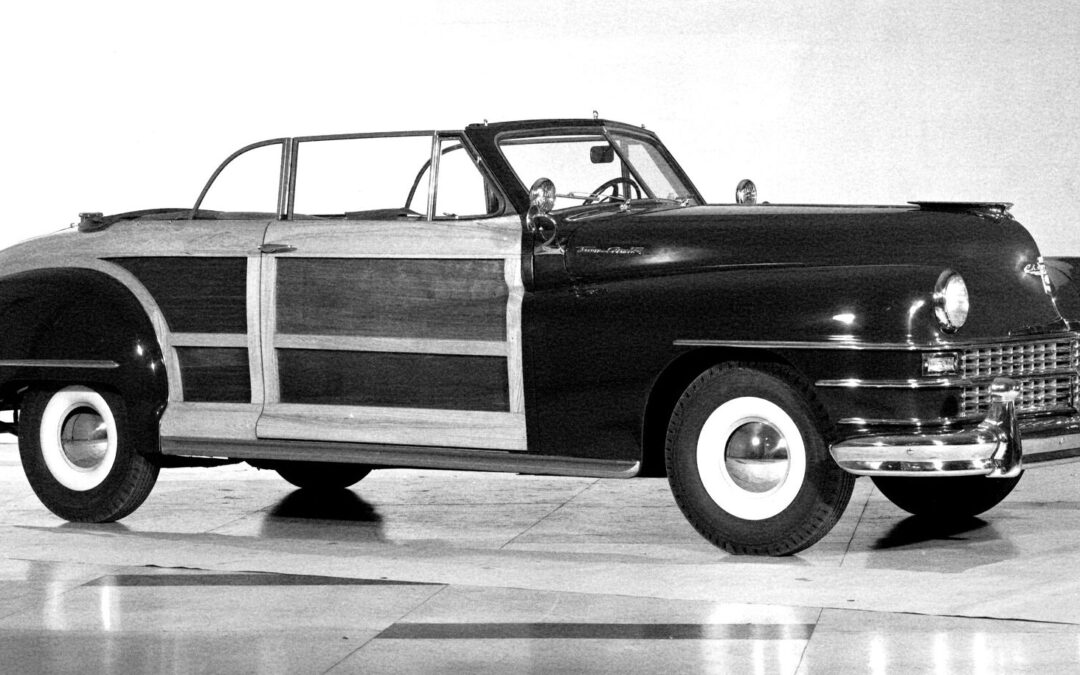
A black and white photo of the new for 1946 Chrysler Town & Country convertible

The retail price on average for the 1946 Chrysler Town & Country in the U.S. was $2,609 ($40,027 in 2023.) Production totals were documented at 2,169. (Photos courtesy of Stellantis media archives)

BY MARK MAYNARD

There’s a certain charm to the white-socks stance as shown in these PR images of the 1946 Chrysler Town & Country Convertible Coupe. It was a new beginning for U.S. carmakers. World War II ended in 1945 and automakers again ramped up car production after transitioning from building war machines.
When GIs returned home from war, they were ready to let the good times roll and Chrysler was ready with its restart of the 1946 Town & Country nameplate.

The Chrysler Town & Country had been in production from 1940 to 1942, primarily as a luxury station wagon, according to the car’s page on Wikipedia. During this time, the Town & Country was also available in wooden-bodied — “woodie” — body styles of a four-door sedan, two-door hardtop, and convertible.

“Following the war, the Town & Country nameplate returned, though the eight-passenger station wagon did not. Only the 1946 Town & Country four-door sedan and the 1946 Town & Country two-door convertible were offered.

Curiously, the 1946 Town & Country sales brochure also described and illustrated a roadster, a two-door sedan called the Brougham, and a two-door hardtop called the Custom Club Coupe. None of those three additional body styles progressed beyond the prototype stage. Only one Brougham and seven Custom Club Coupes were built,” per Wikipedia.

Luxurious and Elite

I found these notes from an auction report by RM Sotheby’s: “While the sedan was a warm, clubby sanctuary for the trip to one’s hunting lodge, the convertible was elite, a favorite of such celebrities as actress Marie “The Body” MacDonald and popular Western actor Leo Carrillo. Some 8,368 convertibles were sold in three years.”
The Town & Country’s wooden body framing was made from white ash and the panels were mahogany veneer but were now bonded to steel body panels. The convertible’s retail price on average in the U.S. was $2,609 ($36,254 in 2021 dollars; production totals were documented at 2,169, per Wikipedia.

An original 1946-48 Chrysler Town & Country sedan, with accessory roof-rack rails.

The 1946 Chrysler Town & Country sedan has been described as a warm, clubby sanctuary for the trip to one’s hunting lodge.

Town & Country for 1947

During the 1947 model year, the Chrysler Town & Country sedan and the convertible each carried over with just a few improvements over the previous model year (1946).

1948 Town & Country Sedan 

By 1948, the Town & Country sedan was in its last model year of production, after only a three-model-year production run (since the 1946 model year). The 1948 Town & Country convertible carried over with just a few improvements over the previous model year (1947). This was also the year the genuine Honduran mahogany wood panels were replaced by DI-NOC vinyl panels.

1949-1950 Town & Country Convertible

The 1949 Town & Country convertible was now in its last model year of production, which was the only Chrysler Town & Country offering during the 1949 model year.

After a four-model-year production run, Chrysler would produce its last true woodie offering, the Town & Country Newport two-door hardtop.

The cars for 1949 were Chrysler’s first new postwar designs, with a longer wheelbase (131.5 inches), and based upon the New Yorker model.

During its one-model-year production run, the 1950 T&C panels were now simulated wood. The year also marked a new optional feature, windshield washers.

1951 Town & Country Wagon

Chrysler’s Town & Country wagon was reintroduced with all-steel construction in 1951. Windsor and New Yorker variants would continue through the end of Windsor model production for the 1960 model year; Newport and New Yorker models continued through 1965.

A black and white pr phot of the 1946 Chrysler Town & Country sedan

The 1946-1948 Chrysler Town & Country sedan.

1966

In 1966, The T&C wagon became a stand-alone model, with trim and features which bridged the gap between the two sedan lines. It was distinguished by luxury features including a carpeted rear cargo area with split-folding second-row bench seats trimmed with chromed strips of steel.

From 1968 forward simulated woodgrain paneling was used on the body sides and tailgate. The treatment was also applied to other competing station wagons, such as the AMC Ambassador, Buick Estate, Oldsmobile Custom Cruiser, Ford Country Squire, and the Mercury Colony Park. In 1976, AMC introduced the Jeep Grand Wagoneer with a simulated woodgrain appearance built on a dedicated chassis.

The Town and Country, however, was in a luxury class by itself until the last of the full-sized versions of 1977. From 1978, it was downsized and absorbed into the LeBaron series. A lower-content version lacking the more luxurious features and woodgrain bodyside decals was available for a few years in the early 1980s.

Last of the T&C Wagons

The 1988 model year was the last for the station wagon until 1990. It was that year when Chrysler reintroduced the Town & Country nameplate as the rebadged variant Chrysler Town & Country minivan.