Select Page

2023 Chevrolet Corvette Z06 Reveal

2023 Chevrolet Corvette Z06 Reveal

Race-bred 2023 Corvette Z06 will be the most capable ever, powered by a new 670-hp LT6 V-8

An exterior-rear view of the 2023 Z06

Chevrolet says it is putting the world on notice with its 2023 Corvette Z06, a global supercar made in America. (Photography courtesy of Chevrolet)

BY MARK MAYNARD

Chevrolet has just shown the 2023 Corvette Z06 with its new 5.5-liter LT6 naturally-aspirated V-8. The 670-horsepower engine is “the highest horsepower, naturally-aspirated V-8 to hit the market in any production car, ever,” Chevrolet said in a statement.

The engineers spent two years crafting a distinctive, rich exhaust tone unlike anything ever heard from a Corvette.

The Z06 chassis has underpinned Corvette Racing’s C8.R since it began competing in 2020. Using a shared chassis, similar engine architecture, and exterior proportions, the C8.R has been referred to internally as the Z06 hiding in plain sight, Chevrolet said in a statement.

Learn more at the Chevrolet website. And watch the release video narrated by Justin Bell.

A static engine display of the Z06 V-8.

The 2023 Corvette Z06 is powered by the 5.5-liter LT6 V-8. The engine makes 670 hp at 8,400 rpm with 460 foot-pounds of torque at 6,300 rpm.

Corvette Z06 Development

The Corvette Z06 was born in 1963 as an optional Special Equipment Package intended for racers. It included a stiffer suspension, heavy-duty brakes, a thicker front stabilizer bar, and a large, 36-gallon fuel tank that reduced the number of necessary pit stops in longer races. A fuel-injected 5.4-liter engine (327 cubic inches) and a close-ratio four-speed manual transmission were required with the package.

“Racing was the reason the Z06 was developed in 1963, and it continues to support the development of the road models that make them better on the street and the track,” said Tadge Juechter, chief executive engineer, Corvette. “It also means we’ve tested the Z06 on the best tracks around the world, from Circuit of the Americas here in the United States, to the Nürburgring in Germany.”

According to Chevrolet testing, the LT6 has 670 hp at 8,400 rpm and 460 foot-pounds of torque at 6,300 rpm. And the tachometer is set at a lofty 8,600 rpm. Chevrolet cites

The quad outlet of center exhaust tips on the Z06

The rear fascia houses centered floating exhaust bezels.

The LT6 is hand-assembled at the Performance Build Center in Kentucky’s Bowling Green Assembly Plant. Each engine features a plaque on the intake manifold with the technician’s signature, who crafted it from start to finish.

The new Z06 will be available in hardtop and convertible body styles in left- and right-hand drive. Production is set to begin in summer 2022.

The cockpit of the 2023 Z06 with a lot of carbon-fiber trim

The cockpit has been “elevated,” Chevrolet says, with rich materials and textures, including more carbon fiber trim.

Highlights of the 2023 Corvette Z06

  • A stance 3.6 inches wider than the Stingray, which gives room for its massive 345-series rear tires and more airflow through side air vents;
  • Unique front and rear fascias, a first for Z06. The front fascia is designed to optimize engine cooling. Special features include channeling air to a center heat exchanger, which is one of five for maximum cooling performance;
  • The reconfigurable rear spoiler, unique to Z06, has height-adjustable “wickerbill” elements. Subtle adjustments can improve high-speed stability and cornering capability on a racetrack;
    The rear spoiler on the Z06

    The reconfigurable rear spoiler, unique to Z06, has height-adjustable “wickerbill” elements.


  • Standard 20-inch front and 21-inch rear forged aluminum “spider” wheels — the largest wheels ever available on a production Corvette. There also are optional carbon fiber wheels (shown in the photo) that provide a 41-pound reduction in unsprung mass;
  • Specific suspension tuning includes Magnetic Ride Control 4.0. And the six-piston front disc brakes are larger than on the Stingray.
  • Brembo brake rotors are 14.6 inches in diameter at the front with six-piston calipers (compared to four-piston on the Stingray). Rear discs are 15 inches.
    The optional carbon fiber wheels on the Z06

    Michelin Pilot Sport 4S ZP tires are standard, with Sport Cup 2 R ZP tires included with the available Z07 package.


  • Eight-speed dual-clutch transmission has a “shorter” 5.56 final drive ratio compared to the Corvette Stingray, which boosts acceleration performance’
  • The driver area has been “elevated” with “rich materials and textures, including more carbon fiber trim and new options”;
  • Unique rear fascia houses centered floating exhaust bezels.
A closeup of the Z06 gauge array showing an 8,600 rpm redline.

The tachometer redlines at 8,600 rpm, 2,000 rpm more than the Stingray.

Z07 Performance Package

The optional Z07 performance package provides 734 pounds of downforce at 186 mph, more than any Corvette ever. The package includes a carbon fiber high rear wing and ground effects, specific chassis tuning, specific Magnetic Ride Control calibration, and unique Michelin Cup 2 R ZP tires, along with Brembo carbon-ceramic brakes and optional carbon fiber wheels.

2023 Z06 convertible and hardtop

The Corvette Z06 is set to begin production next summer 2022. As for all Corvettes, the Z06 will be built at the Bowling Green Assembly in left- and right-hand drive.

“Virtually every component that distinguishes the Z06 was developed to support or enhance its capability,” said Juechter. “By leveraging the mid-engine architecture’s inherent advantages, we are able to achieve 6 percent more downforce than a seventh-gen ZR1 at 8 percent lower drag.”

1966 Dodge Charger — “Leader of the Dodge Rebellion”

1966 Dodge Charger — “Leader of the Dodge Rebellion”

The Dodge Charger debuted in 1966 as a midsize sporty car that would compete with the Rambler Marlin, Ford Mustang, and Plymouth Barracuda

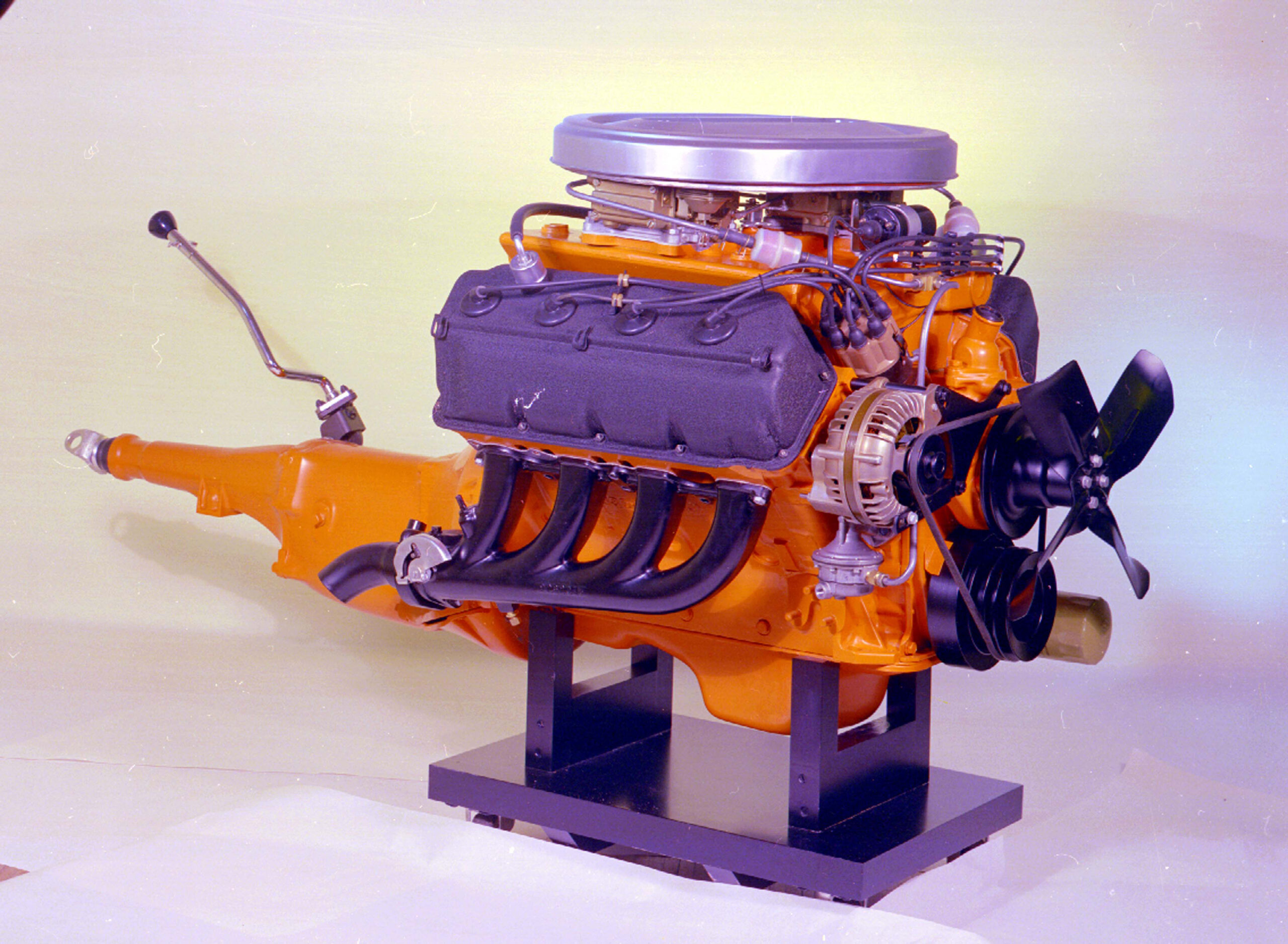
A Hemi V8 and transmission on a display stand 1966 Dodge Charger

The first generation 1966 Dodge Charger introduced a fastback roofline and pot-metal “electric shaver” grille. (Photography courtesy of Stellantis)


BY MARK MAYNARD

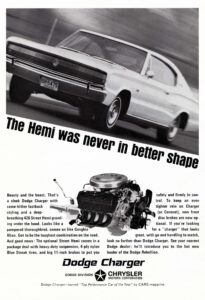
During the early-1950s, automakers were exploring new ideas in the personal luxury and specialty cars.A 1966 print ad for the Dodge Charger

The Hemi engine package included heavy-duty suspension, four-ply nylon Blue Streak tires, and “big” 11-inch brakes. According to Wikipedia, Chrysler had been slow to enter the specialty car market, but tapped its Dodge Division to enter the marketplace. Its first offering would be a midsize B-bodied Dodge Charger. It would fit between the “pony car” Ford Mustang and “personal luxury Ford Thunderbird.

The design focus was to create a fastback look while sharing as much existing company hardware as possible. The result was the Coronet-based Charger. The exterior styling was, in general, a departure from Dodge’s mainstream cars. Introduced in mid-1966, the Charger would compete with the Rambler Marlin, Ford Mustang, and Plymouth Barracuda.

The 1965 Charger concept

The 1965 Dodge Charger II Concept created the desired fastback look shared much existing company hardware.

The interior design of the Charger was different from all other cars, according to the Wiki page. It debuted a full-length center console and “all bucket seating” front and rear. Also an innovation, the rear pseudo-buckets could be folded to create more cargo space through the enormous rear hatch.

The Hemi Halo

The Charger wasn’t intended to compete head-to-head in performance with pony cars but was available with Chrysler’s famed 426 Hemi V8.
On Jan. 1, 1966, The 1966 Charger had its big public debut at the Rose Bowl as the new “Leader of the Dodge Rebellion.” The Charger’s debut was also followed midyear by a new street version of the 426 cubic-inch, 7.0-liter Chrysler Hemi engine.

The Charger wasn’t intended to compete head-to-head in performance with pony cars but was available with Chrysler’s famed 426 Hemi V8.

With the Charger, Dodge had a new model to build a performance image with this engine.

The Charger was designed by Carl “CAM” Cameron and introduced a fastback roofline and pot-metal “electric shaver” grille. Its fully rotating headlights were a feature not seen on a Chrysler product since the 1942 DeSoto. The fastback design ended over a full-width six-lamp taillight in the rear with chromed and wide-spaced “C H A R G E R” lettering.

Dodge Charger Powertrains

According to the Wiki report, Charger powertrains for 1966 consisted of V-8s with three choices of transmission.

Four engines were offered:

  • 318 cubic-inch 5.2-liter with a two-barrel carburetor for the base-model Charger;
  • 361-cubic-inch, 5.9-liter two-barrel;
  • 383 cubic-inch, 6.3-liter with a four-barrel carburetor;
  • And the new 426 Street Hemi. Only 468 Chargers were built with the 426.

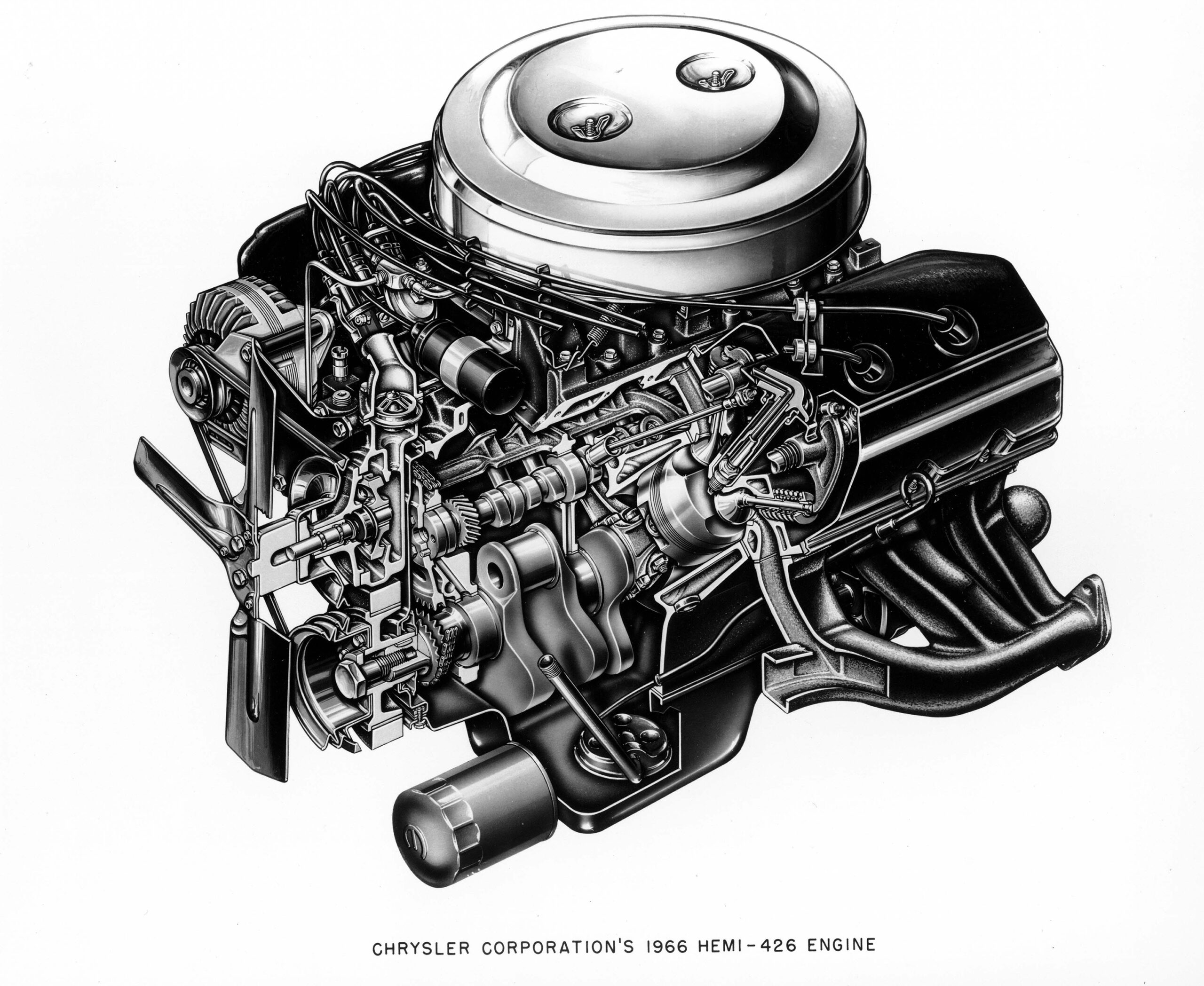
A cutaway illustration of the Hemi V8

The transmissions for the 1966 Charger:

  • Three-speed steering-column mounted manual with the base engine,
  • Console-mounted four-speed manual;
  • Three-speed automatic.

Total 196 Dodge Charger production came to 37,344 units for the mid-model year introduction.

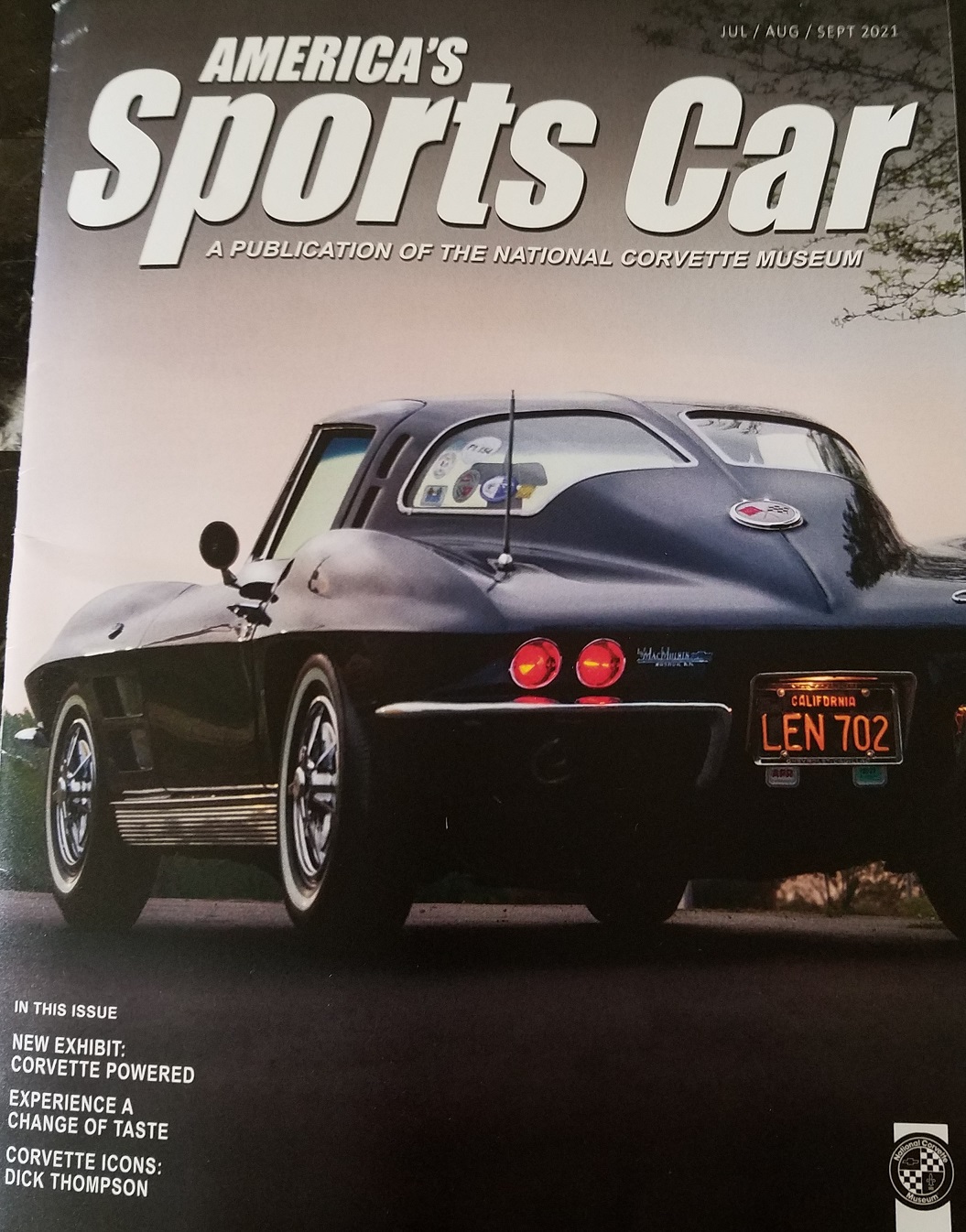
San Diego owners’ 1963 Corvette makes the cover of the National Corvette Museum magazine

San Diego owners’ 1963 Corvette makes the cover of the National Corvette Museum magazine
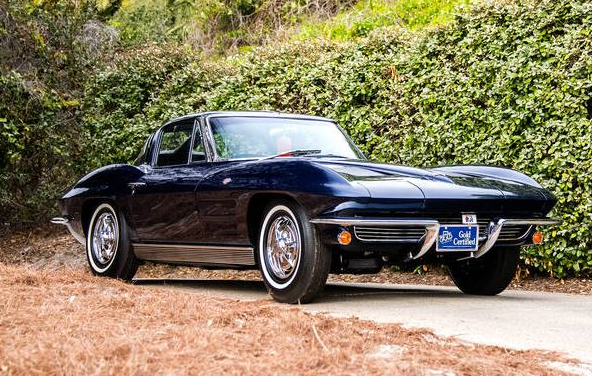
The blue 1963 Corvette on the cover of the National Corvette Museum magazine.

The Daytona Blue 1963 Corvette was photographed for the cover of the National Corvette Museum magazine. (Darwin Ludi)

BY MARK MAYNARD

San Diego car enthusiasts Darwin and Pat Ludi sent a catch-up email about their adventures with their two 1963 Corvette split-window coupes and 1965 Pontiac GTO.

Darwin wrote: “This past April our Daytona Blue ’63 was photographed for the cover of the National Corvette Museum magazine. We just received our copy of the magazine and I have attached a few photos.

A blue 1963 Corvette on the cover of the National Corvette Museum magazine

The Daytona Blue ’63 was featured in a multi-page layout. (Darwin Ludi)

“We have had fun showing our cars around the country at various Concours events. We have won awards at most of them. This year we will be heading to Colorado for an AACA meet where we hope to earn a Senior Award.    We might even be invited to Hershey for the Nationals.

“In October we will head to the Hilton Head Concours. I was told we will compete against nine or 10 other Corvettes. We have to have as much fun as possible.

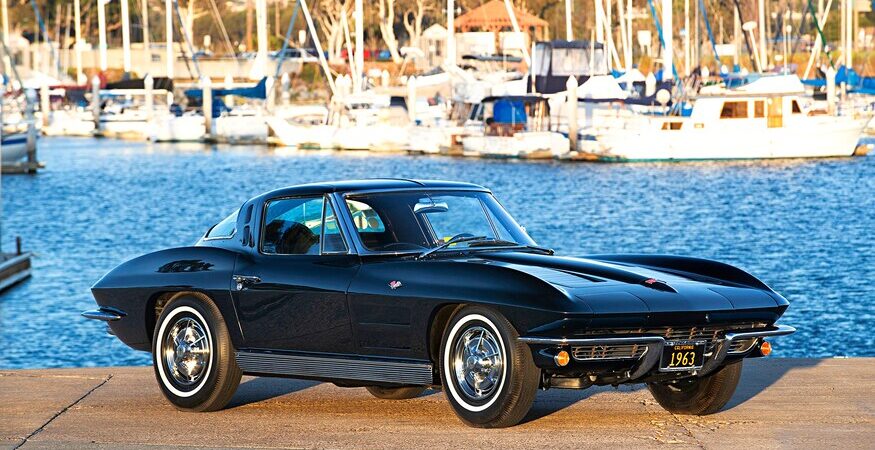
A black 1963 Corvette along Mission Bay in San Diego

The Ludi’s black 1963 Corvette along Mission Bay in San Diego. (Darwin Ludi)

Dedicated caregivers

“Before long, as age creeps up the cars will have to move on to new caregivers,” Darwin said.

The Ludi’s Tuxedo Black 1963 Corvette coupe is now having its correct red interior installed. And they have owned their red 1965 Pontiac GTO tri-power for more than 30 years. And it, too, is all restored and in show condition, Darwin said.

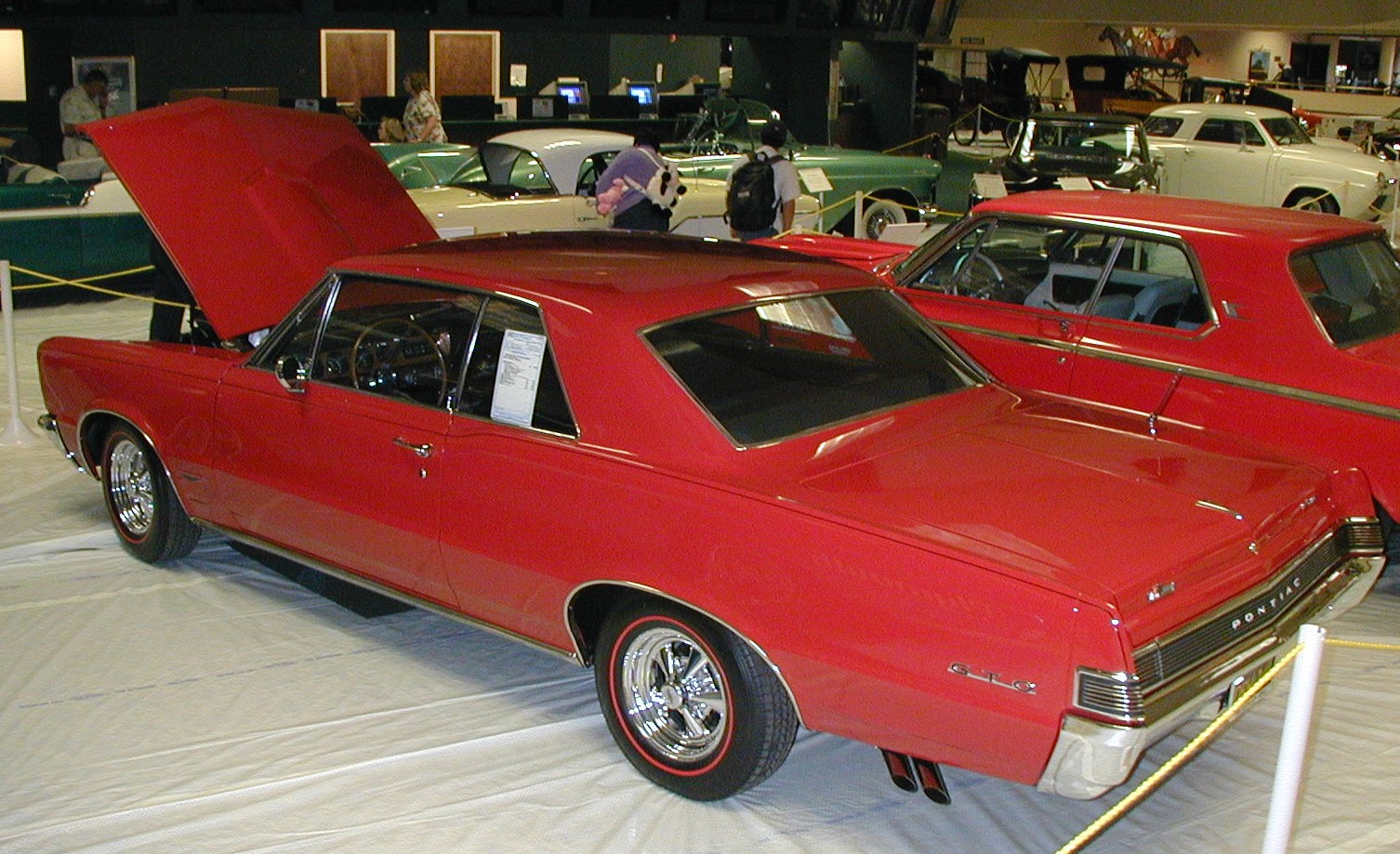
A 1965 Pontiac GTO tri-power at a past Goodguys Del Mar Nationals car show

The red 1965 Pontiac GTO tri-power at a past Goodguys Del Mar Nats. (Darwin Ludi)

“We will take the black Corvette to have it judged NCRS and Bloomington Gold next year. The blue ’63 is already certified by both groups. I want to make sure that the next caregiver of these cars ends up with the best we can provide.

“Last year the National Corvette Museum had a virtual event and 95 cars were registered for the C2 class, in which we won. We have been invited to the EyesOn Design car show in Detroit next year. And in 2019 we won at the Art Center in Pasadena, as well.

“Take care, stay healthy and keep busy. Hope to see you down the road.”

Darwin & Patricia Ludi

1972 GMC Sprint

1972 GMC Sprint

Badge-engineered from the Chevrolet El Camino, 1971-1987

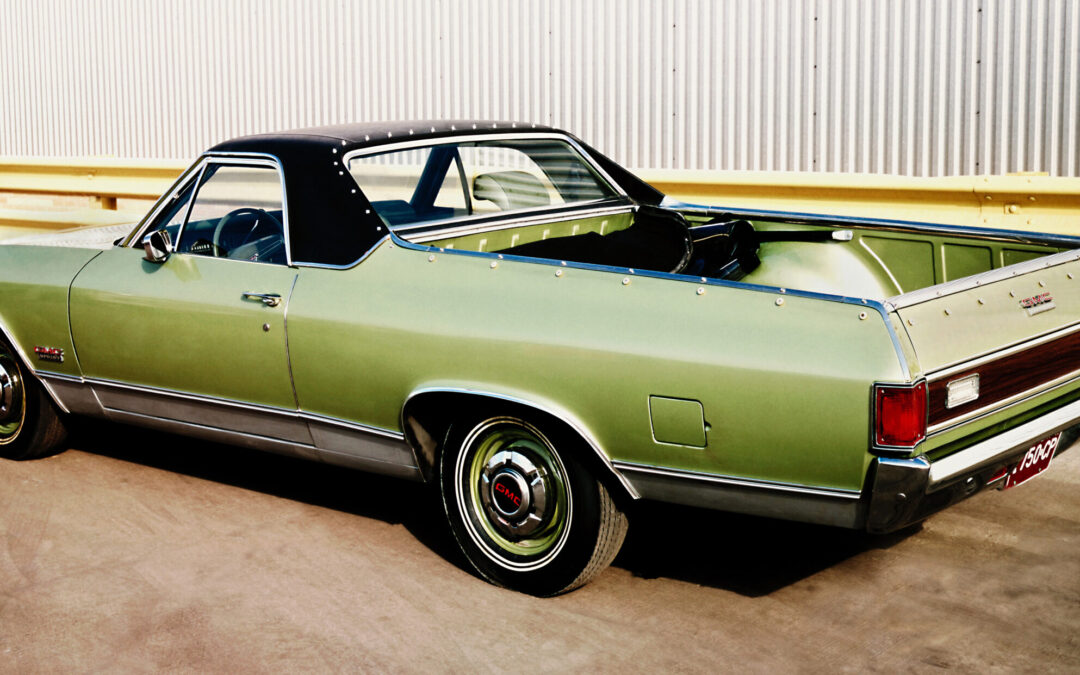
The GMC Sprint shared exterior and interior elements with the Chevelle Malibu and El Camino. A 1971 Sprint is shown. (GM media archives)

BY MARK MAYNARD

I have walked among thousands of vintage vehicles at dozens of car shows, but I learned something new today while researching a 1960 GMC pickup. Trolling the GM media archives I came upon an image for a 1971 GMC Sprint.

How had I never heard of this badge-engineered version of the Chevrolet El Camino. Maybe I had just overlooked it in the years of enjoying car shows, but in my defense, surely its production numbers were a sliver of the very popular El Camino.

According to its page in Wikipedia, the GMC Sprint (a coupe utility-pickup) was produced for the 1971-1977 model years. It was renamed Caballero for the 1978 model year and produced through 1987.

“It was identical to the El Camino except for the name. The chassis for both variants was based on the Chevrolet Chevelle station wagon and four-door sedan.

“The vehicles were built on the GM A platform through 1981; for 1982, it was re-designated the G platform as the A platform switched to front-wheel drive.

Difficult Time To Debut

The Sprint’s debut in the early 1970s was not a happy time for performance cars in the United States. It was the first year for mandated lower-octane unleaded fuel, which necessitated a reduction in engine compression. GM’s A.I.R. system, a “smog pump,” was added to control tailpipe emissions.

The GMC Sprint was sold with several engine choices for 1971-72.  The base engine was a 145-hp, 250-cubic-inch OHV inline-six. Optional engines included small-block V-8s of 307 and 350 cubic inches and big-block V-8s of 402- and 454-cubic-inch displacements.

“For 1972, horsepower measurements were switched to the ‘net’ figures as installed in a vehicle with all accessories and emission controllers hooked up,” according to the Wiki report. “This change brought the horsepower ratings for 1972 down to a range from 110 horsepower for the six to 270 for the 454 V8.”

The Sprint, sold in trim levels of Standard or Custom, shared exterior and interior trims with the Chevelle Malibu and El Camino. Both years featured rear-end styling taken from the Chevelle station wagon (and were shared with El Camino). The interiors featured cloth and vinyl or all-vinyl bench seats and deep twist carpeting. All-vinyl Strato bucket seats and center console were optional.

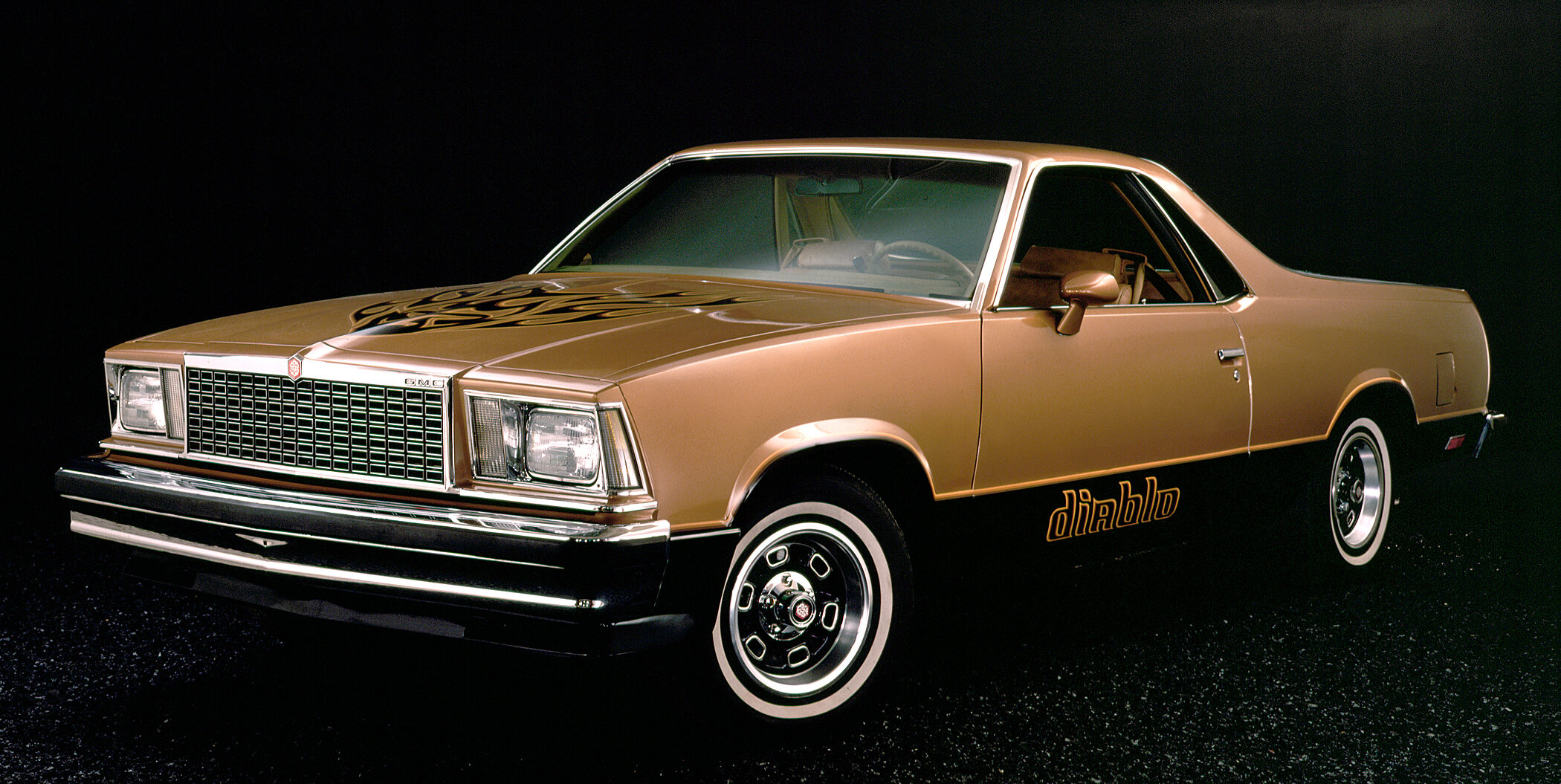
The 1979 GMC Caballero.

The GMC Sprint Diablo package was added in 1978 as an equivalent to the El Camino’s Black Knight (1978) and then the Royal Knight, post-1978, which was an upgrade from the long-running Super Sport package.

The Royal Knight and the Diablo carried a hood graphic in a symmetrical flame pattern that resembled a demon. Diablo also came with lower-body accent paint, body-color mirrors, black-trimmed window frames. Exterior separators also included a front air dam, color-matched steel “Rally” wheels and a large “Diablo” decal on the tailgate.

Sprint SP

The GMC Sprint SP package, only offered on the Sprint Custom, was GMC’s equivalent of the Chevrolet SS package. It was designated as option package, RPO YE7, rather than a distinct model. Engines were an L48 350 four-barrel, LS3 400 (402) big block and the LS5 454 365-hp big block.

On The Auction Block

A 1972 GMC Sprint, in orange paint and black interior, will be among the vehicles slated to auctioned by Mecum at its 34th annual Indy Spring Classic, May 14-22, 2021. It will be Lot T104 and is a “Star” car.

According to the seller’s description:

•This Sprint is one of 749 SP models produced in 1972 and has the original build sheet;
•454-cubic-inch V-8, automatic transmission, disc brakes and power steering;
•Air conditioning;
•Built at Leeds plant in Kansas City, Mo.;
•Sold new at Burnett Buick

Mustang Mach-E 1400 X Hot Sauce

Mustang Mach-E 1400 X Hot Sauce

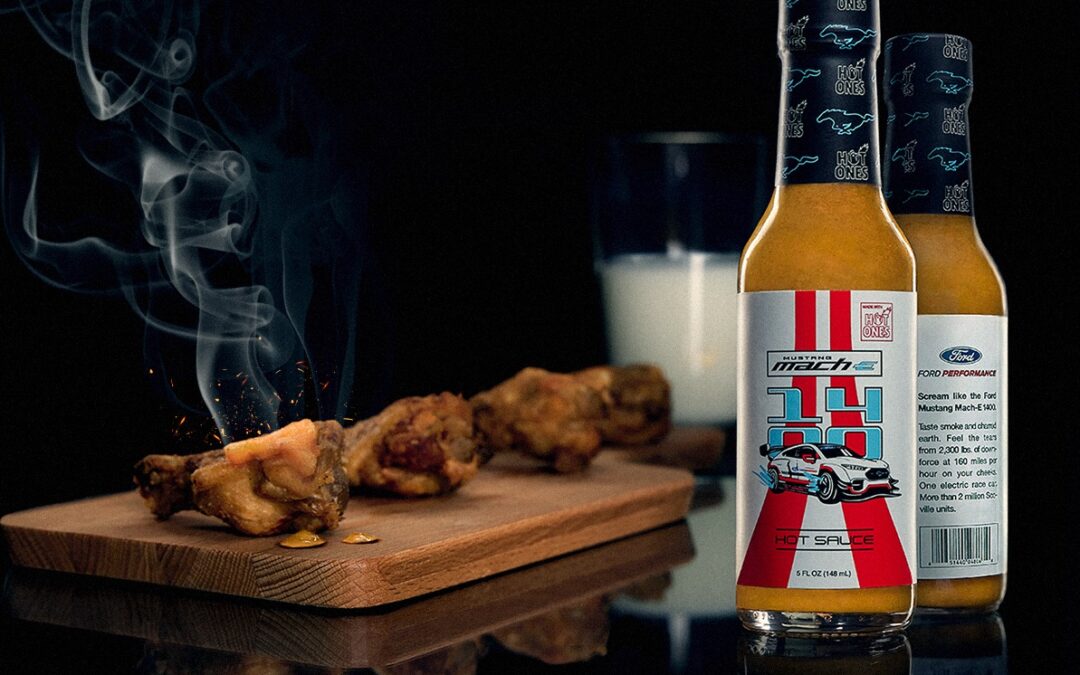
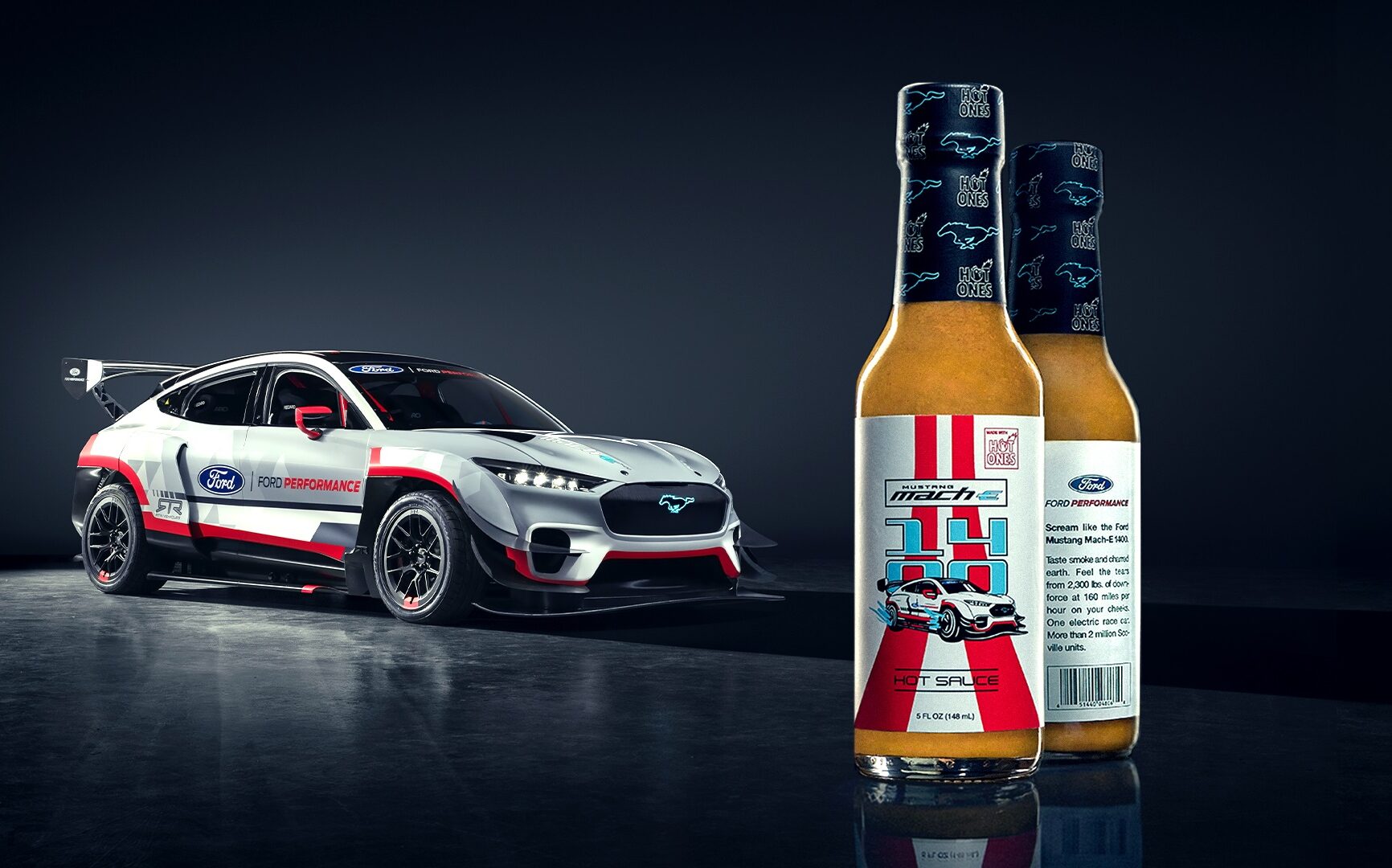
Mustang Mach-E hot sauce promo.Ford Performance joined forces with Sean Evans, of the web show “Hot Ones” to turn the feeling of riding in the Mustang Mach-E 1400 into a hot sauce. (Ford) 

BY MARK MAYNARD

Ford Performance and hot sauce “heatonist” Sean Evans are playing chicken, sort of, with an eye-watering recipe. Evans, of the “Hot Ones” web show, has cooked up a blistering sauce that attempts to translate the sensation of riding in the Mustang Mach-E 1400.

The bottled sauce — too-hot-for-production or for sale — is said to have notes of smoke and charred earth from plenty of insanely hot peppers. Motorsport’s champion and fearless “fun-haver,” Vaughn Gittin Jr., took a taste test. And then Gittin Jr. took Evans for a saucy track run in the Mustang Mach-E 1400.

Both prototypes appear to have similar insane capabilities. Pass the cold milk for the hot sauce, pass the barf bag for the ride-along with Gittin. Watch the video.

Mustang Mach-E hot sauce with Vaughn Gittin and Sean Evans.

Hot sauce “heatonist” Sean Evans (left) and racing champ Vaughn Gittin Jr. sit down for an eye-watering taste test of the hot sauce. (Ford)

No rules

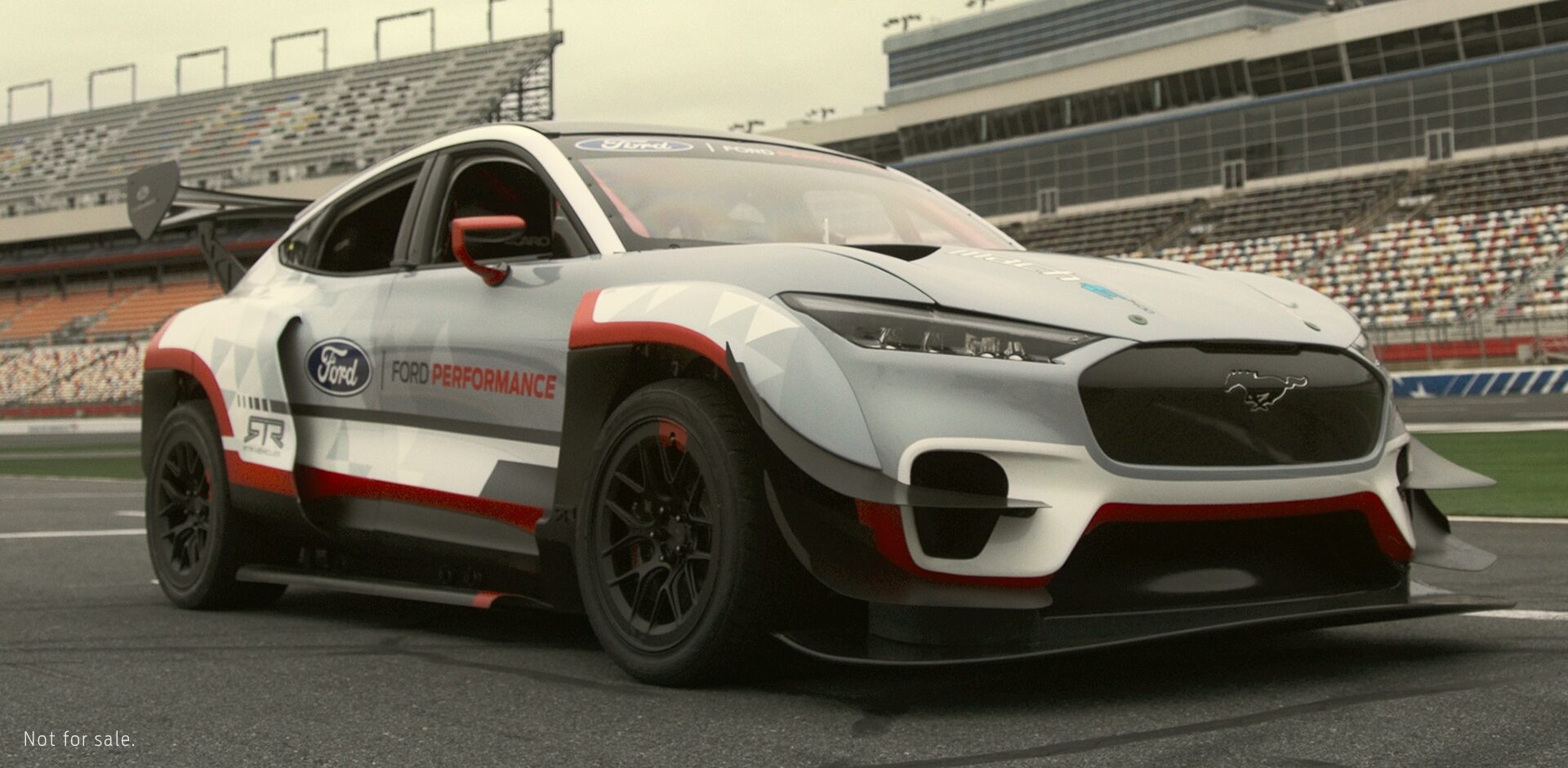
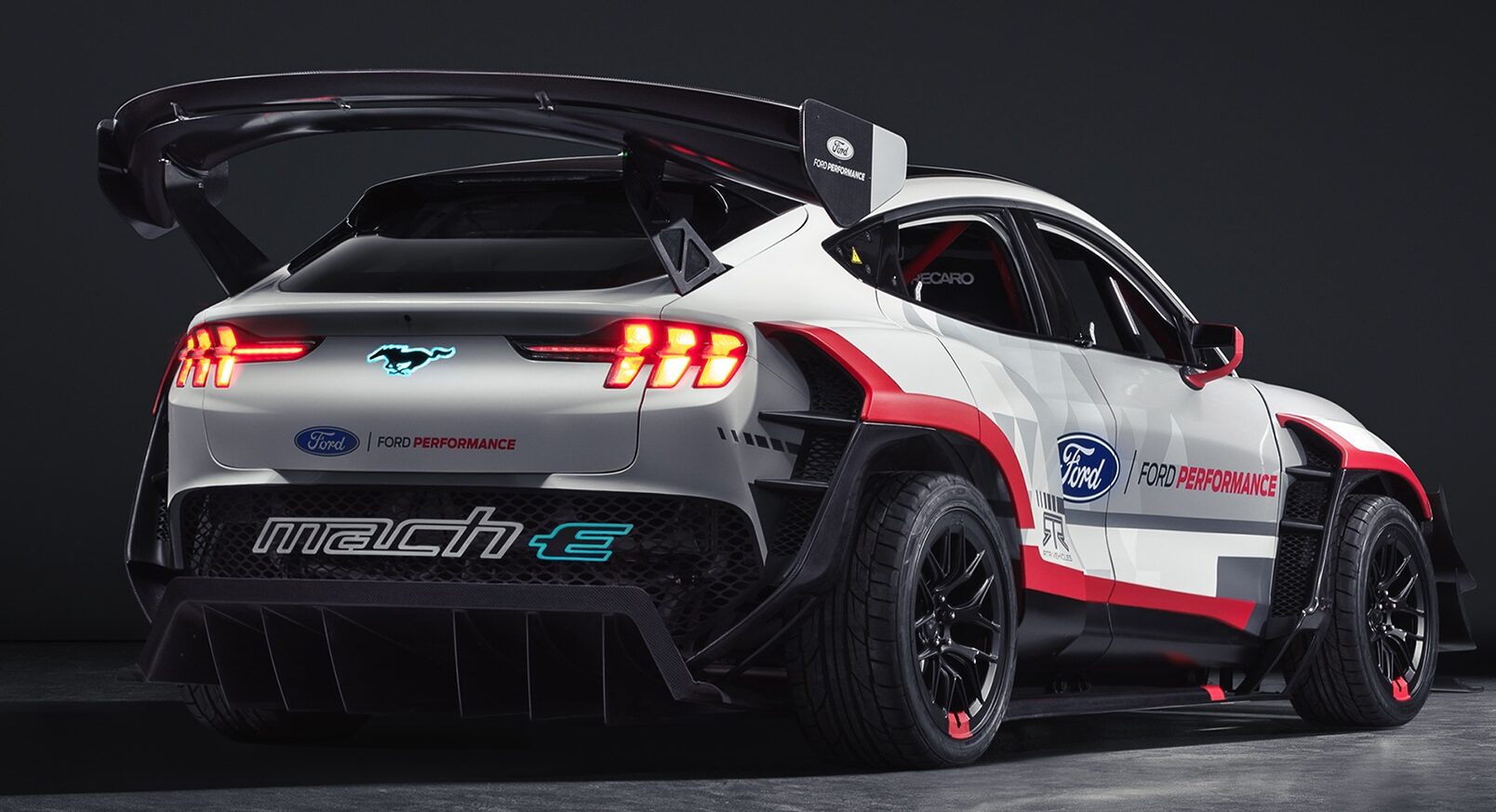
The Mustang Mach-E 1400 is a 1,400-horsepower, all-electric racing prototype built by Ford Racing engineers and RTR Vehicles. It’s a just-for-the-hell-of-it prototype to fathom the limits and adhesion potential for obscene electric power on the track, drag strip, or gymkhana course.

The Mach-E 1400 racing prototype.

The Mustang Mach-E 1400 is a 1,400-horsepower experiment. (Ford)

The project took 10,000 hours of collaboration to figure out what an electric vehicle can do and what customers tend to believe it can do, said Ron Heiser, chief program engineer for the Mustang Mach-E, in a release.

Mustang Mach-E Performance

Blistering power comes through seven — 7 ! — electric motors, five more than the production Mustang Mach-E GT. Three are attached to the front differential and four are attached to the rear in pancake style. A single driveshaft connects them to the differentials.

The setup has a huge range of adjustability to set the car up for everything from drifting to high-speed track racing, Heiser said.

The racecar's tire and aerodynamic fender fairing.

Aerodynamics were optimized, including unique cooling ducts. (Ford)

Battery power

The 56.8-kilowatt-hour battery is made up of nickel manganese cobalt pouch cells. The composition allows ultra-high performance at a high discharge rate. The battery system uses a di-electric coolant during charging to decrease the time needed between runs.

The project took shape without rules, according to Mark Rushbrook, motorsports director for Ford Performance. The Ford team and RTR used many of the same tools Ford uses for its race and production vehicles.

A rear view of the Ford racecar

Blistering power comes through seven electric motors. (Ford)

A winged warrior of downforce

Beginning with a Mustang Mach-E GT body-in-white, aerodynamics were optimized to create a winged warrior of downforce. The body has unique cooling ducts, a front splitter, dive planes, and a tall rear wing. Downforce is targeted at more than 2,300 pounds at 160 mph.

The chassis and powertrain were a test beds to evaluate different layouts and their effects on energy consumption and performance. There were chassis tests for rear-wheel drive, all-wheel drive, and front-wheel drive. Power delivery can be split between front and rear, or completely to one end or the other.

Drift and track setups have completely different front-end configurations,  Rushbrook said. As an example, the control arms and steering changes were calibrated to allow for the extreme steering angles in drifting.

The disc-brake system by Brembo has an integrated electronic booster. It allows series regenerative braking and is combined with ABS and stability control. A hydraulic handbrake for drifting allows the powertrain controls to shut off power to the rear motors.

“The challenge was controlling the extreme levels of power provided by the seven motors,” Rushbrook said in the release. “Mustang Mach-E 1400 is a showcase of the art of the possible with an electric vehicle.”