Select Page

Subaru Crosstrek Wilderness Review

Subaru Crosstrek Wilderness Review

 The 2024 Subaru Crosstrek Wilderness is ready to go above and beyond with 9.3 inches of ground clearance and dual function X-Mode traction control

A three quarter view of a Subaru Crosstrek Wilderness amid a blue sky and San Diego backcountry mountains

More than surefooted transportation, Subaru says the Crosstrek Wilderness is “designed as a ‘partner’ for outdoor activities.” Pricing starts at $33,540. (Photography by Mark Maynard)

Jump To Contents

Crosstrek History
Off-Road Ready Small SUVs
2024 Subaru Crosstrek Pricing
Crosstrek Wilderness Separators
Safety Features
Performance
Wilderness Ride and Handling
Interior Function
Why Buy the Crosstrek Wilderness?
Specifications

BY MARK MAYNARD

When I first saw the Crosstrek Wilderness, I knew we would get down and dirty. This top model of the wildly popular Subaru Crosstrek is outfitted as the Off-Road Militia Commander. Dressed in Alpine Green paint and copper-colored epaulets, I almost gave a crisp salute.

You will know it when you see the Crosstrek Wilderness. The Army green tester looked parade-ready with copper-toned pageantry. With its sand-and-snow grips at the edge of the tread face on raised white-letter Yokohama Geolandar all-terrain tires, it is poised for action. The body side moldings look to be military-grade protection from rock rash and trail pinstriping. Raised roof rails have a capacity of 700 pounds to support the optional roof-top tent, or whatever can be lashed to the rails. Front and rear bumper treatments look bump-stop ready.

It is a silly investment for this owner not to use the Crosstrek Wilderness in its natural element. There are four other Crosstrek trim levels, all with standard all-wheel drive, a base flat-four engine, and a hop-up choice. There are two versions of the Lineartronic continuously variable transmission Incline Start Assist, with the more off-road capable dual-function X-Mode for the Wilderness and upper trims. The Wilderness also has an air-cooled transmission fluid cooler.

Subaru says the Crosstrek Wilderness is more than surefooted transportation; it is “designed as a ‘partner’ for outdoor activities.”

Looking at the driver area and steering wheel

Driver sightlines are uncluttered at the side mirrors and over-the-shoulder.

Subaru Crosstrek History

The 2024 Subaru Crosstrek Wilderness joins the Subaru Forester and Outback Wilderness models. All generations of the Crosstrek compact SUV are raised versions of the Subaru Impreza hatchback.

Crosstrek history goes back to the 2013 U.S. launch of the Subaru XV Crosstrek, which dropped the XV — “Crossover Vehicle” — in 2016. A gasoline-electric hybrid version came out in 2014, and a plug-in hybrid version was added in 2019. The plug-in model was dropped in 2023, but rumors abound that a hybrid variant will be offered again soon.

The second generation debuted in 2017 and offered a six-speed manual transmission. Crosstrek had a facelift for the 2021 model year, introducing new driver-assistance technologies and the new 2.5-liter “boxer” four-cylinder engine option.

This third-generation Crosstrek is built on the Subaru Global Platform and underpins other Subaru models. Subaru says the body is 10 percent stiffer in torsional rigidity than the previous generation. Subaru says the global platform has full inner frame construction and uses more structural adhesive. However, with the stiffer body, Subaru also engineers some flexibility into the chassis to improve suspension movements for greater road adhesion.

Looking through the driver door at the front bucket seats with embossed Wilderness emblems on the headrests

StarTex water-repellent upholstery with a embossed headrests.

Off-Road Ready Small SUVs

Most automakers now offer an adventure-themed SUV or truck. Here are four competing 2024 SUV crossovers to the Subaru Crosstrek Wilderness.

Chevrolet Trailblazer Activ AWD, $30,000. Assets: off-road suspension tuning, front underbody skid plate;

Ford Bronco Sport Badlands 4WD, $40,630 (including $645 “acquisition fee.” Assets: off-road suspension, underbody protection, 17-inch Continental all-terrain tires 225/65;

GMC Terrain AT4, $36,890 (before incentives). Standard AWD, 7.9 inches of ground clearance;

Jeep Cherokee Trailhawk, $42,890. Assets: off-road suspension, Jeep Active Drive Lock with mechanical locking differential on Active Drive Lock, 8.7 inches ground clearance;

Kia Sportage X-Pro, $37,565. Assets: active all-wheel drive with center locking differential, multi-terrain drive modes, and 8.3 Inches of ground clearance;

Toyota RAV4 TRD Off-Road, $39,645 Assets: torque vectoring all-wheel drive with rear driveline disconnect (to improve fuel economy).

A view of the underside from the rear of the Crosstrek

A flat underbody for trail access.

2024 Subaru Crosstrek Pricing

Crosstrek is sold in five trim levels: Base, Premium, Sport, Limited, and Wilderness. All models have standard all-wheel drive and two engine choices, both with a Lineartronic continuously variable automatic transmission with adaptive control and incline start assist; all trims but the Base have an eight-speed manual mode with paddle shifters.

Retail pricing includes the $1,345 freight charge from Lafayette, Ind.:

  • Base: $26,540
  • Premium: $28,085
  • Sport: $30,935; Alpine Green paint is a $395 option.
  • Limited: $32,440
  • Wilderness: $33,540

The Crosstrek Wilderness tester with two options came to $36,205. Alpine Green paint is a $395 choice. Option package 23, $2,270, adds a power moonroof, a 10-speaker Harmon Kardon audio system, and a 10-way power adjustable driver’s seat.

Check this link for special Subaru Crosstrek offers.

Get current Subaru Crosstrek pricing here.

Looking into the front passenger area of the Wilderness Crosstrek

For $36K, the front passenger should also have a power seat.

Crosstrek Wilderness Separators

Wilderness separators from other Crosstrek models, include:

  • Raised suspension with 9.3 inches of ground clearance
  • 182-hp 2.5-liter Subaru Boxer engine with a lower final-drive ratio for improved low-speed climbing — up to a 38-degree grade – and a stronger rear differential;
  • Air-cooled oil cooler for the Lineartronic CVT
  • 17-inch matte black-finish wheels and Yokohama Geolandar all-terrain tires;
  • StarTex water-repellent upholstery and anodized copper-finish interior accents;
  • Unique front and rear bumpers with integrated tow points and extended lower cladding;
  • 3,500-pound towing capacity;
  • An all-weather package adds heated front seats, windshield, and side mirrors.
Looking at a front corner that shows the Crosstrek's fog lights in a hexagonal pattern

Wilderness LED fog lights in a hexagon pattern.

Subaru Options to Consider

Thule Awning — Roof Mounted, $849.95

I camped in Baja California for years and always packed along a 10-by-10 easy-up canopy. It was always a struggle to put up and take down, especially in windy conditions. The Crosstrek’s roof-mounted awning is a simpler choice for shelter from the sun and rain. The awning is made of high-strength fabric and has canopy tensioners. Telescopic support legs are height adjustable, depending on the terrain. Access by the telescoping aluminum ladder also functions as a critical support to stabilize the weight of the tent and its occupants.

The 6 1/2-foot-wide awning, which stows in a lightweight aluminum case, reaches 8 feet when fully extended. Also included is a locking adapter kit for mounting to the crossbars and stakes to secure the legs to the ground.

Thule Roof Top Tent, $2,799.95

It sounds like a great idea to be off the ground while camping, but what a hassle for the midnight bathroom break. The tent is claimed to be large enough for two to three campers. It has panoramic skylights and windows for ventilation and a dual-layer foam mattress.

Lockable mounting brackets are extra and secure the tent to the Thule Crossbar Set – Aero Extended, $539.72.

The Subaru accessories guide claims “quick and easy deployment in 3 minutes or less: unzip the travel cover, unfold the base, and secure the ladder to begin your camping adventure!” The tent weighs 128 pounds. (I’d like to see that “easy deployment” in 3 minutes!)

Other tent features include:

  • A rain cover.
  • Dual-zippered panels for the door and windows.
  • Four skylights with a bug screen and a water-resistant polyester privacy panel.
  • Zippered travel cover.
Wilderness roof rails with copper mounting brackets.

700-pound capacity roof rails. (Subaru)

Subaru Crosstrek Safety Technologies

All Subaru Crosstrek models have eight air bags (including a driver knee bag and front passenger seat-cushion air bag), blind-spot detection with lane change assist and rear cross-traffic alert, and reverse automatic braking.

The suite of Eyesight driver-assist technologies includes advanced adaptive cruise control, pre-collision braking, pre-collision throttle management, lane departure and sway warning, and a lead vehicle start alert.

Looking at the left front tire turned to show the black alloy wheel

17-inch Yokohama Geolandar all-terrain tires look rugged but roll smoothly without much noise.

Powertrain and Performance

I would not want any less than the 182-hp in the Crosstrek Wilderness. The 2.5-liter flat four-cylinder moves out tentatively until the engine gets into the torque range. There is strong force between about 25 and 55 mph, but passing power is thin at 65 mph and above. I used Sport mode except when cruising on the Interstate.

The Crosstrek Wilderness has the heaviest curb weight of 3,417 (with options), but it is just 92 pounds heavier than the Base model. 3,417 pounds with options

Revisions to the 2.5-liter engine include new camshafts, which raise torque to 178 foot-pounds at 3,700 rpm. That is just 2 pound-feet more than before, but peak torque drops by 700 rpm. More torque at a lower rpm provides a quicker getaway from the traffic light and more acceleration control while off-road.

X-Mode is an electronic hill descent control system that automatically controls the throttle and brakes, allowing drivers to focus on steering. However, this setting only works up to 12 mph. Improvements to the X-Mode control now automatically restore it when the speed drops to 22 mph.

Dual-function X-Mode is a secondary setting for use in more extreme snow, sand, or mud conditions. Engagement by a console button (or through the infotainment touchscreen) allows for some wheel spin to maintain forward momentum.

The Lineartronic CVT (Continuous Variable Transmission) is retuned for better low-speed performance, and with the addition of a CVT cooler. The Lineartronic transmission uses a chain instead of a belt, which is longer lasting and responds faster to throttle input. A manual mode simulates eight gear changes, which can be helpful off-road to control downhill speed. The tow rating is surprisingly strong at 3,500 pounds.

A view of the 2.5 liter Crosstrek engine

Look how Subaru places all DIY checkpoints in easy reach.

Crosstrek Wilderness Ride and Handling

Perhaps the greatest asset of the Crosstrek Wilderness will never be experienced in a dealership test drive. Subaru’s “symmetrical” all-wheel drive is more than full-time AWD. It is an entire drive system philosophy. It begins with the low-mounted boxer engine with the driveshaft to the rear differential mounted in a straight, symmetrical line. Most 4WD systems have an offset driveshaft from the front transfer case to the axle and a second driveshaft centered from the transmission to the rear axle.

Subaru’s dual-pinion electric power-assisted steering is unrecognized for its smooth-rolling finesse and quick turn-in.

With the combination of the low position of the engine and driveline, there is much reduced body roll in cornering. On my backcountry run, I steered into tight S-turns and prepared for the expected weight transition of a raised suspension. But there was no roll, just a flat execution through the corners. It brought a smile and encouraged me to push a little harder into the next turn. It might be different with a few hundred pounds lashed to the roof, but I will call Subaru’s symmetrical all-wheel drive a passive stability system.

Inside, the cabin is reasonably soundproofed, including a laminated windshield. But those heavy-duty roof rails and raised ride height generate wind noise.

The open driver's door to show the storage space

Black and gray plastic is acceptable in appearance for a dust-prone off-roader.

Crosstrek Interior Function

The 11.6 inch long tablet style infotainment screen

The 11.6-inch-long multimedia tablet screen presents a narrow rearview camera view.

The Crosstrek cabin is efficient and roomy. There is a comfortable entry step-in height. Driver sightlines are uncluttered at the side mirrors and over the shoulder. Front headroom is good at 38.7 inches, or 39.8 inches, without the sunroof. Seat comfort is sufficient for a three-hour drive, but I did wish for more upper-body bolster control for powering through the S-turns. Substantial sun visors have extenders, and armrest pads are thick and comfy. The wireless charging pad just ahead of the shift console has a thoughtful light when traveling at night.

A 10-way power driver’s seat is a valuable feature in the sunroof package. But, the front passenger gets just a four-way manual seat — it should be power for the $36K Crosstrek Wilderness.

There is much black and Gunmetal Gray plastic that is acceptable in appearance for a dust-prone off-roader. Some creative trim elements add visual texture to the plastic-ness. Piano black around the gearshift showed scratches, with just 4,128 miles on the test vehicle.

My biggest gripe is the 11.6-inch multimedia-plus tablet screen. I’m sure it is efficient packaging to access phone, navigation, and apps, but the display is limiting. The rearview camera view is narrow and small, and glare can complicate views. A row of digital buttons at the tablet’s base is a quick fix while driving to adjust temperature and fan speed. However, those actions take eyes from the road to hunt and tap.

There is a 12-volt plug of 120 watts, but it should be stronger at 180 watts. For campers, a household 120-volt outlet would be beneficial for powering air pumps, auxiliary lighting, and chargers.

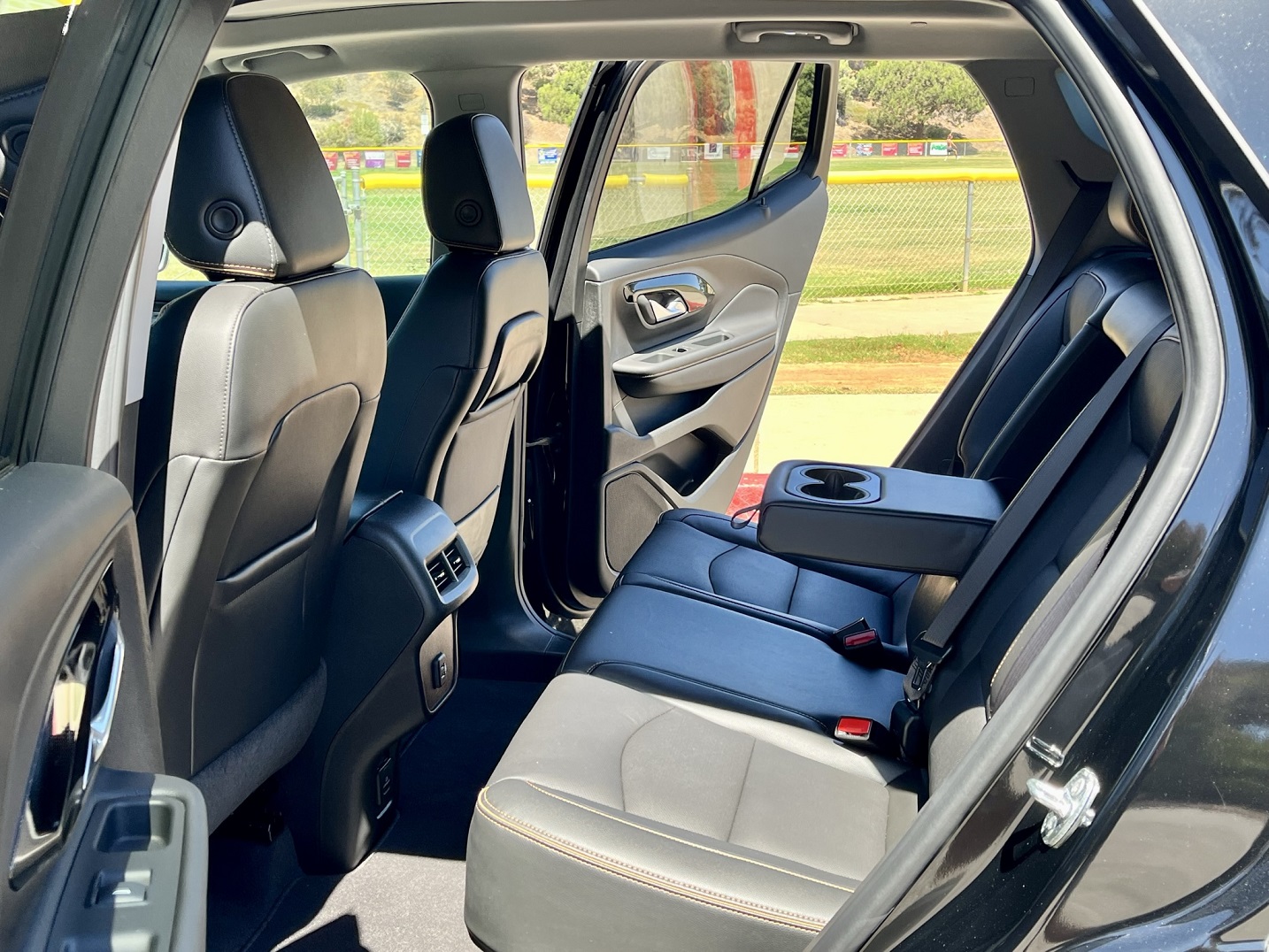
Looking into the back seat with both doors open

Back seat roominess is a smart compromise between cargo space and legroom.

Back Seat and Cargo Space

Back seat roominess is a smart compromise between cargo space and legroom. However, the bench is short on adult thigh support, but that helps legroom of 36.5 inches.

Side windows go all the way down, and the doors open to nearly 90 degrees. That’s more smart Subaru engineering that benefits parents strapping toddlers into child seats or loading gear for camping. However, the big-shoed passenger’s foot space through the back doors is tight.

Fold the back seats for about 5 1/2 feet in length. The cargo entry is wide at 40 ½ inches and 28 ½ inches from floor to headliner.

A full-size 17-inch temporary spare stows under the cargo floor with some robust jacking equipment.

The open cargo area of the Crosstrek

Fold the back seats for about 5 1/2 feet in length. Below, a full-size, 17-inch temporary spare.A full size temporary spare tire stows under the cargo floor

Why Buy the Crosstrek Wilderness?

The Subaru Crosstrek is a long-term keeper. It is smartly simple and adaptive to busy lives. The Wilderness is meant to be tramped and camped and looks better with exterior dirt and trail pinstriping. For maintenance DIY-ers, all the regularly checked engine fluids are clearly marked, and the oil filter is at the top of the engine.

If you are considering one of the new “adventure-themed” SUVs — and you are an active trail explorer — doesn’t it make sense to consider a vehicle from a manufacturer specializing in all-wheel drive and getting people to the outback?

A three quarter rear view of the Crosstrek Wilderness

The Subaru Crosstrek Wilderness has a raised suspension with 9.3 inches of ground clearance.

2024 Subaru Crosstrek Wilderness Specifications

Body style: Compact, 5-door, 5-seat SUV crossover with standard Subaru symmetrical all-wheel drive

Engine: 182-hp 2.5-liter Subaru Boxer four-cylinder with direct fuel injection and auto stop-start at idle; 178 lb.-ft. torque 3,700 rpm; Subaru SI-Drive driver-selectable Intelligent and Sport modes with steering wheel control switches

Transmission: Lineartronic CVT with adaptive control, incline start assist, and 8-speed manual mode with paddle shifters

Fuel economy: 25/27/29 mpg city/hwy/combined; 87 octane recommended

BY THE NUMBERS

Fuel tank: 16.6 gallons

Cargo space: 20-54.9 cubic feet

Max. load floor length, rear seats up/down: 32.1/63.9 inches

Front head/leg room: 38.7*/42.9 inches *39.8 inches w/o moonroof

Rear head/leg room: 38/36.5 inches

Length/wheelbase: 176.4/*104.9 *105.1 inches all other trims

Width/height: 71.7*/63.6 inches *79.4 including mirrors

Curb weight: 3,417 pounds with options

Turning circle: 34.78 feet

Tow rating: 3,500 pounds (class 1); 400-pound tongue weight (1,500 lbs. with 2.0 engine)

Minimum road clearance: 9.3 inches (vs. 8.7 inches in other trims)

Angles of approach/departure: 20.0/33 degrees

Ramp breakover angle: 21.1 degrees

Crossbar dynamic load capacity: 165 pounds (176 lbs. other trims)

Crossbar static load capacity: 700 pounds

FEATURES

Crosstrek Wilderness key equipment includes: Keyless entry with push-button ignition, 4.2-inch color digital display for driver information and gauges, USB-C input-charge port in front center console, wireless phone charger, USB-A and USB-C charge ports in rear center console, cargo cover (retractable), sound insulating windshield, Subaru Starlink 11.6-inch multimedia-plus system, Subaru Starlink connected services, all-weather package (heated front seats, heated windshield, and heated side mirrors), LED light on rear gate for cargo area;

Interior Crosstrek Wilderness features include: anodized copper-finish stitching and accents, Gunmetal Gray touch points, StarTex water-repellent upholstery, front headrests with Subaru Wilderness logo embossed, all-weather floor mats with Subaru Wilderness logo on front mats, black-finish headliner;

Crosstrek Wilderness exterior features include: dual-function X-Mode with hill descent control, 17-inch alloy wheels in matte black finish, 225/60 Yokohama Geolandar all-terrain tires, raised ladder-type roof rails, LED headlights (with LED signal, accent, and side marker lights);

Safety features include: 8 air bags (including a driver knee bag and front passenger seat-cushion air bag), blind-spot detection with lane change assist and rear cross-traffic alert, reverse automatic braking;

Eyesight driver-assist technologies include: Advanced Adaptive Cruise Control; Pre-Collision Braking; Pre-Collision Throttle Management; Lane Departure and Sway Warning, and Lead Vehicle Start Alert.

CHASSIS COMPONENTS

Brakes: Electronic controlled power-assisted dual diagonal 4-wheel discs with electronic brake-force distribution, 4-channel/4-sensor ABS, brake assist, brake override, auto vehicle hold, and active torque vectoring; Front rotors: 12.4-in. ventilated discs with dual-piston calipers; Rear rotors: 11.2-in. ventilated discs with single-piston calipers

Steering: Dual pinion electric power assisted steering; Turning circle: 34.78 ft.) (35.44 ft. other trims)

Tires-wheels: Yokohama Geolandar 225/60R17 99T all-terrain; 17 x 7-inches aluminum alloy, matte black finish

Suspension: 4-wheel independent, raised; front, MacPherson-type struts, lower L-arms, coil springs, dampers, stabilizer bar, hydraulic engine mounts; rear, Double wishbone, coil springs, dampers, stabilizer bar

PRICING

Wilderness base price: $33,540, including $1,345 freight charge; price as tested $36,205.

Options on test vehicle: Alpine Green paint ($395); option package 23 ($2,270) adds a  power moonroof, a 10-speaker Harmon Kardon audio system, and a 10-way power adjustable driver’s seat.

Where assembled: Lafayette, Ind.

Warranties: 3-years/36,000-miles bumper to bumper with roadside assistance; 5-years/60,000-miles powertrain

57th Annual Easter Jeep Safari April 1-9

57th Annual Easter Jeep Safari April 1-9

 The long-running Moab Easter Jeep Safari will draw 20,000 participants and debut 7 wild Jeep concept vehicles, four of which are electrified

The group of 7 Jeep concept vehicles

Seven one-of-a-kind Jeep concept vehicles take four-wheeling to the next level of Jeep 4×4 capability for the 2023 Easter Jeep Safari. (Photos courtesy of Stellantis)

Table of Contents

Wrangler Magneto 3.0 Concept
Scrambler 392 Concept
1978 Jeep Cherokee 4xe Concept
Wrangler Rubicon 4xe Concept
Grand Wagoneer Overland Concept
Wrangler Rubicon 4xe Departure Concept
Gladiator Rubicon Sideburn Concept
Jeep Performance Parts

 BY MARK MAYNARD

Jeep has just off-loaded seven wild mission-capable concept vehicles for the 57th annual Easter Jeep Safari, April 1-9, 2023, in Moab, Utah

The annual gathering since 1967, began as a simple one-day trail ride by the Moab Chamber of Commerce. Over the years, as participation grew, the Easter Safari expanded until it finally reached the current nine-day event. “Big Saturday” remains the culmination of the event on the Saturday of Easter weekend.

Today, Moab’s Red Rock 4-Wheelers four-wheel-drive club hosts the Easter Jeep Safari. The club will lead trail rides and some daylong trips.

“Every year, more than 20,000 Jeep enthusiasts descend on Moab, Utah, for Easter Jeep Safari to wheel in the most extreme off-road conditions,” said Jim Morrison, senior vice president and head of Jeep brand North America. 

Moab, Utah — the Jeep brand’s home away from home — has the ideal conditions to connect with Jeep enthusiasts. Morrison said in a release that Jeep listens to its followers for their feedback on where they want to take the Jeep brand into the future.

A trail ride of Jeeps in Moab

Moab’s Red Rock 4-Wheelers four-wheel-drive club hosts the Easter Jeep Safari and leads trail rides and some daylong trips.

Sermon On the Mount 

Electrified power and commanding performance will be front and center during this year’s Safari, Morrison said. Jeep engineers and designers from Jeep Performance Parts (JPP) by Mopar have created one-off rock-crawling and terrain-traversing vehicles to take four-wheeling to the next level.

The Wrangler Magneto, Jeep’s first battery-electric vehicle concept, returns for a third season. The third iteration of the Jeep Wrangler SUV concept, Magneto 3.0, and three other Jeep 4xe concept vehicles are a testament to the Jeep brand’s commitment to Zero Emission Freedom and 4×4 leadership.

Each concept features the latest production and prototype Jeep Performance Parts, all battle-tested for durability.

“Unlike any other aftermarket offerings, our growing portfolio of factory-tested and factory-backed parts and accessories are designed and engineered to face the toughest trails in the world,” said Mark Bosanac, North America senior vice president, Mopar service, parts, and customer care.  

The 2023 Easter Jeep Safari concept vehicles include:

Jeep Wrangler Magneto 3.0 

The Jeep Magneto concept

The Jeep Wrangler Magneto 3.0 Concept is back with modifications for its third safari.

When the Jeep design team began building the Jeep Wrangler Magneto concept, the intention was to use the platform to discover and push the boundaries of 4×4 electrification.

The Jeep Magneto 1.0 concept made its Safari debut in 2021 as a fully capable battery-electric off-roader. Based on a two-door 2020 Jeep Wrangler Rubicon, the Magneto features a custom-built axial flux electric motor that operates up to 6,000 rpm. Its 285-horsepower e-motor connects to a six-speed manual transmission. The compact e-motor was initially tuned to deliver up to 273 foot-pounds of torque.

The 2022 debut of Jeep Magneto 2.0 raised the e-motor power to 625 hp with 850 lb.-ft. of peak torque.

Updates to the 2023 Jeep Magneto include a more efficient motor and updated programming. Together, the powertrain has a 20 percent increase in useable energy and range, Jeep says.

Also new to the 2023 Jeep Magneto 3.0 concept are three driver-selectable functions. Output select allows the driver to choose between two power settings:

Standard: 285 horsepower and 273 lb.-ft. of torque; 

Maximum: 650 horsepower and 900 lb.-ft. of torque;

  • Two-stage power regeneration mode allows normal driving while off, or with enhanced brake regeneration using the electric motor when engaged ;
  • Aggressive hill-descent mode selectable in low range for “one-pedal” off-road driving;

Trail-riding assets of Magneto 3.0 include:

  • Dynatrac 60 front axles (5.38:1 ratio) and Dynatrac 80 rear axles (5.38:1 ratio).
  • 20-inch off-road beadlock wheels.
  • 40-inch mud terrain tires.
  • A 3-inch lift.   
A clear hood insert on the Magneto concept

The tinted hood insert on the Magneto 3.0 Concept.

Bodywork changes include:

  • Door openings swept back by 6 inches for ease of access, ; 
  • A new B-pillar was moved rearward 2.36 inches (60mm) from stock to make way for a custom anti-roll bar;
  • Front fenders stretched back on the trailing edge by two inches; 
  • Windshield raked 12 degrees to give the side view a “chopped” roof feel without shortening the front glass.  

An updated paint scheme showcases all three evolutions of the Jeep Magneto 3.0. The Bright White and Surf Blue theme remains, but it was amped up with more vibrant exterior details and red accents. Magneto’s front seats are re-trimmed in blue leather with red accent stitching. The rear seats have been removed, and the floor is Rhino-lined in Surf Blue.

Jeep Scrambler 392 

The lime-green Jeep Scrambler conceptIntroduced in 1981, the Jeep Scrambler CJ-8 was Jeep’s first convertible, compact truck. This small pickup was similar to the CJ-7, but featured a longer 103-inch wheelbase and an extended rear overhang for increased cargo space.

Fast forward four decades, and the 2023 Jeep Scrambler 392 concept follows in the tracks of the CJ-8. Though a V-8 engine was never available for the CJ-8, the 392 Scrambler concept has a 470-hp 6.4-liter HEMI V-8 with 470 lb.-ft. of torque.  

The Jeep Scrambler 392 concept started as a four-door Wrangler Rubicon. Custom carbon-fiber bodywork reduced body weight. The windshield is laid back 12 degrees and matches a lower roof. The modified silhouette reminds of chopped-top hotrods.

A clear plastic hood panel to show the engine

A tinted, clear insert in the hood sets off the 392-cubic-inch V-8. in the Scrambler 392.

One of the most functional features of the Jeep Scrambler 392 concept is the newly released AccuAir air suspension kit developed for the Jeep Wrangler and Jeep Gladiator. This adjustable-height system ranges from 1.5 to 5.5 inches. The ride height can be adjusted on the fly with an in-cab controller or through long-range Bluetooth on a wireless device.

Updated bodywork includes a new front fender flare and carbon-fiber hood. A tinted, clear insert in the hood sets off the 392-cubic-inch V-8. Lightweight front and rear bumpers with new fender flares allow more clearance for a larger tire and wheel combo.

The Jeep Scrambler 392 concept sits on 40-inch tires on custom 20-inch rims. The rims and tow hooks are finished in Brass Monkey paint, the same as today’s Jeep Wrangler Rubicon 392. The concept’s Sublime green paint contrasts with the interior treatment of blue plaid inserts with green stitching.

1978 Jeep Cherokee 4xe Concept

The Jeep Cherokee 4xe electrified concept

This year’s resto-mod concept recalls the 1974 Jeep Cherokee SJ, a two-door version of the Wagoneer. The Cherokee SJ was aimed at younger, more adventurous drivers, Jeep says. 

The Cherokee 4xe concept began with a 1978 Jeep Cherokee, which was married with a 2022 Jeep Wrangler Rubicon 4xe

The original body was heavily modified, and the exterior melds original proportions with an unmistakably 1970s multicolor paint scheme.

At a glance, the ’78 Jeep Cherokee 4xe concept looks similar to a vintage Jeep Cherokee SJ. But it has been transformed into a modern, electrified, off-road performer.

The bright yellow interior of the Jeep Cherokee 4xe

The concept’s custom interior features low-back bucket seats trimmed in leather.

Under the hood, the ’78 Cherokee 4xe concept uses the Jeep Wrangler 4xe powertrain. Power comes from two electric motors, a high-voltage battery pack, and a 2.0-liter turbocharged four-cylinder engine. An eight-speed automatic transmission connects with a 4:1 transfer case. The gearing delivers enough power to turn the 37-inch tires wrapped around custom 17-inch “slotted mag” style wheels.  

The concept’s custom interior features low-back bucket seats trimmed in leather. The rear bench seat was replaced with a four-point safety cage, and the rear cargo space houses a full-size spare tire.  

Jeep Wrangler Rubicon 4xe 

A rearview of the Rubicon conceptThis Jeep Wrangler Rubicon 4xe concept won’t be overlooked on the trail. It has an unapologetic color palette in its pink-purple-hued paint with gloss black accents. 

An AccuAir air suspension kit raises off-road capability. The adjustable suspension allows clearance for the concept’s 37-inch tires and 17-inch high-gloss black American Expedition Vehicles Borah wheels. Additional AEV pieces include front and rear bumpers, differential covers, and a Warn Zeon winch.

The Wrangler Rubicon concept in bright pink-purple paint

Grand Wagoneer Overland

 The Grand Wagoneer Overland concept with a rooftop sleeping tent for twoOver the hills and through the canyonlands with the cross-trekking 2023 Grand Wagoneer Overland Concept. The exterior of the Grand Wagoneer Overland concept is painted Industrial Green with Gunmetal accents.

The Grand Wagoneer Overland concept leverages the new 510-hp 3.0-liter V-6 Hurricane Twin Turbo 510 engine with 500 lb.-ft. of torque.

A stand-out feature of the overlanding-inspired concept is its rooftop RedTail Overland Skyloft. The carbon-fiber-constructed Skyloft unfolds in around 10 seconds from the inside by pushing up with one arm.

Inside, the Skyloft’s second- and third-row seats have been removed, and the rear-most sunroof was repositioned to create a weatherproof, step-up entrance from the third-row seating area to the Skyloft level. Entry and exit are by a sliding door and a small step, which doubles as a table. 

The 2 person skyloft

The Skyloft unfolds from the inside by pushing up with one arm.

The two-person Skyloft is a climate-controlled oasis. Its cozy interior has two oversized beanbags, a plush throw rug, pillows, and interior lighting. The interior also provides storage for bikes, gear, or anything else worth its weight and size to pack along.

A heavy-duty Warn winch was at the front grille features two sets of custom laser lights for superior night-time visibility. A durable, black Rhino-lined roof has a pop of orange to call out the outdoor gear used by many overlanding enthusiasts.

Bodywork includes larger wheel openings and custom wheel flares. A custom front chin and rear valance improve approach and departure angles. The concept’s 35-inch tires and 18-inch wheels give a 1.5-inch lift to the vehicle, boosting break over and ground clearance.

Jeep Wrangler Rubicon 4xe Departure 

The Wrangler Rubicon 4xe Departure concept in Harbor Blue paintThe Jeep Wrangler 4xe Departure is a plug-in hybrid with a catalog of special equipment. It can manage tall steps with 37-inch BF Goodrich tires on 17-by-8.5-inch Vintage Bronze KMC Impact OL wheels. It gets a 2-inch JPP lift kit with Bilstein performance shock absorbers. 

A wide-mouth tubular guard, measuring 4 feet by 1 foot, protects the seven-slot grille. The custom grille guard also folds to create a bumper bench, an ideal perch for two to take a break along the trail. Below the grille guard is a modified Rubicon bumper with a Warn winch.   

New, flat fender flares have integral removable daytime-running-light covers, which are 50-state legal. 

The Rubicon Departure leather interior

Dark Harbor blue exterior paint is carried onto the instrument panel, which features various Vintage Bronze accents.

Unique to the Wrangler 4xe Departure concept are innovative options to mount the spare wheel and tire. At the rear is a custom tube gate that allows front- or rear-facing positions for the spare wheel and tire. When the spare is flipped outward, the system acts as a bed extender for more cargo space. When the gate is turned toward the cabin, the rear overhang is improved for off-roading, with the spare wheel and tire safely secured. The convertible gate maintains a factory backup camera and CHMSL in either position.  

Dark Harbor blue exterior paint is carried onto the instrument panel, which features various Vintage Bronze accents. The bold interior treatment has Nappa leather colors of Light Acorn Squash with darker Carnegie Hall brown, accented with off-white stitching. The Dark Harbor blue continues onto the 

The Wrangler 4xe Departure concept also features an accessory instrument panel rail to mount phones or accessories for recording trail rides.

Jeep Gladiator Rubicon Sideburn 

A rearview of the Jeep Sideburn concept in lime green.

The Jeep Gladiator Sideburn concept, in Solar Flash Yellow paint, gets a JPP 2-inch lift kit with Bilstein performance shock absorbers. Hefty-footprint BF Goodrich tires, 37-by-13-inches, are on black HRE six-spoke wheels, 17-by-9-inches

In response to Jeeper feedback, the Gladiator Sideburn concept has a pair of removable 11-inch TYRI rectangular LED lights at each roof panel. The lighting bracket features a quick disconnect.

A front tire of the Sideburn concept

A hefty-footprint BF Goodrich tires, 37-by-13-inches, are on black HRE six-spoke wheels.

The bed on the Gladiator Sideburn has Molle storage panels mounted above and behind the wheel flares. Integrated RotoPaX containers are specially designed for fuel and liquid storage. In the bed, a modified Mopar spare tire carrier secures a 37-inch wheel and tire.

JPP half doors, side steps, and grab handles add to the open-air attitude.

Custom instrument panel bezels carry a 3D topographical map of Moab scenery. The map is in a matte-black base with gloss dark-silver trails. Accents throughout the cabin are in Atomic Silver matte paint. 

Jeep Performance Parts

A see-through image to show jeep performance parts

JPP’s factory-backed and quality-tested parts include axles, lift kits, bumpers, winches, skid plates, and suspension components.

Created in 2012 and offered by Mopar for the Jeep brand, JPP develops high-end, hard-core quality aftermarket accessories and performance parts. 

The factory-backed and quality-tested parts include axles, lift kits, bumpers, winches, skid plates, and suspension components. 

To see the full line of Jeep Performance Parts, visit Mopar.com.

Mazda CX-50 2.5 Turbo Review

Mazda CX-50 2.5 Turbo Review

The 2023 Mazda CX-50 gives a leg up as a family-class adventure SUV with standard all-wheel drive

A trail side view of a Mazda CX 50in zircon sand metallic paint

The 2023 Mazda CX-30 Turbo is sold exclusively with all-wheel drive. Turbo model pricing starts at $43,575. (Photos courtesy of Mazda or as credited)

Table of Contents

Mazda CX-50 Overview
Going Up the Country
CX-5 to CX-50 Comparo
Pricing
CX-50 Powertrains
Curb Weight Dilemma
Ride and Handling
Driver-Assist Technologies
Back Seats and Cargo
Why Buy the Mazda CX-50?
Specifications

BY MARK MAYNARD

The Mazda CX-50 crossover SUV is a stepping stone along the brand’s plan to move upmarket. The brand’s evolution has been ongoing since the slightly larger CX-30 replaced the CX-3. Next is the larger CX-90 three-row SUV replacing the CX-9.

The CX-50 shares sales space with the smaller CX-5, which is likely to be phased out as the sophistication of the CX-50 is recognized. After all, the 2023 CX-50 starts at just $850 more than the CX-5. The larger CX-50 is marketed as an off-road adventure vehicle, Mazda says. Both models are the brand’s top sellers, hitting a combined 16,575 sales at the end of 2022.

The 2023 Mazda MX-30 EV goes on sale in California dealerships this spring but in limited numbers. Mazda says the MX-30 is a full battery-electric small SUV that will work best for urban drivers. It has a 35.5 kWh lithium-ion battery and a driving range of 100 miles. Sold in two trim levels, starting prices are $35,385 and $38,395. Built in Hiroshima, Japan, pricing includes the $1,275 freight charge.

Competitors to the Mazda CX-50 include the Honda CR-V, Hyundai Tucson, Nissan Rogue, Subaru Forester, Kia Sportage, and Toyota RAV4. Some of these have their own “X,” “Wilderness,” and “Off Road” trim levels.

The driver area with wide infotainment screen for the camera, navigation, and cabin controls

A 10.25-inch center display for the rearview camera, maps, apps, and other cabin controls.

Mazda CX-50 Overview

Mazda USA has plans to move the brand upmarket to generate higher revenue per vehicle, according to a report in Automotive News. And at the same time, Mazda is going country, or at least more adventurous in how its vehicles are equipped.

The CX-50 was developed for North America, particularly to support customers’ active and outdoor lifestyles in this region, Jeff Guyton, president and CEO of Mazda North American Operations, said in a release.

Guyton also said there are plans (in the coming years) to offer an electrified CX-50, including a traditional hybrid model, which will use a Toyota system. More information about electrified models will be shared later, he said.

Trail-riding capability is necessary for those just starting their journey into an active lifestyle, Guyton said. Among the capability elements are standard all-wheel drive, high-strength roof rails, and reinforced B-pillars and door jambs for strapping gear to the roof.

The CX-50 is the first Mazda vehicle to be assembled at the new Mazda Toyota Manufacturing (MTM) plant in Huntsville, Ala.

A view of the front passenger area with the new terracotta colored leather upholster.

The CX-50 debuts a terracotta interior color with heated and ventilated front seats.

Going Up the Country

Whether the adventure trend is pandemic based or just a general malaise of urban bitchiness, carmakers are adding off-road-influenced SUVs to help people get the hell out of town. There are lots of jacked-up pickup choices, but the uprated adventure SUVs are fewer but growing.

Long the territory of Jeep and Subaru, the dual-sport SUV choices are growing:

• Ford Motor staked its claim to the outdoors with the new Bronco and Bronco Sport, both with elevated pricing.

• Toyota now offers two adventure-oriented models of the RAV4 (Adventure and RAV4 TRD Off-Road), with a range of quality survival accessories.

• Honda has its Passport TrailSport, $45,000, with standard i-VTM4 all-wheel drive and a 5,000-pound towing capacity. The TrailSport has a 10mm wider track for trail stability and an increased ground clearance of 8.1 inches.

• Kia has an X-Pro trim for the Sportage.

And now Mazda is joining the trend in family-class adventure SUVs with the compact-class, five-seat CX-50.

Mazda has engineered its famed sport-tuned handling into the CX-50, but its off-roading credentials are caught in a crossfire.

It has rugged fender overriders for trail riding, but the suspension is not raised. Ground clearance of 8.6 inches (or 8.5 for the Meridian Edition) is slightly more than half an inch more than for the CX-5. The wider CX-50 on the longer wheelbase with 20-inch tires also has a wide turning circle of at least 39 feet. However, the tester was able to curl neatly into tight parking spaces. Making a U-turn on the trail might be less tidy.

A Meridian Edition CX-50 pulling a camping teardrop trailer on a forest trail

The CX-50 has a 3,500-pound tow rating with the turbo engine.

CX-5 to CX-50 Comparo

Owners who know the CX-5 will likely immediately notice the larger body of the CX-50. Here is a look at other size comparisons:

Wheelbase: The CX-50 wheelbase is a significant 4.6 inches longer than the CX-5. The longer wheelbase gives the CX-50 a more settled highway ride.

Overall length: The CX-50 is 5.7 inches longer, mainly benefiting cargo space. Back-seat legroom has a generous reach of 39.8 inches, but that depends on the person sitting ahead and how far back their seat is positioned.

Body Width: Total body width with the side mirrors folded is 3 inches wider at 80.8 inches (mirror to mirror). However, cabin space from door to door is 1.2 inches narrower in the front seats but 1.2 inches wider in the back seats.

Body height, with the shark fin antenna: The CX-50 roof is 2.4 inches lower than the CX-5, or 66.3 vs. 63.9 inches for CX-50.

Front head and legroom: With the lower roofline, headroom in the CX-50 was trimmed by about a half inch to 38.6 inches vs. 39.2 inches in the CX-5. Legroom gains 0.7 inch or 41.7 inches vs 41 in the CX-5.

Rear legroom: The CX-50 gains just 0.2 inch in rear legroom, or 39.8 vs. 39.6. The rear bench is short on thigh support, and the seatback is somewhat erect with no recline function; that complicates comfort for adults but is acceptable for the school carpool.

Cargo space: The CX-50 has less than a cubic foot of space (0.9 cu.ft.) than the CX-5. Using the EPA measurement standard, there are 30.9 cubic feet of space behind the back seat vs. 30 cu.ft. in the CX-5.

A view of the dashboard to show off the baseball-type cross stitching in terracotta color

Baseball-style cross stitching shows off the more premium interior elements.

2023 Mazda CX-50 Pricing

There are 10 trim levels of the 2023 Mazda CX-50, all with all-wheel drive, a choice of two 2.5-liter four-cylinder engines, and a six-speed automatic transmission.

Starting prices, including the freight charge, range from $28,825 with black fabric upholstery to the midrange CX-50 2.5 S Preferred with black leatherette and gray fabric trim. The top-line CX-50 2.5 Turbo Premium Plus (today’s tester) starts at $43,575.

The new-for-2023 Meridian Edition, $38,830, has a few more outdoorsy elements, such as black metallic 18-inch alloy wheels and all-terrain Falken Tires (225/60). Other Meridian-unique features include a matte black hood graphic, black wheel locks and lug nuts, and side rocker panels to help fend off scrapes and stone chips to the body.

The Meridian Edition has its own paint colors of Polymetal Gray or Zircon Sand exterior paint, $395 each. All seven paint colors are metallic. Only Jet Black Mica and Ingot Blue Metallic are no-cost choices; Machine Gray Metallic is $595.

New this year is the two-tone interior of Terracotta leather with black interior accents.

Mazda’s Mi-Drive is a standard feature with driving modes of Normal, Sport, Off-Road, and Towing. The Turbo models have a tow rating of 3,500 pounds.

Check here for current pricing and offers.

The panoramic sunroof, a first for Mazda

The panoramic moonroof is a first for Mazda.

Meridian Apex Package

Boosting the Meridian equipment list is the optional Apex Package, $1,235. It includes roof-mounted black crossbars, a roof platform, and front and rear splash guards. The roof platform allows customers to secure even more outdoor equipment, including the rooftop tent from Mazda’s accessory line.

Meridian Choice Package

Optional for any CX-50 model in either powertrain is the Meridian Choice Package, $1,899. It is a dealer-installed option, including roof-mounted black crossbars, roof platform, front and rear splash guards, side rocker garnish, and black wheel locks and lug nuts. The package also includes a matte black hood graphic with a different design from that on the Meridian Edition.

The flat black hood graphic on the Meridian Edition

The flat black hood graphic on the Meridian Edition.

CX-50 Powertrains

Both four-cylinder engines for the CX-50 are designated Skyactiv-G 2.5-liter, with direct injection. And all models have a six-speed automatic transmission.

The base non-turbocharged engine has power ratings of 187 horsepower and peak torque of 186 foot-pounds at 4,000 rpm.

The twin-turbocharged Skyactiv-G 2.5 has split power ratings depending on the fuel used, 87 octane or premium fuel.

Running 87 octane, the 2.5 turbo has power ratings of 227 hp and 310 lb.-ft. torque at 2,000 rpm. Pay for the premium fuel, and the ratings rise to 256 hp and 320 lb.-ft. torque at 2,500 rpm.

Mazda cites no power improvement with premium fuel for the base engine. Neither Mazda nor the EPA indicates a variance in fuel-economy ratings between regular and premium.

Sport mode kicks the turbo engine into rapid acceleration without hesitation. I used Sport mode frequently in town because the uptake is sharp and the force is not abrupt or wheel-spinning. Sport is also strategic in the clogged daily commute to guard your line. Acceleration in Normal is more gradual but not power starved.

For those who plan to tow something into the wilderness, the turbocharged engine has a higher tow rating. It has a max towing capacity of 3,500 pounds vs. 2,000 pounds for the non-turbo engine.

The turbo engine has 227 horsepower

The twin turbocharged Skyactiv-G 2.5 has power ratings of 227-hp or 256-hp, whether running 87 octane or premium fuel. (Mark Maynard photo)

Fuel Economy Ratings

EPA estimated mileage ratings for the base 2.5-liter engine are 24 mpg city, 30 highway, and 27 mpg combined, on 87 octane. With a full 15.9-gallon tank, owners can expect a total driving range of 427 miles, per FuelEconomy.gov.

The CX-50 2.5 Turbo has mileage ratings of 23/29/25 mpg city/hwy/combined on 87 octane, or a total range of 395 miles.

According to the onboard computer, most of my mileage around town was 15-16 mpg and up to 21-22 mpg on the highway. I’ll blame the reserved mileage on Sport mode. But it might be more than that.

The six speed automatic shift console

A six-speed automatic transmission is standard in all models of CX-50.

Curb Weight Dilemma

New owners gripe about CX-50 mileage, but its EPA fuel-economy ratings are just an mpg or three different from most of its competitors.

Curb weights tell another story that will influence fuel economy. The Mazda CX-50 is heavier than most of its compact all-wheel-drive competitors. The top-line tester weighs 3,907 pounds. The Honda CR-V is 19 pounds heavier but has the best EPA mileage ratings in the segment of 40/34/37 mpg.

Here is a look at other competitors’ curb weights with mileage ratings:

Subaru Forester Wilderness, 3,620 lbs. — heaviest of the Forester models; 25/28/26 mpg

Toyota RAV4 Adventure: 3,615 lbs.; 25/33/28 mpg

Hyundai Tucson: 3,666 lbs.; 23/28/25 mpg

Nissan Rogue: 3,737 lbs.; 28/34/31 mpg

Kia Sportage X-Pro Prestige: 3,834 lbs.; 23/28/25 mpg

The driver-info gauge array

A 7-inch LCD gauge display.

CX-50 Turbo Ride and Handling

In my test of the CX-50 Turbo, the highway ride was on glide control. It rode solid and steady at interstate speeds and with little variance, whether along California’s grooved concrete or blacktop.

As comfortably as the CX-50 rolls on the interstate, the ride is less svelte around town. The suspension is firm, even hard. I expect Mazda strapped down the CX-50 for sporty handling, but the ride can be jarring over bad pavement and potholes.

The front suspension uses MacPherson struts with a torsion-beam rear axle. Torsion beams are flat in design, which benefits cargo space, but the rear ride quality can feel clunky over bumps.

Mazda’s G-Vectoring traction-control system uses the center and rear differentials to control weight transfer, which is helpful on-road or off. There is confident front-end grip through enthusiastic cornering.

In the snow or dirt, Mazda’s i-Activ all-wheel-drive system is masterful at anticipating wheel slip before barely an inch of traction is lost. Mazda says it is a predictive system that monitors 27 sensors more than 200 times a second.

Rather than moving power “from the wheels that slip to the wheels that grip,” the i-Active system directs engine torque to the necessary wheel to maintain forward momentum.

Mazda also stepped up and gave the CX-50 four-wheel disc brakes a millimeter or three larger than the competition. There are 12.8-inch ventilated rotors in front and 12.8-inch solid rotors rear.

Tire and wheel packages range from 17 inches on entry models to 18 inches on the off-road-focused Meridian Edition. Premium Plus and Turbo models are on 20-inchers. The Premium Plus Turbo tester was fitted with 20-inch Goodyear Eagle Touring tires 245/45.

The 20-inch black alloy wheels have bright outlines for a handsome appearance

Premium Plus and Turbo models are fitted with 20-inch Goodyear Eagle Touring tires. (Mark Maynard photo)

CX-50 Interior Function

The interior layout is ergonomically designed and straightforward to use. Sightlines are open across the hood and over the shoulder. But the 360-degree-view monitor in the Premium Plus package is an enabler when in tight parking situations.

The tester had desirable standard features, such as the heated steering wheel, heated and ventilated front seats, an eight-way power driver’s seat, and a six-way front passenger seat.

There is wireless Apple CarPlay and Android Auto, but a wireless phone charging pad is only offered in the top-trim Turbo Premium Plus. Nor is there an interior tailgate release, only at the tailgate and the key fob.

Interior textures and colors enhance a premium appearance. The tester’s terracotta-and-black leather upholstery, with perforated centers, is handsomely set off with terracotta-color baseball-type stitching. The stitching also spans the dashboard face and upper door panels.

Standard on upper-trim models is a panoramic moonroof, a first for Mazda.

Not so enjoyable for me is the nagging and insistent alert should the driver use left-foot braking with the accelerator. And the same tone nags until the seat belt is secured.

The list of standard features is highlighted in the specs box below.

The back seats in the CX-50

Back-seat legroom has a generous reach of 39.8 inches, but the seat bottom is short on thigh support, and the back is somewhat erect without recline.

Mazda CX-50 Accessories

Another notable omission in the CX-50’s list of features is a power inverter with a household plug. A power inverter, now typical in many new vehicles, allows external electrical devices to be used with power from the vehicle.

A power inverter is handy for outdoor enthusiasts to plug in an inflator for tires, air mattresses, and inner tubes or play video games.

A new owner can buy a plug-in inverter, but Mazda should have considered including this for their new adventure SUV.

Also missing among the standard features of the $43K tester was a retractable roller cover, a $225 accessory. In today’s rampant smash-and-grab thefts, the cover is essential equipment to help keep valuables out of view.

Otherwise, a few camping and road-trip accessories are listed below. But, of course, dealer pricing might vary, and installation is not included in the price.

Roof Top Tent, $1,899: The tent sleeps one or two and has large doors, windows, and skylights. Mazda claims four-season weather protection with a rainfly and waterproof coating. The package includes a ladder and 2.5-inch-thick foam mattress.

Roof Platform, $899: Strap down large items, such as a full-size spare tire. Crossbars are required, adding $350.

Trailer Hitch Cargo Box, $900. Add another 13 cubic feet of storage with this rear-mounted, waist-level box. It slots into most 2- and 1¼-inch hitch receivers — but the box also might create a tail-dragging scrape through dips in the trail.

All-Weather Floor Mats, $150. These heavy-duty rubber mats are ideal replacements for carpeted mats.

Cargo Blocks, $50. Brace your groceries, sports equipment, and other gear.

The CX-50 accessory bike mount with a mountain bike

A bike carrier, tent and roof platform are among the CX-50 accessories.

CX-50 Safety Ratings and Features

The Insurance Institute for Highway Safety gave the new Mazda CX-50 its highest award of Top Safety Pick+. In IIHS testing, the CX-50 earned good ratings in the institute’s six crashworthiness evaluations:
• Driver-side small overlap front
• Passenger-side small overlap front
• Moderate overlap front
• Original side
• Roof strength
• Head restraint tests

Its front crash prevention system earned a superior rating in the vehicle-to-vehicle and daytime vehicle-to-pedestrian evaluations. The CX-50 also has good or acceptable rated headlights standard across all trims, garnering IIHS’s higher-tier award.

The National Highway Traffic Safety Administration has not yet tested the Mazda CX-50.

Driver-Assist Technologies

Mazda has equipped the CX-50 with a range of driver-assist technologies, but the grouping does not add up to Level 2 semi-autonomous driving.

Among the technologies are hill-launch assist, lane departure warning and lane-keep assist, blind-spot monitoring, and radar cruise control.

With the assist technologies activated, the CX-50 would not stay centered in the lane. Blind Spot Assist, however, will add a minor steering intervention to help the driver avoid a collision.

The Turbo Premium Plus package adds such safety tech as traffic jam assist (rerouting), front and rear parking sensors, rear smart brake support, and blind-spot prevention

The open cargo area of the CX-50 with back seats folded.

Fold the back seat for flat sleeping space of 6-plus-feet in length. (Mark Maynard photo)

Cargo Space

Car campers have 6.3 feet of flat space for sleeping when the 60/40 back seat is folded. The area is about 42 inches wide by 29.6 inches tall to the headliner. Oddly, I found only two tie-down anchors but four bag hooks. On either side at entry are two jug-size indents.

Space behind the back seat is wide at 42.6 inches and flat for about 30 cubic feet of space, stacked to the headliner.

A temporary spare is stored below the floor.  In the event of an off-road flat,  however, the small spare could be problematic.

Why Buy the Mazda CX-50?

Mazda has a built-in fan club with its CX-5 and CX-50. A check of Mazda CX-50 forums and social media shows excited reports from CX-5 owners who traded up to the CX-50 after a test drive.

The new CX-50 owners like the larger cabin — though they say cargo space isn’t quite as large as they’d like. Other comments suggest that the interior is more luxurious than the Subaru Forester. The biggest complaints were about the disappointing fuel economy and the firm ride.

With Mazda’s elite engineering and a network of traction-control assists, the CX-50 is safe and secure for families to try trail riding. New owners to off-road driving must use common sense when choosing their routes. The CX-50 will be a capable scamp along forest trails, but Jeep-grade excursions will eat it alive.

An on-road rear view of the Mazda CX-50

The CX-50 is the first Mazda vehicle out of the automaker’s new manufacturing plant in Huntsville, Ala., a joint venture with Toyota.

2023 Mazda CX-50 2.5 Turbo Specifications

Body style: compact, 5-seat, 5-door AWD SUV

Engine: twin-scroll turbocharged Skyactiv-G 2.5 with direct injection; 227-hp with 87 octane, 256-hp with premium fuel; 310 lb.-ft. torque, 87 octane; 320 lb.-ft. torque, premium

Transmission: Skyactiv-Drive 6-speed automatic

Fuel economy: 23/29/25 mpg city/hwy/combined on 87 octane; 395 miles total range.

Towing capacity: 3,500 pounds (w/turbo engine)

BY THE NUMBERS

Fuel tank: 15.9 gallons

Cargo space: 31.4 to 56.3 cubic feet

Front head/leg room: 38.6*/41.7 inches *w/moonroof

Rear head/leg room: 38.6/39.8 inches

Length/wheelbase: 195.8/110.8 inches

Width/height: 80.8 inches (mirror to mirror)/63.9 inches

Curb weight: 3,907 pounds

Turning circle: 39 feet

FEATURES

CX-50 Turbo standard equipment includes: smart-key entry with push-button ignition, 10.25-inch color center display, active-driving display, radar cruise control, rearview camera, Bluetooth phone and audio, Mazda Connected Services, wireless Android and Apple Carplay, electric parking brake, leather-trimmed upholstery, power driver’s seat with 2-position memory, power passenger seat, heated and ventilated front seats, heated steering wheel, remote power liftgate, rear AC vents, 4 USB ports, 12-speaker Bose audio system;

Exterior features include: black 20-inch wheels with P245/45 all-season tires, rain-sensing wipers, wiper de-icer, rear roof spoiler, power-folding side mirrors (automatic on engine shutoff), adaptive front lighting (turning headlights), LED headlights and taillights, high-beam control, roof rails, rear privacy glass;

Turbo Premium Plus features include: heated rear seats, 360-degree view monitor, traffic jam assist, front and rear parking sensors, rear smart brake support, blind-spot prevention, auto-dimming driver-side mirror, Mazda navigation system, active driving display, traffic sign recognition, frameless auto-dimming rearview mirror, wireless phone charger.

Safety features include: 7 air bags, hill-launch assist, lane departure warning, blind-spot monitoring, rear-cross-traffic alert, dynamic stability and traction controls, brake assist with brake-force control.

PRICING

CX-50 Turbo Premium Plus base price: $43,575, including $1,275 freight charge; price as tested $43,970

Options on test vehicle: Zircon Sand Metallic paint $395

Where assembled: Huntsville, Ala.

Warranties: 5-years/60,000-miles powertrain; 3-years/36,000-miles bumper to bumper with roadside assistance

Jeep Grand Wagoneer Review

Jeep Grand Wagoneer Review

 The 2022 Wagoneer will become a portfolio of vehicles that redefines ‘American premium,’ Jeep says

The Grand Wagoneer in Midnight Blue paint.

The Jeep Grand Wagoneer is sold in four trim levels with all-wheel drive. Starting prices range from $89,995 to $109,995, including the $2,000 freight charge from the Warren (Michigan) Truck Assembly Plant. (Photos courtesy of Stellantis)

Table of Contents

Wagoneer History
The Modern Wagoneer
2023 Hurricane Engine and L models
Pricing
Putting the Grand in Wagoneer
10 Cool Features
Performance and Ride and Handling
Wagoneer Client Services
10 Customer Promises
Why Buy the Grand Wagoneer?
Specifications

BY MARK MAYNARD

Jeep ballsied its way into the fray of large, body-on-frame SUVs with its 2022 Wagoneer and Grand Wagoneer. This segment of full-size, seven- to eight-passenger truck-based utes are friendly titans, and throwbacks to what were once just big family wagons.

For years the segment was a three-way competition, dominated by the Chevrolet Suburban (and Tahoe), Ford Expedition, and Nissan Armada. And their luxury variants.

According to GoodCarBadCar.net Second quarter U.S. sales of big SUVs, including the Suburban-based GMC Yukon, totaled 63,061.

And there is big money in big SUVs. So far in 2022, transaction prices on average have ranged from the mid-$60,000s to around $105,000, including the Lincoln Navigator and Cadillac Escalade ESV.

Dinosaur or Dynamic?

The full-size SUV market has remained strong despite headwinds in the form of rising prices, scarce supply, and high fuel prices, said Ed Kim, president and chief analyst at AutoPacific, Inc. The automotive marketing research and product-consulting firm has offices in Long Beach, Calif., Michigan, Wisconsin, and North Carolina.

“Outside of families who need the space and towing capacity of a full-size body-on-frame SUV, full-size SUVs are increasingly popular among livery customers,” Kim said. “As full-size premium sedans like the Lincoln Town Car and Cadillac XTS have disappeared from their respective brands’ portfolios, livery customers have had to look elsewhere.

Kim said that the Wagoneer and Grand Wagoneer are very well executed full-size SUVs that are extremely competitive and, in some ways, better than the incumbents. “With their classy and very well-finished interiors, they will certainly impress any livery customers fortunate enough to ride in one.

“The Jeep brand has been pushing itself further upscale, so there certainly would be no brand deficit to using a Wagoneer or Grand Wagoneer as a livery vehicle,” Kim said in email correspondence. “Livery firms now have another very appealing choice in the Wagoneer and Grand Wagoneer, so there’s no doubt they will find an audience in the livery market.”

The standard and long wheel base models of Wagoneer back to back

2022 Grand Wagoneer (left) and 2023 Grand Wagoneer L (right)

Wagoneer History

The brought-back Wagoneer nameplate continues in the original model’s uplevel presentation. The first-generation Jeep Wagoneer debuted in 1962 for the 1963 model year. Jeep says it the Wagoneer was the first four-wheel-drive vehicle mated to an automatic transmission.

Compared with the more utilitarian Jeep Cherokee, the first-generation Wagoneer was engineered for better ride quality, a more stylish appearance, and a luxurious interior. An independent front suspension was optional. Quadra-Trac, the first automatic full-time four-wheel-drive system, was introduced in 1973.

The Grand Wagoneer debuted in 1984 and marked the beginning of the luxury SUV. Jeep called it “the gold standard of the SUV market.” It was made special by leather upholstery, air conditioning, AM-FM-CB stereo radios, additional sound insulation, and wood-grain exterior trim. Jeep said the Grand Wagoneer’s 175-horsepower 360-cubic-inch V-8 engine had the segment’s highest towing rating.

A 1975 Jeep Wagoneer with simulated wood-panel sides.

A 1975 Jeep Wagoneer.

The Modern Wagoneer

The Jeep division of parent-company Stellantis took its sweet time to re-enter the fray, but it plays by its own rules. Jeep has elevated the format with comprehensive advanced technologies and premium materials.

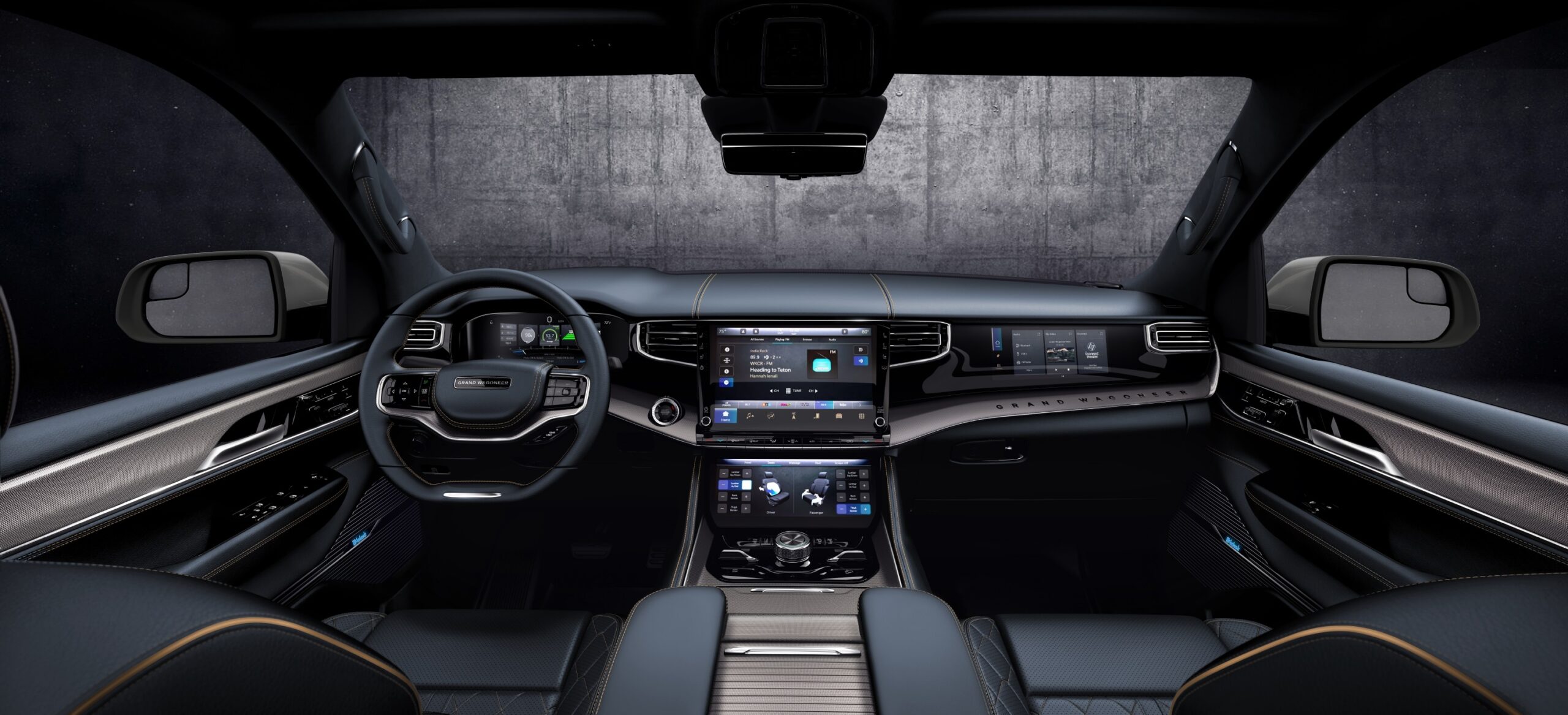
The posh interior treatment of the Grand Wagoneer reminds of midcentury modern Chrysler. Everything about the interior and styling is over-the-top. The design and engineering have the weighty feel of quality. And its engineering teems with advanced technologies that are not fearsome to learn or use.

Stellantis Design Chief Ralph Gilles says the Grand Wagoneer was done the American way. “The first impression is that everything is so beautifully done,” he said in a video overview.

Jeep says the Wagoneer will become a portfolio of vehicles that redefines “American premium” while delivering a unique customer experience. The customer experience will include 10 promises and Wagoneer Client Services.

A front right 22 inch Goodyear Eagle tire on the Grand Wagoneer

Significant tire patch from the 22-inch Goodyear Eagle grand touring tires (285/45).

Wagoneer Foundation

The Wagoneer foundation is sourced from the Ram 1500 pickup, but any comparisons stop there. There are no shared body panels or other common parts that can be seen and touched. The Wagoneer format is a separator from the competition, which starts with a finished pickup truck engineered for hard work first and luxury second.

The current sales plan features two models, Wagoneer and Grand Wagoneer that fill mainstream and luxury categories. Both models have a third row and seating for up to eight. For 2022, both models are V8-powered, but that changes for 2023:

2022 Wagoneer uses a 392 horsepower, 5.7-liter V-8 engine. It has the next generation of eTorque 48-volt hybrid with fuel-saving technologies of cylinder deactivation and variable cam timing. Rear-wheel drive is standard rear-wheel drive or there are three options of 4WD systems. The rear-drive Wagoneer has fuel-economy ratings of 16/22/18 mpg city/highway/combined; and 15/20/17 mpg for 4WD. Midgrade fuel is recommended.

2022 Grand Wagoneer features a 471-hp, 6.4-liter V-8 also with cylinder deactivation and variable cam timing. Four-wheel-drive fuel-economy ratings are 13/18/15 mpg using the recommended premium fuel.

Each engine mates to a TorqueFlite eight-speed automatic transmission.

The Agave blue interior of the Grand Wagoneer

The Blue Agave interior with quilted Palermo leather.

2023 Hurricane Engine and L Models

Long-wheelbase models for both series of Wagoneer will be introduced for the 2023 model year. The additional 12 inches in overall length went to more rear-seat legroom and cargo capacity. With both rows of seats folded, there is room to slide in a few sheets of 4-by-8-foot plywood, Jeep says.

A new family of Hurricane inline six-cylinder engines will trim fuel use and maintain horsepower. The 3.0-liter twin-turbocharged inline-six-cylinder engines have two power levels:

The 420-hp Hurricane in the Wagoneer L has 468 foot-pounds of torque. The heavier Grand Wagoneer gets the high-output Hurricane twin-turbo 510, with 510-hp and 500 lb.-ft. of torque.

Jeep says a run of the Hurricane twin-turbo 510 engine will be available on the 2022 Grand Wagoneer. Ordering is now open for the $2,000 engine option. Rear-drive models have mileage ratings of 15/21/17 mpg on the recommended premium fuel.

Also new for 2023 is the Wagoneer L Carbide with a black theme. Special features include gloss black wheels, black grille, gloss black mirror, and headlamp trim. The interior has a technical hydrographic instrument panel trim and door panels with gloss black seats.

A Wagonner Carbide emphasizing black elements

A 2023 Wagoneer L Carbide. Turn-key for limo service.

2022 Wagoneer Pricing

The 2022 Wagoneer is sold in six trim levels of Series I, Series II, Series III and three series of the Carbide model. Starting prices for the standard rear-drive Wagoneer range from about $61,000 to $76,000. Carbide models range in price from $66,490 to $80,190; add $3,000 for 4WD.

The 2022 Grand Wagoneer is sold in four trim levels, all with four-wheel drive: Series I, Series II, Obsidian, and Series III.

Series I starts at $89,995, Series II at $99,995, Obsidian at $105,490, and Series III at $109,995. All MSRPs include the $2,000 freight charge from the Warren (Michigan) Truck Assembly Plant.

The Grand Wagoneer Series III tester was $116,720. It was nearly fully loaded with factory options and included: Midnight Sky metallic paint $645; Customer preferred package 23W $995; rear-seat entertainment group $2,195; 22-inch machined aluminum wheels with black noise pockets $1,595; and embossed metal interior accents $1,295.

There was a $1,500 bonus cash allowance for both Wagoneer models. See current Grand Wagoneer pricing here.

The passenger side 10.25 inch wide touch screen of controls

The passenger-side 10.25-inch touchscreen.

Safety Features

Standard safety features include eight air bags, automatic emergency braking with pedestrian and cyclist detection, active lane management, blind-spot monitoring, rear cross-path detection, and intersection collision assist.

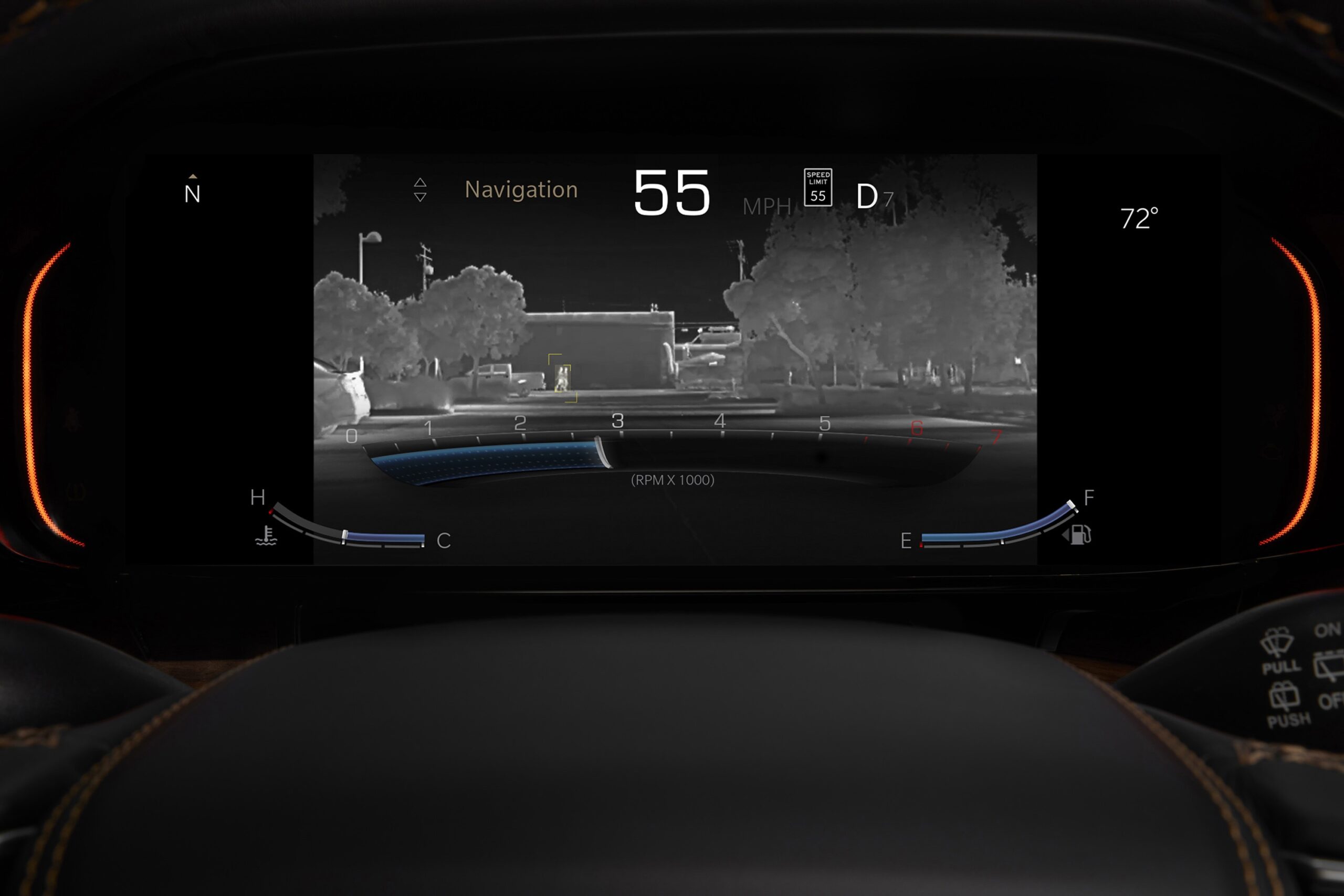
A black and white image of the night vision camera

The Night Vision Camera is especially useful where there are no street lights.

Putting the Grand in Wagoneer

The Grand Wagoneer will stand tall — and long — among the luxury-class competitors. The standard wheelbase models of Wagoneer are about 4 inches longer than their closest competitors. Among the competing luxury SUVs are the BMW X7, Cadillac Escalade, Infiniti QX80, Land Rover Range Rover, Lincoln Navigator, and Mercedes-Benz GLS.

The Grand Wagoneer cabin is rich in comfort, with grandstand views. Jeep tried to ensure a quiet cabin with an acoustic laminated windshield, front door glass, laminated rear glass, and active noise canceling through the audio system. It is an engineering marvel for this towering beast to power along the highway in such traffic-calmed style.

From the suede headliner to the full-weave carpeting, The Grand Wagoneer’s list of standard equipment might be the longest I’ve had to itemize for any vehicle I’ve tested. Power door-closers and heated armrests might be the only missing luxe perks.

The entire list is in the specifications at the end of this review, but here are a few of the standout luxury basics:

Quilted Palermo leather-trimmed massaging seats, 20-way power adjustable front seats, suede headliner, natural walnut interior trim, second-row captain’s chairs with power tilt and slide, heated and ventilated front and second-row seats, luxury front and rear floor mats, reversible cargo mat, foldable cargo shade. There also is a new Uconnect 5 Navigation and infotainment system with voice command, a 360-degree surround-view camera system, and a 23-speaker McIntosh entertainment system.

A digital rearview camera mirror is standard, but I can’t use it with my eyeglasses. When I look at the digital mirror, it takes a second or two for my eyes to focus. But the mirror can be switched to the low-tech original.

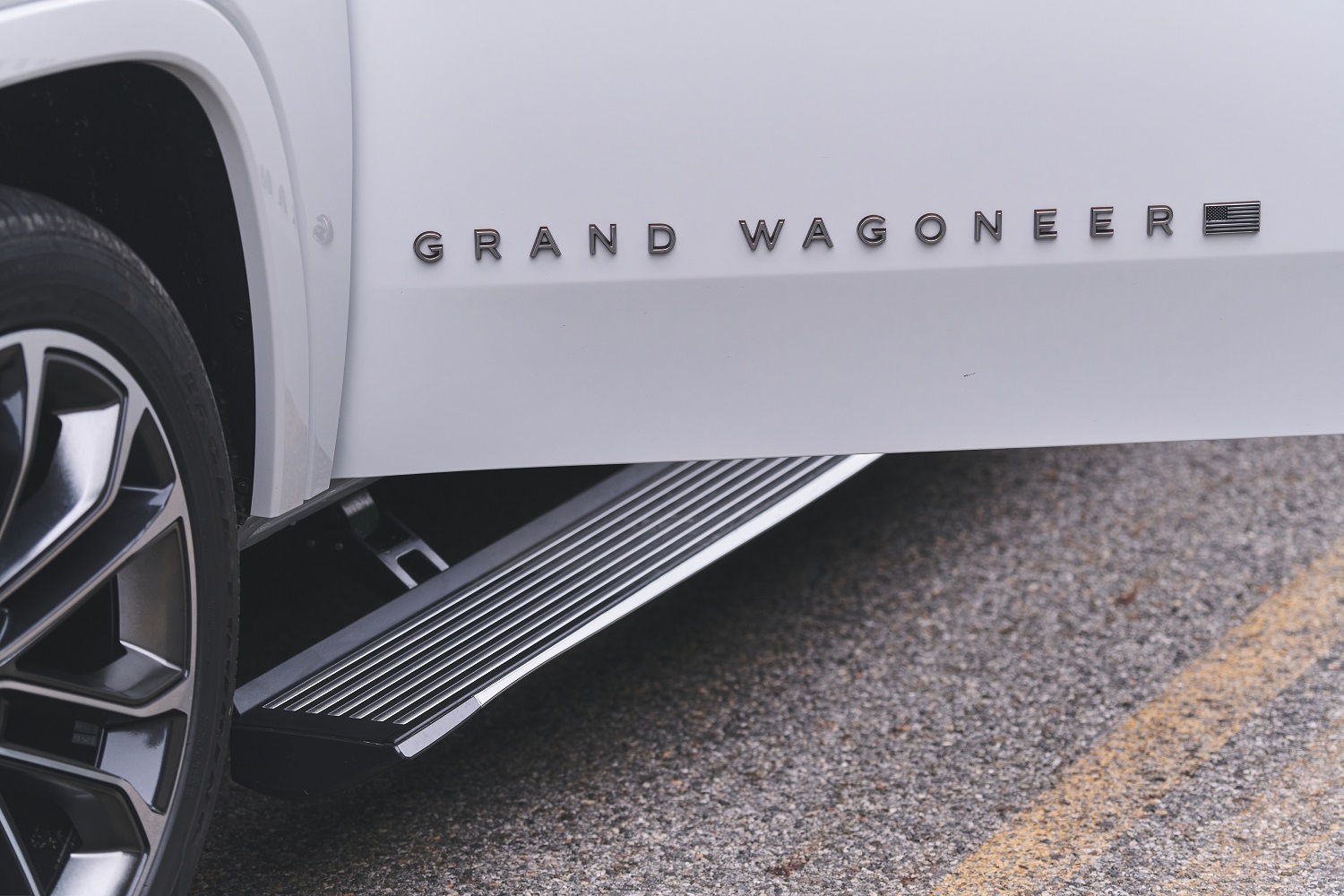
Power running boards lower to a convenient step-aboard height.

Power running boards lower to a convenient step-aboard height.

10 Cool Grand Wagoneer Features

Some of my favorite Grand Wagoneer features:

Power running boards. These lower to a convenient step-aboard height, particularly with the air suspension’s lowered ride height when parked. Too often, running boards create too much of a step and are awkward to use. The design of the boards forms the rocker panel, so legs do not rub on dirty metal.

Power-adjustable pedals (with memory sets). Adjustable pedals are a safety feature to help dial in a secure seating position for drivers of all sizes. The pedals are assets with the power tilt-and-telescoping steering wheel.

Rear seat monitoring camera. The overhead split-screen view of the second row is mainly to keep an eye on a child’s seat, or two — or a pet.

Power folding and reclining second- and third-row seats. How convenient to have this function for loading kids or cargo. And with power switches in the cargo area to fold the second row or fold and raise the third row.

Tri-pane panoramic sunroof and sunshade. The span of glass is dramatic, particularly for those in the second and third rows.

Roof rack with crossbars. Roof-rack crossbars are typically an added cost, but these are standard and store neatly below the cargo floor. Storing the crossbars when not needed helps trim wind noise.

11 USB ports. Let’s hope the USB port does not soon become obsolete. The Wagoneer and Grand Wagoner have eight USB ports, of the dual C-type and standard style. The count goes to 11 with the rear entertainment system.

Night Vision camera with pedestrian and animal detection. This type of system is an asset in areas without street lights. But it is a little odd visually to see the smallish X-ray-like presentation in the driver-info display.

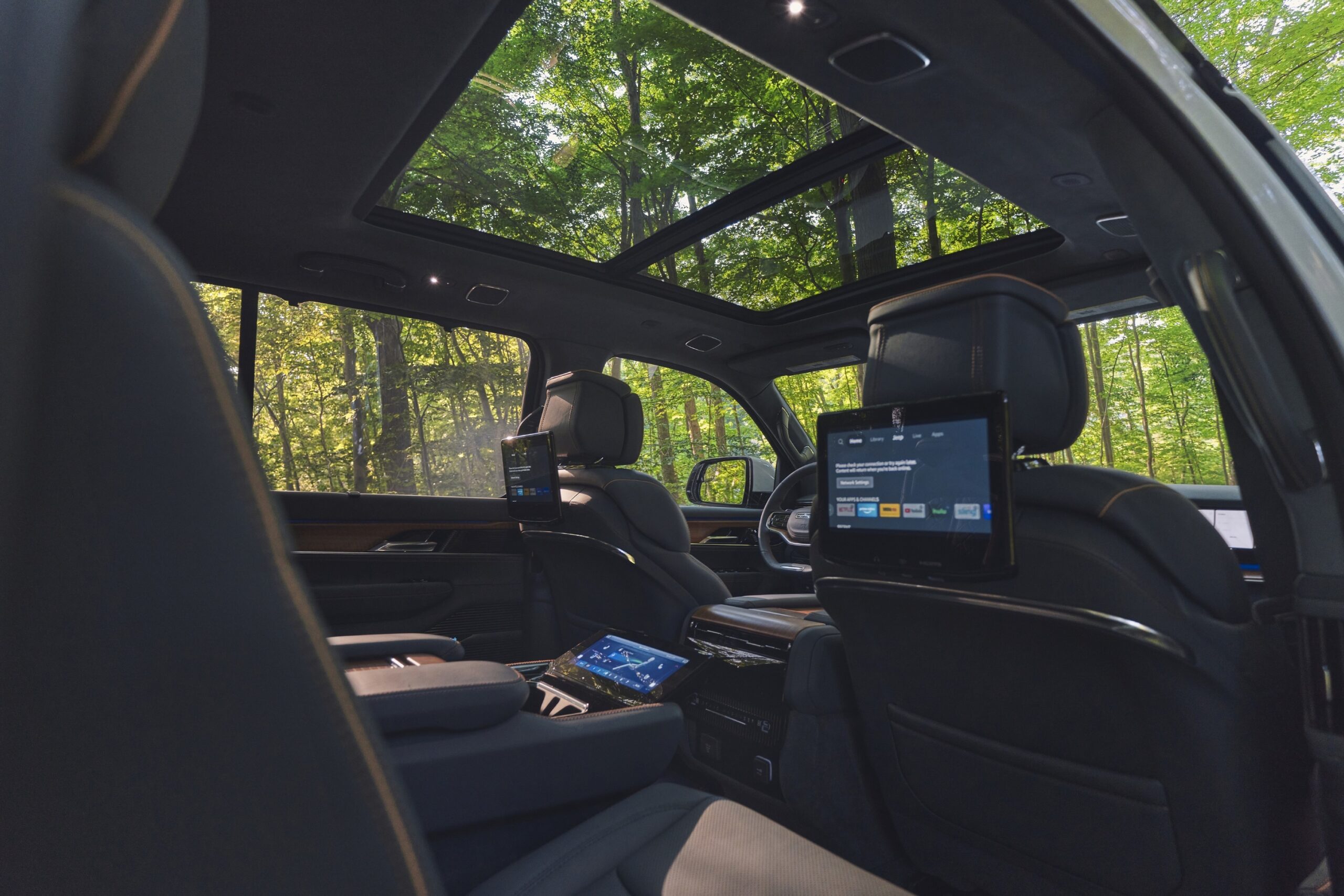
Back seat passengers can view streaming TV and movies on the optional Rear Seat Entertainment system

The Rear Seat Entertainment system, $1,295, features two 10.1-inch touchscreens for streaming movies, apps, and Fire TV for Auto.

Wagoneer Screen Envy

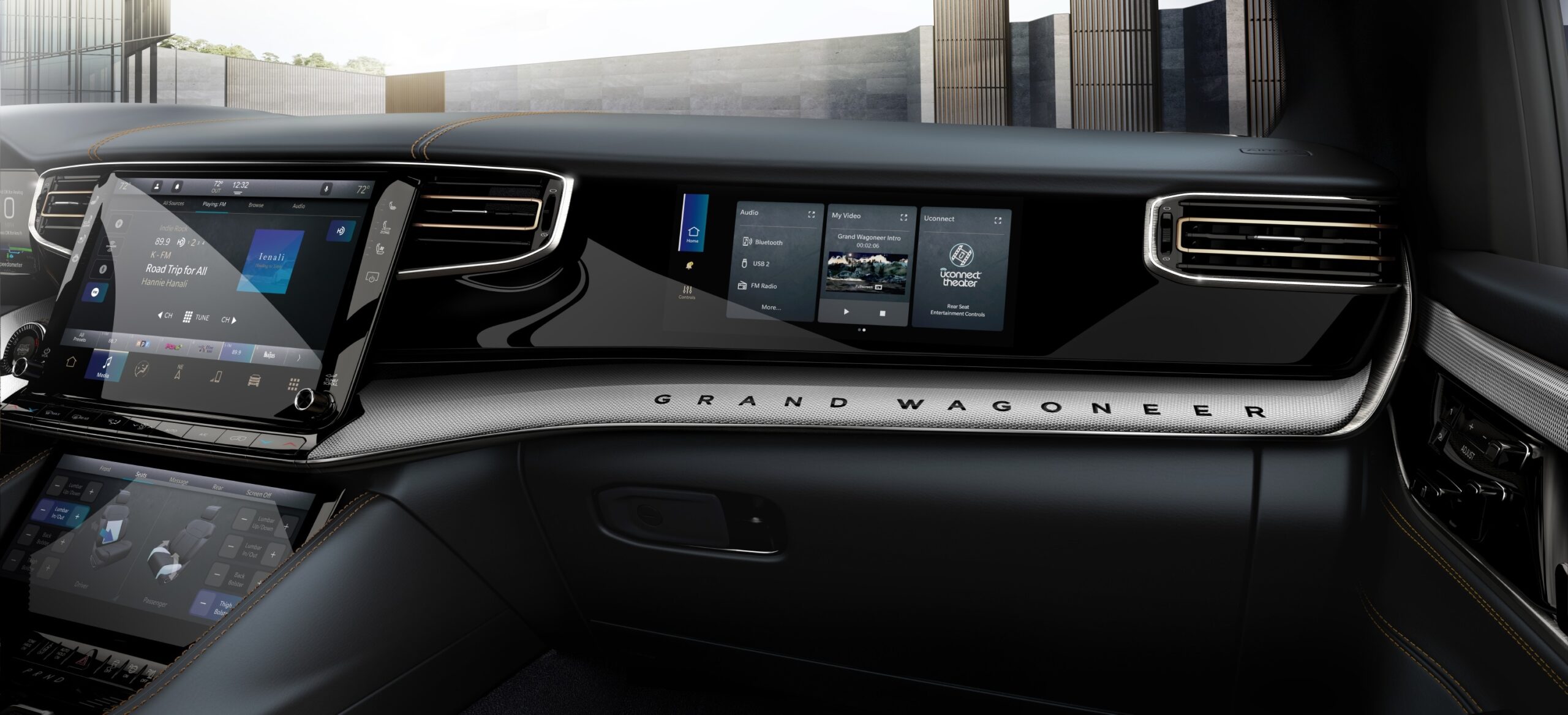
There are nearly 45 inches of display screens along the front instrument panel. Among the inch count are the 12.3-inch-wide instrument cluster, and a 12-inch horizontal touchscreen to access audio, navigation, apps, and views from the 360-degree camera. Just below is a 10.25-inch horizontal display for cabin controls. Then push a button, and the screen rotates to reveal the media hub with two dual USB ports, aux-in, and the wireless charging pad.

To empower the front passenger, the Grand Wagoneer includes a 10.25-inch-wide passenger screen. The access has four primary functions:

  • Co-Pilot (navigation and device management);
  •  Entertainment (via HDMI or rear seat entertainment control);
  •  The ability to view the exterior vehicle cameras;
  •  Fire TV for Auto.  It is possible to start a movie at home and finish it in the Grand Wagoneer.

And there is a 10.25-inch rear screen in the second row to adjust temp, fan, airflow, and seat heating and ventilating controls.

The Rear Seat Entertainment system, $2,195, features Amazon Fire TV built-in. Second-row passengers can stream TV, movies, and apps on two 10.1-inch touch screens on the seatbacks.

In total, there are 75 inches of display screens.

Performance and Ride and Handling

The big 6.4-liter V-8 hits its power stride with a peak of 455 lb.-ft. of torque at 4,400 rpm. The eight-speed automatic rolls smoothly through gear changes while showing respect to stretching fuel economy. Sport mode steps up off-the-line force but not aggressively.

Fuel economy is challenged. The best I could get was 13.3 mpg on a long highway run. Owners will not enjoy filling the 26.5-gallon tank, but they will enjoy every mile it provides.

A hood-up view of the 6.4-lter V-8 engine.

Grand Wagoneer’s 471-hp, 6.4-liter V-8. (Mark Maynard photo)

Ride and Handling

Road tripping in a Grand Wagoneer Series III is a first-class cruiseliner experience. There is headroom and legroom for 6-foot-6 tall adults in the first and second rows. And the second-row captain’s recline and are heated and ventilated.

The ride quality is supple, and some might consider it too soft in road undulations. But there is very little wind or tire noise at highway speeds. And the tire patch is significant from 22-inch Goodyear Eagle grand touring tires (285/45).

Four-wheel-disc stopping power is absolute and necessary when controlling three-plus tons. The front brakes have 14.88-inch vented rotors, and the solid rear rotors are 14.76 inches.

At 6,420 pounds, the Grand Wagoneer is at least 300 to 800 pounds heavier than its mainstream competition. But its turning circle of 38 feet is up to 3 feet tighter.

The Grand Wagoneer’s max tow capacity is a benchmark at 9,850 pounds. A Class IV receiver hitch and 7- and 4-pin wiring harness are included.

Grand Wagoneer’s Air Ride

The GW’s Quadra-lift air suspension gives the feel of a carpeted ride. Head toss is well controlled over speed bumps or when pulling into driveways. The sophisticated system includes electronic semi-active damping to match changing road conditions and stabilizer bars.

Quadra-Lift adds up to 3.6 inches of lift, supported by four-corner air springs. The air-cushioned ride operates automatically, or it can be manually controlled at the shift console. It has five height settings:

Normal Ride Height (NRH): 8 inches of clearance offers improved fuel economy, as well as improved aerodynamics during on-road driving;

Off-road 1: Lifts the vehicle an additional inch from NRH for added height in clearing obstacles (9 inches);

Off-road 2: Adds 2 more inches of ride height, for 10 inches of ground clearance;

Park Mode: Lowers the vehicle 1.6 inches from NRH. NRH and Park Mode are driver-selectable, allowing the driver full control over vehicle ride height;

Aero Mode: Lowers the vehicle 0.6 inches from normal ride height. Aero Mode is controlled by vehicle speed and adjusts for optimal performance and fuel economy. The vehicle will also lower to Aero Mode when in Sport Mode

The spacious second row captains chairs

There is headroom and legroom for 6-foot-6 passengers in the second row.

Wagoneer 4WD Systems

The Grand Wagoneer gets the top two-speed on-demand four-wheel-drive system. Its Selec-Terrain traction control has five modes: Automatic (functional for on- or off-road driving), Sport, Snow, Sand/Mud.

Rock mode works with the Quadra-Lift for a maximum height of 10 inches.

Selec-Speed Control integrates hill-ascent and hill-descent controls. The Electronic Range Select system, engaged at the steering wheel, allows drivers to control vehicle speed up and down trail grades without using the accelerator or brake pedals.

Wagoneer Client Services

Wagoneer will become a portfolio of vehicles that defines “American premium” and delivers a unique customer experience, the company says.

Customers interested in purchasing a Wagoneer or Grand Wagoneer can go to Wagoneer.com, select a dealer and place a $500 deposit. A Wagoneer concierge will make contact to initiate the order process, provide vehicle updates, and assist with any dealer interactions.

After a customer receives their vehicle, support will continue through a VIP helpline via Wagoneer Client Services. Those services include:

  • Five years of free dealership maintenance, including oil changes and tire rotations;
  • 24/7 concierge support and roadside assistance via phone or online chat;
  • No-charge equivalent service loaner;
  • Trip interruption coverage;
  • VIP access to exclusive events;
  • Interior and exterior vehicle cleaning and a full tank of fuel when serviced;
  • Vehicle pickup/delivery for service;
  • Free Wi-Fi and phone charging at the dealership.
The third row seats

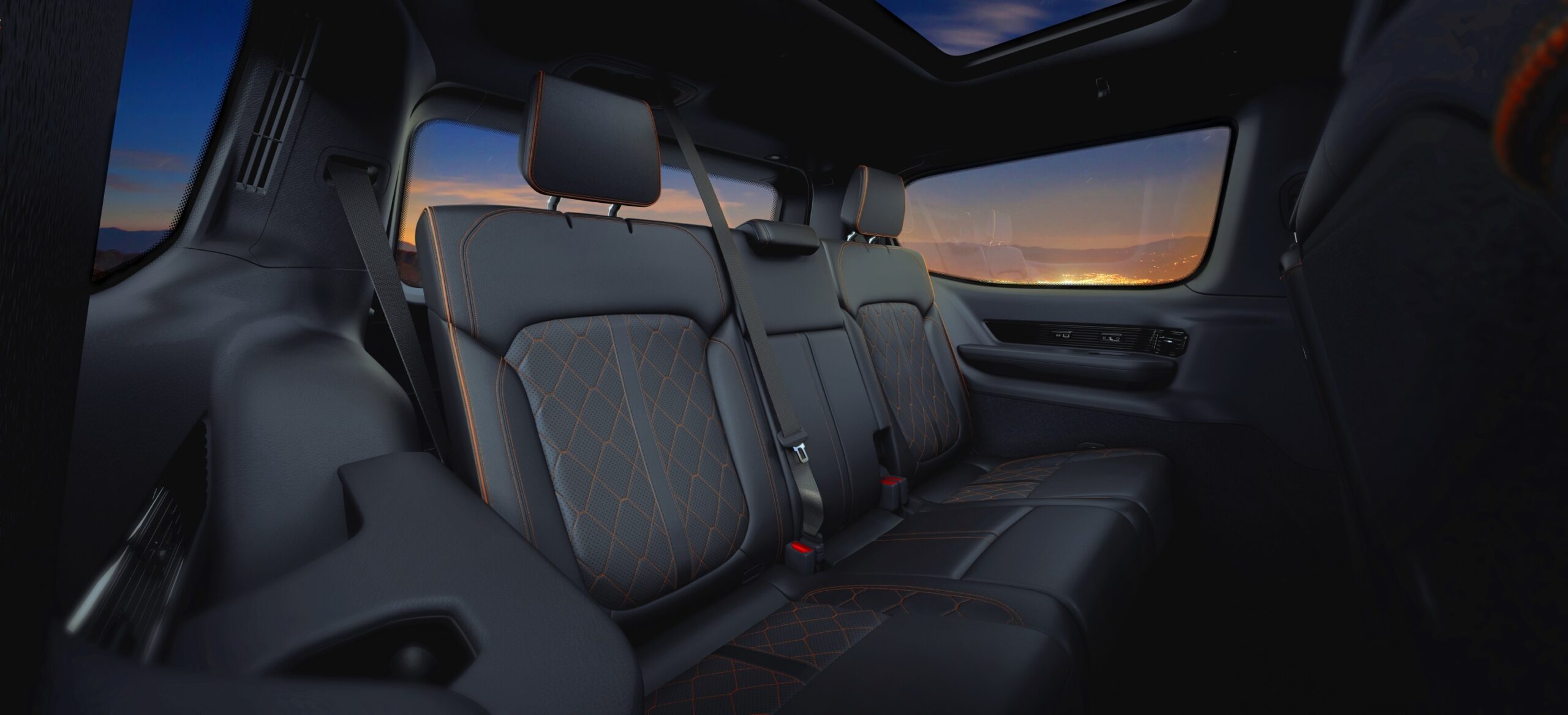
With more than 3 feet of legroom, the third row can recline or fold flat.

10 Customer Promises

1. Only dealers that earn a “Customer First” award for excellence by J.D. Power will be allowed to sell the Wagoneer.

2. The sales process will be efficient. Sales reps will use tablets and full integration to digital communication.

3. Certified Wagoneer Ambassadors. To become certified, a sales or service associate must complete more than 90 hours of training and pass exams to ensure that he or she truly understands the brand, the cars, how they can be used, and how they can be equipped.

4. Every Wagoneer and Grand Wagoneer will be sold with a full gas tank.

5. The vehicle will be thoroughly cleaned at delivery and after servicing and will be returned with radio, seating, climate, and other settings left as the customer had them.

6. Tech access to remote showrooms and to schedule test drives and delivery services.

7. An appropriate loan vehicle will be provided when a Wagoneer must be left at the dealership.

8. Remote services and diagnostics to schedule services and updates, including over-the-air updates and remote diagnostics.

9. Free Wi-Fi and phone charging in the showroom or service lounge, with “high-quality beverages and snacks.”

10. Wagoneer Client Services will provide 24/7 customer support and five years of maintenance. Concierge support and roadside assistance will always be available.

Both back rows of seats folded to show the open cargo area

All-new 2022 Grand Wagoneer rear interior cargo space (94.2 cu. ft. with second and third rows folded flat).

Why Buy the Grand Wagoneer?

It’s not a Jeep, it’s a Wagoneer — the only Jeep ID on the vehicle is in the headlight lenses. The Grand Wagoneer is grand luxury, not a Rubicon Trail-tested SUV. The elite dealership support and promises should be reassuring to new customers and conquests to the brand.

Despite the considerable sticker prices for these big vehicles, customers generally have incomes that make high fuel prices more of an inconvenience than a reason to reject such vehicles, auto-analyst Kim said. “The segment should remain strong in the coming years as lots of product action in that space will keep consumers interested and engaged.”

A rear view of the Grand Wagoneer

The Wagoneer customer experience includes 10 promises and dedicated client services.

2022 Grand Wagoneer Series III Specifications

Body style: large, 5-door, 7-seat body-on-frame SUV with two-speed electronically controlled 4WD

Engine: 471-hp 6.4-liter V-8 with fuel-saver mode and active grille shutters; 455 lb.-ft. torque at 4,400 rpm

Transmission: 8-speed Torqueflite 8HP75 automatic

4WD system: 2-speed electronically shifted transfer case; variable (50/50 or 100 front/rear) with traction modes of Automatic, Tow, Snow, Mud, Sand, Rock, and Sport

Fuel economy: 13/18/15 mpg city/hwy/combined; premium fuel recommended

Towing capacity: 9,850 pounds, with included Class IV receiver hitch and 7- and 4-pin wiring harness

BY THE NUMBERS

Fuel tank: 26.5 gallons

Cargo space: 27.4/70.9/116.7 cubic feet, behind 3rd row/2nd row/front seats

Front head/leg room: 41.3/40.9 inches

2nd-row head/leg room: 40/42.7 inches

3rd-row head/leg room: 39/36.6 inches

Length/wheelbase: 214.7/123 inches

Width/height: 94*/76.6 inches *at the mirrors

Curb weight: 6,420 pounds

Turning circle: 38 feet

FEATURES

Standard equipment includes: Keyless entry and push-button ignition, quilted Palermo leather-trimmed massaging seats, power running boards, 20-way power adjustable front seats, 2nd-row captain’s chairs with power tilt and slide, power folding and heated side mirrors, 60/40 power folding and reclining 3rd-row seats,  hands-free power liftgate, heated and ventilated front and 2nd-row seats, 12.3-inch cluster display, suede headliner, natural walnut interior trim, Uconnect 5 Nav with 12-inch touch screen display, integrated voice command with Bluetooth, 23-speaker McIntosh entertainment system, satellite radio with 6-month subscription, media hub with 2 USB ports and aux-in,tri-pane panoramic sunroof,  locking and lighted glove box, 4-zone automatic climate control, luxury front and rear floor mats, reversible floor mat, foldable cargo shade, roof rack with adjustable roof-rail crossbars, rear back-up-camera washer.

Driving features and technologies: head-up display, automatic headlights and high-beam control, map-in-cluster display, off-road info pages, adaptive cruise control with stop and go, ParkSense automated parking system, ParkSense front and rear park- assist with stop, night vision with pedestrian and animal detection, remote-start system, side distance warning, traffic sign recognition, 4G LTE Wi-Fi hot spot (trial included), automatic crash-notification service, connected travel and traffic services, Apple CarPlay and Google Android Auto, power-adjustable pedals (with memory sets), wireless charging pad, electric parking brake, digital rearview camera mirror, observation mirror, rear seat monitoring camera, acoustic-laminated windshield and front side glass, active noise-control system, LED exterior lighting with 3-optic fog lamps with cornering, 360-degree surround-view camera system.

Safety features include: 8 air bags, automatic emergency braking with pedestrian and cyclist detection, active lane management, blind-spot monitoring, rear cross path detection, intersection collision assist, rear park assist sensors with stop, all-speed traction control, electronic stability control, brake assist, hill-start assist.

PRICING

Series III base price: $109,995, including $2,000 freight charge; price as tested $116,720

Options on test vehicle:

  • Midnight Sky paint $645;
  • Heavy-duty trailer-tow package, $995, adds a trailer-brake control, chrome tow hooks, trailer-hitch lineup assist, trailer-hitch zoom, removable rear tow hook, heavy-duty engine cooling;
  • Rear-seat entertainment group, $2,195, includes Amazon Fire TV built-in;
  • 22-inch machined aluminum wheels with black noise pockets $1,595;
  • Embossed-metal interior accents $1,295

Where assembled: Warren (Michigan) Truck Assembly Plant

Warranties: 3-years/36,000-miles bumper to bumper; 5-years/60,000-miles powertrain; roadside assistance 5-years/60,000-miles

GMC Terrain AT4 Review

GMC Terrain AT4 Review

The 2022 GMC Terrain AT4 is more of a country rambler than a trail-conquering SUV, but it looks the part

A side view of the black 2022 GMC Terrain small suv

The 2022 GMC Terrain AT4 is new the lineup and has standard all-wheel drive and special off-roading elements. Pricing starts at $37,145. (Photography by Mark Maynard)

Table of Contents

Overview
Pricing
5 Star Safety Rating
Interior Function
Back Seats and Cargo
Performance and Fuel Economy
Ride and Handling
Why Buy the 2022 GMC Terrain AT4?
Specifications

BY MARK MAYNARD

Ggeneral Motors’ GMC division is panning for pay dirt in its off-road-defined AT4 sub-brand. It was launched in 2019 and is now offered across its line of SUVs and pickups. New to the AT4 lineup (All Terrain 4WD) is the 2022 GMC Terrain AT4 small SUV.

All-Terrain4 is a premium treatment, which GMC says is bringing in more affluent and younger customers new to GMC. According to GMC market research, their truck owners are 3.5-times more likely to actively use their vehicle for camping and carrying outdoor sports gear.

The AT4 treatment is primarily a cosmetics package. Among the AT4 design accents are a black-chrome finish to the grille and exterior trim, with gloss black roof rails. The Terrain AT4 has exclusively styled 17-inch gloss-black painted aluminum wheels with Goodyear Sport Terrain tires. There is a front steel skid plate and a traction select system with modes of standard AWD, front-wheel drive, and off-road.

The Terrain SUV steering wheel and dashboard

A hands-on control center.

GMC Terrain Overview

The Terrain is GMC’s smallest vehicle and slots below the Acadia midsize SUV. The Terrain debuted in April 2009 as a 2010 model, sharing an architecture with the Chevrolet Equinox. For the 2013 model year, the GMC Terrain introduced the Denali trim, which featured more chrome and slightly improved interior quality.

The Terrain had its first midcycle refresh in 2016. And the second-generation GMC Terrain debuted in 2017 for the 2018 model year.

In February 2020, General Motors unveiled a refreshed version of the GMC Terrain that would go on sale in mid-2020 as a 2021 model. However, production issues and pandemic-related complications delayed its release. The lightly facelifted Terrain finally went on sale in summer 2021 as a 2022 model.

AT4 logo embroidery on the front seatbacks

AT4 trim features.

New For the 2022 Terrain

  • Redesigned front fascia and grille designs.
  • Redesigned LED headlamps and LED taillamps on all models.
  • New 18-inch and 19-inch wheel designs.
  • Three new exterior colors, $495 each: Marine Metallic (mid-blue), Desert Sand Metallic (AT4 only), and Cayenne Red Metallic, which is a 2022 color only, and a new red will be introduced for 2023.
  • New interior trim elements and fabrics.
  • Tech Package made available for SLT and AT4. The package includes HD Surround Vision, a new Head-Up Display, and front and rear park assist.
  • Wireless Apple CarPlay and Android Auto capability.
  • Built-in Amazon Alexa.
Terrain front seats in a black and gray interior

Headroom of 38.2 inches with the panoramic sunroof should fit most adults.

GMC Terrain Pricing

For 2022, the GMC Terrain is sold in four trim levels of SLE, SLT, AT4 and Denali. All have the same powertrain of a 170-hp, turbocharged and direct-injected 1.5-liter four-cylinder engine, and a nine-speed automatic transmission. AWD models include terrain modes and a low mode for hill-descent towing control.

Starting prices range from $31,045 for the front-wheel-drive SLE to $39,745 for the Denali with standard all-wheel drive. Retail pricing includes the $1,395 freight charge from San Luis Potosi, Mexico.

Today’s tester is the Terrain AT4 with standard AWD. Its pricing starts at $37,145 and totaled $41,810 with five options.

Check here for current GMC Terrain pricing. And find current offers and incentives here.

GMC Terrain Safety Features

With its full suite of safety features, the GMC Terrain has earned NHTSA’s top overall five-star safety rating. The rating includes five stars for the driver and front passenger in a frontal crash; five stars front and rear in a side crash; and four stars for risk of rollover.

Standard safety features on all Terrain models include six air bags, hill-descent control, and Stabilitrak traction controls.

And Terrain’s standard safety technologies are notable.

The GMC Pro Safety package layers on automatic emergency braking, a following distance indicator, forward collision alert and front pedestrian braking, lane keep assist with lane departure warning, and auto-dimming IntelliBeam headlights.

And I would choose two more safety options because of their safeguards, which contributed to the top NHTSA safety rating:

GMC Pro Safety Plus, $645, includes Lane Change Alert with Side Blind Zone Alert, Rear Cross Traffic Alert, and Rear Park Assist. The package also includes Adaptive Cruise Control and Safety Alert Seat.

Tech Package, $850, includes HD Surround Vision, Head-Up Display and Front and Rear Park Assist. The head-up display rises from a small plastic panel behind the gauge array. The small screen can be an obstruction to sightlines in heavy traffic, but it can be closed.

GMC Terrain AT4-specific 17-inch Goodyear Sport Terrain tires with gloss-black alloy wheels.

GMC Terrain AT4-specific 17-inch Goodyear Sport Terrain tires with gloss-black alloy wheels.

GMC Terrain Interior Function

Terrain designers pack a lot into a compact cabin, and that includes soundproofing.

With the many updates over the years, the AT4 cabin has a desirable collection of standard features. Among the conveniences are smart key entry with push-button ignition, leather-trimmed and perforated upholstery, HD rearview camera, heated steering wheel and two-function heated front seats, leather-wrapped four-spoke steering wheel with cruise controls and redundant audio controls, 4.2-inch color driver-info gauge display, eight-way power driver seat and a four-way power front passenger seat.

Headroom of 38.2 inches with the panoramic sunroof should fit most adults. Omit the sunroof and there is tall headspace of 40 inches. But the more significant fit consideration is what feels like a subcompact cabin. Shoulder and elbow room are snug, and the front seat bottoms are short in length for large-adult thigh support.

Sightlines are OK across the hood and at the side mirrors, but the ascending body line challenges over-the-shoulder views at the rear quarter. The rearview camera is a big help in cramped parking, but the screen is small; the optional 360-degree camera would be even better.

The center stack controls

Making the most of a small space.

There are many areas, ledges, and nooks for small-item storage, front and rear.

At first glance, there is lots of black plastic throughout, with the good stuff up high where it is seen and felt. Harder plastics are below, which are suitable for scuff and wear resistance.

The shift console neatly packages an e-bin charging area with two USBs, audio input, and a 12-volt plug. But while there is ideal space for a wireless charging pad, there is no availability for that, yet. The armrest console box is deep with two more USBs and a slim pencil-box type of tray.

GMC Terrain Back Seat and Cargo

With the flat floor, a long 39.7 inches of legroom, reclining window seats, and the pano sunroof, the back seat is a pleasant but subcompact space. The three-position bench is short on adult thigh support, but the 60/40 folding seatback has a wide, fold-down armrest with a pair of can or small cup holders. Other conveniences include two more USB ports, a 12-volt plug, and a 120-volt, 150-watt household plug.

The cargo capability has an asset not talked about much by GMC. Because the front passenger seat can fold flat forward, it is possible to have almost 9 feet in length. Think of the possibilities for carrying lumber, ladders, stage props or long surfboards. It adds excellent utility, when few other small SUVs offer such a fold-forward front seat. But folding the seat is a bit of a struggle. The seat-side lever (at door-side) is about 2 inches too short to grasp easily with your hand wedged between the seat and door.

Raise the power-opening tailgate, and the cargo opening is wide at 43 ½ inches, with 29 ½ inches tall from floor to headliner. Fold the back seat for about 6 feet in length.

The cargo space includes a pair of seatback levers and a 12-volt plug but just two cargo tiedowns when four is the norm. There is no lighting or roller cover, but a $210 package includes the roller cover and a vertical cargo net.

Terrain back seat with long legroom and reclining seatbacks.

With the flat floor, a long 39.7 inches of legroom, reclining window seats, and the pano sunroof, the Terrain back seat is a pleasant but subcompact space.

Terrain AT4 Performance

The previous-gen Terrain had three turbocharged engine choices: a 252-hp, 2.0-liter; a 170-hp 1.5-liter; and a 137-hp 1.6-liter turbo-diesel, with 240 foot-pounds of torque.

For 2022, the 1.5-liter four-cylinder is the only choice, and it will feel underpowered to most drivers. The engine has fuel-economy ratings of 25 mpg city, 28 highway and 26 mpg combined, on 87 octane fuel. My best average was 29.2 mpg with much highway driving. Daily around-town driving yielded a max of 22.8 mpg. With careful driving, the AWD fuel tank of 15.6 gallons could yield a driving range of up to around 450 miles.

The Terrain's 170-hp, turbocharged and direct-injected 1.5-liter four-cylinder engine.

The Terrain’s 170-hp, turbocharged and direct-injected 1.5-liter four-cylinder engine.

Transmission

Gear engagement is by a short row of switches at the base of the center stack of cabin controls. The style and action are similar to window-lift switches. The process isn’t particularly smooth at first, but it gets easier in time.

The nine-speed automatic rolls easily through the gears, but the shifting performance is for fuel economy.

A Sport mode would be most helpful to put some spark into the acceleration, especially for the 3,659-pound Terrain. “Fuzzy logic” transmission calibrations attempt to provide shift performance keyed to the driver’s manner of driving. But when a burst of acceleration is needed, there is a three-count before tapping into the torque range of 2,000-4,000 rpm. By that time, the emergency is over. But the system continues to provide sharper performance for a while and then relaxes into mileage mode.

And remember to shift this transmission to Neutral when using an automatic car wash.

Levels of storage in the Terrain front door panels.

Levels of storage in the Terrain front door panels.

Low Mode

Somewhat unique to the transmission modes is an “L” setting at the transmission-select keys. This mode is for hill descents when towing. Engaging Low mode allows manual shifting and a one-pedal drive function to help control downhill speed by using engine braking.

The Terrain is rated to tow up to 1,500 pounds with an unbraked trailer.

Up to 9 feet in length for cargo capacity.

Fold the front passenger flat forward for almost 9 feet in length.

Terrain AT4 Ride and Handling

Despite what appears to be a blunt front end, the wind noise at highway speeds is well controlled and the cabin feels snug. The Terrain’s settled highway ride is due in part to its long wheelbase of 107.3 inches. It is a few inches longer than many of its compact-class competitors, including the Jeep Cherokee, Honda CR-V, Mazda CX-30, Subaru Forester, and Toyota RAV4.

The Terrain AT4 is more of a country rambler than a trail-conquering SUV, but it looks the part. GMC says it worked with Goodyear to develop a suitable Sport Terrain tire. The result is the 17-inch, 225/65 Goodyear Wrangler Fortitude HT. It has aggressive-looking tread blocks at the tread edge for the off-road stance. The tire has a fairly hard 680 treadwear rating, which translates to a 65,000-mile warranty.

Despite the off-roader appearance, the ride is not noisy or with vibration. The tall sidewall is good curb protection and contributes to the comfy ride quality, but the tires’ flex and softness also curb enthusiastic driving.

An independent suspension helps keep tires pressed to the pavement or trail; front MacPherson struts with coil springs and a stabilizer bar; four-link rear independent.

Four-wheel-disc brakes give a firm response without grab. For longer service, the brakes feature low-drag calipers and Duralife rotors formulated for hardness and to resist corrosion. The front rotors are 11.8 inches, with 11.3- inch rotors at the rear, with ABS and electronic stability control.

Underfloor storage, with the temporary spare below.

Underfloor cargo space.

Why Buy the 2022 GMC Terrain AT4?

The GMC Terrain is an economical vehicle with SUV function and low-cost maintenance. This current generation will be at its best when the weather is at its worst.

The mild redesign of 2022 will be short-lived. A more significant redesign (but not a complete re-engineering) is scheduled for 2024. But with all of the supply-chain issues that continue to impact vehicle production, it might be wise to wait for the redesigned 2024 models. The new Terrain will be much improved — but also more expensive.

A rear view of a Ebony Twilight black Terrain

The AT4 subbrand is bringing in more affluent and younger customers new to GMC.

2022 GMC Terrain AT4 Specifications

Body style: compact, 5-seat, 5-door AWD SUV

Engine: 170-hp, turbocharged and direct-injected 1.5-liter 4-cylinder; 203 lb.-ft. torque from 2,000-4,000 rpm

Transmission: 9-speed automatic with AWD terrain modes and a low mode for hill-descent towing control

Fuel economy: 25/28/26 mpg city/hwy/combined; 87 octane

0-60 mph acceleration: 8.9 seconds

Trailering capacity: 1,500 pounds

BY THE NUMBERS

Fuel tank: 15.6 gallons

Cargo space: 29.6-63.3 cubic feet (floor to headliner)

Front head/leg room: 38.2*/40.9 inches *40 inches without sunroof

Rear head/leg room: 38.2*/39.7 inches

Length/wheelbase: 182.3/107.3 inches

Curb weight: 3,659 pounds

Turning circle: 37.4 feet

FEATURES

Standard equipment includes: smart key entry with push-button ignition, leather-trimmed and perforated upholstery, HD rearview camera, heated steering wheel and 2-function heated front seats, leather-wrapped 4-spoke steering wheel with cruise controls and redundant audio controls, 4.2-inch color driver-info gauge display, 8-way power driver seat, 4-way power front passenger seat, dual-zone climate control, LED headlights-taillights, running, hands-free power tailgate with a GMC logo projected on the precise spot.

Safety features include: 6 air bags, hill-descent control, and Stabilitrak traction control;

GMC Pro Safety (standard) includes Automatic Emergency Braking, Following Distance Indicator, Forward Collision Alert, Front Pedestrian Braking, Lane Keep Assist with Lane Departure Warning and IntelliBeam headlights;

PRICING

Base price: $37,145, including $1,395 freight charge; price as tested $41,810.

Options on test vehicle: Ebony Twilight black metallic paint $495; Skyscape sunroof $1,495;

GMC Pro Safety Plus, $645, includes Lane Change Alert with Side Blind Zone Alert, Rear Cross Traffic Alert, and Rear Park Assist. Also included are Adaptive Cruise Control and Safety Alert Seat;

Tech Package, $850, includes HD Surround Vision, Head-Up Display, and Front and Rear Park Assist;

Infotainment package, $1,180, includes 8-inch diagonal GMC Infotainment System with navigation, multi-touch display, AM/FM/SiriusXM radio, and Bose premium 7-speaker system

Where assembled: San Luis Potosi, Mexico

Warranty: 3-years/36,000-miles bumper to bumper with no-cost first scheduled maintenance; 5-years/60,000-miles powertrain with roadside assistance and courtesy transportation