Select Page

2023 Honda Accord Hybrid Review

2023 Honda Accord Hybrid Review

The completely redesigned 2023 Honda Accord has the appealing dimensions of the once-classic American family sedan. But not everybody will like how low it rides

A nighttime front three quarter view of the new Accord.

The 2023 Honda Accord is longer and sleeker with a broad stance with tires and wheels pushed to the edge of the body line for aerodynamics. (Photos courtesy of  American Honda or as credited)

Table of Contents

Hybrid Sedan Competition
Accord’s 47-Year History
2023 Honda Accord Pricing
Two-Motor Hybrid Powertrain
Safety Features and Technologies
Interior Function
Ride and Handling
Why Buy the 2023 Honda Accord Hybrid?
Specifications

BY MARK MAYNARD

If you drive a lot and are not reimbursed for fuel, the redesigned 2023 Honda Accord Hybrid can bring some payback. The most efficient Accord Hybrid EX-L model has fuel economy estimates of 51 mpg city, 44 highway, and 48 mpg combined. And today’s tester, the Accord Hybrid Touring, has mileage ratings of 46/41/44 mpg.

For the mileage conscious, that 3 to 5 mpg variance is the difference between 17-inch wheels on the EX-L and 19-inch wheels on the Hybrid Touring. And the Touring trim (3,532 pounds) is slightly heavier by just 64 pounds.

But the more fashionable Hybrid Touring tester still provides excellent fuel economy. I worked up to 48.7 mpg on extended highway driving, and it might have gone higher on a longer drive. Around town, I saw mileage of 44.9 mpg.

How can a commuter not like sitting on a range of more than 560 miles with a full tank? Well, for one, all 2023 Accord models have a recommendation for premium fuel to get higher fuel economy, but it is not a requirement.

Whether a parent in a carpool or a ride-share driver, there is much to like about the redesigned 11th-generation Honda Accord. But the low-riding Accord, like most midsized sedans, is why many American motorists have migrated to an SUV, like the Honda CR-V.

A view of the modern and clean front seat interior design.

Modern and clean interior design of the 2023 Honda Accord Hybrid.

The Hybrid Sedan Competition

There are just three mainstream midsize hybrid sedans on sale in the U.S. today, including the Hyundai Sonata and Toyota Camry, the only choice offering all-wheel drive.

The Camry Hybrid LE ($29,750) nails the mileage points at 51/53/51 mpg with a total range of 686 miles. The Hyundai Sonata Hybrid Blue ($29,365) is second with 50/54/51 mpg.

Even the 2022 Honda Accord Hybrid has mileage ratings of 48/47/47 mpg.

Accord’s 47-Year History

The Honda Accord was introduced to American car buyers in 1976. It debuted amid an ongoing oil embargo led by Saudi Arabia. At the time, people followed Honda car haulers to dealerships to get one of the most fuel-efficient cars.

And it was the Honda Accord’s early sales success that helped it establish the midsize sedan segment. Since then, the Accord has become a best-selling sedan over the last five decades, Honda says.

Honda hopes its completely redesigned 2023 Accord will re-energize the midsize sedan segment. And the Accord is off to a strong sales start. In May, Accord sales rose to 20,007 cars, 55 percent of which were the Accord Hybrid, or 11,100 units. Honda says the hybrid model has passed 10,000 units for the second straight month. Total 2023 Accord sales are up more than 80 percent compared to May 2022.

The new dash-top 12.3-inch-wide infotainment screen for upper-trim Accords.

A new 12.3-inch-wide infotainment screen for upper-trim Accords.

The 2023 Accord Redesign

The 2023 Honda Accord is longer and sleeker with a slightly broader stance, with tires and wheels pushed to the edge of the body line for aerodynamics.

New styling for the midsize sedan is familiar but with a decidedly upscale appearance, almost Audi-like with some Kia Stinger. Overall length has grown by 2.7 inches, with a 0.4-inch wider rear track for improved stability, particularly when making evasive maneuvers. Wide, horizontal LED straight-line “flush” taillights accentuate Accord’s wide stance.

The midsize four-door approaches the dimensions of the once-classic American family sedan. Without the moonroof, there is tall headroom of 39.5 inches, or 37.5 inches, with the power moonroof. Legroom of 42.3 inches is about as long as is possible in a car. Back seat legroom is also long at 40.8 inches. And the trunk is family-vacation large at 16.7 cubic feet, expandable by the 60/40 folding back seat.

Notable for the Accord Hybrid is that neither back seat nor trunk space is diminished by the battery pack. Mounted under the rear seat, the Intelligent Power Unit — containing the battery pack and its controlling hardware — is 9 percent smaller, Honda says. The smaller and lighter IPU allowed the cooling fan to be integrated into the unit rather than externally mounted.

2023 Honda Accord Pricing

The 2023 Honda Accord is available in six front-wheel drive trim levels, two of which are gasoline powered.

LX and EX gas models have a 192-hp turbocharged and direct-injected 1.5-liter four-cylinder engine. It has fuel-economy ratings of 29/27/32 mpg city/highway/combined.

Pricing starts at $28,390 for the LX and $30,155 for the EX. All manufacturer retail pricing includes the $1,095 freight charge from Marysville, Ohio.

The four gasoline-electric hybrid trim levels — Sport, EX-L, Sport-L, Touring — have starting prices that range from $32,440 to $38,435 for the top-line Accord Hybrid Touring.

Standard Accord Hybrid Touring features include:

  • Walk Away Auto Lock, a driver-configured convenience through the infotainment system;
  • Smart-key locking and push-button ignition;
  • One-touch power moonroof;
  • Leather-trimmed upholstery;
  • 10-way power driver’s seat;
  • 4-way manual front passenger seat;
  • Heated and ventilated front seats;
  • Heated rear (window) seats;
  • 60/40 folding back seat;
  • 12-speaker Bose audio system;
  • Head-up display;
  • Wireless phone charger;
  • 19-inch alloy wheels with black inserts and grand-touring tires.

Check here for current Honda Accord pricing and offers.

A nighttime view through the open power moonroof

A power moonroof is standard on all trim levels except the base LX.

Accord Hybrid Warranty Coverage

Honda’s new-vehicle warranty covers just 3 years or 36,000 miles with 2 years of free maintenance, but there is significant coverage for the hybrid elements.

For states that have adopted California emissions standards, hybrid components have a warranty of 15 years and 150,000 miles. The hybrid battery has coverage for 10 years and 150,000 miles.

Included in the warranty coverage are the following:

  • Hybrid Battery module and internal components
  • Drive and Motor Generator stators and rotors;
  • Drive motor control module, including software;
  • Battery control module, including internal components and software updates;
  • High-voltage and bypass contactors, resistor, and fuse;
  • High-voltage power cables;
  • Battery current sensor.

Two-Motor Hybrid Powertrain

Since 2014, Honda has used a two-motor gasoline-electric hybrid system. One motor is for driving, and the other is for generating power for the hybrid battery.

The two electric motors are now side-by-side rather than in-line. The new positioning has multiple benefits, Honda says. Among them is a larger, more powerful propulsion motor. Total combined horsepower is 204 with 247 foot-pounds of peak torque from 0 to 2,000 rpm, an additional 15 lb.-ft. more than before. And more torque gives a stronger launch from a stop.

For pedestrian awareness, the hybrid system emits an Acoustic Vehicle Alerting System when idling and at low speed on battery power. The tone sounds like a machined angel chorus, but it is effective.

Atkinson Cycle Engine

The 2023 Honda Accord hybrid system runs through an Atkinson-cycle 2.0-liter four-cylinder, revised with direct- and multistage injection. The two-part system improves cleaner combustion for reduced carbon buildup over time.

This engine idles silently with no vibration.

A view of the Accord Hybrid engine

With Honda’s gasoline-electric hybrid system, I achieved highway fuel economy of 48.7 mpg. However, Honda recommends premium fuel for peak mileage. (Mark Maynard photo)

CVT Drive Modes

I don’t like most continuously variable automatic transmissions because of their rev-and-wail performance as the belt catches up with engine power. However, Honda’s e-CVT has Step Shift programming that simulates gear changes and gives downshifts during braking. Acceleration has absolute launch force without lag or obnoxious engine sounds.

A new “B” transmission setting amplifies regenerative and engine braking to put power back into the battery for more electric driving. B mode also allows “one pedal” driving (common among battery-electric vehicles) for deceleration. Paddles at the steering wheel can increase the level of slowdown.

There are four drive modes of CVT performance, but I spent most of my week in Normal.

Normal: Balances fuel efficiency and driving performance;

ECON: Fuel efficiency is prioritized by reducing accelerator responsiveness, and air conditioning is set to a more efficient cycle. (I found the ECON performance maddingly resistant to acceleration and not worth its incremental benefit.)

Sport: This Hybrid-only mode sharpens throttle response, and the Active Sound Control opens the muffler for a sporty tone, though I did not notice a tone difference. Sport mode is my quickness tool in heavy traffic to guard against other drivers trying to sneak in.

Individual: A Hybrid-only mode to make individual settings, such as engine responsiveness, gauges, and steering assist.

Qi-compatible 15-watt wireless smartphone charging pad.

Qi-compatible 15-watt wireless smartphone charging is standard on Touring.

Safety Features and Technologies

The 2023 Honda Accord has earned the Insurance Institute for Highway Safety’s highest rating of Top Safety Pick+. The new Accord earned the institute’s highest possible ratings in six of seven categories. Among the categories is Accord’s standard front crash prevention system. It got a “Superior” rating from IIHS in the daytime and an “Advanced” rating in the nighttime vehicle-to-pedestrian avoidance tests.

The National Highway Traffic Safety Administration (NHTSA) has yet to rate the 2023 Accord. Check here for updates.

In addition to 10 air bags and a rear cross-traffic monitor, the 2023 Accord has the Honda Sensing system of advanced driver assistance system.

Its new features include a front sensor camera and radar, Traffic Jam Assist (in stop-and-go cruise control), and Traffic Sign Recognition. With TSR, the front camera reads traffic signs and displays them through the instrument cluster, infotainment screen, or head-up display. It is a ticket-saver when speed signs are so far and few between.

Other driver-assist features include:

  • Low-Speed Braking Control;
  • Updated Adaptive Cruise Control;
  • Lane Keeping Assist;
  • And a new blind spot information system.

Driver-Assistance Tech

The elements in Honda Sensing combine to provide Level 2 semi-autonomous driving. The system will steer, accelerate, and stop when activated with advanced cruise control. In my experience, Honda’s system gave precise control in highway cornering and never let the Accord drift wide across the lines or Botts dots. Not all such systems are as accurate.

Traffic Jam Assist will be of value for commuters in high-stress traffic. When activated, the system will keep pace with traffic, slow and accelerate as needed, or stop, then start again.

Honda Accord Interior Function

Honda has long focused on creating interiors with find-it-in-the-dark simplicity. The new Accord is another champion of clean design and ergonomics — mostly. The materials are of a refined and pleasing appearance, and, of course, with meticulous panel alignment.

Vacation trips will be more comfortable with the new Body Stabilizing Seats. The design treatment helps reduce fatigue and improve posture, Honda says. Among the seat innovations is a resin mat that supports the area from the pelvis to the lumbar spine for a more stable seating feel. The seat bottom has a new curve to reduce forward and lateral pelvic tilt. And the seat also centers the upper body over the pelvis, Honda says, helping stabilize the upper arms and the driver’s eyesight.

However, the seating position is low in the hole and has an almost drop-in for the driver. And, worse for the passenger because even this top Hybrid Touring model only provides four-way power adjustment and no height lift. The girlfriend-wife was not happy going for a ride.

I suppose for a Sport model, it is essential to include an actual gearshift lever, but it is unnecessary in the hybrid model. The narrow shifter of spindly proportions gets in the way of easy access to the wireless charging pad and cup holders. Honda could have instead used its low and flat strip of electronic gear switches, such as in the Honda Pilot SUV.

I like the Accord’s spray-arm wipers because they don’t scrape dry glass. But the driver-side wiper leaves a 3-inch margin of unswiped glass on driver’s left. The sightline blockage is wider with uncleared droplets and streaks next to the windshield pillar.

The open trunk with a big bag of potting soil and a tray of veggies

The trunk’s 16.7 cubic feet of space is expandable by folding the 60/40 split back seat. (Mark Maynard photo)

Infotainment Finesse

Accord hybrid models have Honda’s largest touchscreen to date. The dashboard-top 12.3-inch color display screen has an actual physical volume knob. A 1-inch finger rest at the bottom of the touchscreen makes it steadier to use.

The system also has fewer embedded menus. And for at-a-glance efficiency, the system has three programmable shortcuts on the left side of the screen.

LX and EX models have a 7-inch color touchscreen audio system. And both infotainment systems have wireless Apple CarPlay and Android Auto, Wi-Fi hotspot capability, and Alexa Built-In.

All trim levels have two illuminated 3.0-amp USB-C ports. The EX-L and Touring add two illuminated 3.0-amp USB-C charging ports in the back seat console. Qi-compatible 15-watt wireless smartphone charging is standard on Touring.

Google Built-In

The top-line Hybrid Touring features Honda’s first integration of Google built-in. A 3-year unlimited data plan is included to use Google Assistant, Google Maps, and Google Play.

Honda says Google Cloud’s Speech-to-Text service has incredibly accurate automatic speech recognition. The voice control works for such functions as climate control. Users can say “Hey, Google” or press the voice control button on the steering wheel to get started. Voice assistant also lets users set their destination in Google Maps without taking their eyes off the road. The route map can be displayed in the instrument cluster.

Google Assistant includes the voice operation of media apps and vehicle functions such as the air-conditioning system. It also is used for texting and making calls. Google Play is to download third-party apps for music, podcasts, and audiobooks.

Accord Hybrid Ride and Handling

Honda does excellent steel-spring suspensions, and the 2023 Accord has sport-sedan attitude and flat handling. But the Accord’s ride quality is inelegant and somewhat coarse. I could feel every expansion seam in the road, though some of that texture could be from the tires. The tester’s Michelin Primacy MXM4 Green X grand-touring tires (235/40) have a 500 treadwear rating, which is hard enough for a warranty of 55,000 miles.

Honda also uses its wheel resonators for noise-reducing wheels. The resonator is a narrow strap-like device that wraps around the inner wheel hub. The idea is to cancel noise from resonance generated by the rotating wheel and tire.

Honda says, “noise-reducing wheels are an ingenious technology that reduces noise and contributes to better fuel efficiency and vehicle performance.”

The 19-inch wheels with Michelin grand touring tires

The Accord Touring Hybrid has 19-inch alloy wheels with Michelin Primacy MXM4 Green X grand-touring tires, 235/40. (Mark Maynard photo)

Why Buy the 2023 Honda Accord Hybrid?

With the potential for nearly 50 mpg, the 2023 Honda Accord Hybrid does more for fuel economy and vehicle emissions than fleets of electric or plug-in electric vehicles.

But the new Accord is aerodynamically low to the ground. That strains the knees and backs of the more mature drivers who can afford an almost $40,000 new car. And in heavy traffic, the driver’s sightline is aimed at the taillights of the vehicle ahead.

That view will turn buyers’ eyes to the very carlike Honda CR-V compact SUV crossover. Here’s my review of the 2023 Honda CR-V Hybrid.

2023 Honda Accord Hybrid Touring Specifications

Body style: midsize, 5-seat, front-drive sedan

Engine: 146-hp, direct-injected 2.0-liter Atkinson cycle 4-cylinder; 134 lb.-ft. torque at 4,500 rpm

2-motor hybrid assist system: 181-hp, AC synchronous permanent magnet; torque 247 lb.-ft. torque from 0-2,000 rpm; 1.4 kWh lithium-ion battery pack

Total system power: 204 hp

Transmission: CVT

Fuel economy: 46/41/44 mpg city/hwy/combined; 87 octane recommended

0-60 mph acceleration: 6.6-seconds *per Car and Driver

BY THE NUMBERS

Fuel tank: 12.8 gallons

Trunk space: 16.7 cubic feet

Front head/leg room: 37.5/42.3 inches

Rear head/leg room: 37.3/40.8 inches

Front shoulder/hip room: 57.9/55.4 inches

Rear shoulder/hip room: 56.5/55.4 inches

Length/wheelbase: 195.7/111.4 inches

Width/height: 73.3/57.1 inches

Track, front/rear: 63.6/62.6 inches

Curb weight: 3,532 pounds

Turning circle: 38.4 feet

FEATURES

Standard Hybrid Touring equipment includes: Walk Away Auto Lock, Smart-key locking and push-button ignition, one-touch power moonroof, leather-trimmed upholstery, 10-way power driver’s seat, 4-way manual front passenger seat, heated and ventilated front seats, heated rear (window) seats, 60/40 folding back seat, 12-speaker Bose audio system, head-up display, wireless phone charger, 19-inch alloy wheels with black inserts and Michelin grand-touring tires;

Safety features include: 10 air bags, rear cross-traffic monitor, stability and traction controls, brake assist, blind-spot monitoring, front and rear parking sensors;

Safety technologies: Forward Collision Warning, Lane Departure Warning, Collision Mitigation Braking, Road Departure Mitigation, Acoustic Vehicle Alerting System;

Driver-Assist technologies: Adaptive Cruise Control with Low-Speed Follow, Lane Keeping Assist, Traffic Jam Assist, Traffic Sign Recognition, Auto High-Beam Headlights, Blind Spot Information with Cross Traffic Monitor, Low-Speed Braking Control, Parking Sensors front and rear.

PRICING

Accord Hybrid Touring base price: $38,435, including $1,095 freight charge;

Options on test vehicle: None

Where assembled: Marysville Auto Plant, Ohio

Warranties: 3-years/36,000-miles bumper to bumper, includes 2-year free maintenance; 5-years/60,000-miles powertrain

2023 Honda CR-V Hybrid Review

2023 Honda CR-V Hybrid Review

The Honda CR-V is as likable and friendly as a Golden Retriever. The compact SUV’s 2023 redesign went deep to hone its qualities with much attention to detail.

A dark blue honda CR v with a background of yellow spring wildflowers

The Honda CR-V went on sale in 1997 for the 1998 model year. This stalwart small SUV has gone on to be the best-selling crossover in America, Honda says. (Photos by Mark Maynard)

Table of Contents

Small Vehicle, Large Role
What’s New for 2023?
Soundproofed To the Max!
7 Outstanding Features
2023 Honda CR-V Pricing
Hybrid Warranty Coverage
CR-V Hybrid Powertrain and Fuel Economy
Safety Features and Technologies
Interior Function
Likes and Don’t Likes
Why Buy the 2023 Honda CR-V Hybrid?
Specifications

BY MARK MAYNARD

Has it really been 25 years since Honda launched the first CR-V? I remember being on the first media drive in 1997. First impressions were not overwhelmingly positive at the time. This new breed of small SUV looked spindly, especially from the rear view showing its trailing arm multilink suspension bars. But it was cute. And it had a cargo-floor card table that could be removed for camping or soccer-game snack duty. The folding table had a center hole for an umbrella, and a “jug” size indent was in the tailgate door.

In the Beginning

The little CR-V was the “I think I can” of small SUVs. From its humble beginning, the Honda CR-V has thrived. The CR-V is the outright best-selling crossover in America for over a quarter century, Honda says.

The first-generation Honda CR-V, codenamed RD1, was Honda’s first in-house designed sport utility vehicle, per its page in Wikipedia. First sold in Japan, the CR-V was built to exceed the Japanese government’s compact-car regulations. To avoid more expensive road-use taxes, vehicle width could not be more than 66.9 inches or just about 5 1/2 feet. And that explains its spindly stance. Today, the CR-V width is a full-bodied 73.5 inches.

There were few choices in the dawning of the CUV segment or compact utility. Among the nameplates were the Kia Sportage, Suzuki Vitara, Subaru Forester, and Toyota RAV4.

Honda’s new compact CR-V brought a rethinking for American motorists. Accustomed to that era’s large and midsize SUVs, the CR-V launched in one trim level with a 126-horsepower, 2.0-liter four-cylinder engine and a four-speed automatic transmission. The powertrain included the then-innovative Real Time all-wheel-drive system. It is the same type of system today but much evolved.

The driver area has headspace and elbow room for tall drivers.

Headspace and elbow room for tall drivers.

Small Vehicle, Big Role

The CR-V has played a critical role in Honda’s past, but what’s significant about the new CR-V is its important role in Honda’s future, Mike Kistemaker, assistant vice president of Honda sales at American Honda, said in a release. He expects the new CR-V Hybrid to represent about 50 percent of sales.

And 50 percent of 2023 CR-V sales will be significant. Last year, sales of the CR-V totaled 238,155. And so far in 2023, CR-V sales are a robust 67,241, according to GoodCarBadCar.net

In May, the new CR-V sold more than 30,000 units for the second straight month with hybrid sales of 18,264 units, Honda said in its monthly sales report.

The Honda CR-V is as likable and friendly as a Golden Retriever. It’s almost impossible not to like it, owners say. It has been a favorite for young families, parents transitioning from a minivan to something more convenient, and the hand-me-down to teen drivers.

It was already a stalwart SUV, so the 2023 redesign went deep to hone its qualities with much attention to detail.

Many small SUVs have gone slash-happy for trend-setting appeal but at a cost to cabin function and driver sightlines. The CR-V has real credibility without the glitz and gimmicks of dazzling light shows or sounds of nature mood music.

A view of the front passenger seat in gray leather-trimmed upholstery

Body Stabilizing Seats.

What’s New for the 2023 CR-V?

Now in its sixth generation, the 2023 CR-V has been completely redesigned. Its length is a mere 2.7 inches longer with less than a half inch (0.5 inch) in width, but it gives much wider appeal to a broader group of buyers.

The new body is 15 percent stiffer, which helps eliminate the flex that can transfer harsh sounds to the cabin. And the wheelbase was lengthened by 1.6 inches, which gives the CR-V a steadier highway ride that is less prone to highway surface irregularities and wandering caused by rain grooves.

A 0.4-inch wider front and rear tracks contribute to cornering and emergency maneuvers stability.

Most noticeable for owners of older models and new customers will be the premium treatment of interior materials, especially on touchpoints. The remodel gave attention to the operation of all switchgear and controls, including the click and heft of knobs, stalks, and switches. And turn signal and windshield wiper stalks are reshaped to be easier to see behind the steering wheel spokes.

The wide instrument panel has contemporary styling without arcs and curves. Rather than old-timer’s wood trim, an attractive honeycomb-embossed pattern hides fingerprints and scratches. Metallic trim has a satisfying appeal.

Trendy 19 inch black wheels can get scraped and ugly over time.

The CR-V Hybrid Sport models have 19-inch black wheels.

Soundproofed To the Max

Everyone who rode with me in my test week commented on the quiet and calm cabin. That’s a selling point for me, which might be why Honda went deep on soundproofing.

Road noise is significantly reduced with new sound-absorbing non-woven fabric front and rear fender liners and the front floor undercover. New sound-absorbing insulation covers the floor, with spray-type urethane foam improving noise insulation by reducing the body gap at the base of the pillars. Sport Touring models also feature noise-reducing wheel liners.

New isolators on the inner and outer firewall reduce engine noise inside the cabin. Sport and Sport Touring hybrid models feature additional insulators on the underside of the hood and cowl, inside the fenders, underneath the instrument panel, and around the cargo opening.

To reduce wind noise, CR-V EX, EX-L, and Sport feature thicker front side glass, while EX-L and Sport Touring add an acoustic windshield, and Sport Touring has acoustic front side glass.

Active Noise Control through the audio system further reduces ambient (booming) noise in the cabin.

An over-the-shoulder view of the cabin

A noise-canceling system and sound-absorption materials insulate the cabin from most encroaching sounds.

CR-V Exterior Redesign

The CR-V is no sex jet in its exterior styling, but it is shapely enough while maintaining a broad and open cabin from the front seats to the cargo area. However, the CR-V Hybrid Sport and Sport Touring have a somewhat gaudy “godfather” treatment to the lower grille valance.

With the 2023 updates, the CR-V is a remarkable transformation from what was already a well-loved compact SUV. Honda says the redesigned 2023 CR-V is 2.7 inches longer but less than an inch wider with a significantly broader stance.

It looks big, mainly from the roofline and horizontal body line, but it still drives small.

Noteworthy in the redesign are the windshield A-pillars. They are positioned 4.7 inches rearward, 2.8 inches outward, and 1.4 inches lower. With new door-mounted side mirrors, the changes improve visibility across the hood and at the side mirrors when turning in an intersection.

Hybrid models have more attitude in the front and rear fascias. The grille has a mesh treatment with a gloss-black accent. Sport trims have a lower bumper design in piano black and platinum colored on Sport Touring. Sport and Sport Touring trims also get polished stainless steel exhaust finishers and black roof rails. The underside of the rear spoiler is matte black for Sport and piano black for Sport Touring.

Looking through the steering wheel to the 7 inch wide driver info gauges

Sport models have orange stitching on the wheel and seats.

7 Outstanding CR-V Features

These seven bullet points are what I look for in vehicle evaluations. And the redesigned 2023 Honda CR-V Hybrid exceeds expectations.

Soundproofing: Honda has applied every technique in the engineer’s manual to give the CR-V the quietest ride of the segment.

Suspension: It is a simple steel-spring, independent setup with a luxurious ride quality. And more importantly, the suspension irons out rough, pock-marked roads with a carpet ride.

Steering: The turning circle is tight at 37.3 feet, and the wheel has smooth rotation. The leathery material that wraps the steering wheel feels almost sensual in the hands — a reward for keeping hands on the wheel.

Door openings: The engineers gave a few degrees more access to the doors, a space that reaches 90 or almost 90 degrees. Wider is better for back doors when buckling children into car seats.

Sightlines: The repositioned windshield and side mirrors give unobstructed sightlines. Rear views are open, too, with a large rear glass.

B-Mode regenerative braking: The CR-V can be driven with one-pedal control while deceleration pipes energy back to the hybrid battery.

Fuel economy: I swear I was getting better mileage than the official estimates of 40 mpg city, 34 highway, and 37 mpg combined. Honda integrates so many electronic enhancements into the CR-V Hybrid that it rivals a plug-in hybrid for fuel economy. The total driving range is 518 miles — possibly more with careful driving.

A 9-inch information screen atop the dashboard

A 9-inch information screen.

2023 Honda CR-V Pricing

The CR-V is available in trim levels of LX, EX, EX-L, and hybrid models of CR-V Sport and Sport Touring, today’s tester. The hybrid models are the new top-of-the-line models.

A CR-V hybrid model is available with front-wheel drive for the first time. The CR-V Sport is available with front or all-wheel drive. Real Time AWD drive is standard on the CR-V Sport Touring.

CR-V gas models have powertrains of a 190-hp, 1.5-liter turbocharged and direct-injected four-cylinder engine and e-CVT. Starting prices range from $29,705 to $35,005.

Pricing for the CR-V Sport Hybrid starts at $33,695, and $40,395 for the CR-V Hybrid Sport Touring.

The CR-V Sport Touring Hybrid is well equipped with limited factory options for metallic paint colors, $455, and utility and interior protection packages. Accessory choices range from bike and kayak racks to a tent ($408).

The Sport treatment has a black headliner and orange contrast stitching on the black cloth seats, console, door panels, leather-wrapped steering wheel, and shifter. The dash trim is matte black.

The top-of-the-line Sport Touring gets standard leather-trimmed upholstery in black or gray with black accent panels and orange contrast stitching on the seats, steering wheel, doors, console, and shifter. The power window switches have silver trim, with piano black along the dash.

The 2023 CR-V and CR-V hybrid models are manufactured in three plants in Ohio, Indiana, and Canada. My tester, with no options or accessories, was assembled in Alliston, Ontario, Canada.

Check here for current pricing and offers.

The door panel has good storage for a bottle and more

Plenty of storage areas throughout the cabin.

Up-Market Features

The CR-V Hybrid Sport Touring has the expected up-market features to support its $40,000 price. Among the desirable features are: Smartkey entry with push-button ignition, leather-trimmed upholstery, electric parking brake, wireless Apple CarPlay and Android Auto, a multi-angle rearview camera with guidelines,12-speaker Bose audio system, power moonroof with tilt, heated front seats, heated steering-wheel, 10-way power driver’s seat with two-way lumbar, four-way power front passenger seat. A more complete list is below in the specifications sidebar.

Vacation trips will be more comfortable with the new Body Stabilizing Seats. The design treatment is to help reduce fatigue and improve posture. Among the seat innovations:

  • A resin mat that supports the area from the pelvis to the lumbar spine for a more stable and solid seating feel.
  • Forward and lateral pelvic tilt are reduced by the new curve of the seat bottom.
  • The seat also centers the upper body over the pelvis, helping stabilize the upper arms and the driver’s eyesight.

CR-V Hybrid Warranty Coverage

Honda’s new-vehicle warranty covers just 3 years or 36,000 miles with 2 years of free maintenance, but there is significant coverage for the hybrid elements.

For states that have adopted California emissions standards, hybrid components have a warranty of 15 years and 150,000 miles. The hybrid battery has coverage for 10 years and 150,000 miles.

Included in the warranty coverage are the following:

  • Hybrid Battery module and internal components
  • Drive and Motor Generator stators and rotors;
  • Drive motor control module, including software;
  • Battery control module, including internal components and software updates;
  • High-voltage and bypass contactors, resistor, and fuse;
  • High-voltage power cables;
  • Battery current sensor.
The XR V Hybrid engine.

204 hp combined hybrid-gas power. Mileage ratings are 40/34/37 mpg city/highway/combined.

CR-V Hybrid Powertrain

Honda hybrids have a unique powertrain. The Atkinson-cycle 2-liter four-cylinder has new direct- and multistage injection. The two-part system improves cleaner combustion for reduced carbon buildup over time.

Combined power ratings are 204 hp and 247 foot-pounds of torque.

I don’t like most continuously variable transmissions because of their rev-and-wail performance as the belt catches up with engine power. However, Honda’s e-CVT has Step Shift programming that simulates gear changes and gives downshifts during braking. Acceleration has absolute launch force without lag or obnoxious engine sounds.

A new “B” transmission setting amplifies regenerative and engine braking to put power back into the battery for more electric driving. B mode also allows “one pedal” driving (common among battery-electric vehicles) for deceleration. Paddles at the steering wheel can increase the level of slowdown.

Honda’s Real Time AWD system is simple and intelligent. It functions in front-wheel drive until conditions deteriorate; then up to 50 percent of engine torque can be sent to the rear wheels. When starting on snow, for example, the system quickly sends power to the rear wheels to minimize the potential for front wheel spin. Dive into a corner — or in an emergency maneuver — and the system can also send power rearward for stability.

CVT Drive Modes

There are four drive modes of CVT performance, but I spent most of my week in Normal.

Normal: A balance between fuel efficiency and driving performance;

ECON: Fuel efficiency is prioritized by changing the ratio of pedal input-throttle opening. Air conditioning is set to a more efficient cycle. (ECON performance was maddingly resistant to acceleration and not worth its incremental benefit.)

Sport: This Hybrid-only mode sharpens throttle response, and the Active Sound Control opens the muffler for a sporty tone, though I did not notice a tone difference. Sport mode is my quickness tool in heavy traffic to guard against other drivers trying to sneak in.

Snow: For low traction surfaces, Snow mode softens throttle response and adjusts the transmission and Real Time 4WD. Idle start-stop is disabled, and engine braking is increased.

Two-motor hybrid system

Since 2014, Honda has used a two-motor hybrid system. One motor is for driving, and the other is for generating power for the hybrid battery.

The two electric motors are now side-by-side rather than in-line. The new positioning has multiple benefits, Honda says. Among them is a larger, more powerful propulsion motor. It has increased torque of 247 lb.-ft., an additional 15 lb.-ft. than before. And more torque gives a stronger launch force from a stop.

When idling and at low speed on battery power, the hybrid system emits an Acoustic Vehicle Alerting System. It sounds like a machined angel chorus, but it effectively alerts pedestrians.

CR-V Fuel Economy Ratings

Front-wheel-drive gas-powered Honda CR-V models have fuel-economy ratings of 28 mpg city, 34 highway, and 30 mpg combined, or 27/32/29 mpg with all-wheel drive. All CR-V models use 87-octane fuel.

Hybrid models have mileage ratings of 43/36/40 mpg for the Sport front-drive and 40/34/37 mpg with AWD. The all-wheel-drive Hybrid Sport Touring (with standard AWD) has ratings of 40/34/37 mpg.

In my week of testing a Sport Touring Hybrid, the onboard computer showed fuel economy around town in the mid-20s to mid-30s and up to 41.1 mpg on extended highway drives.

The navigation system helps to stretch mileage in the CR-V Sport and Sport Touring with Predictive Eco Assist. The navigation system can predict when regen energy will be optimized, such as on downhill slopes, and it also prioritizes EV assist in maximizing efficiency.

A view through both open back doors of the new CR V

Wide door openings are helpful when putting kids in car seats.

Safety Features and Technologies

In addition to 10 air bags, the 2023 CR-V is bristling with safety features and driver-assist technologies in the Honda Sensing system.

Its new features include a front sensor camera and radar, Traffic Jam Assist (in stop-and-go cruise control), and Traffic Sign Recognition. With TSR, the front camera reads traffic signs and displays them through the instrument cluster, infotainment screen, or head-up display. It is a ticket-saver when speed signs are so far and few between.

Other driver-assist features include:

  • Low-Speed Braking Control;
  • Updated Adaptive Cruise Control;
  • Lane Keeping Assist;
  • And a new blind spot information system.

The elements in Honda Sensing combine to provide Level 2 semi-autonomous driving. The system will steer, accelerate, and stop when activated with advanced cruise control. In my experience, Honda’s system gave precise control in highway cornering and never let the CR-V drift wide across the lines or Botts dots. Not all such systems are as accurate.

Traffic Jam Assist will be of value for commuters in high-stress traffic. When activated, the system will keep pace with traffic, slow and accelerate as needed, or stop, then start again.

CR-V Interior Function

Slide behind the steering wheel and enjoy the wedgie-free bolstering of the front seats. The front seats have width and thigh support for even large adults. Tall adults will have head clearance of 38.2 inches — with the sunroof.

Honda designers resisted the temptation to load the instrument panel with wide digital screens for cabin controls and infotainment. There is a 9-inch screen to access all the deep dives for navigation, camera system, phone, audio, and vehicle settings. But behold, Honda gave us knobs, dials, and push-buttons, oh my. It is an easy reach to adjust the temperature, fan speed, or audio volume.

The shift console neatly packages the sturdy shifter, drive-mode controls, and an e-bin with a charging pad, USB ports, and a 12-volt plug. There’s enough space next to the charging pad for a passenger’s phone to plug in.

The feel to switchgear and other cabin controls was refined, including the click action and heft of knobs, stalks, and switches.

Back Seat and Cargo Space

Some of the added length to the CR-V went to a half-inch more back seat legroom, now at 41 inches. Seatbacks can recline in eight angles (up from two angles), which is an asset for parents to make sleepy children comfortable. And improved LATCH anchors make it easier for parents to quickly and properly install front and rear-facing child seats.

Cargo space grew by more than 6 cubic feet to 39.3 cu.ft. behind the second row and 76.5 cubic feet with the second row folded. The space is broad and rectangular. The cargo opening is 44 inches wide, 33 ½ inches tall, with 6 feet in length with the back seat folded.

There is no understorage because of the hybrid battery. Nor is there space for a temporary spare. Instead, a tire-inflator system is stored in the cargo area’s left side.

The cargo area of the CR-V with the back seat folded

Fold the back seat for 6 feet in length and 33 inches in height at the entry.

Likes and Don’t Likes

There was not much I did not like about the 2023 CR-V — and I did not feel that way about the previous model.

I might have wished for ventilated front seats or a front view to the camera when parking (though it does have overhead and curb views).

It seems cheap not to include a cargo-area roller cover because any parcel or bag exposed today tempts a smash-and-grab theft. The accessory is $180.

The Sport’s black alloy wheels are another problem. Once you scrape one, the silver alloy shines through, looking uglier with time. And if a buyer wants a hybrid trim level, both Sport trim levels have black wheels and the bolder fascia treatment.

Why Buy the 2023 Honda CR-V Hybrid?

My test week put me in a quandary. I plan to buy a compact-class SUV to replace our 2008 Ford Escape Hybrid. It has 135,000 miles and a replaced hybrid battery.

My preference had been a plug-in hybrid. I like the idea of a plug-in because I have a home charger, and the girlfriend-wife could do an entire week’s driving in battery mode.

Top of my list was the Hyundai Tucson Plug-in, with 33 miles of battery driving. I liked almost everything about it, especially its luxe interior treatment of the Tucson Limited. (Here’s my review: https://maynardsgarage.com/?s=hyundai+tucson)

I also considered the Toyota RAV4 Prime for its 42 miles of battery driving. But it was $5,000 more than the Tucson PHEV, and the RAV4 did not have the driving or interior refinement.

We tend to keep vehicles longer than the new-vehicle and hybrid-element warranties. Because of that, I would lease a plug-in because of battery life and its expensive replacement cost. But I would purchase the CR-V Hybrid.

Crunch the mileage numbers, and the CR-V Hybrid’s total range (518 miles) is two to three gallons shorter than the RAV4 Prime at 600 miles. And the Honda Hybrid goes farther than the Tucson PHEV’s 480 miles.

After a week with the CR-V Hybrid, I learned I might not need a plug-in. It is more efficient for driving trips, and it would be a long-term keeper.

Check the mileage ratings of other vehicles at FuelEconomy.gov.

A rear three quarter view of the blue CR V

The 2023 Honda CR-V is 15 percent stiffer than previous models.

2023 Honda CR-V Hybrid AWD Sport Touring Specifications

Body style: compact, 5-door, 5-seat SUV

Hybrid engine: 145-hp, direct- and multistage 2.0-liter Atkinson cycle 4-cylinder, with active grille shutters;

Electric motor: 181-hp, AC Synchronous permanent-magnet electric motor

Combined power: 204 hp, 247 lb.-ft. torque

Battery: high-voltage lithium-Ion;

Transmission: e-CVT with drive modes of Econ, Normal, Sport, Snow

Fuel economy: 40/34/37 mpg city/hwy/combined; 87 octane recommended; with capless fuel filler

Towing capacity: 1,000 pounds

BY THE NUMBERS

Fuel tank: 14 gallons

Cargo space: 39.3 to 76.5 cubic feet

Front head/leg room: 38.2/41.3 inches

Rear head/leg room: 38.2/41 inches

Length/wheelbase: 184.8/106.3 inches

Height/width: 66.5/73.5 inches

Curb weight: 3,926 pounds

Turning circle: 37.3 feet

FEATURES

Standard CR-V Sport Touring equipment includes: Smartkey entry with push-button ignition, leather-trimmed upholstery, electric parking brake, wireless Apple CarPlay and Android Auto, 9-inch color touch screen with navigation and voice recognition, a multi-angle rearview camera with guidelines,12-speaker Bose audio system, power moonroof with tilt, LED headlights and taillights, wireless charging pad, heated front seats, heated steering-wheel, 10-way power driver’s seat with 2-way lumbar, 4-way power front passenger seat, rear window wiper-washer (reverse-linked) with heated wiper zone, heated and power side mirrors with LED turn indicators, hands-free power tailgate, lockable glove compartment, LED map lights, 19-inch gloss black alloy wheels with 235/55 19-inch all-season tires, floor mats, reclining fold-down 60/40 rear seatback;

Safety features include: 10 air bags, stability and traction controls, brake assist, blind-spot monitoring, front and rear parking sensors;

Advanced safety technologies: Forward Collision Warning, Lane Departure Warning, Collision Mitigation Braking, Road Departure Mitigation, Acoustic Vehicle Alerting System;

Driver-Assist technologies: Adaptive Cruise Control with Low-Speed Follow, Lane Keeping Assist, Traffic Jam Assist, Traffic Sign Recognition, Auto High-Beam Headlights, Blind Spot Information with Cross Traffic Monitor, Low-Speed Braking Control, Parking Sensors front and rear.

CR-V Hybrid Braking, Suspension, Steering

Brakes: Ventilated 12.3-inch front discs; solid 12.2-inch rear discs.

Tires and Wheels: CR-V Sport trims have Berlina Black 18-inch 10-spoke alloy wheels. Sport Touring trims have Berlina Black 19-inch split 5-spoke alloys. The Sport Touring tester was fitted with Continental CrossContact LX Sport all-season tires, 235/55.

Suspension: Front MacPherson struts with a multi-link double wishbone rear and stabilizer bars front and rear.

PRICING

Hybrid Sport Touring base price: $40,395, including $1,295 freight charge

Options on test vehicle: none

Where assembled: Alliston, Ontario, Canada

Warranty: 3-years/36,000-miles bumper to bumper with 2 years of free maintenance; 5-years/60,000-miles powertrain

April 26, 1948: Ford begins 1949 model-year production

April 26, 1948: Ford begins 1949 model-year production

Nicknamed “Shoebox Ford,” the 1949 Ford debuted the first post-WWII major redesign

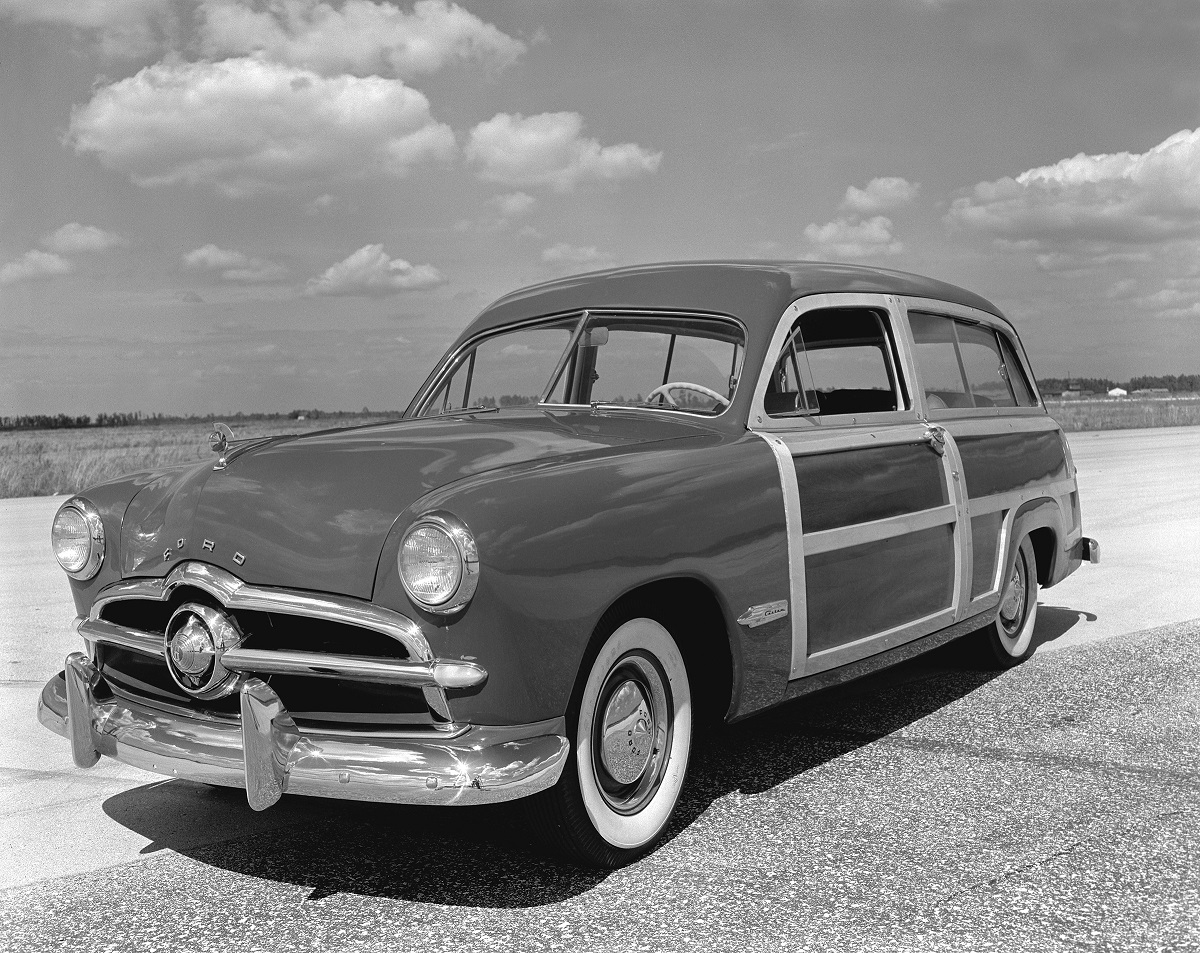
A black and white photo of a new 1949 Ford club coupe

Redesigned from the ground up in many ways, the new Ford retained the drivetrain of previous Ford models. A 226 cubic inch six-cylinder came standard, while an optional 239 cubic inch flathead V-8. (Photos courtesy of Ford PR archives)

BY MARK MAYNARD

The 1949 Ford was the first all-new automobile design introduced by the Big Three after World War II, according to its page in Wikipedia 
Civilian production had been suspended during the war, and the 1946 through 1948 models from Ford, GM, and Chrysler were updates of their pre-war models.

The 1949 Ford would come to market in June, beating Chevrolet by about six months and Plymouth by about nine, according to AutomotiveHistory.org.

A 1951 Ford Country Squire woodie wagon at a construction site with a steam shovel in the background

The 1949 Ford ‘ponton’ styling would continue through the 1951 model year, with an updated design offered in 1952.

New Fords bore model names such as the Custom or Standard Tudor or Fordor, referencing the number of doors on the car. The new models came in coupe, sedan, and convertible body styles, with steel and woody wagon variations.

Redesigned from the ground up in many ways, the new Ford did retain the drivetrain of previous Ford models. A 226 cubic inch six-cylinder came standard, while an optional 239 cubic inch flathead V-8 made the car more fun.

A 1949 Ford woodie wagon

New-for-1949 models came in coupe, sedan, and convertible body styles, with steel and woody wagon variations.


The “Shoebox” Design

According to Wikipedia, the ’49 Ford body style became known as “Shoebox Ford” for its slab-sided “ponton” design. But the 1949 Ford is credited with saving Ford and ushering in modern, streamlined car design with changes such as integrated fenders.

This design would continue through the 1951 model year, with an updated design offered in 1952. Frank L. Engle designed the crest.

A color photo of a 1949 Mercury convertible

The redesigned Mercury Eight for 1949 also debuted the “ponton” styling of the new Fords. The fresh styling was a sales success for both brands.

The redesigned Mercury Eight for 1949 also debuted the “ponton” styling of the new Fords. The fresh design ended the monotony of warmed-over pre-war style, which helped differentiate Mercury from its comparable Ford cousin, a trick that spelled sales success. Sales figures for both Ford and Mercury broke records in 1949.

See more photos and stories about classic cars here

2023 Nissan Pathfinder Platinum Review

2023 Nissan Pathfinder Platinum Review

The fifth-generation 2023 Nissan Pathfinder feels built for the long haul. Nothing about it seemed budget constrained or cheap. Many of its design features are helping hands for parents.

A side view of a red Nissan Pathfinder

The fifth-generation Nissan Pathfinder follows in the tracks of the nameplate’s first U.S. hardbody model from 1986. (Photos courtesy of NissanUSA or as credited)

Table of Contents

Pathfinder Through the Years
7 Cool Features
Oddities and Observations
What’s New for 2023?
2023 Nissan Pathfinder Pricing
How Is It To Drive?
Brakes, Steering, Suspension
Back Seats and Cargo Space
Why Buy the 2023 Nissan Pathfinder?
Specifications

BY MARK MAYNARD

The Nissan Pathfinder has traveled many paths since it debuted as a “hardbody” in 1986.

The first-generation Pathfinder was introduced for model year 1987 as a two-door body-on-frame SUV. Built on a ladder-type frame, Pathfinder shared styling and most components with the Nissan Hardbody pickup.

Pathfinder’s optional 4WD system was considered unique at the time because it could be engaged electronically — “shift on the fly” — while the vehicle was moving. All versions of Pathfinder were available in two-wheel drive or manually engaged 4WD configurations. Base models had modest power from a 106-horsepower, 2.4-liter four-cylinder engine or an optional 143-hp 3.0-liter V-6.

Nissan’s new SUV was in response to the growing competition: Chevrolet Blazer, Ford Bronco II, Jeep Cherokee, and import SUVs such as the Toyota 4Runner, Honda Passport, and the 1989 to 2004 Isuzu MU.

Today, there are more three-row SUV competitors than ever. Among the choices for 2023 are the Chevrolet Traverse, Honda Pilot, Hyundai Palisade, Jeep Grand Cherokee L, Kia Telluride, Mitsubishi Outlander, Toyota Highlander, and VW Atlas.

The front seat area of the 2023 nissanp pathfinder

A roomy driver area with headroom of 41.1 inches with the panoramic moonroof.

Pathfinder Through the Years

Nissan tended dutifully over the years to keep Pathfinder current and competitive. It was ahead of its time for some features, but not all variants endured the tests of owners.

It was October 1989 when Nissan debuted the four-door Pathfinder. Then, in late 1995, the second-generation Pathfinder was introduced with revised styling. There was another mild redesign in 2002.

A completely redesigned, third-generation Pathfinder debuted in late 2004 for the 2005 model year.

Model year 2013 brought a critical shift for the fourth-generation Pathfinder. The body-on-frame, truck-based SUV was replaced with a unibody design and sleek new (aerodynamic) exterior styling. It used the same platform as the Infiniti QX60, Altima, Maxima, Murano, and Quest minivan.

Nissan launched a short-lived gasoline-electric hybrid Pathfinder in 2014. Its powertrain was a supercharged 2.5-liter four-cylinder gasoline engine and an electric motor paired with a compact lithium-ion battery. The hybrid model, however, was a one-year-only offering. Owners complained they could not get gas mileage close to the advertised 25 to 28 mpg.

The fifth-generation Pathfinder was unveiled in early February 2021 as a 2022 model, skipping the 2021 model year.

Nissan brought back more emphasis on the current Pathfinder as a family adventure vehicle. The more squared-off styling — and what might be the best-looking rear end of any new SUV — ever-so-slightly goes back to the roots of Pathfinder.

There is an active forum for Pathfinder owners at PathfinderTalk.com. Owners — some of whom are lifelong Nissan faithful — post their problems, remedies, and praise.

the view from the third row of the pathfinder panoramic moonroof

The panoramic moonroof is standard on the Platinum.

7 Features Owners Will Value

Nissan engineers and designers sweat the small details and provide many enhancements and innovations. Some of these emerge only after time on the road.

Auto on-off LED headlights linked to windshield wiper use. In California and other states, it is the law to use headlights with wipers in the rain. With Nissan’s auto function, drivers will know they are always compliant.

Capacitive touch lock-unlock rear side doors. Such a simple convenience, but many others save some budget and omit that access to the rear side doors. Walking up to the back doors with an armful of kid or groceries, the driver gains quick access with a touch of the door handle. Too often, back-door entry requires first touching a front-door handle.

“Bridge” storage. Nissan makes the most of the front center console with a deep bin and “bridge” under-storage space. The pass-through bridge is also convenient for the passenger. Most other shift consoles are solid, which wastes the extra storage potential.

The pathfinder's 'bridge' storage in the lower center console

‘Bridge’ storage below and above the shift console, with a phone-audio e-bin.

Storage shelf above the glove compartment. The slim shelf will fit any generation iPhone, Nissan says. It is also mostly out of sight and sunshine.

2nd-row pushbutton seat release. Loading kids into the third row is so simple any kid can do it. The pushbutton release at the door-side seat base of the captain’s chair boosts the chair up and forward for third-row access.

the second row captain's chairs

The Captain’s Chairs package with removable center console.

54.1-liter luggage box. The undercargo floor storage compartment (1.9 cubic feet) has a hinged lid and dividers to separate the good-sized compartments. It’s part of the Cargo package, $345, and worth it.

10-way power passenger seat for Pathfinder SL and Platinum. Some imports don’t even provide height adjustment for the passenger — and nobody likes being low in the front seat.

6,000-pound towing capacity. Base models can pull a trailer up to 3,500 pounds, but the Rock Creek and Platinum models are uprated to a 3-ton capacity.

the understorage of the pathfinder

The underfloor storage box is made more functional with the section dividers from the optional Cargo package. (Mark Maynard photo)

 Oddities and Observations

Transmission unexpectedly went into Park while sitting at a stoplight. I don’t believe I bumped the electronic shifter’s Park button atop the shifter grip, yet the Pathfinder transmission went into Park at a stoplight near my home. I didn’t discover the issue until the light turned green. The problem never occurred again in my test week.

Tilt-down mirror confused. When engaging reverse, the passenger side mirror is supposed to tilt down to show the curb and then go back into position when Drive or Park are engaged. The tilt-down can work on either left or right-side mirrors. The driver must select the left or right mirror control on the door panel. I tried both sides, and each time, the side mirror tilted up, not down.

Slow response to infotainment screen. Making a selection on the infotainment screen would take a second or two to activate. Of course, I’d tap the selection again, thinking I’d missed the icon. Nope, it’s just slow.

No wireless Android Auto. While Apple CarPlay has wireless connectivity, Android users must use the access cable.

ProPILOT Assist vagueness. This Level 2 driver-assist system was once at the vanguard of semi-autonomous driving. But the advanced technologies that go into Level 2 have been honed by others to be more accurate, especially in lane centering. In my experience, the system allowed the Pathfinder to drift wide in cornering, crossing the white lines, and then giving me an alert. It also seemed the Pathfinder was closer to the lane marking on the right than the left. Still, ProPILOT is welcome backup in heavy commuting, but  keep both hands on the wheel.

The pathfinder has an around view camera system

The Intelligent Around View Monitor with Moving Object Detection.

What’s New for 2023 Pathfinder?

Nissan brought back the off-roading ready Pathfinder Rock Creek for 2023. Among its adventuring credentials are standard Intelligent 4WD, an off-road-tuned suspension, and a 5/8-inch suspension lift.

Using premium fuel gives the 3.5-liter V-6 engine a power boost of 11 horsepower and 11 foot pounds of torque. A Nissan spokesman explained that the bump in power for Pathfinder Rock Creek is by engine software programming to take advantage of the extra octane in premium fuel. “The engine computer senses the extra octane and adjusts accordingly. The other Pathfinder models don’t get this programming, so they won’t get a horsepower boost like the Rock Creek.”

I suggested that Nissan consider adding that engine-software programming as an option. How much would you pay for 11 more hp?

Other Rock Creek upgrades include:

  • 18-inch beadlock-style wheels with all-terrain tires;
  • Tubular roof rack with a 220-pound capacity;
  • Tow hitch receiver and harness with 6,000-pound maximum towing capability;
  • LED fog lights;
  • Intelligent Around View Monitor with Off-Road Mode. A front-view camera shows the terrain ahead, with a side view, all of which help driver’s place the tires where there is solid ground;
  • Orange interior stitching and second-row captain’s chairs.
  • Rock Creek pricing starts at $44,355.

The 12-inch digital 'dashboard' gauge array

The 12-inch digital dashboard.

Other 2023 Pathfinder Upgrades

  1. The upper-range SL trim levels now have a standard wireless phone charging pad;
  2. Pathfinder Platinum has a new captain’s chairs package, which adds a removable console between the second-row chairs. And it can be easily removed if needed for step-through access to the third row.
  3. 10-way power passenger seat for Pathfinder SL and Platinum. Hooray. Not all Japanese makes provide such adjustability for the front passenger.

The pathfinder third row

Third-row seating is kid class, but access is easy with pushbutton release of the second row.

2023 Nissan Pathfinder Pricing

There are five trim levels for the 2023 Nissan Pathfinder in front- or four-wheel drive. All trims have a 284-hp, 3.5-liter V-6 and a nine-speed automatic transmission. Starting prices below include the $1,335 freight charge from Smyrna, Tenn.

Pathfinder S: $36,535 2WD, $38,435 4WD (add $1,900 for 4WD)

Key S trim features include:

  • Nissan Safety Shield 360, driver-assist system;
  • Tri-zone automatic temperature control;
  • Apple CarPlay connectivity;
  • EZ FLEX seating system featuring Latch And Glide and 3rd-row 60/40-split fold-flat reclining bench seat.

Pathfinder SV: $39,355 2WD, $41,255 4WD

Key SV features include:

  • Heated front seats;
  • ProPILOT driver-assist system;
  • Intelligent Lane Intervention;
  • Intelligent Blind Spot Intervention;
  • 10-way power driver’s seat with 2-way power lumbar;
  • Remote Engine Start System with Intelligent Climate Control.

Pathfinder SL: $44,855

Key SL features include:

  • Four-wheel drive;
  • Leather-trimmed seats in first and second rows;
  • NissanConnect 9-inch color infotainment touch-screen display;
  • Intelligent Around View Monitor;
  • Wireless Apple CarPlay integration;
  • Wireless charger;
  • ProPILOT Assist with Navi-link.

Pathfinder Platinum: $49,505 2WD, $51,405 4WD

Key Platinum features include:

  • 20-inch aluminum-alloy wheels;
  • Heated and ventilated front seats;
  • Panoramic moonroof;
  • Head-up windshield display;
  • Bose premium audio system with 13 speakers, including dual woofers;
  • Tow-hitch receiver with 4-pin wiring harness.

Check here for current pricing and special offers.

The Pathfinder Platinum tester was $55,035 with seven options, including special paint for $790 and $550 for the Captain’s Chairs package, with the removable center console. But the most impressive (usable) option to me is the Cargo package, $345. Among its assets are heavy-duty rubber cargo floor and seatback protectors.

All of the tester’s options and pricing are in the specifications chart below.

Safety Features and Technologies

Every Pathfinder has the Nissan Safety Shield 360. This collection of technologies includes Automatic Emergency Braking with Pedestrian Detection, Blind Spot Warning, Rear Cross Traffic Alert, Lane Departure Warning, High Beam Assist, and Rear Automatic Braking.

And all versions of Pathfinder have 10 air bags, but there is an added driver-seat front-center bag on the Platinum.

Other safety features are in the specs chart below.

Dial-up performance modes from Sand to Sport.

Dial-up performance modes from Sand to Sport.

How Is It To Drive?

The 2023 Nissan Pathfinder feels big and wide, though it has about the same size footprint as its competition. Nissan gave Pathfinder all the power and suspension elements to be driver-engaging, but the result is more fundamental than fun-demental. Most users wouldn’t pile in the family and head out to tear up some back roads.

The turning circle with 20-inch tires is a manageable 38.7 feet, with driver assists from the around-view camera when parking.

The sole powertrain is a 284-hp, direct-injected 3.5-liter V-6 with a nine-speed automatic. Hallelujah, Nissan ditched the continuously variable automatic for this nine-speed, and few will be looking back. Shift points are well-timed but sluggish to downshift when going up hills. Overall acceleration, however, was quick enough that I didn’t feel the need to engage Sport mode. (However, I do use Sport when plugging along in the heavy commute. The quicker Sport kick is helpful to ward off those cretins who try to dive into the too-small space between you and the car ahead.)

With 259 foot-pounds of torque at 4,800 rpm, there is adequate force to handle the Pathfinder Platinum’s 4,625 pounds, not including occupants.

Fuel economy estimates of 20 mpg city and 25 mpg highway might be hopeful; 87 octane is recommended for all models but Rock Creek. Around town in my week of driving, my average fuel economy hovered between 11 to 16 mpg. I worked up to 22 mpg on more extended highway driving, meeting the EPA estimate.

The pathfinder's v6 engine

The 284-hp 3.5-liter V-6 for all Pathfinder trim levels.

Braking, Steering, Suspension

Pathfinder’s foundation feels robust and substantial, essential for towing and adventuring off the highway. The ride quality is comfortable but gives an unexpected sport-tuned jolt over rough road. Inputs to steering and braking are refined and steady.

But there is noticeable ambient cabin noise at highway speeds, which I attributed to the prominent roof rail cross bars.

The 6,000-pound towing capacity for Platinum and Rock Creek requires the Class III receiver hitch, the seven-pin connector for trailer braking, and the factory-installed transmission oil cooler. The upgrade is part of the Premium Package on the SV and SL models. The SV Premium Package is $2,170, and the SL Premium Package is $2,990.

Braking: Four-wheel disc brakes have vented rotors front and rear with 13.8-inch rotors front and 13-inch rotors rear.

Steering: electric power assist with vehicle-speed assist,

Suspension: four-wheel independent with front struts and rear multi-link setup; solid stabilizer bar front, hollow rear. Twin tube, dual-flow path shock absorbers;

Tires-Wheels: 255/50 20-inch all-season tires on machined aluminum-alloy wheels with a dark metallic gray finish. A temporary spare stows underbody at the cargo area;

The Pathfinder Platinum is well dressed in 20-inch all-season tires on machined aluminum-alloy wheels with a dark metallic gray finish.

The Pathfinder Platinum is well dressed in 20-inch all-season tires on aluminum-alloy wheels.

Back Seats and Cargo Space

Raised back seat height in the Pathfinder is very kid friendly for open views and helpful to ward off motion

electronic back seat ac and vent controls

Electronic climate controls for the second row.

queasiness. Also beneficial are ceiling vents just above each side window, with reading lights. There also is a lot of seatback recline, another parenting asset for sleeping youngsters.

A flat floor in the second and third rows is the great enabler for comfortable foot space, uncompromised by a transmission tunnel. Adult legroom in the second row is functional at 35.5 inches, which can be stretched a bit with a few inches of fore-aft slide.

And there is plenty of big-bottle space in the door panels.

a pair of chilld seats in the second row

Captain kids’ chairs.

Parents will appreciate the pushbutton spring release to slide forward the second-row seat for third-row access. And there’s a one-arm push to lock down the seat. As with most midsize, three-row SUVs, the way back is best for small children.

Cargo capacity ranges from grocery bag and gym bag space behind the third row (16.6 cubic feet) to family vacation capacity of 45 cu.ft. with the third row folded.

The liftgate opening is 49 inches wide, or 4 feet, 1 inch. With both rows folded, there is about 6 ½ feet in length for a wide bay of 80.5 cu.ft. Other cargo area features include two grocery bag hooks, four tie downs, lighting, and a 12-volt plug.

Cargo space behind the third row is 16.6 cubic feet

Check out the heavy-duty rubber cargo mat and seatback protector, both are part of the $345 Cargo package, and worth it. (Mark Maynard photos)

Both rows of seats are folded for big and open cargo space

Fold both back seats for 6 ½ feet-plus in length.

Why Buy the 2023 Nissan Pathfinder?

The fifth-generation Nissan Pathfinder feels built for the long haul. Nothing about it seemed budget constrained or cheap. Many of its design features were helping hands for parents, at least for those who resist the “M” word for minivan. And the details of Nissan’s design and engineering will bring years of “Gee, I like that little extra.”

Pathfinder’s next midcycle freshening is planned for 2025, so there are long legs for the current model. But shop wisely for the most value.

The Platinum model has an appreciable load of standard features. However, you can step down a grade to the Pathfinder SL and add options that mimic the Platinum for a sticker of $48,190. I prefer a monotone paint scheme, saving $790. And to save another $395, stay away from optional paint colors, such as Scarlet Ember Tintcoat (a gorgeous red) or Pearl White TriCoat, for $395 each. Then save another $390 if you won’t use the (wind-noise generating) roof rail cross bars.

Add it up, and the Pathfinder SL 4WD, with leather-trimmed upholstery, saves nearly $7,000 over the Platinum. And that savings will buy a lot of gas for a driving vacation.

The good look rear end of the new pathfinder

Starting prices for the 2023 Nissan Pathfinder range from $36,535 to $50,000.

2023 Nissan Pathfinder Platinum Specifications

Body style: large-midsize, 3-row, 7-seat SUV with 4WD

Engine: 284-hp, naturally aspirated and direct-injection 3.5-liter V-6; 259 lb.-ft. torque at 4,800 rpm

Transmission: 9-speed automatic with manual shift mode paddle shifters, and electronic shift-by-wire drive selector; Intelligent 4WD with 7-position Drive and Terrain Mode

Fuel economy: 20/25/22 mpg city/hwy/combined; 87 octane

Tow capacity: up to 6,000 pounds; class III tow hitch with harness and 4-pin prewiring; trailer-sway control

BY THE NUMBERS

Fuel tank: 18.5 gallons

Cargo space: 16.6 cubic feet behind 3rd row; 45 cu.ft. 3rd row folded; 80.5 with both rows folded

Front head/leg room: 41.1*/44.3 inches *42.3 inches w/o moonroof

2nd-row head/leg room: 39.6/35.5 inches

3rd-row head/leg room: 37.8/28 inches

Length/wheelbase: 197.7/114.2 inches

Curb weight: 4,625 pounds

Turning circle: 38.7 feet

FEATURES

Standard equipment includes: Nissan Intelligent Key with push-button ignition, Intelligent cruise control, panoramic moonroof (with one-touch power tilt-sliding glass with shade), tri-zone climate control, wireless phone charging pad, 12.3-inch gauge display, head-up driver windshield display, 9-inch color navigation-infotainment touch display, 13-speaker Bose premium audio system with subwoofer, 10-way power adjusted front seats, heated and ventilated front seats, sun visors with extenders and vanity mirrors, heated 2nd-row window seats, quilted semi-aniline leather-trimmed upholstery in first and second rows, power tilt-telescopic steering column, two-driver memory presets, automatic LED headlights (high and low beams), LED running lights and fog lights, body-color power-folding and heated side mirrors with reverse tilt-down, privacy glass (rear-side windows and liftgate window), silver-finish roof rails, motion-activated power liftgate, 2 12-volt DC power outlets (1 front console, 1 in cargo area);

Safety features include: 11 air bags (including for Platinum, a driver seat-mounted front-center bag), dynamic traction control, hill-start assist with hill-hold control and hill-descent control, brake-force distribution, brake assist, 4-wheel ABS; LED side mirror-mounted turn signals;

Driver-assist technologies include: ProPILOT Assist semi-autonomous driver assist with Navi-link, blind-spot warning and blind-spot intervention, rear cross-traffic alert, automatic emergency braking with pedestrian detection, automatic rear braking, Intelligent forward-collision warning, Intelligent lane intervention.

PRICING

Base Platinum MSRP: $51,405, including $1,335 freight charge; price as tested $55,035

Options on test vehicle: Two-tone paint $790; captain chair’s package $550; roof-rail crossbars $390; LED fog lights $345; lighting package (without running boards $945; carpeted floor mats with captain’s chairs (4-piece set) $265; cargo package $345

Where assembled: Smyrna, Tenn.

Warranties: 3-years/36,000-miles bumper to bumper with 24/7 roadside assistance; 5-years/60,000-miles powertrain

57th Annual Easter Jeep Safari April 1-9

57th Annual Easter Jeep Safari April 1-9

 The long-running Moab Easter Jeep Safari will draw 20,000 participants and debut 7 wild Jeep concept vehicles, four of which are electrified

The group of 7 Jeep concept vehicles

Seven one-of-a-kind Jeep concept vehicles take four-wheeling to the next level of Jeep 4×4 capability for the 2023 Easter Jeep Safari. (Photos courtesy of Stellantis)

Table of Contents

Wrangler Magneto 3.0 Concept
Scrambler 392 Concept
1978 Jeep Cherokee 4xe Concept
Wrangler Rubicon 4xe Concept
Grand Wagoneer Overland Concept
Wrangler Rubicon 4xe Departure Concept
Gladiator Rubicon Sideburn Concept
Jeep Performance Parts

 BY MARK MAYNARD

Jeep has just off-loaded seven wild mission-capable concept vehicles for the 57th annual Easter Jeep Safari, April 1-9, 2023, in Moab, Utah

The annual gathering since 1967, began as a simple one-day trail ride by the Moab Chamber of Commerce. Over the years, as participation grew, the Easter Safari expanded until it finally reached the current nine-day event. “Big Saturday” remains the culmination of the event on the Saturday of Easter weekend.

Today, Moab’s Red Rock 4-Wheelers four-wheel-drive club hosts the Easter Jeep Safari. The club will lead trail rides and some daylong trips.

“Every year, more than 20,000 Jeep enthusiasts descend on Moab, Utah, for Easter Jeep Safari to wheel in the most extreme off-road conditions,” said Jim Morrison, senior vice president and head of Jeep brand North America. 

Moab, Utah — the Jeep brand’s home away from home — has the ideal conditions to connect with Jeep enthusiasts. Morrison said in a release that Jeep listens to its followers for their feedback on where they want to take the Jeep brand into the future.

A trail ride of Jeeps in Moab

Moab’s Red Rock 4-Wheelers four-wheel-drive club hosts the Easter Jeep Safari and leads trail rides and some daylong trips.

Sermon On the Mount 

Electrified power and commanding performance will be front and center during this year’s Safari, Morrison said. Jeep engineers and designers from Jeep Performance Parts (JPP) by Mopar have created one-off rock-crawling and terrain-traversing vehicles to take four-wheeling to the next level.

The Wrangler Magneto, Jeep’s first battery-electric vehicle concept, returns for a third season. The third iteration of the Jeep Wrangler SUV concept, Magneto 3.0, and three other Jeep 4xe concept vehicles are a testament to the Jeep brand’s commitment to Zero Emission Freedom and 4×4 leadership.

Each concept features the latest production and prototype Jeep Performance Parts, all battle-tested for durability.

“Unlike any other aftermarket offerings, our growing portfolio of factory-tested and factory-backed parts and accessories are designed and engineered to face the toughest trails in the world,” said Mark Bosanac, North America senior vice president, Mopar service, parts, and customer care.  

The 2023 Easter Jeep Safari concept vehicles include:

Jeep Wrangler Magneto 3.0 

The Jeep Magneto concept

The Jeep Wrangler Magneto 3.0 Concept is back with modifications for its third safari.

When the Jeep design team began building the Jeep Wrangler Magneto concept, the intention was to use the platform to discover and push the boundaries of 4×4 electrification.

The Jeep Magneto 1.0 concept made its Safari debut in 2021 as a fully capable battery-electric off-roader. Based on a two-door 2020 Jeep Wrangler Rubicon, the Magneto features a custom-built axial flux electric motor that operates up to 6,000 rpm. Its 285-horsepower e-motor connects to a six-speed manual transmission. The compact e-motor was initially tuned to deliver up to 273 foot-pounds of torque.

The 2022 debut of Jeep Magneto 2.0 raised the e-motor power to 625 hp with 850 lb.-ft. of peak torque.

Updates to the 2023 Jeep Magneto include a more efficient motor and updated programming. Together, the powertrain has a 20 percent increase in useable energy and range, Jeep says.

Also new to the 2023 Jeep Magneto 3.0 concept are three driver-selectable functions. Output select allows the driver to choose between two power settings:

Standard: 285 horsepower and 273 lb.-ft. of torque; 

Maximum: 650 horsepower and 900 lb.-ft. of torque;

  • Two-stage power regeneration mode allows normal driving while off, or with enhanced brake regeneration using the electric motor when engaged ;
  • Aggressive hill-descent mode selectable in low range for “one-pedal” off-road driving;

Trail-riding assets of Magneto 3.0 include:

  • Dynatrac 60 front axles (5.38:1 ratio) and Dynatrac 80 rear axles (5.38:1 ratio).
  • 20-inch off-road beadlock wheels.
  • 40-inch mud terrain tires.
  • A 3-inch lift.   

A clear hood insert on the Magneto concept

The tinted hood insert on the Magneto 3.0 Concept.

Bodywork changes include:

  • Door openings swept back by 6 inches for ease of access, ; 
  • A new B-pillar was moved rearward 2.36 inches (60mm) from stock to make way for a custom anti-roll bar;
  • Front fenders stretched back on the trailing edge by two inches; 
  • Windshield raked 12 degrees to give the side view a “chopped” roof feel without shortening the front glass.  

An updated paint scheme showcases all three evolutions of the Jeep Magneto 3.0. The Bright White and Surf Blue theme remains, but it was amped up with more vibrant exterior details and red accents. Magneto’s front seats are re-trimmed in blue leather with red accent stitching. The rear seats have been removed, and the floor is Rhino-lined in Surf Blue.

Jeep Scrambler 392 

The lime-green Jeep Scrambler conceptIntroduced in 1981, the Jeep Scrambler CJ-8 was Jeep’s first convertible, compact truck. This small pickup was similar to the CJ-7, but featured a longer 103-inch wheelbase and an extended rear overhang for increased cargo space.

Fast forward four decades, and the 2023 Jeep Scrambler 392 concept follows in the tracks of the CJ-8. Though a V-8 engine was never available for the CJ-8, the 392 Scrambler concept has a 470-hp 6.4-liter HEMI V-8 with 470 lb.-ft. of torque.  

The Jeep Scrambler 392 concept started as a four-door Wrangler Rubicon. Custom carbon-fiber bodywork reduced body weight. The windshield is laid back 12 degrees and matches a lower roof. The modified silhouette reminds of chopped-top hotrods.

A clear plastic hood panel to show the engine

A tinted, clear insert in the hood sets off the 392-cubic-inch V-8. in the Scrambler 392.

One of the most functional features of the Jeep Scrambler 392 concept is the newly released AccuAir air suspension kit developed for the Jeep Wrangler and Jeep Gladiator. This adjustable-height system ranges from 1.5 to 5.5 inches. The ride height can be adjusted on the fly with an in-cab controller or through long-range Bluetooth on a wireless device.

Updated bodywork includes a new front fender flare and carbon-fiber hood. A tinted, clear insert in the hood sets off the 392-cubic-inch V-8. Lightweight front and rear bumpers with new fender flares allow more clearance for a larger tire and wheel combo.

The Jeep Scrambler 392 concept sits on 40-inch tires on custom 20-inch rims. The rims and tow hooks are finished in Brass Monkey paint, the same as today’s Jeep Wrangler Rubicon 392. The concept’s Sublime green paint contrasts with the interior treatment of blue plaid inserts with green stitching.

1978 Jeep Cherokee 4xe Concept

The Jeep Cherokee 4xe electrified concept

This year’s resto-mod concept recalls the 1974 Jeep Cherokee SJ, a two-door version of the Wagoneer. The Cherokee SJ was aimed at younger, more adventurous drivers, Jeep says. 

The Cherokee 4xe concept began with a 1978 Jeep Cherokee, which was married with a 2022 Jeep Wrangler Rubicon 4xe

The original body was heavily modified, and the exterior melds original proportions with an unmistakably 1970s multicolor paint scheme.

At a glance, the ’78 Jeep Cherokee 4xe concept looks similar to a vintage Jeep Cherokee SJ. But it has been transformed into a modern, electrified, off-road performer.

The bright yellow interior of the Jeep Cherokee 4xe

The concept’s custom interior features low-back bucket seats trimmed in leather.

Under the hood, the ’78 Cherokee 4xe concept uses the Jeep Wrangler 4xe powertrain. Power comes from two electric motors, a high-voltage battery pack, and a 2.0-liter turbocharged four-cylinder engine. An eight-speed automatic transmission connects with a 4:1 transfer case. The gearing delivers enough power to turn the 37-inch tires wrapped around custom 17-inch “slotted mag” style wheels.  

The concept’s custom interior features low-back bucket seats trimmed in leather. The rear bench seat was replaced with a four-point safety cage, and the rear cargo space houses a full-size spare tire.  

Jeep Wrangler Rubicon 4xe 

A rearview of the Rubicon conceptThis Jeep Wrangler Rubicon 4xe concept won’t be overlooked on the trail. It has an unapologetic color palette in its pink-purple-hued paint with gloss black accents. 

An AccuAir air suspension kit raises off-road capability. The adjustable suspension allows clearance for the concept’s 37-inch tires and 17-inch high-gloss black American Expedition Vehicles Borah wheels. Additional AEV pieces include front and rear bumpers, differential covers, and a Warn Zeon winch.

The Wrangler Rubicon concept in bright pink-purple paint

Grand Wagoneer Overland

 The Grand Wagoneer Overland concept with a rooftop sleeping tent for twoOver the hills and through the canyonlands with the cross-trekking 2023 Grand Wagoneer Overland Concept. The exterior of the Grand Wagoneer Overland concept is painted Industrial Green with Gunmetal accents.

The Grand Wagoneer Overland concept leverages the new 510-hp 3.0-liter V-6 Hurricane Twin Turbo 510 engine with 500 lb.-ft. of torque.

A stand-out feature of the overlanding-inspired concept is its rooftop RedTail Overland Skyloft. The carbon-fiber-constructed Skyloft unfolds in around 10 seconds from the inside by pushing up with one arm.

Inside, the Skyloft’s second- and third-row seats have been removed, and the rear-most sunroof was repositioned to create a weatherproof, step-up entrance from the third-row seating area to the Skyloft level. Entry and exit are by a sliding door and a small step, which doubles as a table. 

The 2 person skyloft

The Skyloft unfolds from the inside by pushing up with one arm.

The two-person Skyloft is a climate-controlled oasis. Its cozy interior has two oversized beanbags, a plush throw rug, pillows, and interior lighting. The interior also provides storage for bikes, gear, or anything else worth its weight and size to pack along.

A heavy-duty Warn winch was at the front grille features two sets of custom laser lights for superior night-time visibility. A durable, black Rhino-lined roof has a pop of orange to call out the outdoor gear used by many overlanding enthusiasts.

Bodywork includes larger wheel openings and custom wheel flares. A custom front chin and rear valance improve approach and departure angles. The concept’s 35-inch tires and 18-inch wheels give a 1.5-inch lift to the vehicle, boosting break over and ground clearance.

Jeep Wrangler Rubicon 4xe Departure 

The Wrangler Rubicon 4xe Departure concept in Harbor Blue paintThe Jeep Wrangler 4xe Departure is a plug-in hybrid with a catalog of special equipment. It can manage tall steps with 37-inch BF Goodrich tires on 17-by-8.5-inch Vintage Bronze KMC Impact OL wheels. It gets a 2-inch JPP lift kit with Bilstein performance shock absorbers. 

A wide-mouth tubular guard, measuring 4 feet by 1 foot, protects the seven-slot grille. The custom grille guard also folds to create a bumper bench, an ideal perch for two to take a break along the trail. Below the grille guard is a modified Rubicon bumper with a Warn winch.   

New, flat fender flares have integral removable daytime-running-light covers, which are 50-state legal. 

The Rubicon Departure leather interior

Dark Harbor blue exterior paint is carried onto the instrument panel, which features various Vintage Bronze accents.

Unique to the Wrangler 4xe Departure concept are innovative options to mount the spare wheel and tire. At the rear is a custom tube gate that allows front- or rear-facing positions for the spare wheel and tire. When the spare is flipped outward, the system acts as a bed extender for more cargo space. When the gate is turned toward the cabin, the rear overhang is improved for off-roading, with the spare wheel and tire safely secured. The convertible gate maintains a factory backup camera and CHMSL in either position.  

Dark Harbor blue exterior paint is carried onto the instrument panel, which features various Vintage Bronze accents. The bold interior treatment has Nappa leather colors of Light Acorn Squash with darker Carnegie Hall brown, accented with off-white stitching. The Dark Harbor blue continues onto the 

The Wrangler 4xe Departure concept also features an accessory instrument panel rail to mount phones or accessories for recording trail rides.

Jeep Gladiator Rubicon Sideburn 

A rearview of the Jeep Sideburn concept in lime green.

The Jeep Gladiator Sideburn concept, in Solar Flash Yellow paint, gets a JPP 2-inch lift kit with Bilstein performance shock absorbers. Hefty-footprint BF Goodrich tires, 37-by-13-inches, are on black HRE six-spoke wheels, 17-by-9-inches

In response to Jeeper feedback, the Gladiator Sideburn concept has a pair of removable 11-inch TYRI rectangular LED lights at each roof panel. The lighting bracket features a quick disconnect.

A front tire of the Sideburn concept

A hefty-footprint BF Goodrich tires, 37-by-13-inches, are on black HRE six-spoke wheels.

The bed on the Gladiator Sideburn has Molle storage panels mounted above and behind the wheel flares. Integrated RotoPaX containers are specially designed for fuel and liquid storage. In the bed, a modified Mopar spare tire carrier secures a 37-inch wheel and tire.

JPP half doors, side steps, and grab handles add to the open-air attitude.

Custom instrument panel bezels carry a 3D topographical map of Moab scenery. The map is in a matte-black base with gloss dark-silver trails. Accents throughout the cabin are in Atomic Silver matte paint. 

Jeep Performance Parts

A see-through image to show jeep performance parts

JPP’s factory-backed and quality-tested parts include axles, lift kits, bumpers, winches, skid plates, and suspension components.

Created in 2012 and offered by Mopar for the Jeep brand, JPP develops high-end, hard-core quality aftermarket accessories and performance parts. 

The factory-backed and quality-tested parts include axles, lift kits, bumpers, winches, skid plates, and suspension components. 

To see the full line of Jeep Performance Parts, visit Mopar.com.