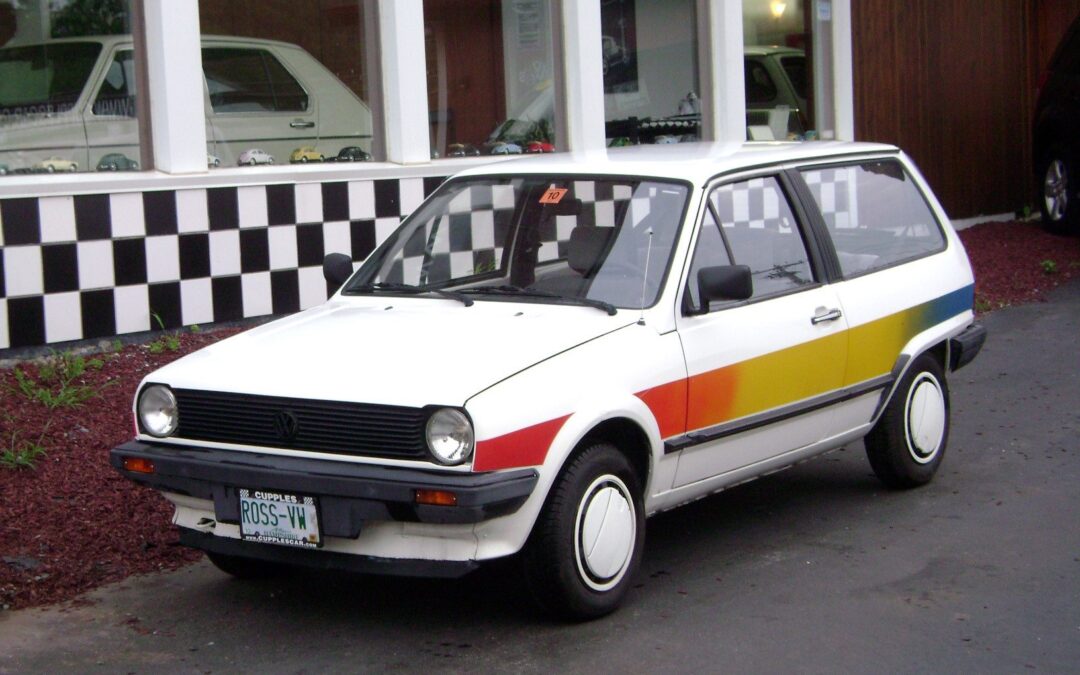
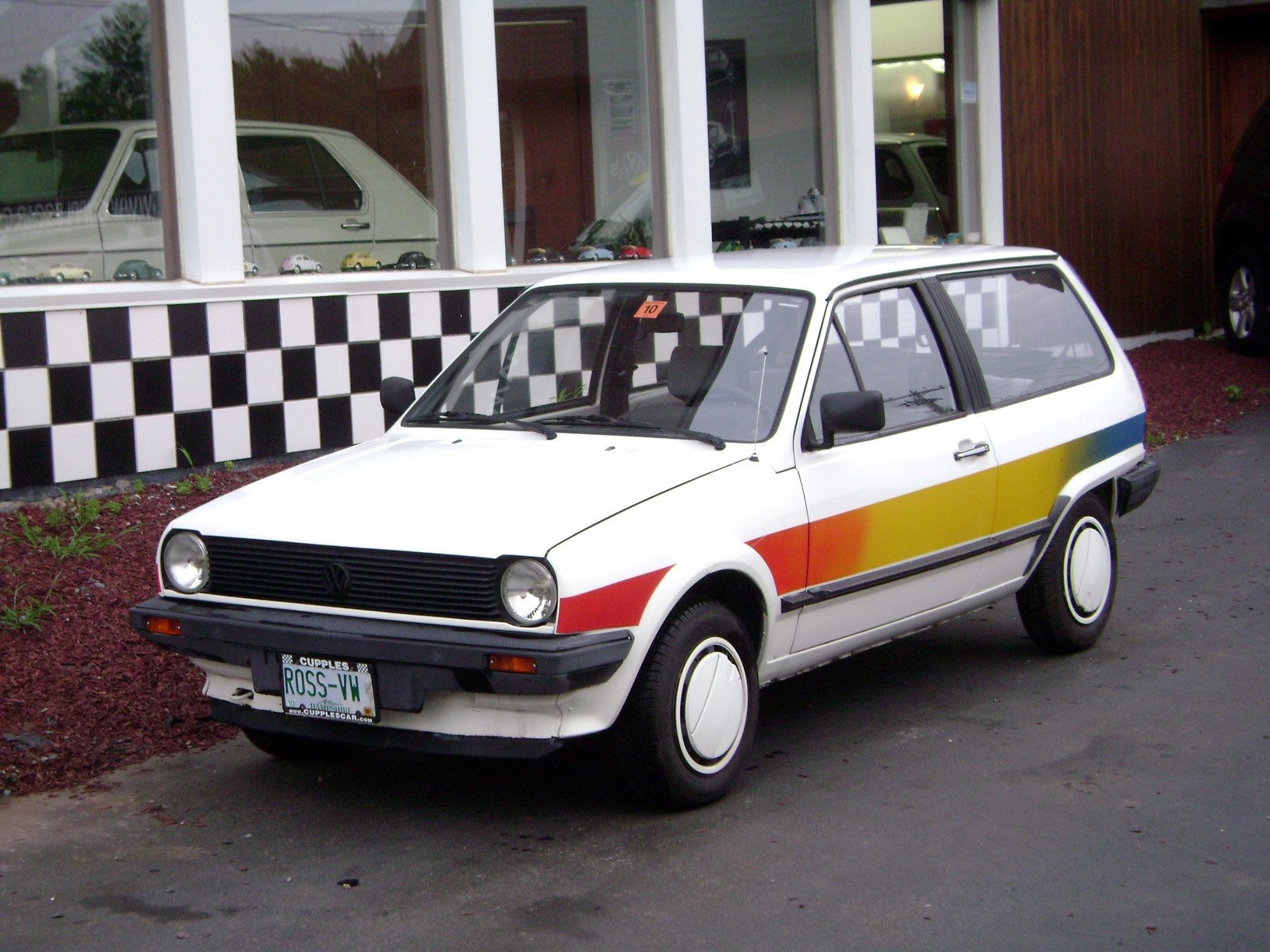
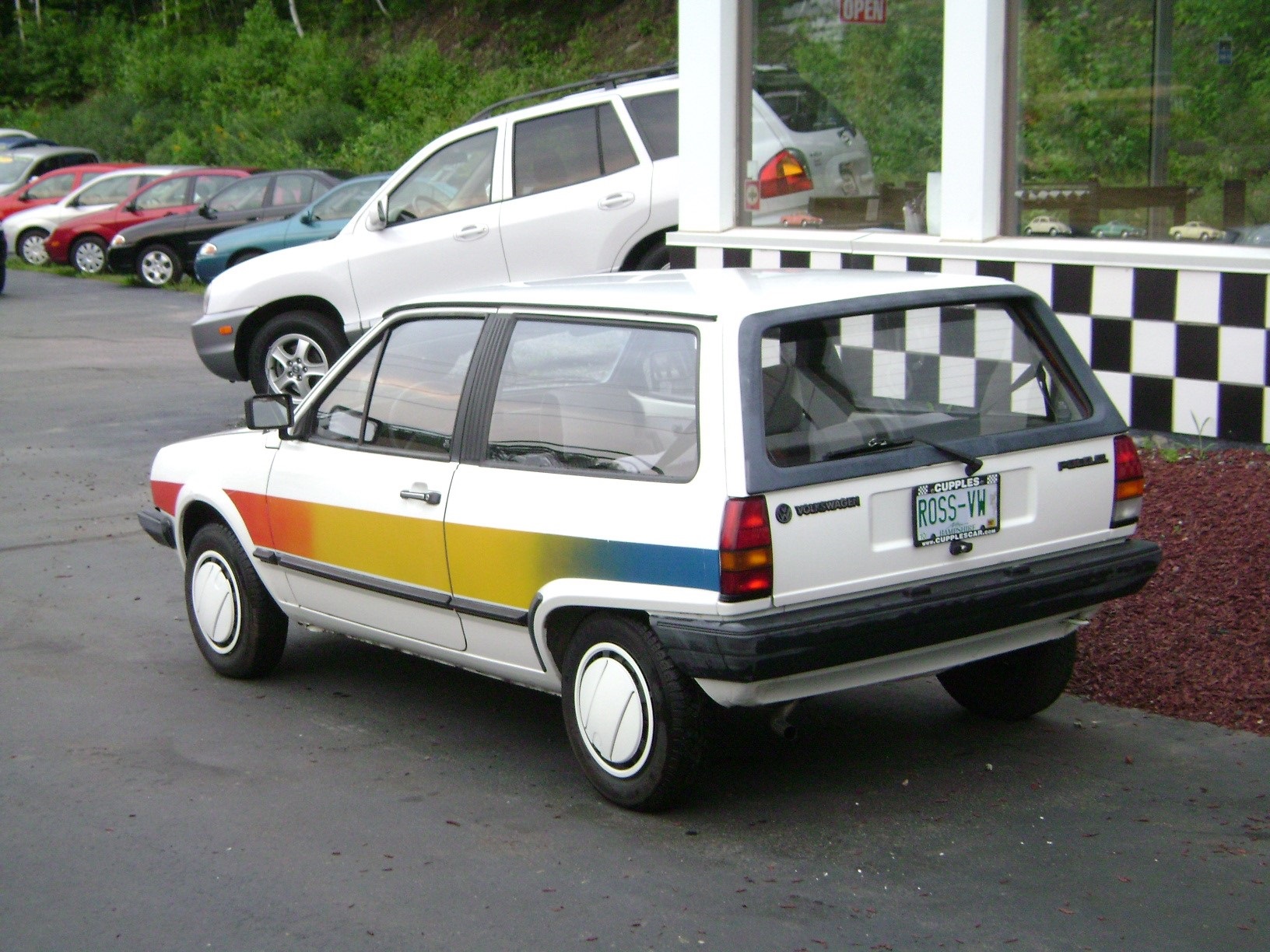
Many enthusiasts are familiar with Volkswagen’s niche models. But not even Ross Cupples, a lifelong fanatic with dozens of Volkswagen cars in his collection, had heard of the Öko-Polo. The rare 1988 VW Öko-Polo prototype had a retro rainbow stripe across its doors when he acquired the car It is the only known model in the United States.
Volkswagens have always been a part of Cupples’ life, according to a press release by VW U.S. At age 10, he fell in love with a yellow 1972 Beetle at his family’s car business in Belmont, N.H. He purchased his first car, a 1985 Jetta GLI, at age 16 and slowly began acquiring and restoring Volkswagen models. Since then, his collection has grown so large that even he has lost track of how many he owns.
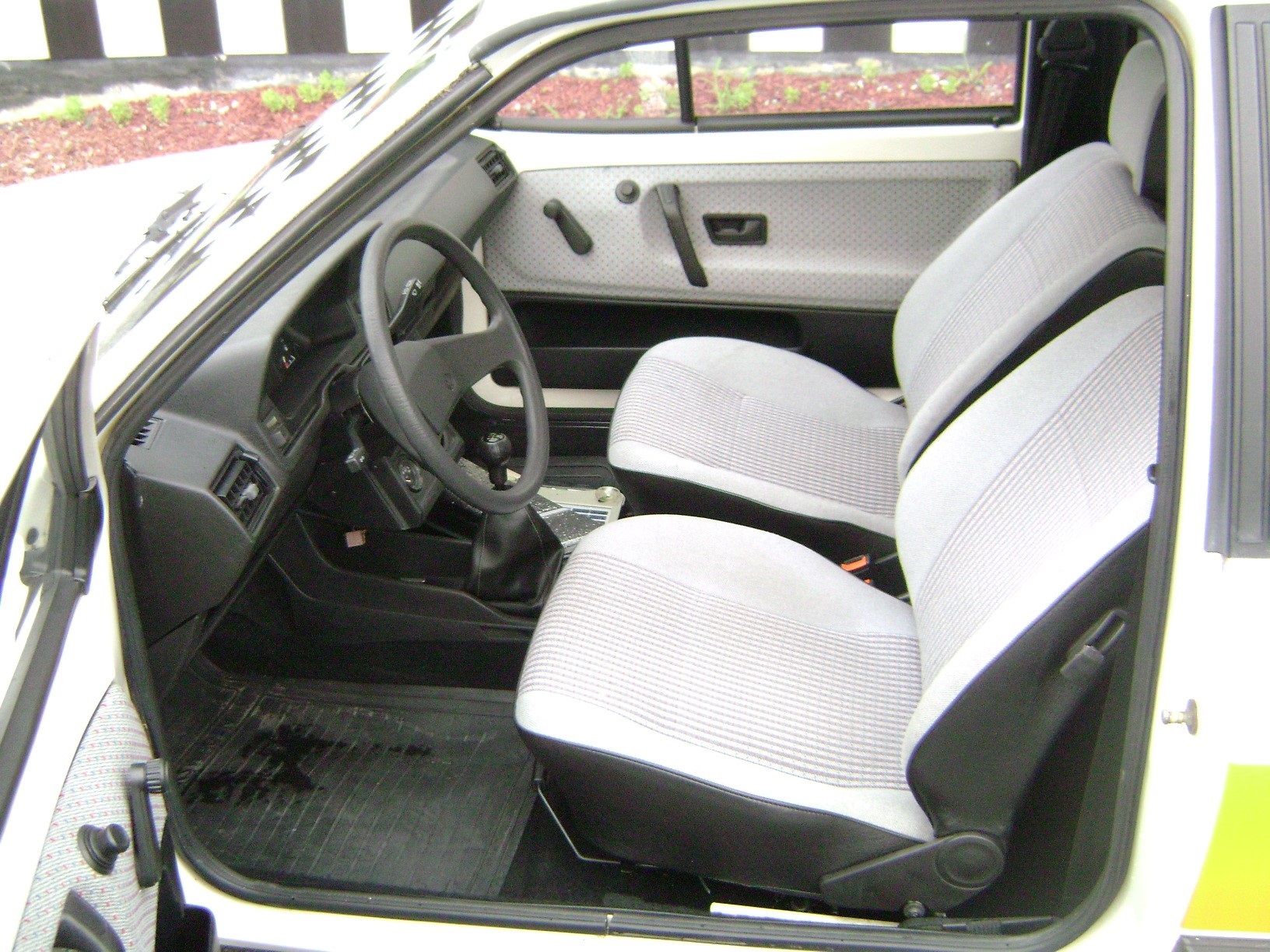
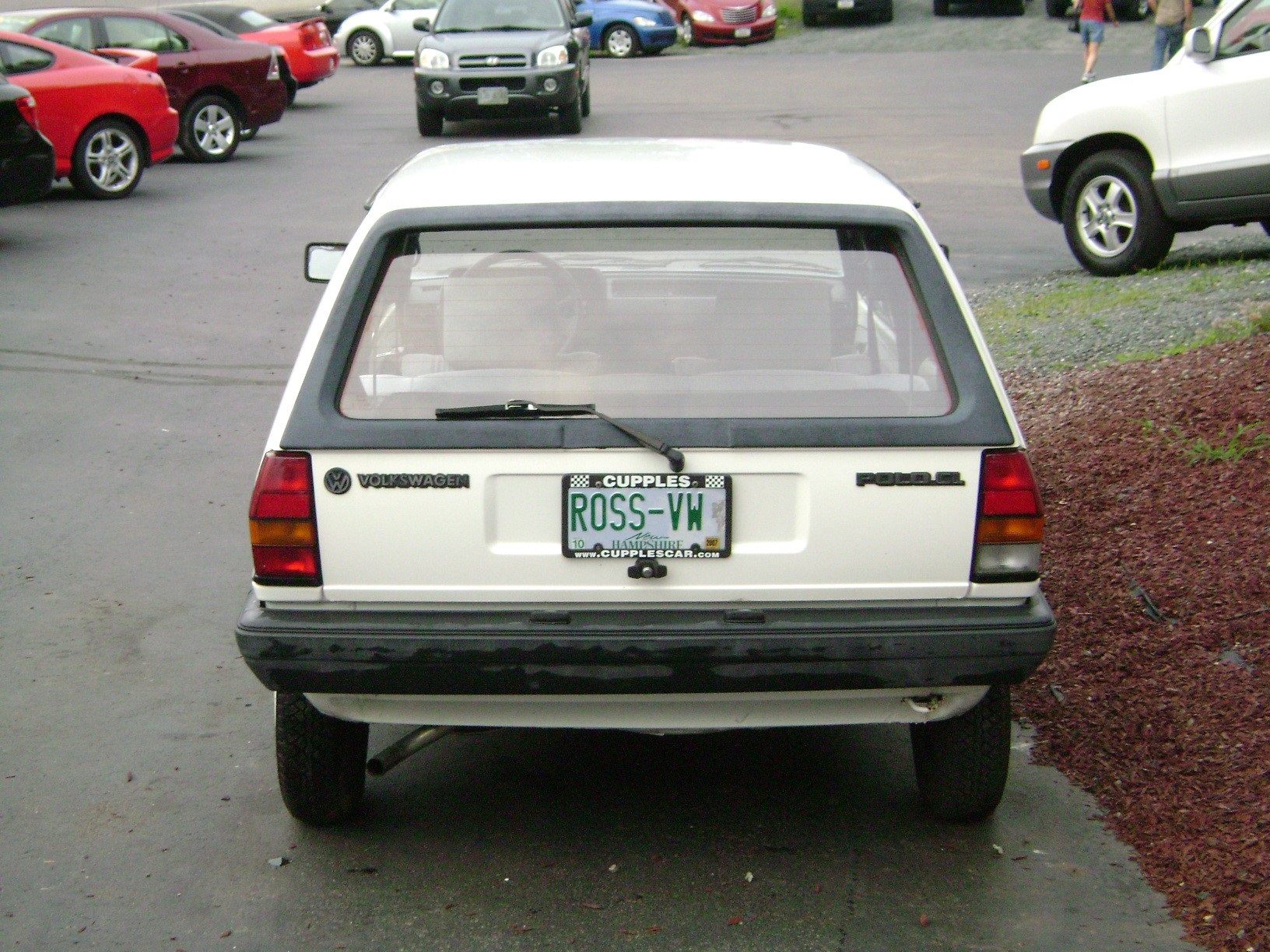
Other than the signature stripe, the Öko-Polo is indistinguishable from any other late-1980s-style Polo Squareback, owner Ross Cupples said.
“I have about 70, most of which are low-mileage, original cars,” Cupples said. His collection fills two buildings, and he is still running out of indoor space as he seeks to keep his vintage vehicles in protected from the elements. “It’s been a fun challenge to research and make connections as I seek out rare models over the years.”
The German translation of Öko-Polo is Eco-Polo.
Fuel Efficient
The prototype was designed to run 100 km (62.13 miles) on just 3 liters of fuel, making it an ultra-economical car at the time.
The German translation of Öko-Polo is Eco-Polo.
The little squareback (wagon) had a two-cylinder diesel direct-injection engine and a G40 supercharger. The two cylinders displaced only 858 cubic centimeters and a heat-resistant foam substance encapsulated the engine bay to minimize the noise and vibrations.
After a year of testing, the series of about 50-75 1988 Öko-Polo prototypes ended. Because of the car’s high cost of production, it was never mass-produced, but it did help future models become more efficient. The Öko-Polo’s newly developed technologies were gradually implemented in other Volkswagen models.
Searching For Parts
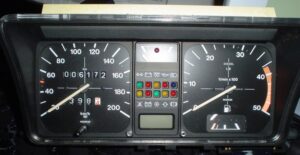
The chassis Cupples purchased was missing many original 1988 Öko-Polo parts, including the engine and supercharger that made it an economical choice. He imported a 1-liter Polo drivetrain and fit it in the body of the car so it could run, albeit without the Öko-Polo engine.
Still, the chassis remains the only known VW Öko-Polo in the country. Its origins in the U.S. are unknown, but the seller in Wisconsin purchased the chassis from a government auction.
The car’s origins in the U.S. are unknown, but the seller in Wisconsin purchased the chassis from a government auction.
“Other than the signature stripe, the 1988 Öko-Polo is indistinguishable from any other late 1980s-style Polo Squareback,” Cupples said. “At the same time, it’s one of the rarest models in my collection.” Even the Volkswagen museum in Wolfsburg does not display an Öko-Polo prototype, he said.
The car Cupples purchased was missing many original Öko-Polo parts.
An interest in VW Polos
The vehicle also sparked Cupples’ interest in other Volkswagen Polos. Over the past two decades, he has collected every Polo model and its variant. He believes he is the only collector in the U.S. to have done so.
While some might consider 70 Volkswagens too many, Cupples is not finished growing his collection.
“I have a mentality of trying to have owned at least one of every model in every generation of Volkswagen,” he said. “Having the Öko-Polo has been a part of that mission. I love being able to hold a part of Volkswagen history.”
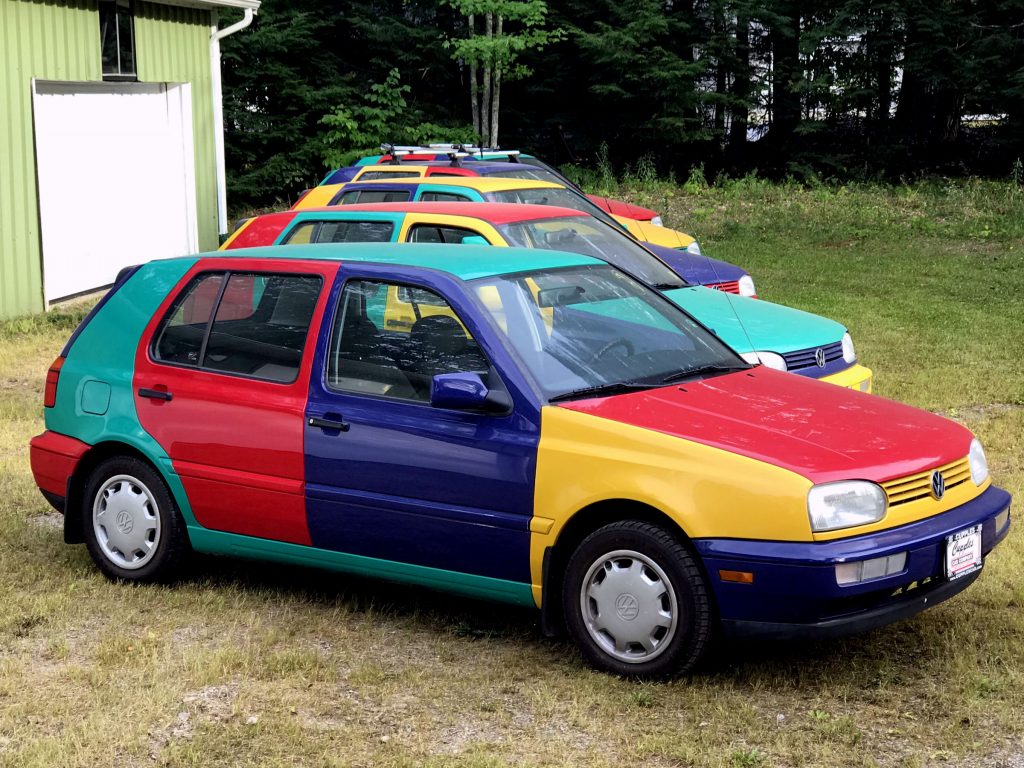
Among his dozens of other Volkswagens have been five Golf Harlequins, with at least one of each color combination.
Cupples owns five Golf Harlequins, with at least one of each color combination.
The new tire centers at JBA Speed Shop are a Tire Rack top five-star installer. (Photos by Mark Maynard)
JBA Speed Shop now provides full tire services and front-end alignment, including for high-performance vehicles
By MARK MAYNARD
New tires are one of the simplest and least expensive ways to give your old ride that new-car feel. Even if the tread does not appear to be unevenly worn or down to the wear-bar indicators, the National Highway Traffic Safety Administration and new-vehicle manufacturers suggest a tire is only 100 percent safe to use until it turns 5 to 6 years old. Of course, a tire can be operable up to 10 years if you check it for issues annually after the fifth year.
In 2013, I had re-tired my 2008 Ford Escape Hybrid (bought in 2012) with four new Goodyear Assurance Fuel Max all-season touring tires. They were promoted as an affordable choice with low-rolling resistance to stretch fuel mileage. They have a tread-life warranty of 6-years or 65,000-miles, which put my set of Goodyears at the end of their life cycle, even though they had substantial tread remaining.
The 7-year-old Goodyear Assurance tires appeared to have good tread remaining, but the cracks of old age were apparent on closer examination.
They did not appear worn out, but upon closer examination, there were visible surface cracks from age — and the tires now rode like hard, black checkers. On the highway I could average 30 mpg and 17-24 around town.
During a suspension check-up for shock absorbers and other suspension elements, the technician advised that the tires were old and should be replaced. They also were out of balance and a front-end alignment was needed.
All of those necessary service points had crept up over the last few years and I had accepted that the tires were just hard and noisy. And I had also accepted that the choppy ride at highway speeds was just how the compact, front-drive SUV handled. I never pushed it for cornering maneuvers, so how it handled was just fine as a daily driver.
But after replacing the front struts and rear shock absorbers, the handling and ride quality improved dramatically. And then I knew that new tires would really improve the ride.
But not just any new tires.
The MeltdownTires center specializes in high-performance applications.
There are many brands of tires for a compact SUV, but it is difficult to choose a winner when the user reviews contradict each other. I was shopping a premium all-season tire and had written a short story on Pirelli’s Scorpion Verde All Season Plus II tires.
Checking various tire sites, the Scorpion Verde had many positive reviews. So I started shopping prices at Tirebuyer.com, which often has the lowest pricing, especially when shipped directly to an installer.
JBA owner J. Bittle bought the best equipment money can buy, he says, including the state-of-the-art Hunter machines.
A set of Scorpion Verdes, size 235/70R16, would cost $590 or $147.50, with free shipping to a tire shop of my choice. And at the time there was a $40 discount if I ordered by a deadline.
For a comparison, I called the JBA Speed Shop in the Kearny Mesa area of San Diego. Owner J. Bittle had recently opened a tire facility in an annex building at his compound. Among the speed shop’s specialties are dynamometer testing for chassis and engine, machine-shop services for custom engine builds and the blueprinting of an engine and a “plumbing” center for braided steel lines, military-spec fuel lines, oil lines and brake lines.
His tire center includes an online tire-shopping link that populates all the major brands and their common pricing. The link listed the same pricing as at Tirebuyer.com. And JBA is a Tire Rack top five-star installer; tires can be purchased online and shipped to JBA for installation.
JBA stocks top brand names in wheels and tires.
I liked the idea of supporting the home-grown business and had JBA order the tires, which were shipped to the shop in about five days.
Bittle has added two levels of tire service. His JBA Tire Center offers basic tires and wheels, “for the best service for the best price,” he says. And the MeltdownTires Performance Center specializes in high-performance tires, including race rubber and custom wheels, whether for a new car or a full custom hot rod.
“A standard alignment center does not understand what occurs when you lower vehicles, so we brought it in-house because we couldn’t outsource anymore,” he said. “It’s becoming more and more difficult to find trusted vendors,” he said, “especially for balancing Plus-1 or Plus-2 tire fitments [adding larger and wider wheels by 1, 2 or 3 inches].
“There are only a couple of facilities in town that have the facilities that we do,” he said. “Our Hunter machines are state of the art and we bought the best equipment money can buy.”
I made an appointment to have the tires installed and an alignment. The tires, mounting and balancing ($20 each) and other fees (tire disposal and recycling) came to a no-regrets $738.34 plus $98 for the alignment.
Premium tire upgrade
Unless you are putting tires on a junker to sell, upgrading to more premium tire brings rewards you will appreciate and value every time you drive. And I also noted a significant boost in fuel economy.
The Goodyear Assurance Fuel Max tires I replaced were good for about 30 mpg on the highway and 17 to 24 mpg around town. While making a recent 80-mile highway run last week on the new Pirellis, I was quite surprised to see that the Escape’s mileage counter had hit 33.3 mpg and it might have gone higher with more highway driving. Around town, the tires are helping to deliver an average of 24-27 mpg. When new, my Escape had factory mileage ratings of 34/30/32 mpg city/hwy combined.
What Pirelli says
I found the Scorpion Verde tires to be quiet rolling and supple, and very responsive in cornering.
The Scorpion Verde tires are quiet rolling and supple. A side benefit has been improved fuel economy.
Pirelli says its Scorpion Verde All Season Plus II tires are an extremely well-balanced choice for SUVs and crossovers. The eco-friendly tire (verde meaning “green” in Italian) delivers high performance, low noise and excellent handling, the company says.
The all-season touring tire was updated in mid-2019 with a new tread compound and a larger footprint for improved wet and dry handling and wet braking. The second-gen formula maintains the mileage, comfort, noise and winter performance of the previous generation, Pirelli says.
Sold in 40 sizes, from 16 to 22 inches, the Scorpion Verde All Season Plus II is covered by a 65,000-mile limited tread wear warranty. Depending on the size, pricing can range from $140 to $255 each. And Pirelli offers a 30-day trial offer, called Confidence Plus Plan. If a buyer is not satisfied with a set of four new tires, they can be exchanged for a new set of four Pirelli tires at the original place of purchase, within 30 days from the original date of purchase.
Older vehicles run great, until they don’t — and then it can be a major expense to get them back to what we had before, which might not feel like the cost was worth it. New tires, however, are like a halo of good feelings and give reassurance of safety in foul weather.
With good tires, you will know exactly where your money went — and you’ll remind yourself to do it sooner next time.
Bentley is offering what it calls a ground-breaking three-dimensional wood trim for the rear door panels in the all-new Flying Spur grand-touring sedan
The open-pore veneer has a 3D surface finish consisting of 150 diamonds. (Photos courtesy of Bentley)
Wood is an organic element that adds natural warmth in an inorganic mode of transportation — but not all wood is equal. The ultraluxury car segment has long been a purveyor of unique wood veneers for vehicle interiors. And the types of wood used by some makers, such as Rolls-Royce, are archived, cataloged, and identified by the vehicle, make and model. When a repair is needed, the core of archived wood can be used to make repairs.
The woods used are often bookmatched so the adjoining surfaces mirror each other, giving the impression of an opened book. To highlight the graining, many makers have sought distinction by offering the patina of aged timber or salvaged lumber from trees that had been submerged. Even the Ram pickup had a wood option that showed damage from barbed wire. Some makers have worked silver powder into the pores as a highlight.
Bentley woodworkers carve the block of wood with a multi-axis routing machine to a tolerance of 0.1mm — less than the thickness of a human hair.
In less-luxurious applications, the wood is sometimes a photograph or plastic representation. But because safety standards for wood trim require it to be so completely treated to avoid splintering in a collision, even the genuine article can look like saturated plastic.
Now, Bentley is offering what it calls a ground-breaking three-dimensional wood trim, designed for the rear door panels. It is a world-first for the automotive sector, Bentley says, and is now available in the all-new Flying Spur grand-touring sedan.
The diamond-shaped pattern is enhanced with a three-dimensional surface finish machined directly into the wood.
The three-dimensional wood works well in the back seat, Bentley says, because the rear doors have an especially large surface to showcase the level of craftsmanship. And the open-pore veneer would potentially clash with the smooth high-gloss veneer used in the front-seat area.
“Typically, ultra-luxurious and expensive features such as this are most appreciated in the rear cabin, particularly important for those who may choose to be driven rather than drive,” Bentley said.
The new veneer option from the Bentley Mulliner “Collections” is a design statement, “bringing tactility to the natural beauty of wood,” Brett Boydell, Bentley’s head of interior design for the Flying Spur, said in a release.
Each rear door and quarter panel is crafted from a single block of sustainable American Walnut or American Cherry timber, “in a harmonious marriage of traditional skills and modern technology,” Boydell said.
The U.S. option package is $13,270.
The three-dimensional wood works well in the back seat, Bentley says, because the rear doors have an especially large surface to showcase the level of craftsmanship.
Roots of the Wood
The concept for 3D-machined wood was first shown in Bentley’s EXP 10 Speed 6 concept at the Geneva Motor Show in 2015. The design was inspired by the diamond-quilted leather used in the Mulliner Driving Specification interior.
Developing the three-dimensional wood took 18 months by expert technical craftsmen to bring the complex concept to reality.
The organic 3D parts are not made using veneers, as is typically applied to the fascia and waist rails. Instead, each is created from a single block of timber, Boydell said. Operators carve the wood with a multi-axis routing machine to a tolerance of 0.1mm, less than the thickness of a human hair.
The cuts are then hand-finished and an open-pore lacquer is applied to allow the true color and texture of the wood to preserve a refined, natural appearance.
The log’s back or “B surface” is machined to match a die-cast template of the aluminum door panel. The plank of wood is then bonded to the template, and then the assembly is placed back into the machine and the front or “A surface” is cut into its three-dimensional form.
Sustainable Timbers
The American Walnut and American Cherry timber are sustainably sourced from North American hardwood forests, Boydell said. Only logs with no knots or resin inclusions through the depth of the wood are used.
American Walnut is one of the most sought-after species of wood in markets around the world, he said. “It is darker than European Walnut, as well as tough, hard and of medium density. American Cherry is highly prized for furniture and interior joinery — the wood finish varies from rich red to reddish brown.”
The third-generation Flying Spur (the four-door variant of the Bentley Continental GT coupé) is built on a new aluminum and composite chassis and features electronic all-wheel steering for the first time in a Bentley.
The New Flying Spur
The all-new Flying Spur grand-touring sedan is rich in limousine-style comfort and a benchmark of innovative technologies. It is hand-assembled in Crewe, England, at the world’s first carbon neutral luxury car factory, Boydell said.
The third-generation Flying Spur (the four-door variant of the Bentley Continental GT coupé) is built on a new aluminum and composite chassis and features electronic all-wheel steering for the first time in a Bentley. The system integrates active all-wheel drive and Bentley Dynamic Ride, which the company says is the “world’s first 48-volt electric anti-roll system to deliver phenomenal handling and ride.”
New, three-chamber air springs offer a greater range of suspension adjustment between limousine-style ride comfort and sporting levels of body control. It allows the Flying Spur a breadth of capability not seen in the luxury segment before, Bentley says.
At the heart of the Flying Spur is an enhanced version of Bentley’s 626-horsepower, 6.0-liter, twin-turbocharged W-12 engine. Its 664 foot-pounds of torque are channeled through the dual-clutch eight-speed transmission for faster, which was updated for eve smoother gear changes. The new direct-injected engine can launch the 5,400-pound sedan to 60 mph in 3.7 seconds, Bentley says, and has a top speed of 207 mph.
The redesigned 2020 Flying Spur has a starting price of about $215,000.
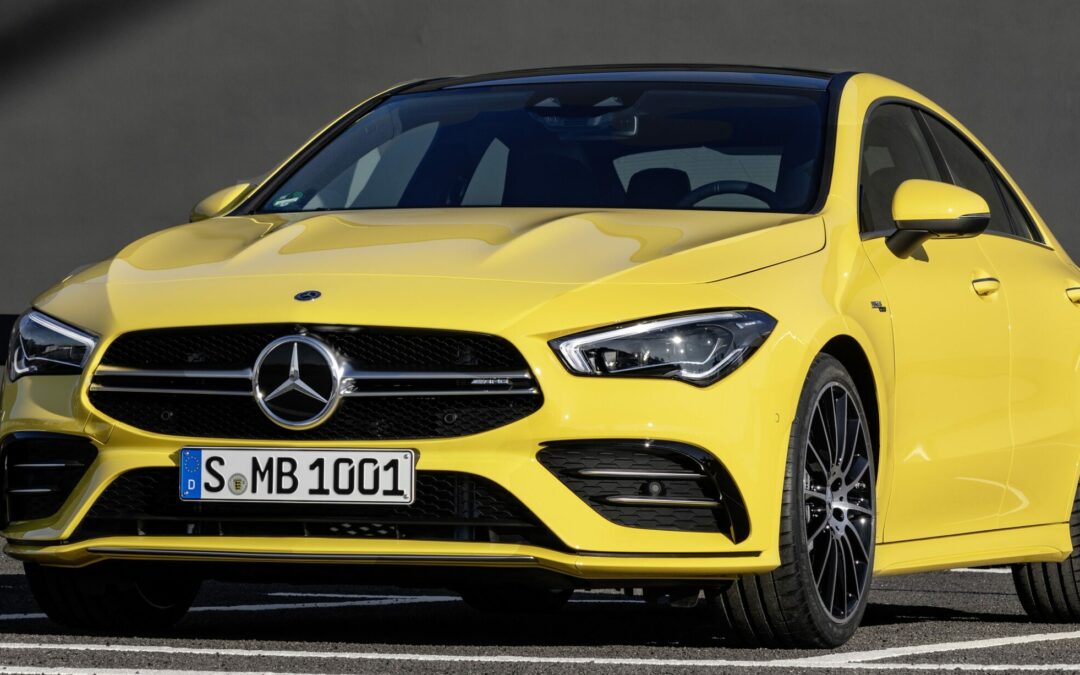
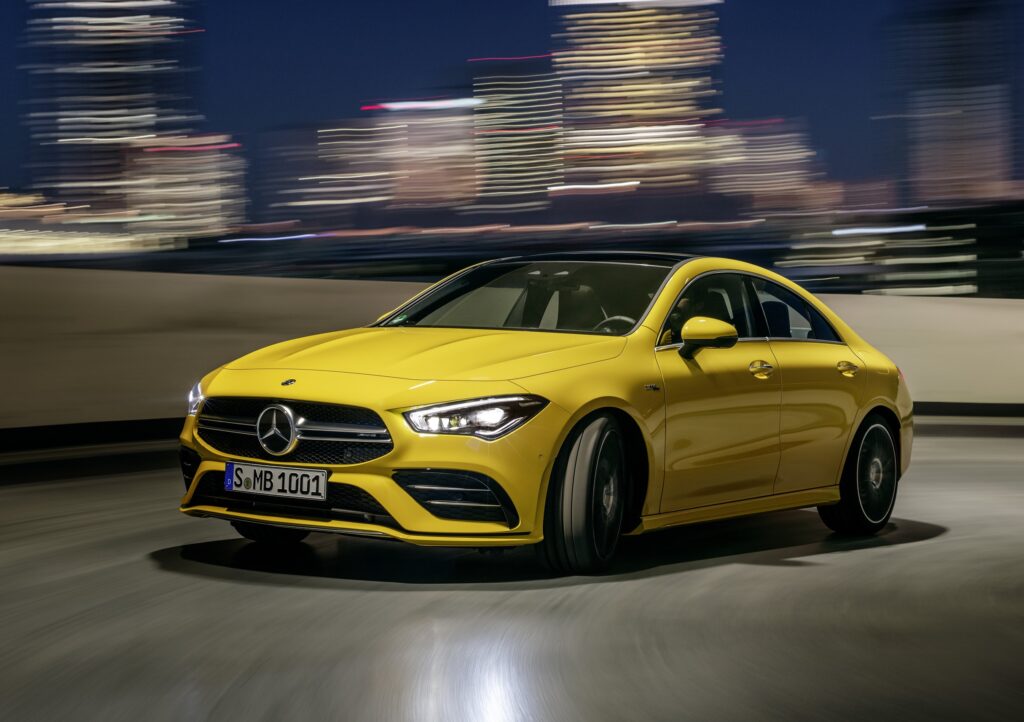
The Mercedes-AMG CLA 35 has a starting price of $47,895 for the performance-tuned 302-hp, 2.0-liter. As equipped, the Sun Yellow tester was $61,335. (Mercedes-AMG)
Strategic precision in a compact four-door “coupe”
BY MARK MAYNARD
Highland Valley Road is a tangled black shoelace of two-lane country road in northeastern San Diego County. It’s a favorite for car-club runs and leisure drives to get some fresh air. The meandering road leads past acres of growing land for landscape nurseries and pine-tree farms before ascending to an area of vineyards and wineries. Mature scrub oaks form shaded canopies along stretches amid a background of boulder-strewn mountainscapes.
The road is unforgiving of reckless driving but a strategic 13 miles or so with blind corners, decreasing radius turns and rollercoaster drops and rises. (Midday and midweek will have the lightest traffic.)
In this environment, the compact Mercedes-AMG CLA35 carves the road with surgical precision. The fortified focus of Sport and Sport-plus modes opens the pipes, tightens the shift points and lets the horses run. The 302-horsepower, AMG-enhanced turbocharged 2.0-liter four-cylinder pulls with breathy force, digging into its 295 foot-pounds of torque from 3,000-4,000 rpm.
The seven-speed AMG Speedshift transmission, a dual-clutch automated manual, clicks off sequential shifts with Formula One intensity. And the variable 4Matic all-wheel-drive system provides the push-back of rear-wheel drive and in aggressive cornering lays down a quick and consistent pull to redline. Mercedes-AMG cites 0-60 mph in an estimated 4.6 seconds — it just feels quicker. A hard launch brings a bristling response.
The driver area is centered by a widescreen layout of HD graphic displays. (Mercedes-AMG)
About the CLA
The compact-class CLA is now in its second-generation after a major update in 2019 for the 2020 model year. Launched in 2013, it was the first compact Mercedes sold in the U.S. and its first front-wheel-drive model.
Because of its arching roofline Mercedes refers to the CLA as a four-door coupe — and it feels the part with its frameless door glass and a cockpit driver area.
With seats for five, it was intended to be a segment disruptor with appeal for its sporty lines, which Mercedes-Benz says pulled many younger buyers from competitors. On average, CLA customers in the U.S. are around 10 years younger than the brand’s typical buyer, the company says.
Sizewise, the CLA slots above the subcompact A-Class, the brand’s smallest and less-expensive sedan, and below the midsize C-Class.
The redesigned CLA is 2 inches wider and almost 2 inches longer and a whisker lower on a wheelbase stretched 1.1 inches, now at 107.4 inches.
The styling is more cohesive now and smoother with a GT stance ready to pounce. The revised size is especially notable in the front seats with 38.5 inches of headroom, legroom of almost 42 inches and more shoulder room. Back-seat width is now family-class comfortable with more legroom (33.9 inches). Trunk space is down but still wide and roomy at 11.6 cubic feet. And the trunk opening was made 10.3 inches wider.
With the gear shift lever relocated as a stalk on the steering column, the center console was freed up for functional space to include a charging bin, deep cup holders and a touch pad for cabin or performance controls. (Mercedes-AMG)
Pricing
The CLA is sold as the CLA 250 in front-drive or 4Matic all-wheel drive with high-performance versions in the AMG CLA 35 (today’s tester) and the AMG 45.
All models have versions of a turbocharged 2.0-liter turbocharged four-cylinder engine and seven-speed dual-clutch automatic transmission. Pricing starts at $36,650 for the 221-hp CLA 250 or $38,650 with 4Matic AWD.
The 302-hp AMG CLA 35 starts at $46,900 and the CLA45 (382-hp and 0-60 mph in 4 seconds) at $54,800. The CLA35 tester was $61,355 with options, including the $995 freight charge from Kecskemet, Hungary.
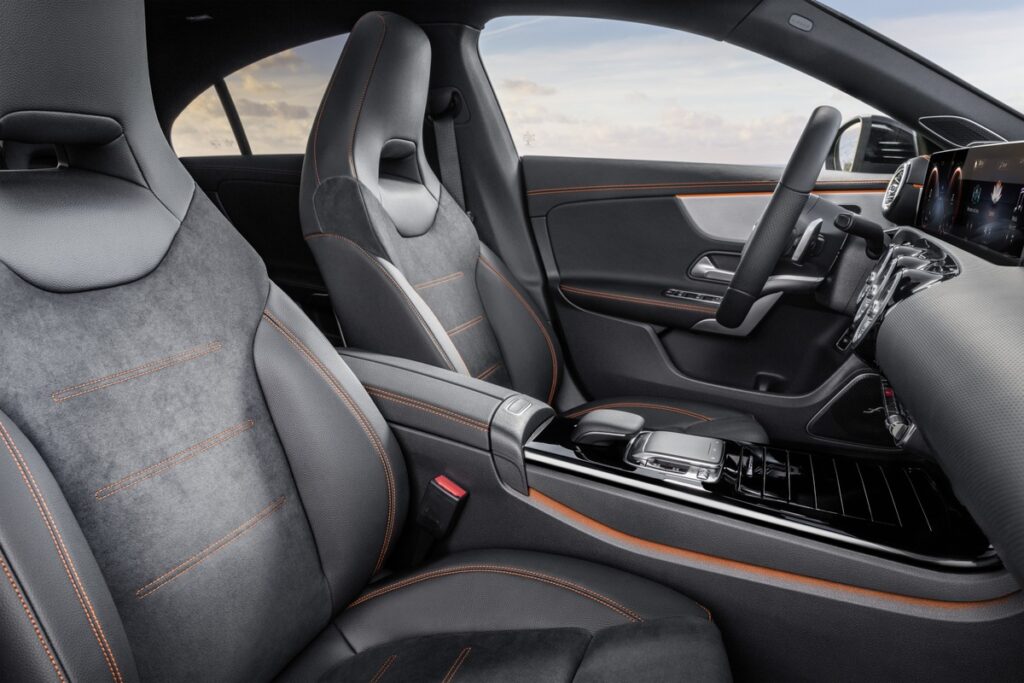
Recaro sport seats in MB-Tex and microfiber Dinamica are available in black with red contrasting stitching and red seat belts or black and digital gray in MB-Tex leatherette. (Mercedes-AMG)
Cabin features
The cabin is dressed to impress with MB-Tex leatherette and Dinamica microfiber upholstery and contemporary materials and trim. Recaro sport seats in front are power adjustable with lumbar and a manual thigh extension.
The flat-bottom, three-spoke AMG steering wheel also functions as an alternate desktop, with thumb controls for navigation, audio and phone a touch-sensitive button to scroll through various screens of information. (Mercedes-AMG)
Sightlines are open and there is enough cabin width to smartly place all controls. The functional center floor console integrates a forward e-bin for wireless or corded phone charging, a pair of deep cup holders and a touch pad to page through the various vehicle systems. It has a steady haptic touch and its use becomes relatively intuitive after a couple hundred miles into ownership. Gear engagement is by a stalk on the steering column.
The flat-bottom, three-spoke AMG steering wheel ($500) wrapped in Dinamica fits sweetly in the hand and also functions as an alternate desktop. The left arm groups cruise control and autonomous drive features. The right arm gives redundant access to navigation and phone. And both groups have a touch-sensitive thumb button to scroll through various screens of information.
Trunk entry is 10.3 inches wider now and the luggage space is large for a compact car at 11.6 cubic feet. (Mark Maynard)
Digital widescreen
The cabin is highly electrified with a widescreen-cockpit presentation to facilitate the Mercedes-Benz User Experience — MBUX. The driver faces a 10.25-inch-wide digital gauge array with a choice of configurations for a traditional layout, a supersport mode or a muted presentation. Supersport focuses the performance with a central, round rev counter and other information in graph bars to the left and right. Via the AMG menu, the driver can call up various special displays such as Warm-up, Set-up, G-Force and Engine Data.
Cabin controls are accessed by another 10.25-inch touch-screen display with voice control or even hand gestures. The “Hey Mercedes” keyword for voice control has been refined to focus on the driver and to filter out other conversations in the cabin.
There also is a tier of manual controls for often-used adjustments, such as fan speed, temp and air flow, plus a console controller for audio volume.
Cabin controls are accessed by the 10.25-inch touch-screen display with voice control or hand gestures. (Mercedes-AMG)
Drivability
AMG puts a fistful of secret sauce into that turbocharged 2.0-liter to wring out 302-hp (or the CLA 45’s 382-hp), when the base engine has a capable 221-hp.
I like that the CLA 35 experience is not all ate-up with horsepower, which can blow past the pleasures of feeling the suspension transition through cornering and how the transmission holds gears through the esses and uphills.
The structure of the car feels tight and nimble, which makes it accommodating for throttle-steering with the accelerator pedal. The roll-on of acceleration is visceral but balanced. Downshift into a corner to raise the revs and then push the nose out a bit or pull it back by subtle lifting. The refined control will make you smile.
The AMG-enhanced 2.0-liter four-cylinder has 302 horsepower that will propel the 3,505-pound CLA35 to 60 mph in 4.6 seconds. (Mercedes-AMG)
Around town, there will be a delay in forward motion as the turbo spools and the dual-clutch engages, but Sport or Sport-plus modes will cut the delay when powering up. The auto stop-start at idle function can be cancelled.
Braking, is immediate but measured for absolute control without grab or lunge. A hard response is flat and composed. The front brakes have four-piston, 13.8-inch vented rotors, backed by single piston, 13-inch vented discs rear.
Even with the bigger brake discs and AMG upgrades, the curb weight is up just 22 pounds compared with a CLA 250 4Matic. Fuel economy estimates are 23 mpg city, 29 highway and 25 mpg combined on the recommended premium fuel.
The tester was optioned with 19-inch matte black AMG wheels ($800) and Michelin Pilot Sport 4S tires (245/35) with a ZR rating. The tires are very sticky with a 300 treadwear rating and resisted squeals of complaint in my backcountry run.
The AMG Ride Control suspension, a worthy $850 upgrade, has three firmness control modes. The Comfort setting can be too firm for the non-enthusiast, but Sport and even Sport-Plus, give impressive turn-in and control.
The tester was optioned with 19-inch matte black AMG wheels ($800) and Michelin Pilot Sport 4S tires (245/35) with a ZR rating. (Mercedes-AMG)
Semi-autonomous driving
New in the redesign is the option for semi-autonomous driving. Using map and navigation data for assistance, elements of the Driver Assistance Package ($2,250) allow the CLA to steer, stop, brake and resume speed, in certain highway configurations — and with the driver’s hands on the wheel. The system functioned with precision to keep the car centered in the lane, while many systems are less precisely calibrated, which will allow the car to wander before a correction is made.
The package adds active brake assist with cross-traffic function, Active Distance Assist Distronic, active steering assist, active blind-spot assist, active lane keeping assist, active lane assist, active speed limit assist, active emergency stop assist, evasive steering assist, Pre-Safe Plus, Route Based Speed Adaptation, and extended restart in stop-and-go traffic.
Active speed limit assist is useful to automatically adapt the car’s speed to an identified speed limit. I discovered this while on the Interstate and was driving through a construction area that was to the far right in merging lanes. When I drove past the reduced speed sign of 55 mph, the cruise control immediately dropped my set speed to 55 mph from 69 mph. And we all know that speeding fines are increased in construction zones.
New in the redesign is the option for semi-autonomous driving using map and navigation data for assistance that allow the CLA to steer, stop, brake and resume speed, in certain highway configurations. (Mercedes-Benz)
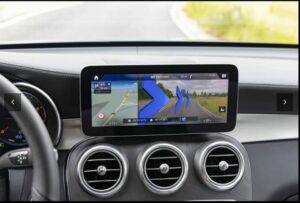
Augmented Video/Reality for Navigation is a hand-holder to guide the way, with blue arrows pointing to the destination. (Mercedes-Benz)
The effect of Route Based Speed Adaptation is the eye in the sky of GPS and the adaptive cruise control system. The system uses map data ahead to reduce speed in anticipation of curves, junctions, roundabouts, toll booths, exit roads, etc.
And for the directionally challenged — even when using a navigation system — the Augmented Video/Reality for Navigation feature is a hand-holder to guide the way. When using the navigation system, a camera in front of the rearview mirror captures a video image of the surroundings and displays arrows or house numbers onto the image in the media display screen. The helpful blue arrows point the way to a street or house number, traffic signs or street names.
And when stopped at a traffic signal, the system uses the front camera to display live video of the intersection on the center screen. It helps the driver see if anyone or anything is in the crosswalk.
Standard safety features include eight air bags, hill-start assist and brake-hold function, crosswind assist and attention assist, for driver awareness.
Why CLA35?
The CLA 35 can be as hands-on or as hands-off as the driver desires. Hands-on was my preferred mode — and none of the assist systems got in the way of a good time.
But if $60K as-tested is too rich for the budget, the same powertrain option and engineering are also available in the subcompact AMG A 35 sedan, starting at about $45,000, and it has access to all the options and upgrades of the CLA 35.
Because of its arching roofline Mercedes refers to the CLA as a four-door coupe — and it feels the part with its frameless door glass and a cockpit driver area. (Mercedes-AMG)
2020 Mercedes-AMG CLA 35 4Matic Body style: compact, five-seat, four-door coupe with variable torque AWD Engine: 302-hp, AMG-enhanced turbocharged 2.0-liter 4-cylinder with cancellable auto stop-start at idle; 295 lb.-ft. torque from 3,000-4,000 rpm Transmission: 7 speed AMG Speedshift dual-clutch automated manual 0-60 mph: 4.8 seconds, estimated Fuel economy: 23/29/25 mpg city/hwy/combined; premium fuel
SPECIFICATIONS Fuel tank: 13.5 gal. Trunk space: 11.6 cu. ft. Front head/leg room: 38.5/41.8 in. Rear head/leg room: 35.7/33.9 in. Length/wheelbase: 184.8/107.4 in. Curb weight: 3,505 lbs. Turning circle: 37 ft., estimated
FEATURES Standard equipment includes: Keyless Go locking with push-button ignition, panoramic sunroof, M-B Tex leatherette upholstery, electric parking brake, rearview camera, 10.25-inch touch-screen display, 10.25-inch digital gauge array, power front seats with lumbar and memory presets, Apple CarPlay or Android Auto Bluetooth connectivity, 40/20/40 folding back seat, LED headlights and taillights AMG 35 special features, include: Speedshift 7-Speed (dual clutch transmission with performance 4MATIC AWD, sport suspension, sport exhaust, 3-stage electronic stability program, Recaro sport seats with integrated headrests and metal-trimmed pedals
Safety features, include: 8 air bags, active brake assist, adaptive braking with hill-start assist and brake-hold function, crosswind assist, attention assist (for driver awareness)
CLA 35 competitors: Audi S3, BMW M240i xDrive; front-drive CLA models compare to the BMW 2-series and Acura ILX
PRICING Base price: $47,895, including $995 freight charge; price as tested $61,335 Options on test vehicle, included: AMG performance steering wheel in Nappa leather and Dinamica $500; 19-inch AMG matte black alloy wheels $800; Parktronic with advanced parking assist $970; AMG ride control sport suspension $850; satellite radio trial subscription $460; Burmester surround-sound audio $850; wireless charging $200; rear side air bags $420 (with a one-time $250 special order fee);
• Driver assistance package, $2,250, includes active brake assist with cross-traffic function, active distance assist Distronic, active steering assist, active blind-spot assist, active lane keeping assist, active lane assist, active speed limit assist, active emergency stop assist, evasive steering assist, Pre-Safe Plus, route based speed adaptation, extended restart in stop-and-go traffic;
• Multimedia package, $1,150, includes navigation and services, including map updates for 3 years, MBUX augmented reality for navigation and speed-limit assist;
• AMG Night package, $750, includes front splitter, grille trim and louvres in outer air intakes, AMG side panel inserts, beltline and window line trim strips in gloss black, black side mirrors and tailpipe trim;
• Performance seat package, $3,270, includes multicontour, heated Recaro seats
Where assembled: Kecskemet, Hungary Warranty: 4-years/50,000-miles bumper to bumper with roadside assistance



 Bentley is offering what it calls a ground-breaking three-dimensional wood trim for the rear door panels in the all-new Flying Spur grand-touring sedan