Select Page

8 Generations of the Golf GTI

8 Generations of the Golf GTI
A graphic sketch timeline of the eight generations of the VW GTI

(All photos courtesy VWoA)

BY MARK MAYNARD

Volkswagen didn’t know it at the time, but when it debuted the first Golf GTI in 1976 it was like tossing a lighted match to gasoline — the hot-hatch segment of sporty front-wheel-drive compact cars was born.

TV advertising taunted performance enthusiasts with the German-tinged tune of “Little GTI,” their remake of the iconic “Little GTO,” by Ronnie and the Daytona’s. And with the “Fly GTI” ad campaign, an image was seared into American consciousness that fun cars did exist in the age of increased emissions standards and rising fuel prices.

The Golf GTI — now in its eighth generation — created a worldwide, cult following. Originally, 5,000 units had been planned, but sales of the Golf GTI Mk1 totaled 461,690 units.

Though Volkswagen ended Golf production for the U.S. this year, it will preserve the GTI fan club. The Golf family name will carry on in model year 2022 with the introduction of the all-new Mk 8 Golf GTI and Golf R, arriving this Fall.

In tribute to its survival, VWoA released today for #TBT this visual DNA of the GTI and how the car has developed over the past half century. Commentary is provided by Marco Pavone, head of exterior design for the new Golf GTI.

Golf GTI Mk 1

The first generation VW Golf GTI

An everyday talent with a dash of “brutishness” – all signs of the revolutionary design concept of the first Golf GTI.

The original GTI hit the scene in Europe in 1976, full of confidence, sporting a front grille with a red border and a simple design. The inside of the black radiator grille on the original GTI features 11 thin horizontal lines. The headlights, protruding from under the hood of the lightweight compact car, form the external end points. The early GTI can be identified by the narrow bumper that was replaced by broader, plastic-covered bumpers in 1978. The first GTI emblem is chrome and intentionally presents a stark contrast with the black Volkswagen logo. “Even with the original GTI, all the design elements already reflect a clear attitude,” says Pavone.

Golf GTI Mk 2

The Golf GTI Mk 2

The second generation of Golf GTI has a more aggressive look: the side, in particular, gives it a more “broad-shouldered” appearance.

“The design of the second-generation Golf GTI is a fascinating development,” says Pavone. Initially sporting twin headlights, like its predecessor, the 16-valve version of the second-generation GTI came with integrated fog lights from 1988 — each located next to the headlights. The grille is still outlined in red, while the bumper itself also features a red GTI line. Under this, for the first time, comes an additional air intake. On the whole, the design continues the conceptual course of the first generation: it is larger, wider and more comfortable. The Volkswagen logo remains black.

Golf GTI Mk 3

The third generation Golf GTI Mk 3

The improved comfort is clear to see from the third GTI. For the first time, the front spoiler and radiator grille are the same color as the car.

The third GTI is somewhat softer and has even more of a wedge shape. “This backs up the sporty character of the Golf GTI,” Pavone says. The front features a striking modification: the double headlamps of the second-generation GTI disappear under a combined diffuser lens, replaced by a collective diffuser. They give the radiator grille, which now consists of just three thick horizontal bars, a narrower appearance. The front spoiler is finished in the same color as the car, and is once again lowered and broader. This lower area also features a split air intake, which becomes a typical feature of generations 4 through 6. Another new feature is the striking red line below the halogen lighting unit, while the GTI emblem, now in red, is moved closer toward the chrome Volkswagen logo, which is now in chrome.

Golf GTI Mk 4

The Golf 4 GTI set new benchmarks in terms of individuality

The Golf 4 GTI set new benchmarks in terms of individuality, quality and speed, says design chief Marco Pavone.

“Launched in 1998, the Golf 4 GTI has a more modest appearance. For example, it is the first and only GTI not to sport the red stripe on the radiator grille. And yet the model is celebrated to this day as the starting point for a new, clean era of vehicle design. It also set new benchmarks in terms of individuality, quality and speed,” says Pavone. From the designer’s perspective, the European 25th-anniversary edition was particularly striking. “It was thanks to that model that I was bitten by the GTI bug,” says Pavone, who was born in Brazil. “The brilliant clear-glass headlights and wide sills were particularly distinctive!”

However, even in the production GTI, the lighting units (including the turn signals and fog lights) were installed in a compact module. The front and rear aprons, side sills and roof-edge spoilers were painted the same color as the car itself, while many elements were once again broader than those of its predecessor. The GTI logo shifted from the right to the left for the first time.

Golf GTI Mk 5

Generation 5 of the VW GTI

GTI No. 5 saw the iconic honeycomb pattern introduced to the sports compact from Wolfsburg for the first time.

“The design of the fifth-generation GTI is once again far more self-contained and takes inspiration from the first GTI,” says Pavone, describing the development. This is particularly clear from the red trim around the radiator grille. One new and emotional style element is the honeycomb design of the grille: Pavone says, “Even today, it is still hard to imagine a GTI without it!”

The round twin headlights are back, grouped in a unit behind dark glass. Just like its ancestor, the fog lights are located low down in the front apron.

Golf GTI Mk 6

The Mk 6

A throwback to the original GTI, directed by two parallel red GTI lines, sharper edges and new, black fins in the front apron.

The sixth generation of the Golf GTI transported the tradition of the original version into the future. Two fine red trim lines run across the grille and link the bi-xenon headlamps. The spoiler is now adorned with striking air intakes with three sharp fins on each side. The vertical fog lights are also located low. The spoiler takes up the central alignment of its predecessor, but broadens it. A splitter is also installed for the first time. “That gives the Golf 6 GTI the most powerful, modern and angular appearance to date,” says Pavone.

Golf GTI Mk 7

The seventh generation had full-LED headlights.

For the first time, the GTI trim runs into full-LED headlights.

“This was the first GTI on which I was allowed to let my creative juices flow as a designer,” says Pavone. “For me, it remains the very best, with an iconic quality — no GTI had ever been as stylish.”

The continuous red GTI trim on the seventh generation runs confidently into the slim, full-LED headlights. The hood arches right down to the grille, while sharp lines run from the headlights up to the A pillar. One particularly characteristic element is the daytime running light with its “Wings” design, which also features the red GTI trim. The broader side sills emphasize the fact that this ‘power’ Golf is a dynamic beast. However, the front spoiler, with its typical GTI honeycomb pattern, also impresses with wider bumpers extending further outwards.

Golf GTI Mk 8

The MK8 mug illustration

The  MK8 uses the honeycomb pattern to hide the optional fog lights, in an X formation, for the first time.

The deep-set headlights are enough to set the eighth-generation GTI apart and reinforce that light is the new chrome. “This Golf GTI has become an icon of the modern era and bears the unmistakable design DNA of its predecessors. However, it embodies these attributes in a more progressive and digital manner than ever before, with a particularly powerful and dynamic stance,” says Pavone. Immediately below the hood, we find the familiar red GTI trim. While the predecessor’s bumper was divided by fins, the honeycomb design is now completely open. Located to the left and right are the new GTI wings, which charismatically integrate the optional LED fog lights in an X shaped and create a completely new impression.

2022 Volkswagen Golf R

The 2022 Volkswagen Golf R on snow

When it goes on sale late this year, the all-new 2022 Volkswagen Golf R will be the most powerful Golf R to date — 315 hp, 310 lb.-ft. torque and a new 4Motion all-wheel-drive system with rear-axle torque vectoring. (VWoA)

A rear view of the 2022 Golf R

Mark Maynard

International Volkswagen Bus Day June 2

International Volkswagen Bus Day June 2
A 1960s VW camper van along the Pacific ocean

The first-generation Microbus was budget-friendly and built for sightseeing adventures. The 23-window bus was designed as a vehicle to tour the Swiss Alps, with seats for up to nine passengers. The van’s features include eight skylights, two curved rear windows, a retractable skylight, and a split windshield. (Photos courtesy of Volkswagen of America)

BY MARK MAYNARD

On June 2nd, 2023, Volkswagen—with The National Day Calendar—will celebrate the inaugural International Volkswagen Bus Day. Paying homage to a global automotive icon, the celebration takes fans of the Type 2 VW Bus for a ride into the future with the debut of the three-row version of Volkswagen’s all-electric ID Buzz in Huntington Beach, Calif.

This global reveal will include new product showcases, live entertainment, and streamed programming, plus a “Cars & Coffee” style gathering for classic Volkswagen Bus owners. Adding the International Volkswagen Bus Day designation commemorates a major milestone in the brand’s journey to electrification and creates a day for worldwide VW Bus and ID Buzz fans to celebrate for years to come.

The VW ID Buzz European model

The ID Buzz is on sale in Europe in two-row and cargo-vehicle configurations.

North American ID Buzz On Sale 2024 

The ID Buzz will be the latest addition to Volkswagen of America’s growing fleet of all-electric vehicles. Already available in Europe in two-row and cargo-vehicle configurations, the three-row model is planned for sale in the North American market starting in 2024.

The zero-tailpipe emission ID Buzz transfers the design of one of the greatest automobile icons—the Microbus—to the era of electric mobility. Its short overhangs, spacious interior and available two-tone color palette pay homage to the past, while the high-tech interior, progressive design features, and EV technology marks it clearly as a vehicle of the future.

“Whether you call them Buses, Bullis, or Kombis, the legacy Type 2s have left on modern culture is unmatched,” Cameron Batten, Chief Communications Officer, Volkswagen Group of America, said in a release. “As we continue to introduce the T2’s 21st Century electric successor, the ID Buzz, we’re thrilled to create this annual day of celebration for Volkswagen bus fans and enthusiasts everywhere.”

A 1960s 23 window vw bus

The first-generation “Microbus” was built from 1951-1967. A Type 2 camper van is shown.

National Day Calendar 

The National Day Calendar is the original source for fun, unusual and unique National and International Days. Since its beginnings on National Popcorn Day in 2013, the organization has been dedicated to the official creation and tracking of National Days, National Weeks, National Months, and International Days.

“National Day Calendar is honored to announce International Volkswagen Bus Day will be celebrated each June 2nd,” Amy Monette, CEO, National Day Calendar, said in a release.

“Life is about celebrating moments and milestones and we are happy to have another reason to celebrate every day,” Monette said. “We can’t wait to see the #VWBusDay celebrations worldwide.”

Volkswagen brand fans and enthusiasts seeking more information on the Huntington Beach celebration of International Volkswagen Bus Day can learn more here.  Live broadcast coverage will begin at 11 a.m. EST on RadioWoodstock.com and on YouTube.

Volkswagen Arteon 2.0T Review

Volkswagen Arteon 2.0T Review

The 2023 Volkswagen Arteon is a diabolically understated driver’s car

A front-corner view of the blue Arteon

The 2023 VW Arteon, in front- or all-wheel drive, has starting prices of $43,825 to $50,990. (Photos courtesy of Volkswagen America)

Table of Contents

Overview
2023 Updates
Pricing
Safety Features
Ride and Handling
Performance
Interior Function
7 Cool Features
Back Seats and Cargo Space
Why Buy the VW Arteon?
Specifications

BY MARK MAYNARD

The Volkswagen Arteon is a sleek and sophisticated grand tourer with a complete array of advanced safety and driver assistance technologies. But this large-midsize sedan travels below the radar of most motorists and, consequently, will be discontinued in the U.S. in 2024.

According to Automotive News, VW’s top-line internal combustion-powered sedan will be replaced by the ID Aero, a battery-electric sedan. ID Aero sales are expected to commence in China during the second half of 2023, followed by a version for Europe. There has been no confirmation yet on the ID Aero for North America, but surely there will be one. Volkswagen is in the process of electrifying its entire vehicle lineup.

The front seat area

The R-Line front sport seats are eight-way adjustable with long thigh support.

Volkswagen Arteon Overview

Arteon arrived in the U.S. from Germany in the spring of 2019 as the replacement for the CC sport sedan. Its sales have been modest for the VW brand, averaging 2,500 to 5,500 yearly, but sales drove off a cliff in 2022. Just 941 Arteon models have been sold as of third-quarter reporting, per Volkswagen.

It is not because the Arteon is a bad car. It’s actually a very well-done car, and diabolically understated as a driver’s car. It is wide but not too low for open sightlines and simple entry and exit. The direct-shift gearbox hooks up quickly from a start and rolls aggressively up to speed. And there is expansive cargo space.

Despite its rewarding performance, the Arteon is simply overlooked in favor of SUVs and SUV crossovers. (VW has four SUV models, plus the battery-electric ID 4 sedan and upcoming ID Buzz microvan.) For the value shopper, the VW Arteon is a pricey commitment, no matter how enjoyable it is to drive.
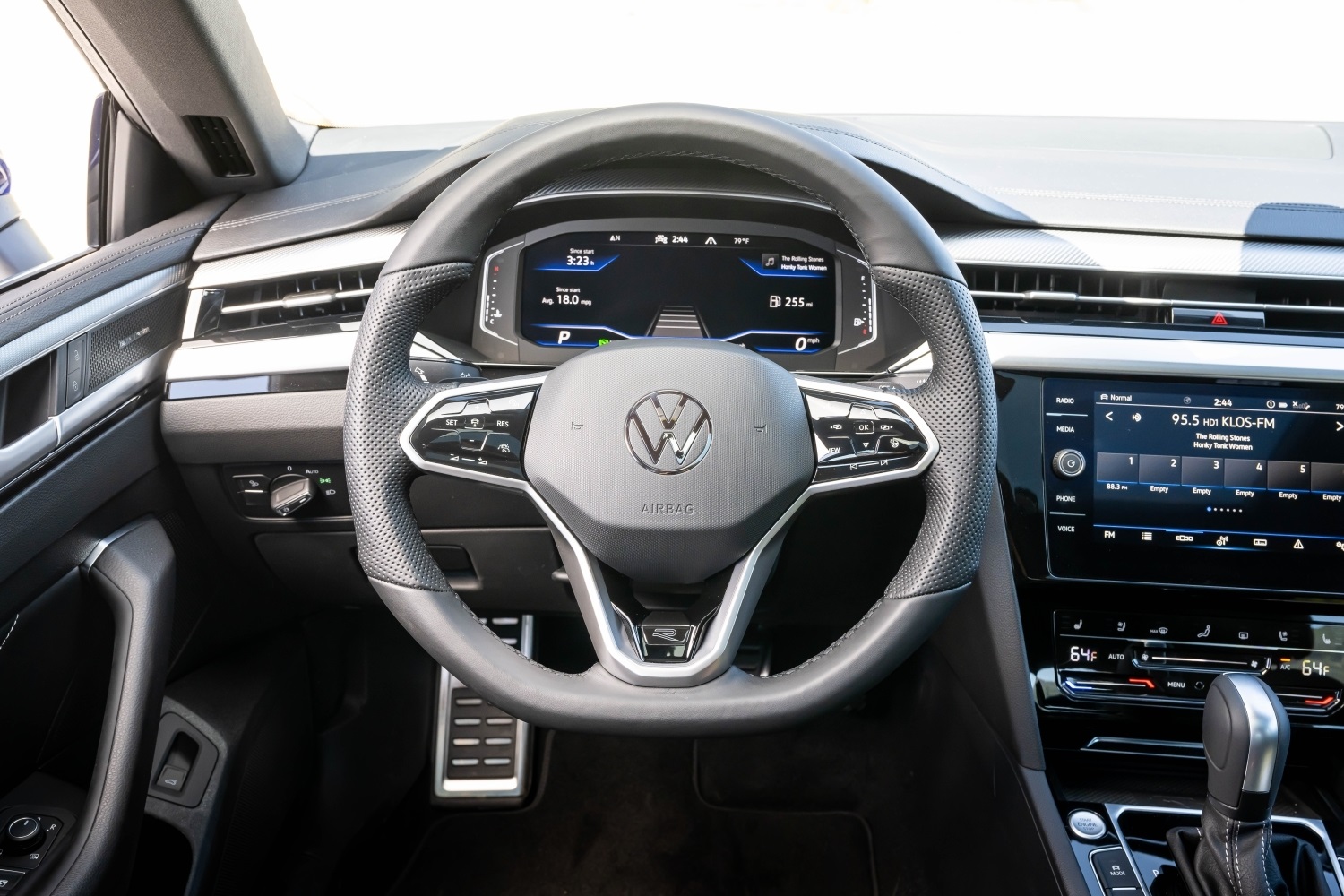
The 3-spoke steering wheel

The three-spoke, heated steering wheel fits firmly in hand.

Out With the ICE, In With the EV

Throughout the car industry, slow-selling cars are being replaced, mostly, by fully electric or electrified models. Would more advertising have helped save the Arteon? Or a more understandable name? “Arteon” is from the Latin word “artem,” meaning art.

The Volkswagen Arteon has just a few competitors in size and content, including the Kia Stinger, Nissan Maxima, and Toyota Avalon. And these well-done cars are facing the same fate as the Arteon.

It is expected that Kia will cease production of the Stinger — a critically acclaimed liftback sport sedan — in late 2023. Sales will continue into 2024, and it will undoubtedly be replaced by an electrified model.

The Maxima is caught in the same dejected state. Nissan will end production for its long-running Maxima nameplate in 2023. And like Volkswagen, Nissan will fill the slot with an electric vehicle inspired by the IMs “elevated sports sedan” concept in 2023, per Automotive News. The same goes for the Toyota Avalon, which is being phased out and will be replaced by the 2023 Crown sedan, a hybrid.

The 8-inch infotainment screen

Access to controls is smartly arranged with an easy-to-use 8-inch touch screen.

2023 Volkswagen Arteon Updates

In its three years on the market, Volkswagen has made dutiful improvements every year. Last year, VW repackaged the Arteon powertrain with a 300-horsepower, turbocharged and direct-injected 2.0-liter four-cylinder engine and seven-speed dual-clutch automated manual transmission. It is the same EA888 2.0-liter engine used in the Mk8 Golf R. The new powertrain replaces a 268-hp, turbocharged and direct-injection 2.0-liter with an eight-speed stepped automatic transmission.

And for the 2023 model year, Volkswagen added more standard content for the entry-level SE R-Line and a few cosmetic changes for higher trim levels. The lineup also was restructured to three trim levels, continuing with a choice of front- or 4Motion all-wheel drive.

Newly standard exterior features include adaptive LED headlights, cornering lights, and front fog lights. The grille now has an illuminated light bar, and the liftgate has an easy open-and-close power function. On SEL R-Line models, 20-inch wheels replace the previous year’s 19-inch wheels.

Inside is a new heated steering wheel, Dynamic Road Sign Display in the digital gauge array, and IQ.Drive driver-assistance technologies. SEL and SEL Premium R-Line models add Black Carbon trim with 30-color ambient lighting.

The wireless charging pad

Slim hands are required to get into the wireless charging pad.

2023 VW Arteon Pricing

Arteon is sold in three trim levels in front- or all-wheel drive with a 300-hp, 2.0-liter turbocharged engine and seven-speed automated-manual direct-shift transmission.

Starting prices for each trim level are $43,825 SE, $48,390 SE R-Line, and $50,990 for the SEL R-Line with 4Motion all-wheel drive. Pricing includes the $1,295 freight charge from Emden, Germany. No-cost interior colors are Titan Black or Stone and Raven.

The SEL R-Line tester with one option for metallic paint ($395 for Kingfisher Blue or King’s Red) was $51,385.

An interesting option is the LED Dynamic Turn Signals, $265, for a set of two. An amber lighting line on the exterior mirror body moves sequentially to the outside of the mirror housing.

The lengthy list of standard features is detailed in the specs box at the end of this story. But Arteon’s overachieving features support its $50K pricing without regrets.

Find current Arteon pricing here.

As of this posting, there are two 2023 $500 pricing offers for college graduates and military, veterans, and first responders. The offers are good for purchase or lease. Get the details here.

The Arteon engine bay

The 300-hp EA888 evo4 engine produces 295 lb.-ft. of peak torque at a low 2,000 rpm.

Warranties and Maintenance

Volkswagen supports the Arteon and every vehicle in its lineup with a bumper-to-bumper warranty and Carefree Maintenance Program. The warranty is for four years or 50,000 miles and can be transferred to a subsequent owner.

The maintenance program provides scheduled maintenance for two years or 20,000 miles. And this coverage, too, can be transferred to a subsequent owner throughout the remainder of the warranty.

VW Arteon Safety Features

The 2022 Arteon was named a 2022 Top Safety Pick by the Insurance Institute for Highway Safety. It is a specific award to Arteon models equipped with LED headlights and adaptive front lighting. It was a three-peat annual award for Arteon.

Standard safety features include six air bags, electronic brake-pressure distribution and hydraulic brake assist, electronic stability control, anti-slip regulation, electronic differential lock, and engine brake assist.

Driver-assist technologies include:

  • Travel Assist (Level 2 semiautonomous driving) and emergency assist;
  • Blind-spot monitor;
  • Forward collision warning and autonomous emergency braking;
  • Pedestrian monitoring;
  • Lane assist;
  • Park assist with park distance control front and rear.

The Travel Assist function works through the adaptive cruise control and has stop-and-go capability. The system’s lane-centering is consistent, particularly in freeway curves, when many other systems allow the vehicle to drift wide across the white lines.

The 20-inch tire and wheel package

The 20-inch wheel and tire package.

Arteon 4Motion Ride and Handling

It is easy to maintain car control with the deliciously engaging German engineering for steering input, throttle uptake, and braking engagement. The steel-spring suspension (front struts and rear multilink) is reinforced by telescopic dampers and an anti-roll bar, front and rear.

The chassis feels extremely rigid and secure. The ride quality is compliant but firm without jolt (or chin scraping) over lumpy intersections. Even the 20-inch Continental ProContact all-season tires (245/35) added to a smooth ride with little road noise. The tires on the test car were inflated to 42 psi. Typically that hard of a tire inflation would create harsh-riding black checkers. But the Continentals showed no harshness or noise. Four-wheel vented disc brakes have 13.4-inch front rotors and 12.2-inch rotors at the rear.

The sturdy gear shift handle in the shift console

Sturdy action for the seven-speed direct-shift gearbox.

Arteon 4Motion Performance

In Arteon specification, the EA888 evo4 engine displaces 1984cc, producing 300 horsepower (using the required premium fuel) at 5,350 rpm. The 295 foot-pounds of torque peaks at a low 2,000 rpm, and there is little turbo or DSG delay in laying down power. It gives some of the most unfettered performance I’ve experienced from a turbocharged four-cylinder and DSG.

Drive modes of Eco, Comfort, Normal, Sport and Custom allow personalization to the driver’s style. Sport mode adds potent acceleration and upshifts. According to ZeroTo60times.com, the Arteon SEL Premium R-Line 4Motion can get to 60 mph in 5 seconds.

Front-wheel-drive Arteon models have an EPA-estimated fuel economy rating of 25 mpg in city driving, 33 mpg on the highway, and 28 mpg combined. Models with 4Motion all-wheel drive have ratings of 22/31/25 mpg. All models have a 17.4-gallon fuel tank, which was downsized from 18.3 gallons last year.

I spent most of a 200-mile test week in Eco plus Sport or Normal plus Sport. My fuel economy around town was in the 20 mpgs, and I worked up to 31.3 mpg on highway cruising, which might have gone higher if I hadn’t reached my exit.

4Motion All-Wheel-Drive

The latest generation of Volkswagen’s 4Motion system is standard on the SEL and SEL Premium trim levels. The system will activate before wheelspin occurs. When driven under a relatively low load or coasting, the front wheels are driven and the rear wheels are decoupled to help save fuel. However, the rear wheels will engage in a millisecond whenever necessary via the center differential.

The XDS cross-differential lock functions as a limited-slip differential and helps to compensate for understeer (front-end push) during cornering. In low traction situations, the system can briefly brake a slipping wheel to transfer drive power to the opposite wheel.

Interior Function

The R-Line cabin has a sporty coupe-like presence with a contemporary design and horizontal lines to accentuate width. The hefty girth of the three-spoke steering wheel fits firmly in hand with grips in the right places.

Front headroom of 37.9 inches (with the sunroof) and the seating position should accommodate taller drivers (up to at least 6-foot-5 inches in my test). The R-Line front sport seats are firmly supportive with long thigh support. But the seats also have serious side and cushion bolsters for those drivers who push the cornering limits. As a grand tourer, however, I’d have the side bolsters cut down to reduce the friction and wear as butts slide over the ridge.

Sightlines are clear at the side mirrors and down the hood, but the smallish back glass and sloped sides can be an issue. When parking, the wide-screen rearview camera with guidance lines is the great equalizer.

Ergonomics and access to controls are smartly arranged with an easy-to-use 8-inch touch screen. As VW has stepped up to add more charging USBs, its wireless charging pad is a struggle to use. It occupies a shallow tray just ahead of the gearshift lever, and it requires slender fingers to slip in a phone or pull it out, but it beats the tangle of a charging cord.

The 12.3-inch-wide digital gauge display (trickle down from Audi) is helpful for its selectable elements, such as the navigation map as background or to highlight a digital speed readout or gear position.

Small storage areas include large door panels with space for bottles.

The Arteon back seat

Back seat legroom of 40.2 inches is grand-touring comfortable.

7 Cool Arteon Features

The Volkswagen Arteon appears to have had a generous budget to support its entry-lux price. Some of the assets I appreciated are:

  • Both front seats are fully power-adjustable. Some makers cheap out on the front passenger seat and give half as many power adjustments;
  • Door lock sensors are in all four doors, not just the front doors, as are done by many other makers;
  • Heated steering wheel;
  • Ventilated front seats, not just heated seats;
  • Frameless side glass for that sport-coupe appearance. And the driver can enjoy driving with the window down and not being cruelly buffeted;
  • Sliding front center armrest top, which helps drivers of all sizes get comfortable;
  • Front and overhead camera views, not just a rear view.

Back Seat and Cargo Space

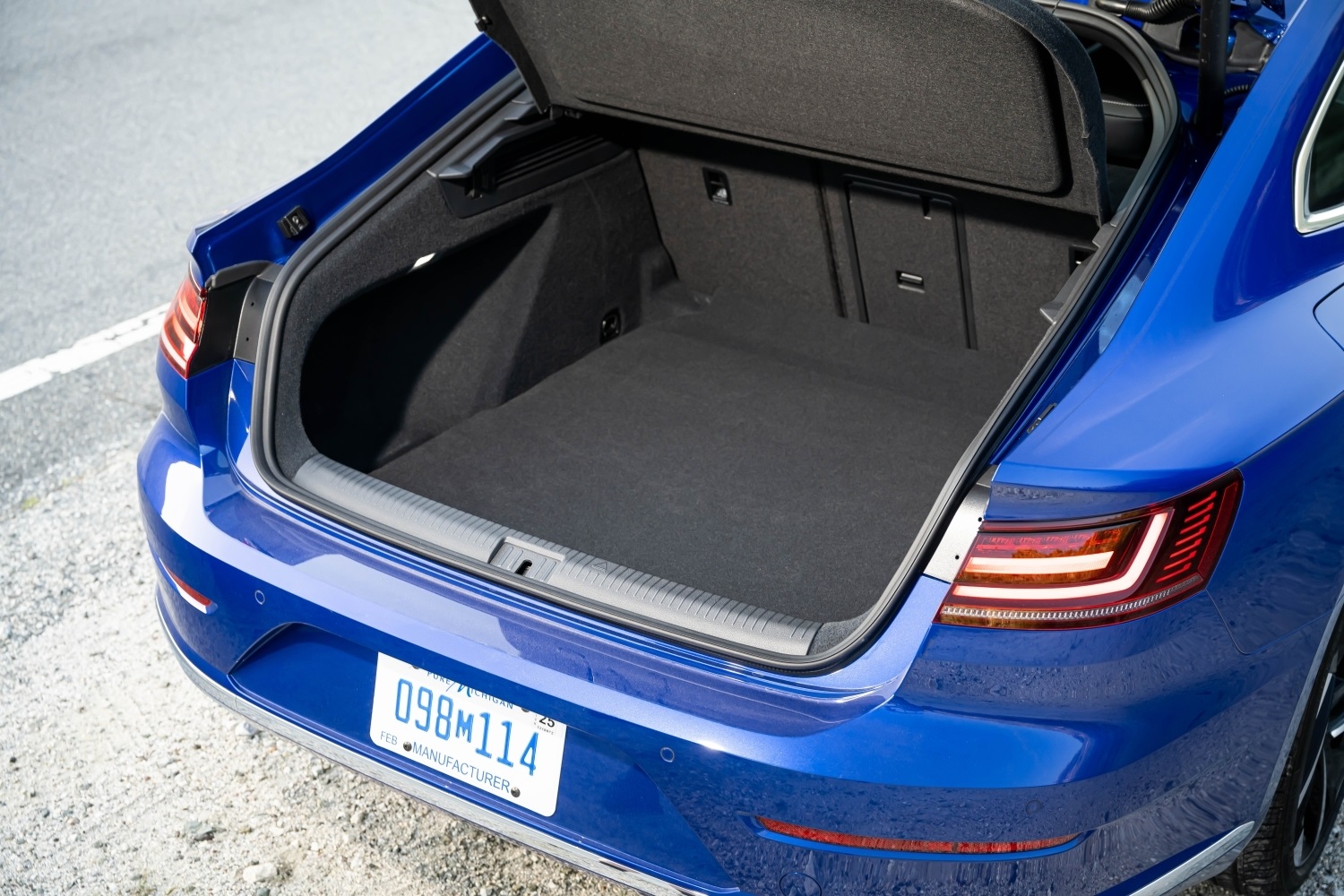
Access to the back seat is a bend-and-drop sequence, but legroom is grand-touring comfortable at 40.2 inches — and the window seats have adult thigh support. The tall but narrow transmission tunnel helps center-seat legroom, but the window seats are far more comfortable.

There is a fold-down armrest and ski pass-through to the cargo area, which is wide and deep. Fold the seatback for about 6 ½ feet in length.
The open cargo area

Fold the seatback for about 6 ½ feet in length.

Why Buy the Volkswagen Arteon?

I strongly dislike using the overused words “premium” or “elevated” unless referring to ice cream, gasoline, or an out-of-the-way diner. However, the Arteon fits both of those descriptors.

As a sedan, it is a step up from a family car and a step below the luxury class.

While an SUV is an appliance valued for its view from the inside outward, the Arteon has a sophisticated presence, seen from the outside in.

The purposeful and balanced German engineering is the unspoken asset of the Arteon. It is a soaring grand tourer, built for 100 mph continental cruising and arriving at your destination with unrumpled style.

Owners will enjoy for the long term its cabin size, power, and nimble footprint.

A review of the Arteon moving along a country road

The Volkswagen Arteon is a soaring grand tourer, built for 100 mph continental cruising.

2023 VW Arteon 2.0T SEL Premium R-Line Specifications

Body style: large-midsize, 5-seat liftback sedan with 4Motion all-wheel drive

Engine: 300-hp turbocharged and intercooled 2.0-liter 4-cylinder with auto stop-start at idle; 295 lb.-ft. torque at 2,000 rpm

Transmission: 7-speed direct-shift automatic transmission with performance modes of Eco,

4Motion Fuel economy: 22/30/25 mpg city/hwy/combined; premium fuel recommended

0-60 mph acceleration: 5.0 seconds

BY THE NUMBERS

Fuel tank: 17.4 gallons

Cargo space: 27.2-56.2 cubic feet

Front head/leg room: 37.7/41.2 inches

Rear head/leg room: 37/40.2 inches

Shoulder room f/r: 56.5/54.7 inches

Length/wheelbase: 191.5/111.9 inches

Curb weight: 3,929 pounds

Turning circle: 39 feet

FEATURES

SEL Premium standard equipment includes:

Exterior: 20-inch alloy wheels with 245/35 all-season tires, adaptive (turning) headlights with cornering lights, LED headlights-taillights-daytime running lights, hands-free remote power rear hatch, fog lights, power folding, heated, power adjustable side mirrors with position memory and passenger-side auto-tilt function, power tilting and sliding panoramic sunroof, and R-Line front bumper and badging.

Interior: Keyless access locking with push-button ignition, rearview camera with overhead view), electronic parking brake with auto-hold function, Volkswagen Digital Cockpit Pro with 10.25-inch configurable instrument display, wireless charging pad, 60/40 split-folding back seat with armrest and center pass-through, auto-dimming rearview mirror, three-zone automatic climate control with air filter, comfort sport seats with power lumbar and driver seat massage function, heated seats front and rear, ventilated front seats, leather-trimmed upholstery and leather-wrapped multi-function (heated) sports steering wheel with touch control and shifting paddles, multi-color adjustable ambient lighting, stainless steel pedal caps, Titan Black headliner, remote engine start, Harman Kardon audio system with center speaker and subwoofer, satellite radio with 3-month subscription, headlight high-beam control, two front USB-C data ports and one rear USB- C charging port, 8-inch touchscreen navigation, adaptive cruise control, App-Connect smartphone integration via wireless & USB, myVW connected vehicle services from Car-Net.

Safety features include: Six air bags, electronic brake-pressure distribution and hydraulic brake assist, electronic stability control, anti-slip regulation, electronic differential lock, and engine brake assist, blind-spot monitor.

Driver-assist technologies include: Travel Assist and emergency assist, dynamic road sign display, forward collision warning and autonomous emergency braking, lane (steering) assist, park assist with park distance control front and rear, and pedestrian monitoring.

PRICING

SEL Premium R-Line base price: $50,990, including $1,295 freight charge; price as tested $51,385

Options on test car: metallic paint $395

Where assembled: Emden, Germany

Warranties: 4-years/50,000-miles bumper to bumper including powertrain; 2-years/20,000-miles free scheduled maintenance; 3-years/36,000-miles roadside assistance

2023 VW Golf R Review

2023 VW Golf R Review

R is for speed in the 2023 VW Golf R five-door hatchback

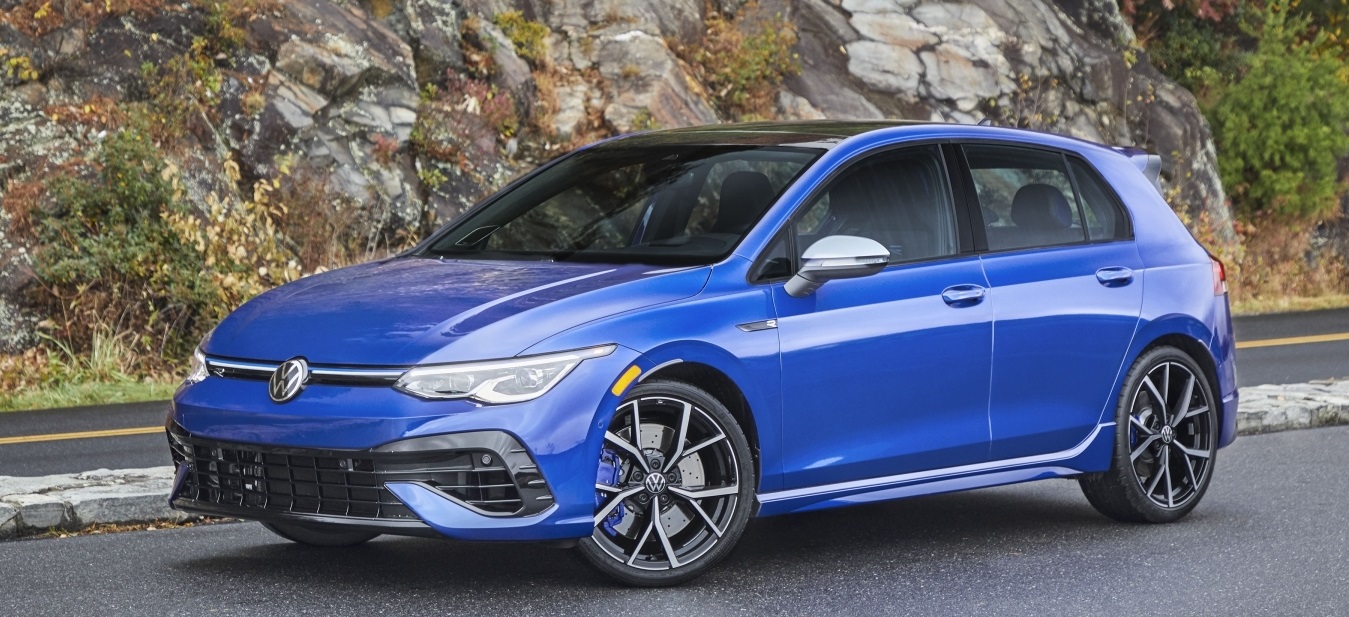
An exterior side view of a Lapiz Blue Golf R

: The Golf R is an altogether different breed of Golf, Volkswagen says. The current Golf R is the most powerful production Golf ever. (Photos courtesy of Volkswagen)

Table of Contents

Pricing
2023 20th Anniversary Limited Edition
Golf R Performance Hardware
Powertrain
Ride and Handling
Interior Function
Back Seats and Cargo
Why Buy the VW Golf R?
Specifications

BY MARK MAYNARD

The VW Golf R is a standard bearer in the hot-hatch segment for its peak horsepower, all-wheel drive, and as a conservator for the three-pedal society.

Volkswagen decided to stop U.S. production last year of its mainstream Golf models, but it has kept the sporty versions of GTI and Golf R, today’s tester. This segment’s fun-driving cars include the Honda Civic Si and Type R, the three-door Hyundai Veloster N, Mazda3, and the Subaru WRX and WRX STI.

Each of these turbocharged, four-cylinder competitors, whether they have three-, four-, or five doors, are engineering hot spots and with distinct personalities. The Golf R hammers out midsize interior space and downplays its high performance with a reserved and revered German obsession for precision. You know it when you feel it when driving just about any Volkswagen model.

There is an RPM dividing line between a mild-mannered Golf R and its visceral alter ego. The difference is how the driver works the accelerator. Hard on the gas, and the Golf R delivers higher-revving shift points that still stitch nicely on the way up to sixth gear. With peak torque at 1,900 rpm, there is ever-ready passing power at 65 to 75 mph. The muscular exhaust note lets drivers know when they are in the sweet spot. It’s a good sound, though electronically generated.

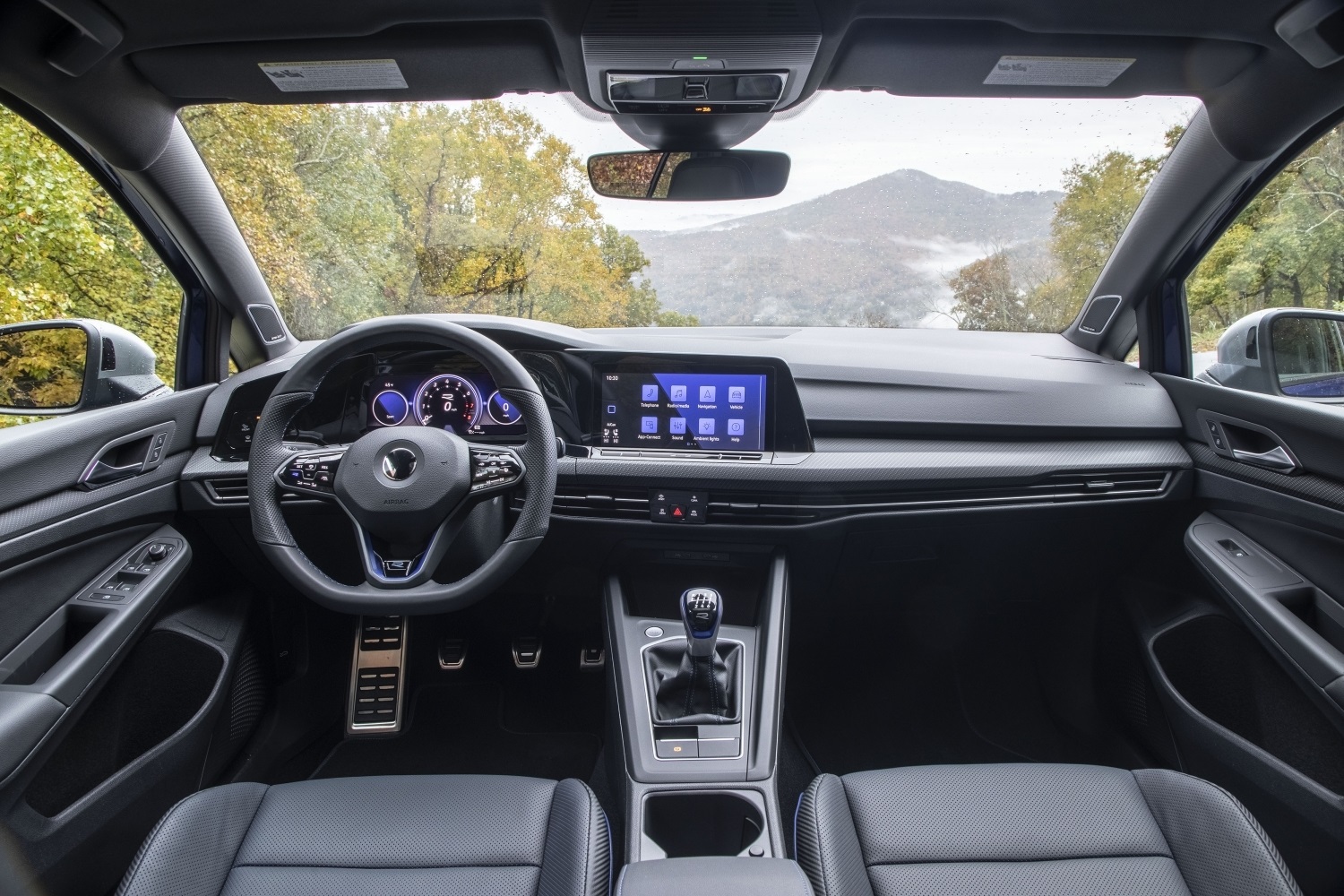
The cabin is handsomely finished with a black microsuede headliner and two-tone black and blue upholstery.

The cabin is handsomely finished with a black microsuede headliner and two-tone black and blue upholstery.

2023 VW Golf R Pricing

Volkswagen prices the Golf R as one well-equipped version. Other than accessories for roof rack systems, seat covers, and heavy-duty floor mats, the only factory choices are for colors — Lapiz Blue, Deep Black Pearl, or Pure White — and the manual or automatic transmission.

Pricing for the 2023 Golf R with the six-speed manual is $45,385 or $46,185 for the seven-speed DSG. Pricing for 2023 is up just $200 from 2022 and includes the $1,095 freight charge from Wolfsburg, Germany.

The Golf R has transmission choices of a six-speed manual or seven-speed DSG, an automated manual transmission

The Golf R has transmission choices of a six-speed manual or seven-speed DSG.

Significant Golf R standard equipment includes: KESSY keyless access with push-button start; panoramic power tilt and slide sunroof; Nappa leather sport seats; a 12-way power driver’s seat with three-position memory; heated and ventilated front seats; Volkswagen Car-Net with Wi-Fi (requiring a data-plan subscription); a nine-speaker, 480-watt Harman/Kardon audio system with a 12-channel amplifier and subwoofer; and a head-up display, which is digitally projected onto the windshield.

For comparison, the front-wheel-drive Golf GTI uses a detuned version of the turbocharged 2.0-liter four-cylinder for 241 horsepower. And like the Golf R, there are choices for a six-speed manual transmission or optional seven-speed dual-clutch automatic. Pricing for 2023 starts at about $30,180, and a 40th Anniversary Edition will arrive later.

Find current Volkswagen pricing and offers here.

2023 Golf R 20th Anniversary Model

A limited production Golf R 20th Anniversary Edition will go on sale this fall in tribute to 20 years of high-performance all-wheel-drive Golf models. The legacy began with the release of the Golf R32 (with a 3.2-liter V-6 engine). It debuted in Germany in 2002 and 2004 in the U.S.

The anniversary model is just $650 more than the standard Golf R, and is available with a manual or DSG transmission. Special features include 20th anniversary badging, blue “R” logos inside and out, carbon fiber interior accents, puddle lights at the side mirrors project a “20R” graphic, and gloss black 19-inch wheels. Around 1,800-anniversary models will be sent to the U.S. from Wolfsburg, Germany.

Golf R Performance Hardware

Dynamic Chassis Control. For particularly agile and accurate handling, the electronic DCC system can deliver individual wheel damping 200 times a second.

Ventilated disc brakes: 14.1-inch rotors at the front and 12.2-inch rotors at the rear. The two-piston, floating front calipers are cross-drilled and supported with aluminum hats for a 1.3-pound weight reduction. An electromechanical brake servo helps to sharpen pedal response and shortened braking distances in testing.

Metal-trimmed pedals are standard with a beefy footrest.

Metal-trimmed pedals are standard with a beefy footrest.

Driving Mode Selection. There are six pre-programmed modes of “Comfort,” “Sport,” “Race,” “Drift,” “Special,” and “Custom.” Each mode has a different steering heft and throttle response. Custom mode sets driver preferences for steering and throttle to their liking. The sportier modes have more aggressive shifts on cars with the DSG transmission.

“Drift” mode. In track-only drift mode, the torque vectoring system kicks off the drift by sending all available rear torque to the outside wheel. As a public safety incentive, the infotainment system displays a confirmation prompt that Drift mode will be used only on private roads.

Wheels and tires. 19-inch alloy wheels with Hankook Ventus S1evo-3 ultra-high performance summer tires, 235/35. The Hankooks have a very sticky treadwear rating of 340. These tires have no treadwear warranty; enjoy them but expect maybe 15,000 miles before it’s time to re-tire.

4Motion All-Wheel-Drive. Evolutionary improvements to Volkswagen’s 4Motion all-wheel-drive system allow drive power to be transferred between the front and rear axles and the two rear wheels. The system activates before wheelspin occurs. The rear differential with two multi-plate clutches can distribute up to 100 percent of the rear torque to an individual rear wheel. In cornering, more power can be directed in milliseconds to the outside wheel, which tightens cornering and improves stability.

Other Golf R elements include:

  • R-specific multifunction sport steering wheel wrapped in leather with perforated inserts and a flat bottom, or “D” shape;
  • Golf R grille, bumpers, side skirts;
  • 2-piece rear spoiler;
  • Chrome-tipped quad exhaust;
  • Blue painted front brake calipers with R logo, and blue painted rear brake calipers;
  • Stainless steel pedal caps and footrest.
The flat-bottom Golf R sport steering wheel is heated with touch controls.

The flat-bottom Golf R sport steering wheel is heated with touch controls.

R is for Speed

The aerodynamicists and designers at Volkswagen worked to shape the Golf R in the wind tunnel. Each body panel was designed for unrestricted airflow, from its aero-optimized side mirrors and refined wheel-arch linings to its underbody paneling. Volkswagen says the Golf R displays an optimal combination of confident yet mature performance.

Subtle design elements separate the new Golf R from the Golf GTI. An accent line in “R” blue stretches across the grille, continuing through each headlamp and eventually merging with the fenders on the side of the vehicle. An illuminated crossbar underneath gives the Golf R an unmistakable light signature. It’s a badass image at night.

Car and Driver clocked 0-to-60 acceleration in a Golf R with DSG in 3.9 seconds. But more real-world is the strong pull from 30 to 50 mph and again at 65 and beyond.

The performance screen in the Golf shows six different modes, including Drift and Race

The Golf R has six performance modes, include Drift and Race.

Golf R Powertrain

Volkswagen considers the Golf R is an altogether different breed of Golf. In addition to being the performance benchmark of the Volkswagen lineup, the current Golf R is the most powerful production Golf ever.

In Golf R specification, the 2.0-liter EA888 evo4 engine produces 315 horsepower (using premium fuel) at 5,600 rpm. Peak torque ratings vary between manual and automatic. DSG models have 295 foot-pounds of torque at 2,000 rpm, and manual-equipped models produce 280 lb.-ft. of torque at 1,900 rpm.

The seven-speed DSG automatic transmission gearbox will stay in manual mode when in “Special” or “Drift” driving mode. And there is launch control.

Fuel economy ratings are based on fun per mile: 20 mpg city, 28 highway, and 23 mpg combined for the manual, and 23/30/26 for the DSG. Premium fuel is recommended. With the manual transmission, I quickly worked up to 30.6 mpg on the highway in Sport mode while enjoying every high-rev shift point around town.

A view of the 315 horsepower, 2.0-liter EA888 evo4 four cylinder engine.el) at 5,600 rpm.

The 2.0-liter EA888 evo4 engine produces 315 horsepower at 5,600 rpm.

Golf R Ride and Handling

VW engineering adds subtle refinement to how predictably the Golf R handles under pressure. Around town, the performance is school-carpool comfortable. But get down on the accelerator, and the demeanor shrugs off the lambskin for stick-and-stab wailing. Damn, that’s fun.

It is pure pleasure to feel the suspension make transitions in cornering and how the shift points knit under pressure. But upshifts between second and third can be notchy when in a rush. And the height difference between the brake and accelerator was not comfortable for me to make heel-toe shifts. However, the hill-holding clutch is will be of far more use to most enthusiasts.

Road harshness and noise are noticeable at speed, but that’s the nature of any high-performance car.

19-inch Hankook Ventus S1evo-3 ultra-high performance summer tires , 235/35

19-inch Hankook Ventus S1evo-3 ultra-high performance summer tires.

Interior Function

It is a handsome cabin with the black microsuede headliner and two-tone black and blue upholstery. The quality of materials reinforces the steep MSRP, and the quality of plastics is consistent from front to rear, top to bottom.

Were it not for the confounding 10-inch infotainment touchscreen, I’d give an A-grade for driver-area design. I’ve fumbled my way to a level of comfortable control on dozens of these digital systems. Still, it’s more of a process for the VW to switch from audio selections to

The driver-side door panel show the quality plastic and nonconventional trim pieces with a slight carbon-fiber look

Interior plastics and trim elements have a premium appearance, fit, and finish.

navigation and climate control. It takes just a swipe to move between settings. There are just a few physical buttons, including a slider for volume control. Changing fan speed requires a two-touch method to bring up the screen, either on the display screen or on a separate button just below the screen. Finding settings for temp or fan speed requires a couple of taps or swipes, which take eyes from the road.

Sightlines are open across the hood and fenders and slightly compromised over the shoulder at the wrap of the rear roof pillar.

The 12-way power driver seat has good thigh support with just modest side and bottom bolsters. The fit is secure in aggressive handling but without the scrunch on entry and exit.

Technically a midsize car, the Golf R has plenty of cabin width (almost 56 inches door to door) for comfortable shoulder and elbow room. But headroom of 38.5 inches with the pano sunroof might be a consideration for tall drivers.

Back-seat Legroom of 35 inches will be fine for the carpool.

Back-seat Legroom of 35 inches will be fine for the carpool.

Back Seat and Cargo Space

Legroom of 35 inches in the back seat will be acceptable for the carpool. But the cargo space transforms the Golf R from weekend warrior to weekend workhorse.

Fold the 60/40 split rear seatback for an almost flat cargo area of 34.5 cubic feet. But the big Harmon Kardon subwoofer in the cargo underfloor cancels the ability to drop the floor by a few inches.

A view of the cargo area with the back seats folded

Nearly flat cargo space is a Golf R asset with the folding rear seatback

Why Buy the VW Golf R?

The Golf R is an impressive collection of engineering. The body has much high-strength steel and solidity, adding to a sense of security and control.

All-wheel drive makes the Golf R feel heavier than its front-drive competitors. But the added lift of 315 horsepower lightens the effect. The turning circle of 39.3 feet is relatively wide, but such is the cost of high-performance greatness with AWD, a wheelbase of 103.5 inches, and 19-inch tires.

Like its German driving DNA, Golf performance is not trigger-happy but balanced and determined.

A rear view of the Golf R showing its rooftop spoiler and quad exhaust tips

Paint colors for the 2023 Golf R are Lapiz Blue Metallic, Deep Black Pearl, and Pure White.

VW Golf R Specifications

Body style: midsize, 5-seat, 5-door, AWD sport hatchback

Engine: 315-hp, turbocharged and intercooled, 16-valve 2.0-liter 4-cylinder; 280 lb.-ft. torque at 1,900 rpm (or 290 lb.-ft. at 2,000 rpm with automatic transmission

Transmission: 6-speed manual (optional seven-speed DSG dual-clutch automatic)

Fuel economy: 20/28/23 mpg city/hwy/combined (23/30/26 mpg automatic; premium fuel recommended

0-60 mph acceleration: 3.9 seconds per Car and Driver for the DSG model

BY THE NUMBERS

Fuel tank: 14.5 gallons

Cargo space: 19.9 to 34.5 cubic feet

Front head/leg room: 38.5/41.2 inches

Rear head/leg room: 38.1/35 inches

Length/wheelbase: 168.9/103.5 inches

Curb weight: 3,404 pounds (3,481 automatic)

Turning circle: 39.3 feet

FEATURES

Exterior standard equipment includes: power tilt-slide panoramic sunroof; 19-inch alloy wheels with summer performance tires; automatic LED headlights-taillights-running lights; fog lights; integrated light bar in grille; side mirror puddle lights; illuminated door handle recesses; power (folding) side mirrors; rear window wiper and washer.

Golf R specific features: Golf R grille, side skirts, and trim, two-piece rear spoiler, chrome-tipped quad exhaust, blue-painted front brake calipers with R logo, blue-painted rear calipers

Interior standard equipment includes: Nappa-leather trimmed upholstery with blue accents and Golf R logo, leather-wrapped Golf R sport steering wheel with touch controls, Golf R interior with black microsuede headliner, heated steering wheel, heated and ventilated front sport seats, power driver’s seat, manually adjusted front passenger seat with power recline, rearview camera with guidance lines, USB data and charging ports, 3-zone automatic climate control with advanced air filter, rear seat climate control panel, adjustable back seat air vents, 60/40 split-folding back seat with ski pass-through, heated rear seats, lighted cargo area with an adjustable floor, multicolor ambient lighting, stainless-steel pedal covers and footrest, carpeted floor mats front and rear.

Technology and Convenience features: Volkswagen Digital Cockpit with 10.25-inch configurable display, adaptive cruise control, head-up display, dynamic road sign recognition, keyless access with push-button ignition, Discover Pro 10-inch touchscreen navigation and audio controls, Harmon Kardon audio system with center speaker and subwoofer, App-Connect smartphone integration via wireless and USB, Bluetooth phone and audio, wireless charging, electric parking brake.

Safety features include: 6 air bags, anti-slip regulation, engine-brake assist, hydraulic brake assist and brake-force distribution, stability and traction controls, automatic post-crash braking, park assist and park distance control front and rear, hill-hold control, high-beam control, Travel Assist semi-autonomous driving assist, lane assist lane keeping, forward collision warning, autonomous emergency braking, blind-spot monitor, rear traffic alert.

PRICING

Golf R manual base price: $45,185, including $1,095 freight charge

Options on test vehicle: none

Where assembled: Wolfsburg, Germany

Warranty: 4-years/50,000-miles; 3-years/36,000-miles roadside assistance, 2-years/20,000-miles free scheduled maintenance

VW Taos 1.5T SEL Review

VW Taos 1.5T SEL Review

The 2022 VW Taos 1.5T is unpretentious and practical with a teaser’s driving attitude

The Taos exterior

The VW Taos is the brand’s fourth and smallest SUV. Sold in front- or all-wheel-drive, pricing starts at about $25,000. (Photos courtesy of VW of America)

Table of Contents

Overview
Powertrain
Pricing
Ride and Handling
Travel Assist
Interior Function
Back Seats and Cargo
Why Buy the VW Taos?
Specifications

BY MARK MAYNARD

Thirty-Nine-point-Five miles per gallon in a front-drive VW Taos — 39.5. On a recent highway drive in a Taos 1.5T, I kept checking the onboard fuel-economy meter to be sure that what I was seeing was correct.

39.5 mpg in a subcompact SUV crossover exceeded my expectations, and that of several of the competing models I’ve tested. 39.5 was not a one-off lucky run. I went out multiple days to repeat the numbers, which the Taos tester did easily. And it seemed as if the highway mileage might even go a few clicks higher.

The around-town mileage was also strong, typically averaging 20 to 30 mpg, on the recommended 87 octane fuel. EPA fuel-economy ratings for the front-drive Taos are 28 mpg city, 36 highway, and 31 mpg combined. Mileage ratings for the Taos 4Motion all-wheel-drive models drop to 25/32/28 mpg.

I would have expected high mileage ratings in a hybrid vehicle, but what separates the 2022 VW Taos from its competition is its driving attitude.

This little SUV with a puny 158-hp., 1.5-liter turbocharged four-cylinder is eager to please. And it is just fun to drive.

There are at least 13 competitors in the subcompact SUV segment, but the VW Taos seems less subcompact and roomier. Among the competitors are the Buick Encore, Chevrolet Trailblazer, Honda HR-V, Hyundai Kona, Jeep Renegade, Kia Seltos, Mazda CX-30, Mitsubishi Eclipse Cross, Nissan Rogue Sport, Subaru Crosstrek, and Toyota C-HR.

The front seats

The compact but not cramped front seat area has open sightlines.

VW Taos Overview

The VW Taos is Volkswagen’s fourth SUV model. In the lineup, it is the smallest, slotting below the Tiguan, Atlas, and Atlas Cross Sport.

Taos is built on VW’s “modular transverse toolkit,” or MQB platform. The MQB is easily tuned for various world markets, VW says. Road conditions were a challenge for chassis engineers. Striking a compromise between ride and handling becomes a serious task.

“For the front-wheel-drive [U.S.] Taos, we went through 77 iterations of the various chassis components — springs, dampers, anti-roll bars, suspension components, bushings, and so on.”

—  Gerold Bremer, Technical Development Director

In the U.S. alone, roads vary from the smooth blacktop in the southern states to surfaces rippled by earthquakes in California to midwestern roads with the heaves of freeze-thaw conditions. And then dirt roads add another complexity.

“To get to a balanced chassis for these markets takes a huge amount of work,” Gerold Bremer, Director, Technical Development, Volkswagen de México, said in a release.

“For the front-wheel-drive [U.S.] Taos, we went through 77 iterations of the various chassis components — springs, dampers, anti-roll bars, suspension components, bushings, and so on,” said Bremer.

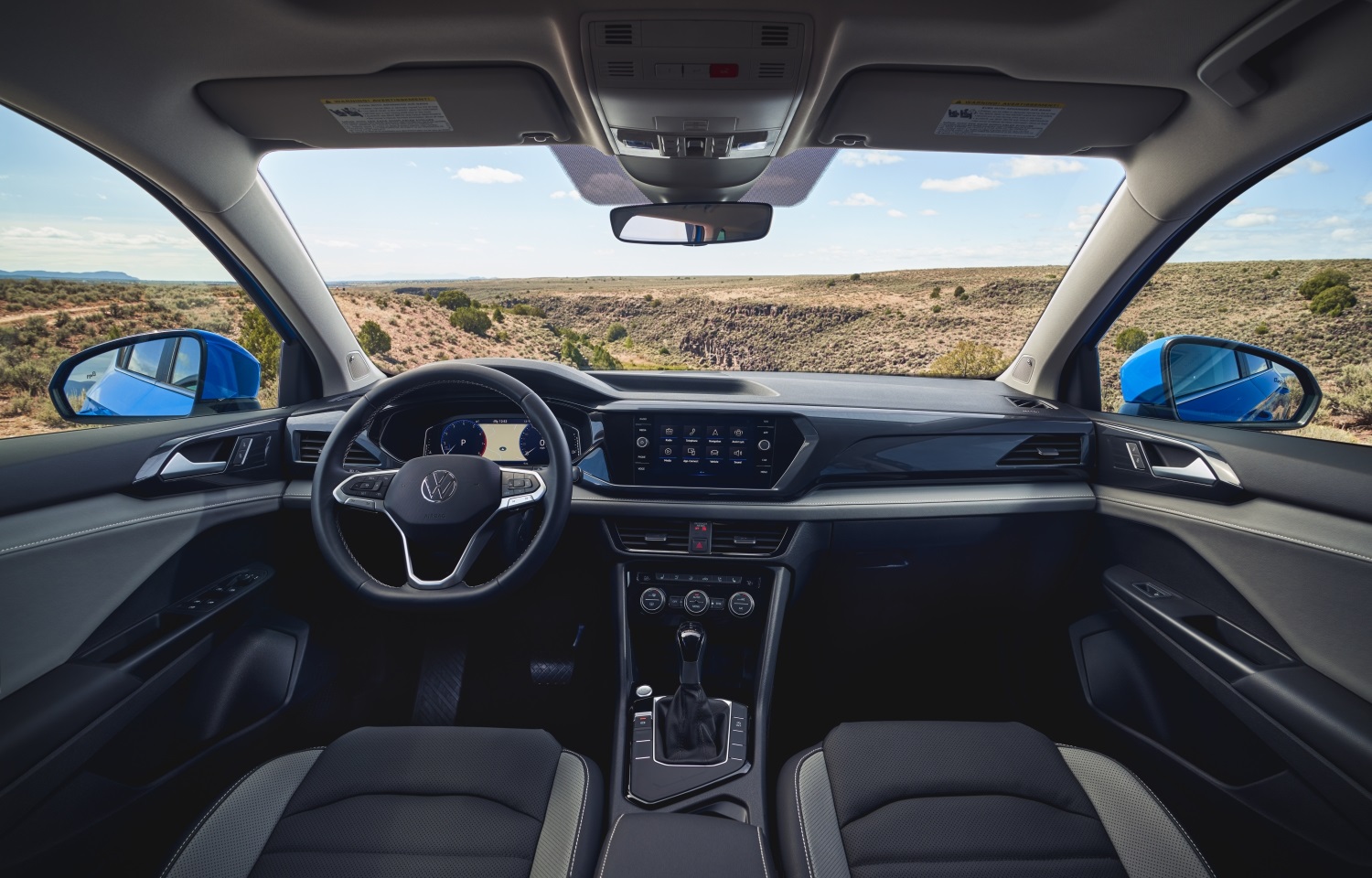
The compact but not cramped driver’s space has smart integration of controls, switches, and dials.

The driver’s space has smart integration of controls, switches, and dials.

Taos Distinctions

The VW Taos uses a strut-type front suspension, but it has different rear suspensions. All-wheel-drive models have a rear multilink layout while front-drive versions get a torsion beam. The multilink rear suspension helps extend wheel travel and maintain traction when off-roading.

And there are slight body size variations between front-drive and AWD. The front-wheel-drive Taos has a wheelbase of 105.9 inches and is 64.4 inches tall. The all-wheel-drive Taos has a wheelbase of 105.6 inches and is 64.6 inches tall. Both versions are 72.5 inches wide.

Front-drive models have a fuel tank of 13.2 gallons but 14.5 gallons for AWD. I’ll bet some buyers of the front-drive Taos would like the option for the larger fuel tank for fewer stops in the week’s commute.

And the FWD models shift gears via an eight-speed automatic transmission with a Sport mode. Taos 4Motion AWD models have a seven-speed dual-clutch automatic transmission.

The 158-hp, 1.5-liter turbocharged four-cylinder

The 158-hp, 1.5-liter turbocharged four-cylinder is as revvy as it is efficient. (Mark Maynard photo)

Taos Powertrain

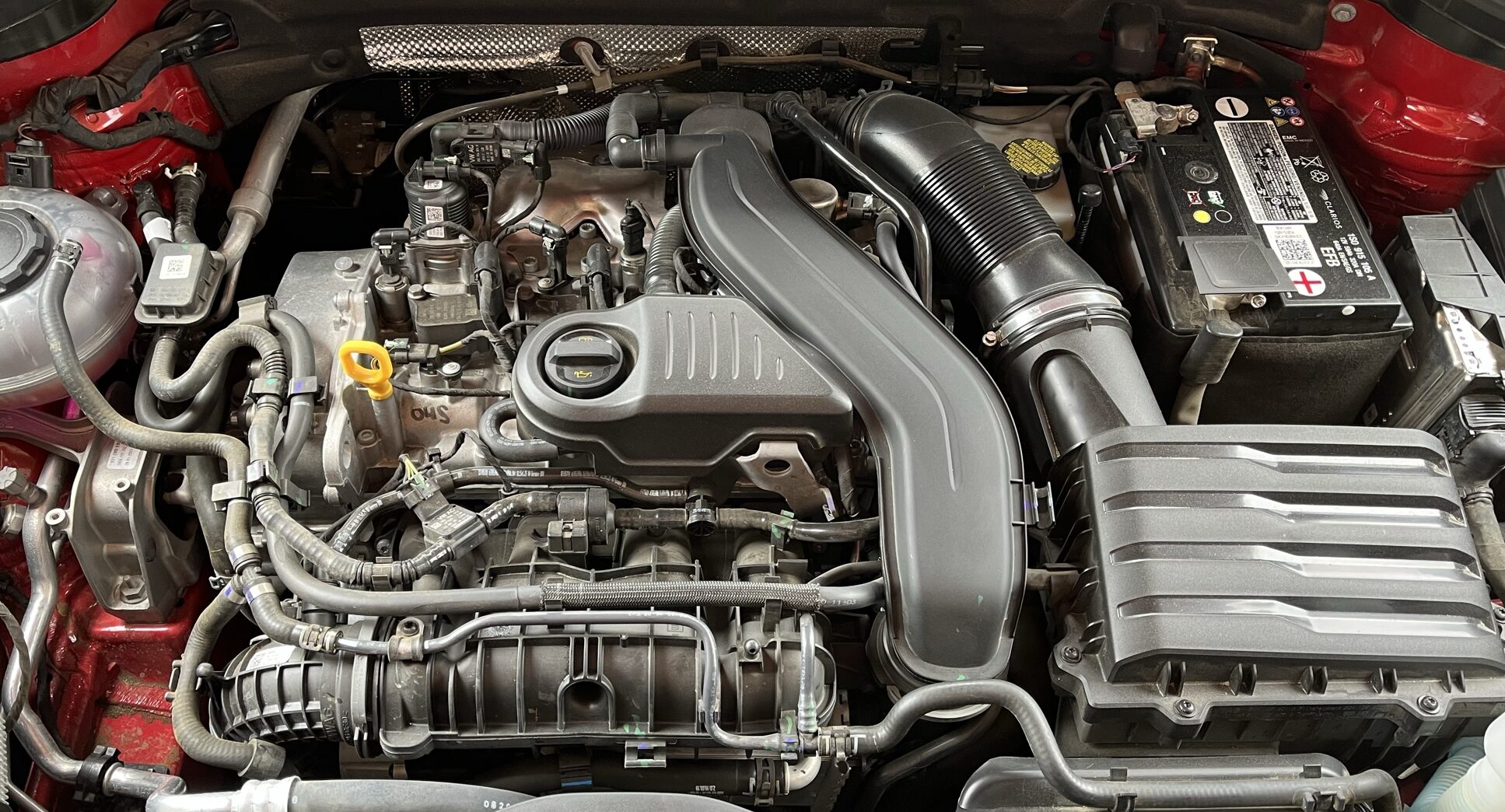
All versions of the VW Taos are powered by a 158-horsepower, 1.5-liter turbocharged and direct-injection four-cylinder engine (the EA211 TSI). The engine has a peak torque rating of 184 foot-pounds at 1,750 rpm.

The engine is an updated and more powerful version of the 1.5-liter used in the Jetta sedan. But the Taos engine is more efficient in fuel usage, VW says. It features Volkswagen’s modified version of the Miller cycle . In the Miller cycle, the intake valves are closed early in the induction stroke to help with fuel economy. For a turbocharged engine, the Taos 1.5 has a very high compression ratio of up to 11.5 to one.

Among the engine’s key features is Variable Turbine Geometry. VW says VTG is more efficient, provides higher boost pressure, and avoids wastegate mass flow. The high-pressure injection system also produces better atomization of the fuel/air mixture. And this injection system also has a shorter injection time, optimized mixture formation, and lower particulate emissions.

Performance around town is calibrated for maximum fuel economy, and it can feel unsteady as it metes out mileage. But pull the floor-shift lever into Sport mode for the fun zone. It brings much quicker and more satisfying, acceleration —without being nervously aggressive.

18-inch grand-touring Bridgestone Turanza tires

The 18-inch grand-touring Bridgestone Turanza tires (215/50).

VW Taos Pricing

The 2022 VW Taos is sold in trim levels of S, SE, and SEL, in front- or all-wheel drive. Starting prices range from $24,690 to $33,285; pricing includes the $1,195 freight charge from Puebla, Mexico. (Pricing is up about $600 from 2021.)

Today’s front-drive SEL tester was $34,880 with and options for Kings Red metallic paint ($395) and a power tilt and sliding panoramic sunroof ($1,200). AWD would add $1,555.

The SEL list of standard equipment has some sophisticated features and technologies. Among them: the Volkswagen Digital Cockpit Pro (digital gauge display), keyless entry with push-button start, adaptive cruise control, blind-spot monitor, rear traffic alert, parking distance alerts, pedestrian monitoring, Travel Assist (semi-automatic driving assist with lane assist and emergency assist), Discover Media 8-inch color touchscreen navigation system, dynamic road-sign display, wireless smartphone charger, two front USB-C data ports and one rear USB-C charging port.

On the outside are 18-inch alloy wheels, adaptive turning headlights, illuminated grille, LED lighting (headlights, taillights, and daytime running lights (with low-speed corner illuminating), power and heated side mirrors.

The interior features leather-trimmed upholstery, a rearview camera, an eight-way power driver’s seat with power-adjustable lumbar support, a front center armrest with a storage compartment, and heated and ventilated front seats.

The eight-speed floor-shift console.

The eight-speed floor-shift console.

Less Can Be Plenty in a Taos

Sometimes, however, less is plenty, as in the base VW Taos S.

If you can live with a basic gray and black interior with fabric seats, you can drive home a fun SUV for $25,685. And that includes the $995 IQ.DRIVE Package & S Convenience Package. AWD would add $2,045, for a total of $27,730.

Standard S model features include the configurable Volkswagen Digital Cockpit, 17-inch alloy wheels, six-way manually adjustable front seats, a multi-function steering wheel, automatic headlights with a coming-and-leaving home feature, power side mirrors, and LED headlights with LED daytime running lights and taillights.

Digital extras for the Taos S include a rearview camera system, two front USB-C data ports, App-Connect, Bluetooth phone and audio, and a color 6.5-inch touchscreen sound system.

Also standard is the next-generation Volkswagen Car-Net telematics system. And it includes five years of remote-access services and in-car Wi-Fi capability with a data-plan subscription.

Find current VW Taos incentives and discounts here.

The Taos has full LED exterior lighting

The Taos has full LED exterior lighting

Taos Ride and Handling

German-driving DNA is built into the gasoline-powered Volkswagens. The Taos is a mighty mite of keen handling — with handfuls of grip and grin. The front-drive suspension smooths out rough road, and the torsion-beam rear suspension has none of the clunks that are commonly felt in some of these setups.

Four-wheel disc brakes have vented 12.7-inch front rotors and solid 10.7-inch rear discs. Left-foot braking, however, can confuse the electronic safety system. In an abundance of caution, the power is reduced in the event of unintended acceleration.

The 18-inch grand-touring Bridgestone Turanza tires (215/50) have good grip in enthusiastic driving and a meaty sidewall to help resist curb rash. The tires have a fairly high (hard) treadwear rating of 560. Such a high rating typically translates to a hard ride, but not so on this Taos, which speaks well of the suspension and its mounting points.

A turning circle of 37.6 feet is tight for easy U-turns and easy maneuverability in tight parking situations.

The 8-inch Discover Media color touchscreen integrates audio and navigation.

The 8-inch Discover Media color touchscreen integrates audio and navigation.

Taos Travel Assist

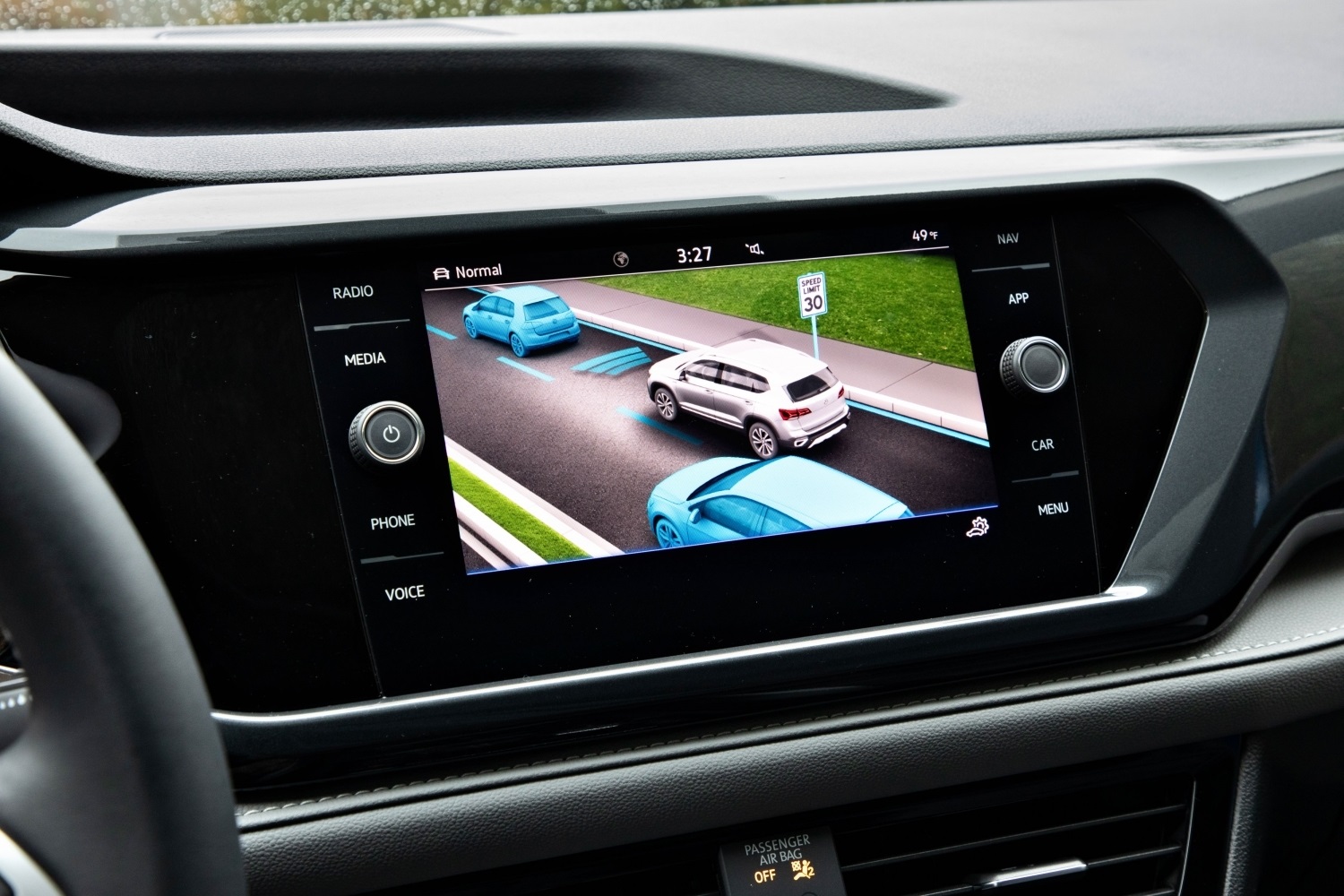
Volkswagen’s semi-automatic Travel Assist is a valuable asset. The system can be used with or without cruise controls. In the crush of commuting traffic, it is an all-seeing system to guard against distractions or an unintended meeting with a driver in the next lane.

The IQ.DRIVE package is a suite of technologies. Integrated into the safety systems are adaptive cruise control, blind-spot monitor, rear traffic alert, pedestrian monitoring with front assist, travel assist, lane assist, and emergency assist.

With both hands on the wheel, the drive guidance gives steady lane centering, but can still be prone to shutoffs in shaded situations. Culprits include a shaded highway overpass or low-angle sunlight into the front grille sensor.

The rearview camera screen

The color camera system.

Taos Interior Function

The sturdy upright exterior design benefits the interior with tall headroom (40.7 inches) and extremely roomy back-seat legroom, 37.9 inches.

The compact but not cramped driver’s space has smart integration of controls, switches, and dials. Gauge graphics in blue on black are easily viewed in all conditions of lighting. Sightlines are open at the side mirrors and over the shoulder.

The $1,200 optional panoramic sunroof trims an inch or so from the front headroom, but it is a compelling picture window for those in the back seat.

The SEL interior design is durable with a variety of plastics, piano black trim, and stitched leather inserts. The eight-way power driver’s seat includes seat-bottom tilt, which is sometimes uncommon in smaller vehicles. However, I would have appreciated a seat-side driver’s armrest. The padded console armrest isn’t one-size-fits-all and it does not slide, as in some VWs.

The power tilt and sliding panoramic sunroof, $1,200.

A power tilt and sliding panoramic sunroof, $1,200.

Back Seat and Cargo

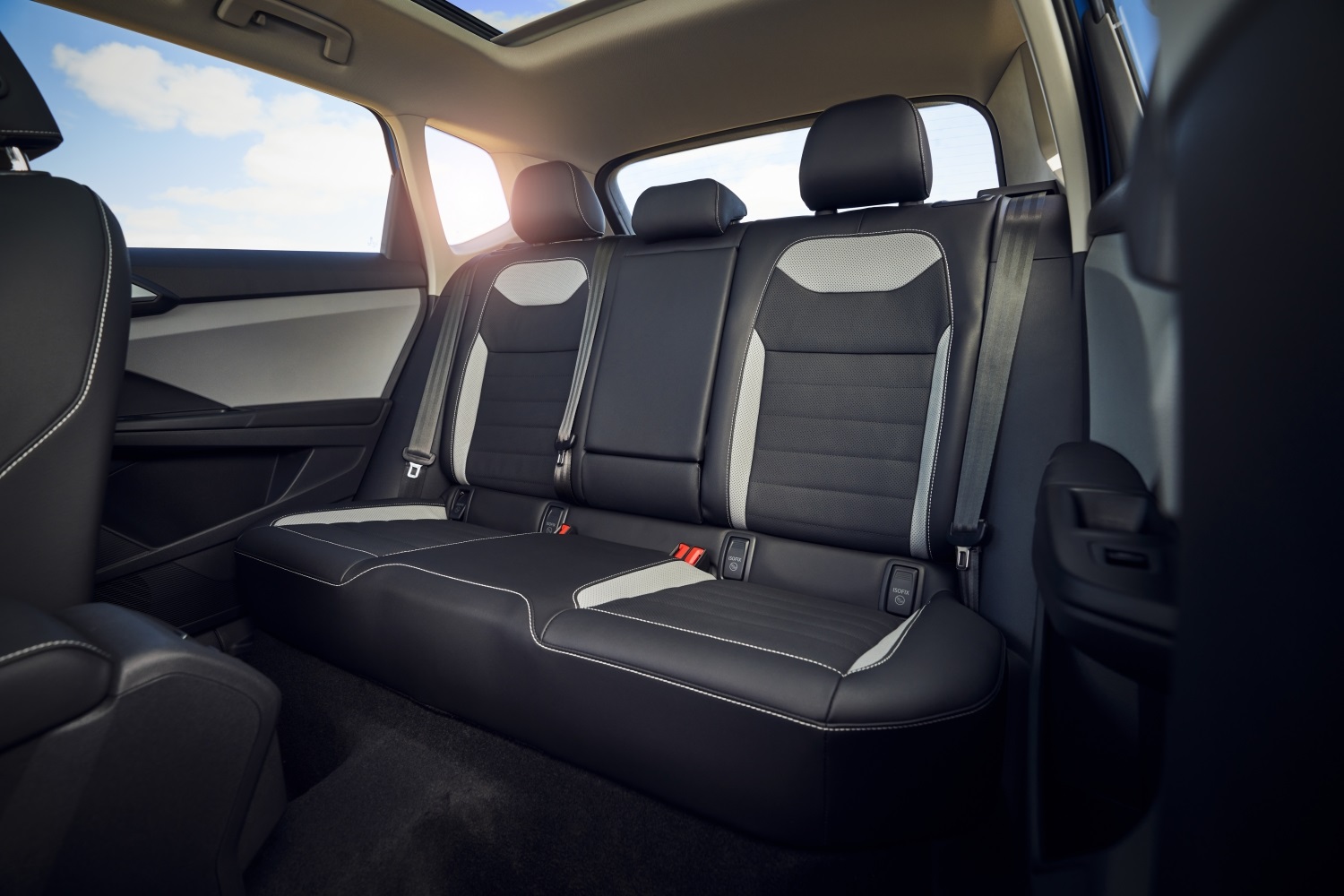
The Taos back seat is no penalty box for children. The boxy space is open and airy with headroom of 39.8 inches. The smallish exhaust-AWD tunnel benefits footroom for occasional three-across seating.

There is no recline to the seatback, but it has a comfortable angle.

Back-seat features include a fold-down, ski-passthrough center armrest with can holders. There also are bottle holders in the door panels and a C-type charging USB.

Cargo space is neatly square with a 42-inch wide opening and about 3 feet in length to the seatback. Fold the 60/40 seatback for a maximum of almost 6 feet in length. The temporary spare tire is stored below the cargo floor.

The Taos back seat space is open and airy

The Taos back seat space is open and airy with headroom of 39.8 inches.

Why Buy the VW Taos?

The Taos is a good starter family SUV that won’t be easy to send down the road, if and when it gets outgrown. Fortunate will be the teen driver who inherits the trusty family Taos.

Fold the 60/40 back seat for maximum cargo space length of almost 6 feet.

VW Taos SEL Specifications

Body style: subcompact, front- or all-wheel drive, 5-seat, 5-door SUV crossover

Engine: 158-hp, turbocharged and direct-injected DOHC 1.5-liter 4-cylinder; 184 lb.-ft. torque at 1,750 rpm

Transmission: 8-speed automatic

Fuel economy: 28/36/32 mpg city/hwy/combined; 87 octane recommended

BY THE NUMBERS

Fuel tank: 13.2 gallons

Cargo space: 27.9 to 65.9 cubic feet

Front head/leg room: 40.7/40.1 inches

Rear head/leg room: 39.8/37.9 inches

Length/wheelbase: 175.8/105.9 inches

Curb weight: 3,175 pounds

Turning circle: 37.6 feet

FEATURES

Standard equipment includes: Smartkey entry and locking with push-button ignition, leather-trimmed upholstery, rearview camera, eight-way power driver’s seat with power-adjustable lumbar support, front center armrest with storage compartment, heated and ventilated front seats. VW Digital Cockpit Pro (configurable digital gauge display), adaptive cruise control, blind-spot monitor, rear traffic alert, parking distance alerts, pedestrian monitoring, Travel Assist (semi-automatic driving assist with lane assist, emergency assist, 8-inch color touchscreen navigation and media system, dynamic road-sign display, wireless smartphone charger, two front USB-C data ports and one rear USB-C charging port, 18-inch alloy wheels, adaptive front-lighting (turning headlights), illuminated grille, LED lighting (headlights, taillights, and daytime running lights (with low-speed corner illuminating), power and heated side mirrors.

Safety features include: 6 air bags, Intelligent Crash Response System, electronic stability control, anti-slip regulation, electronic differential lock, engine brake assist, ABS with brake-force distribution, and hydraulic brake assist

PRICING

Base price: $33,285, including $1,195 freight charge; price as tested $34,880

Options on test vehicle: King’s Red metallic paint $395; power panoramic sunroof $1,200

Where assembled: Puebla, Mexico

Warranties: 4-years/50,000-miles bumper to bumper, including powertrain; 2-years/20,000-miles free scheduled maintenance (includes vehicle checks at 10,000 and 20,000 miles with oil change, but not a tire rotation; roadside assistance for 3-years/36,000-miles