
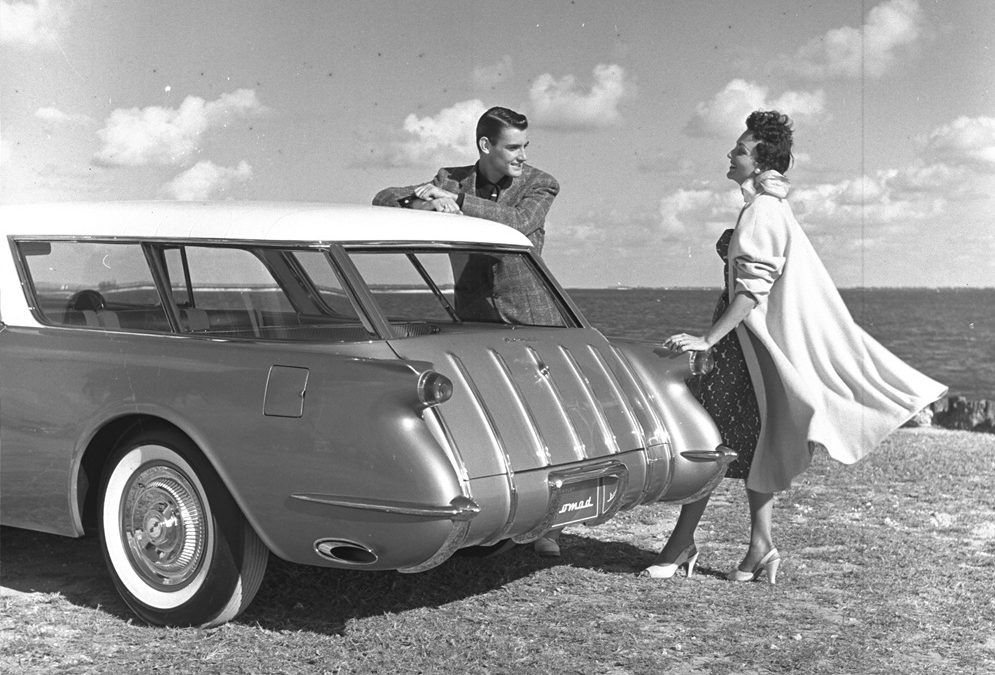
The “Experimental” 1954 two-door Chevrolet Corvette Nomad wagon pushed expectations of luxury and power. It also introduced “Dynamic Obsolescence.”
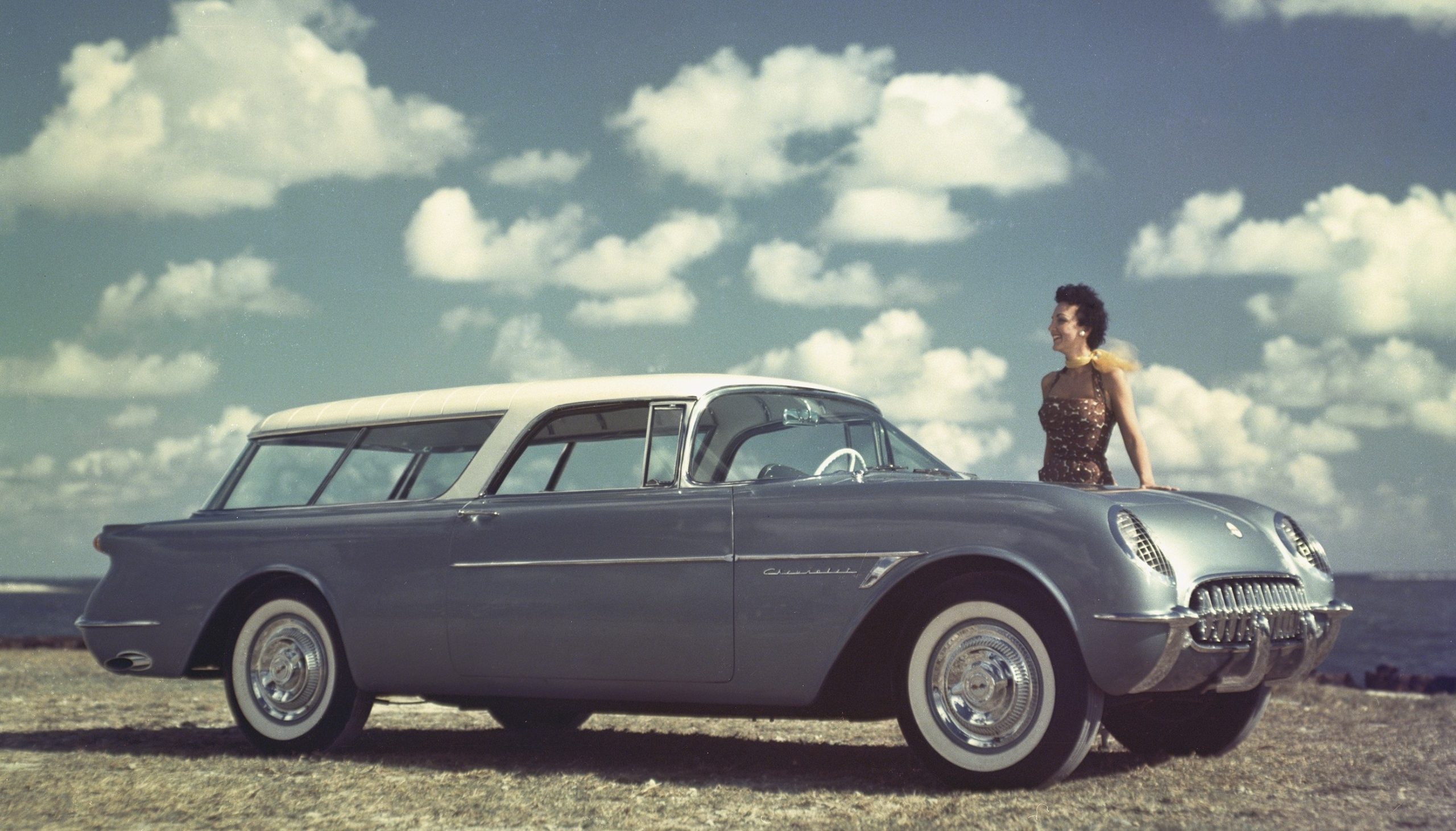
The 1954 Corvette Nomad concept was a vehicle Harley Earl designed to be a sporty two-door station wagon for the 1954 GM Motorama circuit. (Photography courtesy of GM Heritage Archives)
For a brief but dreamy period in 1954, America was shown a special two-door Chevrolet Corvette station wagon. This car, a delicious tease at the GM Motorama—a grandiose showcase of futuristic cars and modern living—marked a shift from the previous year’s introduction of the 1953 Corvette concept.
Despite an ecstatic public reaction to the 1954 Corvette Nomad wagon concept, it never went into production. The year before, in 1953, the Corvette concept stole the show at Motorama and was soon greenlighted for production, highlighting the annual shift in GM’s approach.
All was not lost, however, for the “experimental” Corvette Nomad wagon. GM saw dollar signs in the sizzle generated by the concept’s styling and moved forward with a modified plan. The 1955 Chevrolet Nomad wagon would enter production, but it would not be easy.
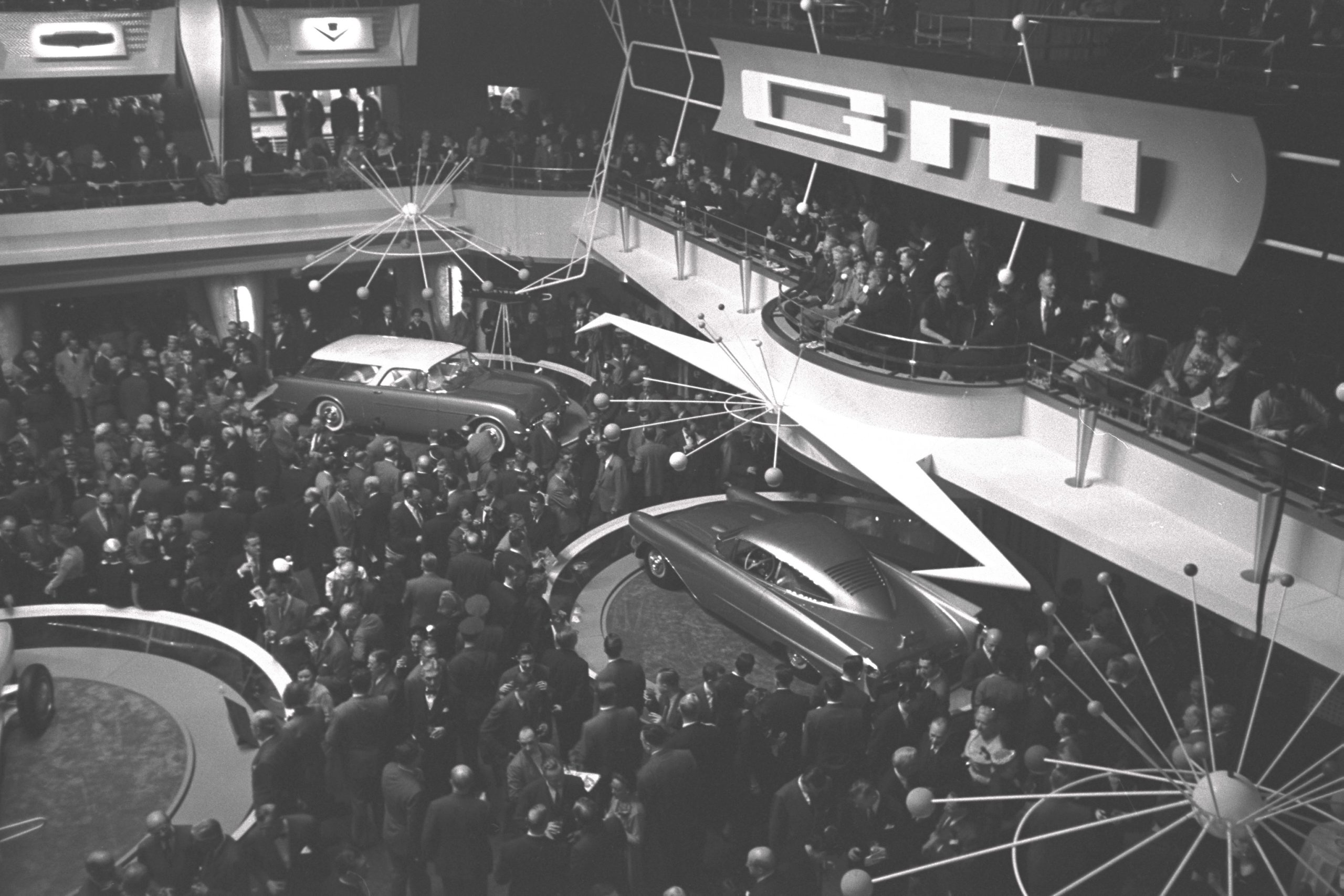
The 1953 GM Motorama was held in the grand ballroom of the Waldorf Astoria in New York City. This first Motorama showcased such concepts as the Corvette Nomad wagon, the 1953 Corvette, the turbine-powered Firebird Series, the Buick Wildcat, and the Pontiac Bonneville Special. The 1954 Oldsmobile Cutlass show car is in the center.
A Radical Mashup
The 1955-1957 Chevrolet Nomad is a revered station wagon that forever changed the traditional family utility vehicle. Its 1954 concept, however, was far more than just another new wagon. The exterior fused design cues from the first Corvette. The Nomad was a hybrid: a sports car with Corvette styling on a wagon body.
Radical at the time, the Nomad’s “experimental” styling made it a mid-century icon. Like the Corvette, the Nomad concept received a big “Hell yeah!” from showgoers. It had “sizzle,” said GM design chief Harley Earl, who believed this wagon had a place in the GM line.
To some, these so-called “Tri Five” models are the holy grail of station wagons. To others, the Nomad needed two more doors.
With its glorious reveal at the 1953 GM Motorama, the Nomad set the stage for the first luxury-infused wagon. As a concept car, it was a two-door wagon built on a modified Corvette chassis. It channeled the sports car within.
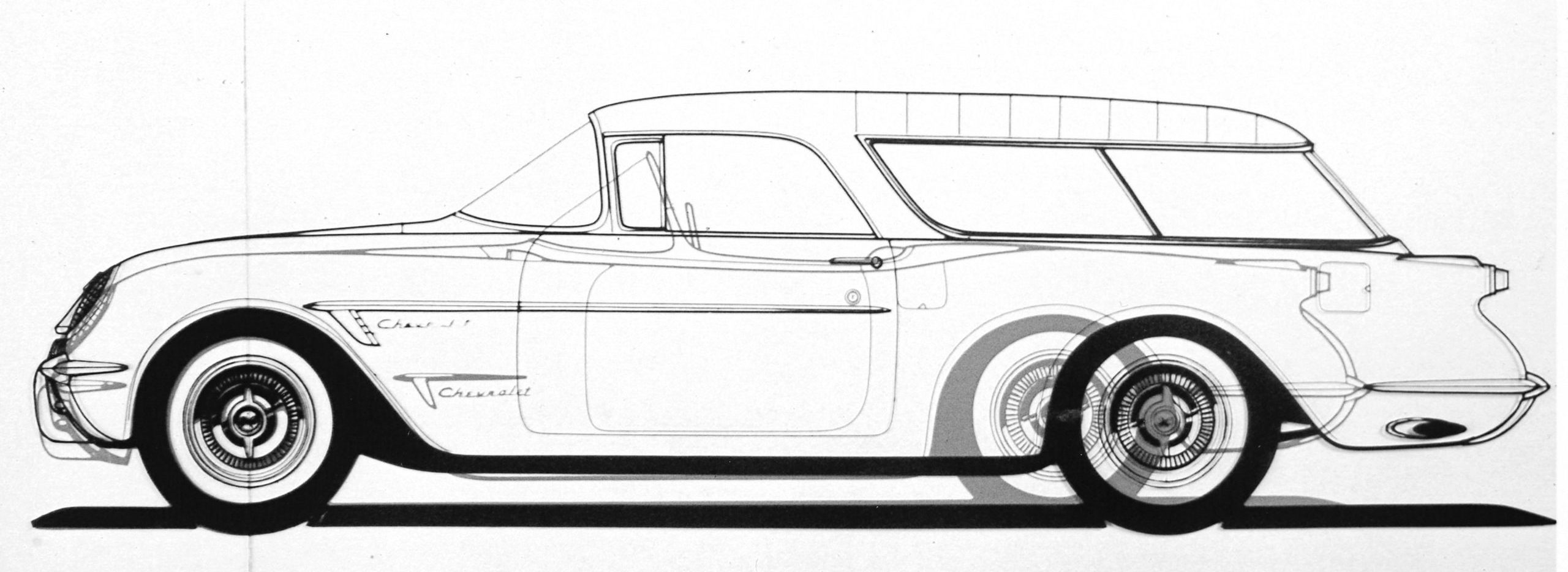
Corvette and Nomad overlay schematic.
Suburban Wagon Status
America was on the move in the 1950s—toward the suburbs. Steering this post-World War II push for the “American dream” was the dutiful station wagon. But this wagon train was on GM’s drawing boards, ready to be reborn as a ride for country living.
In response to families escaping the city, General Motors staged its dream-car Motorama show circuit. The Motorama was an extravaganza to “sell the future” and to spark a craving for new technology and style.
In that pre-SUV era, GM offered station wagons across five brands: Chevrolet, Pontiac, Oldsmobile, Buick, and Cadillac. Today, it has none, though its “crossovers” mimic wagon utility.
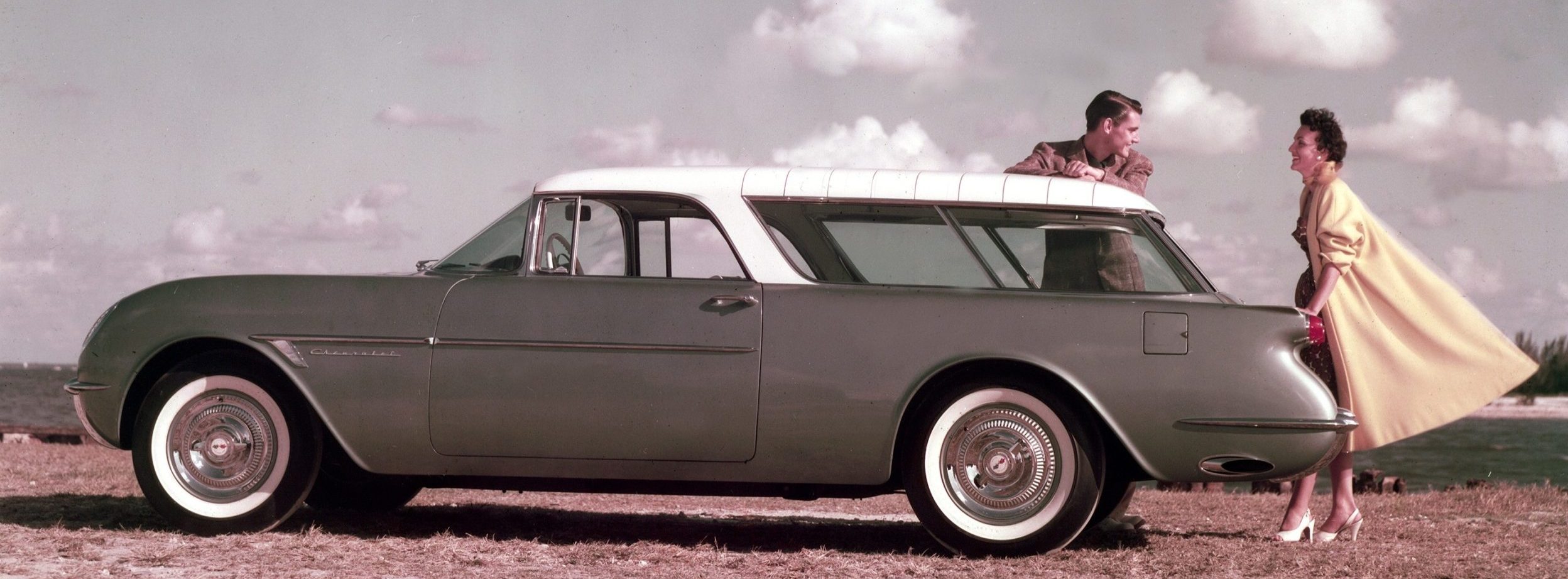
1954 Chevrolet Nomad Motorama Show Car
The GM Motorama
The GM Motorama was an ideal partnership. GM CEO Alfred P. Sloan developed the company’s business strategy. Legendary design chief Harley Earl delivered dramatic showmanship.
Alfred Sloan Jr. (1875-1966) was the organizational genius who built General Motors into the world’s largest industrial corporation. Sloan developed the foundational model for contemporary multinational corporations and introduced the concept of “Dynamic Obsolescence.”
Every year back then, GM (and other makers) would tweak the styling, paint colors, and chrome details of their vehicles. It made last year’s model look “old” and out of style. To create the “style” hook, Sloan, with designer Earl, created a 1955 model that looked noticeably different from a 1954 model.
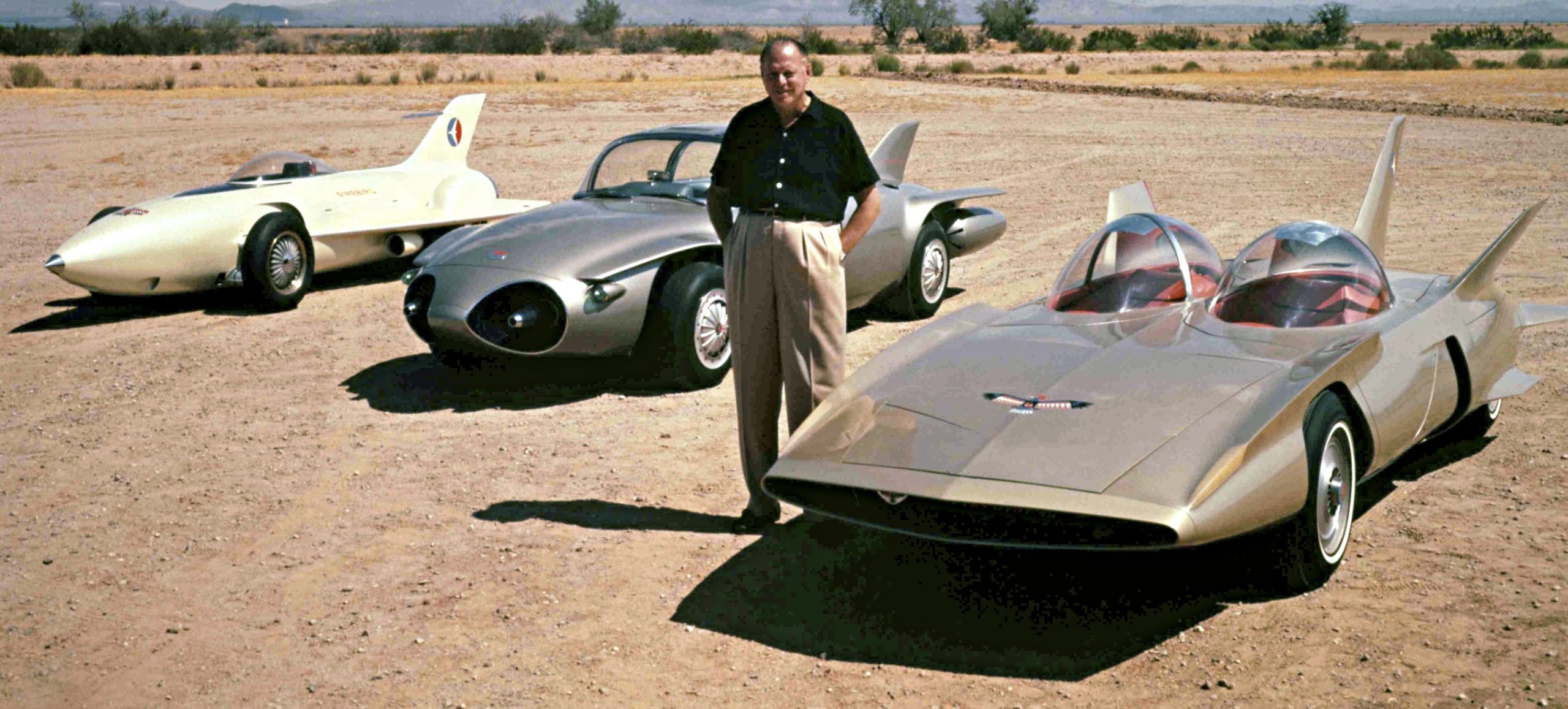
Former GM design chief Harley Earl with (from left) the Firebird I, II, and III concept cars.
It was a psychological reaction of visual shaming. If you drove a 3-year-old car, the neighbors could tell by the tailfins or the grille. This created pressure to upgrade to the latest version to maintain status.
This “planned obsolescence” ensured that customers would always want the newest look. Feeding this motorist ego also helped fuel the 1950s economic boom.
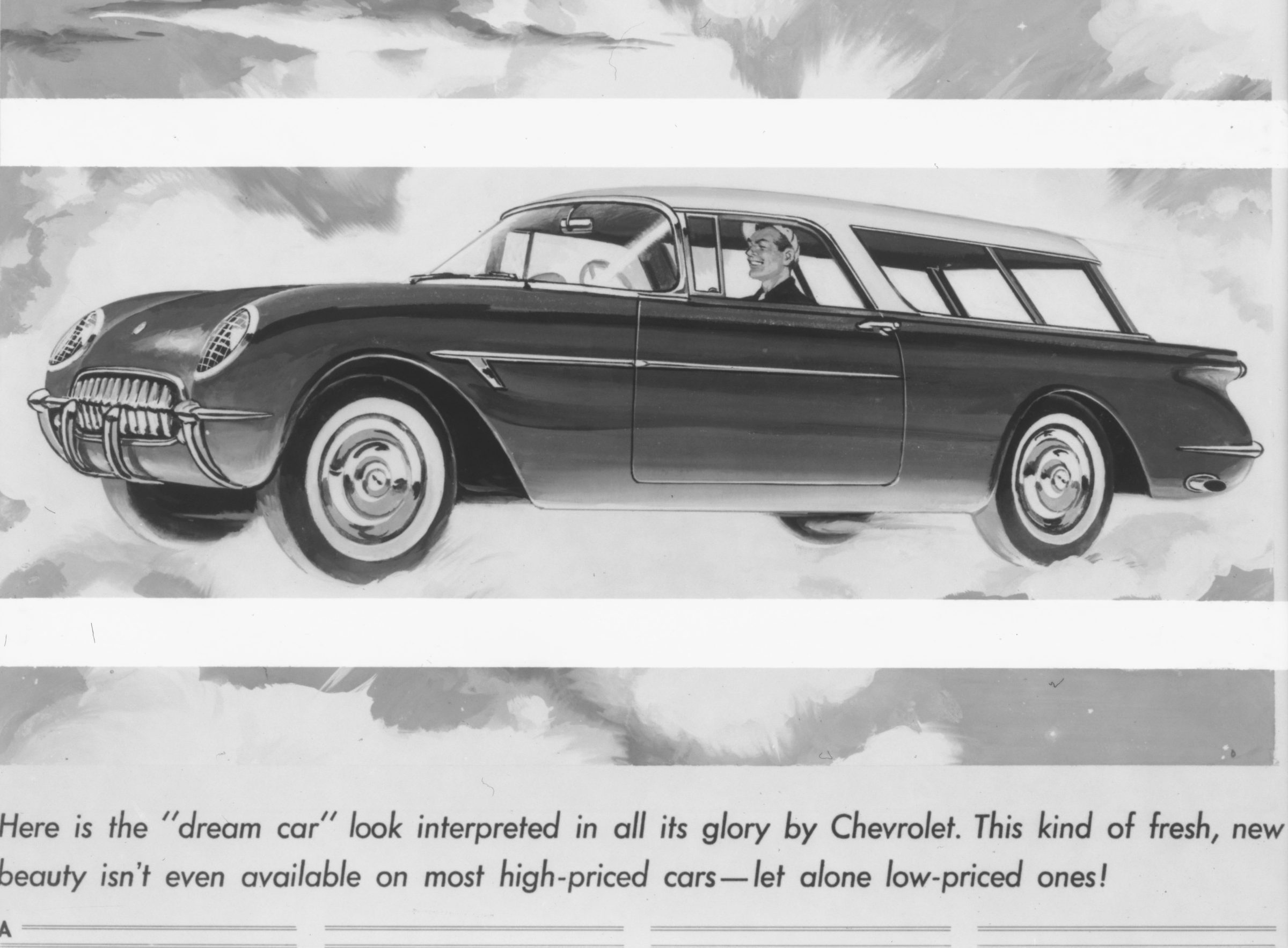
Here is the Dream car look!
Business Became Pleasure
The venue for feeding motorists’ egos came from boring lunch meetings.
Starting in 1931, Sloan had held annual industrial luncheons at the Waldorf-Astoria Hotel in New York City. These were high-society events for dealers, industry leaders, and the press. The luncheons were timed to coincide with the National Automobile Show.
The 1954 Chevrolet Corvette Nomad Motoramic turntable display.
Initially, Sloan’s luncheons staged a handful of cars in the grand ballroom as a backdrop for his economic speeches. But one idea led to another, and quickly the format was supercharged.
After World War II, America was ready for optimism. In 1953, reflecting a new era of showmanship, Sloan and Earl rebranded the Waldorf event as the “Motorama,” marking a significant shift in GM’s public presentations.
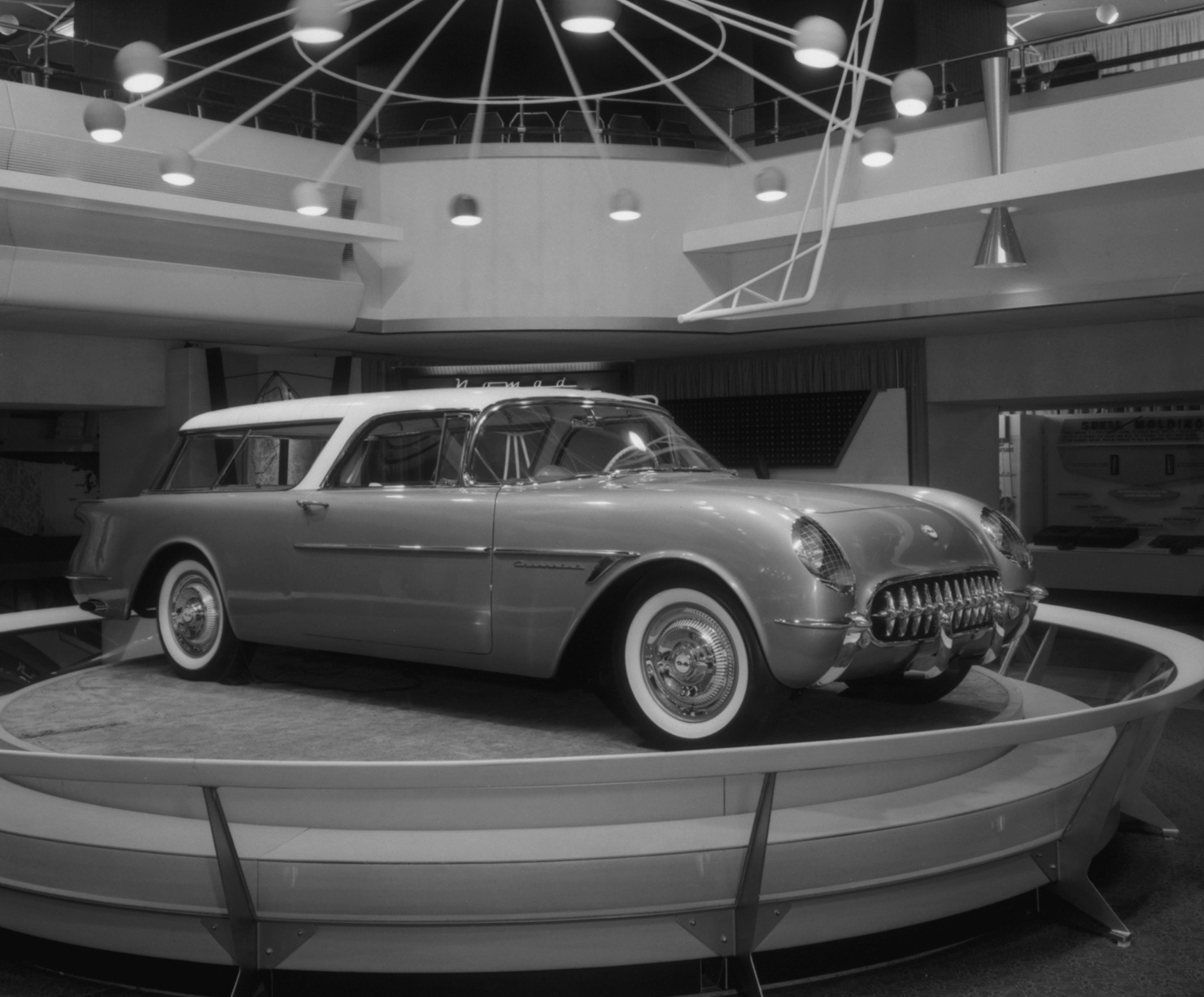
The 1954 Chevrolet Corvette Nomad Motoramic turntable display.
Setting the ‘Dream Car’ Stage
The GM Motorama (1953-1961) was a high-stakes, traveling auto circus. It transformed car shows from static displays into Broadway-style spectacles.
Each Motorama needed more than 100 specialized trucks. Setups were precisely timed. Crews would transform a ballroom into a futuristic wonderland, then move to the next city. The Motoramas usually lasted 6 to 10 days.
Typically, the tour started in New York (January), then moved to Miami, Los Angeles, San Francisco, and Boston.
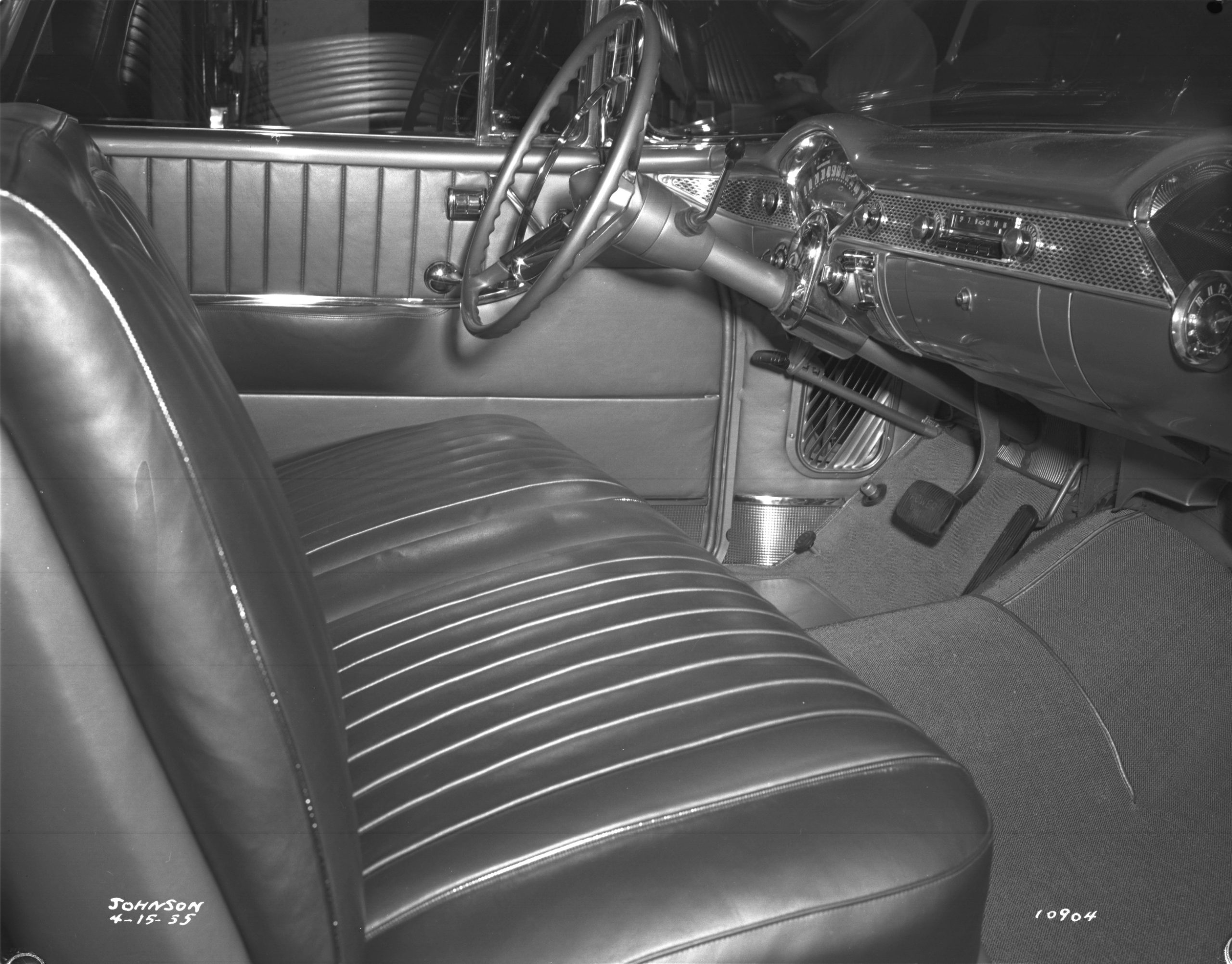
The Nomad Corvette concept featured a blue-and-white leather interior designed by Harley Earl.
The presentation was not just about cars. It featured a 27-piece orchestra and a 12-voice chorus. Professional dancers performed on “grass-hopper” platforms. The platforms lifted and revolved. Fashion models wore custom gowns by designers like Christian Dior. Their gowns matched the cars’ colors.
Dream Cars triggered a psychological red mist, clouding reason and self-control. These experimental prototypes gauged public responses to radical design elements. At the 1953 Motorama, the 1953 Corvette and 1954 Corvette Nomad concepts received enthusiastic reactions.
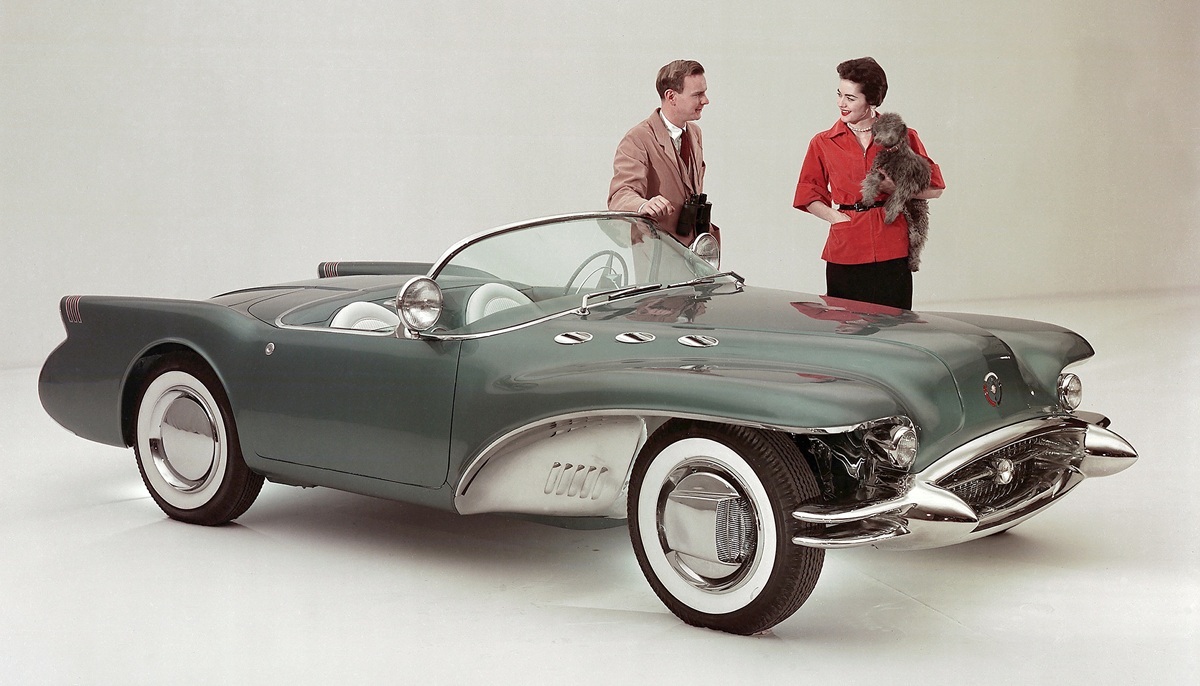
1954 Buick Wildcat II Concept Car.
Also among the inaugural Motorama concepts were:
- Firebird Series: Turbine-powered cars that looked like fighter jets (Firebird I, II, and III) showcased the era’s obsession with the Space Age.
- Buick Wildcat and Pontiac Bonneville Special: Both had fiberglass bodies and wraparound “panoramic” windshields. These details defined 1950s automotive design.
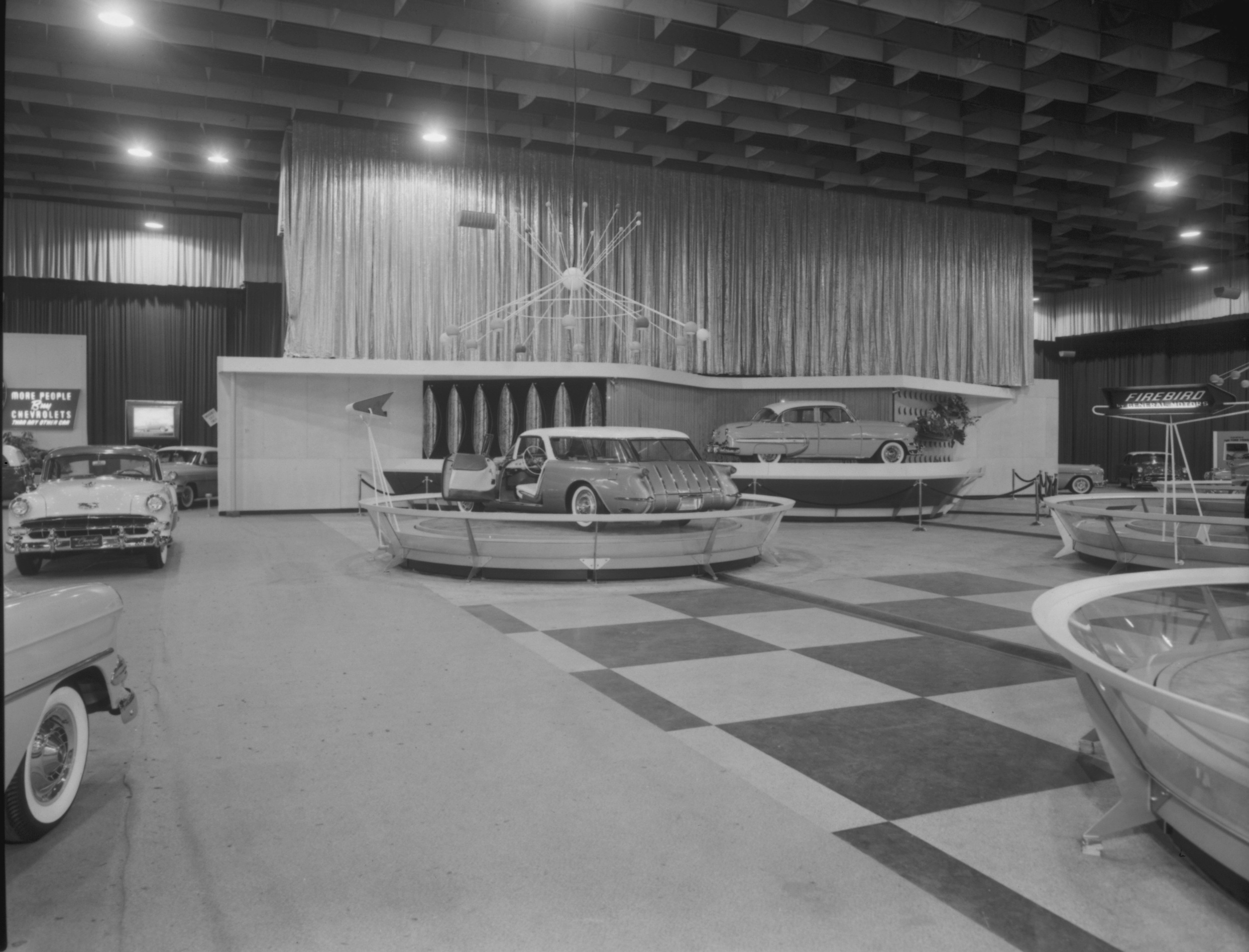
A 1954 Chevrolet Motoramic auto show display.
Kitchen of Tomorrow
GM also used the Motorama to market products of its subsidiaries, specifically Frigidaire.
On display was a “Kitchen of Tomorrow.” It featured futuristic conveniences like ultrasonic dishwashers, automatic ice makers, and wall-mounted refrigerators.
Combining dream cars and futuristic home conveniences was a goal to sell the “total modern lifestyle.”
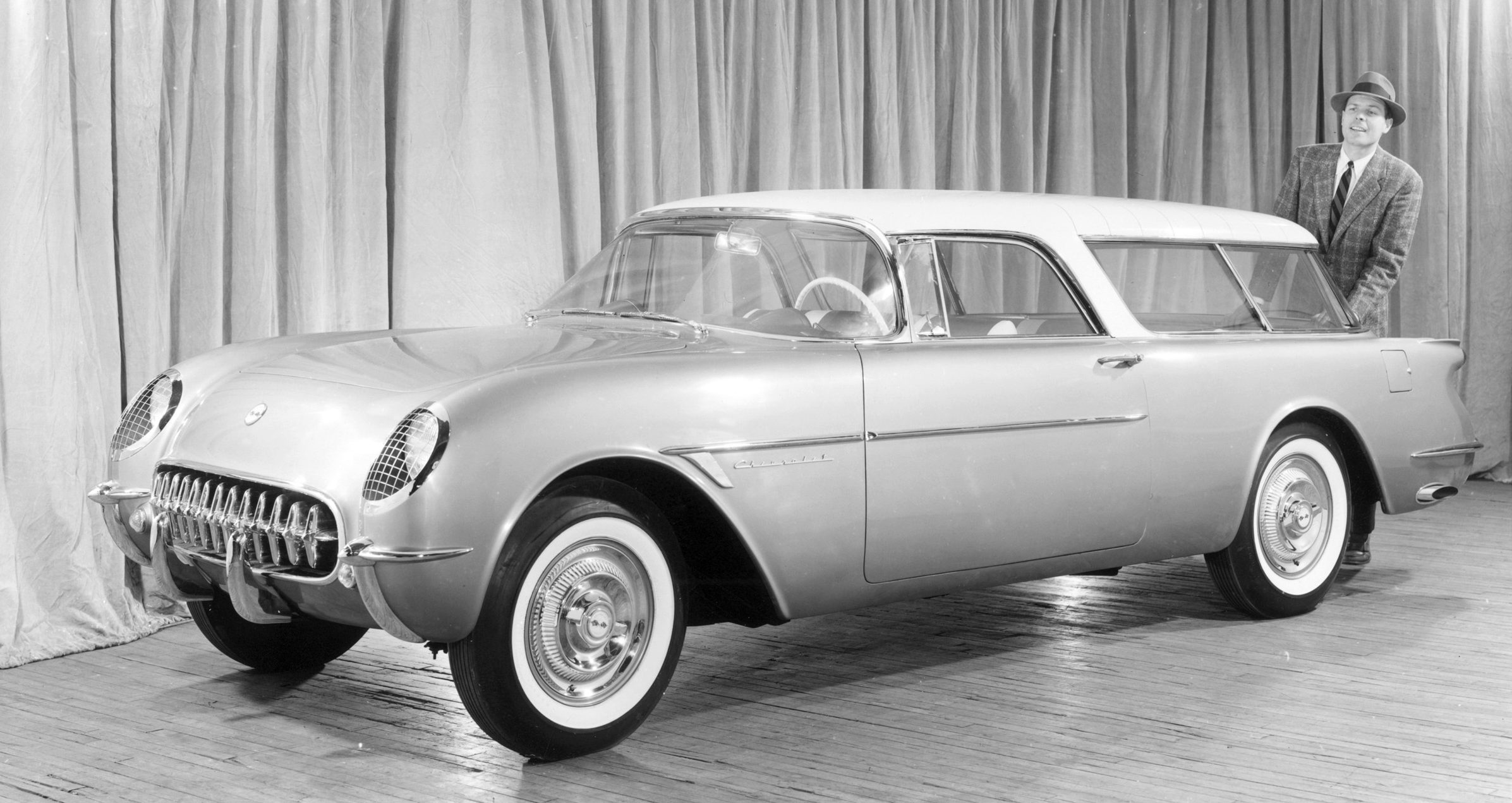
The 1954 Corvette Nomad concept. Note the high front end indicating no motor.
The “Corvette Wagon”
The Motorama’s eye candy of dream cars is all but gone today in any new-vehicle auto show. But the Motorama created two design icons, the Corvette and the Chevrolet Nomad. And with those cars came special designs applied across the GM vehicle lineup.
While most people recognize the later production 1955-1957 Nomad, the 1954 Motorama concept preceding it was quite different and much more radical, illustrating GM’s evolving design over time.
The 1954 Nomad concept was essentially a 1953 Corvette from the windshield forward. It had a specialized station wagon body.
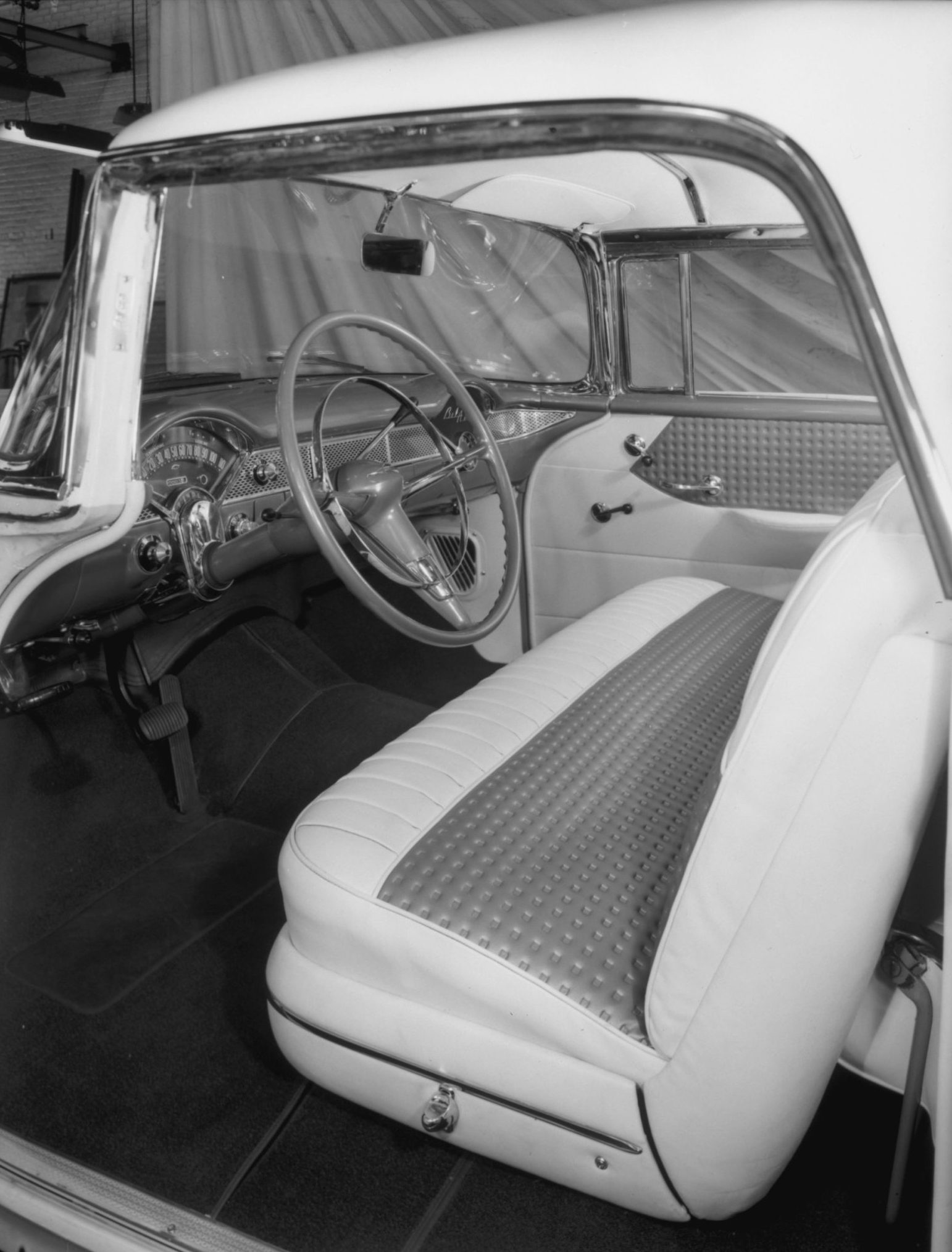
1955 Nomad driver area.
Fiberglass body: Like the Corvette, the entire body was made of fiberglass.
The “Face”: It featured the signature 1953 Corvette grille, round headlamps with wire-mesh guards, and low-slung front fenders.
Interior: It was a six-passenger wagon with a blue-and-white leather interior and a ribbed headliner. It resembled the cabin of a private jet.
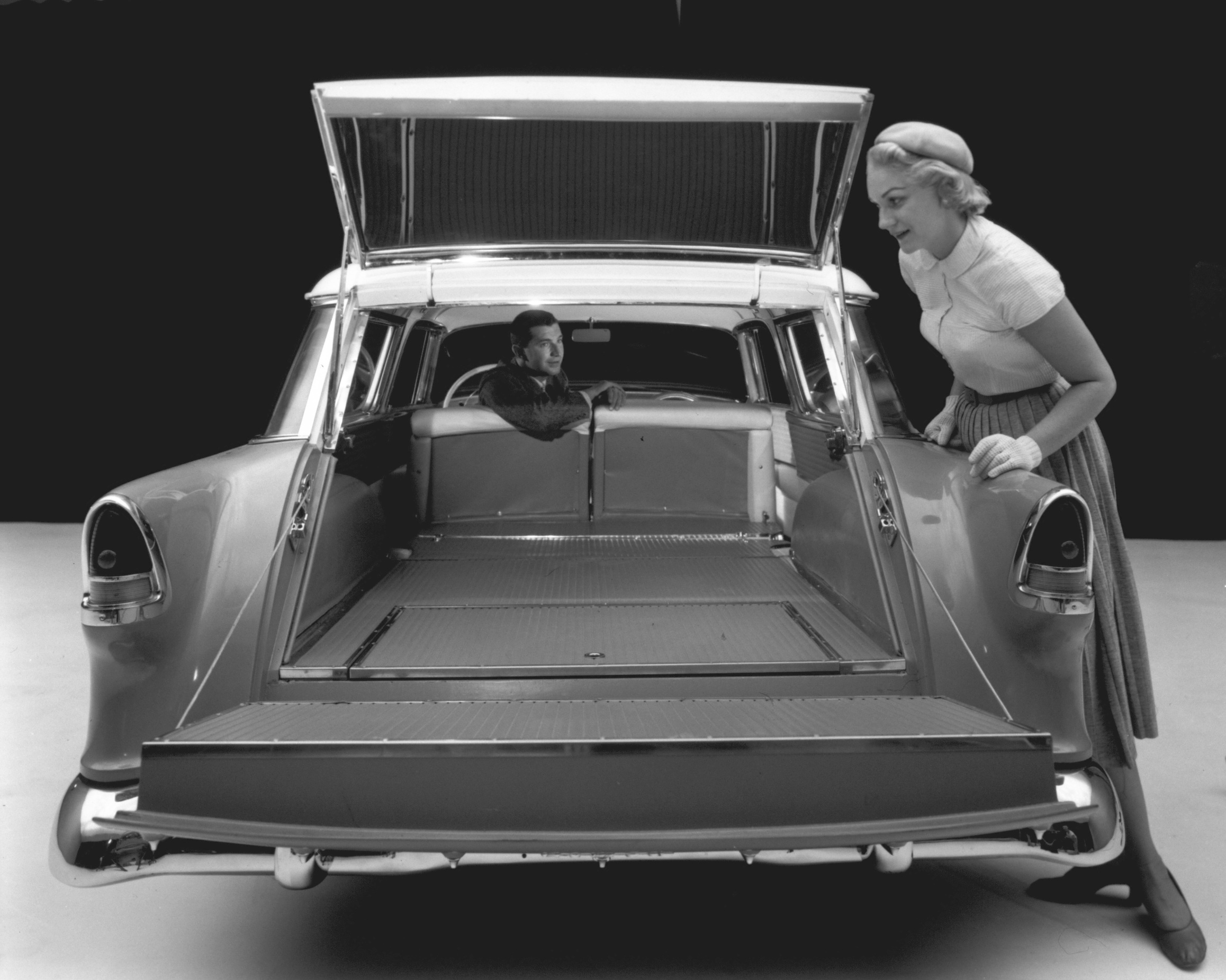
The wagon’s tailgate featured an innovative electric rear window that retracted into the tailgate.
Innovative tailgate: An electric rear window retracted into the tailgate. This feature would not become common on wagons for years.
Body: Unlike production Corvettes, the Nomad used a modified 115-inch Chevrolet sedan chassis.
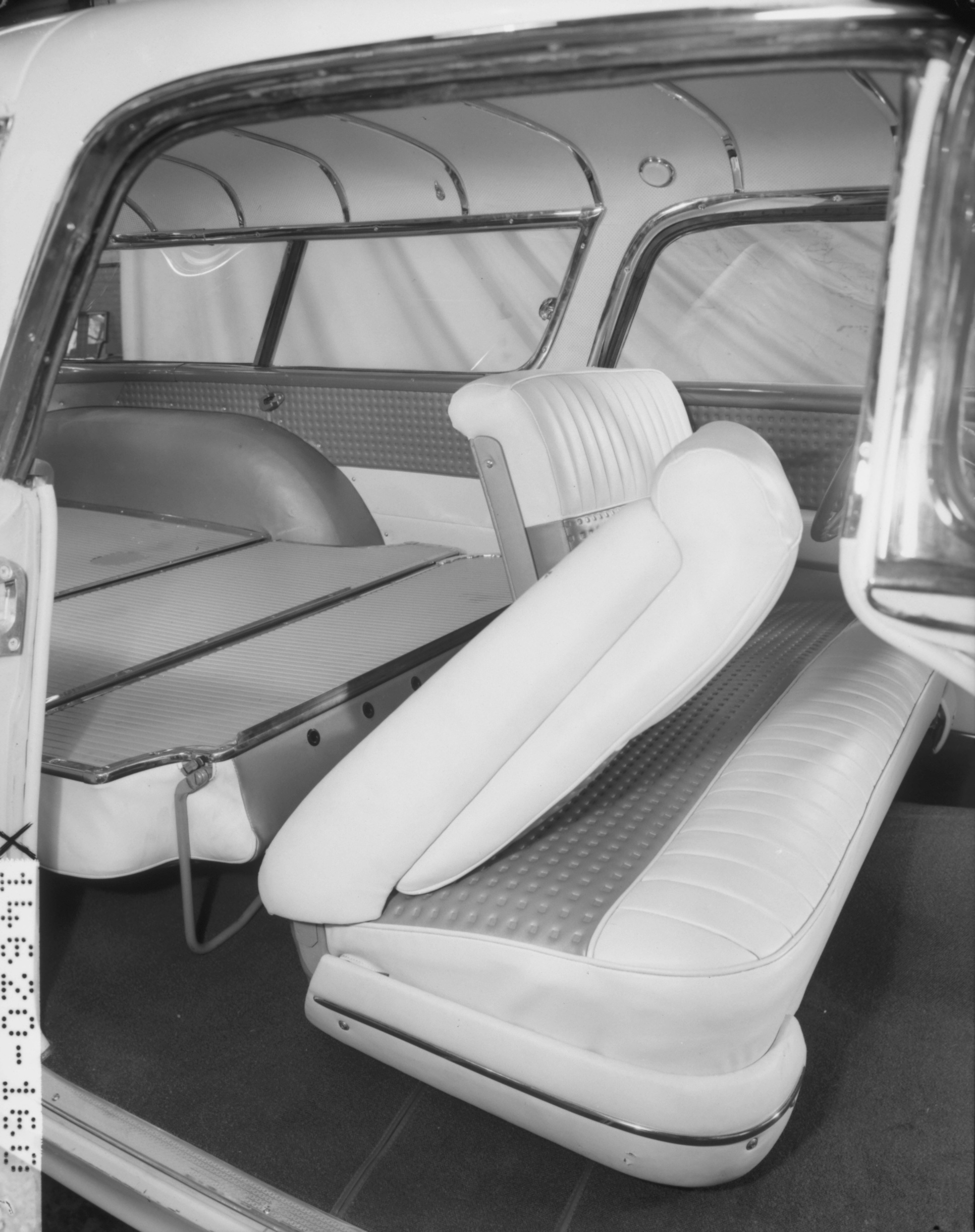
The 1955 Nomad’s interior had a presence like that of a private jet, Chevrolet said.
A Flagging Business Plan
Despite an ecstatic public reaction to the 1954 Corvette Nomad concept, GM executives were hesitant for two reasons:
Poor Corvette sales: The 1953 Corvette roadster’s first year was a disappointment. GM wasn’t sure the Corvette brand would even survive.
Practicality: A fiberglass, two-door sports wagon was expensive to build. It had a very limited market.
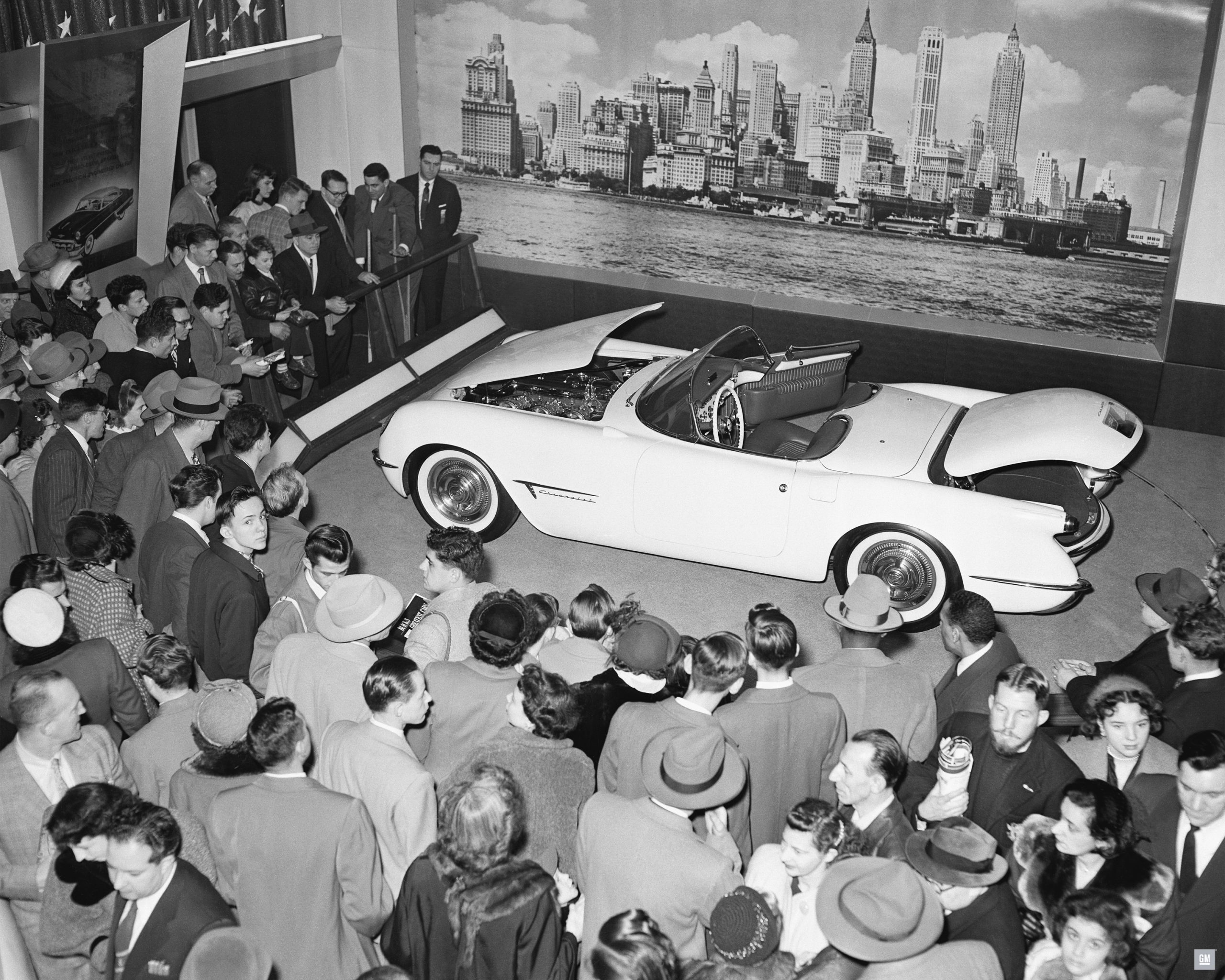
The reveal of the 1953 Chevrolet Corvette at the GM Motorama.
Birth of the 1955 “Tri-Five” Nomads
The Nomad concept did not make good business sense. But Earl believed its design sizzle would sell cars. He told his team to adapt the Nomad’s most striking features onto the 1955 Chevrolet Bel Air wagon.
Here is what was adapted from the Nomad concept for the production car:
Forward-slanting B-pillar: The “leaning” pillar gives the Nomad its fast-moving look.
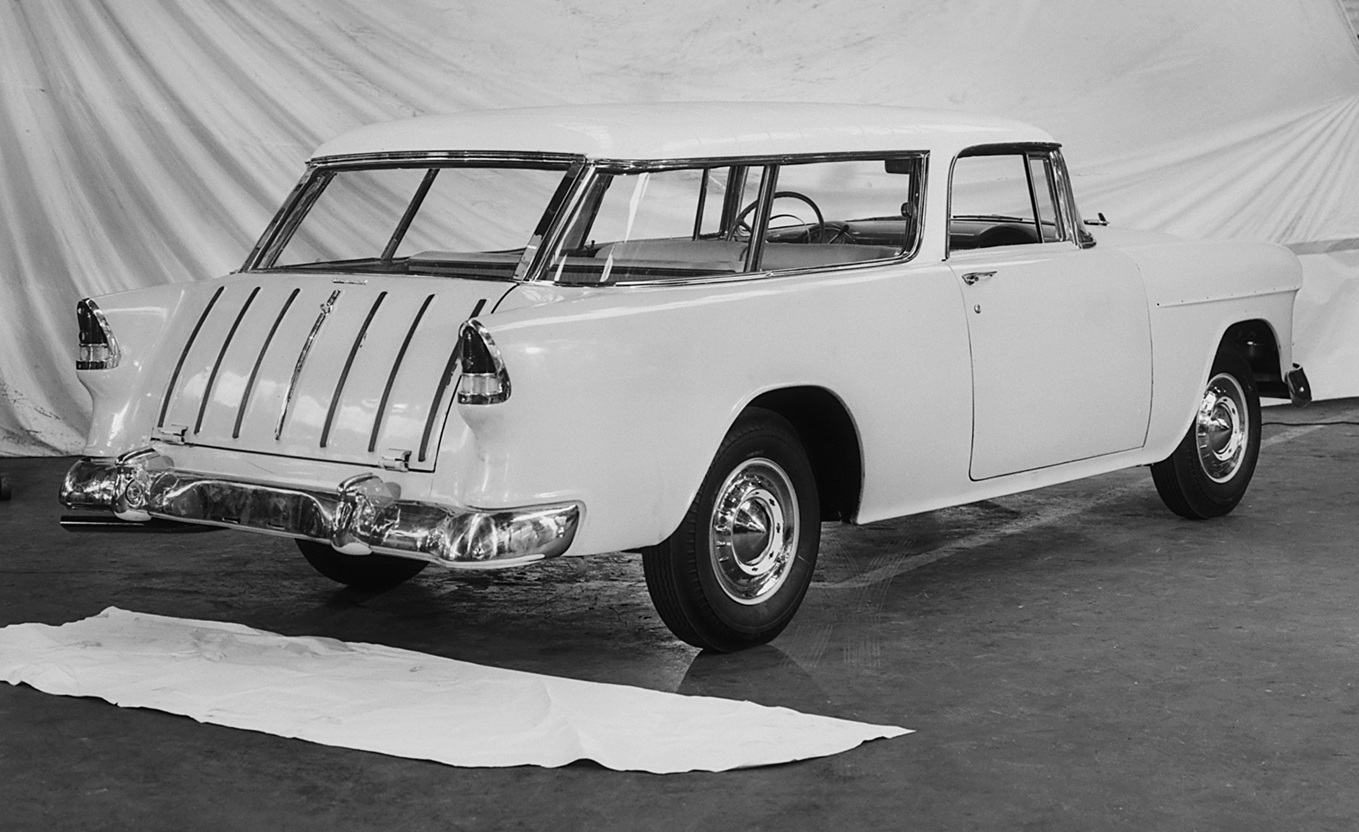
1955 Chevrolet Bel Air Nomad in the design studio. Note the seven tailgate ribs.
Fluted roof: Those unique grooves running across the roofline were a direct carry-over from the fiberglass concept.
Vertical tailgate “spears”: The seven chrome strips on the tailgate came from the Corvette-based concept.
Engine: It was powered by the Corvette’s 150-horsepower, 235-cubic-inch “Blue Flame” inline-six.
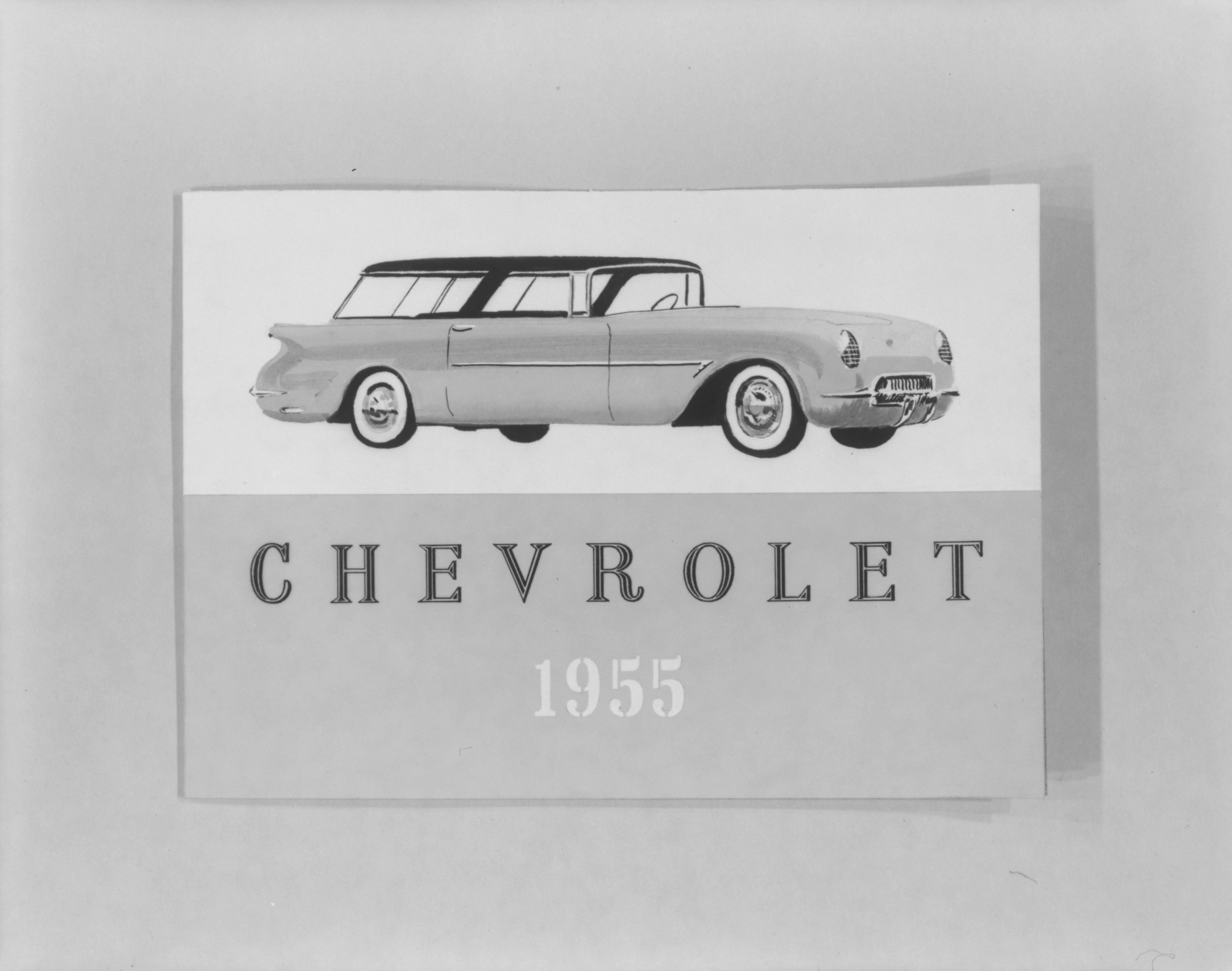
1955 Chevrolet Corvette Nomad brochure cover. Given the 1955 date, did GM anticipate the Corvette Nomad going into production?
1955-1957 Bel Air Nomad Sales
- 1955: 8,386
- 1956: 7,886
- 1957: 6,103
- Total: 22,375
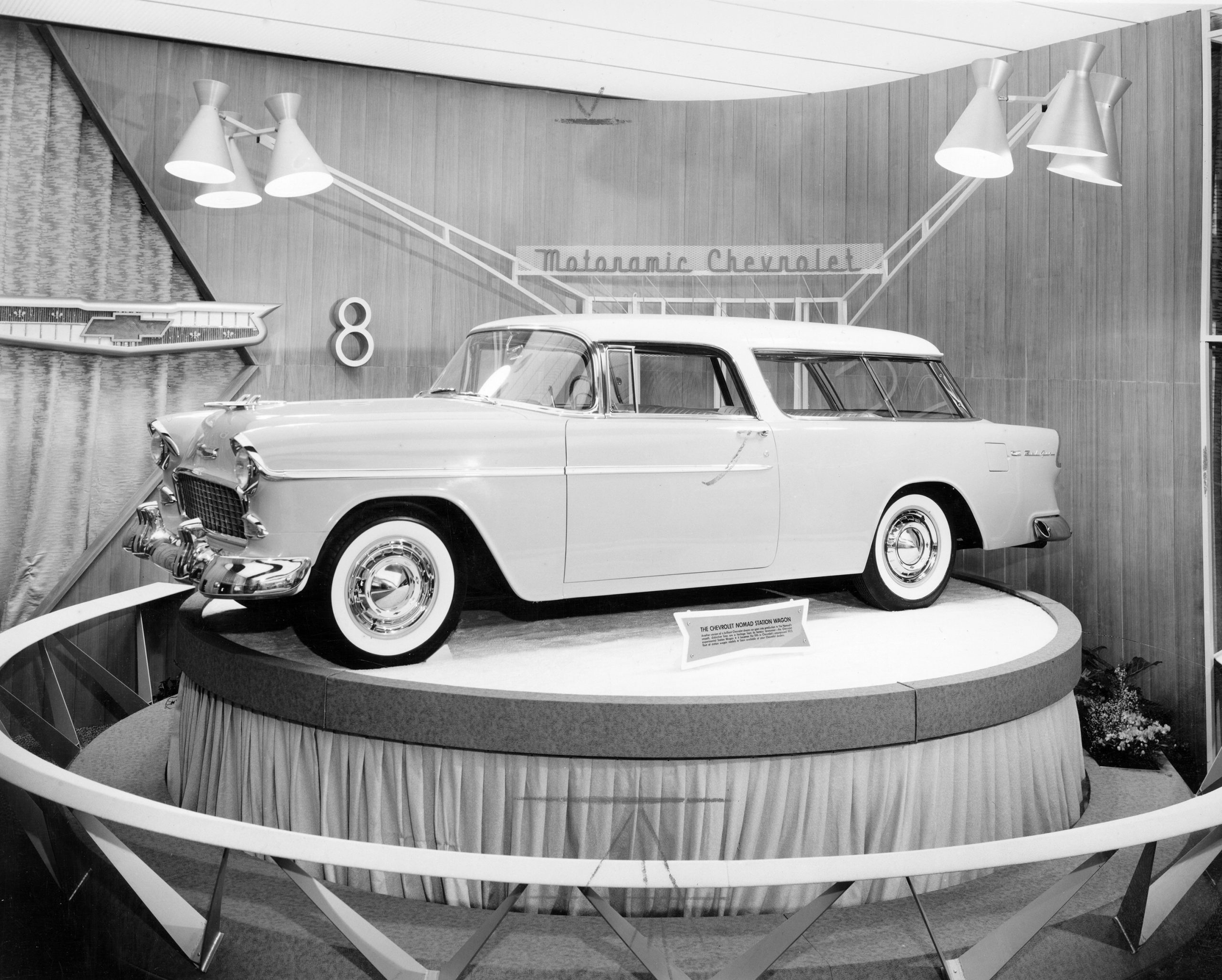
A 1955 Chevrolet Bel Air Nomad in a Chevrolet Motoramic display. The special plaque reads: “Another version of a brilliant Chevrolet dream car goes into production.”
The “Motoramic” Concept
“Motoramic” was a Chevrolet marketing term for its auto-show displays. It conveyed the bold, futuristic styling of its 1955 vehicles. The presentation aimed to make Chevrolet seem as prestigious as Cadillac and Oldsmobile.
Blending “Motor” and “Panoramic,” Motoramic highlighted two major shifts in the 1955 lineup:
Panoramic visibility: The introduction of the “Sweep-Sight” wraparound windshield, which eliminated the vertical A-pillars in the driver’s direct line of sight.
Modern engineering: The 265-cubic-inch “Turbo-Fire” V-8 debuted. It was Chevrolet’s first V-8 since 1918. This new engine was lighter, more efficient, and more powerful than the old “Stovebolt Six.”
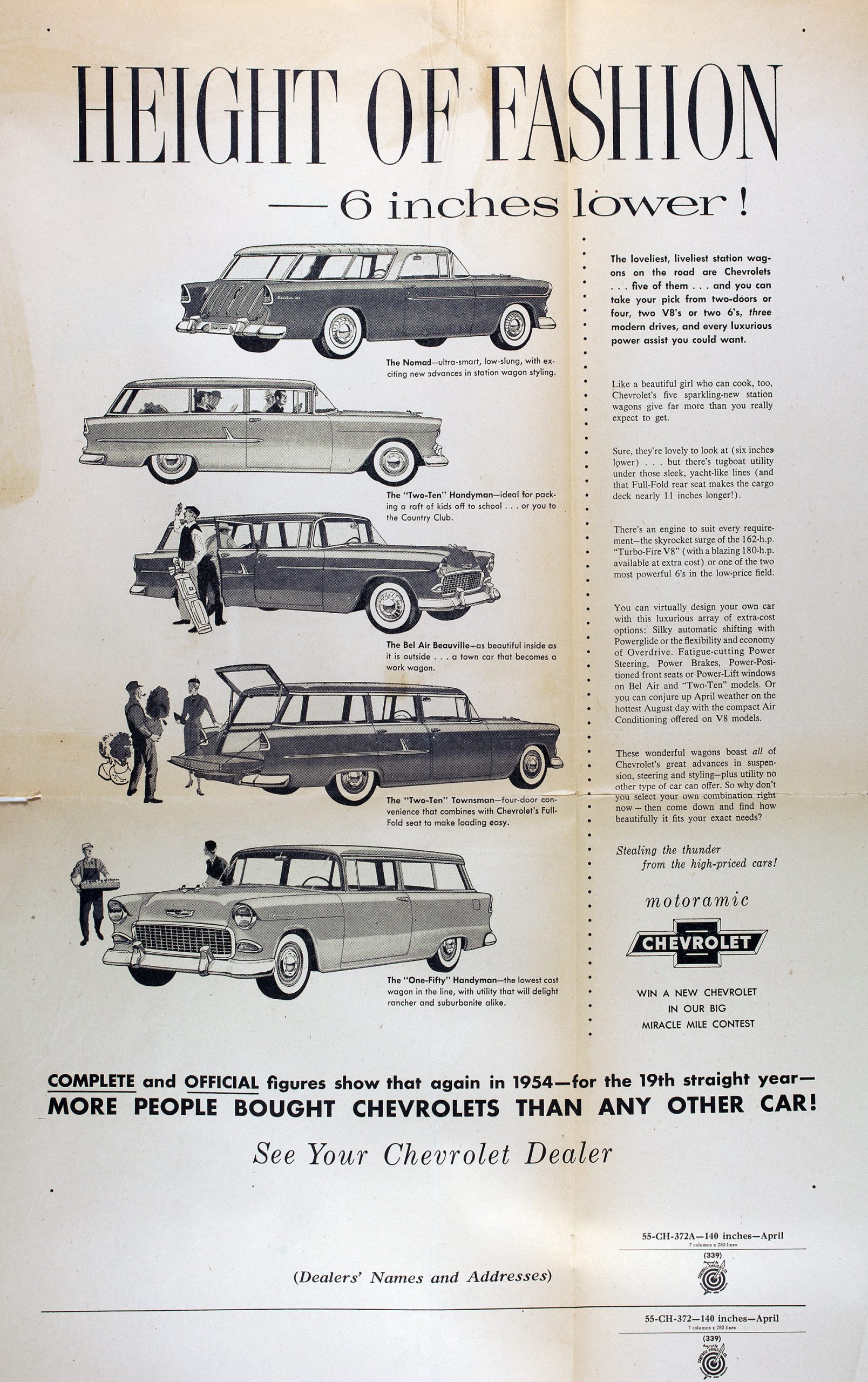
The Height of Fashion print ad promoting Chevrolet wagons for 1955.
Motoramic Station Wagons
In 1955, Chevrolet offered five different station wagon models under the Motoramic styling umbrella, categorized by trim level. While there were several choices of a two-door Chevy wagon, the Nomad was the pinnacle of the line.
Nomad (Bel Air trim): The “halo” car of the wagon lineup.
Townsman (Bel Air trim): A more practical, luxury-oriented four-door wagon that significantly outsold the Nomad due to its convenience
Beauville (Two-Ten trim): A mid-range four-door wagon.
Handyman (One-Fifty or Two-Ten trim): A budget-friendly two-door wagon often used for work or by small families.
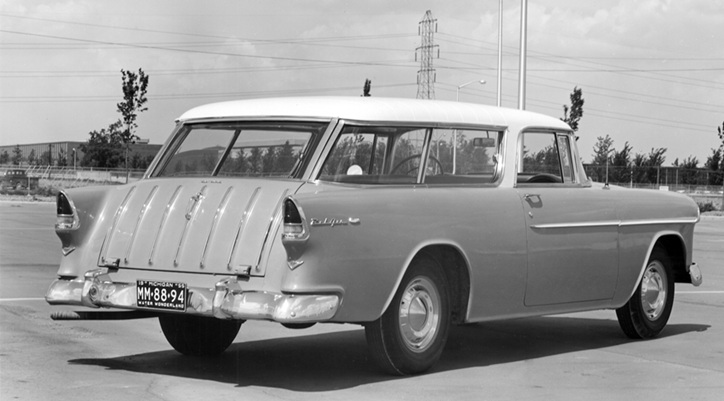
A 1955 Chevrolet Bel Air Nomad engineering prototype with Michigan license plate.
Key Chevrolet 1955 Design Features
The “Motoramic” look was defined by a “shoebox” body style. Flatter, straighter panels replaced the bulbous, rounded fenders of the early 1950s.
Also featured were:
Ferrari-inspired grille: An eggcrate grille design that gave the front end a wide, aggressive stance.
Lower hood lines: Possible because of the compact size of the new V-8 engine.
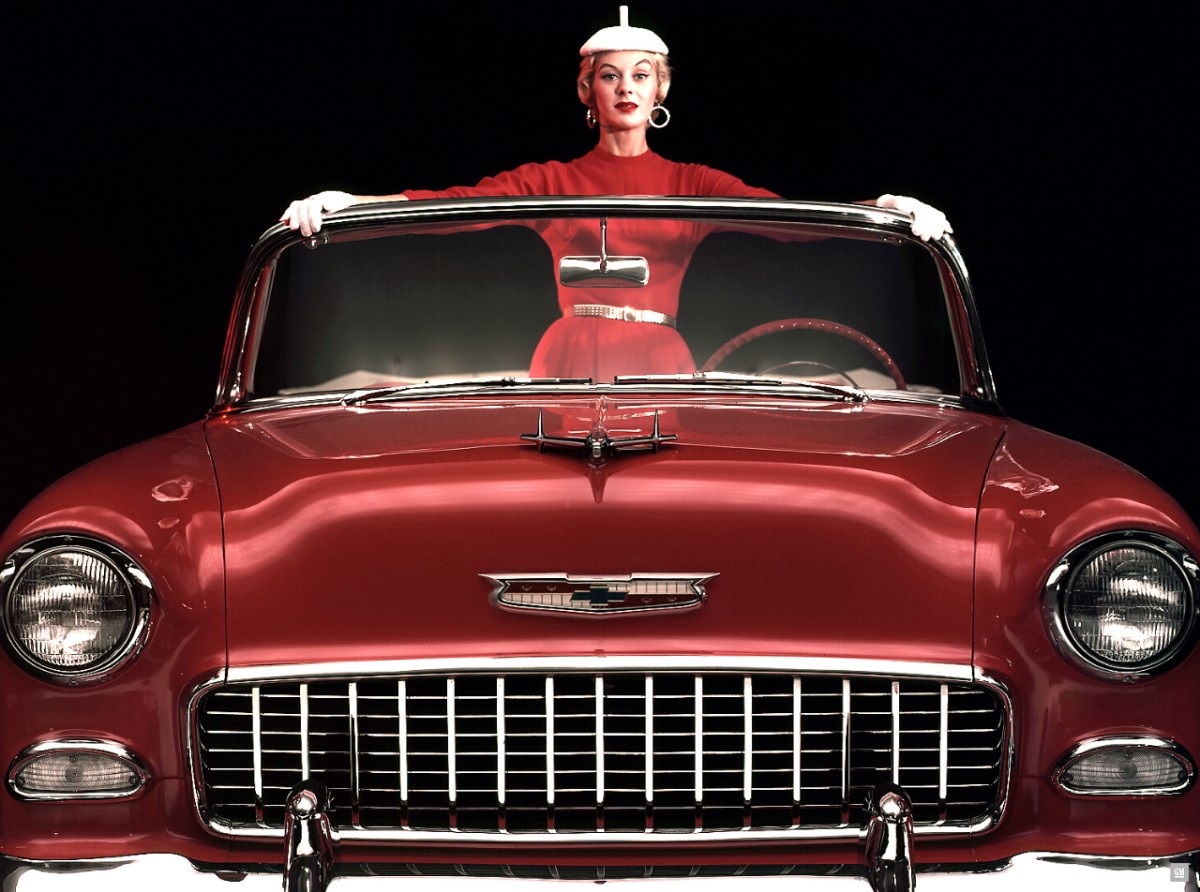
A 1955 Chevrolet BelAir convertible shows the new eggcrate grille.
Chevrolet Nomad for 1956 and 1957
1956: In keeping with annual updates to styling, the 1956 Chevrolet Nomad shared the same front fascia update as other 1956 Chevrolets. The Nomad’s exterior also adopted a unique variation of the revised side-panel trim of the Bel Air. It was given an upward-facing piece angled slightly forward to align with the B-pillar. On all other 1956 Bel Airs, this piece skewed slightly toward the rear. Again called both a Nomad and a Bel Air Nomad interchangeably, the model line received a standard two-tone exterior and interior.
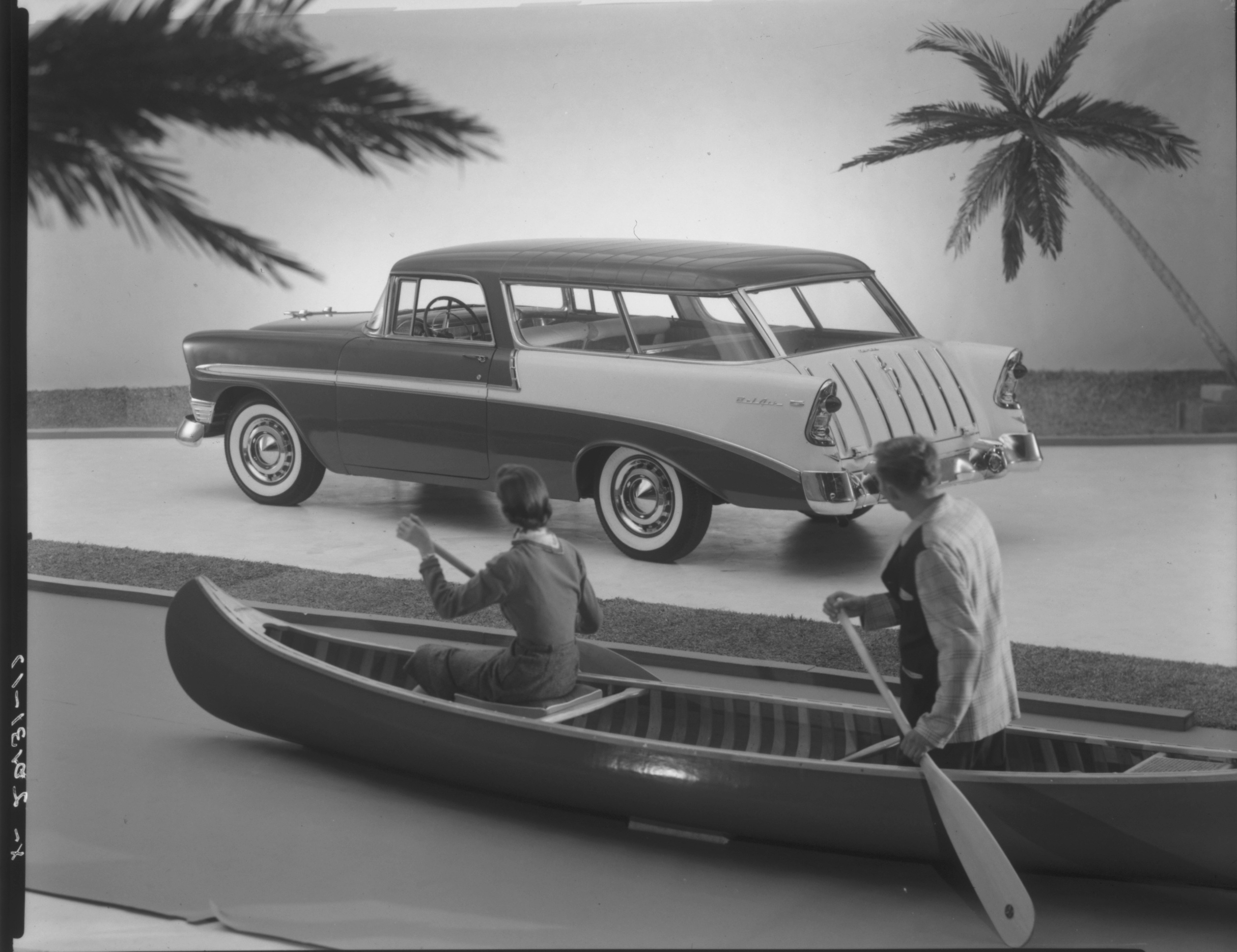
1956 Chevrolet Nomad advertising image amid South Pacific scenery yet with couple in canoe.
The fully radiused rear wheel openings were dropped for the Nomad; all non-Corvette Chevrolets received a larger rear-wheel cutout.
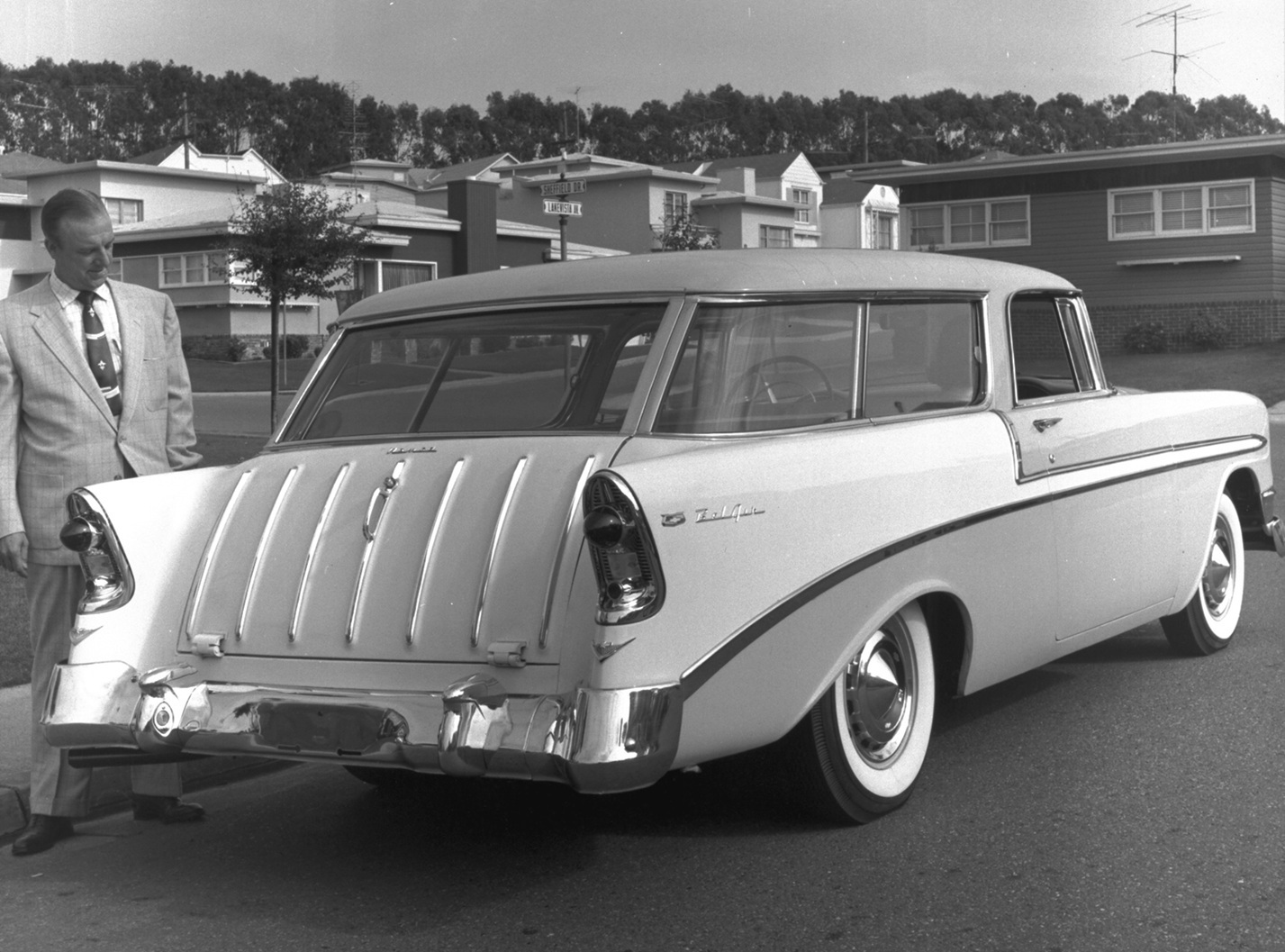
A 1956 Chevrolet Bel Air Nomad.
1957: As for the 1956 model-year Chevrolets, the 1957 Nomad adopted the same overall update as other 1957 Chevrolets. The 1957 Nomad featured a redesigned front fascia and dashboard. Large tailfins added several inches to the overall body length. While two-tone options remained for the interior, exterior two-tone combinations became more subdued, shifting back to a contrasting roofline color.
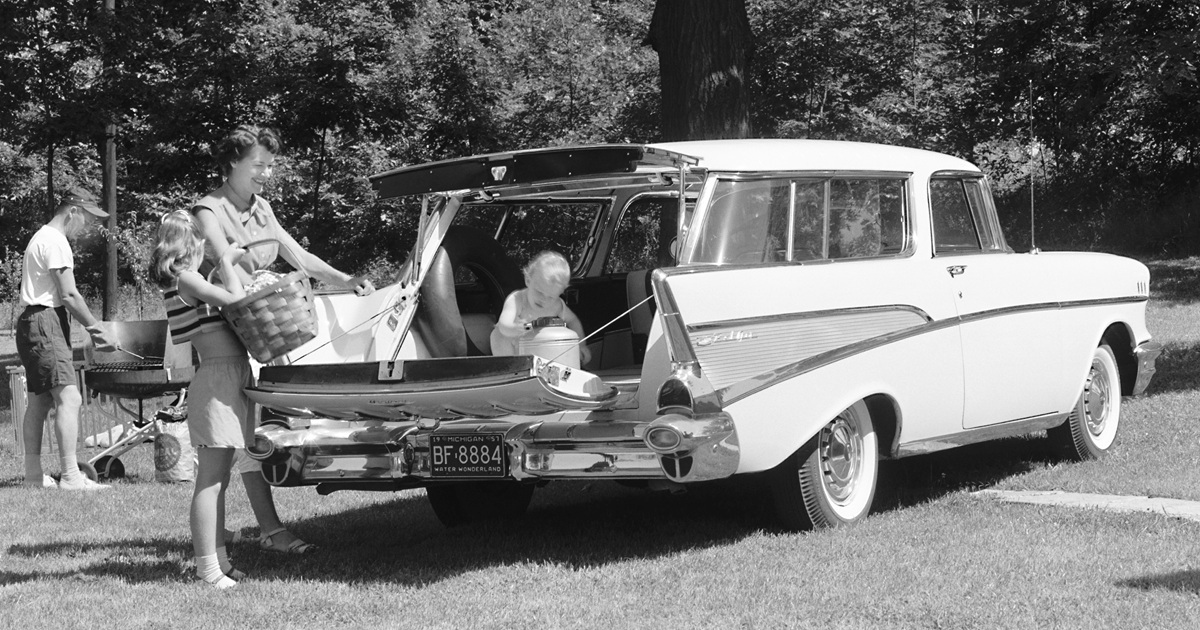
A 1957 Chevrolet Bel Air Nomad.
Following continued low sales of the Nomad through the Tri-Five generation, Chevrolet discontinued the distinct model after 1957. Consequently, Pontiac also withdrew the two-door Safari wagon. Instead, the division adopted the nameplate for nearly its entire range of station wagons.
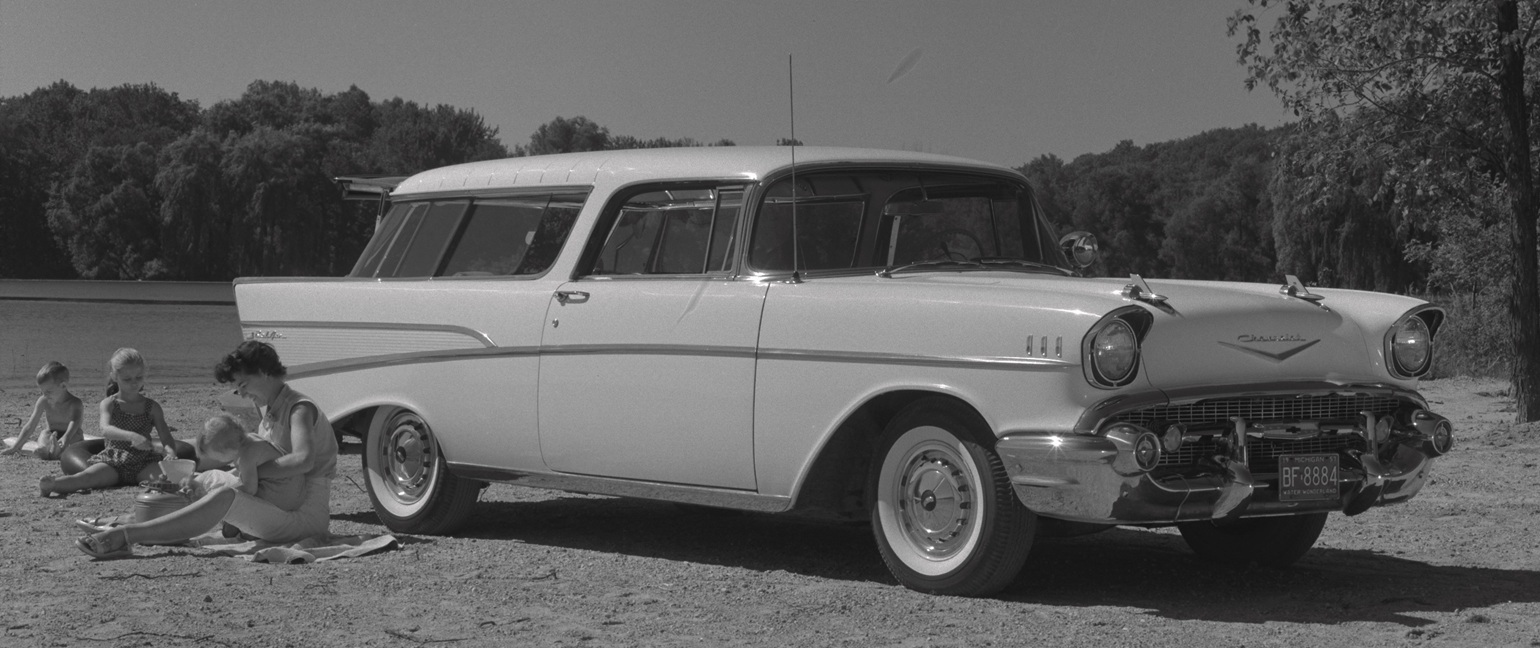
A 1957 Chevrolet Bel Air Nomad.
Original Bel Air Nomad MSRP
1955 to 1957 starting prices, with a six-cylinder or V-8 engine:
- 1955: $2,472 to $2,571
- 1956: $2,608 to $2,707
- 1957: $2,757 to $2,857
The Pontiac Safari Spinoff
While the Tri 5 Nomads are cult classics, there is a rarer, more upscale platform cousin: the Pontiac Safari. GM struck when the sizzle was hot from the Corvette Nomad concept and gave a version to its Pontiac division.
The Pontiac Safari made its debut at the 1955 Motorama and went into production on Jan. 31, 1955. It would be Pontiac’s flagship station wagon and its most expensive model that year.
To make production viable, GM moved the Nomad-Safari’s design to the full-size A-body platform. To split tooling costs, the Safari and Nomad bodies were built in the same Fisher Body plant in Euclid, Ohio. Both models are the same above the beltline — roof, windshield, windows, and liftgate. They use the same doors, tailgate, and seats.
Other than the body components, the Safari and Nomad share very little. There are major differences in the trim, dash, floor, quarter panels, heating, frame, front end, engine, and drivetrain.
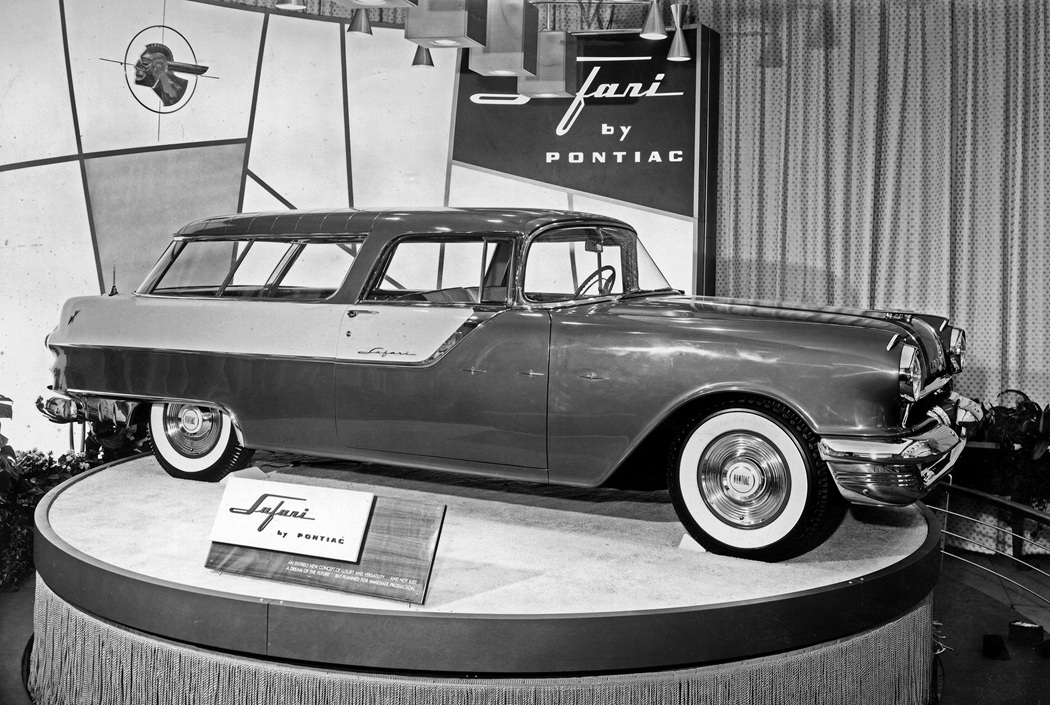
The Pontiac Safari made its debut at the 1955 Motorama.
Nomad’s Specialized Production
The 1955-1957 Chevrolet Nomads were built using a unique, two-stage process. Their low-production body style required specialized work that the standard high-volume Chevrolet lines were not equipped to handle.
Every Nomad body was built at GM’s Fisher Body Euclid Avenue plant in Cleveland. The line was capable of low-production, labor-intensive jobs, such as for the Nomad’s grooved roof, slanted B-pillars, and glass.
After being built, trimmed, and painted in Cleveland, the partially completed bodies were shipped via train in bi-level rail cars. (A myth persists that the Nomad bodies were rail shipped almost vertically on their rear bumpers to save space. However, the so-called Vert-A-Pac system was used to ship the 1970 for the Chevrolet Vega, nose down.)
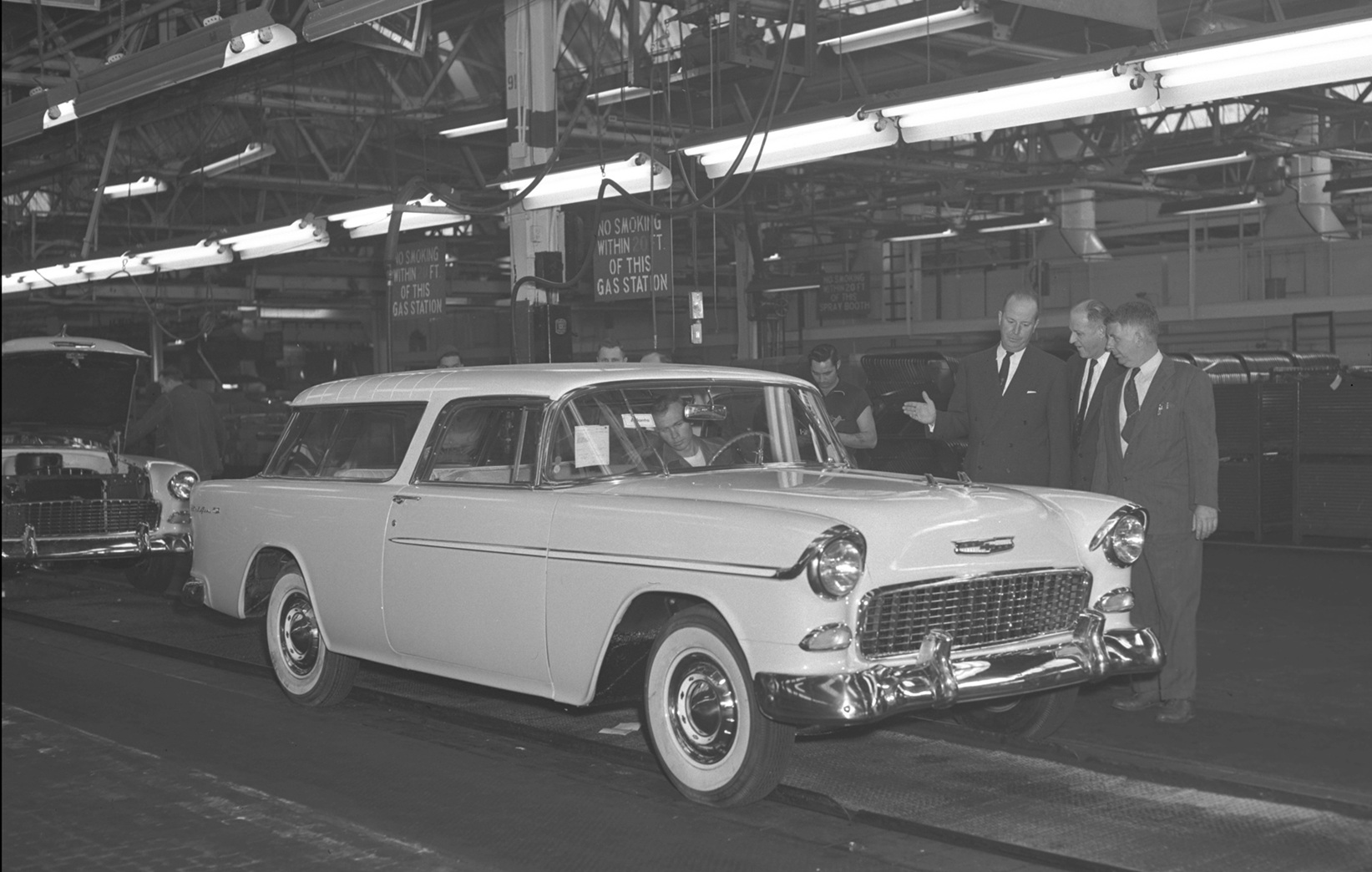
1955 Chevrolet Nomad on the Cleveland production line with GM execs. Harley Earl is the center.
Final assembly
Once the bodies arrived at the various Chevrolet assembly plants across the country, they were mated to their chassis, engines, and front-end sheet metal.
Key final assembly locations included:
- Atlanta, Georgia (Lakewood Assembly)
- Flint, Michigan (Flint Truck Assembly)
- St. Louis, Mo.
- Tarrytown, N.Y.
- Los Angeles-Van Nuys, Calif.
- Baltimore, Md.
- Janesville, Wisc.
- Norwood, Ohio.
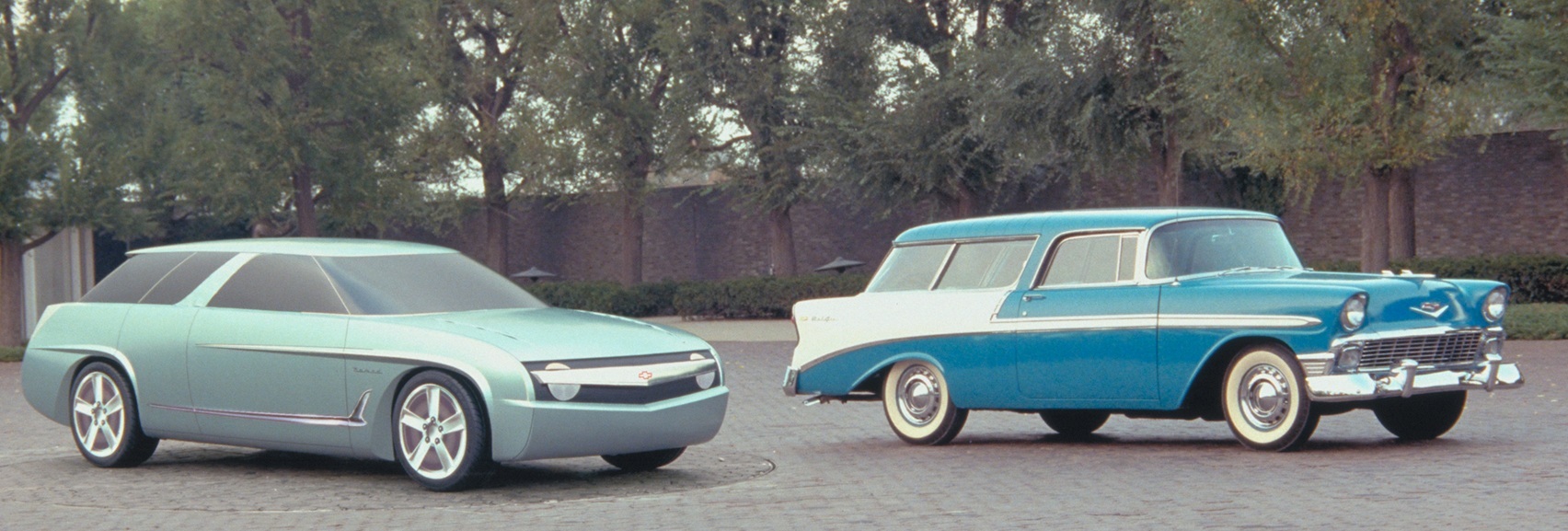
A 1956 Chevrolet Nomad and its 1999 Nomad concept.
Where Is the Original Nomad concept?
The 1954 Nomad concept was a particularly special piece of automotive history. It had a custom interior for Harley Earl. GM often designed custom interiors for executives and celebrities, making those specific 1955 Nomad photos particularly rare.
As was the case with many Motorama “Dream Cars,” GM officially ordered the 1954 Nomad concept to be crushed to avoid tax and legal liabilities.
There were reportedly five built for the show circuit, but most were destroyed.
It is often referred to as the “Waldorf Nomad,” reflecting its debut at the Waldorf Astoria Hotel in New York.
Rumors persist that one or two might have survived in private collections, though none has been publicly verified.
Sources: The National Corvette Museum; RM Sotheby’s and Mecum Auction Archives; “Standard Catalog of American Cars” (1946–1975); GM Heritage Center; Waldorf-Astoria archives; Detroit Free Press and Wall Street Journal; “Modernism and the Motor City” (Academic Research).
