Select Page

Curtiss Goupil Duck

Curtiss Goupil Duck

The birdlike design of the 1917 Curtiss Goupil Duck was based on a monoplane glider by French engineer Alexandre Goupil in 1883

A blackl and white photo of a 1917 Curtiss-Goupil Duck, which was quite birdlike in design.

The 1917 Curtiss Goupil Duck became a patent battleground between aerospace founder Glenn Curtiss and the Wright Brothers. World War I settled the matter. (Photo from the Paul S. Maynard archive)

BY MARK MAYNARD

My dad, Paul Smith Maynard, worked for nearly four decades in aviation as an engineer. His specialty was metals, or metallurgy. Among his tasks was to determine at what point a metal part would fail. He experimented with new, lightweight metals and honeycombed metals that were lighter but strong. He evolved into rocketry, so I consider my dad a rocket scientist, though he would decline that attribute.

Dad began his career in about 1943 after graduating from West Virginia University. He started with Curtiss-Wright Corp., an early pioneer in making flying machines. It was founded by Glenn Curtiss, the father of naval aviation, and the Wright brothers, renowned for history’s first flight. Dad worked at the plant in Columbus, Ohio, where I was born in 1954.

Post-World War II, Curtiss-Wright shut down its Aeroplane Division in 1948 and sold the assets to North American Aviation. Dad was among the assets moved to NAA, which was a leader in aerospace contracts. It eventually would merge again and become Rockwell International, also in Columbus.

Occasionally, dad would bring home glossy PR photos of airplanes and prototype or maybe a chunk of some special metal. Lately, I’ve been going through his boxes of work paperwork and found a trove of early warplanes and other prototypes from Curtiss-Wright to Rockwell.

Among the pictures was this black-and-white image of a 1917 Curtiss Goupil Duck on floats. It emerged during a pissing match between Glenn Curtiss and the Wright Bros. The Wrights felt that certain elements of wing design fell under their patent of 1906, based on “wing warping.”

The Patent Battle

With their patent, the Wrights hoped to gain a monopoly on manned flight. The patent would require anyone building aircraft to pay a royalty to them. It is a fascinating story, well told by Airways magazine.

In 1908, Glenn Curtiss sought to circumvent the Wright’s patent by using ailerons, rather than wing warping. Ailerons use moveable flaps in the wings, which are considered more efficient and simpler for lateral control.
Among my dad’s photos was this 1917 Curtiss Goupil Duck, which used a design by French engineer Alexandre Doupil’s birdlike monoplane glider from 1883.

The plane was never developed. At the start of World War I, the U.S. government persuaded Wright to release the patent for combat aircraft to be developed.

Boeing KC-97G Stratofreighter

Boeing KC-97G Stratofreighter
A 1953 black and white image of a Boeing KC 97G Stratofreighter on takeoff, exhaust spewing from its four engines.

According to Wikipedia, the KC-97 Stratofreighter was an aerial refueling tanker variant of the C-97 Stratofreighter. (Photo from the Paul S. Maynard archive)

Cleared for Takeoff!

Boeing KC-97G Stratofreighter 

BY MARK MAYNARD

This circa 1953 photo appears to show a big Boeing KC-97G “Stratofreighter.” According to the Museum of Aviation at Robins Air Force Base in Georgia, its wingspan was 141 feet, 2 inches, and it was powered by four Pratt & Whitney R-4360s of 3,500 hp each and two General Electric J47s of 5,970 lbs. thrust each.

At 117 feet, 5 inches long with a height of 38 feet, 4 inches, the plane weighed 153,000 lbs. max. and was capable of cruising at 230 mph with a top speed of 400 mph and had a range of 2,300 miles.

According to Wikipedia, the KC-97 Stratofreighter was an aerial refueling tanker variant of the C-97 Stratofreighter, based on the Boeing B-29 Superfortress.

The U.S. Air Force began operating the KC-97 in 1950.

“[The plane’s] cavernous upper deck was capable of accommodating oversize cargo accessed through a very large right-side door. Transferable jet fuel was contained in tanks on the lower deck (G-L models). Both decks were heated and pressurized for high-altitude operations. The boom operator lay prone, viewing operations through a window at the bottom of the tail, a configuration later used on the KC-135.

The KC-97G had a dual role of aerial refueling tankers (underwing fuel tanks) and cargo transport. In addition to the plane’s aviation gasoline for the piston engines, the tanker also carried jet fuel for its refueling mission.

“While it was an effective tanker, the KC-97’s slow speed and low operational altitude complicated refueling operations with jet aircraft,” according to the Wiki report. “B-52s typically lowered their flaps and rear landing gear to slow the aircraft enough to refuel from the KC-97.”

There were 592 KC-97G models built.

Kia Telluride: What’s New for 2023

Kia Telluride: What’s New for 2023

1,000-mile round-trip road trip in a 2023 Kia Telluride in near-luxury and complete comfort

An exterior view of a 2023 Kia Telluride sport utility vehicle in wolf gray

The 2023 Kia Telluride SX-Prestige X-Line tester was $53,825 with options for Wolf Gray paint ($495) and carpeted floor mats ($210). Pricing includes the $1,335 freight charge from West Point, Ga. (Photos by Mark Maynard)

Table of Contents

Road-Trip Ready Telluride
2023 Telluride Pricing
Interior Function
Back Seats and Cargo Space
V-6 Performance
Ride and Handling
Safety Technologies
What’s New for 2023?
Why Buy the Kia Telluride?
Specifications

BY MARK MAYNARD

I had just unpacked from a 1,000-mile round-trip road trip in a 2023 Kia Telluride and wasn’t ready for the drive to end. It was a holiday getaway with the girlfriend-wife and her sister and brother-in-law to spend Christmas with the sisters’ brother and wife in Santa Cruz. It was the quintessential getaway of four retirement-age friends rolling along in near luxury and complete comfort.

With its 291-horsepower V-6, there was plenty of power for secure acceleration — with all of us, our gear, and the Telluride’s all-wheel-drive curb weight of 4,482 pounds. Hefting such poundage still returned a combined fuel economy of 21.2 mpg to a max of 25.6 — on the recommended 87 octane.

To call the Telluride an SUV is almost disrespectful. The clumsy term with negative impact has endured from the early truck-based “sport utility” vehicles. And most of these were seldom sporty or provided much utility.

A view through the windshield from the driver's seat on a rainy day.

Sightlines are unobstructed over the fenders and over the shoulder.

Road-Trip Ready Telluride

The test vehicle was an upper trim level Telluride SX-Prestige V-6 with all-wheel drive and the new-for-2023 X-Line treatment. The new X-Line and X-Pro trim levels have some off-roading traits. X-Line and X-Pro trims have a slightly raised ride height (about a third of an inch), 20-inch black wheels, a unique black grille, trailering tow mode, and upgraded traction control for better control on gravel and sand.

Somebody could forgive such a blunt front end for some interior wind noise, but the Telluride is better soundproofed than some luxury SUVs I’ve tested. Conversations do not wash out in a wall of white noise or road harshness, thank you very much in part to the Michelin tires.

With three rows, the Telluride has seats for seven with the second-row captains’ chairs or eight seats with a second-row bench. The three-position third row is kid class in legroom, but it folds flat into the floor, making it ideal for lots of luggage. We could stow all the suitcases, the cooler of homemade foods and goodies for holiday meals, and the presents. It all fit below the rear window line, but if cargo must be stacked to the headliner, the Telluride has a digital rearview camera that gives a wide-open rearward view. (It is a welcome feature when pulling a trailer.)

There is no need for running boards to climb aboard (even with the X-Line lift). And all four of us had captain’s chairs, heated and ventilated, with rear side sunshades. The front seats are power-adjustable, including lumbar, with seat-bottom thigh extension for the driver.

Dual pane sunroofs in the Telluride SX create a light and pleasurable space for passengers.

Dual pane sunroofs in the Telluride SX Prestige.

2023 Kia Telluride Pricing

Telluride is sold in 10 trim levels: LX, S, EX, EX-X-Line, SX, SX-X-Line, SX-X-Pro, SX Prestige, SX Prestige X-Line, SX Prestige X-Pro. Entry-level LX, S, EX trims are front-wheel drive; AWD is optional ($2,000) and includes Michelin tires. Trims of SX and above have standard, active on-demand AWD.

The powertrain for all trims is a 291-horsepower, Atkinson cycle 3.8-liter, direct-injected V-6, and eight-speed automatic transmission. The tow rating is 5,000 pounds or 5,500 for the SX X-Pro.

Starting prices range from $37,025 for the LX to $54,120 for the top-line SX Prestige X-Pro. Today’s SX-Prestige X-Line tester starts at $53,120, and with options for Wolf Gray paint ($495) and carpeted floor mats ($210), the sticker price was $53,825. All manufacturers’ retail pricing includes the $1,335 freight charge from West Point, Ga.

Kia’s new vehicle warranty coverage is 5 years or 60,000 miles bumper to bumper with roadside assistance. The powertrain has coverage of 10 years or 100,000 miles.

Find current pricing and incentives here.

Second row legroom in the Telluride is very long at 42.4 inches.

Second-row legroom is grand at 42.4 inches.

Telluride Interior Function

Because the cabin has door-to-door shoulder room of 61.6 inches, interior roominess is maximized.

The contemporary cabin design is open with contemporary with design elements of brushed metal trim and light gray wood in the tester. The plastics have an appealing texture, with attentive assembly to all panels. The headliner, roof pillars, and visors are wrapped in soft microsuede. Large sliding sun visors have large, covered mirrors.

There are 39.5 inches of front headroom and long legroom of 44.1 inches. Sightlines are open and further empowered by the around-view camera. (The Telluride is a big vehicle, but the camera system with an overhead side view is empowering when parking and backing out of the space.)

The shift console is efficiently designed with a large charging bin with a wireless pad, 12-volt plug and two USBs. The drive-mode controller (comfort, sport, smart, eco, etc.) takes up just a small square of space, with the nearby electric parking brake switch.
A heated steering wheel.

A heated steering wheel.

Sturdy grab rails flank each side of the console, and there is yet another USB in the dual-level armrest box.

There is no confusion when reaching for climate controls or to access the navigation system, radio or other media choices. But the navi system was a struggle to use, so we used the Waze smartphone app.

Telluride has almost as many USB ports as cup holders (12). There are up to six USB chargers, five of which are the more modern C-Type. But there is one “old-style” A-Type USB in the e-bin.

Back Seats and Cargo Space

The second-row captain’s chairs are road-trip ready. They recline and, in the SX, are heated and ventilated. Legroom is grand at 42.4 inches maximum. With no step rail, placing a child in a car seat is much easier.

The back side of the front armrest console has a pair of cup holders; down low is a 12-volt plug and a 115-volt, 150-watt household outlet. Plus, there is a charging USB notched into the front seatback sides, with a bag hook in each seatback.

An electronic AC controller in the headliner allows control of fan speed, vent flow, and temperature; the controller panel also packages a pair of large reading lights. The moonroof is a welcome skylight, but it would be nice to have a separate sunshade control switch, not just the main controller up front.

Entry to the third row is via a one-touch button to tilt and slide the captain’s seats, with a nearby grab handle for leverage. The three-seat bench, with legroom of 31.4 inches, is snug for adults but fun for youngsters. The seats recline, and the area is stocked with reading lights, cup or box holders, and two more charging USBs.

The cargo area is 4 feet wide and square with up to 7 feet in length with both rows folded, but the captain’s chairs prevent a contiguous floor, such as for sleeping. Behind the third row is 21 cubic feet of grocery capacity. And below the floor is some usable basement space, with storage for the roller shade.

The second-row seats tip and slide for third-row access.

The second-row seats tip and slide for third-row access.

Telluride’s V-6 Performance

I’ve long believed in electric and electrified vehicles, so a V-6 combustion engine might seem indulgent. But it is an asset for a vehicle of this size. The Telluride’s combustion V-6 uses the Atkinson cycle design for fuel efficiency. Together with auto stop-start at idle, the direct-injected engine can be considered a mild hybrid. With 262 foot-pounds of torque at 5,200 rpm, the power response is unhesitating in Sport mode and guarded in Eco mode.

In this round-trip road trip of almost 1,000 miles, my average fuel economy ranged from 21.2 mpg to a high of 25.6. The sweet spot for interstate cruising with cruise control was a consistent 22.8 mpg. With that mileage, the 18.8-gallon tank could provide a cruising range of around 425 miles.

I couldn’t complain about the fuel economy with a cabin of four adults, tooling along between 70 and 80 mph. The Telluride SX curb weight is 4,524 pounds, plus another 700 pounds or so with people and luggage.

I drove the entire trip in Eco mode, thinking that would stretch the mileage. But I also was surprised to find that Eco mode was capable of stiff acceleration when needed, but it wasn’t all that quick to respond to an urgent demand for get-going power.

The transmission also has modes for Smart, Sport, and Comfort. Each mode applies different calibrations for the engine, transmission, and steering effort.

When I’m creeping along in commuter traffic, I dial up Sport mode. There is enough added kick to guard my line against impatient drivers who have to try to cut in front.

The V-6 Telluride engine.

291 hp and thrifty fuel economy of 18 mpg city, 24 highway and 21 mpg combined.

Telluride AWD Ride and Handling

In Eco mode, the steering weight is comfortable and appreciated when hands are on the wheel for 8 hours. The wheel has an easy roll in tight parking situations but was never vague at speed. And the suspension and Michelin tires help the Telluride track steady at high speeds without wandering. Driving the Telluride SX X-Line — with self-leveling rear suspension — never felt heavy, nor was there body lean in cornering. For my passengers, there was no mention of queasiness — and that’s high praise for a road-trip vehicle or for parents with children prone to motion sickness.

Four-wheel disc brakes are reassuring with 13.4-inch vented rotors front and solid 12-inch rotors rear.

The wide navigation and camera screen in the dashboard

Dual 12.3-inch-wide display screens for driver info and navigation and camera system.

Telluride Safety Technologies

The multi-tasking shift console with e-bin and wireless charging pad.

The multi-tasking shift console with e-bin and charging pad.

Kia’s advanced driver assist systems contribute to a much more relaxed driving experience.

Highway Driving Assist 2 (standard on upper trim levels) is a semi-autonomous system that requires both hands on the wheel. But the vast network of safety technologies functions as an array of eyes to keep the Telluride on course. The system gives accurate lane centering, and not once did the Telluride drift wide in cornering or cross the highway lines or Botts dots.

Among the safety features are seven air bags, navigation-based smart cruise control, and Intelligent Speed Limit Assist. The list of driver-assist technologies is highlighted below in ADAS Technologies.

Active On-Demand AWD

Kia’s active on-demand all-wheel-drive system distributes torque between the front and rear wheels. Depending on road conditions and driver action, the system continually redistributes the amount of power transferred fore and aft.

In everyday driving, Eco and Comfort modes can direct 20 to 35 percent of the power to the rear wheels. Sport, Smart, and Snow modes can deliver up to 50 percent of the power to the rear wheels. AWD Lock”sends power evenly to all four wheels.

A gloss-black front wheel and Michelin tire on the Telluride with X-Line treatment

The Telluride X-Line gets 20-inch Michelin Primacy 245/50 tires and gloss-black wheels.

What’s New for 2023?

The Kia Telluride was a smash success when it debuted in the spring of 2019 as a 2020 model. It had the right look and the right stance — substantial and engaging. And 2023 brings a range of updates for Telluride.

The 2023 Kia Telluride has some freshened exterior styling, mainly for a more rugged yet refined look, Kia says. Among the tweaks are the following:

  • Revised vertical headlamp design with optional LED headlights and fog lights;
  • New front fascia and grille;
  • Revised taillights and new rear fascia and trim;
  • New wheel designs for every trim;
  • Three new exterior colors: Midnight Lake Blue, Dawning Red, Jungle Green;
  • X-Line trim replaces the former Telluride Nightfall Edition;
  • Downhill Brake Control, which helps keep a controlled descent on steep roads.
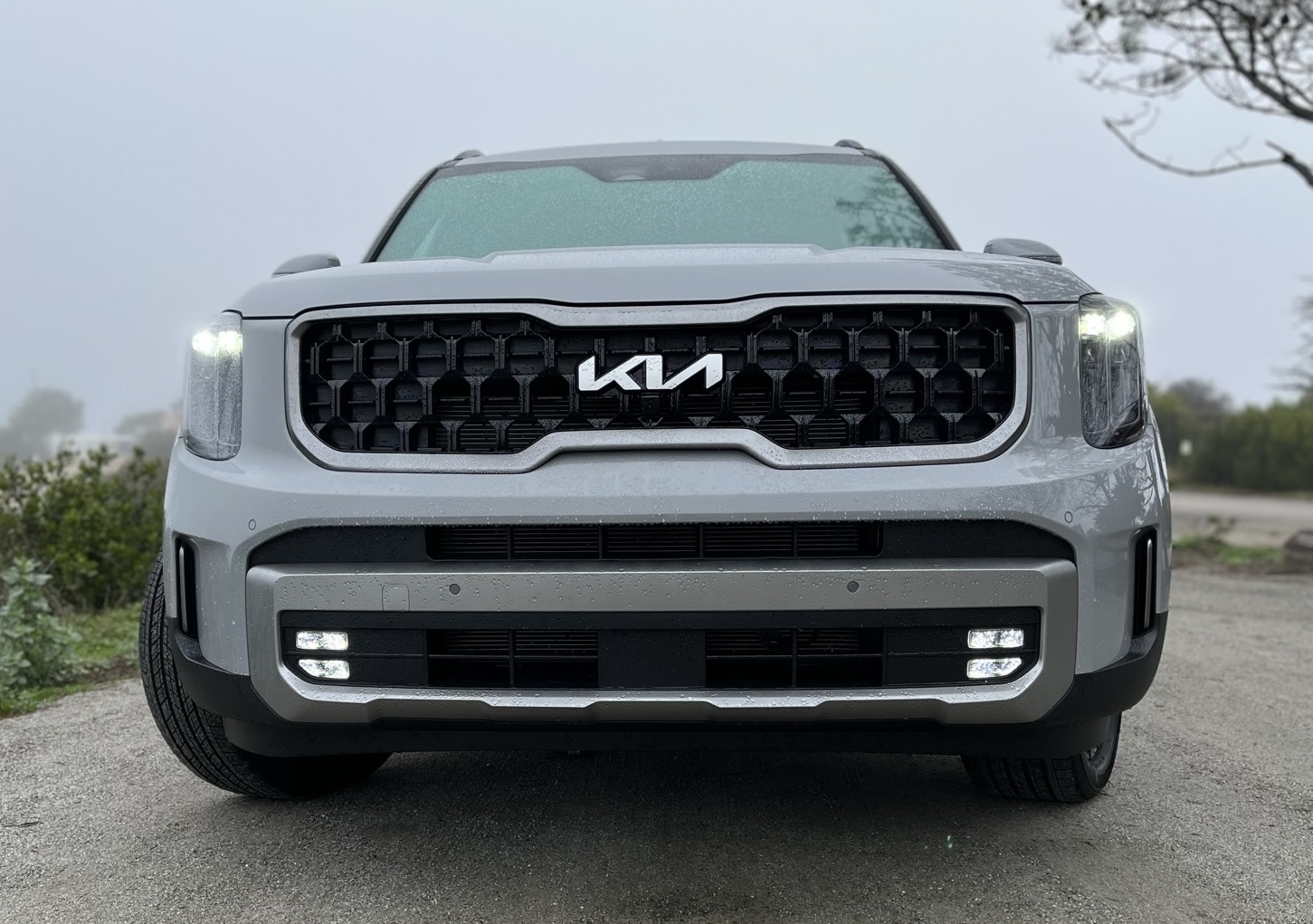
The Telluride X-Line has a unique, black grille treatment.

The Telluride X-Line has a unique grille treatment.

New 2023 Convenience Technologies

  • Standard upgraded 12.3-inch navigation screen (increased from 10.3 inches);
  • Optional full display mirror with HomeLink;
  • Optional Smart Power Liftgate with “Auto Close” function;
  • Kia Connect services for embedded connectivity:
  • Available Digital Key: Allows compatible iPhone, Apple Watch, and Samsung Galaxy smart devices to be used as a virtual vehicle key to lock, unlock and drive. Digital keys can be shared with friends and family over text messages on available devices;
  • In-vehicle Wi-Fi Hotspot connects up to five devices to 4G LTE-based internet;
  • Automatic over-the-air updates for maps and infotainment;
  • Kia Access App for Apple Watch and Samsung Galaxy smartwatch to access such features as remote climate control and door lock/unlock;
  • Stolen vehicle tracking and immobilization capability;
  • Connected Routing: The server-based system will calculate the optimal route using real-time and predicted traffic information. The cloud system uses past driving information to learn the driver’s preferred route;
  • Smart Speaker Integration: Amazon Alexa or Google Assistant can remotely control some functions, such as remote start.
There is rewarding quality to the stitching and precise alignment of interior panes.

There is rewarding quality to the stitching and precise alignment of interior panes.

Expanded ADAS Technologies

The 2023 Advanced Driver Assist Systems add several new technologies:

Intelligent Speed Limit Assist — ISLA: Can detect a road’s maximum speed limit in some cases, provide alerts to the driver and even limit the speed of the car depending on the settings (standard);

Navigation-based Smart Cruise Control – Curve — NSCC-C: In certain circumstances, the smart cruise control can lower the vehicle’s speed proactively before upcoming curves in the road (available);

Highway Driving Assist 2 — HDA 2: A driving convenience system that helps to maintain a predetermined distance from the vehicle detected in front, keep the vehicle within detected lane markers on certain highways, and assist in lane changes under certain conditions (optional; HDA 1.5 is standard);

Forward Collision Avoidance – Junction Turning — FCA-JT: Detects oncoming vehicles while turning left at an intersection (junction). If the system detects that a collision might be likely, the system may apply the brakes to help slow or stop the car (standard);

Forward Collision Avoidance – Junction Crossing — FCA-JC: Is designed to detect crossing vehicles while passing through an intersection. If the system detects that a collision might be likely, the system may apply the brakes to help slow or stop the car (available);

Forward Collision Avoidance – Lane Change Oncoming — FCA-LO: Designed to give steering input to help prevent collisions if the system detects oncoming vehicles while passing other vehicles (available);

Forward Collision Avoidance – Lane Change Side — FCA-LS: Provides steering input to help prevent collisions if the system detects cycles or vehicles in front of the car while changing lanes (available);

Forward Collision Avoidance – Evasive Steering Assist — FCA-ESA: Gives steering input to help prevent collisions if the system detects obstacles, pedestrians, or vehicles in front of the car while driving straight (available).

Looking through the open driver-side door at the front seats.

Front headroom is tall at 39.5 inches, and the driver seat is 8-way power adjustable.

Why Buy the Kia Telluride?

The Telluride is big but efficient, even nimble for a vehicle that is 16.4 feet long. After 12 hours in the saddle, the seats began to feel like leather saddles. But only seat massagers would have prevented that. Still, I stepped out at fuel stops without stiffness or back pain. And I was always eager to climb aboard and continue the adventure.

After our trip, it was a sad wave goodbye to the Telluride. If it had fit easily in my garage, it would have been a keeper.

A rear three quarter view of the wolf gray Telluride with gloss black alloy wheels.

The Kia Telluride X-Line package adds such features as raised, bridge-type roof rails, body-color door handles, and exclusive 20-inch wheels.

2023 Kia Telluride SX-Prestige X-Line V6 AWD Specifications

Body style: large 7-seat, 5-door SUV

Engine: 291-hp, direct-injected 3.8-liter V-6; 262 lb.-ft. torque at 5,200 rpm

Transmission: 8-speed automatic with active on-demand AWD

Fuel economy: 18/24/21 mpg city/hwy/combined; 87 octane recommended

BY THE NUMBERS

Towing capacity: 5,000 pounds

Fuel tank: 18.8 gallons

Cargo space: 21 to 46 cubic feet

Front head/leg room: 39.5/41.4 inches

2nd-row head/leg room: 38.8/42.4 inches

3rd-row head/leg room: 37.8/31.4 inches

Length/wheelbase: 196.9/114.2 inches

Width/height: 78.3/ 70.5 (with roof rails) inches

Curb weight: 4,524 pounds

Turning circle: 38.8 feet

FEATURES

Telluride SX-Prestige Standard equipment includes: smart key entry with push-button ignition and remote start, digital key (for smartphone app use), digital rearview mirror, Nappa-leather trimmed seat upholstery, 10-way power front seats with driver-seat memory, heated steering wheel, heated and ventilated front and rear seats, dual panoramic 12.3-inch panoramic displays with navigation, wireless phone charging pad, surround view monitor and blind-spot view monitor, head-up display, Kia Connect with free 1-year trial, Harman-Kardon audio system;

SX-Prestige exterior features include: 20-inch alloy wheel, dual sunroofs (2nd row fixed), LED headlights, smart power liftgate, power-folding side mirrors with turn signals, roof rails, and rear privacy glass.

Standard safety features and technologies include: 7 air bags, Forward Collision Warning, Forward Collision Avoidance Assist with Pedestrian & Cyclist Detection, high beam assist, lane departure warning, lane keeping assist, blind spot collision warning, driver attention warning, rear cross-traffic collision-avoidance assist, parking distance warning – reverse, lane following assist, safe exit assist;

Kia Drive Wise Driver-Assist Technologies: Forward collision avoidance (cyclist and junction turning), blind spot collision warning, rear cross-traffic collision-avoidance assist, safe exit assist, highway driving assist 2, parking distance warning forward and reverse, smart cruise control with stop-and-go, parking collision avoidance assist, reverse.

PRICING

Telluride SX-Prestige X-Line base price: $53,120, including $1,335 freight charge; price as tested $53,825

Options on test vehicle: Wolf Gray paint $495; carpeted floor mats $210

Where assembled: West Point, Ga.

Warranties: 5-years/60,000-miles bumper to bumper with roadside assistance; 10-years/100,000-miles powertrain

2023 San Diego International Auto Show

2023 San Diego International Auto Show
The auto show "selfie" icon on blue carpet with a big gold star

The “selfie’ icon at the San Diego International Auto Show. (Photos by Mark Maynard)

Something old, something new, something borrowed, and some things that will totally blow you away

BY MARK MAYNARD

The big San Diego International Auto Show is back after a 2-year pandemic-induced hiatus. The show is ongoing in the San Diego Convention Center through Jan. 2, 2023.

As all regional auto shows in the U.S. regain their footing following the pandemic (and manufacturers’ shift from plowing ad dollars into these shows), this show will look much the same upon entry, but the show floor is smaller. The immense space was cropped at the western end, where the Exotics Vault and other specialty vehicles were displayed. Those show favorites are reorganized in other areas.

There are still many classics and outrageous vehicles to be seen. In my Friday morning visit, I saw no concept vehicles, but several new vehicles were not yet on sale. Among them are the Toyota Prius Prime plug-in hybrid and the Dodge Hornet, which will be the first dedicated plug-in hybrid from Stellantis.

The major automakers on display are Chevrolet, Chrysler, Dodge, Ford, Honda, Hyundai, Jeep, Kia, Lexus, Mitsubishi, Nissan, Ram, Toyota, and Volkswagen.

The New Car Dealers Association of San Diego County presents the San Diego International Auto Show.

Ticket Prices

ADULT, ages 13-61: $18

MILITARY, active duty w/ID: $15 (one ticket per ID)

SENIOR, ages 62+: $15 Child (ages 7-12): $12 Child (6 and younger): Free

CHILD, 12 and younger: Free on Family Day, Sunday, Jan. 1 (when accompanied by a paid adult)

Show Hours

Saturday, Dec. 31, 2022 10am-6pm
Sunday, Jan. 1, 2023 10am-9pm
Monday, Jan. 2, 2023 10am-6pm

Information:  (858) 550-0080 and SDautoshow.com/


2023 Toyota Prius First Drive

2023 Toyota Prius First Drive

Sexy new 2023 Toyota Prius wrapped in PDA — Proactive Driving Assist to help save drivers from that “Oops” moment

A silver Prius parked along the ocean at north coastal San Diego

Designed in Japan, the new Prius offers a coupe-like exterior for a more athletic look, Toyota says. (Photos courtesy of Toyota)

Table of Contents

Overview
Pricing
Warranties
Safety Features
Powertrain and Performance
Fuel Economy
Drive Impressions
Why Buy the 2023 Toyota Prius?
Specifications

BY MARK MAYNARD

The redesigned and re-engineered 2023 Toyota Prius is a stunning improvement in almost every way over the previous model. Its sex-jet styling is a pronounced shift in attitude. But this gasoline-electric hybrid hatchback is also more powerful with better fuel economy than before. And its new body is smoother rolling, and the handling is as responsive as its sleek shape implies. The cabin is much quieter and interior materials and plastics are much improved and pleasing to the eye and touch.

Not sanitized in the redesign, however, is some Prius weirdness — its mild personality disorder that has helped make this small car a big icon.

The new Prius has a 2-inch lower roofline, and the body is 1 inch wider and lower. The wheelbase is 1.9 inches longer, now at 108.3 inches. The new length of 181.1 inches is about an inch longer than before.

Looking for a back-to-work commuter? The entry 2023 Prius LE has fuel economy ratings of 56 mpg on the highway and 57 mpg combined city and highway. Its pricing starts at a reasonable $28,545 for front-wheel drive, or add $1,400 for on-demand all-wheel drive (available on all trim levels).

The new Prius is expected to arrive at Toyota dealerships in January 2023.

A side view of the new Prius showing the 2 inch lower roofline

The roofline of the 2023 Prius is 2 inches lower.

Prius Media Drive in San Diego

Toyota brought its national media drive to Del Mar, Calif., just up the coast from downtown San Diego. Select journalists from the U.S. and Canada were given a deep dive into the 2023 Prius, its technologies and design.

There were test drives of XLE and Limited trim levels, in front- and all-wheel drive. I shared seat time with another journalist for about a 40-mile run into the area around Rancho Santa Fe and on the interstate.

The drive gave good input, but I was not able to test such features as the new and enhanced Advanced Park (a Toyota first) that helps drivers steer into a selected parking space. The system works for parallel parking or backing into a perpendicular slot. I also didn’t sample Proactive Driving Assist (details below) or how comfortable the seats would be for an extended commute.

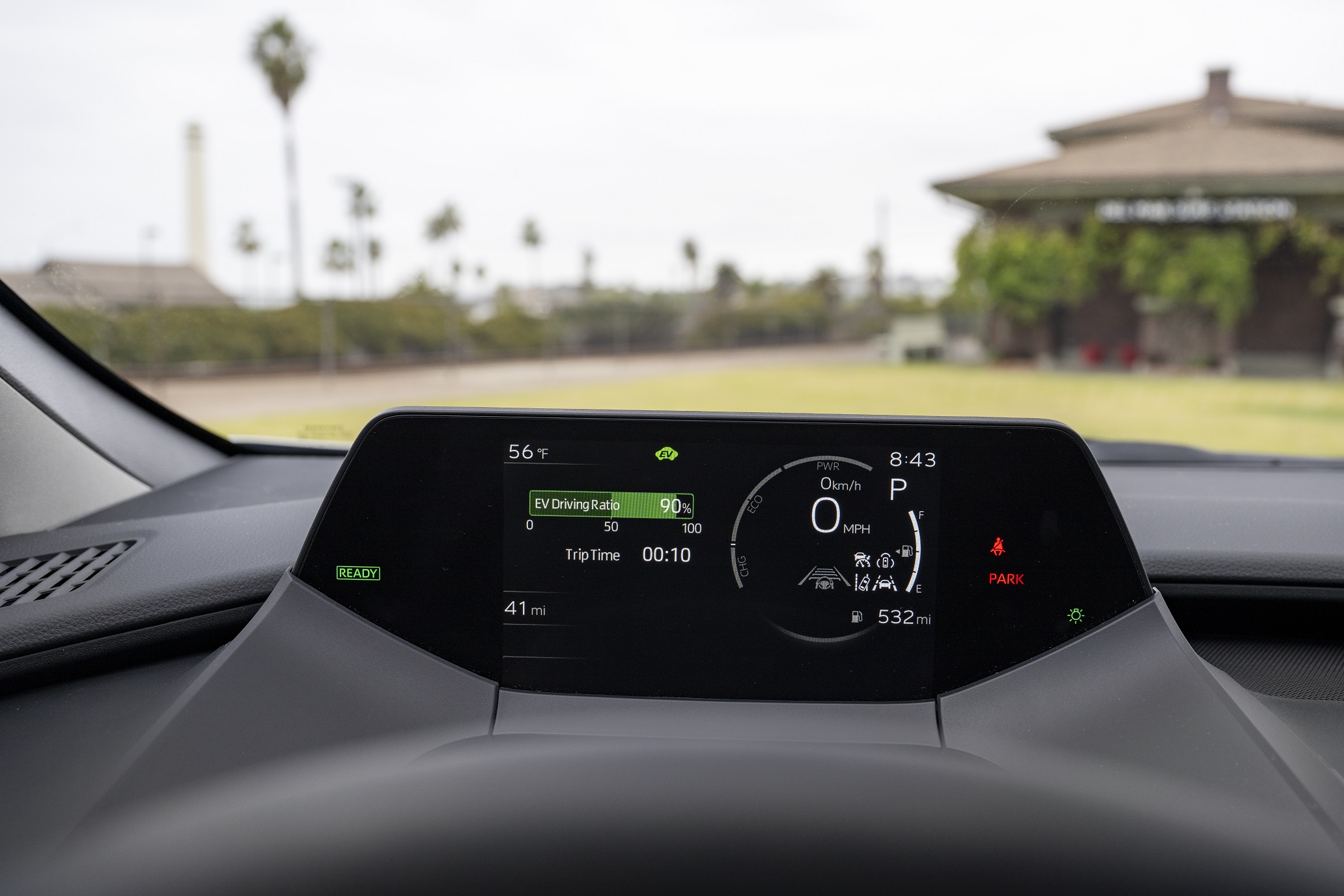
The awkward function of the steering column and driver display screen.

The steering column is among the weird features of the new Prius.

2023 Toyota Prius Overview

Its nameplate needs no introduction — “Prius” is as representative of what it is as “Corvette,” “Mustang,” or “McDonald’s.” But its reputation is founded in its legacy as the world’s first mass-produced gasoline-electric hybrid car. It also is notoriously vilified for its many passionate drivers who feel it is their environmental responsibility to drive 63 mph in the fast lane of the interstate.

The Toyota Prius debuted in Japan in 1997 and was then exported to the U.S. and North America in 2000. But it was a sales dud in the States. It was too small and too weak to handle the interstate hustle. And its center-position driver display and controls in the dashboard were just weird. Cars sat on used lots until the first energy crisis hit in the early 2000s, followed by the Great Recession in 2008. But by 2004, Toyota had launched the second-generation design. This new styling was more palatable but still odd; however, it was a complete design study in aerodynamics, resulting in a very low 0.24 coefficient of drag. That Cd has only recently been surpassed by some new electric cars. And even the new Prius is not as slippery now, compromising Cd for style.

A color image of Satoki Oya, Toyota chief engineer for Prius.

Satoki Oya, Toyota chief engineer for Prius.

Prius Trim Levels and Pricing

The 2023 Prius will be sold in three trim levels: LE, XLE, and Limited. Gone is the L Eco model, which had been the city-mileage champ at 58 mpg.

The XLE is the sweet spot of features to price. The Limited fills in useful details, such as an interior liftback release button.

There are six paint colors, including the new Cutting Edge silver and Guardian Gray. Other choices include Wind Chill Pearl white, Midnight Black Metallic, Supersonic Red, or Reservoir Blue.

The 2023 pricing is about $2,300 more than the previous model. Here are some thumbnail details on the trim levels:

Prius LE, $28,545: standard dark gray 17-inch alloy wheels with wheel covers, an 8-inch audio multimedia touchscreen, six-way adjustable fabric front seats in black or gray, six USB type C charging ports, electric parking brake, SofTex steering wheel, and blind spot monitor with rear cross-traffic alert.

Optional features include front and rear parking assist with automatic braking.

Prius XLE, $31,990: adds 19-inch alloy wheels and eight-way adjustable heated power driver’s SofTex seat in black or gray. Also standard are rain-sensing wipers, smart key locking with push-button ignition, wireless charger, and front and rear parking assist with automatic braking.

Options include a 12.3-inch high-resolution touchscreen display ($735), fixed glass roof ($1,000), and Digital Key ($275), which works with a smartphone app.

Prius Limited, $35,560: adds a standard 12.3-inch JBL Premium Audio touchscreen display, fixed glass roof, SofTex heated and ventilated front seats, heated steering wheel, power liftback, and Digital Key.

Available options include a digital rearview mirror ($200), heated rear seats ($350), and Advanced Park ($1,085, includes panoramic view monitor).

The manufacturer’s Suggested Retail pricing includes the $1,095 freight charge from Japan.

The driver the driver display screen is at the top of the instrument panel, not in the instrument panel.

The placement of the driver display screen is a little far from the driver’s seat.

Prius Warranties

Basic warranty coverage is for 3 years or 36,000 miles and 5 years or 60,000 miles for the powertrain. ToyotaCare provides free scheduled maintenance for 2 years or 25,000 miles, with 24/7 roadside assistance for 3 years (while other Toyota models receive 2 years) and unlimited mileage.

The lithium-ion hybrid battery is covered for 10 years from the date of first use or 150,000 miles, whichever comes first. And Hybrid-related components, including the battery control module, hybrid control module, and inverter with converter, have coverage of 8 years or 100,000 miles.

The Limited’s standard 12.3-inch JBL Premium Audio touchscreen display

The Limited’s standard 12.3-inch JBL Premium Audio touchscreen display.

Safety Features and Technologies

The 2023 Prius has eight air bags and the latest Toyota Safety Sense generation, TSS 3.0. This suite of active safety systems includes everything on the prior generation Prius, plus several driver-assist technologies. The Level 2 semi-autonomous driver-assist function still requires both hands on the wheel.

Among the added technologies are:

  • Pre-Collision System with Pedestrian Detection;
  • Lane Departure Alert with Steering Assist;
  • Full-Speed Range Dynamic Radar Cruise Control;
  • Lane Tracing Assist;
  • Road Sign Assist;
  • Automatic High Beams;
  • Proactive Driving Assist.

Proactive Driving Assist is interesting because it is an “Oops” monitor for everyday situations. Toyota said that the system functions without cruise control, but it is not a substitute for the Pre-Collision System.

PDA uses the vehicle’s camera and radar to provide gentle braking into curves or gentle braking and steering. The system helps with distance control between a preceding vehicle, pedestrian, or bicyclist.

A view of the gasoline-electric engine

Net hybrid-system horsepower is 194 hp for front-wheel drive and 196 hp with AWD.

Prius Powertrain

The 2023 Prius marks the fifth generation. And with it, Toyota hopes to overcome the car’s reputation as dowdy to drive and quirky. Prius chief engineer Satoki Oya made sure of it. And it was his approval of the fast styling that inspired a way to tuck the new hybrid system beneath the skin. And there were compromises.

Engineer Oya had the suspension and steering tuned for sporty driving, and he gave the powertrain 60 percent more horsepower. Indeed, the internal combustion engine is now a 2.0-liter, replacing the previous 1.8-liter four-cylinder. A newly developed lithium-ion battery has 14 percent more output.

The Atkinson-cycle 2.0-liter four-cylinder engine accounts for 150 horsepower and 139 foot-pounds of torque at 4,400 rpm. Net hybrid-system horsepower is 194 hp for front-wheel drive and 196 hp with AWD.

The transmission continues as an e-CVT, an electronically controlled continuously variable automatic. All-wheel-drive models have a rear motor that adds 40 hp and 62 lb.-ft. of torque. The transmission has drive modes of Normal, Eco, and Sport.

The redesigned model, however, has a 0.27 coefficient of drag (Cd), which compares to 0.24 Cd for the previous generations. Blame that shapely peak at the rear of the roofline, according to Oya. It was a sacrifice to maintain the design.

Aerodynamic features include front grille shutters to optimize the inflow of air, which also aids engine cooling. Underbody panels help reduce drag and road noise.

The XLE and Limited trim levels have new aero-tuned alloy wheels rather than steel wheels with aero wheel covers.

SofTex upholstery in black or gray for the XLE and Limited.

SofTex upholstery in black or gray for the XLE and Limited.

Prius Performance

Acceleration from a stop is quicker and less noisy when pressed hard. Toyota says the battery provides a subtle power boost to put less strain on the engine. It also eliminates the “rubber band” acceleration effect experienced with some CVTs.

Also new is an EV mode. Battery power can be used for short distances, such as when in parking lots or indoor parking garages. (This feature had long been available on Japanese market Prii.) When in EV mode, pedestrians will hear the whirring sound of the “Vehicle Proximity Notification.”

Four-wheel-disc brakes have one-inch larger rotors. Front-drive models have ventilated 11.1-inch rotors, and 12-inch rotors for AWD. The rear discs are solid 11-inch rotors, front- or all-wheel drive.

The fixed dual-pane sunroof in the Limited.

The fixed sunroof in the Limited.

2023 Prius Fuel Economy Ratings

Despite the bigger engine, fuel economy increased.

The entry, front-wheel-drive Prius LE gets the highest estimated fuel economy ratings of 57 mpg city, 56 highway and 57 mpg combined. Toyota says that careful driving (Eco mode) can push the mileage to 60 mpg. The other trim levels have ratings of:

  • 52/52/52 mpg, XLE and Limited FWD;
  • 53/54/54 mpg, LE AWD;
  • 49/50/49, XLE/Limited AWD.

Toyota recommends 87 octane fuel, but also says that using premium fuel will help achieve more power and (slightly) higher mileage ratings.

The fuel tank of 11.3 gallons should allow a cruising range of almost 600 miles, but careful driving can easily extend the range.

Though slightly larger, the 2023 Prius weighs about the same as its predecessor. Curb weights range from 3,097 pounds to 3,284 pounds for the top-line Limited AWD trim level; the Limited AWD is about 84 pounds heavier than before.

Maximizing shift-console space is the slot for wireless smartphone charging

Maximizing shift-console space is the slot for wireless smartphone charging.

 Prius Drive Impressions

From the first 500 feet driving the new Prius, there is exceptional feel to the solid body and fluid roll of the steering. The taut suspension is a welcome transition from comfy and soft of the previous design.

The tighter body, with reinforcements at the windshield pillars, midroof, and rear glass pillars, encourages enthusiastic driving. And the cabin is far more soundproofed now, but there is some tire harshness on the interstate.

The turning circle is still subcompact at 34.4 feet with 17-inch wheels or 35.4 feet with 19-inch wheels.

The low-slung design lowers the hip point by about an inch, making for no-struggle entry and exit. But veteran Prii owners might lament the open feel of the previous cabin architecture.

Headroom of 38 inches will suit a 6-foot-6-tall adult without leaning the seatback to an uncomfortable position. But that driver fills the seat area. Legroom is very long at 43.2 inches.

Sightlines over the fenders and hood are good, benefiting from small corner glass in the side windows. But the new driver display screen of speedometer and other gauge readouts is behind the steering wheel atop the instrument panel. In my orientation drive, the black display nagged as a visual obstacle to a clear view. In time, I might adjust. And tall drivers might have to adjust the wheel higher, which will crop the bottom quarter of the display.

Back Seat and Cargo Space

At least there is no more split rear window from the previous kammback body style. However, the new rear window is a slim ellipse, so rear views will be familiar to veteran Prius drivers.

Back seat dimensions are tight. Headroom of 36.4 inches and legroom of 34.8 inches will be adequate for the grade-schoolers carpool. But the space will be too cramped for ride-share use.

Cargo space is luggage capable at 20.3 cubic feet in the XLE and Limited, and 23.8 cu.ft. with the bilevel floor in the LE. Fold the back seat for about 5 feet in length.

The back seat is short on legroom room

Back seat head- and legroom will limit use as a ride-share vehicle.

Why Buy the 2023 Toyota Prius?

The Toyota Prius is weird. It’s always been weird. And the 2023 Prius is weird, too. But its weirdness has been an asset to distinguish this stalwart fuel miser.

The new model will sell easily for those ready for its 50s mpg ratings. It’s still just a gasoline-electric hybrid, with no charging needed, but the Prius Prime plug-in hybrid will go on sale next spring.

Toyota expects the new Prius to sell well, but it also cites a modest annual output of 35,000 cars. With what might be a shortage of new Prii, Toyota dealers will have the opportunity to charge “market pricing.”

Toyota now has 13 electrified models, and by 2025 the carmaker says 40 percent of its lineup with be electrified. That provides many choices for a hybrid Toyota, including the upcoming Crown hybrid sedan.

The Toyota Crown could become what the Prius had been; it is a more powerful hybrid and more expensive but with a 30-mpg combined city/highway fuel economy rating.

Will the Prius lose its crown?

Cargo space is luggage capable and the back seat folds for about 5 feet in length.

Cargo space is luggage capable and the back seat folds for about 5 feet in length.

2023 Toyota Prius Specifications

Body style: compact, 5-seat, 5-door liftback in front- or all-wheel drive

Engine: 150-hp 2.0-Liter 4-cylinder aluminum block and head, double overhead cam 16-valve VVT-I; 139 lb.-ft torque at 4,400 rpm

Hybrid System Net Horsepower: 194 hp FWD; 196 hp AWD

Motor generator: Drives front wheels, regeneration during braking

Motor: Permanent Magnet AC Synchronous Motor; max voltage DC 600-volts

Electric motor power output: 111 hp/83 kW

Torque: 152 lb.-ft.

Hybrid battery: Lithium ion, 222 volts, 4.8 Ah (ampere hour)

Transmission: Electronically Controlled Continuously Variable Transmission (eCVT); AWD, Rear Motor Interior Permanent Magnet (40hp, 62 lb.-ft.)

EPA-estimated fuel economy ratings:

  • 57/56/57 (LE FWD);
  • 52/52/52 (XLE/Limited FWD)
  • 53/54/54 (LE AWD)
  • 49/50/49 (XLE/Limited AWD)

0-60 mph acceleration: 7 seconds, AWD, estimated

Coefficient of drag: 0.27 (Cd) with 17-inch wheels

BY THE NUMBERS

Fuel tank: 11.3 gallons

Cargo space: 23.8 cubic feet LE; 20.3 cu.ft. (XLE and Limited grades)

Front head/leg room: 38/43.2 inches

Rear head/leg room: 36.4/34.8 inches

Length/wheelbase: 181.1/108.3 inches

Curb weights by trim level:

  • 3,097 pounds, LE
  • 3,164 pounds XLE;
  • 3,219 pounds Limited;
  • 3,230 pounds LE AWD;
  • 3,285 pounds XLE AWD;
  • 3,340 pounds Limited AWD

Turning circle: 34.4 feet w/17-inch wheels; 35.4 feet w/19-inch wheels

Tires: Bridgestone Ecopia EP422 Plus 215/45 17-inches; Limited,
Toyo Extensa A/S 195/50 19 inches

FEATURES

Safety features include: 8 air bags, enhanced vehicle stability and traction controls, brake-force distribution, brake assist, smarts stop technology, blind spot monitor with rear cross-traffic alert, hill start assist;

Toyota Safety Sense 3.0 includes: a pre-collision system with pedestrian detection, full-speed range dynamic radar cruise control, lane departure alert with steering assist, lane tracing assist, road sign assist, automatic high beams, proactive driving assist (PDA)

Where assembled: Japan

Warranties: 3-years/36,000-miles bumper to bumper; 5-years/60,000-miles powertrain;

Hybrid battery warranty: 10 years from date of first use or 150,000 miles, whichever comes first;

Hybrid-related components: The battery control module, hybrid control module, and inverter with converter are covered for 8 years or 100,000 miles.

ToyotaCare: Free scheduled maintenance for 2 years or 25,000 miles; 24/7 roadside assistance for 3 years (other Toyota models receive 2 years) and unlimited mileage.