Select Page

VW Taos 1.5T SEL Review

VW Taos 1.5T SEL Review

The 2022 VW Taos 1.5T is unpretentious and practical with a teaser’s driving attitude

The Taos exterior

The VW Taos is the brand’s fourth and smallest SUV. Sold in front- or all-wheel-drive, pricing starts at about $25,000. (Photos courtesy of VW of America)

Table of Contents

Overview
Powertrain
Pricing
Ride and Handling
Travel Assist
Interior Function
Back Seats and Cargo
Why Buy the VW Taos?
Specifications

BY MARK MAYNARD

Thirty-Nine-point-Five miles per gallon in a front-drive VW Taos — 39.5. On a recent highway drive in a Taos 1.5T, I kept checking the onboard fuel-economy meter to be sure that what I was seeing was correct.

39.5 mpg in a subcompact SUV crossover exceeded my expectations, and that of several of the competing models I’ve tested. 39.5 was not a one-off lucky run. I went out multiple days to repeat the numbers, which the Taos tester did easily. And it seemed as if the highway mileage might even go a few clicks higher.
The around-town mileage was also strong, typically averaging 20 to 30 mpg, on the recommended 87 octane fuel. EPA fuel-economy ratings for the front-drive Taos are 28 mpg city, 36 highway, and 31 mpg combined. Mileage ratings for the Taos 4Motion all-wheel-drive models drop to 25/32/28 mpg.

I would have expected high mileage ratings in a hybrid vehicle, but what separates the 2022 VW Taos from its competition is its driving attitude.

This little SUV with a puny 158-hp., 1.5-liter turbocharged four-cylinder is eager to please. And it is just fun to drive.

There are at least 13 competitors in the subcompact SUV segment, but the VW Taos seems less subcompact and roomier. Among the competitors are the Buick Encore, Chevrolet Trailblazer, Honda HR-V, Hyundai Kona, Jeep Renegade, Kia Seltos, Mazda CX-30, Mitsubishi Eclipse Cross, Nissan Rogue Sport, Subaru Crosstrek, and Toyota C-HR.

The front seats

The compact but not cramped front seat area has open sightlines.

VW Taos Overview

The VW Taos is Volkswagen’s fourth SUV model. In the lineup, it is the smallest, slotting below the Tiguan, Atlas, and Atlas Cross Sport.

Taos is built on VW’s “modular transverse toolkit,” or MQB platform. The MQB is easily tuned for various world markets, VW says. Road conditions were a challenge for chassis engineers. Striking a compromise between ride and handling becomes a serious task.

“For the front-wheel-drive [U.S.] Taos, we went through 77 iterations of the various chassis components — springs, dampers, anti-roll bars, suspension components, bushings, and so on.”

—  Gerold Bremer, Technical Development Director

In the U.S. alone, roads vary from the smooth blacktop in the southern states to surfaces rippled by earthquakes in California to midwestern roads with the heaves of freeze-thaw conditions. And then dirt roads add another complexity.

“To get to a balanced chassis for these markets takes a huge amount of work,” Gerold Bremer, Director, Technical Development, Volkswagen de México, said in a release.

“For the front-wheel-drive [U.S.] Taos, we went through 77 iterations of the various chassis components — springs, dampers, anti-roll bars, suspension components, bushings, and so on,” said Bremer.

The compact but not cramped driver’s space has smart integration of controls, switches, and dials.

The driver’s space has smart integration of controls, switches, and dials.

Taos Distinctions

The VW Taos uses a strut-type front suspension, but it has different rear suspensions. All-wheel-drive models have a rear multilink layout while front-drive versions get a torsion beam. The multilink rear suspension helps extend wheel travel and maintain traction when off-roading.

And there are slight body size variations between front-drive and AWD. The front-wheel-drive Taos has a wheelbase of 105.9 inches and is 64.4 inches tall. The all-wheel-drive Taos has a wheelbase of 105.6 inches and is 64.6 inches tall. Both versions are 72.5 inches wide.

Front-drive models have a fuel tank of 13.2 gallons but 14.5 gallons for AWD. I’ll bet some buyers of the front-drive Taos would like the option for the larger fuel tank for fewer stops in the week’s commute.

And the FWD models shift gears via an eight-speed automatic transmission with a Sport mode. Taos 4Motion AWD models have a seven-speed dual-clutch automatic transmission.

The 158-hp, 1.5-liter turbocharged four-cylinder

The 158-hp, 1.5-liter turbocharged four-cylinder is as revvy as it is efficient. (Mark Maynard photo)

Taos Powertrain

All versions of the VW Taos are powered by a 158-horsepower, 1.5-liter turbocharged and direct-injection four-cylinder engine (the EA211 TSI). The engine has a peak torque rating of 184 foot-pounds at 1,750 rpm.

The engine is an updated and more powerful version of the 1.5-liter used in the Jetta sedan. But the Taos engine is more efficient in fuel usage, VW says. It features Volkswagen’s modified version of the Miller cycle . In the Miller cycle, the intake valves are closed early in the induction stroke to help with fuel economy. For a turbocharged engine, the Taos 1.5 has a very high compression ratio of up to 11.5 to one.

Among the engine’s key features is Variable Turbine Geometry. VW says VTG is more efficient, provides higher boost pressure, and avoids wastegate mass flow. The high-pressure injection system also produces better atomization of the fuel/air mixture. And this injection system also has a shorter injection time, optimized mixture formation, and lower particulate emissions.

Performance around town is calibrated for maximum fuel economy, and it can feel unsteady as it metes out mileage. But pull the floor-shift lever into Sport mode for the fun zone. It brings much quicker and more satisfying, acceleration —without being nervously aggressive.

18-inch grand-touring Bridgestone Turanza tires

The 18-inch grand-touring Bridgestone Turanza tires (215/50).

VW Taos Pricing

The 2022 VW Taos is sold in trim levels of S, SE, and SEL, in front- or all-wheel drive. Starting prices range from $24,690 to $33,285; pricing includes the $1,195 freight charge from Puebla, Mexico. (Pricing is up about $600 from 2021.)

Today’s front-drive SEL tester was $34,880 with and options for Kings Red metallic paint ($395) and a power tilt and sliding panoramic sunroof ($1,200). AWD would add $1,555.

The SEL list of standard equipment has some sophisticated features and technologies. Among them: the Volkswagen Digital Cockpit Pro (digital gauge display), keyless entry with push-button start, adaptive cruise control, blind-spot monitor, rear traffic alert, parking distance alerts, pedestrian monitoring, Travel Assist (semi-automatic driving assist with lane assist and emergency assist), Discover Media 8-inch color touchscreen navigation system, dynamic road-sign display, wireless smartphone charger, two front USB-C data ports and one rear USB-C charging port.

On the outside are 18-inch alloy wheels, adaptive turning headlights, illuminated grille, LED lighting (headlights, taillights, and daytime running lights (with low-speed corner illuminating), power and heated side mirrors.

The interior features leather-trimmed upholstery, a rearview camera, an eight-way power driver’s seat with power-adjustable lumbar support, a front center armrest with a storage compartment, and heated and ventilated front seats.

The eight-speed floor-shift console.

The eight-speed floor-shift console.

Less Can Be Plenty in a Taos

Sometimes, however, less is plenty, as in the base VW Taos S.

If you can live with a basic gray and black interior with fabric seats, you can drive home a fun SUV for $25,685. And that includes the $995 IQ.DRIVE Package & S Convenience Package. AWD would add $2,045, for a total of $27,730.

Standard S model features include the configurable Volkswagen Digital Cockpit, 17-inch alloy wheels, six-way manually adjustable front seats, a multi-function steering wheel, automatic headlights with a coming-and-leaving home feature, power side mirrors, and LED headlights with LED daytime running lights and taillights.

Digital extras for the Taos S include a rearview camera system, two front USB-C data ports, App-Connect, Bluetooth phone and audio, and a color 6.5-inch touchscreen sound system.

Also standard is the next-generation Volkswagen Car-Net telematics system. And it includes five years of remote-access services and in-car Wi-Fi capability with a data-plan subscription.

Find current VW Taos incentives and discounts here.

The Taos has full LED exterior lighting

The Taos has full LED exterior lighting

Taos Ride and Handling

German-driving DNA is built into the gasoline-powered Volkswagens. The Taos is a mighty mite of keen handling — with handfuls of grip and grin. The front-drive suspension smooths out rough road, and the torsion-beam rear suspension has none of the clunks that are commonly felt in some of these setups.

Four-wheel disc brakes have vented 12.7-inch front rotors and solid 10.7-inch rear discs. Left-foot braking, however, can confuse the electronic safety system. In an abundance of caution, the power is reduced in the event of unintended acceleration.

The 18-inch grand-touring Bridgestone Turanza tires (215/50) have good grip in enthusiastic driving and a meaty sidewall to help resist curb rash. The tires have a fairly high (hard) treadwear rating of 560. Such a high rating typically translates to a hard ride, but not so on this Taos, which speaks well of the suspension and its mounting points.

A turning circle of 37.6 feet is tight for easy U-turns and easy maneuverability in tight parking situations.

The 8-inch Discover Media color touchscreen integrates audio and navigation.

The 8-inch Discover Media color touchscreen integrates audio and navigation.

Taos Travel Assist

Volkswagen’s semi-automatic Travel Assist is a valuable asset. The system can be used with or without cruise controls. In the crush of commuting traffic, it is an all-seeing system to guard against distractions or an unintended meeting with a driver in the next lane.

The IQ.DRIVE package is a suite of technologies. Integrated into the safety systems are adaptive cruise control, blind-spot monitor, rear traffic alert, pedestrian monitoring with front assist, travel assist, lane assist, and emergency assist.

With both hands on the wheel, the drive guidance gives steady lane centering, but can still be prone to shutoffs in shaded situations. Culprits include a shaded highway overpass or low-angle sunlight into the front grille sensor.

The rearview camera screen

The color camera system.

Taos Interior Function

The sturdy upright exterior design benefits the interior with tall headroom (40.7 inches) and extremely roomy back-seat legroom, 37.9 inches.

The compact but not cramped driver’s space has smart integration of controls, switches, and dials. Gauge graphics in blue on black are easily viewed in all conditions of lighting. Sightlines are open at the side mirrors and over the shoulder.

The $1,200 optional panoramic sunroof trims an inch or so from the front headroom, but it is a compelling picture window for those in the back seat.

The SEL interior design is durable with a variety of plastics, piano black trim, and stitched leather inserts. The eight-way power driver’s seat includes seat-bottom tilt, which is sometimes uncommon in smaller vehicles. However, I would have appreciated a seat-side driver’s armrest. The padded console armrest isn’t one-size-fits-all and it does not slide, as in some VWs.

The power tilt and sliding panoramic sunroof, $1,200.

A power tilt and sliding panoramic sunroof, $1,200.

Back Seat and Cargo

The Taos back seat is no penalty box for children. The boxy space is open and airy with headroom of 39.8 inches. The smallish exhaust-AWD tunnel benefits footroom for occasional three-across seating.

There is no recline to the seatback, but it has a comfortable angle.

Back-seat features include a fold-down, ski-passthrough center armrest with can holders. There also are bottle holders in the door panels and a C-type charging USB.

Cargo space is neatly square with a 42-inch wide opening and about 3 feet in length to the seatback. Fold the 60/40 seatback for a maximum of almost 6 feet in length. The temporary spare tire is stored below the cargo floor.

The Taos back seat space is open and airy

The Taos back seat space is open and airy with headroom of 39.8 inches.

Why Buy the VW Taos?

The Taos is a good starter family SUV that won’t be easy to send down the road, if and when it gets outgrown. Fortunate will be the teen driver who inherits the trusty family Taos.

Fold the 60/40 back seat for maximum cargo space length of almost 6 feet.

VW Taos SEL Specifications

Body style: subcompact, front- or all-wheel drive, 5-seat, 5-door SUV crossover

Engine: 158-hp, turbocharged and direct-injected DOHC 1.5-liter 4-cylinder; 184 lb.-ft. torque at 1,750 rpm

Transmission: 8-speed automatic

Fuel economy: 28/36/32 mpg city/hwy/combined; 87 octane recommended

BY THE NUMBERS

Fuel tank: 13.2 gallons

Cargo space: 27.9 to 65.9 cubic feet

Front head/leg room: 40.7/40.1 inches

Rear head/leg room: 39.8/37.9 inches

Length/wheelbase: 175.8/105.9 inches

Curb weight: 3,175 pounds

Turning circle: 37.6 feet

FEATURES

Standard equipment includes: Smartkey entry and locking with push-button ignition, leather-trimmed upholstery, rearview camera, eight-way power driver’s seat with power-adjustable lumbar support, front center armrest with storage compartment, heated and ventilated front seats. VW Digital Cockpit Pro (configurable digital gauge display), adaptive cruise control, blind-spot monitor, rear traffic alert, parking distance alerts, pedestrian monitoring, Travel Assist (semi-automatic driving assist with lane assist, emergency assist, 8-inch color touchscreen navigation and media system, dynamic road-sign display, wireless smartphone charger, two front USB-C data ports and one rear USB-C charging port, 18-inch alloy wheels, adaptive front-lighting (turning headlights), illuminated grille, LED lighting (headlights, taillights, and daytime running lights (with low-speed corner illuminating), power and heated side mirrors.

Safety features include: 6 air bags, Intelligent Crash Response System, electronic stability control, anti-slip regulation, electronic differential lock, engine brake assist, ABS with brake-force distribution, and hydraulic brake assist

PRICING

Base price: $33,285, including $1,195 freight charge; price as tested $34,880

Options on test vehicle: King’s Red metallic paint $395; power panoramic sunroof $1,200

Where assembled: Puebla, Mexico

Warranties: 4-years/50,000-miles bumper to bumper, including powertrain; 2-years/20,000-miles free scheduled maintenance (includes vehicle checks at 10,000 and 20,000 miles with oil change, but not a tire rotation; roadside assistance for 3-years/36,000-miles

1948 Ford F-1 Pickup Debut

1948 Ford F-1 Pickup Debut
Two ranchers lean on the new 1948 pickup

Standard 1948 Ford F-1 features included an ashtray, glove box, and driver’s side sun visor, unusual on trucks at the time. (Ford archival photography)

BY MARK MAYNARD

On Jan. 16, 1948, Ford Motor publicly revealed the new F-1 pickup, beginning the F-Series legacy. The first-gen truck ran through 1952.

Introduced in late 1947, the F-Series trucks were assembled at 16 different facilities in North America during its production. Engine choices were an inline-6 or a “flathead” V-8, according to the truck’s page in Wikipedia. All F-series were available with optional “Marmon-Herrington All Wheel Drive” until 1959.

Standard features on the F-1 included an ashtray, glove box, and driver’s side sun visor, which was unusual on trucks at the time.

Options included the “See-Clear” windshield washer (operated by foot plunger), passenger-side windshield wiper and sun visor, and passenger-side taillight.

The F-1 truck also had options for additional stainless-steel trim and two horns.

8 F-Series Chassis Configurations

The first-generation F-Series was marketed in eight different chassis weight ratings, giving them their model names. The half-ton rated F-1 was the lightest-capacity version with the F-8 as the highest.

F-1 through F-3 pickup trucks were offered in the lineup, which included the panel trucks. The bare F-3 chassis served as the basis for a parcel delivery truck. The F2 had a three-quarter-ton rating and the F3 was the heavy-duty ¾ ton.

The heavier-duty F-4 chassis was produced as a light-duty commercial truck.

The F-5 and F-6 were medium-duty trucks in three configurations:

  • Conventional;
  • Cab-Over-Engine C-Series;
  • School bus chassis (as the B-Series), with no bodywork rear of the firewall).

The F-7 and F-8 were heavy-duty commercial trucks, marketed under the “Big Job” brand name from 1951.

The cab-over models moved the cab upward and forward, requiring a higher hood and different fenders than conventional models. The F-2 and up used larger wheel well openings than the F-1 models.

2 ranchers lean on the cargo box of a 1948 F-1

The new trucks featured a strengthened tailgate and anti-rattle chains.

The Ford F1 By the Numbers

The most common first-generation model was the F-1. It has a 6 ½-foot-long bed with 45 cubic feet volume of cargo room and a 114-inch wheelbase.

The F-2 and F-3 Express models had an 8-foot bed and a 122-inch wheelbase.

All truck beds had a steel floor with a hardwood subfloor to keep it from being dented. Skid strips were stamped into the steel so they would not come loose, unlike the previous model.

The tailgate was strengthened and reinforced using a rolled edge with a tapered truss. Anti-rattle chains had a smooth quiet operation. The chairs were lengthened to allow the tailgate to open flat to the bed floor for easier loading and unloading of cargo.

Triumph Speed Twin First Look

Triumph Speed Twin First Look

The 2022 Triumph Speed Twin is a  1960s Bonneville modern classic

An static view of the 2022 Triumph Speed Twin sport roadster motorcycle

The Triumph Speed Twin set the benchmark for how a modern classic sport roadster should ride and feel. (Photos courtesy of Triumph)

Table of Contents

Performance
Ride and Handling
Styling
Pricing, Accessories
Why Buy the 2022 Triumph Speed Twin?
Specifications

BY JOE MICHAUD,
Special to Maynard’s Garage

The original Triumph Speed Twin 5T was designed in 1937 by the prolific British visionary Edward Turner. When the 5T made its debut, the 500cc parallel-twin design proved innovative in a performance world previously dominated by large displacement single-cylinder motorcycles. The 5T provided significantly more horsepower, torque, and, more importantly, less vibration than era-available performance singles.

Turner was complicated, sources say, and his inability to compromise was often an impediment to design progress. However, no one can doubt the success of his Speed Twin design. Turner’s design would set the tone — as well as the basic parallel-twin engine design — that would sustain the British motorcycle industry for nearly four decades. Even today, most Triumph devotees credit the 5T and its offspring, the 5TA, for the post-war recovery of Triumph. Its popularity would allow the model to soldier on until 1966.

Triumph cannily resurrected the famous “Speed Twin” nameplate in 2018. It marked the introduction of a line of 1200cc twin-cylinder bikes the factory called “modern classic performance roadsters.”

Four years later, the newest Speed Twin continues the panache of the sport roadster.

Metzeler Racetec RR tires on lighter 12-spoke 17-inch cast wheels.

Metzeler Racetec RR tires on lighter 12-spoke 17-inch cast wheels.

2022 Speed Twin Performance

Triumph has updated the High Power Bonneville twin engine with more midrange power and torque. The fresh enhancements boost the fun for me with the 83 foot-pounds of peak torque moved lower to 4,250 rpm. The power band is more available for real-world riding. And torque is where my motorcycle fun lives.

Rider feel has been enhanced by a reduction in rotating engine inertia. A lightened crankshaft and alternator allow the motor to rev quicker. The combined modifications raise the redline by 500 rpm to 7,250 where the horsepower peaks at 100. A revvy motor coupled with a new profile camshaft (more lift and longer duration) and fresh porting add to the fun factor. It’s all good stuff.

Brushed stainless-steel twin upswept exhaust silencers

Brushed stainless-steel twin upswept exhaust silencers are new.

Improved Handling

Triumph improved the 2022 Speed Twin handling with fresh higher-spec Marzocchi cartridge-damped forks up front. The Marzocchis are a non-adjustable, upside-down 43mm design with 120mm travel.

Twin rear shocks are pre-load adjustable only, and also give 120mm travel. Suspension mods always improve riding feel. These non-adjustable items certainly fit the moderate price point, but enthusiastic riders may tire of them.

Metzeler Racetec RR  tires wrapped on lighter 12-spoke 17-inch cast wheels make turn-in smooth and predictable.

Front brakes are by Brembo with four-piston M50 radial monobloc calipers.

Front brakes are by Brembo with four-piston M50 radial monobloc calipers.

Front brakes are Brembo four-piston M50 radial monobloc calipers squeezing twin 320mm discs. The rear stopper is a single Nissin two-caliper 220mm disc. ABS is standard. Initial bite is strong with much good feel for the bike.

The cable-pull clutch is torque-assisted, coupled through a six-speed gearbox. The shifts are as slick as a bolt-action rifle.

 Speed Twin Ride and Handling

The narrow-waisted saddle with a 31.5-inch seat height provides a slim stand-over width. The reach to the midposition pegs and tapered bars deliver an easy upright position to the rider. It sits easy-peasy and comfy in urban use. Dealing with a stretched sport-bike crouch designed for the track can often be an ergonomic distraction for urban commuting. For most of my bike business, I’ll take some upright situational awareness over sport-bike ergonomics.

There is no multi-axis lean angle sensing (IMU), no quick shifter, and no cruise control. ABS is non-cancellable and electronic controls are limited to basic ride modes — rain, road, and sport. There are no wide distinctions between the basic ride modes. After a few days of playing with the modes, I suspect most riders will simply leave in it Sport and modify their right fist as needed.

The bright headlight

All Speed Twin lighting is LED, except the headlight.

Electronics

The lack of cruise control might feel like an oversight to some riders; inclusion during production would be a pushover for a ride-by-wire bike. Triumph already includes cruise control on other models, so perhaps it’s an additional cost saver. However, I’m not sure I would miss it. Electronic cruise control can be a boon on long commutes over open interstate roads, but I enjoy having personal control of my motorcycles.

All lighting is LED, except the headlight, oddly enough. An under-seat USB charger can keep your phone at the ready.

The claimed weight is 476 pounds, wet and ready. And the first major service is slated for 10,000 miles. That’s a nice cost saving.

Fuel capacity is a moderate 3.8 gallons with a claimed combined fuel economy of 43 mpg. I’m not a fan of the exposed bottom seams currently unavoidable on many new bike tanks. It’s less expensive to manufacture, but I always see the seams.

The bike's ergonomics are ideally proportioned.

The Speed Twin ergonomics are ideally proportioned.

Speed Twin Styling

I like that the Speed Twin looks as a Triumph should.

The modern Speed Twin has kept the open, airy silhouette of a vintage twin-shock 1960s T120. The Speed Twin would not look out of place parked in formation with my 1966 T120 and ’68 TR6R. Light, nimble, and sporty. To my eye, it simply looks right. As much as American V-Twins cling to their classic look, the Bonneville line from Triumph also stays the course. Retro sells, and I enjoy it.

The brushed stainless-steel pipes with black-capped exhaust cans look the part. Together they cleverly hide the emission-control catalyst that makes the bike Euro-5 compliant.

Brushed alloy fenders fore and aft lend a sporty detail. A bar-mounted scroll button controls the discrete multi-function LCD display. The gauges — tach and speedo — are analog and needle-swept. I love them.

Instrumentation is by twin dial analog speedometer and tachometer with LCD multi-functional displays.

Instrumentation is by twin dial analog speedometer and tachometer.

Triumph Speed Twin Pricing

Sharper-minded race folks might decide the Thruxton RS better suits their jam. But the Speed Twin at $12,500 MSRP, has the same basic horsepower and torque as the RS — albeit with a few less zooty parts, suspension, etc. — for $5,000 less.

Paint choices are three, Jet Black is standard, Red Hopper and Matt Storm Grey are $300 options. Finish and detail are superb throughout the Triumph line.

Accessories I would select include knee grips ($70), round bar-end mirrors ($199), and the quilted black seat ($430). See the list of accessories here.

A well accessorized speed twin

More than 50 Speed Twin accessories are available.

Why Buy the 2022 Triumph Speed Twin?

My dictionary defines a roadster as a “two-seat performance vehicle” so it’s not a stretch when Triumph calls the Speed Twin “a modern Classic, performance roadster.”

I’ve never bought a motorcycle simply for transportation. For me, emotion is a powerful persuader. So, I’d like to see a Speed Twin with polished alloy engine cases and wire-spoked wheels. Otherwise, this bike ticks all my boxes for a thoroughly modern 1960s Bonneville.

Joe Michaud is a San Diego-based motorcycle rider and restorer. Send him an email at jmichaud@san.rr.com.

2022 Triumph Speed Twin Specifications

Style: Sport roadster with tubular steel frame and steel cradles

POWERTRAIN

Engine: liquid-cooled, 8-valve, SOHC 1200cc High Power Bonneville parallel-twin, 270-degree crank angle

Power: 98.6 bhp at 7,250 rpm; 83 lb.-ft. torque at 4,250 rpm

Fuel injection: electronic multipoint sequential

Fuel economy: 43 mpg, estimated; combined city and highway

Exhaust: brushed stainless steel 2 into 2 system with twin silencers

Transmission: 6-speed manual

Clutch: wet, multiplate torque-assist clutch

TIRES-WHEELS

Front: 12-spoke cast aluminum alloy, 17 inches by 3.5 inches; 120/70 ZR17

Rear: cast aluminum alloy, 17 inches by 5 inches; 160/60 ZR17

SUSPENSION

Front: 43mm USD Marzocchi forks, 120mm travel

Rear: twin RSUs with adjustable preload, 120mm rear wheel travel

BRAKING

Front: Twin 320mm discs, Brembo M50 4-piston radial monobloc calipers, ABS

Rear: Single 220mm disc, Nissin 2-piston floating caliper, ABS

BY THE NUMBERS

Wet weight: 476.2 pounds (216kg)

Fuel tank: 3.8 gallons

Seat height: 31.85 inches

Length/wheelbase: 82.6 inches (2099mm)/ 55.6 inches (1413mm)

PRICING

Speed Twin base price: $12,500 MSRP

Warranty: two-years unlimited mileage

Where assembled: Hinckley, Leicestershire, England

Kia EV6 Review

Kia EV6 Review

The 2022 Kia EV6 battery-electric is a visual blitz of aerodynamic origami for the electrified era

An exterior view of the EV6

Buyers of the battery-electric 2022 Kia EV6 will receive a charging credit of 1,000 kWh, useable over 3 years. (Photos courtesy of Kia America)

Table of Contents

Developing the Kia EV6
EV6 Exterior Design
5 Cool Things
Kia EV6 Pricing
Incentives and Rebates
Powertrain and Charging
Onboard Generator
EV6 Performance
Ride and Handling
Interior Function
Why Buy the Kia EV6?
2022 Kia EV6 Wind Specifications

BY MARK MAYNARD

The speedline styling of the 2022 Kia EV6 gives it a car-of-the-future mystique. But beneath its steel exterior and neural network of electrification, is the familiar function of a “normal” car. If you are comfortable navigating a smartphone, this car will be a quick study — but not all is simple with some of the electronic controls.

Developing the EV6

The battery-powered Kia EV6 crossover SUV signals the beginning of the brand’s transformative “Plan S” electrification strategy. Kia says it will deliver 11 new electrified models across the world by 2026.

Starting with the EV6, Kia’s EV lineup will have the “EV” designation followed by a number that indicates the car’s position in the lineup.

The E-GMP modular platform will allow multiple vehicle segments — sedans, CUVs, SUVs — with dual-motor options for all-wheel drive.

It is an adaptable foundation with a long wheelbase and wide stance, Kia says. The EV6 has the same 114.2-inch wheelbase as the full-size Kia Telluride SUV. And the liftback EV6 compares with the width of a Ford Mustang Mach E and the wheelbase and ground clearance of a Tesla Model Y.

The EV6 shares powertrain elements and some technologies with corporate partner Hyundai and its just-released IONIQ5, but the two EVs are distinct in styling and footprint. The EV6 is 1.8 inches longer than IONIQ5 and narrower by just .04 inch. The EV6 wheelbase is shorter by 3.9 inches, and the roofline is lower by 2.2 inches.

An overhead view of the Kia EV6

Features of the EV6 GT-Line include a sunroof and monochromatic paint.

EV6 Exterior Design

Exterior design of the EV6 was a collaborative effort between all three of Kia’s global studios: Namyang, Korea; Frankfurt, Germany; and Irvine, Calif.

The appearance is a visual blitz of aerodynamic origami for the electrified era.

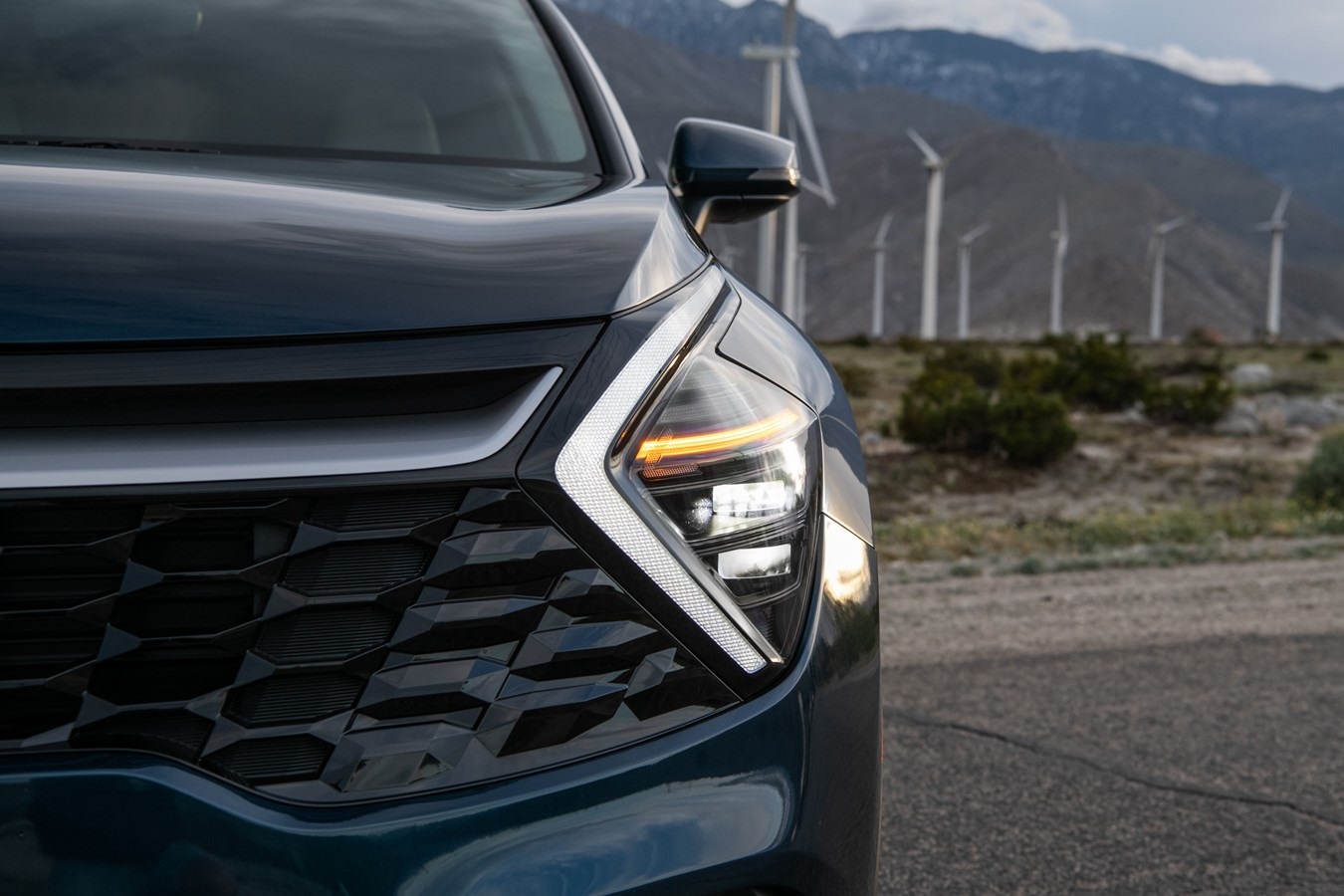
  • A series of slash lines above and below the headlights are the daytime running lights. Kia says the treatment defines the car’s “Digital Tiger Face,” which carries over from Kia’s “Tiger Nose Grille.”
  • The smooth rise of the hood with fender-top bulges flows up and over the swept-back windshield to the slant of the rear tailgate.
  • Crossover-inspired side profile . A character line runs along the bottom of the doors and curves upward toward the rear wheel arches to visually elongate the profile of the car.
The 'Digital Tiger Face' of the Kia EV6

The ‘Digital Tiger Face.’

5 Cool Things About the EV6

  • Dual 12.3-inch-wide digital display screens for driver information and navigation-media.
  • 800-volt multicharging architecture allows ultra-fast DC charging from 10 percent to 80 percent charge (up to 210 miles range) in less than 18 minutes.
  • An upcoming high-performance EV6 GT will have 576 horsepower and is capable of 0-60 mph acceleration in less than 3.5 seconds, Kia says.
  • 21 standard active advanced driver assistance systems. Semi-autonomous driver capabilities include Highway Driving Assist 2.
  • Onboard power generator, known as Vehicle-to-load (V2L) functionality. Owners can use the EV6 battery as an emergency power source.
The power-opening charge door of the EV6.

The power-opening charge door.

 2022 Kia EV6 Pricing

The Kia EV6 is sold in three rear-wheel-drive trim levels of Light, Wind, and GT-Line; all-wheel drive is available for the Wind and GT-Line. The transmission is a single-speed reduction gear with drive modes of Eco, Normal, Sport, and Snow.

Starting prices range from $42,155 for Light, $48,750 for Wind RWD (add $3,900 for all-wheel drive), and $52,455 for the GT-Line RWD or $57,155 with AWD. Pricing includes the $1,255 freight charge from Hwasung, Korea.

Standard equipment on all EV6 trim levels is substantial to support the pricing. Among the features is smart-key entry with push-button ignition (and remote start). Navigation-based smart cruise control has stop-and-go function. And dual 12.3-inch-wide digital display screens (one screen is for driver information, the other for navigation-media) have a panoramic presence. There also are five USB ports (four USB-C charging ports and 1 USB-A media port) and a wireless phone charging pad. The front seats are heated and the driver has an eight-way power-adjustable seat with lumbar.

Also standard is Kia Connect smartphone connection via app. Users have access to lock or unlock the car, remote climate control for preheating or precooling, vehicle charging, Find My Car, and stolen vehicle recovery.

Check here for current Kia EV6 pricing.

The Kia EV6 GT-Line driver area

The EV6 GT-Line driver area with non-animal leather upholstery.

EV6 Trim-Level Details

The EV6 Light trim level has a smaller battery and a shorter driving distance. Inside, the black interior is dressed in recycled fabric and vegan leather (or pleather). Paint colors are limited to just two no-cost choices (Interstellar Gray and Gravity Blue) with a $495 option for Snow White Pearl.

EV6 Wind

For another $6,595, the Wind brings a significant boost of features. The big assets are a bigger battery, a bigger motor, and a 310-mile all-electric driving range, 78 miles farther than the base model.

The Wind also adds the onboard power generator (V2L), gloss-black exterior accents, ventilated front seats, vegan-leather upholstery, an eight-way power front passenger seat with lumbar support, 14-speaker Meridian audio system, smart power tailgate, park-distance warning forward and reverse, and tow-package wiring.

The rear-drive Wind tester was $48,750 with one option for Glacier paint (sort of a faint gray), $495.

EV6 GT-Line

As the top-line model, the GT-Line includes all the features of the Wind, plus exterior and interior upgrades for the price difference of $3,705.

Inside are such extras as a wide sunroof, non-animal leather, and suede seat upholstery, an eight-way power front passenger seat with two-way power lumbar. The “Chauffeur Seat” fore-aft adjustment switch (more of a limousine feature) allows rear passengers to move the front passenger seat forward for more footroom or easier exit).

The EV6 Augmented Reality (AR) Head-Up Display system is engaging for its large three-dimensional image that appears to hover over the hood of the car. Graphics are projected from the base of the windshield and include such functions as speed and driver assistance system alerts, lane guidance, and turn-by-turn navigation instructions.

The augmented head-up display in the EV6

The Augmented Reality Head-Up Display system, only on the EV6 GT-Line.

Unique to the GT-Line exterior are monochromatic paint with gloss black accents, 20-inch wheels, and the very desirable automatic extending door handles.

The GT-Line AWD adds 20-inch wheels (a 1-inch upgrade), heated rear seats, and a heat pump, which is more range-preserving than radiant cabin heating.

Kia EV6 Incentives and Rebates

In California and some other states, the 2022 Kia EV6 qualifies for up to $10,250 in federal and state rebates or incentives.

Federal Electric Vehicle Tax Credit: $7,500.  IRS tax forms are here.

California Clean Fuel Reward: $750. Available toward the purchase or lease of a new electric vehicle with a battery capacity greater than 5. The customer must register the vehicle in California and the customer must reside in California.

California Clean Vehicle Rebate: $2,000.  Participants are eligible based on gross annual income, as stated on their federal tax return.

Find federal and state laws or incentives here.

And the Kia EV6 qualifies for California’s High-Occupancy-Vehicle freeway access, $22, with the green DMV decal

EV6 tire and wheel sizes are 19 or 20 inches with a substantial footprint of 235/55.

Tire and wheel sizes are 19 or 20 inches with a substantial footprint of 235/55.

EV6 Powertrain and Charging

The lithium-ion polymer battery is packaged “skateboard” style under the floor. There are two sizes of high-voltage batteries: 58 kWh (only on the Light trim level) and 77.4 kWh, standard for Wind and GT-Line.

Rear Wheel Drive, Light: 58 kWh battery with a 125kW 167 horsepower rear motor. Estimated zero-to-60 performance in 8 seconds with 232 miles of driving range;

RWD, Wind and GT-Line: 77.4 kWh battery with a 168kW 225-hp rear motor. Estimated zero-to-60 performance in 7.2 seconds with 310 miles of driving range;

AWD, Wind and GT-Line: 77.4 kWh battery with a 70kW front motor and 239kW rear motor for 320-hp total. Estimated zero-to-60 performance in 5.1 seconds with 274 miles of driving range;

Ultra-Fast Charging

Kia says its “world’s first” patented multicharging system supports 400-volt and 800-volt DC charging. The system works on DC chargers with speeds ranging from 50kW to 350kW.

  • 50kW DC fast charging will take 73 minutes to charge from 10 percent to 80 percent.
  • 350-kW DC fast charging adds nearly 70 miles in less than 5 minutes. From a 10 percent to 80 percent charge, it takes fewer than 18 minutes to add up to 210-miles.
  • 11kW onboard charger for Level 2 home or public charging. It can boost the charge from 10 percent to 100 percent in 7 hours, 10 minutes (240-volt AC at 40-amps) for the 77.4 kWh battery.

Onboard Generator

The so-called Vehicle-to-Load (V2L) functionality, or onboard power generator, allows the EV6 to be a power-outage savior. A special adapter connects at the rear charging port to tap power from the high-energy battery.

The generator provides 1900 watts to power electrical appliances, devices, tools, and recreational gear. Or tap into it for tailgating and beach parties.

From a full charge, EV6 power can be drawn for 36 or more consecutive hours, Kia says. And the EV6 can charge vehicle-to-vehicle at 1.1 kW, equivalent to a 110-volt charger. (Charging will be verrry slow but it’s better than nothing in an emergency.)

The system also includes a household 110-volt power outlet at the second-row seat base. Owners could use it to recharge tools and devices or plug-in for video entertainment on the go.

The Kia EV6 has an onboard generator to use in emergency situations or to power appliances and more

Be the life of the outdoor party with the onboard generator.

EV6 Performance

I did the majority of my driving in Normal mode, but if I had a Level 2 home charger, I’d let it rip in Sport mode all the time. It’s not that performance in Normal is lacking. Acceleration from a start feels reserved as the curb weight gets rolling. But there is a fire hose of force with a heavier foot on the accelerator pedal.

Driving in Normal mode seemed miserly in how it conservatively, or efficiently, used the battery reserve. Depending on temp and terrain, a 5-mile jaunt can register 3 miles on the battery charge.

Flip the steering wheel drive mode tab to Sport and the EV6 sees red — the digital driver’s screen glows red. Plunge the accelerator and the performance feels blistering fast, but always controllable. There is no lag in moving away from the light.

A Quick Charge

For a 90-mile roundtrip to visit friends, I topped off the battery, which had a charge of 71 percent. At an EVgo public fast-charge station, it took just under 31 minutes for the charging to stop at 100 percent for 299 miles of range. I used 24.270 kWh of energy for a cost of $14.12. And that is without member discounts on charging. Charging at home on a Level 2 charger gives a greater member discount and a lower power company time-of-use cost to charge in off-hours.

The equivalent fuel cost for adding just over a quarter tank of 87 octane to a 15-gallon fuel tank would have been almost $20 at $5 a gallon.

When asked why my charge didn’t reach the expected 310 miles, the Kia rep explained that total range depends on a variety of factors, including driving style and past efficiency. “Your battery percentage and indicated range will not always be linear per charge, he wrote in an email. “That explains a significant portion of the variance, as you’ve probably experienced with other EVs.”

As with an ICE vehicle, “your mileage may vary.”

The front motor of the Kia EV6 AWD

AWD models add a front motor for a total of 320 hp and 274 miles of range.

EV6 Ride and Handling

The EV6 rides like a big luxury sedan. And the suspension is not elaborate, a steel multilink setup with MacPherson struts at the front and a rear five multilink. Shock absorbers front and rear have selective damping control.

With a curb weight of 4,017 pounds, the EV6 Wind is not a heavyweight among EVs, but the driver can sense the heft of motivating the tonnage.  Transitioning speed bumps and driveways will generate a waggle of head toss. And there will be occasional clunks and jolts as the suspension manages the weight over heaves in the road and busted pavement.

On the highway, the EV6 is a superliner of smoothness. The ride is sound-isolated from road or tire harshness and the cabin is a relaxed atmosphere from the clamor of the commute.

Driving in Sport mode noticeably boosts acceleration response and, somehow, makes the EV6 feel less weighty. With a home Level 2 charger, I’d drive in Sport mode all the time.

Dual 12.3-inch-wide digital display screens show driver information and navigation-media.

A dramatic presentation of dual 12.3-inch-wide digital display screens.

Interior Function

The EV6 cabin has the appearance of a crisply dry-cleaned and neatly pressed dress shirt. It is thoroughly modern and lined with eco-friendly materials. Recycled plastic is used extensively with non-animal leather surfaces on some trims. There is full LED lighting inside and out.

The joined 12-inch digital infotainment screens form a curved display extending 2 feet across the instrument panel. The combined span of screens has a dramatic presence and is easily viewed with filtered blue light.

There are just a few key physical buttons along the instrument panel.

The slim dashboard extends from the steering wheel across to the center of the car. Below the navigation screen are controls for heat, ventilation, and AC that have electronic haptic-touch buttons. There is a bi-modal function to access either the heat-AC-vent controls or the media-radio settings. At either end of the slim control panel is a small dial. One is for manually adjusting volume or fan speed, the other is for channel tuning or temp. But the touchpoints to switch modes is a small contact point that can sometimes be hit-and-miss while driving. Several times I cranked the fan speed when I want to blast the tunes. In time, a driver will adjust.

The center armrest is treated almost as a design statement. Its peninsula style anchors the start button, gear engagement selector, wireless charging pad, and switches for seat heating and ventilation. And there’s also a deep storage box.

The peninsula-style console in the Kia EV6 has open storage below.

The peninsula-style console has open storage below.

Below the console is open storage large enough for a purse or to-go bag. Door panels have generous bottle storage slots and the space is lined with some type of recycled fabric-like material.

The center shift console in the EV6

The multifunction center console makes a design statement.

EV6 Driver Sightlines

Sightlines for the driver are open across the hood. But over-the-shoulder views are somewhat complicated by the narrow back glass and upswept rear quarter. However, the standard surround-view monitor gives total parking views through four cameras.

My biggest complaint was the exterior door handles that do not automatically extend when walking up to the car with the key fob in pocket. Instead, opening the door is almost a two-handed exercise to push open the flush handle and pivot your hand to grab the lever. To get an automatically extending door handle, you’ll have to step up to the EV6 GT-Line.

Unfortunately, there is not a standalone option for automatic door handles on the Wind. And for that simple convenience, I’d opt for the GT-Line.

Back Seat and Cargo Area

All of the back-seat dimensions for the EV6 indicate executive-class transport: 38 inches of headroom, a flat floor, and thin front-seat frames that help maximize rear knee room. But there are complications. Passengers with large shoe sizes might comment on the narrow foot space for entry and exit. The 39 inches of max legroom is adult-class long unless there are tall people up front who don’t wish to move their seats forward a bit. And the seating position feels low because of the upswept rear-quarter panels. And the Wind has no option for a sunroof to help visually open the space.

Once seated, however, there are many assets. Among them are B-pillar vents that add welcome airflow, which is especially beneficial for those who are sensitive to motion. The seat bottoms have adult thigh support and there are a few clicks of seatback recline. And the handy USB port in the side of the front seatback is such a smart idea that it should be copied by others. The fold-down center armrest has a pair of can holders, and there is bottle storage in the doors.

The EV6 has 39 inches of max legroom and a flat floor.

39 inches of max legroom and a flat floor.

Cargo Space

The slant of the EV6 tailgate crops cargo space (24.4 cubic feet) behind the seatback for taller, boxy items. But fold the 60/40 seatback for about 6 1/2 feet in length. The tall floor height (because of the battery below) lowers the cargo entry height to 27 inches. Conveniences include seatback releases (left and right), a 12-volt plug, and a roller cover.

Cargo area of the Kia EV6

Space behind the back seat (24.4 cubic feet) limits taller, boxy items.

The folded seatback for more cargo space in the Kia EV6

But fold the 60/40 seatback for about 6 1/2 feet in length.

Why Buy the Kia EV6?

The Kia EV6 is the car of tomorrow for today. It is a proud statement of Kia’s attention to detail and engineering.

An on-road rear view of the Kia EV6

In California and some other states, the 2022 Kia EV6 qualifies for up to $10,250 in federal and state rebates or incentives.

 2022 Kia EV6 Wind Specifications

Body style: Compact-class 5-door crossover SUV; unibody construction of advanced high-strength and high tensile steels

Motors: AC Permanent-Magnet Synchronous

Battery: 77.4 kWh lithium-ion polymer, 697 volts; 253 kW output

Battery weight: 1,052 lbs.

Power: 168 kW 225 hp rear motor; 258 lb.-ft. torque

Transmission: Single-speed reduction gear with drive modes of Eco, Normal, Sport, and Snow); steering-wheel-button selectable

Top speed: 115 mph (117 mph AWD)

0-60 mph acceleration: 7.2 seconds, in Sport mode; (5.1 seconds AWD)

Driving range: 310 miles

MPGe: 136/100/117 mpg city/hwy/combined

CHARGING TIMES

400V Rapid DC 150kW: 73 minutes, estimated, to 100 percent charge

800V Rapid DC 250kW: 18 minutes, to 100 percent charge

Level 2 240-volt: 7 hours, 10 minutes

Onboard charger: 10.9kW

BY THE NUMBERS

Cargo space: 24.4-50.2 cubic feet

Front head/leg room: 39/42.4 inches *36.8 in. w/sunroof

Rear head/leg room: 38/39 inches

Length/wheelbase: 184.3/114.2 inches

Height/width: 60.8/74 inches

Curb weight: 4,299 pounds; AWD, 4,539

Turning circle: 38.2 feet

Max towing capacity: 2,300 pounds w/braked trailer

FEATURES

Standard equipment includes: smart-key entry with push-button ignition (and remote start), navigation-based smart cruise control with stop-and-go, dual panoramic 12.3-inch digital display screens with navigation-media combination, recycled fabric and vegan-leather seat materials, 5 USB ports (4 USB-C Charge Ports, 1 USB-A media port), Android Auto and Apple CarPlay infotainment, Kia Connect, wireless phone charging pad, Wi-Fi hot spot, heated front seats, 8-way power-adjustable driver’s seat with power lumbar, 19-inch wheels

Wind RWD features: Onboard power generator (V2L), gloss-black exterior accents, ventilated front seats, vegan-leather upholstery, an 8-way power front passenger seat with lumbar support, Meridian premium audio system, smart power tailgate, park-distance warning forward and reverse, and tow package wiring

Safety features include: 7 air bags, forward collision avoidance assist and cyclist-junction turning assist; blind-spot collision avoidance; rear cross-traffic collision-avoidance assist; lane-keeping assist and lane-following assist; parking distance warning-reverse; highway-driving assist

PRICING

Wind base price: $48,255 including $1,255 freight charge; price as tested $48,750

Options on test vehicle: Glacier paint $495

Where assembled: Hwasung, Korea

Warranties: 10-years/100,000-miles electric-vehicle system (150,000 miles in California); 10-years/100,000-miles powertrain limited warranty; 5-years/60,000-miles new vehicle limited warranty and 7-year anti-perforation warranty